CHD represents one-third of all major congenital anomalies, with a reported European prevalence of 8.2/1000 live births (95%CI: 8.1–8.3). Over the last 50 years, medical and surgical interventions have continued to develop, and infants with previously lethal lesions are now routinely treated; however, the challenge of poor growth continues to be a significant concern, and despite intensive nutrition support many children with CHD have early decreases in their growth trajectory.Reference Daymont, Neal, Prosnitz and Cohen 1 The World Health Organisation defines stunting as height-for-age z-score<−2,Reference Joosten and Hulst 2 of which 2.5% of the normal population would be expected to fall into this category. Childhood stunting has been linked to shorter adult height and increased all-cause mortality.Reference Ong, Hardy, Fau-Shah, Shah, Fau-Kuh and Kuh 3 Impaired linear growth is associated with poorer neurodevelopmental outcomes.Reference Ravishankar, Zak and Williams 4
Mendelian and chromosomal syndromes account for ~20% of children with CHD and are known to result in growth disturbances; however, the mechanisms resulting in poor growth among the remaining 80% of non-inherited CHD are not clearly understood nor is the best way to optimally nourish these infants.Reference Medoff-Cooper and Ravishankar 5 Growth failure is a particular problem among infants with complex lesions, and facilitating better growth has been seen as a key component to improving outcomes. Although weight-for-age z-scores have been shown to recover after corrective surgery, height-for-age z-scores show a much less dramatic improvement.Reference Williams, Zak and Ravishankar 6 In addition, poor growth postoperatively is associated with increased mortality.Reference Mitting, Marino, Macrae, Shastri, Meyer and Pathan 7 Studies considering the effect of malnutrition on length of stay report that by improving nutritional status to within −1 to +1 z-scores the median hospital stay can be significantly reduced by up to 10 days.Reference Toole, Toole, Kyle, Cabrera, Orellana and Coss-Bu 8
There is paucity of data considering the prevalence of stunting among children with CHD in regional cardiac services in the United Kingdom. The aim of this audit was to describe the prevalence of stunting among children attending a regional paediatric cardiac service, in addition to investigating the impact low weight for age may have on total length of hospital stay following cardiac surgery.
Methods and materials
The study was classified as a clinical audit and the need for Ethics approval was waived. To investigate the prevalence of malnutrition in a regional cardiology service, records of attendance from a single regional paediatric cardiac service were prospectively collected from October, 2013 to September, 2014 from infancy up to 19 years of age. Measurements of height and weight were conducted in line with the University Hospital Southampton Foundation Trust standards.
In addition to this audit, we investigated the impact of low weight for age on length of hospital stay. Heartsuite, a cardiac data registry, was used to identify all children <60 months of age undergoing cardiac surgery for a similar time period – December, 2012 to December, 2013. Surgical procedures were categorised using Risk Adjustment for Congenital Heart Surgery-1 (RACHS-1). Infants were corrected for gestational age before analysis, and other conditions known to result in perturbation of growth were excluded from the analysis. Anthropometric measures were analysed using WHO Anthro/WHO Anthro Plus software (3.2 WHO), and definitions for moderate malnutrition of <−2 z-scores were used.Reference Joosten and Hulst 2 , Reference Olsen, Petersen, Skovgaard, Weile, Jorgensen and Wright 9 The Mann–Whitney t-test and one-way analysis of variance – Krauskal–Wallis test with a post-hoc analysis of Dunn’s test – were used to test for significant differences. Spearman’s correlation and logistic regression investigated any significant relationships further. Statistical significance was set at p<0.05. Results are shown as mean, standard error mean, standard deviation, and confidence intervals.
Results
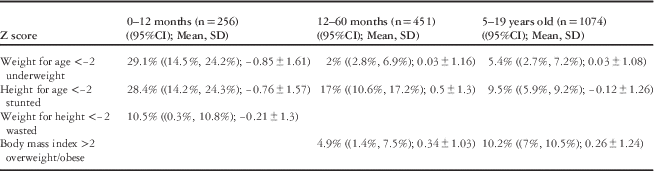
During the study period, a total of 1781 children’s anthropometrical measures were recorded (Table 1). The mean prevalence of stunting in the cohort was 18.5%, with children <12 months of age having the highest prevalence at 28.4%. In older children, fewer were stunted, and the number of overweight/obese children was in line with the national average at 10.2% (5- to 19-year olds).
Anthropometry recorded at a regional paediatric cardiology clinic.

During a similar time period (n=169), children <60 months of age underwent cardiac surgery. Children (n=132) who were underweight for age (<−2 z-scores) at the time of surgery had a significantly longer postoperative length of stay (22.3 days±3.7 SEM) of 9 days (p=0.0056) compared with those of normal weight (13.3 days±1.4 SEM). Children with normal weight had more complex surgery (RACHS-1 score 3.01±1.63 SEM) (p<0.0001) compared with underweight children (RACHS-1 score 1.8±0.08 SEM). In the underweight group, there were significant correlations with length of stay after surgery and total length of stay (n=64; r=0.971, p<0.0001) as well as total length of stay in children of normal weight (n=132; r=0.551, p<0.0001); however, there was no relationship in the underweight group RACHS versus RACHS normal (n=64; r=−0.008, p=0.947). To explore the strength of these relationships further, logistic regression was performed using variables of interest; however, no significant relationships were found.
Discussion
Children with CHD are reported to experience growth failure, which is multifactoral,Reference Medoff-Cooper and Ravishankar 5 , Reference Nicholson, Clabby, Kanter and Mahle 10 and attaining normal growth in children with CHD is immensely challenging. In this regional cohort of children with CHD, the prevalence of stunting was higher than that expected, although there is a paucity regarding the reported prevalence of stunting among United Kingdom Paediatric Cardiology centres, making it difficult to contextualise our findings; however, another cohort study reported a similar prevalence of stunting amongst children with CHD of 28.8% (n=73, 3- to 192-month olds).Reference Costello, Gellatly, Daniel, Justo and Weir 11
Toole et alReference Toole, Toole, Kyle, Cabrera, Orellana and Coss-Bu 8 have previously reported that length of hospital stay was significantly greater in children who were malnourished. Low weight for age at the time of surgery is also associated with increased risk of late mortality at 12 months of age.Reference Mitting, Marino, Macrae, Shastri, Meyer and Pathan 7 We found an association between low weight for age at the time of surgery and significantly longer duration of postoperative hospital stay, which appeared to be independent of the surgical risk. Although when we explored the strength of these relationships further, no statistical significance could be found, which may be due to the small sample size.
Although there is a considerable body of evidence acknowledging that poor growth is common in children with CHD, there is a paucity of information on the ideal way in which to promote catch-up growth, particularly length.
Conclusion
Children with CHD are at significant risk of growth faltering, which negatively impact on postoperative outcomes and neurodevelopment. We have shown a high level of stunting amongst a regional cohort of children attending cardiology service. In order to improve service provision to this vulnerable population group, we aim to investigate the feasibility of implementing home monitoring including a nutrition-care pathway for children with CHD using growth bundles to better promote weight and length gain.
Acknowledgements
The authors thank Mrs Anita Emm, Specialist Paediatric Cardiac Dietitian, Caroline Boyles, and Bradley Yee for their assistance in data collection. Authors’ contribution: L.V.M. drafted the manuscript. L.V.M. and A.M. edited the manuscript. A.M. approved the final version of the manuscript.
Financial Support
This work was supported by an Educational Grant from Health Education Wessex.
Conflicts of Interest
L.V.M. and A.M. have no conflicts of interest.
Ethical Standards
The authors assert that all the procedures contributing to this work comply with the ethical standards of the relevant national guidelines on human experimentation to measure height and weight and with the Helsinki Declaration of 1975, as revised in 2008. As this study was a clinical audit, the local University Hospital Southampton Foundation Trust waived the need for ethical approval.