Institutional diagnostics of complex performance
From the point of view of institutional arrangements, the case of international environmental cooperation in northwest Russia is interesting. It has resulted in a complex structure of interaction between politicians, funding agencies, non-governmental organisations, and various levels of regional and national administration since the early 1990s. Cooperation in northwest Russia takes place in the form of hundreds of projects with international funding arrangements. Assessing the effectiveness of international environmental cooperation is a general challenge both theoretically and methodologically. Kütting (Reference Kütting2000), for example, points out that the larger processes that lead to international environmental cooperation ‘quite possibly also led to changes on other levels, and therefore change cannot be attributed to the institution/agreement alone.’ Another complexity is that it might be impossible to isolate analytically the effects of international cooperation ‘from the larger consciousness developed in general’ (Kütting Reference Kütting2000).
In the IDGEC approach, the analysis of institutional performance is divided into ‘simple’ and ‘complex’ performance. Simple performance focuses on an institution's own activities, on its direct and causal consequences, with an emphasis on positive effects in solving identifiable environmental problems (Young Reference Young2002: 14–15). Complex performance, on the other hand, includes in the analysis of performance a range of broader outcomes that ‘occur outside the initial behavioural complex, involve longer causal chains, and encompass negative as well as positive impacts’ (Young Reference Young2002: 15). Complex performance extends the analysis from individual environmental problems to larger issues of sustainability, fairness, efficiency, and robustness. The performance of international environmental cooperation may be assessed by analysing the institutional contributions in order to rearrange human-environment interactions, or sustainability. Efficiency is a measure of the extent to which the goals of international environmental cooperation, for example, sustainability, are achieved with a minimum expenditure of resources. Fairness refers to the extent to which the outcomes of international environmental cooperation conform to the standards of distribution. Finally, institutional robustness means the extent to which institutions themselves are durable or stable over time. (Young Reference Young2002: 15–16.)
In addition to these four dimensions of the IDGEC approach, capacity-building is an important aspect in the evaluation of complex performance. States and regions vary in their capacity to act on environmental issues (Weidner and Jänicke Reference Weidner and Jänicke2003). Capacity-building comprises human, scientific, technological, organisational, structural, and resource capabilities. It is described as a ‘necessary condition for the effectiveness’ of international environmental institutions (Keohane and others Reference Keohane, Haas, Levy, Haas, Keohane and Levy1993: 415). Without capacity-building, international environmental cooperation may become ‘a mere set of good intentions without the ability to meet international commitments and to comply with international norms and principles’ (Vandeveer and Dabelko Reference Vandeveer and Dabelko2001: 18). However, in the study of institutional arrangements the approach to capacity-building seems quite formal because it focuses on questions such as: ‘what laws are passed, what new policies are adopted, what the extent of their enforcement is, and how much money has been invested?’ (Levy and others Reference Levy, Keohane, Haas, Haas, Keohane and Levy1993: 16). In this article the approach to capacity is not limited to organisational and material capacity; it also encompasses human and institutional resources.
Capacity-building in international environmental cooperation challenges the established boundaries of international and domestic institutional arrangements. Capacity plays an important role in the everyday management of international environmental projects, but the development of national capacity in general also creates a context for the success or failure of international cooperation in terms of the availability of domestic funding arrangements, administrative and legal rules for international cooperation, and national commitment to the goals of international environmental cooperation. However, the interaction between domestic and international institutional arrangements is not really considered in the IDGEC approach, although the capacity of domestic institutions to comply with and implement international commitments is an important element of the performance of international cooperation. According to the IDGEC approach, the density of institutions operating simultaneously within a given social space is a relevant area of study. Institutional arrangements can work at various levels, but the arrangements and performance are linked together through various types of interdependencies (Young Reference Young2002: 8–9).
The IDGEC method of studying institutional arrangements and their effectiveness is divided into ‘simple’ and ‘complex’ diagnostics. Simple diagnostics involves an analysis of the conditions associated with a specific environmental problem, with the objective of determining their individual design implications and possibly formulating recommendations concerning the institutional design (Young Reference Young2002: 176). The assessment of complex performance involves a whole range of issues that are broader and more difficult to deal with in terms of empirical analysis. Despite the problems and shortcomings of evaluating ‘complex’ performance with ‘complex’ diagnostics, an attempt is made to do so. Instead of concentrating on a particular institutional arrangement, the focus is on the structure formed by individual arrangements in northwest Russia and the main features of institutional design. The aim is also to analyse the overall effects of the cooperation, including its intended, wanted, and expected outcomes as well as its unintended, unwanted, and unexpected consequences (see Darst Reference Darst2001: 46–51). The aim is to describe and understand the institutional complexities of international environmental cooperation. The effort produces insight into the strengths and weaknesses of the institutional design by focusing on the sustainability, capacity-building, efficiency, fairness, and robustness of international environmental cooperation in northwest Russia.
An agent-based methodology to study institutional complexity
Franke and Roos (Reference Franke and Roos2005) suggest studying various ‘collective structures’ of acting instead of approaching various institutional arrangements as actors themselves. Differentiation of institutionalisation in international relations, including movements, organisations and social practices, produces different kinds of collective structures of acting. Human beings are situated within specific structures of collective acting as holders of structural positions. However, due to their agency, which is both enabled and constrained by these structures of acting, human beings, the actors, themselves, are capable of changing these structures.
The structures of international environmental cooperation are complex in northwest Russia because it includes national and multilateral institutional frameworks. The neighbouring countries started bilateral cooperation with the Russian Federation, especially in northwest Russia, in the early 1990s. In this study, the focus is on the cooperation between the EU, Nordic countries, and Russia in the Arctic and in the Russian part of the Barents region. Most of the cooperation is implemented by international projects in various fields of environmental management and sustainable development, such as environmental education, institution-building, technological modernisation, and support to civil society in northwest Russia. The participants in the international cooperation include representatives of central, regional, and local administrations; companies; research and educational institutes; and non-governmental organisations (NGOs).
The EU signed the Cooperation and Partnership Agreement (PCA) with the Russian Federation in 1997. The main instrument of EU cooperation in northwest Russia is the TACIS programme. Among the various EU funding arrangements is the Northern Dimension Environmental Partnership for the European Union (NDEP), established in 2001. Its main purpose is to support investments related to environmental protection and nuclear safety in northwest Russia. The environmental projects of the NDEP aim to tackle problems dealing with energy use, waste water processing, heating systems, and municipal environmental services in different locations in the region in question (NDEP 2004).
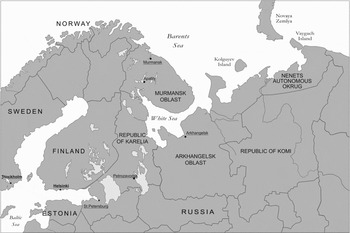
Northwest Russia. Copyright: University of Rovaniemi Arctic Centre information service.

In addition, there are special political bodies for coordinating national and international activities. The Arctic Council aims at political and strategic work while Barents Euro-Arctic (BEAR) cooperation aims at more concrete projects to advance sustainable development in the Barents region. The Arctic Environmental Protection Strategy (AEPS) was established in 1991 by the eight ‘Arctic’ states, that is the Nordic countries, Canada, the Soviet Union, and the USA to protect the fragile Arctic environment especially from pollution. The Arctic Council was established in 1996 and the AEPS activities were incorporated under it. The Arctic Council does not make any funding arrangements: its individual projects are funded by various national and international sources. The work in the projects of the Arctic Council is very much based on the individual countries interests in particular topics and their willingness to fund projects related to them. Since 1993, BEAR cooperation has focussed on northwest Russia and its various problems, and not only on environmental concerns in the region. In 2004, the Nordic countries established the Barents Hot Spot Facility to support financially projects related to the environment. NEFCO, the Nordic Environment Funding Company, manages these funds.
A typical feature of high-level cooperation is that NGOs, have a very limited role. This is the case especially in the BEAR and EU cooperation. They are partners mainly in practical implementation. The BEAR cooperation takes place in working groups at ministerial and regional levels between the Nordic countries, the European Commission, and the Russian Federation. In the NDEP, collaboration takes place between international funding agencies, such as the European Bank for Reconstruction and Development (EBRD), the European Investment Bank (EIB), the Nordic Investment Bank (NIB), the World Bank, and Russian authorities. Some environmental organizations, especially Norwegian and Finnish environmental NGOs, have collaborated in northwest Russia with local Russian environmental NGOs in concrete projects. The work of international NGOs in the Russian Federation has been constrained in 2006 by means of a new law controlling the international activities of NGOs in Russia.
In this article, an agent-based approach has been chosen to analyse the complexity of institutional arrangements and their performance. The focus is on the various participants’ own interpretations of the complexities of international environmental cooperation and on the participants’ rationalisations of their own and other parties’ actions. According to Giddens (Reference Giddens1984: 56–57), most of the human activities are conducted habitually, but in moments of change and crisis, agents are capable of reflecting consciously and discursively on their behaviour and the choices they have made. This study was conducted at a time of such reflection on both sides due to the changing political and economic context of international environmental cooperation in northwest Russia. Especially of importance is that the continuation of EU-Russia cooperation is under review. The assumption in this study is that the cooperating parties are able to analyse and reflect upon social institutions, social structures, the rules of these institutions and structures, and the resources established in the cooperation (see Bagguley Reference Bagguley2003).
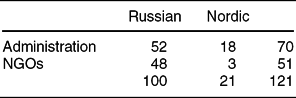
Instead of analysing western and Russian environmental discourses (see Hønneland Reference Hønneland2003), the interview method seemed appropriate for capturing agents’ views and experiences about international cooperation in northwest Russia. The article is based on interviews conducted from among Russian and Nordic cooperating parties. The interviewees were chosen based on their participation in the working group and project activities of different forums of cooperation as representatives of regional or federal administration or as representatives of environmental and other NGOs (Table 1).
Russian and Nordic interviewees
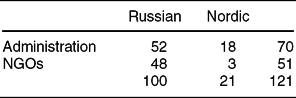
The interviews (100 in number) were conducted in Apatity, Arkhangelsk, Moscow, Murmansk, Petrozavodsk, and St. Petersburg (Fig. 1) during the winter of 2003–2004 and again in 2006. Most of the Nordic interviews (18 in number) were made in Helsinki, Kirkenes, Oslo, Rovaniemi, and Stockholm in the spring of 2004, but some follow-up interviews (3 in number) were made in Helsinki in 2006. The interviewees were selected using publicly available lists of national contact persons and members of working groups. The persons interviewed were promised anonymity. A set of questions was presented to them about their experiences of cooperation in general, the different participants’ roles in it, the successes and failures of the cooperation, and the reasons for the successes and failures. They were also asked to give concrete examples of projects they felt were either successful or less successful and to assess the relevance of international cooperation to sustainable development and its progress.
In addition, a questionnaire was sent in the autumn of 2004 and again in the autumn of 2006 to project managers working in northwest Russia in order to collect their experiences of international environmental cooperation in the region. Seventy-five of them, mainly Nordic project managers, responded to the questionnaire. These project managers have practical experience on planning and implementing international environmental projects in northwest Russia. They have very different backgrounds: they come from different companies, educational and research institutes, and NGOs. They were asked to evaluate the relevance of sustainable development projects and the positive and negative impacts of cooperation. They were also asked to define their relations with their partners and to assess the future of the cooperation.
Dimensions of performance
Sustainability
International environmental cooperation aims at advancing sustainable development. The legitimacy of this aim depends on the process of its emergence and on its development in international environmental cooperation (Florini Reference Florini1996; Finnemore Reference Finnemore1996). Hurd (Reference Hurd1999: 381) defines legitimacy as ‘the normative belief by an actor that a rule or institution ought to be obeyed.’ Hurd continues that this belief is defined by the actor's perception of the institution. In the case of cooperation under the auspices of the Arctic Council, the norm of sustainable development has competed with other norms of cooperation and still continues to have a contested position in the cooperation. However, it seems that it has gained a legitimate position among the Russian participants, especially the definition of sustainable development which emphasises economic sustainability during the Russian chairmanship period (2004–2006). In the case of the BEAR cooperation, the norm of sustainable development was taken for granted at the beginning, but it has become somewhat problematic after being challenged by the Russian participants, who often prefer economic cooperation to environmental cooperation. In the case of the NDEP, Russian resistance to the norm has been vocal. According to the Russian interviewees, ‘concern for the environment gets too much attention at the expense of other important issues, such as economic development and growth.’ One of the Russian interviewees stated: ‘First western interests, and then ours, our time will come.’
The adoption of sustainable development in domestic politics depends on the salience of the issues, the domestic normative structure, and the domestic power structure (Checkel Reference Checkel1999; Cortell and Davis Reference Cortell and Davis1996). At the moment, sustainable development seems to fit poorly into the domestic structure of norms and power in the Russian Federation. Many have suggested that the Russian idea of sustainable development is yet to be developed. Sustainable development is interpreted by the Russian interviewees as ‘a need to separate national economic interests and the economic interests of big companies, a problem of incomplete and imperfect legislation, a problem of low level of public participation, or a lack of knowledge on the state of the environment and priorities to solve the problems.’ These approaches to sustainable development indicate its emergence in the Russian domestic debate, but it is still in a phase of ‘cascading’, that is, various interpretations of it exist among the domestic actors. Clearly, international cooperation has not been successful in introducing the idea within the Russian domestic debate nor have the actors been eager to adopt and apply such a concept. The Russian interviewees very often used words such as ‘ecological safety’ or ‘ecological security’ instead of sustainable development. In some cases, sustainable development is understood by the Russian interviewees only as economic growth and improvement of social well-being without any environmental considerations.
Capacity building
In his study on East-West environmental cooperation, Darst (2001: 206–207) suggests that economic, political, and administrative capacities do play an important role in practical international cooperation. In terms of capacity for international cooperation, there are problems on both sides. According to Russian as well as Nordic interviewees, the Russians are ‘not so good at project work.’ They are ‘good at talking about projects but worse at implementing them.’ Commitment on both sides was identified as crucial for the success of projects. ‘A project needs to have an owner who wants to manage and implement it.’ This problem is encountered in interaction between different regions, many projects, and individuals at different levels.
A Nordic interviewee pointed out that compared to the current situation, the Russian participants could get more out of the cooperation but they have to do their homework to accomplish it. The Russian interviewees recognise this as well. A new generation of Russians better skilled in international and effective project work is emerging. Funding, as such, was not the critical factor in assessing the conditions for success or failure in international environmental cooperation. Instead, the ‘human factor’ was considered critical. The success of a project depends on the project leaders’ capacity to deal with administrative difficulties, cultural differences, and working practices. The preconditions for successful projects include, according to the project managers, ‘having the right people in the right places with good, stable, and trustful relationships; getting political support for the cooperation; making proper funding arrangements; and recognising the partners’ common interests to work together.’
However, the lack of Russian environmental capacity continues to be a problem at the more general level. Since the late 1980s, the environmental administration of the Russian Federation has been in turbulence (Peterson and Bielke Reference Peterson and Bielke2001; Crotty Reference Crotty2003; Blakkisrud and Hønneland Reference Blakkisrud and Hønneland2005; Oldfield Reference Oldfield2005). In addition to this and due to the Russian economic difficulties in the 1990s, very little domestic funding was available for tackling environmental challenges (OECD 1999; Kjeldsen Reference Kjeldsen2000; Wernsted 2002). These developments have made international environmental cooperation difficult with the Russians, as the personnel in charge and the rules of participation change constantly. This is also noted on the Russian side. One of the Russian interviewees described the situation as follows: ‘revolution never ends.’ However, they say that the most difficult years are now over.
Fairness
In international environmental cooperation, some of the problems can be ‘benign’; the problem itself is defined jointly and shared, and the solution might simply be better to coordinate the measures of the actors. However, some problems might be ‘malign’: there is no consensus about the essence of the problem and the participants have differing views about their roles and appropriate actions (Skjaerseth and Wettestad Reference Skjaerseth and Wettestad2002: 109–111). In the case of northwest Russia, the problem structure is closer to malign than benign. The problem structure itself is not based on fairness. The Nordic interviewees stress that the aim of international environmental cooperation in the region is not really to tackle ‘transboundary’ environmental problems but to assist Russia to deal with its domestic environmental problems. ‘In the end’, some of the Nordic interviewees pointed out, ‘the Russians have to solve their problems themselves.’ Some of the Russian interviewees stress that ‘only the Russians can solve their own problems.’ Only few Russian interviewees pointed out that the environmental problems in the region were really not merely ‘Russian’, but instead ‘common’ due to the era of Cold War hostility and competition. Some of the western partners were also accused of being hypocritical – expressing concern for the state of the Russian environment ‘just because the environment in western countries has already been destroyed.’
Fairness also concerns distribution. The principle of fairness requires contributions in return for benefits, but that rarely takes place in international environmental cooperation. While calculating their own self-interests, the participants in international environmental cooperation will not necessarily follow up their responsibilities to provide benefits to others in exchange for those they receive (Linklater Reference Linklater2000: 782). The need for any kind of funding during the hard economic years of the late 1990s explains the willingness of the Russians to cooperate with western partners and on western conditions. The unfairness of the situation leads to unsuccessful cooperation. According to the interviewees, ‘a failure in international environmental cooperation can be expected when the Russian participants perceive that the cooperation arrangements are unequal.’ Both the Nordic and Russian interviewees considered the current international environmental assistance a problem in northwest Russia, leading to an unequal use of expertise and experts in international environmental cooperation. The Russians maintain that western consultants, project planning meetings, and reports dominate international environmental cooperation. In their view, more Russian expertise and experts should be used in the cooperation.
Efficiency
The question of efficiency concerns rational use of resources to fulfil the aims of international environmental cooperation. However, scholars disagree concerning whether it is possible to exclude environmental efficiency and analyse only the institutional efficiency of institutional arrangements (see, for example, Keohane and others Reference Keohane, Haas, Levy, Haas, Keohane and Levy1993). However, some researchers point out that it is not enough that the participants only fulfil the commitments they have made in international environmental regimes: the commitments themselves also have to make sense in terms of the state of the environment (Bernauer Reference Bernauer1995; Cioppa and Bryuninckx Reference Cioppa and Bryuninckx2000; Kütting Reference Kütting2000).
The interviewees evaluated the cooperation as institutionally effective with modest environmental effects. The Russian interviewees regarded many of the EU TACIS projects on international environmental cooperation as ‘just paper.’ The interviewees report that at the beginning, the Nordic countries were sceptical about international environmental cooperation in northwest Russia. There were ‘no high hopes for quick results.’ According to the Russian interviewees, international environmental cooperation in northwest Russia has developed ‘from an era of romanticism to a more realistic approach to international environmental cooperation.’ As a whole, the Nordic interviewees regard northwest Russia as ‘not an easy place for cooperation.’ They mentioned many reasons for the difficulties: a lack of environmental awareness, the weakness of environmental administration, and continuous changes in the political, economic and legal contexts for international environmental cooperation in the region. The interviews and surveys of the study also revealed the problem of corruption as a minor issue.
The interviews and the questionnaire responses result in two totally different views about the environmental importance of international environmental cooperation in northwest Russia. In general, the project managers evaluated the cooperation as environmentally effective. One possible explanation for this is that they have been involved with practical projects longer and know the processes better than the interviewees. The international environmental projects in northwest Russia advance sustainable development in various ways according to their view. The projects have a positive effect because they enable the exchange of ideas and experiences. They also enable networking and increase the amount of knowledge and information. The projects also improve the state of the environment and advance environmental awareness. In most cases the projects have a concrete effect on the environment, and the extent of the effect has been as expected. According to the majority of the respondents, the benefits of the projects are also evenly distributed among the western and Russian partners. However, the project managers also reported some negative effects of international environmental cooperation, related to social justice and to the exchange of ideas and experiences. In addition, there were negative effects concerning the general state of knowledge, information, skills, and communication. Project managers reported about occasional disagreements between partners in terms of sharing information, ownership of knowledge in projects and compensation for using it as well as problems in inter-cultural communication.
Robustness
Robustness refers to the maintenance of some desired institutional characteristics despite internal and external fluctuations (Carlson and Doyle Reference Carlson and Doyle2002). Both the Nordic and Russian interviewees value the efforts in the last decade to build multilateral structures and networks for international cooperation. The interviewees stressed that the different multilateral platforms developed since the early 1990s have their own functions and roles, although some of the interviewees thought that the roles overlap and that the various activities need to be rationalised. One Nordic interviewee pointed out that the work to strengthen these structures and their effective use should continue, and nothing should be done to weaken this. For example, better cooperation between decision-makers and funding agencies is needed in the region.
Robust institutions persist, are adaptable, and can withstand the test of time (Jen Reference Jen2003). The existing structures and forms of cooperation are reassessed because the political and economic contexts of international environmental cooperation are changing in northwest Russia. Many of the Nordic interviewees expect that the period of international environmental assistance to the region has come to an end in its current form. Due to the rapid development of the Russian economy there should be more Russian intellectual and material resources available to take care of domestic environmental concerns. New ways of organising international environmental cooperation and its funding between the partners are also needed. One of the Russian interviewees pointed out that ‘the time for consulting is over.’
Most of the Nordic interviewees were committed to continue the cooperation. They expect that all these efforts will bear fruit when the political and economic situation in the Russian Federation improves. ‘There are more opportunities for cooperation than threats to it.’ However, the time perspective for these expectations to become reality is long. One of the interviewees noted: ‘cooperation with the Russian Federation takes time.’ The Nordic partners need to be patient with the Russian Federation and its developments. Long-term benefits from the international environmental cooperation can be expected ‘within ten to twenty years.’ On the Russian side, a widely-shared expectation among the interviewees was that international environmental cooperation between the western and Russian partners will continue into the future. In most cases, the Russian interviewees expected that the cooperation would remain at least at the same level as before or develop even further.
Overall assessment of institutional performance
The performance of international environmental cooperation in northwest Russia was, for many of the interviewees, difficult to evaluate because of its complexity. For example, for the Russian interviewees, it was occasionally difficult to separate between various bodies, programmes and projects and their performance. In the analysis of the performance of institutional arrangements for international environmental cooperation, five aspects were identified as important: sustainability, capacity building, fairness, efficiency, and robustness. The interviewees had differing opinions on the legitimacy of sustainability as a norm in Russian cooperation, especially in terms of finding a balance between economic and environmental sustainability. The project managers recognise in practical project work that there are differences in environmental thinking between the Nordic and Russian participants, which makes cooperation sometimes difficult. However, they also see that international environmental projects advance sustainable development ‘step by step’.
The capacities of the participants play a critical role in making sustainable development a reality. The cooperation is inflicted with administrative, political, and economic difficulties on both sides, which makes projects less successful. Some of these difficulties relate to the personal capacities, such as linguistic and cultural skills, of the project managers and other project members. The human factor is identified as the most important part of successful cooperation. The projects advance the environmental capacities of the participants in different ways. According to the interviews and the questionnaire, the most important facet of cooperation is the exchange of ideas, knowledge, and experiences. Funding, although important, is not considered the main factor when defining the success or failure of international environmental projects.
In terms of fairness, international environmental cooperation does not appear very successful, at least not according to the assessment of the interviewees. In their opinion, the cooperation is unfair in many respects. The interviewees do not share an understanding of the problems nor do they value the contributions of the other side in the projects. However, the project managers give a much more positive assessment of the partnership between Nordic and Russian participants. They consider the relationship more equal, reciprocal, and trustworthy than the interviewees. One possible explanation to this is their long, hands-on experience in international environmental cooperation.
In terms of efficiency, the Nordic side had no high hopes for success to begin with. But still, most of the Nordic interviewees hope for better results in the future. Such positive development may be expected in the future. At the moment, it seems that the interviewees value the general, political benefits of international environmental cooperation more than its efficiency in terms of costs and benefits. The views of the interviewees and respondents to the questionnaire also differed in this area. The project managers evaluated the cooperation as efficient both institutionally and environmentally. In their view, international environmental projects are in most cases concrete, practical, and effective.
Analysing the international institutional arrangements and their performance without taking into account domestic developments tells us only half the story. International efforts in environmental capacity-building in northwest Russia have been stalled by Russian environmental politics, which is characterised by inadequate domestic environmental expenditure, constant administrative and legal changes, a lack of opportunities for Russian experts to participate in international environmental cooperation, and a low level of commitment to sustainable development. This is the crosscutting theme of the interviews and questionnaire results in the analysis of the various dimensions of institutional performance. Thus, there is still a need to enhance the Russian environmental by international environmental cooperation.
Acknowledgements
This research project was supported by the Academy of Finland (project number 802136). The author is grateful to Svetlana Agarkova, Ludmila Ivanova, Larissa Riabova, Nadezhda Kharlampieva, Ekaterina Tsbetkova, Antonina Kuliasova and Tamara Semenova for their help in organising the interviews and in providing translations. The author is very appreciative of the helpful comments of two anonymous referees.