

%20--%3e%3c!DOCTYPE%20svg%20PUBLIC%20'-//W3C//DTD%20SVG%201.0//EN'%20'http://www.w3.org/TR/2001/REC-SVG-20010904/DTD/svg10.dtd'%3e%3csvg%20version='1.0'%20id='Layer_1'%20xmlns='http://www.w3.org/2000/svg'%20xmlns:xlink='http://www.w3.org/1999/xlink'%20x='0px'%20y='0px'%20width='64px'%20height='64px'%20viewBox='5.5%20-3.5%2064%2064'%20enable-background='new%205.5%20-3.5%2064%2064'%20xml:space='preserve'%3e%3cg%3e%3ccircle%20fill='%23FFFFFF'%20fill-opacity='0'%20cx='37.785'%20cy='28.501'%20r='28.836'/%3e%3cpath%20fill='%23595959'%20d='M37.441-3.5c8.951,0,16.572,3.125,22.857,9.372c3.008,3.009,5.295,6.448,6.857,10.314%20c1.561,3.867,2.344,7.971,2.344,12.314c0,4.381-0.773,8.486-2.314,12.313c-1.543,3.828-3.82,7.21-6.828,10.143%20c-3.123,3.085-6.666,5.448-10.629,7.086c-3.961,1.638-8.057,2.457-12.285,2.457s-8.276-0.808-12.143-2.429%20c-3.866-1.618-7.333-3.961-10.4-7.027c-3.067-3.066-5.4-6.524-7-10.372S5.5,32.767,5.5,28.5c0-4.229,0.809-8.295,2.428-12.2%20c1.619-3.905,3.972-7.4,7.057-10.486C21.08-0.394,28.565-3.5,37.441-3.5z%20M37.557,2.272c-7.314,0-13.467,2.553-18.458,7.657%20c-2.515,2.553-4.448,5.419-5.8,8.6c-1.354,3.181-2.029,6.505-2.029,9.972c0,3.429,0.675,6.734,2.029,9.913%20c1.353,3.183,3.285,6.021,5.8,8.516c2.514,2.496,5.351,4.399,8.515,5.715c3.161,1.314,6.476,1.971,9.943,1.971%20c3.428,0,6.75-0.665,9.973-1.999c3.219-1.335,6.121-3.257,8.713-5.771c4.99-4.876,7.484-10.99,7.484-18.344%20c0-3.543-0.648-6.895-1.943-10.057c-1.293-3.162-3.18-5.98-5.654-8.458C50.984,4.844,44.795,2.272,37.557,2.272z%20M37.156,23.187%20l-4.287,2.229c-0.458-0.951-1.019-1.619-1.685-2c-0.667-0.38-1.286-0.571-1.858-0.571c-2.856,0-4.286,1.885-4.286,5.657%20c0,1.714,0.362,3.084,1.085,4.113c0.724,1.029,1.791,1.544,3.201,1.544c1.867,0,3.181-0.915,3.944-2.743l3.942,2%20c-0.838,1.563-2,2.791-3.486,3.686c-1.484,0.896-3.123,1.343-4.914,1.343c-2.857,0-5.163-0.875-6.915-2.629%20c-1.752-1.752-2.628-4.19-2.628-7.313c0-3.048,0.886-5.466,2.657-7.257c1.771-1.79,4.009-2.686,6.715-2.686%20C32.604,18.558,35.441,20.101,37.156,23.187z%20M55.613,23.187l-4.229,2.229c-0.457-0.951-1.02-1.619-1.686-2%20c-0.668-0.38-1.307-0.571-1.914-0.571c-2.857,0-4.287,1.885-4.287,5.657c0,1.714,0.363,3.084,1.086,4.113%20c0.723,1.029,1.789,1.544,3.201,1.544c1.865,0,3.18-0.915,3.941-2.743l4,2c-0.875,1.563-2.057,2.791-3.541,3.686%20c-1.486,0.896-3.105,1.343-4.857,1.343c-2.896,0-5.209-0.875-6.941-2.629c-1.736-1.752-2.602-4.19-2.602-7.313%20c0-3.048,0.885-5.466,2.658-7.257c1.77-1.79,4.008-2.686,6.713-2.686C51.117,18.558,53.938,20.101,55.613,23.187z'/%3e%3c/g%3e%3c/svg%3e)
%20--%3e%3c!DOCTYPE%20svg%20PUBLIC%20'-//W3C//DTD%20SVG%201.0//EN'%20'http://www.w3.org/TR/2001/REC-SVG-20010904/DTD/svg10.dtd'%3e%3csvg%20version='1.0'%20id='Layer_1'%20xmlns='http://www.w3.org/2000/svg'%20xmlns:xlink='http://www.w3.org/1999/xlink'%20x='0px'%20y='0px'%20width='64px'%20height='64px'%20viewBox='5.5%20-3.5%2064%2064'%20enable-background='new%205.5%20-3.5%2064%2064'%20xml:space='preserve'%3e%3cg%3e%3ccircle%20fill='%23FFFFFF'%20fill-opacity='0'%20cx='37.637'%20cy='28.806'%20r='28.276'/%3e%3cg%3e%3cpath%20fill='%23595959'%20d='M37.443-3.5c8.988,0,16.57,3.085,22.742,9.257C66.393,11.967,69.5,19.548,69.5,28.5c0,8.991-3.049,16.476-9.145,22.456%20C53.879,57.319,46.242,60.5,37.443,60.5c-8.649,0-16.153-3.144-22.514-9.43C8.644,44.784,5.5,37.262,5.5,28.5%20c0-8.761,3.144-16.342,9.429-22.742C21.101-0.415,28.604-3.5,37.443-3.5z%20M37.557,2.272c-7.276,0-13.428,2.553-18.457,7.657%20c-5.22,5.334-7.829,11.525-7.829,18.572c0,7.086,2.59,13.22,7.77,18.398c5.181,5.182,11.352,7.771,18.514,7.771%20c7.123,0,13.334-2.607,18.629-7.828c5.029-4.838,7.543-10.952,7.543-18.343c0-7.276-2.553-13.465-7.656-18.571%20C50.967,4.824,44.795,2.272,37.557,2.272z%20M46.129,20.557v13.085h-3.656v15.542h-9.944V33.643h-3.656V20.557%20c0-0.572,0.2-1.057,0.599-1.457c0.401-0.399,0.887-0.6,1.457-0.6h13.144c0.533,0,1.01,0.2,1.428,0.6%20C45.918,19.5,46.129,19.986,46.129,20.557z%20M33.042,12.329c0-3.008,1.485-4.514,4.458-4.514s4.457,1.504,4.457,4.514%20c0,2.971-1.486,4.457-4.457,4.457S33.042,15.3,33.042,12.329z'/%3e%3c/g%3e%3c/g%3e%3c/svg%3e)
%20--%3e%3c!DOCTYPE%20svg%20PUBLIC%20'-//W3C//DTD%20SVG%201.0//EN'%20'http://www.w3.org/TR/2001/REC-SVG-20010904/DTD/svg10.dtd'%3e%3csvg%20version='1.0'%20id='Layer_1'%20xmlns='http://www.w3.org/2000/svg'%20xmlns:xlink='http://www.w3.org/1999/xlink'%20x='0px'%20y='0px'%20width='64px'%20height='64px'%20viewBox='5.5%20-3.5%2064%2064'%20enable-background='new%205.5%20-3.5%2064%2064'%20xml:space='preserve'%3e%3cg%3e%3ccircle%20fill='%23FFFFFF'%20fill-opacity='0'%20cx='36.924'%20cy='28.403'%20r='28.895'/%3e%3cpath%20fill='%23595959'%20d='M37.442-3.5c8.99,0,16.571,3.085,22.743,9.256C66.393,11.928,69.5,19.509,69.5,28.5c0,8.992-3.048,16.476-9.145,22.458%20C53.88,57.32,46.241,60.5,37.442,60.5c-8.686,0-16.19-3.162-22.513-9.485C8.644,44.728,5.5,37.225,5.5,28.5%20c0-8.762,3.144-16.343,9.429-22.743C21.1-0.414,28.604-3.5,37.442-3.5z%20M12.7,19.872c-0.952,2.628-1.429,5.505-1.429,8.629%20c0,7.086,2.59,13.22,7.77,18.4c5.219,5.144,11.391,7.715,18.514,7.715c7.201,0,13.409-2.608,18.63-7.829%20c1.867-1.79,3.332-3.657,4.398-5.602l-12.056-5.371c-0.421,2.02-1.439,3.667-3.057,4.942c-1.622,1.276-3.535,2.011-5.744,2.2%20v4.915h-3.714v-4.915c-3.543-0.036-6.782-1.312-9.714-3.827l4.4-4.457c2.094,1.942,4.476,2.913,7.143,2.913%20c1.104,0,2.048-0.246,2.83-0.743c0.78-0.494,1.172-1.312,1.172-2.457c0-0.801-0.287-1.448-0.858-1.943l-3.085-1.315l-3.771-1.715%20l-5.086-2.229L12.7,19.872z%20M37.557,2.214c-7.276,0-13.428,2.571-18.457,7.714c-1.258,1.258-2.439,2.686-3.543,4.287L27.786,19.7%20c0.533-1.676,1.542-3.019,3.029-4.028c1.484-1.009,3.218-1.571,5.2-1.686V9.071h3.715v4.915c2.934,0.153,5.6,1.143,8,2.971%20l-4.172,4.286c-1.793-1.257-3.619-1.885-5.486-1.885c-0.991,0-1.876,0.191-2.656,0.571c-0.781,0.381-1.172,1.029-1.172,1.943%20c0,0.267,0.095,0.533,0.285,0.8l4.057,1.83l2.8,1.257l5.144,2.285l16.397,7.314c0.535-2.248,0.801-4.533,0.801-6.857%20c0-7.353-2.552-13.543-7.656-18.573C51.005,4.785,44.831,2.214,37.557,2.214z'/%3e%3c/g%3e%3c/svg%3e)
The schism of German Social Democracy and the emergence of two rival socialist parties in 1917 was a world-historical event. It set the stage for the violence between former comrades that marked the postwar revolution and it contributed to the divided response of the German left to the forces of reaction at key junctures leading up the National Socialist seizure of power. Internationally, the fracturing of the once preeminent socialist party of Europe enabled greater Bolshevik influence over other socialist parties, a circumstance whose effects were felt until 1989/91. Given these weighty consequences, scholarly debates over the positions taken by German socialists during war and revolution have been highly charged. To a significant extent they have followed and been shaped by the arguments made at the time by the intellectuals and leaders of the competing parties. For revolutionary socialists, the formation of an Independent Social Democratic Party (USPD) in 1917 became necessary after reformist forces had undermined the party commitment to class struggle. Those who remained in the Majority Social Democratic Party (MSPD) argued that radicals were trying to hold Social Democracy back from becoming a mass party capable of entering government, and that the radicals preferred instead to live as a sect which warmed itself on the myth of a coming revolution. After the Second World War, the official line of the East German historical establishment was that the decision of the MSPD Chancellor Friedrich Ebert to turn the guns of the military against revolutionaries had been a betrayal of Marxism. Many West German historians, by contrast, saw it as an unfortunate but necessary deed, committed by those who had shouldered “the burden of power” and sacrificed elements of the socialist project in order to secure parliamentary democracy.Footnote 1 In the 1960s and 1970s, a number of West German historians, some with sympathies for the USPD, offered a third interpretation, when they argued that the revolution had been “incomplete” because it failed to rigorously eliminate the vestiges of the old regime, thereby weakening Weimar democracy.Footnote 2
The recent centenary brought renewed scholarly attention to the German revolution, yet most new studies have remained locked in the normative positions of the West German historiographies of the 1970s and 1980s: Was Ebert’s option for parliamentary rule and against revolution a success that led to democracyFootnote 3 or a failure that paved the way for the National Socialist dictatorship?Footnote 4 Some studies have sought to break out of the interpretative fetters of this binary alternative by focusing instead on the roles of gender, violence, transnational flows, or revolutionary narratives.Footnote 5 Yet, the role of religion has been conspicuously absent. Does this simply reflect a lack of historical importance of socialist secularism to the course of events between 1914 and 1922? One could imagine that the religious concerns apparent in Munich and Berlin in 1913 simply gave way to the weightier political concerns produced by the national crisis of war, according to the adage of historian Jacob Burckhardt: “When two crises intersect, the stronger temporarily [momentan] carves its way through the weaker.”Footnote 6 Indeed, in the weeks leading up to the declaration of war on August 4, 1914 the air suddenly went out of the campaigns of the secularists to overturn confessional discrimination in Prussia and Bavaria. In early September 1914, Ethicist Rudolf Penzig asked monist Wilhelm Ostwald to return a manuscript related to their secularist campaigns with the explanation that, even if it escaped military censorship, it was unlikely to find buyers. He intended to lay this text and thus his agitation efforts ad acta: “After all, one must also do something for one’s literary archive!”Footnote 7
Yet, as this chapter will show, the secularist plans did not stay in the desk drawer for long. As Burckhardt noted, the disappearance of the weaker crisis was only momentary. The ideas and politics that had informed the heady church-leaving campaigns in 1913 soon re-emerged and thrust themselves into the new dynamics created by the existential struggles over war and revolution. While liberal secularists brought their interests into multiple camps from the völkisch right to the pacifist left, the dominant direction of socialist secularists led to the USPD, where some assumed key positions. The task of this chapter is to not merely to show how they arrived in such positions, but to investigate to what extent secularism shaped antiwar and revolutionary action and provided a source of utopian political imagination that was translated into programs for a new social order.
Secularists and the Outbreak of War
The advent of war in 1914 did not so much paper over the bitter confessional divisions of Germany, as offer a hope for their resolution. In one of his only successful public speeches, on August 1 Kaiser Wilhelm II appealed directly to this hope:
Should it now come to a battle, then there will be no more political parties. I, too, was attacked by the one or the other party. That was in peace time. I forgive you now from the depths of my heart. I no longer recognize any parties or any confessions; today we are all German brothers and only German brothers.Footnote 8
This so-called fortress peace or Burgfrieden raised hopes for a new and lasting national unity, and a lessening if not an elimination of the confessional conflicts that had divided Germans since the Reformation. Many secularists gripped by the “August experience” understood the Kaiser’s words as an offer to them as well. This encouraged them to join the spiritual mobilization for war. On August 23, Munich’s Freiheitlicher Kulturbund, which only a month before had been attacking the Catholic Church and the Center Party, convened a patriotic commemoration, at which Ernst Horneffer enthused in front of a crowd of 600–700 people that “a rebirth has taken place, people have become transformed, we are witnessing the birth of the inner man. A new book of history is rushing over our heads, the powerful magic of the word ‘united’ has taken us completely captive. For the first time in two thousand years we are united.”Footnote 9
Rather than eliminating secularist demands for state recognition, however, the Burgfrieden merely reframed them. While applauding the end of the Kulturkampf that had raged since roughly 1906, the antagonistic parties, and the secularists among them, almost immediately began to restate their positions and argue them through the logic of the Burgfrieden. In the first weeks of the war, the socialist lawyer Hermann Heimerich petitioned that the recently issued ban on Free Religious teaching in Bavaria be postponed until after the war with “reference to the well-known phrase of the Kaiser that he no longer recognizes parties and confessions, but only Germans.”Footnote 10 The Bavarian Minister of Culture remained unmoved. In Berlin at the same time, Landtag deputy Adolph Hoffmann accused the Spandau State Munitions Plant of violating the Burgfrieden when it told a Free Religious worker that he had been refused work because it “would not tolerate confessionless workers, because people who believe in nothing are capable of anything.”Footnote 11
Many church leaders did not accept the notion that the Burgfrieden gave secularists the right to articulate their creed in public, because they understood secularism as inherently antireligious. In October 1915, the Royal Consistory of the Protestant Church lodged a formal complaint with the Magistrate of Berlin, when it learned that the Berlin Free Religious Congregation had held its semi-annual Jugendweihe in the city hall. According to the conservative press reports, the socialist city councilor who officiated the ceremony, Waldeck Manasse, had called the war a “bloody misunderstanding of world history” and had pointed out that all the belligerent parties “prayed to the same God for victory.”Footnote 12 Because such statements injured the religious feelings of others, the Consistory argued that use of municipal buildings by the Free Religious was not compatible “with the idea of the Burgfrieden, which animates the German people in these difficult days.” In keeping with its own liberal traditions, the Magistrate responded that it could not reject orderly requests for such legitimate spiritual celebrations, precisely in the interest of “maintaining the Burgfrieden.”Footnote 13
Secularist Support for War
Church historians have drawn attention to the theological contributions made by both major churches to the war effort. In their sermons, priests and pastors accepted the just war claims of the government and portrayed the war as a test of faith and of the willingness of believers to sacrifice.Footnote 14 There has been little study of the secularist response to war. Many of the leading lights of the secularist movement, particularly the liberals among them, initially became avid proponents of war. Rather than abandon secularism, most sought to harness their movement and its ideas to the war effort. Echoing their Christian rivals, these secularist ideologues called for the sacrifice of life in the interest of a spiritual nation, which they equated with the term Kultur. monists Haeckel and Ostwald joined with a number of university theologians to sign the “Declaration to the Kulturwelt,” a document circulated worldwide to defend Germany against accusations of barbarism and declare that Germans were fighting as a “Kulturvolk” in the name of Goethe, Beethoven and Kant.Footnote 15 Some prowar secularists shared with Protestants the proclivity for filling the national Kultur entirely with their own worldview, which one now called the “German religion.”Footnote 16 In June 1915, Das Freie Wort, a mouthpiece of liberal secularism, sought to build bridges between secularists and Protestants by proposing that Germans could be united by a new abstract understanding of God that would remain alien to Russians, Jews and Catholics.Footnote 17 The popular preacher in Frankfurt am Main, Wilhelm Klautke, portrayed Free Religion as the only truly German religion in his effort to gain state recognition of his congregation as a legal church. In a 1916 article, he set out to prove that “in its soul, German culture is Free Religious,” because only Germany had produced the succession of spiritual prophets, from Luther, Leibniz, Frederick the Great, Kant, Schiller, to Goethe, who had given the best expression to the ultimate truth of monism. Through them Free Religious culture was penetrating the German people, and now through the war the opportunity had come to spread “our Free Religious-monist-humane culture” throughout world civilization.Footnote 18
Secularist war theology also entailed a new relationship to authority. In 1916 Gustav Tschirn, the joint chairman of the German Freethought League and the League of Free Religious Congregations, circulated “A Freethinker’s Confession,” which wrestled with the tension between anti-authoritarian traditions and new authoritarian desires. It began with the core credo shared by the Free Religious since the 1870s: “Free self-determination in all religious matters in accordance with advancing knowledge,” instead of the “authority of infallible councils, popes or holy scriptures.” But it continued with the oath of a loyal subject: “I bow down in reverence [Ehrfurcht] before the eternal power that – superior to any human-like personality – is uniformly active in all worlds and also penetrates and rules [durchwaltet] me.”Footnote 19
The war also brought some former Protestant ministers, Max Maurenbrecher and Gottfried Traub, away from their involvement in secularism and back into the fold,Footnote 20 where they soon re-emerged as advocates of a völkisch Protestantism.Footnote 21 Maurenbrecher made it clear that his return to the church did not mean that he was dropping his quest for “a freer religion in favor of renewed dogmatic ties.” He had merely recognized that religious renewal could not be achieved “outside of the traditional religious community, which is after all historically intertwined with our national life.”Footnote 22 Although initially accepted by Protestant conservatives with a degree of pleasure, the theological innovations of these former renegades soon raised alarm. In March 1916, General Superintendent Wilhelm Zoellner of Münster noted the alacrity “with which the enthusiastic cosmopolitans had given up the dream of the fraternity of peoples as the not far off stage of evolution … and become unsurpassable in accenting Germanness [Deutschtum].” Rather than abandoning their earlier orientation on the monistic substance of all things, these cultural Protestants “nationalized” it. They, too, began to speak in a völkisch vein of “the German God.”Footnote 23
The language of dread and talk of a “German God” or “German religion” paralleled the reorientation of prowar secularists to state authority. In an address to Kiel monists in 1916, Heinrich Peus, who was the sole prominent SPD politician in the otherwise liberal and “bourgeois” Monist League, approvingly spoke of loyalty towards the king (Fürst) as a civic virtue: “love for the ruler, who stands at the head of the state entity, is already a bit of love of the fatherland, it leads the most apathetic to become a good citizen.” This is a striking reversal for a man who had spent several months in jail for lèse-majesté in 1891. Peus became one of the most nationalistic Social Democrats and embraced the postwar plans of Friedrich Naumann. In 1915, he wrote several articles in Vorwärts supporting the voluntary incorporation of Belgium and other smaller states in a “Central European Empire,” and in 1916, he identified imperialist competition, in which the small states would be eliminated in the interest of economies of scale and colonial expansion, as a means of achieving socialist aims.Footnote 24 In the same year, Ethicist Rudolf Penzig argued that the entire country should rally behind Chancellor Bethmann-Hollweg as the embodiment of the “total interests of the people,” because “the state means nothing other than organized society.” Thus, one could safely resurrect Naumann’s idea of the “social Kaisertum” and put it to use in a “social Kanzlertum.”Footnote 25 Klautke, too, sought to reposition Free Religion as a safe religion firmly in the mainstream of the German nation. He argued that the designation “dissident” was too negative and no longer appropriate given the selfless idealism and high ethical content of the monist Weltanschauung. A new positive designation was needed.Footnote 26
Secularists expected their demonstrations of patriotism to be rewarded by a lifting of discrimination. And with mounting sacrifices and emotional investment in war, they made their demands more fervently. Late in 1916 Peus gave a speech in the Reichstag demanding that dissidents be granted the right to become army officers.Footnote 27 The Ministry of War rejected this petition with an argument that had long been used to exclude Jews and secularists from the officer corps. Affiliation with a recognized religious creed, the Ministry argued, “was of indispensable significance for the educational influence of the officer on the rank and file,” particularly regarding the military oath.Footnote 28 In fact, administration of the oath was often a point at which dissidents were singled out for abuse, such as occurred at the mustering of the young monist Carl von Ossietzky, who went on to become the most famous antifascist journalist of the Weimar Republic. His wife later recounted the scene, which finds analogues in the biographies of other socialists:
First the Catholics had to take the oath on the flag, then the recruits of the Protestant faith. Carl did not step forward with the one or the other. He was a Freethinker. He waited to see what the major would do with him and the other like minded. Then came the command “Freethinkers, atheists, sectarians, godless – step forward!” Carl was the only one who stepped forward. The major regarded him from head to toe with a withering look – how could a recruit not recognize the official churches: “You godless swine, the oath also applies to you!”Footnote 29
Despite continued discrimination, the secularists did not give up seeking recognition, and in May 1918, the Berlin monist Dr. Eckold tried to portray monism as a legitimate religion with a positive creed: “Under religion we understand a reverent awe of a godhead or equivalent power [Machtfaktor],” which in the case of monism was not the Christian God, but “the trinity of ‘ethics,’ morality and reason.” The avant-garde literary journal Die Aktion snidely characterized the logic of this new piety:
Oh please, please, dear state, do us the favor and be so kind as to recognize us as a ‘religious society.’ We promise to always be very good. If we can’t believe in the Christian God, because Haeckel forbids that, then we want to believe in you and always obey your laws. Then you’ll be so kind and allow us to become officers, won’t you?Footnote 30
Pacifism and Secularism
In one of his last “monist Sunday sermons,” given in September 1914, the President of the Monist League, Wilhelm Ostwald, called for a union of European nations under the German Kaiser, and in early 1915 set off for Sweden (with Foreign Office help) to try to win support for a “Europe under German leadership” united against Russian despots.Footnote 31 Although he could have likely counted on the support of prominent figures, such as Haeckel, Penzig, Horneffer and Wille, an increasing number of liberal secularists resisted the war. In December 1914 Ostwald reported to Haeckel that the war was dividing the Monist League, and he proposed keeping the organization inactive to prevent a split. Yet, in May of the following year, he announced his resignation. He publicly cited his health, but in private correspondence noted that a great “chasm” separated him and the organization. He complained to Haeckel that the numerous representatives of “international Jewry” found in the monist ranks were opposed to his patriotic acts.Footnote 32
The Berlin chapter of the DMB was indeed strongly pacifist and in 1915 fell under the leadership of Count Georg von Arco and Kurt von Tepper-Laski, who together with Otto Lehmann-Rußbüldt formed the core of a new antiwar organization Bund Neues Vaterland (BNV) founded in November 1914.Footnote 33 Tensions between pacifist and prowar camps soon divided the monist movement. In February 1916 von Arco forwarded a poem to Ernst Haeckel written by a young monist serving on the front, who depicted a struggle between those who sill honored the “goddess Philosophy” and those who called on Germans to “stay the course [durchhalten]”:Footnote 34
Had this poem been read as intended by its author at the annual meeting of the DMB in Jena in February 1916, its mobilization of anti-Catholic stereotypes to characterize the obedience of the population to state and military authorities during the war would have only antagonized those monists like Haeckel, who backed the war.
Late in 1916, the then eighty-three-year-old Haeckel made an effort to lead the DMB back into the nationalist camp and offered Wilhelm Bölsche the presidency as a replacement for the recently deceased Munich sociologist Franz Müller-Lyer. Bölsche declined this offer over expected opposition from the Berlin chapter, “because for these queer saints I am horribile dictu not enough of a pacifist but rather an imperialist, war celebrant or I don’t know what else!”Footnote 35 Bölsche recommended ignoring the Berlin DMB until after the war, “when in place of these political eccentricities that don’t belong to monism at all, true intellectual motivations will again prevail, even in Berlin.” Yet, this prediction proved false; it was the nationalist monists like himself and Haeckel who effectively abandoned the organizations, never to return. A similar parting of ways took place in the other corners of the secularist movement in 1916.Footnote 36
With their drift towards pacifism, the secularist organizations became subject to increased military censorship. The journal of the Komitee Konfessionslos, Der Weg, was banned from publishing for the duration of the war in January 1915 and the following year the publications of the BNV were subjected to the same fate.Footnote 37 In July 1916, the Ministry of War began to solicit information from regional governments on pacifist activities among monists and freethinkers.Footnote 38 The conservative Christian Reichsbote announced in August 1916 that “the enemies of Christianity are on the move again” and reported statements made by the DMB that it planned to produce new flyers and that those organizations who could not agitate in public, like the Proletarian Freethinkers, would work by “word of mouth.”Footnote 39
Socialist Opposition to the War
A few notable socialist secularists supported the war effort, such as union organizer Ida Altmann and revisionists Heinrich Peus and Henriette Fürth, but most fell into the camp of the opposition that coalesced into the USPD in 1917. The historical literature generally cites the following milestones on the path to the formation of the USPD: opposition to war in the Reichstag, international solidarity efforts between socialist radicals, and acts of resistance to party domination of the press and organizations. If we revisit these milestones, it becomes clear that secularists active in the church-leaving movement played an oversized role. The first socialist Reichstag delegate to break party discipline over the war was the former teacher of the Berlin Free Religious Congregation, Fritz Kunert, who abstained from voting on the first round of war credits on August 4, 1914. That same day Ernst Däumig, future member of the same Free Religious Congregation, was one of the editors of Vorwärts who issued a declaration against the war credits.Footnote 40 The first two deputies to vote against the war credits were freethinker Otto Rühle and anticlerical activist Karl Liebknecht. They formed a revolutionary “International Group,” which transformed first into the Spartacist League and then the Communist Party. A second, larger group stepped into opposition on March 24, 1916, when party co-chair Hugo Haase delivered an antiwar speech in the Reichstag and eighteen delegates voted against the war credits. This group joined together in the Socialist Working Group (Sozialistische Arbeitsgemeinschaft, SAG) and formed the nucleus for the later USPD. The SAG gained control of the Berlin SPD executive, and Adolph Hoffmann was elected its new chairman in 1916. Two of the four signers of a declaration of opposition in 1917 had secularist backgrounds: Ledebour and Vogtherr. Kunert, Hoffmann, Menke and Fricke also became active in the opposition. The SAG differed from the Spartacists in its reluctance to split the party and endanger its organization.Footnote 41 Thus, when Adolph Hoffmann and Georg Ledebour attended the antiwar Zimmerwald conference in Switzerland in December 1915, they joined French comrades in denouncing the Burgfrieden policies of their respective parties, but were unwilling to banish socialists who still supported the war from the International Group, a move demanded by Bolsheviks, such as Vladimir Lenin, and Spartacists, such as Rosa Luxemburg.Footnote 42
If anger at continuing confessional discrimination provided one contributing factor to the oversized role of these prominent red secularists in the formation of the USPD, a second lies in their access to the autonomous secularist organizations at a time in which the majority party suppressed oppositional agitation. The press of the Proletarian Freethinkers provided a site for the expression of alternative viewpoints not allowed in the party press. In August 1914, nationally circulated Der Atheist immediately cast a shadow over the war, lamenting that with it “our Freethought movement, the bourgeois as well as the proletarian, has been almost completely annihilated.” Yet, its position was initially ambivalent. The newspaper reprinted some prowar statements, such as Haeckel’s article “England’s Blood Guilt,” and carried an article by editor-in-chief Konrad Beisswanger justifying the summary execution of a Belgian priest who reportedly directed partisan activity against the German occupiers from his church tower.Footnote 43 However, such articles soon gave way to criticisms of the military. In October 1914, freethinker Arthur Wolf reported that socialists were confronting the question of “Who bore the guilt for the war?” Chauvinists, who “decades ago would have shoved all guilt for our social malaise in the shoes of the Jews, have now found a scapegoat in England.”Footnote 44 Der Atheist reported in December on a debate over the German atrocities in occupied Belgium that had taken place in the Dresden chapter of the Proletarian Freethinkers between Bruno Sommer, the former editor of Lichtstrahlen, and Bernhard Menke, the national chairman of the ZpF and later Saxon party secretary of the USPD. Sommer blamed partisan attacks on the poor popular education that Belgians received from Catholic priests. Menke accused Sommer of false patriotism and concluded that Germany bore the “main guilt” for the war. Those who voted for the war credits had betrayed the people and the International and were therefore “no longer Social Democrats.”Footnote 45
Red secularists could take a lead in the early formation of party opposition because their organizations were semi-immune from party and police control. According to a retrospective account, the opposition forces in Dresden that later formed the local USPD first gathered in the local chapter of the Proletarian Freethinkers, in part because it could mask its activities as cultural. Already in January 1915, the chapter hosted a secret meeting with three dozen selected members, who gathered to hear Otto Rühle describe the heated arguments over the war credits among the socialist Reichstag deputies. So tight was the connection made in Dresden that for police “the word Freethinker was somewhat equivalent with war resister and political criminal.”Footnote 46 Freethinkers and other secularists were also prominent in the development of the party opposition in Berlin, Leipzig and Gelsenkirchen.Footnote 47 Freethinkers were a particular “site of infection” in the party in Frankfurt am Main.Footnote 48 In November 1915, the Frankfurt-based Youth Section of the Proletarian Freethinkers became the coordinating body for the antiwar opposition that had been driven out of the Young Workers (Arbeiterjugend) by central party officers. They transformed the newsletter of Youth Freethinkers into a mouthpiece for their struggle against the dictatorial practices of the party leadership.Footnote 49 The later USPD leader Robert Dißmann founded a chapter of the ZpF in Frankfurt to hide his oppositional activities.Footnote 50
Freethinkers also played a prominent role in the party opposition in Bavaria, where, as the last chapter showed, the SPD had long been dominated by reformists who got along well with their Catholic counterparts. Josef Sontheimer became a key figure in the oppositional circle around the ethical socialist Kurt Eisner, who went on to become the Prime Minister of the Bavarian Socialist Republic in 1918. Both later fell victim to the counterrevolution; Eisner was assassinated in February 1919 and Sontheimer was executed by the Freikorps Oberland less than three months later. In Nuremberg, where all local party bosses stayed loyal to the party mainstream, the outsider Konrad Beisswanger, editor-in-chief of Der Atheist, began to organize the party opposition. Also in the smaller Bavarian town of Kempten, the key figure in the development of the future USPD was the chairman of the local Freethought organization.Footnote 51 Given such incidents, there is little reason to question the retrospective account of a delegate at a ZpF conference in 1919, who recalled “that the proletarian Freethought organizations consistently offered energetic resistance to the war madness.”Footnote 52 On a national level, the three best-known leaders of the ZpF – Menke, Beisswanger and Theodor Fricke – spent time in jail for oppositional activities.Footnote 53
In a period in which the military severely constrained public speech, the partial immunity from prosecution granted to elected officials turned the national and state parliaments into key forums for debating the war effort. On the floor of the Reichstag in October 1916, Otto Rühle rejected Eduard Bernstein’s petition to release Liebknecht from prison, stating that it was only the class struggle of the working class and not parliament that would free Liebknecht. After being called to order by the president of the Reichstag, Rühle stated that he was not addressing members of the house but the millions outside.Footnote 54 Hoffmann also used parliament to criticize the war, but unlike Rühle he did so within the logic of the liberal state. He demanded fulfillment of the equal rights implied in the Burgfrieden, while at the same time arguing that the war itself violated the cultural ideals for which it was supposedly being fought. In both registers, the religious question served him well. In early 1916, for example, Hoffmann was making a principled argument for separation of church and state in the Landtag, when he switched gears and began to pillory church involvement in the war effort by reading from In the name of God – Forward! (Im Namen Gottes – Durch!), a book being sent to soldiers on the front by a military chaplain:
There it states: ‘It is not our fault, if in the bloody work of war, we also have to do the work of the executioner. (Listen to that! among the Social Democrats.) The cold iron has been placed in the hand of the soldier, he should use it without shame, he should run the bayonet between the ribs of the enemy, (Listen to that! among the Social Democrats) he should smash his rifle on their skulls …, that is his holy duty, that is his service to God [Gottesdienst]!’ (Raucous cries of ‘Listen! Listen!’ and ‘Boo’ among the Social Democrats.) You must certainly protest against this! … Is this Christian? Is this religious? (Introjection from right: ‘Yes!’ Dep. Liebknecht ‘you’re still smiling?’- commotion to the right. Dep. Ströbel: ‘You would drive Christ from the Temple!’ Introjection from right: ‘Go to England!’)Footnote 55
Hoffmann cited the opinion of the liberal Protestant theologian Martin Rade that war and true Christianity were mutually exclusive and concluded therefore that “this attitude of the military chaplain is … assuredly a consequence of the financial dependence of the church on the state.” Upon hearing this, deputies from the liberal, conservative and Center parties left the chamber calling out “Outrageous, disgusting, cowardly, scandal.” Hoffmann ended his speech by repeating the slogan that had twice gotten him called to order by the president of the Landtag before 1914: “War is a mockery of God, Christianity, and all human culture!”Footnote 56
Hoffmann’s speech and the reactions of the other deputies to it show how effectively the juxtaposition of the pacifist core of the Christian message and the reality of war could puncture the moral sensibilities of the Burgfrieden. Hoffmann’s speeches were so critical that his fellow socialist deputy Konrad Haenisch stated publicly that he preferred the company of the liberal deputies.Footnote 57 Following Hoffman’s criticism of a fellow socialist deputy on January 19, 1917, the five SPD deputies loyal to the party majority voted to exclude the four SAG members from their parliamentary faction, a step that the Reichstag members had taken three days earlier. The division of the SPD was formalized in April 1917 with the founding of a new party, the USPD. The larger rump party retained control of most of the party apparatus, newspapers and organizations, and became known as the Majority or MSPD.
Observers saw in the split a final division between the two ways of reading the party platform regarding religion as a private matter. In an article “Atheists and Party Opposition,” Der Atheist quoted extensively from the Catholic Center Party’s flagship paper Germania:
All personalities in the Social Democratic Party, who have enthusiastically contributed to Freethought propaganda, church-leaving movement, etc., now stand in the camp of the [SAG], i.e., Adolf Hoffmann, Vogtherr, Ledebour. It thus appears that the spirits of the party can divide on this issue as well: here the neutrals, here the declared atheists and opponents of religion.
Nevertheless, Germania distrusted the apparent neutrality of the Majority Socialists, given their prewar weakness against the church-leaving movement in Berlin. Vorwärts (now in the hands of the MSPD) insisted that the party was neutral on religion. Der Atheist agreed and told Freethinkers to expect no improvement from the Majority socialists, “but we hope that the oppositional direction in the party will take a different stance on this matter and not play hide-and-seek with it, as has been common practice in the party till now.”Footnote 58
If the party split allowed secularists to articulate their viewpoints more clearly in the USPD, some leaders of the MSPD greeted the schism as an opportunity to purge the party of its anticlericalism and seek cooperation with Christian parties. A Catholic Church observer noted with pleasure the anti-Marxist and antisecularist comments made by Wilhelm Kolb, the leader of Badenese Social Democrats, in November 1917.Footnote 59 Kolb castigated socialist radicals, those “epigones of Marx” whose intransigent and dogmatic belief in the theory of revolution had been hindering socialism’s transition “from a political sect to a political party.” It made them blind to the fact that a socialization of the economy was taking place through the very state they opposed. By ending its rejection of the state and voting for the war credits, the SPD had actually moved closer to its goal because now the “state must approach socialism, whether it wants to or not.” It also opened up to the party a new politics of culture. Without compromising on the socialist commitment to separation of church and state, Kolb stated that the party could now recognize the positive contribution of religion and break with that tradition that understood “the pseudo-Enlightenment [Aufkläricht] of Freethought as a quasi-integral part of socialist worldview.”Footnote 60
Debates over Dissident Children
Amidst the rising domestic tensions that led to splits among secularists and socialists in 1916, arguments over the confessional issues shelved at the start of the war now resurfaced. In March 1916, National Liberals in the Prussian Landtag reopened debate on petitions to release dissident children from obligatory religious instruction in state schools. As the bitterest opponent of the deconfessionalization of the schools, the Center Party argued that reopening this question would disturb the Burgfrieden and should thus be postponed until after the war. Left liberal Gottfried Traub responded that the Burgfrieden created precisely the right conditions for solving this problem, and Adolph Hoffmann asked how the Center could call the dissident question a disturbance of the confessional peace and yet not say the same of the “Judenstatistik,” referring to the recent military census of Jewish participation in the war.Footnote 61 He demanded a new Reich school law that would free schools “of all particularistic slag” and create a single non-denominational school. “One people, one school, that corresponds to the present time,” he concluded, tapping into arguments against the existing system of confessional schools (Bekenntnis-Schulen) made by Johannes Tews, the General Secretary of the national Teachers’ Association. Tews wanted a non-denominational “German united school” under secular control, because, as he put it, “in the trenches one does not ask about confession.”Footnote 62
When the Prussian Diet resumed debate on religious instruction in November 1917, the Bolsheviks had just seized power in Russia. Traub, who had recently left the Progressive Party and joined the reactionary and völkisch Vaterlandspartei, did not abandon his call for non-confessional religious instruction in schools, but he gave it a new twist. He said that it was important to guarantee the rights of the “large movement of rightwing dissidents,” by which he presumably meant völkisch-Protestant supporters of a Germanic religion, for whom “religious instruction, as taught in the schools, is not pious enough, not orthodox enough.”Footnote 63 Responding to Traub, Hoffmann argued that the schools should not be teaching Luther’s Catechism, but the peace declaration of the new Russian government. Traub retorted that Hoffmann should try to write his own catechism, a jab at Hoffmann’s lack of formal education.Footnote 64 Little did he suspect that Hoffmann would soon undertake just such a book. The Free Religious Congregation commissioned Ernst Däumig to write a Free People’s Catechism which Hoffmann published in a reported edition of 100,000. Hoffmann later recalled that he hid the bulk of these and allowed the police to confiscate a small portion which he purposely left in his printing shop.Footnote 65 After being called before a military censor, Hoffmann was forced to cut two pages from the Free People’s Catechism. Despite this, possession of the booklet was considered treasonous, as revealed by an incident that Hoffmann recounted in the Landtag in July 1918. A twenty-three-year-old toolmaker had been reading Däumig’s book in a café in the suburban town of Pankow, when a soldier asked if he might have a copy. After the toolmaker agreed to provide the book, he was arrested for fifteen days and then deported to the front for distributing revolutionary tracts, “which are suited to compromise the military power of the German Reich during the current war.”Footnote 66
The course of the war unsettled liberal secularists and new positions on socialism emerged. Several leading figures were drawn into organizing efforts undertaken by a circle of liberal Protestant historians – Friedrich Thimme, Friedrich Meinecke, Ernst Troeltsch and Adolf von Harnack – who sought to prevent a return to prewar oppositional socialism and confessional strife.Footnote 67 In 1917, Thimme co-founded a “Committee for the Cultivation of Domestic Peace” (Ausschuss zur Pflege des inneren Friedens), whose first conference was attended by the Center Party politician Dr. August Pieper and two Catholic priests as well as numerous secularists, including Tschirn, Peus, Penzig and Zepler. Peus drafted a declaration calling for the equality of all political parties, churches, religious and “worldview directions” willing to seek common ground through a “positive, constructive” attitude rather than “merely negative criticism.” This was too much for Pieper, who made it clear that Catholic participation was contingent on striking the passage on the equality of all “worldview directions” and including more prominent Protestants rather than “Free Religious personalities.”Footnote 68 Although this effort had few practical consequences, it represented an inter-confessional counterpart to the Interfactional Committee formed of left liberals, Catholics and moderate Social Democrats in the Reichstag in 1917 and which later constituted the foundation of the “Weimar coalition” of democratic parties.Footnote 69
Another effort to unite a broad spectrum of liberals was undertaken by the freigeistig publisher Eugen Diederichs, who gathered important intellectual figures at Burg Lauenstein in 1917. The meeting came to an impasse between the positions of the (former) Free Religious preacher Max Maurenbrecher, who proposed a “State Party of the Intellectuals” (Staatspartei der Geistigen) and Max Weber, who supported the introduction of universal suffrage. According to Gangolf Hübinger, this failed meeting symbolized the end of the intellectual Burgfrieden. German intellectuals earlier united in support for an international “war of culture” now found themselves on different sides of a domestic culture war.Footnote 70 This division also ran through the secularist movement. Those who left organized secularism often became outright reactionaries. Alongside Maurenbrecher, this included Ernst Haeckel, who joined the ultranational Vaterlandspartei and reportedly became a member of the Thule Society around December 1918, an organization that included some of the founding figures of National Socialism, such as Dietrich Eckart, Gottfried Feder and Rudolf Hess.Footnote 71
The ongoing collaboration between the USPD and Democratic pacifists organized in the BNV deepened in the final days of the war, and the BNV moved closer to support of socialism. In an illegal meeting on October 14, 1918 Tepper-Laski declared to forty-seven members of the BNV that they had to attack militarism, capitalism and monarchism. On November 8, 1918 there was a meeting of the BNV in Magnus Hirschfeld’s house, at which it was decided to put the organization onto a “socialist foundation,” although few of the participants actually joined a socialist party.Footnote 72
Secularists in the Revolution
The second half of this chapter analyzes the role of red secularism in the events of the revolution itself. At the start of the revolution, between November 1918 and January 1919, several secularist leaders were catapulted into positions of governing power (Figure 7.1). One reason for this was their strategic position in the revolutionary events that led up to the unexpected collapse of the government on November 9. In January 1918, 183,000 workers went on strike at 299 Berlin factories, in what was the most serious challenge to government authority during the war. The strike was led by a group called the Revolutionary Stewards (Revolutionäre Obleute), who had formed as an opposition to the official trade unions and their support of the war effort. The Revolutionary Stewards held both the USPD and the Spartacists at arm’s length, the former for being too cautious, the latter for being too reckless. According to historian Ralf Hoffrogge, Ernst Däumig was the only outsider and intellectual allowed into their leadership. When the metal turner Richard Müller was arrested and sent to the front following the January strike of 1918, Däumig became the group’s de facto leader.Footnote 73 When police disbanded the strike leadership, a secret council formed under Vogtherr, Hoffmann, Kunert and Josef Herzfeld and met in the Reichstag to avoid arrest.Footnote 74
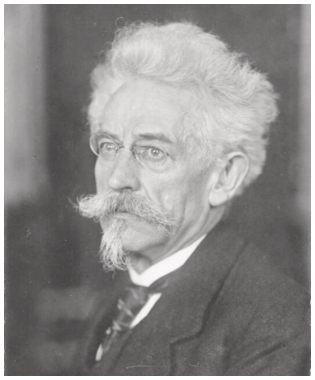
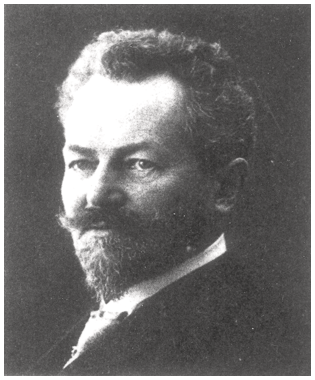
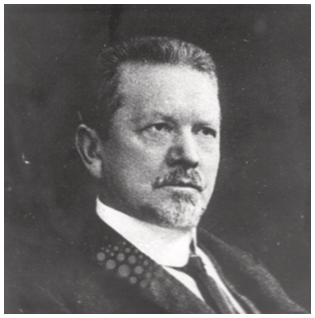
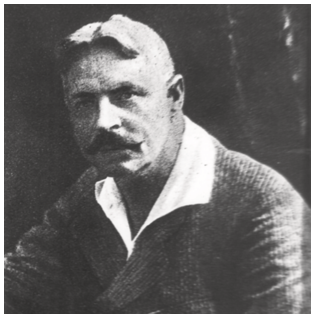
When the authority of the elected parliaments and the monarchy suddenly collapsed in early November, the workers’ and soldiers’ councils asserted themselves as the new basis of popular legitimacy and the Executive Council of the Workers’ and Soldiers’ Councils of Greater Berlin (Vollzugsrat des Arbeiter- und Soldatenrates Groß-Berlin) became the most important council in the nation. With Richard Müller as its chairman, and Däumig and Ledebour as members of the Executive Council, the Revolutionary Stewards and the USPD had a strong hand and were able to forge a power-sharing agreement with the MSPD on November 10, whereby the Majority and the Independent Socialist Parties agreed to co-lead all the ministries in the state of Prussia.Footnote 75 As a consequence, Adolph Hoffmann was appointed to co-lead the Ministry of Education for Prussia, Däumig and Ledebour soon joined the Executive Council, and Vogtherr was appointed a liaison to the navy. However, although political power was to be shared, the monopoly of violence was not. In December 1918, Ebert secured a secret agreement with the military to suppress revolutionary excesses, which would prove crucial for the unfolding of events in January 1919.
How are we to interpret the fact that three or four members of the 1918 strike committee and the informal leader of the Revolutionary Stewards were all prominent socialist secularists? What role, if any, did their secularism play in the course of the revolution? To an extent, it helps explain the structural position of these men at the arrival of the revolution in the nation’s capital. Their past secularist activism had made them locally powerful leaders, who had been held at arm’s length by the party leadership for their repeated efforts to drag the party into religious politics. Yet, if we shift our focus from how they arrived at leadership positions in the USPD to an exploration of their motivations, we can point to other concerns that made them secularist revolutionaries. On the one hand, they continued to be motivated by a desire to modify the confessional system, and, on the other, they worked from a utopian political imaginary linked to their worldview and life reform efforts. In the following I explore how the division of the party gave secularists an opportunity, unmatched since the revolution of 1848, to bring these concerns into the center of revolutionary politics. I will do this by latching onto the actions of the most prominent revolutionary secularists of this period. Following Adolph Hoffmann, I show how confessional struggles played a pivotal role in shaping religious responses to the revolution and helped shape the Weimar Constitution. Turning to Ernst Däumig, I explore the connection between his secularist political imaginary and theory of the workers’ councils, through which he hoped to lead the revolution and shape a new generation of socialists.
Adolph Hoffmann as Co-Minister of Culture
Given that religious matters were a prerogative of state governments and Prussia was the largest state, the Prussian Ministry of Education was the single most important office in Germany for determining the fate of the German churches. Not surprisingly, upon his appointment, Hoffmann immediately sought to dismantle all aspects of confessional discrimination and church privilege and power by revolutionary fiat. The vision for the Ministry of Culture issued on November 13, 1918 was also signed by MSPD co-minister Konrad Haenisch, but reveals Hoffmann’s initial dominance:
The old fortresses of arbitrary violence have fallen. Now it is time to create new space for a new edifice, a house in which the entire people feel at home. Thus, first of all, away with all the barriers and hindrances in our public institutions that are left over from centuries of reaction; away with the remnants of the antiquated views and ideas that have allowed the spirit of narrowness and darkness, the worship of brutal power, and the celebration of militarism and bureaucracy to run wild in people’s heads.
The ministry’s first step would be to liberate the schools from every “paternalism,” “falsification of history” and “confessional influence.” The schools were to be separated from the churches and the churches “liberated from the state, but also from their state subsidies.” This announcement was followed by a flurry of decrees. On November 15, Hoffmann announced the equal rights of dissident children. Two weeks later he ended school prayer, removed religion from among the exam subjects in schools, and ordered the consistories to eliminate prayers for the King and the royal house from church services.Footnote 76
These measures prompted an immediate outcry from Catholic and Protestant church leaders. On November 19, the Catholic Bishop of Cologne, von Hartmann, denied their legality; without the legitimacy of an elected legislative body, this separation was simply an “act of arbitrary violence.” According to Vice President Lahusen of the Protestant Higher Church Council (EOK), the events in Prussia would decide “whether the masses of our people want to live under the blessings of the church or sink into paganism.”Footnote 77 Both churches mobilized their faithful against Hoffmann. The Protestant Church circulated a petition to retain religious instruction in schools, which received 7 million signatures by January 1919. The Catholic regions of Rhineland and Silesia threatened to withdraw from Prussia and form independent states. The Catholic Kölner Volkszeitung wove fears of Bolshevism together with antisemitism, when it wrote that through Hoffmann’s Ministerial Director Alexander Futran, a Jewish monist of Russian origins, the Ministry of Culture would soon place “Catholics and Protestants in the state of Prussia under the Russian whip.” Futran was summarily executed a little over a year later by government troops for leading a USPD defense organization, and was eulogized by the Monist League, as a hero who had turned from monist worldview to revolution because, as Futran himself had written, “A conviction only has value and effect, if it is backed by action.”Footnote 78
Defeat in war, the Kaiser’s abdication, and socialist revolution were deeply traumatic events for both state churches. Because the collapse of the monarchy robbed the Protestant Church of its highest official, or summus episcopus, the Church found itself in a constitutional crisis, necessitating a reorganization on a new foundation. A number of church liberals supported the separation of church and state as a necessary step in their efforts to democratize the church. However, their willingness to cooperate with Hoffmann’s Ministry tarnished their reputation within the High Church Council.Footnote 79 Hoffmann’s efforts helped conservative Protestants, such as the editor of the Kirchliches Jahrbuch Johannes Schneider, make sense not only of the revolution but of the lost war. Although he blamed the church for not doing enough to maintain the “spirit of 1914,” he concluded that “guilt for the political and moral collapse is borne first and foremost by Social Democracy.” The revolution unleashed “a flood of religious hatred, which had previously been held in check, bubbling in the dark depths.”Footnote 80 This was the church version of the stab-in-the back theory, circulated by the military to pin blame for defeat on domestic enemies. For Catholics, too, Hoffmann’s brief stint as Culture Minister had a lasting impact, revealing for them the antireligious character of socialism. For men such as Catholic Cardinal Michael Faulhaber, the Weimar Republic bore “the mark of Cain” and would remain marred by this birth defect.Footnote 81
Tremendous strains soon developed in the Prussian Ministry of Culture, not over the goal but over the means of achieving the separation of church and state. Hoffmann wanted to rule by revolutionary right (“kraft der Revolution”) while Haenisch wanted decisions to be provisional, awaiting later democratic legitimization. Hoffmann desired the elimination of the Wilhelmine bureaucrats, while Haenisch was convinced that the machinery of the state would stop if this course were pursued. Hoffmann wanted to use state power to generate support for the new regime through public propaganda that would deliver “enlightenment to the masses in the countryside via a comprehensive campaign.”Footnote 82 Haenisch, still infused with the spirit of wartime nationalism, wanted to create national solidarity within the Volksgemeinschaft to stand up to the external threats to Germany’s territorial integrity.Footnote 83
From late November onwards, Haenisch campaigned publicly against Hoffmann’s decrees and opposed any “shallow priest-eating, pseudo-enlightenment and iconoclasm.” This open rift between the two fed into the growing strains in the coalition government, which led the MSPD to make use of its ultimate authority. On December 12 and 13, 1918, leaders of the eight Prussian Protestant churches met with Ministry of Culture officials, who assured them that the Ministry would back away from Hoffmann’s decrees and thereby avert a Kulturkampf. In a letter of December 31, 1918, Haenisch informed Hoffmann of the steps he was undertaking to reverse earlier decrees, which were driving Catholic workers back into the Center Party fold and costing both socialist parties “hundreds of thousands of votes.” Haenisch claimed that he had only voted for these measures in November because Hoffmann had otherwise threatened to take the matter to the Soldiers’ and Workers’ Councils. He concluded that “going forward only one of us can carry out the leadership of the Ministry of Culture” and that in the interest of “socialism and the fatherland, I would find it desirable that you go.”Footnote 84 This assertion reflected the decisive tipping of the balance between the USPD and the SPD in late December 1918. At the Reich Congress of Workers’ and Soldiers’ Councils that met between December 16 and 20 in Berlin, this “highest organ of the revolution” decided that future power would rest in the democratically elected National Assembly. Without hope of continuing the revolution within the government, Hoffmann followed the other USPD ministers and resigned from the governing coalition with the MSPD. Haenisch issued the government’s new position on January 9, which was to leave open the question of the future relationship of church and state until after the democratic elections to the National Assembly, which were set for January 19.
Hoffmann’s initiatives had contradictory effects. They prompted the Center Party to run its campaign for the National Assembly as an antisocialist, antisecularist defense of Catholic worldview. At the same time, the threat posed by radical secularism pushed party moderates to seek collaboration with the MSPD. Matthias Erzberger, the central figure behind Center’s ongoing cooperation with majority social democrats and liberals since 1917, made quick parliamentary elections a condition of his agreeing to enter Ebert’s government and take the unenviable position of Armistice Commissioner in November 1918. Erzberger reported to papal nuncio and future pope Eugenio Pacelli in February 1919 on the “good results” obtained by this decision, which had allowed the Center Party to stave off the obligatory separation of church and state and prevent the MSPD from introducing the “confessionless” public school:
These two successes must be esteemed all the more since a further political development to the Left must be anticipated in the near future before we can expect the inevitable return to the Right. Great injury to the Church can be prevented by the Center [Party] in this present period of maximum danger. If church-state separation were once put into effect, it would be almost impossible to return to the earlier condition.Footnote 85
Shared opposition to the radical secularism of the first months of the revolution opened some common ground between Catholics and Protestants. The Catholic politician and professor of economics Martin Faßbender invoked Hoffmann to argue for Protestant membership in the Center Party: “Hand on your heart: What are all the controversies between Christian religious communities since the Reformation … in comparison to the chasm that separates us from – Adolf Hoffmann?”Footnote 86 Yet, despite such ecumenical overtures, the existential danger posed by the revolution led the churches and their political allies to respond with calls for confessional loyalty. Thus, historian Rudolf Morsey called Hoffmann, somewhat ironically, “the savior of the Center.”Footnote 87
By the same token, Hoffmann could also be considered the “savior of the DNVP,” as historian Ludwig Richter has proposed. Fighting his decrees provided a justification for church participation in the formation of the German National People’s Party (DNVP) in late 1918, which collected the remnants of the Fatherland Party, the prewar Conservative parties and the antisemitic Christian Social Movement to form the most powerful interwar conservative party. The DNVP was a bastion of antidemocratic thought and the political home of most high-ranking Protestant clergymen and, according to some historians, it formed the first true milieu party of Protestant German conservatism. Prior to the war, many elites, in particular the clergy and nobility, identified with the Borussian imperial state and did not participate in the milieu organizations of the conservative base. Only once the abdication of Wilhelm II severed their ecclesiological and personal ties to the Prussian monarchy and the “godless” Revolution of 1918/1919 welded them together, did Protestant conservatives have an experience of persecution comparable to that which had integrated the Catholic and Socialist milieus in the 1870s and 1880s.Footnote 88
Like the Center Party, the DNVP waged its campaign for the National Assembly as a confessional struggle against the anticlerical “Kulturkampf” triggered by the revolutionary government. Superintendent Otto Dibelius proposed that Protestant ministers inform parishioners how to vote and that they walk together from the church service to the polls.Footnote 89 Although Haenisch had reassured the churches that he would not single-handedly implement secularization, politically minded clergymen sought to portray Hoffmann as the embodiment of the MSPD policies as well. Some historians have identified the propagandistic use of Hoffmann’s earlier actions as an electoral trick, which, as liberal-democratic politician Theodor Heuss claimed of the crude antisemitism, reflected “the dearth of ideas of the DNVP.”Footnote 90 However, both antisemitism and antisecularism were not trivial matters for German conservatives; they had been linked since the late 1870s as core elements of conservative nationalist identity. Furthermore, as shown by the aforementioned letter from Erzberger to Pacelli just following the election, the churches and their political allies recognized that the outcome of the elections to the National Assembly would determine the writing of the constitution that would lay out the future position of the churches in German society.
The USPD had emerged from the party split with few newspapers and a weak party structure, which contributed to a poor showing in the January 19 elections. It obtained only 22 delegates, as against the 165 elected for the MSPD. Together the socialist parties did not have a majority of the 423 delegates of the new National Assembly.Footnote 91 The MSPD could have ruled alone with the left-liberal German Democratic Party (DDP) with whom it shared points of agreement in education and church policy. However, because of the enormous tasks facing the new government, the SPD sought to include the Center Party, which required compromise on the issues dear to Catholics.
Secularism and the Weimar Constitution
With the defeat of Hoffmann and USPD, control over the restructuring of Germany’s confessional system passed into the hands of the MSPD and its allies. Already before the formation of the new government in February 1919, compromises on religious matters had made their way into the draft constitution being written by the professor of law Hugo Preuss on behalf of the Council of People’s Deputies. Because Preuss declined to give clear direction on school secularization to avoid sparking lengthy debates on worldview issues, the USPD-controlled Leipziger Volkszeitung warned of a “complete victory of the clerics.”Footnote 92 Over a period of six months, the subcommittee responsible for educational and religious matters hammered out the articles of the constitution governing the confessional order, arriving at compromises that made no one entirely happy, but which reflected some of each coalition party’s program. Shortly before ratification, the DDP left the government in protest over the terms of the Versailles Treaty, and the Center Party used its increased power to extract additional concessions out of the SPD.
When Carl Schmitt later characterized the Weimar Constitution as a “dilatory formal compromise” composed of contradictory contents, he named religious differences between the leading parties as a chief cause.Footnote 93 Indeed, on several crucial issues, such as the confessional organization of the school system, the constitutional assembly simply pushed ultimate regulation into the future. Ulrich Stutz famously called it a “limping” separation of church and state because, although it declared “there exists no state church” and guaranteed individual freedom of conscience, the churches sought and obtained a continuity of the key privileges they had enjoyed hitherto, although now justified with new legal principles. The churches were declared “corporations of public law” and continued to receive state-collected church taxes from all registered church members. Language from earlier drafts of the constitution demanding a “unified school” was removed and the rights of parents to determine the religious nature of the schools was inserted. The confessionalized school system was retained pending a future school law, which was never passed due to the polarization of the political fronts and the weakening of the left in the ensuing years.Footnote 94
Although the Weimar Constitution guaranteed dissident children freedom from religious instruction, it did not guarantee them the right to an alternative instruction. This meant that while all citizens enjoyed a negative freedom from compulsion to attend confessional instruction, for most German states only the former state churches retained the positive religious freedom to provide such instruction. Yet, the secularist organizations were integrated into the confessional order in a new way. In a subcommittee meeting on April 1, 1919, the leading voice of the DDP, Friedrich Naumann, expressed sympathy for the socialist position that the churches should not be principally privileged over “associations with cultural aims or associations that are concerned with questions of worldview, even if they are monists or Freethinkers.” Simon Katzenstein of the MSPD, a leader of the workers’ abstinence movement with long-standing ties to secularist circles, promptly brought in an amendment co-sponsored by a member of Naumann’s party to open the status of corporation of public law to associations that pursue “the collective cultivation of a worldview.”Footnote 95 Crucially, however, worldview associations would have to petition for this status and provide evidence that they had a steady membership and stable constitution to guarantee their continuity. This meant that the de facto exclusion of secularists from access to confessional goods was maintained, but was offset by the de jure right to rectify this in the future. Here, as with the schools, the dilatory nature of the compromise worked towards the interest of the churches. When the largest secularist organizations, such as the Proletarian Freethinkers and the Monist League, later requested the status of corporations of public law, their petitions were usually rejected.Footnote 96 It may be concluded that the Weimar Constitution represented a compromise between deeply entrenched confessional positions that satisfied none, but did allow for the survival of key structures of the Wilhelmine confessional system. This translation of the confessional system into a democratic order pointed the way forward to the church–state arrangement of the Federal Republic of Germany in 1949, but for the duration of the Weimar Republic it provided grounds for ongoing socialist-secularist agitation.
When the final version of the constitution was presented to the entire National Assembly in July 1919, Fritz Kunert rejected the compromise in the name of the USPD. He demanded “no baksheesh, no fat tips from the state in the form of subventions, salaries” for the churches, and concluded by calling for the “confiscation” of church property. Historian Ludwig Richter has argued that such USPD pronouncements on religious policy were largely propagandistic efforts to profile itself as the truly socialist party.Footnote 97 However, this interpretation is not plausible given the strong secularist streak in the party. The USPD position on the new constitution coincided with that of Der Atheist, which lamented that “a tragicomedy has been played out in the Weimar National Theater, in which the German people and human progress have been the victims. … On questions regarding school and church the Center [Party] was victorious down the line, thanks to its red friends [in the MSPD, T. W.].” Der Atheist praised the USPD, “which stood entirely alone with its petition for a separation of church and state.”Footnote 98
Multiple sources speak of a reignition of the church-leaving movement in the spring of 1919.Footnote 99 According to Protestant minister and editor of the Kirchliches Jahrbuch Johannes Schneider, the agitation was not being driven by the liberal secularist organizations that had been at the center of the prewar church-leaving campaigns, nor was the MSPD involved. Rather the greatest propaganda was being made in Der Atheist, Rote Fahne (KPD) and Die Freiheit (USPD). Indeed, the highest rates of church-leaving between 1919 and 1922 occurred in the cities and regions that showed the highest electoral support for the USPD, such as in Saxony and Berlin.Footnote 100 Kurt Rosenfeld of the USPD believed that the huge upsurge in church-leaving in Berlin in September 1919, which saw over 12,000 requests filed, was sparked by popular anger at the DDP for backing away from the more liberal church-leaving law it had proposed earlier in the year. Indeed, the tides were changing, and a more restrictive regulation was passed against the votes of the SPD and USPD in November 1920. This ordinance required a period of one month for reconsideration, during which the duly informed church officials were allowed to contact the applicant.Footnote 101
Religion became a key point of distinction between the rival socialist parties. The most powerful leader of the USPD in Saxony, Richard Lipinski, authored a pamphlet with the emphatic title Leave the Church (Heraus aus der Kirche) in 1919, whereas MSPD leader and long-time editor-in-chief of Vorwärts, Friedrich Stampfer, reprinted his 1905 Religion is a Private Matter (Religion ist Privatsache).Footnote 102 Ample evidence exists of correlations between the USPD and the advancement of secularist aims. A Christian teachers’ organization concluded that the party’s “animosity towards religion” had motivated it to issue three resolutions to the Reichstag to secularize the schools in 1921.Footnote 103 Police reported that Freethought propaganda was being distributed in USPD meetings in Bremen in late 1921.Footnote 104 A statistical comparison of the regional membership of the largest Freethought association GpF and the 1920 Reichstag elections shows that regions with strong support of the USPD were also centers of German Freethought. This was especially true of the Rhineland, Halle/Merseburg, Thuringia and Leipzig/West Saxony (see Table 7.1).
Connections between the secularist movement and the USPD were particularly tight in Berlin, where the Free Religious Congregation, Germany’s largest local secularist organization, counted in its leadership some of the highest-ranking leaders of the USPD. The Free Religious Congregation published its announcements in the USPD papers Freiheit, Der Sozialist and Arbeiter-Rat and jointly conducted its Jugendweihe with the party in 1920. Most of the socialist Free Religious leaders – Manasse, Vogtherr, Hoffmann, Däumig, Paul and Maria Krische, Adolf Harndt – worked in the USPD. In fall 1920 the annual report of the Berlin Congregation contained the “preliminary draft of state settlement with the church” that had recently been worked out by the Central Committee of the USPD.Footnote 105 The draft called for:
1. An end to all state payments to churches (Religionsgemeinschaften).
2. State employees to be barred from employment by churches.
3. No state supervision of religion.
4. An end to government compilation of statistical information on the confessional identity of the inhabitants.
5. No religious holidays except Christmas, Easter and Pentecost.
6. No religious celebrations in public institutions, including schools.
7. All church members required to reregister their religious affiliation upon passage of the new law.Footnote 107
8. All buildings and mobile property of the churches to be turned over to the community (Gemeinschaft). Religious groups to apply to a public administration for building use.
9. Instruments necessary for religious services to remain with the churches.
10. An end to religious instruction in schools and closure of the theological faculties in public universities.
11. Cemeteries to enter into the public trust.Footnote 108
Had these measures been enacted, they would have brought about a radical secularization of state and society and the nationalization of key church assets. The close proximity of the Proletarian Freethought movement to the USPD, is revealed by the objection lodged by the local chapter of the Saxon town of Gersdorf, which was majority MSPD, against the clear support of the USPD given by the editors of Der Atheist.Footnote 109 Although the USPD failed to develop into a significant force at the national level, it did seek to implement some of these measure at the local level. One Independent member of the Berlin Magistrate wrote that in many regions of the country, the party would have to accept its inability to affect educational policy and remain aloof as the “loyal lieutenant” of the working class. However, in regions where it could rule alone or in coalition with MSPD, it would be “heavy sin” to remain in the opposition. He gave as examples Erfurt, where the party sought to communalize the burial services, and cities, such as Hamburg and Berlin, where Independents were leading the struggle against the confessional school system.Footnote 110
Ernst Däumig and the Revolutionary Council Movement
In the first six months of 1919, Ebert’s government unleashed the Freikorps to suppress the insurrectionary efforts by communists and USPD radicals in the Ruhr, Leipzig, Halle and Berlin. This, and the smashing of the Bavarian Council Republic in May, deepened the hostility between MSPD and USPD. At a conference of Proletarian Freethinkers of Rhineland Westphalia in October 1919, delegates from the town of Remscheid proposed the following amendment to the organizational statutes: “Members of the Majority Social Democracy are to be excluded.” The petition was not passed, but it indicates the mood in socialist-secularist circles, as echoed in the speeches given that day. One speaker was the liberal monist turned socialist culture expert Kurt Löwenstein, who stated that November 9, 1918, had marked not the beginning of revolution, but simply a collapse of the old order. The revolution had yet to take place. Another speaker told delegates that the chief task of the moment was the “continuation of the revolution, which has to be based on the foundation of the council system and the dictatorship of the proletariat.”Footnote 111
The “council system” of the USPD was an original model of revolutionary direct democracy that gained many adherents between 1918 and 1921. Writing after the hopes for revolution had collapsed in 1921, Karl Korsch, a critical observer and later pioneer in the development of “Western Marxism,” noted an inverse relationship between the actual power of the councils and the utopian hopes associated with them as a form of political association. In November and December 1918, when the councils had been the actual bearers of sovereignty, they had been moderate and featured a mixture of political perspectives. As the Independents were ejected from the national government in January 1919, the councils fell more and more under their sway, and, despite the fact that fewer and fewer cities called up their councils, the claims made in the name of the councils increased. In 1920, Korsch concluded, the councils mostly continued as an idea.Footnote 112 Indeed, critics on the right and the left identified the council model as an overly idealistic system that was distant from the messiness of parliamentary democracy or the clarity of party dictatorship.
Although the council system has attracted the attention of a dedicated following among specialists over the years,Footnote 113 most historians have given it short shrift as a passing interlude between the power-sharing government of November 1918 and the violent efforts to overthrow the government by the KPD.Footnote 114 This interpretation occludes the fact that the USPD was the principal force of revolutionary action in Germany up until the merger of its left wing with the much smaller KPD in October 1920.Footnote 115 A further reason for the neglect of the council system was that its political opponents as well as later historians considered its model of direct democracy to be unworkable and its advocates naïve if not irrational.Footnote 116 One obvious explanation of this apparent irrationality, namely that it was inspired by religious motivations, has been hinted at by some historians but never explored.Footnote 117 Yet, in the summer of 1919, Viktor Stern, a German-speaking Czech-Jewish schoolteacher and prewar monist, proposed that the councils embodied a religious idea, “which like a magic formula promises salvation in every direction. … Faith in the council system is nearly a new religion of the German proletariat. Even its most bitter enemy must today bow to this [expression of] mass will.”Footnote 118 The connection between secularism and the council movement is suggested by the fact that several of its leading theorists were past or future organized secularists, including – alongside Stern – Georg Ledebour, Ernst Däumig and Max Sievers. Other contributors, such as Curt Geyer and Max Adler, were strongly influenced by monism and were culturally close to the secularist movement.
According to historian Carl Schorske, the specific revolutionary imaginary that underpinned the council idea sprang from “the traditional ultra-democratism of the German left.”Footnote 119 Yet, as I have explored previously, this ultrademocratism that erupted in the revolution of 1848 was closely tied to Free Religion,Footnote 120 and this connection survived the revolution and reappeared, for example, in the “revolt of the young ones” explored in Chapter 3. To delve more deeply into the role of the secularist imaginary in the council system, I will link these earlier movements to the actions and writings of Ernst Däumig, who was not only the leading German theorist of the council system, but as co-chairman of the USPD and member of the Reichstag also its most powerful champion. Throughout the period of revolution, he also sat on the board of the Berlin Free Religious Congregation and gave regular lectures there. In 1917 and 1918, he published Journeys through Church History (Wanderungen durch die Kirchengeschichte), an ambitious history of religion from the origins of Christianity in Greek and Jewish thought up to the present, as well as the aforementioned Free People’s Catechism.Footnote 121 Reading these writings on religion against the proposals for the council system that he set forth in keynote speeches to party congresses, pamphlets and in his journal Arbeiter-Rat (Workers’ Council) can open a window onto the historical relevance of this dimension of the secularist imaginary for the German Revolution.
We have encountered Däumig already as an example of a socialist-secularist intellectual. His biography was marked by several abrupt transformations. He dropped out of the Gymnasium in his native Halle to join the French Foreign Legion, where he served in Indochina. Having returned home, and after a frustrating tour in the German army, Däumig “converted” to socialism in 1900.Footnote 122 He became the editor of the socialist paper in Halle, where he also contributed to worker education and penned a Jugendweihe brochure. When he moved to Berlin in 1911, he became editor for military and educational affairs at Vorwärts, taught at the Arbeiterbildungsschule and sat in the Party’s Educational Committee for Greater Berlin.Footnote 123 He was an outspoken antimilitarist and radical.Footnote 124 He participated in the fringes of the church-leaving movement, and during the war Däumig become a frequent speaker at the Free Religious Congregation. By war’s end he had eclipsed Bruno Wille as the congregation’s favorite Jugendweihe orator. He was elected to the board of the congregation in December 1918 and held regular lectures there throughout the next three years, when not hindered by the threat of arrest.Footnote 125 At the same time, Däumig had become the leading representative of the USPD’s left wing and in March 1919 was elected party co-chairman, an office he did not accept after the moderate co-chair Hugo Haase refused to serve with him. After Haase’s untimely death as the result of an earlier assassination attempt, Däumig became party co-chair in December 1919 and was elected to the Reichstag in 1920.
Already during the last year of the war, Däumig had begun to think through the organizational architecture of a new system of direct democracy based on workers’ councils. He became an expert on developments in Russia, and in October 1918 planned a series of lectures on the Russian Revolution at the Workers’ Education School.Footnote 126 The workers’ and soldiers’ councils sprang up throughout Germany upon the collapse of the government and the declaration of a socialist republic in early November. The MSPD and USPD centrists, such as Haase, accepted the initial necessity of the councils to create order in the chaos that descended on Germany following defeat and governmental collapse, but wanted to subject them to party control and replace them as soon as possible with elected government bodies. The USPD left, of which Däumig was a leading voice, saw councils as revolutionary bodies through which class rule by the proletariat could be carried out. Already at a November 16 meeting of the Executive Council (Vollzugsrat), Däumig opposed the formation of a “constitutional national assembly” and demanded instead a central committee of all councils to determine the new form of “proletarian Democracy.”Footnote 127 When the first Council Congress met in Berlin in December 1918 and approved plans for elections to the National Assembly, Däumig called it a “political suicide club” which had just passed a “death sentence” on its own existence. In a speech of December 27, 1918, in which Däumig delivered a pessimistic analysis of the first six weeks of the revolution, he called the formation of the councils its “sole achievement.”Footnote 128
Däumig’s “pure council system” contrasted clearly with the Soviet model. In the USPD Party Congress in March 1919, Däumig stated his support of the council system, “as we now find it established in the constitution of the Russian Soviet Republic,” but made the differences clear. Whereas the Bolsheviks used their strictly disciplined, hierarchical and centralized party as a leading force within the democratic councils, in Däumig’s model the councils not only replaced parliament, but were ultimately superior to socialist parties and the state itself. In stating that the councils and not the parties should lead the revolution, Däumig acknowledged that he was making a “heretical comment” that would dismay listeners of all the rival socialist parties.Footnote 129
Whereas the MSPD saw parliament and the Bolsheviks saw the party as the representative of the people or the revolution, Däumig wanted to do away with representation. For him, the councils were the people and revolution. The revolution “had created its own organs with elementary force,” and these councils were not merely “proletarian-socialist combat formations [Kampfgebilde]” that would fade away once they had eliminated the “authoritarian state [Obrigkeitsstaat], even if it has a republican facade.” The councils were to replace the state as a “self-administering collective body [Gemeinwesen].”Footnote 130 Using another biological metaphor, Däumig described the council system as a living organism in which the central organs are “continually controlled by cells of electoral bodies in factories and professions [that are] active at all times and distributed across the entire country.” Completing the system was a supreme council of representatives of the regional councils that was to be a “control instance” but not an executive.Footnote 131
The council idea also had bearing on Däumig’s understanding of the role of political violence. He opposed Bolshevik “putschism,” by which he meant the strategy of trying to precipitate revolution through insurrection. Although he believed that violence was a necessary part of revolution and was widely rumored to have been behind the creation of armed units within the USPD, Däumig was convinced that one could not “make” revolution.Footnote 132 Proletarian violence was to be reactive not proactive. Related to this, he opposed the Bolshevik embrace of terror as a tactic for maintaining the dictatorship of the proletariat. Lenin once claimed that the lesson to be drawn from the French Revolution was the need for more, not less terror. Däumig similarly denounced the MSPD for embracing violence to maintain its own rule. He deplored the use of paramilitary Freikorps by Gustav Noske, the “bloodhound” of the MSPD, to suppress worker insurrection, and said that unlike the Ebert government, the Democrats of 1848 would never have called in the “praetorian guards” to secure their rule.Footnote 133
In May 1919, Lenin blasted this “pure council system” as being fully removed from the exigencies of class war: “Those philistine gentlemen headed by Däumig are probably dreaming of a revolution (that is, if any idea of revolution ever enters their heads) in which the masses will all rise at once, fully organized.”Footnote 134 While Däumig left hard-nosed politicians scratching their heads, his plans were fully in keeping with core elements of secularist political thought.
The first core element of the secularist imaginary was the belief that social transformation would occur through the formation of advanced spiritual communities, such as the Free Religious Congregations. Thus, the botanist Nees von Esenbeck went to the revolutionary Prussian parliament of 1848 as a Free Religious “missionary,” and Theodor Hofferichter called the congregations a “nursery for the principles of democracy.”Footnote 135 Socialist secularists supported such reform projects as garden cities, consumer and production cooperatives, and “people’s houses,” which were conceived of as islands of community that would slowly penetrate and transform the society. Georg Ledebour expressed something similar when he hoped that the revolutionary workers’ councils would develop into rural communes reminiscent of Charles Fourier’s phalansteries.Footnote 136
The second element of the secularist imaginary was the centrality of overcoming the spiritual and psychological shackles of authoritarianism. At the Second Council Congress in April 1919, Däumig stated that the KPD was leading the workers rather than educating them to become self-governing, and accused the MSPD of having succumbed to the lure of ruling through what was still, in his eyes, an authoritarian state.Footnote 137 Both of these methods failed to overcome the psychological weakness of the German proletariat, which resulted from its lack of education and autonomy:
We are still suffering from the spirit of military subservience and passive obedience, our heritage from the past centuries. This spirit cannot be killed by more electoral struggles, by election tracts passed out among the masses every two or three years. It can only be destroyed by a sincere and powerful effort to maintain the German people in a condition of permanent political activity. This cannot be realized outside of the [council] system.Footnote 138
This psychological diagnosis of political consciousness tied into his criticism of religion. In the preface to his book Church History, Däumig blamed the alliance of “state, church and school” for drilling ignorance and obedience into the population. When the time for war arrived, the military had been able to mobilize the Lutheran creed “let every soul be subject unto the higher powers” that lay dormant in every former schoolchild, so that “we, who consider ourselves spiritually free, witness with horror the uncanny power that medieval beliefs still exercise in our ‘enlightened’ age.”Footnote 139 Thirty years earlier, Free Religionist Bruno Wille had similarly turned the sectarian struggle against the church hierarchy into a critique of the growing authoritarianism and bureaucratization of the SPD. He accused the party leadership of falling to the lure of electoral politics and turning the workers into “herd animals” and “members of the mass.”Footnote 140
The centrality of overcoming alienation to Däumig’s thought is also reflected in his belief that the success of the revolution depended on erasing the distinction between intellectuals and workers, a third element of the secularist imaginary. According to Däumig, the Germans had to avoid the “enormous mistake” of the Bolsheviks, which had been to seek support “exclusively from the calloused fist” of the workers: “From the start we want to strive for an understanding between head and hand workers and build our council system on this dual foundation.”Footnote 141 The task of intellectuals was to help workers overcome the educational and psychological barriers that stood in the way of their self-mastery. He claimed that in Berlin the council leadership had identified one hundred promising young workers, who, once educated, would replace the old socialist leaders not merely as individuals, but more importantly as a type. Whereas the old functionaries, who were either parliamentarians or union leaders, had become alienated from the masses, the new leaders would be “inside the pulsing life” of the revolution, part of its organically evolving being.
In spring 1919, Däumig announced in the name of the Executive Council the founding of a “Free Higher-Learning Community [Hochschulgemeinde] for Proletarians,” named thus because it would entail the “life together of learners and teachers with all the fruits of a school founded on non-authoritarian and joyful cooperation.” It would not provide “bookish knowledge” or vague general education, but practical and political knowledge and “training of the spirit” with the aim of helping young proletarians take an active part in the socialization of the economy, which would be achieved not through decrees, but through the struggle of the workers in the councils.Footnote 142 Däumig’s views were echoed by other council theorists with secularist affinities. Kurt Eisner saw in the council a “school of democracy,” out of which “personalities arise to take up political and economic” tasks,Footnote 143 while Austrian Max Adler stressed the primacy of consciousness rather than party control for maintaining the integrity of the councils. Like Däumig, he proposed that the right to vote not be tied to a narrow definition of working-class membership as it was in Soviet Russia, but rather to “a confession of socialism.”Footnote 144
The notion that historical progress originated in idealistic communities constantly under threat from the powers of authority describes not just Däumig’s understanding of politics, but also of religion. In Journeys through Church History, Däumig argued that religion developed along two parallel and antithetical tracks: the first in intellectual culture, the second in the institution of the church. Culture was driven forward by the progressive evolution of consciousness towards a higher humanism; however, these achievements were coopted by the church, which “in continual adaptation to the conditions of the time developed itself into an organization of domination” by state and clerical elites.Footnote 145 In the dialectic of spiritual advance and dogmatic calcification, Däumig pointed to the key role played by heretics in advancing the spirit and simultaneously building the bridge to political action. Heretical movements are “decidedly revolutionary uprisings in religious garb.”Footnote 146 The end of this dialectic was not the elimination of religion, but the conquering of “the fortress of the church, in order to set something more perfect in its place.”Footnote 147 Thus social revolution and anticlerical struggle flowed together. Only backed by social revolution could the champions of the modern, free worldview create the more perfect “religion of humanity” described in Däumig’s Free People’s Catechism. The catechism closes with “our confession of faith,” which combines natural-scientific monism and democratic humanism: “I believe that I am and remain a link in the unending chain of humanity … I believe that it is my obligation to love my fellow men, to support them in need and danger and to contribute to making humanity freer and happier.”Footnote 148
Däumig saw religious and political heresies as expressions of the same emancipatory spirit that was threatened by the same institutional manipulations. Thus, he compared the contemporary socialist movement to Christianity before it was coopted by the Roman state, but concluded that “in the speed of its spread, modern socialism far exceeds Christianity.”Footnote 149 It is reasonable to conclude that he understood socialist revolution and the particular form of the councils as the culmination not only of the Marxist history of class struggle, but also of the history of religion and secularism.
The Final Act of the Revolution
By the summer of 1920, Däumig’s hopes that his council system could provide a correction to the Bolshevik model of revolution had faltered. With the successive collapse of the council governments in Bavaria and Hungary, Russia appeared to be the sole remaining beacon of world revolution. In July 1920, Däumig traveled to Russia to attend the Second Congress of the Communist International to negotiate terms of cooperation. In front of the congress, the chairman of the Comintern, Grigory Zinoviev, criticized Däumig for failing to understand that communists must “lead the way for the working class, and not to wait until we are dragged forward.” The USPD was then presented with the Twenty-One Conditions for Membership in the Communist International (Comintern),Footnote 150 which would have effectively required its Bolshevization. This Moscow ultimatum effectively split the party in two, as shown by the cover of the satirical magazine Ulk (Figure 7.2). At the regional congress of the Saxon USPD in September, Däumig took on Rudolf Hilferding, Arthur Crispien and others who opposed the union of USPD and KPD. He argued that the Germans would have to choose sides in a possible future war between France and Russia, which would result in a “struggle of worldviews.”Footnote 151 Hilferding and Crispien reportedly identified the German supporters of the Comintern, such as Däumig, not as Leninist hardliners, but rather as “revolutionary romantics” given to “utopian, syndicalist and anarchist tendencies.”Footnote 152
“Look to the Right and to the Left, you see a half Independent fall!” Moscow cleaves the USPD, with a message in favor of joining the Comintern carried by Däumig and one against carried by Dittmann. Source: Ulk, October 1920.
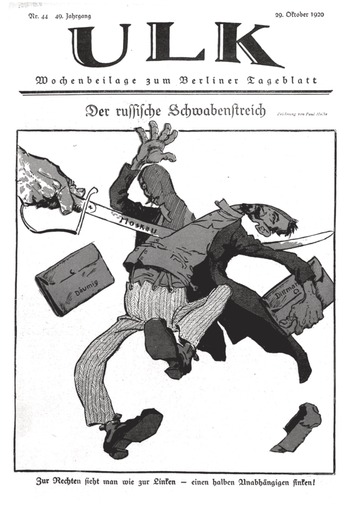
The differences could not be reconciled, and in December 1920 the left wing of the USPD joined the KPD. KPD leader Paul Levi and Däumig became co-chairmen of the United Communist Party of Germany (VKPD). This was a momentous historical event, as it lifted the KPD from being a disparate sect with only 1,700 members in the summer of 1920 to a party with 52,000 members. Yet conflicts with the Comintern led membership to drop precipitously to 26,000 by August 1921. Däumig was one of the first casualties: he and Levi resigned in February 1921 over Comintern plans to precipitate the violent and disastrous “March Action” in Germany.Footnote 153 On October 1, Däumig and Hoffmann announced the formation of the Communist Working Collective (Kommunistische Arbeitsgemeinschaft, KAG), a new faction dominated by secularist socialists. In addition to Däumig and Hoffmann, its executive committee included Max Sievers, the future chairman of Germany’s largest Freethought association.Footnote 154 Otto Brass, the future chairman of the Berlin Free Religious Congregation, later joined the KAG. Although the KAG had hoped to serve as the basis for a new revolutionary party, just as the SAG had done for the USPD in 1917, it proved to be a dead end. As an ironic finale, which shows the continued relevance of secularist structures in supporting inner-party dissent, one of the last meetings of the KAG, at which it was decided to rejoin the USPD, was held in the Free Religious meeting hall in Berlin in March 1922. In July, Däumig died as a result of a heart attack suffered on the floor of the Reichstag. Following the murder of Foreign Minister Walter Rathenau by nationalist reactionaries in June 1922, the former KAG members rallied around the republic and rejoined the SPD in September. By this point, it had become clear to the secularist organizations that their hopes for a thoroughgoing secularization of the state were not going to be realized soon. In January 1922, the rump USPD signaled its retreat from its earlier radical anticlericalism, when it voted to reverse the practice of requiring candidates to leave the church, due to “the strong anchoring of the church in our national life.”Footnote 155
Conclusion
According to historian Susanne Miller, two souls had lived in the breast of prewar Social Democracy. On the one hand, the party was sustained by the utopia of total social transformation, which despite its global claims fostered sectarianism and an alienation from political reality. On the other hand, it nursed a practical reformist tendency. These souls separated during the war and their conflict drove the dynamics of the German Revolution. The first principle explained, for Miller, the repeated rejection by the USPD of opportunities for participation in power. Their “wishful thinking untethered from reality” led to ultimate powerlessness.Footnote 156 By contrast, when the MSPD assumed “the burden of power” and compromised its ideals to work with its political opponents, it became a responsible, pragmatic pillar of democracy. In this telling, the failure of the USPD remains a key point used to emplot the history of Social Democracy as one of disenchantment, in which the SPD successively pruned away its utopian offshoots.
This chapter has offered another explanation of some of the utopian content of the USPD and the revolution more broadly. Rather than seeing it purely as an expression of Marxism or socialist culture, this article has examined the impact of red secularism. Weeks into the war, socialist secularists were protesting that the Burgfrieden had not led to full integration of religious dissidents in the national community, and this confessional discrimination spurred their antiwar opposition in the SPD. Secularist networks and press organizations gave them a necessary measure of autonomy to build a leadership position in the inner-party opposition and later the revolution. This allowed figures such as Ernst Däumig and Adolph Hoffmann to pick up the reins of revolutionary power and seek to take the state itself in 1918 and 1919. However, their leadership did not merely result from their strategic positions in moments of revolutionary contingency. Both men were charismatic leaders, who spoke on behalf of reform ideals and political projects that had been cultivated in the secularist movement for decades before the war. Hoffmann effectively linked his pacifism to religious criticism, whereby his secularist worldview appeared both as the negation of clerical hypocrisy and as a higher fulfillment of some of the humanistic sentiments expressed in the “Sermon on the Mount.” Hoffmann’s attempted elimination of the public power of the churches was quickly foiled. However, the episode galvanized the Christian parties and helped cement the political alliance of MSPD, Center Party and DDP, who forged the “limping” separation of church and state in the new constitution. The survival of key elements of the prewar confessional system meant that red secularism retained its political relevance, and set the stage for the “culture wars” of the Weimar Republic.
Däumig’s writings and actions open another window on the relationship of secularism to revolution. Religious and political dissidence coincided in his revolutionary theory and in his political choices. The “pure” council system, which he defended for a time against Lenin, offered German socialists a novel form of revolutionary organization that expressed a communitarian imaginary that had been expounded by prior generations of radical secularists. Through the councils, he believed workers would gain moral autonomy and consciousness of the monist humanism that he saw as the telos of religious and political history. Following the collapse of the council movement and the disastrous putschism of the United Communist Party in 1921, most socialist secularists returned to the SPD and red secularism returned to what it had been before 1914, a dissenting movement largely within German Social Democracy.
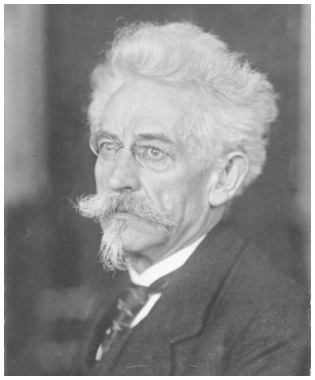
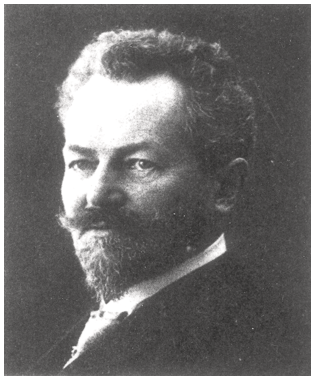
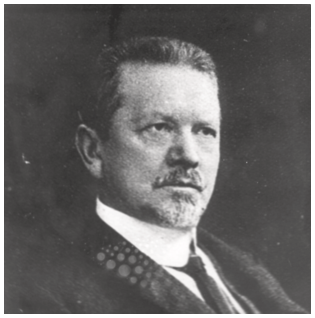
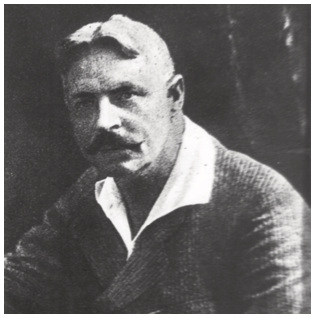
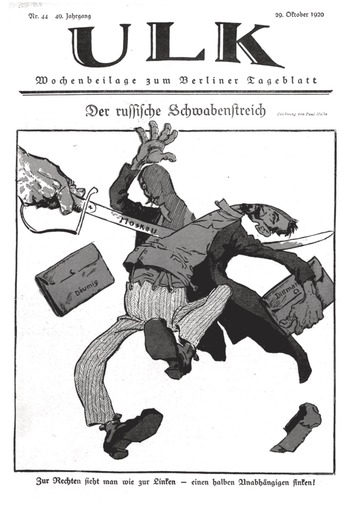

 Open access