1 Introduction
Statistical machine translation (SMT) typically relies on very large amounts of bilingual sentence-aligned parallel texts. Here, we consider settings in which we have access to (1) bilingual dictionaries but no parallel sentences for training, and (2) only a small amount of parallel training data. In the first case, we augment a baseline system that produces a simple dictionary gloss with additional translations that are learned using monolingual corpora in the source and target languages. In the second case, we wish to augment a baseline statistical model learned over small amounts of parallel training data with additional translations and features estimated over monolingual corpora.
In this article, we detail our approach to bilingual lexicon induction, which allows us to learn translations from independent monolingual texts or comparable corpora that are written in two languages (Section 2). We evaluate the accuracy of our model on correctly learning dictionary translations, and examine its performance on low frequency words which are more likely to be out of vocabulary (OOV) with respect to the training data for SMT systems.
We describe our approach to learning how to transliteration from one language’s script into another language’s script (Section 3). Transliteration is a useful aid, since many OOV items correspond to named entities (NEs) or technical terms, which are often transliterated rather than translated.
We show how the diverse signals of translation equivalence that we use in our discriminative model for bilingual lexicon induction can also be used as additional features for a phrase table in a standard SMT model to enhance low resource SMT systems (Section 4). We analyze six low resource languages and find consistent improvements in BLEU score when we incorporate translations of OOV items and when we re-score the phrase table with additional monolingually estimated feature functions.
Finally, we combine all of these ideas and demonstrate how to build a true end-to-end SMT system without bilingual sentence-aligned parallel corpora (Section 5). We build a patchwork phrase table out of entries from a standard bilingual dictionaries, plus induced translations, plus transliterations. We associate each translation with a set of monolingually estimated feature functions and generate translations using a SMT decoder that incorporates these scores and a language model probability.
This article combines and extends several of our past papers on this topic: Irvine, Callison-Burch and Klementiev (Reference Irvine, Callison-Burch and Klementiev2010), Irvine and Callison-Burch (Reference Irvine and Callison-Burch2013b), Irvine and Callison-Burch (Reference Irvine and Callison-Burch2013a), Irvine (Reference Irvine2014) and Irvine and Callison-Burch (Reference Irvine and Callison-Burch2015). This article expands the previous publications by providing additional analysis and examples from Ann Irvine’s PhD thesis. The main experimental results that were not previously published are the expanded set of experiments on our discriminative model for bilingual lexicon induction (Section 2). Because this article assembles research undertaken over a period of 5+ years, it is not perfectly consistent from section to section in terms of what languages it analyzes or in using identical features across all experiments. Despite this, we believe that this article provides a valuable synthesis of our past work on trying to improve SMT for low resource languages, with the aim of reducing or eliminating the dependency on sentence-aligned bilingual parallel corpora.
2 Learning translations of unseen words
SMT typically uses sentence-aligned bilingual parallel texts to learn the translations of individual words (Brown et al. Reference Brown, Cocke, Della Pietra, Della Pietra, Jelinek, Lafferty, Mercer and Roossin1990). Another thread of research has examined bilingual lexicon induction which tries to induce translations from monolingual corpora in two languages. These monolingual corpora can range from being completely unrelated topics to being comparable corpora. Here, we examine the usefulness of bilingual lexicon induction as a way of augmenting SMT when we only have access to small bilingual parallel corpora, and when we have no bitexts whatsoever.
The most prominent problem that arises when a machine translation system has access to limited parallel resources is the fact that there are many unknown words that are OOV with respect to the training data, but which do appear in the texts that we would like the SMT system to translate. Figure 1 quantifies the rate of OOVs for half a dozen low resource languages. It shows the per cent of word tokens and word types in a development set that are OOV with respect to varying amounts of training data for several Indian languages.Footnote 1 Bilingual lexicon induction can be used to try to improve the coverage of our low resource translation models, by learning the translations of words that do not occur in the parallel training data.
The rate of out of vocabulary (OOV) items for six low resources languages. We show the token-based and type-based OOV rates. The curves are generated by randomly sampling the training datasets described in Section 4.1.

Although past research into bilingual lexicon induction has been motivated by the idea that it could be used to improve machine translation systems by translating OOV words, it has rarely been evaluated that way. Notable exceptions of past research that does evaluate bilingual lexicon induction in the context of machine translation through better OOV handling include Daumé and Jagarlamudi (Reference Daumé and Jagarlamudi2011), Dou and Knight (Reference Dou and Knight2013) and Dou, Vaswani and Knight (Reference Dou, Vaswani and Knight2014). However, the majority of prior work in bilingual lexicon induction has treated it as a standalone task, without actually integrating induced translations into end-to-end machine translation. It was instead evaluated by holding out a portion of a bilingual dictionary and evaluating how well the algorithm learns the translations of the held out words. In this article, we perform a systematic examination of the efficacy of bilingual lexicon induction for end-to-end translation.
Bilingual lexicon induction uses monolingual or comparable corpora, usually paired with a small seed dictionary, to compute signals of translation equivalence. Here, we briefly describe our approach to bilingual lexicon induction that combines multiple signals of translation equivalence in a discriminative model. More details about our approach are available in Irvine and Callison-Burch (Reference Irvine and Callison-Burch2013b), Irvine (Reference Irvine2014) and Irvine and Callison-Burch (Reference Irvine and Callison-Burch2015). Although past research into bilingual lexicon induction also explored multiple signals of translation equivalence (for instance, Schafer and Yarowsky (Reference Schafer and Yarowsky2002)), these features have not previously been combined using a discriminative model.
2.1 Our approach to bilingual lexicon induction
We frame bilingual lexicon induction as a binary classification problem: for a pair of source and target language words, we predict whether the two are translations of one another or not. Since binary classification does not inherently give us a list of the best translations, we need to take an additional step. For a given source language word, we find its best translation or its n-best translations by first using our classifier on all target language words. We then rank them based on how confident the classifier is that each target word is a translation of the source word. The features used by our classifier include a variety of signals of translation equivalence that are drawn from past work in bilingual lexicon induction, notably by Rapp (Reference Rapp1995), Fung (Reference Fung1995), Schafer and Yarowsky (Reference Schafer and Yarowsky2002), Klementiev and Roth (Reference Klementiev and Roth2006), Klementiev et al. (Reference Klementiev, Irvine, Callison-Burch and Yarowsky2012) and others. The features that we use in our model are:
• Contextual similarity – In a similar fashion to how vector space models can be used to compute the similarity between two words in one language by creating vectors that representing their co-occurrence patterns with other words (Turney and Pantel Reference Turney and Pantel2010), context vector representations can also be used to compare the similarity of words across two languages. The earliest work in bilingual lexicon induction by Rapp (Reference Rapp1995) and Fung (Reference Fung1995) used the surrounding context of a given word as a clue to its translation. Fung and Yee (Reference Fung and Yee1998) and Rapp (Reference Rapp1999), used small seed dictionaries to project word-based context vectors from the vector space of one language into the vector space of the other language. We use the vector space approach of Rapp (Reference Rapp1999) to compute similarity between word in the source and target languages.
More formally, assume that (s 1, s 2, . . .sN) and (t 1, t 2, . . .tM) are (arbitrarily indexed) source and target vocabularies, respectively. A source word f is represented with an N-dimensional vector and a target word e is represented with an M-dimensional vector (see Figure 2). The component values of the vector representing a word correspond to how often each of the words in that vocabulary appear within a two word window on either side of the given word. These counts are collected using monolingual corpora. After the values have been computed, a contextual vector for f is projected onto the English vector space using translations in a given bilingual dictionary to map the component values into their appropriate English vector positions. This sparse projected vector is compared to the vectors representing all English words, e. Each word pair is assigned a contextual similarity score based on the similarity between e and the projection of f.
Various means of computing the component values and vector similarity measures have been proposed in literature (e.g. Fung and Yee (Reference Fung and Yee1998); Rapp (Reference Rapp1999)). Following Fung and Yee (Reference Fung and Yee1998), we compute the value of the kth component of f’s contextual vector, fk, as follows:
(1)where n f, k and nk are the number of times sk appears in the context of f and in the entire corpus, and n is the maximum number of occurrences of any word in the data. Intuitively, the more frequently sk appears with fi and the less common it is in the corpus in general, the higher its component value. After projecting each component of the source language contextual vectors into the English vector space, we are left with M-dimensional source word contextual vectors, Fcontext, and correspondingly ordered M-dimensional target word contextual vectors, Econtext, for all words in the vocabulary of each language. We use cosine similarity to measure the similarity between each pair of contextual vectors: $$\begin{equation}
f_{k} = n_{{f},k} * (log( {n / n_{k}}) + 1)
\end{equation}$$
(2)
$$\begin{equation}
sim_{context}(F_{context},E_{context}) = \frac{F_{context} \cdot E_{context}}{||F_{context}|| ||E_{context}||}
\end{equation}$$
• Temporal similarity – Usage of words over time may be another signal of translation equivalence. The intuition that is that news stories in different languages will tend to discuss the same world events on the same day and, correspondingly, we expect that source and target language words which are translations of one another will appear with similar frequencies over time in monolingual data. For instance, if the English word tsunami is used frequently during a particular time span, the Spanish translation maremoto is likely to also be used frequently during that time. To calculate temporal similarity, we collected online monolingual newswire over a multi-year period and associate each article with a time stamps. We gather temporal signatures for each source and target language unigram from our time-stamped web crawl data in order to measure temporal similarity, in a similar fashion to Schafer and Yarowsky (Reference Schafer and Yarowsky2002), Klementiev and Roth (Reference Klementiev and Roth2006) and Alfonseca, Ciaramita and Hall (Reference Alfonseca, Ciaramita and Hall2009). We calculate the temporal similarity between a pair of words, using the method defined by Klementiev and Roth (Reference Klementiev and Roth2006).
• Orthographic similarity – Words that are spelled similarly are sometimes good translations, since they may be etymologically related, or borrowed words, or the names of people and places. We compute the orthographic similarity between a pair of words using Levenshtein edit distance,Footnote 2 normalized by the average of the lengths of the two words. This is straightforward for languages which use the same character set, but it is more complicated for languages that are written using different scripts. For non-Roman script languages, we transliterate words into the Roman script before measuring orthographic similarity with their candidate English translations (Virga and Khudanpur Reference Virga and Khudanpur2003; Irvine et al. Reference Irvine, Callison-Burch and Klementiev2010). More details of our transliteration method are given in Section 3.
• Topic similarity – Articles that are written about the same topic in two languages, are likely to contain words and their translations, even if the articles themselves are written independently and are not translations of one another. We use Wikipedia’s interlingual links to identify comparable articles across languages. These links define a number of topics, and we construct a topic vector. We compute cosine distance between topic signatures.
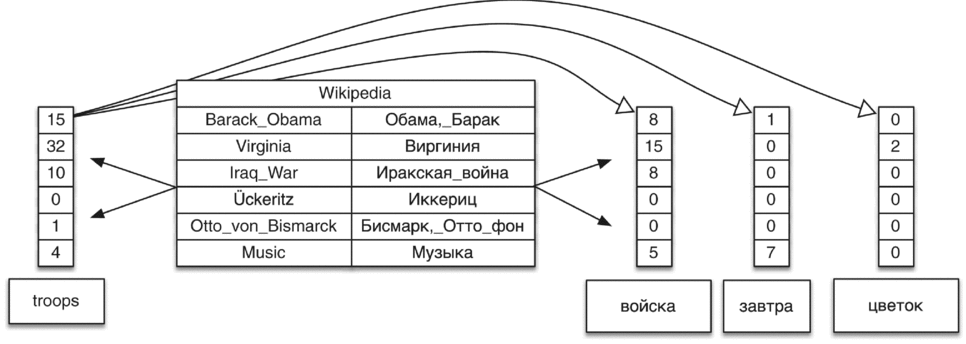
(3)The length of a word’s topic vector is the number of interlingually linked article pairs. Each component fk of Ftopic is the count of the word f in the foreign article from the kth linked article pair, normalized by the total occurrences of k. The dimensionality of the topic signatures varies depending on the language pair. The number of linked articles in Wikipedia range from 84 (between Kashmiri and English) to over 500 thousand (between French and English). Figure 3 illustrates this signal. More details on our topic similarity are in Irvine (Reference Irvine2014).
$$\begin{equation}
sim_{topic}(F_{topic},E_{topic}) = \frac{F_{topic} \cdot E_{topic}}{||F_{topic}|| ||E_{topic}||}
\end{equation}$$
• Frequency similarity – Words that are translations of one another are likely to have similar relative frequencies in monolingual corpora. We measure the frequency similarity of two words, simfreq, as the absolute value of the difference between the log of their relative corpus frequencies, or
(4)This helps prevent high frequency closed class words from being considered viable translations of less frequent open class words.
$$\begin{equation}
sim_{freq}(e,f) = \left| log\left(\frac{freq(e)}{\sum _{i} freq(e_i)}\right) - log\left(\frac{freq(f)}{\sum _{i} freq(f_i)}\right) \right|
\end{equation}$$
• Burstiness similarity – Burstiness is a measure of how peaked a word’s usage is over a particular corpus of documents (Pierrehumbert Reference Pierrehumbert, Santos, Lindén and Nganga2012). Bursty words are topical words that tend to appear when some topic is discussed in a document. For example, earthquake and election are considered bursty. In contrast, non-bursty words are those that appear more consistently throughout documents discussing different topics, use and they, for example. Church and Gale (Reference Church and Gale1995, Reference Church, Gale, Armstrong, Church, Isabelle, Manzi, Tzoukermann and Yarowsky1999) provide an overview of several ways to measure burstiness empirically. Following Schafer and Yarowsky (Reference Schafer and Yarowsky2002), we measure the burstiness of a given word based on Inverse Document Frequency:
(5)where dfw is the number of documents that w appears in, and |D| is the total number of documents in the collection. We have also experimented with a second burstiness measure, similar to that defined by Church and Gale (Reference Church and Gale1995), as the average frequency of w divided by the per cent of documents in which w appears. We make one modification to the definition provided by Church and Gale (Reference Church and Gale1995) and use relative frequencies rather than absolute frequencies to account for varying document lengths:
$$\begin{equation}
IDF_{w} = - log \frac{df_w}{|D|}
\end{equation}$$
(6)where as before, dfw is the number of documents in which w appears and rf w di is the relative frequency of w in document di. Relative frequencies are raw frequencies normalized by document length.
$$\begin{equation}
B_{w} = \frac{\sum _{d_i \in D}{rf_{w{_{d_i}}}}}{df_w}
\end{equation}$$
• We also compute a number of variations on the above using word prefixes and suffixes instead of fully inflected words, and based on two different sources of data (web crawls and Wikipedia). In total, our model uses eighteen such features in order to rank English words as potential translations of the input foreign word.


Example of projecting contextual vectors over a seed bilingual lexicon. The Spanish word crecer appears in the context of the words empleo, extranjero, etc. in monolingual texts. We use this co-occurence information to build a context vector. Each position in the context vector for corresponds to a word in the Spanish vocabulary. The vector for crecer is projected into the English vector space using a small seed dictionary. Context vectors for all English words (policy, expand, etc.) are collected and then compared against the projected context vector for Spanish crecer. Finally, contextual similarities are calculated by comparing the projected vector with the context vector of each target word using cosine similarity. Word pairs with high cosine similarity are likely to be translations of one another.
Illustration of how we compute the topical similarity between troops and three Russian candidate translations. We first collect the topical signatures for each word (e.g. troops appears in the page about Barack Obama fifteen times and in the page about Virginia thirty-two times.) based on the interlingually linked pages. We can then directly compare each pair of topical signatures.
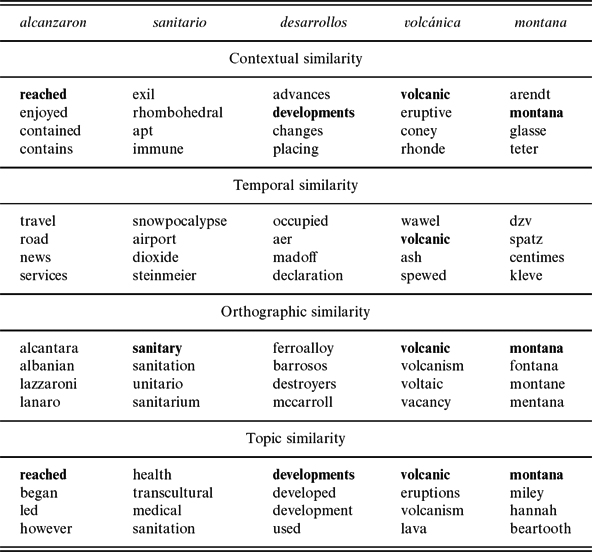
Table 1 shows some examples of the highest ranking English translations of five Spanish words for several of our signals of translation equivalence. Each signal produces different types of errors. For instance, using topic similarity, montana, miley and hannah are ranked highly as candidate translations of the Spanish word montana. The TV character Hannah Montana is played by actress Miley Cyrus, so the topic similarity between these words makes sense.
Examples of translation candidates ranked using contextual similarity, temporal similarity, orthographic similarity and topic similarity. The correct English translations, when found, are bolded
A significant research challenge is how best to combine these signals. Previous approaches have combined signals in an unsupervised fashion. One method of combining the ranked lists of translations that are independently generated by each of the signals of translation equivalence is using mean reciprocal rank (MRR), which is a measure typically used in information retrieval. It is defined as the average of the reciprocal ranks of results for a sample of queries Q:Footnote 3
 $$\begin{equation}
\textnormal {MRR} = \frac{1}{|Q|} \sum _{i=1}^{|Q|} \frac{1}{\textnormal {rank}_i}
\end{equation}$$
In the case of bilingual lexicon induction, we query each signal of translation equivalence with a source word, the value |Q| corresponds to the number of signals, and ranki corresponds to the rank of a target language translation under the ith signal. The translation with the highest MRR value is output as the best translation. The disparate of signals of translation equivalence all provide an equal contribution in MRR, regardless of how good they are at picking out good translations.
Instead of weighting each signal equally, we use a discriminative model that is trained using entries in the seed bilingual dictionary as positive examples of translations, and random word pairs as negative examples (we use a 1:3 ratio of positive to negative examples). Discriminative models have an advantage over MRR in that they are able to weight the contribution of each feature based on how well it predicts the translations of words in a development set. When feature weights are discriminatively set, these signals produce dramatically higher translation quality than MRR. In Irvine and Callison-Burch (Reference Irvine and Callison-Burch2015), we present experimental results showing consistent improvements in translation accuracy for twenty-five languages. The absolute accuracy increases over the MRR baseline ranges from five per cent–thirty-one per cent, which correspond to 36 per cent–216 per cent relative improvements. Our discriminative approach requires a small number of translations to use as a development set. This requirement is not a major imposition, since bilingual lexicon induction already typically requires a small seed bilingual dictionary.
2.2 Experiments with bilingual lexicon induction
We excerpt a number of experiments from Irvine and Callison-Burch (Reference Irvine and Callison-Burch2015) that show our method’s performance on four of the Indian languages that we examine in the end-to-end machine translation experiments (Section 5).
2.2.1 Data
We created bilingual dictionaries using native-language informants on Amazon Mechanical Turk. In Pavlick et al. (Reference Pavlick, Post, Irvine, Kachaev and Callison-Burch2014), we describe a study of the languages demographics of workers on Amazon Mechanical Turk. In that work, we focused on the hundred languages which have the largest number of Wikipedia articles and posted Human Intelligence Tasks asking workers to translate the 10, 000 most frequent words in the 1, 000 most viewed pages for each source language. For the experiments in this article, we filter the dictionaries to include only high quality translations. Specifically, we limit ourselves to words that occurred at least ten times in our monolingual data sets, and we only use translations that have a quality score of at least 0.6 under the worker quality metric defined by Pavlick et al. (Reference Pavlick, Post, Irvine, Kachaev and Callison-Burch2014). Workers provided between one and thirty two reference translations for each word (with an average of 1.4 translations per word).
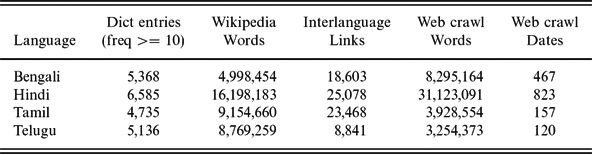
We gathered monolingual data sets by scraping online newspapers in each language, and by downloading the content of each language version of Wikipedia. For all languages, we use Wikipedia’s January 2014 data snapshots. Table 2 gives statistics about the monolingual data sets.
Statistics about the data used in our bilingual lexicon induction experiments
2.2.2 Measuring accuracy
We measure performance using accuracy in the top-k ranked translations. We define top-k accuracy over some set of ranked lists L as follows:
 $$\begin{equation}
acc_k = \frac{\sum _{l \in L}{I_{lk}}}{|L|}
\end{equation}$$
where Ilk is an indicator function that is 1 if and only if a correct item is included in the top-k elements of list l. That is, top-k accuracy is the proportion of ranked lists in a set of ranked lists for which a correct item is included anywhere in the highest k ranked elements. The denominator |L| is the number of words in a test set for a language. The numerator indicates how many of the words had at least one correct translation in the top-k translations posited for the word. Top-k accuracy increases as k increases.
A translation counts as correct if it appears in our bilingual dictionary for the language. We split our dictionaries into separate training and test sets. The test sets consist of 1, 000 randomly selected source language words and their translations. The training sets consist of the remaining words. We use the training set to project vectors for contextual similarity, and to train the weights of our discriminative model.
2.2.3 Experimental results
We answer the following research questions:
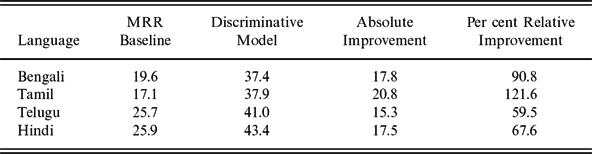
• How often does our discriminative model for bilingual induction produce a correct translation within its top-10 guesses? Table 3 gives the top-10 accuracy for our model on Bengali, Tamil, Telugu and Hindi, and shows its improvements over the standard unsupervised approach for combining multiple signals of translation equivalence.
• How much bilingual training data do we need in order to reach stable performance? We analyzed how accuracy changed as a function of the number of bilingual dictionary entries used to train the discriminative model. Figure 4 shows learning curves that hold steady after approximately 300 training words.
Fig. 4.Learning curves varying the number of dictionary entries used as positive training instances to our discriminative models, up to 1,000. For all languages, performance is fairly stable after about 300 positive training instances. The x-axis shows the number of dictionary entries used in training, and the y-axis gives the top-k accuracy of the model.
• How much monolingual data would we need? Figure 5 shows a learning curve function of the size of the monolingual corpora used to estimate the similarity scores that are used as features in the model. The accuracy continues to increase, even beyond 10 million words. More monolingual data is better, but it is sometimes difficult to acquire even monolingual data in huge volumes for low resource languages.
• How well can our models translate rare words versus frequent words? Figure 6 shows that words that appear with higher frequency in our monolingual corpora tend to be translated better. Pekar et al. (Reference Pekar, Mitkov, Blagoev and Mulloni2006) also investigated the effects of frequency on finding translations from comparable copper. This makes sense since we have more robust statistics when constructing their vector representations. The performance drops slightly for the highest frequency words, which are likely function words.
Bilingual lexicon induction learning curves over varying monolingual corpora sizes for Tamil. The x-axis is shown on a log scale.
Bilingual lexicon induction accuracy as a function of source word frequency in Wikipedia monolingual data. Frequency is plotted along the x-axis. Top-k accuracy for the model is given in the y-axis.
Top-10 Accuracy for bilingual lexicon induction on a test set. The accuracy increases significantly moving from the unsupervised MRR baseline to our discriminative model
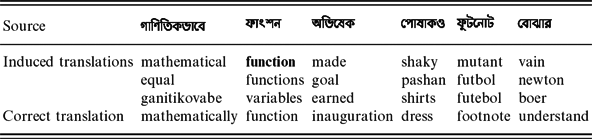
The effect of frequency has largely been ignored in past work on bilingual lexicon induction – most past work tried to discover translations only for the 1,000 most frequent words in a language.Footnote 4 The fact that low frequency words do not translate as well as high frequency words has significant implications for the application of bilingual lexicon induction to SMT. The most obvious use of learned translations would be as a way of augmenting what a SMT model learned from bitexts by applying bilingual lexicon induction to the OOV words. Unfortunately, the OOVs are lower frequency than the words that occurred in the bilingual training data. Therefore, the translations are of mixed quality. Table 4 shows some induced translations of Bengali words which were OOV with respect to a small bilingual training set.
Examples of OOV Bengali words, our top-3 ranked induced translations, and their correct translations. Correct induced translations are bolded
3 Transliterating OOV words
Transliteration is a critical subtask of machine translation. Many NEs (e.g. person names, organizations, locations) are transliterated rather than translated into other languages. That is, the sounds in the source language word are approximated with the target language phonology and orthography. NEs constitute an open class of words. The names of people and organizations, for example, often show up in new documents and are often OOV with respect to the bilingual training data. Transliteration is therefore an alternative way of dealing with OOV items, and may produce more robust results than bilingual lexicon induction for named entities (NEs) and cognates.
3.1 Our approach to transliteration
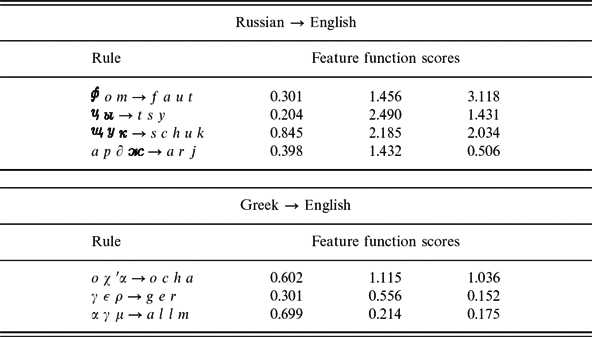
Following Virga and Khudanpur (Reference Virga and Khudanpur2003), we treat transliteration as a monotone character translation task. Rather than using a noisy channel model, our transliteration models is based on the log-linear formulation of SMT described in Och and Ney (Reference Och and Ney2002). Whereas SMT systems are trained on parallel sentences and use word-based n-gram language models, we use pairs of transliterated words along with character-based n-gram language models. We apply the word alignment algorithms from SMT to automatically align characters in pairs of transliterations. In fact, transliteration is simpler than translation, since phrases are often reordered in translation, but characters sequence are monotonic in transliteration. Our feature functions include a character sequence mapping probability (similar to the phrase translation probability), a character substitution probability (similar to the lexical probability), and a character-based language model probability. Table 5 shows some example transliteration rules that are learned using the SMT machinery.
Examples of automatically learned transliteration rules from Russian to English and from Greek to English, along with their associated log probabilities for a character sequence mapping probability, a character substitution probability, and a character-based language model probability
3.2 Transliteration experiments
3.2.1 Data
We can use the standard SMT pipeline to learn transliteration rules, and we can produce transliterations of previously unseen words using an SMT decoder. The key is simply to find appropriate parallel data that shows transliterated pairs across different character sets (like between English’s Roman alphabet and the Devanagari script used by Hindi). In Irvine et al. (Reference Irvine, Callison-Burch and Klementiev2010), we detailed how we mined transliteration training data from Wikipedia page titles for 150 languages. Wikipedia’s interlanguage links can be used as a source for example transliterations. We use the titles of non-Roman script languages that are paired with English pages that correspond to names. Wikipedia categorizes articles and maintains lists of all of the pages within each category. In mining transliteration data, we took advantage of a particular set of categories that list people born in a given year. For example, the Wikipedia category page ‘1961 births’ includes links to the ‘Barack Obama’ and ‘Michael J. Fox’ pages. We iterated through birth years and the links to pages about people born in each year and then followed interlingual links from each English page about a person, compiling a large list of person names (Wikipedia page titles) in many languages. We found a total of 8,26,508 English Wikipedia pages about people. A similar process could be done to scrape other types of NEs, for instance by iterating over Wikipedia page categories for things like ‘Countries in Africa’ or ‘Cities in Europe’, but the expected yield would be lower than the number of person names. Table 6 gives the number of pairs of names between the English articles and the Indian languages that we examine in our end-to-end SMT experiments.
The number of Wikipedia articles with interlanguage links to English Wikipedia articles that describe people. These name pairs are used as training data to our SMT-inspired transliteration system

3.2.2 Experimental results
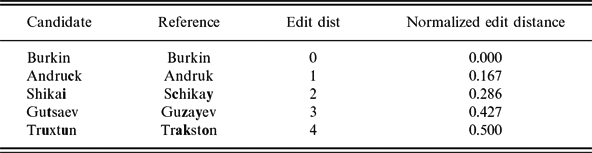
Here, we reproduce some of the experimental results from Irvine et al. (Reference Irvine, Callison-Burch and Klementiev2010) that demonstrate the quality of our transliteration system. We evaluated our transliteration system on the ACL 2009 NEs Workshop, which featured a shared task on transliteration (Li et al. Reference Li, Kumaran, Pervouchine and Zhang2009). The shared task evaluated systems trained to transliterate from English to several other languages using a variety of metrics. We used the workshop data to build a English–Hindi transliteration system, and compared our results against the other entries to the shared task. Table 7 shows our system’s performance on the NEWS task – it is competitive with other systems entered into the shared task. Table 8 shows some example transliterations produced by our system paired with reference transliterations. Sometimes the system produces near-misses that could still be useful.
A comparison of our performance (Irvine et al. Reference Irvine, Callison-Burch and Klementiev2010) against the systems submitted to the Hindi transliteration shared task at the ACL 2009 Named Entities Workshop. There were 4,840 training pairs for English → Hindi in the NEWS shared task

Example transliterations. Sometimes the errors are near-misses where the system’s proposed transliterations are only a few letters off from the reference transliteration. In these cases, the system does not receive any credit under metrics like the Bleu score, even though they may still be useful for human readers. Normalized edit distance is the number of edits divided by the length of the reference
In our end-to-end translation experiments, we output the single best transliteration of each OOV word using our transliteration model. This transliteration was placed alongside the top-k translations proposed by the bilingual lexicon induction module. Hermjakob, Knight and Daumé III (Reference Hermjakob, Knight and Daumé2008) trained a system so that it was able to learn when to transliterate versus translate. In our simpler setup, the SMT decoder had access to both transliterations and translations, and it used its model scores to select between the different options.
4 Building an end-to-end MT system with small parallel corpora
The parameters of statistical models of translation are typically estimated from bilingual parallel corpora (Brown et al. Reference Brown, Della Pietra, Della Pietra and Mercer1993). In Klementiev et al. (Reference Klementiev, Irvine, Callison-Burch and Yarowsky2012), we showed that it might be possible estimate the parameters of a phrase-based SMT system from monolingual corpora instead of a bilingual parallel corpus. We replaced the standard features from the phrase-based models (such as the phrase translation probabilities) with the monolingual signals of translation equivalence used in bilingual lexicon induction (Section 2). In the Klementiev et al. (Reference Klementiev, Irvine, Callison-Burch and Yarowsky2012) study, we worked with estimating the parameters from Spanish–English, and we had an idealized scenario in that we performed bilingual lexicon induction on two halves of a bilingual parallel corpus. We further showed that keeping all of the standard bilingually estimated features and adding monolingually estimated features from bilingual lexicon induction seemed to improve the translation quality over bilingual features alone.
In this section, we do a deeper analysis of the experiments that we originally published in Irvine and Callison-Burch (Reference Irvine and Callison-Burch2013a). We enhanced the phrase tables for six low-resource Indian languages (translating Tamil, Telugu, Bengali, Malayalam, Hindi and Urdu into English). We examine two ways of improving the quality of low-resource machine translation:
• We add translations of OOV words (and of low-frequency words) using our discriminative bilingual lexicon induction model. This allows better coverage by the models of the words in the test set that do not appear, or appear only rarely, in the training data.
• We incorporate new features into the SMT model based on the different signals of translation equivalence that we use our bilingual lexicon induction method. The features are included both for monolingually induced translations, and for translations learned from the small bitexts. The features are combined in a log linear model, and their weights are set using batch MIRA (Cherry and Foster Reference Cherry and Foster2012).
For all six languages, we see improvements in translation quality, ranging from 0.6 to 1.7 BLEU points. These experiments represent a realistic way of improving SMT using bilingual lexicon induction for genuinely low resource languages.
4.1 Data
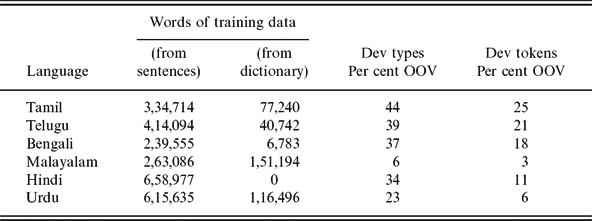
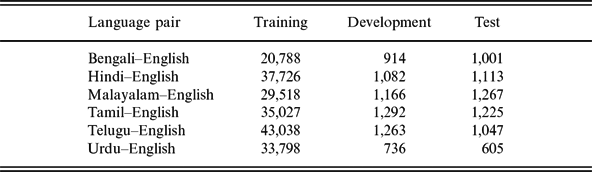
Post, Callison-Burch and Osborne (Reference Post, Callison-Burch and Osborne2012) used Amazon Mechanical Turk to collect small parallel corpora for the following Indian languages and English: Tamil, Telugu, Bengali, Malayalam, Hindi and Urdu. They collected both parallel sentence pairs and a dictionary of word translations. We use all six datasets, which provide real low resource data conditions for six truly low resource language pairs. Tables 9 and 10 show statistics about the datasets.
Information about datasets released by Post et al. (Reference Post, Callison-Burch and Osborne2012): words in the source language parallel sentences and dictionaries, and per cent of development set word types and tokens that are OOV (do not appear in either section of the training data). Post et al. (Reference Post, Callison-Burch and Osborne2012) did not provide a dictionary for Hindi, so we exclude it from the baseline SMT system
The number of sentence pairs in the training/dev/test set splits for the Indian-language bilingual parallel corpora released by (Post et al. Reference Post, Callison-Burch and Osborne2012)
As usual, we use both our web crawls and our Wikipedia comparable corpora for each language pair. Dataset sizes are given in Table 2 for Bengali, Hindi, Tamil and Telugu. For Malayalam, we had 4 million words in our web crawled data, and 5 million words in our Wikipedia data (with 17,000 interlanguage links). For Urdu, we had 285 million words in our web crawled data, and 3 million words in our Wikipedia data (with 15,000 interlanguage links).
4.2 Experimental setup
We use the training/development/test data splits given by Post et al. (Reference Post, Callison-Burch and Osborne2012) and, following that work, include the dictionaries in the training data and report results on the devtest set using case-insensitive BLEU and four references. We use the Moses phrase-based MT framework (Koehn et al. Reference Koehn, Hoang, Birch, Callison-Burch, Federico, Bertoldi, Cowan, Shen, Moran, Zens, Dyer, Bojar, Constantin and Herbst2007). For each language, we extract a phrase table with a phrase limit of seven. In order to make our results comparable to those presented in Post et al. (Reference Post, Callison-Burch and Osborne2012), we follow that work and use the English side of the training data to train a language model. Using a language model trained on a larger corpus (e.g. the English side of our comparable corpora) may yield better results, but such an improvement is orthogonal to the focus of this work. Throughout our experiments, we use the batch version of MIRA (Cherry and Foster Reference Cherry and Foster2012) for tuning the feature set. We rerun tuning for all experimental conditions and report results averaged over three tuning runs (Clark et al. Reference Clark, Dyer, Lavie and Smith2011).
Our baseline uses the bilingually extracted phrase pairs and standard translation probability features. We augment it with the single top-ranked translation for each OOV to improve coverage (+ OOV Trans) and with additional features to improve accuracy (+Features). We make each modification separately and then together. Then, we present additional experiments where we induce translations for low frequency words, in addition to OOVs (4.2.3), append top-k translations (4.2.4), vary the amount of training data used to induce the baseline model (4.2.5), and vary the amount of comparable corpora used to estimate features and induce translations (4.2.6).
4.2.1 Results: bilingual lexicon induction
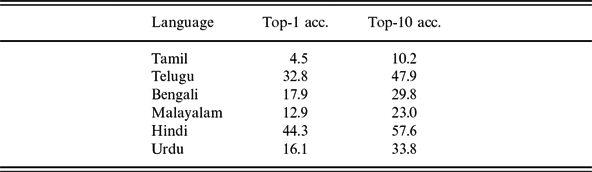
Before presenting end-to-end MT results, we examine the performance of the supervised bilingual lexicon induction technique that we use for translating OOVs. In Table 11, top-1 accuracy is the per cent of source language words in a held out portion of the training dataFootnote 5 for which the highest ranked English candidate is a correct translation. Post et al. (Reference Post, Callison-Burch and Osborne2012) gathered up to six translations for each source word, so some have multiple correct translations. Performance is lowest for Tamil and highest for Hindi. For all languages, top-10 accuracy is much higher than the top-1 accuracy. In Section 4.2.4, we explore appending the top-k translations for OOV words to our model instead of just the top-1.
Per cent of word types in a held out portion of the training data which are translated correctly by our bilingual lexicon induction technique. Evaluation is over the top-1 and top-10 outputs in the ranked lists for each source word

4.2.2 Improving coverage and accuracy in end-to-end SMT
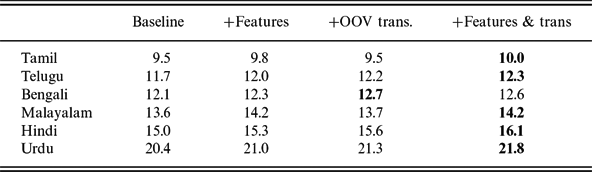
Table 12 shows our results adding OOV translations, adding features and then both. Simply adding monolingually estimated features functions to the phrase table improves our models’ accuracy, increasing BLEU scores between 0.18 (Bengali) and 0.60 (Malayalam).
BLEU scores improve for all six low resource languages when we add translations of OOV using bilingual lexicon induction (+OOV Trans.), and when we add monolingually derived features to the standard phrase table features (+Features). The greatest gains come from incorporating both OOV translations and new features (+Features & Trans)
Adding OOV translations makes a big difference for some languages, such as Bengali and Urdu, and almost no difference for others, like Malayalam and Tamil. The OOV rate (Table 9) is low in the Malayalam dataset and high in the Tamil dataset. However, as Table 11 shows, the translation induction accuracy is low for both. Since few of the supplemental translations are correct, we don’t observe BLEU gains. In contrast, induction accuracies for the other languages are higher, OOV rates are substantial, and we do observe moderate BLEU improvements by supplementing phrase tables with OOV translations.
Combining the two methods results in translations that are better than applying either technique alone for five of the six languages. BLEU gains range from 0.5 (Bengali) to 1.4 (Urdu). We attribute the particularly good Urdu performance to the relatively large monolingual corpora (Table 2). In Section 4.2.6, we present results varying the amount of Urdu–English comparable corpora used to induce translations and estimate additional features.
4.2.3 Translations of low frequency words
Beyond adding translations just for strictly OOV words, we wanted to evaluate whether bilingual lexicon induction could also be useful for low frequency words. Strictly speaking, adding translations of OOV words will never decrease the BLEU score, since even adding in a random translation is no worse (under BLEU) than outputting a foreign word written in a non-Roman script.
For source words which only appear a few times in the parallel training text, the bilingually extracted translations in the standard phrase table are likely to be inaccurate and incomplete. Augmenting a model with additional translations for low frequency words may fix some other types of errors, for instance, a source word was observed in training with a translation that is not the correct sense for the test set.
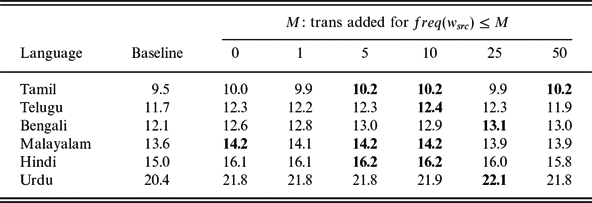
We perform additional experiments varying the minimum source word training data frequency for which we induce additional translations. That is, if freq(wsrc) ⩽ M, we induce a new translation for it and include that translation in our phrase table. Note that in the results presented in Table 12, M = 0, meaning that it only adds induced translations for OOVs and not for low frequency words that occurred once or more in the training data. In these experiments, we include our additional phrase table features estimated over comparable corpora and hope that these scores will assist the model in choosing among multiple translation options for low frequency words, one or more of which is extracted bilingually and one of which is induced using comparable corpora. Table 13 shows the results when we vary M. As before, we average BLEU scores over three tuning runs.
Varying minimum parallel training data frequency of source words for which new translations are induced and included in the phrase-based model. In all cases, the top-1 induced translation is added to the phrase table and features estimated over comparable corpora are included (i.e. +Feats & Trans model)
In general, modest BLEU score gains are made as we augment our phrase-based models with induced translations of low frequency words. The highest performance is achieved when M is between 5 and 50, depending on language. The largest gains are 0.5 and 0.3 BLEU points for Bengali and Urdu, respectively, at M = 25. This is not surprising; we also saw the largest relative gains for those two languages when we added OOV translations to our baseline model. With the addition of low frequency translations, our highest performing Urdu model achieves a BLEU score that is 1.7 points higher than the baseline.
In different data conditions, inducing translations for low frequency words may result in better or worse performance. For example, the size of the training set impacts the quality of automatic word alignments, which in turn impacts the reliability of translations of low frequency words. However, the experiments detailed here suggest that including induced translations of low frequency words will not hurt performance and may improve it.
4.2.4 Appending top-k translations
So far we have only added the top-1 induced translation for OOV and low frequency source words to our phrase-based model. However, the bilingual lexicon induction results in Table 11 show that accuracies in the top-10 ranked translations are, on average, nearly twice the top-1 accuracies. Here, we explore adding the top-k induced translations. We hope that our additional phrase table features estimated over comparable corpora will enable the decoder to correctly choose between the k translation options. We induce translations for OOV words only (M = 0) and include all comparable corpora features.
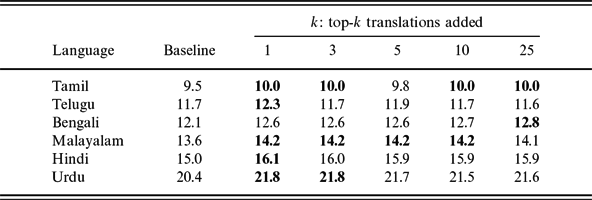
Table 14 shows performance as we append the top-k ranked translations for each OOV word and vary k. With the exception of Bengali, using a k greater than 1 does not increase performance. In the case of Bengali, and additional 0.2 BLEU is observed when the top-25 translations are appended. In contrast, we see performance decrease substantially for other languages (0.7 BLEU for Telugu and 0.2 for Urdu) when the top-25 translations are used. Therefore, we conclude that, in general, the models do not sufficiently distinguish good from bad translations when we append more than just the top-1. Although using a k greater than 1 means that more correct translations are in the phrase table, it also increases the number of possible outputs over which the decoder must search.
Adding top-k induced translations for source language OOV words, varying k. Features estimated over comparable corpora are included (i.e. +Feats & Trans model). The highest BLEU score for each language is highlighted. In many cases, differences are less than 0.1 BLEU
4.2.5 Learning curves over parallel data
In the experiments above, we only evaluated our methods for improving the accuracy and coverage of models trained on small amounts of bitext using the full parallel training corpora released by Post et al. (Reference Post, Callison-Burch and Osborne2012). Here, we apply the same techniques but vary the amount of parallel data in order to generate learning curves. Figure 7 shows learning cures for all six languages. In all cases, results are averaged over three tuning runs. We sample both parallel sentences and dictionary entries.
Comparison of learning curves over lines of parallel training data for four SMT systems: our baseline phrase-based model (baseline), model that supplements the baseline with translations of OOV words induced using our supervised bilingual lexicon induction framework (+Trans), model that supplements the baseline with additional phrase table features estimated over comparable corpora (+Feats) and a system that supplements the baseline with both OOV translations and additional features (+Trans & Feats).
All six learning curves show similar trends. In all experimental conditions, BLEU performance increases approximately linearly with the log of the amount of training data. Additionally, supplementing the baseline with OOV translations improves performance more than supplementing the baseline with additional phrase table scores based on comparable corpora. However, in most cases, supplementing the baseline with both translations and features improves performance more than either alone. Performance gains are greatest when very little training data is used. The Urdu learning curve shows the most gains as well as the cleanest trends across training data amounts. As before, we attribute this to the relatively large comparable corpora available for Urdu.
4.2.6 Learning curves over comparable corpora
In our final experiment, we consider the effect of the amount of bilingual comparable corpora that we use to estimate features and induce translations. We present learning curves for Urdu–English because we have the largest amount of monolingual corpora for that pair. We use the full amount of parallel data to train a baseline model, and then we randomly sample varying amounts of our Urdu–English monolingual corpora. Sampling is done separately for the web crawl and Wikipedia comparable corpora. Figure 8 shows the results. As before, results are averaged over three tuning runs.
Urdu to English translation results using varying amounts of monolingual corpora to estimate features and induce translations.
The phrase table features estimated over comparable corpora improve end-to-end MT performance more with increasing amounts of comparable corpora. In contrast, the amount of comparable corpora used to induce OOV translations does not impact the performance of the resulting MT system as much. The difference may be due to the fact that data sparsity is always more of an issue when estimating features over phrase pairs than when estimating features over word pairs because phrases appear less frequently than words in monolingual corpora. Our comparable corpora features are estimated over phrase pairs while translations are only induced for OOV words, not phrases. So, it makes sense that the former would benefit more from larger monolingual corpora.
5 Building an end-to-end MT system with zero versus small bitexts
In this section, we build several end-to-end Hindi–English SMT systems. We use a variety of techniques to construct the translation models, including using existing (incomplete) bilingual dictionaries to gloss the text, and using our transliteration model and our bilingual induction model to translate OOV words. We translate two (arbitrary chosen) Hindi Wikipedia pages about Islam and Forests. We qualitatively evaluate the output our a system that uses no bilingual sentence-aligned parallel corpora and compare it to the output of models trained with small amounts of bitexts.
We generate a Hindi–English phrase tables in the following way:
• We add all entries from the Hindi–English bilingual dictionaries. The existence of a bilingual dictionary is more likely than a large sentence-aligned bilingual parallel corpus, and it is required for our bilingual lexicon induction model.
• We generate the one-best transliteration for all non-Roman script words in the Hindi articles. As we described in Section 3, we do transliteration by training character-based translation models on Wikipedia page titles.
• We generate the top-10 translations for all OOV Hindi words using our bilingual induction model.
• Then, we score each patchwork phrase table using the following similarity features: web crawl contextual similarity, web crawl temporal similarity, Wikipedia contextual similarity, Wikipedia topic similarity and orthographic similarity.
In addition to generating the phrase table, we also use a language model computed over the entire English Wikipedia, except for the English versions of the pages which we wish to translate.
Typically in SMT, in addition to using parallel corpora to estimate, the parameters of an SMT model, a small bitext is also used as a development set to tune the feature weights of the log linear model. Since we are assuming a zero bitext setting here, we also assume that there is no such data available for tuning. Rather than tuning the parameters specifically for Hindi-to-English, we reuse the weights that were learned for a Bengali-to-English MT experiment that used the same set of monolingually derived features. The choice to reuse the model parameters from Bengali rather than some other language was arbitrary. Of course, the source language and corpora change substantially in these new experiments, and the optimal weights are unlikely to be the same.
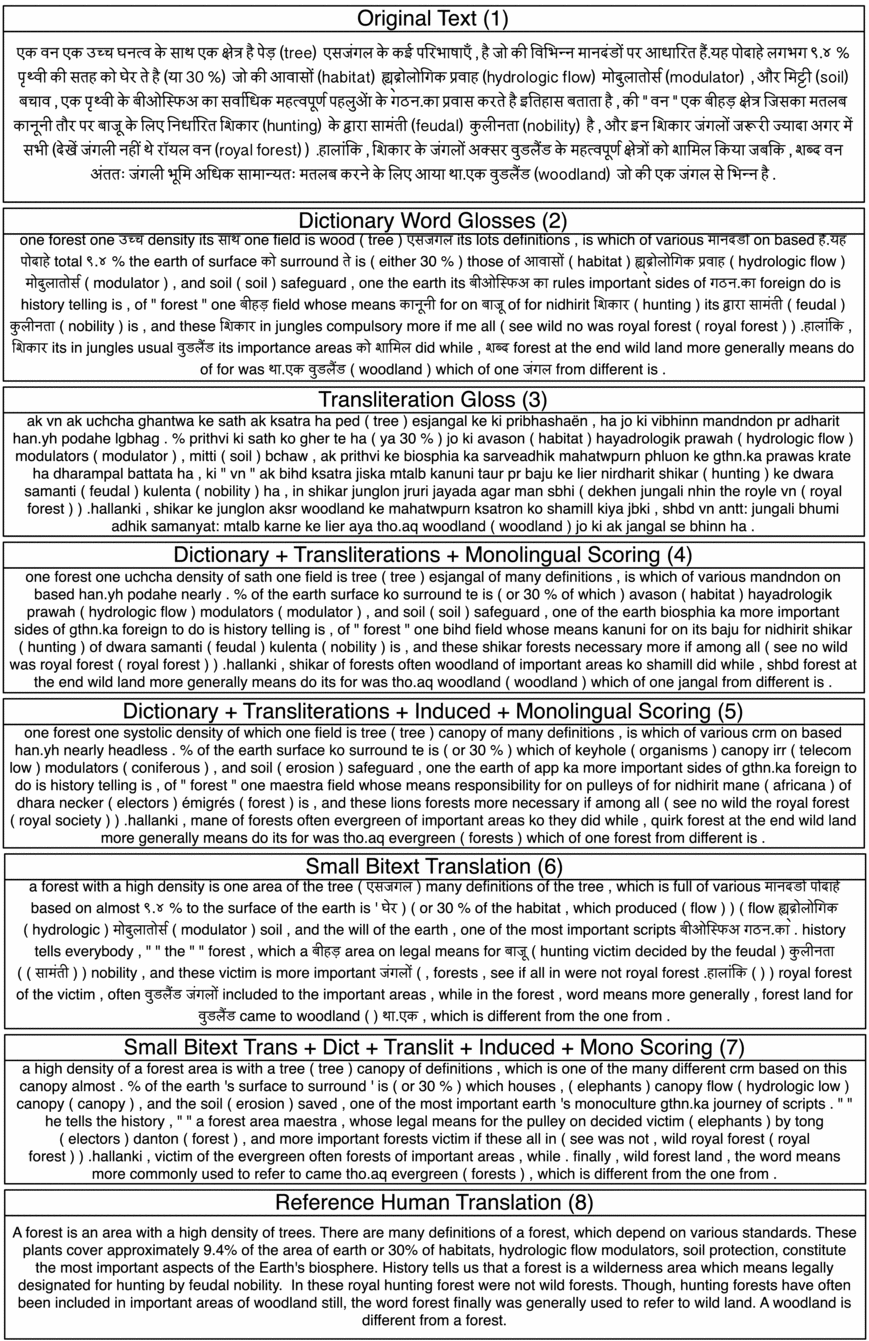
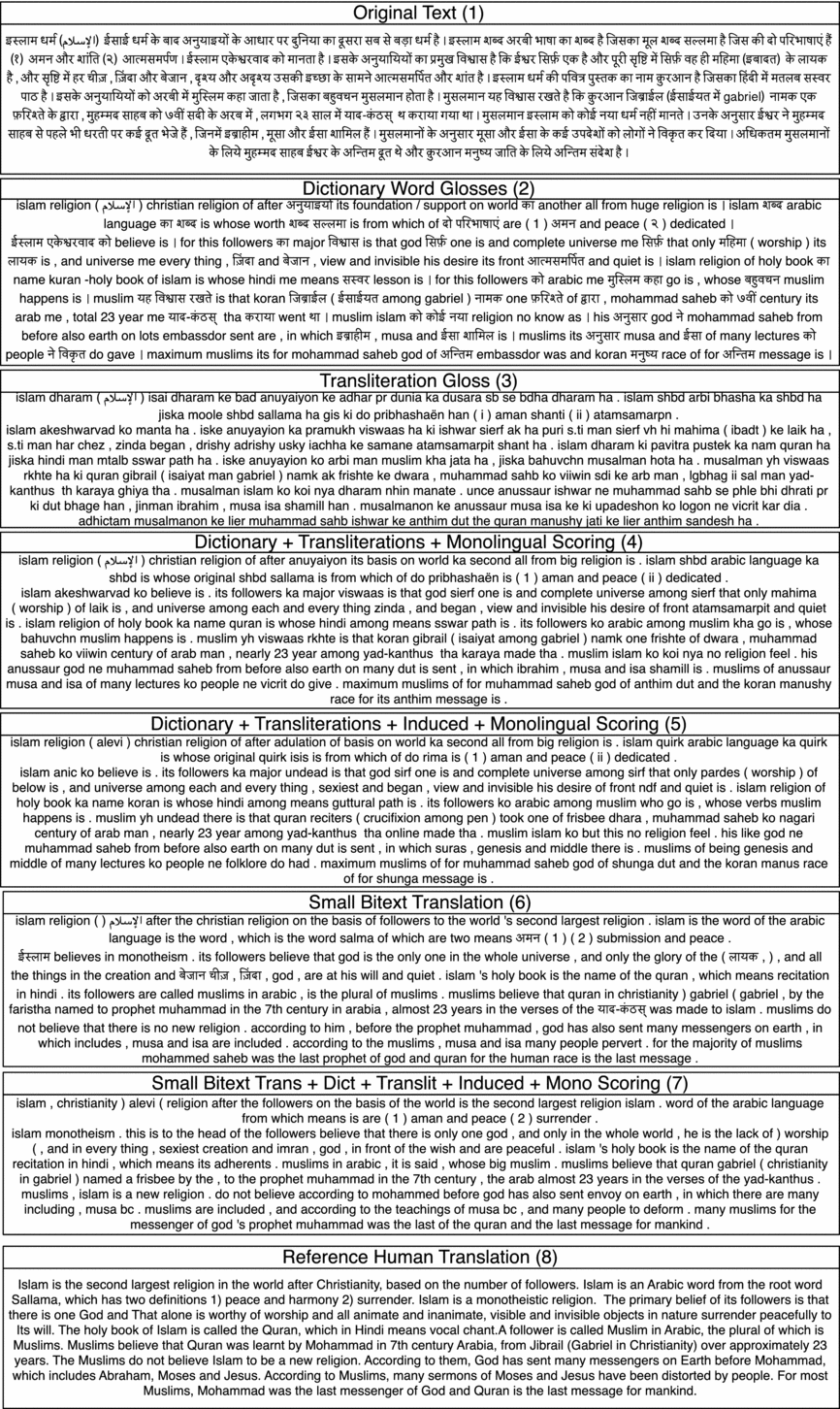
Rather than evaluating these translations with an automatic metric like BLEU, we show example translations and evaluate them qualitatively. Because the topics are familiar, it is possible to read the output and get a sense of the translation quality. Figures 9 and 10 (pages 542 and 543) show the first few sentences of the Hindi Wikipedia pages on Forest and Islam translated several ways. In each figure, we show the Hindi source paragraph and the different ways that it can be rendered into English. The figures show the following:
(1) The original Hindi paragraph.
(2) The dictionary to gloss the Hindi words into English. The dictionary gloss is based on bilingual dictionaries that we collected on Amazon Mechanical Turk. If the dictionary contain more than one translation of a given word, we pick one randomly. The dictionary glosses are somewhat readable, but there are many OOV words.
(3) A transliteration of each of the Hindi words into Roman script. Although the transliterations of some cognates, including hayadrologik and biosphia in the forest translation, are understandable, most words are not. The number of cognates and NEs, which can often be accurately transliterated instead of translated, varies by subject matter. For example, in the Hindi page on Barack Obama, there are many more ‘transliteratable’ words than the Hindi page on forests.
(4) Here, we construct a phrase table with the dictionary translations and transliterations. The monolingually derived scores allow us to select between dictionary translations and transliterations (and to select between alternate translations when there are multiple entries in the bilingual dictionary). The results are much better translations than either gloss. For translations 4–7, we use a 5-gram language model trained on the English gigaword corpus.
(5) Here, we construct the phrase table not only with the dictionary translations and transliterations, but also with the top-10 translations that we induce for each Hindi word by the bilingual induction model presented in Section 2. This is a full transliteration model estimated using no parallel training data whatsoever. Introducing induced translations has several noticeably positive effects. For example, in the first sentence of the forest translation, the transliterations uchucha, esjangal and podahe are used in the ‘Dictionary + Transliterations + Monolingual Scoring’ model. Here, we instead use the corresponding induced translations systolic, canopy and headless instead of the non-sensical transliterations. None of these words is a completely accurate translation, but they are closer than the non-sensical transliterations. This condition represents the most complete system that we can build with zero bitexts.
(6) This translation is produced by the model trained on our small Hindi training bitext (used in Section 4). This is the type of translation that results from running standard SMT on low resource language pairs. There is a relatively high OOV rate, but the words that are seen in the bitext are translated fairly reasonably.
(7) The final translation takes advantage of our entire bag of tricks: the small training bitext, our bilingual dictionaries, transliterations, induced translations and monolingual scoring. The phrase table is populated with the top-10 induced translations, top-1 transliterations, dictionary pairs and phrase pairs extracted from the word aligned training text. Each phrase pair is scored monolingually and those taken from the bitext are also scored bilingually. Like the dictionary word gloss, using the model trained on the small bitext to translate the Hindi text alone results in many OOV words. However, using the small bitext allows us to accurately translate function words plus common words and phrase, for example which is and one of the most important.
(8) A human reference translation.
First paragraph of Hindi Wikipedia page on Forest, and a progression of translations of it.
First paragraph of Hindi Wikipedia page on Islam, and a progression of translations of it.
Qualitatively, we prefer the final automatic translation (7) over the other automatic translations (2–6) for the Hindi articles about forests and Islam. This model takes advantage of both bilingual and monolingual resources. Although the translations are certainly not publishable in any of the conditions, they are useful for understanding the gist of the text, and even the zero-bitext translation (5) might be useful for downstream NLP technologies like topic detection and tracking systems (Church and Hovy Reference Church and Hovy1993).
6 Discussion and other related work
In this article, we have assumed that a bilingual dictionary is available. Several past efforts have tried to eliminate even this assumption. Notably, Ravi and Knight (Reference Ravi and Knight2011) built a full machine translation system using decipherment techniques. With these techniques, they are able to produce translations without bilingual parallel corpora, and without bilingual dictionaries.
Other approaches to bilingual lexicon induction attempt to do away with the requirement of having a seed bilingual dictionary. Vulić, De Smet and Moens (Reference Vulić, De Smet and Moens2011) propose a bilingual Latent Dirichlet Allocation model for finding translations from comparable corpora without using any other linguistic resources. Other bilingual lexicon induction techniques, from Koehn and Knight (Reference Koehn and Knight2002) and Peirsman and Padó (Reference Peirsman and Padó2010), have tried to solve the problem of projecting across the vector spaces for two languages by seeding with orthographically similar words instead of small bilingual dictionaries. Vulić and Moens (Reference Vulić and Moens2013) presents a systematic study of different ways of bootstrapping the projection across the vector spaces of two languages. Chu, Nakazawa and Kurohashi (Reference Chu, Nakazawa, Kurohashi and Gelbukh2014) also does away with the seed bilingual dictionary by first using topic models to find similar words, and then using those as the seed to a context-based model.
7 Conclusion
In this article, we used bilingual lexicon induction techniques to create and re-score phrase tables for a machine translation system for low resource languages. We pushed the idea of learning translations from monolingual corpora to its logical conclusion by building a full end-to-end machine translation system without any of the sentence-aligned bilingual parallel training data that is typically required by SMT systems. We additionally demonstrated that the induced translations and the associated scoring techniques can be used to improve the quality of SMT when we have only small amounts of parallel text to train our translation models. Rather than simulating a low-resource setting, we undertook the task of translating truly low resource languages.