In recent years, contaminated sink drains and other wastewater drainage sites have been linked to numerous outbreaks caused by gram-negative bacilli, including Pseudomonas spp and carbapenemase-producing organisms (CPOs).Reference Kizny Gordon, Mathers and Cheong1–Reference Smolders, Hendriks, Rogiers, Mul and Gordts8 These wastewater drainage sites provide optimal conditions for biofilm formation and plasmid-mediated sharing of resistance genes.Reference Parkes and Hota9,Reference Kanamori, Weber and Rutala10 Moreover, organisms colonizing sink drains can be dispersed from beneath the strainer to the sink bowl, and countertop, and to patients or personnel by splashing of flowing water.Reference Kotay, Chai, Guilford, Barry and Mathers11–Reference Gestrich, Jencson, Cadnum, Livingston, Wilson and Donskey13 Unfortunately, addressing sink contamination is challenging because sink drains are not amenable to cleaning and disinfection.Reference Cadnum, Livingston, Gestrich, Jencson, Wilson and Donskey14 For example, sinks in healthcare facilities typically have fixed, narrow strainer holes that do not permit access by brushes that could be used to remove bioburden prior to application of disinfectants.Reference Cadnum, Livingston, Gestrich, Jencson, Wilson and Donskey14
Several studies have suggested that pouring liquid disinfectants into sink drains may have only a modest and transient effect on sink colonization.Reference Starlander and Melhus4–Reference Leitner, Zarfel and Luxner7,Reference Parkes and Hota9,Reference Kanamori, Weber and Rutala10 The limited efficacy of this approach may be in part because liquid disinfectants flow rapidly down the drain, providing inadequate contact time and poor penetration into many of the areas harboring microorganisms.Reference Kanamori, Weber and Rutala10,Reference Cadnum, Livingston, Gestrich, Jencson, Wilson and Donskey14 Previously, we hypothesized that approaches that enhance contact time and penetration of disinfectant would improve the efficacy of sink disinfection.Reference Cadnum, Livingston, Gestrich, Jencson, Wilson and Donskey14,Reference Jones, Mana and Cadnum15 Use of a stop valve to allow a 1-hour instillation of disinfectant throughout the proximal drainage system reduced proximal sink drain colonization for several days, whereas pouring disinfectants down drains had only a transient impact.Reference Cadnum, Livingston, Gestrich, Jencson, Wilson and Donskey14 Similarly, Buchan et alReference Buchan, Arvan and Graham16 reported that a hydrogen peroxide–based foam disinfectant was more effective than liquid bleach in decreasing sink drain bacterial counts at 24 hours, but not 7 days, posttreatment, presumably due to longer persistence of foam within the drain. Here, we expand upon these previous studies by comparing the efficacy of 4 foam disinfectants. For the most effective product, we compared the efficacy of foam versus liquid applications and tested the efficacy of repeated foam treatments.
Methods
Setting and study design
The Cleveland VA Medical Center includes a 215-bed acute-care hospital and affiliated long-term care facility (LTCF). During a 5-month period, different methods for sink drain disinfection were evaluated in patient rooms on 5 hospital wards and in LTCF resident rooms on 4 wards. In total, 132 sinks were studied, including sinks located in patient bathrooms or inside the patient room. All sinks were automated and had an overflow drain in the sink bowl. However, the sinks in the facility had several designs that differed in shape and size of the bowl and drainage pipe orientation (ie, straight or curved pipe between strainer and P-trap).
Initially the efficacy of a single treatment with 4 different foam products for disinfection of the sink drains were compared. For the most effective product, the effectiveness of application as a foam versus as a liquid poured down the drain was evaluated. Finally, the efficacy of repeated foam treatments for sink disinfection was tested.
Comparison of the efficacy of 4 foam products applied as a single treatment
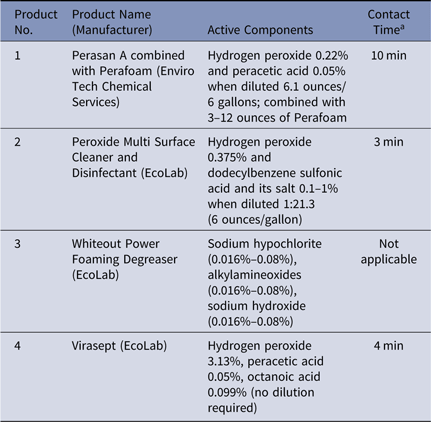
The characteristics of the 4 foam products tested are shown in Table 1. Peroxide Multi Surface Cleaner and Disinfectant (Ecolab, St Paul, MD) is the hydrogen peroxide-based (0.375%) product previously studied by Buchan et al.Reference Buchan, Arvan and Graham16 Virasept and Perasan A/Perafoam (Enviro Tech Chemical Services, Helena, AR) have higher concentrations of hydrogen peroxide than Peroxide Multi Surface Cleaner and Disinfectant and also contain peracetic acid. Whiteout Power Foaming Degreaser is not a disinfectant but rather is a degreaser; it contains sodium hypochlorite but in a concentration insufficient to provide substantial disinfectant activity. The foam for each product was generated from 300 mL liquid and delivered via a FOAM-iT 2.6-gallon foam unit (FOAM-iT, Grand Rapids, MI). Approximately 3 minutes was required for each foam application.
Characteristics of the Foam Products Tested

a Contact time for disinfectants based on manufacturers’ recommendations for Pseudomonas aeruginosa.
Prior to foam application, BBL culture swabs (Becton Dickinson, Franklin Lakes, NJ) premoistened with Dey-Engley neutralizing medium were used to sample the proximal sink drain to a depth of 2.4 cm (1 inch) below the strainer. Foaming disinfectant agents were applied to sink drains and overflow drains (N = 10 sinks for each foam product) with a dwell time of 15 minutes. The water was then run for 1 minute to flush the drain. Additional swabs were used to collect cultures from the sink drain immediately after treatment and on days 1, 2, 3, and 7 after treatment.
Comparison of a single foam application versus liquid pouring of disinfectant
The Virasept foam product was chosen for evaluation of the efficacy of foam versus liquid-pouring application. For comparison with the Virasept foam application (N = 33 sinks), liquid Virasept (N = 27 sinks) was poured down the sink drain in a volume equal to the volume used for the generation of foam (ie, 300 mL).
Comparison of a single liquid-pouring application of Virasept versus a bleach product
The efficacy of pouring 300 mL of Clorox germicidal bleach diluted 1:10 (sodium hypochlorite 0.825% when diluted) versus Virasept down sink drains (N = 8 sinks per group) was assessed. The bleach product was tested for comparison because pouring liquid bleach has frequently been used for sink disinfection. A foam application of bleach was not tested because the product is not amenable to foaming applications.
Effect of repeated treatment with a foam disinfectant on sink colonization
Four treatments with Virasept foam (N = 10 sinks) were applied as described previously at 3-day intervals (initial treatment and at days 3, 6, and 9 after the initial treatment). Swabs were used to sample the sink drains as previously described immediately after each treatment, at 1- to 3-day intervals between each treatment, and 1 and 4 days after the fourth treatment.
Microbiology
Swabs were vortexed in 200 µL phosphate-buffered saline for 1 minute. We then serially diluted 10-µL aliquots of the suspension, and plated them onto MacConkey agar (Becton Dickinson, Franklin Lakes, NJ), and incubated them for 24 hours at 37°C. The remaining 190 µL of suspension was also cultured to detect low concentrations of gram-negative bacilli. Colony-forming units (CFU) of total gram-negative bacilli per swab were calculated.
Data analysis
Repeated measures analysis of variance was used to compare the concentrations of gram-negative bacilli among the treatment groups. Significance was defined in this study as P < .05. When significant effects were detected using F tests, tests of contrasts were used to determine which time points differed among the groups. For the repeated-dosing group, the Mann-Kendall trend test was used to examine the concentrations of gram-negative bacilli over time. All analyses were performed using R version 3.5.1 statistical software (The R Foundation for Statistical Computing, Vienna, Austria).
Results
Comparison of the efficacy of 4 foam products applied as a single treatment
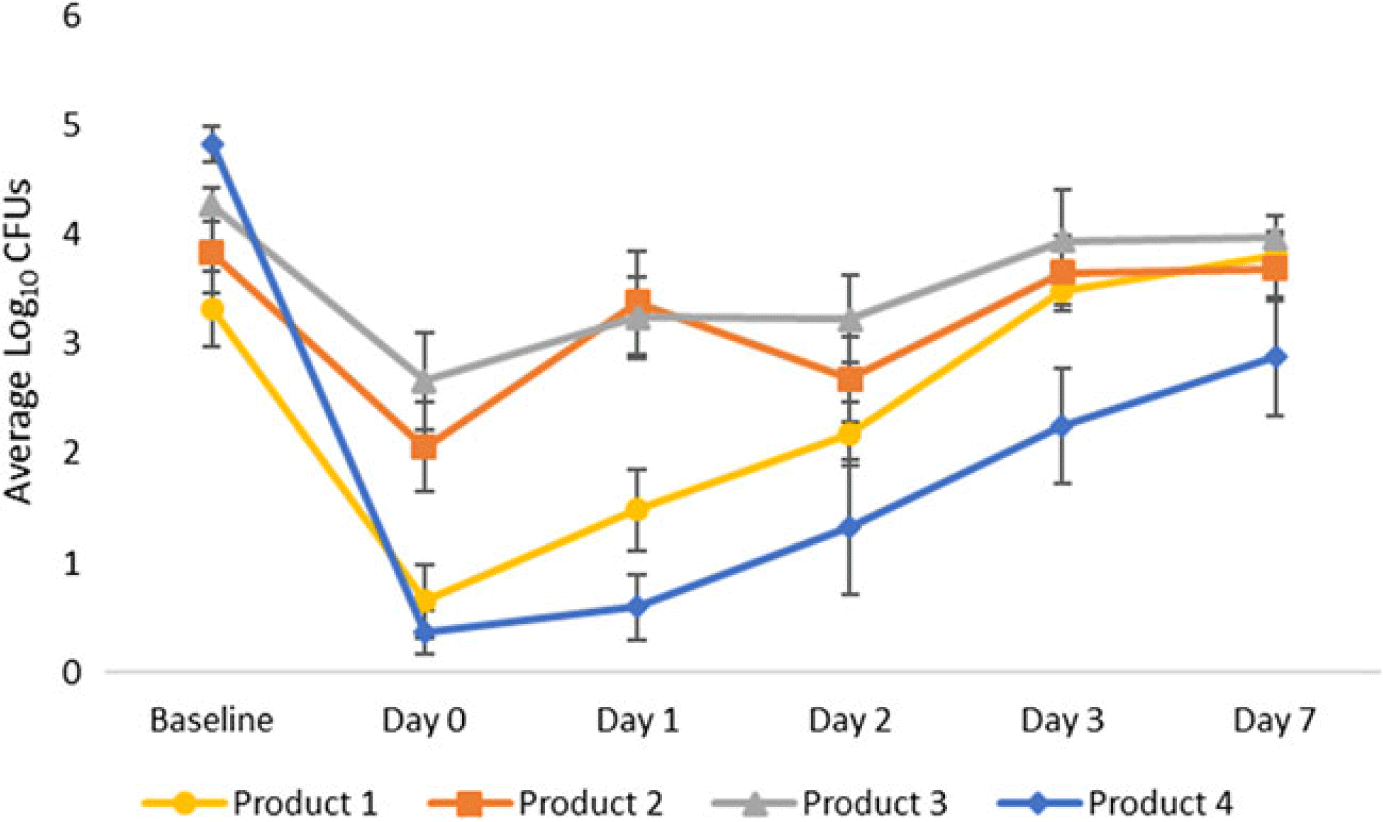
Figure 1 shows a comparison of the efficacy of the 4 foam products applied as a single treatment in reducing the burden of gram-negative bacilli in sink drains. At baseline, the mean concentration of gram-negative bacilli ranged from 3.3 to 4.8 log10 CFU per swab; the mean concentration was significantly higher for the Virasept-treated sinks than for the sinks treated with Perasan A/Perafoam (P < .05). After the initial treatment and on day 1 posttreatment, the Virasept and Perasan A/Perafoam-treated sinks had significantly lower concentrations of gram-negative bacilli than the sinks treated with the other products (P < .05). On days 2 and 3, the Virasept sinks maintained reduced concentrations of gram-negative bacilli in comparison to the sinks treated with Peroxide Multi Surfaces Cleaner and Disinfectant and Whiteout Power Foaming Degreaser (P < .05). At 7 days posttreatment, the sinks treated with Virasept maintained a 1.9 log10 CFU reduction in gram-negative bacilli recovered (2.9 log10 CFU per swab vs 4.8 at baseline).
Comparison of the efficacy of 4 foam products applied as a single treatment in reducing the burden of gram-negative bacilli recovered from sink drains (N = 10 per treatment group). Product 1, Perasan A combined with Perafoam; product 2, Peroxide Multi Surface Cleaner and Disinfectant; product 3, Whiteout Power Foaming Degreaser; and product 4, Virasept. Note. CFU, colony-forming unit. Error bars indicate standard error.

Comparison of a single foam application versus liquid pouring of disinfectant
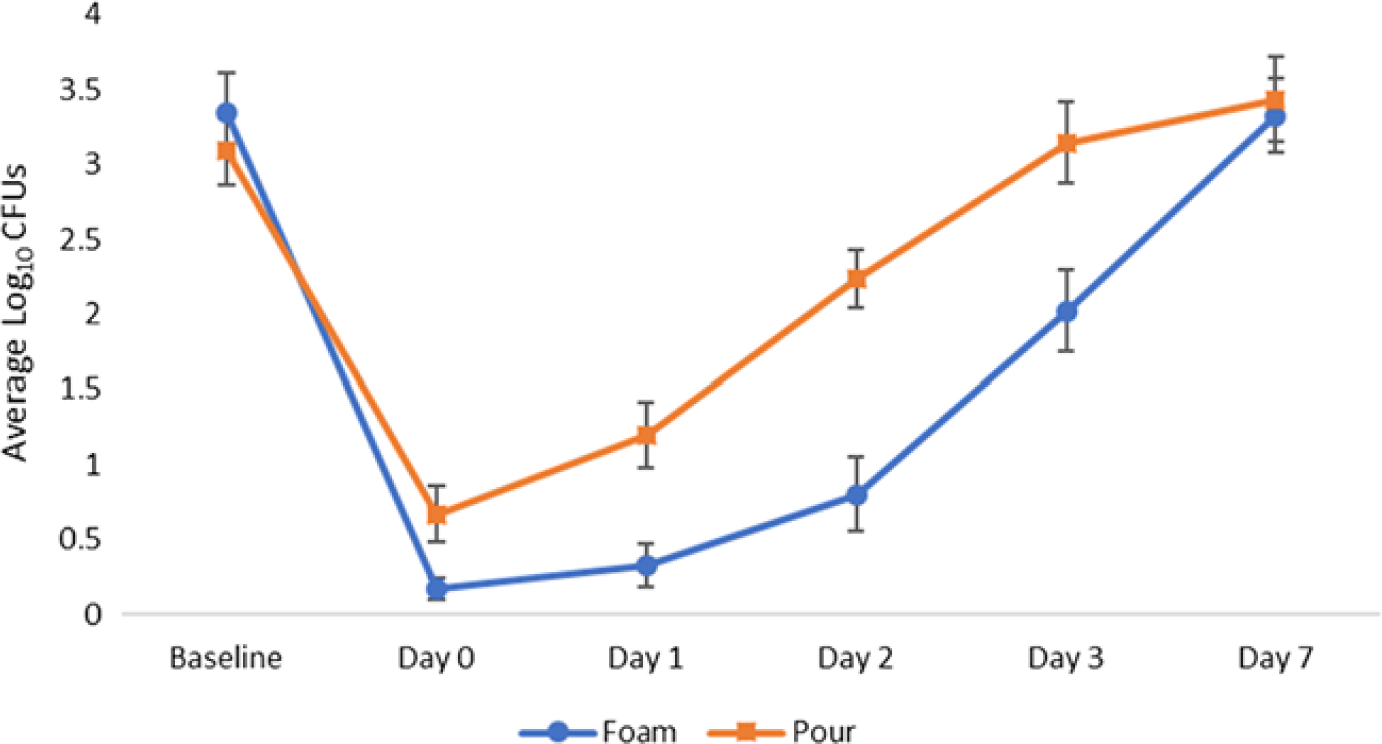
Figure 2 shows the effect of a single treatment with Virasept foam versus the same volume of Virasept poured down sink drains. At baseline, the mean concentration of gram-negative bacilli recovered from sink drains was similar for both treatments (P = .50). The foam application resulted in significantly reduced recovery of gram-negative bacilli in comparison to the liquid-pouring application after the initial treatment and on days 1, 2, and 3 after treatment (P < .05). By day 7 after treatment, the mean concentration of gram-negative bacilli in the foam-treated sinks had returned to the pretreatment baseline of 3.3 log10 CFU per swab and was not different than the treated sinks with liquid pouring (P = 1.0).
Effect of a single treatment with Virasept foam versus the same volume of Virasept liquid poured down sink drains (33 foam-treated and 27 liquid-treated sinks) on the burden of gram-negative bacilli recovered from sink drains. Note. CFU, colony-forming unit. Error bars indicate standard error.

Comparison of a single application of Virasept versus a bleach product poured as a liquid
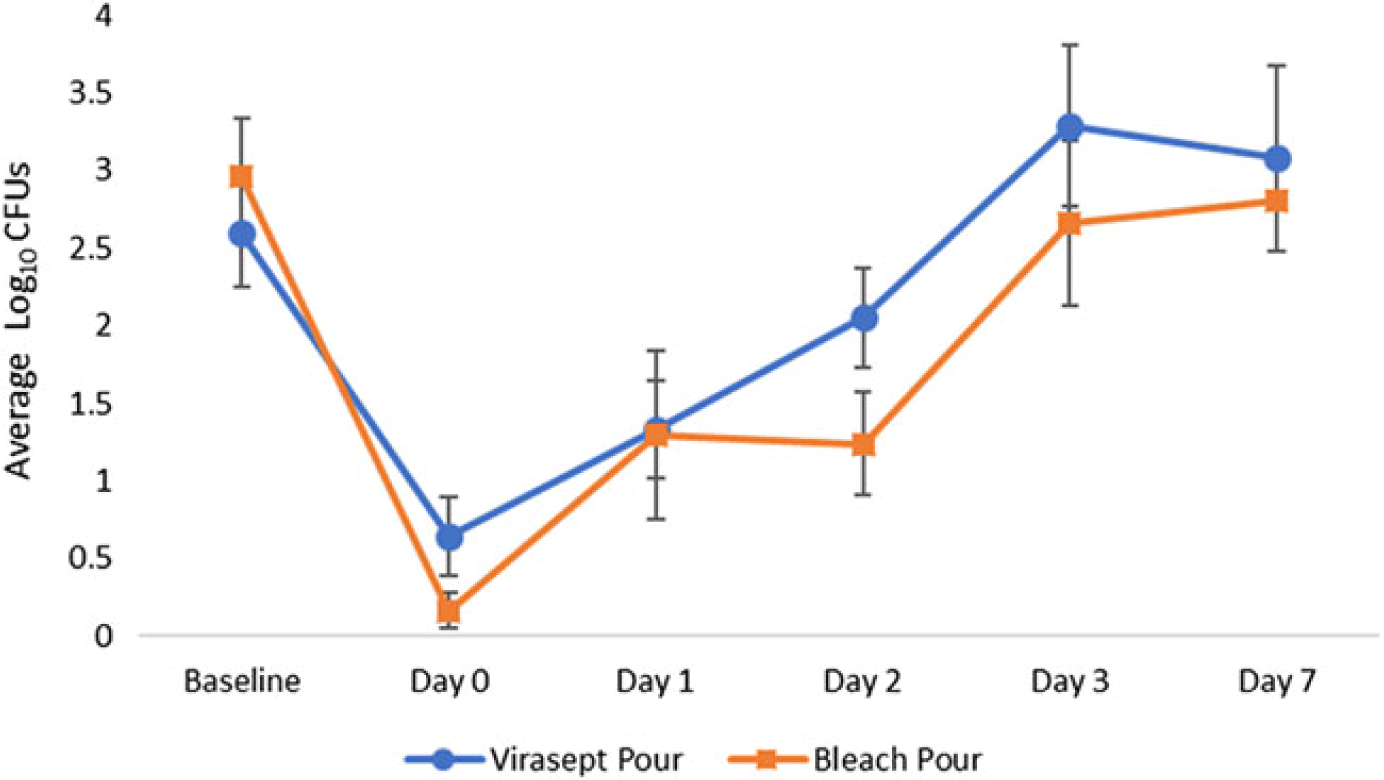
Figure 3 shows the comparison of a single liquid-pouring application of Virasept versus pouring a 1:10 dilution of liquid bleach. There was no significant difference in the concentrations of gram-negative bacilli recovered between the 2 groups at baseline and on days 1, 3, and 7; the bleach-treated sinks had significantly lower concentrations of gram-negative bacilli on day 2 (P < .05). For both treatments, the concentrations of gram-negative bacilli were >2.7 log10 CFU per swab by day 3 after treatment.
Effect of a single treatment with liquid pouring of Virasept versus liquid pouring of a 1:10 dilution of bleach on the burden of gram-negative bacilli recovered from sink drains (8 Virasept-treated sinks and 7 bleach-treated sinks). Note. CFU, colony-forming unit. Error bars indicate standard error.

Effect of repeated treatment with a foam disinfectant on sink colonization
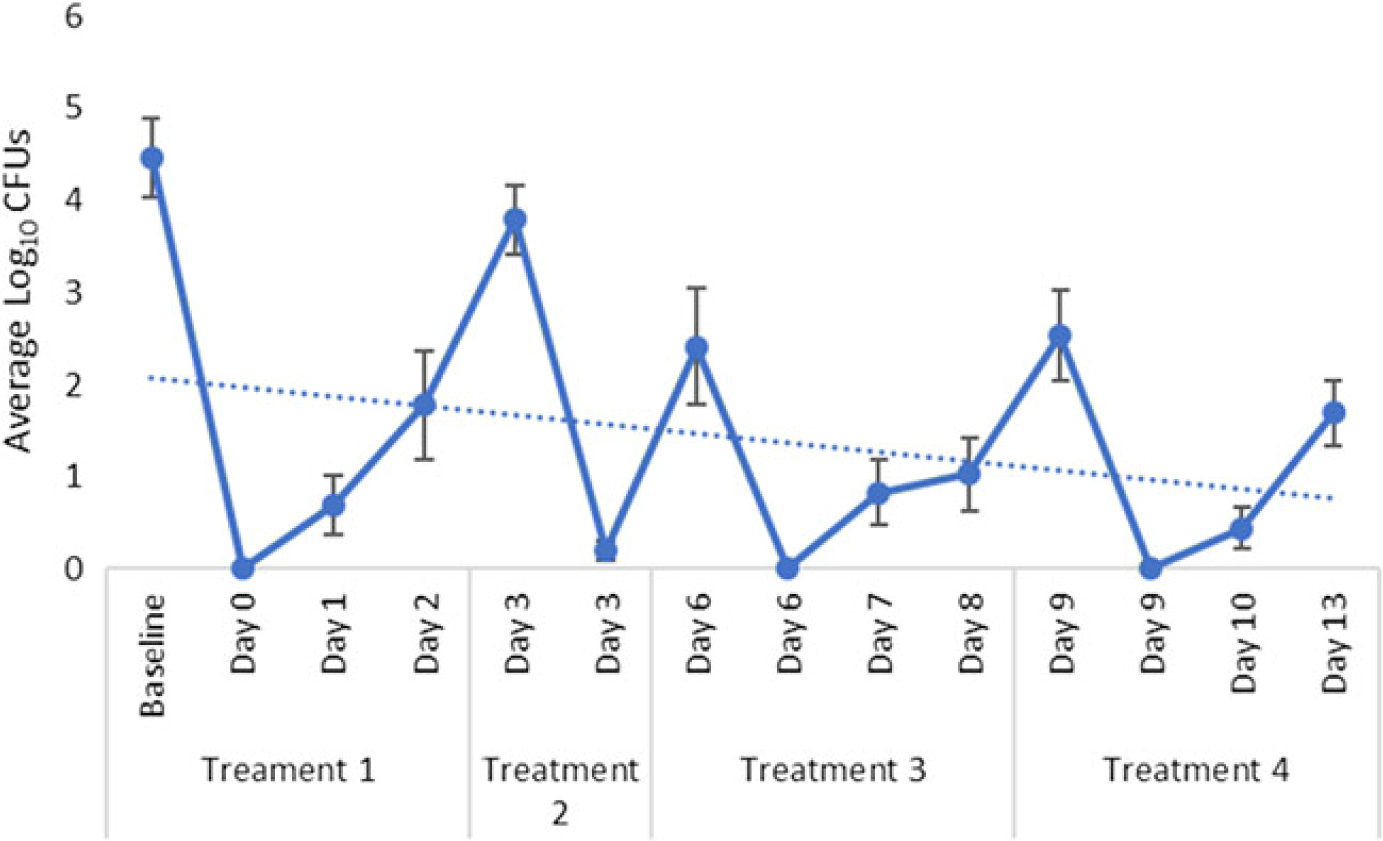
Figure 4 shows the effect of repeated treatment with a foam application of Virasept on the burden of gram-negative bacilli in sink drains. Immediately after the initial treatment, no gram-negative bacilli were recovered from the 10 treated sink drains. By day 3, however, the concentration increased to an average of 3.8 log10 CFU. The mean concentrations of gram-negative bacilli recovered prior to the day 6 and day 9 treatments and on day 13 (4 days after the fourth treatment) (2.4, 2.5, and 1.7 log10 CFU, respectively) were significantly lower than the mean concentrations recovered at baseline and prior to the day 3 treatment (P < .05). The Mann-Kendall trend test did not detect a statistically significant difference in the downward trend with repeated treatments between day 1 and day 13. On day 16 (7 days after the fourth treatment), the mean concentration of gram-negative bacilli had increased to 3.61 log10 CFU per swab.
Effect of repeated treatment with a foam application of Virasept on the burden of gram-negative bacilli recovered from sink drains (N = 10 sinks). Four treatments were applied, on days 0, 3, 6, and 9. The trendline was based on data collected between the baseline and day 13. Note. CFU, colony-forming unit. Error bars indicate standard error.

Discussion
Disinfection of sink drains is challenging because they are not amenable to standard methods of cleaning and disinfection. In sinks in a hospital and affiliated long-term care facility, our results demonstrate that a foam product containing 3.13% hydrogen peroxide and 0.05% peracetic acid was significantly more effective than other foam products tested. In comparison to pouring a liquid formulation of the hydrogen peroxide and peracetic acid disinfectant, the foam application resulted in significantly reduced recovery of gram-negative bacilli on days 1, 2, and 3 after treatment with a return to baseline by day 7. With repeated treatments every 3 days, the bacterial load recovered from sink drains progressively decrease, although the trend was not statistically significant. The bacterial load returned to baseline within 1 week after the treatments were discontinued. These results suggest that intermittent application of the foaming disinfectant could potentially reduce the risk for dissemination of pathogens from sink drains.
Our findings build upon previous studies that have evaluated poured-liquid and foam disinfectants for sink drain disinfection. Several studies have demonstrated that pouring liquid disinfectants down drains has only limited or transient efficacy in reducing sink drain colonization.Reference Smolders, Hendriks, Rogiers, Mul and Gordts8 Buchan et alReference Buchan, Arvan and Graham16 recently reported that one of the hydrogen peroxide foam products that we tested (product 2 in Table 1) was more effective than liquid bleach in decreasing sink drain bacterial counts at 1 day posttreatment but not at 7 days posttreatment. The authors noted that further studies were needed to examine contamination between days 1 and 7; we found that this product suppressed colonization immediately after treatment, but not on days 1, 2, or 3 after treatment. The reduced efficacy of the product in comparison to Virasept may be related to the fact that it has a lower concentration of hydrogen peroxide (0.375% vs 3.13%) and does not contain peracetic acid. Limited data are available on use of foam disinfectants in clinical settings. Lowe et alReference Lowe, Willey and O’Shaughnessy17 reported that use of a foaming hydrogen peroxide product for 1 month was not effective in reducing sink colonization rates with extended-spectrum β-lactamase–producing Klebsiella oxytoca. However, the impact of the treatment on the microbial burden in sink drains was not reported.
Intermittent use of foam disinfectants could provide a simple and practical alternative to other approaches for reducing sink drain colonization. Many of the other methods used to control outbreaks related to sinks may be costly, labor intensive, and difficult to implement rapidly. These approaches have included placing barriers between sinks and work areas,Reference Hota, Hirji and Stockton6 reducing water flow pressure,Reference Hota, Hirji and Stockton6 ozonation of water,Reference Livingston, Cadnum, Gestrich, Jencson and Donskey18 heating and/or sonicating the drain stem,Reference Parkes and Hota9,Reference Ayliffe, Collins, Babb, Lowbury and Newsom19–Reference de Jonge, de Boer, van Essen, Dogterom-Ballering and Veldkamp21 replacing the P-trap,Reference Parkes and Hota9,Reference Kanamori, Weber and Rutala10,Reference Lewis, Smith, Sickbert-Bennett and Weber22 and complete elimination of sinks.Reference Hopman, Tostmann and Wertheim23 Another approach that could be implemented rapidly in outbreak settings is the use of disposable plastic sink drain covers that reduce dispersal of organisms from sink drains.Reference Livingston, Cadnum, Gestrich, Jencson and Donskey24 Given that moisture may promote survival of gram-negative bacilli and Candida spp on surfaces,Reference Piedrahita, Cadnum, Jencson, Shaikh, Ghannoum and Donskey25 keeping sink bowls and countertops clean and dry may reduce the risk that dispersed organisms will persist on surfaces.
Our study has several limitations. The study was conducted in a single healthcare facility. Multiple different sink designs were present in the facility that might affect the volume of disinfectant required for proper disinfection. It is plausible that different drainage system designs (eg, presence of an overflow drain in the sink bowl and straight vs curved drain pipes) might affect the efficacy of foam disinfection. Future studies are needed to assess foam disinfectants with varying sink designs because all sinks studied had an overflow drain and we did not collect information on other features of drain pipe design. The overflow drain was included in our disinfection protocol based on the assumption that contamination of the overflow might lead to more rapid recolonization of the proximal drain. Additional studies will be needed to confirm that it is beneficial to disinfect the overflow drain. Finally, studies are needed to evaluate factors such as materials compatibility, safety, feasibility, and potential for emergence of resistance to foam products.
In conclusion, a foam product containing 3.13% hydrogen peroxide and 0.05% peracetic acid was more effective in reducing sink drain colonization than 3 other foam products. Foam application of this product was effective in suppressing proximal sink drain colonization for at least 3 days. Further studies are needed to determine whether intermittent application of the foaming disinfectant will be effective in controlling outbreaks of infection linked to sink drain colonization.
Acknowledgments
We thank the nursing staff at the Cleveland VA Medical Center for assistance in identifying rooms for testing.
Financial support
This work was supported by the Department of Veterans Affairs. EcoLab provided the Peroxide Multi Surface Cleaner and Disinfectant, Virasept, and Whiteout Power Foaming Degreaser for testing but did not provide funding, input on study design, or assistance in writing or editing the manuscript.
Conflicts of interest
C.J.D. has received research funding from Clorox, GOJO, Pfizer, Avery Dennison, and Boehringer Laboratories. All other authors report no potential conflicts.