1. Introduction
Many people think that John Locke's account of personal identity is inconsistent and circular. In fact it's neither of these things – Locke has been massively misunderstood. The blame for the misunderstanding falls principally on two otherwise admirable bishops – Berkeley and Butler – and an otherwise admirable doctor of divinity – Thomas Reid.Footnote 2 Their influence has been such that almost no one since their time has had a chance to read what Locke wrote without prejudice. Another bishop – Bishop Law – put things right in 1769, when he was Master of Peterhouse, Cambridge, and Knightbridge Professor of Philosophy, in his Defence of Mr. Locke's Opinion Concerning Personal Identity. But no one paid any lasting attention.
The root cause of the misunderstanding, perhaps, has been the tendency to read the term ‘person’ in Locke's Essay as if it were simply a sortal term like ‘human being’ or ‘thinking thing’, a term for a standard temporal continuant. This approach is bound to lead to error because it fails to take proper account of Locke's use of ‘person’ as what he calls a ‘forensic’ term (§26).
Many have acknowledged the importance of the forensic use, but they've continued to suppose that Locke's principal aim is to provide criteria of diachronic identity for persons considered simply as persisting subjects of experience, and so considered independently of forensic matters. They have thought that Locke is trying to answer the following canonical question about personal identity: [i] consider a subject of experience at time t 1 (2000, say) who is a person as we ordinarily understand this term – call this person ‘P1’. [ii] Consider a subject of experience at a later time t 2 (2015, say) who is a person as we ordinarily understand this term – call this person ‘P2’. Question: What has to be the case for it to be true that P1 at (time) t 1 is the same as person P2 at (time) t 2, the same persisting subject of experience?
Locke isn't interested in this question – not as it is ordinarily understood. He takes the notion of a persisting subject of experience or locus of consciousness for granted in his discussion of personal identity, and answers four other questions:
-
[A] what does a subject of experience that qualifies as a person consist of, ontologically speaking, considered at any given time?
-
[B] what mental capacities must a subject of experience have in order to qualify as a person?
-
[C] what sorts of changes of substantial composition can a subject of experience that qualifies as a person undergo while continuing to exist?
-
[D] which actions is a subject of experience who qualifies as a person responsible for at any given time?
These are the questions he sets himself to answer and does answer – as I will now try to show. (For [A] see in particular section 9, for [B] section 10, for [C] and [D] section 12.)
2. ‘Subject of experience’
Let me establish an uncommitted term that allows one to refer neutrally to the kind of thing that Locke is concerned with when he raises the question of its personal identity (the aim is to avoid begging or obscuring any relevant questions and triggering irrelevant questions). The term must be neither soul nor man nor person, all of which Locke famously distinguishes from each other (§7). Nor can it be any of the terms he uses interchangeably with soul, i.e. immaterial substance (§14), (immaterial) spirit (§14, 15), immaterial being (§14), individual immaterial substance (§23), immaterial thinking thing (§23); nor any of the terms he uses interchangeably with man, i.e. rational animal (§8, parrots being sub judice) and (human) animal (§§6, 8). Nor can it be any of the terms Locke uses when he wishes to put aside the question of whether ‘that which is conscious in us’ (§25) is material or immaterial – terms like intellectual substance (§13) and thinking substance (§13, §23). These terms also fail to be neutral in the required way, if only because they introduce the notion of substance, for one of the things that Locke aims to question is precisely whether a person is or must be supposed to be a substance.
The same goes for conscious thinking thing (§17), ‘that thinking thing that is in us’ (§27), thinking being (§25), intelligent being (§25), and other such terms. For thing and being, here, are essentially the same as substance. Nor is self a sufficiently neutral choice, for Locke treats self as synonymous with person.Footnote 3 There are, among all his unhelpfully numerous terms, some that could perhaps serve as the uncommitted term. One possibility is intelligent agent (§26), or individual agent (§13), but at certain points problems arise even with agent.Footnote 4 Locke's use of ‘consciousness’ as a count noun in §23 – ‘could we suppose two distinct incommunicable consciousnesses acting the same body, the one constantly by day, the other by night’ – might serve the purpose. It is, in a sense, exactly what we want, and it's Locke's own use. It would, however, be confusing to use ‘consciousness’ in this way in this paper, in addition to using it in the more standard way as a non-count noun.
I propose therefore to introduce my own term: subject of experience. The entity that Locke is concerned with, when he raises the question of what its personal identity consists in, is a subject of experience. Not any kind of subject of experience, such as an elephant or a dog or a fox (2.1.19, 2.11.7), but a subject of experience whose mental capacities are such that it qualifies as a person (§§9, 26). Subjects of experience of any species can be persons, so long as they possess the requisite capacities, but Locke's principal concern is unsurprisingly with ourselves, human persons, human subjects of experience considered either at a particular time in life or on the Day of Judgement. This is where he starts from – the given fact of complex, self-conscious, diachronically persisting personalitied subjects of experience like ourselves who are born, live, and die (but who may, he crucially argues, conceivably survive switches of body and soul), who act, who are capable of pleasure and pain, happiness and misery, and who are on Locke's view eventually resurrected. In asking about the personal identity of such subjects of experience, Locke's focus is always on the forensic issue of what they're (morally and legally) responsible for. His question is about their personal identity in the sense of their moral or legal identity, their overall standing when it comes to the question of moral and legal responsibility.
3. ‘Person’
The word ‘person’ has a double use and has perhaps always done so. In its most common use, today as in the seventeenth century, it denotes a human being considered as a whole: a person 1 as I will say. But a less common use, henceforth person 2 , is no less available to us, no less natural and no less readily understood. This is the use that allows one to say of a human being ‘She isn't the same person any more’ or ‘He's become a completely different person’. When Henry James writes of one of his early novels ‘I think of... the masterpiece in question ... as the work of quite another person than myself ... a rich … relation, say, who ... suffers me still to claim a shy fourth cousinship’ (1915, 562–3) he knows perfectly well that he's the same human being (person1) as the author of that book. It's just that he doesn't feel he's the same person2 as the author of that book and we all know what he means – even though the notion of a person2 is somewhat vague. Here James is using the word ‘person’ in the familiar way that allows one to distinguish the person or self that one is from the human being that one is considered as a whole.
The person2 use of ‘person’ is plainly connected to the notion of personality, and we ordinarily think of personality as a property of a creature, not as a thing of any sort; and yet when we use ‘person’ to mean a person2 we do still think of it as denoting a thing or entity of some sort – a subject of experience, a ‘self’. We don't think that we're using the word just as a way of talking about personality, where personality is a mere property of a person1. Much of the difficulty of exposition of Locke's view lies in a similar fact about his use of ‘person’.
A Lockean person – a Person, as I'll say, using an initial capital letter to mark Locke's special use of the term (except when quoting Locke or others) – is certainly not a person1, i.e. (or e.g.) a human being. A (Lockean) Person isn't a person2 either as ordinarily conceived (i.e. an instance of the kind of thing that Henry James takes himself to be in 1915 when he says that he's a different person from the person who wrote his early novel). Locke's use of ‘person’ does share certain features with the person2 use. It shares [i] the person2 use's fundamental connection with the property-denoting notion of personality (or rather, in Locke's case, the property-denoting notion of one's overall moral personality or standing). But it also shares with the person2 use [ii] the person2 use's property of being naturally taken to denote a thing of some sort, i.e. not merely a property, but rather something that is naturally thought of as a temporal continuant, however vague its temporal boundaries. And the trouble is that [i] and [ii] pull in different directions. Lockean Personal identity is not simply a matter of the diachronic identity of a temporal continuant, in spite of the [ii]-affinity. To take proper account of the [i]-affinity is to see that there's a key sense in which one's overall moral personality or being changes all the time, on Locke's view, simply insofar as one engages in new actions and experiences. Thus a person – a Lockean person, a subject of experience who is a Person – is different every day and indeed every moment, on Locke's view, so far as its Personal identity or Personhood is concerned. And this is of course not so given the standard person1 use or the standard person2 use of ‘person’ according to which a person's personal identity remains unchanged through time.
4. ‘“Person” a forensic term’
Plainly there is scope for confusion. I hope things will become clearer in what follows. One can put the point by saying that there's a sense in which ‘person’ is indeed a property term, a term for a moral quality, in Locke's text, in spite of its natural use as a thing term. Throughout the seventeenth century, as Thiel observes,
‘person’ most commonly referred to an individual human being: it was simply a term for the individual human self, as it is today. But in some philosophical discussions ‘person’ referred to a particular aspect, quality, or function of the individual human being (1998, 868–9)
This second use of the word derives from Roman law, in which ‘persona’, which originally meant ‘mask’, refers ‘to the individual human being specifically in so far as he or she stands in a relationship to legal matters’ (ibid.).
J. L. Mackie generally reads Locke well, and he's right when he says that Locke's theory ‘is … hardly a theory of personal identity at all, but might be better described as a theory of action appropriation’. This, after all, is exactly what Locke says himself. But Mackie then goes on to claim that ‘Locke seems to be forgetting that “person” is not only “a forensic term”, appropriating actions and their merit, but also the noun corresponding to all the personal pronouns, i.e. a thing term’ (1976, 183). But Locke isn't forgetting this. He's chosen to use the word ‘person’ in a less common but time-honoured way which, for all that it is forensic, can still correspond to the personal pronouns. He's well aware that his use of ‘person’ is non-standard. He says so himself: ‘Person, as I take it’ – ‘Person’, as I am taking the word – ‘is a forensic term’ (§26).
5. The Field of Responsibility and the Field of Concernment
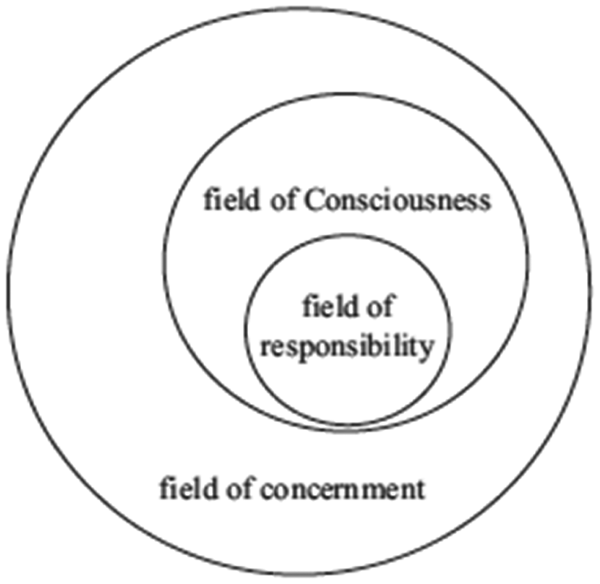
‘Person … is a forensic term appropriating actions and their merit’ (§26). It applies to subjects of experience who are ‘intelligent agents’ (§26), i.e. subjects of experience whose mental capacities are such that they qualify as Persons by Locke's definition. Consider S, a subject of experience who is suitably complex and so qualifies as a Person. Given the forensic sense of ‘person’ the question of what S's Personal identity consists in considered at some particular time is simply the question of what S is morally or legally responsible for at that time.Footnote 5 This is the force of ‘forensic’. One could put the point by saying that the question of which or what Person S is is a question about S's overall field of responsibility at that time.
A little more accurately, one could say that it is a question about S's overall field of concern or concernment at that time. The adjustment is needed because one's field of concernment is wider than one's field of responsibility. One's field of concernment contains everything that one is intimately involved in in such a way that it can be a source of one's ‘pleasure or pain; i.e. happiness or misery; beyond which we have no concernment’ (4.11.8). It therefore extends beyond matters of specifically moral or legal concern – to one's mind and body and toothache. One's field of responsibility falls wholly within one's field of concernment because what one is responsible for has vast consequences for one's happiness or misery both here on earth and on and after the Day of Judgement, but the field of responsibility is not coextensive with latter field of concernment because many pains and pleasures have nothing to do with responsibility.
What is the extent of a person's concernment? As we ordinarily understand concern, one can be concerned for or in or about many things: one's family, one's possessions, one's business concerns, the fate of the world, the baggage retrieval system at Heathrow. In his Essay, however, Locke focuses on a much narrower notion of concernment which I'll mark with a capital letter – Concernment. He makes the scope of Concernment clear by tying it tightly to consciousness in his special sense of ‘consciousness’ which I'll also flag with a capital letter – Consciousness – except when it appears in quotations. He holds that Consciousness entails Concernment: ‘concern for happiness [is] the unavoidable concomitant of consciousness’ (§26); ‘self is that conscious thinking thing … which is sensible or conscious of pleasure and pain, capable of happiness or misery, and so is concerned for itself, as far as that consciousness extends, and no farther.’ (§17).
6. ‘Consciousness’
To understand the precise scope of Concernment, we have to know exactly what Consciousness is. Fortunately the matter is straightforward: to be Conscious of x is to experience x in a certain immediate kind of way – whether x be one's actions and experiences, one's mind, or one's body. One's awareness or consciousness of one's present actions and experiences is the paradigm case of such immediacy (for illustrative quotations, see page 20 below). It's the immediacy of the way in which we experience our own pains, to take a familiar example. Our present-day use of the word ‘conscious’ allows that we can be said to be conscious of other creatures' experiences but we don't think that we are or can be conscious of others' experiences in the immediate kind of way in which we are conscious of our own.
One may say that to be Conscious of x is to experience x as one's own in a certain immediate kind of way, but one does then run the risk of being misunderstood. To avoid misunderstanding one needs to stress that this kind of experiencing something as one's own is found in all sentient beings; it doesn't require any sort of express self-consciousness of the sort characteristic of human beings, any sort of explicit conceptual representation of x as one's own, although it does also involve this in the special case of a Person, since a Person is a fully self-conscious creature that ‘can consider itself [specifically] as itself’ (§9).Footnote 6
This is what Locke means by ‘consciousness’. It's not an elaboration or variation of what he means. To be Conscious of x is to experience x in a certain immediate kind of way. It is in fact the way in which a subject of experience S can experience an action or experience or mind or body only if it is in fact S's own action or experience or mind or body.
We can now ask why Consciousness of x entails Concernment about (or in or for) x. The answer is simple. Locke takes it, reasonably enough, that one is necessarily concerned for oneself. One is necessarily concerned for what is one's own in the narrow sense of being part of oneself, the Person one is; where this crucially includes, on his view, one's actions and experiences in addition to one's substantial realization (material or otherwise).
In taking it that the converse is also true, i.e. that Concernment entails Consciousness (see the last three words of the last section), Locke makes it clear that he's focusing on a notion of concernment – Concernment – which is narrow in precisely the following sense. One's Concernment (one's capital-C Concernment) extends only to whatever one experiences (as one's own) in a certain immediate kind of way. That is, it extends only to whatever one is Conscious of in his sense of ‘conscious’. That is, it extends only to oneself, the Person one is, where ‘the Person one is’ includes one's actions and experiences – since this notion of Person is a forensic notion – in addition to one's current substantial realization, material or otherwise.Footnote 7
7. The Field of Consciousness
The notion of experiencing something as one's own is crucial when it comes to the forensic consequences of Consciousness for subjects of experience who are Persons. Briefly (and to anticipate) if you genuinely no longer experience something as your own in the required immediate kind of way then you're no longer Conscious of it. It follows that you're no longer genuinely Concerned in it. It follows in turn that it's no longer part of your Personal identity, i.e. your forensic identity. It follows in turn that you are no longer properly held responsible for it. One is of course (lower-case) concerned for one's family members or possessions, on Locke's view, but one is not (upper-case) Concerned for them. One's field of Concernment is restricted to oneself – so that it is at any given time identical with one's field of Consciousness at that time, which, to repeat, includes one's bodyFootnote 8 in addition to one's mind and one's actions and experiences.
The fields of responsibility, Consciousness and concernmentFootnote 9

Lockean Consciousness isn't memory, contrary to what so many commentators have supposed, although memory can certainly involve Consciousness. If one still feels immediately ‘personally involved’ in or with one's past actions and experiences in remembering them, if one feels about them rather as one does about one's present actions and experiences, which are the paradigm cases of what one is Conscious of, then one is still Conscious of them. But memory as such – even autobiographical memory – needn't involve any Concernment. Nor therefore need it involve any Consciousness – any experiencing of what is remembered as one's own in the immediate kind of way that Locke has in mind in talking of Consciousness. I'll return to this in section 11.
Nor need being Conscious of one's experiences – experiencing them as one's own – involve any sort of express conscious second-order apprehension of them as one's own, any more than experiencing one's mind or body as one's own does. In the case of one's present experiences, which are always and paradigmatically Conscious, it never involves this. It's just a matter of what it is like to have the experiences, a matter of their ‘immediate givenness’. Locke makes this plain when he says that Consciousness is
inseparable from thinking, and as it seems to me essential to it: it being impossible for any one to perceive, without perceiving, that he does perceive. When we see, hear, smell, taste, feel, meditate, or will anything, we know that we do so. Thus it is always as to our present sensations and perceptions (§9).
This passage is enough to settle the point that Consciousness is not an explicit second-order matter, in Locke's view. If one thing is certain it is that Locke – that most sensible of philosophers – doesn't think that we spend our whole lives having explicit second-order thoughts about all our first-order experiences.Footnote 10
We can vary the characterization of Consciousness by using the expression ‘from the inside’.Footnote 11 Subject of experience S's field of Consciousness is identical with S's field of from-the-inside givenness. If, however, it is allowed that past events can be given from-the-inside in memory in a way that is empty of affect or personal ‘identificatory involvement’ (Concernment), then we will need to say rather that S's field of Consciousness, in Locke's sense of ‘consciousness’, is identical with S's field of morally-affectively-concerned from-the-inside givenness. This is a pretty barbarous expression so I won't use it again. The point is that Locke has in effect built moral-affective Concernment into Consciousness: (Lockean) Consciousness is essentially accompanied by Concernment: ‘self’ or Person, he says, is that conscious thinking thing … which is sensible or conscious of pleasure and pain, capable of happiness or misery, and so is concerned for itself, as far as that consciousness extends'.
8. The Reach of Consciousness
One's field of from-the-inside givenness, one's field of Consciousness, isn't just a matter of whatever one is now aware of in occurrent thought or sensation or memory. It also, and crucially, has a dispositional aspect. In addition to containing all the experiences one is having now, together with any past experiences one is at present explicitly recalling, it contains all of those past experiences, and in particular actions, that one can remember from the inside.
How far into the past does this ‘can’ reach? The brief answer is that Locke takes it to reach beyond what one can now bring back to mind unaided (and perhaps also beyond what one can remember when suitably prompted or shocked) to all of those past actions that one is Conscious of in one's conscience or heart (§22). What one is Conscious of in one's heart may not be fully known or accessible to one now but on the Day of Judgement ‘the secrets of all hearts will be laid open’ (§§22, 26). On that alarming day you'll recall things that you are in fact still morally-affectively involved in, in such a way as to be properly held responsible for them, even if they've slipped beyond recall in your ordinary everyday life.Footnote 12
One's Consciousness doesn't reach back to early childhood, though – if only because of the phenomenon of ‘childhood amnesia’. Nor does it reach back to most of the actions of childhood. On one natural reading of Locke it needn't reach back to these actions even if they're remembered, because one can remember one's past actions while no longer experiencing them as one's own in the required immediate way or feeling morally-affectively Concerned about (or in) them. Nor does it reach back to the bulk of one's past life. When Locke imagines a ‘spirit wholly stripped of all its memory or consciousness of past actions, as we find our minds always are of a great part of ours’, he indicates the sense in which most of one's past actions are not actions of the (forensic) Person one is now. Footnote 13
Thomas Reid tells the story of a young boy who becomes an officer who is Conscious of something the boy did, and then a general who is Conscious something the officer did but has wholly forgotten – and is no longer Conscious of – what the young boy did.Footnote 14 Following Berkeley in the insensitivity of his reading of Locke, Reid objects that on Locke's account of personal identity
-
(i) the general may be the same person as the young officer, because he's Conscious of some experience had by the young officer,
-
(ii) the young officer may be the same person as the boy, because he's Conscious of some experience had by the boy,
while
-
(iii) the general may not be the same person as the boy, because he's not Conscious of the experience of the boy.
Reid's objection is that the conjunction of (i), (ii), and (iii) contradicts the principle of the transitivity of identity and that Locke's theory is therefore inconsistent.
The conjunction of (i), (ii), and (iii) does contradict the principle of the transitivity of identity but this isn't an objection to Locke's account of personal identity. It's a perfect illustration of its fundamental and forensic point – the plausible idea (it's plausible relative to the story of the Day of Judgment) that human beings won't on the Day of Judgment be responsible for all the things they've done in their lives but only for those that they're still genuinely Conscious of – still genuinely morally-affectively Concerned in, implicated in. What they'll be responsible for will in practice be a bundle of actions dating from many different periods of their lives.
Butler misses Locke's point as spectacularly as Berkeley and Reid. In speaking of Locke's ‘wonderful mistake’ he makes a wonderful mistake. Ignoring Locke's explicit statement that he's using ‘person’ specifically as a forensic term, and Locke's definition of Consciousness in terms that have nothing to do with memory, Butler takes Locke to mean memory by the word ‘consciousness’ and writes as follows:
to say, that [consciousness] makes personal identity, or is necessary to our being the same persons, is to say, that a person has not existed a single moment, nor done one action, but what he can remember; indeed none but what he reflects upon. And one should really think it self-evident, that consciousness of personal identity presupposes, and therefore cannot constitute, personal identity; any more than knowledge, in any other case, can constitute truth, which it presupposes (1736, 440–41)
One should really think it self-evident that this is isn't any sort of objection to Locke's theory. It's a statement of its central point. As a subject of experience you have a lifetime of actions and experiences behind you – most of which you've completely forgotten. The ones that are part of your Personal identity, i.e. the ones that constitute your forensic identity, i.e. the ones that constitute the Person you are, considered as a moral being, a forensic entity, are simply those which you're still Conscious of, hence still Concerned in: those that you still experience as your own in the crucial moral-affective way.
It's worth stressing that the Lockean question of Personal identity is always a question raised about a subject of experience S considered at a particular time. The particular time at which the question is raised (now, say, or on the Day of Judgement) is crucial because S's Personal identity or Personhood is differently constituted every day, on Locke's view. This follows immediately from the fact that S's field of Consciousness, and in particular the overall field of things S is responsible for, changes each day and indeed every moment. This is so for no other reason than that S has done more things a day later. But it may also be so for other reasons. S may for example have ceased to be Conscious of certain things that S was Conscious of yesterday.Footnote 15
9. Locke's Definition of ‘Person’ 1
Although Berkeley, Butler and Reid are largely to blame for the misunderstanding of Locke, ‘marvellously mistaken’, as Law observes (1769, 21), Locke isn't blameless. Part of the misunderstanding stems from the fact that he offers a definition of ‘person’ that is independent of his definition of it as a forensic term. I'll now consider this definition, and offer a general statement of what Locke takes a Person to be.
I'm an individual agent, a thinking being, a persisting human subject of experience, very much as I think I am. All good. But what am I in so far as I am a Person – according to Locke? This still doesn't seem clear.
The first answer we can give is terminological: the Person that I am is the self that I am: ‘Person, as I take it, is the name for this self. Wherever a man finds what he calls himself, there, I think, another may say is the same person’ (§26). This is one of many places where the terms are equated.
The second answer is more substantive. It's the answer to the first of the four questions listed in section 1 above, question [A]: what does a subject of experience that qualifies as a Person consist of, ontologically speaking, considered at any given time? The answer is that the self or Person that I now am – the individual, persisting, morally accountable subject of experience that I am – considered at any given particular time t, consists, literally consists, of the following things. First
-
[1] my living body at t
for as Locke says ‘any part of our bodies vitally united to that, which is conscious in us, makes a part of our selves’ (§25); all the particles of our bodies
whilst vitally united to this same thinking conscious self, so that we feel when they are touched, and are affected by, and conscious of good or harm that happens to them, are a part of our selves: i.e. of our thinking conscious self. Thus the limbs of his body are to everyone a part of him self: he sympathizes and is concerned for them (§11).Footnote 16
What else is part of the Person I am? Well, if I have an immaterial soul – which may be doubted, as Locke observes – then the person that I am at t consists also of
-
[2] my soul at t
the immaterial soul-substance in which my thinking goes on; for ‘any substance [now] vitally united to the present thinking being, is a part of that very same self which now is’ (§25), be it material or immaterial.
That [1] and also [2] are literally part of the self or person I am at t (assuming that materialism is false and that [2] is therefore to be included) is explicitly stated by Locke. The third and for many purposes central component consists of everything else (everything other than [1] and [2]) of which I am Conscious at t, i.e.
-
[3] all the experiences (thoughts and actions, past and present) of the individual-persisting-subject-of-experience that I am of which I am now occurrently or dispositionally Conscious at t.Footnote 17
Consciousness of the past is thus a fine-grained matter, in Locke's view. For I may still be Conscious of one thing I did on my birthday twenty years ago and not be Conscious of a thousand other things I did on that day, things I've completely forgotten and am no longer ‘Concerned in’ in any way.Footnote 18 In that case they're no longer any part of the Person I am, for it is only ‘that with which the consciousness of this present thinking thing can [now] join itself’ that ‘makes the same person, and is one self with it’. The present thinking being that I am
attributes to itself, and owns all the actions of that thing, as its own, as far as that consciousness reaches, and no farther;Footnote 19
if there be any part of [an immaterial substance's] existence, which I cannot upon recollection join with that present consciousness, whereby I am now myself, it is in that part of its existence no more myself, than any other immaterial being. For whatsoever any substance has thought or done, which I cannot recollect, and by my consciousness make my own thought and action, it will no more belong to me, whether [or not] a part of me thought or did it, than if it had been thought or done by any other immaterial being anywhere existing.Footnote 20
So when Locke says that Consciousness of one of Nestor's actions would make one ‘the same person with Nestor’ he doesn't mean that one would be the same person as Nestor with respect to all Nestor's actions. In the case imagined one's Consciousness doesn't reach any further into Nestor than that one single action, ‘that part of [Nestor's] existence’, and one is the same person as Nestor only so far as that action is concerned.Footnote 21
This, then, is a Person ontologically considered, a person in Locke's special sense of the word. This is the answer to question [A]. A Person is a [1] ± [2] + [3].Footnote 22 This is the ontological core. Now we need to answer question [B]: what mental capacities must a subject of experience have in order to qualify as a person? We need to list the defining characteristics of Personhood, the properties that distinguish Persons from other subjects of experience that have bodies and experiences and act (and even perhaps have immaterial souls), but aren't Persons.
10. Locke's Definition of ‘Person’ 2
The first thing to record is that Persons are essentially
-
[i] capable of a law, and happiness, and misery (§26)
where to say that something is ‘capable of a law’ is to say that it is capable of grasping the import of a law in such a way that it can understand itself to be subject to it and can thereby be subject to it. Given that this is an essential part of Locke's definition of ‘person’ as a forensic term, it's regrettable that it occurs several pages after his famous more narrowly cognitive-functional definition of ‘person’ in §9 according to which a Person is
a thinking intelligent being, that has reason and reflection, and can consider itself as itself, the same thinking thing, in different times and places; which it does only by that consciousness, which is inseparable from thinking, and as it seems to me essential to it…(§9)
The trouble is (and Locke must take some of the blame) that this part of his definition tends to be cited in isolation from the point that a Person is also essentially ‘capable of a law, and happiness, and misery’ (§26) and the intimately connected point that ‘person’ is for Locke an essentially ‘forensic’ term (§26).
Regrettable – but there it is. What does the cognitive-functional definition say? It's very clear. Capacities for
-
[ii] thought (experience)
-
[iii] intelligence
-
[iv] reason
and
-
[v] reflection
are essential preconditions of being a Person.Footnote 23 But they're not sufficient, nor are they the central focus of the definition. The crucial further cognitive-capacity condition is a Person's
-
[vi] capacity to consider itself as itself, the same thinking thing in different times and places
‘which it does only by that consciousness which is inseparable from thinking, and, as it seems to me, essential to it’. This condition fits tightly with the requirement of being ‘capable of a law’, for on Locke's view one can reward and punish intelligent beings for what they've done because and only because they possess this cognitive capacity, which keeps them in touch with their past actions, and makes it possible for them to be aware that these actions are their own.Footnote 24 To see this, imagine a thinking, intelligent, reasoning, reflecting being that is ‘capable of a law’ (it might act out of morally good or bad intentions in the moment of action), but has no memory at all. It makes no moral sense to punish or reward it for its past actions. It has no personal identity in Locke's sense – given that personal identity is an essentially diachronic notion.
There's a further and connected problem that arises from restricting one's attention to the famous part of Locke's definition in §9. The famous part specifies Consciousness in a merely cognitive way that makes no explicit mention of the essential connection between Consciousness and Concernment (Concernment is mentioned in §11, two paragraphs later). To see this imagine an utterly emotion-lacking subject of experience that fully satisfies the famous part of the definition. It is a cognitively highly sophisticated, fully memory-equipped subject of experience that qualifies as Conscious inasmuch as it possesses the mental reflexivity that is in Locke's view essentially constitutive of all ‘thinking’ (i.e. all experience) and is in addition fully and explicitly self-conscious in the way that human beings are and dogs and foxes aren't, so that it can consider itself specifically as itself in the past and future. It has, however, no capacity for happiness or misery and therefore no Concernment, nor any grasp of a law. Such a subject of experience is certainly not a Person on Locke's view.Footnote 25
11. Consciousness isn't memory
It's already clear that Consciousness isn't the same as memory. But this is not just because Consciousness is essentially accompanied by Concernment, in addition to its purely cognitive features. The principal point is much simpler: the primary case of Consciousness involves no memory at all, according to Locke, for it's the Consciousness that one has of one's own experience and action in the present. It's the Consciousness that is ‘inseparable from thinking’ (i.e. experience), ‘essential to it’, essentially constitutive of it. ‘Thinking consists in being conscious that one thinks’, Locke writes, just as ‘hunger consists in that very sensation’ (2.1.19). One could be fully Conscious in this fundamental way throughout one's life and have no memory at all, or only a few seconds' worth.Footnote 26 The case of Consciousness of past actions and experiences, which does of course involve memory, is explicitly explained and characterized by reference to the primary and fundamental case of present Consciousness. Personal identity ‘extends itself beyond present [conscious] existence’ (where Consciousness is certainly in place, because it is essentially constitutive of the very existence of experience)
only by consciousness, whereby it becomes concerned and accountable; owns and imputes to itself past actions, just upon the same ground, and for the same reason, that it does the present [actions] (§26).
As far as any intelligent being can repeat the idea of any past action with the same consciousness it had of it at first, and with the same consciousness it has of any present action; so far it is the same personal self. For it is by the consciousness it has of its present thoughts and actions, that it is self to itself now, and so will be the same self as far as the same consciousness can extend to actions past or to come’ (§10).Footnote 27
The fundamental reference point for all attributions of Consciousness is the subject considered in the present moment.
It may be said that Consciousness of the past, at least, is the same as memory, on Locke's view. Or rather, it may be said that Locke wouldn't have felt any need to distinguish memory and Consciousness if he had restricted attention to autobiographical from-the-inside memory. But he might have rejected even this identification if he had thought (as I do) that there can be from-the-inside memory without Concernment.Footnote 28 One can identify Consciousness of the past with from-the-inside memory only if one accepts that from-the-inside memory is truly inseparable from moral-affective Concernment.
Some years ago, Schechtman observed that almost all commentators on Locke think of Consciousness as merely
a faculty of knowing, and this makes the interpretation of consciousness of the past as memory almost irresistible. This is not, however, the aspect of consciousness that Locke most emphasizes in his discussion of personal identity. Instead he stresses the affective side of consciousness. (1996, 108)
She put a very good question: if Locke means memory when he talks of Consciousness, why doesn't he say so? Why doesn't he simply talk of memory? Why does he ‘never say ... that memory connections constitute personal identity if this is what he means?’ (1996, 107). There's an extended discussion of memory in 2.10 of the Essay, and Locke uses the word many times in his discussion of personal identity, and yet ‘when he tells us what personal identity consists in, which he does many times throughout the chapter, he always talks about extension of consciousness and never about memory connections’ (ibid.).
The principal reason for this has been given: Consciousness has nothing essentially to do with memory. But the point Schechtman stresses is also important – the fact that ‘we extend [Lockean] consciousness back in time to some past action or experience by caring about it in the appropriate way’ (ibid., 109). Certain ‘past events can become part of present [Lockean] consciousness by affecting us in the present along the dimension of pleasure or pain’ (ibid., 112). That said, it should be noted that caring or affective concern (Concernment) is not strictly part of Consciousness, on Locke's view, only an inevitable accompaniment of it. It's also arguable that one may be Conscious of a past experience in the present simply in so far as one experiences it as one's own, while having no particular feelings of pleasure or pain with regard to it; just as one can be Conscious of a part of one's body as one's own while having no particular present feelings of pleasure or pain with regard to it. One may also, perhaps, remember stealing plums and being flogged as a boy with some amusement, and hence with whatever pleasure and emotion is inseparable from amusement, while no longer being Conscious of it in the accountability-engaging sense.
Another case involves a complication Locke didn't consider, and which arguably raises a doubt about the adequacy of his account. Suppose one is given to guilt. It seems plain that one can continue to feel guilty about an action performed as a child although one is not in fact still related to it – emotionally implicated in it – in an accountability-engaging way. Guilt, however, is a form of Concernment, and entails Consciousness in Locke's sense, and Consciousness entails Personal identity or same-Personhood, and same-Personhood entails present accountability and punishability. So it seems that a current feeling of guilt entails accountability and punishability even when the feeling is inappropriate or absurd.
A quick answer to this in the spirit of Locke's theory is that one will be all right on the Day of Judgement, because one's conscience on that awesome occasion will get things in proportion and excuse one (§22) for one's childish misdeed. One will see how things are and no longer feel guilty. Alternatively one may suppose that one's childish misdemeanour will indeed feature on the long list of things for which one is accountable, simply in so far as one is Conscious of it, but that it certainly won't follow that one will actually be punished for it. (God, for one, wouldn't dream of doing such a thing.)
12. Personal Identity: The Canonical Question
I'll take these issues a little further below. First consider the canonical personal identity question mentioned in section 1: What are the necessary and sufficient conditions of the truth of the claim that a person considered at time t 1 – whom we may call P1 – is the same person as a person considered at a different (later) time t2 – whom we may call P2? What has to be true if it is to be true that P1 is indeed the same person as P2? The present claim is that Locke doesn't address this question – or not as it's ordinarily understood. He simply assumes – takes it for granted – that he's dealing with a continuously existing thing, a continuously existing subject of experience, a continuously existing ‘consciousness’ (in the special count-noun use of ‘consciousness’ in §23) that is of such a kind that it qualifies as a Person. Having taken the existence of continuously existing subjects of experience for granted, and having specified what they have to be capable of to qualify as Persons (= answering question [B]), and what they consist of ontologically, at any given time (= answering question [A]), he raises question [D]: the question of what the Personal identity – i.e. the forensic identity – of such entities consists in.Footnote 29
He also raises and answers question [C]: the question of what sorts of substantial changes subjects of experience like S that qualify as Persons can undergo while continuing to exist. He argues that, as far as we know, they may possibly survive complete replacement of any parts that substantially realize them at any time – whatever those parts are. S may for example survive a complete change of body or body parts ([1] parts), and/or a complete change of immaterial soul (a [2] part). In telling us what sorts of changes and replacements he thinks Persons can survive, Locke makes it clear that he's conceiving of them as things whose continuing existence essentially involves the continuing existence, through all possible changes of substantial realization, of something that remains in possession of psychological capacities [i]–[vii] – the psychological capacities specified in answer to question [B] .Footnote 30
I'll repeat this. Locke is simply assuming, and operating with, a conception of continuously existing psychological-capacity-preserving subject-of-experience-hood that allows that a single persisting subject of experience may survive replacement of all its substantially realizing parts. He's not giving an account of what the continuity of this same-subject-of-experience-hood consists in (as most accounts of personal identity aim to do) in giving his special forensic account of Personal identity. He's assuming the existence of entities like S that have this sort of continuity, and taking it that we are ourselves things of this kind, in order to raise the issue that then concerns him: the issue of the Personal identity of such things, including most notably ourselves; that is, the question of the moral standing – the forensic identity – of such things; that is, the question of which parts of their past still count as theirs forensically speaking; and therefore still count as part of the Person they are. Equivalently: he's asking which parts of the past of the continuing subjects of experience that they are no longer count as part of the continuing Persons they are.
This is the point at which these things' capacity for Concernment-involving Consciousness of their past actions and experiences becomes crucial – because it provides the answer to question [D]. But there's no sense in which possession of this capacity constitutes one of these subjects of experience, say S, as a continuously existing thing. The subject of experience S is simply given as a continuously existing thing that possesses this capacity, and it would continue to exist as the same subject of experience even if it lost this capacity, and so ceased to be a full Person. Nor does the set of things of which S is Conscious at any given time, in virtue of its possession of this capacity (i.e. [1] ± [2] + [3] – pages 15–16), constitute it as a continuously existing thing. Its material and immaterial parts ([1] and [2]) may completely change, compatibly with its continuing to exist. As for [3], the past actions and experiences of which it is Conscious, these do not in fact constitute a temporally continuous series. The subject of experience, once again, is simply given as a continuously existing thing. Some but certainly not all of the subject of experience's past actions and experiences are still part of the Person it is.
So Locke doesn't answer the canonical personal identity question. But he does give a full account of what one is considered specifically as a Person: [1] ± [2] + [3]. Why is [1] ± [2] literally part of what constitutes one, considered specifically as a Person, in spite of the fact that it's the persistence of one's psychological capacities that is essential to one's persistence as a Person? Two answers are possible and correct: [i] because [1] ± [2] is situated in the field of one's Consciousness, and hence in the field of one's Concernment; [ii] because one is (one's actions and experiences apart) what actually substantially constitutes one at any given time.
The first answer is primary for Locke: one is constituted as a Person by whatever lies in one's field of Consciousness.Footnote 31 That's it. And that's the answer to question [D], although it's only [3] (the set of actions and experiences one is Conscious of) that matters, not [1] and [2] (one's substantial realization), when it comes to [D], the question of responsibility. Locke's famous claim that ‘Consciousness makes personal identity’ (§10) is not in any sense a claim that something merely mental or psychological constitutes Personal identity in the sense of making up its whole being. It is rather and precisely the theoretically elegant claim I've just italicized. Given a subject of experience, a thinking intelligent agent, considered at a particular time t, it's the reach of that subject of experience's Consciousness at t that wholly determines and settles the question of which or what Person that subject of experience is at t; where this includes, of course, the question of what constitutes the Person substantially speaking (materially ± immaterially). Everything that one's Consciousness touches or ‘can join itself…with’, everything that is ‘comprehended under’ one's Consciousness in this sense, is a part of the person one is.Footnote 32 This and only this settles the question of the subject of experience's Personal identity, or Personhood, which is also (given [3]) question [D], the question of its forensic identity, at t. Certainly one needn't know exactly what is comprehended under one's Consciousness. (One may not for example know something Locke knew himself not to know, i.e. whether an immaterial substance is comprehended under one's Consciousness, or whether instead materialism is true.)
I hope the picture is now clear. The material ± immaterial substance that actually makes you up now, substantially, is literally part of what constitutes you, the Person you are now. What about the past? Which parts or aspects of the past of you-the-continuing-subject-of-experience are now part of the Person you are? None of the material particles that have previously constituted your body are, given that they no longer lie in your field of Consciousness (or Concernment). Only those that are now part of your body do so. The same goes if there has been any change in your immaterial substance. Only the immaterial soul or soul-substance that is currently part of you lies in your field of Consciousness (and Concernment) and is therefore part of the Person you now are.
So far as its substance is concerned, then, a subject of experience S who is a Person consists of S's present substantial realization – which may be wholly different from S's substantial realization at some previous time. One may certainly say, in spite of this, that S is a diachronically extended entity, but one must cancel any implication that diachronic extension implies any kind of same-substance-involving diachronic continuity. Most essentially, S is a diachronically continuous stream of memory-and-disposition-rich mental being (‘a consciousness’ in the count-noun use). S is always carried by something, substance-wise, but it doesn't matter what substantial realization S has at any given time. It doesn't matter what substantial realization S has although S must of course always have some substantial realization or other in order to exist at all. For on the one hand S may have switched bodies, according to Locke, as in the case of the cobbler and the prince; on the other hand S's whole mental being (memory, Consciousness, personality, and so on) may have transferred from one portion of soul-substance to another, as in the case Locke considers in §13.Footnote 33 S is indeed – as ever and without qualification – a whole single subject of experience, metaphysically speaking, and it is as such that S will report for inspection, fully embodied, on the Day of Judgement. But there's also a sense in which S may be said to be a gappy entity metaphysically speaking, when considered as a Person, because the temporally scattered actions and experiences that S is still Conscious of are literally part of what constitutes S as a Person so far as S's (forensic) Personal identity is concerned. In this forensic respect, one's Consciousness-constituted Personal identity resembles the contrail of an aeroplane most of whose parts have faded to nothing while some indelibly remain.
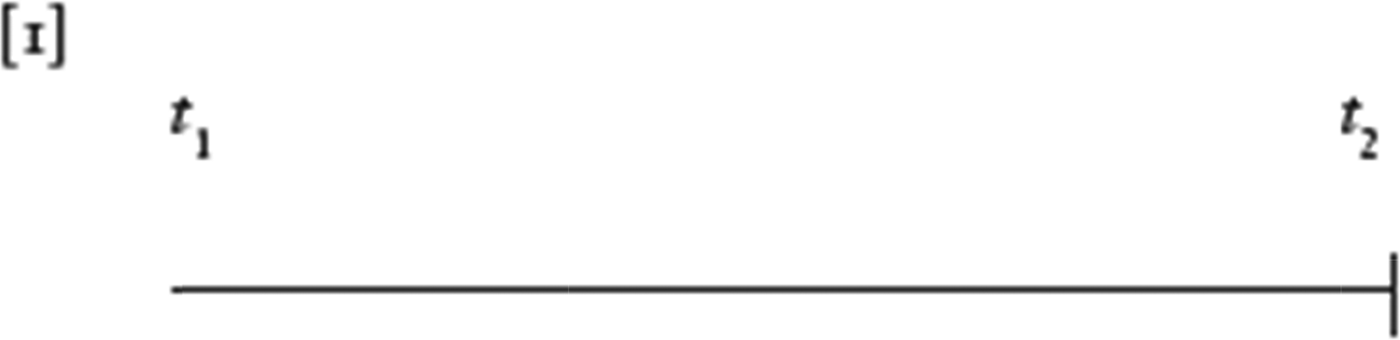
Suppose we draw an unbroken line (Fig. 2) to represent my actual life as a subject of experience, from my first coming into existence as a human being. We may then consider the segment from t 1 a moment ten years ago, to t 2, a moment five years ago:
My life from t 1 to t 2

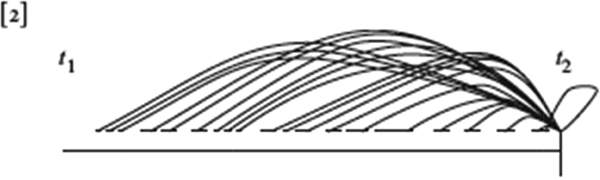
We can now add a line above my basic lifeline (Fig. 3) to represent schematically the Person that I am at t 2 considered specifically with respect to [3] my actions and experiences between t 1 and t 2.Footnote 34 This will be a broken line and will look something like this:
The view of t 1–t 2 from t 2; my (forensic) Consciousness at t 2 with respect to t 1–t 2

The dashes of the fragmented upper line represent pieces of the lower line: action-and-experience-involving pieces of which I am now Conscious. The curving lines represent the fact that I am at t 2 Conscious of some of the periods of time between t 1 and t 2. The line from t 2 to t 2 represents my present Consciousness of my currently occurring experiences at t 2 (‘thinking consists in being conscious that one thinks’, 2.1.19).
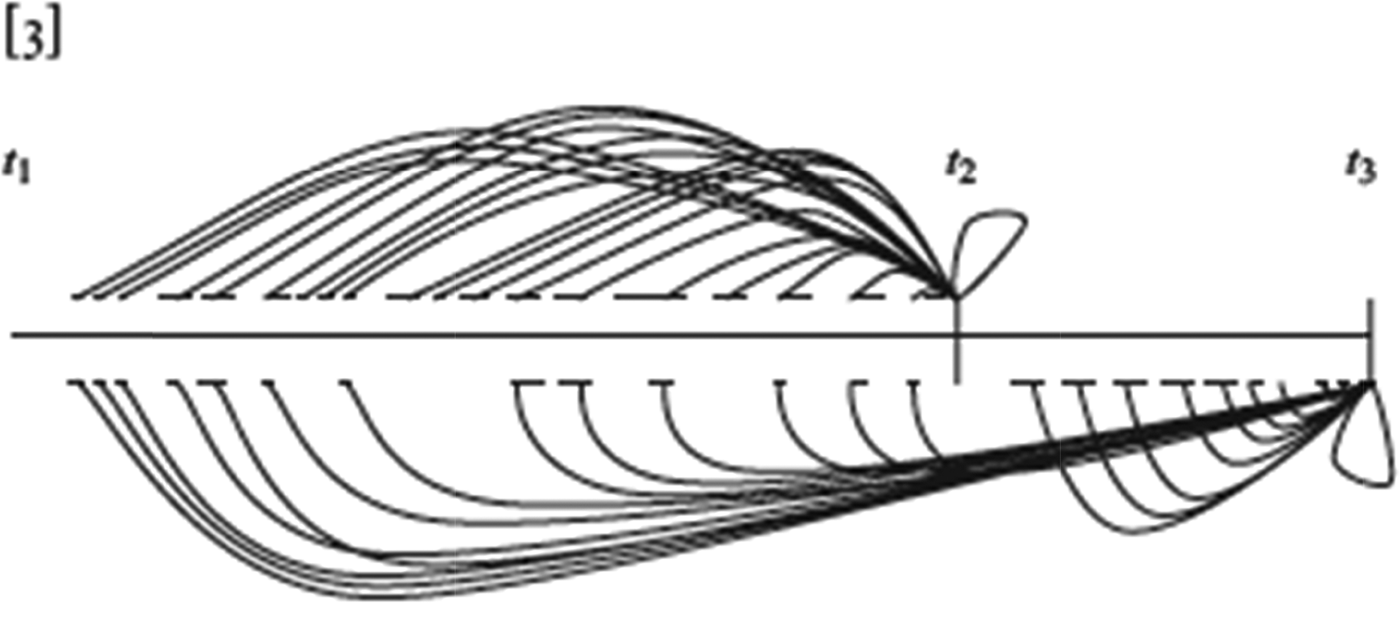
Now consider the view of t 1–t 2 from t 3, the present moment (Fig. 4), and see what the passing of time has done.
The view of t 1–t 2 from t 3; my (forensic) Consciousness at t 2 and t 3 with respect to t 1–t 2

The view from t 2 is represented as before by the gappy line above my continuous lifeline; the view from t 3 is represented by the gappy line below it. (The vertical line cutting the continuous horizontal lifeline marks the Person I was at t 2.) The key change in my (forensic or [3]-related) Consciousness from t 2 to t 3 – the change so far as the period from t 1 to t 2 is concerned – is marked by the fact that the lower gappy line is sparser than the higher gappy line. This represents the fact that I am at t 3 Conscious of fewer of the experiences that occurred between t 1 and t 2 than I was at t 2. So the Person that I am at t 3, the moral unit that I am, has changed not only because I've performed new actions and undergone new experiences between t 2 and t 3 but also because I'm no longer Conscious, at t 3, of some of the actions and experiences that occurred between t 1 and t 2 of which I was still conscious at t 2.
The diagram represents a considerable thinning of the lower dotted line relative to the higher one, and may not be accurate in this respect. For I may at t 3 still be Conscious of almost all the things I was Conscious of at t 2. If we slightly redefine ‘Conscious’ so that it doesn't pick up everything that I'm still Concerned or emotionally implicated in, such as happy memories of morally neutral experiences, but only picks up morally relevant items, then it may be that not much has changed at t 3, Consciousness-wise, when it comes to the period between t 1 and t 2. In particular, it may be that not much has changed in my ‘heart’ – all of whose secrets will be ‘laid open’ on the Day of Judgment. I think that Locke doesn't expect the field of my Consciousness to change much from t 2 to t 3 so far as the morally important events in my life prior to t 2 are concerned.
That said, it's important that his view allows change in the content of my field of Consciousness over time, relative to the actions and experiences of any period of past time. I may for example steal plums between t 1 and t 2 and no longer be Conscious of this action at t 3 – and so no longer be properly punishable for it at t 3 (which may be the Day of Judgment). A Person's Consciousness may contain an involuntary natural mechanism that operates somewhat like a statute of limitations. One may forget many things precisely because they can appropriately be forgotten, because one is no longer Concerned in them (rather than ceasing to be Concerned in them simply because one has irretrievably forgotten them and is therefore no longer Conscious of them). And one may perhaps remember things although one is no longer Conscious of them in the relevant sense, no longer Concerned in them in the moral-responsibility-engaging sense. One may not have to ask for 17,033 other minor offences to be taken into consideration on the Day of Judgment, when receiving one's doom (i.e. all the offences of the human subject of experience = person1 one is). For even if one then remembers them one may no longer be Concerned in many of them. One may hope that Reid's general will not be punished by God on the Day of Judgement for stealing plums when he was a boy,Footnote 35 for he neither remembers nor is Conscious of the theft, and the theft is therefore not part of the Person he is, on the Day of Judgement. In fact he won't be punished for it even if he does remember it – so long as he isn't still Conscious of it, i.e. so long as he isn't still morally or affectively concerned or implicated in it. For in this case it will again not be part of the Person he is: ‘whatever past actions [he] cannot reconcile or appropriate to that present self by consciousness, [he] can be no more concerned in, than if they had never been done’ (§26).
It seems to me that the general shouldn't be punished even if he not only remembers it but still feels bad about it, and is to that extent still Concerned in it in such a way that it is still part of the Person he is. For in childhood we have not yet attained the ‘age of responsibility’, and this is a fact to which divine law will surely not pay less attention than human. There are vicious eschatologies that demand punishment of young children and of all wrong acts performed in childhood, but what will presumably happen on the Great Day, as remarked earlier, is that the general's conscience, enlightened by the grandeur of the occasion, will excuse him, and so surely and in any case will God.
It may help to introduce the notion of one's account – the bill, the tab, the list of chargeable items that the subject of experience that one is will have on the Day of Judgement.Footnote 36 Only things (actions) that are on one's account will be punished or rewarded. What is on one's account will be a function of what one is Conscious of, where Consciousness (as always) brings with it moral-emotional Concernment.Footnote 37 To work out one's Personal account one starts out from the complete set of the past actions of the continuing subject of experience one is, i.e. – in our own case – the human person1 that one is. Plainly not all of these actions are on one's account. In fact very few of them are. The question, question [D] (familiarly by now), is this: which of these actions does one still feel involved in, involved in in such a way as to feel that it is something that one did – where this ‘one’ in italics denotes the Person one is now or if you like the person2 one is now? This tiny subset of the actions of the person1 that one is contains all the actions that are on one's account and that actually constitute the Person one now is so far as one's past actions are concerned (i.e. so far as [3] rather than [1] ± [2] is concerned): ‘that with which the consciousness of this present thinking thing can join itself, makes the same person, and is one self with it, and with nothing else’ (§17). And although being on one's account is a necessary condition of attracting punishment or reward, it is not a sufficient condition, for many things – like warm memories – will be morally neutral; and God has a reputation for mercy.
13. Psychological Connectedness
The point can be re-expressed in Parfitian terms, according to which a person P7 at t7, e.g. now, is (directly) psychologically connected to a person P1 at some past time t1 if – to take the case of memory – P7 can now remember having some of the experiences that P1 had at t1; while P7 is psychologically continuous with P1 if there is an overlapping chain of such direct connections (e.g. P7 is psychologically connected to P6, P6 to P5, P5 to P4, and so on unbrokenly back to P1). Clearly P7 can be psychologically continuous with P1 even if P7 is not psychologically connected to P1. Equally clearly, P7 can be psychologically connected with P1 even if not psychologically continuous with P1.Footnote 38
In these terms we may say that Locke isn't interested in the (transitive) relation of psychological continuity when it comes to the question of personal identity. He's only interested in the (non-transitive) relation of psychological connectedness. It is accordingly misleading to call those who seek to give an account of personal identity principally in terms of psychological continuity ‘neo-Lockeans’. It's true that Locke gives an essentially psychological account of the conditions of Personal identity (an account in terms of Consciousness) but the resemblance between Locke and the neo-Lockeans ends there.
The psychological connectedness that matters to Locke is furthermore narrower – more fine-grained – than psychological connectedness as ordinarily understood; and this isn't simply because Consciousness isn't the same as memory (it's not the same as memory even when we restrict attention to Consciousness of the past). The point was made in section 10 but it's worth repeating. Suppose P1 performs two actions a1 and a2 at the same time at t1.Footnote 39 Locke's position, which is clearly correct given the constantly reiterated point of his account of Personal identity, is that P7 at t7 can be Conscious of a1, and so psychologically connected to P1 at t1 as the performer of a1 in such a way as to be the same Person as P1 at t1, and so morally responsible for a1, while not being Conscious of a2 – not psychologically connected to P1 at t1 as the performer of a2 in such a way as to be the same Person as P1 at t1. Plainly, then, P's Consciousness connection at t1 to P1 at t1 is not a connection to P1 at t1 überhaupt, for if it were this would yield a contradiction. The Consciousness connection is to the doing of a1 at t1 and not to the doing of a2. On Locke's theory it doesn't matter that there is only one human being involved. P can be the same Person as P1-doing- a1 (‘P1a1’) and not the same Person as P1-doing-Y (‘P1a2’).
Objection. ‘This isn't possible. P1a1 is not only the same human being as P1a2 but also the same Person, because she is (we may suppose) fully Conscious of what she is doing at t1. And this means that we can generate a contradiction. For even if we allow ourselves for purposes of argument to treat P1a1 and P1a2 as potentially different Persons, in spite of the fact that there's only one human being, so that P7 at t7 can be the same Person as P1a1 and not the same Person as P1a2, still P1a1 and P1a2 must be the same Person by Locke's own Consciousness criterion, given that P1 is fully Conscious of what she is doing at t1; so P1 can't be identical with P1a1 and not also with P1a2.’
Reply. There is perhaps no better way to understand Locke's theory of personal identity than to realize that is not any sort of objection to it. ‘Person … is a forensic term, appropriating actions and their merit’.Footnote 40