Scholars working in the Lower Mekong Basin continue to debate the organisational mechanics behind the transition from the prehistoric to the historic period in Southeast Asia. On the one hand, Chinese accounts, local oral traditions, a thick Indic imprint in the region's developing art and architectural traditions, artefacts, and strings of early Southeast Asian rulers named in local inscriptions suggest that mainland Southeast Asia's earliest states arose primarily through external influences associated with ‘Indianisation’.Footnote 1 On the other hand, there is a growing body of archaeological information that outlines the indigenous development of social stratification in mainland Southeast Asia. This latter data source offers the potential to evaluate incomplete and contradictory historical evidence on which earlier historical models were based.Footnote 2 Archaeology is a valuable strategy to fill this information gap, and more work has been done in the last 15 years than at any time since Louis Malleret's excavation at Oc Eo during the early 1940s.Footnote 3
Recent archaeological attention to proto-historic societies in peninsular and northeast Thailand, Cambodia, and southern Vietnam illustrates that these ‘late prehistoric’ societies were more involved with the international trade network than previously assumed.Footnote 4 While communities in proximity to the South China Sea have produced the greatest evidence of inter-regional interaction, archaeological evidence now exists for a series of complex proto-historic mainland Southeast Asian societies that preceded the sixth and eighth century CE ‘Indianised’ polities. Scholars still puzzle over the degree to which this bridging period was characterised by gradual indigenous change or by rapid externally-generated transformations. Paul Wheatley argues that local aspiring elites selectively adopted Indic ideas, which slowly became institutionalised in early Southeast Asian societies.Footnote 5 Monica Smith suggests two phases of contact between India and Southeast Asia corresponding with the pre- and post-fourth century CE, and that ‘Indianisation’ occurred during the second phase.Footnote 6 This study examines the nature of social and power relations among proto-historic societies, within the crucial timeframe of 300–500 CE, prior to the adoption of Indian religious ideologies in the Lower Mekong Basin and the Mun River Valley — now part of northeast Thailand, Cambodia, and southern Vietnam — circa fifth to sixth centuries CE. The data explored here comprise mostly of known ceramic traditions from Thala Borivat and Angkor Borei and the corpus of Pre-Angkorian inscriptions. However, the Pre-Angkorian temples and the Thala Borivat lintel style is not part of the focus of this article.
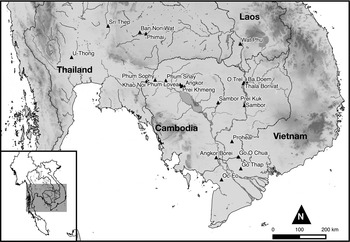
Recently collected archaeological data from Thala Borivat are compared with materials from previously documented known proto-historic sites in Cambodia, northeast Thailand, and southern Vietnam to examine the transition from prehistory into the Pre-Angkorian period (fig. 1). The proto-historic communities in Stung Treng appeared along the Mekong River by at least the second century BCE, and display evidence of interaction with the Mekong Delta populations as part of a regional trade network that moved ceramics and beads over four centuries. Soon thereafter, Thala Borivat settlements concentrated around a few nuclear zones, which are also the loci for the area's earliest brick religious architecture and inscriptions that name specific founders/ancestors as kings. That some of these brick temples were built atop previous proto-historic burials suggests continuity in local populations, and a transformation from ancestor worship into the later Indic-related religious institutions.
Major archaeological sites mentioned in this article

This article offers new perspectives on the Pre-Angkorian period by reporting findings on the proto-historic period from the Thala Borivat Archaeological Project, and argues that these data support a model of indigenous development of the proto-historic complex polities preceding the subsequent ‘Indianised’ polities in the region. Archaeological patterning at Thala Borivat and other proto-historic sites in Cambodia and northeast Thailand also suggests the possibility that proto-historic elites throughout the Lower Mekong region bore some relationship to the poñ-mratāñ elites named in seventh and eighth century CE inscriptions. By the sixth through eighth centuries CE, the few proto-historic centres that remained occupied in central, southern and northern Cambodia became pre-eminent regional centres of the Pre-Angkorian period. The settlement nucleation, shared ceramic traditions, and regional interactions of the late proto-historic period as well as their continuity into the Pre-Angkorian period offers a new model for reinterpreting the archaeological evidence acquired from the Lower Mekong region and the Mun Valley. This model also offers new insights into the dual processes of elite consolidation of power and the adoption of Indic ideologies over the multi-century period whose end-point was marked by the establishment of the Angkorian state from the ninth to fifteenth centuries CE.
Historical perspectives on Pre-Angkorian polities
This discussion uses a preliminary chronology for the Pre-Angkorian period that draws from archaeological, epigraphic, and art historical data. Although art historical and historical data are simultaneously applied to understand the Pre-Angkorian period, archaeological data such as settlement systems, ceramics, and other materials are rarely included. This research bridges these disparate and divergent data sources to provide a holistic perspective on the transition into the Pre-Angkorian period. The chronometrically-anchored Angkor Borei (AB) ceramic chronology links technologically discrete ceramic traditions to three basic phases with a date range beginning c.500 BCE (AB Phase I: 500–200 BCE) and ending c.600 CE (AB Phase III).Footnote 7 Angkor Borei is one of the earliest Pre-Angkorian centres located in the Mekong Delta, a substantial distance from Thala Borivat (c.380 km by river), yet it provides the best sequence from the proto-historic to Pre-Angkorian periods. Well-dated ceramic traditions, including ‘Phimai Black’ and buffware uncovered from other excavated sites in Cambodia and Thailand, are also used in this analysis. Epigraphers have attributed a substantial number of inscriptions, in both Sanskrit and old Khmer, to the Pre-Angkorian period.Footnote 8 Date ranges for dynastic reigns and the inscription locations are based on previous work by Michael Vickery and other scholars as well as the Interactive Map of Khmer Archaeological Sites (CISARK) database.Footnote 9 A large corpus of art historical research on the Pre-Angkorian period has established a series of relatively well-dated lintel styles.Footnote 10 The four successive lintel styles associated with this period, i.e., Thala Borivat, Sambor Prei Kuk, Prei Khmeng, and Kampong Preah, are suggested to begin around the seventh century CE and end in the eighth century CE. Only the first one is mentioned here because it dates to the beginning of the Pre-Angkorian period and is associated with early kings, including Bhavavarman I or Mahendravarman or Iśānavarman.
Inscriptions and early rulers
The early historic period Mekong Basin is recorded in the Chinese accounts as containing multiple polities.Footnote 11 Funan (in the Delta) and Zhenla (north, along the Mekong) were the two largest polities, and Zhenla later succeeded in becoming the dominant Pre-Angkorian state by the seventh century CE. Based on Khmer language inscriptions, Vickery argues that the title poñ represents the matrilineal local elites prior to the political centralisation that we associate with the Pre-Angkorian period, and later disappears completely from Angkorian-period inscriptions. Poñ were hereditary owners of rice fields, ponds, and roads within their communities. It is possible that early Pre-Angkorian kings inherited the same title as indicated by poñ Śivadatta, a son of Iśanavarman and brother of Bhavavarman II.Footnote 12 Vickery argues that the Khmer term poñ refers to the Funan rulers (fan). Another common title was the mratāñ, which was likely awarded by the king. The mratāñ were associated with political positions in addition to ownership of topographical features such as ponds and rice fields. Mratāñ also occurred with the poñ as donors to temples and may have been a title awarded to Brahmans in the Pre-Angkorian period.Footnote 13 In one instance, K.114/698 CE, a poñ was the son of a mratāñ, which suggests that the mratāñ title was awarded to the poñ family. Our earliest documented knowledge of the mratāñ title dates to 611 CE, with the earliest dated Khmer language inscription (K.600, Angkor Borei). The importance of the mratāñ title continues into the Angkorian period, but references to poñ (and presumably to individuals bearing the poñ title) are no longer found in Angkorian-period inscriptions. The matrilineal practice, however, continued to be an important aspect of the Angkorian temple elites, of which the most famous case is the Sdok Kak Thom family of K.235/1052 CE.
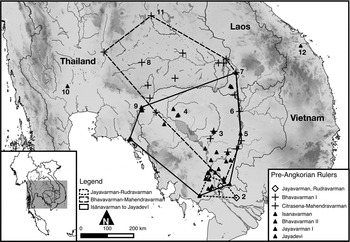
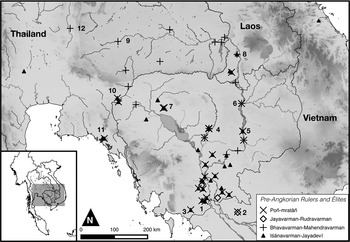
Chinese accounts suggest that by 240 CE a series of local rulers/kings in the Delta with the family names ‘Hun’ and ‘Fan’ expanded their domain across much of peninsular and central Thailand, as well as southern Vietnam.Footnote 14 Contemporary and later inscriptions inform that the temple institutions related to Hindu–Buddhist religions were already established by the time of Jayavarman of Funan (c.470–514 CE) and his son, Rudravarman (c.514–5xx CE). By c.550–600 CE, there was a series of inscriptions left by Bhavavarman I (c.550–600 CE) and Citrasena-Mahendravarman (c.600–616 CE). Vickery calls these rulers the ‘Dangrek chieftains’. K.53 indicates that Gambhīreśvara was the main god of Bhavavarman I's reign.Footnote 15 Thus, the locations of all the inscriptions mentioning Bhavavarman I, Mahendravarman, and god Gambhīreśvara (excluding K.749/674 CE from Ak Yum) suggests that their sphere of influence would have stretched as far south as K.53, near Ba Phnom, north to Khon Kaen, west to Sri Thep and Banteay Mean Chey, and as far east as the Mekong River.Footnote 16 Figure 2 highlights the locations of the inscriptions bearing Pre-Angkorian kings’ names, from Jayavarman of Funan to Jayadevī (680–725? CE).
The Pre-Angkorian rulers: 1. Angkor Borei, 2. Go Thap, 3. Sambor Prei Kuk, 4. Angkor, 5. Sambor, 6. Thala Borivat, 7. Wat Phu, 8. Phimai, 9. Khao Noi, 10. U Thong, 11. Khon Kaen, 12. Mi-Son (©Phiphal Heng)

The epigraphic data (K.151) suggest a region-wide territorial system was in place by at least 598 CE in which rulers of different territories, sometimes referred to as pura in inscriptions, claimed allegiance to Bhavavarman I.Footnote 17 Some of these territories have been identified while others are being further researched (e.g., Indrapura of K.151, Saṃlāy of K.349). This territorial system became clearer by the time of Iśānavarman and his successors. Were Iśanavarman, Citrasena-Mahendravarman, and Bhavavarman I poñ prior to their accession to power? Hiranyavarman of K.359 from Stung Treng and K.1041 from Khon in Laos seems to claim his family prestige through his mother, a sister of Bhavavarman I. This matrilineal practice was common to the poñ of the Pre-Angkor period as explicitly shown by the Āḍhyapura family of K.53. Was Hiranyavarman's family, including Bhavavarman I, a poñ-ship family? Although archaeological data cannot directly resolve these genealogical riddles, they can inform on the location and tempo of change in key centres throughout the Lower Mekong region, where one of the key archaeological sites is Thala Borivat.
Archaeological perspectives from Thala Borivat (Stung Treng province, Cambodia)
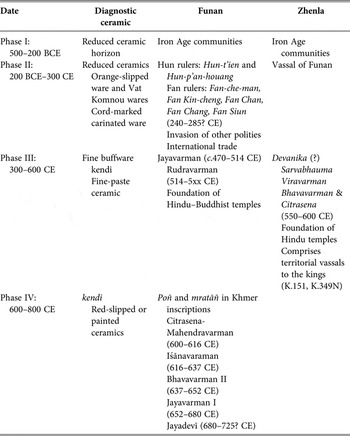
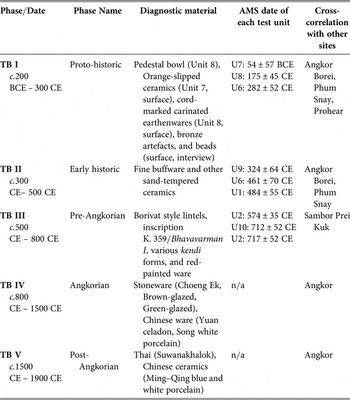
Growing archaeological data sets on the Mekong Basin provide comparable perspectives to this historical narrative. If the Chinese accounts are reliable, then the earliest records of the fan/poñ rulers in the Delta were within the transition period from the proto-historic to the early historic period. In the archaeological records, the reduced ceramic horizon (sensu Shawn Fehrenbach), including Phimai Black, of the proto-historic period continued until c.300 CE in Angkor Borei and later until c.400 CE at Phum Snay.Footnote 18 The early transition in the Delta may have been associated with the rise of the early historic polities of Funan. The distribution of the reduced ceramic horizon from central Thailand across Cambodia represents the intra-community interactions of the proto-historic period through shared ceramic technological traditions.Footnote 19 The distribution of the fine orangeware horizon in the Mekong Delta and to the north in Phum Snay and Thala Borivat suggests an intensification of north–south interactions by at least 300 CE. This period coincides with the Chinese account of ‘Funan invasions’ c.200–300 CE, and the ceramic and historical chronologies mesh nicely, as shown in table 1.
Angkor Borei (AB) ceramic chronology compared against historical records

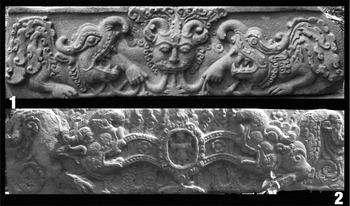
The Thala Borivat community and its eponymous archaeological site is located at the confluence of the Mekong, Se San, and Se Kong rivers, about 45 km south of the Khon Falls at the Laos–Cambodia border (see fig. 2). Some scholars have assumed that Thala Borivat was an early Pre-Angkorian capital before power moved south to Iśānapura (Sambor Prei Kuk).Footnote 20 The region clearly lies within the domain of the ‘Dangrek chieftains’ based on the distribution of the Dangrek inscriptions of Bhavavarman I (550–600 CE) and his brother, Mahendravarman (600–616 CE).Footnote 21 Thala Borivat's brick architectural tradition and associated Thala Borivat lintel style have been relatively dated to c.550–637 CE (fig. 3).Footnote 22
Thala Borivat style lintels: 1. New lintel uncovered near Sala Prambuon Lveng during the 2012 field season. 2. New lintel found buried near the main complex of Ba Doem in 2011 and unearthed by villagers in 2013

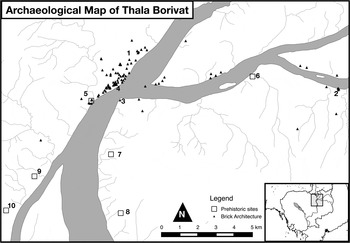
Dissertation field research on the Thala Borivat Archaeological Project involved three phases from 2011 to 2014, covering an area of c.35 sq. km. Field-based data collection strategies included topographic mapping, surface collection, sample coring, and test excavations. Despite at least two episodes of heavy looting in the area (1980s, and 2011–13), our survey identified eight burial sites and more than seventy brick architectural features (foundations) in the region (fig. 4). The surface collection process concentrated on areas within 1 km of the Mekong and the Se San, where extensive looting (for gold ornaments, and glass and stone beads) and road construction activity (to quarry laterite) has destroyed at least eight burials but produced surface materials that reflect buried deposits and established our provisional site chronology. The results from eight 1 by 2 m test units, placed across the Thala Borivat region, establish chronometric sequences complementary to the chronology produced by surface collections presented in table 2.
Archaeological sites in Thala Borivat. 1. Preah Ko, 2. Ba Doem, 3. Ba Chong, 4. Sala Prambuon Lveng, 5. O Trel, 6. O Khlong, 7. Tuol Neakta Kang Memay, 8. Tuol Khtum, 9 Tuol Ansang, 10. Tuol Meas

Provisional Thala Borivat (TB) chronology
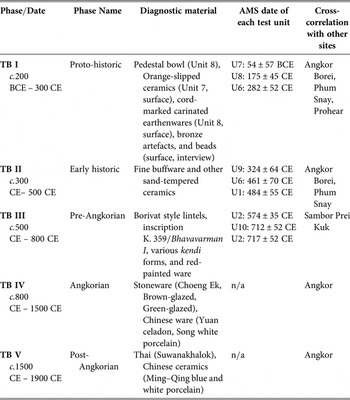
This archaeological survey of Thala Borivat (TB) suggests that proto-historic communities appeared in the area by at least 200 BCE. By 300 CE, there is evidence of fine orangeware from the Mekong Delta as well as stone and glass beads found in proto-historic and early historic sites across Cambodia, suggesting inter- and intra-regional interaction. From c.500 CE, there is evidence of fine buffware ceramics and kendi, all of which characterise the Pre-Angkorian period. The data suggest that some proto-historic sites show evidence of continuity over five centuries into the Pre-Angkorian period while others were abandoned. This phenomenon — of continuity from proto-historic to early historic archaeological occupation — is particularly clear in the well-documented region of Thala Borivat (TB Phase II: c.300–500 CE), to which this article now turns.
Thala Borivat in regional perspective
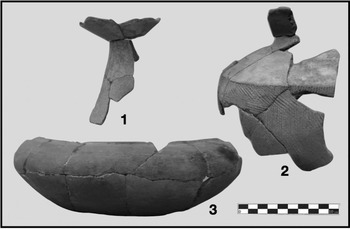
It is evident that inter-regional proto-historic interaction networks set the stage for greater settlement nucleation by TB Phase II around pre-existing large sites. Based primarily on settlement patterns and mortuary assemblages, Charles Higham argues that the proto-historic communities in the Mun Valley of northeast Thailand were chiefdoms.Footnote 23 Previous ceramic studies might support this claim for widespread interactional networks by the late centuries BCE.Footnote 24 The shared aesthetic of the reduced ceramic tradition represents some degree of interaction between the proto-historic communities in central and northeast Thailand and Cambodia. Organisational changes associated with the transition from the reduced ware tradition in AB Phase II c.200 BCE–300 CE (and seen in the Wat Kumnou cemetery) overlap with the Chinese records of the Hun and Fan who ruled Funan.Footnote 25 The distribution of fine orangeware, mostly restricted to the Mekong Delta, from Angkor Borei to Thala Borivat and Phum Snay, may represent intra-regional interaction. The transition from the reduced ware tradition to fine-tempered buffware and other ceramic traditions likely occurred later in most regions. These regions were outside of the Delta, to the north, where a series of smaller polities, including Zhenla, emerged during the third century CE. Despite similar pottery styles, including pedestalled dishes and bowls commonly found in proto-historic sites across northeast Thailand and Cambodia, the absence of a clear reduced ware tradition in Thala Borivat suggests that the proto-historic communities here may have transitioned into the early historic period around the same time as Angkor Borei or only slightly later (fig. 5). By 500 CE, many of these areas shared similarities in their ceramic traditions, particularly the increased number of buffware and kendi, as well as the names of rulers with Indic religious associations starting to appear in the inscriptions. This evidence suggests that increased interactions between the proto-historic and early historic communities coincide with or possibly stimulated the rise of the Pre-Angkorian state.
Grave goods from Unit 8 at Tuol Neakta Kang Memay: 1. Pedestalled bowl, 2. Cord-marked carinated pot similar to three others found from Wat Kumnou (Angkor Borei), and 3. Bowl similar to those found from the Iron Age sites in northeast Thailand and northwest Cambodia

Proto-historic data from Thala Borivat are scarce due to looting. Surface surveys suggest that the proto-historic communities lived along the major river systems, likely exploiting the floodplain and rivers for agriculture, fisheries, and as communication routes. Looting in these sites provide a rough estimate of site size ranging from 1 ha to 4 ha. The most heavily looted sites are the largest (O Trel: 4 ha, O Khlong: 2 ha or larger) and are reported to have contained more gold and bronze artefacts and beads than smaller ones that were less attractive to looters. Our excavation in O Trel supports this claim: Unit 6 (a 1 by 2 m trench) produced more than 30 beads in comparison to other sites that produced little to no beads. This suggests that additional work might uncover variations in proto-historic Thala Borivat inhumations, which date between 100 BCE and 300 CE (table 2).
The spatial relationship between proto-historic artefacts, particularly the chronometrically-anchored ceramic traditions and Pre-Angkorian temples, elucidates the pattern of continuity and discontinuity of this region. The Thala Borivat field investigations indicated that larger proto-historic sites in the area were located closer to TB Phase III brick temple constructions, and agglomerate into what might be two Pre-Angkorian communities: the Thala Borivat and Ba Doem complexes. Brick fragments associated with temple construction lay in disturbed deposits atop the Unit 6 burial feature at O Trel with an associated date of 461 ± 70 CE, and three Pre-Angkorian brick structures (two of which had Thala Borivat style lintels), are located within the 4 ha area reported to contain burials. This site, like others in the region, has fine buffware ceramics that Mekong Delta populations also used. Preah Ko or Prasat Boran, the temple with Bhavavarman I's family inscription and Thala Borivat style lintels, is 3 km to the east.Footnote 26 This TB Phase III temple cluster is c.3 sq. km in area, and contains various forms of kendi commonly associated with the Pre-Angkorian period. Surface artefacts from the second-largest proto-historic site of O Khlong do not include TB Phase III ceramics, although examples of the latter have been found 1.2 km to the east. Similarly, the Pre-Angkorian temples are located within c.1.5–5 km from O Khlong, which suggests that the proto-historic communities of O Khlong may have been incorporated into the later temple complexes. Other smaller proto-historic sites do not have a TB Phase III component and are located farther, c.5 and 7 km, from the current known temples. The Thala Borivat data produce a model that suggests smaller proto-historic sites were absorbed into the larger ones, between 300–500 CE, to become a nexus of the Pre-Angkorian centres. This model likely correlates with the transition into the Pre-Angkorian period. Similar trends of smaller sites becoming incorporated into larger settlements likely occurred in the Delta, such as at Bit Meas and Prohear in Prei Veng, where the Pre-Angkorian temples and inscriptions are located relatively further away (20–40 km) from these sites. Prohear is unique in that it shares many similarities with Angkor Borei until AB Phase II, or c.100 CE, and yet it did not become a large centre with a temple in the later sequence.Footnote 27 The CISARK database suggests that the closest stylistically and epigraphically datable Pre-Angkorian temples are located c.30 km from Prohear, one example being the Āḍhyapura family inscriptions near Ba Phnom. In the Angkor region, the well-known site of Phum Lovea does not contain evidence of Pre-Angkorian temples,Footnote 28 whereas another set of proto-historic and early historic sites — Go O-Chua (southern Vietnam), Wat Kumnou, Prei Khmeng, and Koh Ta Meas — indicate that Pre-Angkorian temples were built atop, or very close to, the proto-historic burials, similar to those in Thala Borivat and in the Angkor region.Footnote 29
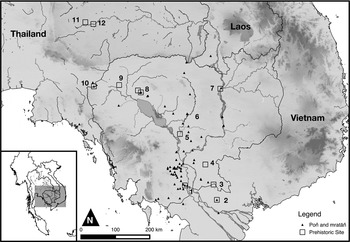
A parallel trajectory can be observed in a number of proto-historic sites in northeast Thailand (figs. 2 and 6). The proto-historic communities of the Mun Valley in northeast Thailand were possibly absorbed into the large, pre-existing proto-historic sites that later became Pre-Angkorian centres. Many proto-historic sites have been identified within the Mun Valley system, however, not all of them became large centres during the Pre-Angkorian period.Footnote 30 Ban Non Wat provides evidence of rich grave goods during the time when Angkor Borei was flourishing in the early centuries CE, yet it does not contain evidence contemporary with the Pre-Angkorian or Dvāravatī periods. Archaeological surveys of the Phimai region place the transition from the proto-historic to historic periods within the Classic Phimai Phase (c.200 BCE–300 CE) and Late Phimai Phase (c.300–600 CE).Footnote 31 Though the ceramic sequences of the two periods were not well understood at the time, David Welch notes close similarities between ceramics in the Phimai region and Angkor Borei, rather than the Dvāravatī ceramics.Footnote 32 Welch argues that by the Mueang Sema phase (600–1000 CE), as the general proto-historic site size decreased, some sites were abandoned in the Mun Valley. Only some large moated sites continued to function as local centres in the later period, similar to the pattern observed at Thala Borivat.Footnote 33 Prasat Phimai itself was likely an important Pre-Angkorian site bearing an inscription, K.1106, from Citrasena-Mahendravarman, and was built atop a proto-historic burial.Footnote 34 Caitlin Evans, Nigel Chang and Naho Shimizu argue that the settlements of this area tend to cluster closer to the Mun River by the late proto-historic and Pre-Angkorian period, probably in order to exploit the floodplain and communication routes in a manner similar to Thala Borivat. Phimai and Mueang Sema evolved from medium-sized proto-historic sites to become ‘proto-cities’ or large riverine outposts during the Pre-Angkorian and Dvāravatī periods.Footnote 35 Higham and Rachanie Thosarat also note the presence of a proto-historic burial near one of the structures at Khao Noi, an important Pre-Angkorian centre within the territory called Jyeṣṭhapura.Footnote 36
Major prehistoric/proto-historic sites and poñ-mratāñ inscriptions. 1. Wat Kumnou (Angkor Borei), 2. Go Thap, 3. Go O Chua, 4-. Prohear, 5. Samrong Sen, 6. Sambor Prei Kuk, 7. Thala Borivat, 8. Koh Ta Meas, Prei Khmeng, Lovea, Angkor, 9. Phum Snay, 10. Khao Noi, 11. Ban Non Wat, 12. Phimai

The archaeological data in northwest Cambodia from sites like Phum Snay, a large proto-historic necropolis dating to c.400 BCE–500 CE, provide similar patterns to the northeast Thailand sites.Footnote 37 The ceramic traditions from this area indicate similarities with contemporary sites in northeast Thailand, and possibly other regions, including the Mekong Delta. The reduced ceramic horizon associated with the early phase represents some degree of proto-historic interaction across the Dang Raek Mountains. In the other direction, a kendi from Phum Snay, very similar to the AB Phase II example of fine orangeware, with an associated date of 160 ± 85 CE, represents interaction with the Delta at a later phase.Footnote 38 Despite the small skeletal sample size, the grave goods imply that Phum Snay was a society based on gender division, and that prestige goods were possibly limited to a few individuals.Footnote 39 By 300–500 CE, some burials included buffware kendi, which suggests greater interaction with other Pre-Angkorian period regions.Footnote 40 However, there is scarce evidence of the succeeding Pre-Angkorian period after 500 CE in Phum Snay. The CISARK database does not show significant Pre-Angkorian temple remains in the surrounding area. Phum Snay's proto-historic communities may have been incorporated into other, nearby Pre-Angkorian centres (such as Mongkol Borei c.23 km away) where the inscriptions and temples are located (see figs. 6 and 7).
Poñ and mratāñ and Pre-Angkorian rulers’ inscriptions. 1. Angkor Borei, 2. Go Thap, 3. Kuhear Luong (K.44 mentions Jayavarman I and Rudravarman), 4. Sambor Prei Kuk, 5. Sambor, 6. Thala Borivat, 7. Angkor, 8. Wat Phu, 9. Phimai, 10. Khao Noi, 11. Wat Sabab, 12. Sri Thep

The proto-historic communities in these areas may have been absorbed into the later Pre-Angkorian centres of Amoghapura, Bhimapura (Battambang), Cakraṅkapura (K.60/626 CE), Jyeṣṭhapura (K.506/637 CE and K.1150), and other unknown centres of northeast Thailand and northwest Cambodia.Footnote 41 Proto-historic communities in the south may have been incorporated into various Pre-Angkorian centres such as Āḍhyapura, Vyādhapura, Dhanvipura (Ta Kev), Rudrapura (southern Vietnam), and others.Footnote 42 The patterns of the Pre-Angkorian ‘large and small settlement clusters’ identified with the middle Mekong and Se Kong rivers and their tributaries in Laos are comparable with the Thala Borivat settlement patterns.Footnote 43 Although we need more data on the proto-historic period, epigraphic and architectural data related to the Pre-Angkorian kings, including Citrasena-Mahendravarman and Thala Borivat style lintels, provide many similarities to the findings at Thala Borivat.
The missing link
Archaeologists and historians question whether these documented proto-historic communities formed discrete and autonomous ‘chiefdoms’, or whether they instead constituted larger but loose-knit polities under the rule of individual poñs. Higham's analysis of Ban Non Wat's mortuary patterning (in northeast Thailand), which includes significant wealth differentiation, inspired him to associate particularly rich burials with chiefs. Sarah Talbot's earlier work at Phimai also supports a ‘proto-poñ’ model of political organisation.Footnote 44 Noted here is the proximity of these proto-historic sites to provenienced Pre-Angkorian inscriptions (figs. 6 and 7), which suggests a relationship between proto-historic and Pre-Angkorian occupations and, possibly, the continuity of the proto-historic elites as the Pre-Angkorian poñ.Footnote 45
Michael Vickery asked: ‘[D]id the fan chiefs become varman kings, or did some other groups completely replace the fan, using the title -varman as their claim to superior status?’Footnote 46 If poñ were local Funan elites that the Chinese called fan prior to the Pre-Angkorian period, when Sanskrit titles such as –iśvara or raja were adopted, then their chronology fits well with the transition period or early historic period (table 1). If local elite groups were replaced by outside groups, we would expect to see a drastic change in burial practice and ceramic technology. However, based on the archaeological data presented earlier, there is no evidence of population replacement. Both ceramic technology and burial goods at sites like Angkor Borei and Phum Snay suggest gradual change and continuity from the proto-historic to the Pre-Angkorian periods. The question should then be: Did the elites of the proto-historic polities, i.e., fan or poñ, consolidate their power to become early kings and distinguish themselves from their competitors by taking up Indic names and titles? It is difficult to distinguish a clear relationship between the early poñ and the early kings due to inadequate data, such as a lack of precise dates. Also complicating the inference that poñ became kings is the fact that the inscriptions are in Sanskrit while another Khmer title for king, vraḥ kamratāṅ añ, was already in use by Iśānavarman (c.616–37 CE). Whether Iśānavarman's predecessors had the same title is unclear, as there is no reference to the poñ title being used by the Pre-Angkorian kings.
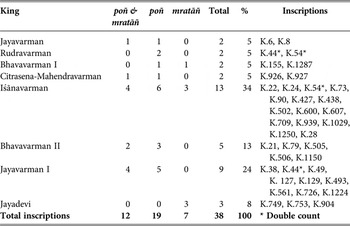
However, the spatial correlation between the inscriptions mentioning poñ/mratāñ and the Pre-Angkorian kings and proto-historic sites is striking (figs. 2 and 6). If each inscription mentioning a Pre-Angkorian king is assigned a 1-km-radius zone of influence, then at least 38 poñ-mratāñ inscriptions, dated between 611 CE and 713 CE, lie within this 1-km-radius zone (table 3).Footnote 47 The poñ and mratāñ category is further subdivided into inscriptions mentioning poñ & mratāñ, poñ, and mratāñ. The zone assigned here is hypothetically based on the settlement patterns along the Mekong (including Thala Borivat and Sambor), where most sites are located within 1 km from the bank.Footnote 48 This suggests that the sphere of interaction along the main route lies within the 1-km radius, even though the length of these settlements is generally much longer. The assumption here is that a king's name might have been heard of or known within a minimum of a 1-km zone, radiating from the inscription mentioning that name. In fact, there is not much difference between 500 m, which produces 30 inscriptions, and 2 km, producing 39 inscriptions. All inscriptions are within the same date range, except those within the 500 m-radius, which excludes Iśānavarman's predecessors, but includes Jayavarman of Funan. Similar approaches have been applied to other epigraphic data, for example, the relationship between the Angkorian kings and exemptions granted to temple foundations based on inscription locations, and the relationship between the locations of ‘nodes’ denoting the words for ‘road’ in the inscriptions to study the Angkorian road networks.Footnote 49
The poñ-mratāñ inscriptions located within a 1 km-zone of the inscriptions mentioning the Pre-Angkorian kings

Figure 7 illustrates the spatial configuration of the 38 poñ and mratāñ inscriptions that are located within a 1-km zone of inscriptions mentioning the Pre-Angkorian kings, supporting the evidence of multi-generational relationships between the Pre-Angkorian kings and the poñ, as shown by K.53. This pattern suggests that the Pre-Angkorian kings may be related to the poñ themselves since they appear around the same timeframe, c.500–700 CE. The co-occurrence of the poñ-mratāñ and Pre-Angkorian kings’ inscriptions at four proto-historic sites that became Pre-Angkorian centres (Go Thap, Wat Kumnou, Phimai, and Khao Noi) suggests the continuity of proto-historic and Pre-Angkorian elites. If the Pre-Angkorian temples are used as an index of continuity, then the list is currently growing to include Thala Borivat (O Trel), Prei Khmeng, Koh Ta Meas, and Phanom Wan. Though other proto-historic sites are not associated with any known direct evidence of the Pre-Angkorian period, some Pre-Angkorian inscriptions are located within 30 km from these sites. For example, Phum Snay is located c.23 km from K.213 of Bhavavarman I. Prohear and Bit Meas are c.30 km from K.53/667 CE of the Āḍhyapura family which served multiple kings beginning with Rudravarman of Funan. This set of proto-historic sites were probably incorporated into the later Pre-Angkorian period centres (e.g., Bhimapura [Battambang], Jyeṣṭhapura in the north and Āḍhyapura [Prei Veng] in the south) a similar pattern to that observed in Thala Borivat. From the Delta to the north, the inscriptions mentioning the poñ and mratāñ are located atop proto-historic sites such as Go Thap (K.6 and K.8), Wat Kumnou (K.600/611 CE), and Khao Noi (K.506/637 CE and K.1150/Bhavavarman II 638–52 CE). Other proto-historic sites that bear no direct evidence of the Pre-Angkorian period are nonetheless located within a 35-km radius of the poñ/mratāñ inscriptions.
Whatever ‘Indianisation’ describes, the timeframe of these -varman, their power consolidation, and the extent of their temple institutions overlap with the fine buffware horizon from c.500 CE, fitting into Monica Smith's post-fourth-century date for the second period of contact between South and Southeast Asia.Footnote 50 Art historical evidence associated with the distribution of conch-on-hip Viṣṇu-vāsudeva images in Southeast Asia also fits this timeframe.Footnote 51 In the Delta, this process coincided with the appearance of –varman (e.g., Jayavarman and Rudravarman, c.450–550 CE) in the inscriptions and its equivalent in the Chinese records. The major archaeological records from Angkor Borei associated with complex sociopolitical systems, such as the city wall and canal systems linking other regions, all predate this timeframe.Footnote 52 The buffware horizon is widespread across mainland Southeast Asia and many buffware pieces have been found within Pre-Angkor era polities such as Dvāravatī and Campā.
Archaeological data from Thala Borivat, Phimai, Khao Noi, Prei Khmeng, and Koh Ta Meas indicate that complex proto-historic societies already existed prior to the references to Pre-Angkorian rulers described in sixth to eighth century inscriptions. The rich burial goods from Prohear and Bit Meas, c.500 BCE to 100 CE, suggest that a complex sociopolitical system already existed in the Delta.Footnote 53 For Zhenla in the north, individuals bearing the –varman title are only known in retrospect from Bhavavarman I and Citrasena's inscriptions, referring to their father as Viravarman, who may have been a contemporary of Rudravarman of Funan (c.514–550? CE). Whether Viravarman ever had the status of a king is subject to debate.Footnote 54 The appearance of fine buffware in Phum Snay may coincide with Rudravarman of Funan or Bhavavarman I, who left an inscription (K.213) approximately 23 km from there. It is also possible that Bhavavarman I and Citrasena-Mahendravarman were consolidating power among different poñ-ship polities in northeast Thailand, southern Laos, and Cambodia. Figures 2 and 6 illustrate the hypothetical zone created by connecting the locations of Bhavavarman and Mahendravaman inscriptions, which overlap the distribution of the proto-historic reduced ceramic horizon. Similarly, there is continuity from the later proto-historic burials to the period associated with Bhavavarman I's family in Thala Borivat. The early transition from proto-historic to early historic ceramics in Angkor Borei (c.200 BCE–300 CE) may relate to a similar process of power consolidation among these fan/poñ rulers. Figure 2 illustrates Jayavarman's and Rudravarman's zone by linking inscriptions referencing their names, which overlap with the fine orangeware horizon of the Delta. The spatial relationship between proto-historic sites, poñ-mratāñ inscriptions, Pre-Angkorian temples, and the gradual transition and distribution of three ceramic traditions (reduced ware, fine orangeware, and fine buffware) all suggest the continuity of communities from the proto-historic to Pre-Angkorian periods.
Conclusion
This article explores the transition from proto-historic into the early historic or Pre-Angkorian period using comparative archaeological and historical data, and compares these general patterns against that data from the Thala Borivat region. Thala Borivat archaeological data, while not unique, offer new evidence of continuity from the proto-historic to the early historic or Pre-Angkorian period. From at least between c.1000–100 BCE, a series of prehistoric communities were located along the Mekong and the Se San rivers near Thala Borivat. Most of the sites are burial grounds, whose sizes suggest a site hierarchy clustered around the larger centres of O Trel and O Khlong. Reports from looters and the intensity of looting in both the latter sites imply that they contain more wealth (such as gold, bronze, and beads) than the smaller sites. Both sites produced sherds belonging to the fine orangeware tradition, likely from the Mekong Delta, which suggests long-distance interaction possibly via the river system. The Pre-Angkorian brick architecture or structures with Thala Borivat style lintels were built atop the largest proto-historic burials at O Trel. At O Khlong, the second largest site, the Ba Doem complex and other smaller temples are located nearby. There is no evidence, however, of a Pre-Angkorian temple being located close to the smaller proto-historic sites. It is argued that by c.300 to 500 CE, large proto-historic sites became much larger, possibly by absorbing smaller ones, and after 500 CE they were centred around a temple cluster such as Thala Borivat and Ba Doem. The model constructed based on the Thala Borivat archaeological data explains similar trends in northeast Thailand and the Mekong Delta, where only some of the proto-historic sites became Pre-Angkorian centres with brick monuments built on or near them, while other sites provide no evidence of continuity.
No direct historical evidence links proto-historic elites with Pre-Angkorian elites, in part because the former did not leave a documentary record. A substantial gap also characterises the transition from the last known fan of Funan (285 CE) and the first appearance of poñ-mratāñ in inscriptions (the earliest dated Khmer inscription is 611 CE). However, continuity and gradual change characterise the ceramic technology at both Angkor Borei and Thala Borivat. The overlapping location of proto-historic sites, Pre-Angkorian inscriptions mentioning poñ and mratāñ, and those mentioning the Pre-Angkorian kings also suggest the same pattern of continuity and gradual change.
It is argued here that a series of proto-historic complex societies or chiefdoms, likely associated with poñ-ship, predate references to ‘Indianisation’. The shared reduced ceramic tradition of the proto-historic communities across modern-day northeast Thailand, Cambodia, and southern Vietnam suggests that they were already in contact. The transition period in the Mekong Delta coincides with the distribution of fine orangeware, which overlaps the distribution of inscriptions mentioning Jayavarman and Rudravarman of Funan. As intra- and inter-regional interactions increased, smaller proto-historic communities were absorbed into larger ones and eventually became Pre-Angkorian politico-economic centres. The locations of the early Zhenla kings Bhavavarman I and Citrasena-Mahendravarman overlap with the reduced ceramic horizon of the proto-historic period. This pattern may be associated with the consolidation of the Pre-Angkorian kings at the expense of other proto-historic societies. The timeframe also accords with the distribution of the fine buffware horizon and the formation of Pre-Angkorian regional centres. The association with ‘Indianisation’ occurred at a later stage and coincided with the expansion of rulers with Indian religious associations and their temples. The construction of the Pre-Angkorian temples atop some of the proto-historic burials also implies such continuity, possibly suggesting a merging of ancestral worship practices with Indian religious traditions. The co-occurrence of poñ-mratāñ inscriptions with proto-historic and Pre-Angkorian sites also suggests the continuity of elites and local communities. Likewise, the co-occurrence of the Pre-Angkorian kings’ inscriptions with both the poñ-mratāñ inscriptions and the proto-historic sites suggests that some of the regional elites, who declared themselves kings, were consolidating their power among these proto-historic communities to form larger and more complex Pre-Angkorian polities.