INTRODUCTION
Major depressive disorder (MDD) is a recurrent illness. Its natural history varies widely, depending on the source population (in-patients versus out-patients), the subtype of depression, the length of the follow-up, and the criteria for defining a positive outcome. Overall, the evidence from studies of hospitalized depressed patients indicates that between 50% and 90% achieve a full remission over a 1- to 5-year period (Keller et al. Reference Keller, Shapiro, Lavori and Wolfe1982, Reference Keller, Lavori, Mueller, Endicott, Coyell, Hirschfeld and Shea1992; Coryell et al. Reference Coryell, Keller, Lavori and Endicott1990; Keitner et al. Reference Keitner, Ryan, Miller and Norman1992; Rothschild et al. Reference Rothschild, Samson, Bond, Luciana, Schildkraut and Schatzberg1993; Ramana et al. Reference Ramana, Paykel, Cooper, Hayhurst, Saxty and Surtees1995; Paykel, Reference Paykel1998; Kravitz et al. Reference Kravitz, Bloom and Fawcett2000; O'Leary et al. Reference O'Leary, Costello, Gormley and Webb2000; Solomon et al. Reference Solomon, Keller, Leon, Mueller, Lavori, Shea, Coryell, Warshaw, Turvey, Maser and Endicott2000). However, in the long run, almost all patients relapse at least once (Lee & Murray, Reference Lee and Murray1988). The strongest predictor of poor outcome is a more chronic early course characterized by multiple episodes, psychotic symptoms, underlying chronic depression, and greater severity of the index episode (Ramana et al. Reference Ramana, Paykel, Cooper, Hayhurst, Saxty and Surtees1995; Paykel, Reference Paykel1998; Kennedy et al. Reference Kennedy, Abbott and Paykel2003). Indeed, the majority of patients hospitalized with psychotic depression, that is at the severe end of the spectrum, have poor outcomes (Tsuang & Coryell, Reference Tsuang and Coryell1993; Goldberg & Harrow, Reference Goldberg and Harrow2004). For example, in one study two-thirds of a collaborative depression cohort with psychotic depression were rated as psychosocially impaired at the 5-year follow-up (Coryell et al. Reference Coryell, Keller, Lavori and Endicott1990). As in other studies, however, these samples contained a mix of incident and recurrent cases. It is thus striking that in the McLean hospital and Suffolk County first-admission cohorts, the early course of psychotic depression was generally positive (Tohen et al. Reference Tohen, Stoll, Strakowski, Faedda, Mayer, Goodwin, Kolbrener and Madigan1992; Bromet et al. Reference Bromet, Jandorf, Fennig, Lavelle, Kovasznay, Ram, Tanenberg-Karant and Craig1996; Craig et al. Reference Craig, Bromet, Jandorf, Fennig, Tanenberg-Karant, Ram and Rosen1997), with almost all of the McLean patients achieving syndromal recovery by the 2-year follow-up (Tohen et al. Reference Tohen, Hennen, Zarate, Baldessarini, Strakowski, Stoll, Faedda, Suppes, Gebre-Medhin and Cohen2000).
Besides chronicity, two consistent predictors of longer time to remission in patients with psychotic depression are mood incongruent psychosis (Coryell et al. Reference Coryell, Keller, Lavori and Endicott1990) and poor pre-morbid functioning (Coryell et al. Reference Coryell, Keller, Lavori and Endicott1990; Bromet et al. Reference Bromet, Jandorf, Fennig, Lavelle, Kovasznay, Ram, Tanenberg-Karant and Craig1996). In mixed psychotic and non-psychotic samples, older age at index episode (Kennedy et al. Reference Kennedy, Abbott and Paykel2003) and male sex (Keitner et al. Reference Keitner, Ryan, Miller and Norman1992) are also associated with poorer outcome. Naturalistic studies rarely examine the predictive utility of antidepressant (AD) treatment, but O'Leary et al. (Reference O'Leary, Costello, Gormley and Webb2000) reported that AD dose at remission onset was not related to relapse. This study therefore addresses some gaps in the research by examining remission and relapse among an epidemiologically ascertained first-admission cohort with psychotic depression followed over a 4-year period, and the influence of demographic, clinical and treatment-related factors, including daily use of AD and antipsychotic (AP) medications during the follow-up.
METHOD
Sample and procedure
The data came from the Suffolk County Mental Health Project (SCMHP), a naturalistic, prospective study described in detail elsewhere (Bromet et al. Reference Bromet, Mojtabai, Fennig, Zipursky and Schulz2002). In brief, between September 1989 and December 1995, first-admission patients who were residents of Suffolk County (population 1·3 million), aged 15–60, and who presented with psychotic symptoms were recruited by the head nurse or social worker or by project staff from the 12 in-patient facilities in the county. Exclusion criteria were significant mental retardation, inability to speak English, and lack of capacity to provide informed consent. The consent procedures were approved annually by the Committees on Research Involving Human Subjects at Stony Brook University and by Institutional Review Boards of all hospitals where respondents were recruited. Written informed consent was obtained after the study was fully explained; for those aged 15–17, written consent was first obtained from a parent. Signed releases for hospital and clinic records were obtained at each face-to-face follow-up assessment.
The baseline interview occurred primarily in the hospital. Face-to-face follow-up interviews took place in respondents' homes 6, 24 and 48 months later, and by phone every 3 months from baseline to 24 months and every 6 months from 24 to 48 months. The baseline evaluation included the Structured Clinical Interview for DSM-III-R (SCID; Spitzer et al. Reference Spitzer, Williams, Gibbon and First1992) supplemented with questions about suicide, violence and drug use. Interval SCIDs were administered at the 6- and 24-month face-to-face interviews; selected modules were administered at the 48-month interview. Best-estimate, consensus DSM-IV research diagnoses were determined by a team of psychiatrists at the baseline, 6- and 24-month time points using all available sources of information (Schwartz et al. Reference Schwartz, Fennig, Tanenberg-Karant, Carlson, Craig, Galambos, Lavelle and Bromet2000).
The baseline cohort consisted of 675 hospitalized participants (72% of the target sample). Forty-seven were subsequently found to be ineligible for diagnostic reasons or because they had previously been hospitalized. Of the 628 remaining, 589 had sufficient follow-up information for a 24-month consensus diagnosis. This study focused on 87 respondents who received a 2-year consensus diagnosis of MDD with psychotic features. The 24-month consensus diagnosis was used to define the sample because at baseline and at 6 months, the diagnosis of MDD was not always clear (Schwartz et al. Reference Schwartz, Fennig, Tanenberg-Karant, Carlson, Craig, Galambos, Lavelle and Bromet2000).
Outcome measures
The SCMHP maintained a chronological record of all changes in psychiatric status during the follow-up, including onset and offset dates of mood and psychotic symptoms. Based on Frank et al. (Reference Frank, Prien, Jarrett, Keller, Kupfer, Lavori, Rush and Weissman1991), full remission was defined as a period lasting at least 8 weeks in which the respondent was asymptomatic (did not meet syndromal criteria and had only minimal symptoms), regardless of treatment status. Partial remission was defined as having some persistent symptoms but not meeting syndromal criteria for MDD. Relapse was defined as an episode meeting DSM-IV symptom and duration criteria after achieving remission. Partial relapse referred to recurrence of more than minimal symptoms but not meeting syndromal criteria for an episode. The start dates of the first full remission and first full relapse are considered here.
Predictors
Background characteristics, clinical features and treatment factors were examined. The background characteristics were sex; ethnicity (black versus non-black); occupation of head of house (blue- versus white-collar job based on the Hollingshead scale); marital status at baseline (never versus ever married); age at admission; and family history of mood disorder based on the Family History Research Diagnostic Criteria (FH-RDC) administered to respondents and significant others and from a review of medical records (Andreasen et al. Reference Andreasen, Endicott, Spitzer and Winokur1977).
The clinical characteristics addressed clinical history and symptom severity at baseline. The clinical history variables were childhood psychopathology (behavior disorder; other childhood problems; none; see Carlson et al. Reference Carlson, Bromet, Driessens, Mojtabai and Schwartz2002); age of onset of mood disorder determined at the consensus diagnosis meeting; number of depressive episodes prior to admission (0, 1, 2, 3+); latency between first episode and index admission (5+ years versus <5 years); lifetime co-morbidity of cigarette smoking, DSM-III-R substance use disorder determined by the baseline SCID, and DSM-III-R panic and/or obsessive-compulsive disorder (OCD) determined by the SCID; and the Global Assessment of Functioning (GAF) for the best month in the year preceding index admission. Baseline symptom measures included presence of mood incongruent psychotic symptoms (Fennig et al. Reference Fennig, Bromet, Karant, Ram and Jandorf1996); admitted for a suicide attempt; severity of mood symptoms based on the 21-item Hamilton Depression Rating Scale (HAMD21; Hamilton, Reference Hamilton1960) and the anxiety/depression subscale of the Brief Psychiatric Rating Scale (BPRS; Woerner et al. Reference Woerner, Manuzza and Kane1988); and severity of psychotic symptoms [average global severity rating of the Scale for the Assessment of Positive Symptoms (SAPS); Andreasen, Reference Andreasen1984].
The hospital treatment factors were length of stay (above versus at/below the median values calculated separately for the community, public and university hospitals for the periods 1989–1991, 1992–1993, and 1994–1995 for the entire SCMHP baseline sample); being discharged on AD and AP medications (e.g. the optimal treatment for psychotic depression) versus one type of medication or neither; and type of insurance [private, public (mostly Medicaid), and none; see Rabinowitz et al. Reference Rabinowitz, Bromet, Lavelle, Hornak and Rosen2001].
Use of medication during the follow-up was recorded on a chronological record form developed for the study that included the start and stop dates of each drug (Bromet et al. Reference Bromet, Finch, Carlson, Fochtmann, Mojtabai, Craig, Kang and Ye2005). Three distinct event history series were created characterizing medication use on each day from admission through first remission (rem): using medication on a given day (onADrem); off medication after having taken it previously (discontinuous use) (offADrem); and never having taken the medication to that point (preADrem). Analogous event history series were also created to reflect changes in medication status between remission and relapse (for more details, see Bromet et al. Reference Bromet, Finch, Carlson, Fochtmann, Mojtabai, Craig, Kang and Ye2005). AD was also subclassified into tricyclics/serotonin-norepinephrine reuptake inhibitors (SNRIs), selective serotonin reuptake inhibitors (SSRIs), and others. Given the timing of the study, the most commonly prescribed ADs were fluoxetine (n=39) and sertraline (n=29). We note that nine respondents received electro-convulsive therapy (ECT).
Statistical analysis
Survival analysis was used to examine the distributions of time from first psychiatric hospitalization to first full remission and from first full remission to first relapse. To evaluate the predictors of time to remission and relapse, we used the Cox proportional hazards models with censoring at the date of missing outcome information (Hosmer & Lemeshow, Reference Hosmer and Lemeshow1999) as implemented in SAS 8.2 (SAS Institute Inc., Cary, NC, USA). Eighteen respondents had incomplete follow-up information over the 4-year period. Those having incomplete versus complete follow-up information were similar on all variables included in this report except that more respondents with incomplete follow-up had mood incongruent psychosis (77·8% v. 44·9%; two-sided Fisher's exact test, p<0·05). Each predictor was first analyzed independently and then jointly in a stepwise multivariable model in which variables were retained or removed if p⩽0·05 (using Wald's test). The same procedure was followed in analyses of the time-varying medications variables with censoring at the first missing medication or loss to follow-up date. Hazard ratios (HRs), 95% confidence intervals (CIs) and p values are reported.
RESULTS
Sample characteristics
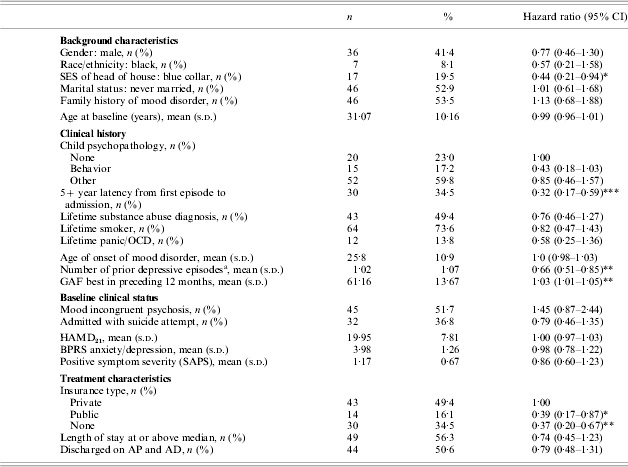
As shown in Table 1, less than half of the sample was male, black, or from blue-collar households. The average age was 31 years. Slightly more than half had never married and had a family history of mood disorder. The majority had a psychological or behavioral problem during childhood. For nearly half the sample, the index admission was their first lifetime depressive episode. One-third had their first depressive episode more than 5 years prior to admission (62·8% of those with prior episodes). Close to half had a history of substance use disorder, and three-quarters were lifetime smokers. Few respondents (13·8%) had a history of panic disorder or OCD. Slightly more than one-third of the sample had been hospitalized following a suicide attempt, and half had mood incongruent psychotic symptoms. The relative low HAMD21 and SAPS scores reflect the timing of the baseline interviews, which took place when respondents were well enough to provide informed consent.
Descriptive characteristics of 87 first-admission patients with major depressive disorder with psychotic features and associations with time to remission: results from unadjusted Cox proportional hazards models

CI, Confidence interval; SES, socio-economic status; OCD, obsessive–compulsive disorder; HAMD21, 21-item Hamilton Depression Rating Scale; BPRS, Brief Psychiatric Rating Scale; SAPS, Scale for the Assessment of Positive Symptoms; AP, antipsychotic; AD, antidepressant.
a Six cases had missing values.
* p⩽0·05, ** p⩽0·01, *** p⩽0·001.
One-third of the sample had no health insurance at baseline, and about half had relatively long hospitalizations compared to the overall SCHMP cohort. At discharge, 44 respondents (50·6%) were prescribed a combination of AP and AD, 25 (28·7%) AP alone, 11 (12·6%) AD alone, and seven (8·1%) received neither medication.
Time to first remission
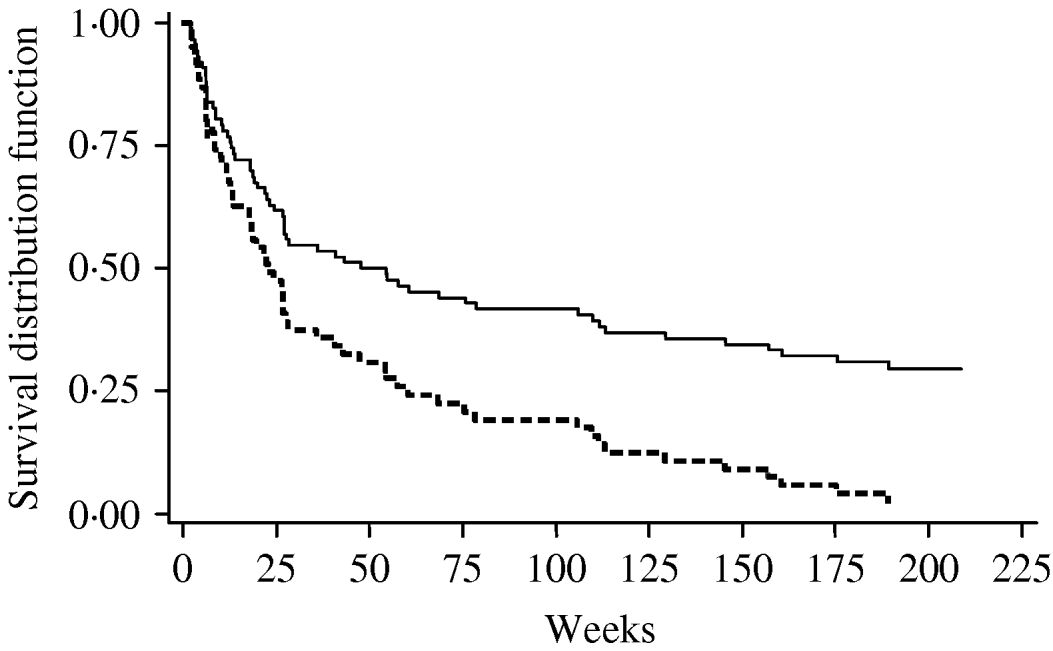
Sixty respondents (69·0%) achieved a period of complete remission by the 4-year follow-up, 20 (23·0%) had a partial remission, and seven (8·0%) did not remit at all. The median time to full remission among the 60 remitters (Fig. 1, lower curve) was 22·2 weeks (interquartile range=8·4–56·1 weeks). Cumulatively, 11·7% achieved a complete remission by 1 month after admission, 36·7% by 3 months, 55·0% by 6 months, and 71·7% by 1 year. Among all 87 respondents, the median time to remission was 54·3 weeks (Fig. 1, upper curve), with 8·1% achieving complete remission by 1 month after admission, 25·5% by 3 months, 38·3% by 6 months, and 48·8% by 1 year.
Time from hospital admission to full remission in 87 respondents with psychotic depression and in the subset who remitted (n=60). ––––, All respondents; - - - -, respondents who remitted.

The significant predictors of remission based on the bivariate analysis are shown in Table 1. Slower remission was associated with: being from a blue-collar household, longer latency from initial episode to first hospitalization, more depressive episodes before admission, worse GAF score in the year preceding admission, and not having private health insurance. Descriptively, eight of the 60 remitters (13·3%) compared to nine of the 27 non-remitters (33·3%) were from blue-collar households, and 13 remitters (21·7%) compared to 17 non-remitters (63·0%) had their first episode >5 years before admission. Most respondents (88·4%) with private insurance remitted, compared to 50% of respondents with no insurance and 50% with public insurance. The mean±s.d. GAF ratings were 63·7±12·2 for remitters and 55·5±15·2 for non-remitters; the mean±s.d. number of previous episodes was 0·71±1·47 for remitters and 1·80±2·50 for non-remitters [57·1% of remitters (32/56) versus 24·0% of non-remitters (6/25) had no prior episodes (six respondents had missing values)].
In the stepwise multivariable analysis, three variables were significantly associated with remission: longer latency from initial lifetime episode to admission (HR 0·46, 95% CI 0·24–0·90, p<0·05); poorer GAF score (HR 1·02, 95% CI 1·00–1·05, p<0·05); and having no insurance (HR 2·14, 95% CI 1·14–4·04, p<0·05).
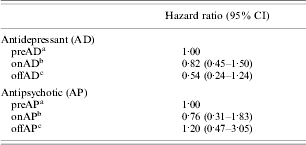
The temporal patterns of AD and AP use over the 4-year study period were not significantly associated with time to remission (Table 2). Moreover, there were no significant associations of any of the AD subtypes with remission (data not shown).
Relationships between medication event history series and time to remission in 87 first-admission patients with major depressive disorder with psychotic features

a Using medication on a given day.
b Off medication after having taken it previously (discontinuous use).
c Never having taken the medication to that point.
Time to first relapse
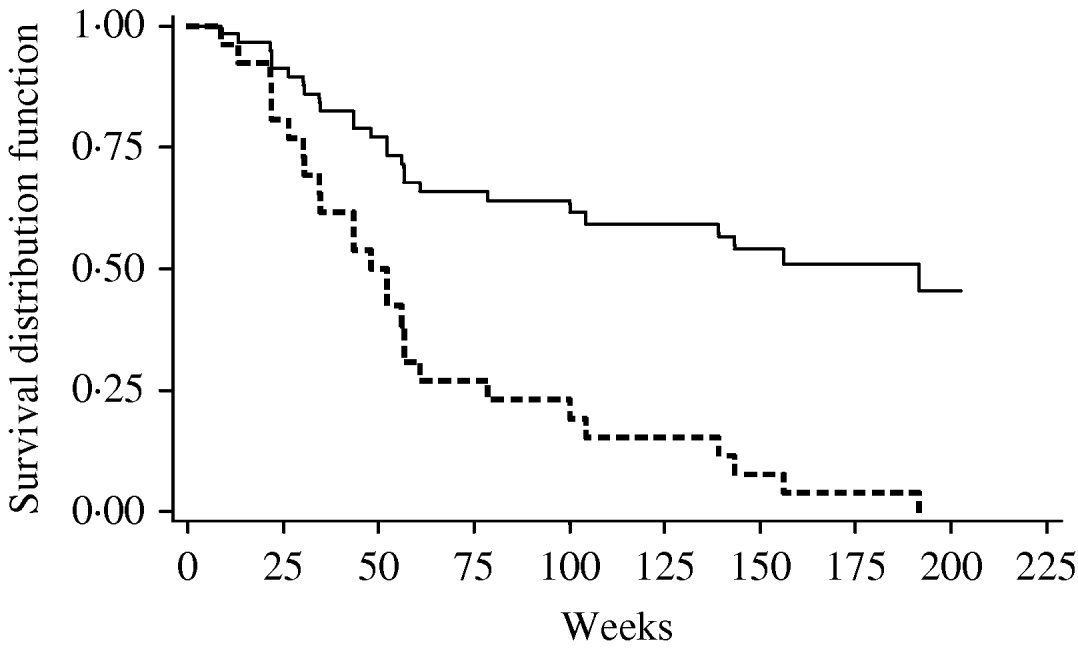
Twenty-six of the 60 remitters (43·3%) subsequently relapsed before the 4-year point. Seven additional respondents experienced a partial relapse. Among the 26 who fully relapsed (Fig. 2, lower curve), the median time to relapse was 50·0 weeks (interquartile range=30·3–78·6 weeks). Cumulatively, 19·2% relapsed by 6 months and 53·9% by 1 year. Among all 60 remitters (Fig. 2, upper curve), the median time to relapse was 191·6 weeks, with 8·5% relapsing by 6 months and 24·8% by 1 year of their remission.
Time from start of first remission to relapse in 60 depressed respondents who achieved remission and in the subset who relapsed (n=26). ––––, Respondents who remitted; - - - -, remitters who relapsed.

None of the background, clinical or treatment variables, including the time-varying medication time series constructed for the period between remission and relapse, was significantly associated with relapse. Moreover, time to remission was not significantly related to time to relapse.
DISCUSSION
This is a naturalistic study describing remission and relapse in 87 first-admission patients with DSM-IV diagnoses of MDD with psychosis followed up for 4 years. Sixty-nine per cent achieved a period of complete remission during the 4-year follow-up. By comparison, Simpson et al. (Reference Simpson, Nee and Endicott1997) found that 90% of their first-episode cohort had a complete remission during a 5-year follow-up period, and similarly O'Leary et al. (Reference O'Leary, Costello, Gormley and Webb2000) reported an 88% remission rate at 18-month follow-up. Moreover, Coryell et al. (Reference Coryell, Keller, Lavori and Endicott1990) found that 82·6% of depressed patients with psychosis achieved recovery over a 5-year period, albeit with considerable psychosocial impairment, and Tohen et al. (Reference Tohen, Hennen, Zarate, Baldessarini, Strakowski, Stoll, Faedda, Suppes, Gebre-Medhin and Cohen2000) found that almost all of their first-admission psychotic MDD patients were recovered by the 2-year follow-up. At the other extreme, Goldberg & Harrow (Reference Goldberg and Harrow2004) reported that only 41% of the Chicago cohort with psychotic depression had a good overall outcome during the year preceding the 4·5-year follow-up (27% were rated as good outcome at the 2-year point), and Vythilingam et al. (Reference Vythilingam, Chen, Bremner, Mazure, Maciejewski and Nelson2003) found that 41% of patients with psychotic depression died within 15 years of admission. Thus, our finding is less positive than most prior studies but not as pessimistic as that for the Chicago cohort. It is difficult to interpret these differences because of variations in sampling and methods of formulating diagnosis and outcome. One way to resolve the discrepancy is to conduct a prospective, epidemiological study of first-admission MDD patients with and without psychotic features. However, given the shift away from hospital admission and ever shortening lengths of stay, newly admitted patients may be more severely ill or have more co-morbidity than was the case in the past, and relatively fewer may have the capacity to give informed consent before discharge.
In our sample, a first episode of illness more than 5 years prior to admission predicted a longer time to remission, consistent with the findings reported by O'Leary et al. (Reference O'Leary, Costello, Gormley and Webb2000). Indeed, those whose first onset occurred more than 5 years earlier had a more protracted early course (e.g. they had more prior episodes). Thus, this variable signifies greater illness severity and poorer pre-hospital functioning overall. We also found that lower occupational status of head of household and having no or public insurance predicted longer time to remission, suggesting that less adequate socio-economic circumstances have a negative influence on clinical course. In addition, lower GAF scores for the year prior to index hospitalization were associated with later remission, confirming that one of the best predictors of outcome is previous functioning. These findings need to be validated in other samples, but they support the hypothesis that poorer resources confer a worse course for patients with psychotic depression.
Coryell et al. (Reference Coryell, Leon, Winokur, Endicott, Keller, Akiskol and Solomon1996) found that almost half of the patients with psychotic depression who relapsed were receiving AD treatment, and almost 20% were receiving AP medication in the week prior to the relapse. Similarly, O'Leary et al. (Reference O'Leary, Costello, Gormley and Webb2000) and Tohen et al. (Reference Tohen, Hennen, Zarate, Baldessarini, Strakowski, Stoll, Faedda, Suppes, Gebre-Medhin and Cohen2000) found no association between AD treatment and outcome. Our failure to detect associations of optimal medication treatment at discharge or time-varying AD and AP treatment with remission or relapse is consistent with these reports. As a naturalistic study, we were not able to reliably determine the adequacy of dosage. However, in examining the patterns of reported medication use, when AD medications were prescribed, they tended to be used episodically. In addition, there was little evidence of augmentation of AD with other medications or of direct switching from one AD to another as recent reports have noted (Rush et al. Reference Rush, Trivedi, Wisnewski, Stewart, Nierenberg, Thase, Ritz, Biggs, Warden, Luther, Wilson, Niederehe and Fava2006; Trivedi et al. Reference Trivedi, Fava, Wisnewski, Thase, Quitkin, Warden, Ritz, Nierenberg, Lebowitz, Biggs, Luther, Wilson and Rush2006). In sum, given the evidence for the positive impact of AD treatment on the course of MDD (Melfi et al. Reference Melfi, Chawla, Croghan, Hanna, Kennedy and Sredl1998), these findings support the need for more careful adherence to treatment guidelines for both psychotic and non-psychotic depression.
Overall, the illness course over the 4-year follow-up was stormy for the majority of respondents. Half of the sample was discharged on what appears to be inadequate treatment. This might reflect differences between clinicians and the research team in either diagnosis or characterization of psychosis, patient preferences, or adverse reactions to medications given earlier in the hospitalization. Twenty-seven respondents did not achieve full remission, and 26 remitters relapsed by the 4-year follow-up point. Thus, only 34/87 (39%) had a single episode with full remission. Previously reported relapse rates were in the range 30–76%. For example, 40% of the Lee & Murray (Reference Lee and Murray1988) cohort relapsed by the 4-year follow-up. In addition, Pintor et al. (Reference Pintor, Torres, Navarro, Matrai and Gasto2004) found that 91·4% of MDD patients who achieved only partial remission as well as 51·3% of those achieving complete remission subsequently relapsed during a 4-year follow-up. Collectively, these findings underscore the profoundly debilitating nature of psychotic depression.
A major strength of our study is that it is a prospective, naturalistic follow-up in which subjects were contacted at regular follow-up intervals for symptom assessments as well as for medication use. However, there are also inherent limitations. The sample size is relatively small, and the findings are generalizable only to depressed in-patients with psychosis. Another limitation is that medication information came from self-reports, although this was corroborated, when possible, with prescription bottles, medical records, and information from significant others. Although no gold standard exists for the measurement of medication adherence (Dolder et al. Reference Dolder, Lacro, Dunn and Jeste2002), previous reports have found good congruence between self-reports and validators, such as serum levels (Cochran, Reference Cochran1986). A final limitation is attrition and, in particular, the fact that relatively more respondents with incomplete follow-up information were hospitalized with mood incongruent psychosis compared to those with complete follow-up information. Indeed, our failure to detect a significant association of this variable with remission and relapse may be due to sample bias.
In summary, the 4-year course of MDD with psychosis is characterized by considerable turmoil. Almost two-thirds of the sample either failed to remit or relapsed after achieving full remission. The time to first remission averaged more than 1 year, and the only predictors of shorter remission, based on a multivariable analysis, were first onset less than 5 years before admission, better functioning during the year before admission, and having private versus no health insurance. Thus, better resources prior to admission were associated with better illness course. Future studies will examine other aspects of outcome, such as functional recovery. Use and non-use of AD or AP during the follow-up were not associated with remission or relapse. Naturalistic studies with larger samples are needed to investigate whether other forms of treatment, in conjunction with AD and AP, are associated with better outcomes.
Acknowledgments
This study was funded by NIMH Grant 44801 and a grant from the Eli Lilly Corporation. We are indebted to Janet Lavelle, Qing Wang, Qing Ye, Su-wei Chang and Steven Grossman for their help in data preparation. Most importantly, we thank the study participants for their ongoing support and the project interviewers and psychiatrists for their outstanding commitment and diligence.
Declaration of interest
None.