Introduction
Debates as to the need for the conservation of fungi have been prompted by threats to biodiversity throughout the world. Fungi are highly diverse and essential components of all ecosystems as symbiotic partners, predators and parasites, decomposers and nutrient cyclers and sources of food for vertebrates and invertebrates (McMullan-Fisher et al. Reference McMullan-Fisher, May, Robinson, Bell, Lebel, Catcheside and York2011). While the broad ecological importance of fungi justifies consideration of their conservation, discourse regarding biodiversity conservation has seemingly excluded fungi, with any consideration usually limited to the possible threats that they pose to agriculture, food security and the conservation of other species (Field et al. Reference Field, Daniell, Johnson and Helgason2020). Reasons proposed for this treatment pertain to the large and generally under-described diversity of fungi, and a general indifference to their conservation (Grube et al. Reference Grube, Gaya, Kauserud, Smith, Avery and Fernstad2017), with conservation decisions at the species level driven more by the popularity and perceived ‘charm’ of an organism rather than by the rationale of their significance to the greater ecosystem. Additionally, the omission of fungi in conservation efforts has been attributed to the lack of relationship that humans have with the organisms, especially when compared to the biophilia displayed by humans with animals and plants (Moore et al. Reference Moore, Nauta, Evans and Rotheroe2008). Furthermore, fungal species are responsible for spoilage of food and the deterioration of building materials, and some represent threats to human health through their pathogenic and toxigenic activities (Arora & Shepard Reference Arora and Shepard2008), potentially hindering conservation efforts through ‘mycophobia’ (Peintner et al. Reference Peintner, Schwarz, Mešić, Moreau, Moreno and Saviuc2013).
Fungal diseases have caused some of the most severe extinctions ever witnessed in wild species and are jeopardizing food security (Fisher et al. Reference Fisher, Henk, Briggs, Brownstein, Madoff, McCraw and Gurr2012). For example, high-profile declines in wildlife have been caused by Geomyces destructans (Frick et al. Reference Frick, Pollock, Hicks, Langwig, Reynolds and Turner2010, Boyles et al. Reference Boyles, Cryan, McCracken and Kunz2011), increasing the probability of extinction for many species of North American bats. Additionally, the skin-infecting amphibian pathogen, Batrachochytrium dendrobatidis, is implicated in the greatest disease-driven loss of biodiversity ever documented, causing infections in over 500 species of amphibians in 54 countries (Byrne et al. Reference Byrne, Voyles, Rios-Sotelo and Rosenblum2016). Taken together, these recent events have exacerbated the rationale of fungi representing a threat to the biota, rather than as a target for conservation efforts.
This review aims to describe the attention given to fungi in biodiversity conservation policy documents, management plans and formal conservation schedules throughout the world, to describe the methods used to determine the diversity of fungi, to detail the general lack of awareness of mycological species in the scientific community and to quantify the scarcity of mycology-associated curricula and the lack of mycologists in research institutions. This review then outlines a potential remediating strategy by quantifying the growing community interest and citizen science initiatives through social media or otherwise that contribute to the concept of community-based learning and could significantly contribute to mycology.
Conservation mycology
The 1992 Rio Convention on Biological Diversity (CBD) played a significant role in driving dialogue regarding the conservation of biological diversity, initiating discourse at a global political level (Panjabi Reference Panjabi1993). This conservation initiative was presented in terms of ‘animals, plants and microorganisms’, with all microorganisms combined into an arbitrary third group based solely on organism size (Dahlberg & Mueller Reference Dahlberg and Mueller2011). Several aspects of fungal biology and ecology lead to this group not fitting well into this grouping, and their consideration in global conservation planning has consequently largely been forsaken (Suryanarayanan et al. Reference Suryanarayanan, Gopalan, Sahal and Sanyal2015). The ‘right’ of fungi for their conservation has been established, but the convention has provided no policy or framework to enable it.
Nevertheless, as information on fungal ecology expands, including detailed descriptions of population dynamics and their roles in ecosystem functioning, especially in relation to symbioses, interest in the ecological significance, if not the conservation of fungi is growing. Although in a fledgling state, a community of fungal conservation advocates has emerged in recent decades (Davoodian Reference Davoodian2015). These interested parties are promoting critical intellectual discourse on the matter, either through organizing conferences or through promoting the idea of incorporating fungi into conservation planning (Barron Reference Barron2011). Though much of the groundwork remains to be conducted, these pioneering efforts are major steps towards a more comprehensive outline for fungal conservation and thus biodiversity and ecosystem conservation (Barron Reference Barron2011). On a regional scale, national Red Lists started to emerge in the 1980s, first being promoted in Germany in 1982. Currently, more than 35 countries have some form of Red List that includes fungi (Sadiković & Kuštera Reference Sadiković and Kuštera2013). Furthermore, these efforts may have fostered a baseline worldwide interest in the conservation of fungi, evidenced by the many fungal conservation groups established in the past decades, such as the European Council for the Conservation of Fungi, the International Society for Fungal Conservation and the International Union for Conservation of Nature’s (IUCN) Fungal Committee.
In addition to the growing efforts in conservation governance, the importance of fungi to symbioses with plants has been recognized, and thus they have been included in the Global Strategy for Plant Conservation (GSPC), which is a strategy that was established and implemented by the Convention on Biological Diversity (CBD) in 2002 (Jackson & Kennedy Reference Jackson and Kennedy2009). The GSPC provided an important new opportunity to focus on the potential loss of tens of thousands of threatened plant species, with those working within its framework deemed fundamental to delivering the GSPC and advancing the conservation of both plants and fungi (Le Breton et al. Reference Le Breton, Zimmer, Gallagher, Cox, Allen and Auld2019). Furthermore, in 2018, Kew Royal Botanical Gardens, supported by the Sfumato Foundation, released a benchmark publication (Willis Reference Willis2018). It was comprehensive, describing all of the positive interactions fungi provide, as well as describing fungal threats to ecosystems and fungal responses to climate change. More importantly, it detailed the collation of 2189 new species of fungi described during 2017 alone, and it highlighted the challenges of fungal conservation, demonstrating the taxonomic imbalance within the field of biological conservation. The continued activity and expansion of such groups illustrates the increasing understanding of the importance of fungi across stakeholders from academic, political and public spheres.
The collection and collation of species conservation data utilize three main tools (Dahlberg et al. Reference Dahlberg, Genney and Heilmann-Clausen2010): inventories, mapping and Red Lists. The lack of scientific data available on rare fungi, and thus their potential to become endangered, has largely led to their comparatively recent inclusion on IUCN Red Lists. Additionally, an obvious weakness with the fungal Red Lists provided so far is their national scope, making comparisons across larger regions challenging (Halme et al. Reference Halme, Holec and Heilmann-Clausen2017). To overcome this, Ódor et al. (Reference Ódor, Heilmann-Clausen, Christensen, Aude, van Dort and Piltaver2006) proposed a list of ‘fungi of special interest’ on the scale of continental Europe to facilitate discussion on how the fungi indigenous to beech forests were affected by forest management and fragmentation across countries from Denmark to Slovenia and to identify regions with the highest conservation value. This list has not been completed as of the time of writing, nor has it entered the planning stages in other countries that have equivalent, if not greater, fungal biodiversity, such as Australia. There has been some progress; in 2019, there were more than 340 species included in the IUCN Red List; however, this is still very incomplete. In light of this, it was proposed that three alternative conservation strategies could be adopted to protect fungal biodiversity (Allen & Lendemer Reference Allen and Lendemer2015). The first strategy is to wait for ecological literature and taxonomic data to become available, after which time the conservation of fungal species could take place using the same methodologies as those used for other taxa. The second well-supported strategy is to protect entire habitats, and thus all of the species contained within those environments. The third option could be to combine all of the information on fungi identified in environmental surveys and species databases into a central database, to consolidate all information on species population dynamics through time. Despite the continual growth in the literature and data on fungal diversity, the paucity of information on fungal species distributions remains the major barrier to the development of appropriate and accurate conservation efforts.
Fungi are vulnerable to the same biodiversity threats as many plants and animals, including habitat fragmentation, degradation and loss, climate change, nitrogen enrichment and pollution (Jönsson et al. Reference Jönsson, Ruete, Kellner, Gunnarsson and Snäll2017). While all types of ecosystem services – regulating, supporting, provisioning and cultural services (Millennium Ecosystem Assessment Reference Millennium Ecosystem2005) – are provided by fungal activities, their actions in regulating terrestrial ecosystem processes are central to sustainable land use (Heijden et al. Reference Heijden, Martin, Selosse and Sanders2015). It is therefore possible that the loss of any fungi, including those not yet unidentified, may result in restricted performance of the most critical ecosystem services.
Over the last two decades, global conservation initiatives have shifted in focus, from being species centric to an integrative habitat–ecosystem-based approach (Heilmann-Clausen et al. Reference Heilmann-Clausen, Barron, Boddy, Dahlberg, Griffith and Nordén2015). Ecosystem-based approaches provide mycologists with the most opportunities to implement fungal conservation goals into broader-scale conservation targets. Additionally, a broader ecosystem-level approach may be the only achievable conservation method due to the involvement of fungi in complex interactions with a plethora of other taxa (Nordén et al. Reference Nordén, Abrego, Boddy, Bässler, Dahlberg and Halme2020), thus making it impossible to successfully protect fungi on a species basis (Molina Reference Molina2008). In light of this, Heilmann-Clausen et al. (Reference Heilmann-Clausen, Barron, Boddy, Dahlberg, Griffith and Nordén2015) proposed five key criteria that could facilitate the incorporation of fungi into conservation actions: (1) as habitat and process providers for organisms of concern; (2) as indicators of ecosystem function trends; (3) as indicators of valuable habitats for conservation; (4) as a link between humans and the natural world through food, medicine and biotechnical utility; and (5) as a source of novel solutions to conservation problems in other diverse organism groups. This ecosystem-level approach of habitat protection due to fungal hotspots has been achieved in England, with areas listed as ‘Important Fungus Areas’ (IFAs), including Pembury Walks (west Kent), which has almost 1200 fungal species recorded (Ainsworth Reference Ainsworth2004).
Engaging mycologists in the work of conservation professionals and recognizing the potential for the integration of mycology into broader conservation efforts would increase opportunities for research and increase interest in this field. Emphasis on the necessity for fungal conservation may help change the protection status of valuable habitats, and so also the preservation of all taxa. However, traditionally, most of the research in the field of environmental mycology has been associated with taxonomy rather than ecology and conservation biology.
In Australia, the conservation of fungi also receives little recognition from a land management perspective, which is likely to reduce the probability that it will appear on subsequent conservation agendas. Reviews of the management plans of 40 Australian national parks revealed that 30% made no reference to fungi (Pouliot Reference Pouliot2013, Pouliot et al. Reference Pouliot, May, McMullan-Fisher, Buchanan, Allison and Packer2014). Of those that did mention fungi, over 90% made reference to pathogenic species; that is, only in the context of fungi posing a threat to other taxa. Only 25% referred to fungi in other contexts, but then usually only as an acknowledgement of their existence or of the need for further research. In almost all cases, only a single reference was made to fungi, compared to an average of 109 references for plants and 83 for animals.
Determining the diversity of fungi for conservation
Determining the diversity of fungi is not without challenges. Only c. 5% of species can currently be isolated as pure cultures (Manoharachary et al. Reference Manoharachary, Sridhar, Singh, Adholeya, Suryanaraynan, Rawat and Johri2005). This limits knowledge of what these organisms look like and how to survey their prevalence in the field. Basidiomycetes are difficult to identify in culture, and are often categorized with non-sporulating fungi as mycelia sterilia or as unknowns (Crawford et al. Reference Crawford, Rosenbaum, Anagnost, Hunt and Abraham2015). Thus, the future of fungal detection and identification will be through DNA genome analysis (Raja et al. Reference Raja, Miller, Pearce and Oberlies2017). Ideally, molecular methods should be used in conjunction with culture-based methods, where possible, for both practical and accurate quantification and identification. As the collective molecular sequence data available to mycologists are growing (Ryberg Reference Ryberg2015), the combined value of DNA sequence data along with taxonomic metadata such as images, morphological descriptions and herbarium specimens can greatly increase our overall knowledge, which will likely benefit other areas of conservation (Lücking et al. Reference Lücking, Aime, Robbertse, Miller, Ariyawansa and Aoki2020). Furthermore, the pressure to discover new fungal species at a faster pace is mounting, with an estimated 90% of fungal species still undescribed (Hawksworth Reference Hawksworth2012). Up to 2011, c. 1200 fungi were described each year; at this rate, it might take 4000 years to identify all species of fungi (Hibbett et al. Reference Hibbett, Ohman, Glotzer, Nuhn, Kirk and Nilsson2011). However, the cost of DNA analysis has fallen dramatically, and amateur mycologists have managed to become involved as citizen scientists collecting specimens for DNA barcoding and the depositing of curated specimens in fungaria.
It is possible that species could become extinct before being described and named, but the identification of a primary fungal barcode marker for DNA and rRNA sequencing methodologies has revolutionized the way fungal communities are studied (Stielow et al. Reference Stielow, Lévesque, Seifert, Meyer, Iriny and Smits2015). Enhanced conservation efforts should be achievable with these advances, potentially enabling insights into fungal communities that were previously unavailable (Bengtsson-Palme et al. Reference Bengtsson-Palme, Ryberg, Hartmann, Branco, Wang and Godhe2013). A good example of this is the Global Spore Sampling Project (GSSP), which aimed to collect air samples across the world and conduct DNA-based comparisons to compile information on fungal diversity at very large spatial scales proximal to the sampling location (Ovaskainen et al. Reference Ovaskainen, Abrego, Somervuo, Palorinne, Hardwick and Pitkanen2020), since many fungi disperse by windborne spores. The project currently has 50 sampling locations distributed across all continents, with additional researchers encouraged to join.
Mycological education and research in academia
The nature of mycological research and education is changing, as with all disciplines. Research in all areas appears to be decreasing in intensity, despite the continued efforts of dedicated mycologists. If this is the case, the community of mycological professionals is losing potential new members to other, higher-profile areas of science – potentially due to mycology rarely being included in tertiary courses. However, this needs to be quantified.
Methodology
In order to determine the presence or absence of the extent to which mycological science is currently taught within university curricula and to quantify the existing expertise within these tertiary institutions, a survey was conducted of all universities within the Australian states of Victoria and South Australia, which have rich fungal biotas with numerous endemic species (Buchanan & May Reference Buchanan and May2003) and boast some of the highest-ranked universities in the world. All data were collected in 2017, before the start of the 2018 academic year. Searches were conducted within the respective university websites, course handbooks and expert registers. This may not be the most exhaustive search; however, the results effectively demonstrate the relative prominence of mycology across the studied institutions. The current work was constrained in both its timescale and geographical extent, building on previous work (Irga et al. Reference Irga, Barker and Torpy2018).
The presence/absence information that was gathered fell into three categories, depending on whether the search terms ‘Mycology’, ‘Fungi’, ‘Fungal’, ‘Fungus’, ‘Mushroom’ and ‘Yeast’ were present in: (1) the name of a subject or course; (2) the subject or course description; or (3) the profiles of researchers or academic staff.
This information was obtained through a combination of email correspondence with university administrative staff and general internet searches reviewing publicly available information on university websites.
In order to quantify the growing community interest in mycology, a manual search through social media platforms was conducted that pertain to mycology, with the same search terms as used above. For the purposes of this investigation, ‘social media’ refers to any web-based service that allows individuals, communities and organizations to collaborate, connect and build a community by enabling them to generate and engage with user-generated content that is easily accessible (Toivonen et al. Reference Toivonen, Heikinheimo, Fink, Hausmann, Hiippala and Järv2019). Numbers of members engaging with content on each of these platforms were recorded in March 2018 and in March 2020. Focus was placed specifically on social networking sites and content communities such as Facebook, Quora and Reddit, which are likely to contain relevant information for studying human–fungi interactions. Non-English-speaking platforms such as VKontakte and Odnoklassiniki, as well as the Chinese QZone, could also be sources of mycological information sharing, but were not referred to here.
Through the process of searching through social media platforms, we were made aware of successful community science initiatives that had their own websites, but had a strong social element. These identification sites are additionally presented and discussed.
Results
Mycology in academia
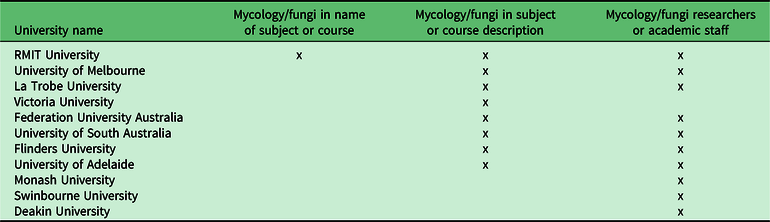
Of the 11 universities assessed, only one had a course with mycology or fungi as part of the name of a subject (Table 1), and this delivered content on the medical, clinical and pathological aspects of mycology. Just over 70% of the universities mentioned mycology and/or fungi within the formal descriptions of subjects, although most of these were not primarily mycological; they referred, for example, to microbiology, basic ecology or clinical pathology. University biodiversity and conservation subjects and courses, as observed in the current study (i.e., Victoria, Australia and South Australia, Australia), tend to exclusively examine biodiversity and extinction as they relate to plants and animals and the potential threats to ecosystem functioning and services if fauna or flora were removed: mycology appeared mainly to be taught in general biology subjects, where the curricula were limited to developing an awareness of the key characteristics of the kingdom. Interestingly, over 90% of universities listed a mycologist researcher or academic working at the institution.
Victoria and South Australia university curricula and the presence/absence of mycology within these tertiary institutions.

Mycology in social media
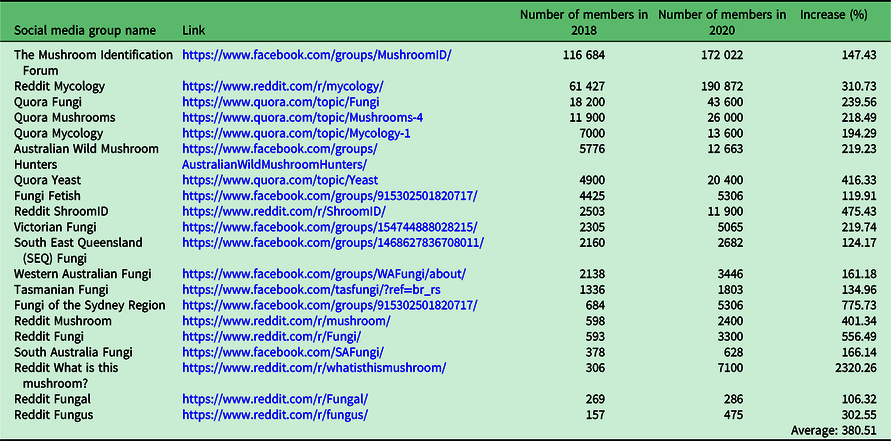
Twenty social media groups related to mycology were identified across Facebook, Quora and Reddit (Table 2), the most popular of which are ‘The Mushroom Identification Forum’, Reddit mycology and Quora fungi. Every group showed increased participation over the 2-year study period, with a total of 528 854 individuals engaging with these platforms in 2020, an increase from 243 739 individuals in 2018.
Regionally based social media groups that provide resources about fungi, their relationships with other flora and identification.

Additionally, successful community science initiatives that had their own websites were identified:
-
Mushroom Observer (https://mushroomobserver.org)
-
iNaturalist (https://www.inaturalist.org)
-
Fungimap (https://fungimap.org.au)
-
Fungal Diversity Survey, formerly North American Mycoflora Project (https://fundis.org)
Discussion
In order to ensure academic mycology flourishes and continues to provide research to inform conservation biology, the field needs to attract and retain talented people, improve communication with the public so as to attract research funding and continue producing cutting-edge science. Better recruitment of mycologists is likely to be achieved by exposure to content at the undergraduate level. In doing so, mycology careers may be re-conceptualized, with mycology-focused graduates seeking employment in new sectors, which will help with the retention of early-career scientists. This can be achieved by providing opportunities and then actively encouraging promising undergraduates to apply for postgraduate positions and mentoring them through applications. Mycology is a small field and suffers from an invisibility problem. Few people know what a mycologist is, and fewer have met one. This perception can be combatted by promoting interactions between existing mycologists and convincing students that mycology is an important and rewarding career path. An additional barrier to careers in mycology is perception; perception that the careers are repetitive, laborious and unrewarding, as has been the case for traditional careers in systematics and taxonomy. A key to countering these perceptions is to expose students to the diverse career pathways pursued by established mycologists. Current levels of mycological expertise in Victoria and South Australia are inadequate to provide the necessary background research so as to support local fungal conservation.
Citizen science and social media networks
Fungal study groups meet and organize meetings through social media, usually through blogs, Facebook, Quora or Twitter (Table 2). These sites and platforms tend to provide resources about fungi, their relationships with other taxa and identification resources. The resources provided can be regionally based or more general. The general aim of these groups is to educate and assist people with field identification and also (depending on interest and access to equipment) with microscopic examination, along with the active encouragement of interaction between members. Interactions such as these could leave a lasting legacy if people fall in love with mycology and outdoor experiences, become aware of the work done by other mycologists or develop science–citizen relationships.
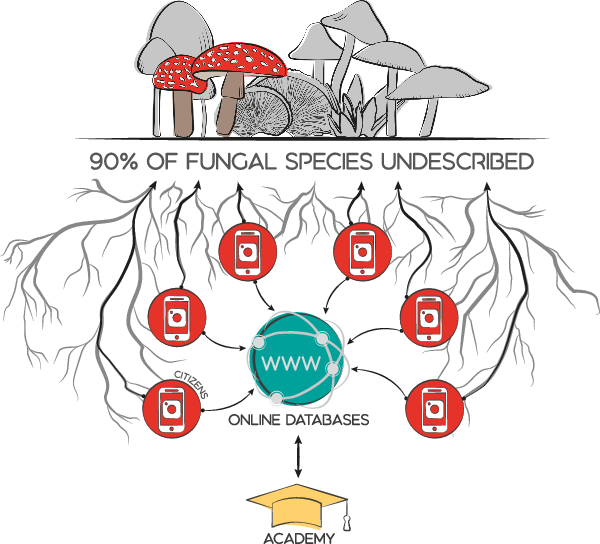
Concerning the decline in professional mycologists, there is potential that the resulting shortfall in education, skills and knowledge can be partially supplemented with voluntary contributions from amateur scientists and citizens, especially in regards to macro-fungi. Macro-fungi are appealing to ordinary people, which facilitates the inclusion of fungi in citizen science-based monitoring of biodiversity. Additionally, for exceptionally rare species, the search for macro-fungi by interested amateurs, under the guidance of professional scientists, might be the only cost-effective way to obtain records, as environmental sampling of very-low-frequency mycelia hidden in soil or other substrata is difficult to organize and fund. Citizen science has developed from its early conception as an educational tool into a significant contributor of empirical data in ecological research (Gallo & Waitt Reference Gallo and Waitt2011). Citizen science engages and enables the public knowledge of species and conservation needs, with the concomitant provision of data that are of scientific value (Follett & Strezov Reference Follett and Strezov2015). A benefit of citizen science is that amateurs can participate at multiple levels depending on their time and experience. Citizen science projects offer mutually beneficial partnerships between scientists and non-scientists through the promotion of the participatory approach to mycology research in which citizens are not only considered as ‘data collectors’, but as proper ‘scientists’. Citizen science-based projects are helping to address challenges unique to mycology, such as high species richness and poorly resolved taxonomy (Watling Reference Watling and Sutton1996). By combining citizen science into the broad field of conservation mycology, there is an increase in human–nature interactions that can potentially integrate public outreach with data collection, filling the gap in diversity knowledge in mycology (Fig. 1).
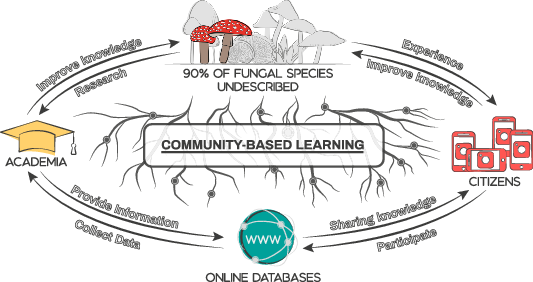
The network of information sources contributing to the increase in mycological research and teaching is harmonized through community-based learning, which incorporates academia, citizen science via social media and online databases in the pursuit of discovering the remaining 90% of fungal species that are currently undescribed.

Citizen science projects, especially using web platforms, require some degree of standardization to ensure that the data generated are of the highest possible quality (Heigl et al. Reference Heigl, Kieslinger, Paul, Uhlik and Dörler2019). This appears to be the greatest barrier to its use, and it remains one of the most discussed aspects of its implementation (Fritz et al. Reference Fritz, See, Carlson, Haklay, Oliver and Fraisl2019). Solutions include volunteer training, continual data collection feedback over the duration of the project, comparison against data that have been professionally collected, validation by experts (Fritz et al. Reference Fritz, See, Carlson, Haklay, Oliver and Fraisl2019) and use of standardized measurement tools (Kosmala et al. Reference Kosmala, Wiggins, Swanson and Simmons2016).
Community-based learning
An additional beneficial component of citizen science-orientated projects is that they support community-based learning and a participatory research approach that involves citizens in scientific debate through community engagement, direct experience and informal education (Ballard & Belsky Reference Ballard and Belsky2010). A community-based monitoring approach allows for more than just the collection of data, but enables the enhancement of ecological literacy and the public understanding of anthropogenic impacts on natural ecosystems (Whitelaw et al. Reference Whitelaw, Vaughan, Craig and Atkinson2003). Community-based monitoring promotes citizens’ direct experience of the natural environment that contributes to community engagement and improves ecological awareness. The informal educational role of citizen science activities also contributes to the redesign of the standard process of knowledge production and to democratizing science through sharing information between experts and non-experts (Conrad & Hilchey Reference Conrad and Hilchey2011). Even such grassroots mycology as the submission of incidence information and photographs of fungi by citizens in their local area (Newbound et al. Reference Newbound, McCarthy and Lebel2010) can provide valuable information on species distributions.
New technologies and social media offer opportunities to expand the democratization of science data sharing by making scientific information accessible to non-experts. Internet-based platforms and mobile applications have greatly simplified the recording of species observations, and are also widely used to store documentation such as photographs and map distribution profiles. Recent advancements made in technology and communication have benefited amateur mycological studies through the facilitation and encouragement of global information sharing amongst amateurs, but also potentially with the professional community. There are some challenges that must be overcome to maximize what citizen science can offer mycology. In particular, the pressure of professional research and the lack of funding available for taxonomic work may lead some professionals to become concerned over a heavy reliance on amateur mycologists for their research.
The identified social media pages include collaborations with academics, experts and other citizens, who provide interactions such as commenting on photographs and providing identification assistance. This encourages a culture of engagement, as the photographer/uploader interacts with their community to create discourse and discussion on the identification collectively. Furthermore, these groups organize local forays, and the social media pages are where these forays tend to be announced. Fungal forays (haphazard screening of a specified area, recording species of interest within that area) represent the classic means of obtaining records or specimens of macro-fungi. However, there are significant limitations when social media platforms such as Facebook and Reddit are used for conservation. Some skill and/or privileged access is required in order to mine the text and pictures for research data. In addition, there is no way to download a list of all of the species that have been found and where from a Facebook page/group or a subreddit. Facebook and Reddit pages on mycology vary in quality: some perpetuate false information about mycology, the posts are not always corrected and some posts focus on psilocybin mushrooms, which are illegal in some countries.
The increased involvement of amateurs may require the reconsidering of traditional research questions and approaches, but will ultimately benefit the discipline. One of the main qualities of opportunistic foraying is that it is often the best way to record rarely fruiting species that may be missed using structured sampling methods (Halme et al. Reference Halme, Heilmann-Clausen, Rämä, Kosonen and Kunttu2012, Reference Halme, Kuusela and Juslén2015). Irrespective of these challenges, any attempt to overcome data shortfalls and develop ways to break down the barriers to engagement with real-world mycological biodiversity is a priority for conservation, and thus paramount to further initiatives.
To this end, the use of specialized platforms that try to link all stakeholders in conservation mycology will have the most success. The top two specialized platforms of fungi identification are Mushroom Observer (MO; https://mushroomobserver.org) and iNaturalist (https://www.inaturalist.org). Both sites have a social element but are primarily about identifying species. iNaturalist is one of the most popular citizen science data portals in the world (Boone & Basille Reference Boone and Basille2020). Users can submit pictures of biological observations to an online database to be reviewed by the rich online community and used for important biodiversity research around the world. Users can use the iNaturalist app to plan community projects and learn more about species identification and biodiversity. It uses a community-driven model to help identify species and experts to assist with both initial identifications and verifying observations. The leadership of iNaturalist sees its primary function as social and educational, rather than scientific. At the time of writing, iNaturalist has c. 13 million accounts of species ranging from fungi, plants, insects and animals. MO is also guided by citizen science, albeit with a focus on macro-fungi (Moose et al. Reference Moose, Schigel, Kirby and Shumskaya2019), which assists researchers in linking images uploaded to geographical locations, and it enables an assessment and comparison of the morphological variability of the species in question. iNaturalist and MO allow for downloading of all ‘verified’ observations for an area, and the area can be defined. They offer the great advantage over social media groups of offering the geographical locations of fungal reports and thus being much more important for fungal distribution knowledge. Using these data, machine learning and visual recognition computer vision research can be applied to increase the rate and precision of identification (Sulc et al. Reference Sulc, Picek, Matas, Jeppesen and Heilmann-Clausen2020). Some apps (e.g., Fungal Diversity Survey (https://fundis.org) and Australia’s Fungimap (https://fungimap.org.au)) targeting fungal citizen scientists have done more to address the data quality issues than others. Fungimap demonstrated a successful engagement model by working with regional fungi society groups, which gives volunteers and collaborating groups the support of a dedicated research coordinator working within a proven framework. A similar strategy is employed by Fungal Diversity Survey (FunDiS for short), who have assembled a working group of mycologists and leaders in fungal conservation, with a focus of putting FunDiS into the service of tracking species for conservation.
Conclusion
The paucity of mycological research will unquestionably lead to poor conservation outcomes for fungi. This could potentially lead to the loss of species, even before they are named and their ecological niches are resolved. Whilst technological advancements in molecular investigative tools are allowing for an increased rate of species discovery, the lack of active professional mycologists is currently constraining progress.
The engagement and participation of citizen scientists is becoming an increasingly important factor in mycological research, which is currently being facilitated through social media. The synergy of these potentially competing forces through community-based learning and participatory research approaches (Fig. 2) has evolved to become the new frontier of mycological research and teaching, which should help fill gaps in this poorly resourced discipline. The main barriers for future engagement with this approach will be connecting amateurs with experts and ensuring that crowdsourced online platforms are able to guarantee data quality and species verification, highlighting the importance of integrated data validation processes for decision-making in environment conservation programmes.
Community-based learning is central to increasing data acquisition and knowledge for mycology.

Acknowledgements
We thank the incredibly passionate and engaging citizen scientists that dedicate their time to conservation, many of whom are volunteers – you were the source of inspiration for this article.
Financial support
PJ Irga is supported by the University of Technology Sydney (UTS) Chancellor’s Postdoctoral Research Fellowship scheme, facilitated through the Centre for Green Technology.
Conflict of interest
None.
Ethical standards
Social media pages collected for the purposes of this study were in the public domain and web searching of the associated data was done solely for research purposes.