Working with economic and other social institutions, political institutions shape economic policies and outcomes. National policy regimes shape investment, employment, production and, ultimately, the decisions of consumers in the global economy. In this context, the effect of a nation’s policy regime on investment depends on how market elites throughout the world perceive regulatory policy, and how those elite perceptions change investment decisions and, correspondingly, capital flows. One way regulation changes the business environment is by changing how business elites form their perceptions of regulatory quality.
Recent studies have shown direct relationships between the perceived quality of a country’s regulatory regime and trade between nations,Footnote 1 per capita incomeFootnote 2 and foreign direct investment.Footnote 3 Many other studies find links between perceptions of quality regulation and ‘good’ governance, growth and productivity.Footnote 4 For example, De Groot et al. estimate that increasing perceptions of regulatory quality by one standard deviation from the mean across countries increases trade by 16 to 26 per cent.Footnote 5 Investor perceptions that regulatory quality means a better climate for capital investment and accumulation are considered a primary mechanism driving these substantial effects.Footnote 6
The purpose of this study is to estimate the effect of regulatory independence on the perceptions of business elites regarding the quality of regulation. In so doing, we assess the manner in which an institutional arrangement – the presence of an independent regulatory agency – affects the crediblity of commitments that governments make to business elites in competing for their investment. Our theoretical argument is as follows. Business elites cannot forecast the impact of political and economic conditions on regulatory decision making perfectly, but they do understand that regulatory policy choices respond to those conditions. Business elites thus form expectations about the likelihood that regulation will favour their interests; the higher the likelihood of a favourable regulatory environment, the higher the perceived regulatory ‘quality’. Independent regulators help to stabilize these expectations if they are institutionally buffered from political influence. Of course, independent regulators are not randomly assigned across nations. For this reason, we argue that the problem of stabilizing the expectations of business elites is more difficult in some political systems than in others.
Our statistical analysis accounts for multiple potential foundations for perceptions of the quality of regulation across nations. In this study, perceptions are measured by the survey responses of business elites regarding whether policies inhibit market mechanisms, restrain foreign trade and limit business development by increasing the costs of transactions. Specifically, we use a treatment–effects regression model for a panel of eighty-nine countries measured at six points in time over a nine-year period. Our results show that independent regulators are more likely to be in place in systems with moderate levels of democratization. Given this relationship between democratization and regulatory independence, we demonstrate that perceptions of regulatory quality are greater when systems have independent regulators. We also show evidence that whilst elite perceptions of regulatory quality are greater in countries with larger economies and that those perceptions have fallen over time, they remain systematically greater in countries with independent regulators. Our presentation begins with a theoretical argument grounded in the credibility of regulatory rules. From this line of reasoning, we then derive a series of hypotheses regarding the impact of political institutions on regulatory quality. We offer next a research design using data from the World Bank and describe our statistical methodology. Results are then presented and discussed, and the article concludes with some brief remarks and potential extensions of our study.
Commitment, institutions and perceptions of regulatory quality
In their seminal work, Kydland and Prescott formally show the importance of credible commitment to policy: ‘policy makers should follow rules rather than have discretion. The reason is not that they are stupid or evil, but, rather, that discretion implies selecting the decision which is best, given the current situation.’Footnote 7 Their highly influential argument implies that ‘[i]n a democratic society, it is probably preferable that selected rules be simple and easily understood, so it is obvious when a policymaker deviates … There could be institutional arrangements which make it a difficult and time-consuming process to change the policy rules in all but emergency situations.’Footnote 8 Our examination of the impact of regulatory independence on perceptions of regulatory quality is rooted in this notion of credibility, which has significant anecdotal support.Footnote 9 When assessing the regulatory environment in nations in which they consider investing, do business elites perceive higher quality environments where regulatory policy is less discretionary? Radaelli, for instance, notes that the European Community recently defined ‘high-quality regulation’ as being ‘efficient, effective, coherent, and simple’,Footnote 10 precisely the qualities that Kydland and Prescott suggest that regulation should have.Footnote 11 To address this question in broader empirical context, we focus our attention on the role of independent regulators in enhancing credibility.
Two conditions are necessary for a credibility problem to exist. First, if policy varies over time, commitments to a stable rule become impossible. Changing policy has consequences; Persson and Tabellini note that some policies are chosen after the private sector has made some irreversible decisions, such as accumulating an asset or signing a contract.Footnote 12 Firms investing in a country based on their expectations about the regulatory environment find their decisions easier if the government of that country commits to a stable regulatory policy over time.Footnote 13 Secondly, a conflict of interest must arise between government and business; government must have ‘the incentive to undertake policy surprises’ when it finds them to its advantage.Footnote 14 On the one hand, whilst politicians retain control over regulation, they maintain the authority to claim credit for short-term successes; on the other, business demands quality regulation marked by virtues of proportionality, consistency and transparency to facilitate the agreements that secure profits.Footnote 15
A large literature suggests that independent regulators help to stabilize these expectations about regulation when their arms-length structure insulates them from responsive politics.Footnote 16 Though a politician faces electoral incentives that may induce him or her to set policy so as to maximize short-term achievements to the detriment of long-term commitments, an independent regulator is insulated from such electoral incentives. The regulator can, then, credibly commit to policies that may fly in the face of public opinion trends, electoral mandates and so forth.Footnote 17 For example, students of monetary policy have examined a government’s credibility gains through delegation to explain the emergence and importance of the independent central banker.Footnote 18
Put simply, a government’s commitment to a regulatory rule creates the expectations of a predictable investment environment; regulatory independence helps to supply that commitment. Firms can contract to deliver goods and services at lower risk if they believe regulators are unlikely to change the rules of the game during the period of the contract. This diminution of risk can be seen as reducing transactions costs. By definition, regulation affects the operation of a market for goods and services. This is why, for purposes of its Governance Matters project from which our data have been drawn, the World Bank bases its inferences about differences in regulatory quality on perceptions of such things as the restriction of unfair competition, the imposition of price controls and tariffs, subsidies for unprofitable firms and environmental regulations. Firms perceive high regulatory quality when the regulatory burden borne by business entities is not excessive, nor the tax burden too distortionary, and when sufficient anticipated returns to investment encourage market entry. From the perspective of the World Bank, then, a high-quality regulatory environment is good for business because it is amenable to contract. And as economists have shown, these perceptions often have observable implications for measures like economic growth, productivity, per capita income and direct foreign investment.Footnote 19
Because of the credibility problem, international competition for business investment means that nations also compete for high-quality perceptions of their regulatory regimes. Perceptions are like hypotheses – they impose a structure on the ‘accepted reality’ firms face, and let them ‘use limited data to remakable effect’.Footnote 20 Business invests resources on the basis of these perceptions, and it is that investment, along with the intertemporal commitment problem induced by politics, that raises the problem of credibility. What alters this expectation is the credible commitment of the government to a path of behaviour, and altering this expectation in a way that encourages capital investment is rational for governments as they compete for investment on the international stage.
We now turn to the set of hypotheses drawn from the logic just presented that we test statistically in this article. Our principal concern lies in the effect of regulatory independence on credibility: the hypothesis that market actors perceive the separation between the power of politicians and that of the policy setter/implementer as a credible commitment – a commitment that supports perceptions of a regulatory regime that is more inviting to capital investment.
Our first and principal claim regards the establishment of independent regulatory authority at the national level:
HYPOTHESIS 1: Regulatory independence is associated with perceptions of higher regulatory quality.
Other scholars have made similar claims. For example, Spulber and Besanko offer a model based on this logic, where a regulator of observable type helps to solve the commitment problem for a politician.Footnote 21 By choosing a regulator with preferences over firms’ interests that are counter to his own, the politician can make credible commitments to future agency actions.
We also acknowledge that political institutions contribute to what Acemoglu et al. have called de jure political power.Footnote 22 That regulatory independence changes the landscape of de jure government power is central to our argument and, for a national government, the choice of an independent regulator is a mechanism of cross-national competition for high-quality perceptions of national regulatory regimes. As we have argued, the characteristics of the political system through which politicians gain authority represents a portion of the national institutional environment that generates more or less demand for independent regulation as a result of its character. Consequently, we do not construct a research design that treats independent regulators as being randomly assigned across nations.
Our design incorporates two separate data-generating processes. The first characterizes how strategic decision making by a national government underlies its adoption of an independent regulator; the second considers the impact of having an independent regulator on business elites’ perceptions of regulatory quality. We consider certain characteristics of political systems – whether a system is more or less democratic, has many or few veto players, has legislators that are elected by proportional representation, has a strong or weak president or a unitary parliament – to help us understand which nations adopt independent regulators. Regulatory independence acts as a ‘treatment’ in the sense of a policy experiment that conditions elite perceptions of regulatory quality: those countries receiving the ‘treatment’ (an independent regulator) are hypothesized to experience its benefit (higher quality perceptions) vis-à-vis the ‘untreated’ countries. Yet whether regulators are independent depends on the need for policy credibility as a signal to potential business investors. We must then empirically address the role of independent regulators in supporting perceptions of regulatory quality in a model that also allows for other, independent causes of those perceptions such as the effects of ‘market-preserving’ federalismFootnote 23 and the nature of the legal system.Footnote 24 We describe our predictions about these other effects on elite perceptions of regulatory quality below.
The Likelihood of Regulatory Independence
Evidence suggests that regulatory independence provides investors with a signal of government commitment; at the same time, formal models support claims that the broad contours of political systems determine credibility. Both approaches fail to consider possible contingent effects. In fact, constitutional choices such as the rules governing democracies, presidentialism, the presence of proportional representation and veto players are usually made ex ante without fully considering their effects on regulatory credibility. The choice to have an independent regulatory authority is often made given an existing government structure, with an eye towards influencing the perceptions of potential investors.Footnote 25 We examine these conditions statistically in the following manner.
First, democratization increases the number of ‘voices’ represented in government decision making.Footnote 26 Recall that investors fear government intervention in the economy because it changes the stability of the regulatory environment; regulatory independence helps mitigate those concerns and so supports perceptions of higher regulatory quality. Only at the knife-edged condition in which business and all interests democratically represented are congruent in their support for (or opposition to) a regulatory rule would democracy not pose a problem for the stability of the ‘clear rule’ advocated by Kydland and Prescott.Footnote 27 In a related study, Kunicová and Rose-Ackerman argue that participation, political competition and constraints on the chief executive increase the ability of the population to monitor and legally constrain politicians from engaging in extractive behaviour (which is at the root of much political intervention in the economy).Footnote 28 Montinola and Jackman find a strong non-linear relationship between democratization and extractive behaviour (measured as corruption).Footnote 29 They find that rent-seeking behaviour increases in the early stage of democratization and falls only after a certain level of democratization is reached. Our hypotheses are then:
HYPOTHESIS 2A: The likelihood of adopting independent regulators increases in the early stages of democratization.
HYPOTHESIS 2B: The likelihood of adopting independent regulators falls at higher levels of democratization.
These hypotheses indicate a possible non-linear relationship between democratization and the likelihood of adopting an independent regulatory body.
Other recent contributions have emphasized the roles of veto players.Footnote 30 The veto player framework centres on the number of decision points that define the legislative process. The ability of political actors, acting in institutions, to change economic policy and alter the market depends on how veto players are aligned in the legislative process. Our hypothesis is:
HYPOTHESIS 3: Countries with a large number of veto points are less likely to adopt independent regulators.
In separation-of-powers systems, regulatory independence can check the president’s ‘decree power’ or the implementability of ‘law made by the executive and not subject to congressional review’.Footnote 31 We offer the following hypotheses about strong and weak presidential systems:
HYPOTHESIS 4A: Parliamentary and weak presidential systems are less likely to adopt independent regulators than are strong presidential systems.
HYPOTHESIS 4B: Weak presidential systems are more likely to adopt independent regulators than are parliamentary systems.
Similarly, single member plurality (SMP) electoral systems make it more difficult to make policy decisions than do systems based on proportional representation (PR).Footnote 32 PR systems generally support many parties, whose preferences must be accommodated in any policy bargain; when there is a change in the governing coalition, instability can result if deals are renegotiated, along with delay and gridlock. Generally, SMP systems organize political competition between individual members of rival parties at the level of a geographic jurisdiction. According to Cox and McCubbins, PR systems are ‘feeble’ when compared with the ‘strength’ of presidential systems, and economic policy outcomes are stable in the latter and unstable in the former.
HYPOTHESIS 5: Proportional representation systems are more likely to adopt independent regulators than are SMP systems.
Other Predictors of Perceived Regulatory Quality
Recent studies argue that federalism has a role in supporting perceptions of regulatory quality.Footnote 33 Again, the essential feature of federalism is the decentralization of authority and information across multiple policy-setting units and the resulting jurisdictional competition, both of which contribute to the formation of credible commitments. For Qian and Weingast, federal systems are ‘market-preserving’ due to this competition between jurisdictional units. Our hypothesis is:
HYPOTHESIS 6: Federal systems produce higher perceptions of regulatory quality.
De facto political power has its root in a set of forces beyond the formal institutions of government and is extremely difficult to measure.Footnote 34 Per capita gross domestic product (GDP) is included in our models as an attempt to partial out the degree to which business can impact politics through informal channels. We state no specific hypothesis in this regard, but include these measures in our statistical model to recognize the de facto component of national politics in a way that facilitates broad cross-national comparisons; we also assess a possible non-linear relationship between the size of the economy and elite perceptions of regulatory quality.
Finally, we include an additional covariate to account for recent models that describe colonial heritage as a possible cause for market-supporting economic policy, which may feed through into the perceptions held by elites about regulatory quality.Footnote 35 Many of those systems are common law regimes, which theorists say create efficiency incentives for private transactions.Footnote 36 Common law is thought to select rules that govern the behaviour of firms efficiently, and that individuals and/or firms respond to such rules efficiently (creating a general equilibrium effect). We posit this effect to exist regardless of judicial ideology or competence. We test the hypothesis:
HYPOTHESIS 7: English colonial origin (as a proxy for a common law regime) is associated with perceptions of higher regulatory quality.
Together, we argue, these structures constitute the default rules, and, of course, determine the quality of the contractual environment captured in elite assessments of regulatory quality. We next specify our empirical model and then present the estimation results.
Model specification
The foregoing hypotheses can be examined by simultaneously estimating the following models:

and

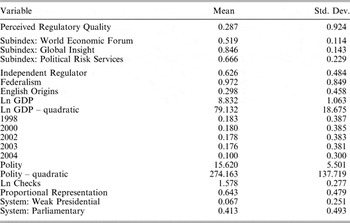
We test these hypotheses simultaneously, include our variables for economic development and colonial origin, and include a fixed effect for each year. Table 1 presents summary statistics on the variables employed in these models and which are described next.
Descriptive Statistics

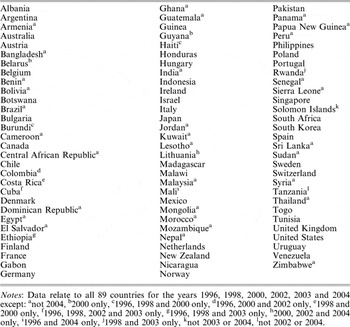
Our dependent variable is from the World Bank’s Governance Matters data collection, which includes multiple year measures for six primary areas of governance in almost 200 countries.Footnote 37 These ‘benchmarks’ are meant to illuminate the core themes that contribute to economic growth across disparate countries and across time. The six indicators are: Voice and Accountability, Political Stability and Lack of Violence, Government Effectiveness, Regulatory Quality, Rule of Law, and Control of Corruption. Since 1996, multinational organizations have used these measures for studying the key themes in governance and the ways citizens react to the state and its behaviour. Variables are constructed by estimating a measurement model that summarizes data provided by seventeen different organizations as detailed in the appendix (Table A1). We employ data collected in 1996, 1998, 2000, 2002, 2003 and 2004. Our models are estimated using eighty-nine countries, for which 479 observations of regulatory quality are available. Our sample size is limited by national-level missing data for our covariates of interest as detailed in Table 2.
The Eighty-Nine Included Countries

Notes: Data relate to all 89 countries for the years 1996, 1998, 2000, 2002, 2003 and 2004 except: anot 2004, b2000 only, c1996, 1998 and 2000 only, d1996, 2000 and 2002 only, e1998 and 2000 only, f1996, 1998, 2002 and 2003 only, g1996, 1998 and 2003 only, h2000, 2002 and 2004 only, i1996 and 2004 only, j1998 and 2003 only, knot 2003 or 2004, lnot 2002 or 2004.
Our focus is the regulatory quality dimension that ‘includes measures of the incidence of market-unfriendly policies such as price controls or inadequate bank supervision, as well as perceptions of the burdens imposed by excessive regulation in areas such as foreign trade and business development’.Footnote 38 The variation we seek to explain is that in the perceptions of well-placed business elites (to whom the underlying surveys were administered, from which the dimensions are constructed) on the openness of the local economy to investments and market operations by private business operations. We recognize the uncertainty inherent in these ratings,Footnote 39 but one advantage over competing measures is the possibility of weighting observations to account for this uncertainty. Likewise, we are aware that numerous emerging economies are known for their good governance, such as Botswana, Chile or Slovenia. In fact, between 2000 and 2002, states exhibiting large positive changes in regulatory quality include El Salvador, Cameroon, Zambia, Bangladesh and Argentina; those with large negative changes include Afghanistan, Belarus, Iraq, Moldova, Russia and Zaire. Another advantage is that this measure has been found to correlate highly with an objective measure for regulatory quality (regulation of entry provisions).Footnote 40 Our main task is to explain variation in the subjective measures. The individual components of the dependent variable are described in detail in the Appendix.
Whilst other measures of regulatory independence are available, we choose one that emphasizes sample coverage at the expense of covering a broad range of types of regulation. We employ the Wallsten records for the year in which a country established a separate (independent) regulator for the policy arena of telecommunications, as recorded by the International Telecommunications Union.Footnote 41 The liberalization of telecommunications markets is a highly visible and important area in which independent regulatory bodies have come to play an extremely important role.Footnote 42 For example, the Office of Telecommunications (Oftel, now Ofcom) was set up as an independent regulator when the Thatcher government decided to sell off 51 per cent of British Telecom to the private sector.Footnote 43 The opening of telecommunications markets requires that a new entrant lease or otherwise obtain a share of capacity on the existing telecommunications infrastructure. But at the outset, this infrastructure is controlled by the incumbent service provider or by the government, making the need particularly acute for an independent regulator placed at arm’s length from both the government and the incumbent provider.
Focusing on telecommunications undoubtedly limits the inferences we can make about the policy independence in which states can engage, but also has three distinct advantages. First, as noted, telecommunications and utility regulation is a constant and present concern in academic and policy circles, as well as among economic elites, and is a useful proxy for summarizing state-level interest in establishing credible commitments. In short, the development of an independent telecommunications regulatory authority is likely to be noticed by business elites as a signal of higher quality national regulatory environments.Footnote 44 By focusing only on telecommunications, we make it less likely that we will find a significant effect of independence. Moreover, the importance of this area makes it a bellwether for perceptions generally. Secondly, this ‘summary statistic’ for regulatory independence changes over the ‘lives’ of the countries included in the six strobes: that is, the presence of independence shifts over time in our data. The adoption of independent regulators by nations during the time span of our data helps to identify the essence of the effect defined by Hypothesis 1. Thirdly, our measure is available for a very large cross-section of cases (197 countries) relative to other, competing measures,Footnote 45 which is useful since our goals are to maximize comparable combinations of commitment devices in the form of interactions and to limit the loss of observations due to missing covariate information.
We measure presidential versus parliamentary systems by categorizing a system as either parliamentary or weak presidential (=1, strong presidential systems comprise the reference category) if it features legislatures and chief executives that are elected independently of one another and whose powers are distinguished by clear executive and legislative roles; in weak presidential systems the president is elected by the assembly.Footnote 46 Checks and balances may exist between the branches of government, but the leadership in the legislature does not compete with the president in terms of executive authority.Footnote 47 Our measure for PR is whether a state uses proportional representation to elect all or a portion of its legislators (if either chamber of the legislature is elected based on the percentage of votes received by their party).Footnote 48 Our measure of whether a system is federal describes the degree to which state/provincial governments are locally elected: if neither the local executive nor the local legislature is directly elected by the population they govern (=0); if either is directly elected and the other is indirectly elected (=1); or if both local executive and legislature are directly elected (=2).Footnote 49 Our measure of democratization comes from Gurr et al.Footnote 50 The Polity variable is assigned to each country based on the level of democracy versus autocracy within its political system. Scores range from −10 (most autocratic) to +10 (most democratic); we rescale this to range from 0 to 20, and include both the measure and its square. Missing data on these dimensions (especially our measure of federalism) make our sample sizes for the statistical analysis smaller than the samples for the dependent variable alone.
Our measure of colonial origins is an indicator variable for English origins. This measure helps to capture legal attributes such as judicial and legislative precedent, rights to private property and the general rights of the individual relative to the stateFootnote 51 that impact economic performance.Footnote 52 Likewise we account for economic development by including the natural log of each country’s per capita Gross Domestic Product for each year (in 2000 dollars and adjusted for purchasing power parity) from the World Bank’s World Tables, 2003 and a quadratic term. We also include a dummy variable for each year in the sample to control for any unobserved phenomena imparting a temporal bias to our model.
Estimation and results
In order to understand the impact of having independent regulators on elite perceptions, we must account statistically, as does our theoretical story, for countries that do not randomly adopt regulatory independence. In quasi-experimental terms, countries are not randomly assigned to the treatment condition of having independent regulators. To account for this, we estimate the empirical model via a treatment effects regression using data for the countries listed in Table 2. The treatment effects model jointly estimates the effect of a binary treatment on a continuous variable given two sets of independent variables when observations are not randomly assigned to the treatment. The binary treatment indicates the assignment of the treatment or not; in this case, the treatment is the presence or absence of an independent regulator (as measured above). One set of independent variables affects the latent variable that underlies the assignment of the treatment effect; the second set affects the outcome equation of the perceptions of regulatory quality. The treatment and outcome equations are estimated jointly by maximum likelihood.Footnote 53
We construct analytic weights using the inverse of the number of survey items used to construct each estimate of perceived regulatory quality in each country (attached to each measurement of the dependent variable). Ignoring this level of uncertainty would bias estimates based on varying levels of information. Each observation of the dependent variable is a summary of a collection of measurements gathered across individuals, across survey instruments, and across question wordings. The World Bank provides the standard error of each estimate, and our previously described analytic weights are appropriate in weighted regression when the outcome measurement is a summary statistic.Footnote 54 The model includes institutional variables, control variables and a fixed effect for each year, and employs heteroscedasticity-robust standard errors clustered by country identifier.
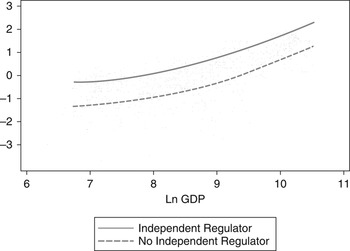
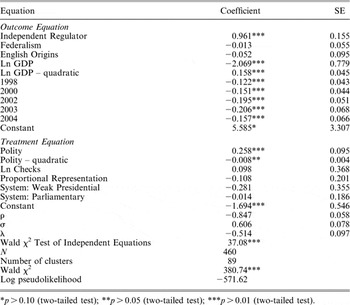
Table 3 presents our results. The logic of credible delegation in the RogoffFootnote 55 and Spulber and BesankoFootnote 56 models suggests that politicians in democratic systems face the incentive to manipulate policy in ways counter to the long-term interests of investors. Knowing this, politicians have the incentive to make credible policy commitments by delegating to independent regulators with an eye towards addressing investors’ concerns about their motivations. This expectation (Hypothesis 1) finds direct support in the model. As Table 3 shows, the impact of having an independent regulator on elite perceptions is larger than a one-standard deviation shift in the dependent variable. Figure 1 shows an empirical curvilinear relationship between GDP and elite perceptions of regulatory quality – that perceptions increase in GDP at an increasing rate (the quadratic term for GDP is also significant in Table 3) – but that the impact of having an independent regulator is to shift the curve upwards. Indeed, the lowest average level of elite perceptions given regulatory independence (when the natural logarithm of GDP is around 7) is higher than the average level of elite perceptions in systems without regulatory independence when the natural logarithm of GDP is two standard deviations higher (around 9). Table 3 and Figure 1 show numerically and graphically that those systems where regulators are independent experience significantly higher elite perceptions of regulatory quality.
Effect of having an independent regulator on perceptions of regulatory quality

Treatment Regression Model of Perceptions of Regulatory Quality

*p > 0.10 (two-tailed test); **p > 0.05 (two-tailed test); ***p > 0.01 (two-tailed test).
This is not to say that independent regulators are the only sources of such perceptions. Clearly, we observe higher quality perceptions when nation-states have large, wealthy economies as measured by GDP. It is unclear which direction causation runs, so we may not claim that high GDP causes those perceptions. In a related vein, we find no direct effects of either federalism or English origins, which calls into question the connection between those mechanisms (for policy credibility and for supporting economic growth) and elite perceptions of regulatory quality. Some evidence exists that elite perceptions of regulatory quality fall over time, but the adoption of independent regulators over time may represent an attempt to mitigate the impact of those trends.
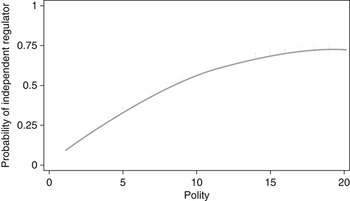
What explains the non-random assignment of countries to the treatment of having independent regulators? Which countries adopt independent regulators? The lower half of Table 3 shows evidence that we can reject the null hypothesis that democratization does not increase the likelihood of having an independent regulator. Figure 2 shows our estimated curvilinear relationship between democratization and the likelihood of having an independent regulator, with the probability increasing from roughly 0.1 in the most autocratic countries to around 0.7 in the most democratic ones. However, Figure 2 also shows our estimated quadratic relationship – that there are diminishing returns to democratization. Unlike the relationship between democratization and corruption in Montinola and Jackman,Footnote 57 we observe no diminishing returns at the highest levels. Our results suggest that moderately democratic nations are most at risk (in need) of adopting an independent regulator. One implication of this finding is that, generally, the mechanism of regulatory independence in the competition for elite perceptions and thus capital depends on the incentives of actors in a political system, and thus their ability (or inability) to credibly commit to the long-term protection of capital. Table 3 shows no evidence that the specific form of the system (strong or weak presidential, parliamentary, SMP or PR, or the overall number of checks) is the mechanism underpinning the choice to adopt regulatory independence.
Effect of democratization on having an independent regulator Note: Quadratic fit.

What little wiggle room there is for regulatory policy designers is found in non-constitutional mechanisms such as the use of the independent regulator. But this result holds only in the case of presidential systems. The data provide no evidence of an added effect of regulatory independence on perceptions of regulatory quality in the case of proportional representation electoral systems.
Conclusion
Our empirical results suggest independent regulators substantially improve perceptions of national regulatory quality by business elites. We also show evidence that the likelihood of adopting an independent regulator increases with democratization to a point. Perceptions of quality governmental institutions are a key ingredient in attracting capital to a country. Nations with high levels of democratization have various other advantages in securing international capital flows, and their governments do not need the additional advantage of independent regulation. Yet emerging democracies can substantially increase perceived regulatory quality by creating an arms-length regulator, and they are more likely to do so.
Our results also suggest strikingly that constitutional design, specifically electoral and political institutions within nations, exerts no additional effect on perceptions of regulatory quality. Once the size of the economy and regulatory independence are considered, factors such as federalism, veto points, presidentialism, parliamentarism, electoral mechanisms and the legal system exert no additional effects on perceived regulatory quality.
The intuition behind this finding may simply lie in the nature of regulation as a constraint on business activity. Established business benefits from regulatory capture, whilst new business cannot take hold in its presence. Credible commitment to end capture through independent regulation invites new investment because national markets are now fertile for business success. This matters because, for many people, a key indicator of the performance of a government is its ability to provide services to citizens, and governments that sustain healthy climates for investment are usually better able to provide those services. This article shows evidence that governments that are more democratic are more likely to adopt independent regulators, and that regulatory independence supports a health investment climate. More broadly, though, our study demonstrates the link between democratization and the choice of governments to engage in vertical separation of powers, a topic that to date has garnered little academic interest. Vertical separation seems to be one mechanism that supports a social environment where economies flourish. Our research provides ample rationale for future studies of the micro-mechanisms that link democratization and growth. If we observe this mechanism in the case of regulatory independence, others are likely to exist as well.
Appendix
This appendix first describes the construction of the dependent variable: a measure of perceptions about the quality of a country’s regulatory regime. The measure comes from the World Bank’s Governance Matters data collection. This collection includes six attributes of governance (Voice and Accountability, Political Stability and Lack of Violence, Government Effectiveness, Regulatory Quality, Rule of Law, and Control of Corruption) in almost 200 countries.Footnote 58 The World Bank has constructed these ‘benchmarks’ to help illuminate core themes the Bank thinks contribute to economic growth. In general, the variables measuring these attributes are constructed by estimating a measurement model that summarizes twenty-five separate data sources at eighteen different organizations. As noted above, we employ measures from 1996, 1998, 2000, 2002, 2003 and 2004.
Table A1 presents the components and sources used for constructing the measures in any given year. The number of sources subsumed in the measure varies by country. This variability in the number of components available for a given year and a given source is why our models are estimated with analytic weights that account for the amount of information used to construct the point estimate of the dependent variable for a given observation. Table A1 indicates the range of regulation covered by these components and used for constructing the dependent variable. The components indicate that the Governance Matters variable for regulatory quality is an aggregate of perceptions across the regulation of competition, capital movement, factor and final product prices, financial services, taxes and more general questions on regulatory climate. We recognize that these components touch on new social regulation like environmental and occupational safety and health regulation only obliquely through questions on the ease of starting new businesses, and so forth.
Concepts Contained in Perceived Regulatory Quality Dependent Variable

*Covariate data missing for 2005.
The individual indices, collected by the sources listed in Table A1 in the years noted, are aggregated into a scale indicating the respondents’ views of the degree of regulatory quality present in a country in a given year. That scale is constructed by the use of an unobserved components model related to the family of item response models now widely used in political science.Footnote 59 Essentially, the model used by the World Bank starts with the observed data in each cluster and then expresses it as a linear function of the unobserved common component of regulatory quality and an error term that represents perception errors and/or sampling variation.