From the early cognitive-behavioral traditions (Hollon & Beck, Reference Hollon, Beck, Kendal and Hollon1979) to the most recent advances in cognitive therapies (e.g., Mindfulness and Acceptance-Based approaches; Hayes, Strosahl, & Wilson, Reference Hayes, Strosahl and Wilson1999; Segal, Williams, & Teasdale, Reference Segal, Williams and Teasdale2002) the concept of decentering has been highlighted as an important change mechanism in therapy.
Although several authors proposed distinct definitions of decentering, they all converge on the notion that decentering refers to a particular way to relate to thoughts and feelings as transient mental events that do not necessarily mirror reality, or the self, in a true or important way, and that do not require particular behaviours in their response (Fresco, Moore et al., Reference Fresco, Moore, van Dulmen, Segal, Ma, Teasdale and Williams2007; Hollon & Beck, Reference Hollon, Beck, Kendal and Hollon1979; Safran & Segal, Reference Safran and Segal1990). Inherent to this ability are also other dimensions: Fresco, Segal, Buis, and Kennedy (Reference Fresco, Segal, Buis and Kennedy2007), consider that crucial to decentering is the ability to be in the present moment, non-judging and accepting the events as they occur in the mind; similarly, Segal and colleagues (2002) suggested that being capable to see thoughts as different from the self, entails non-reactivity to negative experiences and self-compassion.
In this sense, the ability to decenter oneself from one’s internal experience seems to reflect the ability to be mindful of such experience. According to Bishop et al. (Reference Bishop, Lau, Shapiro, Carlson, Anderson, Carmody and Devins2004), decentering and mindfulness are both framed within the capability to observe thoughts and feelings as they occur in the mind. In fact, the definitions of both constructs include the ability of facing one’s thoughts and feelings from a present-focused perspective and with a nonjudgmental and accepting attitude (Fresco, Segal et al., Reference Fresco, Segal, Buis and Kennedy2007; Kabat-Zinn, Reference Kabat-Zinn1990). Also, there is empirical evidence that suggests that these processes are indeed closely related (Carmody, Baer, Lykins, & Olendski, Reference Carmody, Baer, Lykins and Olendzki2009; Shapiro, Carlson, Astin, & Freedman, Reference Shapiro, Carlson, Astin and Freedman2006). However, it is currently recognized that efforts should be placed on making a more clear distinction between decentering and mindfulness and how these two mechanisms of change interact in therapeutic settings (Sauer & Baer, Reference Sauer, Baer and Baer2010). Fresco, Moore and colleagues (2007) although assuming their conceptualization of decentering as complementary to the definition of mindfulness proposed by Bishop et al. (Reference Bishop, Lau, Shapiro, Carlson, Anderson, Carmody and Devins2004), state that decentering is a fundamental ingredient of change of empirically-supported psychotherapeutic approaches to depression (e.g., cognitive-behavioral therapy and mindfulness-based cognitive therapy), not only restricted to treatments framed within the mindfulness and acceptance field.
Being able to detach oneself from one’s internal experiences and kindly accept them has been pointed out as a crucial aspect for mental well-being and health. On the contrary, identifying with and viewing one’s thoughts as reflecting reality, truth and self-worth, has been linked to poorer mental health (Fresco, Moore et al., Reference Fresco, Moore, van Dulmen, Segal, Ma, Teasdale and Williams2007). Decentering seems to be consistent with the ability to disentangle oneself from one’s internal experiences, viewing them as part of the process of thinking and not as literal truths that dictate one’s actions. This has been defined as cognitive defusion and referred to as crucial to psychological flexibility. Psychological flexibility, in turn, has been linked to increased well-being, reduced psychopathological symptoms and seems, therefore, vital to psychological health (Ciarrochi, Bilich, & Godsell, Reference Ciarrochi, Bilich, Godsell and Baer2010; Hayes et al., Reference Hayes, Strosahl and Wilson1999; Kashdan & Rottenberg, Reference Kashdan and Rottenberg2010).
To sum up, despite the relatively long history of the construct of decentering, and of its conceptualization tapping into the definition of other constructs inherent to more recent therapeutic approaches (e.g., mindfulness and acceptance-based interventions), it is consensual that decentering is as an important mechanism inherent to effective therapeutic change and well-being.
In fact, theoretical and empirical evidence has long been suggesting that decentering is a fundamental mechanism linked to depressive symptoms’ reduction and relapse prevention (Ingram & Hollon, Reference Ingram, Hollon and Ingram1986; Teasdale et al., Reference Teasdale, Moore, Hayhurst, Pope, Williams and Segal2002). Specifically, decentering seems to buffer against the impact of rumination on depression. Nolen-Hoeksema (Reference Nolen-Hoeksema1987) conceptualizes rumination as a specific strategy to cope with negative emotions and disturbing symptoms. Rumination is typified by self-reflection (Morrow & Nolen-Hoeksema, Reference Morrow and Nolen-Hoeksema1990) and by the passive and repetitive focus on one’s internal experience, as well as in its possible causes, meanings and consequences (Nolen-Hoeksema, Reference Nolen-Hoeksema1991; Nolen-Hoeksema, Larson, & Grayson, Reference Nolen-Hoeksema, Larson and Grayson1999; Nolen-Hoeksema, Parker, & Larson, Reference Nolen-Hoeksema, Parker and Larson1994). Studies on rumination have shown that distinct dimensions of ruminative self-focus have differential relationships with depression: self-reflection is positively correlated with depressive symptomatology concurrently, but predicts decreases in depressive symptomatology longitudinally; while brooding is associated with depression both concurrently and longitudinally (Treynor, Gonzalez, & Nolen-Hoeksema, Reference Treynor, Gonzalez and Nolen-Hoeksema2003). Rumination is, therefore, strongly linked to the onset, severity, and maintenance of depressive symptomatology. (Nolen-Hoeksema & Morrow‚ Reference Nolen-Hoeksema and Morrow1991‚ Reference Nolen-Hoeksema and Morrow1993; for reviews see Lyubomirsky & Tkach, Reference Lyubomirsky, Tkach, Papageorgiou and Wells2004; Mor & Winquist, Reference Mor and Winquist2002; Nolen-Hoeksema, Reference Nolen-Hoeksema1991, Reference Nolen-Hoeksema, Papageorgiou and Wells2004). And studies show that, in previously depressed individuals, decentering seems to prevent negative thinking patterns from escalating to such ruminative style of thinking associated to higher depressive symptomatology.
There is already preliminary evidence for the role of decentering in the relationship between rumination and depression: the experimental manipulation of both ruminative and experiential self-focus in groups of depressed patients and dysphoric college students has revealed the mediating effect of decentering on the relationship between the mode of self-focus and negative thinking in depression (Lo, Ho, Yu, & Siu, Reference Lo, Ho, Yu and Siu2014).
Despite the fact that decentering has long been a focus of interest and investigation, as far as we know there are only three measures designed for its assessment and evaluation.
The Measure of Awareness and Coping in Autobiographical Memory (MACAM; Moore, Hayhurst, & Teasdale, Reference Moore, Hayhurst and Teasdale1996) corresponds to the first attempt to measure decentering. It was originally developed to assess metacognitive awareness defined as “the process of experiencing negative thoughts and feelings within a decentered perspective” (Teasdale et al., Reference Teasdale, Moore, Hayhurst, Pope, Williams and Segal2002, p. 276). Research on this measurement tool showed its construct validity, and that it mediates the reduction of relapse for subjects in recovery or remission from major depression after undergoing a Mindfulness-Based Cognitive Therapy program (MBCT; Segal et al., Reference Segal, Williams and Teasdale2002). However, it revealed to be too time-consuming given its completion procedures for participants, and also methodologically unpractical given the constraint of implicating trained examiners to conduct a final semi-structured interview.
The Toronto Mindfulness Scale (TMS; Davis, Lau, & Cairns, Reference Davis, Lau and Cairns2009; Lau et al., Reference Lau, Bishop, Segal, Buis, Anderson, Carlson and Devins2006) was designed for assessing change mechanisms following mindfulness-based trainings, in both a trait and a state version. It was constructed taking into account Bishop and colleagues’ (2004) definition of mindfulness, which includes the self-regulation of attention in the present moment, with an accepting and curious attitude towards one’s internal experience. Thus, the TMS comprises two subscales, decentering and curiosity, with the former specifically measuring the ability of viewing the self as different from thoughts (Lau et al., Reference Lau, Bishop, Segal, Buis, Anderson, Carlson and Devins2006). Nevertheless, although both versions of the TMS are reliable and valid measures, they essentially target mindfulness as a global construct and were not designed to assess decentering as an independent construct.
Finally, the Experiences Questionnaire (EQ) emerged as an attempt to overcome the MACAM’s methodological limitations, and as the first self-report measure targeting specifically decentering, which has been pointed out a change mechanism of MBCT. This instrument measures decentering as a multifaceted construct involving the ability of viewing the self as separate and different from its own thoughts, the capacity of non-reacting to negative experiences, as well as the ability to be self-compassionate (Fresco, Moore et al., Reference Fresco, Moore, van Dulmen, Segal, Ma, Teasdale and Williams2007).
Fourteen items were generated to measure this ability to sustain a wider perspective on one’s thoughts, feelings and sensations. Additionally, six items were created to assess rumination as a control subscale for response bias. Several exploratory and confirmatory factor analyses were conducted in two different student samples and results all converged in a final single-factor scale assessing decentering. Furthermore, confirmatory factor analyses conducted in a clinical sample comprising subjects with Major Depressive Disorder in remission and a control group with non-depressed subjects confirmed this one-dimensional structure initially found for this questionnaire. EQ was found to be reliable and its convergent and discriminant validities were established for both general and clinical samples (Fresco, Moore et al., Reference Fresco, Moore, van Dulmen, Segal, Ma, Teasdale and Williams2007).
Even though the EQ is widely used as a measure of decentering, little is known regarding its psychometric properties, namely in other languages. In this sense, the current study intends to explore the psychometric characteristics of the Portuguese version of the EQ through a confirmatory factor analysis, reliability, and its convergent validity.
Moreover, this investigation also aims to compare two different measures assessing decentering: the EQ and the TMS’ decentering subscale. Thus, two path models were conducted to further establish whether the use of EQ contributes to better demonstrate the indirect effect of rumination on depressive symptoms through the mechanism of decentering, in comparison to a non-specific measure – TMS. We hypothesized that EQ would emerge as the measure that better illustrates the previously established and aforementioned relationships between the variables (Ingram & Hollon, Reference Ingram, Hollon and Ingram1986; Nolen-Hoeksema, Reference Nolen-Hoeksema, Papageorgiou and Wells2004; Teasdale et al., Reference Teasdale, Moore, Hayhurst, Pope, Williams and Segal2002). In fact, while EQ specifically assesses decentering, TMS assesses decentering alongside with curiosity as change mechanisms within mindfulness-based interventions. Moreover, EQ addresses decentering from a wider perspective, that is, not only as the ability to view oneself as distinct from one’s thoughts (which is the only feature captured by the TMS’ decentering subscale), but also as the capacity to hold one’s private experiences with kindness and acceptance.
STUDY 1: The psychometric properties of the Experiences Questionnaire
In the current study the factorial structure of the Experiences Questionnaire, its internal consistency, retest reliability and convergent validity were examined.
Method
Participants
The sample of the current study comprised 709 Portuguese participants, 66% women (n = 466) and 34% men (n = 243). The age ranged from 14 to 66 and the mean was 29.52 (SD = 11.89). The years of education ranged from 4 to 30, with a mean of 14.81 (SD = 3.16). Sixty seven percent were single (n = 473), followed by 25% married participants (n = 175). Of the total sample, 356 (50.2%) were students, 212 (30%) reported having a middle class profession, 107 (15.1%) had low income professions and 34 (4.8%) had high class professions. There were no significant gender differences regarding age (t(706) = 1.24; p = .216), years of education (t(697) = 1.54; p = .123, and marital status (χ²(4) = 3.31; p = .507). There were significant differences between genders regarding types of profession (χ²(3) = 25.78 ; p < .001).
Measures
Experiences Questionnaire (EQ)
EQ (Fresco, Moore et al., Reference Fresco, Moore, van Dulmen, Segal, Ma, Teasdale and Williams2007) is a 20-item self-report measure designed to assess decentering. Respondents are asked to answer, in a 5-point Likert scale ranging from 1 (“Never”) to 5 (“Always”), the extent in which the experiences described in each item are similar to the ones they recently experienced (e.g., “I can observe unpleasant feelings without being drawn into them”).
Mindfulness Awareness and Attention Scale (MAAS)
MAAS (Brown & Ryan, Reference Brown and Ryan2003; Portuguese version by Gregório & Pinto-Gouveia, Reference Gregório and Pinto-Gouveia2013) is a self-report instrument assessing attention and awareness in daily life present moment experience as a dispositional quality of mindfulness. It comprises 15 items related to everyday experiences (e.g., “I rush through activities without being really attentive to them”) which subjects have to answer, using a 6-point Likert scale (ranging from 1”almost always” to 6 “almost never”). This scale presents a high internal consistency both in its original version (α = .84; Brown & Ryan, Reference Brown and Ryan2003) and in its Portuguese version (α = .90; Gregório & Pinto-Gouveia, Reference Gregório and Pinto-Gouveia2013). The current study also revealed a .89 internal consistency coefficient for this instrument.
Toronto Mindfulness Scale – Trait version (TMS)
TMS (Davis et al., Reference Davis, Lau and Cairns2009; Portuguese version by Gregório & Pinto-Gouveia, Reference Gregório and Pinto-Gouveia2010) is a 13-item scale assessing two factors of mindfulness trait: curiosity, which reflects an attitude of wanting to learn more about one’s experiences; and decentering, meaning a shift from identifying personally with one’s internal experience to relating to one’s thoughts, emotions and sensations in a wider field of awareness. Items are rated on a 5-point Likert scale ranging from 0 (“not at all”) to 4 (“very much”). The TMS revealed high internal consistency in its original version (α = .91 and α = .85 for the subscales curiosity and decentering, respectively). In the current study, the internal consistency coefficient alpha for the curiosity subscale was .89 and .73 for the decentering subscale.
Acceptance and Action Questionnaire II (AAQ-II)
The AAQ-II (Bond et al., Reference Bond, Hayes, Baer, Carpenter, Guenole, Orcutt and Zettle2011; Portuguese version by Pinto-Gouveia, Gregório, Dinis, & Xavier, Reference Pinto-Gouveia, Gregório, Dinis and Xavier2012) is a 7-item scale based on the original AAQ (Hayes et al., Reference Hayes, Strosahl, Wilson, Bissett, Pistorello, Toarmino and McCurry2004). This questionnaire aims at examining individual differences regarding the single domain of psychological flexibility/inflexibility. Participants are asked to rate, on a 7-point Likert scale ranging from 1(“never true”) to 7 (“Always true”), how true each statement is to them (e.g., “My painful memories prevent me from having a fulfilling life”). Higher scores reflect greater psychological inflexibility. Bond and cols. (2011) found a .84 mean alpha coefficient across six samples (ranging between .78 and .88). Similar results were found in the Portuguese version of the scale (Pinto-Gouveia et al., Reference Pinto-Gouveia, Gregório, Dinis and Xavier2012; α = .90). In the current study AAQ-II also revealed high internal consistency (α = .85).
Ruminative Response Scale - short version (RRS10)
The RRS10 (Treynor et al., Reference Treynor, Gonzalez and Nolen-Hoeksema2003; Portuguese version by Dinis, Pinto-Gouveia, Duarte, & Castro, Reference Dinis, Pinto-Gouveia, Duarte and Castro2011) is a 10-item scale based on the original 22-item RRS (Nolen-Hoeksema & Morrow, Reference Nolen-Hoeksema and Morrow1991). The RRS short version comprises two factors: the brooding subscale, which contains items with negative connotation describing ‘moody pondering’ (e.g., “Think: Why do I have problems that other people don’t have?”); and the reflection subscale, which comprises ‘neutrally valenced’ items reflecting a tendency to attempt to analyze problems leading to negative mood (e.g., “Go away by yourself and think about why you feel this way”). Each item is rated on a 4-point scale ranging from 1 (“Almost never”) to 4 (“Almost always”). Higher scores indicate greater rumination. In the original study, each factor showed adequate internal consistency with a Cronbach’s alpha of .77 for brooding and .72 for reflection. Similar internal consistency coefficients were found in the Portuguese version of the scale (brooding α = .76; reflection α = .75). In this study the Cronbach’s alpha were .77 for brooding and .68 for reflection.
Emotional Regulation Questionnaire (ERQ)
The ERQ (Gross & John, Reference Gross and John2003; Portuguese version by Pinto-Gouveia & Dinis, Reference Pinto-Gouveia and Dinis2006) assesses two dimensions of emotion regulation: reappraisal and suppression. The first one comprises 6 items and assesses the capacity to cognitively modify or change the emotions one experiences, while the second one, with four items, refers to ability to avoid or prevent how the emotions express themselves. In its original version (Gross & John, Reference Gross and John2003), the scale presented a high internal consistency, which averaged .79 for reappraisal and .73 for suppression. Similar values were found in the current study (.79 for reappraisal and .76 for suppression).
Positive and Negative Affect Schedule (PANAS)
The PANAS questionnaire (Watson, Clark, & Tellegen; Reference Watson, Clark and Tellegen1988; translated and adapted to Portuguese by Galinha & Pais-Ribeiro, Reference Galinha and Pais-Ribeiro2005) is constituted by 20 items, measuring positive affect and negative affect. Items are rated on a 5-point scale ranging from 1 (“very slightly or not at all”) to 5 (“extremely”), and assess the extent in which the participant has experienced a particular emotion within a specified time period (in the Portuguese version the time frame adopted was “in the past few weeks”). In the original version, this measure revealed a high internal consistency (α = .88 for the positive affect scale and α = .87 for the negative affect scale).The Portuguese version of the PANAS also revealed adequate internal consistency (positive affect α = .88; negative affect α = .89). In our study, the Cronbach´s alpha for the positive and negative affect scale was .86 and .88, respectively.
Depression, Anxiety and Stress Scales (DASS42)
The DASS42 scale (Lovibond & Lovibond, Reference Lovibond and Lovibond1995; Portuguese version by Pais-Ribeiro, Honrado, & Leal, Reference Pais-Ribeiro, Honrado and Leal2004a) comprises three subscales designed to measure levels of depression (e.g., “I couldn’t seem to experience any positive feelings at all”), anxiety (e.g., “I was aware of dryness of my mouth”), and stress (e.g., “I found it difficult to relax”). Each item is rated on a 4-point Likert scale ranging from 0 (“did not apply to me at all”) to 3 (“applied to me very much, or most of the time”). In the original version, Lovibond and Lovibond (Reference Lovibond and Lovibond1995) found that all subscales have an adequate to good internal consistency with alpha´s values of .81 for depression .73 for anxiety and .81 for stress subscales. Similar values were found by Pais-Ribeiro et al. (Reference Pais-Ribeiro, Honrado and Leal2004a), with the Portuguese version of the scale presenting internal consistency coefficients of 93. (depression), .83 (anxiety) and .88 (stress). In the present study, the three subscales have also shown high internal consistencies (.91, .88, and .90, respectively).
The Cognitive Fusion Questionnaire (CFQ)
The CFQ (Gillanders et al., Reference Gillanders, Bolderston, Bond, Dempster, Campbell, Kerr and Remington2012; Portuguese version by Pinto-Gouveia, Dinis, Gregório, & Pinto, Reference Pinto-Gouveia, Dinis, Gregório and Pinto2011) is a brief self-report instrument to assess cognitive fusion through 13 items. Respondents answer on a 7-point Likert scale labeled from “never true” (1) to “always true” (7); and higher scores indicate more fused responding. The original version presented a Cronbach’s alpha of .85 in community samples, while the version used in this study also revealed a good level of internal consistency (.84).
The Satisfaction with Life Scale (SWLS)
The SWLS (Diener, Emmons, Larsen, & Griffin, Reference Diener, Emmons, Larsen and Griffin1985; Pavot & Diener, Reference Pavot and Diener1993; Portuguese version by Neto, Barros, & Barros, Reference Neto, Barros, Barros, Almeida, Santiago, Silva, Oliveira, Caetano and Marques1990) is a short 5-item instrument designed to measure global cognitive judgments of satisfaction with one's life. It asks respondents to indicate their level of agreement with each item in a 7-point Likert scale from 1 (strongly disagree) to 7 (strongly agree). According to Pavot and Diener (Reference Pavot and Diener1993), several studies on the scale reported alpha coefficients over .80 for the internal consistency of the scale. The coefficient was found to be .78 for the Portuguese version (Neto, Barros, & Barros, Reference Neto, Barros, Barros, Almeida, Santiago, Silva, Oliveira, Caetano and Marques1990) and .88 for the present study.
Procedure
All participants consented to answer a series of self-report questionnaires, administered in the same order (EQ, DASS42, AAQ-II, MAAS, CFQ, SWLS, ERQ), after being informed that their cooperation was voluntary and their answers were confidential and only used for the purpose of the study. The self-report measures were administered by the researchers and instructions were standardized for all participants. In particular, the students (n = 356) filled the measures at the end of a lecture with the consent of the educational institution board. The remaining participants (n = 353) filled the set of scales in their workplace at a break authorized by the professional institutions’ boards. In order to avoid overloading all participants with filling the total set of the self-report instruments, and according to the time each institution allowed for the participation in this investigation, only 285 completed an additional set of questionnaires (PANAS, RRS10, TMS; sample used in Study II), and a shorter version of DASS42. Of these, 31 were randomly selected to complete the EQ retest.
Data Analyses
All statistical analyses were conducted using both SPSS software (version 19.0 for Windows) and AMOS (18.0). The psychometric properties of the Experiences Questionnaire were examined through several statistical procedures. Specifically, Confirmatory Factor Analyses were conducted to examine the questionnaire factorial structure, the internal consistency was evaluated by computing Cronbach’s alphas coefficients for the structure obtained, convergent validity was assessed by computing Pearson product-moment correlation coefficients, and retest reliability was analyzed by Tests for Dependent Samples comparing the first and second administration mean values of the scale, and by Pearson product-moment correlations.
Results
Development of the Portuguese Version of the Scale
After obtaining permission from the authors to adapt the Experiences Questionnaire into Portuguese, several translation and back-translation procedures were conducted in order to achieve a conceptually equivalent version of this instrument for the Portuguese population.
First, two Portuguese health professionals, with a Psychiatry and Clinical Psychology background and also familiar with research and clinical practices within the 3rd wave of cognitive-behaviour therapies, conducted the forward translation. Then, aiming at improving its reliability and validity, two independent translators not familiar with this instrument translated it back to English. Minor discrepancies were found when comparing both the source and the back-translated versions of the EQ (e.g., item 2 the expression “ I remind myself…” was back-translated as “I tell myself…” and so an adjustment was made in the Portuguese translation of this verb to better reflect the original item). They were discussed between the authors of the adapted version and were finally shared with one of the original authors of the questionnaire, who took part of this adaptation process. These minor adjustments were made with the purpose of assuring the fidelity of the final Portuguese version of the scale.
Preliminary data analyses
Preliminary data analyses were conducted to assess the normality of the variables. The Kolmogorov-Smirnov Test results indicated a bias from the normal curve for all the study measures. However, the values of Skewness and Kurtosis situated in the recommended reference values, respectively |3| and |7| (Kline, Reference Kline2005). These findings, along with the visual inspection of the distribution, confirmed that these data were suitable for the subsequent analyses (Maroco, Reference Maroco2010; Tabachnick & Fidell, Reference Tabachnick and Fidell2007).
Factor structure of the Experiences Questionnaire
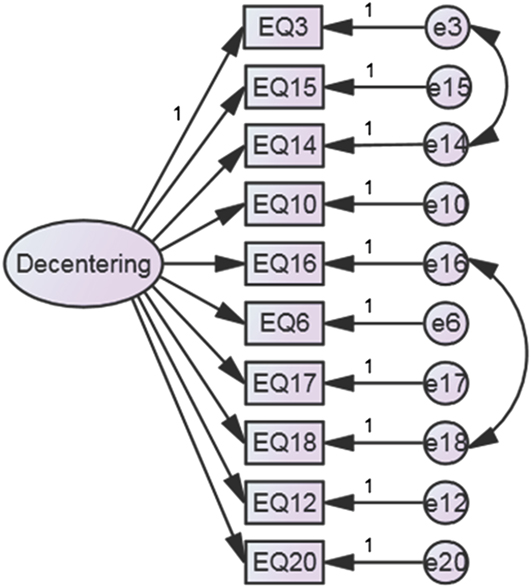
We began by exploring the one-factor structure found by Fresco, Moore and colleagues (2007), following the same procedures. A Confirmatory Factor Analysis (CFA) with Maximum Likelihood as the estimation method was conducted in a model comprising 11 items. According to Brown (Reference Brown2006) this is a widely used and reliable estimator in CFA’s. As in the original study, and to avoid bias in the results (MacCallum & Tucker, Reference MacCallum and Tucker1991), correlated measurement errors were specified among the items that presented similar content (i.e., items 3 and 14, 9 and 10, and 16 and 18).
The first indicator used to test for the global adjustment of the model under examination was the Chi-Square, which was shown to be statistically significant (χ2 (41) = 108.59; p < .001). This value was expected given the size of our sample since this measure, although widely known, is highly influenced by the sample size, resulting in problematic test and possibly biasing the results’ interpretation (Bollen, Reference Bollen1989; DeCoster, Reference DeCoster1998; Jöreskog, Reference Jöreskog1969). Nevertheless, the Normed Chi-Square (which overcomes the aforementioned limitation) for this solution was found to be an adequate value (χ2/df = 2.65) since it situates in the reference range (2 to 5; Bollen, Reference Bollen1989; Tabachnik & Fidell, Reference Tabachnick and Fidell2007; Wheaton, Muthen, Alwin, & Summers, Reference Wheaton, Muthen, Alwin and Summers1977).
Furthermore, both the Comparative Fit Index [CFI = .96], and the Tucker-Lewis Index [TLI = .94] were analyzed, which were found to be indicative of a good model fit accordingly to the minimum value of .90 suggested by several authors (Brown, Reference Brown2006; Hu & Bentler, Reference Hu and Bentler1999). The Root-Mean Square Error of Approximation [RMSEA = .05; CI = .04 to .06] was analyzed, and once more the value obtained confirmed the acceptable fit of the solution under study, according to the interval [.05 to .08] suggested as representing a reasonable error and acceptable fit (Browne & Cudeck, Reference Browne, Cudeck, Bollen and Long1993; Hu & Bentler, Reference Hu and Bentler1999). Finally, the Akaike’s Information Criterion [AIC] was 158.59 and the Modified Expected Cross-Validation Index [MECVI] was 0.23.
To sum up, these global adjustment indices attest the goodness of fit of this model for the Portuguese version of this questionnaire.
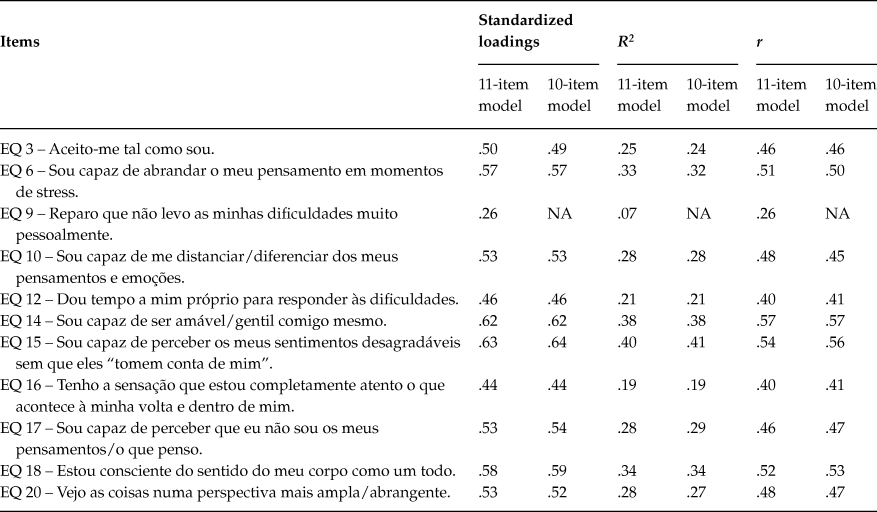
Regarding the item-level statistics the local adjustment indices were also examined (Table 1). First, the standardized regression weights revealed that all items, with the exception of item 9 (.26; “I notice that I don’t take difficulties so personally”), situated above the cut-off point of .40 (Tabachnick & Fidell, Reference Tabachnick and Fidell2007). Also, the squared multiple correlations presented acceptable values; but again item 9 failed to reach an acceptable value (R 2 = .07). Lastly, the corrected item-total correlations, which should be above .30, ranged from .40 to .57, indicating that all items are linked to the latent variable of decentering; but item 9 presented the lowest correlation with the total scale (.26). Given that item 9 appeared as problematic in all analyses, this led us to test for another solution excluding this item from the analyses.
Standardized Regression Weights, Squared Multiple Correlations (R2), and Item-Total correlations (r) for the two models tested for the Portuguese version of the EQ (N = 709)

Note: NA means that the item was dropped and, therefore, was not included in the analysis.
Following the same specifications a new CFA was conducted to test for a new model comprising 10 items. One error measurement correlation was eliminated from the solution since it involved item 9 (Figure 1). Results show that the 10-item solution presents a Chi-square value of 86.59 (p < .001), a finding that should be interpreted considering the abovementioned theoretical statements. Regardless, this new model presents an acceptable Normed Chi-Square of 2.62 as well as adequate global adjustment indices [CFI = .96; TLI = .95; RMSEA = .05, CI = .04 to .06; AIC = 130.59; MECVI = 0.19].
Path diagram of the single-factor model of the Portuguese version of EQ (N = 709).

Regarding the local adjustment, results showed that all items significantly contribute to measurement of the construct of decentering. As can be seen in Table 1 the items characteristics remained relatively stable in both models under analysis.
This 10-item model presented the best adjustment to the data, considering the differences in the Chi-square estimates in comparison to the 11-item model (Δχ2 = 22.00). Also, the predictive fit indices AIC and MECVI indices were used for comparison between the 11-item model and the 10-item model. Lower AIC and MECVI values suggest that the model is more likely to replicate and fits better. Results showed that the 10-item solution presented the lowest values in both the AIC and MECVI. So this model presented a significantly better fit than the original model (Kline, Reference Kline2005; Maroco, Reference Maroco2010). Finally, a multigroup analysis confirmed that the examined model was invariant across the groups that comprised the sample (ΔCFI = 0.07), according to recommended standards (Cheung & Rensvold, Reference Cheung and Rensvold2002).
Reliability Analysis
Results show a very good reliability for the total 10-item scale (α = .81), which is a similar value of what Fresco, Moore and colleagues (2007) found in the original version of the scale (α = .83).
Temporal Stability
Regarding test-retest reliability results show that the Portuguese 10-item version of the Experiences Questionnaire reveals a high temporal stability (r = .86; p < .01) assessed in a sub-sample of 31 subjects that fulfilled the questionnaire also after a 1-month period. Additionally, the t value was -1.89 (p = .068), which confirmed the temporal stability of the instrument.
Convergent validity
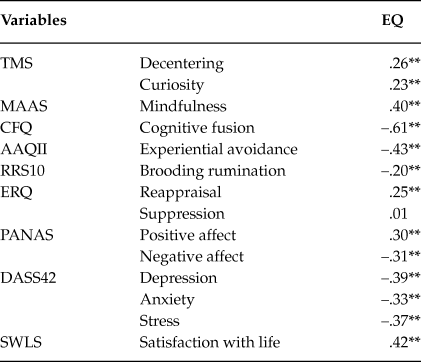
Convergent validity was assessed through product moment correlation coefficients (Table 2) examining the association between the 10-item EQ and several theoretically related constructs, namely mindfulness measures (TMS and MAAS), cognitive fusion (CFQ), psychological inflexibility (AAQ-II), depressive rumination (RRS10 brooding subscale), and emotion regulation (ERQ).
EQ showed positive small to medium associations with mindfulness measures. Specifically, small correlations with TMS curiosity and decentering subscales. Moderate associations were verified between the EQ and the global score of the MAAS. The EQ was largely and negatively correlated with cognitive fusion. Moderate negative associations were found with the AAQ-II. Also, the EQ was negatively linked to the brooding rumination RRS10’s subscale. Regarding its association with the ERQ, a positive moderate correlation was found with reappraisal, but no significant link was found with the suppression subscale.
Furthermore, the associations between decentering and positive and negative affect (PANAS), current symptoms of depression, anxiety and stress (DASS42) and satisfaction with life (SWLS) were examined. The EQ was moderately and positively associated with positive affect and with levels of satisfaction with life. Moreover, moderate and negative correlations were found between decentering and negative affect, and also with depressive, anxiety and stress symptoms.
Product-moment correlation coefficients between EQ and TMS, MAAS, SWLS, CFQ, AAQII, RRS10, ERQ, PANAS, and DASS42

Note: **p < .001; EQ = Experiences Questionnaire; TMS = Toronto Mindfulness Scale; MAAS = Mindful Attention and Awareness Scale; SWLS = The Satisfaction with Life Scale; PANAS = Positive and Negative Affect Schedule; CFQ = Cognitive Fusion Questionnaire; AAQII = Avoidance and Fusion Questionnaire II, RRS10 = Ruminative Responses Scale – short version, ERQ = Emotional Regulation Questionnaire; DASS42 = Depression, Anxiety and Stress Scales 42.
Discussion
Study 1 aimed at examining the factorial structure of the Portuguese version of the EQ and its psychometric characteristics, particularly its association to other decentering and mindfulness measures, assessing tools of cognitive fusion, psychological inflexibility, emotion regulation, and measures of emotional and psychological well-being, using a wide sample from the general population.
The results revealed that, in its Portuguese version, the EQ mimics the one-dimensional structure found in preliminary evidence regarding the factorial structure of this instrument in college students and in a clinical sample of individuals in remission from depression (Fresco, Moore et al., Reference Fresco, Moore, van Dulmen, Segal, Ma, Teasdale and Williams2007). In particular, a confirmatory factor analysis of the original 11 items’ version was conducted and results indicated that item 9 presented a poor local adjustment and, even though it did not interfere with the global adjustment, it ought to be excluded in order to improve the quality of the measure. A second confirmatory factor analysis confirmed that the removal of item 9 resulted in an improvement of the measure. We hypothesize that this item was problematic due to translation issues since the expression comprised in the original item is not common among Portuguese speakers. The 10-item version replicated the one-factor structure of the original EQ (Fresco, Moore et al., Reference Fresco, Moore, van Dulmen, Segal, Ma, Teasdale and Williams2007). The chi-square goodness of fit-index was significant, but this finding was expected given the large sample size. Nevertheless, the remaining goodness-of-fit indices indicated a good model fit (Browne & Cudeck, Reference Browne, Cudeck, Bollen and Long1993; Hu & Bentler, Reference Hu and Bentler1999), and all standardized indicators were theoretically and statistically supported, confirming the plausibility of the obtained one-dimensional model to measure the construct of decentering.
In regard to the scale reliability, results showed that the 10-item scale demonstrated a high internal consistency, similarly to what was verified by Fresco, Moore and colleagues (2007) in the original development of the EQ. The analysis of the test-retest reliability revealed that the Portuguese version of the EQ was stable along a month period.
The analysis of the associations between the EQ and other measures, on one hand, offered extra support regarding the robustness of the Portuguese version of the scale and, on the other hand, extended the work of the authors of the original version of the scale (Fresco, Moore et al., Reference Fresco, Moore, van Dulmen, Segal, Ma, Teasdale and Williams2007). The analysis of the link between the Portuguese version of the EQ and a widely used measure of mindfulness that includes the assessment of decentering (TMS; Davis et al., Reference Davis, Lau and Cairns2009) was of particular interest. As a matter of fact, we found that decentering as measured by the Portuguese version of the scale was positively but poorly associated to the curiosity subscale of the TMS (which assesses the disposition to wanting to learn more about one’s experiences) and, surprisingly, a correlation with the same diminished strength was found with the decentering TMS’ subscale. This finding suggest that even though the EQ and the TMS’ decentering subscale tap the same theoretical construct of decentering, that covers the ability to view thoughts and feelings as transient events in the mind rather than reflections of reality (Fresco, Moore et al., Reference Fresco, Moore, van Dulmen, Segal, Ma, Teasdale and Williams2007), with a present-focused, nonjudgmental, and accepting attitude (Fresco, Segal et al., Reference Fresco, Segal, Buis and Kennedy2007), these two measures do not entirely overlap. These findings, although not expected, were similar to extant research that found a positive but low association between EQ-decentering and decentering as assessed by the TMS state-version (Bieling et al., Reference Bieling, Hawley, Bloch, Corcoran, Levitan, Young and Segal2012).
Additionally, in regard to how the Portuguese version of the EQ associates with another selected measure of mindfulness, the MAAS, our results revealed a moderate positive link, which is in line with previous theoretical suggestions that decentering and mindfulness are related and reciprocal, but distinct constructs (Baer, Reference Baer and Baer2010). The correlation analyses’ results also confirmed that the ability to view one’s experience in a wider perspective is antithetical to taking thoughts literally, mistaking them with what they represent, that is, cognitive fusion (Gillanders et al., Reference Gillanders, Bolderston, Bond, Dempster, Campbell, Kerr and Remington2012).
Similarly, the welcoming attitude of decentering measured by the Portuguese version of the EQ was, as hypothesized, negatively associated with psychological inflexibility, that is, the proneness to try to avoid, suppress or inhibit the frequency or intensity of thoughts, emotions and sensations (Hayes et al., Reference Hayes, Strosahl and Wilson1999). Also, our results confirmed that this measure is positively linked to the adaptive ability to cognitively change a situation and thus its negative emotional impact (i.e., cognitive reappraisal; Gross, Reference Gross1998; Gross & John, Reference Gross and John2003). Regarding the association of decentering and rumination, although this construct comprises two factors – self-reflection and brooding – we opted to explore the link with the latter, which is known to be the more maladaptive component of rumination (Treynor et al., Reference Treynor, Gonzalez and Nolen-Hoeksema2003), since it correlates with high current depressive symptoms and predicts their increase over time (while reflection is positively correlated with depressive symptomatology concurrently but predicts decreases in depressive symptomatology longitudinally). We found that decentering correlated highly and negatively with brooding rumination, the maladaptive ongoing comparison of one’s actual state with an unachieved one (Treynor et al., Reference Treynor, Gonzalez and Nolen-Hoeksema2003). Thus, these findings were in line with prior evidence and our previous hypotheses (Fresco, Moore et al., Reference Fresco, Moore, van Dulmen, Segal, Ma, Teasdale and Williams2007).
Extending previous evidence (Fresco, Moore et al., Reference Fresco, Moore, van Dulmen, Segal, Ma, Teasdale and Williams2007), our results also evidenced a significant negative association between the Portuguese version of the EQ and self-report measures of depressive, anxiety and stress symptoms (Lovibond & Lovibond, Reference Lovibond and Lovibond1995), as well as negative affect (Watson et al., Reference Watson, Clark and Tellegen1988). Furthermore, we verified that a decentered perspective was, as expected, positively associated with life satisfaction, a particular dimension of general well-being (Diener et al., Reference Diener, Emmons, Larsen and Griffin1985; Pavot & Diener, Reference Pavot and Diener1993), as well as with positive affect (Watson et al., Reference Watson, Clark and Tellegen1988).
To sum up, the first set of analyses of the present research offers sound evidence that this adaptation of the EQ has robust psychometric properties and is, therefore, a valid and reliable self-report measure to assess decentering as a one-dimensional construct.
STUDY 2: Decentering versus decentering: The role of the Experiences Questionnaire against other decentering measure
In the current study it was analyzed whether decentering is a mechanism through which rumination exerts influence on depressive symptomatology, testing decentering as measured by the Experiences Questionnaire in comparison to decentering as measured by the Toronto Mindfulness Scale. In fact, the extent to which the use of a specific measure would better suit for the examination of the aforementioned relationships, remained unclear. The weak association between these two measures verified in Study 1 offers evidence further supporting the importance of comparing decentering as measured by the EQ and by the TMS.
Even though decentering is expected to be captured by these two measures, they have important dissimilarities regarding item content and, consequently, the dimensions tapped by them, with the EQ decentering subscale being referred to as being a more comprehensive measure of this process than the TMS’ decentering subscale. That is, while Fresco, Moore and colleagues (2007) developed EQ based on a decentering conceptualization that involves the ability to view oneself as distinct from one’s thoughts, from a non-reacting and self-compassionate perspective, the TMS’ decentering subscale pretends to assess awareness of private experience with the ability to distance oneself and the capacity for disidentification (Davis et al., Reference Davis, Lau and Cairns2009; Lau et al., Reference Lau, Bishop, Segal, Buis, Anderson, Carlson and Devins2006).
Method
Participants
This study comprised a group of 285 participants from Study 1 sample, who completed the full set of self-report measures. Fifty nine point three per cent were women (n = 169) and 40.7% were men (n = 116). They presented an age mean of 36.18 (SD = 11.96); the age of education mean was 15.75 (SD = 3.08). Almost half of the sample reported being married (n = 137; 48.1%), followed by 38.6% (n = 110) single participants.
Measures
Participants completed the Experiences Questionnaire (EQ; Fresco, Moore, et al., Reference Fresco, Moore, van Dulmen, Segal, Ma, Teasdale and Williams2007), the Toronto Mindfulness Scale (TMS; Davis et al., Reference Davis, Lau and Cairns2009; Portuguese version by Pinto-Gouveia & Gregório, Reference Pinto-Gouveia and Gregório2010), the Ruminative Response Scale - short version (RRS10; Treynor et al., Reference Treynor, Gonzalez and Nolen-Hoeksema2003; Portuguese version by Dinis et al., Reference Dinis, Pinto-Gouveia, Duarte and Castro2011) and the Depression, Anxiety and Stress Scales (DASS21; Lovibond & Lovibond, Reference Lovibond and Lovibond1995; Portuguese version by Pais-Ribeiro, Honrado, & Leal, Reference Pais-Ribeiro, Honrado and Leal2004b), the shorter version of DASS42 which was described in Study 1.
Procedure
Procedure has already been described in Study 1 procedure’s section.
Data analyses
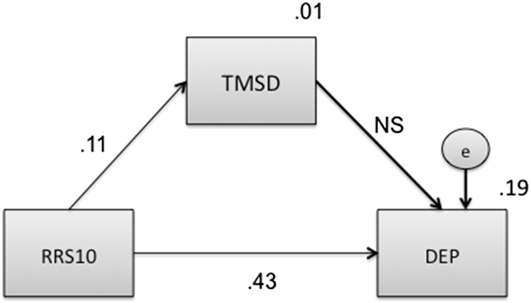
Path analyses were conducted to explore the indirect effect of brooding rumination on depression through the 10-item EQ, against other decentering measure (decentering subscale of the TMS – termed here as TMSD), using the software AMOS (18.0).
In the first path analysis we tested whether decentering as measured by EQ would contribute for the association between brooding rumination (independent, exogenous variable) as measured by RRS10 and depressive symptoms as measured by DASS21 (dependent, endogenous variable); in the second path analysis decentering was measured by TMSD to test the aforementioned relationships. Path analyses were used to conduct these analyses. This statistical method is a subset of Structural Equation Modeling (SEM), used to assess theoretically expected causal relations between previously defined variables, examining for direct and indirect effects between exogenous and endogenous variables, while controlling for error (Byrne, Reference Byrne2010; Kline, Reference Kline2005; Maroco, Reference Maroco2010). Even though the cross-sectional design of the current study does not allow one to establish casual influence between variables, it may offer a higher understanding of the processes under study by allowing to test whether the models tested here are consistent with the hypothesized theoretical model (e.g., Hayes, Reference Hayes2013; Warner, Reference Warner2013) of how a ruminative style of thinking fuels depressive symptomatology through a lower ability of distancing oneself from one’s thoughts (e.g., Ingram & Hollon, Reference Ingram, Hollon and Ingram1986; Teasdale et al., Reference Teasdale, Moore, Hayhurst, Pope, Williams and Segal2002). The Maximum Likelihood method was used to evaluate the regression coefficients significance. The significance of direct, indirect and total effects was assessed using Chi-Square (χ2) tests (Kline, Reference Kline2005). Furthermore, the Bootstrap resampling method, which is assumed to be a powerful and reliable method to examine mediation effects (Maroco, Reference Maroco2010), was further used to test for the significance of the mediational paths. We selected 2000 bootstrap samples and 95% bias-corrected confidence intervals (ICs; Kline, Reference Kline2005). The effects which revealed that zero was not on the interval between the lower and the upper bound of the 95% bias-corrected confidence interval (Kline, Reference Kline2005) were considered to be significantly different from zero (p < .05).
Results
Preliminary data analyses
Uni and multivariate normality was assessed using the Kolmogorov Smirnov test which revealed to be statistically significant for all study variables. Nevertheless, the examination of the values of Skewness and Kurtosis indicated that there was no severe violation of normal distribution, |3| and |7|, respectively (Kline, Reference Kline2005). Multivariate outliers were screened using Mahalanobis squared distance (DM2) method and cases with high DM2 values were identified as contributing to multivariate non-normality and excluded from further analysis (Kline, Reference Kline2005).
Path analyses
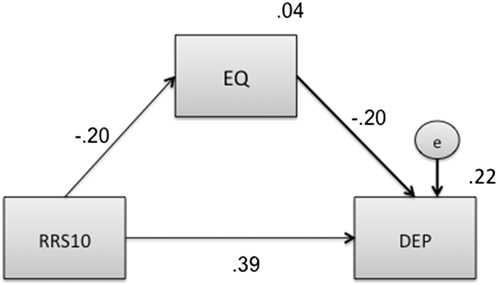
In the model testing for the indirect effect of rumination on depressive symptoms through the mechanism of decentering measured by EQ (Figure 2) all the paths were statistically significant (βRRS10 = .392; SE b = .529; Z = 7.354; βEQ= -.199; SE b = .075; Z = -3.723; p < .001) and the model accounted for 22% of depression variance. Results suggest that rumination increases depressive symptoms, with an indirect effect of .040, mediated by decreased levels of decentering as measured by EQ. This effect was statistically significant according to the Bootstrap resampling method(95% CI = .015 to .076).
Path diagram for the mediation of decentering as measured by the EQ in the relationship between rumination and depression (n = 285)

The model testing for the indirect effect of rumination on depressive symptomatology through decentering but assessed by TMS’ decentering subscale (TMSD; Figure 3) revealed that the direct effect of TMSD on depression was nonsignificant (βTMSD = -.002; SE b = .075; Z = -.034; p = .973). In this case, only rumination presented a significant direct effect on depression (βRRS10 = .432; SE b = .530; Z = 8.078; p < .001).
Path diagram for the mediation of decentering as measured by the TMS subscale in the relationship between rumination and depression (n = 285)
Note: RRS10 = Brooding rumination subscale of the Ruminative Responses Scale – short version; EQ = Experiences Questionnaire; TMSD = Decentering subscale of the Toronto Mindfulness Scale; DEP = Depression subscale of the DASS21 – Depression, Anxiety and Stress Scales 21.

Discussion
Concerning Study 2, findings revealed that decentering (when measured by EQ) is an important mechanism operating on the well-established relationship between rumination and depressive symptoms. These results add therefore evidence to the wide body of research on the role of both decentering and rumination on depression (e.g., Hollon & Beck, Reference Hollon, Beck, Kendal and Hollon1979; Nolen-Hoeksema, Reference Nolen-Hoeksema1987, Reference Nolen-Hoeksema1991; Segal et al., Reference Segal, Williams and Teasdale2002). Evidence shows that the tendency to ruminate about negative emotions is highly linked to increased depression and that rumination predicts future depressive episodes (Nolen-Hoeksema & Davis, Reference Nolen-Hoeksema and Davis1999; Nolen-Hoeksema, Morrow, & Fredrickson, Reference Nolen-Hoeksema, Morrow and Fredrickson1993; Nolen-Hoeksema et al., Reference Nolen-Hoeksema, Parker and Larson1994; Roberts, Gilboa, & Gotlib, Reference Roberts, Gilboa and Gotlib1998). Contrary to this self-focused and entangled form of attention on one’s internal experiences is decentering, which has long been emphasized as a core buffer mechanism in regard to depressive symptoms reduction and relapse prevention (Ingram & Hollon, Reference Ingram, Hollon and Ingram1986; Teasdale et al., Reference Teasdale, Moore, Hayhurst, Pope, Williams and Segal2002).
The findings from the current study are in accordance with empirical and theoretical suggestions that the extent to which individuals that are more prone to engage in a ruminative chain of thoughts become more vulnerable to present higher levels of depressive symptomatology, even more when these individuals show a lower capacity of detaching from such thoughts (viewing them as they are, as products of the mind and not as the reality). However, the key finding of this study is that the examination of these associations seems to be influenced by the measure used to assess decentering. In fact, the results of the indirect effect of rumination in depressive symptoms tested when using the TMS subscale to assess decentering did not replicate what had been found with the EQ. This finding, along with the weak association between both measures verified in study I, further supports the idea that, in fact, these two measures might not be capturing entirely the same dimensions of this construct of decentering.
These findings support the need to actively target decentering in depression treatment protocols (e.g., MBCT) and suggest the benefits of using EQ as a specific assessment tool of an important change mechanism to decrease depression and to improve well-being, as previously suggested by Sauer and Baer (Reference Sauer, Baer and Baer2010).
General Discussion
Decentering has been a focus of attention by researchers across several traditions within cognitive-behaviour therapy as a critical change mechanism in psychotherapy, particularly in the context of mood disorders (Hayes et al., Reference Hayes, Strosahl and Wilson1999; Hollon & Beck, Reference Hollon, Beck, Kendal and Hollon1979; Sauer & Baer, Reference Sauer, Baer and Baer2010; Segal et al., Reference Segal, Williams and Teasdale2002). The refinement of the investigation of the role of decentering in preventing depression required rigorous assessment tools. Among other measures, the Experiences Questionnaire emerged as a brief and usable self-report instrument intended to capture the ability to decenter from thoughts and feelings (Fresco, Moore et al., Reference Fresco, Moore, van Dulmen, Segal, Ma, Teasdale and Williams2007). Nevertheless, there is a dearth of literature regarding its psychometric properties and this is possibly constraining the research on this field. Moreover, the research on non-English versions of the EQ is scarce. Taken together, these aspects led us to investigate the psychometrics properties of the Portuguese version of the questionnaire in a wide sample from the general population.
Our findings showed that the Portuguese version of EQ, mirrors the one-dimensional structure found in the original study of the measure (Fresco, Moore et al., Reference Fresco, Moore, van Dulmen, Segal, Ma, Teasdale and Williams2007), and in other adaptations (e.g., Spanish; Soler et al., Reference Soler, Franquesa, Feliu-Soler, Cebolla, García-Campayo, Tejedor and Portella2014). The only inconsistency found was the lack of adjustment of one of the items under study, namely item 9. Although its removal was not crucial for the global adjustment of the scale, a CFA conducted with a 10-item solution revealed that the removal of this item would allow for a better model when assessing decentering. However, as previously mentioned, the lack of adjustment of this item could be due to translation issues and, thus, future investigation should explore whether the inclusion of a re-written form of item 9 is a better option than its removal. The EQ also revealed to be internally consistent and to have temporal stability across a one-month period. Concerning convergent validity, the Portuguese version of the scale presented similar associations, in the expected directions, to those found in the original study, particularly with psychological inflexibility, brooding rumination, reappraisal and emotion suppression, as well as with depressive, anxious and stress symptoms, and positive and negative affect. Findings from the current research also provided further evidence on the association between decentering and satisfaction with life as well as with mindfulness and cognitive fusion.
Furthermore, the current study aimed at expanding our understanding of the utility of the EQ in the exploration of the role of decentering as a mechanism through which rumination impacts depression (Nolen-Hoeksema & Davis, Reference Nolen-Hoeksema and Davis1999; Nolen-Hoeksema et al., Reference Nolen-Hoeksema, Morrow and Fredrickson1993, Reference Nolen-Hoeksema, Parker and Larson1994; Roberts et al., Reference Roberts, Gilboa and Gotlib1998). Results demonstrated that decentering when measured by the EQ has a significant role in the aforementioned relationship, in comparison to another commonly used instrument to assess the same construct, namely the decentering subscale of TMS. Thus, our data suggests that the EQ items seem to accurately capture the capacity of being able to decenter from ruminative thoughts which, in turn, have been established as strong predictors of depressive symptoms (for reviews see Lyubomirsky & Tkach, Reference Lyubomirsky, Tkach, Papageorgiou and Wells2004; Mor & Winquist, Reference Mor and Winquist2002; Nolen-Hoeksema, Reference Nolen-Hoeksema, Papageorgiou and Wells2004).
Regardless of these contributions, these results should be interpreted taking into account relevant limitations. The Portuguese version of the EQ replicated the original EQ factor structure, confirming that decentering maintains a one-dimensional structure in a different language. Also, this was confirmed using a large community sample comprising participants of both genders and with distinct occupational backgrounds. Nevertheless, we cannot assume the factorial invariance of the measure across distinct samples of the Portuguese population and thus it would be very valuable if future research could determine whether this questionnaire possesses factorial invariance across different community samples, and also within the context of specific clinical populations (e.g., depressed patients).
Furthermore, our findings highlight the importance of using the specific measure of EQ to assess decentering to better understand the relationship between rumination and depression. It is important to note, however, that the cross-sectional design of the current study precludes conclusions to be drawn from the analyses. In fact, our findings on the indirect effects of rumination on depression through decentering are the outcome of an observational study in which data on all the variables was collected at the same time nullifying the possibility of establishing a causal ordering for the observed relationships between rumination, decentering and depression. In line with this, more than adding evidence on a mediational process in which decentering acts as an essential mediator in the relationship between rumination and depression, this study shows the specific covariation between these variables in a previously demonstrated causal system without implying causality. To sum up, the covariation found is in accordance with a theoretical proposed model of causality and recent empirical evidence (e.g. Lo et al., Reference Lo, Ho, Yu and Siu2014), when the specific measure of EQ is applied to test decentering. Future research should address these limitations inherent to research design, by implementing experimental and longitudinal studies on the investigation of these causal processes.
In this sense, although not free of limitations, our results point to the utility of using this measure in research and clinical settings, to assess an important mechanism that contributes to therapeutic change on symptoms’ reduction and improvements in mental well-being. Finally, these findings seem to be an important contribution to a more accurate research of decentering as a transdiagnostic process.
Research by the first and third authors has been supported by Ph.D. Grants (SFRH/BD/40290/2007; SFRH/BD/76858/2011), sponsored by FCT (Portuguese Foundation for Science and Technology).