INTRODUCTION
Soybean, maize and cotton are three major crops which have been commercialized on the basis of different transgenes for traits such as herbicide tolerance and insect resistance, and are also being cultivated all over the world (Gaskell et al. Reference Gaskell, Bauer, Durant and Allum1999; Clive Reference Clive2013). The development and commercial-scale plantation of transgenic crops necessitate continuous monitoring of their performance in the ecosystem, particularly in relation to the target gene expression and its implications, if any.
Pakistan is among the top cotton producers of the world, with an area of 2·88 million ha, producing 2·09 million tons per annum (Wasti Reference Wasti2013). One of the major threats to this economic crop is bollworm, causing yield losses of 30–40% (Cororaton et al. Reference Cororaton, Salam, Altaf, Orden, Dewina, Minot and Nazli2008; Masood et al. Reference Masood, Arif, Hamed and Talpur2011; Khan et al. Reference Khan, Saeed, Shah, Shah and Mir2012). Massive pesticide applications had been used to control these pests, leading to increases in pesticide imports and in the costs of production (Tariq et al. Reference Tariq, Afzal, Hussain and Sultana2007). Environmental pollution and the hazardous impact of pesticides on farmers and livestock are additional side effects (Ali et al. Reference Ali, Hameed, Masood, Ali and Zafar2010). After the introduction of Bt technology in the developed world, unapproved and unregulated Bt cotton genotypes were widely imported and adopted as bollworm-resistant crops in Pakistan. Some Bt cotton varieties were formally approved in Pakistan for the first time in 2010. The time lag between the illegal introduction and the formal approval of Bt cotton seeds led to the spread and adoption of sub-standard seeds among cotton growers. Therefore, this technology has not enhanced yield as much as expected.
The efficacy and performance of Bt cotton depend mainly upon expression of the Cry1Ac gene (Greenplate et al. Reference Greenplate, Penn, Mullins, Oppenhuizen, Dugger and Richter2000; Holt et al. Reference Holt, Mares and Akhurst2002; Gutierrez et al. Reference Gutierrez, Adamczyk, Ponsard and Ellis2006), which fluctuates throughout the growing season (Kranthi et al. Reference Kranthi, Naidu, Dhawad, Tatwawadi, Mate, Patil, Bharose, Behere, Wadaskar and Kranthi2005; Olsen et al. Reference Olsen, Daly, Holt and Finnegan2005; Adamczyk et al. Reference Adamczyk, Perera and Meredith2009; Bakhsh et al. Reference Bakhsh, Rao, Shahid, Husnain and Riazuddin2010). Expression of the transgene hinges on genotype, age, tissue type and site of insertion in the host plant genome (Adamczyk & Sumerford Reference Adamczyk and Sumerford2001; Gore et al. Reference Gore, Leonard and Adamczyk2001; Abel & Adamczyk Reference Abel and Adamczyk2004; Jackson et al. Reference Jackson, Bradley, Van Duyn and Gould2004; Wan et al. Reference Wan, Zhang, Wu and Huang2005). Therefore, it is critical to include a standard level of Bt gene expression in the list of variety approval and seed certification criteria, along with monitoring the performance of cultivated Bt cotton for toxin concentration. It should be practiced in a developing country such as Pakistan, where the success story of this technology in the developed world prompted seed companies to sell whatever was available with the label of Bt cotton. Hence, the present study was planned to collect seed randomly from farmers and seed dealers to evaluate the presence and expression of transgenes. Although only first generation Bt technology (Cry1Ac) was supposed to be present in Pakistan, the primers for all transgenic events reported in cotton were used to evaluate the genotypes collected. Among the various diagnostic tools used for transgene detection in crop plants, polymerase chain reaction (PCR) is the most sensitive and widely used analytical method (Singh et al. Reference Singh, Ojha, Bhatanagar and Kachru2008; Randhawa et al. Reference Randhawa, Chhabra and Singh2009). Real time PCR and enzyme linked immunosorbent assay (ELISA) have been used effectively for quantitative detection of several genetically modified (GM) crops such as maize, cotton, rapeseed and cassava (Li et al. Reference Li, Hansen, Liu, Zemetra and Berger2004; Lee et al. Reference Lee, Kang, Park, Min and Kim2006a, Reference Lee, Min and Kimb; Wu et al. Reference Wu, Wu, Xiao and Lu2007; Aguilera et al. Reference Aguilera, Querci, Pastor, Bellocchi, Milcamps and Van den Eede2009; Beltrán et al. Reference Beltrán, Jaimes, Echeverry, Ladino, López, Duque, Chavarriaga and Tohme2009).Therefore, these qualitative and quantitative methods were employed to test the transgenicity and expression of Cry1Ac in the collected genotypes.
MATERIALS AND METHODS
Collection of putative Bt cotton genotypes
The seeds of 52 putative Bt cotton (Gossypium hirsutum L.) genotypes were collected from farmers and seed dealers. Out of 52 genotypes, 10 were purchased from seed retailers and 42 were collected from various farmers of the Khanewal, Vehari and Multan districts of the Punjab province in Pakistan. The collected genotypes were grown at the research area of the Department of Plant Breeding and Genetics, University of Agriculture, Faisalabad, Pakistan (31°15′N, 73°3′E, 184·4 m asl), during the 2012 crop season. The row to row and plant to plant distances were 75 and 30 cm, respectively. Standard agronomic practices were adopted for the cultivation of cotton crop.
Oligonucleotide primers
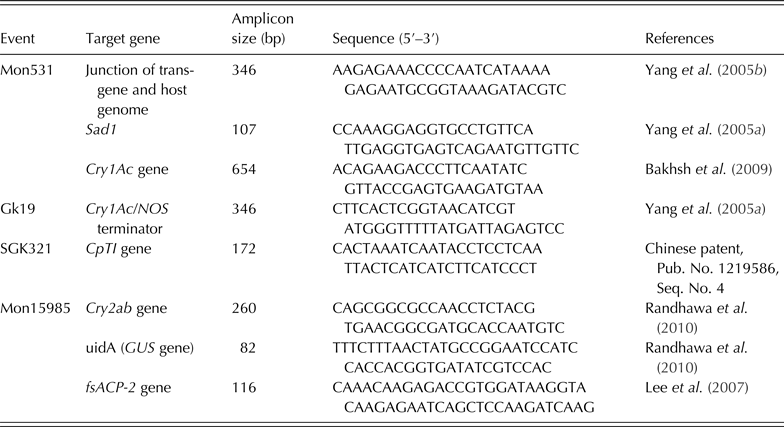
The reported primers, targeting various regions of transgene construct and the events (Table 1), were synthesized by Gene Link, USA. The designed primers were reconstituted in double distilled and de-ionized water for further use at a concentration of 50 ng/μl.
Primer pairs used for testing cotton genotypes by qualitative PCR

Genomic DNA extraction
The genomic DNA from fresh leaf tissue of 10-weeks-old Bt and non-Bt plants was extracted using the cetyl trimethyl ammonium bromide (CTAB) method (Doyle & Doyle Reference Doyle and Doyle1990). The DNA samples were quantified using a Nano Drop spectrophotometer (Beckman, USA) at 260 nm/280 nm. The concentrated DNA was finally diluted to 50 ng/μl.
Qualitative polymerase chain reaction
Multiplex PCR assay was performed in a single reaction, using the combination of primer sets for Sad1 gene, Cry1Ac and MON 531, to make the Bt detection technique more economical, cost effective and reliable. Each reaction mixture contained 400 ng of template DNA, 1X Taq PCR buffer, 2 mm magnesium chloride (MgCl2), 0·2 mm deoxynucleotide triphosphates dNTPs mix, 0·5 U of Taq DNA Polymerase and 0·4 μ m of each primer. The amplification conditions were: One cycle of initial denaturation for 5 min at 95 °C, 35 cycles of denaturation at 94 °C for 1 min, annealing at 48 °C for 1 min, and elongation at 72 °C for 1 min. Thirty five cycles were followed by a final extension of 5 min at 72 °C.
Quantitative polymerase chain reaction
For quantification of Cry1Ac gene transcripts by Rt-PCR assay, only those samples were assessed which had earlier been reported to harbour the transgene. Syber green super mix (Fermentas, USA) was used to carry out Rt-PCR assays in a fluorometric thermal cycler (icycler Bio-Rad, USA) with a final volume of 25 μl. Fluorescence was monitored during every cycle at the annealing step. The reaction was carried out in triplicate for each sample using primers of Cry1Ac and a ubiquitin gene (GhUBQ7) (Table 2) used as a reference for normalization. The normalized expression value in terms of Ct (∆Ct Ct of Cry1Ac-Ct of GhUBQ7) was obtained from the inbuilt software of the iCycler (Bio-Rad, USA). The fold expression of Cry1Ac in the transgenic genotypes was determined by using the lowest Ct value as a reference point, which was obtained after normalization. Relative fold transcript level was determined by 2−∆∆Ct method.
Primers used for real time Rt-PCR
Immunoblot strip assay
The strip test was performed to detect the presence or absence of the Cry1Ac and Cry2Ab genes. Leaf samples of all genotypes were ground manually in extraction buffer and tested by Immunoblot strips, following the manufacturer's instructions (Envirologix Inc., USA). Specific Immuno strips for Cry1Ac and Cry2Ab (Catalog No. AS 012 LS) were used in the study.
Quantification of Cry1Ac Bt-toxin
Collected genotypes were analysed by sandwich ELISA to quantify the varying levels of Cry1Ac protein. Leaves (4–5 days old) were sampled from the 3rd and 4th node from the bottom at 70 days after sowing (DAS). The samples were processed immediately for sandwich ELISA according to the manufacturer's instructions (Envirologix, USA). The optical density was calculated three times and the mean was recorded by adjusting the wavelength at 450 nm, using a micro plate reader for each genotype (Epoch BioTek). Simple regression analysis was carried out in Microsoft Excel to calculate Cry1Ac concentration (μg/g) in the sampled leaves.
RESULTS
Qualitative analysis of transgene
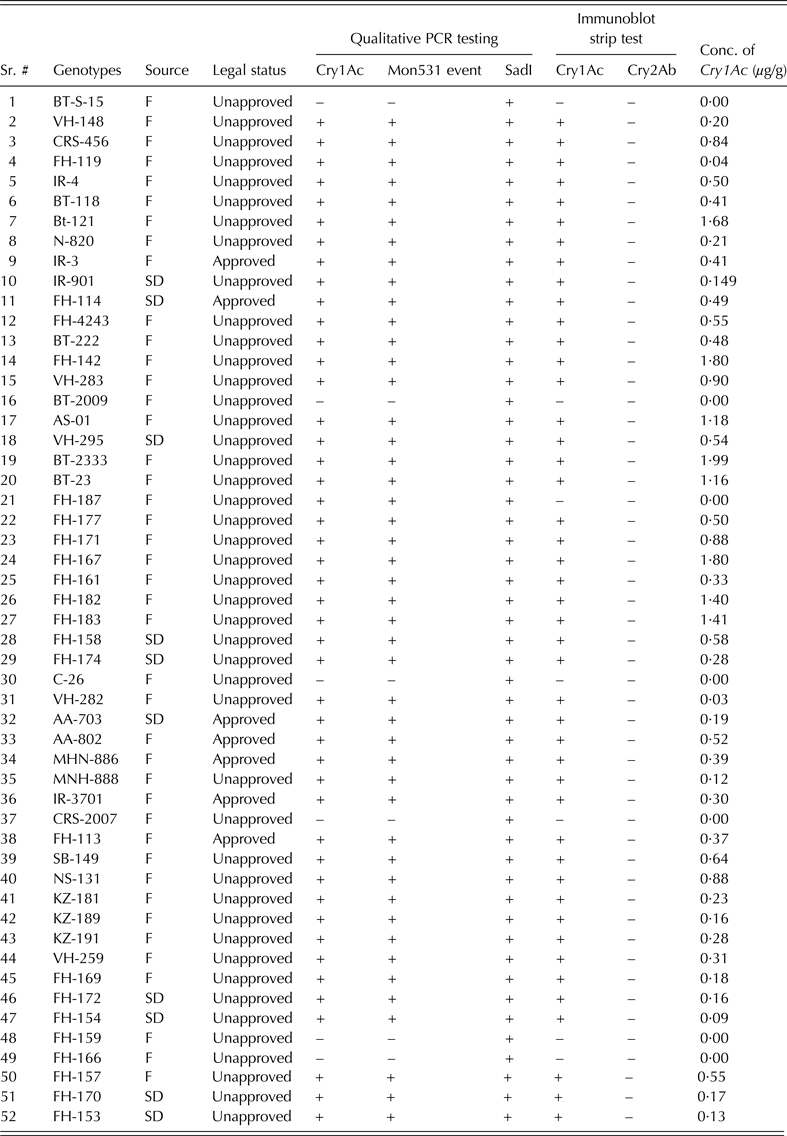
Qualitative PCR (Table 3) showed the presence of only the MON531 event in Pakistani genotypes. None of the PCRs was able to amplify the MON15985 event in the sampled genotypes, but the internal control gene (SadI) was successfully amplified in all samples. A simple and efficient multiplex PCR method was optimized for the subsequent detection of MON531 in the collected genotypes. In the established multiplex PCR, three primer pairs with different amplified lengths were employed in one reaction for the synthesis of expected amplicons of Cry1Ac, Mon531 event and SadI gene with sizes of 655, 346 and 107 bp, respectively. These were amplified in 45 Bt cotton genotypes while only seven non-Bt genotypes could amplify the SadI gene alone.
Source, approval status and testing results of collected genotypes
F, farmers; SD, seed dealer.
For immunoblot strip test, all genotypes showed negative results for Cry2Ab while 0·85 genotypes showed positive reactions for Cry1Ac gene (Table 3) and 0·15 of total genotypes did not show any signals for either Cry1Ac or Cry2Ab.
Quantitative analysis by real time polymerase chain reaction
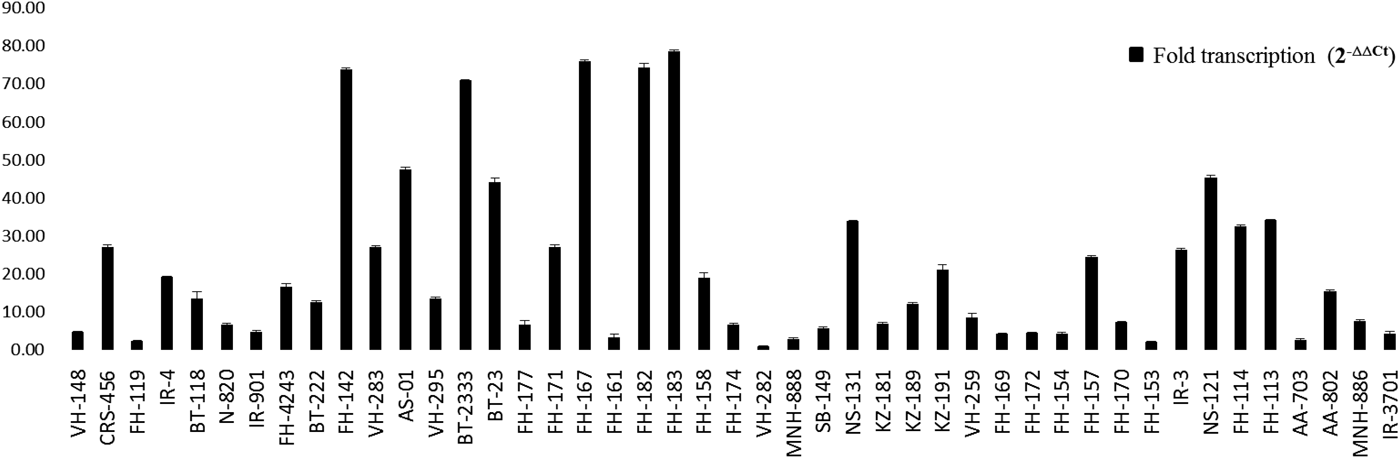
The difference in transcript level in real time PCR analysis might have been caused by some pipetting errors or from the difference in initial RNA samples used for complementary DNA (cDNA) synthesis. Therefore, GhUBQ7 was used as a reference gene to normalize the transcript analysis assay. The relative quantification of the accumulated transgene transcripts showed a highly variable rate of transcription among various genotypes. The maximum mRNA transcripts were observed in FH-142, FH-167, FH-182, FH-183 and BT-2333 (Fig. 1).
Relative fold transcription of Cry1Ac, determined by real time Rt-PCR, in transgenic genotypes.
Quantitative analysis by enzyme linked immunosorbent assay
All collected cotton genotypes were subjected to ELISA for determining the concentration of Cry1Ac toxin. Results showed that Cry1Ac expression level in leaf tissues ranged from 0·03 to 1·99 μg/g on a fresh weight basis. Three genotypes, Bt-2333, FH-167 and FH-142, expressed the highest amounts of Cry1Ac toxin, i.e. 1·99, 1·80 and 1·80 μg/g, respectively at 70 DAS, while VH-282, FH-119 and FH-154 expressed the lowest amount of Cry1Ac toxin, i.e. 0·03, 0·04, and 0·09 μg/g, respectively.
DISCUSSION
It was observed during the collection of genotypes for the present study that there is a long list of cotton seed, mostly unapproved, being sold in Pakistan as Bt cotton (Table 3). It might be speculated that these genotypes have not undergone the quality checking procedures usually adopted in the variety approval process.
Transgenic testing procedures should consist of reliable, cost-effective and reproducible qualitative and quantitative techniques. In the present study, multiplex PCR and strip tests were conducted for qualitative testing whereas Rt-PCR and ELISA were performed for quantitative evaluation of transgenic Bt expression. The detection of non-Bt genotypes among those recognized as Bt by the seed providers indicated the worst situation of quality measurements, adopted for Bt cotton cultivation. The poor performance of transgenic technology in Pakistan might be attributed to this prevailing situation, which could foster resistance in target pests. Toxin concentration should not be less than the standard lethal level, because it may create resistance in the target pests faster than the predicted period (Ferré & Van Rie Reference Ferré and Van Rie2002). Late approval, illegal cultivation and unregulated adoption of Bt cotton has encouraged the malpractice of selling non-Bt cotton seed with the label of Bt (Ahsan & Altaf Reference Ahsan and Altaf2009). The qualitative detection of transgene products by immunoblot strip tests further endorsed the PCR results, except for one genotype (FH-187) that showed negative results for the Cry1A gene, though it was reported by PCR to harbour the transgene. This may be due to low levels of Cry toxin, below the detection potential of the strip test. The zero ELISA reading further confirmed that the toxin was below detectable concentrations in this particular sample. Another study (Ali et al. Reference Ali, Hameed, Masood, Ali and Zafar2010) evaluated 42 local Bt cotton genotypes by strip test and confirmed only 34 as Bt gene carriers. This mixing of Bt and non-Bt genotypes badly affects their yield potential due to infestation of pests, which might not be able to survive if pure Bt genotypes are cultivated in the fields. The transcriptome analysis by real time Rt-PCR showed that the transgene promoter is not behaving as a constitutive type of promoter. The difference of many folds in transcription of a particular transgene with the same promoter suggests the involvement of some other factors in attenuating the transcription of Cry1Ac gene. The quantification of toxin protein by ELISA also revealed that Cry1Ac toxin differed significantly in all Bt cotton genotypes. A similar trend of variation was expected for transcript accumulation (Rt-PCR) and translated gene product (ELISA) for a given genotype, but only a few genotypes showed the same trend. The different location of leaves used for RNA extraction and ELISA might be the reason for the different trends between Cry1Ac mRNA and protein (Kranthi et al. Reference Kranthi, Naidu, Dhawad, Tatwawadi, Mate, Patil, Bharose, Behere, Wadaskar and Kranthi2005). The Bt toxin in different tissues of the cotton plant vary throughout its life-cycle (Adamczyk & Sumerford Reference Adamczyk and Sumerford2001; Mahon et al. Reference Mahon, Finnegan, Olsen and Lawrence2002; Kranthi et al. Reference Kranthi, Naidu, Dhawad, Tatwawadi, Mate, Patil, Bharose, Behere, Wadaskar and Kranthi2005), so no uniformity in toxin level in all genotypes was observed.
Another important observation was the sub-lethal concentration of Bt toxin in most of the genotypes. The fact is that no prior study has reported the baseline susceptibility of local lepidoptera before the release of transgenic cotton. In the absence of the standard lethal level, the lethal level of 1·8 μg/g reported in India by Kranthi et al. (Reference Kranthi, Naidu, Dhawad, Tatwawadi, Mate, Patil, Bharose, Behere, Wadaskar and Kranthi2005) was used for comparison. Sufficient levels of Cry protein are crucial in appropriate plant parts for resistance against target insect pests (Greenplate et al. Reference Greenplate, Mullins, Penn, Embry, Dugger and Richter2001). The main factors contributing towards the variable expression of Bt gene are its base sequences, copy number, the promoter used and gene incorporation point into the host genome of cotton genotypes (Guo et al. Reference Guo, Sun, Guo and Zhang2001). However, in the present study the same transgenic event was observed in which the Cry1Ac gene is under control of the CaMv35S promoter, a constitutive type of promoter. So a high level of variability in expression of the same transgene among collected genotypes might be attributed to variations in the methylation status of the promoter (35S) region, over-expression of the insecticidal genes at earlier stages of plant growth that ultimately results in gene silencing at later stages (Xia et al. Reference Xia, Xu and Guo2004), or differences in genetic background (Adamczyk & Meredith Reference Adamczyk and Meredith2004). The variation in toxin level in different genotypes, ranging from low to higher levels, can be harnessed by breeders to exploit the potential of this technology by developing genotypes that express the transgene at a higher level.
Variable expression of the insecticidal transgene would not only increase the production cost but also instigate resistance in target pests against a transgenic crop. The main cause of this low level of Cry protein might be the adoption of unapproved genotypes. The current results also showed that even approved varieties did not meet the standard toxin level. Most genotypes collected from farmers’ fields were elite lines leaked from various research institutes but still unapproved. No specific trend of expression was observed regarding the source of seed. None of the cotton seed collected from seed dealers was found to be non-Bt, but the smaller sample size prevents any final verdict about the reliability of source.
The results suggest that Government agencies must implement the Seed Act quickly to ensure that seed is correctly labelled and prevent the cultivation of unapproved varieties, along with considering toxin level as a quality criterion for approval and certification. The approval of plant breeder's rights together with amendments to the Seed Act can overcome obstacles in the involvement of the private sector for research and development, which may improve technology development and dissemination. Attention should also be paid to developing consistent and stable promoters for the Cry transgene that can drive the expression throughout cotton plant development, especially in the tissues that are more vulnerable to target insect-pest attack. In addition breeders should utilize better combinations of parents, favouring higher toxin concentration, considering that genetic background has the potential to manipulate transgene expression in cotton. The present study also showed the need for capacity development and creating awareness about the application of transgenic technology to harvest maximum benefits.
Funding for this study was provided by a project funded by USDA supported Endowment Fund Secretariat, University of Agriculture, Faisalabad, to Dr Hafiza Masooma Naseer Cheema. The student fellowship, provided by Mian Muhammad Afzal, Afzal Traders Pvt Ltd, is also acknowledged.