Significant outcomes
Context-conditioned freezing was reduced when rats were serotonin-depleted during acquisition only or during expression only or during both acquisition and expression, but not if they were serotonin-depleted in the consolidation phase only.
The results suggest that the dominating influence of serotonin on the process of fear conditioning is promoting rather than dampening.
Limitations
The possible relevance of fear conditioning in rat for human anxiety and various anxiety disorders remains a matter of speculation.
PCPA is not entirely selective for serotonin.
The present experiments did not aim to clarify the apparently disparate influence on conditioned freezing exerted by serotonin in different brain areas, but merely to address if the overall impact of this transmitter is best explained as fear-promoting or fear-dampening.
Introduction
As judged by the impressive efficacy of long-term administration of selective serotonin reuptake inhibitors in most anxiety disorders (Eriksson and Humble Reference Eriksson and Humble1990, Zohar and Westenberg Reference Zohar and Westenberg2000), and by the paradoxical anxiogenic effect these and other serotonergic drugs may exert upon acute administration (Coplan et al., Reference Coplan, Gorman and Klein1992, Sinclair et al., Reference Sinclair, Christmas, Hood, Potokar, Robertson, Isaac, Srivastava, Nutt and Davies2009), serotonin appears to be an important modulator of human anxiety. While numerous animal experiments lend further support for serotonergic neurons exerting a complex impact on fear and anxiety-like behaviour, it remains a matter of debate if the dominating influence of this transmitter is best described as anxiety-dampening or anxiety-promoting (Bauer Reference Bauer2015, Bocchio et al., Reference Bocchio, McHugh, Bannerman, Sharp and Capogna2016, Inoue et al., Reference Inoue, Kitaichi and Koyama2011, Isosaka et al., Reference Isosaka, Matsuo, Yamaguchi, Funabiki, Nakanishi, Kobayakawa and Kobayakawa2015).
Whereas in vivo microdialysis experiments have demonstrated increased extracellular levels of serotonin as compared to those found at baseline, in all likelihood reflecting enhanced neuronal release, in the hippocampus (Amat et al., Reference Amat, Matus-Amat, Watkins and Maier1998, Hajos-Korcsok et al., Reference Hajos-Korcsok, Robinson, Yu, Fitch, Walker and Merchant2003, Voigt et al., Reference Voigt, Rex, Sohr and Fink1999), the nucleus accumbens (Fulford and Marsden Reference Fulford and Marsden2007), the central nucleus of the amygdala (Hassell et al., Reference Hassell, Collins, Li, Rogers, Austin, Visceau, Nguyen, Orchinik, Lowry and Renner2019), the basolateral complex of the amygdala (BLA) (Mitsushima et al., Reference Mitsushima, Yamada, Takase, Funabashi and Kimura2006), the dorsal periaqueductal grey (Amat et al., Reference Amat, Matus-Amat, Watkins and Maier1998), and the prefrontal cortex (Dazzi et al., Reference Dazzi, Seu, Cherchi and Biggio2005, Miyata et al., Reference Miyata, Shimoi, Hirano, Yamada, Hata, Yoshikawa, Ohsawa and Kamei2007) of animals exposed to a non-conditioned stressor, and in the amygdala (Yokoyama et al., Reference Yokoyama, Suzuki, Sato, Maruta, Watanabe and Miyaoka2005), including the BLA (Zanoveli et al., Reference Zanoveli, Carvalho, Cunha and Brandao2009), the nucleus accumbens (Fulford and Marsden Reference Fulford and Marsden2007), the dorsal periaqueductal grey (Zanoveli et al., Reference Zanoveli, Carvalho, Cunha and Brandao2009), and the prefrontal cortex (Hashimoto et al., Reference Hashimoto, Inoue and Koyama1999, Yoshioka et al., Reference Yoshioka, Matsumoto, Togashi and Saito1995) of animals displaying a conditioned fear response, the functional role played by serotonin in these situations remains disputed. For example, whereas some authors have suggested that the increase in extracellular serotonin levels in the BLA accompanying conditioned fear serve to promote the behavioural response to the aversive stimulus (Bauer Reference Bauer2015, Bocchio et al., Reference Bocchio, McHugh, Bannerman, Sharp and Capogna2016, Isosaka et al., Reference Isosaka, Matsuo, Yamaguchi, Funabiki, Nakanishi, Kobayakawa and Kobayakawa2015), others have suggested that serotonin, on the contrary, dampens or resolves this response (Gutknecht et al., Reference Gutknecht, Popp, Waider, Sommerlandt, Goppner, Post, Reif, van den Hove, Strekalova, Schmitt, Colavarsigmao, Sommer, Palme and Lesch2015, Inoue et al., Reference Inoue, Kitaichi and Koyama2011, Kiyasova et al., Reference Kiyasova, Fernandez, Laine, Stankovski, Muzerelle, Doly and Gaspar2011), putatively through mechanisms including the hippocampus (Dai et al., Reference Dai, Han, Tian, Cao, Xiu, Song, Huang, Xu, Ding and Xu2008, Waider et al., Reference Waider, Popp, Mlinar, Montalbano, Bonfiglio, Aboagye, Thuy, Kern, Thiel, Araragi, Svirin, Schmitt-Bohrer, Corradetti, Lowry and Lesch2019), which has also been attributed an important role in context-conditioned fear (Fanselow Reference Fanselow2000). Even though it is not unlikely that serotonin in fact exerts both a promoting and an inhibitory influence on fear conditioning, depending on the specific situation at hand, we deemed it important to assess if the dominating impact of this transmitter on the acquisition and expression of context-conditioned fear is promoting or dampening, that is if rats deprived of serotonergic transmission during the different phases of fear conditioning display enhanced, reduced, or unaltered fear conditioning.
A straightforward way to explore the possible general influence of a transmitter on a certain behaviour, and the direction of this influence, is to examine the behaviour in question after removal of the transmitter, for example, by inhibiting its synthesis with an enzyme inhibitor or by means of genetic or optogenetic manipulation. While many studies have addressed the impact of specific serotonin receptor subtypes on fear conditioning, and/or the role played by serotonin in specific brain areas, there are relatively few reports on this response in rats effectively deprived of serotonergic transmission throughout the brain (see (Bauer Reference Bauer2015) for refs).
A strategy introduced already in the 60s to arrest serotonergic activity is to administer p-chlorophenylalanine (PCPA) (Koe and Weissman Reference Koe and Weissman1966), which is an inhibitor of the enzyme converting tryptophan to the immediate serotonin precursor, 5-hydroxytryptophan (tryptophan hydroxylase, TPH2). While this drug may transiently impact also the levels of catecholamines, after 72 h of daily administration, PCPA-treated animals (including those where for solubility reasons a methyl ester has been used), thus, display a marked and selective depletion of serotonin (Eden et al., Reference Eden, Bolle and Modigh1979, Koe and Weissman Reference Koe and Weissman1966, Miczek et al., Reference Miczek, Altman, Appel and Boggan1975, Naslund et al., Reference Naslund, Studer, Nilsson, Westberg and Eriksson2013, Naslund et al., Reference Naslund, Studer, Pettersson, Hagsater, Nilsson, Nissbrandt and Eriksson2015, Pettersson et al., Reference Pettersson, Hagsater and Eriksson2016). Supporting the usefulness of this approach to explore the physiological role of serotonin, early studies reporting PCPA-treated animals to display enhanced aggression and enhanced sexual activity (Ferguson et al., Reference Ferguson, Henriksen, Cohen, Mitchell, Barchas and Dement1970, Tagliamonte et al., Reference Tagliamonte, Tagliamonte, Gessa and Brodie1969) paved the way for the hypothesis, subsequently corroborated by the use of other strategies (Gutknecht et al., Reference Gutknecht, Popp, Waider, Sommerlandt, Goppner, Post, Reif, van den Hove, Strekalova, Schmitt, Colavarsigmao, Sommer, Palme and Lesch2015, Liu et al., Reference Liu, Jiang, Si, Kim, Chen and Rao2011), that serotonin exerts largely an inhibitory influence on these aspects of behaviour in experimental animals. Subsequent clinical observations that serotonin reuptake inhibitors may elicit a rapid reduction in anger and sexual drive suggest serotonin to exert a similar impact also in man (see (Landen et al., Reference Landen, Erlandsson, Bengtsson, Andersch and Eriksson2009) for refs).
Conditioned fear in rodents is largely expressed as a freezing reaction characterised by the absence of body movements in conjunction with an arched back, retraction of the ears, and piloerection (Blanchard and Blanchard Reference Blanchard and Blanchard1969, Riess Reference Riess1945). In the present study, we assessed how contextual freezing is influenced by PCPA-induced serotonin depletion applied either (i) throughout the period from (and including) acquisition to (and including) expression, (ii) during acquisition but not during expression, (iii) after acquisition, that is during memory consolidation, but not during expression, and (iv) during expression only.
Material and methods
Animals
Male Sprague–Dawley rats purchased from Janvier (Le Genest-Saint-Isle, France) and Taconic (Borup, Denmark) were housed with three individuals per cage (595 × 380 × 200 mm) under controlled conditions: temperature 23°C; humidity 55–65%; 12 h light–dark cycle with light on at 07:00 h. Food and water were supplied ad libitum. Rats were 9 weeks of age at arrival and were habituated to human handling on a regular basis during 2 weeks before testing.
Drugs
For solubility reasons, a methyl ester of PCPA was used (4-chloro-DL-phenylalanine-methyl ester hydrochloride), which was purchased from Sigma-Aldrich (St Louis, MO, USA), and administered intraperitoneally for 4 (experiment I) or 3 (experiments II, III, IV, and V) consecutive days at a daily dose of 300 mg/kg. This dosage regimen has been shown to cause an almost complete depletion of serotonin throughout the brain while leaving catecholamine levels intact (Eden et al., Reference Eden, Bolle and Modigh1979, Koe and Weissman Reference Koe and Weissman1966, Miczek et al., Reference Miczek, Altman, Appel and Boggan1975, Naslund et al., Reference Naslund, Studer, Nilsson, Westberg and Eriksson2013, Naslund et al., Reference Naslund, Studer, Pettersson, Hagsater, Nilsson, Nissbrandt and Eriksson2015, Pettersson et al., Reference Pettersson, Hagsater and Eriksson2016). Control animals received intraperitoneal injections of 0.9% saline.
Assessment of freezing
The experiments were performed using a fear-conditioning system (MED-VFC-NIR-R, Med Associates, St Albans, VT, USA) with sound-attenuating cubicles. Within each cubicle, the rats were placed in a fear-conditioning chamber (VFC-008, Med Associates) measuring 305 × 241 × 210 mm. Individual rats were assigned to the same cubicle for fear conditioning and testing, respectively.
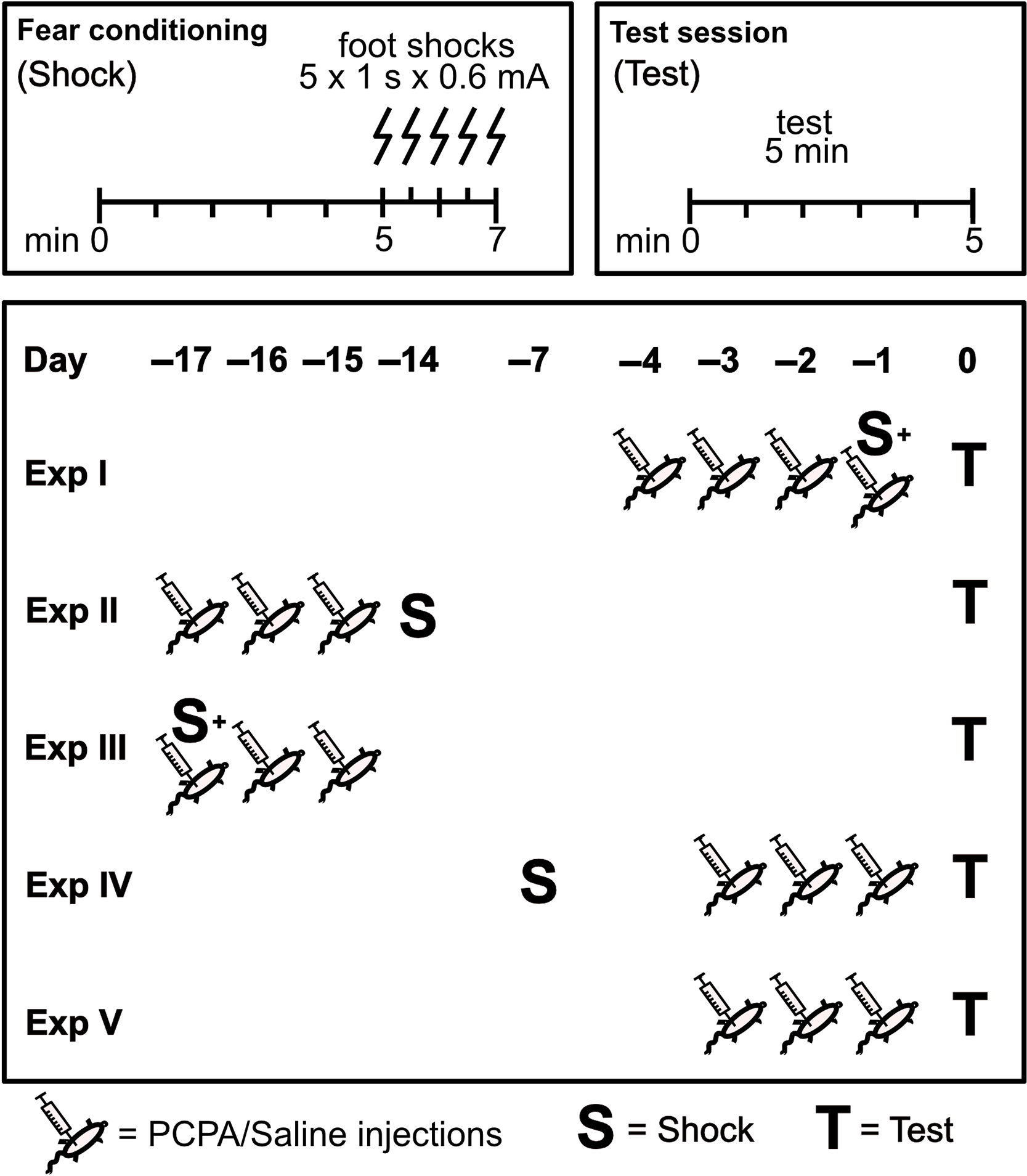
During fear conditioning, the animals were first exposed to a 5-minute adaptation period (without stimuli) followed by five electric foot shocks (1 s duration, 0.6 mA) with a 30 s inter-shock interval (Fig. 1). During testing, where no additional stimuli were presented, the time spent freezing during a 5-minute period was assessed by automated scoring of video recordings and computed as lack of motion for more than 1 s (Anagnostaras et al., Reference Anagnostaras, Wood, Shuman, Cai, Leduc, Zurn, Zurn, Sage and Herrera2010, Hagsater et al., Reference Hagsater, Thoren, Pettersson and Eriksson2019). All animals displaying immobility were the subjects of gross observation to ensure that they did display typical freezing behaviour.
Schematic illustration of the fear-conditioning protocol and the outline of experiments I–V. Fear conditioning is denoted by S (Shock) and test session by T (Test).

In experiment V, in addition to freezing, spontaneous locomotion was quantified and calculated as the absolute difference between subsequent image frames.
Experimental design
In experiment I, addressing the effect of PCPA-induced serotonin depletion throughout the period from (and including) acquisition to (and including) expression, the time between conditioning and testing was short (1 day) since the animals should be under the influence of serotonin depletion during the entire period (Fig. 1). The first injection of PCPA was given 3 days prior to acquisition and the last 1 day prior to testing.
In experiment II, addressing the impact of PCPA administered during acquisition but not during expression, the time period between acquisition and expression was 14 days so that the rats had sufficient time to replenish their serotonin levels before testing (Koe and Weissman Reference Koe and Weissman1966). Last of three daily injections of PCPA was 1 day prior to acquisition (Fig. 1).
In experiment III, aiming to address the effect of serotonin depletion during memory consolidation but neither acquisition nor expression, the first of three daily doses of PCPA was administered immediately after acquisition. The time period between the last PCPA injection and expression was 15 days (as in experiment II).
In experiment IV, addressing the impact of PCPA administered during expression only, 7 days were allowed to elapse between acquisition and testing. The first of three daily doses of PCPA was given 4 days after acquisition and the last dose 1 day prior to testing.
A control experiment was performed in which the effect of PCPA-induced serotonin depletion on naïve rats that had not been subjected to the fear conditioning chamber was assessed (experiment V).
The rats were handled and given injections by both female and male experimenters. Only male experimenters executed the procedures involving fear conditioning (Sorge et al., Reference Sorge, Martin, Isbester, Sotocinal, Rosen, Tuttle, Wieskopf, Acland, Dokova, Kadoura, Leger, Mapplebeck, McPhail, Delaney, Wigerblad, Schumann, Quinn, Frasnelli, Svensson, Sternberg and Mogil2014).
Statistics
The data were analysed using SPSS version 19. Comparisons of groups were undertaken using Mann–Whitney U-tests.
Results
Experiment I
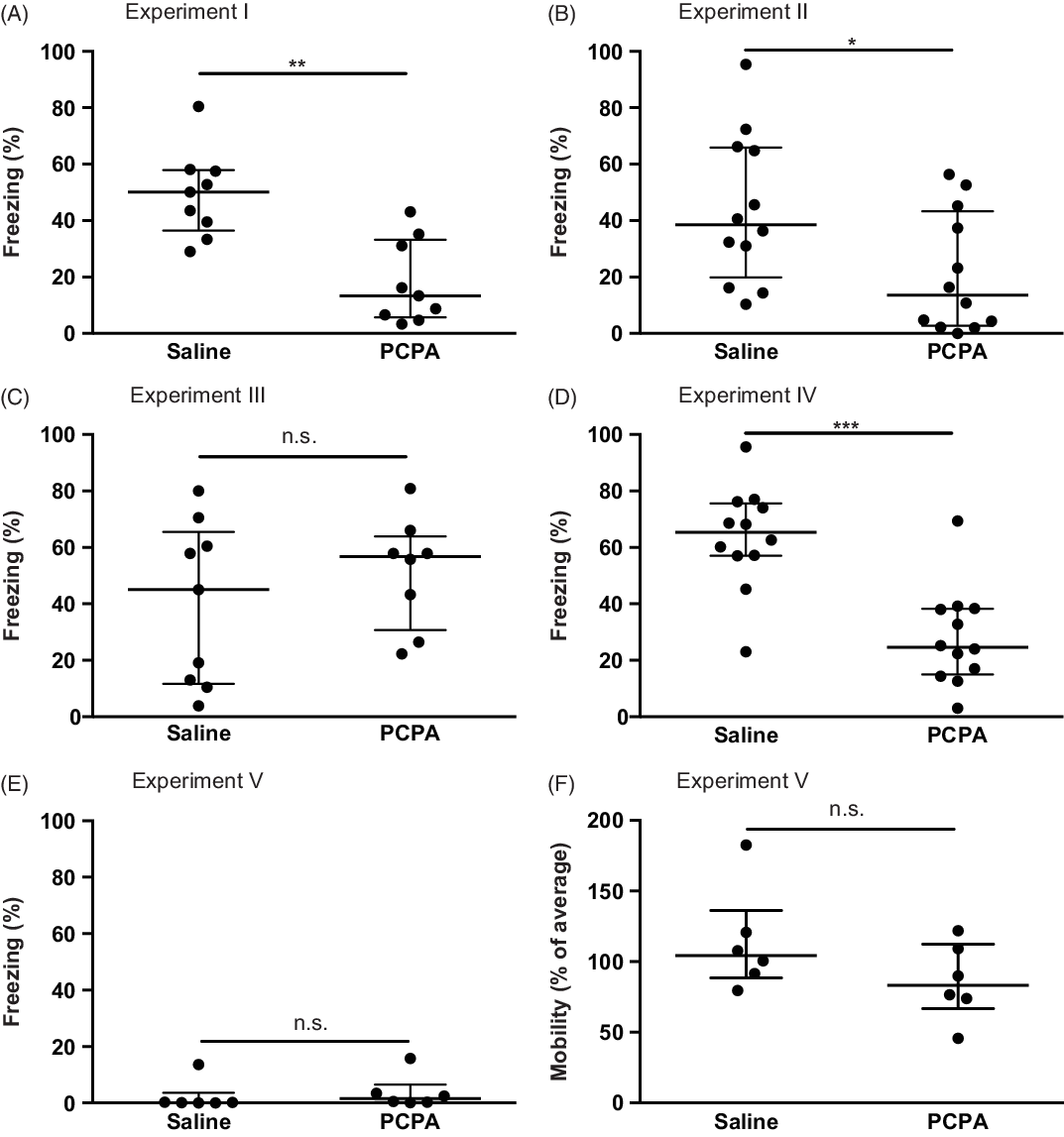
PCPA administered in a regimen rendering the animals serotonin-depleted from (and including) acquisition to (and including) expression of context-conditioned fear resulted in a significant reduction in freezing on the day of testing (U = 6.0, p < 0.01) (Fig. 2(A)). During acquisition, freezing was significantly reduced for PCPA-treated animals in the time period from the first foot shock (5 min) until the end of the session (7 min) (U = 15.5, p < 0.05).
Effect of serotonin depletion on rats subjected to fear conditioning (experiments I–IV) and non-conditioned rats (experiment V). (A) Experiment I: animals that received PCPA (n = 9) or saline (n = 9) injections prior to fear conditioning and testing. (B) Experiment II: animals that received PCPA (n = 12) or saline (n = 12) injections prior to fear conditioning. (C) Experiment III: animals that received PCPA (n = 8) or saline (n = 9) injections immediately after fear conditioning. (D) Experiment IV: animals that received PCPA (n = 12) or saline (n = 12) injections prior to testing. (E–F) Experiment V: animals that received PCPA (n = 6) or saline (n = 6) injections prior to testing (without prior fear conditioning). Bars in (A–E) represent median time spent freezing (±IQR) and in (F) median intensity of motion (±IQR). Statistical significance is indicated by * = p < 0.05, ** = p < 0.01, *** = p < 0.001, and n.s. = non-significant.

Experiment II
PCPA administered in a regimen rendering the animals serotonin-depleted during acquisition (and including the first part of the consolidation phase) of context-conditioned fear resulted in a significant reduction in freezing on the day of testing (U = 36, p < 0.05) (Fig. 2(B)). During acquisition, there was a tendency for reduced freezing for PCPA-treated animals from the first foot shock (5 min) until the end of the session (7 min) that however did not reach the level of statistical significance (U = 39, p = 0.06).
Experiment III
PCPA administered immediately after fear conditioning, that is during memory consolidation, did not significantly affect time spent freezing on the day of testing (Fig. 2(C)).
Experiment IV
PCPA administered in a regimen rendering the animals serotonin-depleted during expression but not during acquisition of context-conditioned fear resulted in a significant reduction in freezing on the day of testing (U = 14, p < 0.001) (Fig. 2(D)).
Discussion
In contrast to what has previously been reported for mice genetically modified not to express TPH2 (Gutknecht et al., Reference Gutknecht, Popp, Waider, Sommerlandt, Goppner, Post, Reif, van den Hove, Strekalova, Schmitt, Colavarsigmao, Sommer, Palme and Lesch2015), PCPA-treated animals never displayed enhanced freezing behaviour; instead, PCPA markedly reduced time spent freezing when administered so that the animals were serotonin-depleted during the entire period of acquisition, memory consolidation, and expression. Subsequent experiments showed similar outcome when serotonin was depleted during acquisition only or during expression only – the increase in serotonin release that has previously been observed in different brain areas during both exposures to non-conditioned stressors and during expression of conditioned fear hence appear crucial both for acquisition and expression of conditioned fear and to largely promote rather than dampen this behaviour. In contrast, rats exposed to serotonin depletion after the training session only, that is during memory consolidation, displayed normal expression of conditioned fear, suggesting that the effect observed in the other experiments is not (solely) due to PCPA-induced memory impairment.
Previous experiments using other approaches than inhibiting TPH2 pharmacologically to arrest serotonergic transmission throughout the brain during fear conditioning have revealed conflicting results. On the one hand, workers exploring the effect of (partial) serotonin depletion following the destruction of the median raphe nucleus have (in consonance with the present study) reported reduced rather than augmented freezing (Borelli et al., Reference Borelli, Gargaro, dos Santos and Brandao2005, Melik et al., Reference Melik, Babar-Melik, Ozgunen and Binokay2000). But on the other hand, transgenic mice deprived of serotonergic transmission due to knockout of either TPH2 (Gutknecht et al., Reference Gutknecht, Popp, Waider, Sommerlandt, Goppner, Post, Reif, van den Hove, Strekalova, Schmitt, Colavarsigmao, Sommer, Palme and Lesch2015, Waider et al., Reference Waider, Popp, Mlinar, Montalbano, Bonfiglio, Aboagye, Thuy, Kern, Thiel, Araragi, Svirin, Schmitt-Bohrer, Corradetti, Lowry and Lesch2019) or transcription factors required for the early development of serotonergic neurons (Dai et al., Reference Dai, Han, Tian, Cao, Xiu, Song, Huang, Xu, Ding and Xu2008, Kiyasova et al., Reference Kiyasova, Fernandez, Laine, Stankovski, Muzerelle, Doly and Gaspar2011) are reported to display augmented conditioned freezing, leading the authors to conclude, as have previously others (Inoue et al., Reference Inoue, Kitaichi and Koyama2011), that the overall impact of serotonin on conditioned freezing is dampening rather than promoting. While species differences (rats versus mice) could contribute to the differences in results between the present study and those using transgenic mice, a more likely explanation would be that serotonin exerts both freezing-promoting and freezing-dampening influence at different stages of the process, and in different situations, and that mice lacking serotonin during their development (in contrast to those rendered serotonin-depleted by means of PCPA at adult age) develop mechanisms compensating for the former but not the latter effect of the missing transmitter. While studies using selective destruction of serotonergic pathways to the BLA, obtained by local administration of the neurotoxin 5,7-DHT have shown this treatment (administered before either acquisition or expression) to impair the conditioning response (Izumi et al., Reference Izumi, Ohmura, Futami, Matsuzaki, Kubo, Yoshida and Yoshioka2012, Johnson et al., Reference Johnson, Molosh, Fitz, Arendt, Deehan, Federici, Bernabe, Engleman, Rodd, Lowry and Shekhar2015), an experiment exposing 3-day-old rats to intraventricular injections of 5,7-DHT noted no effect on conditioned fear in the adult animal (Rok-Bujko et al., Reference Rok-Bujko, Krzascik, Szyndler, Kostowski and Stefanski2012).
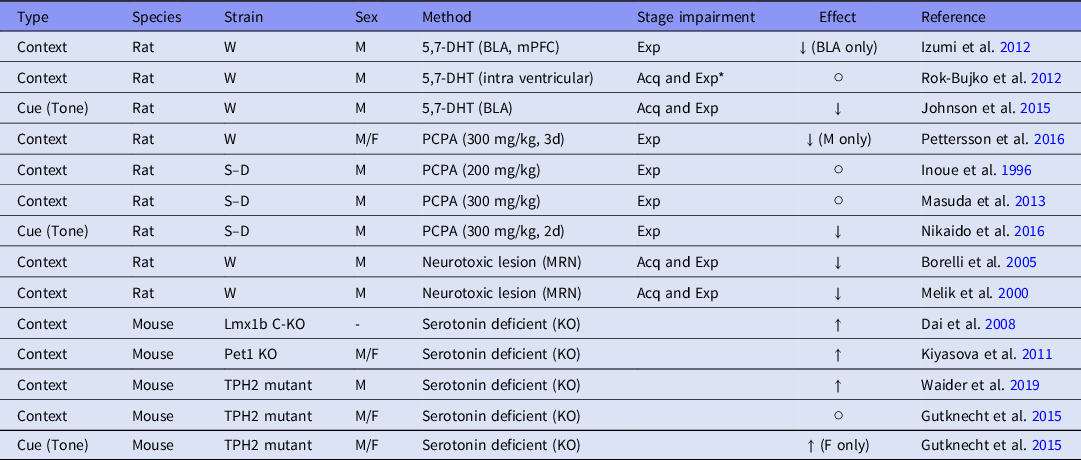
Also with respect to the impact of PCPA on context-conditioned freezing, data are conflicting. While we have previously reported (and now replicate) that PCPA administered before expression reduces the freezing response in male rats (Pettersson et al., Reference Pettersson, Hagsater and Eriksson2016), neither Inoue and co-workers (Inoue et al., Reference Inoue, Tsuchiya and Koyama1996) nor Masuda and co-workers (Masuda et al., Reference Masuda, Nishikawa, Inoue, Toda, Nakagawa, Boku and Koyama2013) found any effect of PCPA given prior to testing. However, while we administered 300 mg/kg of PCPA subcutaneously for three consecutive days, that is a dosage that we and others have previously shown cause a depletion of serotonin levels of approximately 95% (Miczek et al., Reference Miczek, Altman, Appel and Boggan1975, Naslund et al., Reference Naslund, Studer, Nilsson, Westberg and Eriksson2013, Naslund et al., Reference Naslund, Studer, Pettersson, Hagsater, Nilsson, Nissbrandt and Eriksson2015, Pettersson et al., Reference Pettersson, Hagsater and Eriksson2016), studies not observing an effect of PCPA applied regimens that could be expected to cause considerably lower degrees of serotonin depletion. In line with our observation, PCPA administered before expression has been reported to dampen the freezing response to auditory fear conditioning (Nikaido et al., Reference Nikaido, Yamada, Migita, Shiba, Furukawa, Nakashima and Ueno2016). For an overview, previously reported effects of serotonin impairment on cued- and context-conditioned fear are displayed in Table 1.
Effects of serotonin impairment on cued and context-conditioned fear

Strain is denoted by S–D = Sprague–Dawley and W = Wistar. Arrows indicate significant effect on freezing and zeros indicate no significant effect.
* Rats were 3 days old at impairment and 90 days at test.
To the best of our knowledge, this is the first study to investigate conditioned freezing in animals rendered serotonin-depleted before acquisition but not expression. That these rats displayed reduced freezing when re-exposed to context and a tendency for reduced freezing also during exposure to shocks, suggests that the increase in serotonin release observed in animals exposed to unconditioned stressors (for refs, see Introduction) serves to promote rather than counter fear conditioning. Previous studies have shown PCPA to not affect pain sensitivity (Ogren and Berge Reference Ogren and Berge1984), to enhance reactivity, and decrease the response threshold to electric foot shocks (Bodnar et al., Reference Bodnar, Kordower, Wallace and Tamir1981, Fibiger et al., Reference Fibiger, Mertz and Campbell1972, Tenen Reference Tenen1967), to increase startle response to acoustic noise (Pettersson et al., Reference Pettersson, Hagsater and Eriksson2016), to facilitate active avoidance learning (Ogren Reference Ogren1985), and to increase reactivity to cutaneous stimulation (Dringenberg et al., Reference Dringenberg, Hargreaves, Baker, Cooley and Vanderwolf1995, Koe and Weissman Reference Koe and Weissman1966). Our present observation that animals that were serotonin-depleted when exposed to foot shocks appeared less impacted by this aversive stimulus than controls hence is not likely caused by a reduction in pain sensitivity or by a dampening of general reactivity vis-à-vis unpleasant stimuli.
Likewise, since serotonin depletion has been reported not to impair learning and long-term memory (Buhot et al., Reference Buhot, Martin and Segu2000, Hritcu et al., Reference Hritcu, Clicinschi and Nabeshima2007, Santucci et al., Reference Santucci, Knott and Haroutunian1996, Tenen Reference Tenen1967), and since we observed normal conditioned freezing in animals that were serotonin-depleted during the consolidation phase but neither during acquisition nor expression, the reduction in conditioned freezing in rats re-exposed to context is also not easily explained in terms of memory impairment. The present results are, on the other hand, well in line with early studies suggesting PCPA to dampen ‘emotional reactivity’ (Tenen Reference Tenen1967), and with our previous report showing reduced freezing response in rats exposed to noise bursts (Pettersson et al., Reference Pettersson, Hagsater and Eriksson2016). They are also in general consonance with the notion that an overall role for serotonin is to promote freezing responses at the expense of fight and flight reactions (Graeff Reference Graeff1994, Johnson et al., Reference Johnson, Lightman and Lowry2004, Magierek et al., Reference Magierek, Ramos, da Silveira-Filho, Nogueira and Landeira-Fernandez2003, Ramirez et al., Reference Ramirez, Moscarello, LeDoux and Sears2015).
Rats that were not fear-conditioned spent little time immobile regardless of treatment. They displayed numerically, but not significantly less spontaneous locomotion indicating that enhanced general activity could not explain the effect of PCPA on context-conditioned freezing. This observation is in line with previous studies suggesting PCPA not to affect or to exert a modest inhibitory impact on spontaneous motor activity (Angrini et al., Reference Angrini, Leslie and Shephard1998, Dringenberg et al., Reference Dringenberg, Hargreaves, Baker, Cooley and Vanderwolf1995, Kohler and Lorens Reference Kohler and Lorens1978, Kubala et al., Reference Kubala, McGinnis, Anderson and Lumia2008, Marsden and Curzon Reference Marsden and Curzon1976, Tenen Reference Tenen1967).
There are limited possibilities to explore the effects of selectively arresting serotonin transmission in man. It is however noteworthy, and in line with the present results, but not with the above-mentioned studies using genetic manipulation to arrest serotonergic activity, that administration of a tryptophan-free diet attenuates autonomic responses to a conditioned stimulus in humans (Hindi Attar et al., Reference Hindi Attar, Finckh and Buchel2012).
While the relevance of conditioned fear and other anxiety-related animal models remains a matter of discussion, the present data suggesting the dominating impact of serotonin on anxiety is promoting rather than dampening are in line with the anxiety-augmenting influence exerted by the serotonin-releasing agent fenfluramine (Brauer et al., Reference Brauer, Johanson, Schuster, Rothman and de Wit1996, Targum and Marshall Reference Targum and Marshall1989) as well as the selective serotonin reuptake inhibitors (SSRIs) (at acute administration) (Sinclair et al., Reference Sinclair, Christmas, Hood, Potokar, Robertson, Isaac, Srivastava, Nutt and Davies2009), which is particularly noteworthy in patients with panic disorder (Rammsayer and Netter Reference Rammsayer and Netter1990). Likewise, some clinical support for both panic disorder (Esler et al., Reference Esler, Lambert, Alvarenga, Socratous, Richards, Barton, Pier, Brenchley, Dawood, Hastings, Guo, Haikerwal, Kaye, Jennings, Kalff, Kelly, Wiesner and Lambert2007) and social phobia (Furmark et al., Reference Furmark, Tillfors, Garpenstrand, Marteinsdottir, Langstrom, Oreland and Fredrikson2004) being manifestations of enhanced serotonergic transmission has been published. Conversely, however, Graeff and Zangrossi (Graeff and Zangrossi Reference Graeff and Zangrossi2010) have suggested that the SSRIs counter panic attacks by augmenting an anxiety-reducing impact of serotonin in the dorsal periaqueductal grey (mirrored by a reduced response to proximal danger in animal experiments) but exert their therapeutic effect in generalised anxiety disorder by down-regulating an anxiety-promoting serotonergic influence in the amygdala and the prefrontal cortex (corresponding to a reduction in responses to potential threats, such as conditioned fear, in animals).
The first limitation of this study resides in the lack of specificity of PCPA in the sense that the drug may transiently impact also brain levels of catecholamines; after 3 days of repeated administration, it is however reported to exert a selective influence on serotonin levels only (Eden et al., Reference Eden, Bolle and Modigh1979, Koe and Weissman Reference Koe and Weissman1966, Miczek et al., Reference Miczek, Altman, Appel and Boggan1975). The second limitation is that the rats in experiment III, that were to be serotonin-depleted in the consolidation phase only, received PCPA immediately after acquisition, and hence can be expected to be only partially serotonin-depleted during the first hours following exposure to the conditioning stimulus; previous studies thus suggest that serotonin levels 6 h after administration are reduced to approximately 50% (Koe and Weissman Reference Koe and Weissman1966). Since memory consolidation takes place within hours after exposure, although the neural processes related to long-term memory formation are perpetuating for days (Dudai Reference Dudai2004, McGaugh Reference McGaugh2000), it cannot be excluded that PCPA had exerted an effect if the drug had displayed a more immediate impact on serotonergic transmission. The third limitation is that freezing was not assessed manually, but by automatic scoring of immobility (Anagnostaras et al., Reference Anagnostaras, Wood, Shuman, Cai, Leduc, Zurn, Zurn, Sage and Herrera2010); however, automatic scoring may also be an advantage since it provides a more objective measure than manual scoring (Luyten et al., Reference Luyten, Schroyens, Hermans and Beckers2014). By means of gross observation, it was confirmed that animals displaying immobility also exhibited typical signs of freezing, such as rigged tail, arched back, piloerection, and retracted ears (Blanchard and Blanchard Reference Blanchard and Blanchard1969, Riess Reference Riess1945). The fourth limitation is that the four experiments assessing fear conditioning are not entirely comparable since methodological aspects required us to alter the time elapsing from acquisition to testing depending on at what stages of the process serotonin depletion should be in place. Finally, it may be considered a drawback that only male animals were studied, which however is justified by the fact that we in a previous study found no effect of PCPA administration on the expression of context-conditioned fear in females (Pettersson et al., Reference Pettersson, Hagsater and Eriksson2016).
To summarise, while the present data do not exclude the possibility that brain serotonergic neurons in certain situations may dampen or dissolve fear conditioning, they support the notion that the increase in serotonin release observed in different brain regions both during exposure to non-conditioned stressors (i.e. during acquisition of conditioned fear) and during expression of conditioned fear serves primarily to promote rather than counter fear-conditioning process.
Acknowledgements
Gunilla Bourghardt, Ann-Christine Reinhold, and Lars Börjesson are acknowledged for their excellent technical assistance. This study was supported by the Swedish Research Council (K2013-61X-14961-07-3), Söderberg’s Foundation (MT-30/09), Hållsten’s Foundation, and the Swedish Brain Foundation (FO-20110293).
Authors’ contributions
SMH designed and executed the experiments, analysed and interpreted all data. RP and AH designed and executed the experiments. EE designed the experiments, reviewed and interpreted the data. All authors contributed on the writing of the manuscript.
Conflicts of interest
There are no competing financial interests in relation to the work described.
Ethical standards
All procedures were approved by the Animal Ethics Committee at the University of Gothenburg. The authors assert that all procedures contributing to this work comply with the ethical standards of the relevant national and institutional guidelines on the care and use of laboratory animals.