The issues to be resolved, then, concern divergent league policies toward market division and toward entry. Why, despite similar origins, did the Football League's founders reject the territorial monopolies that appeared to benefit the National League? Why did the Football League open its haphazard election system into formal promotion and relegation in the same year that the National League was barring the door against its own previous haphazard system of club entry? Our explanation focuses on geographic compactness, its impact on wages and travel (both for teams and their fans), on the cost side, and on the excitement level of games and ability to maintain territorial monopolies on the benefit side.
Compactness
Uncoordinated scheduling proved easier in densely populated England than in sparsely populated America, because teams in the United Kingdom had many more nearby opponents among which to choose. Even top-flight English clubs could ordinarily arrange games against comparably strong opponents at locations that permitted round-trip travel within a day, requiring little disruption of the work schedules of the fans as well as those players who continued to hold outside employment.
A similar environment existed for the lesser clubs in urban America, but the best teams discovered that they could either travel short distances to play generally one-sided games against inferior opponents before few fans, or they could travel long distances to meet comparable teams before large crowds composed almost entirely of home-team fans. Long-distance travel disrupted players' work at their full-time jobs, so U.S. baseball's top teams became fully professional much earlier than any English football club. Once a team had to travel so far that its players could not hold outside jobs during the season, the marginal cost of an increase in travel distance diminished. Though baseball's total travel costs were much higher, their marginal travel costs with respect to distance were lower; thus, they became less sensitive to distance than were U.K. football teams.
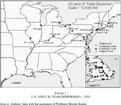
Old England occupies about three-quarters as much area as New England, as shown in Figure 1, where the countries are drawn to the same scale. According to the 1890 U.S. and 1891 U.K. censuses, however, Old England contained roughly half as many people as the entire United States. Even today England and Wales hold more than a fifth of the U.S. population in an area the size of Michigan. The Football League covers only a middling area among major European soccer leagues, barely half that of Italy, but even the league in France, Europe's most extensive, covers less than half the area of the northeast quadrant of the United States, where the National League began play.41
France has an area between those of California and Texas, and its first professional football championship was not contested until the 1932/33 season. Although Russia is the largest country in Europe, the area spanned by its football league is limited. In fact, nearly all noteworthy Russian soccer teams play in Moscow.
Due to their greater population densities, European nations were blessed with a denser rail network than the United States.
FIGURE 1 U.S. AND U.K. TEAM DISPERSION C. 1950
To illustrate that the requisite travel would have rendered supplemental in-season jobs less viable for American than English players, we contrasted the geography of the National League with that of the Football League upon their respective inaugurations. The average separation between the eight original National League teams was ten times that between the 12 original Football League teams—595 miles (958 km) versus 59 miles (95 km).42
An almost identical ratio applies to the separation in today's leagues, though with air travel available and fully professional top-echelon players in both countries distance is less important. The average distance between today's 26 major league cities is 1,317 miles (2,120 km) whereas the average distance between the 45 cities shown in Figure 1 with teams that have played Premier League football is 131 miles (210 km). For present purposes we drew no distinction between continuously operating teams and reorganizations or replacements for failed clubs that had operated at the same site. Four former Premier League teams or their successors began the 2005/06 season below the Football League level.
Over the history of the Football League, the furthest two teams have ever traveled for a league game is 410 miles (660 km), the distance between Plymouth and Newcastle. That trip is about the same as that from Boston to Baltimore, or Los Angeles to San Francisco. It is less than the average separation between the original National League teams, and less than a third of the average separation between today's major league teams. Manchester and Liverpool are 35 miles (55 km) apart. Either one is less than 95 miles (155 km) from Birmingham, roughly the distance between Chicago and Milwaukee. These three English cities are closer than the minimum separation between National League teams in 1876, the 101 miles (163 km) between Cincinnati and Louisville. English compactness led to lower travel times and thus lower total (as distinct from marginal) travel cost.
Travel time is a reasonable proxy for the average player's opportunity cost, and the time that would have been required during the late nineteenth century to travel round-trip to another city and play an average game can be estimated. Assuming that compensation foregone per hour was equivalent in baseball and football, we took the intercity mileage, assumed average train speeds of 35 mph (55 km/h), then added six hours (three hours for getting to and from the stations at each end, dressing, warm-ups, undressing, and treating injuries, plus a generous three hours for playing the game).43
The assumptions are based on samples from the timetables in Travellers' Official Railway Guide for the United States (1899) and Bradshaw's Guide for Great Britain (1882). Foregone earnings swamp direct travel costs, but account book information assembled by Haupert and Winter, “Pay Ball,” suggests that in 1915—the first year for which data are available—the New York Yankees' direct travel costs were equivalent to the annual salaries of five players.
None of the 66 city pairs in the original Football League would have required as much as 14 hours for that round trip, and 54 (82 percent) would have required less than 12 hours. In contrast, among the 28 original National League city pairs, 24 (86 percent) would have required more than 14 hours, and none could have been completed in less than 12 hours. Indeed, nearly two-thirds of the National League round trips would have required more than 24 hours, nearly half would have required more than 48 hours, and a round trip between St. Louis and either Boston or Hartford would have taken almost three full days.
The average round trip in the Football League (including game time) was less than half a day and well under the National League's minimum. Plymouth didn't play a league match against Newcastle until 1934, but even in 1888 that round trip would have required only 30 hours, well under the 40-hour average in the original National League.
Because strong competitors were nearby, English football teams could leave for most away games Saturday at noon (the end of the British workweek until the 1950s), play a game against a closely matched opponent during the afternoon, and return home Saturday evening. Separating the teams by enough distance to form monopolies would have meant paying the players more, because the semiprofessionals among them would have experienced more broken time. Separating the teams into territorial monopolies would have prevented many fans from traveling with a team, reducing revenues. European fans have always attended away games in large numbers, and from the beginning most Football League games were scheduled to accommodate them. In contrast to all North American sports, night games remain rare in English football because so many of them would require visiting fans to spend a night away from home. Thus, when the Football League formed, there was good reason to eschew territorial monopoly.
By contrast, a quality baseball team had to travel so far that its entire roster became fully professional of necessity; no player could maintain outside employment during the season. Few supporters could travel to away games, so attendance was almost exclusively local fans. When the National League formed, there were few potential cost savings to be netted against territorial monopoly advantages. With fully professional players on both continents and the availability of air travel, the travel cost difference has fallen substantially, but even today in the United States, visiting teams and fans generally must incur at least an overnight stay.
Excitement Level of Games
The excitement level of games is a function of parity and variety/rivalry. The literature has discussed the benefits of parity extensively—any league's success depends on staging games with uncertain outcomes.44
See, for example, Canes, “Social Benefits”; and Szymanski and Zimbalist, National Pastime, pp. 170–94.
If outcomes become too predictable, games become boring, and fewer fans attend. We characterize parity as having positive, but decreasing, marginal value. Under normal circumstances, sports fans prefer a greater than 50 percent probability that their favored team wins, but attendance wanes when the likelihood of a win becomes too great.
45 Surdam, “American ‘Not-So-Socialist’ League,” found that revenue sharing benefited the New York Yankees in their post–World War II glory days because they were a better road than home draw. While New York attendance waned, fans outside of New York City took advantage of their limited opportunities to see the Yankees' star players, despite the modest probability that their home team would win.
Consider one team in a two-team market. The other local team offers low travel costs, but two teams playing repeatedly expose parity differences. So, variety is also a virtue, again with positive, but decreasing, marginal value. Variety and rivalry are negatively correlated. If rivalry also has positive, but decreasing, marginal value, an optimal league size exists where adding a team leads to a loss of passion that overwhelms the weak benefit of added variety, but the increased rivalry that results from subtracting a team fails to compensate for the ennui from repetition.
To produce well-played games with uncertain outcomes in the sparsely populated, relatively rail-poor United States, the National League restricted membership to one outstanding team in each of eight cities that spanned 1,207 miles (1,942 km). For the sake of parity, the league might have begun with even fewer teams, but that would have provided too little variety.46
Cincinnati won less than one game of every seven they played during the inaugural season, whereas Chicago won nearly four of every five. Chicago swept the ten games it played against Cincinnati by an average score of 11.4 to 3. By season's end the games must have engendered little anticipation in either city.
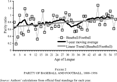
Although the Football League began in England's midsection with 12 teams spanning 126 miles (203 km), parity tended to be higher than the National League's had been at a similar age (see
Figure 2).
47 The idealized standard deviation, devised to study baseball (Quirk and Fort, Pay Dirt), is a commonly used parity measure that adjusts for different season lengths. In “Measuring Parity,” we explore the subtle errors that arise when applying that alternative to soccer and other sports that permit games to end in ties.
FIGURE 2 PARITY OF BASEBALL AND FOOTBALL, 1888–1956
Because comparable, high-quality opponents were much denser, variety was less costly to English teams, so, until reaching long-run equilibrium, any Football League division would be predicted to have more teams than would baseball. That requires a relatively strong assumption for cross-section analysis—omitted variables have similar impacts on baseball and football—though that assumption is unnecessary for time-series analysis. Testing that hypothesis is trivial. The Football League began with a larger membership and grew to 28 teams within four years. Despite the much larger U.S. population, well over a century passed before 28 teams were eligible to compete for the World Series championship. Even today there are only 30 such clubs, and only 22 have won a title. One hundred thirty-one teams have played in the Football League, 20 are in the Premier League and another 72 in the three Football League divisions today. Sixty-three have reached the Premier League at some point—an average of more than 29 separate teams during any five-year span since the Football League added a fourth division in 1921—and 23 have won its championship. From the birth of the Football League in 1888 through the leagues' seasons that began in 2005, the inverse Herfindahl yields an equivalent of 35.9 Premier League teams, but only 23.5 Major League Baseball teams.48
In distinction to the Herfindahl-Hirschman index, which sums squared percentage market shares across all of an industry's firms [(25)2 = 625, for a firm commanding a quarter of its industry], the Herfindahl sums squared fractional market shares [(1/4)2 = 1/16, or more conveniently, (0.25)2 = 0.0625]. Though the alternative measures of industrial concentration differ by a constant factor of 10,000, Stigler (Organization of Industry, p. 31) showed that the Herfindahl's inverse is equivalent to the number of firms of identical market share that would have produced that same Herfindahl measure, offering an intuitive view of what concentration differences imply. For our computations, a given team's market share is the number of years that it has competed at the top level divided by total team-years of competition for all teams that have competed at that level since the Football League was established. If the computations include the Players League, the Federal League, and the American Association, baseball's inverse Herfindahl increases by one team. Either way, the ratio of football to baseball rounds to 1.5 to 1; American baseball has been substantially more concentrated than English football.
If one grants our strong assumption that omitted variables have similar impacts, parity was less costly in England at the outset, so the Football League would have begun as the more balanced league. Even without such an assumption, falling travel costs would raise parity on both continents, though more strongly for baseball where the initial costs were greater. Testing the parity prediction is more challenging than testing the variety prediction. The parity measure we employ is the proportion of clubs that win between 40 percent and 60 percent of the maximum points (football) or games (baseball) available to a team in a season.49
For consistency we adjusted the data after 1981 when wins in football became worth three rather than two points. Draws have always been worth one point, but are no longer permissible in American baseball. Because we do not adjust for different season lengths, there is a downward bias in our measure of parity for football relative to baseball.
Figure 2 contrasts parity in the Premier League and Major League Baseball at similar league ages (the effect remains when we use chronological dates that begin each series in 1888). We end the analysis with the 1955/56 Football League season due to several exogenous events that seem to have affected football parity adversely—court decisions that eliminated maximum salaries, broadcasting's advent as an important revenue source, and the inauguration of continent-wide competitions. It is unclear a priori how salary cap elimination or broadcasting should be expected to alter football parity vis-à-vis baseball, as comparable phenomena occurred in North America. The continental competitions, however, would predictably reduce it.
In the continental competitions—principally the Champions Cup (subsequently the Champions League) and the UEFA Cup—Europe's best few teams according to the prior season's results play against each other. That provides a bonus for excelling—a lucky few teams play additional games against similarly skillful foreign clubs. Of necessity being interwoven between weekend league games, the continental contests are played on mid-week evenings against unusually distant clubs. Because fewer visiting fans will attend, those extra games are more valuable to teams with strong local followings, and, as of the 1956/57 season, they had an added incentive to invest in team quality. Perceiving little chance to “play in Europe,” the many teams that rarely play in football's upper divisions, and then for only a few seasons at a time, were given little added incentive to improve.50
Noll, “Economics of Promotion,” p. 199, discusses the incentives that marginal clubs have to pursue such a strategy, becoming what may be called “yo-yo” teams. We ran preliminary regressions of parity against league age that included dummy variables for both the Champions Cup/Champions League and the UEFA Cup. At conventional confidence levels, those regressions suggest that both had a negative impact on parity in the top Football League division, whereas the Champions Cup/Champions League had an even stronger negative impact on the Premier League, though the UEFA Cup had little. Chow tests lead to strong acceptance of the hypothesis that there was no break between 1955 and 1956 for Major League Baseball, weakly rejects the hypothesis for the Premier League, and strongly rejects it for the top Football League division.
The number of teams admitted and the number of games played by the median team—and thus the influence of the continental competitions—have increased over the years.
51 Liverpool earned about as much from broadcast rights for its 2005 Champions League games and performance bonuses as from broadcast rights for the team's Premier League season; Chelsea and Arsenal did almost as well. Though eliminated early, Manchester United nonetheless earned nearly half as much as Liverpool. Gate receipts for the four teams' home Champions League games were additional. British Broadcasting Company, Champions League Winners, p. 2. UEFA Cup earnings would have been more modest. The majority of Premier League teams participated in neither competition and thus earned nothing.
A regression of the ratio of Major League Baseball parity to Premier League parity against league age suggests convergence, the trend line's ratio increasing from 0.673 at the start to 0.910 at the end. The statistical confidence that the increase of 0.004 per year differs from zero approaches 99 percent (p = 0.015).
52 Statistical analysis based on the idealized standard deviation leads to identical conclusions to those reported, providing it is appropriately corrected for the many tied games in football.
The National League was pinched on the variety margin despite including a few fringe members, as it was pinched on the parity margin because it included them. To produce a more attractive product that balanced variety with parity, the National League rejected open entry. Assuming that the league started with the appropriate teams, potential supplicants either were too far away (say, in San Francisco) implying travel that would be too time-consuming and costly, or they were in a market that was thought to be unable to support a suitable team.
The National League was prepared to expel teams that did not measure up, but tried to discourage autonomous exit by those that did. During the early league history, a league club might play as many “exhibitions” against nonleague foes as it played league games, but playing such games in league cities was banned from the outset. As the number of league games that comprised a season grew, exhibition games were virtually eradicated. Consequently, any high-quality team that left the league by choice or expulsion experienced difficulty scheduling worthy opponents, and often failed.53
Eckard, “Team Promotion, p. 143.
In contrast, frequent nonleague games remain staples of English football, institutionalized in the FA Cup, continental competitions, and various others.
54 A participant in the Champions League might play 19 additional games during the 2005/06 season; its Premier League season consists of 38 games.
The Football League could be more blasé about turnover because, with greater team density than the National League, a defecting team was relatively easy to replace.
The Football League could also be more relaxed about the danger that an owner would weaken his team by capitalizing the contracts of star players. The problem would be dealt with promptly as the weakened team would be relegated to a division more in keeping with its reduced ability. If a North American team attempts to capitalize its roster, however, the impact on parity, and thus the external cost on other teams, could prove long-lived.
Territorial Monopolies
In sharp contrast to the nascent Football League, National League founders seized the opportunity to create territorial monopolies from the outset. Initially the league replaced clubs between seasons when that suited the interests of those that remained, but no team has ever been permitted to locate in a city that is already the home of another National League team.55
Only two of the original eight clubs—those known today as the Cubs and Braves—remained in the league as its sixth season began. Two strong National Association teams, the Whites and the Athletics, had played their home games in Philadelphia. Incorporating both would have improved parity, but defeated a territorial monopoly in Philadelphia. Only the Athletics were admitted to the National League. The American League has followed the same policy regarding team territories, though neither league has consistently respected territories of the other league, resulting in a few duopoly markets in the largest metropolitan areas.
So from its birth the National League was closed to a degree that the Football League never has been. Following the American Association's demise, entry into the National League—even into a nonleague city—became extraordinarily difficult.
Monopoly successfully achieved, even if for meritorious purposes, may provide market power. When the first additional market grows to a size adequate for a major league caliber team, entrepreneurs face an expensive choice—organize an entire league, as the American League did, with members who either must face entrenched franchises or be sited in initially substandard markets (risking piecemeal invasion as a result of major league expansion or franchise movement as those markets grow); or offer to purchase a franchise from the league.
A European team of any level, coordinating with no other club, need only keep winning to reach the top. The Football League's mergers with the Football Alliance and Southern League as well as the more recent emergence of the Conference illustrate that credible alternative leagues are easy to form in England's compact, densely populated environment. When the better teams became fully professional, the multidivisional promotion-and-relegation system was firmly entrenched. By 1921 the Football League already had 86 teams, and 33 had played in the Premier League. It seems that the Football League could not have maintained an effective closed cartel, and it never tried.
Assume that the Premier League had decided to adopt North American-style territorial restrictions for the 2005/06 season. Further, assume each metropolitan area was limited to a maximum of two teams within a 30-mile (48-km) radius.56
A 30-mile radius seems conservative. The Orioles asked for compensation for dilution of territorial rights due to Major League Baseball's relocation of the Montreal baseball team to Washington, 40 miles (64 km) from Baltimore. San Jose's mayor wants a major league team for his city, but the Giants were given territorial rights to San Jose upon moving to San Francisco, 50 miles (80 km) to the north.
This means that only two of the six London teams in the league could stay there; four would have been forced to move to much smaller cities if they wanted to remain in the Premier League. Indeed, considering the number of teams separated by less than 30 miles in other parts of the country, nine of the 20 Premier League teams would have had to move to meet the territorial restrictions. Rather than move, there would be an incentive for the potentially displaced teams to remain in place and play in the Football League. Thus, the likely result would be two leagues of similar ability and credibility with no alteration in any team's capacity to control a territory. As the National League discovered when the American League moved into its territory, when faced with credible insurgents, cooperation makes more sense than exclusion.
But why did the initial teams institute the promotion-and-relegation system that permitted so many competitors to gain a foothold in the first place? To understand that, it is necessary to recognize that the interests of league teams are heterogeneous. Expansion of the number of teams in a single league became unattractive once the marginal values of variety and rivalry were offsetting, so a divisional structure was adopted. Random year-to-year fluctuation in team quality meant that promotion and relegation within a divisional structure would maintain a higher level of parity. Teams with a strong expectation of playing in the Premier League would benefit, though weaker league members might not. English football is definitely fluid, but a core has enjoyed frequent Premier League membership, and, while doing so, promotion and relegation has provided them with greater parity.57
No team has played its entire history in the Premier League, but nine teams have played there for more than two-thirds of its 107 seasons (there was no competition during either world war).
As long as travel costs are significant, our analysis predicts football team survival in smaller markets than are necessary to support baseball teams and, collaterally, English metropolitan areas that possess more teams for a given population. Given England's size, virtually every game is against a neighbor (at least from a North American perspective). The lack of territorial monopoly increases price elasticities in European football, but games draw fans from two markets so the more elastic demand curve is shifted to the right.58
Though European football leagues enforce no territorial monopolies for their teams, FIFA, the world governing body, enforces territorial monopolies for leagues. A league in one nation can add a team from a different nation only if the latter has no domestic league. A violation would result in disqualification from FIFA-sanctioned events such as the World Cup for the national team and the Champions League for club teams. Thus Monaco was permitted to join the French league and Auckland the Australian league. A separate Scottish league formed in 1890, however, so the two major Glaswegian teams, Celtic and Rangers, have been stymied in recent bids to join the Premier League despite a chronic dearth of strong Scottish opponents. Teams from Northern Ireland cannot compete in English, Scottish, or Irish leagues. Cardiff, Swansea, Wrexham, and a few other Welsh teams entered the Football League before the Welsh League began play, and are grandfathered in.
In contrast, most baseball attendance is drawn from the territory over which a team has a monopoly.
Intercountry differences in market size are difficult to quantify because the United Kingdom and the United States do not define metropolitan areas in analogous ways; the “conurbations” as defined in the 2001 U.K. Census cover substantially smaller areas than the “combined statistical areas” (CSA) defined in the 2000 U.S. Census. London's conurbation appears to be about as populous as the San Jose-San Francisco-Oakland CSA, the fifth largest in the United States. Whereas that CSA has two major league teams, 13 London teams have played in the Premier League, six during the 2005/06 season.59
Those 13 teams include the former Wimbledon, which now plays in Milton Keynes, 55 miles away.
Using a road map for guidance, we calculated populations for ersatz English CSAs of roughly the same area as Chicago's. London's “CSA” has a substantially higher population than the London conurbation, but still only half that of New York City. Again, only two New York City teams now play in the major leagues. Chicago's CSA has a larger population than our imaginary Manchester-Liverpool CSA, but, as contrasted with Chicago's two major league clubs, 13 football teams in Lancashire and Cheshire have reached the Premier League, seven during the 2005/06 season.
60 Accrington, the sole defunct Football League founding member, was included.
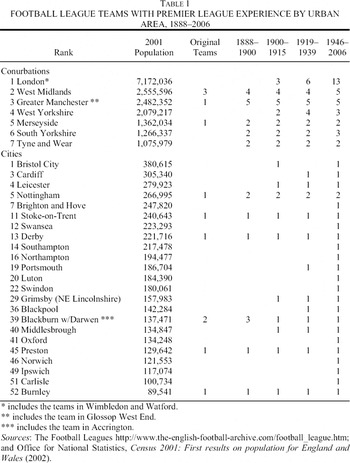
Table 1 lists, by size over time, British conurbations and cities with teams in the Premier League. The number of teams in the original Football League and the number of teams today give an indication of league growth, with the last four columns indicating when it occurred. All conurbations plus the city of Nottingham have multiple teams with Premier League experience, and other Football League teams in and around nearly all of those places are yet to be promoted that far. The pattern is extremely varied in comparison with North America. A conurbation with over 7 million people hosts 13 past and present Premier League teams, but a town with a population of less than 90,000 also supports one.61
Green Bay, Wisconsin, with a 2000 population of 226,778, is by far the least populous North American metropolitan area with a major professional sports team; the next smallest is Edmonton, Alberta, whose population of 937,845 approaches that of Tyne and Wear, the smallest of the seven English conurbations.
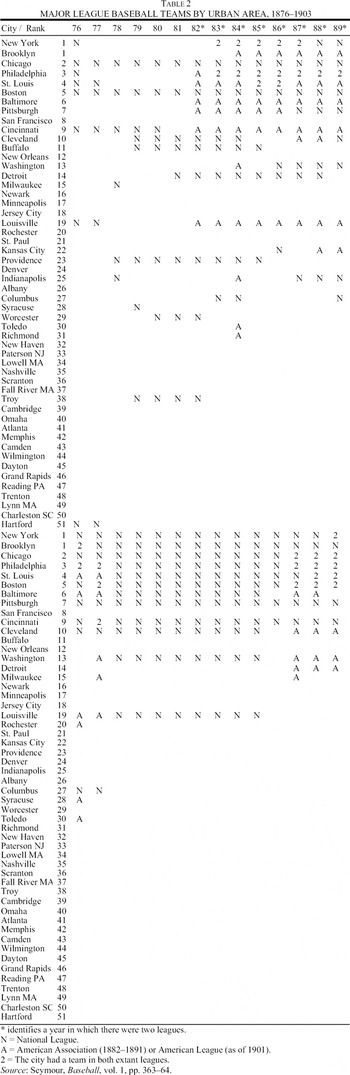
Beginning with the National League's founding and ending with the 1903 Major League Agreement, Table 2 shows, on a year-by-year basis, all teams playing in the National League (denoted by N), the American Association (from 1882 through 1891, denoted by A), the American League (as of 1901, also denoted by A), or that a city had a team in both extant leagues (denoted by 2). Urban areas have been ranked by the 1890 Census; Brooklyn is ranked with New York City throughout these years. Three noteworthy features are no city with more than two teams until 1903 when the American League placed a team in New York City (see note 24); headlong abandonment of small cities, both features in sharp contrast with English football; and league saturation of the largest markets, comparable to the Football League's expansion north to Tyne and Wear, east to Yorkshire, and south to London.
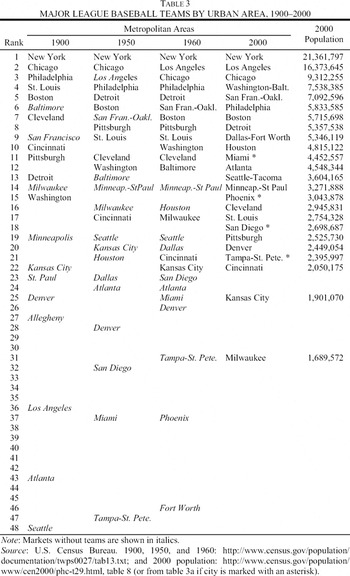
In Table 3, today's major league cities are ranked at the four census years that correspond as nearly as possible with the Major League Agreement (1900 Census data paired with teams in 1903), the beginning of relocation (1950 paired with 1953), the beginning of expansion (1960 paired with 1961), and today (2000 paired with the present).62
Because several cities that now have major league teams were much smaller in 1900, a few relevant cities are omitted from the table's earlier years.
At each date, markets without teams at that time are in italics. The process of transfer and expansion that led to teams in an increasing number of major markets is evident. Milwaukee, the smallest market with a team now in Major League Baseball, is nearly 19 times the size of Burnley, the smallest city that has had a team in the Premier League.
63 Milwaukee has had a team in the American or National League during 51 of the 130 seasons (39 percent) since the National League began play, and has been home to one World Series Champion (1957); Burnley has had a Premier League team during 51 of the 107 seasons (48 percent) of competition since the Football League was founded, and has been home to two champions (1921 and 1960).
By 1903 teams were in nearly every major market of the northeast quadrant of the United States, but nowhere else. Only three unoccupied markets with populations that exceeded the smallest major league city's would have been available to an entrant in the same region—Baltimore, Milwaukee, and Buffalo (the eighth most populous in 1900 and a perennial bridesmaid in baseball). Before air travel became possible, San Francisco and New Orleans (the twelfth most populous) were too distant to be included. In sum, at the time of the Major League Agreement 16 teams played in ten cities, with the smallest ranked fifteenth (see
Figure 1). Those teams remained in precisely the same cities for half a century, but by then the smallest market—Cincinnati—ranked seventeenth, and seven larger ones around the nation had no major league team. Though still tedious, air travel was rapidly improving. Soon the entire nation would comprise a single market for professional baseball. Major League Baseball formulated a plan to meet the coming threat—transfer “surplus” teams from multiteam markets to large cities that had none. In successive years beginning in 1953, one of the two teams in Boston, St. Louis, and Philadelphia moved to Milwaukee, Baltimore, and Kansas City, three sizable cities without major league teams.
For a few years the West Coast remained unworkably distant, but that need not have stymied a major league caliber entrant that confined itself to the region, as the existing leagues continued to confine themselves to the continent's opposite side. The minor Pacific Coast League (PCL) appeared to be on the verge of becoming a third major league, relying solely on the region's population and wealth. The PCL had four teams playing in urban areas that ranked among the nation's seven largest by 1950 and one more ranked nineteenth.64
The PCL had two teams in Los Angeles and one each in San Francisco, Oakland, Seattle, Portland, San Diego, and Sacramento, in order of their 1950 populations. Counting Anaheim with Los Angeles (as the Los Angeles CSA does), five of those cities now house six relocated or expansion major league teams.
Moreover, all of those markets were growing rapidly, as
Table 3 illustrates.
The PCL moved too slowly, being preempted by the 1958 transfer of two of the three New York City franchises to the two largest West Coast markets once long-distance air travel emerged. During the 1950s the smallest major league market had fallen to twenty-second, and air travel between New York and Los Angeles became more convenient than travel by rail between New York City and Chicago had been in 1900.
In 1960, after Major League Baseball had reduced its supply of multi-team cities to Chicago, the insurgent Continental League announced it would place new teams into many of the unoccupied large markets as well as New York City. As a consequence, in 1961 the American and National Leagues initiated a process of expansion that created the first new teams to be admitted to the major leagues since 1901. Once again baseball preempted an upstart, this time by quickly placing expansion teams in three of the Continental League's most attractive intended markets.
By 2000 major league teams were in all of the nation's top 22 markets (and two smaller ones). Except where going head-to-head with the existing leagues, no entrant could have even one team in any market ranking higher than twenty-third. By contrast, at the founding of the American League, its three unopposed franchises were in the seventh, thirteenth, and fifteenth largest markets. During any season, only a few large U.S. markets remain on the outside, hat in hand, hoping wanly for team movement or expansion, almost begging to finance fancy new facilities.65
For instance, designed as a dual use (football/baseball) stadium, the Louisiana Superdome in New Orleans was completed at public expense 30 years ago. A football team immediately began to play there, but no Major League Baseball team has arrived.