Introduction
Motor abnormalities are often described in patients on treatment with antipsychotic medication. However, a wide range of neurological motor disturbances has been reported in patients with schizophrenia who have never been treated with antipsychotic drugs. Spontaneous movement disorders (SMDs) such as dyskinesia and parkinsonism occur spontaneously in antipsychotic-naive individuals with schizophrenia. Dyskinesia is characterized by involuntary choreoathetoid movements, most commonly of the tongue, mouth or limbs. Classic parkinsonian symptoms include rigidity, bradykinesia and tremor.
Throughout the pre-neuroleptic era numerous reports appeared in the literature of involuntary abnormal movements resembling current descriptions of both dyskinesias and parkinsonian motor signs observed in medicated patients (Kraepelin, Reference Kraepelin1919; Turner, Reference Turner1989; Fenton et al. Reference Fenton, Wyatt and McGlashan1994). In the post-neuroleptic era, information about SMDs in schizophrenia has been obtained from studies of chronically ill patients, mainly in developing countries, who were never exposed to antipsychotic medications (Owens et al. Reference Owens, Johnstone and Frith1982; McCreadie & Ohaeri, Reference McCreadie and Ohaeri1994; Hoffman et al. Reference Hoffman, Kadri, Fenn, Tilane, Green, Lakloumi, Bousaid, Bentounssi, Moussaoui and Casey1996; McCreadie et al. Reference McCreadie, Thara, Kamath, Padmavathy, Latha, Mathrubootham and Menon1996; Srinivasan et al. Reference Srinivasan, Thara, Padmavathi and McCreadie2001) and, to a lesser extent, from evaluations of first-episode drug-naive patients (Table 1). The majority of these studies confirmed that a proportion of abnormal movements, such as spontaneous dyskinesia and parkinsonism, are already evident in patients with schizophrenia before exposure to antipsychotic treatment. Therefore, many investigators proposed that idiopathic extrapyramidal disturbances may be intrinsic to the pathophysiology of schizophrenia and that antipsychotic medication might be acting by modifying the expression of disease-based motor dysfunctions (Yarden & DiScipio, Reference Yarden and DiScipio1971; Crow et al. Reference Crow, Cross, Johnstone, Owen, Owens and Waddington1982; Rogers, Reference Rogers1985). Thus, spontaneous abnormal movements may reflect specific alterations in subcortical dopamine neuronal activity, possibly due to basal ganglia dysregulation (Caligiuri et al. Reference Caligiuri, Lohr and Jeste1993).
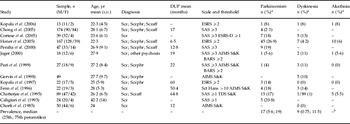
Studies included in this review, listed in reverse chronological order

M, Male; F, female; DUP, duration of untreated psychosis; Scz, schizophrenia; Sczphr, schizophreniform disorder; Sczaff: schizo-affective disorder; ESRS, Extrapyramidal Symptom Rating Scale (Chouinard et al. Reference Chouinard, Ross-Chouinard, Annable and Jones1980); SAS, Simpson–Angus Scale (SAS) for extrapyramidal side-effects (Simpson & Angus, Reference Simpson and Angus1970); Sct Hans, Sct Hans Rating Scale for Extrapyramidal Symptoms (Gerlach, Reference Gerlach, Korsgaard, Clemmesen, Lauersen, Magelund, Noring, Povlsen, Bech and Casey1993); BARS, Barnes Akathisia Rating Scale (Barnes, Reference Barnes1989); TDS, Tardive Dyskinesia Scale (Simpson et al. Reference Simpson, Lee, Zoubok and Gardos1979); AIMS, Abnormal Involuntary Movement Scale (Schooler & Kane, Reference Schooler and Kane1982); S&K, Schooler & Kane severity criteria for definite tardive dyskinesia: a score of 2 on at least two items or a score of ⩾3 on one item of the AIMS.
a Number and percentage of patients positive for the specific movement disorder in each study, according to the threshold used in that study.
b Median prevalence rates not reported because of the small number of studies available.
Over the past few years the observation that movement disorders might be a part of the clinical manifestation of schizophrenia has been more widely accepted. The discovery that, in the new era of antipsychotic drugs, psychosis treatment and movement disorders are not integrally related and the broadening awareness and recognition that basal ganglia structures, viewed as part of a larger system, may play an important role in the pathogenesis of psychotic symptoms have both contributed to this concept (Whitehorn & Kopala, Reference Whitehorn and Kopala2002; Friedman, Reference Friedman2004). Moreover, recent evidence indicates that a possibly dopamine-induced dysbalance of basal ganglia neurocircuits may be an important pathophysiological component linking movement disorders to psychosis (Bocti et al. Reference Bocti, Black, Waddington, Bédard, Agid, Chouinard, Fahn, Korczyn and Lesperance2003; Mehler-Wex et al. Reference Mehler-Wex, Riederer and Gerlach2006). In schizophrenia and movement disorders such as Parkinson's disease, cortical and subcortical motor organization is influenced by primary disease conditions. Basal ganglia and thalamic connections seem to have a key role in cortical and subcortical interaction. Thus, crucial changes in cortico-striato-thalamo-cortical networks are associated with dysfunctions in perception, attention, affective regulation, information processing and motor disturbances. The latter may, therefore, represent a clinical sign of the disconcerted cortical–subcortical connectivity that putatively underlies psychotic disorders. Consequently, neuromotor dysfunction and psychotic symptoms may be better understood as manifestations of related rather than distinct pathophysiological processes in schizophrenia.
A fundamental issue is whether these abnormal movements are already present at the time of first presentation of the illness or whether they develop over time, in relation to illness progression and/or ageing. Thus, an investigation of drug-naive patients in the early stages of the illness has the following potential advantages in comparison to studying already treated or drug-naive chronic patients: it can clarify whether SMDs are part of a neurodysfunction that underlies schizophrenia rather the consequence of a degenerative process; it can elucidate whether an SMD is simply an antipsychotic-induced epiphenomenon; and it can disentangle the ‘true’ estimates of medication-related extrapyramidal signs and symptoms (EPSS). To date, the literature documenting the presence of SMDs in antipsychotic-naive patients with first-episode psychosis has not been reviewed.
Method
We reviewed studies that reported on the prevalence and demographic and clinical correlates of spontaneous dyskinesia or parkinsonism in antipsychotic-naive patients at the time of their first presentation to psychiatric services with a psychotic episode. In considering patients with first-onset psychosis, it is important to note that some studies have included not only patients with schizophrenia but also those with other forms of psychosis. As assessments are frequently performed at the very early stages of psychotic presentation, this over-inclusiveness is unavoidable. Therefore, for the purpose of this review, we include studies that have evaluated first-episode psychosis as a whole. Thus, studies were considered for inclusion if they (1) included patients who were experiencing their first episode of psychosis, (2) included patients with no history of treatment with antipsychotic medication, and (3) specifically reported on the presence of spontaneous dyskinesia or parkinsonism. We performed a systematic literature search of the databases Medline, PsychLit and EMBASE for articles published between 1966 and May 2007 using the following terms: first-episode and spontaneous dyskinesia*; first-episode and spontaneous parkinsonism*; antipsychotic-naive and extrapyramidal signs*; spontaneous movement disorders and early psychosis*; EPSS and never-treated psychosis*. We also examined cross-references from the articles identified and contacted the authors directly when appropriate.
We identified 13 first-episode studies on SMDs that are summarized in Table 1. A variety of instruments have been used to evaluate abnormal movements and different threshold criteria for the case definition applied, making direct comparison and interpretation of findings sometimes difficult.
Results
The prevalence of SMDs among never-treated first-episode psychosis patients
Parkinsonism
Parkinsonism in patients treated with antipsychotics is generally attributed to the striatal dopamine antagonism activity of these medications. We identified 11 studies that evaluated spontaneous parkinsonism in first-episode psychosis patients never treated with antipsychotics (Table 1).
The studies that evaluated drug-naive patients with first-episode psychosis reported a prevalence of parkinsonian motor signs ranging from 2·3% (Chong et al. Reference Chong, Subramaniam and Verma2005) to 27% (Honer et al. Reference Honer, Kopala and Rabinowitz2005). Rigidity, bradykinesia and tremor were most often evaluated with either the Simpson–Angus Scale (SAS) for extrapyramidal side-effects (Simpson & Angus, Reference Simpson and Angus1970) or the Extrapyramidal Symptom Rating Scale (ESRS; Chouinard et al. Reference Chouinard, Ross-Chouinard, Annable and Jones1980). In the papers reviewed, the authors used a total SAS score ranging from 1 to 3 and a total ESRS score between 1 and 2 as threshold criteria for case definition. Some investigators intentionally used more lenient criteria than those often used for studies of neuroleptic-induced parkinsonism. This allowed them to identify even mild and subtle cases of extrapyramidal signs, on the grounds that, as the patients were otherwise physically healthy and in the early course of their illness, any basal ganglia pathology would be subtly manifested (Chatterjee et al. Reference Chatterjee, Chakos, Koreen, Geisler, Sheitman, Woerner, Kane, Alvir and Lieberman1995). Thus, variations in prevalence estimates reported across studies are likely to be the result of differences in patient population, definitions of parkinsonism and operational criteria. We should, of course, take into consideration that the prevalence rates of movement disorders might genuinely differ by ethnicity or genetic background. For example, some studies reported that African Americans had lower rates of parkinsonism and a higher risk of developing tardive dyskinesia than Caucasians, whereas Asians seem to have a lower or equal risk of developing tardive dyskinesia as compared with Caucasians (Eastham et al. Reference Eastham, Lacro and Jeste1996). However, the literature on SMDs to date is limited to either support or discard the above notion.
From the studies reviewed, the median prevalence rate of parkinsonism is 17%; thus, approximately one-sixth of antipsychotic-naive patients presenting with a psychotic disorder showed some parkinsonian motor signs. This proportion is similar to that reported for chronically ill drug-naive patients with schizophrenia, although few studies have addressed the subject, making reliable comparisons difficult. McCreadie et al. (Reference McCreadie, Srinivasan, Padmavati and Thara2005), presenting data from a sample of 143 mixed first-episode and chronic patients, reported that parkinsonism was present in 15%. By contrast, Venkatasubramanian et al. (Reference Venkatasubramanian, Latha, Gangadhar, Janakiramaiah, Subbakrishna, Jayakumar and Keshavan2003) failed to detect any parkinsonian signs in a sample of 25 never-treated chronic patients. The above rates seem to be at the lower end of the range of parkinsonism identified in patients treated with antipsychotics. In fact, prevalence figures for drug-related parkinsonism in patients on conventional antipsychotic medications range from 15% to 30%; thus, between one-fifth and one-third of patients exposed to typical antipsychotics have a clinically significant parkinsonian syndrome (Owens, Reference Owens1999). In first-episode psychosis studies, drug-induced parkinsonism is present in approximately 35% of patients (Chakos et al. Reference Chakos, Mayerhoff, Loebel, Alvir and Lieberman1992; Caligiuri & Lohr, Reference Caligiuri and Lohr1997). However, these rates seem to be lower in patients treated with atypical antipsychotic drugs (Stahl, Reference Stahl2000; Hunter et al. Reference Hunter, Joy, Kennedy, Gilbody and Song2003).
Several studies have reported on the presence of specific EPSS in never-treated patients with first-episode psychosis. Muscle rigidity is reported as the most common parkinsonian sign in drug-naive patients. Rigidity and bradykinesia, often referred together as akinetic type, are reported much more frequently than non-akinetic type signs such as tremor, glabellar tap, and salivation in antipsychotic-naive first-episode patients (Caligiuri et al. Reference Caligiuri, Lohr and Jeste1993; Chatterjee et al. Reference Chatterjee, Chakos, Koreen, Geisler, Sheitman, Woerner, Kane, Alvir and Lieberman1995; Fenn et al. Reference Fenn, Moussaoui, Hoffman, Kadri, Bentounssi, Tilane, Khomeis and Casey1996; Kopala et al. Reference Kopala, Good and Honer1997; Peralta et al. Reference Peralta, Cuesta, Martinez-Larrea and Serrano2000; Honer et al. Reference Honer, Kopala and Rabinowitz2005). This would suggest that akinetic signs represent an important extrapyramidal dysfunction associated with schizophrenia. Moreover, evidence that non-akinetic parkinsonism becomes more severe following treatment with antipsychotics than the akinetic type suggests that the former is primarily a drug-induced phenomenon (Peralta et al. Reference Peralta, Cuesta, Martinez-Larrea and Serrano2000; Honer et al. Reference Honer, Kopala and Rabinowitz2005).
Only two studies to date have investigated extrapyramidal motor system asymmetries in neuroleptic-naive schizophrenic patients (Caligiuri et al. Reference Caligiuri, Lohr and Jeste1993; Kopala et al. Reference Kopala, Good and Honer1997). Both studies reported that patients with parkinsonism showed greater right- than left-side abnormalities, supporting previous evidence of primary asymmetries involving the basal ganglia in schizophrenia. The results are consistent with studies demonstrating greater right-side parkinsonism secondary to antipsychotic treatment (Tomer et al. Reference Tomer, Mintz, Kempler and Sigal1987; Caligiuri et al. Reference Caligiuri, Bracha and Lohr1989).
Some investigators suggest that the lack of objectivity and sensitivity of clinical ratings could be overridden by the use of automated measures of EPSS. Indeed, studies that have used electromechanical measurements have reported a higher prevalence of instrumental measures of parkinsonian signs than studies using qualitative clinical, observer-based ratings (Caligiuri et al. Reference Caligiuri, Lohr and Jeste1993; Cortese et al. Reference Cortese, Caligiuri, Malla, Manchanda, Takhar and Haricharan2005). For example, in the study of Caligiuri et al. (Reference Caligiuri, Lohr and Jeste1993), parkinsonian tremor seemed to be subclinical and was evident only with laboratory procedures of force steadiness. The authors noted that instrumental measures of EPSS are less vulnerable to examiner bias, are linearly related to severity, and are more sensitive than observer-based ratings in quantifying subclinical motor dysfunction and asymmetries.
Nonetheless, spontaneous parkinsonian motor signs, particularly rigidity and bradykinesia, are already present in patients at very early stages of the illness. It has been postulated that adaptive brain changes may contribute to the development of parkinsonism as part of an autogenic, compensatory response to a mesolimbic hyperdopaminergic state (Csernansky et al. Reference Csernansky, Murphy and Faustman1991). Furthermore, this underlying neurodysfunction, possibly due to basal ganglia dysregulation, could, at least in part, explain why some patients are more prone to the subsequent emergence of antipsychotic-induced EPSS.
Spontaneous dyskinesia
Far more attention has been paid to the controversy that surrounds the frequency and phenomenology of spontaneous, and tardive, dyskinesia in schizophrenia than to the presence of spontaneous parkinsonism. Several studies have investigated the presence of abnormal involuntary dyskinetic movements in never-treated patients with chronic schizophrenia. By contrast, only a few report data on first-episode patients.
Of the first-episode studies reviewed here, only 10 have reported data on dyskinesia (Table 1). Abnormal movements were mainly assessed with the application of the Abnormal Involuntary Movement Scale (AIMS; Schooler & Kane, Reference Schooler and Kane1982) using the operational criteria of Schooler & Kane for a diagnosis of dyskinesia; hence, dyskinesia is defined as present when there are mild movements in at least two areas, or moderate movements in at least one area. Other scales used include the ESRS (Chouinard et al. Reference Chouinard, Ross-Chouinard, Annable and Jones1980) and the Tardive Dyskinesia Scale (TDS; Simpson et al. Reference Simpson, Lee, Zoubok and Gardos1979).
According to the studies reviewed, the median dyskinesia prevalence rate for antipsychotic-naive patients with first-episode psychosis is 9%. Reported figures ranged from 0% (Chorfi & Moussaoui, Reference Chorfi and Moussaoui1985) to 14% (Fenn et al. Reference Fenn, Moussaoui, Hoffman, Kadri, Bentounssi, Tilane, Khomeis and Casey1996), including two negative studies (Chorfi & Moussaoui, Reference Chorfi and Moussaoui1985; Kopala et al. Reference Kopala, Good and Honer1997). The variation could be attributed to differences in sample sizes and/or to the use of different scales and thresholds for caseness in the measurement. However, the studies with lower rates do not seem to differ systematically in methodology from the studies reporting higher rates. For example, two studies that included approximately the same number of subjects used the same clinical instrument and indeed the same operational criteria, and still reported different frequencies of 0% and 10% (Chorfi & Moussaoui, Reference Chorfi and Moussaoui1985; Gervin et al. Reference Gervin, Browne, Lane, Clarke, Waddington, Larkin and O'Callaghan1998).
The rate of spontaneous dyskinesia for chronically ill patients with schizophrenia has been reported to range even more widely, with the majority of studies suggesting elevated rates. Hence, previous reviews of studies that assessed the prevalence of spontaneous dyskinesia in individuals with chronic schizophrenia have reported different values: 4% (Casey, Reference Casey1985), 5·8% (Baldessarini, Reference Baldessarini1988), 12% (Torrey, Reference Torrey2002), and 4–40% (age-adjusted rates) (Fenton, Reference Fenton2000). However, three studies found no evidence of an elevated rate of spontaneous dyskinesia in antipsychotic-naive chronic patients with schizophrenia (Hernan Silva et al. Reference Hernan Silva, Jerez, Ruiz, Seguel, Court and Labarca1994; McCreadie & Ohaeri, Reference McCreadie and Ohaeri1994; Venkatasubramanian et al. Reference Venkatasubramanian, Latha, Gangadhar, Janakiramaiah, Subbakrishna, Jayakumar and Keshavan2003). Here again, the negative studies do not differ systematically in methodology from the positive studies, except for a tendency of the negative studies to evaluate younger and less chronic patients. The wide prevalence range in chronic patients could reflect variability in the mean age of the patients evaluated. Indeed, spontaneous dyskinesia is known to increase with age (Fenton, Reference Fenton2000). For example, studies have reported a spontaneous dyskinesia prevalence rate of 1–5% for healthy elderly subjects (Klawans & Barr, Reference Klawans and Barr1982; Kane et al. Reference Kane, Weinhold, Kinon, Wegner and Leader1982), 18–32% for geriatric antipsychotic-naive medical patients in nursing homes (Bourgeois et al. 1980a,b; Blowers et al. Reference Blowers, Borison, Blowers and Bicknell1981), and 38–100% for elderly drug-naive patients with chronic schizophrenia (Owens et al. Reference Owens, Johnstone and Frith1982; McCreadie et al. Reference McCreadie, Thara, Kamath, Padmavathy, Latha, Mathrubootham and Menon1996; Waddington & Youssef, Reference Waddington and Youssef1990). It is possible that an increase in the rates of spontaneous dyskinesia with age reflects an extrapyramidal neurodegenerative process in relation to ageing and organic and psychotic illness progression.
The prevalence rate of tardive dyskinesia in individuals with schizophrenia who have been treated with traditional antipsychotic medications has been estimated to be 15–20% (Kane & Smith, Reference Kane and Smith1982; Gerlach & Casey, Reference Gerlach and Casey1988). The prevalence and severity of tardive dyskinesia are also related to the time of exposure to antipsychotics. In fact, the incidence of tardive dyskinesia is about 5% per year of exposure to conventional antipsychotic medications (Kane et al. Reference Kane, Woerner and Lieberman1988). Data from a 4-year follow-up study of first-episode schizophrenia patients showed a cumulative incidence for tardive dyskinesia of 4·8% at 1 year, and 15·6% at 4 years (Chakos et al. Reference Chakos, Alvir, Woerner, Koreen, Geisler, Mayerhoff, Sobel, Kane, Borenstein and Lieberman1996). However, the incidence and prevalence of tardive dyskinesia seem to have fallen with the use of second-generation atypical antipsychotics (Kane, Reference Kane2004; Correll et al. Reference Correll, Leucht and Kane2004). Three recent, long-term studies of atypical antipsychotics in first-episode psychosis suggest that these antipsychotic drugs possibly produce less extrapyramidal side-effects and tardive dyskinesia (Green et al. Reference Green, Lieberman, Hamer, Glick, Gur, Kahn, McEvoy, Perkins, Rothschild, Sharma, Tohen, Woolson and Zipursky2006; Kopala et al. Reference Kopala, Good, Milliken, Buiteman, Woodley, Rui, Whitehorn, Love, Balshaw, Kiss and Honer2006; Schooler et al. Reference Schooler, Rabinowitz, Davidson, Emsley, Harvey, Kopala, McGorry, Van Hove, Eerdekens, Swyzen and De Smedt2006).
The presence of dyskinesia in patients with schizophrenia constitutes a complex and heterogeneous phenomenon. Thus, some abnormal choreoathetoid movements seem to be intrinsic to the pathogenesis of the illness, occurring spontaneously even at the early stages of the psychotic process. It has been suggested that the presence of such spontaneous abnormal movements is associated with primary alterations in subcortical dopamine neuronal activity, although their aetiopathogenesis remains poorly understood. Medication, ageing and neurodegeneration can further contribute to their emergence or modify their expression.
Akathisia and dystonia
Most studies on antipsychotic-naive patients with psychotic illness have not specifically investigated the presence or correlates of akathisia or dystonia. A few have provided a summary index of the observed rates alongside their main findings on spontaneous dyskinesia or parkinsonism. Scales used for the assessment include the ESRS (Chouinard et al. Reference Chouinard, Ross-Chouinard, Annable and Jones1980) and the Barnes Akathisia Rating Scale (BARS; Barnes, Reference Barnes1989). Only six studies have investigated the presence of akathisia in first-episode antipsychotic-naive patients (Table 1). Of these, two studies failed to find any sign of akathisia (Kopala et al. Reference Kopala, Good and Honer1997; Puri et al. Reference Puri, Barnes, Chapman, Hutton and Joyce1999), whereas the remaining four studies reported prevalence figures ranging between 5·5% (Chatterjee et al. Reference Chatterjee, Chakos, Koreen, Geisler, Sheitman, Woerner, Kane, Alvir and Lieberman1995) and 8% (Kopala et al. Reference Kopala, Good, Milliken, Buiteman, Woodley, Rui, Whitehorn, Love, Balshaw, Kiss and Honer2006). Again, these findings should be interpreted with caution. The ESRS, which was used by the majority of the studies reviewed, contains only one item to assess akathisia, in contrast to the more comprehensive BARS, which was designed specifically for this purpose. Dystonia was evaluated in only two first-episode studies (Table 1). The first one reported a low rate of dystonia (2·4%; Honer et al. Reference Honer, Kopala and Rabinowitz2005) and the second was negative (Kopala et al. Reference Kopala, Good, Milliken, Buiteman, Woodley, Rui, Whitehorn, Love, Balshaw, Kiss and Honer2006). To our knowledge, there are no studies evaluating akathisia or dystonia rates in chronically ill, never-treated patients with schizophrenia. Consequently, the evidence supporting the occurrence or absence of both akathisia and dystonia in psychotic patients never exposed to antipsychotic medication is, at present, weak and inconclusive.
Follow-up studies of never-treated patients with first-episode psychosis
Follow-up studies provide the potential to address the following important questions: (1) Is the presence of pretreatment EPSS related to an increased risk of subsequent drug-related parkinsonism and/or dyskinesia? (2) What is the impact of different types of medication, that is typical versus atypical antipsychotics, on pre-existing EPSS? (3) Is the occurrence of spontaneous EPSS affecting illness outcome?
Follow-up studies of patients who were naive at first presentation, and who were reassessed following treatment with antipsychotic, showed no significant differences in the frequency of dyskinesia before and after commencing antipsychotic treatment (Chatterjee et al. Reference Chatterjee, Chakos, Koreen, Geisler, Sheitman, Woerner, Kane, Alvir and Lieberman1995; Kopala et al. Reference Kopala, Good and Honer1997; Jager, Reference Jager2000; Peralta et al. Reference Peralta, Cuesta, Martinez-Larrea and Serrano2000; Cortese et al. Reference Cortese, Caligiuri, Malla, Manchanda, Takhar and Haricharan2005). However, it should be noted that the follow-up duration of these studies was on average short (3 weeks to 6 months) and a wide variety of antipsychotics were prescribed. Some authors have previously reported a relationship between the appearance of drug-induced EPSS and the subsequent development of persistent tardive dyskinesia (Crane, Reference Crane1978; Tenback et al. Reference Tenback, Van Harten, Slooff and Van Os2006). It is possible that the follow-up periods of the above studies were too short for tardive dyskinesia to develop in patients at increased risk.
Of interest, patients with SMDs in the study by Chatterjee et al. (Reference Chatterjee, Chakos, Koreen, Geisler, Sheitman, Woerner, Kane, Alvir and Lieberman1995) were more likely to develop parkinsonism within the first 8 weeks of antipsychotic treatment. Similarly, Caligiuri & Lohr (Reference Caligiuri and Lohr1997) found that pre-existing extrapyramidal motor signs, especially rigidity, were risk factors for the development of antipsychotic-induced EPSS in a mixed sample of first-episode and chronically ill patients with schizophrenia. The reason for this is unclear, but the authors hypothesized that because the presence of spontaneous EPSS indicates some degree of nigrostratial compromise, these patients may be especially vulnerable to parkinsonian side-effects of treatment. It is of note that in the study of Chatterjee et al. (Reference Chatterjee, Chakos, Koreen, Geisler, Sheitman, Woerner, Kane, Alvir and Lieberman1995), patients with SMDs were more severely ill and less responsive to treatment with typical antipsychotics than patients without pretreatment extrapyramidal signs. The two groups were similar with respect to the mean doses of antipsychotic medication they received. According to the investigators, the presence of SMDs seems to have prognostic significance, being linked with a poorer outcome and with a longer time to remission. By contrast, in the study by Chakos et al. (Reference Chakos, Alvir, Woerner, Koreen, Geisler, Mayerhoff, Sobel, Kane, Borenstein and Lieberman1996), treatment-related EPSS were associated with greater baseline psychopathology but with superior symptom response in first-episode patients treated with typical antipsychotics. Symptomatic response to atypical antipsychotics seemed to be unrelated to the presence of pretreatment extrapyramidal disorder (Kopala et al. Reference Kopala, Good and Honer1997; Peralta et al. Reference Peralta, Cuesta, Martinez-Larrea and Serrano2000). Of particular clinical relevance was the finding that treatment with risperidone resulted in a reduction of pre-existing EPSS (Kopala et al. Reference Kopala, Good and Honer1997). Although this report comes from a single study, it would suggest that careful examination of pretreatment movement disorders might be advisable. This would help to establish a baseline severity and avoid possible misattribution to subsequent medication. Furthermore, it would help to establish whether atypical antipsychotics ameliorate existing spontaneous abnormal movements.
In conclusion, the predictive value of motor examination before antipsychotic treatment in identifying patients at risk for later development of acute EPSS remains unclear, and the question of whether pretreatment extrapyramidal side-effects are associated with better or worse treatment outcome awaits further study.
SMDs, demographic characteristics and clinical correlates
The evaluation of the relationship between motor dysfunction and clinical or demographic characteristics of schizophrenia may contribute to the understanding of the biological underpinnings of this dysfunction. The studies of patients with first-episode psychosis reviewed did not identify any relationship between the presence of SMDs and age. This finding is not surprising in these populations of relatively young and age-homogeneous patients. Similarly, there was no correlation between the presence of SMDs and gender, age at onset, and duration of untreated illness.
As mentioned earlier, spontaneous dyskinesia rates seem to increase with age in studies of chronically ill patients with schizophrenia, although some studies failed to replicate these findings. For example, a large study of never-treated patients with schizophrenia of all age groups did not find a significant change in the rates of spontaneous dyskinesia or parkinsonism in association with age, gender, duration of illness or age at onset of psychosis (McCreadie et al. Reference McCreadie, Srinivasan, Padmavati and Thara2005). Increasing age, female gender and young age at illness onset have been reported as predisposing factors for tardive dyskinesia (Kane & Smith, Reference Kane and Smith1982; Waddington & Youssef, Reference Waddington and Youssef1985) and drug-induced parkinsonism (Sandyk & Kay, 1991a; Montastruc et al. Reference Montastruc, Llau, Rascol and Senard1994), although this also has not always been confirmed. The presence of drug-induced EPSS and neurological soft signs, which are minor neurological abnormalities in motor and sensory performance often described in patients with schizophrenia, may also be predictive of tardive dyskinesia (Emsley et al. Reference Emsley, Turner, Oosthuizen and Carr2005). Nonetheless, the association between increasing age and spontaneous involuntary movements is perhaps the most robust finding across studies in samples including subjects of different ages, and merits consideration as a potential confounding factor when comparing rates among study groups or examining clinical correlates.
Several first-episode studies have investigated whether SMDs are associated with a specific symptom profile or dimension of schizophrenia. Cortese et al. (Reference Cortese, Caligiuri, Malla, Manchanda, Takhar and Haricharan2005) showed a positive association between spontaneous dyskinesia and positive symptoms, and also between spontaneous parkinsonism and multiple dimensions of psychopathology, including disorganization, positive and negative symptoms. An association between negative symptoms and spontaneous parkinsonism has been reported in the majority of first-episode studies that have addressed the issue. One study indicated a significant correlation between severity of negative symptoms and severity of akinetic parkinsonism (Peralta et al. Reference Peralta, Cuesta, Martinez-Larrea and Serrano2000). Four additional studies reported that patients with extrapyramidal disorders at illness onset had higher mean negative symptoms (Chatterjee et al. Reference Chatterjee, Chakos, Koreen, Geisler, Sheitman, Woerner, Kane, Alvir and Lieberman1995; Fenn et al. Reference Fenn, Moussaoui, Hoffman, Kadri, Bentounssi, Tilane, Khomeis and Casey1996; Kopala et al. Reference Kopala, Good and Honer1997; Honer et al. Reference Honer, Kopala and Rabinowitz2005). Only one first-episode study failed to confirm the above correlation between parkinsonism and psychopathology. The authors speculated that the lack of any significant relationship between extrapyramidal motor scores (clinical or instrumental) and severity of negative symptoms might have been due to the insensitivity of the instrument used to measure psychopathology (Caligiuri et al. Reference Caligiuri, Lohr and Jeste1993).
The association between negative symptoms and spontaneous parkinsonism might reflect either overlapping definitions among constructs or shared pathological mechanisms. Phenomenological similarities between certain negative symptoms (affective flattening, alogia) and certain parkinsonian symptoms (akinesia) may explain their association (Brown & White, Reference Brown and White1992; Peralta & Cuesta, Reference Peralta and Cuesta1999). Alternatively, parkinsonian signs in schizophrenia may reflect frontostriatal hypodopaminergia intrinsic to the illness (Caligiuri et al. Reference Caligiuri, Lohr and Jeste1993).
Previous studies on unmedicated patients at different stages of their illness have also investigated the relationship between SMDs and psychopathology, with inconsistent results. Some studies found a positive correlation between spontaneous dyskinesia and negative symptoms (Fenton et al. Reference Fenton, Wyatt and McGlashan1994; McCreadie et al. Reference McCreadie, Latha, Thara, Padmavathi and Ayankaran1997) whereas others failed to reveal any relationship between SMDs and psychopathology in chronic patients with schizophrenia (McCreadie et al. Reference McCreadie, Srinivasan, Padmavati and Thara2005). In medicated patients, tardive dyskinesia has been associated with both positive (Sandyk & Kay, 1991b; White et al. Reference White, Brown and Woods1991) and negative symptoms (Waddington et al. Reference Waddington, Youssef, Dolphin and Kinsella1987). Drug-induced parkinsonism has been mainly associated with negative symptoms and described as a ‘negative movement disorder’ (Sandyk & Kay, Reference Sandyk and Kay1992).
Finally, possible associations have been reported between SMDs and impaired pre-morbid functioning (Honer et al. Reference Honer, Kopala and Rabinowitz2005) and poorer outcome (Chatterjee et al. Reference Chatterjee, Chakos, Koreen, Geisler, Sheitman, Woerner, Kane, Alvir and Lieberman1995), as well as between spontaneous dyskinesia and lower educational achievement (Gervin et al. Reference Gervin, Browne, Lane, Clarke, Waddington, Larkin and O'Callaghan1998) in first-episode patients. Fenton et al. (Reference Fenton, Wyatt and McGlashan1994) reported an association between spontaneous dyskinesia and both a more severe course and a lower IQ among never-treated chronically ill patients with schizophrenia. Of potential relevance, poor childhood performance predisposed to developing tardive dyskinesia in first-episode patients following exposure to typical antipsychotics (Chakos et al. Reference Chakos, Alvir, Woerner, Koreen, Geisler, Mayerhoff, Sobel, Kane, Borenstein and Lieberman1996). Nevertheless, there is an extensive literature supporting an association between tardive dyskinesia and cognitive dysfunction (Waddington et al. Reference Waddington, O'Callaghan, Larkin and Kinsella1993).
The association between SMDs, cognitive dysfunction and negative symptoms indicates that this triad, also known as the ‘deficit syndrome’, may have a common pathophysiology, and is possibly related to a poorer outcome (Crow, Reference Crow1985).
Discussion
The studies reviewed confirm that dyskinesia and parkinsonism are already evident in antipsychotic-naive patients suffering their first episode of schizophrenia or psychosis. These findings give support to the hypothesis that SMDs represent a neuromotor component of schizophrenia.
Unfortunately, the structural and functional neurobiological basis of SMDs in schizophrenia remains poorly understood. It has been suggested that the presence of spontaneous movements reflects regionally specific alterations in subcortical dopamine neuronal activity. Thus, schizophrenia in some patients may be associated with striatal dopamine hypoactivity independently from, or as a compensatory mechanism for, increased mesolimbic dopamine transmission (Caligiuri et al. Reference Caligiuri, Lohr and Jeste1993). Evidence for the coexistence of motor disorders and functional and neurocognitive deficits in schizophrenia suggest that the neurobiological mechanisms involved in these deficits are more complex than simple hypo- or hyperdopaminergia (Graybiel, Reference Graybiel1997; Andreasen et al. Reference Andreasen, Nopoulos, O'Leary, Miller, Wassink and Flaum1999). In this respect, neuromotor dysfunction in schizophrenia may involve multiple frontal–subcortical brain pathways responsible not only for motor but also for emotional, cognitive and affective behaviour (Andreasen et al. Reference Andreasen, Paradiso and O'Leary1998). At the subcortical level, the basal ganglia have been implicated in the pathogenesis of schizophrenia, and have been suggested to play a crucial role in the origin of the motor dysfunction observed in this disorder. In fact, the basal ganglia constitute an essential integrative forebrain system that collects signals from the entire cerebral cortex (sensory, motor, association and limbic areas), redistributes these signals with respect to one another, and sends their outputs back to the frontal lobes and brainstem, through the thalamus. They include five subcortical nuclei: the caudate and putamen (which together form the striatum), the globus pallidus, the subthalamic nucleus and the substantia nigra. There are both parallel and integrative networks in corticobasal ganglia pathways, maintained and modulated through trans-thalamic circuits (Draganski et al. Reference Draganski, Kherif, Klöppel, Cook, Alexander, Parker, Deichmann, Ashburner and Frackowiak2008). The caudate is thought to play a role in cognitive function, the ventral striatum is involved in reward and reinforcement, and the putamen is known to be responsible for motor control. Symptom distribution in various neurological and psychiatric conditions and also in neuropsychological models and neuropathological data are primarily supportive of this model (Utter & Basso, Reference Utter and Basso2008). The perturbed connectivity between these structures and the cortex, which putatively underlies psychotic disorders, could be the substrate for motor disorders. This notion finds further support in recent neuropsychiatric imaging data. Studies on antipsychotic-naive patients and subjects at high risk have shown a reduced size of basal ganglia structures as compared to healthy controls (Keshavan et al. Reference Keshavan, Rosenberg, Sweeney and Pettegrew1998; Lawrie et al. Reference Lawrie, Byrne, Miller, Hodges, Clafferty, Cunningham Owens and Johnstone2001). Furthermore, higher rates of neurological abnormalities, including motor signs, have been associated with a reduction of basal ganglia volumes in first-episode psychosis patients (Keshavan et al. Reference Keshavan, Sanders, Sweeney, Diwadkar, Goldstein, Pettegrew and Schooler2003; Dazzan et al. Reference Dazzan, Morgan, Orr, Hutchinson, Chitnis, Suckling, Fearon, Salvo, McGuire, Mallett, Jones, Leff and Murray2004), and with a reduction of specific frontal and temporal cortical areas in both healthy and psychotic subjects (Dazzan et al. Reference Dazzan, Morgan, Chitnis, Suckling, Morgan, Fearon, McGuire, Jones, Leff and Murray2006). Schröder et al. (Reference Schröder, Niethammer, Geider, Reitz, Binkert, Jauss and Sauer1991) reported a similar association between motor coordination and reduced basal ganglia and thalamus volume in patients with schizophrenia. In a functional magnetic resonance imaging (fMRI) fingertapping study, significant activation was found in cortical and subcortical motor areas such as the pre-motor cortex and putamen in both patients with schizophrenia and parkinsonism (Müller et al. Reference Müller, Deuticke, Putzhammer, Röder, Hajak and Winkler2003). Two studies also reported a motor-induced overactivation of the pre-motor cortex using single photon emission computed tomography (SPECT) in untreated patients with schizophrenia (Gur et al. Reference Gur, Gur, Skolnick, Caroff, Obrist, Resnick and Reivich1985; Günther et al. Reference Günther, Petsch, Steinberg, Moser, Streck, Heller, Kurtz and Hippius1991). In another fMRI study, patients with schizophrenia showed alterations in the activation patterns of basal ganglia and the thalamus during a motor sequencing task relative to healthy controls (Menon et al. Reference Menon, Anagnoson, Glover and Pfefferbaum2001). Of interest, antipsychotic agents have been shown to modulate the activity of basal ganglia and/or their associated neuronal networks. In a positron emission tomography (PET) study in patients with first-episode schizophrenia, the observed primary overactivation of the cortico-striato-thalamic-cortical loop was reduced under treatment with risperidone (Liddle et al. Reference Liddle, Lane and Ngan2000). Furthermore, antipsychotic drugs have been found to reduce basal ganglia activity and enhance thalamus activity (Liddle et al. Reference Liddle, Lane and Ngan2000). These data would suggest that antipsychotic treatment may in fact interact with an underlying disease-mediated process to bring about and accentuate the simple and complex motor abnormalities observed in schizophrenia.
In contrast with prevailing clinical practice, not all abnormal movements should be explained away as a consequence of antipsychotic use, and a baseline examination of SMDs, conducted before antipsychotic treatment administration, can be informative. Future first-episode, longitudinal, follow-up studies, assessing patients before and after antipsychotic treatment may be able to determine what proportion of movement disorders in patients with schizophrenia is intrinsic to schizophrenia, iatrogenic, or the result of an interaction between the two. Indeed, there is preliminary evidence that pre-existing abnormal movements increase the risk of subsequent EPSS. Therefore, early treatment of schizophrenia may provide an opportunity to prevent the development of the component of abnormal movements attributable to the disease process itself. Furthermore, first-episode studies support an association between motor abnormalities and negative symptoms, cognitive dysfunction, poor outcome and possibly positive family history. SMDs may therefore be trait characteristics of either a distinct ‘motor’ type of schizophrenia (similar to the parakinetic schizophrenia described in the past) or part of a more severe form of the illness.
The findings reviewed support the notion that the SMDs observed in first-episode patients are part of a neurodysfunction related to the pathogenesis underlying the illness, rather than the consequences of neurodegenerative processes. Future studies should attempt to provide a greater insight into the role of basal ganglia structures and extrapyramidal pathways in the pathophysiology of schizophrenia.
Declaration of Interest
None