On August 29, 2005, New Orleans was hit by Hurricane Katrina, the costliest natural disaster in the history of the United States. Eventually 80% of the city became flooded, along with large tracts of neighboring parishes. Around 1 million people are estimated to have evacuated after the storm. At least 1836 people (1577 in Louisiana) lost their lives in the devastation caused by the hurricane along the Gulf Coast and in the southeastern United States.Reference Beven, Avila and Blake1
Previous studies have shown an increase in acute coronary syndromes in the immediate hours to weeks after natural disasters.Reference Bhattacharyya and Steptoe2 Research also indicates that a natural disaster can lead to adverse effects on glycemic control and quality of life among diabetics, increased risk of hypertension, coronary heart disease, and other chronic conditions.Reference Ford, Mokdad and Link3 There is no literature on the long-term cardiovascular morbidities following a large-scale natural or unnatural disaster, however.
Tulane University Health Sciences Center (TUHSC) hospital is a 235-bed primary percutaneous coronary intervention (PCI) center established in 1976 in downtown New Orleans. Tulane's hospital was located at the heart of the Katrina-affected area. Hurricane Katrina offered us a unique opportunity to study the health effects of a natural catastrophe in a city with an ethnically and socioeconomically diverse population. With this in mind, we designed our study to investigate the change in incidence of acute coronary syndrome at our center in the wake of Hurricane Katrina.
METHODS
Study Design
This was a single-center retrospective observational study performed at TUHSC. Patients admitted to TUHSC with acute myocardial infarction (AMI) from August 29, 2003 to August 28, 2005 were identified from the hospital medical records, using International Classification of Diseases-9 codes 410.1 to 410.9. Of these, patients with the both of the following criteria were selected as AMI patients: ischemic symptoms at rest, lasting ≥10 minutes, within 24 hours of hospital presentation (ischemic symptoms were defined as chest pain or angina equivalents), and elevated cardiac troponin I > upper limit of normal (as defined per the TUHSC biochemistry laboratory). These patients were considered group 1.
Following Katrina, TUHSC resumed complete onsite cardiac catheterization services, including primary PCI, on February 14, 2006. Patients admitted with AMI from February 14, 2006 to February 13, 2008 were identified in a similar manner. These patients were considered group 2. The exclusion criteria for the study were age younger than 18 years and nonspecific increase in serum troponin in the presence of severe noncardiac systemic illnesses including sepsis, renal failure, and hypovolemic shock.
The patients' medical records were accessed to record demographic, clinical, and laboratory data. The demographic data included age, sex, date of arrival, date of cardiac catheterization, body mass index, medical history, medications, medication compliance, insurance status, marital status, employment status, resident/migrant status, Katrina evacuee status, and psychiatric comorbidities. The clinical data included blood pressure, heart rate, ST segment elevation/depression, culprit vascular territory, type of coronary intervention (angioplasty with/without coronary stenting), and door to balloon time. The laboratory data consisted of random blood glucose, glycosylated hemoglobin, total cholesterol, low-density lipoprotein, high-density lipoprotein, serum triglycerides, creatinine, and glomerular filtration rate. All of the charts were reviewed by S.G. and J.M., both medical professionals experienced in chart review. All of the cases excluded from the study were agreed upon by both abstractors. The abstractors were not blinded to the study hypothesis. The study data was entered into a standardized Microsoft Excel worksheet. The statistician (S.K.S.) was blinded to the hypothesis and received a revised data sheet with alphabetical coding of all of the study parameters. All of the data were statistically analyzed to detect any difference in the incidence of AMI in the pre- and post-Katrina periods, and any relation to the above-mentioned parameters.
As a prespecified subset analysis, we further divided group 2 into first year post-Katrina (group 2A) and the second post-Katrina year (group 2B). We compared the incidence of AMI between these 2 subgroups.
The goals of our study were to investigate any long-term difference in the incidence of AMI after Hurricane Katrina and to determine the contributing factors to any such difference. The study was approved by the institutional review board at the Tulane Office of Human Research Protection, with waiver of the requirement of informed consent.
Statistical Analysis
The primary goals of the study included determination of the incidence of patients with AMI who presented to TUHSC during the 2-year period preceding Katrina and the 2-year period after the cardiac catheterization laboratory reopened post-Katrina. The secondary goals included analysis of the demographic and clinical data of these patients and attempt to establish factors responsible for any change in the incidence of AMI pre- and post-Katrina.
Descriptive results such as mean, standard deviation, frequency, percentage, and range were reported for all of the variables studied. A 2-tailed Student t test at the 5% significance level was used to compare mean values between pre- and post-Katrina data groups. Chi-square test at the 5% significance level was used to compare the different rates. Fisher exact test was also used at the level of 5% significance to test the proportions and the count data of interested variables. All of the statistical analysis tests were performed with Statistical Analysis Software 9.1 (SAS Institute, Cary, NC).
RESULTS
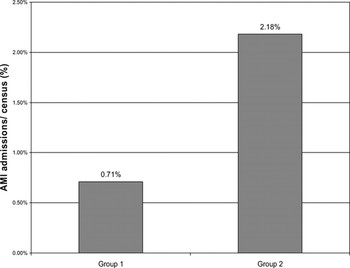
There were 150 admissions for AMI out of a total of 21,229 patients (0.71%) in group 1 (2 years preceding Katrina). Group 2 (2 years following Hurricane Katrina) had 246 admissions for AMI out of a total census of 11,282 patients (2.18%; P < 0.0001), as shown in Figure 1.
Comparison of AMI admissions before and after Hurricane Katrina.

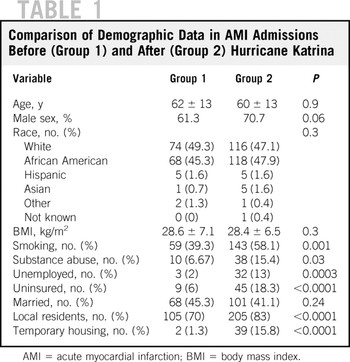
On comparison of the demographic data between the 2 groups (Table 1), group 2 had a significantly higher prevalence of unemployment (P = 0.0003), smoking (P = 0.001), substance abuse (P = 0.03), first-time hospitalization (P < 0.001), local residents rather than visitors affected (P < 0.0001), and people living in temporary housing (P < 0.0001), and a lack of medical insurance (P < 0.0001). There was no significant difference in the racial distribution in the 2 groups.
Comparison of Demographic Data in AMI Admissions Before (Group 1) and After (Group 2) Hurricane Katrina

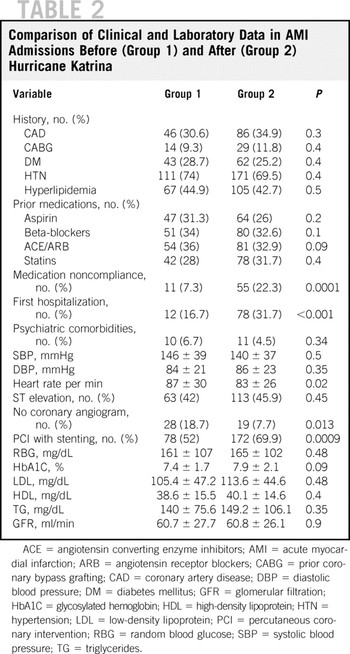
Among the clinical parameters (Table 2), group 2 showed a significantly higher prevalence of medication noncompliance (P = 0.0001). The patients in group 2 also received a significantly higher number of coronary interventions (P = 0.0009). More patients in group 1 (18.6%) did not undergo coronary angiography as compared with group 2 (7.7%; P = 0.013).
Comparison of Clinical and Laboratory Data in AMI Admissions Before (Group 1) and After (Group 2) Hurricane Katrina

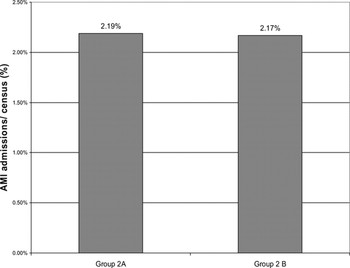
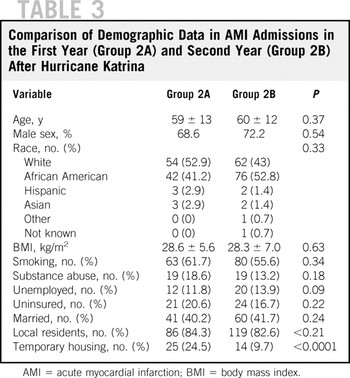
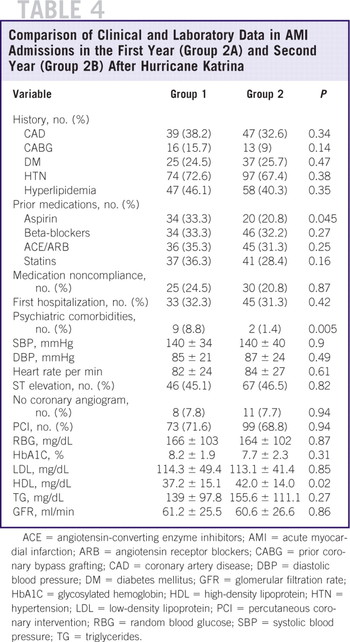
Within group 2, there was no significant difference between the incidence of AMI between groups 2A and 2B (ie, the first and second post-Katrina years [P = 0.8; Fig. 2]). Group 2B (second post-Katrina year) had a fewer number of patients still living in temporary housing (P < 0.0001), lower aspirin usage (P = 0.045), fewer psychiatric comorbidities (P = 0.005), and higher high-density lipoprotein (P = 0.02; Tables 3 and 4). The proportion of African Americans increased in group 2B in a nonsignificant manner (P = 0.33; Table 3).
Comparison of acute myocardial infarction (AMI) admissions within the post-Katrina group between the first year (group 2A) and second year (group 2B).

Comparison of Demographic Data in AMI Admissions in the First Year (Group 2A) and Second Year (Group 2B) After Hurricane Katrina

Comparison of Clinical and Laboratory Data in AMI Admissions in the First Year (Group 2A) and Second Year (Group 2B) After Hurricane Katrina

DISCUSSION
This retrospective analysis showed a highly significant increase in the incidence of AMI in a primary PCI center in New Orleans in the 2 years following Hurricane Katrina.
The short-term effect of natural disasters on cardiovascular events has been examined. After the Northridge earthquake in the Los Angeles area in January 1994, a postal survey of more than 100 hospitals in the area showed that the number of admissions for AMI increased from 149 in the week before to 201 in the week after the earthquake.Reference Leor, Poole and Kloner4 Examination of the coroners' records for Los Angeles County revealed that the number of sudden deaths from cardiac causes increased from an average of 4.6/day in the week before to 24 on the day of the earthquake.Reference Leor and Kloner5 Similarly, the Hanshin-Awaji earthquake in Japan in 1995 was associated with an increase in AMI during the first 3 months after the event.Reference Suzuki, Sakamoto and Miki6 Investigators also described an increase in electrocardiographic abnormalities such as deep negative T waves in patients experiencing the earthquake, as well as an increase in sympathetic activity of the heart by metaiodobenzylguanidine imaging.Reference Strike and Steptoe7 There was, however, no increase in MIs after the 1989 Loma Prieta earthquake in California.Reference Brown8 Chi et al did not find any excess cardiac death rates or admissions to acute coronary care in New York City in the period surrounding September 11, 2001.Reference Chi, Poole, Kandefer and Kloner9 To our knowledge, our study is the first to investigate the long-term cardiovascular morbidity after a natural disaster.
Hurricane Katrina's effect was massive not only in the immediate destruction but also in its lingering legacy even after 2 years. In its wake, the storm also brought around a change in the basic structure and character of the “Big Easy.” According to the 2000 Census, the population of New Orleans was 484,674. An estimate by the US Census Bureau in July 2006 placed the population of New Orleans at around 210,000. A subsequent estimate in July 2007 indicated that approximately two thirds of the pre-Katrina population had returned to the city. In addition, the city populace is different. Parts of the city remain abandoned. A large portion of the population migrated elsewhere, and there has been a significant influx of “migrant” populations, mainly construction workers of different ethnic backgrounds.
In a recent review, stress was divided into acute (<1 week) and chronic.Reference Dimsdale10 The role of chronic emotional stress in acute coronary syndromes is long suspected but never systematically demonstrated. Putative mechanisms include excessive sympathetic nervous system activation, exacerbation of coronary artery atherosclerosis, transient endothelial dysfunction or necrosis, abnormalities of thrombosis and hemostasis including increases in platelet aggregability, decreased cardiac vagal tone, and alterations in the fibrinolytic system related to elevated plasminogen activator inhibitor 1 levels. Reference Rozanski, Blumenthal and Kaplan11–Reference Kario, McEwen and Pickering13 In a study on British civil workers as part of the Whitehall II database, Chandola et al suggested that chronic work-related stress can lead to an increase in coronary heart disease by indirect effects on health behaviors and direct effects on neuroendocrine stress pathways.Reference Chandola, Britton and Brunner14 In a prospective study on cardiovascular events in 6576 healthy men and women, Hamer et al suggested that the association between psychological distress and cardiovascular disease risk could be largely explained by behavioral processes such as smoking, alcohol intake, and sedentary lifestyle.Reference Hamer, Molloy and Stamatakis15
A study in 499 Katrina evacuees residing in American Red Cross shelters in Louisiana 2 weeks after the event showed a high prevalence of chronic disease (55.6%), mainly hypertension, hypercholesterolemia, diabetes, pulmonary disease, and psychiatric illness. Of the evacuees, 48.4% lacked suitable medications.Reference Greenough, Lappi and Hsu16 Surveys estimate that 25% to 40% of people living in the regions affected by hurricanes Katrina and Rita lived with at least 1 chronic disease.Reference Miller and Arquilla17 Despite this, there is a lack of any significant research on treating people with chronic illnesses during disasters. Perhaps this is because, in wealthier countries, catastrophic damage to the medical infrastructure is uncommon, so patients with chronic diseases continue to receive care.Reference Ford, Mokdad and Link3
Our study shows a significant increase in admissions for AMI at a single primary PCI center, for a period exceeding 2 years after Katrina. We believe this represents a significant increase in the community incidence of acute coronary syndromes in this region. Our data suggests deterioration in the overall socioeconomic status of the AMI population after Katrina. These patients were more likely to be uninsured and unemployed. As a corollary, they were also more likely to be medically noncompliant. The increase in smoking and substance abuse could also be similarly related. It has previously been postulated that chronic stress can lead to unhealthy practices such as abuse of tobacco, alcohol, and illicit drugs, as well as medication and therapeutic noncompliance. According to 1 study, residents in Connecticut, New Jersey, and New York were more likely to drink more alcohol and smoke more as a result of the September 11 terrorist attacks on the World Trade Center.18 Chronic stressors can also make it more difficult for smokers to quit, if already addicted.Reference Dimsdale10
We found a significantly higher percentage of local residents compared with visitors in the post-Katrina group, which reflects the decrease in tourists to New Orleans. We also found a lower number of coronary angiograms in the AMI population before Katrina, some of which could be due to out-of-town visitors/tourists declining to undergo the procedure. This could also explain the lower number of coronary interventions in the pre-Katrina group.
TUHSC has been a primary PCI center in downtown New Orleans since well before Hurricane Katrina. There were 7 primary PCI centers in New Orleans before Katrina, 3 of which, including Tulane, were affected by the hurricane. Of the remaining 2 primary PCI centers, Louisiana reopened University Hospital (interim LSU Hospital) in New Orleans in November 2006 with rapid resumption of full emergency and inpatient services. Traditionally, the Louisiana Charity Hospital System served the indigent population in downtown New Orleans, with a higher proportion of uninsured patients. Our results show the persistence of increased AMI admissions at the Tulane hospital in the second post-Katrina year (February 2007–February 2008), with a disturbing trend in continuing adverse factors, such as smoking, unemployment, lack of insurance, and medication noncompliance. We believe that this reflects a true change in the local population behavior and health practices, rather than a simple redistribution of uninsured population to Tulane post-Katrina. As expected, the percentage of patients living in temporary housing declined in the second post-Katrina year, reflecting active rebuilding in New Orleans.
In a recent analysis of the finalized death data from the Louisiana Office of Vital Statistics, Eavey et al found no significant increase in the monthly death rates in New Orleans from 2002 to 2006.Reference Eavey and Ratard19 That study is confounded by the lack of accurate population estimates in New Orleans after Katrina. Also, it may be too early for the increase in AMI incidence to translate into a mortality effect.
Our study has some shortcomings. The retrospective nature of the study creates obvious difficulties in data collection and gaps in knowledge. In particular, we do not have sufficient information about the annual income of the study patients and the post-Katrina patients' evacuation status during Katrina, which could have helped explain problems in medication compliance and loss of insurance. We do not have any data for the period of September 2005 to January 2006, when the hospital was not at full functional status. We cannot also fully adjust for a loss of a number of local hospitals after Katrina and do not have access to similar data from other regional hospitals. We believe that the loss of other local primary PCI centers would not account for the significant increase in AMI incidence, however, in the face of an almost 50% decrease in the total admission census at Tulane in the 2 years after Katrina.
CONCLUSIONS
We have found a 3-fold increase in the incidence of acute coronary syndrome in downtown New Orleans in the 2 years following Hurricane Katrina. We believe that the present study is the first to demonstrate long-term adverse influence on the cardiovascular health of a community affected by a natural disaster.
More MIs indicate deterioration in the cardiovascular health of the society, which could have significant prolonged effects. Because it is difficult to design a prospective study on natural (or unnatural) disasters, we hope that our data will encourage further, longer-term studies on the chronic health effects of these events. We also hope that our study will prompt research into methods to ensure optimal health care to the populace in these scenarios.
Authors' Disclosures
The authors report no conflicts of interest.