Introduction
Mealybugs (Hemiptera: Pseudococcidae) comprise more than 2000 species worldwide (Hardy et al., Reference Hardy, Gullan and Hodgson2008). Several species are of great economic importance as noxious pests on many plants, including apple, avocado, cassava, citrus, coffee, grapes, pineapple, rice and sugarcane (Jahn et al., Reference Jahn, Beardsley and González-Hernández2003). Mealybugs feed on plant sap by inserting their stylets into the epidermis of the leaf and into the fruit and the stem. They inject a toxic substance into the leaves that induces chlorosis, plant stunting, leaf deformation, early leaf and fruit drop, and death of the plant in extreme cases. Also, sap feeding may cause build-up of honeydew and development of sooty moulds (Mibey, Reference Mibey, Ben-Dov and Hodgson1997), which, together with mealybug thick white wax, make the sale of fruits difficult or cause quarantine rejections. In addition, mealybugs have a major impact on various crops through the transmission of viral diseases (Dhouibi, Reference Dhouibi2009).
Taxonomic identification remains a major problem in the study and management of mealybugs. Mealybugs are very similar morphologically and their identification on the basis of morphological criteria is therefore difficult, time-consuming and even impossible for immature stages and males, or for adults of very closely related species. In practice, these difficulties challenge the development of appropriate control strategies, for instance those based on the use of specific natural enemies.
Molecular markers are a particularly useful complement to morphological and ecological characterizations. So-called ‘DNA barcoding’ approaches can be used to assign voucher specimens with particular DNA sequences to morphologically characterized and identified taxa. Once this correspondence has been established, routine molecular characterization can be used to obtain highly accurate and repeatable identifications, avoiding the need for time-consuming, repetitive morphological examinations of the most common species, provided that DNA characterization is performed routinely. Molecular characterization data can also be used for the development of rapid identification tools based on species-specific PCR (Demontis et al., Reference Demontis, Ortu, Cocco, Lentini and Migheli2007; Saccaggi et al., Reference Saccaggi, Kruger and Pietersen2008). However, the use of DNA barcoding databases is a considerable advantage only when these databases are large enough to cover the range of intra- and interspecific genetic diversity observed in the field. Unfortunately, this is far from the case in many taxonomic groups, even for groups of relevance for pest management. For example, in the Pseudococcidae, a large percentage of the DNA barcodes generated to date are new and absent from international databases (Beltrà et al., Reference Beltrà, Soto and Malausa2012; Correa et al., Reference Correa, Aguirre, Germain, Hinrichsen, Zaviezo, Malausa and Prado2011, Reference Correa, Germain, Malausa and Zaviezo2012; Malausa et al., Reference Malausa, Fenis, Warot, Germain, Ris, Prado, Botton, Vanlerberghe-Masutti, Sforza, Cruaud, Couloux and Kreiter2011; Park et al., Reference Park, Suh, Hebert, Oh and Hong2011).
In this study, we surveyed the mealybugs infesting key crops (grape, sugarcane, apple, etc.) or causing particularly high levels of infestation on ornamental plants in urban areas of Egypt and France, two countries for which DNA barcoding data are currently scarce or completely absent. We used a combination of molecular and morphological characterization, based on the methods described by Malausa et al. (Reference Malausa, Fenis, Warot, Germain, Ris, Prado, Botton, Vanlerberghe-Masutti, Sforza, Cruaud, Couloux and Kreiter2011). The main DNA barcode used was a marker located in the region of the cytochrome oxidase subunit I (COI) mitochondrial gene used in international barcoding projects (Hebert et al., Reference Hebert, Cywinska, Ball and DeWaard2003). The analysis of this COI region remains challenging in mealybugs because there are few conserved sites where ‘universal’ PCR primers can be designed. We, therefore, also considered two other markers that are easily amplified in most species and distinguish between them: internal transcribed spacer 2 (ITS2) and 28S-D2 (Malausa et al., Reference Malausa, Fenis, Warot, Germain, Ris, Prado, Botton, Vanlerberghe-Masutti, Sforza, Cruaud, Couloux and Kreiter2011). We used this approach to characterize samples from 40 sites located in Egypt and France, in which we identified 17 species, providing the foundations for the integration of molecular-based diagnostic techniques into control or biosafety programs targeting mealybugs in these two countries.
Materials and methods
Specimen collection
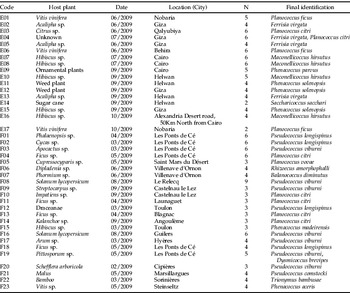
We sampled 40 populations of mealybugs infesting crops and ornamental plants throughout Egypt and France (table 1). Our aim was to get samples when heavy infestations of crops or ornamental plants were reported by our network of partners (e.g. the consortium ‘Astredhor’ in France). Specimens were stored in ethanol (70% or 95%) at −20°C.
Mealybug specimens: site codes, host plant, collection date, location, number of specimens subjected to DNA extraction, identification based on DNA analyses and morphological examinations. Egyptian site codes begin with an ‘E’, and French site codes begin with an ‘F’.

DNA extraction, amplification and sequencing
Genomic DNA was extracted with the DNeasy Tissue Kit (QIAGEN, Hilden, Germany). Mealybugs were not crushed before extraction to keep intact vouchers for the morphological examination. We rigorously followed the methods described by Malausa et al. (Reference Malausa, Fenis, Warot, Germain, Ris, Prado, Botton, Vanlerberghe-Masutti, Sforza, Cruaud, Couloux and Kreiter2011), without any modification to the published protocol, to amplify the two nuclear ribosomal DNA loci 28S-D2 and internal transcribed spacer 2 (ITS2). For the LCO-HCO part of cytochrome oxidase subunit I (hereafter referred to as LCO), we used a new primer pair amplifying a wider range of species than the one from Malausa et al. (Reference Malausa, Fenis, Warot, Germain, Ris, Prado, Botton, Vanlerberghe-Masutti, Sforza, Cruaud, Couloux and Kreiter2011). The primers used were M-28SD2-F (5′ AGAGAGAGTTCAAGAGTACGTG 3′) and M-28SD2-R (5′ TTGGTCCGTGTTTCAAGACGGG 3′) for 28S-D2, M-ITS2-F (5′ CTCGTGACCAAAGAGTCCTG 3′) and M-ITS2-R (5′ TGCTTAAGTTCAGCGGGTAG 3′) for ITS2; M-LCOn-F (5′ AYAATATAATRATTACWWTWCATGC 3′) and M-LCOn-R (5′ TTTWCCATTTAAWGTTATTATTC 3′) for LCO. The annealing temperature for these primer pairs were 60°C for 28SD2, 58°C for ITS2 and 48°C for LCO. The PCR conditions are given in Malausa et al. (Reference Malausa, Fenis, Warot, Germain, Ris, Prado, Botton, Vanlerberghe-Masutti, Sforza, Cruaud, Couloux and Kreiter2011) and at http://bpi.sophia.inra.fr/dnabarcoding/.
Polymerase chain reaction products were sent to Genoscreen (Lille, France) or to the French National Genoscope for capillary electrophoresis on ABI automatic sequencers (Applied Biosystems, Foster City, CA, USA). PCR products were sequenced on both strands. Consensus sequences were generated and checked with Seqscape v2.7 (ABI). Alignments were edited manually with Bioedit version 7.01 (Hall, Reference Hall1999).
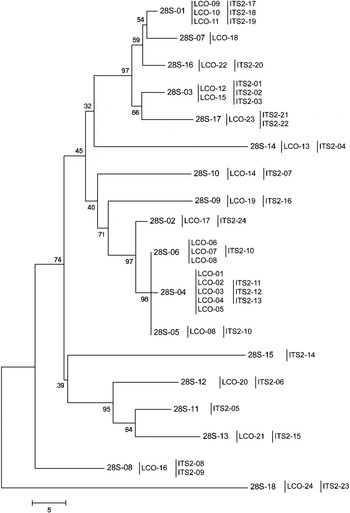
Sequences were compared by direct alignment. We generated a neighbor-joining (NJ) tree based on the number of nucleotide differences between 28S sequences, with Mega4 (Tamura et al., Reference Tamura, Dudley, Nei and Kumar2007), in order to provide a visual representation of the data. We underline that this tree is not to provide phylogenetic information.
Morphological examination
Specimens with a previously unidentified haplotype (here we defined an haplotype as a DNA sequence differing from any other at one or more sites) at one of the three genetic markers were slide-mounted for morphological examination and kept as vouchers. When possible, i.e. for adult females – the only stage at which morphological identification is possible – and when the specimens were sufficiently numerous, we studied at least three slide-mounted specimens for each haplotype. Mealybugs were slide-mounted and morphologically characterized exactly as previously described by Malausa et al. (Reference Malausa, Fenis, Warot, Germain, Ris, Prado, Botton, Vanlerberghe-Masutti, Sforza, Cruaud, Couloux and Kreiter2011). Slide-mounted specimens (vouchers) were deposited in the national collection of ANSES, Laboratoire de la Santé des Végétaux (Montferrier-sur-Lez, France). The other specimens stored in 96% ethanol and DNA extracts are available from INRA Sophia Antipolis, France.
Matches with international databases
We used the BLAST tool from NCBI to look for similarities between our sequence dataset and the sequences already published in Genbank. For 28S, the MEGABLAST method (for highly similar sequences) was used, while the BLASTn method was used for LCO and ITS2.
Results and discussion
DNA analysis
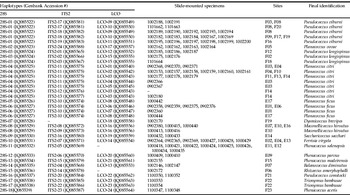
We obtained at least one DNA sequence for 163 of the 176 individuals subjected to DNA analysis (Genbank accession numbers JQ085522–JQ085588). We obtained 140 sequences for 28S, 121 sequences for ITS2 and 118 sequences for LCO. We identified 18 haplotypes for 28S, 24 for ITS2 and 24 for LCO (table 2). We could amplify 28S and ITS2 from at least one specimen from each of the populations sampled, whereas LCO amplification was entirely unsuccessful in the E11, E12, E15 and F06 populations.
List of multilocus haplotypes: haplotype code and GenBank accession numbers of the corresponding sequences for each marker; references of slide-mounted specimens displaying each multilocus haplotype; sites at which individuals displaying each multilocus haplotype were collected; final identification based on morphological and molecular data. The full multilocus data for all individuals are provided as Supplementary online material, table S1.

The analysis of 28S sequences revealed 15 substantially different haplotypes and a cluster of three very similar haplotypes: 28S-4, 28S-5 and 28S-6. The 28S-5 and 28S-6 even displayed no difference when the 28S regions displaying insertion/deletion were removed for calculation of the NJ tree (fig. 1). As previous studies with the same marker found little or no intraspecific variation for 28S (Malausa et al., Reference Malausa, Fenis, Warot, Germain, Ris, Prado, Botton, Vanlerberghe-Masutti, Sforza, Cruaud, Couloux and Kreiter2011; Beltrà et al., Reference Beltrà, Soto and Malausa2012), these results suggest that our specimens belong to 16 to 18 species. Indeed, without additional information, it is not clear whether specimens with the 28S4, 28S-5 and 28S-6 haplotypes belong to the same species or to several.
Neighbor-joining tree based on the number of differences between 28S haplotypes. Bootstrap values (10,000 replications) are displayed under the branches. The sequence alignment used to compute the tree (fig. S1) differs slightly from the alignment of raw sequences because we removed regions including numerous insertions and deletions due to the impossibility of achieving a satisfactory alignment. The LCO and ITS2 haplotypes of specimens displaying each 28S haplotype are also given.

The results for LCO were entirely compatible with those for 28S. They revealed 15 clusters of very similar haplotypes potentially corresponding to 15 taxa. As no amplification of this marker was observed in four populations displaying two different 28S haplotypes (28S-11 and 28S-15), these results suggest that there were 17 taxa in our survey. Interestingly, the samples with the 28S-4, 28S-5 and 28S-6 haplotypes were clearly different and formed two groups: (i) one containing LCO-01 to LCO-05 corresponding exclusively to haplotype 28S-4; (ii) one containing LCO-06 to LCO-08 associated with haplotypes 28S-5 and 28S-6 (table 2 and fig. 1).
Sixteen distinct clusters were observed for ITS2 (table 2). However, it was not possible to generate a global alignment of ITS2 sequences because of the numerous insertions and deletions in this region. An alignment was possible only for a reduced dataset, including individuals corresponding to haplotypes 28S-2, 28S-4, 28S-5 and 28S-6. Three groups were observed: (i) ITS2-10 associated with 28S-05, 28S-6, and with LCO-06 to LCO-08; (ii) ITS2-11 to ITS2-13, actually differing by only one ambiguous site (T/A/W) and associated with 28S-04 and with LCO-01 to LCO-05; (iii) ITS2-24 associated with 28S-02 and LCO-17 (table 2 and fig. 1). Furthermore, attempts to amplify the ITS2 marker repeatedly failed in specimens with the 28S-07 haplotype.
Overall, the multilocus haplotypes and the rare cases of amplification failure suggest the occurrence of 17 taxa. Clearly, molecular characterization alone is not sufficient for the delineation of taxa. However, given the degree of divergence between haplotype clusters, it provides a lower limit for the number of species sampled.
Morphological analysis
Morphological examination of specimens displaying each multilocus haplotype led to the identification of 17 species: seven in Egypt (Planococcus citri, Planococcus ficus, Maconellicoccus hirsutus, Ferrisia virgata, Phenacoccus solenopsis, Phenacoccus parvus and Saccharicoccus sacchari) and 11 in France (Planococcus citri, Pseudococcus viburni, Pseudococcus longispinus, Pseudococcus comstocki, Rhizoecus amorphophalli, Trionymus bambusae, Balanococcus diminutus, Phenacoccus madeirensis, Planococcus vovae, Dysmicoccus brevipes and Phenacoccus aceris) (tables 1 and 2). Planococcus citri was the only species common to both countries (tables 1 and 2). We slide-mounted from one to 20 specimens per species (table 2). All slide-mounted specimens (vouchers) were deposited in the ANSES collection at Montferrier-sur-Lez under the code numbers presented in table 2.
The morphological examination was thus entirely consistent with the delineation of taxa obtained with the molecular data and made it possible to assign species names to the various haplotype combinations (table 2). Interestingly, all the taxa with closely related 28S haplotypes belonged to the genus Planococcus. Morphological examination confirmed the split of this genus into three species (Pl. citri, Pl. ficus and Pl. vovae), as suggested by the existence of three clear haplotype clusters in the LCO and ITS2 datasets. However, no marked morphological difference was observed between specimens displaying genetic variation inside each putative species. The same was true for the following species, in which specimens displayed genetic variation but no significant morphological difference: B. diminutus, M. hirsutus, Ps. viburni, Ps. longispinus and T. bambusae.
Matches with international databases
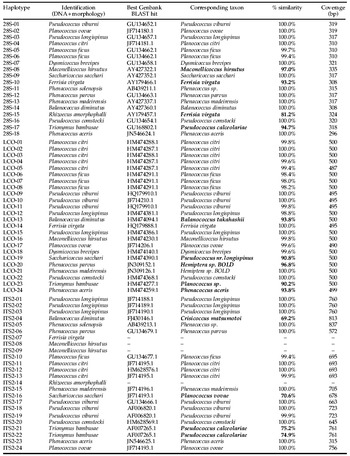
Our identifications were confirmed by the matches between our sequences and those present in the Genbank database (table 3). Most sequences displayed a BLAST hit (and a sequence similarity percentage between 98% and 100%) with a Genbank sequence assigned to the same species (table 3). However, nine sequences displayed no BLAST hit or hits with very divergent sequences (similarity percentage <85%). Part of the hits between 85% and 98% tended to confirm the taxonomic identification when the Genbank sequence was from a closely related species (e.g. Balanococcus diminutus and B. takahashii displaying 93.8% of similarity at LCO) (table 3). In contrast, other hits clearly suggested taxonomic issues. For instance, the sequences that we assigned to F. virgata displayed BLAST hits with (i) Genbank sequences assigned to F. virgata by Gullan et al. (Reference Gullan, Downie and Steffan2003) with only 93.2% of similarity at 28S (which strongly suggests the occurrence of two different species), and (ii) Genbank COI sequences identical to ours and assigned to F. virgata by Park et al. (Reference Park, Suh, Hebert, Oh and Hong2011) (table 3). Hence, at least two taxa probably share the same name. Repeated morphological examinations of our specimens did not reveal inconsistencies with the main characters of F. virgata (Gullan et al., Reference Gullan, Kaydan and Hardy2010). Additional works thus appear necessary to investigate the occurrence of cryptic species in the genus Ferrisia. The same issue was found in M. hirsutus and P. aceris, for which similar patterns of BLAST hits were observed with 28S and LCO sequences (table 3).
Blast hits between our sequences and those from the NCBI Genbank database. For each sequence the table displays our identification, the most similar sequence in Genbank (BLAST hit with a region covering >30% of the sequence, highest similarity percentage), the similarity percentage between the two sequences (ignoring differences involving compatible ambiguous bases, e.g. Y with T and C) and the length of the region with which the similarity percentage was calculated. Blast hits associated to similarity percentages under 97% appear in bold. Such hits occur when our sequence (i) is from a species for which no sequence is available in Genbank and the best hit involves a sequence from another species, or (ii) displays a hit with a Genbank sequence assigned to the same species but a substantial divergence is found between the two sequences (which may indicate taxonomic issues).

Species delineation
Overall, in the absence of ecological data and measurements of reproductive isolation between the various populations, we propose the retention of 17 species, as supported by both molecular and morphological data, despite the detection of some molecular variability in some so-called ‘species’. However, surprising results meriting further investigation were obtained for some populations. For example, most French populations of Ps. viburni shared the same LCO and ITS2 haplotypes (LCO-09, LCO-10, ITS2-17 and ITS2-18), but all the individuals of one population (F16) had a unique combination of haplotypes (LCO-11 and ITS2-19). This may be the result of simple geographic effects, but this population was sampled and sent to our laboratory because the mealybugs appeared to be less affected by releases of the parasitoid Acerophagus flavidulus than other French Ps. viburni (P. Kreiter, personal communications). In Egypt, the E17 population of Pl. ficus displayed variation at 28S, a marker that is usually conserved, and had only one LCO haplotype (LCO-08), which was absent from other populations. Too few specimens were analyzed to draw conclusions about the possible existence of divergent taxa, but this observation of genetic variability calls a more detailed examination of Pl. ficus population structure. Indeed, the Egyptian Planococcus ficus populations were formerly considered to belong to two species: Planococcus ficus Signoret and Planococcus vitis (Ezzat & McConnell, Reference Ezzat and McConnell1956). These species were subsequently merged to create a single species, Pl. ficus, by Cox & Ben-Dov (Reference Cox and Ben-Dov1986). However, recent results suggest that the so-called ‘species’ Pl. ficus is composed of at least two divergent clusters consisting of European and Turkish populations on the one hand, and Egyptian, Israeli and Californian populations on the other (Daane et al., unpublished data). Unfortunately, the cytochrome oxidase I regions used by Daane et al. and the region used in this work are different and overlap over only a small region of about 150 bp. However, a quick comparison of the haplotypes obtained in these two studies (results not shown) suggests that the LCO-06 and LCO-07 haplotypes correspond to the California-Israel-Egypt cluster, whereas LCO-08 (collected in one population only in this study) appears to be separate from the two clusters. A multilocus comparison of specimens collected, together with morphological comparisons, might help to unravel the status of P. ficus populations.
Furthermore, although genetic variability was found in Pl. citri in both countries; no ITS2 or LCO haplotype was found to be common to Egyptian and French populations. Again, these differences may be explained by simple geographic population differentiation; but, this study, following on from those of Rung et al. (Reference Rung, Scheffer, Evans and Miller2008), Malausa et al. (Reference Malausa, Fenis, Warot, Germain, Ris, Prado, Botton, Vanlerberghe-Masutti, Sforza, Cruaud, Couloux and Kreiter2011) and Beltrà et al. (Reference Beltrà, Soto and Malausa2012), provides additional evidence for high levels of genetic diversity in populations classified as Planococcus citri. Notably, if the data obtained for the LCO region of cytochrome oxidase I in this study are pooled with those reported by Malausa et al. (Reference Malausa, Fenis, Warot, Germain, Ris, Prado, Botton, Vanlerberghe-Masutti, Sforza, Cruaud, Couloux and Kreiter2011), the number of differences at the LCO locus between Pl. citri haplotypes (between 1 and 5) is similar to the number of fixed differences between Pl. citri and Pl. minor (6). It is therefore possible that populations currently classified as Pl. citri actually have a structure composed of several cryptic taxa.
Conclusions
We identified 17 taxa in Egypt and France, each of which was associated with a multilocus DNA barcode facilitating subsequent identification and monitoring. Obviously, this survey is not exhaustive and probably covers only a small proportion of the mealybug diversity of each country. However, it provides a list of species known to be present, with reliable multicriterion characterization of the mealybug species that appear to be particularly problematic on ornamental or crop plants. The use of variable genetic markers also led to the detection of intraspecific variability in several species, raising questions about the taxonomic status of some populations sampled from different regions and displaying genetic differences at several loci (e.g. in Pl. citri, Pl. ficus and Ps. viburni).
Acknowledgements
This study would not have been possible without the help of all those who participated in the mealybug sampling, especially the members of ASTREDHOR. This study was also greatly facilitated by the assistance of Atif Abdelaal, who drove us to the fields in Egypt! This work was funded by the Egypt-France scientific interchange program IMHOTEP (2009–2010), the French grants Agropolis Fondation (RTRA – Montpellier, BIOFIS project number 1001-001), SPEED-ID and ‘Bibliothèque du Vivant’, and the European grants FP7-IRSES ‘Iprabio’ #269196 and FP7-KBBE ‘PURE’.
Supplementary material
The online table and figure can be viewed at http://journals.cambridge.org/ber.