Implications
When rearing geese for fatty liver production, the feeding programme must prepare the digestive tract of the birds for high feed intake, mainly ensuring a sufficient development of the crop volume. Incorporation of sugar beet pulp (SBP) in the finisher diet increases its swelling capacity, affects the birds’ feed intake during the finishing period and tends to increase the crop volume at the end of the rearing period. However, the mode of use of this by-product in the diet of geese should continue to be investigated, because the feeding strategy used in the present work, such as SBP incorporation rate or period of use, had no effect on performance during the overfeeding period.
Introduction
The fatty liver (foie gras) production system is based on the spontaneous ability of waterfowl to hyperphagia and store fat in the subcutaneous tissue and liver (Pond, Reference Pond1978; Guy et al., Reference Guy, Fortun-Lamothe, Bénard and Fernandez2013), probably linked to the migratory behaviour of their ancestors, which had the natural ability to over-consume food to store energy before long migrations (Odum, Reference Odum1960). Producers have developed specific feeding programmes to take advantage of this natural phenomenon (Guéméné and Guy, Reference Guéméné and Guy2004). However, fatty liver is controversial in animal science and society. There is a widespread lack of understanding and acceptance of the production system, as overfeeding is considered to be detrimental to animal welfare. Therefore, it seems necessary to improve this production system to respect societal demand. A natural morphological adaptation of the digestive tract to take in large amounts of feed would support a more animal-friendly production system. In this way, Arroyo et al. (Reference Arroyo, Auvergne, Dubois, Lavigne, Bijja, Bannelier and Fortun-Lamothe2012b) have previously shown in goose species that a sufficient development of the crop is necessary to obtain good performance during the overfeeding period. Therefore, in present farming systems for fatty liver production, the feeding programme is managed to stimulate the crop development, mainly by changing the time of access to the feeder or the quantity of food offered to birds during the end of the rearing period, called the finishing period (Arroyo et al., Reference Arroyo, Fortun-Lamothe, Dubois, Lavigne and Auvergne2012a).
Arroyo et al. (Reference Arroyo, Auvergne, Dubois, Lavigne, Bijja, Bannelier and Fortun-Lamothe2012b) showed that crop volume is affected by the hydration capacity of diet. Dried sugar beet pulp (SBP), a by-product of sugar beet, has a high water-holding capacity (WHC; Giger-Reverdin, Reference Giger-Reverdin2000), and thus may be of interest in goose feeding to help the development of the crop and stimulate feed intake in a natural way. Most of the work on the use of this by-product in the diet of geese has been carried out on geese destined for meat production (Arslan, Reference Arslan2003; Arslan, Reference Arslan2004). It shows that incorporation of SBP, at a proportion of 10% to 15%, induced a high spontaneous feed intake leading to leaner birds having a more developed intestinal tract (Arslan and Saatci, Reference Arslan and Saatci2003) without detriment to growth rate (Arslan, Reference Arslan2005). However, no data are available on the use of SBP in the diet of geese reared for fatty liver production.
Therefore, the aim of this work was to study the combined effects of the mode of distribution of the diet and SBP incorporation in the finisher diet of geese on development of crop, feed intake, growth and fatty liver weight and quality in geese reared for fatty liver production.
Materials and methods
Birds and feeding programmes
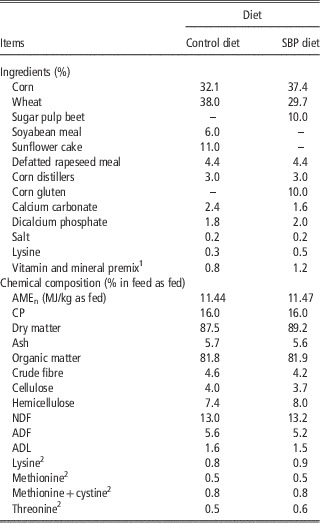
The animals were cared for in accordance with the guidelines for animal research of the French Ministry of Agriculture. Investigators were certified by the French governmental authority for carrying out these experiments (agreement n°31–11.43.501). This trial was carried out at the Goose and Duck Breeding Station (Coulaures, Dordogne, France) with Greylag ganders (Anser anser; line Maxipalm®). A total of 480 1-day-old ganders were divided into three groups (four pens of 40 birds per group) differing in the composition and mode of distribution of the finisher diet (distributed from day 56 to 89). The feeding programme was similar in all the three groups from day 1 to 55 and from day 90 to 104. All diets used during the rearing period met the NRC requirements (National Research Council (NRC), 1994) and were manufactured by Sanders Centre Auvergne (Aigueperse, France). Until day 55, the birds were subjected to a standard feeding programme as described by Arroyo et al. (Reference Arroyo, Fortun-Lamothe, Dubois, Lavigne and Auvergne2012a). In brief, birds were fed a pre-starter diet (nitrogen-corrected apparent metabolizable energy, AMEn 11.72 MJ/kg, 220 g/kg CP) from day 1 to 10, a starter diet (AMEn 11.72 MJ/kg, 200 g/kg CP) from day 11 to 28 and a grower diet (AMEn 12.14 MJ/kg, 180 g/kg CP) from day 29 to 55. Between day 56 and 89, the following two diets were used: a standard diet (AMEn 11.44 MJ/kg; 160 g/kg CP) or a diet containing 10% of SBP (SBP diet, AMEn 11.47 MJ/kg; 160 g/kg CP; Table 1). In the Control group, birds were fed the standard diet and had a controlled time of access to the feeder: 4 h/day (2 h in the morning and 2 h in the afternoon) from day 56 to 62; 2 h/day from day 63 to 87; and 3 h/day from day 88 to 89. Other birds were fed the SBP diet and had a controlled time of access to the feeder (SBPt group, exactly as those in Control group) or a controlled quantity of feed (SBPq group), corresponding to 95% of theoretical needs distributed once a day (Table 2) according to standard practice described by Guéméné and Guy (Reference Guéméné and Guy2004).
Ingredients and chemical composition of the two experimental diets

AMEn=nitrogen-corrected apparent metabolizable energy.
1 Vitamins: A: 9990 IU/kg; D3: 1998 IU/kg; E: 10 IU/kg; B1: 2.0 mg/kg; K3: 1.0 mg/kg; B2: 2.5 mg/kg; B5: 5.1 mg/kg; B6: 1.0 mg/kg; PP: 24.9 mg/kg; B9: 0.3 mg/kg; choline: 300 mg/kg. Oligo elements, Cu: 9.3 mg/kg; Fe: 29.0 mg/kg; I: 0.99 mg/kg; Co: 0.16 mg/kg; Mn: 70 mg/kg; Zn: 47 mg/kg; Se: 0.20 mg/kg; clay (sepiolite): 2 g/kg.
2 Calculated from Sauvant et al. (Reference Sauvant, Perez and Tran2004).
Feeding programmes in the groupsFootnote 1 used during the experiment

SBP=sugar beet pulp.
1 Control group: birds have a controlled time of access to the control diet; SBPt group: birds have a controlled time of access to the SBP diet; SBPq: birds have a controlled quantity of SBP diet.
From day 90 to 104, 88 birds/group were overfed a mixture of 340 g of corn flour, 240 g of whole corn, 400 g of water and 20 g of vitamins (E: 32.00 UI/kg; B1: 4.00 mg/kg; K3: 2.86 mg/kg) and minerals (FeSO4: 55.40 mg; CuSO4: 15.00 mg, ZnSO4: 40.00 mg; MnSO4: 74.00 mg; Ca: 2.13 g, Na: 1.44 g; P: 0.23 g/kg) per kg, according to the standard practices (Arroyo et al., Reference Arroyo, Fortun-Lamothe, Dubois, Lavigne and Auvergne2012a). The diet was distributed with an automatic feed dispenser (Gaveuse Mg 300, Dussau, Distribution Sas, Pecorade, Landes, France) and according to the planned overfeeding programme described by Arroyo et al. (Reference Arroyo, Auvergne, Dubois, Lavigne, Bijja and Fortun-Lamothe2013a). The birds used for overfeeding were chosen according to their live weight (LW) at day 89 to be representative of the LW variability within groups.
Housing and management conditions
During the rearing period, the birds were housed in pens of 19 m² containing 40 birds. The pens were equipped with two drinkers, three feeders and an outdoor access area (91.5 m²/pen). The geese had outdoor access between 0700 and 1800 h from day 30 to 89; however, from day 56 to 89, the duration of outdoor access was reduced because it was denied during the time when birds received experimental diets. The room temperature was maintained at 28°C from the 1st week after hatching and was subsequently gradually reduced to 20°C at day 30, after which no heat was provided.
During the overfeeding period, the 264 geese were housed in 24 3×1 m pens, each with 11 geese. Each pen was equipped with drinkers. The room was maintained at a maximum temperature of 20°C and a maximum relative humidity of 90%.
Measurements
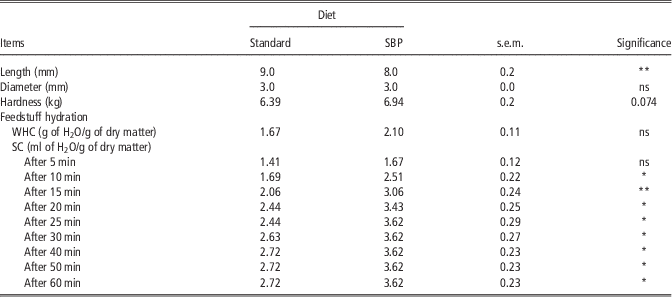
The chemical composition of the experimental diets is shown in Table 1. The physical characteristics of the experimental diets are shown in Table 3. Length and diameter of the pellets were measured on 50 samples. The same samples were used to analyse the pellet hardness using standard methods (Thomas and van der Poel, Reference Thomas and van der Poel1996) with a ‘Kahl’-type tester (Hardness tester, Amandus Kahl GmbH & Co., Hamburg, Germany). The hydration capacity was measured through the WHC (g of H2O/g of dry matter) and the swelling capacity (SC, ml of H2O/g of dry matter) as described by Giger-Reverdin (Reference Giger-Reverdin2000). To measure WHC, 2 g of feedstuff was mixed with 10 ml of distilled water. After 8 h at room temperature, the mixture was centrifuged (966×g for 10 min at 20°C) and the supernatant was removed before weighing the hydrated pellets. To measure SC, 25 ml of distilled water at room temperature was added to 2 g of feedstuff. Volume of the hydrated pellets was measured 5, 10, 15, 20, 25, 30, 40, 50 and 60 min after water addition.
Physical characteristics of the two experimental pellets

s.e.m.=standard error of the mean; WHC=water-holding capactiy; SC=swelling capacity.
**P<0.01; *P<0.05; ns, P>0.2.
Birds were weighed individually at day 1, 28, 56, 70 and 89 after 18 h of fasting. LW at 104 days of age was measured after 8 h of fasting, because at the end of overfeeding fasting more than 8 h leads to a decreased fatty liver weight (Leprettre et al., Reference Leprettre, Auvergne, Manse, Babilé, Dubois and Candau1998). Mortality was recorded daily throughout the experiment. Feed intake was measured weekly from day 1 to 89 (a measure per pen) and daily from day 90 to 104 (individual measurements).
At day 89, the crop volumes of 40 geese per group selected on their LW at day 89, according to the recommendations of Leprettre et al. (Reference Leprettre, Dubois, Lavigne, Combebiac and Babilé2002), were measured in vivo after 18 h of fasting, as described by Arroyo et al. (Reference Arroyo, Auvergne, Dubois, Lavigne, Bijja, Bannelier and Fortun-Lamothe2012b). In brief, an inflatable balloon was gently introduced into the oesophagus and inflated to a constant pressure (70 mm Hg). The volume of air introduced was measured by displacement of a water column. Twelve geese per group were slaughtered at day 89 to study carcass traits according to the World’s Poultry Science Association method (WPSA, Reference Jensen1984). The weights of the gut (small intestine, duodenum, jejunum, ileum and caecum), gizzard, liver, carcass (eviscerated carcass with skin) and abdominal fat were measured, as well as breast and thigh weights (without skin and subcutaneous fat).
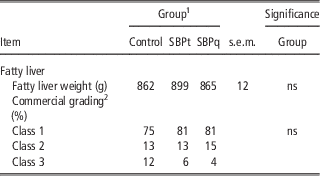
At day 104, all geese (n=88 per group at the beginning of overfeeding) were slaughtered after 8 h of fasting to measure the weight of fatty liver. The commercial grading of the fatty livers was carried out by an industry professional (Coopérative Sarlat Périgord, Sarlat-la-canéja, Dordogne, France) trained to classify the raw fatty livers according to their potential commercial use, as described by Arroyo et al. (Reference Arroyo, Auvergne, Dubois, Lavigne, Bijja and Fortun-Lamothe2013a and Reference Arroyo, Auvergne, Dubois, Lavigne, Bijja, Bannelier, Manse and Fortun-Lamothe2013b). The livers were graded using a three-point scale: Class 1 corresponded to the best commercial class for livers with no defects, appropriate texture, usually processed as entire canned livers; Class 2 corresponded to livers with no external defects but too heavy (>900 g) to be processed as entire canned livers; and Class 3 livers had several defects in appearance or texture.
In this experiment, all birds were killed according to the European council regulations (EC, 2009).
Statistical analysis
Data were analysed using PASW Statistics18 for Windows (version 18.0.2, SPSS Inc., Chicago, IL, USA). Performance of geese (except mortality rate and fatty liver commercial grading) was first analysed using the GLM procedure, using the following equation:
 $$Y_{{ij}} \, {\rm =}\, \mu {\rm {\plus}}G_{i} {\rm {\plus}}P_{j} {\rm {\plus}(}G_{i} {\times}P_{j} ){\rm {\plus}}{\varepsilon}_{{{\rm ij}}} $$
where Y is the dependent variable; µ the overall mean; G i the effect of group (three levels: control, SBPt and SBPq); P j the effect of pen (12 levels); (G i ×P j ) the interaction between group and pen; and ɛ ij the error.
However, the effects of pen (P j ) and the interaction (G i ×P j ) were not significant (data not shown), and were, thus, removed from the final model, which was finally Y i =µ+G i +ɛ i . Physical characteristics of the diets (length, diameter, WHC, SC, hardness) were analysed using the following equation:
 $$Y_{i} {\rm =}\mu {\rm {\plus}}D_{i} {\rm {\plus}}{\varepsilon}_{i} $$
where Y i is the dependent variable; µ the overall mean; D i the effect of diet (two levels: standard diet and SBP diet); and ɛ i the error.
When significant, differences between treatments were compared using Duncan’s test. The fatty liver commercial grading and mortality during the rearing and overfeeding periods were analysed using a χ 2-test. Differences were treated as significant when P⩽0.05.
Results
Physical characteristics of experimental diets
The diameter of the pellets was similar in the Control and the SBP diets (3.00 mm; P>0.2; Table 3), but the pellets were longer for the Control than for SBP diet (+13%; P<0.01). The hardness tended to be higher in SBP compared with the Control diet (6.94 v. 6.39 kg; P=0.074; Table 3). WHC tended to be higher in SBP than in the Control diet (+25%; P=0.104). SC was higher in SBP than in the Control diet from 10 min (+48%; P<0.05) until 60 min after water addition (+33%; P<0.05). The swelling volume maximum was reached faster for SBP compared with the Control diet (25 v. 40 min; Table 3).
Feed intake during the rearing period
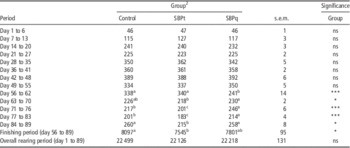
From day 1 to 55, the feed intake was similar in all the three groups (P>0.05, Table 4). In contrast, feed intake from day 56 to 89 was highest in the Control group (8097 g) and lowest in the SBPt group (7545 g), feed intake in the SBPq group being intermediate (7801 g; P<0.05). Effect of SBP incorporation in the diet on feed intake was dependent on the mode of distribution of the diet, as feed intake was lowest in the SBPq group from day 56 to 62 and highest from day 71 to 83. Over the entire rearing period – that is, from day 1 to 89 – feed intake of the birds was similar in all the three groups (22 281 g; P>0.2; Table 4).
Average daily (g/day) and cumulative (g/bird) feed intake of geese during the rearing period Footnote 1

s.e.m.=standard error of the mean; SBP=sugar beet pulp.
a,b,cWithin a row, means with no common superscript differ at P<0.05.
1 The individual feed intake was calculated from the intake per pen (n=4 pens/group) and the numbers of birds in the pen during the period (40 birds per pen at the beginning of the experimental period).
2 Control group: birds have a controlled time of access to the control diet; SBPt group: birds have a controlled time of access to the SBP diet; SBPq: birds have a controlled quantity of SBP diet.
***P<0.001; *P<0.05; ns, P>0.2.
Mortality and bird growth during the rearing period
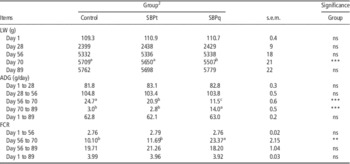
Mortality during the rearing period tended to be similar in all the three groups (0.3%; P=0.081). The LW were similar (P>0.2) in the three groups throughout the rearing period (110, 2422, 5335 and 5746 g at day 1, 28, 56 and 89, respectively), except at day 70 when the birds were lighter in the SBPq compared with the other two groups (5507 v. 5680 g; P<0.001).
From day 56 to 70, the average daily gain (ADG) was lower in the SBPq group compared with the SBPt and Control groups (11.5 v. 20.9 and 24.7 g/day, respectively; P<0.001). Conversely, from day 70 to 89, ADG was higher in the SBPq group than in the other two groups (14.0 v. 2.9 g/day; P<0.001, Table 5). Over the entire rearing period – that is, from day 1 to 89 and from day 56 to 89 – the feed conversion ratio (FCR) was similar in all the three groups (3.96; P>0.2 and 19.72; P>0.2, respectively; Table 5).
Average LW, ADG and FCRFootnote 1 of geese during the rearing period

s.e.m.=standard error of the mean; ADG=average daily gain; LW=live weight; FCR=feed conversion ratio; SBP=sugar beet pulp.
a,b,cWithin a row, means with no common superscript differed at P<0.05.
1 FCR per bird was determined using measured LW (individual measure) and estimated feed intake (measure per pen).
2 Control group: birds have a controlled time of access to the control diet; SBPt group: birds have a controlled time of access to the SBP diet; SBPq: birds have a controlled quantity of SBP diet.
***P<0.001; **P<0.01; ns, P>0.2.
Body traits at the end of the rearing period
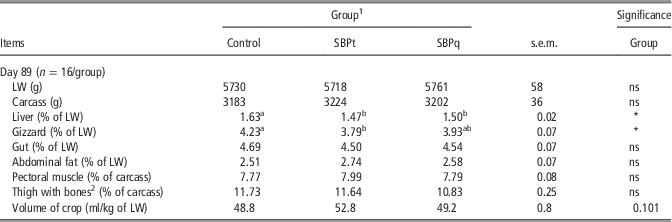
At day 89, the crop volume tended to be higher in SBPt than in the Control group (52.8 v. 48.8 ml/kg of LW, P=0.101). The liver was heavier in the Control group than in the other two groups (+10%; P<0.05), and the gizzard was heavier in the Control group than in the SBPt group (+12%; P<0.05). The gizzard in the SBPq group was intermediate (3.93% of LW). The other body traits were similar in all the three groups (Table 6).
Effect of dried sugar beet pulp in the finisher diet on geese carcass composition at day 89

SBP=sugar beet pulp; s.e.m.=standard error of the mean; LW=live weight.
a,bWithin a row, means with no common superscript differed at P<0.05.
1 Control group: birds have a controlled time of access to the control diet; SBPt group: birds have a controlled time of access to the SBP diet; SBPq: birds have a controlled quantity of SBP diet.
2 Without skin and subcutaneous fat.
*P<0.05; ns, P>0.2.
Bird performance during and after overfeeding
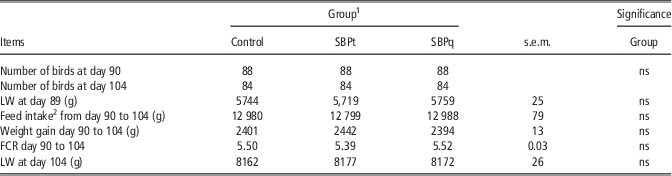
Mortality was similar in all the three groups throughout the overfeeding period (4.5%, P>0.2). Feed intake (12 922 g; P>0.2), weight gain (2412 g; P>0.2), FCR (5.47; P>0.2) and LW at the end of the overfeeding period (8170 g; P>0.1; Table 7) were similar in the three groups. The weight (875 g; P>0.2) and commercial grading of the fatty livers (P>0.2; Table 8) were similar in all the three groups.
Performance traits of geese before, during and after overfeeding

SBP=sugar beet pulp; s.e.m.=standard error of the mean; FCR=feed conversion ratio; LW=live weight; s.e.m.=standard error of the mean.
1 Control group: birds have a controlled time of access to the control diet; SBPt group: birds have a controlled time of access to the SBP diet; SBPq: birds have a controlled quantity of SBP diet.
2 Without water.
ns, P>0.2.
Effect of dried sugar beet pulp in the finisher diet of geese on fatty liver quality before cooking

s.e.m.=standard error of the mean; SBP=sugar beet pulp.
1 Control group: birds have a controlled time of access to the control diet; SBPt group: birds have a controlled time of access to the SBP diet; SBPq: birds have a controlled quantity of SBP diet.
2 Class 1: livers with no defects and <900 g; Class 2: heavy livers (>900 g) with no external defects; Class 3: livers with several defects in appearance or texture.
ns, P>0.2.
Discussion
Greylag geese are mainly reared for fatty liver production, and the feeding programme of birds is intended to prepare them for overfeeding (Guéméné and Guy, Reference Guéméné and Guy2004) – that is, to consume a large amount of food in a short period of time. The development of the crop is a key feature of fatty liver production systems, especially in goose species in which the crop is not a truly differentiated organ (Sturkie, Reference Sturkie1986), but rather an extension of the oesophagus in the form of a pocket produced especially under the effect of the diet. The objective of the experiment was to study the effect of a 10% incorporation of SBP in the finisher diet on hydration capacity of the diet and body development including crop volume and performance of geese during finishing and overfeeding periods. The underlying hypothesis concerned the ability of SBP to naturally adapt the digestive tract of birds to high feed intake, because of its high WHC.
Incorporation of SBP at a proportion of 10% has a strong influence on the SC of the diet (+25% for WHC and +48% for SC at 10 min), as shown previously (Giger-Reverdin, Reference Giger-Reverdin2000). Nevertheless, WHC of the two experimental diets was lower than that reported by Arroyo et al. (Reference Arroyo, Auvergne, Dubois, Lavigne, Bijja, Bannelier and Fortun-Lamothe2012b) for a diet offered to finishing geese (2.33 v. 1.67 g of H2O/g of dry matter in both control diets). This can be explained by the composition, the hardness (Hansen and Storebakken, Reference Hansen and Storebakken2007; Samuelsen et al., Reference Samuelsen, Mjøs and Oterhals2013) and/or particle size of the diets used in our experiment. Indeed, Raghavendra et al. (Reference Raghavendra, Ramachandra Swamy, Rastogi, Raghavarao, Sourav and Tharanathan2004) showed that hydration capacity increased when particles increased from 400 to 600 µm but decreased above 600 µm.
A relationship between hydration capacity of the diet and crop volume at the end of the growing period has previously been shown in geese (Arroyo et al., Reference Arroyo, Auvergne, Dubois, Lavigne, Bijja, Bannelier and Fortun-Lamothe2012b). In the present study, SBP incorporation had a small effect on crop volume, but, independently of the group, the crop volume was higher (48.8 to 52.8 ml/kg of LW) compared with that previously reported by Arroyo et al. (Reference Arroyo, Auvergne, Dubois, Lavigne, Bijja, Bannelier and Fortun-Lamothe2012b; 42.2 to 48.5 ml/kg of LW) with the same line of geese.
SBP incorporation reduced the weight of gizzard and liver before overfeeding, independently of the mode of distribution of the diet (restricted quantity or of time access). This may be because of differences in the size of particles and/or the greater hardness of the SBP diet compared with standard diet, as previously shown (Amerah et al., Reference Amerah, Ravindran, Lentle and Thomas2007; Abdollahi et al., Reference Abdollahi, Ravindrana and Svihus2013). Gizzard weight was reduced when birds had a controlled time of access to the SBP diet (SBPt group). This may result from an interaction between diet composition and its mode of distribution on feed intake, which was lower in the SBPt group than the SBPq group in several periods. We hypothesized that because of its high SC, the SBP diet fills the oesophagus more quickly than the Control diet, accelerating the onset of satiety. When the time of access to the feeder is restricted (as in SBPt group), access to the feeder was denied even when hunger returned, leading to a reduced feed intake.
The present results show that SBP incorporation did not reduce the growth of geese during the finishing period, as previously shown in geese reared for meat production (Arslan, Reference Arslan2003; Arslan, Reference Arslan2005). Furthermore, SBP incorporation decreased the feed intake of geese having a controlled time of access to the diet during the finishing period. This is at variance with the results of Arslan and Saatci (Reference Arslan and Saatci2003) obtained in geese reared for meat production. This suggests that the value of SBP in increasing feed intake in growing geese may not be applicable during restricted feeding. The influence of SBP in a finishing diet provided ad libitum on feed intake and subsequent performance of geese during overfeeding needs, therefore, to be studied. However, the energy content of the finishing diet should be low, as high subcutaneous or abdominal fat deposition before the overfeeding period reduces performance during that period (Arroyo et al., Reference Arroyo, Auvergne, Dubois, Lavigne, Bijja, Bannelier and Fortun-Lamothe2012b).
SBP incorporation in the finisher diet had no influence on performance (feed intake, weight gain, fatty liver quality) during the overfeeding period. Arroyo et al. (Reference Arroyo, Auvergne, Dubois, Lavigne, Bijja, Bannelier and Fortun-Lamothe2012b) have previously shown that the mortality is negatively related to crop volume. Therefore, in the present study, slightly larger crop volumes of birds might have reduced mortality, but it was not the case. However, the mortality observed in the present study was already considerably lower than that reported earlier (4.5% v. 9.8%).
Conclusions
The incorporation of SBP in the diets of finishing geese modified the physical characteristics of diet, mainly SC, and body traits of geese at the end of the rearing period. It had no effect on the birds' performances during growing or overfeeding periods. However, the mode of distribution of the diet interacted with its composition and influenced the feed intake of birds. Therefore, the way this by-product is used in the diet of geese grown for fatty liver production should be further investigated in order to improve its efficiency.
Acknowledgements
The advice and technical assistance of the staff of the Goose and Ducks Breeding Station (Dordogne, France) and of the UMR1388 Génétique Physiologie et Systèmes d’Elevage, especially A. Auvergne, are acknowledged.