More you also desired, but every one of us/ Love draws earthward, and grief bends you with still greater power;/ Yet our arc not for nothing/ Brings us back to our starting place.Footnote 1
—Friedrich Hölderlin
Now it seems to me you return cultivated and ripe back to your youth, and will unite the fruit with the blossom. This second youth is the youth of the gods, and immortal, like them.Footnote 2
—Johann Christoph Friedrich von Schiller
Introduction
Brahms's Schicksalslied, Op. 54, a setting of the poem ‘Hyperion's Schicksalslied’ from Hölderlin's Hyperion, is one of a number of distinctly elegiac works by Brahms. Although many of his instrumental compositions can be described as elegiac, Schicksalslied, along with Nänie, Op. 82, and Gesang der Parzen, Op. 89, can be distinguished from the larger group on account of the nature of their poetic texts. All three compositions are concerned with the legends of Classical antiquity as mediated through the turn-of-the-century New Humanism of Goethe, Schiller and their contemporaries. Furthermore, when viewed as a group these works speak to the poetics of loss in German culture that runs from before these Hellenic humanists up to figures such as Martin Heidegger and Theodor Adorno.Footnote 3
Brahms's interest in the renaissance of Greco-Roman civilization was not a passing intellectual phase. His love for and deep appreciation of the literature of Greek antiquity is evidenced not only by the well-worn copies of the writings of Sophocles, Aeschylus and Homer in his library,Footnote 4 but also by the fact that his friend, the philologist Gustav Wendt, dedicated his 1884 translation of Sophocles to Brahms.Footnote 5 The idea of looking back to antiquity that these Hellenic humanists advocated resonates with Brahms's own focus on musical styles of the past as representative of a lost golden age.Footnote 6 As is the case with many of Brahms's compositions, however, the form of nostalgia found in these poetic texts also looks toward the future.
Brahms's library testifies to the depth of his involvement with the writings of Hellenic humanism.Footnote 7 He shared his profound interest in Schiller and Goethe with those in his circle of cultivated and learned friends in Vienna. His continued interest in the writings of Hölderlin was, however, somewhat more unusual. For this Swabian poet (born in Lauffen am Neckar, near Stuttgart, in 1770) was little understood or appreciated in the nineteenth century. Although he was catapulted to fame in the early years of his adult life, in the second half of the eighteenth century, he was largely viewed with scholarly scepticism because of the madness that isolated him from society for the last forty years of his life, until his death in 1843.Footnote 8 As a result, his work was almost entirely forgotten, and his translations of the texts of Classical antiquity were regarded as the fruits of madness, until the pioneering efforts of early twentieth-century editors.Footnote 9 Brahms is perhaps the only nineteenth-century composer to have set Hölderlin, a poet who seems instead to have captured the imagination of many twentieth-century composers and thinkers.Footnote 10
Brahms's interest in Hölderlin predates the composition of Schicksalslied. We find Hölderlin in the pages of the notebooks that Brahms compiled in his youth to record quotations he especially liked.Footnote 11 Annotations to his 1846 edition of Hölderlin's Sämtliche Werke, and his eventual setting of ‘Hyperion's Schicksalslied’, bear witness to his continued preoccupation with this poet. Although there are no markings on the pages of Hyperion, the Thalia fragment or the poem ‘Hyperions Schicksalslied’ itself, we can learn much from Brahms's annotations in this volume to Hölderlin's other poems.Footnote 12 Singled out for attention are ‘Die Nacht’ (extracted from ‘Bread and Wine’ in Brahms's 1846 edition), ‘Die Heimath’ (‘Home’), and ‘Lebenslauf’ (‘The Course of Life’), all of which are concerned with the human condition, and more specifically, with the dichotomy between nature and civilization, with the ‘cycle of endowment and loss’ as portrayed through the antithesis between the human and the divine, and with humankind's ultimate destiny.Footnote 13
The nature and extent of Brahms's preoccupation with fate-related texts is immediately evident in Figure 1, where his underlining of certain words and, at some points, even particular letters (presumably with an eye to prosody) in Hölderlin's poem ‘An die Parzen’ (‘To the Fates’) suggests that he considered setting this to music. This resonates with his ongoing quest throughout the 1870s and 1880s to find suitable texts that deal with the poetics of loss in a secular manner, evidenced most explicitly in his correspondence with Elisabet von Herzogenberg. On a number of occasions in the years around 1880 Brahms expressed his dissatisfaction with his lot as a composer of spiritual music, and explicitly stated his wish to find ‘heathen’ texts for musical setting. On 14 July 1880 he wrote to Elisabet von Herzogenberg:
A copy of Brahms's annotations to Hölderlin's poem ‘An die Parzen’ as found in his copy of Friedrich Hölderlin, Sämmtliche Werke, ed. Christoph Theodor Schwab, 2 Vols (Stuttgart & Tübingen: J. G. Cotta'scher Verlag, 1846): I: 55. This book is housed in the Archive of the Gesellschaft der Musikfreude in Vienna17

I am quite willing to write motets, or anything for chorus (I am heartily sick of everything else!); but won't you try and find me some words? One can't have them made to order unless one begins before good reading has spoilt one. They are not heathen enough for me in the Bible. I have bought the Koran but can find nothing there either.Footnote 14
In August 1882 Brahms asked Herzogenberg, ‘shall I never shake off the theologian?’Footnote 15 Most likely referring to Gesang der Parzen, Op. 89 he wrote that ‘I have just finished one which is actually heathenish enough to please me and to have made my music better than usual I hope’.Footnote 16
The Hölderlin poem that Brahms set – the artistic, structural and formative heart of Hyperion – is in three verses. The first verse directly addresses the gods, the ‘blessed genii’ who wander ‘above in the light’; the second is a reflection on the condition of the gods, a consideration of the unattainable state of the naïve or the ‘aorgic’; and the third is about ‘suffering mortals’, who – in contrast to the ‘heavenly’ ones – are ‘hurled like water from ledge to ledge, downward for years to the vague abyss’:
This potent Götter/Menschen antithesis is reflected in Brahms's setting, although with altered weight. The work is divided into two halves: the first is bound up with the gods, a setting of verses one and two, and the second is concerned with the pitiful lot of humanity, a setting of the third verse, which is repeated in full. Twice-repeated diminished triads at bars 102–103 delineate this cleft between the divine and the human, between youth and maturity, and nature and art (see Ex. 1).
Brahms, Schicksalslied, Op. 54, bars 94–103 (including the diminished seventh chords at 102–103
Brahms's setting is framed by an instrumental prelude and postlude. The former is 28 bars long and tonicizes E-flat major. Its performance direction, ‘Langsam und sehnsuchtsvoll’ (‘slow and full of longing’), is an unusual tempo designation for Brahms. The Nachspiel texturally elaborates the same thematic material, but now transposed down a minor third to C major. Moreover, in the postlude, following the articulation of the poem, the performance direction is ‘Adagio’. (See Exx. 2a and 2b.) The text–music relationship outlined here has been one of the most contentious aspects of the work's reception.
Troubled Reception of Schicksalslied
As though cast in the shadow of its poet's maligned reputation, Brahms's Schicksalslied has had a troubled reception from the time of its premiere in Karlsruhe in 1871 to the present. The two principal reasons for this are precisely the points just raised, the first of which is the presence of the Nachspiel identified above. This is considered problematic because Hölderlin's ostensibly despairing poem now ends with a section that is widely regarded to evoke comfort and reconciliation. Secondly, the instrumental postlude transposes the thematic material of the E-flat major introduction down a minor third to C major, thereby creating a progressive tonal scheme.
The largely positive response to the work's early performances was mitigated by critics seeking to add another dimension to Hölderlin's poem, an imaginary continuation of its contents, in order to make sense of Brahms's setting. Hermann Kretzschmar, for instance, asserted that Brahms ‘ethically wishes to imply an entire third part of the work’, the interpretation of which required a hermeneutic leap on Kretzschmar's part beyond what is stated either in the poem or in Hölderlin's text. Voices would have been redundant in this Nachspiel, he argues, for they have already ‘mourned, pleaded, and hoped. But the answer comes in other tones, it comes from above […] The choir sang, “below it is dark,” from above the comforting reminder urges perseverance, with the blessed promise: “Above is light”‘.Footnote 19
Others understood the postlude to supplement Hölderlin's poetic message, and interpreted the music as conquering or subjugating the words of the poem.Footnote 20 Eduard Hanslick pointed to such a discrepancy, interpreting Brahms's poem as conveying something that was beyond the expressive capacity of the poem:
In this hopelessness the poet finishes – but not so the composer. It is an extremely beautiful poetic turn, which reveals to us the whole transfiguring power of music. Brahms returns, after the final words sung by the choir, to the solemn, slow movement of the opening, and dissolves the confused hardship of human life in a long orchestral postlude, in blessed peace. In a touching and generally accessible way, Brahms conveys this train of thought via pure instrumental music, without the addition of a single word. The instrumental music here replenishes and complements the poem, and it articulates that which can no longer be expressed in words.Footnote 21
In Leipzig, the anonymous critic of the Allgemeine musikalische Zeitung surmised that ‘such an ending [as Hölderlin's] could seem permissible to a musician. The poetic justice, however, demands resolution and reconciliation. And so enters a bright, comforting Nachspiel in C major, which takes the thoughts of the introduction and brings them to a satisfactory conclusion in a small orchestral section of really wonderful harmonic and instrumental effect’.Footnote 22 None of these critics, however, countenanced the notion that Brahms's setting was faithful to the context of Hölderlin's book.
Such divisive views persist in more recent commentary, which charge Brahms with either fundamentally misunderstanding or consciously contradicting Hölderlin's poetic message. Michael Musgrave argues that the text ‘posed a problem for Brahms in ending in despair, with mankind plunged “headlong into the abyss”, thus denying him the opportunity, always exploited in the texts of his own selection, for ending with consolation, with a hope of some kind’.Footnote 23 Malcolm MacDonald is convinced that Brahms has been faithful to the despondent nature of the ending of Hölderlin's poem. He finds ‘the “hopeless longing” aroused in the postlude’ to underscore ‘the impassability of the divine/human cleft in Hölderlin's poem. Brahms's ultimate decision to close without recourse to words thus reinforces the conviction that verbal recall would create only a false sense of comfort’.Footnote 24
Similarly, James Webster notes that ‘despite Brahms's love for the poem’, it lacked ‘some hope of consolation’, with the result that Brahms's setting ‘violates no fewer than three fundamental aesthetic principles: fidelity to the sense of the text, tonal coherence, and the assurance of closure by the use of all performers at the end’.Footnote 25 Christopher Reynolds adds that whereas ‘Brahms ultimately rejected the notion that the choir should repeat the earlier verses at the end,’ his ‘qualms’ did not prevent him ‘from patching on a seemingly unmotivated reprise of the opening instrumental music, which even without words bewildered listeners struggling to understand what Brahms's conciliatory ending contributed to Hölderlin's despairing text’.Footnote 26 Peter Petersen puts it most forcefully by asserting that the postlude is ‘a rare instance of a composer not merely placing an arbitrary interpretation on words but explicitly contradicting a poet's statement’.Footnote 27
This fraught reception can be attributed to two related scholarly tendencies, the first to underestimate the sophistication of Brahms's appreciation of the poetic texts he set, the second for musical commentators to attempt to force Brahms's literary settings into an existing formal scheme.Footnote 28 For, unlike much of Brahms's instrumental output that evinces a closed form, this choral work is open ended and does not meet such formal requirements. The resistance to viewing Schicksalslied in this manner is perhaps bound up with how scholars view the poem itself.
Commentators on Schicksalslied have regarded the interpolated poem that Brahms set as a self-contained entity, a fragment that is divorced from the broader context of Hölderlin's book. Yet, ‘Hyperion's Schicksalslied’, as we shall see, is the poetic nucleus of this epistolary novel. Hyperion belongs to the genre of the Bildungsroman. The poem that Brahms set, for reasons that will be elucidated below, is intricately bound up with the spiritual journey embarked upon in the book; it encapsulates its manifold contradictions and dissonances and, in bringing these to their peak, clarifies the poetic, moral and philosophical direction of the journey of hero and reader alike. Moreover, such a reading of this Bildungsroman might well have occurred to Brahms because of his considerable knowledge of, and meaningful engagement with, the poetic and literary writings of Hölderlin, Schiller and Goethe.
This article, therefore, looks anew at Brahms's Schicksalslied and its ending in the full context of Hyperion, the literary and philosophical tradition to which it belonged, and Brahms's literary and intellectual preoccupations at the time of composition. Drawing on musical and hermeneutic analysis of Schicksalslied, on post-Kantian philosophy, on Brahms's annotations of pertinent books, and on literary theory, I dispute the notion that Brahms's setting is at odds with Hölderlin's poetic message. Rather, I make the case that precisely because of the tonal trajectory of its ending, amongst other features, we can meaningfully consider this work to assume the characteristically Romantic shape of the spiral. Consequently, Brahms's Schicksalslied can be understood as a musical manifestation of the notion of Bildung that prompts reflection and realization on the part of Brahms's listener akin to that of Hölderlin's reader. This proposed interpretation of Schicksalslied further prompts a reassessment of the extent to which Brahms's intellectual pursuits informed his compositional process.
Schiller, Goethe and the Renaissance of Classical Antiquity
German Idealist aesthetics – especially in Schiller's formulation, which was to have such a profound impact on Hölderlin – were inspired by a perceived disjunction between imperfect reality and ideal. The imperfect reality refers to modern Germany, both at the level of the individual and society. It concerns the modern condition that has seen mankind as a unified whole fall into a state of fragmentation and opposition. This splintering of primal unity was brought about with the mechanization of modern man whereby the individual became increasingly highly developed in one faculty or function at the expense of the whole, at the cost of the harmonisch gebildeter Mensch. Schiller analyses the condition thus:
Enjoyment was divorced from labour, the means from the end, the effort from the reward. Everlastingly chained to a single little fragment of the Whole, man himself develops into nothing but a fragment; everlastingly in his ear the monotonous sound of the wheel that he turns, he never develops the harmony of his being, and instead of putting a stamp of humanity upon his own nature, he becomes nothing more than the imprint of his occupation or of his specialized knowledge.Footnote 29
The ideal, on the other hand, refers to the perceived wholeness that existed prior to this destruction by modern civilization. It refers to a golden age of Classical antiquity, when man was a creature of instinct, unspoiled by reason.Footnote 30 A re-imagination of the scriptural account of a paradise lost formed the basis for a secular philosophical humanism that would witness the recovery of the lost unity of the mind and spirit of humanity through the development of the intellect and culture. This conceptual design of the past, present, and future of human history was given powerful expression by Hellenic humanists for whom, as M.H. Abrams formulates it, ‘the right-angled biblical pattern of Paradise–Fall–Redemption–Paradise Regained’ was assimilated and re-imagined in the ‘post-Biblical circular pattern of Unity–Multiplicity–Unity Regained’, that is, a ‘Neoplatonic circular scheme of emanation and return’.Footnote 31
Schiller is regarded as having provided the most sophisticated theory of such unity in On the Aesthetic Education of Man and On Naïve and Sentimental in Poetry. In the latter he makes a distinction between a naïve character – a childlike nature, a state of innocence, which is all but lost – and a sentimental character – a nature that seeks the naïve, and engages in a reflective, retrospective contemplation. Schiller clarifies that the naïve is unattainable for humanity: it requires a victory of art over nature, which entails both a heightened consciousness and an attempt to reflect on nature. The naïve, therefore, although it yearns for a state of innocence, is not comparable to innocence, because it exists solely in one's awareness of it.
The dialectical thrust of Schiller's distinction is that ‘neither the naïve nor the sentimental’, taken alone, exhausts the ‘ideal of beautiful humanity’, which ‘can only arise out of the intimate union of both’.Footnote 32 In order to heal the (self-)inflicted ‘wound’ – which has severed the ‘inner union of human nature’ – one must strive for wholeness.Footnote 33 This is to be found in Schiller's concept of the ‘aesthetic’, that is, a belief in education through art.Footnote 34
Here Schiller parted ways with the aesthetics of Kant. Whereas Schiller was indebted to Kant as a critic, both he and Goethe recognized a deficiency in the subjective basis of Kant's aesthetic system. Although convinced that pleasure in beauty must be disinterested, Schiller could not dissociate art from virtue. He and Goethe agreed that Kant's critical philosophy taught much about man but very little about art and beauty.Footnote 35 These Weimar Classicists aspired to a state of mind that would transform intellectual into moral virtue.
Thus, a moral imperative underpins the notion of Bildung that characterizes the work of these authors. Schiller and Goethe corresponded at length on this topic, which caught Brahms's attention – and captured his imagination – as he highlights and annotates many such passages in his copy of their Briefwechsel. Of particular note is a letter from Schiller to Goethe of January 1797 which we might allow ourselves to imagine Brahms may have read as though it were addressed to him:
I should wish particularly to know the chronology of your works. It would not surprise me, if, in the developments of your being, a certain necessary course in the nature of man were not traceable. You must have had a certain, not very short, epoch, which I might call your analytic period, wherein through division and separation you struggled toward wholeness; wherein your being was as if it were fallen out with itself and sought to reinstate itself again through Art and Science.
Now it seems to me you return cultivated and ripe back to your youth, and will unite the fruit with the blossom. This second youth is the youth of the gods, and immortal, like them.Footnote 36
The concept of Bildung encapsulated in this passage, and the literature it gave rise to, with its characteristic assimilation of philosophical thought, gripped the German artistic imagination throughout the nineteenth and twentieth centuries. At the heart of this philosophical and literary movement is what Constantin Behler terms ‘nostalgic teleology’– that is, ‘the classical German theory of modernity, in which typically an idealized image of ancient Greece anchors a critique of an alienated present that is to be dialectically overcome in a utopian third stage of history’.Footnote 37 Each of the texts Brahms chose for the works that espouse the poetics of loss engages in one way or another with this ‘nostalgic teleology’, confronting the dichotomy between the real and the ideal, between nature and a higher spiritual world. It is to Friedrich Hölderlin's attempt to reconcile these differences in Hyperion that we now turn.
The Caesura in Hölderlin's Theory of Tragedy
Hölderlin's Hyperion or the Hermit in Greece – as the full title reads – is written in the spirit of Sophoclean tragedy, a central tenet of which is an acceptance of circumstances endemic to the human condition over which mankind exerts no control. Hölderlin's translations of Sophocles, with which he was preoccupied for many years, profoundly influenced the writing of this novel and the theoretical writings on tragedy to which Hyperion is intimately connected.Footnote 38 A number of facets of this theory are crucial to understanding the structure and meaning of the novel.
First, central to the struggle of Greek Tragedy, according to Hölderlin, are the conflicting drives of what he calls the ‘aorgic’ and the ‘organic’.Footnote 39 The ‘aorgic’ is loosely comparable to Schiller's concept of the ‘naïve’. It is the ‘condition of highest simplicity’Footnote 40 and represents nature prior to human intervention.Footnote 41 Also referred to as a ‘Greek unicity’, the ‘aorgic’ is unattainable, because humanity's only access to it is through a conscious realization that it is lost.Footnote 42 The ‘organic’ (setting aside any connotations of organic compounds or growth) is loosely comparable to Schiller's concept of the ‘sentimental’. It is the ‘condition of highest development’ that humans are capable of giving themselves.Footnote 43 It represents the peculiarly human activities of self-action, art and reflection. Hölderlin considered what he refers to as the ‘eccentric orbit of all human life’ to run between the two poles of the ‘aorgic’ and the ‘organic’.Footnote 44 The path of life for Hölderlin, therefore, entails contemplating the relation between reflection and being, between real and ideal, between art and nature.
In the published prologue to Book 1 of Hyperion, Hölderlin gave great emphasis to the notion of a ‘resolution of dissonances in a particular character’.Footnote 45 Such dissonance, discernible on numerous levels in the novel, is most apparent in the struggles and hardships that face the protagonist (amongst them suffering and death), the antithesis between the divine and the human, and the tension between past and present, and youth and maturity, here played out in the contrast between modern society and the great heroic age of Greece.
Schiller's influence on the young Hölderlin was matched only by the latter's spiritual and intellectual exchange during the early 1790s with his friends and fellow students at the Tübingen Seminary, Hegel and Schelling. Each not only identified with the spirit of the French Revolution, but also shared a great deal of circumspection regarding Kant's critical philosophy.Footnote 46 The extent of their scholarly exchange and interaction was such that the exact authorship of their collaborative essay ‘The Oldest Programme for a System of Idealism’ remains unknown.Footnote 47
In his own way, each of these men intuited and recorded a process ‘from a world-embedded consciousness to a philosophically reflective one’.Footnote 48 This process, as Schelling explicates it, consists in the clarification ‘of that which is utterly independent of our freedom, the presentation of an objective world which indeed restricts our freedom, through a process in which the self sees itself develop, through a necessary, but not consciously observed act of self-positing’.Footnote 49 The process to which Schelling refers would later acquire the name ‘dialectic’ and was to be taken up and perfected in Hegel's Phenomenology of Spirit.Footnote 50
Hölderlin channelled the intellectual energy of this philosophical triumvirate into his poetry and literature. The result is the poet's singular thinking regarding beauty. His point of departure is that the great saying of Heraclitus ‘εν διαϕερον εαυτω (the one differentiated in itself) … is the very being of Beauty, and before that was found there was no philosophy’.Footnote 51 For Hölderlin, beauty is manifest through unity-in-diversity, and offers a resolution of difference in aesthetic experience. As the hero proclaims in the novel, ‘Poetry […] is the beginning and end of philosophical knowledge. Like Minerva from the head of Jupiter, philosophy springs from the poetry of an eternal, divine state of being. And so in philosophy, too, the irreconcilable finally converges again in the mysterious spring of poetry’.Footnote 52 Aspiring to the same concept of wholeness as Schiller – and anticipating Nietzsche and Heidegger – Hölderlin believed in a dialectical scheme whereby ‘division and difference’ and ‘suffering and confusion’, are the ‘conditions of experiencing unity’, and it is precisely in these conditions that ‘unity or wholeness manifests itself’.Footnote 53
It does so at the point at which the opposition between the ‘aorgic’ and the ‘organic’ reaches its highest peak. Hölderlin calls this the ‘caesura’ and in his notes on the tragedies of Sophocles he locates this watershed moment in the speeches of Tiresias.Footnote 54 He elaborates:
Hence the rhythmic succession of ideas wherein the transport manifests itself demands a counter-rhythmic interruption, a pure word, that which in metrics is called a caesura, in order to confront the speeding alternation of ideas at its climax, so that not the alternation of the idea, but the idea itself appears.Footnote 55
The ‘caesura’ is comparable to a catastrophe in the literal sense: it entails a double-movement, ‘a complete (kata) destruction and overturning (strophé) of the old, thus opening onto a new beginning’.Footnote 56 It does nothing to change the course of events. Rather, the moment of the caesura is a decidedly prophetic one. By crystallizing the moment of deepest tragedy and conflict, it is the catalyst for a fundamental change of perspective brought about by a piercing moral clarity, and it thus marks the point at which humanity, through suffering, becomes wise. This crucial point of reversal or inversion speaks to the idea that ‘a poem or a dramatic work turns on a moment of suspension or discontinuity’.Footnote 57 As Adler and Louth attest, this literary device is a constant of Hölderlin's poetics’.Footnote 58
Fate and Tragedy in Hyperion
Hyperion comprises a series of letters written to the recipient Bellarmin, in which the hero records a spiritual journey of ‘reflection and realization’. In what has become known as the Thalia Fragment – published before the novel in 1794 in the journal Thalia and outlining the proposed trajectory for the complete work – Hölderlin charted the book as tracing the development of a character from a state of ‘highest simplicity’ (höchste Einfalt) brought about by the mere organization of nature, with no human intervention, to a state of highest formation (höchste Bildung), through the organization that humans are capable of giving themselves.Footnote 59 The published book proceeds through three successive stages, in each of which we become acquainted with one of the hero's three companions. By the end of the novel, Hyperion will have lost all three, and the reader will have shared in the numerous moments of fulfilment that end in his disillusionment or loss. Hyperion's relationships, therefore, involve a repetitive, increasingly intensified experience.
There is first his revered mentor Adamas, who represents learning and awakens Hyperion's consciousness from a state of childlike innocence; second, his friend Alabanda, the guardian of his soul, who represents friendship, yet also conflict and dissonance; and third, his beloved Diotima, the ideal of beauty and perfection in the world. Diotima teaches Hyperion humility and shows him the path back to the natural beauty of the world, and to the human realm, all of which she does through love.
Most eighteenth-century epistolary novels, from Rousseau's La nouvelle Heloise, are characterized by subjective expression. In Die Leiden des jungen Werther, Goethe emphasized this subjectivism by including only letters by Werther himself and the voice of the editor. Hölderlin takes this a step further by making Hyperion his own editor.Footnote 60 We learn of this hero's tale through his first person account to Bellarmin, in which he is both ‘subject and object of his own discourse in a way that Werther, always writing out of an immediate situation, is not’.Footnote 61 As Hyperion narrates his own life, the reader witnesses him coming ‘to discern in it a pattern and coherence he had not been able to grasp at the time of experiencing’.Footnote 62 Consequently, the reader of Hyperion accompanies the character Hyperion on his spiritual journey and the artist Hölderlin-Hyperion on his artistic journey towards becoming a poet. Both paths are fused, and the story of loss and disillusionment is ‘recounted in a philosophically resigned but poetically transformative retrospect’.Footnote 63
M.H. Abrams's explication of the romantic notion of ‘the ascending circle, or spiral’ is apposite to the form of this book. It is written as a secular Bildungsroman in which Hyperion must earn his return to wholeness by ‘incessant striving along a circuitous path’.Footnote 64 This speaks to the spiral form that many Romantic figures considered to be the shape of all intellection, and in which they ordered their philosophies (for instance, Hegel's Phenomenology of Spirit), their histories (for instance, Carlyle's Past and Present and Karl Marx's writings on capitalism) and their fictional writings (for instance, Wordsworth's The Prelude and Goethe's Wilhelm Meisters Lehrjahre). Abrams provides a compelling and lucid account of how this Christian experience is intentionally reconstituted into secular thinking in the works of Goethe, Schiller, Hegel, Hölderlin, Wordsworth and T. S. Eliot, amongst others:
The mind of man, whether generic or individual, is represented as disciplined by the suffering which it experiences as it develops through successive stages of division, conflict, and reconciliation, toward the culminating stage at which, all oppositions having been overcome, it will achieve a full and triumphant awareness of its identity, of the significance of its past, and of its accomplished destiny. The course of human life […] is no longer a Heilsgeschichte but a Bildungsgeschichte; or more precisely, it is a Heilsgeschichte translated into the secular mode of a Bildungsgeschichte.Footnote 65
The self-education of the mind is also a central trope of the Romantic philosophy of consciousness. The figure of the circuitous journey homeward, as Abrams formulates it, is developed into a sustained vehicle for Hegel's Phenomenology of Spirit (1807), which recounts a spiritual journey from the ‘moment’ of departure of an alienated self until it finds itself ‘at home within itself in its otherness’.Footnote 66 The goal of this spiritual Reise is ‘an ultimate recognition of the spirit's own identity’.Footnote 67
This circuitous path is reimagined in Hyperion, which the author makes explicitly clear to the reader in the Thalia fragment of 1794:
We all pass through an eccentric path, and there is no other way possible from childhood to consummation [Vollendung].
The blessed unity, Being (in the only sense of that word) is lost to us, and we had to lose it if we were to gain it again by striving and struggle. We tear ourselves loose from the peaceful en kai pan of the world, in order to restore it through ourselves. We have fallen out with nature, and what was once one, as we can believe, is now in conflict with itself, and each side alternates between mastery and servitude. … Hyperion too was divided between these two extremes.Footnote 68
As we make our way through the novel, privy to the powerfully intimate nature of Hyperion's correspondence, we experience the increasing intensity of his joys and the depths of his grief. Because each stage in the development of the novel ‘involves transformation and regression as well as growth and progression, Hyperion becomes a meditation on identity, time, and memory’.Footnote 69 This incorporates three temporalities: that of an earlier time to be recollected, the narrated present (the time at which the poet recalls the past – and the poem), and narrative time (when the poet formulates and tells of the multifaceted effect that such recollection has on him). In the course of composing this autobiographical narrative, as Abrams notes, ‘Hyperion has recollected, faced up to, and to a degree comprehended his own past’.Footnote 70
Hölderlin breaks the epistolary form only once in the book, to insert the interpolated song accompanied by a lute that Brahms would later set to music. This occurs in the fourth book at a juncture that marks the lowest ebb in Hyperion's fortunes. His hope in revolution has been dashed; due to his world-weariness, the elderly Alabanda has chosen to end his life by Romantic suicide; and Hyperion will soon learn of the death of his beloved Diotima. It is here that Hyperion recalls the song learned from his revered teacher Adamas during an earlier, immature time and, in his time of loss, he narrates it to Bellarmin. The recollection of the interpolated poem occurs in the letter that marks the chronological endpoint – but not the actual ending – of the novel. The poem itself is therefore supratemporal in its intersection of the three temporalities within the novel outlined above – an earlier time, the narrated present, and narrative time.
This poem, then, serves the crucial function of the caesura in Hölderlin's tragedy: it is the expression of catastrophe, epitomizing that term's double meaning of both destruction and renewal. In experiencing the acute division and conflict between his self and his outer world, and in suffering utter devastation and deprivation whilst at once feeling elation at his union with the universe, Hyperion reaches the farthest poles of his eccentric orbit. Lawrence Ryan points to the structural significance of the poem, observing that ‘in the context of the novel, this song marks the very depth of suffering which soon turns into a new bliss (Seligkeit). […] Schicksalslied is thus a turning point in the novel’.Footnote 71 From here, Hyperion will turn back. Yet he does so self-consciously, aware that his suffering and anguish have afforded him a deeper insight into beauty and humanized nature.
The process of recollection, and the circularity which it entails, is crucial to understanding Hölderlin's novel and to our reading of Brahms's setting of its poetic nucleus, for, the depth of despondency and dissonance that is articulated in this song is the agent of its own resolution. To put it more explicitly, the caesura of Hölderlin's Hyperion as articulated in this poem contains its own resolution, from which it cannot be separated.
Hölderlin's eccentric path, and perhaps also Brahms's, is both autobiographical and vocational. As Abrams sees it, ‘the act of writing Hyperion is […] a functional part of the autobiography itself, on which its conclusion turns’, and this very act has led towards the vocation of the poet: ‘at the end of the novel Hyperion is beginning to be the poet Hölderlin himself now becomes’.Footnote 72Hyperion, therefore, as Michael Minden expresses it, epitomizes ‘the figure of autobiography redeemed by art’.Footnote 73 The passage with which Hölderlin has Hyperion introduce the poem is a testament to his redemption in that it bespeaks a level of maturity and wisdom that the younger Hyperion had not known:
I stayed by the shore and, wearied by the pains of parting, gazed silently at the sea, hour after hour. My spirit told over the sorrowful days of my slowly dying youth and waveringly, like the beautiful dove, flitted over the time to come. I wanted to strengthen myself, I took out my long forgotten lute to sing a Song of Fate that once in happy, heedless youth I had repeated after my Adamas.Footnote 74
Here Hölderlin inserts the poem. The reader will observe that the preposition with which the poem concludes – ‘hinab’ (‘downward’) – ‘signifies a direction, not an ending’.Footnote 75 This speaks to Hölderlin's understanding of a poem being as a metaphor. For Hölderlin, a poem literally ‘carries’ something ‘across’ into sensible form.Footnote 76 In encapsulating and juxtaposing all of the extremes of this novel, ‘Hyperions Schicksalslied’ brings to bear the fact that Hölderlin's poetry integrates that which ‘seems to lie outside it – the unpoetic – in order to be its “highest form”‘,Footnote 77 for, as he boldly expresses it in his famous ‘Verfahrungsweise’ essay (‘When the Poet is at Once in Command of the Spirit …’), at ‘this point the spirit is feelable in its infinity’.Footnote 78
Following the poem, Hyperion continues to narrate his recollections to Bellarmin, paying particularly poignant attention to the letters in which Diotima reassured him that ‘perfection’ [Vollendung] is attainable in ‘change’ as well as in ‘continuity’. The letter containing the poem (that is, the chronological endpoint of the novel) ends in a manner that speaks to a resolution of dissonance, and an acceptance of suffering and conflict. The caesura results in the ensuing effusive paean to the naïve, which extols the rewards of sentimental reflection:
Ye airs that nourished me in tender childhood, and ye dark laurel woods and ye cliffs by the shore and ye majestic waters that taught my soul to surmise your greatness – and ah! ye monuments of sorrow, where my melancholy began, ye sacred walls with which the heroic cities girdle themselves, and ye ancient gates through which many a beautiful traveller passed, ye temple pillars and thou rubble of the gods! and thou, O Diotima! and ye valleys of my love, and ye brooks that once saw her blessed form, ye trees where she rejoiced, ye springtimes in which she lived, lovely with her flowers, depart not, depart not from me! yet if it must be, ye sweet memories! grow dim ye too and leave me, for man can change nothing and the light of life comes and departs as it will.Footnote 79
The Sophoclean and the dialectical bent of the novel are given further powerful expression in Hyperion's exclamation to Bellarmin, that ‘like nightingale voices in dark, the world's song of life first sounds divinely for us in deep affliction’.Footnote 80
Form and Tonality in the Song of Destiny
Analysts have tended to view Schicksalslied within the framework of sonata form. Timothy Jackson, for instance, considers this work to have a ‘tragic reversed recapitulation’ in which Brahms sacrifices the recapitulation of the first group.Footnote 81 (See Table 1) This interpretation is based purely on formal features and avoids all hermeneutic elements of the piece, including the poetic text. It takes no account of the correspondence between the introduction and the coda that lie outside Jackson's sonata space, cyclic elements that are further bound up with the psychological journey of the piece and its attendant reflection and sense of contemplation. For Jackson, the circularity of this sonata space – which he sees as a metaphor ‘for entrapment or flight without escape’ – is attributable solely to the reversed sonata.Footnote 82 Nonetheless, this thematic material of the first group is never brought back in the tonic.
Summary of Jackson's formal outline of Schicksalslied

John Daverio analyzes the work as a double-sonata form, whereby the first sonata form maps onto the first two verses of Hölderlin's poem, eschewing a development section, while the second sonata form, concerned with Hölderlin's depiction of the pitiful lot of mankind, ostensibly includes all of the formal functions of a sonata. (See Table 2) Daverio does not account for the lack of a development section in what he deems to be the first of these conjoined sonata forms, nor does he explain the lack of cadential structures demarcating the formal functions he outlines.Footnote 83 Most significantly, he restricts his discussion of Brahms's setting to the poem as a self-contained entity divorced from the book. The hermeneutic gap that Daverio attempts to bridge, I assert, is not present if Brahms's composition is considered in relation to the entire novella.Footnote 84
Summary of Daverio's formal outline of Schicksalslied
Note for all tables: After William Caplin: I:PAC denotes a perfect authentic cadence on the tonic. Cadences occur at the end of the span of bars indicated. FF = Formal function; LSF = Large-Scale Function.
This is precisely because our understanding of the poem is integral to how we understand the piece. By limiting our field of vision to seeing the poem as a self-contained entity, and interpreting the piece as a closed form, we severely limit the scope of our hermeneutic reading. This is borne out in Daverio's hermeneutic interpretation. Although he goes so far as to acknowledge that the poem is a ‘mise en abyme, an encapsulated summation of the contraries informing the novel as a whole’, he does not take the next step, which is to recognize that the purpose of the poem within the novel is to bring about a resolution of dissonance. His mapping of Brahms's Schicksalslied onto Hölderlin's theory of poetics seems to draw more on knowledge of the theory of Hölderlin's poetry, than on the poetry. Hölderlin's theory is diagnostic, not prescriptive.Footnote 85 Daverio uses it in a prescriptive manner, hence his conclusion: ‘Only with the reflective orchestral Nachspiel do we come up against a problem, for here Brahms does overstep the structural bounds of his text. The music […] modulates, so to speak, out of the fundamental tone of Hölderlin's text, closing as it does with suffering humanity's blind plunge into the abyss’.Footnote 86
Accordingly, not only are attempts to make Schicksalslied fit the sonata mould problematic, they also hinder hermeneutic analysis. Brahms's op. 54 is distant from this formal paradigm for two fundamental reasons. First, the dominant is never firmly established in the first half of the piece; second, the material heard on (as opposed to in) the dominant in the first half of the work is never later heard in the tonic. Thus, Brahms's Schicksalslied does not establish the polarization or opposition that Charles Rosen sees as fundamental to the sonata-form paradigm, nor does it meet the ‘obligation for tonal resolution’ that Hepokoski and Darcy deem to be the defining feature of a sonata.Footnote 87
If we think of Schicksaslied as a setting of the poetic nucleus of Hölderlin's novel as articulated in this poem, charges of the violation of aesthetic principles and of arbitrary interpretations that contradict the poet's statement no longer stand. A nuanced and sophisticated reading of Hölderlin's poem in its narrative context opens a window onto a more compelling reading of Brahms's composition, particularly given that Brahms was conversant with the spiritual journey of the Bildungsroman and was evidently quite taken with the philosophy of consciousness in its literary guise.Footnote 88
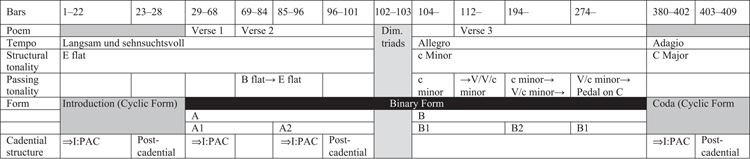
By way of a new interpretation of this work, I propose that Brahms's Schicksalslied evinces a hybrid form singularly placed to accommodate its directional tonality: a large binary structure contained within a cyclic frame. Table 3 summarizes these findings. The introduction and the coda serve framing functions within Brahms's setting. They are not designated with letters or numbers by which to denote their formal sections and subsections, because they stand outside the binary form.
Formal outline of Brahms, Schicksalslied, op. 54Footnote *
* After William Caplin, I:PAC indicates a perfect authentic cadence in the tonic. All cadences occur at the end of the given span of bars.
At a cursory level, this binary form corresponds to the potent Götter/Menschen antithesis of Hölderlin's novel. The A section can profitably be conceived of as a setting of the first and second verses of the poem. Brahms's A1 music has a close affinity to Hölderlin's concept of the ‘aorgic’ – an unattainable state of innocence. Following the establishment of the tonic at bar 39, the optimistic mediant rise at bar 41 reflects Hölderlin's mention of the ‘mild breezes’ of the ‘radiant gods’ that ‘gently play on you’. This is shortly followed by a further mediant rise to B♭ at bar 52. The dominant is never firmly established here, however (as is shown in the structural tonality, passing tonality and cadential structure rows of Table 3). A return to the realm of the tonic is implied in the A2 material beginning at bar 69, which contemplates the heavenly life of the gods, before the B section addresses the human condition, the ‘organic’. It is in this latter section, as we shall see below, that the music is at its most dissonant, perhaps expressive of all the division and conflict experienced in the eccentric orbit of human life. Encapsulating this binary opposition is the cyclic frame of the introduction and orchestral postlude, a framework that gives musical expression to the process of recollection fundamental to the genre of the Bildungsroman.
Elaborating on the work of Hepokoski,Footnote 89 Benedict Taylor recently theorized a ‘Romantic conception of cyclic form’ in his work on Mendelssohn's cyclic designs.Footnote 90 There he speaks in the plural of ‘cyclic forms’, his categorization dealing predominantly with multi-movement works. The cyclic principle, Taylor argues, ‘involves musical recall above the level of the individual movement’, with the exception of ‘a single-movement structure whose coda corresponds to the introduction’, as is the case with Schicksalslied. Yet, unlike Brahms's other essays in cyclic form, including the Symphony No. 3 in F major, op. 90, and the String Quartet No. 3 in B-flat major, op. 67, the Song of Destiny does not evince a tonal unity.Footnote 91
Although shifting tonality was nothing new by 1871, the tonal design of Schicksalslied with its directional tonality is highly innovative in Brahms's œuvre. A late-nineteenth century trajectory from E-flat major to C minor within this binary structure will elicit few remarks. It is the fact that Brahms framed this structure with the correspondence yet simultaneous alienation of the introduction and coda (by turns E-flat major and C major) that marks this work apart, and vexes Heinrich Schenker's theory of monotonality,Footnote 92 for the implied symmetry of the thematic recollection is not mirrored in the tonal plan. An exploration of the significance each of these tonalities held for Brahms will give a further dimension to this analysis.
I am inclined, with Michael C. Tusa, to dismiss scepticism at ‘prior associations of key with character’, instead thinking of such associations as ‘part of the background of expectations, conventions, traditions, and individual works that informed the creation and reception of new works in the nineteenth century’, even if within the œuvre of a single composer.Footnote 93 The E-flat major in which Schicksalslied begins is a key Brahms had used on only three occasions in his compositional output before op. 54. Each of these works is elegiac in nature. The Variations in E-flat on a Theme by Schumann (variations based on a theme that Schumann composed shortly before his suicide attempt in February 1854) end with a ceremonial funeral march;Footnote 94 the Trio for Piano, Violin and Horn, op. 40 has as its second movement an elegy on the death of Brahms's mother in the tonic minor, and the whole work was written in her memory;Footnote 95 and the fourth movement of Ein deutsches Requiem, op. 45, ‘Wie lieblich sind deine Wohnungen’, is also in the key of E-flat major. Although it was composed later than Schicksalslied, the Violin Sonata No. 1 in G major, op. 78, with its central Adagio in E-flat major, also is suggestive in this context. The closing theme from the opening Allegro reappears in the slow second movement, expressively transformed into a funeral march that Brahms explicitly associated with the death of Felix Schumann.Footnote 96 We can therefore designate E-flat major as a tonality to which Brahms repeatedly turned in works associated with loss and bereavement, with each of these works being decidedly wistful and melancholic in nature.Footnote 97
These E-flat major pieces, moreover, tend to transition out of the realm of mourning. The Requiem provides a particularly interesting case as, before Brahms added the fifth movement, ‘Ihr habt nur Traurigkeit’, the tonal trajectory from the fourth movement to the next (now sixth), ‘Denn wir haben hie keine bleibende Statt’, would have corresponded to that of Schicksalslied.Footnote 98 The E-flat that celebrates the dwelling place of the gods would have given way to the tumultuous C minor that gives voice to the woes of humanity, ultimately ending with the triumph of victory over death in C major. In the Violin Sonata, the theme expressively transformed as the funeral march in the second movement reappears one last time in the G minor finale, a movement that ends in the major.Footnote 99 All four works inhabit the same emotional sphere that prompted Adolf Schubring rather candidly to describe Brahms's Schumann Variations, op. 23 in terms of a ‘determined pulling oneself together, shared with outbreaks of quivering pain’.Footnote 100
The twice-repeated diminished triads heard in the winds and horns that directly precede Brahms's setting of Hölderlin's third verse (as shown in Ex. 1), and delineate the cleft between the human and the divine, could go either to E-flat major or C minor. Brahms's choice of the latter key for this turbulent setting of verse 3 afforded him the opportunity to employ a long-range tonal trajectory from C minor to C major over the second half of the work. This progression is redolent of the characteristically expressive course from sorrow or struggle to comfort and reconciliation that was common currency in the nineteenth century. Nonetheless, from Haydn's time on, as James Webster argues, resolutions into C major constituted the most important class of this topos, for this progression ‘retained a special character, especially in conjunction with notions of the sublime and of transcendence.’Footnote 101 Webster categorizes the most meaningful C minor to major progressions since Haydn that must have been highly significant to Brahms, including, but not limited to, Haydn's ‘Chaos’ from The Creation, Beethoven's Fifth Symphony, the finale of Schubert's String Quintet, and Act I of Wagner's Tristan und Isolde.Footnote 102 In Brahms own output, we find this progression not only in Schicksalslied, but also in the Alto Rhapsody, the Symphony No. 1, and the sixth movement of Ein deutsches Requiem.
Brahms's extraordinary and intricately linked choices of form and tonality – from the elegiac E-flat major, via the turbulent C minor, to the transcendent C major – resonate closely with three characteristics that are central to Hölderlin's Hyperion, each of which has far-reaching implications for this musical setting: first, the three temporalities within the poem explored above, which can be further understood in terms of ‘torrential time’ (reißende Zeit, a term Hölderlin associated with revolutionary turmoilFootnote 103) and a ‘time of maturity’ (reifenden Zeit);Footnote 104 second, the ‘resolution of dissonance’ within the novel; and, third, the manner in which the articulation of this dissonance – the caesura or rupture – is the agent of its own resolution. It is to the manner in which we can discern such resonance in the details of Brahms's musical setting that we now turn.
The Caesura in Schicksalslied and Brahms's Ascending Circle
With deep artistic affinity to Hölderlin's poetry, and in keeping with the rebirth of a new identity at the end of a secular Bildungsroman, Brahms's circle is incomplete. The beginning of Schicksalslied, as Christopher Reynolds astutely notes, ‘sounds like a culmination, like a well-prepared conclusion’,Footnote 105 whereas, because the final bars do not employ all of the instrumental and vocal forces heard up to this point, the ending evades a full sense of closure. This is entirely appropriate for a composition written in the spirit of the Bildungsroman whose journey is circuitous by necessity. As Hegel explains, ‘it is a circle that returns into itself, that presupposes its beginning, and reaches its beginning only in its end’.Footnote 106
The work opens with an arrestingly beautiful melody on muted violins supported harmonically by strings and winds, with pulsating timpani ostinato on the tonic. Brahms gives new meaning to this music upon its return in the coda with the use of a number of subtly sensitive alterations. When the opening melody reappears (as shown in Exx. 2a and 2b), the restless timpani ostinato has ceased. The composer intended the erstwhile violin melody, now heard on the flute, to be played upon its return with ‘passion and beauty’, its ethereal tones transcending the ‘large section of violins’.Footnote 107 The strings, now dolce, play an undulating arpeggio figure, serving to enhance the ‘Er-Innerung’Footnote 108 of this ending, that is, the manner in which it remembers, internalizes, and re-participates in its evolving consciousness.
Brahms, Schicksalslied, Op. 54, orchestral introduction, bars 1–7
Brahms, Schicksalslied, Op. 54, orchestral postlude, bars 380–392
The Allegro C minor section that lies between this E-flat major opening and its ethereal C major return has a furious energy not found elsewhere in the piece. This is brought about by a number of factors. As Jackson observes, Brahms does not, in fact, establish the tonic of C minor, but rather suggests it by prolonging its dominant.Footnote 109 The unfulfilled nature of the music is intensified by the relentless quaver motion in the strings, reminiscent of the sixth movement of the German Requiem, combined with the oppressive four-part choir singing here for the first time in strict unison. All this characterizes the music that flanks the B2 section (that is, the music from bars 104–178 and 274–332, as outlined on Table 3). What lies between is music with developmental tendencies: it is the most harmonically free music within the piece, yet it is also tonally directed, as it establishes the unique tonal trajectory of the ending.
The overlapping circular figures in the strings, from bar 179, announce the dominant of the dominant whilst providing respite from the frenzied pace. The fugal rendition of the first two lines of verse three has an eddying motion redolent of the transformation and regression as well as growth and progression that characterize Hölderlin's novel (bars 194–251). The swirling arpeggios that ushered in the secondary dominant now introduce the dominant of the ultimate tonic. The relentless quaver motion and the unison voices of the choir return as the suffering mortals fall headlong into the abyss. The texture is saturated with diminished seventh chords, which are at their most pronounced on the word ‘blindlings’ (headlong or blindly) before the hemiolas that evoke the symbolism of water thrown from ledge to ledge culminating in the terrifying fortissimo ‘jahrlang’ (for years) of bars 314–316. This takes place over a sustained pedal on C, posed as the dominant of F. Its energy spent, and the dynamic reduced from the fortissimo outbursts to a sustained piano, the music hovers here for no fewer than 54 bars (bars 326–379). Contemplating the vague abyss, and conscious of the division and conflict between the self and the outside world, Brahms's setting is now at its most dissonant.
Rather than continuing in the tonal direction adumbrated thus far, however, the music turns back, opening onto a new beginning. This is the definitive moment of the caesura in Brahms's composition, the ‘pure word’, as Hölderlin would have it. It marks the very moment when the subject has been objectified and now recognizes itself. As Hegel formulates it:
On the one hand … [consciousness] alienates itself and in this alienation sets itself off as object. … On the other hand there is in this very process the other moment in which [self-consciousness] has equally transcended this alienation and objectification and taken it back into itself, and so is at home with itself in its otherness as such.—This is the movement of consciousness.Footnote 110
Brahms was certainly conversant with the Romantic plot archetype that underpins the philosophy of consciousness, for he highlights a lengthy passage in letter No. 809 in the Schiller–Goethe Briefwechsel, in which Schiller, taking issue with Schelling's System of Transcendental Idealism, addresses precisely the dichotomies central to Hölderlin's Hyperion: between the conscious and the unconscious, between what Hölderlin would later term the ‘aorgic’ and the ‘organic’, the two extremes of the ‘eccentric orbit of all human life’:
I fear, however, that these Gentlemen of Idealism [such as Schelling is] pay too little attention to experience in their ideas, and, in experience, the poet also begins with the Unconscious. Indeed, he may consider himself lucky if, in the completed work, he only comes so far through the clearest Consciousness of his operations as to find once again the first, obscure total-idea of his work unweakened.Footnote 111
The return to the thematic material of the introduction in this altered manner, I propose, transfers the poetic idea to the object of music, thereby giving musical form to the movement of consciousness, so that the listener can now experience the orchestral postlude from a different and much enhanced perspective. When considered in this way, this moment plays out just as Foucault characterizes it in his discussion of Hölderlin's Hyperion, as ‘the improbable unity of two beings as closely aligned as a figure and its reflection in a mirror’.Footnote 112 In listening to (and experiencing) the postlude to Schicksalslied, we ‘arrive where we started/And know the place for the first time’.Footnote 113
Taken together, the unique tonal trajectory of this work, the refined alterations in orchestration and expression, and the consummate treatment of form invite the listener to experience the musical material of the introduction anew and with heightened awareness. This ending, therefore, calls to mind a moulding of musical material into the characteristically Romantic shape of an ascending circle or spiral. Brahms's musically ‘eccentric path’, like Hölderlin's, leads us away from the original unity in order to restore it, in a heightened manner, through ourselves. This postlude prompts reflection and realization on the part of Brahms's listener akin to that of Hölderlin's reader.
Epilogue: Brahms and the Literature of Humanity
The composer's well-known indecision, throughout 1871, regarding this ending has undoubtedly vexed the question as to the work's hermeneutic meaning. Brahms addressed this subject in a number of letters to his friend Karl Reinthaler that year, in the elusive manner that characterizes his enigmatic correspondence. Writing in October, he confessed that, where his setting of Hyperion's song is concerned, ‘I certainly say something that the poet does not say and, to be sure, it would be better if what's missing were in fact his main concern’.Footnote 114
Commentators have taken this as an indication that Brahms granted himself poetic license to ‘overstep the structural bounds of [Hölderlin's] text’.Footnote 115 His comment can be interpreted differently, however, in light of our recognition of the structural significance of the caesura in Hölderlin's writings. Ian Balfour clarifies that at this pivotal juncture in much of Hölderlin's output ‘the one truth … must not be written or spoken, only “circumscribed”, literally written around’.Footnote 116 Might Brahms, therefore, have been paying tribute to this very quality in Hölderlin's writings – that which Carola Nielinger-Vakil eloquently terms the poet's characteristic ‘art of leaving things unsaid’?Footnote 117 If so, we might more usefully interpret his comment as ‘I simply say something that the poet does not explicitly say and, to be sure, it would be better if what's missing were in fact his main concern’.
Furthermore, throughout Brahms's deliberations, there is no evidence to suggest the slightest uncertainty regarding either the tonal trajectory or the formal structure of the ending of this work. He initially composed a coda that included the choir singing excerpts from the first two lines of the poem, ‘Ihr wandelt droben im Licht auf weichem Boden’ in homophonic chords from what would have been bars 390–395, and a polyphonic interweaving of voices on the words ‘selige Genien’ from bars 402–406. It was this ending that Brahms shared with Hermann Levi in May 1871, and that Levi copied in piano reduction (reproduced as Fig. 2, and transcribed as Ex. 3). The composer subsequently thought better of including these words, and wondered if the solution might not be to let the choir instead hum ‘ah’ in the specified bars. Max Kalbeck reports that following his discussion with Levi, Brahms took a pencil and scratched the choir out of the postlude altogether.Footnote 118
The piano reduction of Brahms's proposed ending for Schicksalslied in May 1871 in Levi's hand, housed at the Brahms Institut an der Musikhochschule, Lübeck
Hermann Levi's transcription of Brahms's proposed ending for Schicksalslied, in May 1871 in piano reduction, transcribed from the original held at the Brahms Institut an der Musikhochschule, Lübeck. This would have followed on from bar 380
The question of the extent of Levi's influence on the final composition has never been fully addressed. A newly discovered letter from the conductor to Brahms, which is found on the reverse of the piano reduction in Figure 2 (housed at the Brahms-Institut, Lübeck), seems to indicate that Levi's input concerned only matters of instrumentation and choral and orchestral balance.Footnote 119 (This letter is reproduced in Fig. 3.) The fact that Brahms had on an earlier occasion paid attention to “some of the remarks that [he] mumbled shyly at the piano,” Levi writes, had given him the courage to offer some further suggestions. Here the conductor proposes, for instance, adjustments to the balance of timpani and bass in the opening, and a reconsideration of a flute entry that he deems to look better on paper than it sounds in practice (at bars 56–57). Nowhere, however, does he make any suggestions regarding matters of large-scale form or tonality. Nor does he give any indication that such matters had arisen in earlier conversations.Footnote 120 Evidence seems to suggest, therefore, that Levi's influence was limited to helping Brahms reach his decision regarding the absence of the choir in the postlude. Indeed, both the piano reduction in Levi's hand and the autograph score of the composition, now housed at the Library of Congress confirm that matters of form and tonality were finalized by May 1871.Footnote 121
Letter from Hermann Levi to Brahms found on the reverse of the ending in Hermann Levi's hand (Fig. 2), and housed at the Brahms Institut an der Musikhochschule, Lübeck
In Christmas of that same year, Brahms's yuletide greeting to Reinthaler picked up on their earlier exchange when the composer quipped that ‘Hyperions's Schicksalslied’ is ‘not the kind of poem to which one can tack something on’.Footnote 122 I venture that this statement indicates Brahms's full appreciation of the completeness [or perfection – Vollendung] of Hölderlin's poem. By Christmas 1871, Brahms was happy to allow his wordless and tonally anomalous ending stand on its own merit as a representation of a heightened consciousness, for the ontological implications of his ascending circle were at that point entirely clear to him. We can profitably think of his last utterance to Reinthaler regarding the inappropriateness of words in his Nachspiel in the same spirit as the maxim with which Heidegger would later preface his commentaries on Hölderlin: ‘for the sake of what has been composed, commentary on the poem must strive to make itself superfluous’.Footnote 123
I bring together here the artistic voices of Brahms and Heidegger not by happenstance, but by way of highlighting the poetic vision with which Brahms chose, interpreted and set Hölderlin's poetry. It took literary critics more than a century to discover the structure of Hyperion ‘since it is folded into the thematic and philosophical texture of the book’.Footnote 124 Yet, in his setting, Brahms intuited its complex poetic and philosophical meaning with an artistic sensitivity to Hölderlin that was not to be equalled until the late twentieth century. In the intervening years, the poet's reputation suffered, as a consequence of what Robert Savage refers to as his ‘state of spiritual benightedness’.Footnote 125 Following his rehabilitation in the early twentieth century, the misappropriation of his poetry by the National Socialists saw a renewed demise of Hölderlin's reputation.Footnote 126 Both Heidegger and Adorno were key figures in the post-war re-evaluation of this poet.Footnote 127 Their writings, in turn, were instrumental in attracting numerous composers to the works of Hölderlin in the late twentieth century including Hanns Eisler, Heinz Holliger, Luigi Nono, Wolfgang Rihm, György Ligeti and Hans Werner Henze.Footnote 128
What these late-twentieth-century composers were undoubtedly drawn to in Hölderlin, as was the case with Brahms in the late 1860s, was ‘the literature of humanity’.Footnote 129 This entails ‘a belief in the possibility and significance of formation, “Bildung”, which applies equally to the individual human life and to the individual work of art’.Footnote 130 By intricately interweaving compositional process in Schisksalslied with intellectual tradition and philosophical thought, Brahms bestowed upon posterity a musical manifestation of Bildung in the form of a quintessentially Brahmsian fabric.