Introduction
The search for records from the missing Franklin expedition (1845–1848) ended with the return of the Franklin search expedition of 1878–1880 better known as ‘Schwatka's search’. It was commanded by Lieutenant Frederick G. Schwatka (1849–1892) and was under the sponsorship of the American Geographical Society (AGS). The society had developed in part as an American response to the growing interest in the Arctic brought about by the tragedy of the Franklin expedition. Its support came from a number of prominent New York businessmen including Henry Grinnell (1799–1874) who was its first president. Included among these were James Gordon Bennett (1841–1918), proprietor of The New York Herald and Charles Patrick Daly (1816–1899) a New York Supreme Court judge and president of the society at the time of the Schwatka expedition (Wright Reference Wright1952: 155).
The purpose of the expedition was to retrieve books and records that Captain Thomas Barry had alleged were located in a cairn on ‘an island in the Gulf of Boothia’ (Stackpole Reference Stackpole and Schwatka1965: 13). Barry had reported, among other things, that there were no valuables ‘only the books . . .’ (Barry Reference Barry1880: 277). For Bennett the prospect of an expedition in search of the records had the important prospect of increasing his readership (Riffenburgh Reference Riffenburgh1993: 74). Although Schwatka did not discover the books and records, he did bring back a number of relics and the remains of Lieutenant John Irving (1812–1847). He also interred the remains of a number of others. The expedition also endured some of the coldest temperatures recorded to that time in polar exploration. The material found produced the foundation for forensic research that came to dominate efforts to understand the fate of the Franklin expedition in the 20th century.
The purpose of this article is to provide an understanding of Schwatka's search that goes beyond what is found in the modern Arctic literature. The discussion focuses on those factors that shaped Schwatka and what he brought to the expedition, in the context of the Franklin search efforts at the time, and aims to provide an evaluation of Schwatka's organisation and management of the expedition and its legacy. The research is primarily based on documents produced during the period of the expedition. Because it was a private expedition there were few records beyond those left by the immediate participants. Inferences and conclusions have been drawn by triangulation among the available materials including Schwatka's address to the AGS on his return, and books by William Henry Gilder (1838–1900) and Henry Klutschak (1848–Reference Schwatka1890) and Schwatka's journal (Daly Reference Daly1880b; Gilder Reference Gilder1881b; Klutschak Reference Klutschak1881; Schwatka Reference Schwatka and Stackpole1965). The two books were written for commercial gain although pure sensationalism did not prevail. Gilder's book resulted from a series of newspaper articles in The New York Herald. His approach has been seen as positive, indeed ‘no previous Arctic adventurer had written at such length or in such detail for newspapers’ (Riffenburgh Reference Riffenburgh1993: 75). There are some differences among the various articles and reports with regard to names, places, and spellings. However, these are not substantial.
Schwatka the American
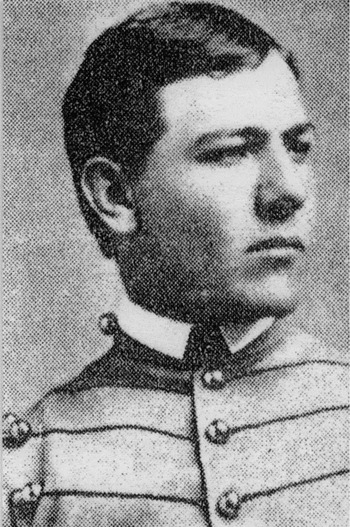
Schwatka's family originally migrated to the United States from Danzig (now Gdansk in Poland). They first settled in Galena, Illinois, where Schwatka was born on 29 September 1849, and then moved to Astoria in the Oregon Territory in 1850. They then moved again, first to Albany, Oregon, and then later to Salem, Oregon in the Willamette Valley in 1859. His father was a cooper and his elder brother was a printer who helped him secure positions with two newspapers in Salem, The Statesman and The Willamette Farmer in which he first read about Arctic exploration. He attended Willamette University in Salem and then received a prestigious appointment to West Point, the United States Military Academy, from whence he graduated in 1871 (Fig. 1). He was commissioned with the rank of lieutenant and was then assigned to the 3rd Cavalry, a unit in which he served in the Indian Wars of 1871–1876 during which he came to appreciate the culture of American natives (Cullum Reference Cullum1891: 429). Schwatka was in the first class at West Point to receive the advantage of a new curriculum that ‘provided a balance among natural sciences, social sciences, humane letters and practical instruction in military matters’ (Johnson and others Reference Johnson, Johnson, Jeanes and Deaver1984: 5). During his military career he studied the law in Nebraska and was admitted to the bar in Omaha in 1875 and, as a result of work with Army surgeons in Arizona and Nebraska during campaigns, he obtained a residential internship at the Bellevue Medical College in New York City from which he qualified as doctor of medicine with a thesis on diphtheria in 1876 ‘which he identified as an infectious disease, an early recognition of the germ theory of disease’ (Johnson and others Reference Johnson, Johnson, Jeanes and Deaver1984: 6–7). He went to Wyoming and was involved in the defeat of the Sioux Indians during which his leadership prowess was marked by his ability to organise his men to supply food to starving troops (Finerty Reference Finerty1890: 248).
Frederick G. Schwatka, West Point class of 1871.

From the time of his youth, Schwatka was familiar with Arctic exploration and especially with the search for Sir John Franklin and while serving at Ft. Vancouver, Washington, he responded to the call of the AGS for a commander for their planned search for the Franklin documents. He wrote to Daly at the AGS and offered his services. ‘The letter intrigued the President of the American Geographical Society and he invited the young army officer to come to New York’ (Stackpole 1865: 14). Daly was impressed by Schwatka's interest and knowledge and wrote to William T. Sherman, Secretary of War, to grant Schwatka leave of absence to undertake the expedition. This award was approved by President Rutherford B. Hayes.
After Schwatka's return from the expedition, he began to explore, in 1883, Alaska and the Yukon River as a part of an American army assignment. His expedition ‘was the first complete exploration of the Yukon River.’ ‘However, he failed to note significant traces of gold that would soon transform Alaska’ (Goetzmann Reference Goetzmann1986: 428–429). Soon after his return from this expedition, he resigned his commission in order to pursue his own exploration interests under the sponsorship of The New York Times. He devoted much energy to lecturing and writing based on his subsequent expeditions to Alaska in 1891 and to Mexico in 1891, 1889 and 1890. Most focus on the Apache and the Sioux and among them are a number of anthropological and ethnographic studies about American Indians with a focus on women and children (Schwatka Reference Schwatka and Schwatka1893, Reference Schwatka1886, Reference Schwatka1887, Reference Schwatka1890–Reference Schwatka1898). His ‘The sun dance of the Sioux’ remains a classic work documenting ceremonies not open to European Americans of the period (Schwatka Reference Schwatka1890). Unlike many explorers before him, he took pains to understand native peoples and their cultures and as a result he treated them in a fair and just manner. Interestingly, except for one printed version of a lecture to the AGS, he wrote little about his own search in the Arctic although he wrote a great deal about his observations of Inuit culture and customs (Schwatka Reference Schwatka1883a, Reference Schwatka1883b, Reference Schwatka1884b). His narrative of the expedition was not published until 1965 by which time, of course, other accounts had already appeared (Schwatka Reference Schwatka and Stackpole1965; Gilder Reference Gilder1881a, Reference Gilder1881b; Klutschak Reference Klutschak1881, Reference Klutschak and Barr1987).
An important lesson from Schwatka's military service was the value of understanding the culture of native peoples and the importance of treating them with fairness and equity. Although he sometimes used the words ‘rude’ and ‘savage’ to describe the Inuit and even remarked on their odour, this was simply the language of the times (Schwatka Reference Schwatka and Stackpole1965: 18). He was not one to hide differences but saw cultural traits as something from which to learn. His behaviour was in contrast to some previous Arctic explorers who often viewed the Inuit with disdain or put up with them as necessary elements in Arctic exploration. His admirers often did not fully appreciate his ways: he has ‘matched himself with savage man, and by sheer intellectual force beaten the savage on his own ground . . .’ (Hayes1880: 260). In contrast he wrote I am ‘somewhat disgusted with the Shylock manner with which they had been treated previously’ (Schwatka Reference Schwatka and Stackpole1965: 19). His respect for the Inuit and their respect for him paid off in the search and its success was ‘ascribed to his wide knowledge and correct handling of his men’ and especially the Inuit (Klutschak Reference Klutschak and Barr1987: 13).
Schwatka was part of the American exploration tradition of the nineteenth century: he was more than an adventurer seeking glory. These explorers were pioneers, literally in his case, but also figuratively because they brought new dimensions to exploration. Many came from humble backgrounds that saw the challenges and opportunities of exploring and documenting the opening of the American west. The westward movement was driven by ‘manifest destiny’, the almost religious notion that underlay geographic expansion. The west was seen ‘through a blaze of mystical fervour, as part of a grand geopolitical design, the overture to global harmony . . . and the home for millions . . .’ (Stegner Reference Stegner1953: 2). It was the right and duty of America to occupy the American continent and this notion received support from the government. The army was given the primary role in the expansion. Although led by army personnel, this was not a military operation per se (Ambrose Reference Ambrose1996). The explorers not only had the responsibility for mapping the continent but also of systematically understanding the native people and recording and collecting the varieties of flora and fauna. It was embodied in ‘the Corps of Topographical Engineers [that] brought the hand of the government and the skills of science to the exploration of the West’ and ‘they became the servants of a rapidly growing America whose citizens echoed the cry “Westward the course of empire takes its way”‘ (Goetzmann Reference Goetzmann1986: 168). It was a programmed effort with regard to its mission, organisation and goals and objectives (Goetzmann Reference Goetzmann2000: 5). ‘The Army performed a variety of highly useful civil functions in the interwar years, despite the new professionalism that decried such activities as contrary to the natural purpose of an army’ and prominent among these were exploring expeditions (Stewart Reference Stewart2005: 316–317). The first of these was the Lewis and Clark expedition of 1803–1806 (Ambrose Reference Ambrose1996). Among other important explorers were John C. Fremont (1813–1890) and John Wesley Powell (1834–1902) (Stegner Reference Stegner1953).
Personally, Schwatka was a large and jovial man who had both the mental training and physical discipline to undertake the demands of leadership. He enjoyed good health in his early life, due to ‘habits of life and mental training’, and had a cheerful disposition with great powers of concentration. He impressed people as having ‘a stomach that can relish and digest fat . . .’ (Gilder Reference Gilder1881b: 240, 241). Unfortunately he died an ignominious death on 2 November 1892 on the streets of Portland, Oregon after a self-administered dose of the narcotic laudanum, a drug that he often used to control a long-standing stomach ailment. He was buried in the Odd Fellow Rural Cemetery on 4 November 1892 (Savitt Reference Savitt2007: 271). His short career exhibited a strong belief in expanding knowledge of the world in which he lived; he brought a passionate and purposeful message to the American public about the continent and especially about its native peoples. He was a renaissance figure who ‘clearly combined the talents of the serious scientist, the courage and drive of the adventurer, and desire to be a public media hero that so captured mass enthusiasm at the end of the nineteenth century’ (Goetzmann Reference Goetzmann1986: 429).
Schwatka's search in the Arctic literature
Schwatka's achievements in his successful Arctic search have not been fully appreciated in contemporary polar literature. This is contrast to the acclaim that he received on his return. Schwatka's search was described as ‘a journey unparalleled in the history of Arctic travel’ (Hayes Reference Hayes1880: 258). Clements Markham (1830–1916) offered a similar opinion in 1880 although he made no reference to Schwatka in The lands of silence in 1921 in which a complete chapter is given over to ‘Discovery of the fate of Franklin’ (Markham Reference Markham1880, Reference Markham1921: 272–278). Leopold McClintock (1819–1907) also lavished praise on Schwatka. In his ‘Introduction’ of June 1881 appearing in the1908 edition of The voyage of the ‘Fox’ in the Arctic seas, published after his death, he praised Schwatka's efforts, the length of the sledge journey, and his resolution in facing the exceptionally cold weather. (McClintock Reference McClintock1908: 77). Savours provides a brief review of Schwatka's expedition including direct reference to the comments of Markham and McClintock (Savours Reference Savours1999: 301–302). Vaughan provides a more complete discussion and concludes that ‘Schwatka had proved an outstanding leader, in dealing with both expedition members and the Inuit travelling with them’ (Vaughan Reference Vaughan1994: 178). Yet one of the most important studies of sledging only offers a perfunctory observation about Schwatka; he undertook ‘extensive sledging but seems to have added little to the development of sledge designs or methods’ and, in spite of an extensive table of major sledge journeys, does not acknowledge the length of Schwatka's journey (Pearson Reference Pearson1995: 10).
Three major volumes arose from the expedition and a brief, near contemporary, summary appeared in 1884 in a volume describing American exploration on the ice (Nourse Reference Nourse1884). William Henry Gilder (1838–1900), second in command, published Schwatka's search in 1881. As noted, the book was based on a series of articles he wrote for The New York Herald and elsewhere (Gilder Reference Gilder1881a, Reference Gilder1881b). Gilder, first and foremost was a journalist who was given the assignment by Bennett of accompanying Schwatka. His descriptions of the search had a sensational air but were good reporting. Gilder was an accomplished Arctic traveller, who ‘gave a more enlightened record of Arctic travel than virtually any of his predecessors’ (Riffenburgh Reference Barr1993: 75–76). ‘Gilder wrote with more understanding than most of his contemporaries about sledge travel, dogs, native populations and their customs, and living off meagre Arctic resources’ (Riffenburgh Reference Riffenburgh1993: 81). After the expedition, Gilder proceeded to another expedition in the accounts of which he extolled Schwatka's advice (Gilder Reference Gilder1883: 316). Gilder's account describes the challenges of the journey and also presents a significant amount of ethnological material including an appendix on Inuit philology and a brief glossary of Inuit terms (Gilder Reference Gilder1881b). A small volume aimed at young readers without a clearly designated author offers brief glimpses of the search. It appears to be drawn from Gilder's articles and Schwatka's presentation to the AGS in 1880. The ‘editor’ notes that much ‘has been condensed from an exhaustive statement by Colonel Gilder which appeared in the months of September and October 1880 in The New York Herald’ and a summary of comments by Schwatka to the AGS (Anon. 1897: 97). It contains similar materials to those found in a narrative by Schwatka published in 1965 under the editorship of E.A. Stackpole (Schwatka Reference Schwatka and Stackpole1965).
This account is a small volume of 117 pages including drawings and maps and an epilogue by the editor that summarises the achievements of the expedition. It is drawn from Schwatka's report to the AGS (Schwatka Reference Schwatka1880: 256–258, 1965: 116). It was forgotten for nearly 75 years when it reappeared and was published by the Marine Historical Association (Stackpole Reference Stackpole and Schwatka1965: 11). Schwatka's voice is bland and descriptive and varies only in rare circumstances. For example, when on his return to Hudson Bay to be collected for the trip home he discovers that Captain Barry has deserted them, he exhibits some quite reasonable irritation. ‘Neither the schooner nor her master had awaited our return; in fact, the men upon whose story our expedition had been founded had virtually abandoned us’ (Schwatka Reference Schwatka and Stackpole1965: 113). His address to the AGS in October 1880 is a matter of fact document, although he took great pleasure in describing his achievements, the length of sledge journey, the sadness of dealing with the remains of the lost crews, and his regard for his colleagues. ‘To my subordinates, officers and men, white and native . . . their cordial co-operation and harmonious working as a whole’ (Schwatka Reference Schwatka1880: 258). Although, later, he wrote about the culture of the Inuit, methods of hunting musk oxen, and on navigation in the polar regions, he never produced a comprehensive work of his experiences such as Hall had done (Schwatka Reference Schwatka1883a, Reference Schwatka1883b, Reference Schwatka1884a, Reference Schwatka1884b, Reference Schwatka1885a; Hall Reference Hall1970). He continued to have an interest in Arctic exploration and wrote an article ‘The next polar expedition’ which he believed should be the one to reach the North Pole, offering alternative approaches including one using the Zemlya Frantsa–Iosifa [Franz Josef Land] route proceeding from a base in Spitsbergen, (Schwatka Reference Schwatka1889: 158). That, of course, was an interesting precursor to Frederick George Jackson (1860–1938) and the Jackson-Harmsworth expedition, 1894–1897 (Jackson Reference Jackson1898).
The third volume arising from the expedition was originally published in German by Henry Klutschak (1848–1890) in 1881 as Als Eskimo unter den Eskimos [As an Inuk among the Inuit] and was not available to the English readership until it was translated and published in 1987 as Overland to Starvation Cove (Klutschak Reference Klutschak1881, Reference Klutschak and Barr1987). Much as Gilder's, this volume describes the sledge journey, living among the Inuit, the discoveries of relics and remains, and the difficult return journey. Klutschak's materials differ slightly from Gilder's because he and Frank Melms, an experienced whale-man, spent about 7 weeks in a separate search (Gilder Reference Gilder1881b: 2). He was less reserved with his criticism of previous search expeditions, ten and twenty years previously, which, he considered, had not fully expended their resources. They ‘were right on the site of the deaths of this large number of men, too quickly declared themselves satisfied with easy achievements, instead of following the clues they found to the very uttermost’ (Klutschak Reference Klutschak and Barr1987: 112). As with Gilder and Schwatka, he provides anthropological insights concerning the Inuit, and indeed his particular objectives were to ‘become acquainted with the Inuk in his unmodified condition as a child of the North, to demonstrate his capacity for being civilized, and to prove that it is possible to use him to advance geography and the natural sciences . . .’ (Klutschak Reference Klutschak and Barr1987: 3). The volume is enhanced by William Barr's ‘Introduction’ and by an ‘Afterword’ by Owen Beattie who completed extensive research on the remains in the 1980s (Barr Reference Barr and Klutschak1987: Beattie Reference Beattie and Klutschak1987).
Because the search was a private expedition no formal report beyond Schwatka's presentation to the AGS was ever produced. (Nourse1884: 363). Why Schwatka did not to do more with his materials is unclear but there are some possible reasons. In the first instance he had little time to engage in the production of a book as he was required to return to active military service and was assigned to plan for the 1883–1884 expedition to Alaska and the Yukon, areas that were to dominate his exploration interests for the rest of his life (Schwatka Reference Schwatka1885a, Reference Schwatka1885b). In the second case, it appears that he did not want to get caught up in the continuing discussion of cannibalism, a topic discussed more fully later. While that was interesting to some, he seemed to understand the limits of what was acceptable and unacceptable and in any case it reduced the significance of his journey itself. In his lecturing and writing career he was always careful with controversial matters.
His focus was the adventures and the peoples. The description of him as ‘one of the first mercenaries of exploration, a man who would travel anywhere, if he had sufficient financial incentive’ indicated that Schwatka was careful in his writing, he was interested in adventure not exploitation (Riffenburgh Reference Riffenburgh1993: 111). Interesting examples of his discretion are found in his many letters to Gilder between 11 February 1889 and 2 December 1891 in which he discusses a number of schemes ranging from additional expeditions to the publication of materials to the development of gold mines but never does he raise controversial matters. In one dated 4 April 1890 he assures him that his advice on a gold mining project comes from ‘a resident of this region for the past 22 years and . . . a practical surveyor and mining engineer; so there is very little chance of his leading us into a “wild-cat” scheme’ (Schwatka Reference Schwatka1890). In reality the various expeditions of the last years of his life left him little time to write about his Arctic search. Alaska, the Yukon and Mexico appealed much more to the American reading public at that time than did stories about searches in the Arctic for dead men.
The reports of Captain Thomas Barry
Barry's reports were the stimuli for the AGS's interest and sponsorship for the search for the Franklin records but their inaccuracies had the potential for wreaking death and destruction on the search party. Besides being the bearer of this information, he served as captain of Eothen, the vessel that transported Schwatka's expedition to Hudson Bay in 1878.
His reports concerning the fate of the Franklin expedition, especially about the availability of records and relics, began as early as 1872. Between 1871 and 1873, Barry served as the second officer on the American whaler, Glacier. During an overwinter at Repulse Bay, he heard the Inuit describe ‘a stranger in uniform who had visited them some years before and who was accompanied by other white men’ (Gilder Reference Gilder1881b: 3). His knowledge of the local Inuit language, which he claimed to have acquired on Depot Island in 1864, provided his confidence for believing that what he had heard was authentic. Beyond the specifics, the Inuit provided him with some vague information about the direction that the men had come from and what they had in their possession. Barry recollected that they had seen many articles but could not say much more than that the men had died. ‘They said nothing about valuables being put in the cairn or cache; only the books—putting their hands on my journal in the cabin and said that they were of no value to them’ and ‘that they are still there’ (Barry Reference Barry1880: 277).
In 1876, when Barry was second mate of A. Houghton, he claimed to have received a spoon with an engraving whose identity was unknown to him. Later it proved to be Franklin's crest. He tried to have the Inuit show him the location where the spoon had been discovered by inspecting a map. ‘They followed the chart up, and very carefully, the same as others had done [1872], and stopped at Cape Englefield [Inglefield]; and without any prompting on our part, looked for the island in the Gulf of Boothia, the same as others had done’ with a gesture pointing to an unidentified island that they said was ‘there’ (Barry Reference Barry1880: 277). The island where the cairn could be found was King William Island. ‘The natural inference was that the books that they saw in a cairn with silverware and other articles from the Erebus and Terror were probably the records of Franklin's Expedition . . .’ (The New York Herald 24 September 1880: 5). In reality ‘this was a false report’ although that was not known at the time (The New York Times 11 December 1881: 6). ‘Eskimo Joe’ Ebierbing (ca.1837–ca.1881) who had been with Elisha Kent Kane (1820–1875) and Charles Francis Hall (1821–1871) and who would accompany Schwatka, gave some credence to Barry's statements although this was imprecise (Loomis Reference Loomis1986). Ebierbing questioned whether Barry understood the Nestilingmiut language. Furthermore he noted that the Nestilingmiut did not live on King William Island and wondered if they had told the truth about these matters since they believed that the Europeans might blame them for the deaths. ‘They might, therefore fool the white men when talking to them; but I think it probable that what the Netchilli [Nestilingmiut] told Barry at Marble Island, when he was there with Capt. Potter might be true’ (Ebierbing Reference Ebierbing1880: 281).
In addition to Ebierbing's mixed opinions, Daly had received two letters written in 1877 by McClintock and John Rae that are appended to materials presented to the AGS on Schwatka's return (Daly Reference Daly1880b). Both were sceptical about the report of records. McClintock reviewed Rae's and Hall's expeditions as well as his own and he was doubtful about the existence of the records. He did not believe that any ‘more definite traces than relics such as spoons, &c., which have probably passed through native hands’ will be discovered. He goes on to discredit the Barry claim that ‘graves, mounds or cairns are tangible things, and if readily accessible, render it easy to test the truth of the report under consideration. I believe that the Esquimaux are truthful; but I have not much confidence in this interpretation of their words’ (McClintock Reference McClintock1877: 283). Rae's is even stronger. He asserts that ‘a few footsteps in the snow, has by a lapse of time and frequent repletion grown into a very considerate mountain’ and the ‘whole report brought home by Barry I believe to be a mistake in all its important particulars, and if the Franklin records are ever found, it certainly will not be anywhere in the neighbourhood of Cape Inglefeld’ (Rae Reference Rae1877: 288).
There is no record concerning what Schwatka thought about the arguments contradicting Barry's reports before he left. It appears that he saw the expedition as an important opportunity to fulfil his interests in the Arctic as well as to enhance his own status as an Army officer. If the reports turned out to be incorrect or even false, he could make adjustments in his plans. Once he arrived in Hudson Bay he became suspicious about the claim when he was unable to find the guides that Barry had identified. Furthermore the specific locations identified by Barry were unclear and created problems for the search because they were too far apart to include both in the time available. More distressing was that one of guides that had been engaged ‘was supposed to be one of those natives who had seen the cairn’ but neither he nor a cousin of his knew anything of it (Schwatka Reference Schwatka and Stackpole1965: 35). Gilder took on the responsibility of enquiring into the truth of Barry's story about the spoon that was central with regard to the location of the records. He pursued a three month investigation and he learned that there had never been more than three families of Nestilingmiut living with the Aivilingmiut. As to the individuals involved he learned that one had died and the other had only heard the story from his mother. ‘The third, Nu-tar-ge-ark, a man of about forty-five year or fifty years of age, gave us valuable information’ (Gilder 1881: 29). Moreover, there were inconsistencies within Barry's story. The Inuit said that he ‘had not given the spoon to Captain Barry, but to the wife of Sinuksook, an Iwillik [Aivilingmiut] Esquimaux, who afterward gave it to a Captain Potter . . . she distinctly remembered having given the spoon to Captain Potter. It was necessary, therefore, to find this officer’ which they did. Potter ‘had never heard anything about it until he read in the newspapers that Barry had sent one to Sir John Franklin's niece, Miss Cracroft, which surprised him very much. He further said that he had received three spoons at that time, one of which mysteriously disappeared shortly afterward. The published description of Barry's spoon corresponded exactly with the one he [Porter] had lost . . .’ (Gilder Reference Gilder1881b: 39).
In spite of the false claims, Schwatka, Gilder, Klutschak, and Melms decided to proceed in the hopes of finding some evidence of the Franklin records. Schwatka ‘felt sure that the mysterious cairn to be found would be in King William Land [Island], and my companions agreed’ (Schwatka Reference Schwatka and Stackpole1965: 36). So began their journey. Not only did they face the dangers of being sent off on a wild goose chase, but they also faced the dangers from a greater problem created by Barry that they did not discover until their return from King William Island. He did not keep his ‘word that he would await our return’ and on reaching their base at ‘Camp Daly, our first discovery was as sad as it was shocking—the greater portion of the party's trading materials, and other stores placed in Captain Barry's charge, had disappeared with him’ . . . ‘in fact, the men upon whose story our expedition had been founded had virtually abandoned us’ (Schwatka Reference Schwatka and Stackpole1965: 113). Shock pervaded the party; no explanation had been left and although ‘not starving we were not well nourished . . .’ (Klutschak Reference Klutschak and Barr1987: 179).
On the return of the party to the United States, Barry was confronted with both the information about the records and the spoon and his failure to meet the returning search party. He aggressively defended himself and denied any inaccuracies in the story of how he learned of the spoon. He attacked Gilder rather than discussing his own veracity. He was most upset that Gilder did not confront him of the accusation when he was present; it ‘should have been made in Hudson's Bay in the presence of Captain Potter when we are all there together’ and ‘I do know that any story of how the spoon came into my possession different than the way I have stated is a lie’ (The New York Herald 25 September 1880: 6). With ferocity he denied any responsibility for not fulfilling his obligations to leave supplies or return to Depot Bay. He put the blame on Schwatka and Gilder whom he alleged had put additional demands on the supplies by arriving with a number of Inuit who had to be fed. His excuse for not returning related to ‘thick and stormy weather and the prevalence of scurvy among my men, thirteen of whom were down with that disease when I gave up the trial and returned around for home. I reached St. John's in September, sick and was obliged to leave my vessel at that port in charge of my mate’ (The New York Herald 25 September 1880: 6). The owners of his vessel, Messrs Morrison and Brown, a firm of whalers, were most distressed with his attitude and on the return of Eothen censured him, called his actions ‘cowardly’ and accused him of lying about the supplies and the reasons for not returning as well as on a number of matters concerning the ship's log and manifest. They asserted that he had basically deserted his ship. The full truth will probably never be known, but Barry's behaviour had the potential for causing problems to the health and welfare of the Schwatka search and the misadventures of Captain Barry ‘proved so disastrous as to lead to the failure’ of Messrs. Morrison and Brown (Daly Reference Daly1880b: 241).
Sponsorship of the expedition
Grinnell had an important role in American participation in the search for the Franklin expedition. He helped to create the AGS and he substantially funded and equipped the first United States expedition to the Arctic (1850–1851) under the command of Lieutenant E.J. de Haven (1816–1865) in response to a plea from Lady Franklin (1795–1871). Grinnell with the help of several New York business men, Peter Lorillard, Henry Herman, Pierre Brevourt, and James Birnheimer, supported the 1853–1855 expedition of Elisha Kent Kane (1820–1857), the first two voyages of Charles Francis Hall, and the 1860–1861 attempt of Isaac Israel Hayes (1832–1881) to reach the North Pole. The AGS, itself, established various committees to raise funds although it did not provide money directly as it had few funds from which to do so (Wright Reference Wright1952: 154). Daly, also, had strong interests in promoting geographical matters and had written about English exploration in the Arctic (Daly Reference Daly1877). As President of the AGS, his response to Barry's reports was to organise and support a new search party (Stackpole Reference Stackpole and Schwatka1965: 13). He saw such an undertaking as an important way to bring credibility and prominence to the society (Pinther Reference Pinther2003: 5).
An important participant in launching the AGS expedition was Bennett who needed a quick substitute for a scheme that had not come to fruition. He had hoped to employ the journalist Henry Morton Stanley (1841–1904) who had found David Livingstone (1813–1872), to undertake an expedition to reach the North Pole. Because of disagreements over financial matters that did not take place and once the negotiations were at an end, Bennett became involved in Daly's project and provided financial aid and the services of Gilder as second in command. Thus preparations for the Franklin search party took shape (Riffenburgh Reference Riffenburgh1993: 75). Daly with Bennett, and Messrs. Morrison and Brown, combined their efforts to plan the expedition.
Sponsorship did not convert into an abundance of funds, although, as will be seen later, this was not a troublesome matter for Schwatka. Morrison and Brown outfitted Eothen, and placed Barry in command. Bennett supplied a full set of instruments and Lorillard made a contribution to the stores and additional supplies. The Wilson Co. of Chicago donated 200 pounds of their famous corned beef and the Wilson Bakery of New York provided 500 pounds of hard tack and 400 pounds of margarine (Klutschak Reference Klutschak and Barr1987: 15). ‘Outfitting the expedition demanded no great amount of funds indeed only $450 in cash, which was subscribed by private individuals. All the greater and more appreciated were the contributions in kind which, within only a few days, placed the expedition in a position to be adequately, even abundantly provided with the means which it most needed to achieve its task’ (Klutschak Reference Klutschak and Barr1987: 14).
Daly in his remarks to the AGS on Schwatka's return took the limited resources of the expedition as a token of pride in American skills. ‘I doubt if any expedition successfully carried out was ever dispatched to the Arctic with so small an expenditure’ (Daly Reference Daly1880b: 240). Even with the provisions provided by Morrison and Brown, Schwatka had only approximately two-thirds of what was required to undertake a traditional expedition. His resources covered only the sea transport and basic supplies. ‘You are provisioned for eighteen months for twelve men’ but that was not sufficient for their plans (Gilder Reference Gilder1881b: 6). Schwatka did not seem concerned by paucity of the supplies at hand but did order a significant stock of arms and ammunition. They ‘had a trifle less than a month's supply. But it was not the intention to depend on this until it was eaten up and then live upon the country but to stretch it out as far as possible by the assistance of reindeer [caribou] meat as soon as we entered hunting country’ (Schwatka Reference Schwatka and Stackpole1965: 50). He readily admitted that his armament ‘looks formidable for an Arctic party, consisting of ten breech loaders of different patterns, and over 10,000 rounds of ammunition’ (Schwatka Reference Schwatka1880: 249).
Schwatka and his party set off to the north recognising the dangers they might face and what might befall them. As commander, he was neither an adventurer nor a fool and clearly understood that the party could face death and destruction. He was confident that his understanding of the Arctic, his previous experiences in the American west, and his plan would carry them through.
Schwatka's plans for the search for the Franklin records
Schwatka's plans were shaped by the resources made available by Bennett and the AGS, his military experiences with native peoples in western America, and his understanding of previous search expeditions. Information concerning these is readily available (Barr Reference Barr1999; Cyriax Reference Cyriax1939; Karpoff 2002; Markham Reference Markham1921; Mirsky Reference Mirsky1970; Ross Reference Ross2004; Savours Reference Savours1999; Vaughan Reference Vaughan1994).
Before presenting the details of his plans, it is necessary to describe the insights he derived from previous efforts. It is difficult to document how far and wide Schwatka had read about those expeditions, but he had a clear idea of some of what had taken place during the period of the Franklin search, referring primarily to the search expeditions mounted between 1847 and 1859, including private efforts as well as those by the Royal Navy (Ross Reference Ross2000: 59). It is clear that Schwatka knew about the efforts of Rae, 1847–1849, 1850–1851, and 1853–1854, McClintock, 1857–1859 and Hall, 1860–1862. With regard to the latter, he was so impressed with its contents that he took a copy of Hall's book with him on the expedition (Gilder Reference Gilder1881b: 297).
Rae's search activities in the search for Franklin were undertaken by small, land-based parties relying on Inuit practice. To some, his behaviour, such as his utilisation of snow houses, appeared outlandish. Furthermore, he believed in the Inuit and their reports regarding a meeting with 40 Europeans and their subsequent discovery of corpses. Based on that evidence, Rae had offered reasonably conclusive evidence about the fate of some of Franklin's men (Berton Reference Berton2000: 265, 268). In 1853, Rae had reached the northern shores of Hudson Bay and Back River. His meeting with Inuit provided information about abandoned ships and the path of survivors, much as Schwatka was to learn a quarter of a century later. Rae accumulated numerous relics with various family crests that were later identified as belonging to Franklin's men. Rae's discoveries conclusively established the complete loss of the Franklin expedition and his work prepared the ground for McClintock's expedition in Fox in 1857–1859. His main contribution to Schwatka was in his sledging methods, his reliance upon the Inuit, and his geographical reference points. Unfortunately for Rae, his personal reputation and his professional achievement with regard to solving the Franklin mystery were tarnished by the publication of his report to the Admiralty in which he included stories about acts of cannibalism, an issue that is referred to below.
In 1857 at the request of Lady Franklin, McClintock undertook a sea-based expedition with a concerted sledging programme (Lentz Reference Lentz2003: 179). His plans were to travel along the west side of King William Island. Although Rae and McClintock differed with regard to sledge characteristics, they agreed on general principles, on the need for small parties and on the use of dog sledges (McClintock Reference McClintock1876: 478). McClintock in the spring of 1858 divided his search operations into three parties. He, himself, was to go to the Great Fish River, examining the shores of King William Island on his way back. Lieutenant William R. Hobson (1831–1880) was to search the north shore of King William Island and cross over to Gateshead Island if possible. Captain Allen W. Young (1827–1915) was to search the shores of Prince of Wales Land. McClintock's winter trip provided a meeting with ‘Eskimos who not only were stocked with relics plundered from the Erebus and Terror but also gave him the important information that one of those ships had been crushed by the ice out at sea in the vicinity of Cape Felix’ at the northern end of King William Island (Mirsky Reference Mirsky1970: 158). Both McClintock and Hobson had discussions with various Inuit and learned that one of the Franklin ships had been badly battered and driven ashore by the ice. Both discovered relics and remains but it was Hobson on 7 May 1859 who was ‘first to find the important sites and relics on King William Island as well as the only two messages relating to the final phase of the expedition’ (Barr Reference Barr1986: 185). They were on the traditional printed form used ‘which were meant to be placed in bottles or cylinders and thrown overboard, for the study of ocean currents (Savours Reference Savours1999: 292). In the upper third of the form was a description of the route of the expedition as 28 May 1847 and around the edge of the form was information describing Franklin's demise on 11 June 1847 and the fate of the expedition (McClintock Reference McClintock1998: 191–193).
This document as well as the considerable number of relics provided subsequent explorers with a much clearer idea of where to search and what to look for. Yet McClintock and his officers did not entirely close the considerable geographical gap between their area of operations and Rae's. To some degree this was filled or at least better understood by the Hall expedition and fully closed by Schwatka (Hayes Reference Hayes1880: 266). McClintock's success in Fox added greatly to the understanding of the route taken by the survivors, an idea of what they carried with them, and a better perspective of what to look for and where to look. Also, McClintock provided support for the use of dog sledges and an appreciation of Inuit methods (McClintock Reference McClintock1876; Berton Reference Berton2000: 320).
Although Schwatka had great respect for, and an understanding of, Hall's efforts and methods, he did not have the full benefit of Hall's second expedition because the narrative was published after his departure (Hall Reference Hall and Nourse1879). However, Life with the Esquimaux . . . provided him with a substantial number of ways of approaching Arctic exploration which he could incorporate with the experiences of Rae and McClintock in developing his plans (Hall Reference Hall1970). Moreover, he had the services of ‘Eskimo Joe’ Ebierbing who would serve Schwatka as he did Hall with his ‘native skill in the use of the lance and the line and by his readily learned use of the rifle . . . materially aiding Hall by this beyond the bare support of the lives saved, and gaining for the expedition lasting good will and help’ (Nourse 1897: 445). What Schwatka did was not simply rely on the explicit knowledge provided by Hall but also the important tacit knowledge that came with ‘Eskimo Joe’ (Savitt Reference Savitt2004). Hall was a complex individual whose life took many strange twists and turns in his pursuit of the Arctic (Loomis Reference Loomis1972). Schwatka took to heart Hall's views that understanding the Inuit would lead to the discovery of the mysteries of the disappearance of the Franklin expedition and ‘by living with them he should be able to extract the truth from them’ (Tyson Reference Tyson2000: 16). He fully accepted the idea that living among the Inuit meant truly living with them and adopting their customs and procedures; it required emersion and engagement not emulation. To his colleague Klutschak, much of the success ‘lay in the party's total adoption of Inuit techniques, clothing, diet and life-style (Barr Reference Barr and Klutschak1987: 219).
The search party was small with 4 ‘white men’ and a number of Inuit. The issue with regard to size was whether the party was too small and too diverse to undertake an extensive sledge journey from the northern reaches of Hudson's Bay to King William Island and back and, at the same time, engage in the summer search. The members of the search party were Schwatka and Gilder, Klutschak, a young naturalist, and Melms, two experienced men who had spent some time in the Arctic with whalers (Stackpole Reference Stackpole and Schwatka1965: 14). Schwatka saw this as important ‘in that he had previous experience with the Aivilingmiut and may have acquired some command of the Inuktitut’ (Barr Reference Barr and Klutschak1987: xxvi). Melms has been described as an able seaman who served in the United States navy (Johnson and others Reference Johnson, Johnson, Jeanes and Deaver1984: 9).
The ‘white members’ were supported by 14 to 16 Inuit, and were able to master the environment and undertake activities that closely approached those of the Inuit. As noted Schwatka secured the services of ‘Eskimo Joe’ Ebierbing together with his wife Hanna Tootoolito (ca.1838–ca.1876). Both had been on several previous expeditions and had a reasonable appreciation of western ways and knew basic English as a result of having spent time in Great Britain (Hall Reference Hall1970: 132–133). This was not a guarantee that other Inuit would be cooperative. What he hoped for was these two would do for him what they had done for Hall ‘teaching them the Inuit ways of surviving in the Arctic’ (Loomis Reference Loomis1986: 187). While basically employed as an interpreter, ‘Joe’ provided enormous help in all parts of the journey including hunting with a rifle, resolving difficulties among various Inuit bands, and searching for relics and remains (Klutschak Reference Klutschak and Barr1987: 110).
Schwatka's experience in the American west with its harsh desert conditions and his association with the Apache and Sioux proved valuable. Schwatka was no neophyte to extended journeys in challenging environments and with native peoples. His military education gave him ‘a thorough grounding in the comprehensive knowledge which, while leading his command in the North, earned him the respect of his companions and the admiration and trust of the Inuit’ (Klutschak Reference Klutschak and Barr1987: 13). During his first military assignments starting in 1871, he had to develop methods to explore vast land areas and to work with a variety of people including native Americans (Schwatka Reference Schwatka1887). The Arctic environment was different and hence required different methods from those he had used in the west. He relied on three traditional sledges rather a larger number that would require more dogs and resources; he intended to cross the land and to avoid the ice of the shores and hence opened himself to greater risks. He sacrificed carrying tents for the ability to build icehouses and he limited the amount of food because he believed that he could provide most of the food from the land. Yet he had concerns. Especially worrying was ‘the antipathy with which a diet of fish-eating animals is received [walrus, seal and polar bear]’ (Schwatka Reference Schwatka and Stackpole1965: 45). ‘Dependent as we would become upon the game of the country, we had fair reasons to believe such existed in sufficient quantities to support us and our dogs if our hunters were only vigilant’ (Schwatka Reference Schwatka and Stackpole1965: 49–50). He was poised to adopt these approaches without condition. Being poised and being able to carry them out are different matters. He had great respect for the Inuit and the knowledge that they would bring, but he had to make certain that this would be credible and that he could convince them to accompany him. Having a preconceived notion of what to do, Schwatka searched widely for knowledge and evaluated each source without being biased by the source. His plan was based on self-reliance, a high degree of flexibility, and the immersion in Inuit ways.
The sledge journey was carefully planned and was flexible to reflect the challenges of travelling across bare ground, along the shore and on the ice. ‘The unanimous opinions of explorers experienced with sledge travelling in the Arctic was to avoid land excursions as much as possible, and adhere rigidly to the vicinity of the coasts and great watercourses. In fact, some explorers of undoubted reputation had pronounced sledging absolutely impracticable for extended journeys, and there are very few instances, indeed, when any had turned to this venturesome method of transportation. Although adept in sledging I was yet to learn that a sledge journey properly managed, could be taken over any ground in the Arctic winter where it is possible for any other vehicle to pass’ (Schwatka Reference Schwatka and Stackpole1965: 36). Key to the plan was having a sufficient number of suitable dogs to sustain the expedition for at least a year. Schwatka knew that there would be no search without them. ‘I felt the greatest solicitude in securing a sufficient supply of these valuable animals as in 1864 Captain Hall on these same grounds had been delayed three years on account of failure to obtain them’ (Schwatka Reference Schwatka and Stackpole1965: 21).
Schwatka's plans took on different dimensions from those of other Franklin search efforts. He clearly recognised from the start that the resources at hand were less than required for the traditional large scale expedition. He intended to accomplish his search using Inuit methods supplemented by European equipment and a large arsenal. His plan did not depend on extensive resources and, indeed, if there had been more they might have been a burden since they would require transport. It is doubtful that he shared much of the detail of his plans with his sponsors. In any case, he wanted to get on with the search activities and any campaign for more or even different resources might have delayed or even prevented the starting of the search.
The long sledge journey
After an uneventful sea journey to Hudson Bay in August 1878, Schwatka established Camp Daly along the west coast between Wager Bay and Chesterfield Inlet on the mainland near Depot Island. Originally he had hoped to land at Repulse Bay but the ice made this impossible (Klutschak Reference Klutschak and Barr1987: 19). After a discussion with local people at Cape Fullerton, Barry brought the party to Depot Island because of its proximity to Inuit whom Schwatka needed for the supply of dogs, sledge-drivers and hunters. ‘Although Depot Island was much out of the way, either for reaching Cape Englefield [Inglefield] or King William Land [Island], yet we were constrained to make it our headquarters for the present, so the assistance we thereby gained from the natives could not be ignored’ (Schwatka Reference Schwatka and Stackpole1965: 20). The search party settled in to prepare for their trip to King William Island and much of their time during the winter was spent in this activity. Their major task was learning Inuit customs. Gilder was sent to visit the Kinnepatoos Inuit who were some 70 miles from the camp on Depot Island in order to obtain 44 dogs (Gilder Reference Gilder1881a). In the autumn of 1878, Schwatka surveyed the coast from Baker's Foreland to Cape Fullerton and discovered that the Admiralty charts were incorrect.
Schwatka's energies were mainly spent in gathering information concerning the cairn that had been reported by Barry. In a letter written to Daly, received by him in 1879, and appended to his annual address to the AGS (Daly Reference Daly1880a), Schwatka relates ‘I find it utterly impossible to confirm, even in part, the story on which the present Franklin Search Party is based. In fact, I am thoroughly convinced there is nothing whatsoever in it. Officers of whalers here, who have had many more advantages, and were with Captain Barry at the time, know nothing of this information’ (Schwatka Reference Schwatka1879: 107). He took a number of smaller journeys to reconnoitre the territory and to plan routes for their spring departure. Their search officially began on 1 April 1879. Although they had planned on starting out first thing that morning, there were a number of problems, so their start was delayed until late in the afternoon. After shaking hands with their trusty Inuit colleagues, they looked at the igloos that had been their homes, and then departed ‘for a . . . cheerless and dreary journey’ (Schwatka Reference Schwatka and Stackpole1965: 50).
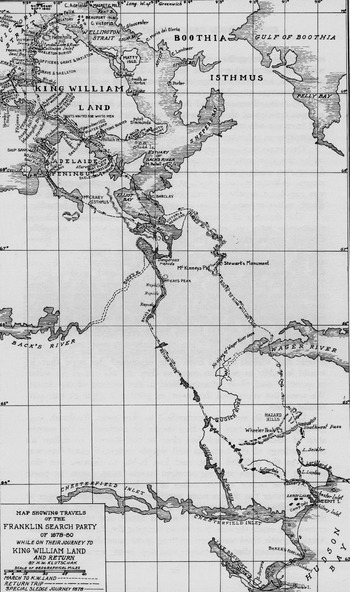
The details are documented in the books of Gilder (Reference Gilder1881b), Schwatka (Reference Schwatka and Stackpole1965) and Klutschak (Reference Klutschak and Barr1987). Each has a different focus and differs in describing how they used the time until their return to Camp Daly in December 1879. The route they took is shown on a variety of maps, however, the map selected for the present discussion is the one prepared by Klutschak and included in Schwatka's narrative (Fig. 2) (Schwatka Reference Schwatka and Stackpole1965: 77). The Schwatka search can be divided into three periods. These are the journey to King William Island between 1 April 1879 and 10 June 1879, the search effort between early 24 June 1879 and the end of September 1879 comprised two separate searches, one led by Gilder and Schwatka and the other led by Klutschak and Melms, and the return journey to Camp Daly between late October and 12 December 1879.
Map of Schwatka's expedition drawn by Klutschak (Schwatka Reference Schwatka and Stackpole1965: 77).

To King William Island
The sledge party used three large sledges with 44 dogs; and carried a large armament in order to live off of the land as well as to trade with Inuit. Their route took them north along the Lorillard River to Wager Bay where they crossed Brown River. They continued to Mckinney's Peak, crossed Elliot Bay, and followed the eastern side of the Adelaide Peninsula. On 10 June 1879, they ‘crossed over Simpson's Strait to King William Land’ (Schwatka Reference Schwatka and Stackpole1965: 76). During the latter part of the journey they met with some of the Inuit who had seen skeletons and who, apparently, were the ones that had reported seeing the box that supposedly contained the books and records of the Franklin expedition. Tuktoocheeah, the ‘old crone’, as Schwatka characterised her ‘described how some of the Inuits [Inuit] had broken the box open and emptied it of books and kept only the box’ (Schwatka Reference Schwatka and Stackpole1965: 75). They learned that such a container had been one of the items carried by the survivors but it was quite clear that the books had literally blown in the wind after having been given to Inuit children. Some ‘of the leaves of the books were seen near the boat place, flying around in the winds, for quite a number of years afterwards, but they slowly disappeared’ (Schwatka Reference Schwatka and Stackpole1965: 75). They were greatly disappointed at this information.
The search
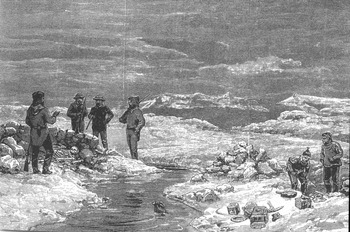
In spite of knowing that there were no records to be found, the party began its summer trek to Cape Felix at the northern end of King William Island. On 27 June 1879, they made a major discovery. Melms found a skull that was clearly from a European. The next day Klutschak and Melms described the grave of an officer, identified as that of Lieutenant John Irving. Although the gravesite had been despoiled by the natives, it contained one of the most important relics discovered from the Franklin expedition, namely the ‘Second Mathematical Prize, Royal Naval Academy’ medal that had been ‘“Awarded to John Irving, Midsummer 1830”’ (Schwatka Reference Schwatka and Stackpole1965: 80). Among the many remains they discovered, these are the most important because of their completeness including the identification of the person in question. A monument was erected on the now empty grave (Fig. 3). He mentioned further discoveries including ‘a heavy two gallon stone demi-John’ with the words ‘R. WHEATLEY, Wine and Spirit Merchant, Greenhithe, Kent’. He noted that this was found ‘about four miles south of Victory Point and at the time it was found I believed it to be a new discovery not seen by McClintock, who located his cairn on Victory Point’ (Schwatka Reference Schwatka and Stackpole1965: 82–83). The party travelled from Cape Herschel to Cape Felix arriving at the latter position on 3 July 1879 where they ‘celebrated the 4th of July by hoisting our expedition flag and killing a large polar bear whose meat promised to provide many good feasts for our dogs’ (Klutschak Reference Klutschak and Barr1987: 88).
‘Grave of Lieutenant John Irving, R.N., and Relics of H.M.S. Terror (1847), with a view of Victory Point, King William's Land.’ An engraving made from a drawing by Klutschak (Anon. 1897: 51).

During July, they continued to search. They found cans, broken bottles and pottery in a number of locations but were disappointed at not finding more graves and remains. On 7 July 1879 they discovered the ‘record left by Capt. McClintock containing a copy of the one Lieutenant Hobson had found left by Captains Crozier and Fitzjames’ years before and it raised the hopes ‘that some more important documents, left by Franklin's Party, equally preserved, might be revealed in a summer's search’ (Schwatka Reference Schwatka and Stackpole1965: 85). In this period they discovered a variety of other items including blue cloth from a naval uniform, and the bones of several skeletons. But they were unable ‘to discover the whereabouts of the second boat spoken of by Captain Hall in his 1869 letter to Mr. Grinnell and frequently alluded to by the Netchilluk [Nestilingmiut] natives’ and in which Hall believed that the records had ‘been carefully buried on King William's Land [Island] before the Erebus and Terror were abandoned . . .’ (Schwatka Reference Schwatka and Stackpole1965: 88; Hall Reference Hall and Nourse1879: xxii). The party spent a great deal of time interring the skeletons over which they raised a stone monument. The rest of the summer was spent searching King William Island. Schwatka and Gilder spent nearly a month searching for the spot described by a Nestilingmiut woman at which a significant number of Franklin's men had evidently perished.
On 7 July 1879, they began their return trek although they continued to engage in extensive research activities as they proceeded. On 6 August 1879, the parties divided. Klutschak and Melms went to search the coast to the southeast, then to cross Simpson Strait, and eventually to continue their efforts on the Adelaide Peninsula. They had hoped to find a gravesite at Cape Herschel but they found only caches used by the natives in previous years for storing blubber and meat (Klutschak Reference Klutschak and Barr1987: 108). While it was possible that some of Franklin's men might have come this way ‘there is a total lack of clues, especially any supported by adequate proof’ (Klutschak Reference Klutschak and Barr1987: 111). Before rejoining Schwatka and Gilder towards the end of September 1879, Klutschak and Melms spent much time studying various phenomena including the Inuit practices of salmon fishing (Klutschak Reference Klutschak and Barr1987: 141–142).
The return
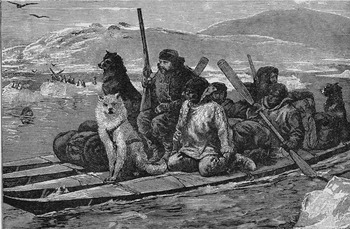
On 24 September 1879, Schwatka and Gilder began their journey back to Hudson Bay and Camp Daly to meet Klutschak and Melms who had already crossed Simpson Strait (Fig. 4). They travelled to Starvation Cove, so named for the numerous skeletons discovered around a boat, and southwards along the Adelaide Peninsula (Klutschak Reference Klutschak and Barr1987: 73). Their journey was in great part affected by the start of one of the coldest Arctic winters ever recorded. The temperatures in 1879–1880 were significantly colder that those recorded in 1821–1822, 1829–1830, 1830–1831, and 1846–1847. The mean temperature from December to February experienced by Schwatka was –49.5°F (–45.3°C), 22.3°F (12.4°C) degrees lower than those experienced by others (McClintock Reference McClintock1908: 72). They were delayed by the shortage of food and often had to take travel time to hunt for caribou to replenish their diminished supplies (Schwatka Reference Schwatka and Stackpole1965: 106).
‘Crossing Simpson Strait in kayaks.’ An engraving made from a drawing by Klutschak (Anon. 1897: 103).

Schwatka's ‘long way back’ included the discovery of a small number of relics and potential conflicts with the Inuit. The party experienced what Ebierbing viewed as threats from the Nestilingmiut and Aivilingmiut. Schwatka met threats with threats suggesting that, if they harmed his party, ‘every male combatant in the camp, some twenty in number should pay the penalty of the Act’ (Schwatka Reference Schwatka and Stackpole1965: 101). They returned through the Back River country east of their original route to King William Island. They had hoped that their food shortages were at end as they approached Camp Daly, but on their arrival they discovered that Barry was not there and that he had failed to keep his word that he would wait for their return and ‘upon arrival at Camp Daly, our first discovery was as sad as it was shocking—the greater portion of the party's provisions, trading material and other stores placed in Captain Barry's charge, had disappeared with him’ (Schwatka Reference Schwatka and Stackpole1965: 113). The winter journey took 4 months in contrast to the 1 month outward trip and the party was greatly affected by the cold temperatures as well as the limited food supplies. ‘Twenty-seven of their dogs died from hard work and starvation, rendering it necessary for the men to take their places at the sledges’ (The Illustrated London News Supplement 1 January 1881: 19). The last part of their time was spent at Camp Daly until they moved south to Marble Island from whence they sailed to New Bedford, on board George and Mary under the command of Captain Michael F. Baker. They arrived there on 22 September 1880 (Klutschak 1897: 196).
Cannibalism
Cannibalism had been alleged by Rae and became a concern of Schwatka's expedition. Schwatka and Gilder were particularly careful in their discussion of this topic. Klutschak, who documented the discovery, evaluation and burial of a number of skeletons, remained silent about it. The possibility had been raised by Rae in Reference Rae1854 but it seems that it was simply not regarded as an acceptable topic (Rae Reference Rae1854a, Reference Rae1854b). In spite of subsequent rumours including findings and representations made to Hall, the general opinion was that members of the Royal Navy would never engage in such practices. Even Charles Dickens had become involved in the question of the authenticity of Rae's reports, which had been printed in his magazine Household Words, and expounded the general belief that Rae had taken the ‘word of savages’ which could not be relied upon. Dickens, it appeared, was more interested in causing trouble and enhancing his own prominence than in engaging in a discussion of the evidence. He was described as having ‘an infallible moral sense, but little in intellectual quality’ (Orwell Reference Orwell1981: 104). He attached no personal blame to Rae. As he saw it, ‘if fault there be, [it] lay with the Admiralty for making his [Rae's] report public’ (Stone Reference Stone1987: 8). It was simply a proposition that few wanted to discuss and any discussion was at the risk of personal stature.
In his report to the AGS in 1880, Schwatka made no mention of cannibalism in spite of devoting several paragraphs to describing the discovery of bones and skeletons and their subsequent reburial (Schwatka Reference Schwatka1880: 253–254). In his narrative, Schwatka makes two rather obscure references to interviews with natives. One woman spoke of cutting into a tent where there were several bodies and there ‘was nothing left but bones, tendons and torn clothes, with the exception of one body that had the flesh on, but whose insides had been taken out’ (Schwatka Reference Schwatka and Stackpole1965: 70). ‘The Esquimaux thought that the white men had been eating each other, as some of the bones were sawed in two. They found one small saw and one large one [This corroborated previous reports by other explorers in the Franklin search]’ (Schwatka Reference Schwatka and Stackpole1965: 75, material in square brackets added by Stackpole). Gilder was somewhat more open. However, he was also careful not to dwell too deeply on their discovery of cannibalism. He began a rather lengthy statement but ‘the point which has provoked more criticism than all the rest is the native evidence that the distressed crews were in the last resort reduced to cannibalism. This is set down just as it was heard, being worthy neither more nor less than any testimony on an event which happened so many years ago’ (Gilder Reference Gilder1881b: ix). He then goes on to include a letter that he had received from Rae in which relates his need to report on his Reference Rae1854 findings even had ‘my dearest friends be[en] among the lost ones, for had I withheld any part of the sad story, it would have come to light through my men, and I should have been accused with some show of justice, of garbling my report’ (Gilder Reference Gilder1881b: ix). Hedging his discussion, Gilder goes on to state that ‘Sir George Richards shows strong reasons why the Esquimaux should not be believed. They are said to give as their reasons, that some of the limbs were removed as if by a saw. If this is correct, they were, probably, the operators themselves’ (Gilder 1881: xi).
On his return from the Arctic, Gilder raised the issue with McClintock and wanted to know if he had any information about the report of the Inuit to which he replied: ‘[n]o; I can neither confirm or deny the story; but I am strongly disinclined to receive it.’ He went on to state that ‘it is an unpleasant subject, any discussion of it must be harrowing to the relatives of the missing men. I do not think any reliable information can be obtained on the subject and the less said about it the better’ (The New York Herald 28 September 1880: 3). The article continues with reference to an unnamed officer of the Schwatka search, who suggested it was important ‘for each individual reader to form his own conclusion’ but each reader was given the warning that the ‘Esquimaux’ have been known ‘to make such charges against white men.’ ‘He agreed with Sir Leopold McClintock in believing that this was a matter that could not be benefited by discussion’ (The New York Herald 28 September 1880: 3). This may have reflected Gilder's concern with creating unacceptable sensationalism that might take away from the adventure and excitement that had been created by Schwatka. The ‘authors’ of The search for Franklin in a footnote reproduced Richards’ letter of 1880 that dismissed the entire issue. ‘The thing appears so monstrous to me that I am at a loss to conceive how it can have been suggested’ (Anon. 1897: 44–45).
The matter resurfaced in 1884 when Rae responded to a leader in the London Standard, partially republished in The New York Times. Rae invoked Schwatka's name, presumably in hopes that he might provide evidence to vindicate his position (The New York Times 21 September 1884: 5). He restated his evidence for his view and commented: ‘[y]our leader says that discipline would have prevented men having recourse to cannibalism. I do not believe any discipline would eradicate the cravings of nature, and it is all very well for those who, probably have never been 24 hours continually without food in their lives to engage most indignantly on the subject’ (The New York Times 21 September 1884: 5). He suggested that the descriptions that Schwatka heard supported his previous view.
Of all of the explorers involved in the Franklin search, Schwatka may have had the strongest qualifications for reaching a conclusion about the possibility of cannibalism. Yet, he stayed away from the discussion in spite of his medical knowledge. There is no clear reason why he did not give specific judgement in this matter. It may well have come from his belief that further discussion was not going to solve the issue and from his respect for the dead. Furthermore, he might not have wanted to sully the reputation of the Inuit who he understood and respected. Finally, there were political issues. His mentor, Daly, sided with those who had rejected Rae's earlier findings by accusing the ‘Indians,’ not the Inuit of being involved in the murder of Franklin's men and implicitly their dismemberment (Beattie and Geiger Reference Beattie and Geiger1987: 60). Schwatka owed much to Daly who helped him in obtaining leave from the Army to engage in the search and with his return to the Army, becoming involved in controversy might not have benefited his future.
Whatever the circumstances, no one wanted to get involved with the issue. The matter was clarified in the twentieth century when evidence appeared that ‘[f]racture lines also indicated that the skull had been forcibly broken, the face, including both jaws and all the teeth, was missing. Evidence that the body had been intentionally dismembered was further supported . . .’ (Beattie and Geiger Reference Beattie and Geiger1987: 59). The times were just not right for accepting that men under dramatically oppressive conditions would engage in such practices. A 1996 study of the skeletal evidence from the Franklin expedition did support the conclusion that the cut marks on the bones indicated cannibalism (Keenleyside and others Reference Keenleyside, Bertulli and Fricke1997: 43–44).
The achievements of the expedition
Schwatka failed to find written records from the Franklin expedition and concluded the search for them in the nineteenth century. However, his findings provided the stimuli for new search activities in the twentieth century. These focused on scientific research aimed at explaining the causes of death for many of Franklin's men.
Remains
The recovery of Irving's remains represents the most significant achievement of the search. It is the tragic symbol of the end of the Franklin expedition. Schwatka also interred a number of skeletons during his search. He undertook this task with care and respect and in every case he placed a stone marker on the grave (Gilder 1881: 284–290). Ironically, ‘curating’ the skeletal fragments they discovered only further obscured their locations. ‘By burying bones, and then placing probably one or two stones on each grave, Schwatka ensured that later discovery would be unlikely. Given the nature of the King William Island coastline, graves such as these would disappear into the landscape’ (Beattie Reference Beattie1983: 69). Even though he knew what the results of his actions would be, it is likely that Schwatka's decisions were based on humanitarian grounds. He was continually saddened by such discoveries. On the last he expressed his feelings about the fact that ‘[a]lthough there were plenty of large and more suitable ones, conveniently by, with which they always made their dead comrades’ sepulchres who had died previously to this point being reached, this grave pointed unmistakably to the fast waning strength and energies of the starving survivors’ (Schwatka Reference Schwatka and Stackpole1965: 97). Although he never suffered the deprivations of the Franklin crew, his knowledge of how they suffered shaped his feelings and his actions.
Relics
Among Schwatka's major contributions to the history of the Franklin expedition is the return of relics, which are now located at the National Maritime Museum in Greenwich. Schwatka's contribution to the collection ranks second only to McClintock's whose expedition in Fox from 1857 to 1859 accounts for the greatest number of relics from the greatest number of locations of the 9 expeditions that did find relics. His total is 156. Schwatka is second with 62 and Rae, third with 60. (National Maritime Museum 2000: 1–10). Schwatka's contribution is important not simply in the volume of items found but because they were gathered some 20 years after those of McClintock. Schwatka's success stemmed from his knowledge of where to search and of having a whole summer to devote to the task.
Achievements
Schwatka describes ‘the most salient points’ of his achievements in his 1880 presentation to the AGS (Schwatka Reference Schwatka1880: 256–258). Subsequent writers have expressed opinions about these. Adolphus Greely (1844–1935) wrote in 1906 that the ‘expedition of Schwatka and Gilder made no important additions to geographic knowledge, for this country had been traversed by many parties’ although he does recognise its extensive nature (Greely Reference Greely1906: 142). A more recent view noted that it was ‘the first crossing of formidable hill barrens in a region that is, even now, virtually unknown’ (Mowat Reference Mowat1989: 219–220). The case remains strong that Schwatka using the small party, overland approach, organised, managed and succeeded. By the most demanding criteria of exploration, reaching the destination and returning from it, adding to scientific knowledge, and minimising human suffering and loss, proposed by Sir Vivian Fuchs (1908–1999), Schwatka scores highly (Fuchs Reference Fuchs1963).
The achievements are as follows:
1. This was the longest sledge journey with regard to time and distance, a period of eleven months and 20 days, covering 3,251 statute miles, (5232 km), undertaken by European explorers in the Canadian Arctic.
2. It was the first sledge journey partly conducted ‘with exceedingly low temperatures, with 16 days during which the average temperature was 100°F below freezing point. One of the most remarkable features of Schwatka's expedition is the unusually low temperatures recorded during the winter of 1879–80’ (McClintock Reference McClintock1908: 76). They were the equivalent of those suffered by Robert F. Scott (1868–1912) in his coldest march (Solomon Reference Solomon2001).
3. It was the one of the first Arctic expeditions whose reliance for food and draft animals was based on local resources and in which the Europeans lived on the same diet as the natives. These practices were anticipated by Rae and Hall.
4. It was the first overland sledge journey in the Canadian Arctic, relying only marginally on the coastline for routes and making extended summer explorations (Burwash Reference Burwash1930: 601). However, similar journeys had been undertaken in Russia by Alexander von Middendorff (1815–1894) in 1842–1845 and Alekxandr Lavrent'yevich Chekanoviskiy in 1873–1876 (Tammiksaar and Stone Reference Tammiksaar and Stone2007; Barr 1991, 1993). ‘Undoubtedly, the most arduous part of Schwatka's brilliant achievement was his return winter march. To have accomplished so much, and to have brought back his party safe and well through so many dangers and privations, and thus to have conducted his Expedition to a happy termination, reflects the highest credit upon him and those who supported him to his close’ (McClintock Reference McClintock1908: 77–78).
5. It brought back a significant number of relics and remains and it provided the last rites for members of the Franklin crew. Schwatka does not hesitate ‘to state that not a single unburied man of Sir John Franklin's expedition probably exists’ (Schwatka Reference Schwatka1880: 257).
Management skills
Underlying the success of Schwatka's expedition was his strong leadership and managerial skills. He took advantage of his freedom to organise and control his expedition and to manage his resources, human and physical (Savitt Reference Savitt2004: 162). The general themes relate to how he was able to allocate his extremely modest funds, how he was able to maximise the use of the Inuit, and how he selected methods for ensuring the success of the search (Klutschak Reference Klutschak and Barr1987: 135).
Both his immediate colleagues were complimentary of Schwatka's managerial abilities. Klutschak referred to his leadership abilities when he wrote about the discipline that was brought to the search. He noted that success ‘can be achieved if one knows how to lead or command without giving too many orders . . .’ (Klutschak Reference Klutschak and Barr1987: 13). Gilder comments that all ‘our movements were conducted in the dull, methodical business-like manner of an army on the march. Every contingency was calculated upon and provided for beforehand, so that the personal adventures were almost unknown or too trivial to mention’ (Gilder Reference Gilder1881b: 241). ‘Good management kept all of the Esquimaux loyal and Schwatka's strong will helped the travellers live while the dogs were falling exhausted and dying along the way’ (Gilder Reference Gilder1881b: xii). His abilities were best summarised ‘by the proper exercise of a natural gift for command by which means he held throughout the confidence and ready support of his people’ (Hayes Reference Hayes1880: 258). In the end, Schwatka goes out of his way, as good management practice dictates, to pay tribute. To ‘my subordinates, officers and men, white and native, is due the fact that such an undertaking was made possible, not only by their untiring energy in their several departments, but also to the cordial cooperation and harmonious working as a whole’ (Schwatka Reference Schwatka and Stackpole1965: 257–258). Subjective as the comments of members of the party may be, there is no contradictory evidence. Markham writes about his achievement that it ‘reflects the highest credit on the commander, and on those who served under him so admirably; and it is certain that the work could not have been done without natural qualities of a very high order, combined with careful training and the most thoughtful adaptation of the best attainable means to the end in view’ (Markham Reference Markham1880: 659).
Legacies
The legacies of the Schwatka expedition merit careful study. By this is meant the effects of the expedition in the short, medium and long terms. It is a neutral concept used to identify without attempting to make value judgments (Savitt and Lüdecke Reference Savitt and Lüdecke2007: 62). Schwatka's use of the small party integrated with, and hence reliant on, the Inuit was an extension of previous experience. This was basically Rae's approach in 1854 and a central element in Richard King's (1810–1876) proposal in 1836 with regard to exploring Boothia. He argued for a small land party with ‘a leader who had a knowledge of ascending and descending rapids, of portaging, trading with Indians, and of canoe and sledge travel. This was knowledge, he said, that only a person who had experience in the interior of the North America could possess’ (Wallace Reference Wallace1980: 32). While Schwatka made minor changes, his plans were similar to Rae's. It is noteworthy that King, Rae, and Schwatka were all medical men. Hall, too, adapted many of these elements in his expeditions and in doing so influenced Schwatka. Robert Peary (1865–1920) was struck by Schwatka's approach. He wrote that it ‘deserves to be recorded as the American plan’ although it was it was not new as it had been used by Rae, William Kennedy (1814–1890), and Hall among others but ‘Peary, with his meticulous preparation and use of hand-picked and personally trained natives, took it several steps further’ (Berton Reference Berton2000: 514). He, however, never gave full credit to the Inuit who accompanied him and focused on the ‘parties of two or three’ (Peary: Reference Peary1898: lxxvii). Vihjalmur Stefansson (1879–1962) ‘thought more of Rae than of any other explorer, attributed to Rae a slew of innovations . . .’ (Mills Reference Mills2003: 543; Stefansson Reference Stefansson1954). In his autobiography Stefansson summarises Schwatka's contributions. ‘In the Canadian north Lieutenant Frederick Schwatka, a brilliant exponent of living off the land, completed one of the great sledge journeys of all time. In the course of his traces of the long-lost Sir John Franklin expedition, Schwatka helped to develop the techniques of sled travel’ (Stefansson Reference Stefansson1964: 7). Small parties rather than large scale ones became the order of the day after the end of the searches for the Franklin expedition in the Arctic, including on the expeditions of Fridtjof Nansen (1861–1930) and Frederick Jackson.
As important as these legacies were, they had limited value in the higher Arctic and the Antarctic. In the former case, it was a matter of geography; as explorers moved into the higher northern regions, it would be impossible to live off the land and carrying food for the party and the dogs would be mandatory and the ‘explorer will have no assistance from the natives beyond what he gains from those who live south of Discovery Bay’ (De Costa Reference De Costa1880: 92).
More recently in the field of nutrition, Schwatka's observations about diets and shifts of diets have drawn the interest of modern scientists. Schwatka's contributions to medicine were briefly noted by Johnson (Reference Johnson1968). Schwatka's observations about the changes that he and his party experienced as they switched from a traditional carbohydrate diet to a one based exclusively on meat has become the focus of nutritional research in the area of ketogenic diets and physical performance. Schwatka described the ease with which they were readily able to eat caribou without suffering weaknesses and debilitating effects and how the Inuit could survive exclusively on ‘a hunter's diet’ (Phinney Reference Phinney2004: 3). A leading researcher in the field includes extensive quotations from Schwatka and notes that ‘Schwatka was not impaired by his prolonged experience eating meat and fat is evidenced by his diary entry for the period of 12–14 March 1880, during which he and an Inuit companion walked the last 65 miles in less than 48 hours to make a scheduled rendezvous with a whaling ship and complete his journey home’ (Phinney Reference Phinney2004: 3). While Schwatka did not pursue these nutritional issues in his own writings, the issue of change of diets and the diets of the Inuit were of interest to him and his party.
Summary and conclusions
Schwatka was a complex individual whose background and education prepared him for the challenges of Arctic exploration. He accepted the role of commander of a search that had the potential for disaster given the un-reliable information on which it was undertaken, the limited resources originally allocated to it, and the self-imposed demands of adopting foreign methods of operations. Schwatka's search did not discover records from the Franklin expedition, which was of limited possibility given the time factor and the environment that limited the possibility of their survival. It brought to an end the search for the Franklin expedition in the 19th century. However, the expedition was successful in confirming that small, land-based sledging parties could work well in a variety of Arctic conditions. Schwatka certainly established the importance of Inuit methods and practices.
Schwatka provided a set of guidelines for future exploration, but these were infrequently followed by his successors. For his part, he continued to apply and to develop these principles in his subsequent expeditions in Alaska and the Yukon. His untimely death limited his contributions to the literature of exploration.
Acknowledgements
The author gratefully acknowledges the significant contributions of two anonymous referees whose time and effort greatly improved the first version of this article. The author would also like to thank Sarah I. Hartwell, the Rauner Special Collections, Dartmouth College, and Jonathan Dore, Oregon State Library, Oregon Historical Society and Willamette Valley Genealogical Society.