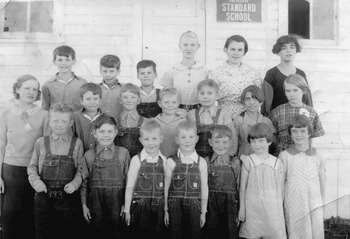
Unlike many archaeologists and other anthropologists, I had no early experiences that predisposed me toward a career in anthropology, although my mind had a historical bent, and I was always curious about past things. Also, since my early teens I have been rather negative about mainstream U.S. values, aspirations, and lifestyles. My twin brother, Warren, and I spent the first 18 years of our lives in one place, a farm (mostly wheat, some livestock) barely a mile outside the small town of Grangeville, in the southern part of the Idaho panhandle, about 200 miles south of Coeur d'Alene and about 200 miles north of Boise, the state capital. At the time, Grangeville had a population of about 2,000, seat of a county larger than Massachusetts that even today has a population little more than 15,000 because most of it consists of national forests and wilderness areas with almost no human inhabitants. There was no larger settlement within 80 miles. A selective account could make it all seem quite remote and even primitive. We had no indoor plumbing before I was three (in 1933), no electricity until I was four, only graveled roads until I was five, and our first year of schooling was in one room, where a single inexperienced teacher attempted to deal with grades one through eight (Figure 1). But such an account would be highly misleading. In the 1930s, few rural houses in the United States had running water or electricity, and because we were so close to town and my mother's father was local manager for the power company, we were electrified several years before the Rural Electrification Administration, part of Franklin Roosevelt's “New Deal,” extended electricity to rural areas that had been deemed unprofitable by private companies. This part of Idaho escaped serious Dust Bowl conditions, and during those Depression years, when many farmers lost their land, we remained secure and lived comfortably. By the time my brother and I were in the second grade, our parents had us in the town school, with one teacher per grade, and the second-grade teacher was remarkably good. Among many other things, I was fascinated by dinosaurs and stories about cavemen.
Warren and I launch our academic careers. Adkison School, Idaho County, 1936–1937. Which twin is me? I can't tell.

Though spatially somewhat remote, and with the impression that everything important happened somewhere else, we were connected with the outside world by AM radio, Hollywood hits, daily newspapers, the Book of the Month Club, and (for better or worse) magazines such as Time and the Saturday Evening Post. My parents were fairly well educated. My father's father was a domineering autocrat, one of the early settlers who had come west with nothing and built up prosperous holdings (partly due to the low price of land after Native Americans had been expropriated by armed force, partly by astute business dealings and exploiting the labor of his family), and he gave his only son, my father, no choice but to take the agricultural short course at the University of Idaho. I don't believe my father liked farming, and I think that, given a choice, he would have found something like civil engineering more congenial. His sisters fared better, and two of them went as far as to get graduate degrees at Columbia in the 1920s (where they must have been not too far from figures such as Boas, Benedict, and Mead, but probably never had the slightest contact with them). My mother had a year at the University of Idaho but chose not to continue, for lack of interest rather than for financial or other reasons. Warren and I were not the first generation in our family with college experience.
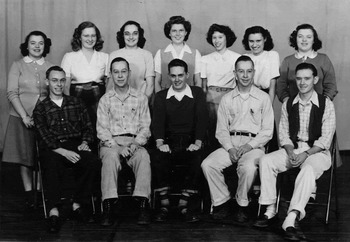
We began some household and yard chores early on, limited farm work by 11, and full days during summers by 13, but no one ever pressured us to continue in that line. Our parents gave us a children's encyclopedia when we were five and the Encyclopedia Britannica when we were 12. By the time I was four I thought of being some kind of scientist or inventor. This was fostered by exposure to comic-strip figures, especially the elderly Dr. Huer in Buck Rogers. In high school I became a fan of science fiction, both H. G. Wells and “pulps” of the 1940s, and a reader of science popularizers such as Isaac Asimov. From Willy Ley (Reference Ley1945) I gained a serious knowledge of rocketry and space travel and was introduced to mathematical concepts such as the constant e, the base of natural logarithms. I first read about cybernetics and feedback in a pulp, leading me to assume that this was common knowledge. I also read books by Sir James Jeans (Reference Jeans1945). The minister of the local Presbyterian–Methodist church that I attended, far too much of a free thinker and free spirit to go over well with most locals and who, if anything, abetted my growing skepticism of all received religions, loaned me two books by Sir Arthur Eddington (probably Reference Eddington1928 and Reference Eddington1933), and I was fascinated by the paradoxes and novel concepts of relativity and quantum theory. I never much cared for biology, and chemistry seemed boring and rather smelly. I detested sports and was very mediocre in music, but all the academic aspects of high school were easy, and that included high school math, though I was not particularly interested in math for its own sake (Figure 2).
Staff of high-school newspaper, Grangeville, Idaho, 1948.

In those years, I read two anthropological books. One was Ruth Benedict's Patterns of Culture (Reference Benedict1934); the other was Frank Hibben's The Lost Americans (Reference Hibben1946), where I learned about Folsom and other early finds. In the National Geographic I saw lurid depictions of Aztec and Maya rituals and was intrigued by Matthew Stirling's Olmec explorations. However, I was more influenced by H. G. Wells's Outline of History (Reference Wells1920), which I borrowed from the town library but took so long to finish that eventually the librarian sold it to me. All these were interesting enough, and they certainly made me aware of non-Western and ancient societies, but many other things were also interesting, and I don't think it ever occurred to me that I might make a career of anthropology. By that time I was on track for physics.
Upon graduation from high school in 1948, it seemed natural to go to the University of Idaho, and I gave no thought as to whether that was a strategic place for physics. I remember my freshman year with tremendous pleasure, feeling liberation from a constricting home environment and being among people who didn't think it odd that I read books for pleasure, free of the “nerdly” image and cliques of my high school days, but not too far away for frequent weekends at home. Regarding fraternities with fear and loathing, I was happy in an independent dorm and had my first experiences with alcohol and something like escapades. People who've only known me in later years may be surprised that it felt quite a bit like Animal House, although I did this while staying out of trouble and keeping up a high grade-point average. Idaho didn't do much for my science aspirations, however, as first-year college chemistry proved less advanced than the strong chemistry course I'd had in high school. By far the most influential professor I had at the University of Idaho was Joseph Duffy, a young instructor of English, who went on to a long and distinguished career at Notre Dame. He was from Columbia and, in retrospect, I think strongly influenced by Lionel Trilling. He urged me to read William Empson's Seven Types of Ambiguity (Reference Empson1966 [1930]), and I always meant to but somehow only began it a few years ago, when it was too late to have much effect on me. Duffy considerably enlarged my knowledge of literature, and I suspect his recommendation had a lot to do with my being accepted by Stanford.
Warren had already been studying Latin for several years and as a freshman was the only student in second-year Latin in the university. Since nothing beyond that was offered in Latin, it was imperative that he go elsewhere, and he applied to Stanford. By this time it had registered on me that Idaho was not a great place for physics either, so I followed his lead. Stanford proved more challenging than Idaho, both socially and academically. I didn't fit in too well socially but made a few close and lasting friends. First-year physics was not too hard, catering mainly to engineering types who seemed less than brilliant and were taking the course as a requirement. Beyond that, both physics and math (partial differential equations, orthogonal series, etc.) became far more challenging, and I was soon struggling just to get mediocre grades. I enjoyed studying German, sensible for a physicist at the time, but since then I've forgotten most through disuse, and I'd have done far better to have studied Spanish. I continued to be interested in literature and writing and took several electives in English. However, I found it very hard to think of plots for fiction, and though I worked a little on the Stanford Daily and marginally on the college humor magazine, I didn't fancy being a journalist or a literary critic. So I kept on with physics, though with something of an “I don't give up easily” attitude. It didn't occur to me to seek a mentor, and I selected an adviser mainly because he would let me sign up for any non-physics electives that appealed to me—in retrospect, a sign of my wide interests but lack of commitment to any one thing.
One of my friends, Ronald Wolf, was an anthropology major, and we talked about that some. I was interested enough to begin auditing Felix Keesing's introductory anthropology course in my senior year. I soon dropped out because of the pressure of courses I was taking for credit. Nevertheless, I went to see Keesing about possibly switching my major to anthropology. He pointed out that if I were to do that, it would take me an extra year to graduate and suggested that I take time to make sure my interest in anthropology was lasting. So I stuck with physics and graduated in 1952, about in the middle, academically, of the graduating cohort of 12 physics majors. I applied unsuccessfully to a number of places for graduate work in physics but was accepted by Yale. Warren went to Yale to do graduate work in historical linguistics, mainly Indo-European and Anatolian (Hittite, Luwian, etc.), where he continued and had a distinguished career, terminated too early by his death from cancer in 1985 (Klein Reference Klein2006).
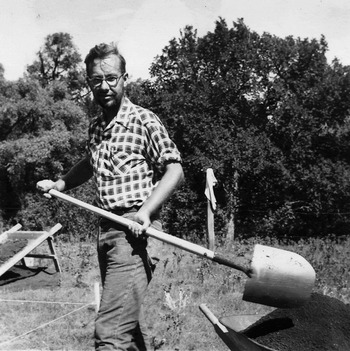
However, Ron Wolf was planning to spend the summer of 1952 on a dig near Jamestown, North Dakota, a Smithsonian Institution project, part of the River Basin Surveys that were doing salvage archaeology in areas being flooded by federal dam building along the Missouri and its tributaries. He didn't want to go there alone and persuaded Warren and me to accompany him. Eventually he backed out, but Warren and I went. We approached the project with some anxiety, feeling totally inexperienced in archaeology and not knowing what to expect. We were soon reassured by the project director, Richard P. Wheeler, a man of considerable sensitivity and wide learning, but who didn't publish easily and didn't make the mark he might have. His assistant early in the season was Thomas Cain, who left abruptly to become director of the Heard Museum in Phoenix. Also notably present was Hester Davis. Dick Wheeler and Hester chatted arcanely about a site in Arizona called Awatovi. Archaeology proved to be much easier and more agreeable than farming, and field skills, including digging and survey, easy to acquire, while years cleaning barns pre-adapted me for shoveling backdirt (please, no snide comments about other academic skills) (Figure 3). Because I was just an employee, neither a student nor a director, I felt few responsibilities. I read two influential books, Kluckhohn's Mirror for Man (Reference Kluckhohn1949) and Flint's Glacial and Pleistocene Geology (Reference Flint1947), from which I suddenly understood the U-shaped valleys, cirques, tarns, and moraines I'd been tramping unknowingly for years in the mountains of central Idaho. The summer was a decisive experience, but at the time I looked on it as only a pleasant interlude before resuming hard mental work in physics.
First archaeology, Jamestown, North Dakota, 1952. This is actually Warren, but the resemblance is close enough.

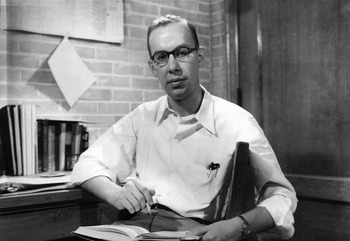
Midway in the summer, I was offered a teaching assistantship at Iowa State College, in Ames, and the prospect of support was too good to refuse, so in the fall of 1952 I went there rather than to Yale. Graduate work in physics at Iowa State proved less challenging than undergraduate work at Stanford, partly, I think, because the average caliber of students was lower and partly because it was easier for me to catch onto difficult ideas (especially in mathematics) the second or third time around. So I felt more secure about myself as some kind of physicist (Figure 4). Nevertheless, I didn't find it very exciting. I realized that the only kinds of physics that interested me were high-energy-particle physics and cosmology. But, although I shared an office for a while with A. G. W. Cameron, then just starting what was to be a distinguished career in astrophysics, what he was doing failed to captivate me. I found myself mostly running an electron microscope, basically as a service for botanists, metallurgists, and ceramicists. I kept up some writing interests through the campus writers' club (once I was writing term papers in anthropology, that satisfied my writing needs, and I quit trying to write short stories and poetry). I was quietly skeptical of 1950s U.S. values and styles and had my first involvement with Unitarians but didn't publicly stick my neck out. As far as it got was singing songs of the Abraham Lincoln Brigade (a volunteer unit that fought against the fascists in the Spanish Civil War of 1936–1939 and that was considered unsuitably leftist in some quarters) late at night on the streets of Ames, hearing accounts from participants in peyote ceremonies, listening to Pete Seeger and the Weavers, and reading excerpts from Bertrand Russell on campus radio. Serious public protest wasn't part of it; nor were cannabis and other popular substances of the 1960s.
Physics grad student, Ames, Iowa, 1954.

I was more interested in philosophy of science than were most physics students, and I perused some of the works of Henry Margenau and Percy Bridgman. They had views at least closely allied to those of logical positivism, although I never studied them carefully enough to work out the differences among them. They all seemed commonsensical enough—nothing to get too excited about.
However, one of the things I most enjoyed were excursions with pals to visit collectors of Indian relics in Iowa and even scout for some sites. I also read—or, at least, skimmed—some archaeology publications, including Griffin (Reference Griffin1952) on the eastern United States, Luther Cressman's volume on early sites in Oregon, and Phillips and Willey (Reference Phillips and Willey1953). I made contact with Reynold (“Rey”) Ruppé, then on the faculty at the University of Iowa in Iowa City, who was soon to leave and become founder of the Arizona State University Department of Anthropology (later I spent the summer of 1955 in Rey's field school near Cherokee in northwestern Iowa, digging a site of the Mill Creek culture, my first field school experience). I also visited Effigy Mounds National Monument in far northeastern Iowa, where I met Will Logan. Friends and I once spent a nearly sleepless night there, cramped in a car and fighting off mosquitoes and humidity—one of many pieces of evidence that one need not go to the tropics to find trying conditions. Indeed, the heat and humidity of Iowa summer nights were a shock to me after crisp Idaho weather and Bay Area mildness, and I formed the opinion that reasonable humans wouldn't put up with such a climate if they had the chance for anything better. This distaste for humid heat without air-conditioning has persisted and substantially lowered the quality of life for me later in Chicago, Boston, and the Maya Lowlands. I found cool upland Mexico far more congenial, and even summer temperatures upward of 115 °F in the Phoenix area are not too unpleasant now that I have air-conditioning. Besides, “It's a dry heat.”
During Christmas break in 1953, I visited Warren in New Haven and devoured most of Kroeber's Anthropology (Reference Kroeber1948). That was, however, only a fascinating little holiday from physics. My dissatisfaction with physics came to a head during a week off in the spring of 1954. I visited Logan, who spoke highly of Griffin and the University of Michigan. I applied there and was accepted, but I then thought it would be prudent to read something by Leslie White (Reference White1949), chair of the department. I was horrified by his simple-mindedness and dogmatic assertions. Because I was attracted by the writings of Julian Steward a few years later, I think many will be perplexed by this, since White and Steward are often lumped as neo-evolutionists, with only quarrels between themselves that seem minor to outsiders. To me, precisely because I was interested in cultural evolution, the differences seemed enormous. Even before I'd read much anthropology, but perhaps in part because I'd read more history, White seemed terribly narrow and doctrinaire.
If I had gone to Michigan in 1954, I would have overlapped with Lewis Binford, and I can only speculate about what we would have thought of each other. In fact, however, I hastily applied to the University of Chicago, managed to get accepted there, and sent my apologies to Michigan. At Chicago, in the fall of 1954, it was all a Brave New World, easy and fun after the rigors of physics, and I loved all of it—very much a four-field approach, which is the way anthropology was taught at Chicago then. I immediately came under the influence of Robert Adams, a young instructor just beginning his academic career. Early on, we read Steward's “Cultural Causality and Law: A Trial Formulation of the Development of Early Civilizations” (Reference Steward1949) and Childe's Man Makes Himself (Reference Childe1936) and What Happened in History (Reference Childe1943), which I assumed were standard fare in other anthropology departments of the day. I was also impressed and influenced by Sherwood Washburn, Clark Howell, and Fred Eggan. Washburn was a brilliant teacher but too difficult as a person to appeal to me as a thesis director. I wrote a library-based master's thesis on Plains Indians under Eggan, who had been influenced by Radcliffe-Brown in the 1930s but had none of the functionalists' contempt for “conjectural history.” On the contrary, he integrated ethnography, history, and archaeology into his work on native peoples of the western and southwestern United States. That seemed eminently sensible to me. But diffidence about nosing around asking questions of oppressed minorities held me back from ethnographic research. I seriously considered going into paleoanthropology with Howell and only by a narrow margin tilted toward working on early civilizations. Adams, however, worked mainly in Iraq, and my then wife, Ursula Moser Cowgill, didn't want to live in an Islamic country. China was unavailable for political reasons, and South America was a long way off. That left Mesoamerica, which I chose more for convenience than because of any prior attraction. But since no one at Chicago was doing much archaeology in Mesoamerica (Adams had worked briefly at Mayapan and in Chiapas), and since Adams had had us read Gordon Willey's settlement survey of the Viru Valley in Peru and I'd seen early versions of what was to become Willey and Phillips' Method and Theory in American Archaeology (Reference Willey and Phillips1958), which was “cutting edge” theory for the 1950s, I transferred to Harvard in 1956.
In the summer of 1956, I had my first experience of Mexico as an assistant on a field school at the Schroeder site in Durango, directed by J. Charles Kelley and Carroll “Cal” Riley. That left me with the lasting impression that northwestern Mexico was an important part of Mesoamerica that should never be underestimated. Later, on my first visit to Teotihuacan, in December 1957, I was impressed by similarities between some of the ceramics I'd been digging in Durango and the Coyotlatelco style of the Basin of Mexico, although I now recognize differences in vessel forms and decorative motifs and see the connection as only indirect.
Harvard was a considerable letdown after the excitement I'd felt at Chicago. Willey and I never quarreled, but we just weren't on the same wavelength, and I could get no inspiration from him. He did a tremendous service to U.S. archaeology by introducing concepts and practices of settlement archaeology derived at least to some extent from Steward, but I could get no sense that his thinking was moving beyond that. He did, however, without labeling it as such, make some impressive hermeneutic assessments of the art of Olmec in Mesoamerica and Chavin in Peru. In other courses, I often felt I was wasting my time. Hallam Movius insisted that I take his Paleolithic course even though I'd already had as much as I thought a non-specialist needed from Howell at Chicago. Sometimes I had trouble thinking up ideas for term papers, and it went better once I realized that ideas were a Chicago thing and to do well at Harvard, the main thing, at least in archaeology in the 1950s, was to assemble data.
To be fair to Harvard, I think more was going on among some of the social anthropologists and others in the social relations department. I would gaze hungrily in the catalog at some of their courses, but I had to forgo most of them to meet archaeology requirements. Also, in two years at Chicago I'd been exposed to many ideas but not a lot of Mesoamerican data, so the Harvard years were a valuable chance to absorb data. However, the only really impressive faculty figure for me at Harvard was Clyde Kluckhohn, who had time to talk and argue about my ideas, even when he protested that he was busy with other things. The most impressive students, a few years ahead of me, were Donald Lathrap and David Kelley. I could have learned much from Tatiana Proskouriakoff, but she was not very outgoing and, as befitted a “mere female”, she was rather marginalized, and not teaching courses.
In December 1958, Ursula and I left Cambridge for a year in Guatemala, where we spent several months in the Peten, doing small-scale surface reconnaissance and excavations of unattractive ceramics in the unimpressive ruins of the Postclassic period, following the collapse of the Classic Maya, which, at least locally, was very real. We also, with the advice of Edward Deevey of Yale, obtained the first pollen cores in central Peten lakes, and I aided Ursula in brief investigations of contemporary agricultural practices. After a course from Grahame Clark when he visited Harvard, all these seemed straightforward efforts to reconstruct ancient environments and to get information that would have a bearing on ancient Maya subsistence practices. I had a small grant from the Doherty Foundation and later a National Science Foundation (NSF) fellowship (not a grant), and we were happy to get logistical support anywhere we could find it, including United Fruit, oil-exploration companies, Protestant missionaries, and Barbara Aldana, A. V. Kidder's daughter, as well as various U.S. government functionaries. Even so, we were underfunded and hungry as well as too hot, and I found life in the Peten quite an ordeal (two weeks of recovery from type A hepatitis in the University of Pennsylvania field camp at Tikal were a welcome luxury), and I've never returned. Since then, others have done far more with Postclassic-period archaeology and pollen studies in the Peten, and ideas about Maya subsistence have drastically changed.
A month at a coffee experiment station at Chocola in the Pacific piedmont and six months in Guatemala City doing data analysis were physically and nutritionally far more pleasant. However, this was not long after the CIA-engineered revolution that had brought a right-wing government into power and the atmosphere of political repression and open racism was oppressive, although not nearly as bad as what was to come.
Back in the United States by January 1960, I spent several troubled months, living on little and worrying about a job. In those days, academic hiring practices were far more informal than they've become, and the market was more favorable than now, at least for white males. After only two rejections (from the American University and the University of Oregon), I was very happy to land a job as an ABD (all but dissertation) instructor at Brandeis University. Busy with my first teaching (I'd never been a teaching assistant, except a few weeks at Iowa State) and beset by marital problems, it seemed my dissertation was taking forever to complete. By the summer of 1962, I had left Ursula and was finally able to focus on the dissertation and finish it.
For the first few years in the 1960s, Brandeis seemed exciting and full of promise. With Elizabeth Colson, Robert Manners, and others, the Anthropology department had only recently separated from sociology and begun to offer a Ph.D. program. David Aberle and Kathleen Gough (his wife) were hired in 1962, and it looked as if we were set for unlimited expansion. To be sure, I was the only archaeologist in the department, and for a while I found myself teaching not only Old World and New World archaeology but also statistics and such physical anthropology as was offered. I was scrambling to keep up with it all but anticipating reinforcements soon. In fact, lines for one physical anthropologist and a second archaeologist opened up a few years later, but neither archaeology nor physical anthropology ever became numerically strong at Brandeis, and the department remained primarily social-anthropological. Although the campus atmosphere at Brandeis was fairly liberal, Kathleen Gough's strongly held and very outspoken leftist views were always a sore point with the administration and came to a head when she was reprimanded for her speech at the time of the Cuban Missile Crisis in the fall of 1963. In the ensuing turmoil, the university president was sharply criticized by senior faculty (including Herbert Marcuse), and the Aberles took jobs elsewhere, while, junior and untenured, I remained meekly on the sidelines (as I did throughout the 1960s in general, strongly opposed to the Vietnam war, reading I. F. Stone with admiration, and once in a while marching or lobbying in protest, but never very audibly and always a bit skeptical of some more conspicuous protesters, such as Noam Chomsky). Elizabeth Colson also quit in disgust, and Brandeis fell into such low repute in the social-anthropology community that it could never recover from these losses with replacements of equally high standing.
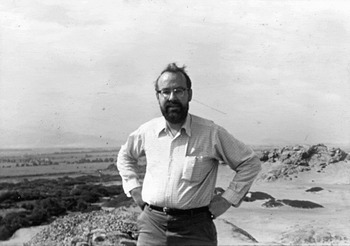
Nevertheless, in the 1960s I did acquire an exceptional colleague, the late Craig Morris, working at the Inka site of Huanuco Pampa in highland Peru (Figure 5). However, I never had the skills, temperament, or inclination for the university politics that would have been required to build archaeology, and by the 1970s it seemed that anthropology at Brandeis, and archaeology in particular, were no longer growing. After Morris left for the American Museum of Natural History, I had other good archaeological colleagues, especially Judith and Robert Zeitlin, and some good Ph.D. students, but the graduate students were never numerous, and I didn't build up a cadre. I had job offers from the State University of New York, Binghamton; the University of Illinois; and the University of Washington, but there were always obstacles, such as personal ties in the Boston area or, paradoxically, concerns (at Illinois and Washington) about trying to work with the very person who was trying to recruit me.
Atop the Huaca del Sol, Peru, 1971.

In 1970, I met Cynthia Wild, a clinical psychologist, and in 1972 we were married. This was far happier than my first marriage, but Cynthia had lived with Type 1 diabetes since the age of eight and died of its effects in 1978.
By the 1980s, it seemed I would never escape the cold climate for archaeology at Brandeis, and I was considering early retirement, so I was overjoyed by an offer from Arizona State, and without hesitation I moved there in 1990. Later I understood there had been some discussion about whether Arizona State would be able to “lure” me away from Boston. To me, that was like officers at the rail of a Cunard liner spotting a forlorn figure on a flimsy life raft being chipped at by sharks and saying to one another, “I wonder if we could entice that chap to come aboard?” Anthropology at Arizona State had begun about 30 years earlier, small and overshadowed by the University of Arizona department in Tucson, but by 1990 it had achieved very high quality, thanks to hard work by a number of very able people. By moving to Arizona State I was instantly provided with an infrastructure I hadn't even dreamed of at Brandeis, with stimulating and very congenial colleagues and throngs of good graduate students working in a diversity of areas. In metropolitan Boston there had been an effort to make up for scarce archaeology faculty in institutions other than Harvard through cross-registration and consortia such as the Center for Materials Research in Archaeology and Ethnology (CMRAE) at Massachusetts Institute of Technology (MIT), but it was never anything like having numerous good colleagues in the same department. Also, the Boston area seemed a backwater that was outside mainstream theoretical developments of the 1960s and later, such as processual and postprocessual archaeologies. Philip Kohl, at Wellesley, was a welcome exception.
It was also easy to leave Boston in 1990 not only because of lack of any close personal relationships, but because I'd never taken to East Coast urban lifestyles. I took little advantage of the cultural attractions that appeal to so many. I went to occasional concerts, ballets, operas, and art exhibitions, but the hassle of getting to and from them tended to offset whatever rewards they provided. I spent some time in Cambridge coffee houses in the 1960s (just too late for Joan Baez), but I mostly remember the hard benches and wishing they served something stronger than coffee, and my best memory is the quiet intelligence of Fritz Richmond. Theater engaged me more, but not so much as to make leaving Boston seem anything but an escape from the eastern United States. My heart and roots were in the Pacific Northwest. Arizona State is in the southwestern United States, but it feels west and isn't that far from the Northwest.
The 1990s were heavenly for me at Arizona State. Since then, it hasn't been quite so much fun—the department is larger and doing more things than ever, but I'm beginning to feel my age and, since retirement in 2005, rather marginal to the big developments. Yet paradoxically, in the past decade I've had more graduate advisees than ever before. They are very good and, only now, I just may be building something of a cadre—but, I hope, no disciples. Next generations should do things we haven't imagined.
FIELD PROJECTS
After dissertation research, in 1963, I was half-heartedly planning a project at the Late Postclassic Maya site of Cilvituk, in Campeche (recently studied by Rani Alexander). However, my first NSF proposal was not funded. I was considering resubmission, but meanwhile René Millon invited me to join his massive project of mapping the entire Early Classic city of Teotihuacan. I joined in the summer of 1964 and happily abandoned Maya research, which thereafter became another of my spectator sports. My fieldwork has focused on Teotihuacan ever since. It has been my fortune to work there with two people who had a drive that I lacked, both of whom insisted on doing unreasonable and impossible things in the face of obstacles that would have daunted lesser persons. In both cases, I see myself as an important helper and facilitator but not a leader.
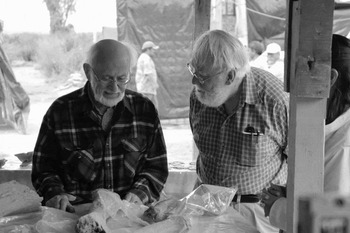
One of these persons is René Millon, whose Mapping Project was carried out with an unprecedented and unparalleled combination of scale, thoroughness, detail, imagination, and determination, supported primarily by a series of grants from the NSF. I had become acquainted with Millon through correspondence in the fall of 1957, when Willey suggested that, for a term paper on highland central Mexico, I contact him for information about his ongoing excavations and survey at Plaza One in Teotihuacan. We didn't meet until the fall of 1958, at a cocktail reception hosted by the Pan American Union during the annual meeting of the American Anthropological Association in Washington, DC. We hit it off immediately. I can't remember what we said, but I remember that we talked eagerly until closing. Here was the stimulation I'd been missing since Chicago. It was an easy decision to join his project in 1964 (Figure 6).
With René Millon examining mammoth bones at Tecamac I, a salt-making site north of Ecatepec, Basin of Mexico, September 2007. Courtesy Ian G. Robertson.

The other person is Saburo Sugiyama, who took on the challenge of tunneling into the Feathered Serpent Pyramid (Temple of Quetzalcoatl), in collaboration with Rubén Cabrera of the Instituto Nacional de Antropología e Historia (INAH), which the three of us started in 1988. Three proposals for this project were declined by NSF reviewers before funds from private sources sufficed to get it started. Later field work on this project was supported mainly by the National Geographic Society, the National Endowment for the Humanities, and INAH. The NSF did provide significant support for data analysis.
Never in the world would I have carried out either of these projects on my own initiative. In both cases I was happy to help out while standing in awe of those with the driving zeal. To a degree, this was also my role in Sugiyama and Cabrera's subsequent project at the Moon Pyramid, started in 1998, though in that case my involvement was only peripheral.
MY MAJOR INTERESTS AND THE LEGACY I'M TRYING TO BUILD
I think I am most known for my participation in the Teotihuacan Mapping Project. I had nothing to do with its design or inception but have worked considerably on Mapping Project data analysis, including building and slowly refining an electronic database, which, after 40 years and to my embarassment, is still not quite ready for broad dissemination. I've drafted most of a book on that, to be co-authored with Ian Robertson and Rebecca Sload. I hope that the electronic files will become part of a much wider electronic knowledge base (not just a database) for all of highland central Mexico. I've also not quite finished my part of the full excavation report on the Feathered Serpent Pyramid Project of 1988–1994, and much remains to be done on my ceramic report for that project. I've also published more generally about Teotihuacan (e.g., Cowgill Reference Cowgill and Stone2007) and am working on a short book about Teotihuacan, trying to synthesize many kinds of knowledge about it. I'm also engaged (with Deborah Nichols of Dartmouth College and Arizona State doctoral students Destiny Crider and Sarah Clayton) in NSF-funded analysis of data from Cerro Portezuelo, a project only partly finished after George Brainerd's untimely death in 1956. That is part of a broader goal of situating Teotihuacan in the context of its neighbors and of better understanding the turbulent conditions associated with the collapse of the Teotihuacan state and its aftermath.
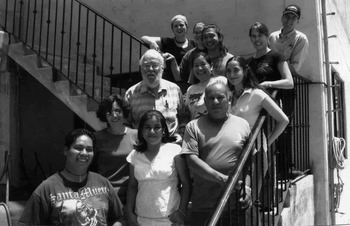
Another kind of legacy is the archaeological research center managed by Arizona State in the town of San Juan Teotihuacan. This grew out of the rented quarters that Millon established in the 1960s for housing the Mapping Project collections. By the 1980s, we needed something larger and more stable. With grants from NSF and other sources, I headed a group that acquired a long-term lease on property and built new facilities for living and for curating and studying archaeological materials. This was a considerable task, made more difficult by my failure to overcome the incomprehension and lack of interest of Brandeis bureaucrats, in marked contrast to the very strong and at times indispensable support of the facility by colleagues and administrators at Arizona State, for which I'm very grateful. The center is a continuing resource for research by scholars from many institutions on Mapping Project materials and other materials housed there, many of which are irreplaceable (Figure 7).
Colleagues, students, and staff at the Teotihuacan Archaeological Research Center, summer 2006.

I have a number of other interests, some of which have attracted less attention. These include statistical and other quantitative methods; systematics, especially for ceramics; population anthropology; and anthropological theory. I think part of the low-visibility problem has been my responding too willingly to invitations to contribute chapters to books that never got wide circulation and have gone out of print, at the expense of volunteering papers to major journals. My few publications in such journals are cited more often than the book chapters. Also, I think I too often tried to cover too many unrelated topics too briefly in a single paper. Finally, I somehow slipped past the need to publish a sole-authored book in order to get tenure—another sign of the easier job market in the 1960s.
With my mathematics background, social-science statistics came easily to me. However, it has been hard to find applications that have helped much with the most interesting archaeological questions. In particular, efforts toward mathematical formalizations of theory, I think, so far have led only to unprofitable abstractions. For example, the actual content of many 1970s systems models was nearly nil—less than met the eye. Perhaps far richer models of the 2000s will do better.
Mathematical methods have, however, become an indispensable tool for some aspects of data analysis. One outstanding example is in materials analyses, where multivariate methods such as principal components, discriminant analysis, and correspondence analysis are by now standard (e.g., Baxter Reference Baxter1994). Another is in the effective use of 14C age determinations for chronology building, especially the use of Bayesian methods (e.g., Buck et al. Reference Buck, Cavanagh and Litton1996). I have tried, not very successfully, to explain in the abstract how much better Bayesian concepts are than those of more traditional canons of statistical inference (Cowgill Reference Cowgill and Johnson1994, Reference Cowgill, Stančič and Veljanovski2001, Reference Cowgill2002). Probably applications such as those of Robertson (Reference Robertson1999, Reference Robertson2001) and Ortman and colleagues (Reference Ortman, Varien and Gripp2007) will do this more effectively. Meanwhile, much of the task is simply trying to educate archaeologists about mistakes to avoid (e.g., Cowgill Reference Cowgill2005) and how to make best use of extremely simple methods, such as drawing appropriate pictures. A continuing obstacle is the poor mathematics preparation of most archaeologists. As long as high school and undergraduate mathematics teaching is so limited, it's not possible to convey adequate statistical understanding in a single semester, yet there's scarcely time for more in most graduate programs. This is a dilemma.
I had an early preoccupation with artifact systematics, especially ceramics. In the 1960s I was burdened by the belief that it was irresponsible not to report every single sherd in sufficient detail that a reader could reconstruct a fairly close facsimile without having seen the object. Happily, I've realized that is impossible. But that makes it all the more necessary to go to the trouble and expense of documenting and curating large collections, since descriptions can never substitute for the actual objects. We have made huge efforts to keep Mapping Project collections intact, but the curation problem is now recognized as an archaeological crisis everywhere.
In the 1960s, my thinking about archaeological systematics was strongly influenced by Albert Spaulding, and I was critical of the views of James Ford. But after a while I realized they were mostly talking past each other: Spaulding focusing on analyses within single assemblages and Ford dealing with relationships among assemblages. It now seems to me that Spaulding never got much beyond the idea that discrete multivariate analyses (cross-tabulations of nominal-scale variables) were the way to do this for assemblages, and I don't think this has been very productive. Ford, for all his simplicity in some ways, proposed a seriation approach that has proved useful, not least because it uses only fractions of the available information.
I have never been happy with “type-variety” approaches, partly because applications have tended to privilege variables such as color schemes at the expense of variables such as vessel shapes, but especially because they lend themselves far too much to reification. By assigning names to types, as if they had person-like individuality rather than intergrading, we foster a human mental proclivity that we should be fighting. Along with earlier workers such as James Bennyhoff, Evelyn Rattray, and William Sanders, I've resisted attempts to apply this approach at Teotihuacan. I believe, however, that current systematics for Teotihuacan ceramics can be improved, and that is another of the things I'm working on. I published some more general thoughts about systematics rather obscurely (Cowgill Reference Cowgill and Voorrips1990). I hope to rewrite the main points more lucidly in another article.
I think my interests in population anthropology are little known, except for papers I published in 1975 (Cowgill Reference Cowgill1975a, Reference Cowgill and Swedlund1975b), which were probably my most influential contribution ever. My main point was that growth rates of populations in the past were quite variable and not uniformly high, so an innate tendency for growth cannot be taken for granted or treated as a self-explained prime mover that played a key role in the rise of complex societies. To be sure, population increases, when they occur, have important consequences, but episodes of growth are themselves in need of explanation, and they are only one factor among many that were involved in the emergence of sociopolitical complexity.
My subsequent efforts in population anthropology have been frustrating and not very visible. What I've tried to get across, with little or no success, is that current population-growth rates are a matter of concern for sustainability and environmental issues to which anthropologists can make unique contributions. But, on the one hand, demographers are overwhelmingly socialized as economists or sociologists, and few can overcome institutional obstacles that make them unreceptive to anthropological knowledge. On the other hand, only a tiny handful of anthropologists have worked on these topics, generally discouraged by unreceptiveness of demographers and neglect or even antipathy from most sociocultural anthropologists. Many of the latter rightly observe that “overpopulation” has often been offered as a deceptive explanation for poverty that was due more to exploitation and sociopolitical inequality. However, the non sequitur often follows that, therefore, high population or rapid increase is only a red herring, not a real problem at all. Even among those who accept that rapid growth could be a problem, a considerable slowing of growth rates in many (but not all) countries has been taken as cause for relief. In fact, even with this slowing, current rates are still worrisome, and it is fanciful to assume that deceleration will automatically continue—rates might even speed up again. In any case, large and/or rapidly increasing human populations can only exacerbate other problems, so it is very worthwhile to learn more than we think we know about why rates decrease or increase. However, I've grown tired of trying to get this across. I think part of my lack of impact lies in the fact that I didn't do actual research on this topic: I was just preaching about it, not furnishing any new data. By now, I don't have time to do that and also do archaeology.
Aside from work at Teotihuacan and thinking about ceramic systematics and population anthropology, my main preoccupation has been evolutionary theory and other theory about emergence or creation of sociopolitically complex societies and their functioning and malfunctioning. I have become more critical of Steward, but I think he had a positive influence in stimulating much of the work that called his models into question. However, what he called “multilinear” evolution in his seminal article (Steward Reference Steward1949), was, within the category of early complex societies, in fact unilinear, since he proposed a single trajectory for Mesopotamia, Egypt, China, northern Peru, and Mesoamerica—a trajectory that today we can see is wrong in important aspects, as well as different in different cases. I have moved further and further away from any form of an evolutionary story, but not toward any other general theory. Instead, it's back to the old effort to learn something from the complexity of actual events but without trying to make any tidy scheme do justice to it all. My most ambitious publication along these lines (Cowgill Reference Cowgill, Yoffee and Cowgill1988) is hardly ever cited, perhaps in part because I spent too much time criticizing what I saw as mistakes before getting to anything positive, such as my discussion of tensions between rulers and what are now called intermediate elites. Concepts such as agency and Giddensian “duality of patterning” are useful tools, but they are tools rather than models. Power and power inequalities can never be overlooked; nor can human psychological propensities and other ideational matters that are underestimated in more materialist schemes (Cowgill Reference Cowgill1993, Reference Cowgill, Dobres and Robb2000).
By the mid 1960s, I was aware of “new” or “processual” archaeology and not sharply opposed, but somewhat underwhelmed by it. Besides my 1950s exposure to Margenau and Bridgman, in 1960 G. E. Hutchinson, eminent Yale authority on limnology (the study of lakes) and beyond that a very wide-ranging scholar, suggested I read Braithwaite (Reference Braithwaite1953). When Carl Hempel gave a talk at Brandeis in 1962, it seemed sensible but nothing to get excited about, and I never dreamed of using it as a basis for a revolution in archaeology. In fact, New Archaeology was applied mostly to smaller-scale societies, while workers in Mesoamerica remained more focused on issues of cultural evolution. I was in sympathy with many of the “post-processual” criticisms of the 1980s but often put off by murky and overstated rhetoric. Lucid analyses in a series of articles by Alison Wylie (Reference Wylie2002) untangled many issues and made good sense.
Perhaps the largest contribution of “post-processual” thought has been that data on tangible things are indispensable but never enough; we must also take account of ancient thoughts, attitudes, and the meanings of objects. In the absence of ample texts, this poses a grave challenge. It won't do simply to make intuitive leaps and claim that they must be correct, and the notion of “multiple pasts” is simply an evasion. Assuredly, there are multiple legitimate “takes” on the past, but the past was real, and we must try to get it right. We can only approach this by taking a skeptical and critical attitude toward one another's ideas, constructive in tone but constantly demanding that all steps in the reasoning be explicit and that all reasonable alternatives be considered and assessed in the light of evidence.