Introduction
Attention-deficit/hyperactivity disorder (ADHD) is characterized by developmentally inappropriate levels of inattention and/or hyperactivity/impulsivity which affect 5–7% of school-aged children and cause significant impairment in multiple settings (American Psychiatric Association, 2013). ADHD is associated with neurocognitive deficits in multiple domains including inhibitory control (Barkley, 1997; Oosterlaan, Logan, & Sergeant, Reference Oosterlaan, Logan and Sergeant1998), set-shifting (Sjöwall, Roth, Lindqvist, & Thorell, Reference Sjöwall, Roth, Lindqvist and Thorell2013; Ware et al., 2012), vigilance (Willcutt, Doyle, Nigg, Faraone, & Pennington, Reference Willcutt, Doyle, Nigg, Faraone and Pennington2005), and working memory (Dovis, Van der Oord, Wiers, & Prins, Reference Dovis, Van der Oord, Wiers and Prins2012; Kasper, Alderson, & Hudec, Reference Kasper, Alderson and Hudec2012; Martinussen, Hayden, & Hogg-Johnson, Reference Martinussen, Hayden and Hogg-Johnson2005; Myatchin, Lemiere, Danckaerts, & Lagae, Reference Myatchin, Lemiere, Danckaerts and Lagae2012).
Considerable attention has been devoted to examining working memory (WM) impairments among youth with ADHD. Baddeley and Hitch (Reference Baddeley and Hitch1974) define WM as the ability to maintain and manipulate information in temporary storage so that it can be used to guide behavior and complete complex cognitive tasks. Baddeley’s (Reference Baddeley2000) revised model of WM contains four components: the phonological loop, visuospatial sketchpad, episodic buffer, and central executive. The phonological loop and visuospatial sketchpad comprise two slave systems that are short-term storage components responsible for processing and retaining auditory-verbal and visual-spatial information, respectively. The episodic buffer, another slave system, integrates information across the phonological loop and visuospatial sketchpad. Lastly, the central executive represents a supervisory component that controls and coordinates information processed by the slave systems. WM is also characterized by two closely linked but separable processes: maintenance versus manipulation. Maintenance, often referred to as short-term memory (Baddeley, Reference Baddeley2012), involves simple rehearsing of information, while more effortful manipulation requires the rearranging and updating of information. These WM processes occur within each modality-specific slave system of Baddeley and Hitch’s model; however, more complex tasks (i.e., manipulation) require greater effort to be exerted by the central executive, whereas simpler tasks (i.e., maintenance) require minimal control from this supervisory component.
Research examining the two WM modalities (i.e., auditory-verbal and visual-spatial) in ADHD have reported poorer performance compared to their typically developing peers (Bedard, Martinussen, Ickowicz, & Tannock, Reference Bedard, Martinussen, Ickowicz and Tannock2004; de Jong et al., Reference de Jong, Van De Voorde, Roeyers, Raymakers, Oosterlaan and Sergeant2009; Gau, Chiu, Shang, Cheng, & Soong, Reference Gau, Chiu, Shang, Cheng and Soong2009; Healey & Rucklidge, Reference Healey and Rucklidge2006; Kasper et al., Reference Kasper, Alderson and Hudec2012; Kerns, McInerney, & Wilde, Reference Kerns, McInerney and Wilde2001; Martinussen et al., Reference Martinussen, Hayden and Hogg-Johnson2005). Within the auditory-verbal domain, simple span tasks (e.g., Digit Span) are commonly used to assess WM. WM maintenance has been assessed by administering the forward condition, with results displaying few differences between children with ADHD and controls (Manassis, Tannock, Young, & Francis-John, Reference Manassis, Tannock, Young and Francis-John2007; McInnes, Humphries, Hogg-Johnson, & Tannock, Reference McInnes, Humphries, Hogg-Johnson and Tannock2003; Nyman et al., Reference Nyman, Taskinen, Gronroos, Haataja, Landetie and Korhonen2010). To assess WM manipulation, many researchers use the backward condition of span tasks and have found that children with ADHD generally perform poorer than controls (Gau & Chiang, Reference Gau and Chiang2013; Karalunas & Huang-Pollock, 2013; Nikolas & Nigg, Reference Nikolas and Nigg2013; Sjowall et al., 2013; Udal, Øygarden, Egeland, Malt, Lovdahl, & Groholt, Reference Udal, Øygarden, Egeland, Malt, Løvdahl, Pripp and Grøholt2012a). Still others (Udal, Øygarden, Egeland, Malt, & Groholt, Reference Udal, Øygarden, Egeland, Malt and Grøholt2012b) have administered span tasks in their entirety (i.e., both forward and backward conditions) to yield a global depiction of WM. These commonly used approaches to assess WM pose some significant limitations. Using only the forward condition allows for the assessment of WM maintenance. However, without including both WM processes in the same statistical model, interpretation of backward performance becomes problematic. Specifically, it will remain uncertain whether difficulty completing backward span tasks in youth with ADHD lies in the simpler task of attending to and rehearsing/maintaining information, or in the more complex task of updating/manipulating information. Similarly, by collapsing performance across forward and backward conditions, and using only the total/combined score (e.g., Udal et al., Reference Udal, Øygarden, Egeland, Malt and Grøholt2012b), one cannot dissect the individual contributions of these distinct WM processes.
For the visual-spatial domain, many researchers have used computerized spatial span tasks (Dovis, Van der Oord, Wiers, & Prins, Reference Dovis, Van der Oord, Wiers and Prins2012; Dovis et al., Reference Dovis, Van der Oord, Wiers and Prins2013; Nikolas & Nigg, Reference Nikolas and Nigg2013; Takács et al., 2014), while others (Fried, Hirshfield-Becker, Petty, Batchelder, & Biederman, Reference Fried, Hirshfield-Becker, Petty, Batchelder and Biederman2012; Gau & Chiang, 2013; Rhodes, Park, Seth, & Coghill, Reference Rhodes, Park, Seth and Coghill2012; Tseng & Gau, 2013; Vance, Ferrin, Winther, & Gomez, Reference Vance, Ferrin, Winther and Gomez2013) have used the Spatial Span and/or the Spatial Working Memory test from the Cambridge Neuropsychological Test Automated Battery (CANTAB; Robbins et al., Reference Robbins, James, Owen, Sahakian, McInnes and Rabbitt1994). Still others (Myatchin et al., Reference Myatchin, Lemiere, Danckaerts and Lagae2012; Strand et al., Reference Strand, Hawk, Bubnik, Shiels, Pelham and Waxmonsky2012) assess visual-spatial WM through n-back tasks in which participants watch stimuli appear sequentially on a computer screen and indicate when they saw the same stimulus appear one target before (1-back), two targets before (2-back), three targets before (3-back), etc. This requires effort in updating previous information. These studies have consistently found that youth with ADHD performed significantly worse on visual-spatial WM tasks compared to controls, whether it involved simple rehearsal or updating/changing of information. However, within the visual-spatial domain, studies have not examined whether children with ADHD exhibit differentially poorer performance on WM manipulation relative to WM maintenance. As such, the specificity of visual-spatial WM manipulation as a deficit in children with ADHD has not been determined.
McInnes et al. (Reference McInnes, Humphries, Hogg-Johnson and Tannock2003) did administer tasks to assess WM maintenance and manipulation in both modalities, providing an opportunity to parse differences in WM processes and modalities within a single model. However, four separate analyses were conducted examining WM maintenance and manipulation in the auditory-verbal and visual-spatial modalities; thus, specific WM weaknesses, while accounting for other related processes, were not assessed. They reported that children with ADHD performed significantly worse than controls on tasks assessing visual-spatial maintenance and manipulation, and auditory-verbal manipulation, but not auditory-verbal maintenance. Similarly, Fair, Bathula, Nikolas, and Nigg (2012) administered both the forward and backward conditions of the digit span task and a computerized version of the spatial span task. They separately analyzed the two WM processes, defining them as encoding/span [maintenance] and WM [manipulation], but collapsed their findings across modality. They reported that children with ADHD performed significantly poorer on both encoding/span and WM measures. It therefore still remains difficult to ascertain where the specific WM weaknesses exist in youth with ADHD.
Two meta-analyses (Kasper et al., Reference Kasper, Alderson and Hudec2012; Martinussen et al., Reference Martinussen, Hayden and Hogg-Johnson2005) found that children with ADHD have substantially poorer visual-spatial WM compared to their typically developing counterparts. However, conclusions regarding the auditory-verbal domain were less consistent. Martinussen et al. (Reference Martinussen, Hayden and Hogg-Johnson2005) found limited group differences in auditory-verbal WM, whereas Kasper et al. (Reference Kasper, Alderson and Hudec2012) reported substantial auditory-verbal WM deficits. Furthermore, neither meta-analysis examined whether children with ADHD have specific deficits in the more complex process of manipulation, when maintenance, which is closely linked to attentional control, is held constant.
Beyond comparisons of children with and without ADHD, few studies have examined WM differences as a function of ADHD presentation. Two studies (Skogli Egeland, Andersen, Hovik, & Øie, Reference Skogli, Egeland, Andersen, Hovik and Øie2013; Yang et al., Reference Yang, Cheng, Chang, Liu, Hsu and Yen2013) found no differences between children with ADHD, Predominantly Inattentive Presentation (ADHD-I) and ADHD, Combined Presentation (ADHD-C) on WM measures. However, despite similar overall performance on tests of WM, children with ADHD-I and ADHD-C may exhibit more subtle differences in particular WM processes and/or modalities. For example, no study has systematically examined whether one of the ADHD presentations has differentially poorer performance on WM manipulation, when WM maintenance is held constant, or whether they have differential performance in the auditory-verbal versus visual-spatial modality.
Furthermore, most studies (Ferrin & Vance, 2012; Gau & Chiang, 2013; Myatchin et al., Reference Myatchin, Lemiere, Danckaerts and Lagae2012; Rhodes et al., Reference Rhodes, Park, Seth and Coghill2012; Vance et al., Reference Vance, Ferrin, Winther and Gomez2013) examining WM in ADHD used wide age ranges, spanning up to 9 years within a given cohort. As WM, like other executive functions, undergoes rapid non-linear growth throughout childhood and early adolescence (Simmonds, Hallquist, Asato, & Luna, Reference Simmonds, Hallquist, Asato and Luna2014), collapsing data across these age ranges complicates efforts to determine the specific chronological age(s) at which WM differences occur and may decrease the likelihood of detecting subtle specific differences in WM processes between children with and without ADHD. Lastly, using a narrower age-range allows for the use of raw scores which, as opposed to age-standardized scores, are more sensitive to detecting individual differences (e.g., raw scores on WISC-IV Digit Span can range from 0 to 32, but scaled scores only from 1 to 19).
Moreover, the cerebral cortex develops at different rates in children with and without ADHD (Shaw et al., Reference Shaw, Eckstrand, Sharp, Blumenthal, Lerch, Greenstein and Rapoport2007), such that peak cortical thickness occurs at around 10.5 years old for children with ADHD, as opposed to 7.5 years old for children without ADHD. This neurodevelopmental lag of key cortical areas likely coincides with the development of neurocognitive processes. Thus, 8-year-old children were studied to be consistent with these neuroimaging findings and perhaps maximize group differences.
The present study examined WM modalities (auditory-verbal vs. visual-spatial) and processes (maintenance vs. manipulation) among 8-year-old children with and without ADHD in a single analytic model using well-matched tasks that allow for the isolation of domain-specific processes to more clearly identify the precise nature of the WM weaknesses in children with ADHD. We used an additive factors model (Sergeant, Geurts, & Oosterlaan, Reference Sergeant, Geurts and Oosterlaan2002; Sternberg, Reference Sternberg1969), which uses multiple well-matched conditions to differentially tax the construct/process of interest. Thus, by examining Group×Condition interactions, one can isolate specific weaknesses (e.g., in manipulation) while accounting for other possible group differences (e.g., in maintenance). Such efforts have not been undertaken to date, leaving open questions about the nature of WM deficiencies in youth with ADHD. For example, no previous study has examined in such a clear way the incremental weaknesses in manipulation relative to maintenance, nor the incremental degree of poorer performance in the visual relative to the verbal modality. We hypothesized: (1) As compared to non-ADHD peers, 8-year-old children with ADHD would demonstrate differentially poorer WM manipulation (regardless of modality) relative to WM maintenance. (2) Eight-year-old children with ADHD would show significantly weaker visual-spatial versus auditory-verbal WM (irrespective of processing demands) relative to their non-ADHD peers.
Secondary/exploratory analyses using the additive factors model examined WM processes and modalities as a function of ADHD presentation.
Method
Participants
The sample consisted of 8-year-old children who participated in a longitudinal study of preschoolers initially characterized as either “hyperactive/inattentive” or “typically developing”. To be included, preschool children had to be English-speaking and attending school and/or daycare. Exclusionary criteria at initial recruitment were: FSIQ<80 as assessed by the Wechsler Preschool and Primary Scale of Intelligence–Third Edition (WPPSI-III; Wechsler, Reference Wechsler2006), systemic medication use (including for ADHD), and presence of a neurological, post-traumatic stress, and/or pervasive developmental disorder. At their initial evaluation (ages 3–4), parents and teachers rated all children using the ADHD-Rating Scale-IV (ADHD-RS-IV; DuPaul, Power, Anastopoulus, & Reid, Reference DuPaul, Power, Anastopoulus and Reid1998), which consists of the 18 ADHD symptom criteria listed in the Diagnostic and Statistical Manual of Mental Disorders - Fourth Edition Text Revision (American Psychiatric Association, 2000). Children rated as having six or more different symptoms in either the inattentive or hyperactive/impulsive domain, as endorsed by a combination of parent and teacher reports, were deemed to be “hyperactive/inattentive”; children rated as having three or fewer symptoms in both domains by both parent and teacher were classified as “typically developing.” Additional details regarding recruitment and selection procedures for the original study are available elsewhere (Rajendran et al., Reference Rajendran, Trampush, Rindskopf, Marks, O’Neill and Halperin2013).
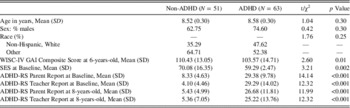
At 8-years-old, children received a comprehensive psychiatric evaluation consisting of a semi-structured parent interview, along with several parent and teacher rating scales. For this study, children were classified as having ADHD if they were hyperactive/inattentive at baseline and met full DSM-5 diagnostic criteria for ADHD at age 8. The non-ADHD comparison group consisted of children who were typically developing at baseline and did not meet criteria for ADHD. The final sample consisted of 63 children with ADHD (M=8.58 years; SD=0.31; 75% male) and 51 non-ADHD children (M=8.52 years; SD=0.30; 63% male). Among those with ADHD, 18 (28.57%) met criteria for ADHD-I, 7 (11.11%) for Predominantly Hyperactive-Impulsive Presentation (ADHD-H), and 38 (60.32%) for ADHD-C. The sample was racially and ethnically diverse, consisting of 67 (58.8%) Caucasians, 13 (11.4%) African Americans, 17 (14.9%) Asians, and 17 (14.9%) of mixed racial make-up; 33 (28.9%) were of Hispanic descent. As shown in Table 1, the ADHD and non-ADHD groups differed significantly in parent and teacher ratings of ADHD symptoms at baseline and 8-year-old evaluations. Furthermore, the ADHD group had a significantly lower WISC-IV General Ability Index (GAI) as measured at age 6, and lower socioeconomic status (SES) as measured by Nakao and Treas’ (Reference Nakao and Treas1994) Socioeconomic Prestige Index (range=20–100), although both groups fell within the middle-class range.
Descriptive characteristics of the sample

Measures
Diagnostic Measures
ADHD-RS-IV
Parents and teachers completed the ADHD Rating Scale-IV (DuPaul et al., Reference DuPaul, Power, Anastopoulus and Reid1998) at baseline and 8-year-old evaluations. For all 18 ADHD symptoms, parents and teachers rated each behavior on a 4-point Likert scale (0=not at all, 1=somewhat, 2=pretty much, and 3=very much). Coefficient alpha for the parent scales at baseline and 8-year-old evaluations were .95 and .97, respectively; analogous values for teacher ratings were .97 and .96.
Kiddie Schedule for Affective Disorders and Schizophrenia – Present and Lifetime Version (KSADS-PL)
Parents/caregivers were administered the KSADS-PL, a semi-structured interview (Kaufman, Birmaher, Brent, Rao, & Ryan, Reference Kaufman, Birmaher, Brent, Rao and Ryan1996), which assesses the presence of childhood psychiatric disorders. Interviewers were well-trained psychology graduate students or post-doctoral fellows.
Working Memory Measures
Auditory-verbal WM
Auditory-verbal WM was assessed using the Digit Span subtest from the Wechsler Intelligence Scale for Children-Fourth Edition Integrated (WISC-IV Integrated; Kaplan, Fein, Kramer, Morris, Delis, & Maerlender, Reference Kaplan, Fein, Kramer, Morris, Delis and Maerlender2004). This subtest contains two conditions, Digit Span Forward and Digit Span Backward.
Visual-spatial WM
Visual-spatial WM was assessed using the Spatial Span subtest from the WISC-IV Integrated (Kaplan et al., Reference Kaplan, Fein, Kramer, Morris, Delis and Maerlender2004). Similar to Digit Span, the Spatial Span subtest has both forward and backward conditions. Participants watch the examiner point-out a series of block sequences and must touch the blocks in the same or reverse order.
Within each of these tests the forward condition served as a measure of WM maintenance and the backward condition served as a measure of WM manipulation. Both span tests were administered using standardized procedures with the forward condition preceding the backward condition. While this could potentially lead to order effects (e.g., fatigue or practice), following standardized procedures seemed prudent. Raw scores rather than scaled scores served as the primary dependent measures because of the greater sensitivity and variability that they provide, as well as their ability to allow for direct comparisons across the forward and backward conditions. The narrow age-range of the sample as well as the close correspondence in age across groups (<1 month difference) makes the use of raw scores particularly appropriate for this study.
Procedure
Children were tested individually while a different evaluator interviewed the child’s parent using the K-SADS-PL. Both examiners were blind to the child’s prior diagnostic status. Parents of children with ADHD who were being treated with stimulant medication or atomoxetine were asked to withhold medication until after the evaluation. All children completed a battery of neuropsychological and academic achievement tests primarily from the Delis-Kaplan Executive Function System (Delis, Kaplan, & Kramer, Reference Delis, Kaplan and Kramer2001), Wechsler Individual Achievement Test – Second Edition (Wechsler, Reference Wechsler2001), and WISC-IV Integrated (Kaplan et al., 2004). The neuropsychological and academic achievement measures were interspersed while maintaining standardization procedures to minimize fatigue and enhance examinee engagement. Within the test session, all children completed the Spatial Span task before the Digit Span task, but not in immediate succession. With such a large battery, counterbalancing or using random order seemed impractical, and thus we used a fixed test order that was administered to all participants in both groups. Children were given a small gift for their participation and parents received compensation for their time and expenses.
This study was approved by the institutional review board of the participating institution. Following a full description of the study and their rights as participants, parents/caregivers signed institutional review board-approved informed consent forms and children provided verbal assent.
Statistical Analysis
A three-way Group×Modality×Condition (2×2×2) analysis of variance (ANOVA) was conducted. Group (ADHD vs. non-ADHD) served as the between-group variable, and Modality (Auditory-Verbal vs. Visual-Spatial) and Condition (Forward vs. Backward) served as within-group variables. A significant main effect of Group would suggest that overall the groups performed significantly different on the WM measures. A main effect of Modality would indicate significant differences in performance across auditory-verbal and visual-spatial WM. A main effect of Condition would point to a significant difference in performance across maintenance and manipulation processes. While main effects are noteworthy, specific interactions are of primary interest because with well-match conditions, which differ only in one narrow parameter, they allow for the isolation of specific processes/modalities relative to other modalities/processes. Thus, a significant Group×Condition interaction would indicate that one group performed differentially worse in one of the WM processes (e.g., difficulties in manipulation over and above, or after accounting for, group differences in maintenance). Analogously, a significant Group×Modality interaction would indicate that one group performed differentially worse across one of the WM modalities (e.g., visual-spatial performance being worse in one group after accounting for differences in auditory-verbal performance). Where significant interactions emerged, post hoc tests comparing the two groups on key data points were conducted to elucidate the nature of specific interactions. Bonferroni’s correction was used to control for multiple contrasts. As four post hoc tests were conducted, an alpha of.0125 (.05/4) was required in these individual contrasts for statistical significance. Effect sizes are reported as partial eta squared (η2 p), with .02, .13 and.26 reflecting small, medium, and large effect sizes, respectively (Miles & Shevlin, Reference Miles and Shevlin2001).
Notably, analysis of covariance would not be an appropriate method to examine one measure while “controlling” for the other (e.g., comparing Digits Backward across groups using Digits Forward as a covariate). Compelling statistical (Lord, Reference Lord1967; Miller & Chapman, Reference Miller and Chapman2001) arguments have been made as to why analysis of covariance should not be used and how the use of such covariates is likely to misrepresent the true findings. Similarly, both statistical (Lord, Reference Lord1967; Miller & Chapman, Reference Miller and Chapman2001) and conceptual (Dennis et al., Reference Dennis, Francis, Cirino, Schachar, Barnes and Fletcher2009) arguments have been made as to why covarying IQ would be inappropriate.
Using the same analytic approach, secondary analyses were conducted to examine ADHD presentation differences in WM. As there were only seven children with ADHD-HI, these analyses were restricted to those with ADHD-I and ADHD-C.
Results
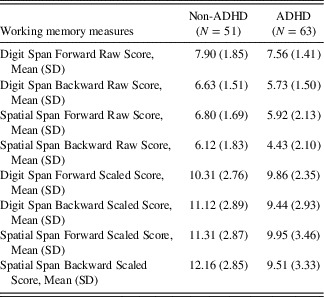
Descriptive statistics for the different WM measures as a function of group are displayed in Table 2.
Group scores on each working memory task

ADHD versus Non-ADHD Children
There was a significant main effect of Group (F(1,112)=17.31; p<.001; η2 p=0.13), indicating that 8-year-old children with ADHD performed worse across all WM tasks compared to their non-ADHD peers. Also observed was a main effect of Modality (F(1,112)=56.01; p<.001; η2 p=0.33), such that participants performed worse on the visual-spatial compared to the auditory-verbal tasks. Lastly, a main effect of Condition (F(1,112)=82.53; p<.001; η2 p=0.42), indicated poorer performance on the backward relative to forward conditions.
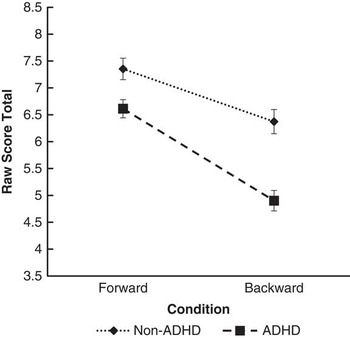
As depicted in Figure 1, there was a significant Group×Condition interaction (F(1,112)=5.45; p=.02; η2 p=0.05). Post hoc analyses revealed that the groups differed significantly on backward (F(1,112)=21.81; p<.001; η2 p=0.163), but only marginally on forward tasks (F(1,112)=5.349; p=.02; η2 p=0.046) after Bonferroni correction.
Performance of children with ADHD and their non-ADHD peers on forward and backward span conditions collapsed across modality. Bars indicate standard error (SE). Group×Condition Interaction: F(1,112)=5.45, p=.02, η2 p =0.05. Forward Condition: F(1,112)=5.349, p=.02, η2 p=0.046. Backward Condition: F(1,112)=21.81, p<.001, η2 p=0.163.

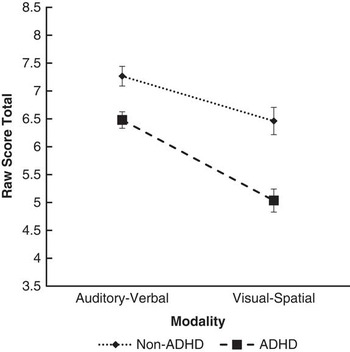
Additionally, there was a significant interaction of Group×Modality (F(1,112)=4.79; p=.03; η2 p=0.04). Post hoc analyses revealed that the groups significantly differed on auditory-verbal (F(1,112)=7.682; p=.007; η2 p=0.064), as well as visual-spatial WM tasks (F(1,112)=16.395; p<.001; η2 p=0.128; see Figure 2). However, those with ADHD performed differentially worse on visual-spatial relative to auditory-verbal WM tasks. Finally, neither the Condition×Modality interaction (F(1,112)=3.59; p>.05; η2 p=0.03) nor the three-way interaction (F(1,112)=0.28; p>.05; η2 p=0.002) were significant.
Performance of children with ADHD and their non-ADHD peers on auditory-verbal and visual-spatial tasks collapsed across condition. Bars indicate standard error (SE). Group×Modality Interaction: F(1,112)=4.79, p=.03, η2 p=0.04. Auditory-verbal WM: F(1,112)=7.682, p=.007, η2 p=0.064. Visual-spatial WM: F(1,112)=16.395, p<.001, η2 p=0.128.

ADHD-I versus ADHD-C
Secondary analyses examining differences between children with ADHD-I and ADHD-C yielded a significant main effect of Modality (F(1,54)=38.12; p<.001; η2 p=0.41), indicating that children performed worse on the visual-spatial compared to the auditory-verbal tasks. Also, a main effect of Condition (F(1,54)=76.10; p<.001; η2 p=0.59) indicated lower scores on the backward relative to the forward conditions. The main effect of Group was not significant (p=.767), indicating that overall performance across presentations did not differ.
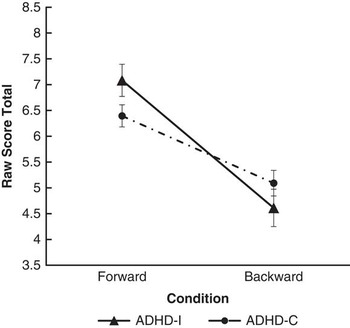
Nevertheless, a significant Group×Condition interaction emerged (F(1,54)=7.31; p=.009; η2 p=0.12), such that children with ADHD-I, compared to those with ADHD-C, performed differentially worse on backward versus forward tasks (see Figure 3). Post hoc tests did not reveal significant group differences on forward or backward tasks (both p>.10). However, children with ADHD-I had a significantly greater difference between forward and backward scores as compared to the ADHD-C group (t=2.70; p=.009). The Group×Modality (F(1,54)=2.54; p=.12; η2 p=0.04) and 3-way (F(1,54)=2.41; p=.13; η2 p=0.04) interactions were not significant.
Performance of children with ADHD-Predominantly Inattentive Presentation (ADHD-I) and ADHD-Combined Presentation (ADHD-C) on forward and backward span conditions collapsed across modality. Bars indicate standard error (SE). Group×Condition Interaction: F(1,54)=7.31, p=0.009, η2 p=0.12.

Discussion
The present study systematically examined components of WM in 8-year-old children with ADHD within a single model, and represents the first of its kind to parse distinct memory processes while accounting for global attentional and mnemonic abilities. Overall, the data indicated that, as compared to their non-ADHD peers, school-aged children with ADHD exhibited incrementally greater weaknesses in visual-spatial versus auditory-verbal WM; however, for children with ADHD, difficulties were evident in both domains. In addition, those with ADHD demonstrated significantly greater difficulties in WM manipulation relative to WM maintenance as compared with their non-ADHD peers. Taken together the findings suggest that 8-year-old children with ADHD are not globally impaired across WM processes, but rather have a pattern of relative strengths and weaknesses.
Our findings are largely consistent with and extend previously published literature as described in two meta-analyses that have systematically examined research on WM deficits in children with ADHD (Martinussen et al., Reference Martinussen, Hayden and Hogg-Johnson2005; Kasper et al., Reference Kasper, Alderson and Hudec2012). Martinussen et al. (Reference Martinussen, Hayden and Hogg-Johnson2005) reported large differences between children with and without ADHD in visual-spatial WM, but only a moderate effect size for differences in auditory-verbal WM. Consistent with our results, these findings suggest that school-aged children with ADHD perform significantly worse on visual-spatial WM tasks relative to auditory-verbal WM tasks. However, while this meta-analysis did differentiate between the WM processes of maintenance versus manipulation, they did not examine manipulation after controlling for the processes associated with maintenance such as attention and rehearsal. Thus, our finding of a selective weakness in WM manipulation, after accounting for these other factors, expands upon previous findings.
Nevertheless, the findings of the current study, as well as those of Martinussen et al. (Reference Martinussen, Hayden and Hogg-Johnson2005), were somewhat discrepant from the more recent meta-analytic review by Kasper and colleagues (Reference Kasper, Alderson and Hudec2012), which found large differences between children with ADHD and controls for both visual-spatial and auditory-verbal WM. Processing demands associated with maintenance and manipulation were not differentiated in this meta-analysis, and thus our findings expand upon previous research.
The distinction between maintenance and manipulation processes is critical to understanding the nature of WM weaknesses among children with ADHD. Several studies have independently examined performance on forward and backward tasks in children with and without ADHD, with some examining differences on both measures (Udal et al., Reference Udal, Øygarden, Egeland, Malt, Løvdahl, Pripp and Grøholt2012a) and others examining differences only on backward tasks (Gau & Chiang, 2013; Karalunas & Huang-Pollock, 2013; Nikolas et al., 2013; Sjöwall et al., 2012; Udal et al., 2012b). However, findings on backward tasks are difficult to interpret when performance on more rudimentary (forward) tasks requiring attention and sequencing are not accounted for within the model. Our data demonstrate that youth in the present sample demonstrate particular difficulties in WM manipulation independent of other potentially more global weaknesses.
Our findings are consistent with presumed neurobiological underpinnings of ADHD and WM. Neuroimaging data indicate an array of neurodevelopmental delays and/or anomalies in children with ADHD that preferentially impact prefrontal regions (Seidman et al., Reference Seidman, Valera, Makris, Monuteaux, Boriel, Kelkar and Biederman2006; Shaw et al., Reference Shaw, Eckstrand, Sharp, Blumenthal, Lerch, Greenstein and Rapoport2007). Additionally, neuroimaging studies examining different WM processes generally find that maintenance (or storage/simple rehearsal components) activate more posterior brain regions, and as tasks grow in complexity or require more manipulation/updating of information, both dorsolateral and ventral lateral brain regions are preferentially activated (Wager & Smith, Reference Wager and Smith2003). Our data are consistent with these findings, such that children with ADHD clearly show WM weaknesses, and specifically in manipulation processes which appear to be more frontally mediated.
Our secondary analyses examining the different ADHD presentations also provided interesting and unique findings. Several investigators (Skogli et al., Reference Skogli, Egeland, Andersen, Hovik and Øie2013; Solanto et al., Reference Solanto, Gilbert, Raj, Zhu, Pope-Boyd, Stepak and Newcorn2007; Yang et al., Reference Yang, Cheng, Chang, Liu, Hsu and Yen2013) have examined differences between Predominantly Inattentive and Combined Presentations of ADHD on a range of executive function measures finding relatively few differences. Similar to others, our analyses did not yield main effects of Group, which could superficially lead to the conclusion that children with ADHD, Predominantly Inattentive and Combined Presentations do not differ in WM. However, our data indicated that 8-year-old children with ADHD-I have differentially greater difficulties in WM manipulation relative to maintenance, as compared to those with ADHD-C. Thus, our unique analytical approach allowed us to parse the different WM processes between the ADHD presentations. Further research into the relations between inattention and WM manipulation may be warranted. However, first, these findings from secondary analyses will require replication.
The current study may have important clinical implications as recent efforts have centered on the use of working memory training as a therapeutic intervention for youth with ADHD. Perhaps the most widely publicized and empirically investigated of these is Cogmed Working Memory Training (CWMT; Klingberg et al., Reference Klingberg, Fernell, Olesen, Johnson, Gustafsson, Dahlstrom and Westerberg2005; Klingberg, Reference Klingberg2010), a computerized training program in which individuals learn and perform various WM tasks in an effort to improve their WM capacity. However, recent data (Chacko et al., Reference Chacko, Bedard, Marks, Feirsen, Uderman, Chimiklis and Ramon2014; van-Dongen-Boomsma, Vollebregt, Buitelaar, & Slaats-Willemse, Reference van Dongen-Boomsma, Vollebregt, Buitelaar and Slaats-Willemse2014) and reviews (Rapport, Orban, Kofler, & Friedman, Reference Rapport, Orban, Kofler and Friedman2013) have suggested that CWMT may not yield real-world improvements of ADHD behavior, but instead primarily improve proficiency on proximal cognitive (i.e., working memory) tests. Our findings suggest that 8-year-old children with ADHD demonstrate a particular weakness in WM manipulation (with maintenance relatively intact) and have more difficulties in the visual-spatial domain rather than auditory-verbal. As current CWMT focuses on WM manipulation and visual-spatial WM as primary target areas to improve, the findings from our study justify these as appropriate foci for remediation. However, the incorporation of these processes on the one hand and limited clinical utility of WM remediation methods may suggest that children with ADHD do not uniformly manifest WM deficiencies and may therefore not be uniformly positioned to benefit from such interventions. It is important to emphasize that ADHD is a heterogeneous disorder, with some youth presenting with unambiguous WM weaknesses and others exhibiting a markedly different, possibly more intact neurocognitive profile. With such heterogeneity, those children who present with WM weaknesses may be the ones who are better suited to benefit from WM treatments, while others with ADHD who exhibit intact WM might not benefit. Nevertheless, it is still unclear whether individuals with weaker WM who receive WM intervention, actually gain real-world improvements or decreases in ADHD severity.
This study had several notable strengths. First, we used a well-studied sample that has been routinely followed-up as a part of a larger longitudinal research project. Thus, the sample is well-characterized for both the presence and absence of ADHD. Second, this study is unique with regard to the narrow age-range of the participants. Chronological age is of particular importance because the neurocognitive processes under examination progressively develop as children age, and tremendous brain growth occurs in late childhood and adolescence (Shaw et al., Reference Shaw, Eckstrand, Sharp, Blumenthal, Lerch, Greenstein and Rapoport2007). This narrow age range also facilitated the use of raw scores rather than scaled scores, with the former being more sensitive to individual differences. Perhaps most importantly, this was the first study to examine the various WM components in a single model using well-matched tests, which facilitated comparisons of distinct WM processes (i.e., maintenance vs. manipulation) and modalities (i.e., visual-spatial vs. auditory-verbal WM) while accounting for possible weaknesses in other processes and modalities.
Nevertheless, this study had some limitations. While the narrow age-range is largely viewed as a strength, caution must be used when generalizing the results to other ages. Furthermore, the current study only examined the participants at one point in time. It would be beneficial to examine the same children over various time points to identify developmental trajectories of these WM components and their potential correspondence to symptom expression. Therefore, future research should use longitudinal designs when examining the various components of WM in children with ADHD. Additionally, the tasks used to assess WM manipulation were restricted to memory span tasks. Some researchers (Engle, Tuholski, Laughlin, & Conway, Reference Engle, Tuholski, Laughlin and Conway1999; Rapport et al., Reference Rapport, Alderson, Kofler, Sarver, Bolden and Sims2008) have argued that simple span tasks are not taxing enough to assess central executive control of WM. While this may be true in some samples, we do not believe this to be the case in this study as none of the tasks used were hampered by ceiling effects, and the backward span tasks in both domains were sensitive enough to reveal group differences. Furthermore, the study included only a single measure to assess each WM process within each modality. While the use of a single task might increase measurement error, these well-matched tasks allowed us to make direct comparisons of performance between the WM processes and modalities, and enabled us to parse the specific nature of WM weaknesses in this sample. Nevertheless, future research is needed to replicate these findings using additional WM tasks to form aggregated and/or latent constructs of WM.
Finally, an alternative interpretation might suggest that variations in task difficulty are key to the differential group findings irrespective of process or modality. However, there are several examples in the literature in which manipulations analogous to those used in this study were conducted in children with and without ADHD and yielded significant main effects of condition (thus one task was more difficult), but not a Group×Condition interaction (Berwid et al., Reference Berwid, Curko Kera, Marks, Santra, Bender and Halperin2005; Marks et al., Reference Marks, Berwid, Santra, Kera, Cyrulnik and Halperin2005; Rommelse et al., Reference Rommelse, Altink, de Sonneville, Buschgens, Buitelaar, Oosterlaan and Sergeant2007; van der Meere & Sergeant, Reference van der Meere and Sergeant1987). Thus, those with ADHD did not perform differentially worse on the more difficult task. In light of such findings, we interpret our Group×Modality and Group×Condition interactions as reflecting incrementally worse performance relative to their non-ADHD peers in the visual modality and manipulation process rather than being associated with task difficulty.
Overall, we found that 8-year-old children with ADHD exhibited specific weaknesses in WM manipulation, while WM maintenance remained relatively intact. Additionally, 8-year-old children with ADHD exhibited difficulties across both WM modalities, with greater group differences in the visual-spatial relative to the auditory-verbal domain. To the best of our knowledge, this was the first study to systematically examine both WM processes along with modalities, in an effort to examine specific versus global weaknesses of WM in children with ADHD. While our findings suggest more specific difficulties of WM among school-aged children with ADHD, future longitudinal research designs are warranted to prospectively track the correspondence between WM and ADHD symptom changes.
Acknowledgements
This research was supported by grant R01 MH068286 from the National Institute of Mental Health (NIMH). There are no conflicts of interest for any of the authors listed.