The distortion of facts is nothing new to politics. From rumors that Al Gore claimed to have invented the Internet to conspiracy theories about the assassination of John F. Kennedy and the attacks on the World Trade Center, wading through political misinformation is as much a part of politics as debates and campaign slogans. With the rise of the Internet and the 24-hour news cycle, political misinformation and half-truths are now capable of taking on a life of their own. Political gaffes, parodies, and unsubstantiated rumors now spread more rapidly than ever. As misinformation disperses through social networks, it increases the likelihood of fiction becoming fact in a voter’s mind as audiences are burdened with distinguishing rumors from reality. Two examples from the 2008 presidential election campaign perhaps best illustrate this new social reality.
In 2008, polls showed a sharp increase in the percentage of American voters who mistakenly believed then-presidential-hopeful Barack Obama to be a Muslim (Hollander Reference Hollander2010; Mosk Reference Mosk2008). The catalyst for this shift in public opinion can best be traced to a chain e-mail that went viral during the campaign season. The e-mail—which originated with claims made by Andy Martin, a self-described writer and journalist, following Obama’s 2004 Democratic Convention speech—presented a biographical sketch of Obama as a Muslim who was concealing a radical Islamic past (Hollander Reference Hollander2010; Mosk Reference Mosk2008; Rutenberg Reference Rutenberg2008). Although Obama holds familial ties to the Muslim faith and has been less vocal about his Christian views than many other American politicians, the e-mail was baseless and has since been debunked by several fact-checking websites, news organizations, and even the president himself (Hollander Reference Hollander2010). However, if the polls are any indication, the belief persists that President Obama is a Muslim, with anywhere from 10% to 25% of Americans holding this view (Hartman and Newmark Reference Hartman and Newmark2012; Hollander Reference Hollander2010; Newsweek 2010; Pew Research Center 2010; Time Magazine 2010).
Around the same time that rumors were circulating about Obama’s faith, then-Alaska governor Sarah Palin’s nomination as the Republican Party’s candidate for vice president was gaining momentum. In September 2008, in her first interview as the vice-presidential nominee, Palin spoke with Charles Gibson of ABC News. When asked what insights she had gained by governing a state that was so geographically close to Russia, she responded, “They’re our next-door neighbors, and you can actually see Russia from land here in Alaska, from an island in Alaska.” Two days later, in a parody of Palin, Saturday Night Live’s Tina Fey delivered the now-famous “I can see Russia from my house” line. Fey’s impersonation became an instant hit—partly because of the physical likeness between Fey and Palin—and appeared at the top of several “best of” lists for that year, garnering millions of views online (Carter Reference Carter2008). Fey subsequently appeared as Palin in five more sketches leading up to the election, gaining notoriety from the impersonation and attracting unprecedented levels of attention from the mainstream news media (Gorman Reference Gorman2009). As a result, leading academic researchers later investigated the possibility of a “Fey effect” on citizen attitudes and vote choice (Baumgartner et al. Reference Baumgartner, Morris and Walth2012; Esralew and Young Reference Esralew and Young2012).
It is interesting that the study found that Republican and independent voters were most negatively influenced by the impersonation, although this may be partly related to a “floor effect” among Democratic voters.
Researchers and pollsters focused considerable attention on beliefs about President Obama’s religion (e.g., Garrett Reference Garrett2011; Hollander Reference Hollander2010; Pew Research Center 2010), including a recent study published in this journal (Hartman and Newmark Reference Hartman and Newmark2012). The consensus from much of this work is that misperceptions about Obama’s faith appear disproportionately among conservative voters, which suggests partisan differences in how liberals and conservatives process information about this issue. Less attention, however, has been given to Fey’s portrayal of Palin, despite the widely documented popularity of the sketches. A notable exception was a study that focused on approval of John McCain’s choice of Palin as a running mate and subsequent voting intentions based on exposure to the Saturday Night Live parody (Baumgartner et al. Reference Baumgartner, Morris and Walth2012). This study found evidence that the parody may have dampened support for the Republican ticket leading up to the election, with viewers of the portrayal significantly less likely to report an intention to vote for McCain (Baumgartner et al. Reference Baumgartner, Morris and Walth2012). It is interesting that the study found that Republican and independent voters were most negatively influenced by the impersonation, although this may be partly related to a “floor effect” among Democratic voters who likely started with more unfavorable opinions toward McCain.
Of course, what this study fails to confirm is whether and to what degree audiences actually attribute Fey’s words to Palin. Did American audiences view the impersonation as simply a condemnation of Palin, or can the shifts in support be better explained by a failure of individuals to distinguish parody from reality? If we assume the latter, was the confusion more pronounced among liberal voters and, therefore, indicative of a partisan liberal bias that is similar to the conservative bias concerning President Obama’s religion? Or was this misperception widespread among the public, regardless of partisan predispositions? The goals of this study are therefore twofold. First, we are interested in determining how widespread political misinformation is among American audiences. We focus our analysis on the two examples already discussed: (1) the myth surrounding President Obama’s ties to the Islamic faith; and (2) the misattribution of the statement, “I can see Russia from my house.” Footnote 1 We give particular attention to the second example because researchers have yet to determine the extent to which audiences actually attribute Fey’s words to Palin. Our second goal is to compare how these misperceptions differ based on respondents’ value predispositions and media-use habits. In pursuing these questions, we situate our analysis within the motivated-reasoning literature and its impacts on political understanding.
MOTIVATED REASONING
We know from social-psychology research that individuals are motivated by their predispositions, including political ideology and religious belief, to process information in a biased and attitude-congruent manner (e.g., Strickland et al. Reference Strickland, Taber and Lodge2011). So-called motivated reasoning means that individuals selectively attend to particular types of information when surveying the information landscape (Kunda Reference Kunda1990; Kunda and Sinclair Reference Kunda and Sinclair1999) and that they have a tendency to “arrive at conclusions that they want to arrive at” (Kunda Reference Kunda1990). This type of distorted perception has been investigated extensively in the realm of politics, most notably in studies concerned with candidate evaluations (e.g., Meffert et al. Reference Meffert, Chung, Joiner, Waks and Garst2006). During the 1980 presidential debate, for example, voters who favored Ronald Reagan believed he had won the debate, whereas those who favored Jimmy Carter believed the opposite (Sigelman and Sigelman Reference Sigelman and Sigelman1984). That partisan motivations influence how people evaluate subjective stimuli is hardly surprising, and the studies cited in this article provide only a glimpse into this robust phenomenon.
Partisan biases can also have a strong effect on perceptions of objective political facts (Bartels Reference Bartels2002; Hollander Reference Hollander2010). Using American National Election Studies data from 1988 and 2000, Bartels (Reference Bartels2002) found that Democrats and Republicans differed significantly in their evaluations of several political truths—including the size of the national debt, shifts in inflation rates, and unemployment levels—based on the party that was in power when the question was asked. Democrats, for example, were more likely to claim that inflation rates worsened during the years that Reagan was in office (they did not), whereas Republicans were less likely to agree that the Clinton administration reduced the federal-budget deficit (it did). These findings are explained in terms of “partisan loyalties” that shape how partisans view and make sense of the political world (Bartels Reference Bartels2002). In other words, directional goals can inhibit individuals’ ability to reason rationally, thereby leading to an overvaluation of arguments that are favorable to their own points of view (Nir Reference Nir2011).
As noted previously, there is evidence of this type of motivated reasoning for one of the issues addressed in this article. Compared to liberals and registered Democrats, conservatives and registered Republicans are more likely to identify Obama as being a Muslim (Hartman and Newmark Reference Hartman and Newmark2012; Hollander Reference Hollander2010). Hartman and Newmark (Reference Hartman and Newmark2012) used implicit attitude tests to demonstrate that those on the political Right hold stronger associations between Obama and Islam in their long-term memory. They argue that political predispositions influence how an individual feels about Obama, with those on the Right motivated to believe that he is lying about being a Christian. As associations between Obama and Islam become more firmly embedded in a person’s long-term memory, they become more difficult to break and may become “fact” to that individual.
Cognitive-dissonance theory suggests that people experience uncomfortable psychological states when discrepancies exist in their cognition (Festinger Reference Festinger1957). As a result, they strive to avoid such dissonance.
SELECTIVE EXPOSURE
Motivated reasoning has an impact not only on how individuals process information; it also has implications for how they search for information. People tend to more positively perceive and evaluate messages that are consistent with their own attitudes than incongruent information (Eagly and Chaiken Reference Eagly and Chaiken1993; Klapper Reference Klapper1960). Cognitive-dissonance theory suggests that people experience uncomfortable psychological states when discrepancies exist in their cognition (Festinger Reference Festinger1957). As a result, they strive to avoid such dissonance. One method of doing so is to assimilate agreeable information and reject incongruent information (Sherif and Hovland Reference Sherif and Hovland1961). Seeking information that is consistent with or confirming of a person’s prior attitudes has been deemed the “confirmation bias,” whereas avoiding information that runs counter to an individual’s original opinions is referred to as the “disconfirmation bias” (Taber and Lodge Reference Taber and Lodge2006). Together, the process of seeking confirmatory information while avoiding counter-attitudinal information results in “selective exposure” (Stroud Reference Stroud2011).
Selective exposure remains a contentious issue for which evidence is mixed. On the one hand, some scholars have found that people typically choose to expose themselves to information that they expect will confirm their preexisting attitudes and opinions (Iyengar et al. Reference Iyengar, Hahn, Krosnick and Walker2008; Iyengar and Hahn Reference Iyengar and Hahn2009). It is not surprising that this can increase the strength of preexisting attitudes because individuals engaged in the process are less likely to encounter incongruent information (Iyengar and Hahn Reference Iyengar and Hahn2009 Taber and Lodge Reference Taber and Lodge2006). On the other hand, Zaller (Reference Zaller1992) notes that most citizens are “not so rigid in their information-seeking behavior that they will expose themselves only to ideas that they find congenial.” He argues that selective exposure is a relatively rare phenomenon, one that occurs only under special conditions.
THE RISE OF CABLE NEWS AND THE INTERNET
It has been suggested that the lack of consistent selective-exposure findings in studies of American voters may be a product of the information environment surrounding political campaigns (Iyengar and Hahn Reference Iyengar and Hahn2009). For quite some time, the mass media arguably has played the most important role in informing the public and in shaping perceptions of political issues and candidates (e.g., Chaffee and Kanihan Reference Chaffee and Kanihan1997; Gerbner et al. Reference Gerbner, Gross, Morgan, Signorielli, Shanahan, Bryant and Zillmann2002; Robinson and Levy Reference Robinson and Levy1996; Scheufele Reference Scheufele1999). Indeed, citizens have little choice but to indirectly observe the political theater in Washington through the lens provided by the mass media. As cultivation research shows, people who are repeatedly exposed to media content are more likely to perceive the real world in terms of media depictions (Gerbner et al. Reference Gerbner, Gross, Morgan, Signorielli, Shanahan, Bryant and Zillmann2002). These findings suggest the importance of mass media in its impact on public perceptions, and they allude to the potential for selective exposure among audiences to color how they see the world.
Of course, the media environment has changed in recent years. Before the rise of cable news and the Internet, voters were likely to encounter mediated political information in the form of unbiased, “point-counterpoint” coverage (Iyengar and Hahn Reference Iyengar and Hahn2009). This balanced media environment made it difficult for news consumers to search out or casually encounter news information that would be slanted in any particular direction. It also decreased opportunities for partisan groups to gather around biased media content that reinforced their views. Since then, the information environment has become more diversified and it is easier for consumers to find news that fits their predispositions. This is perhaps best exemplified by the success of cable news networks such as Fox News and MSNBC, which have profited by catering to the political preferences of their viewers (Iyengar and Hahn Reference Iyengar and Hahn2009).
The Internet provides even greater levels of control because consumers not only can gather tailored information; they also can do so on demand. Whereas traditional mass media still cover bigger markets and more general interests, the Internet allows for information acquisition on specialized news topics (Kim Reference Kim2008; Sunstein Reference Sunstein2007), which has several implications. First, it provides opportunities for users to supplement the information they acquire from traditional mass-media sources (Althaus and Tewksbury Reference Althaus and Tewksbury2000; Tewksbury Reference Tewksbury2003). Users can find more in-depth information online and verify news covered in traditional media outlets, resulting in a more politically informed populace (Dalrymple and Scheufele Reference Dalrymple and Scheufele2007). Second, users can choose to selectively expose themselves to biased information that fits their predispositions, which can result in more polarized opinions as different segments of the population become fragmented and further entrenched in their points of view.
COMEDY PROGRAMS
In addition to traditional news and the Internet, other types of mediated content (e.g., comedy) have a role in shaping perceptions of politics and political figures (Baumgartner and Morris Reference Baumgartner and Morris2006; Becker et al. Reference Becker, Xenos and Waisanen2010; Moy et al. Reference Moy, Xenos and Hess2006; Xenos and Becker Reference Xenos and Becker2009; Young Reference Young2006). It is significant that media portrayals increase the prominence of particular image characteristics in political figures (Moy et al. Reference Moy, Xenos and Hess2006; Weaver et al. Reference Weaver, Graber, McCombs and Eyal1981). Scholarship on the effect of humor on attitudes and behavior has often been grounded in the Elaboration Likelihood Model (ELM) (Lyttle Reference Lyttle2001; Petty and Cacioppo Reference Petty and Cacioppo1986; Young Reference Young2008). ELM theorizes that information processing occurs by central and peripheral routes. Central processing involves high cognitive function and is crucial to critical thinking. Peripheral processing requires less cognitive effort, is more reliant on affective considerations, and increases the likelihood of success of a persuasive message. ELM theory suggests that humorous information, which often is processed peripherally, has a greater ability to persuade and “stick” with the audience. In addition to humor, the popularity of impersonations, parodies, and images that political-comedy shows depict can further increase audience receptiveness to the content (Baumgartner et al. Reference Baumgartner, Morris and Walth2012; Baumgartner and Morris Reference Baumgartner and Morris2008). There is further evidence that negative portrayals and caricatures from political comedy can motivate individuals to shift their attitude in a direction consistent with received media messages ( Baumgartner Reference Baumgartner2007; Baumgartner and Morris Reference Baumgartner and Morris2006; Reference Baumgartner and Morris2008; Baumgartner et al. Reference Baumgartner, Morris and Walth2012; Becker Reference Becker2012; Young Reference Young2004). Therefore, it is likely that the pseudo-realities created by comedy shows can have a significant role in shaping political views, particularly perceptions of political figures.
ELM theory suggests that humorous information, which often is processed peripherally, has a greater ability to persuade and “stick” with the audience.
In this study, we focus particular attention on the role of different media channels in spreading and reinforcing political misinformation. We are interested in the ways in which media attention to a diverse set of channels can create opportunities for caricatures and misinformation to become political reality in the mind of American audiences.
METHOD: DATA AND SURVEY DESIGN
Data were collected by GfK Knowledge Networks via an online survey sample of 2,806 US adults between December 2011 and January 2012. Footnote 2 To assess political misinformation, survey respondents were asked to identify President Barack Obama’s religion and the public figure who first said “I can see Russia from my house.” Footnote 3 Respondents self-reported their political ideologies using a pair of survey questions that asked their political leanings on (a) fiscal issues and (b) social issues, with scales ranging from “very liberal” (1) to “very conservative” (7) (M = 4.22; SD = 1.44). To assess the religious beliefs of respondents, individuals were asked whether they consider themselves “born again” or evangelical Christians (38.0% yes). A summative index of five items was used to measure respondents’ political knowledge. Footnote 4 Political-knowledge scores ranged from zero to five correct answers (M = 3.55; SD = 1.46). Additional items measured attention to three types of media Footnote 5 : traditional news media, television comedy shows, and the Internet. An averaged index measuring attention to politics in traditional news media was created from four items that asked respondents how much attention they gave to information about (a) international affairs and (b) national government and politics when they (a) read newspapers and (b) watched television (Cronbach’s alpha = 0.90; M = 2.87; SD = 1.02). Responses were coded using a five-point scale (1 = “None,” 5 = “A lot”). Attention to television comedy shows was created by averaging responses to two items that asked about attention to late-night comedy shows on both (a) network and (b) cable television (r = 0.57; M = 1.82; SD = 0.90). Attention to politics on the Internet was created by averaging responses to two items that asked about attention to information concerning (a) international affairs and (b) national government and politics while online (r = 0.88; M = 2.32; SD = 1.15).
Two hierarchical logistic-regression models were used to assess the elements that shape public misperceptions of Barack Obama and Sarah Palin. Variables were included in our models in the following blocks: demographics, value predispositions, media-use variables, and political knowledge. Variables were entered into the regressions based on their assumed causal order (Cohen et al. Reference Cohen, Cohen, West and Aiken2003).
RESULTS
The results of our logistic-regression models predicting misperceptions of Barack Obama and Sarah Palin are presented in table 1. For the sake of brevity, we discuss only findings that are significant; for the sake of clarity, we translated the logistic-regression coefficients reported in table 1 into percentage probabilities when they are discussed in this article.
Logistic Regression Coefficients

B = “logistic-regression coefficients; S.E.= “standard error”.
* p ≤ 0.01, **p ≤ 0.001. The Nagelkerke Index is adjusted so that the maximum value it can attain is 1.00 (Nagelkerke Reference Nagelkerke1991).
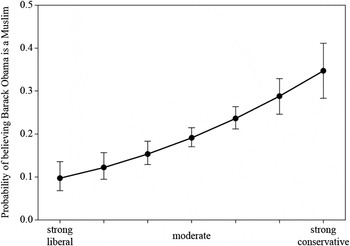
Holding all other variables at the mean, white Americans had a 24.6% probability of believing that President Obama is a Muslim; the probability among nonwhite respondents was 14.8%. As figure 1 shows, strong liberals had a 9.8% probability of misperceiving Obama as a Muslim, whereas conservatives had a 36.1% probability. Individuals who considered themselves “born-again” or evangelical Christians had a 25.8% probability of having this misperception; alternatively, the probability among nonevangelicals was 19.1%. Only one media-use variable significantly predicted misperceptions of Obama’s faith: respondents who paid little attention to political news had a 23.9% probability of thinking that President Obama is a Muslim, whereas respondents who paid high attention to political news had a 16.5% probability. The results reported in this article are largely consistent with previous research on this topic (e.g., Hartman and Newmark Reference Hartman and Newmark2012; Hollander Reference Hollander2010).
Relationship between Political Ideology and the Likelihood of Believing that Barack Obama is a Muslim

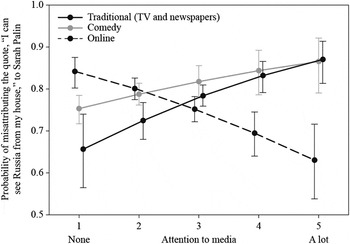
Regarding our second issue, when all other variables in the model are held at the mean, individuals who considered themselves “born again” or evangelical Christians had a 60.7% probability of believing that the former Alaska governor was the first to say “I can see Russia from my house”; for nonevangelicals, that probability increased to 70.0%. Unlike our first issue, media use had a stronger role in predicting misperceptions about Palin. Heavy users of traditional news media had a 75.8% probability of believing that Palin was the first to make the statement; alternatively, light users had a probability of only 61.9%. Heavy viewers of late-night TV comedy programs had a 71.2% probability of believing that Palin authored the statement, whereas lighter viewers of such programming had a 63.6% probability. The two previous findings suggest largely negative effects of increased media use; however, there is a “silver lining.” Light users of online news had a 73.0% probability of falsely attributing the statement to Palin, whereas heavy users fared much better, with only a 58.8% probability (figure 2).
Relationship between Attention to Media (Traditional, Online, and Comedy) and the Likelihood of Misattributing the Statement, “I can see Russia from my House,” to Sarah Palin

Finally, we explored the effects of general political knowledge on the probability of inaccurately attributing Fey’s quote to Palin. It is interesting that individuals who scored zero on the political-knowledge index had a 28.0% probability of believing that Palin made the statement, whereas highly knowledgeable respondents had an 86.4% probability.
DISCUSSION AND CONCLUSION
In the hyperpolarized world of modern American politics, misinformation remains widespread. Our beliefs are shaped not by facts but instead by the pseudo-realities created by talk shows, political pundits, and mainstream media. In short, we have turned the theater of modern politics from a metaphor into reality.
Our study showed that more than 20% of Americans still believe that President Obama is a Muslim. We validated previous research on this issue, demonstrating that this misperception is a product of motivated reasoning—that is, the tendency for partisan audiences to selectively attend to and interpret news information. Scholars have long blamed the highly polarized political climate in the United States on misperceptions among voters (e.g., Bartels Reference Bartels2002; Mooney Reference Mooney2012; Nyhan and Reifler Reference Nyhan and Reifler2010), and our study supports that claim. We find that conservatives and people who consider themselves “born again” or evangelical Christians were more likely to identify Obama as a Muslim than liberals and nonevangelical Christians.
Of greater interest was our finding that nearly 70% of Americans mistakenly attribute the statement, “I can see Russia from my house,” to Sarah Palin. Not only was this misperception widespread, it also was consistent across partisan lines. Indeed, our model showed that respondents’ political ideology and religious faith were not significantly related to misattribution of the quote to Palin. Why does this finding occur across the partisan divide? It seems clear that the media is the primary driver of this misattribution. Much of the blame seems to be directed at traditional news media because greater levels of attention to politics through traditional media were associated with higher probabilities of misattribution. At the same time, late-night comedy shows (e.g., The Colbert Report and The Daily Show) also share in the blame because heavy consumers of these programs were more prone to inaccuracies. Footnote 6
As society and the media become increasingly polarized, understanding how citizens process information to form their opinions and attitudes will be imperative to understanding the voting decisions of the electorate.
Some commentators may interpret these findings as simply another indictment of the dysfunctional “lamestream” media spectacle that surrounds modern elections. There may be some truth to that interpretation. Citizens have little choice but to indirectly observe the political theater in Washington through the lens of the mass media. Our findings show that misinformation about what politicians say or do can become fact in a voter’s mind if it is repeated often enough in the news media. The positive side is that there seems to be little partisan bias in the media underlying the misperceptions about Sarah Palin. In fact, even journalists seem to have a difficult time distinguishing between Tina Fey and Sarah Palin. In 2011, for example, Fox News had to apologize for accidentally using a stock photograph of Fey in a story about Palin’s potential presidential bid. Although the comedic nature of the parody and the undeniable likeness between Fey and Palin (see Flowers and Young Reference Flowers and Young2010 for a discussion of the physical similarities between the two women) may be partly responsible for the widespread misperception among the public, the parody itself was fairly close to the discourse in the media. Fey’s parody was indicative of Palin’s lack of foreign-policy expertise, an issue that was widely circulating in the media at that time.
We also found that citizens with higher levels of general political knowledge were more likely to misattribute the statement to Palin. Although it may seem counterintuitive, there is evidence that political sophisticates are typically better equipped to extract information from media sources compared to their less knowledgeable counterparts (Rhee and Cappella Reference Rhee and Cappella1997). Again, the dominant media narrative surrounding Sarah Palin focused heavily on questions of her preparedness for the role of vice president, including her knowledge of basic political facts and foreign-policy experience. Such narratives undoubtedly would be consistent with believing that she actually said, “I can see Russia from my house.” Moreover, the popularity of Tina Fey’s portrayal may have contributed to “fooling” people of different partisan outlooks and levels of political knowledge.
However, an encouraging outcome of this analysis is that online news consumers were more likely to get the facts straight—at least as they related to misperceptions about Sarah Palin. Heavy users of online news media were less likely than light users to falsely attribute the statement to the former Alaska governor. This suggests that the Internet can have an important role in supplementing information unavailable in traditional media channels. For example, a Google search of “I can see Russia from my house” brings up several webpages aimed at discrediting the rumor that Palin had originally made the statement. Many of the webpages have links to clips from the original interview with Charles Gibson that provide context for why the statement is often attributed to her. Although this is only one example, it is a promising sign concerning the potential of the Internet for informing the electorate. Further studies should include a more in-depth exploration of the role of the Internet in the distortion of political facts.
The most disconcerting part of this analysis is the suggestion that we are moving increasingly toward a political world in which our beliefs are shaped by the pseudo-realities created by hyperpartisan talk shows, political pundits, and the mainstream media (Delli Carpini and Williams Reference Delli Carpini, Williams, Bennett and Entman2001). The informed and deliberative electorate that the Founding Fathers envisioned may have never existed; until 2012, however, this country also never experienced a media environment that was so successful in creating the polar opposite of their original purpose. As society and the media become increasingly polarized, understanding how citizens process information to form their opinions and attitudes will be imperative to understanding the voting decisions of the electorate.
ACKNOWLEDGMENTS
This material is based upon work supported by grants from the National Science Foundation to the Center for Nanotechnology in Society at Arizona State University (Grant No. SES-0937591) and the UW-Madison Nanoscale Science and Engineering Center in Templated Synthesis and Assembly at the Nanoscale (Grant No. SES-DMR-0832760). Any opinions, findings, and conclusions or recommendations expressed in this material are those of the authors and do not necessarily reflect the views of the National Science Foundation.
Michael A. Cacciatore is an assistant professor in the department of advertising and public relations at the University of Georgia. He can be reached at mcacciat@uga.edu.
Sara K. Yeo is a doctoral candidate in department of life sciences communication at the University of Wisconsin-Madison. She can be reached at sarakyeo@gmail.com.
Dietram A. Scheufele is the John E. Ross Professor in Science Communication at the University of Wisconsin-Madison and Honorary Professor at the Technische Universität Dresden, Germany. He can be reached at scheufele@gmail.com.
Michael A Xenos is an associate professor in the department of communication arts at the University of Wisconsin-Madison. He can be reached at xenos@wisc.edu.
Doo-Hun Choi is a doctoral candidate in the department of life sciences communication at the University of Wisconsin-Madison. He can be reached at dchoi6@wisc.edu.
Dominique Brossard is Professor and Chair in the department of life sciences communication at the University of Wisconsin-Madison. She can be reached at dbrossard@wisc.edu.
Amy B. Becker is an assistant professor in the department of communication at Loyola University Maryland, in Baltimore. She can be reached at amybreebecker@gmail.com.
Elizabeth A. Corley is an associate professor in the school of public affairs at Arizona State University. She can be reached at corley.elizabeth@gmail.com.