How might the Pacific be brought alive to an audience in central London and at the Royal Historical Society? It is an ocean that spans one-third of the surface of the Earth but which is so often seen as far away and as a definitive other. It is important to begin with the argument that the Pacific unsettles our sense of what counts as History or even how we plot History on the globe.Footnote 1
Through the long past, Pacific islanders have narrated their histories not as texts but as oral performances or genealogies, charting their descent down generations and linking their selves and their rulers to stories of their arrival across the sea to their islands.Footnote 2 These histories disorient Western conceptions of time as an evenly measured background for the writing of history. Pacific genealogies also disrupt divisions between nature and humankind, for seas and islands are alive and changing. The perspective from which a genealogy is narrated in the Pacific is dynamic in relational terms: not simply an account of the dead but rather an organic relation between ancestors and descendants which is intensely embodied in the act of telling. I'm not a genealogist or a Pacific islander, but in the Pacific it is said that you walk backwards into the future while facing the past, and it is in this sense too that to write from the Pacific is to adopt a different practice; a decolonised practice.
Among those who led the way in decentring the European Pacific was Epeli Hau‘ofa, the Tongan and Fijian anthropologist who has been inspirational for Pacific historians.Footnote 3 Hau‘ofa, who died in 2009, sought to dislodge a view of the Pacific as a chain of islands in a faraway sea, a place which silently bore the brunt of Western invasion or global transformation. Instead he insisted that the Pacific was a ‘sea of islands’, a site of intense energy and connection which is indigenous. Meanwhile, recently deceased Fijian, Chinese, British and Australian historian Tracey Banivanua Mar persuasively argued that indigenous processes of decolonisation have persisted over a long period.Footnote 4 These scholars, among others, have challenged the invisibility that is imposed on the Pacific by historians in gatherings like ours. Thinking with the Pacific provides another lens for debates afoot in this country today about what it takes to decolonise the historical curriculum and research programme, especially as there are so few Pacific historians in the UK.Footnote 5
I The Pacific's age of revolutions
Rather than a Pacific genealogy, what follows is an account of the age of revolutions in the Pacific Ocean. Accordingly, I propose in this lecture to reconceptualise and even repopulate a central analytical term of Western historiography and Western modernity: the age of revolutions.Footnote 6
The uneven and transformative meetings between invaders and islanders which occurred and accelerated at the end of the eighteenth and start of the nineteenth centuries radically altered the Pacific. From the Pacific, the age of revolutions might be defined, following European historiography, as an age of empirical knowledge-gathering which birthed new kinds of sciences and ethnologies in this sea.Footnote 7 Simultaneously, a form of colonial history was born here too as an account of migration and relatedness between Europeans and islanders which was plotted on a linear calendar. This recontextualised prior ways of thinking about the past, exemplified by genealogies. In this age of revolutions, the Pacific also saw extensive exploration, settlement and disease; the arrival of new bodies and the dispossession of Islanders. The region saw the advent of new kinds of imperial alliances and takeovers.Footnote 8
If all this cannot be denied, in critical engagement with these perspectives, the starting premise of this lecture is that it is important to attend to the creative agency of Pacific islanders, steeped in other ways of telling history. The age of revolutions in the Pacific was characterised first and foremost by a vibrant and surging indigeneity. Pacific peoples took ideas, material culture and structures from invaders and cast them anew in light of their own traditions, for instance of legitimacy, descent and rule, to mount a transformation in their politics, culture and society.Footnote 9 Invaders sought in turn to mount a counter-revolutionary imperialism. This never outdid indigenous creativity. The history that follows braids Western and indigenous agents, Outlanders and Islanders as they are called in the Pacific, textual and visual archives, and the indigenous as much as possible.
In arguing like this, the paper joins a vast literature on the age of revolutions.Footnote 10 Many of these works focus in on the Atlantic, and this dominant emphasis is in keeping with the sentiment of the Atlanticist and early historian of the age of revolutions R. R. Palmer, who wrote as long ago as 1959 that ‘[a]ll revolutions since 1800, in Europe, Latin America, Asia and Africa, have learned from the eighteenth-century Revolution of Western Civilization’.Footnote 11 Yet more recently, there is the work of Kate Fullagar and Mike McDonnell. They, together with a band of mostly Australian historians, have shown that in this revolutionary age what it meant be indigenous was pushed forward.Footnote 12
A surge of indigeneity occurred through declarations of independence and definitions of sovereignty that reverberate until the present. This surge was then met with a counter-revolutionary imperialism. The meeting of these separate manoeuvres constituted the transformative intersections of this period at the end of the eighteenth century and the start of the nineteenth century, in the oceanic South, outside the Atlantic. The next section considers how to approach the history of European exploration in the Pacific through the lens of the age of revolutions.
II French voyages to the Pacific and the tumult of Europe
In October 1793, the French ships the Recherche and Espérance lay moored 25 miles outside the Dutch foothold of Surabaya, now the second largest city of Indonesia.Footnote 13 With two-thirds of the crew ill, mostly with scurvy, they longed to be received into Surabaya. Alexandre d'Auribeau, now the commanding officer, very sick from an unknown ailment, sent out another boat, this time flying a white flag as a sign of peace. Eventually a Javanese chief brought out the latest supplement of news of the European age of revolutions: Louis XVI had been executed and France was at war with its European neighbours, including the Dutch. A republic had been declared. The way ahead for these ships was thus uncertain. All the men – and tellingly for the operation of gender, one disguised woman – were Dutch prisoners of war. The European family had been torn apart, and the diplomatic etiquette surrounding the provisioning of ships in the Pacific no longer held.
Months had to pass before the final fate of this expedition – which had left Europe under the command of Bruni d'Entrecasteaux in 1791, with the sanction of the National Assembly – was sealed. But when it finally happened it was dramatic proof of the impact of the European age of revolutions on a particular Pacific voyage. In the interim, the commanding officer had weighed up the possibility of sailing to republican Mauritius; there was the prospect of ship-board commotion and conflict between republican and royalist camps; and there was the rumour that the National Assembly had sent secret orders to some of the crew. As the Frenchmen's debts mounted, the Recherche and Espérance were sold at auction in Batavia at the end of 1794.Footnote 14
The royalist d'Auribeau died of dysentery before republican envoys from Mauritius could take him captive as a traitor. Yet the workings-out of the age of revolutions in the specific conditions of this voyage continued further. After d'Auribeau's death the papers of the d'Entrecasteaux expedition were seized in St Helena by the British and were eventually kept in London under the protection of the final commander of the expedition, Élisabeth-Paul-Édouard de Rossel.Footnote 15 Rossel was a royalist. He based himself in London in these tumultuous years until the Treaty of Amiens in 1802, after which he returned to France. The republican Jacques-Julien Houtou de La Billardière, one of the surviving naturalists from the d'Entrecasteaux expedition, returned to Paris and ingeniously arranged for the expedition's natural history cases to be transferred there.Footnote 16
Despite this example of the impact of the Western age of revolutions in the Pacific, there has barely been any discussion in the historical literature of what the age of revolutions looks like from the Pacific. One could argue that French Pacific voyages nicely illustrate the phases of the European age of revolutions. The d'Entrecasteaux expedition that ended in Surabaya was sandwiched between two others: on one side was an expedition under the command of Comte La Pérouse (1785–8) and with the authority of an absolute monarch, Louis XVI; and on the other was the expedition of Nicolas Baudin (1800–3), under instruction by Napoleon.Footnote 17 As well as the change in patrons, the transition from La Pérouse and d'Entrecasteaux to Baudin is itself revealing: unlike the two aristocrats who went before him, Baudin was the first French captain not of noble birth to sail through the Pacific. Another path through which the politics of the European age of revolutions is apparent is in a key aim that drove the d'Entrecasteaux voyage, and in which it failed too. This was to solve the puzzle of the lost voyage of La Pérouse which preceded it. Unfounded rumours spread in France that it had gone missing because of the action of the anti-republican English, who had just formed a convict settlement in Port Jackson – Sydney.Footnote 18
The disappearance of this official French voyage served as a much-repeated tale, an affront to French glory. In the end, the mystery was solved not by a Frenchman but by an Irish private trader in the 1820s, Peter Dillon, who took news not to London but to Calcutta.Footnote 19 It later became clear that the expedition had come to its end in the midst of a hurricane. The fact that it was Dillon, rather than d'Entrecasteaux, who found the first inklings of the evidence points to the rise of the British and ports like Calcutta over the oceanic South by the second decade of the nineteenth century.
III To be a king in Tonga
Let us then return to the d'Entrecasteaux voyage but with a different footing; a footing in what is now Tonga. Captain Cook had been here in the 1770s. In Tonga, while in search of the lost La Pérouse, explorer d'Entrecasteaux had some of his most charged ethnographic encounters.Footnote 20 And d'Entercasteaux was particularly interested in political arrangements. European voyagers like him – and this includes both the British and the French, and both republican and royalist observers – sought to theorise Tonga's politics. D'Entrecasteaux wrote, for instance: ‘I believe, like Cook, that this government has a lot in common with the old feudal regime, where the inconveniences increase in proportion to the weaknesses of the principal chief.’Footnote 21 D'Entrecasteaux held to the view that anarchy was especially evident in the prevalence in Tonga of theft, which arose from the insecurity of property. For the chiefs owned all the property and could demand from their inferiors anything that they wished. Yet the riddle which plagued d'Entrecasteaux was this: who was the monarch of Tonga?
Between Cook's visit and his own, he would have expected that the throne would have passed to Fuanunuiava, the son of the man denoted as sovereign by Cook.Footnote 22 Perhaps it was because of Fuanunuiava's youth, he pondered, that this had not occurred. D'Entrecasteaux also puzzled over the fact that Tiné, whom he now took to be the head of state and called queen, could not confer the throne on her death to her immediate relations. For d'Entrecasteaux the complicated rules of succession were part of the problem. There was too much confusion in ‘distinguishing men who exercise power and to whom respect is given’.Footnote 23 Here was a man who wished for authority – but for the kind of authority upheld by rules and constitutions and hemmed in by a market in trade, land and familiar gender norms. D'Entrecasteaux's naturalist, La Billardière, wrote, in similar terms to d'Entrecasteaux, of ‘King Tuoobou’ or Tupou of Tonga.Footnote 24 Tupou was in fact the Tu‘i Kanokupolu, one of three paramount titles in Tonga; the highest ranking however held another title, Tu‘i Tonga. Fuanunuiava was named as Tu‘i Tonga in 1795. La Billardière also observed how Queen Tiné was conscious of her privileges as the paramount authority on Tonga. Inferior chiefs including Tupou were obliged to pay their respects by taking her right foot to their heads.Footnote 25
Europeans, who themselves were reworking politics sought to work out politics in this island world by searching for monarchs and trying to fit Pacific societies against categorisations of feudalism or royalism. Yet d'Entreacasteaux's portrait of Tonga reveals more about his culture and its paradigms than of the Tonga of this period.Footnote 26 Until the arrival of Europeans, there were no European-style kings and queens. In Tonga, chiefly status was determined by a rank prescribed by society, on the basis of descent from a chosen ancestor, where age and gender were valued as in Europe, but where sisterhood was ranked as a higher privilege than brotherhood in questions of succession. The differences between chiefs and others did not lie in questions of what labour they undertook, if any, and so the language of class that d'Entrecasteaux used to observe Tonga was misplaced. Objects were not marketised and did not retain a value on the basis of the work that had been put into making them. Rather, value was determined primarily by the rank and status of the creator of the object; it was no wonder that Tongans wished to possess European objects. Yet those whom the Tongans called papālangis, or men from the sky, brought to these islands a new language of politics and organisation and this was creatively adopted. In this region, these changes counted as a consolidation of monarchy whereas elsewhere the period could see monarchies torn down. European weapons in particular made early nineteenth-century Tonga a place characterised by intense wars. Chiefs quarrelled over the arrival of European ships, trying to attract them to their harbours. And those who resided at ports inevitably did better than those based elsewhere. As Europeans sought for kings and queens, islanders reinvented their politics.
In Tonga, with the arrival of a range of European settlers in the 1790s, including traders, evangelical missionaries as well as those who had escaped from the convict station in Australia, there came a long civil war between rival chiefs. The investiture of the paramount chief, Tu‘i Tonga, was laid aside and there was a conflict between the lineages of the Tu‘i Tonga and Tu‘i Kanokupolu.Footnote 27 Chiefs fought over tribute and connections to missionaries and other Europeans. The wars between chiefs were attended by the spread of European diseases and weapons, and the fleeing of many chiefs to neighbouring Fiji or Samoa. One chief fled with his wife to British Sydney.Footnote 28 In the midst of these radical changes, there was a loss of cohesion and the chiefly system of rule was in crisis. It was in this context that a new monarchic ideal was firmed up.
The work of Protestant missionaries is notable here. A new age dawned in Tonga with the conversion of the uninstalled paramount chief Taufa‘ahau to Protestantism through the work of Wesleyan missionaries who arrived in 1822. Taufa‘ahau changed the political make-up of Tonga, transforming it from a competitive set of chiefdoms into a united monarchic polity. Taufa‘ahau took the name George I at his baptism in 1831 and used the support of British missionaries to unify Tonga. The change in religion signified a drastic change in political organisation: for where chiefs had received their sanction from lineages tied to gods, the spread of Christianity now brought a different relationship between political and sacred authority. Now the missionaries were the purveyors of the Word, and George I was the keeper of the law. Taufa‘ahau's opponents feared that soon the missionaries themselves would become chiefs. Many of George I's followers adopted Christianity, though there continued to be a great deal of wavering and movement in and out of Christian faith and church attendance. George I boasted: ‘I am the only Chief on the Island … When I turn they will all turn.’Footnote 29 He was right: his monarchical line has survived till today, priding itself on never being formally colonised. This shows how indigenous reworkings of politics in the age of revolutions were successful. Tonga is a microcosm of changes afoot elsewhere in an Pacific where monarchy was also consolidated.
IV Tongans raiding Europe
As the argument is deepened further, attention is paid in what follows to the specific material and cultural dynamics that attended this moment of political transformation. There were mutual exchanges but also blockages and creative reinventions which allowed Pacific peoples to craft the modern in light of the old and within the context of the age of revolutions. Tongans raided the ships of Europe, quite literally at times, to find their own path. This is especially evident in an iconic moment in Tonga's history which is often retold.
Fifteen years had passed since d'Entrecasteaux's time in Tonga when William Mariner was taken captive in the Tongan islands, at the age of fifteen, and to the north of where d'Entrecasteaux had made his observations. The vessel in which he arrived in 1806 was rather different to the state-owned French and British vessels used by d'Entrecasteaux and Cook. The Port-au-Prince was an English privateer-whaler, which was formerly French, and which was now deployed to raid French or Spanish vessels. The ship was ‘nearly 500 tons, 96 men, and mounting 24 long nine and twelve pounders, besides 8 twelve-pound carronades on the quarter-deck’.Footnote 30 The sailors on board the Port-au-Prince were allowed to keep their booty. In the words of recent historians from Tonga, the crew of this vessel behaved ‘like pirates and robbers’.Footnote 31 It is important to first establish that these Europeans were raiders of an unprecedented kind.
Yet this vessel the Port-au-Prince was taken over by about 300 Tongans who went aboard the ship and attacked the surprised crew. They eventually grounded it. Gunpowder, carronades and stripped iron were taken ashore, and after the ship had been summarily looted of everything that was deemed valuable it was burnt.Footnote 32 About half of its crew were massacred by the Tongans in what followed. According to Mariner, the attack was led by a Hawai‘ian, who had probably arrived in Tonga on an American ship.Footnote 33 And it was in this way that William Mariner's time in Tonga began. Mariner wrote of the noise let off by the guns on board:
In the evening they set fire to her, in order to get more easily afterwards at the iron work. All the great guns were loaded, and as they began to be heated by the general conflagration they went off, one after another, producing a terrible panic among all the natives.Footnote 34
The survivors, their skills and what was looted were recycled by Tongans in the wars ravaging Tonga, before the consolidation of George I's monarchical state.Footnote 35 So even the people on board became goods in Tonga. The story that was later told in Tonga is that the future George I, then about nine years old, was himself involved in the raid on the Port-au-Prince and nearly drowned in the whale oil in the hold of the vessel.Footnote 36 Mariner was to become a key asset. He was very much liked by the chief Finau ‘Ulukalala II, who had raided the ship, and he was adopted by one of ‘Ulukalala's wives, marking his incorporation into Tongan society. Another of the survivors of the Port-au-Prince was serving as ‘prime minister’ to a chief on Vava‘u as late as 1830.Footnote 37
From his base in the Ha‘apai islands ‘Ulukalala, wished to attack the political centre of these islands in Tongatapu. In seizing the Port-au-Prince he was arming himself for his wars with the ruling powers in the main island. Mariner together with fifteen other Britons participated in the raid that followed on Tongatapu, undertaken using a fleet of canoes and the carronades looted from the Port-au-Prince.Footnote 38 In the end, one of the most important forts at Nuku‘alofa, now the capital of Tonga, fell into the hands of ‘Ulukalala's forces. Mariner described the fort as constructed of wickerwork supported by posts, to make 9-foot-high fences; it had stood for eleven years but was now ravaged. It was a truly awful rout: ‘The conquerors, club in hand, entered the place in several quarters and slew all they met, men, women and children.’Footnote 39 The inhabitants were awestruck by the new weapons used by their assailants. They described balls as if they were alive, entering houses, going around their dwellings looking for someone to kill, rather than exploding straight away. While the battle was in progress, ‘Ulukalala sat himself in an English chair taken off the Port-au-Prince and surveyed the scene from the reef.Footnote 40 After this attack, his further attempt to take the fort in Vava‘u harbour was not as successful.
When at peace, ‘Ulukalala took the opportunity to learn about the outside world from Mariner, and one topic that was particularly interesting was that of politics. ‘Ulukalala wished to be the king of England. This again highlights the central argument that this period saw an assertion of indigenous political agency in Islanders’ adoption of the new in light of the old:
‘Oh, that the gods would make me king of England! [T]here is not an island in the whole world, however small, but that I would then subject to my power: the King of England does not deserve the dominion he enjoys; possessed of so many great ships, why does he suffer such petty islands as those of Tonga continually to insult his people with acts of treachery? Where [sic] I he, would I send tamely to ask for yams and pigs? No, I would come with the front of battle; and with the thunder of Bolotane [the noise of the guns of Britain].’Footnote 41
Mariner finally escaped in 1810. In 1832, Mafihape, Mariner's alleged adoptive mother in Tonga, sent him an intriguing letter now in an Australian archive.Footnote 42 In her letter, written or probably transcribed for her by someone very familiar with Tonga, she asks Mariner to send a ship with a son whom she could adopt:
If you have genuine affection [for me] it would be wonderful if you could send your younger brother, if you have one – or your son, if you have one, so I can see him, and also so that you be shown, in the Lord, to be manly – if you are so determined not to come yourself and see me. He can come and live here instead.Footnote 43
Mafihape herself had by this time converted, but wanted Mariner to know that she was ‘very poorly off’. Despite the spread of Christianity, and its associated trappings of paper and writing, as also new conceptions of behaviour, Mafihape still hoped to utilise the customs of chieftaincy, where chiefs adopted powerful sons, to circumvent her lowly situation.
Mariner could not read Mafihape's letter, having forgotten most of his Tongan. He complained that its ‘orthography’ was in too unfamiliar a form, indicating the impact of the English missionaries perhaps.Footnote 44 After returning to England, he gave up his life of adventure, became a stockbroker in London, married and fathered eleven children and, rather unfittingly, drowned in Surrey Canal at the age of fifty-three.Footnote 45 In the Pacific, meanwhile, there are also still people who claim the name Mariner. As for Mariner's own end in the canal, a speculative Tongan theory that I heard when I was there is that Mariner committed suicide, being unable in the end to come to terms with his life in England.Footnote 46
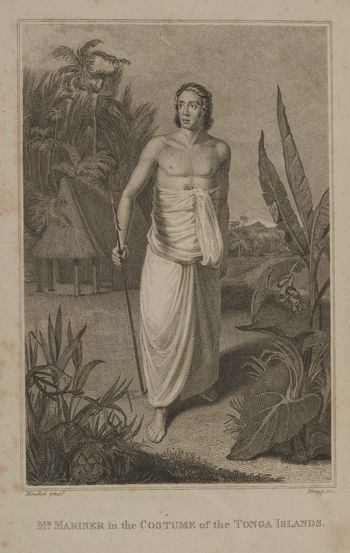
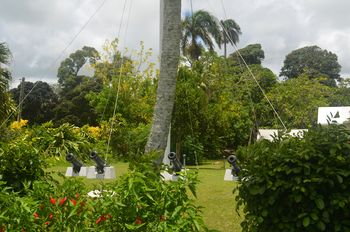
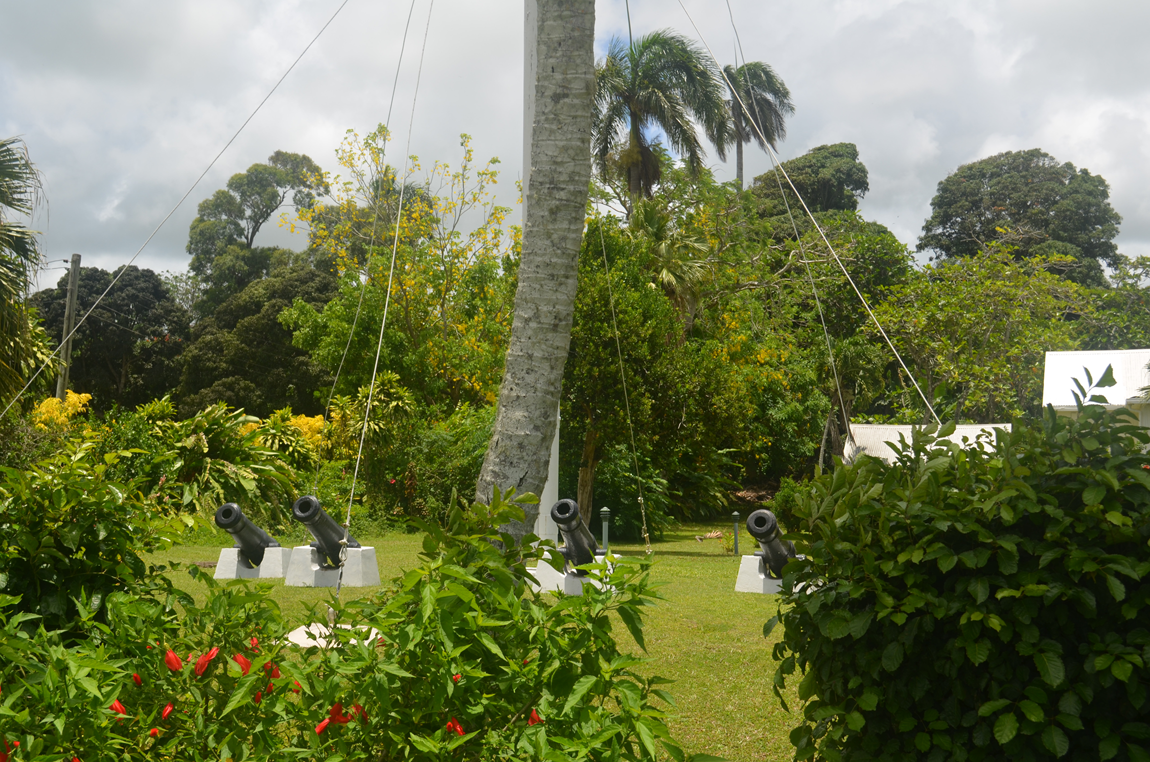
Mariner's account of his travels was published for him by a doctor John Martin. The image facing the title page is a full-length view of Mariner dressed in Tongan clothes and bare-bodied above the waist (Figure 1). Mariner had thus straddled worlds. A product of the European age of revolutions, and its commitment to global war at any price, he had been taken captive to fight in a series of other wars, which were Tongan tussles for a monarchy and indigenous political assertion. The dispersal of European weapons was critical to the story around the Port-au-Prince; it is appropriate that three of the cannons from the Port-au-Prince are today placed in front of the site of the British High Commission in Tonga (Figure 2).
‘Mr Mariner in the Costume of the Tonga Islands’, from William Mariner, An Account of the Natives of the Tonga Islands (London, 1817) (E.30.3). Reproduced by kind permission of the Syndics of Cambridge University Library.

Cannons from the Port-au-Prince at the British High Commission, Tonga. (Author's photograph)
V Aotearoa and monarchy before Waitangi
Once monarchism had been articulated like this by islanders across the Southern Pacific and in the context of prior cultures of descent, it was an idea that was open to political use. Islanders could manipulate monarchy in a contest with the invaders who were becoming increasingly familiar on these shores. These invaders, and the British in particular, wished in turn to overtake monarchism with an authoritarian imperialism; they wanted to be bigger kings. In this manner, as the period wore on, the debate about political organisation opened up a space for the rise of the British Empire and an Islander response to it which was creative and at times anti-colonial. If the age of revolutions is defined as indigenous assertion meeting European invasion, this dynamic carried on in this next phase as British government tightened and as indigenous peoples fought and organised themselves. The argument is now illustrated from a different site, from Aotearoa or New Zealand.Footnote 47
Māori were mobile peoples who undertook war in order to restore their integrity and status.Footnote 48 If war could not be undertaken against offenders it could be conducted against distant non-kin, to this end of restoration. The arrival of Europeans expanded these customary forms of politics in new directions, making wars more intense and wider in their radius. As in Tonga, the appropriation of European weapons was significant. Newer styles of war, sometimes termed ‘muskets wars’, unified and concentrated power. They generated an unprecedented number of fatalities and a decline in population. But they transformed what already existed by way of conflict, rather than giving rise to a simple fatal impact with no room for indigenous response.
The physical power of muskets was not the sole determining factor in these wars. Some historians have cast the new culture of the potato as being equally significant, in providing the means to keep long-range war parties fed.Footnote 49 In the opinion of the first British Resident of New Zealand in 1837, ‘there seems to be good reason to doubt whether their wars were less sanguinary before Fire Arms were introduced’.Footnote 50 Established military tactics involving close combat evolved in order to accommodate the new long-distance weapons.Footnote 51 The symbolism of these muskets was critical too. Particular chiefs who acquired weapons were cast as great leaders and warriors even though they were operating within pre-existent modes of righting wrongs. As an example of the attribution of monarchy, the artist Augustus Earle drew ‘King George’ or ‘Shulitea’ (Te Uri-Ti), who served as his friend and protector in New Zealand.Footnote 52
Gradually, over the decades that followed, and beyond the signing of the Treaty of Waitangi in 1840, the concept of the Māori monarch appeared as a result of this entanglement between old and new, the Pacific and Europe. The ‘King Movement’, or Kīngitanga, appointed the first Māori king in the late 1850s and opposed the take-up of ancestral land by the British Empire. It declared the boundaries of the Kīngitanga, or kingdom, in 1858. The movement expected to govern alongside the settler state. Yet it is possible to trace the longer ancestry of this commitment to monarchy. Missionaries reported how the concept of monarchy was already being discussed by Māori prior to the 1840 Treaty of Waitangi.Footnote 53 Iconic fighters also show the evolution of notions of leadership and monarchy.
The so-called ‘Māori Napoleon’, Hongi Hika (1772?–1828), was an early initiate to the power of European muskets and utilised them in wars in the Bay of Islands district of North Island.Footnote 54 Hongi arrived in London in 1820 and created quite a stir, accompanied by the evangelical Thomas Kendall and an aide, Waikato. Tellingly he was presented to the British monarch, George IV. According to one mid-nineteenth-century chronicler, he is said to have observed: ‘There is only one king in England, there shall be only one king in New Zealand.’Footnote 55 When he returned to New Zealand, he came with gifts and patronage and a personal bond with the British Crown. This allowed him to immediately mount a series of campaigns to consolidate his power. He traded many of his presents in Sydney on the way back to New Zealand, preferring muskets, powder and shot. (He had hundreds of muskets in his hands when he returned to New Zealand.) He retained a suit of armour which was presented to him.Footnote 56 His journey to Britain was in a sense a validation of his kingship. A similar story might be traced in relation to another iconic figure of this period, Te Rauparaha, where once again contact with Europeans expanded the reach of existent customs of politics and war.Footnote 57
To move one step further with this analysis, the arrival of British bureaucracy and legislation took the guise of an attempt to protect Māori from the Europeans’ depredations against them. However, in practice these modes of governance aimed at overtaking extant notions of chieftaincy and monarchism. The flux in concepts of rule and monarchy is evident in the following sequence of evidence. The British appointed a Resident to New Zealand, the Tory James Busby, in 1833. Busby was seen by Māori as the British ‘king's man’, just as men-of-war were called the ‘king's ships’ and their sailors the ‘king's warriors’.Footnote 58 Busby arranged for a Māori flag, previously used by the missionaries, to be flown by vessels built in New Zealand entering Sydney, as ‘the Flag of an Independent State’.Footnote 59 A declaration of Māori independence was also signed by fifty-two chiefs by the end of the 1830s in the name of ‘The United Tribes of New Zealand’.Footnote 60 This was conceived by Busby as a ‘Magna Carta of New Zealand Independence’.Footnote 61
The scene was set for the controversial Treaty of Waitangi of 1840. A change in the language of politics had come to pass in slow motion. This happened through the evolution of established concepts such as iwi (denoting people of common descent), hapu (meaning groups subordinate to chiefs, fighting as units) and intra-tribal identity and war and Māori attempts to respond to British ideas. It also involved attempts, not fully successful, at British control of the structures of Māori organisation and independence.
VI On the age of revolutions
The argument may now be summarised. Pacific cultures had long-established customs of political arrangement around hereditary chieftaincy, notions of kinship, genealogy, historical memory and ceremonial decision-making. It was into this world that European voyagers arrived. In an age of ‘democratic’ revolutions, these travellers sought out the monarchs of Tonga, for instance, and their discussion of the politics of the Pacific was supercharged by the political changes in Europe.
Yet, the intent of this lecture instead was to highlight the space that then opened up between Pacific islanders and Europeans in the age of revolutions – making it possible for the Pacific and its peoples to craft this period of transition. Pacific islanders asserted their agency, and this response characterises the Pacific's age of revolutions. The spread of weapons – for instance, think of Hongi's muskets – the skills brought by settlers – for example, William Mariner as an asset himself – or the dispersal of other sorts of material culture – think about flags – all generated a crisis point in chiefly systems of organisation, and in turn the opportunity to consolidate newer monarchic lines out of the old. This change was not a smooth or unidirectional one – as is evident in the way the Port-au-Prince was physically raided or how Hongi travelled to Britain and then came back to orchestrate war.
The arrival of Christianity in turn provided an ideological foundation for consolidating newer forms of politics in the Pacific, though the relics of older ideas of chieftaincy, encompassing notions of kinship as much as military custom, were never obliterated – as is evident for instance in Mafihape's letter. The gaps, ignorances and at times wilful misconstruals were politically useful for the ascent of the British Empire, even as treaties were made with indigenous peoples, allowing Britons to become the dominant authorities over the Pacific's kings; the bigger and more militarily powerful kings. If islanders’ characteristic agency counts as definitive of the age of revolutions, this imperial manoeuvre was a counter-revolution. Yet the relics of older ideas of chieftaincy, now become kingship, were still evident in the later nineteenth century and could serve as a ground of resistance – for instance in the Kīngitanga movement which became violent by the early 1860s.
If this is the argument about the Pacific's age of revolutions, it is important to return to the wider claims at the start of my lecture on decolonising history. It is worth noting here that this very transition between old and new, between different kinds of materials, oral and printed, and between indigenous peoples and Western writers characterised the making of History itself at the end of this age of revolutions.
VII History in the Pacific age of revolutions and decolonisation today
Among a series of histories of the Māori that appeared in the later nineteenth century was John White's six-volume Ancient History of the Maori (1887–90), which was sponsored by the colonial state in New Zealand, and which followed White's having been editor of a Māori newspaper.Footnote 62 White asked Māori to fill the books that he provided with information about Māori knowledge; he paid £5 for a full book and £3 for one which was partly full.Footnote 63 Aperahama (or Abraham) Taonui wrote his genealogy in such a notebook of forty-three pages for White.Footnote 64 In corresponding with White, Tanoui showed an eagerness for the stuff of writing, asking for ink on a couple of occasions: ‘As I have no ink to write Genealogy books with this is why there has been nothing for you.’Footnote 65 He came to terms with the lack of materials in the context of why access to Māori cultural traditions was confined to the initiated: ‘It is impossible to write the explanations and meanings of the many waiata and the whakatauki and the other things which you have requested.’
This letter, dated 8 September 1856, is composed of shreds of torn paper with uneven edges. Taonui's coming to terms with the materiality of writing was thus occurring side by side with his coming to terms with how to integrate Māori cosmology and genealogy alongside and within Judaeo-Christian History, within empiricist Western history. It is through processes like this that came at the end of the age of revolutions that the colonial printed history of Māori was born, and yet within it and within White's confused text one can see the stamp of the oral. White cut and pasted genealogies to construct linear time.
The making of History alongside the tussle over the concepts of the age of revolutions is also apparent in how Taonui called in 1855 for a ‘Mekana Tata’, changing his sense of customary authority and possession of land and resources in the light of British political thought. ‘Mekana Tata’ is a transliteration of Magna Carta and here is his explanation of what this means:
The Barons of England (that is the chief of those days as we are now in New Zealand) met and demanded of this King certain terms which they required him to sign, some of which were that every man should enjoy his own property, and that the Chiefs of the King should not take anything by force, unless the law allowed it. This document which the King signed was called ‘Magna Carta’. From this has come all England's good. Now, if the Chiefs agree to any thing this night in the assembly, we might call it ‘Mekana Tata’.Footnote 66
The interlocking of imperialism and monarchy is a story of counter-revolution that followed indigenous creativity and agency; an account of how the possibilities of this period, the age of revolutions, had opponents who were elites and imperialists. Following the story of White and the agenda of decolonising history, it might be added that the opponents were colonial historians too. Such an argument is in keeping with a broader literature on the global history of this period which stresses the contradictory results of this age, with its differing articulations of what counts as revolution and the differing outcomes of revolutions. Yet there is a specific feature to this history: for most writers and observers of the time and for pretty much the whole of the vast historiography of the age of revolutions today, the Pacific does not count. It is not a place of significant political, cultural and intellectual agency at this critical period of transition around 1800. It is instead a place to authorise the West's history and its invention of the politics of the modern; and for White it was a place to gather myths.
Where Mariner came ashore in Tonga, when I visited at the end of 2017, there was nobody on the beach. A monument to the Port-au-Prince massacre was being overtaken by tropical vegetation; in the water lay the carcass of a dead pig and along the shoreline were some plastic bottles. If this lecture has been about an age which saw unprecedented change in the Pacific, another time of unprecedented change awaits. Weather patterns and changes in vegetation are a topic of constant conversation in Tonga. There are now more Tongans who live overseas than in the islands. If the Pacific shaped the age of revolutions in the late eighteenth and early nineteenth centuries, my prediction is that it is a place to watch once again for the human future. To decolonise history today is to respond to indigenous creativity. Additionally, now more than ever before, at a time of climate emergency it is important to take account of both the land and the sea and how they are changing. Such a perspective is vital for the Pacific's next age of revolutions.