Introduction
Providing care to older patients in the emergency department (ED) is a challenge from a health care point of view because of the relationship between the growing demand for emergency care by the ageing populationReference Roberts, McKay and Shaffer1 and the need for immediate response. On the other hand, the care of elderly patients is of high complexity and requires more resources (number of ambulance transfers, complementary tests, consultations with other specialists, length of stay in the ED and the probability of hospitalization)Reference Martín-Sánchez, Fernández Alonso and Gil Gregorio2 and with worse results (iatrogenia, unresolved problems at discharge, mortality, repeated ED attendance, readmission, disability and institutionalization) compared with younger patients.Reference Strange and Chen3, Reference Tomás, Chanovas, Roqueta, Alcaraz and Toranzo4 In spite of this, the ED has not appropriately adapted either structurally or functionally to the care of older patients.
Frailty is the most problematic expression of ageing.Reference Clegg, Young, Lliffe, Rikkert and Rockwood5 In the ED the denomination of frail or high-risk elderly patients is given to those with a high probability of having a short-term adverse effect (hospitalization, return to the ED, mortality, functional deterioration or dependence, institutionalization or deterioration in quality of life and overload to the caregiver). In colloquial terms this is an intermediate patient, that is, one who is neither very well (‘healthy older patient’) nor very ill (‘discapacitated or disabled older patient’).Reference Sternberg, Werson, Karunananthan, Bergman and Clarfield6
In this sense, the ED becomes a key place for the identification of older patients at risk since this is where there is the greatest possibility of presenting potentially reversible adverse events. A visit to the ED may demonstrate a state of frailty in the form of functional deterioration which, if not detected and corrected early, may progress to disability after activation of the cascade of dependence.Reference Duaso and López-Soto7
The objective of this review is to make an update of the definition of older frail patients in the ED, that is, identification by geriatric evaluation adapted to the ED and the possible models of intervention.
Definition and prevalence of frail older patients
Frailty in older patients appears as a consequence of a series of changes in the organism secondary to ageing that diminish the physiological reserves and lead to a loss in the capacity of response to situations of stress. Most authors distinguish between frailty, disability and co-morbidity.Reference Walston, Hadley, Ferrucci, Guralnik, Newman and Studenski8, Reference Jaafar, Heycock and George9
At present there are two approaches to frailty: the frailty phenotype modelReference Fried, Tangen, Walston, Newman, Hirsch and Gottdiener10 and the model of accumulation of deficiencies.Reference Mitnitski, Mogilner and Rockwood11 In the first model, Fried supports the idea of a ‘wasting syndrome’ with six criteria (involuntary weight loss, self-reported exhaustion, low energy expenditure, slow speed of movement and weak grasping strength). Patients are considered as ‘pre-frail’ when presenting one or two criteria and ‘frail’ with the presence of three or more criteria. The second model of frailty is based on an ‘accumulation of deficiencies related to health’. According to this model the Frailty Index was developed. This index has 92 items that are expressed as a quotient among variables, with a value greater than 0.67 indicating most probable death.
In a recent review the components most frequently used in the definition of frailty were physical function, speed of walking and cognition. The results most frequently used were death, dependence and institutionalization. It was of note that it was considered that functional deterioration should be assessed a result rather than a component and the grades of frailty should be categorized. In addition, the Fried phenotype was deemed to have scarce clinical applicability, being mainly useful in investigation.Reference Sternberg, Werson, Karunananthan, Bergman and Clarfield6 According to a recent consensus of expertsReference Rodríguez-Mañas, Féart and Mann12 on the definition of frailty, functional, cognitive and nutritional aspects should be included and frailty was considered as a state of extreme vulnerability different from disability.
The prevalence of frail older patients in the ED is unknown. The lack of information and the heterogeneity of the results are directly related to the scarcity of studies and particularly, to the lack of consensus as to the definition of frailty in clinical practice.Reference Sternberg, Werson, Karunananthan, Bergman and Clarfield6 The frequency of frailty in older patients in the community ranges from 5 to 60%, based on the diagnostic criteria, with a greater frequency (25–50%) being reported for very elderly patients, especially those over 85 years of age.Reference Ferrer, Badia and Formiga13 With respect to the ED, there are even fewer data. In a study including 148 patients 75 years of age or older admitted to an observation area in the ED, only one patient was not found to have criteria of frailty and one out of five become dependent for basic activities of daily life when they previously had not.Reference Fernández, González del Castillo, González Armengol and Martín-Sánchez14
Identification of frail older patients in the emergency department
Frailty screening scales
Standardized triage systems allow nurses to prioritize and order care according to vital risk on arrival of the patient to the ED. It is has reported that triage systems do not allow the identification of frail older patients or those at risk and they underestimate older patients with unspecific complaints, with deficient interpretation of the vital signs, pain, anxiety or alteration in the mental state.Reference Grossmann, Zumbrunn, Frauchiger, Delport, Bingisser and Nickel15
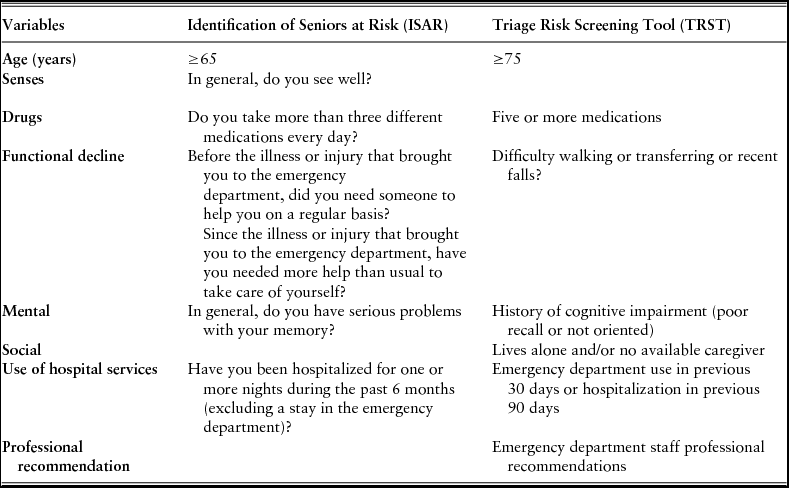
To date, no method has been universally accepted for the screening of frail older patients. In a systematic review up to 20 standardized questionnaires were described to identify frailty.Reference Sternberg, Werson, Karunananthan, Bergman and Clarfield6 Those most commonly used are ISAR (Identification of Seniors at Risk)Reference McCusker, Bellavance, Cardin, Trepanier, Verdon and Ardman16 and TRST (Triage Risk Screening Tool).Reference Meldon, Mion and Palmer17 Both consist of six different questions on clinical, functional, mental and social aspects (Table 1). A score of 2 or more is associated with a greater probability of presenting adverse effects (mortality, hospitalization, functional deterioration, revisit and institutionalization) in the short (30 days) and medium (120 days for the TRST and 180 days for the ISAR) term. ISAR seems to have greater sensitivity and worse specificity than TRST for detecting frail patients. The negative predictive value of the two tests was high, allowing appropriate discrimination of older patients at low risk. The main limitation of the two tests was the detection of return to the ED after discharge. The Rowland questionnaire was designed to solve this problem. It is a 7-question questionnaire on activities that are basic and instrumental to the daily life of the patient.Reference Moons, De Ridder and Geyskens18 On the other hand, the BRIGHT (Brief Risk Identification for Geriatric Health Tool) scale, which consists of 11 questions, has shown to identify older patients with a risk of functional deterioration in the ED and has been used for the selection of older patients who are candidates for global geriatric assessment.Reference Boyd, Koziol-McLain and Yates19
Frailty screening

The time of application of these screening scales continues to be controversial. To date, they have been implemented in patients to be discharged directly from the ED, although benefits have also been described in hospitalized patients.Reference Salvi, Morichi and Grilli20 Thus the ideal ‘geriatric triage’ would be that which, in addition to identifying severe elderly patients, could also detect those who are frail. This dual focus integrated in the configuration of an ED would represent a benefit for the patient, family and health care system.
Diagnostic scales of frailty
The Edmonton scaleReference Rolfson, Majumdar, Tsuyuki, Tahir and Rockwood40 and the Frailty IndexReference Hastings, Purser, Johnson, Sloane and Whitson41 have been suggested as possible diagnostic tools of frailty.
The Edmonton Frail Scale (EFS) is a multidimensional tool including 10 domains: cognitive deterioration by the clock-drawing test for cognitive deterioration, mobility by the timed up-and-go test, and eight questions on mood, functional independence, drugs, social support, nutrition, health attitudes, continence, medical disease load and quality of life. Scores are 0, 1 or 2. The maximum score is 17 and represents the highest level of frailty. The examination is rapid (less than 5 minutes) and is valid, reliable and feasible for routine use by non-geriatricians. Nonetheless, the diagnostic precision of disease of this test has not been investigated.
The DAI (Deficit Accumulation Index) is based on the model of accumulation of deficiencies. It is a scale that consists of 44 questions and has shown an association with hospitalization, institutionalization or 30-day mortality after ED discharge, but it is not able to determine the probability of return to the ED.
Geriatric assessment
Geriatric evaluation (GA) is a diagnostic evaluation carried out by an interdisciplinary team (physicians, nurses, occupational therapists and social workers) with the objective of identifying all the clinical, functional, mental and social problems and thereby to establish a care plan to improve the functionality and the quality of life of the geriatric patient.Reference Baztán Cortés, González-Montalvo, Solano Jaurrieta and Hornillos Calvo21
It has been determined that the functional, mental and social problems detected by GA are related to bad results. Functional dependence is, on occasions, a more powerful vital prognostic factor than the disease itself. Acute functional deterioration is related to re-attendance and the need for conventional hospitalization.Reference Fernández Alonso, Martín Sánchez and Fuentes Ferrer22 On the other hand, cognitive deterioration is a frequent problem (25–40%) that is usually under-diagnosed (only objectified in 25% of the patients) and is associated with a greater probability of revisit to the ED and hospital admission, functional deterioration and death.Reference Hustey and Meldon23 It has also been reported that a good social situation and co-ordination with primary care and social services diminishes the visits to the ED, functional deterioration and mortality.Reference Kilshaw24 Therefore, these factors must be taken into account in the decision making as to final placement and care planning at discharge. Nonetheless, diagnostic evaluation in the ED is usually exclusively focused on the clinical episode.Reference Hustey and Meldon23
Geriatric assessment is the gold standard in the diagnostic evaluation of frail older patients. Those who most benefit from this evaluation are patients previously identified as possibly frail or at high risk.Reference Martín-Sánchez, Fernández Alonso and Gil Gregorio2 The problem with the GA is the difficulty to carry it out in the ED setting.Reference Samaras, Chevalley, Samaras and Gold25 Indeed, the utility and applicability of the GA in this setting is doubtful,Reference Rubenstein26 being reserved for other health care levels.
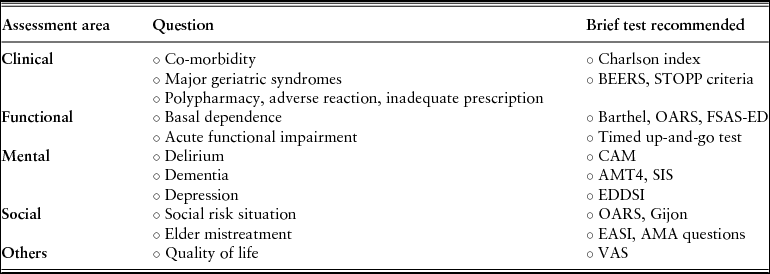
In our opinion there is the need to generate a geriatric evaluation adapted to each ED using a combination of screening scales that approach different spheres of the patient, with applicability in the ED and having a high predictive value of bad short-term resultsReference Martín-Sánchez, Fernández Alonso and Gil Gregorio2 (Table 2). The principal utility would be in the areas of observation in the ED, since frail older patients are admitted here for the worsening of chronic problems or unspecific complaints and at the time of planning health care, mainly in the discharge process directly from the ED.Reference Fernández, González del Castillo, González Armengol and Martín-Sánchez27
Adapted geriatric assessment of the frail older patient
OARS, Older American Resources and Services; STOPP, Screening Tool of Older Person's Prescriptions; FSAS-ED, Functional Status Assessment of Seniors in Emergency Departments; CAM, Confusional Assessment Method; AMT4, 4-item Abbreviated Mental Test; EDDSI, Emergency Department Depression Screening Instrument; ESAI, Elder Abuse Suspicion Index; AMA, American Medical Association; VAS, visual analogic scale.
Clinical area
Greater attention should be given to unspecific complaints and the information provided by a reliable caregiver and/or the primary care physician in the clinical history. Important geriatric syndromes such as falls, delirium, dementia and incontinence are usual reasons for consultation. The Charlson index is an adequate method to categorize co-morbidity and predict mortality after discharge from the ED.Reference Olsson, Terent and Lind28 Very advanced age and the presence of recent ED visits or admissions are associated with bad results.
Polypharmacy is constant in frail older patients.Reference Martín-Sánchez, Fernández Alonso and Merino29Adverse reactions to drugs are a frequent reason for consultation which is even interpreted as a new clinical process for which another drug is added, thereby activating the prescription cascade.Reference Martín-Sánchez, Fernández Alonso and Gil Gregorio2Inadequate prescription is another added problem, overall favoured by the frequent changes in medication made by the ED itself. BEERS and STOPP criteria are adequate to detect this problemReference Martín-Sánchez, Martínez Agüero, Fernández Alonso, González del Castillo and González Armengol30 but have little applicability in the ED. The introduction of ‘alarms’ in the computerized prescription may be a good measure. A score has recently been designed that combines co-morbidity and polypharmacy, allowing identification of older patients with trauma at risk who are under-classified by triage.Reference Justiniano, Evans and Cook31
Functional area
Functional evaluation based on the usual tools obtains better results than a subjective medical assessment.Reference Rodríguez-Molinero, López-Diéguez, Tabuenca, De la Cruz and Banegas32 The grade of basal dependence and the acute functional impact should be recognized.
A recent systematic reviewReference Bissett, Cusick and Lannin33 evaluated the utility of different functional assessment tools used in the ED setting. This review detected more than 10 scales assessing the basic and instrumental activities of daily life. Most of these scales, such as Barthel index or Lawton scale, were not designed for this setting. FSAS-ED (Functional Status Assessment of Seniors in Emergency Departments) and OARS (Older American Resources and Services) seem to be more adequate tools for the ED. The timed up-and-go test may be an alternative to the anterior scales. It is a direct standardized measure of morbidity that is easy to apply and only requires a chair and watch, being related to the risk of frailty (10–20 seconds) and falls (>20 seconds).
Mental area
With the presentation of a patient with cognitive deterioration in the ED, the presence of an acute confusional picture or delirium should first be ruled out. At this point the Confusional Assessment Method (CAM) is accepted as the most adequate in the EDReference Rockwood and Mitnitski34 with a sensitivity and specificity of nearly 100%. In cases with no history of psychiatric alterations or delirium, the diagnosis of suspicion of both cognitive deterioration and depression may be made in the ED.Reference Martín-Sánchez, Fernández, Guevara and Gil Gregorio35 There is no consensus as to the most adequate brief test. In a structured review, up to 12 cognitive tests were described,Reference Slater and Young36 suggesting that the AMT4 is the most adequate. Other authors prefer the Six-Item Screener (SIS) and Emergency Department Depression Screening Instrument (EDDSI) for depression.Reference Martín-Sánchez, Fernández Alonso and Gil Gregorio2
Social area
An older patient is considered at high social risk if living alone or without a principal caregiver, fixed residence or having economic problems. The usual social assessment scales such as OARS have not been adapted to the ED. The modified Gijon scale may be a good alternative for the ED, although its validity has not been proven in this setting.Reference Martín-Sánchez, Fernández Alonso and Gil Gregorio2 Collaboration with the social worker prior to discharge may allow the optimization of social resources without increasing costs.Reference Gordon37
Mistreatment of the elderly is an under-diagnosed problem that is closely related to social frailty. The application of standardized tools improves its detection,Reference Fernández Alonso, Baratas Crespo, García Briñón and Martín Sánchez38 the most adequate for the ED being the American Medical Association Screening questions for abuse and the Elder Abuse Suspicion Index.Reference Bond and Butler39
Quality of life
Quality of life is difficult to measure. The usual scales are not valid for the ED. Subjective questions providing qualitative information such as what is done with the visual analogy scale in pain may be considered.
Intervention models in the emergency department
No health care model for frail patients in the ED has a sufficient grade of evidence for universal use.Reference Caplan, Williams, Daly and Abraham42 The application of any model must be based on evidence and the process should be monitored and assessed.Reference Fairhall, Langron and Sherrington43
To date, few randomized controlled clinical trials of intervention models in the care of frail older patients in the ED have been performed. Nonetheless, randomized clinical studies in frail older patients aimed at studying the utility of intervention by an interdisciplinary team and geriatric assessment are currently underway.Reference Wilhelmson, Duner and Eklund44
Intervention studies that have demonstrated utility included previously selected frail older patients discharged from the ED. On the other hand, the results in hospitalized patients are scarce and of doubtful benefits. Some authors have reported that the number of admissions could be reduced.Reference Corbett, Lim, Davis and Elkins45
Intervention related to pharmacological aspects such as prescription and adequate adherence, nutrition, better mobility, avoidance of falls or prevention of delirium is of great interest. The results obtained showed a reduction in the number of admissions to a residence at 30 days, an increase in patient satisfaction, diminishment in functional deterioration, a lower percentage of revisits at 30 days, readmission at 18 months and a longer time to the first admission, with differences in mortality and institutionalization as well as lower functional and cognitive deterioration.Reference Caplan, Williams, Daly and Abraham42, Reference Mion, Palmer and Meldon46
Multiple geriatric intervention systems in the ED have been published: assessment by specialized nurses, geriatric consultant and even specific ED units for the elderly or observation, and short-stay annexes to the ED.Reference Salvi, Morichi and Grilli47 All of these systems have shown promising results, albeit with limited evidence.Reference Edmans, Conroy, Harwood, Lewis, Elliott, Logan, Bradshaw, Franklin M and Gladman48 The creation of a geriatric ED such as a structural unit independent of the remaining hospital ED does not seem to be the best idea.Reference Bridges, Meyer, Dethick and Griffiths49
A systematic, preventive focus that is aimed at all older patients and developed from the ED is preferred.Reference Latour, Lebel, Leclerc, Leduc, Berg, Bolduc and Kergoat50 Most initiatives involve the formation of personnel in geriatric aspects and structural adaptation in the setting of the ED.
Conclusions
• Older patients are a problem in the ED because of their high demand and complexity. The ED requires functional and structural redesigning to attend older patients.
• There is no consensus as to the definition of frailty. Two approaches, which have little reproducibility in the ED, have been proposed. From a practical point of view a frail older patient is identified as an older patient at risk of presenting adverse events (death, revisit, readmission, dependence, and bad quality of life) in the short to medium term.
• To identify older patients at high risk, standardized screening tools such as the ISAR or TRST are recommended prior to discharge.
• The ideal geriatric triage has a dual focus. On one hand, it should identify imminent vital risk according to traditional triage and, on the other hand, frailty according to the cited scales.
• The GA should be performed in frail patients or those at high risk. This assessment has not yet been adapted to, nor structured for, the ED. It recommends the identification of clinical (current disease, co-morbidity, geriatric syndromes, polypharmacy) mental (delirium, dementia, depression), functional (basal dependence and acute impact) and social problems which allow a health care plan to be established at discharge.
• There is no universal model of care for frail patients in the ED. A globally ‘more geriatric’ ED seems to be more reasonable instead of a specific geriatric ED. The observation areas are more adequate for the GA.
• The design of a health care plan after a holistic assessment, co-ordination with different specialists and health care levels together with short-term follow-up is key to avoid fatal adverse results.
• In the near future clinical studies and health care policies which demonstrate that frailty is not inevitable should be promoted.
Financial support
This review received no specific grant from any funding agency, commercial or not-for-profit sectors.
Conflicts of interest
None.