The discussions started a few years ago in the hallways and back rows of academic conferences. One colleague who conducts statistical analyses of elections and parliamentary politics told me, “There's not much point in studying Russia anymore. I guess I'll move on to Ukraine.” Another colleague confided that he gets embarrassed when he's asked about developments in Russian politics because “there aren't any, not like it used to be [in the 1990s].” At the annual conference of the American Association for the Advancement of Slavic Studies in 2007, a panel discussion was tellingly entitled, “Where Have the Political Scientists Gone?”Footnote 1 In brief, the answer appears to be that political scientists are leaving Russia. It is not a mass exodus, nor is it a coordinated movement, but the gradual exit is palpable. In part, it is bound up with the ongoing controversy regarding the value of area studies for comparative politics and reinforced by the realities of academic publishing and career opportunities. These are common complaints that should surprise no one. But increasingly it seems likely that comparativists who study Russia are heading for the exits owing to disenchantment with the Kremlin's brand of “sovereign democracy.”
If this is the case, there are good reasons to expect that this is a problem that reaches well beyond Eurasia. Recent years have seen a revival of non-democratic or “hybrid” regimes regionally and globally with the ebbing of the “third wave” of democratization,Footnote 2 such that comparativists are increasingly likely to face the prospect that particular fieldwork methods only yield convincing access to knowledge depending upon the political environment—even if the matter is rarely discussed openly within the discipline. Standard methodology training arms graduate students in comparative politics with a number of tactics for choosing cases, avoiding ethical pitfalls, and evading threats to personal safety. There is some discussion of ambient and situational risks to researchers that amounts to the recommendation to avoid dangerous settings or undertaking observations that might trigger conflict, hostility, or violence.Footnote 3 The manner in which researchers' identities are implicated in complex power relations during fieldwork receive increasing attention in political science and other disciplines.Footnote 4 Yet one thing that never seems to be discussed in the literature is whether regime type influences the utility of particular fieldwork techniques, if not the very identification of the field. For those who study relatively open regimes, of course, the decision to conduct fieldwork and choice of method is a technical one that (ideally) is determined by the theoretical puzzles at hand. Where regimes are closed (or closing), whether haunted by an authoritarian past or abandoning democracy, the selection of research sites and choice of fieldwork techniques are relatively constrained compared to more open regimes. The use of qualitative fieldwork methods—particularly traditional methods like interviewing and focus groups that rely on close contact between researcher and respondents—may prove challenging to conduct, impossible to verify, and unlikely to convince a skeptical audience. Similarly, the closing of regimes may reduce the value of quantitative analyses of voting (since elections are rigged), diminish the utility of official statistics (which are unreliable), or mass surveys (where citizens feel threatened).
The danger posed by this disciplinary silence concerning the relationship between regime and fieldwork is two-fold. In the first place, it creates incentives for scholars to conduct fieldwork in politically congenial environments where methods that have acquired a high status in the discipline may be applied. As scholars leave closed regimes for friendlier environs, newspapers, television, blogs, and politicians are left to define the essential knowledge about those regimes in their absence. Even as public interest in the regime increases, then, scholarly knowledge of the country in question falls in short supply. One alternative would be for scholars to pick apolitical topics, as has been the trend with sociological studies of Russia in recent years.Footnote 5 While this approach keeps the discipline's foot in the door, it also sacrifices policy relevance for the satisfaction of intellectual curiosity. A second danger is found in the way that the standing of Western political scientists within their own discipline is influenced by changes in fieldwork practices. With particular regard to the study of Russia, awareness of the past stigma of Russianists as “Sovietologists” and “Kremlinologists” may induce political scientists to accept a redefinition of Russia or even abandon it altogether rather than risk isolation from academic hiring and publishing opportunities.
I examine whether such an effect can be found in the Western study of Russian politics since Putin came to power. I begin with a brief discussion concerning the nature of hybrid regimes, the ways that hybrid regimes may frustrate common assumptions about fieldwork, and how they challenge the adoption of common research methods. The following section makes the case for examining Russia as a hybrid regime and suggests ways that one might observe the effect of regime on the conduct of fieldwork. I then examine scholarship on Russian politics published in a dozen journals over ten years to track the prevalence of fieldwork and the varieties of methods used in order to assess whether scholars are staying away from Russia in greater numbers. I consider a range of alternative explanations, taking stock of the fieldwork and methods experience in recent dissertations, the distribution of fieldwork funding across social science disciplines, the general interest in Russian area studies, and the influence of professional incentives. The evidence indicates an undeniable trend of declining fieldwork that tracks with Russia's authoritarian drift since 2000. I next assess the harm to research inflicted by the disciplinary silence concerning the effect of regime on fieldwork, and conclude with a few suggestions that scholars might adopt to avoid these kinds of problems.
What Are Hybrid Regimes?
The notion of hybrid regimes is implicit in measures provided by Freedom House or Polity which place regime type on a sliding scale, though these kinds of scores do not provide the means to distinguish taxonomical differences among varieties of non-democratic regimes.Footnote 6 Though regimes that mixed formal democratic institutions with authoritarian practice existed prior to the end of the Cold War (consider Malaysia, Mexico, Singapore, South Africa, or Taiwan), scholars initially treated them as waypoints in transition like democradura or dictablanda,Footnote 7 or as diminished subtypes of democracy.Footnote 8 Hybrid regimes grew in number and diversity in the post-Cold War era as regimes assumed to be transitioning towards democracy turned out to be pointed in different directions.Footnote 9 This was particularly evident in the post-Soviet sphere, where only the Baltic states made strides towards establishing electoral democracies in the 1990s while Russia was “lost in transition.”Footnote 10
Acknowledging the spread of hybrid regimes is one thing, while pinning down a working definition is quite another. The stalling of the Third Wave forced a reconceptualization of these regimes in order to assess their sources of stability and change. While hybrid regimes combine elements of democracy and authoritarianism, the term generally refers to forms of authoritarianism featuring semi-competitive elections that serve to disguise dictatorship.Footnote 11 In this sense, hybrid regimes are sometimes called “electoral authoritarian” regimes. Opposition parties or candidates participate in elections, though Diamond cautions that victory “requires a level of opposition mobilization, unity, skill, and heroism far beyond what would normally be required for victory in a democracy.”Footnote 12
The literature on hybrid regimes sometimes appears myopically focused on elections relative to other regime characteristics such as the treatment of civil society. The reason is that elections are understood as part of a larger regime structure in which formally democratic institutions (including the judiciary, legislatures, and the media) are undermined by coercive informal institutions.Footnote 13 Elections provide opportunities to assess a regime's performance and to estimate the prospects for its survival. Moreover, a focus on elections further helps scholarship from falling prey to the “paradox of comprehensiveness” whereby the attempt to identify every form of electoral manipulation raises staffing and logistical burdens while the increased information renders electoral manipulation indistinguishable from the regime's structural features.Footnote 14
The nature of the opposition's participation and the regime's control of electoral outcomes serve to distinguish electoral authoritarian from closed authoritarian regimes and to differentiate two varieties of electoral authoritarianism. In competitive authoritarian regimes, power is obtained through formal democratic institutions though incumbents regularly violate the rules to maintain office. Nevertheless, opposition parties or candidates compete in elections and incumbents ignore them at their peril.Footnote 15 By contrast, hegemonic authoritarian regimes allow elections but limit real competition to just the ruling party or the regime's favored candidates. The opposition might be allowed formally to participate in elections but in practice it is shut of out the ballot box, the media, the courts, and sometimes the country.Footnote 16 Of course, differentiating a quixotic opponent from a regime puppet may be difficult in practice. Similarly, the potential for the opposition to unify against the regime must be weighed against the likelihood that some of the opposition is complicit in silencing the regime's critics, particularly where regimes engage in divide et impera. There is some agreement, however, that regimes in which presidents are reelected with upwards of 70 percent of the vote are no longer competitive.Footnote 17 Schedler pithily captures the distinction between these varieties of electoral authoritarianism in the observation that rulers are insecure in competitive authoritarian regimes while they are invincible in hegemonic authoritarian regimes.Footnote 18
Having identified the characteristics of hybrid regimes and the principle differences between competitive and hegemonic electoral authoritarian regimes, the difficulty of actually studying their dynamics in the field starts to come into focus. All fieldwork faces fundamental hurdles in overcoming issues of access and ensuring the credibility of one's observations. In studying electoral authoritarianism, these issues are particularly acute when the tools developed for the study of politics tend to assume the benefits and context of open democracy while the object of investigation is sensitive to scrutiny.Footnote 19 To the extent that political scientists tend to use the antipodes of democracy and autocracy to characterize the regimes they study, it is not surprising that they will seek to use methods developed for the study of the former for regimes that appear more or less democratic. Ironically, treating regime type as a continuous variable (as in Freedom House or Polity rankings) between extremes of democracy and dictatorship conceals the specifically “hybrid” institutional characteristics of electoral authoritarian regimes by blurring rather than clarifying the thresholds that distinguish them from other regime types. As a result, the methodological consequences of importing fieldwork techniques designed for the study of democratic (or, for that matter, closed authoritarian) regimes remains hidden. To illustrate the point, one might take three examples of common ways of studying democratic politics which are problematic in the study of hybrid regimes.
First, observations of legislative process, parliamentary debates, and court decisions are meaningful and comparable among countries where formal institutions are more consequential and enduring than informal institutions. While observing legislatures and courts is a useful means of studying politics in a democracy, the use of informal practices to guide (or subvert) formal institutional procedure in hybrid regimes turns the study of formal institutions into a catalog of legal fictions.Footnote 20 In reflecting generally upon the difficulties of studying authoritarian regimes, Barros notes that scholars often rely upon the regime's public artifacts (speeches, decrees, policies, personnel movements). These artifacts are then used to infer the regime's inner workings, “notwithstanding the glaring fact that scholars usually have no access to the internal circumstances, contexts, and interactions that might allow us to make these types of judgments.”Footnote 21 The temptation to draw conclusions about decision-making processes is arguably greater within hybrid regimes owing to their cultivated appearance of openness.
The study of formal institutions in hybrid regimes also carries ethical risk. All hybrid regimes claim to be democratic and point to the operation of formally democratic institutions as evidence of their credentials. Scholars who study formal institutions in hybrid regimes therefore run the risk of replicating the regimes' claims to legitimacy. Such studies may be provided with surprising access that is due, in part, to the ruling elite's instinctive need for independent information. Studies of voting and elections in hybrid regimes may actually benefit electoral authoritarian regimes by providing information which they would be unlikely to receive through their own channels about the actual nature and extent of popular support (including how it might be maintained or recovered).
Second, in conducting elite interviews, responses are useful insofar as respondents are not threatened with coercion or violence for participation in the study, or when respondents are not concerned about surveillance. The various means of controlling interview bias are aimed at the problem of respondents who perform for the researcher or themselves, rather than respondents who perform for the state. In a hybrid regime, relations between a foreign researcher's and respondent's governments may be mapped onto the researcher-respondent relationship. The vulnerability of hybrid regimes to opposition challenges backed by international election monitors potentially makes any foreign researcher seem dangerous while subjecting local researchers to increased scrutiny regarding their sources of funding or collaboration with foreign scholars or organizations. Potential respondents may be unwilling or fearful of speaking to foreigners if it might render the respondent suspect or somehow threaten their friends, families, co-workers, or their own livelihood.
This resistance to scrutiny may be replicated at lower levels within the regime hierarchy even as researchers become increasingly distanced from ruling elites. The operation of hybrid regimes is just as opaque to those further down the regime's hierarchy as it is for foreign scholars, yet the repercussions for failing to anticipate the regime's response are much greater for respondents while foreign scholars may simply be deported. The “paradox of comprehensiveness” is a two-way street: elites and officials in hybrid regimes likewise struggle to determine whether a foreign researcher's study somehow flows into a broader condemnation of the regime for which they will be held individually responsible. When the possibility appears credible or even just conceivable, the easiest (and safest) decision is to refuse participation in the study.
A third means of studying open politics involves the gathering of credible information from the media (and media archives) where the press is free, independent, and relatively responsible. While only the most naïve would assume that any newspaper is free of editorial bias, the diversity and competition of media in a democratic regime is a far cry from closed regimes where state control over local and national media renders press archives into documentary histories of state propaganda. In hybrid regimes, the media may be a powerful resource for the opposition. Reporters and editors are frequently subject to harassment, intimidation, and violence, such that outlets may opt for self-censorship to avoid provoking the regime or to leave its options open. Incumbents may use the media to drown out or discredit independent sources of information, for instance, through the circulation of fake poll numbers or pseudo-sociological surveys “documenting” support for the regime. Consequently, journalism becomes a site for mercenary political activity in electoral authoritarian regimes. Aside from weakening the value of the media as a source of data, this treatment of journalists conceivably has a knock-on effect for researchers gathering personally identifiable information such as recorded interviews.
Defining and Observing Russia's Hybrid Regime
These observations should not be taken to mean that conducting fieldwork in hybrid regimes is utterly infeasible and ethically disastrous. The pitfalls enumerated above only manifest when scholars pay insufficient attention to the specific features of hybrid regimes in crafting research designs and planning fieldwork. In suggesting that regime type affects the conduct of fieldwork, the Russian case (both in terms of the Soviet past and the post-Soviet present) provides useful insight as a “plausibility probe,” or a case study that is aimed at developing theoretical generalizations where none presently exist and assessing their potential validity.Footnote 22 Moreover, Russia's profound impact on Western (and especially American) social science makes it a particularly important case. At the start of the Cold War, the need to foster expertise on the Soviet Union spawned the first area studies centers in American universities.Footnote 23 With the fall of the Soviet Union, the opportunity to apply Western methods to the study of Russian politics generated a great deal of scholarly excitement as the democratic opening created an unprecedented social scientific opening. As Peter Rutland describes, “the big guns of Western social science” were deployed, “using methods and concepts that had already, allegedly, proved their worth in studying other parts of the world.”Footnote 24 By contrast, the gradual closing of the regime over the last decade has so far evaded discussion of the methodological implications.
Whatever one might think of the Putin-Medvedev regime today, the USSR was far more closed and brutal. Gaining access for fieldwork was difficult and inevitably politicized by the crests and troughs of the Cold War. The state's surveillance was an assumed feature of daily life and the upper rungs of Party leadership were impenetrable for outsiders.Footnote 25 Interviews were largely empty of content until glasnost, while the most meaningful conversations happened over kitchen tables or in other informal settings. Newspapers reliably reported the party line but were mostly useful for establishing timelines, tracking official speeches, or marking conspicuous absences at official ceremonies. Formal state institutions were ultimately subordinate to the CPSU's leadership such that party-states were comparable only with in-kind regimes. Rutland's study of dissertations on Soviet domestic politics written from 1976 to 1987 reflects these constraints: only seventeen out of eighty-seven dissertations involved study in the USSR and only a handful involved anything like fieldwork (beyond working in libraries or interviewing academics). Dissertation topics were driven by what data was available, while a quarter of dissertations relied exclusively upon English-language sources.Footnote 26
These challenges did not deter scholars from developing innovative ways of investigating and analyzing Soviet politics. The Harvard Interview Project derived significant insights about the Soviet system and daily life by interviewing émigrés from the USSR from 1950 to 1953.Footnote 27 Merle Fainsod's study of Smolensk made use of regional archives that had been removed from the country by Germany during the Second World War.Footnote 28 Archie Brown's work demonstrated that observations of the frequency and regularity of meetings of the Politburo and Party Conferences and changes in the order and content of leaders' positions said a great deal about the policy priorities and distribution of power in the regime.Footnote 29 Popular literature could be mined for representations of the role and authority of party and state officials.Footnote 30 One particularly heroic attempt to apply quantitative methods to Soviet politics attempted to uncover the meaning of the “missing” one percent in Soviet election results (in contrast to the ninety-nine percent who allegedly voted for a single candidate).Footnote 31 As the Soviet Union came to look less convincingly totalitarian under Brezhnev, a new generation of scholars focused on provincial administration and local organizations as a way to infer the operation of the Soviet system.Footnote 32 These creative and insightful works continue to prove their worth today as scholars of contemporary Russian politics reach into the past to understand the legacies of Soviet rule.
Nevertheless, scholars of Soviet politics came to be labeled as Sovietologists or Kremlinologists—terms that were more accusation than category. The limited applicability of the research tools developed for “normal” politics was claimed to render the Soviet system sui generis and incapable of producing useful generalizations beyond the Soviet bloc in spite of earnest attempts to locate the study of Soviet politics within a broader comparative context.Footnote 33 If Soviet studies were sustained by the Cold War,Footnote 34 they were also penalized by association. All this changed with the collapse of the Soviet Union. Scholars of Soviet politics were charged with failing to predict the end of Soviet power and the terms Sovietology and Kremlinology ceased to be used in a non-ironic sense.
Most scholars were committed to the idea of Russia as a transitional or democratizing regime during the 1990s. Discussions within the field focused initially on the extent to which post-communist and post-Soviet regime transitions were comparable to previous waves of democratization, reflecting both the scientific enthusiasm and methodological opportunism that followed the collapse of the USSR.Footnote 35 By the late-1990s, the authoritarian drift in Russian politics was matched by the gradual shift in the field to explaining why democratization in Russia and other post-Soviet states appeared to grind to a halt.Footnote 36 The scholarly dissatisfaction with the quality of Russian democracy also produced a vigorous debate regarding the value of “transitology” as a framework of analysis.Footnote 37 In a review of the 1990s scholarship on post-Soviet politics, David Laitin suggested that political scientists interested in democratization should start incorporating actors intent upon subverting democratization into their models.Footnote 38 This suggestion moved from the margins to the mainstream in the last five years as democratization gave way to debates concerning post-Soviet autocracy.Footnote 39
Redefining Russia
It has become increasingly common to categorize Russia as a hybrid regime,Footnote 40 though the literature is marked by a great deal of terminological innovation. To cite but a few instances, Putin's regime has been described in terms of managed pluralism,Footnote 41 managed democracy,Footnote 42 stealth authoritarianism,Footnote 43 oligarchy,Footnote 44 virtual politics,Footnote 45 electoral authoritarianism,Footnote 46 and imitation democracy.Footnote 47 Within a single issue of the Journal of Democracy, Russia was labeled a façade democracy, bureaucratic authoritarianism “with-add ons,” and even a “dying mutant.”Footnote 48
The way that Russia's regime is discussed within the country provides additional labels, though they are generally consistent with the properties of hybrid regimes. The opposition mockingly refers to the regime as “tandemocracy” in reference to the ruling tandem of Putin and Medvedev. The irony is two-fold: few consider Russia to be a democracy, and most believe that Putin continues to run the show. For its own part, the Kremlin describes its form of rule as “sovereign democracy” (suverennaia demokratiia). The term essentially refers to the premium the regime places on maintaining domestic order and protecting the country's freedom from interference by foreign powers.Footnote 49 The latter portion became particularly urgent following the “color revolutions” in Georgia and Ukraine,Footnote 50 leading Putin to declare in his “state of the nation” address in 2005 that Russia would become democratic on its own time and in its own way.Footnote 51
If one follows the distinctions between hybrid regime types discussed in the previous section, Russia appears less like a democratic regime turning authoritarian than a competitive authoritarian regime during the 1990s and early 2000s that became a hegemonic authoritarian regime by the 2003–2004 election cycle. From this perspective, the successive crises in Russian politics represented critical junctures in which the regime failed to choose democracy.Footnote 52 In the “romantic” phase that accompanied the collapse of the USSR, Boris Yeltsin received sweeping decree powers from the Russian parliament in 1991 to implement market reforms. The relationship between president and parliament soured the following year and Yeltsin used tanks to resolve the heated constitutional dispute over the separation of powers in October 1993.Footnote 53 His new constitution substantially strengthened the powers of the presidency and weakened the parliament.
During the 1990s, elections were relatively free but seldom were they fair. Opposition parties dominated the State Duma (the lower house of parliament) and actively contested elections at all levels, occasionally winning executive offices on the regional and local levels, yet they played no role in forming the government. The 1996 presidential election was telling of the regime's nature in many ways. The likelihood that he would lose the election led Yeltsin to consider canceling it altogether.Footnote 54 The fact that he required substantial support from Russia's oligarchs just to force a run-off exemplifies the significance of elections in competitive authoritarian regimes: the election decided who would rule Russia, but what decided the election was the regime's all-out effort to stack the deck.
In his final act as Russian president on New Year's Eve in 1999, Yeltsin resigned on national television and designated Vladimir Putin his successor. Yeltsin's resignation accelerated the timetable for the upcoming presidential election from June to March 2000. While opposition candidates scrambled to field a campaign, Putin received daily media coverage and benefited from the support of elites who viewed him as a guarantor of the property and status gained during the Yeltsin era. Putin handily won the election in the first round. During his first term, Putin moved to increase central control over regional executives and legislatures. The oligarchs were brought to heel, culminating in Mikhail Khodorkovsky's sentence to eight years in a Siberian prison colony.Footnote 55 A ruling party (Edinaia Rossiia, or United Russia) was fashioned to support Putin's agenda while a new law on parties created additional obstacles for the opposition to register and compete in elections.Footnote 56 After parliamentary elections in 2003, United Russia benefited from defections by independents and members of smaller parties to gain control of 60 percent of the State Duma. Putin was re-elected in March 2004 with 71.3 percent following a perfunctory campaign in which legitimate opposition candidates refused even to participate.
Putin consolidated United Russia's gains in 2004 by eliminating single member districts in parliamentary elections and increasing the electoral threshold for parties (from five to seven percent). Gubernatorial elections were eliminated and replaced with a system of presidential appointments.Footnote 57 For the 2007 parliamentary elections, Putin formally assumed leadership of United Russia (though he did not join) and the party's faction in the State Duma grew to 70 percent. Putin designated his own successor, Dmitrii Medvedev, for the 2008 presidential election while moving sideways into the position of Prime Minister. Medvedev handily won the 2008 election with 70.3 percent, but it was Putin that got the most applause at the televised celebration of Medvedev's victory.
Redefining Russia as a competitive authoritarian regime in transition to a hegemonic authoritarian regime fleshes out the concern raised in the previous section regarding the observation of formal political institutions. A casual reading of Russia's constitution might tempt one to categorize its political system as semi-presidential. However, given the preponderance of presidential power and the frequency with which Yeltsin changed prime ministers, a more accurate characterization of Russia's political system during the 1990s was “super-presidential.”Footnote 58 Only with Putin's move into the Prime Minister's seat in 2008 (by his own volition) did it become somewhat reasonable to speak of “semi-presidentialism” in Russia, though this owes entirely to the personal authority that Putin invests in the office and the corresponding impression that Medvedev is only half a president.
Similarly, debates in the Russian parliament steadily lost observational value after 2003. While the opposition had no chance of forming a government in the 1990s, the State Duma at least provided a forum for the opposition to air grievances and to compel a response from the Kremlin. Since United Russia established control over the parliament, however, it has relied increasingly upon the so-called “zero reading” to negotiate and secure the adoption of laws before they are presented in the Duma.Footnote 59 On the regional level, variations in regional regime types produce wild swings in both institutional design and the informal structure of authority.Footnote 60 Perhaps nowhere was the gap between formal institutions and actual practice more evident than in the conduct of regional gubernatorial elections. On Election Day in Buryatia in 2002, for example, the streets were empty despite official claims of widespread voter turnout. Though I'd been invited to observe the republican electoral commission, I was turned away at the door by scared-looking police who reached for their truncheons.
The regime's opacity also affects the conduct of interviews in Russia. For instance, Allina-Pisano reports experiencing difficulty in administering a survey in Russian and Ukrainian provinces owing to vague fears regarding the eventual repercussions.Footnote 61 I observed a similar reaction in conducting interviews with regional political elites. On one occasion, an official declined to meet with me on the grounds that, as a former FSB agent (the post-Soviet successor organization to the KGB), he considered himself duty-bound not to speak to foreigners. Of course, the official's concern might have been that meeting with a foreign researcher could have unanticipated consequences or he might simply have decided it would be funny—one does not know for certain and this is precisely the difficulty. Rather than linking such resistance to interviews to the properties and dynamics of hybrid regimes, scholars typically ascribe it to a post-communist behavioral legacy or a lingering feature of Soviet political culture.Footnote 62
The use of media for observing Russian politics is further complicated by Russia's authoritarian drift. Regional administrations often commission pseudo-sociological studies during election campaigns that do little to enhance the status of foreign researchers and magnify problems of gaining access. When I visited Karelia in December 2001, the republican administration was sufficiently wary about the April 2002 election to decline any interviews (this was not my conclusion, but was explained to me by my local contact). Elsewhere, a common concern voiced when conducting interviews with regional elites was whether interview material would be used for chiefly scientific purposes or some other use. A typical request was to submit interview questions prior to the decision to grant an interview and local contacts usually insisted on a prior vetting of the questions before passing them onward.
Such matters reflect the extent that social science and journalism are appropriated for political agitation in post-Soviet Russia. Even where press outlets are not strictly controlled by the local administrations in Russia, journalists become adept at self censorship or risk life and limb.Footnote 63 In a discussion with journalists from a major newspaper in Perm', which is relatively open by Russian standards, I was told that they saw no value in stirring up trouble with the local and regional administrations. Whereas press archives provided valuable information for scholars studying regionalism of the early 1990s,Footnote 64 they lost much of their value for studying regional politics under Putinism. More generally, journalistic output became more conformist and less interesting with the expansion of state control.
The ambiguity of Russia's regime type throughout most of the post-Soviet era—at once claimed to be transitional or democratizing while in practice competitive authoritarian and, more recently, hegemonic authoritarian—further complicates the ability of foreign scholars to navigate power relationships between interviewer and respondent. In my own experience as a graduate student, a telling moment came when I asked an academic contact in Petrozavodsk if there were close ties between the university and the regional administration. After checking over both shoulders, he responded: “none at all.” In another incident, a contact in Ulan-Ude arrived unannounced at my hotel to discuss eco-tourism. While we were talking, I was passed a note that read: “Can we talk outside? They're listening!” The contact hoped to link a local ethnic minority organization into a broader global network—something about which the regime was very sensitive, but the contact hoped I could provide help through my apparently vast reserve of international connections. The encounter illustrated how foreign researchers may be seen as saviors-in-waiting, if not a vital link to the outside world, for political non-conformists in hybrid regimes. And quite aside from the threat to my professional objectivity, it occurred to me that the regime might decide to start listening thanks to the visit. More generally, the role of foreign training and sponsorship of youth groups in the staging of “color revolutions” is well known to the regimes in the post-Soviet region. This potentially raises sensitivity to political research conducted by foreign scholars, though it is just as likely that domestic researchers are more affected by scrutiny concerning foreign sources of funding and the purpose of their research.Footnote 65
When viewed in isolation during fieldwork, it is tempting to shrug off such encounters as part of the broader social or cultural fabric of post-communism in Russia. One finds this temptation even in anthropological studies of post-communism. The adoption of “transitional” to describe post-communist societies emerged as a form of “similarity-hunting” aimed at “the cleansing of socialist differences” in order to render them comparable with societies in the developing world.Footnote 66 In comparative politics, “transition” became the accepted paradigm for understanding post-communist regimes despite the surprising lack of scholarship explicitly adopting the regime transitions framework.Footnote 67 In both disciplines, the effect of the adoption of “transition” to characterize post-communist politics and societies was to make previous insights and fieldwork techniques from the developing world and prior waves of democratization appear legitimately and unproblematically applicable. Where scholars met resistance to the use of a fieldwork technique, the problem was interpreted as a residual cultural legacy of communism rather than a mismatch between fieldwork technique and regime type.
Once these observations are examined as fundamentally related to the nature of hybrid regimes, the disciplinary silence concerning the appropriateness of widely-used research tools to study politics in hybrid regimes becomes deafening. With regard to today's Russia, comparativists are apt to recognize a familiar dilemma: as the tools developed to study open politics become less applicable to studying Russia, scholars who continue to study Russia run the risk of professional marginalization. In the short term, they are likely to accept a shrinking of the field in terms of access to research sites and credible information–both of which may be understood as practical consequences of “sovereign democracy.” However, it is not inconceivable that political scientists will abandon their area training over time and go where their research skills “travel” rather than innovate and risk having one's work branded as idiographic, unsystematic, or (worst of all) “Kremlinological.”
Research on Russian Politics, 1999–2008
Moving from anecdote to evidence, I attempted to determine whether there is a correspondence between the emergence of “sovereign democracy” in Russia and changes in the use of fieldwork methods in the study of Russian politics. To do this, I examined research published in academic journals from 1999 to 2008. Journal articles provide an opportunity to observe what the field considers most valuable in the study of Russian politics—both in terms of what is researched and what is worth publishing.Footnote 68 Starting in 1999 allowed me to capture the state of affairs from the end of the Yeltsin era (assuming some lag time between research and publication) through to the end of Putin's presidency, with the expectation that changes in regime ought to be reflected in changes in the conduct of fieldwork and the kinds of methods reported in published research on Russian politics. I selected a dozen journals from the US and UK, most of which are broadly concerned with comparative politics. Only four journals are traditionally considered multi-disciplinary “area” journals, while the remaining journals are broadly focused on political science or comparative politics.Footnote 69
For the period in question, I recorded the variety of methods that were utilized or referenced as well as fieldwork location (if applicable) for each article that dealt with Russian politics.Footnote 70 Concerning the coding of data, I relied on self-reporting in the journal articles. Since it is often the case that much qualitative research does not find its way into footnotes, I erred on the side of caution and included articles that referenced at least one source of data per method. Hence, an article was counted as using “interpretation” if it made use of Russian press sources, “interview” if it referenced at least one interview in Russia, and so forth. As for recording fieldwork, I similarly relied on self-reporting in articles to determine whether the research involved fieldwork and where it was conducted (if reported). Where the fieldwork was not specifically mentioned but the article made references to on-site interviews or other data collection, the article was coded as involving fieldwork and the location was inferred where possible.
It quickly became difficult to include strictly quantitative analyses since they tend to report data and findings rather than fieldwork. It is common practice to use locally-based, professionally-trained survey teams for gathering quantitative data. This reduces the role of the individual scholar in the conduct of fieldwork and potentially limits the impact of interpersonal consequences when Western scholars study hybrid regimes. At the same time, surveys usually are preceded by preliminary discussions with local academics, consultants, or policy-makers. One must assume that these discussions take place in the field but they are rarely reported. Though quantitative fieldwork ought to be vulnerable to the same kinds of regime effects suggested above, such effects are harder to observe given the discipline's habits regarding self-reporting of fieldwork in published research. By comparison, variation in reported use of qualitative research methods is easier to observe and record, though the study also recorded articles that mixed quantitative and qualitative methods.
The observations exclusively concern articles related to the study of Russian politics. Articles that study other post-Soviet or post-communist countries were not included in the sample unless they included Russia as a case. For instance, an article that focused on Ukraine and only made passing reference to Russia would not be included in the sample while a systematic study of center-regional relations in both Ukraine and Russia would be included. Purely descriptive articles or those that did not involve any clearly identifiable methods were not counted.
While it would be tempting to add additional cases from the post-Soviet region to the observations regarding the study of Russian politics, such comparisons are not easily made. In the first place, one would need to specify differences in regime types among the post-Soviet cases and follow up with a “differences within differences” research design.Footnote 71 As noted above, it requires significant effort to forge consensus regarding the Russian case, alone. This does not mean that such a study is not possible but it is prudent to focus the present observations on a single regime—after all, what is being observed is the reported research rather than the country, itself. An expansion of the study would necessarily follow to confirm or disconfirm the effects of hybrid regimes on fieldwork and possibly to isolate regime effects from countries' idiosyncrasies. Furthermore, articles published on Russian politics may be found in a broad range of journals that cover comparative politics and area studies while this is not always the case with regard to other post-Soviet countries where scholarly communities are tightly-knit and publish in journals with a regional specialization (that might, in turn, exclude articles on Russian politics). One might substitute those journals for the area journals used to observe published research on Russian politics but then one must reckon with the comparability of the journals in addition to the comparability of the research.
At first glance, the data demonstrate distinct (if sporadic) changes in the use and diversity of qualitative methods in the study of Russian politics. Figure 1 shows the changes in the most commonly used qualitative methods as a percentage of all articles for each year from 1999 to 2008. Of particular interest are the drop in traditional methods like interpretation and interviewing and the dramatic rise in the use of content analysis towards the end of the decade. In considering the reasons for the rise in content analysis, close scrutiny of the data showed that only one article out of 22 in 2008 combined content analysis with fieldwork. This suggests that the rise in content analysis is not only connected with the decline in interpretation and interviewing, but that changes in all three are related to declining fieldwork in Russia.
Choice of method as percent of articles

Figure 2 looks at the percentage of articles that combine qualitative methods with fieldwork experience. In just three years out of the decade under examination did the portion of articles drawing upon fieldwork reach or exceed 50 percent. Perhaps a more telling indicator is the percentage of articles that involve fieldwork outside of Moscow, which slumps from a high of eight articles (35 percent) in 1999 to just one article (5 percent) in 2008. Clearly one should hesitate to panic about the decline in reported fieldwork from 2006 to 2008; indeed, one might be rather optimistic about the state of fieldwork on Russian politics if only articles through 2006 were surveyed. A complicating factor is the lag time between the conduct of research and its publication that is not reflected in these figures. In 2008, the articles reporting fieldwork used data collected during 2004–2006. If one examines the articles from 2006, the reported fieldwork occurred during each year of the 2000–2005 period. For the previous high point of published fieldwork data in 2000, the reported fieldwork occurred during the 1995–2000 period. Therefore, the two year decline at the end of the decade might simply reflect a temporary decline as fieldwork data accumulates prior to publication. Nevertheless, it is striking that only two out of 22 articles on Russian politics published in 2008 using qualitative or mixed methods actually involved fieldwork conducted in Russia. Perhaps the most important insight yielded by this data is that, on the average, fewer than 40 percent of articles published on Russian politics involved fieldwork and less than 25 percent involved fieldwork outside of Moscow.
Percent of articles reporting qualitative fieldwork

Alternative Explanations, or Out of Alternatives?
The worst-case scenario suggested by the evidence above is that Russianists seem to be avoiding going to Russia, and the decline in fieldwork (and simultaneous rise in the use of methods that do not require fieldwork) suggests that they are doing so in greater numbers. This decline appears to correspond with the authoritarian drift of Russian politics since Putin came to power in 2000. I started with the concern that gaining access to closed regimes is difficult, and it may even be the case in hybrid regimes that access is inversely proportional to the amount of legitimately useful political data that might be gained from fieldwork (i.e., one may have tremendous access to observe stage-managed events but little access to observe actual decision-making within the Kremlin). It is certainly possible that Putin's “sovereign democracy” is working in fits and starts to dissuade Western scholars from conducting fieldwork, particularly where research tools are ill suited for studying politics in closed regimes. It is also possible that scholars are staying away from Russia because they feel reasonably confident in accounting for the regime's dynamics without conducting fieldwork.
Are there other explanations for this decline that are unrelated to changes in political regime? For one, the method of counting journal articles in this study might underestimate the resolve of scholars to undertake fieldwork. Fieldwork is both time- and resource-intensive such that scholars may prefer to publish their findings as books rather than articles. Instead of journal articles, one might get more leverage over this possibility by examining graduate student dissertations since they are likely to involve extensive fieldwork resulting in book-length monographs. Scholars tend to conduct their most intensive fieldwork while researching dissertations but retreat from extended fieldwork after receiving their degrees owing to teaching, administrative, or family demands. Alternatively, the decline in fieldwork may actually reflect a drop in the number of doctoral students studying politics in Russia over the last decade. To consider both of these possibilities, I examined the full-text dissertations available on ProQuest Dissertation Abstracts that dealt with Russian politics.Footnote 72 I included both single-country studies focused on Russia and multi-case studies as long as Russia received equal treatment with other cases.
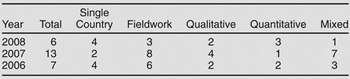
As illustrated in Figure 3, the number of dissertations on Russian politics has been steadily declining since reaching a high point in 2000 (with the exception of 2007). If one examines the last three years (Table 1), it is encouraging to note that more than 50 percent of dissertations involve some form of fieldwork, exceeding by far the rate of reported fieldwork among peer-reviewed journal publications for the same period. Nevertheless, one would expect that junior scholars would seek to publish portions of their research in journals as they complete their dissertations and prepare for the job market so their apparent absence remains troubling.
Dissertations on Russian politics

Fieldwork and methods in recent dissertations on Russian politics

If the number of political scientists conducting fieldwork in Russia appears to be declining, it is worth asking whether this is a trend that is unique to the discipline? It is well known, for instance, that archival access for historians has been closing since Putin came to power.Footnote 73 If growing authoritarianism plays a role in the decline of fieldwork in political science, it might also be expected to affect fieldwork among other social science disciplines. For this purpose, I examined the IREX listings of Individual Advanced Research Opportunity (IARO) fellowship recipients for the last ten years. Since IREX provides grants for a wide range of scholars (especially history and sociology, in addition to political science), the awards provide a measure of where scholars are going by region as well as by discipline. In Figure 4, one finds that the number of projects involving Russian fieldwork generally declined aside from a sharp rise in 2004–5. The second line shows the percent of political science projects involving fieldwork in Russia, which remains under 10 percent starting in 2000. Taken together, these data suggest that the trend of declining fieldwork is not exclusive to political science but is shared across other disciplines, as well.
IARO fieldwork projects in Russia

In a 2009 study of funding by seven of the eight Title VIII recipient organizations over a five-year period, the picture appears a bit less clear cut.Footnote 74 The Social Science Research Council Fellows reported an overall decline in the number of applications for fieldwork in Russia, from 40 in 2004, to 26 in 2008. There was a precipitous drop in funded research for projects involving fieldwork in Russia, as well, from 14 in 2004 to just one in 2008. The SSRC data also shows a drop in the number of projects requesting funding for fieldwork outside the metropoles (Moscow and St. Petersburg) from 36 applications in 2004 to 14 in 2008. The study's IREX data include applications and grants for both IARO and short-term travel grants (STG). These data show an increase in applications for fieldwork in Russia, rising from 61 in 2004–2005 to 83 in 2007 and 2008. Presumably this increase is due to the inclusion of STG data, which are available to established scholars for brief fieldwork. Adding STG to the IARO data also smoothes out the decline in funded projects for Russian fieldwork (from 25 in 2004 to 17 in 2008). In other words, the SSRC and IREX data suggest that younger scholars conducting dissertation research are, indeed, staying away from Russia though the decline is somewhat masked by established scholars who continue to pursue fieldwork.
By contrast, the American Councils for International Education (ACTR/ACCELS) reported a steady stream of applications for fieldwork in Russia since 2003. Here the interesting trend concerns the rise in the number of applications for fieldwork in other Eurasian countries, which increased from 9 in 2003, to 33 in 2008. The IREX data evidenced a similar trend. In both cases, part of the explanation for the rise in fieldwork outside of Russia is the organizations' efforts to stimulate research in other Eurasian countries. At the same time, the number of metropole-oriented applications for IREX grants significantly outnumbered non-metropole applications (475 versus 268) despite the significantly higher success rate of applications for non-metropole fieldwork in obtaining funding.Footnote 75
If this seems to provide some confirming evidence that regime closure generally corresponds with the decline of scholarly fieldwork in Russia, the counter-argument might simply be that interest in Russian studies has fallen relative to other areas—especially the Middle East and South Asia since 9/11. One might therefore expect to observe a decrease in the number of recipients of Foreign Language Area Studies fellowships for the study of Russian. Indeed, despite nearly a doubling of FLAS funding in 2002, the number of recipients for academic year fellowships declined steadily from 2002 to 2007 (Figure 5).Footnote 76 Curiously, the decline in graduate student interest reflected by FLAS funding is at odds with undergraduate trends. I examined the records of graduation rates for students in Russian studies as reported by the American Association for the Advancement of Slavic Studies (AAASS) for the period 2001–2008.Footnote 77 AAASS relies on institutional self-reporting and the number of institutions providing data varies each year. As shown in Figure 6, the number of graduates per institution actually increased rather than dissipated as one might expect if students were drawn to study other parts of the world.Footnote 78 Moreover, general public interest in Russia measured as Google searches relative to all other searches remained on par with Iran and higher than Afghanistan for the period 2004–2009 (refer to Figure 7).Footnote 79
FLAS recipients for study of Russian (academic year)

Number of undergraduates in Russian Studies per institution, 2001–2008

Relative volume of Google Searches, 2004–2009 (by week)

If general interest in Russia remains strong, are there other explanations for the decline in fieldwork? A possible explanation for the mismatch between undergraduate and graduate interest may have less to do with declining interest in Russia than with changes in the academic job market. Departments often prefer to hire candidates possessing methodological and area expertise that build upon existing strengths. As a result, it can be difficult to persuade senior faculty that it is in their department's interest to hire young Russianists.Footnote 80 Since graduate students have finely-tuned antennae when it comes to the increasingly competitive job market, it would not be surprising if their early interest in Russian politics became less compelling as they moved towards designing a marketable dissertation.Footnote 81 However, this is a speculative point that is called into question by the increase in FLAS recipients from 2007 onward.
Another possible explanation concerns publishing space in political science. In brief, one might argue that scholars are leaving Russia because they are penalized for their area expertise. While the number of political science journals surveyed here outnumbered the “area” journals by three to one, the distribution of published qualitative research favors the area journals by more than four to one (refer to Figure 8). One might therefore expect that scholars self-select into particular publishing outlets based upon training and professional socialization. Moreover, political science departments in research-oriented universities sometimes disregard publications in “area” or specialty journals when assessing faculty members' performance. Of course, the observation of qualitative and mixed methods may have biased the results of the study by capturing trends in journals' unwillingness to publish work that relied upon this kind of fieldwork rather than overall trends in fieldwork in Russia. However, the evidence does not support this thesis of a conspiracy against qualitative and mixed methods in political science journals. If this were so, one would expect that most “qualitative” articles published in political science journals would be coded as using mixed methods (which often tended to be primarily quantitative). Instead, fewer than 30 percent of articles reporting fieldwork published in non-“area” journals used mixed methods. Moreover, Tucker's survey of the literature on post-communist elections and voting during the 1990s found a relatively even split between the use of qualitative and quantitative methods in journal articles. Tucker also found that most articles were published in “area” journals rather than general political science journals, which is consistent with the observations in this study.Footnote 82
Distribution of published qualitative research

In sum, the arguments presented above do not succeed in rejecting (or, at least, explaining) the relationship between regime closure, diminished access, and the decline of fieldwork on Russian politics. If there is a positive development, it is that scholars of Russian politics are becoming increasingly sophisticated in their understanding and use of qualitative and mixed methods. This much is suggested by a comparison of the distribution of qualitative methods in published articles in 1999 (Figure 9) and 2008 (Figure 10). In a sense, access to the field may have been too easy through the 1990s, allowing researchers on a budget to make the most of a limited range of research tools. By 2008, qualitative methods that are common to other disciplines (archival research, focus groups, and discourse analysis) began to work their way into the mainstream study of Russian politics. Diminishing access may have the unexpected benefit of forcing scholars to become more creative in their selection of research tools as a means of counteracting the shrinking of the field. Without a doubt, the rise in the use of content analysis in particular is connected with the rising availability of primary source materials online. One potential risk with the increased ease of access to press and media sources (particularly via Internet) is that such sources are increasingly disregarded as objectively useful owing to governmental control over media content and distribution. A more potent danger is the possibility of a return to Soviet-era analyses of public documents such as the manifold dissertations that subjected speeches by Politburo members to content analysis.Footnote 83
Distribution of qualitative methods, 1999

Distribution of qualitative methods, 2008

How Has Research Been Harmed?
If the study of political regimes is one of the oldest traditions in comparative politics, it is curious to find a yawning gap between the way that non-democratic regimes are identified and understood and the lack of open discussion of the ways by which they might be studied. Most intriguing is the difficulty of identifying a clear relationship between the nature of a regime and the kinds of methods that are available for scrutinizing its dynamics. Undoubtedly, one reason for this silence is the discomfort arising from the awareness that political realities impose serious constraints upon researchers' ability to collect data in a systematic and comparable fashion. Accepting that there are practical and institutional limits on the ability to apply particular techniques potentially threatens the foundational notions of reliability and validity in the application of fieldwork methods. Instead, the relationship between regime type and method of investigation is reduced to the ins and outs of navigating corrupt bureaucracies, cajoling venal archivists, or securing interviews with authoritarian elites, often in the form of the departmental brown bag discussion or the pre-departure pep talk. The notion that the choice of fieldwork technique ought to be determined by theoretical problems makes for good social science but it factors the political environment out of the equation.
At the same time, open recognition of such limits potentially threatens the status of accumulated knowledge about hybrid and other non-democratic regimes gained through fieldwork. If certain techniques are only available for use among specific varieties of political regimes, it is possible that the origins of those techniques are bound up with the accepted modes of participation within those regimes. For instance, it is not only acceptable to openly discuss politics with a foreign researcher in a democracy, but it is assumed that government officials would not face state-sponsored violence for their participation in interviews. Neither of these assumptions may be reasonably sustained in non-democratic regimes. This points to the politicization of fieldwork techniques in the conduct of comparative research, insofar as the willingness of non-democratic regimes to tolerate a foreign researcher may well be related to the extent to which the regime perceives social science as independent of the politics of the scholars' home country.
There is an added layer to the politicization of fieldwork techniques insofar as the kinds of techniques that were designed within democratic regimes for the scientific study of democratic politics may be completely useless for examining partially or fully closed regimes. The danger is that social scientists avoid asking interesting and necessary questions about non-democratic regimes because it no longer appears possible to utilize their preferred methods or even to pursue social scientific inquiry within them. Openly accepting this possibility threatens academic institutions that train new scholars, command publishing space, and regulate employment opportunities based upon the intellectual premise that social scientific knowledge is appraised by a uniform set of standards. To take one slice of the disciplinary politics suggested here, it is accepted practice that the choice of methods is justified in published works in methodological and theoretical terms. Yet new scholars do not re-spoke the wheel every time they leave for fieldwork. Rather, the burden of providing information about the practical side of fieldwork falls increasingly to area specialists in the absence of a frank and open discussion of the relationship between regime type and methods. For comparativists who are already skeptical of the contribution of area studies to political science, acknowledging any such dependence smacks of disciplinary betrayal. Published works in comparative politics rarely make reference to the difficulties of conducting research in hybrid or authoritarian regimes, or the pre-research choices that led scholars to abandon their preferred methods for others that proved to be more practical or convenient.
These speculative points regarding the harm dealt to research by leaving unexamined the effects of regime type on fieldwork are increasingly supported by anecdotal evidence. In the first place, harm occurs through the deterrent effect on conducting fieldwork. At the annual American Political Science Aassociation meeting in 2009, one prominent scholar of post-Soviet politics mentioned that she decided to avoid Russia altogether after Putin came to power. Another senior scholar described how his graduate student had been blacklisted by the FSB and kicked out of Russia, such that the student needed to re-train to work on Ukraine. Other informal discussions with colleagues and graduate students confirm that the expectation of difficulties in conducting research in Russia led them to adopt different research designs that do not require fieldwork or to shift their projects to different sites.Footnote 84 In other words, the decision is made prior to research design rather than as a result of actually encountering obstacles en route to conducting fieldwork.
From a practical standpoint, studying Russian politics (or those of any country) from afar limits the likelihood that one's hypotheses and evidence may be challenged or refined by direct observations. Otherwise, scholars risk replicating Mill's infamous claim that one could “obtain more knowledge of India in one year, in his closet in England, than he could obtain during the course of the longest life, by the use of his eyes and ears in India.”Footnote 85 Every graduate student who conducts fieldwork experiences the realization that their models and expectations were, to some degree, out of step with reality. The fieldwork experience forces scholars to become better comparativists, while avoiding fieldwork (for whatever reason) potentially produces parsimonious models that are untroubled by messy reality. For those who conduct quantitative analyses, one might contend that the absence of fieldwork increases the risk of omitted variable bias. The Soviet case presents a clear historical reference, particularly in the bloodletting following the USSR's collapse over why scholars of Soviet politics “failed” to predict its demise.
In examining some prominent recent analyses of Russian politics, one may detect both the effect of the regime on limiting research as well as potential ethical pitfalls. Diminishing access to the field forces difficult tradeoffs between answering interesting questions and producing replicable and verifiable research. Steven Fish's excellent book on the sources of democratic failure in Russia foregoes fieldwork in opting for the latter approach, relying almost exclusively on statistical data and secondary sources. In considering the possible relationship between Russia's oil and gas windfall during the 2000s and the regime's authoritarian turn, he points out that repression is handled by the secretive FSB and that some officials might draw upon Russia's petrodollars to underwrite repression “though hard evidence on this matter is scarce.”Footnote 86 Of course, this lack of evidence is a consequence of the regime's secretiveness. In the absence of fieldwork, the author is forced to pull his punches in making claims that conform to evidentiary standards that would only realistically be met in democratic countries. By contrast, fieldwork conducted for Graeme Robertson's study of labor strikes in Russia yielded data on a sensitive matter though at the cost of other scholars' ability to replicate his data collection.Footnote 87 Robertson's quantitative analysis makes impressive use of confidential Interior Ministry (MVD) reports as well as evaluations of Russia's governors acquired from the investment firm Renaissance Capital (RK). The author benefited from a unique opportunity to utilize the MVD data, though such access was privileged and presumably vanished altogether with the closing of the regime.Footnote 88
In addition to forcing tough choices between access and verifiability of one's findings, fieldwork in hybrid regimes may produce potential (and unexpected) ethical dilemmas. While Fish devotes a lengthy chapter to documenting election fraud, he later recalls breaking Russian electoral law to vote on a friend's behalf in the 1993 constitutional referendum. Rather than reflecting on what this said about the putatively democratic process, Fish interprets his individual act of electoral fraud as a choice “for the constitution” which amounted to “resisting the forces of nostalgia.”Footnote 89 Ironically, the author was motivated by his commitment to the notion of Russia as democratizing in the early 1990s, even as this commitment deflected attention away from the competitive authoritarian nature of the regime and his individual contribution to it.
A more nebulous case is provided by Colton and Hale's work on popular support for Putin and United Russia.Footnote 90 In documenting voters' preferences and linking them to electoral support for Putin and the ruling party, the authors confront the reality that Putin is genuinely popular and the ruling party's platform appears to conform to public desires. This is an important finding and it often proves inconvenient for critics of the regime who prefer to assume the nature of Kremlin dynamics without the benefit of fieldwork. Their finding further serves a theoretical purpose in establishing that coercion is not the primary factor in sustaining the regime, hence supporting the categorization of Russia as a hybrid rather than full-blown authoritarian regime. At the same time, their election surveys potentially legitimate decorative elections which many in Russia view as merely registering the loyalty of local and regional officials to the Kremlin. Even though the authors control for voters' perceptions of pressure to vote in a particular way, the findings potentially minimize the role of pre-election harassment of opposition figures, press, and academics (such as the shuttering of European University in St. Petersburg in advance of the March 2008 presidential election) and elide the issue of Election Day vote tampering.
A common limitation imposed by growing authoritarianism in Russia is found in the reliance on the regime's public artifacts in lieu of fieldwork. The study of regionalism became something of a cottage industry during the 1990s as Western scholars gained unprecedented access for fieldwork. Since 2000, however, the majority of monographs on regional politics confine their fieldwork observations to politics in the 1990s.Footnote 91 Stoner-Weiss presents an impressive study of center-regional relations that includes a survey of 824 regional officials in 72 regions in 1999.Footnote 92 When the author comes to the critical problem of explaining the restoration of central authority under Putin and compliance of regional officials with centralization, however, she relies on secondary materials and press sources to infer the limited reach of state centralization. In an influential article, Bahry argues that the regions were never as strong and the center never as weak as portrayed in the literature on regionalism in the 1990s.Footnote 93 Yet the argument relies upon an assertion that the Kremlin effectively consolidated a new enforcement regime to contain regional defections without evidencing why or how it succeeded.
The common thread that runs through these accounts is the reliance on the regime's public artifacts to confirm expectations regarding its operation. It might be expected that this decline in substantial coverage of regional politics reflects the constraints imposed by the regime on access to the field, “particularly as analysts lack access to alternative evidence that might raise doubts about these narratives and contradictory outcomes or sequences can always be explained away as miscalculations or self-deceptions.”Footnote 94 Yet hybrid regimes are not fully closed and work by Russian scholars suggests that there is still room for investigation while Russia remains partially open. For instance, Alla Chirikova's interviews document the ways that regional governors perceived Putin's federal reforms and how they transformed the resources available to them.Footnote 95 Additional insightful fieldwork is found in the work of perennial observers of Russian politics such as Vladimir Gel'man, Nikolai Petrov, Rostislav Turovskii, as well as the scholarship of Russian scholars who work in Western universities like Alena Ledeneva,Footnote 96 Elena Chebankova,Footnote 97 and Gulnaz SharafutdinovaFootnote 98 (to name just a few).
Given these considerations, what accounts for the lack of discussion of regime effects on fieldwork? Part of the neglect might simply be a function of the sloppy way that fieldwork and methods are reported in both dissertations and published articles. Many dissertations report adopting mixed methods designs but omit any discussion of fieldwork aside for a few words of gratitude in the acknowledgements. A number of the articles examined for this study reported interviews but did not indicate the location or even the date. It would not be surprising if the furtive treatment of fieldwork exacerbates the appearance that fieldwork is on the decline while subtly communicating to junior scholars that fieldwork is avoidable or even unnecessary.
Perhaps the most important and pragmatic reason for why the issue flies under the radar is that it reflects the absence of consensus concerning the most basic ways that we carve up the world around us.Footnote 99 The traditional divisions of the world into distinct areas is constantly under revision in line with shifts in the geopolitical landscape (i.e., the former Eastern Europe is now Central Europe, while Russia, the Caucasus, and Central Asia are now Eurasia, when only just a short time ago they were all simply known as the Soviet bloc), while the neat division of countries into regime types is constantly challenged by new scholarship on regime change, regime transitions, and (more recently) hybrid regimes. The usual approach is to invoke surrogate terms like “developing” or “postcommunist” to acknowledge that there are different varieties of methodological challenges depending upon the location of the field, though neither term is any less contested than those for region or regime type. From this perspective, then, it would be imprudent and indefensible to recommend specific fieldwork techniques except in the abstract.
What Is to be Done?
Identifying a problem and recommending solutions are vastly different enterprises. A first option is to relax the assumptions about what counts as “post-communist” in order to render Russia and other post-Soviet regimes comparable with countries outside of the region.Footnote 100 Adducing new points of comparison conceivably points up new sources of data or models of political behavior that might be compared with the regime's public record. Indeed, comparing public records might demonstrate the vacuity of claims to legitimacy made by such regimes. The foundation for this move has already been accomplished in the abandonment of the conceptual frames of transition and democratization in the study of Russian politics and the shift to conceptual frames of hybrid regimes and authoritarian consolidation.
A second opportunity is found in the availability of diachronic comparisons with the Soviet regime. The opening of the Soviet archives provided insight into the “black box” of Soviet decision-making. To the extent that the present regime bears a family resemblance to the pre-Gorbachev era style of rule (without the ideological dressing), one might use the Soviet past to generate hypotheses about processes within the regime today.Footnote 101 Insightful works like Roeder's examination of Soviet leadership dynamics in terms of collective action demonstrate how the regime's public artifacts can be used to shed light on certain varieties of political processes that are broadly relevant for comparative politics.Footnote 102 Indeed, such approaches might fruitfully be joined to the substantial body of work that already exists on the legacies of Soviet rule.Footnote 103 On a related note, the wealth of data generated during the 1990s to study Russia's democratization (or its failure) might be explored for what it can contribute towards understanding Russia's authoritarian drift.Footnote 104
A third possible remedy might be found in the form of methodological triangulation. In particular, Laitin's call for a “tripartite” comparative method of combining statistical analysis with narratives and formalization might be relevant, though his introduction of the notion is not accompanied by discussion of whether it is confounded by tradeoffs concerning access or reliability that are introduced by the regimes under investigation.Footnote 105 He argues that comparison should begin with statistical analyses to identify general propensities. The virtue of survey analyses is that they appear to facilitate scholarly collaborationFootnote 106 at the same time that they help to take the identities of foreign researchers out of the equation in the process of data collection. The nature of statistical data necessarily leaves open questions regarding political processes in the Kremlin, however, and it is not always clear that establishing general propensities is the most efficient means of identifying interesting research problems concerning hybrid regimes. It might also be the case that the most useful or relevant data is only available on an individually limited basis or not at all. For example, election data (particularly for regional and local elections) was difficult to locate and individually compile during the 1990s. By contrast, a vast amount of election data is available today on central and regional electoral commission websites but the veracity of the data is less certain.
Rather than proceeding from the statistical analysis, the merging of formalization and narrative in the “analytic narratives” approach holds some promise.Footnote 107 For instance, one might establish hypotheses about a regime's public response to events that threaten its legitimacy (such as the global financial crisis) based upon contending models of its operation. Tracing differences in regime responses might then serve to differentiate among varieties of hybrid regimes and exclude certain models of political processes within them. For this purpose, scholars of Russian politics might give some consideration to using the endlessly fascinating Moscow rumor mill as a source of hypotheses, for developing narratives that already bear some local credibility, and especially for considering alternative explanations of a given outcome.
Conclusion
The greatest advantage of studying Russian politics and hybrid regimes is that they are broadly fascinating, and this also gives one a sense of what is at stake in confronting the intersection of regime type and fieldwork methods. For comparativists of all stripes, tales of electoral fraud and intimidation shock the senses and put us in touch with the tragically absurd side of comparative politics. More importantly, studying hybrid regimes invites us to reflect on the quality and fragility of democratic institutions. It would be a shame if scholars forfeited this advantage by turning to dry and inaccessible dissections of speeches and public appearances of Kremlin insiders to divine the nature and inner workings of the regime, or by yielding to the “advisorism” that lurked behind much of the work on regime transitions in the 1990s.Footnote 108
Beyond its theoretical significance as a case, the decline of fieldwork on Russian politics threatens our understanding of a country that has been at the heart of the most radical social and political transformations of the twentieth and twenty-first centuries. The legacies of these transformations will continue to be felt in Eurasia and around the world even as Western scholars withdraw from studying Russia. Russia is critical to Europe's energy security and the Kremlin has sought to extend its energy distribution empire to China and Japan. In world politics, Russia remains one of the five Permanent Members of the UN Security Council, it is Europe's single largest trading partner, and its location on the front lines of the global war on terror makes it a natural partner for the United States. Russia maintains one of the world's largest stockpiles of weapons of mass destruction and, as evidenced by its war with Georgia in August 2008, it is once more comfortable with the notion of projecting military force beyond its borders. In brief, political scientists' exit from Russia may be symptomatic of a deeper problem in comparative politics, but it threatens the scholarly reservoir of expertise on a country that is crucial to international security.
The suggestions above are tentative and far from exhaustive. After all, my purpose is not to set the disciplinary agenda but to call attention to a problem in the discipline and to stimulate constructive deliberation. Researchers need to innovate in order to acknowledge the potential constraints imposed by hybrid regimes on fieldwork. Moreover, they need to incorporate those constraints into their research: whenever one meets resistance, it should be explicitly indicated in field notes and treated as an additional observation.
Ongoing academic productivity requires clearly defined areas of doubt and uncertainty that allow scholars (a) to gain expertise without any single scholar or institution monopolizing a given subject, and (b) to exercise their creativity in unraveling puzzles that are both timely and timeless. It is far from clear that a disciplinary silence is a purposeful means of protecting scholarly status and initiative, nor is silence enough to sustain ongoing innovation in the field. The challenge is to have the conversation openly without succumbing to dogma in mandating the methods that scholars use in a given political environment. Otherwise, we suffer the loss of real expertise even as we send our graduate students to flog inappropriate research tools in non-democratic regimes or, even worse, counsel them simply to stay away.
Supplementary Materials
• Explanatory File http://journals.cambridge.org/pps2010024
• Datafile http://journals.cambridge.org/pps2010025