

Numerous theoretical models have sought to identify the mechanisms influencing parental involvement in a child’s education (see Bronfenbrenner, Reference Bronfenbrenner1979; Epstein, Reference Epstein, Hurrelmann, Kaufmann and Lösel1987; Hoover-Dempsey & Sandler, Reference Hoover-Dempsey and Sandler1997; Hornby & Blackwell, Reference Hornby and Blackwell2018; Moll, Amanti, Neff, & Gonzalez, Reference Moll, Amanti, Neff and Gonzalez1992), and existing research has focused on parental involvement through a lens of home–school partnerships (e.g., Baxendale, Lockton, Adams, & Gaile, Reference Baxendale, Lockton, Adams and Gaile2013; Bull, Brooking, & Campbell, Reference Bull, Brooking and Campbell2008; Epstein & Salinas, Reference Epstein and Salinas2004; Graham-Clay, Reference Graham-Clay2005; Rimm-Kaufman & Pianta, Reference Rimm-Kaufman and Pianta2000; Stoner & Angell, Reference Stoner and Angell2014). However, to date, limited studies have focused on the complex factors associated with collaboration between parents, teachers, and other stakeholders involved in the education of students with disability specifically.
In Australia, consultation with parents and/or an associate of a student with disability regarding appropriate adjustments is legislated within the Disability Standards for Education 2005 (DSE; Commonwealth of Australia [COA], 2006). Despite this, current policy does not mandate specific processes for involving all relevant stakeholders involved in the development of a student with diverse educational needs. In this paper, we explore how collaboration is currently experienced by teachers, parents, and allied health professionals (AHPs) supporting students with autism spectrum disorder (ASD) enrolled in mainstream Australian primary schools. The article offers a cohesive overview of the stakeholders’ current experiences and processes of collaboration, to support ongoing research and policy analysis to ensure students with ASD are receiving the appropriate supports to achieve their unique potential.
Inclusive Education in Australia
Established within a social justice paradigm, inclusive education (IE) in Australia promotes the rights of parents to decide the educational setting in which their child is enrolled, irrespective of disability or diversity. Since the release of the Disability Discrimination Act in 1992 (COA, 1992), Australian schools have been limited in denying access to any student unless they prove their inclusion would present ‘unjustifiable hardship’ (p. 14). Inclusion of students with disability in mainstream settings has been further regulated by the DSE (COA, 2006), which requires that educational institutions ensure students with disability are able to access and participate in educational experiences on ‘the same basis as other students’ (p. 11).
Despite the opportunity for inclusion of students with disability in mainstream classrooms, the increasing prevalence of students with ASD presents unique and complex challenges (Busby, Ingram, Bowron, Oliver, & Lyons, Reference Busby, Ingram, Bowron, Oliver and Lyons2012). ASD is a life-long neurodevelopmental disorder characterised by ‘persistent deficits in social communication and social interaction across multiple contexts’ (American Psychiatric Association, 2013, p. 50); however, traits and behaviours are unique to each individual. Students with ASD typically present with communicative, socialisation, and learning difficulties that are demonstrated by challenges with paying attention, following instructions, forming friendships, observing social protocols, executive functioning, as well as maintaining motivation to learn (American Psychiatric Association, 2013; Barbaro & Dissanayake, Reference Barbaro and Dissanayake2013). The heterogeneous nature of an ASD diagnosis presents challenges for teachers to adequately cater to the varying needs of students with the aim of achieving positive educational experiences and outcomes (Dykstra Steinbrenner & Watson, Reference Dykstra Steinbrenner and Watson2015), and research has established that this population of students typically have poorer outcomes than students without disability or those with other disabilities (Australian Bureau of Statistics, 2012; Australian Institute of Health and Welfare, 2016).
In Australia, limited funding, resourcing, and time affect mainstream teachers’ ability to cater to the individual needs of students with ASD (Lindsay, Proulx, Thomson, & Scott, Reference Lindsay, Proulx, Thomson and Scott2013). These factors may contribute to Soto-Chodiman, Pooley, Cohen, and Taylor’s (Reference Soto-Chodiman, Pooley, Cohen and Taylor2012) findings that mainstream educators feel overwhelmed by the diverse needs of their students with ASD. Similarly, an Irish study involving six teachers reported apprehension towards educating students with ASD, and further discussed the implications of limited training prompting ‘trial-and-error’ approaches to supporting their students’ diverse needs (Anglim, Prendeville, & Kinsella, Reference Anglim, Prendeville and Kinsella2018, p. 83). These results suggest that constraints impact on the level of support offered to students with ASD in mainstream schools.
Stakeholder Collaboration in Education
In general, the perceptions and level of involvement of parents in the educative process demonstrate clear links to student experience and outcomes (see, e.g., Egger, Lehmann, & Straumann, Reference Egger, Lehmann and Straumann2015; Emerson, Fear, Fox, & Sanders, Reference Emerson, Fear, Fox and Sanders2012; Epstein, Reference Epstein, Hurrelmann, Kaufmann and Lösel1987; Epstein & Salinas, Reference Epstein and Salinas2004; Hoover-Dempsey & Sandler, Reference Hoover-Dempsey and Sandler1997; Raftery, Grolnick, & Flamm, Reference Raftery, Grolnick, Flamm, Christenson, Reschly and Wylie2012). For students with ASD, this link is even more pronounced (see, e.g., Edwards & Marks, Reference Edwards and Marks2009; Roberts & Simpson, Reference Roberts and Simpson2016; Schultz, Sreckovic, Able, & White, Reference Schultz, Sreckovic, Able and White2016). Raftery et al. (Reference Raftery, Grolnick, Flamm, Christenson, Reschly and Wylie2012) suggest that the collective quality of a student with ASD’s home and school environments typically predicts educational engagement and achievement. Given this relationship, it is reasonable to argue that cooperative relationships between members from each setting are vital contributors to providing students with appropriate opportunities to achieve their full academic and developmental potential. Despite research into the benefits of home–school partnerships for students with ASD (Falkmer, Anderson, Joosten, & Falkmer, Reference Falkmer, Anderson, Joosten and Falkmer2015), little is known about the effects of collaborative relationships that include AHPs. In the context of this study, AHPs refer to the three therapist groups funded under the Helping Children With Autism funding program in Australia (Australian Government Department of Social Services, 2016): psychologists, occupational therapists, and speech pathologists. Intervention services and programs with the aforementioned AHPs improve the fundamental skills individuals with ASD require in education and beyond (Prior, Roberts, Rodger, Williams, & Sutherland, Reference Prior, Roberts, Rodger, Williams and Sutherland2011). Each therapeutic discipline targets specific attributes and skills to improve cognitive, physical, and communicative efficacy to facilitate increased participation and confidence in personal, academic, and social settings. AHPs often focus on therapeutic methods and programs to improve school preparedness and performance, such as daily functioning, adaptive behaviour, executive functioning, and social communication (Blacklock, Perry, & Geier, Reference Blacklock, Perry and Geier2014; Koenig, Bleiweiss, Brennan, Cohen, & Siegel, Reference Koenig, Bleiweiss, Brennan, Cohen and Siegel2009; Schaaf et al., Reference Schaaf, Benevides, Mailloux, Faller, Hunt, van Hooydonk and Kelly2014; Tanner, Hand, Toole, & Lane, Reference Tanner, Hand, O’Toole and Lane2015). For instance, psychologists typically play a fundamental role in the assessment and ongoing management of the psychological needs of individuals with ASD, as well as support for common comorbidities, such as anxiety and depression (Gillis & Beights, Reference Gillis and Beights2012). Occupational therapists and speech pathologists play a further role in supporting the physical, sensory, social, and communicative difficulties frequently experienced by individuals with a diagnosis of ASD (Peranich, Reynolds, Brien, Bosch, & Cranfill, Reference Peranich, Reynolds, O’Brien, Bosch and Cranfill2010). Therefore, including AHPs in the educative process alongside parents may be a key determinant of high-quality education for students with ASD.
Collaborative Relationships
Recognising and implementing best practice collaborative relationships is fundamental to achieving beneficial outcomes for students with disability (Conderman & Johnston-Rodriguez, Reference Conderman and Johnston-Rodriguez2009). Despite positive intentions from a range of contributors, the purpose and practice of collaborative relationships vary significantly (Cloninger, Reference Cloninger, Orelove, Sobsey and Gilles2017; Sobsey, Reference Sobsey, Orelove, Sobsey and Gilles2017). From professional autonomy in unidisciplinary organisations, to increasingly interrelated consultation and communication across multidisciplinary and interdisciplinary arrangements, each structure predominantly anticipates a segregation of disciplinary knowledge, skills, and individual professional responsibilities (Cloninger, Reference Cloninger, Orelove, Sobsey and Gilles2017). Unlike these practices, transdisciplinary collaboration combines the knowledge and expertise of specialists from one or two disciplines to work with a client and their families towards a specific outcome (Department of Education and Training Queensland, 2017). Transdisciplinary collaborative arrangements anticipate individual disciplinary goals and support processes and regular communication between stakeholders to evaluate progress (Cloninger, Reference Cloninger, Orelove, Sobsey and Gilles2017; Department of Education and Training Queensland, 2017). The purpose of transdisciplinary collaboration is extended within the collaborative team model (CTM), which establishes the importance of professional development across disciplines to achieve client-centred goals.
Students and their families are vital members of CTMs in education, and their experiences and knowledge are valued equally to the contributions of educators, AHPs, and other professionals (Cloninger, Reference Cloninger, Orelove, Sobsey and Gilles2017). Within CTM, all team members develop ‘a shared vision, a shared framework, and shared strategies’ to achieve client-centred goals (Cloninger, Reference Cloninger, Orelove, Sobsey and Gilles2017, p. 20). Discipline-specific knowledge is shared between members to ensure approaches to supporting a client are consistent across environments. For example, a speech therapist using a specific self-regulation framework to support a client would share relevant details with the client’s teacher to equip him or her with the appropriate knowledge to implement the strategy within the classroom and school setting. This provides consistency for the client across environments, as well as increases the exposure to the strategy to support the intended outcome.
Although CTM promotes a comprehensive collaborative partnership between all stakeholders, little is known about its current functions in the education of students with diverse educational needs, such as students with ASD. Two separate studies undertaken by Ellis, Lutz, Schaefer, and Woods (Reference Ellis, Lutz, Schaefer and Woods2007) and Asher and Nichols (Reference Asher and Nichols2016) have reported the benefits of a collaborative team approach to support the holistic development of students with ASD in mainstream primary education in the United States. In both case studies, the researchers observed the positive impact collaborative teams had in supporting students with ASD in the classroom and during times of transition. The authors of both studies emphasised that the team’s collaboration was paramount to meeting the educational and medical needs of the student through improving each care provider’s skills and knowledge to create consistency across environments, which led to greater crossover of skills across multiple environments for each student.
Despite the benefits collaboration offers all members of the school community (Cleaves, Reference Cleaves2015; Otero, Reference Otero2016), a study by Reupert, Deppeler, and Sharma (Reference Reupert, Deppeler and Sharma2015) highlight concerns with current collaborative practices with parents within the Australian mainstream education sector. Through focus group interviews, Reupert et al. (Reference Reupert, Deppeler and Sharma2015) reported that their maternal participants expressed concerns for educational support, transitions, and communication with educators. Responses further highlighted the need for joint collaboration between educators, parents, and other stakeholders to support their children’s individual educational goals. The parental participants suggested schools could be a ‘catalyst point’ for relevant stakeholders to work cooperatively to determine beneficial strategies (p. 94). The discussion emphasised that valuable collaboration is reciprocal in nature, with each party able to contribute to the teaching and learning strategies developed (Reupert et al., Reference Reupert, Deppeler and Sharma2015). This suggestion is supported by other studies around the world, reporting that educators typically approach collaboration with parents from a position of authority, rather than partnership (Egger et al., Reference Egger, Lehmann and Straumann2015; Peterson, Reference Peterson2010), validating the importance of gaining a greater understanding of how collaboration is currently perceived by all members involved in the care of students with ASD.
While Reupert et al.’s (Reference Reupert, Deppeler and Sharma2015) study has recognised the benefits of strengthening collaboration with parents, and Ellis et al.’s (Reference Ellis, Lutz, Schaefer and Woods2007) and Asher and Nichols’ (Reference Asher and Nichols2016) case studies have emphasised the beneficial outcomes of collaboration between teachers, parents, and AHPs supporting the needs of students with ASD, there remains an insufficient understanding of collaboration in current practice. Therefore, a greater understanding of collaborative practices and processes between all stakeholders involved in the education of students with ASD in mainstream primary schools is necessary to ensure that appropriate supports are provided. Furthermore, although the focus remains on students with ASD, the same considerations may extend to other students receiving a similar triangulation of support. The value of collaboration discussed encourages an exploration of current experiences to determine current collaborative systems and priorities in the education of students with ASD in order to tailor future policy and practice towards increasing beneficial outcomes for this population of students.
Method and Participants
Approval to conduct the research was sought from and granted by the Human Research Ethics Committee of the University of Tasmania, Australia. Subsequently, teacher and parent participants were recruited through advertisements placed on Australian teaching discussion boards and groups, as well as support groups for parents of children with ASD on Facebook. AHPs were identified through the Australian National Disability Insurance Agency’s (https://www.ndis.gov.au) public list of service providers and emailed individually.
A qualitative approach (Creswell, Reference Creswell2014) was adopted for this study, and the experiences of the participant sample were examined using an anonymous online survey. Questions sought to answer the research question, ‘What are the collaborative experiences and views of teachers, parents, and allied health professionals regarding collaboration for the education of students with ASD in mainstream Australian primary schools?’, through identifying collaborative definition and purpose; interactional circumstances; benefits, limitations, and challenges; and suggestions participants expected would increase the efficiency and effectiveness of collaboration.
A total of 129 completed responses were recorded across the three participant groups: 41 teachers (31.78%), 44 parents (34.11%), and 44 AHPs (34.11%). The 44 parental participants had a combined total of 58 children with a diagnosis of ASD who had been enrolled in an Australian mainstream primary school within the previous five years. Approximately 60% of the participating teachers had more than 10 years of experience.
The data collated from the surveys were analysed through an inductive thematic process using Braun and Clarke’s (Reference Braun and Clarke2006) and Clarke and Braun’s (Reference Clarke and Braun2017) six-step process. Within the initial analysis phase, qualitative statements were examined before coding participants’ responses (Braun & Clarke, Reference Braun and Clarke2006). Further analysis revealed recurrent trends across participant groups and explored the entirety of responses in conjunction with demographic statistics: between each participant group and across the three groups.
Results
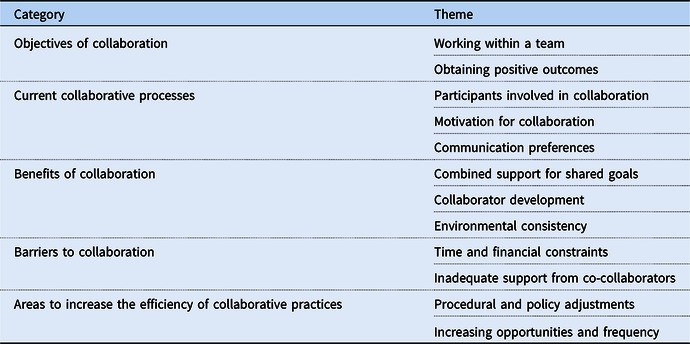
The analysis revealed a total of five categories containing a total of 12 themes, as displayed in Table 1. The findings reported in this section describe the responses of the participants in relation to these five categories.
Survey Categories and Themes

Category 1: Objectives of Collaboration
The participants’ personal definition of collaboration, and their belief of the purpose of collaboration for supporting students with ASD, identified the structural components of collaboration: (a) working within a team (n = 119, 92.25%) and (b) attaining positive outcomes (n = 81, 62.79%).
Working within a team to accomplish goals with a focus on improving outcomes was consistently identified as the definition of collaboration:
Openly discussing together and/or separately with the stakeholders in someone’s life. Including formal and informal supports, family, across different workgroups, and the person themselves. The discussion is to enable everyone involved to contribute to formulating the best/most appropriate strategies to enable the person to reach their potential. (AHP)
Despite minimal variance in responses pertaining to the element of working as a member within a team, the purpose and processes of setting and accomplishing goals differed. Slightly under half of all participants (n = 58, 44.96%) explicitly regarded client-centred goals and combined efforts as a fundamental component of goal accomplishment; however, only a small proportion (n = 3, 2.33%) emphasised the importance of valuing the contributions of all collaborators equally.
Attaining positive outcomes was consistently mentioned throughout each participant group to describe the purpose of collaboration for students with ASD. Despite this compatible theme, teacher participants emphasised improved ‘learning’ and ‘academic outcomes’ as fundamental components of positive outcomes. Parents’ and AHPs’ responses contained a greater focus on developing skills that would be transferable to a student’s life beyond the school setting and across their lifespan:
Families, school staff and therapists have the opportunity to share information about what’s working well and not so well. They can use common strategies to help the client achieve goals across a range of settings such as home, school, out of hours’ care and recreational activities. (AHP)
To provide a supportive, trusted and safe environment in which my child can develop and reach his potential with the ultimate objective of being able to transition from school as an adult with the ability to live independently and actively participate in society. (Parent)
Category 2: Current Collaborative Processes
Responses regarding current collaborative processes were categorised into three themes: (a) the participants involved in collaboration (n = 86, 66.67%), (b) motivation for collaboration (n = 57, 44.19%), and (c) communication preferences (n = 51, 39.53%).
One hundred per cent of teacher and AHP participants reported collaborating with parents to support the needs of students with ASD, and parents identified classroom teachers as their most regular co-collaborator (n = 31, 70.45%). The distribution of parental and teacher collaboration with AHPs differed across speech pathologists (n = 14, 31.81%), occupational therapists (n = 22, 50.00%), and psychologists (n = 29, 65.91%).
Regarding those absent from current collaborative teams, but desired by participants, teachers sought greater inclusion from AHPs. These teachers primarily suspected that time and financial constraints accounted for AHPs’ limited involvement; however, they believed the contribution of AHPs within the collaborative process would provide additional support and assistance with implementing strategies to support students with ASD. Both parents and AHPs identified school personnel as those they would like involved in collaboration to a greater extent. More specifically, parent participant responses identified a desire for greater contact with educational support staff and members of the leadership team to improve consistency in support processes. AHPs identified a greater need for collaboration with teachers and the school leadership to contribute to the ‘implementation of support strategies in the classroom’ (AHP) and ‘to ensure that recommendations are implemented as a whole school’ (AHP).
Across all participant groups, addressing or modifying concerning behaviours was identified as the most common motivation for collaboration compared with individual education plan (IEP) development, IEP review, or during times of significant change. Participants across all groups reported that they collaborated with at least one other person regarding a student’s behaviour (n = 57, 44.19%). A further proportion of participants (n = 26, 20.16%) suggested that collaboration provided ‘different perspectives of the child, behaviour and strategies’ (Parent) to support teachers in feeling less isolated with preventing and reducing challenging behaviours at school. Therefore, collaboration was also sought and valued as an opportunity to increase an understanding of the motives behind students’ challenging behaviour:
To create an open channel of communication to best meet the needs of the child. For ASD students this is particularly vital as their triggers and behaviours change and evolve, and the child is not always able to clearly communicate their needs or emotions clearly on their own. (Teacher)
Participants’ preferred communication modes were explained in terms of access to co-collaborators, efficiency, and ability to increase accountability. Collaborating in person was reported as the preferred communication method across the participant groups (n = 51, 39.53%), with responses highlighting the ability to build a rapport and develop relationships with co-collaborators as the primary reason for this preference. A portion of other participants (n = 24, 18.60%) recognised the value of combining communication methods for ongoing communication. Some parent and AHP participants (n = 6, 6.82%) who preferred collaboration to be in person also noted the importance of documenting conversations through email to increase accountability: ‘I prefer to gauge a person’s thoughts face to face and how they’re working with my child. I also request emails for paper trails’ (Parent) and ‘Everything is then in writing, thus can be used for evidence when supports are not met, also so teachers, parents etc. can all be in on the same information’ (AHP).
Category 3: Benefits of Collaboration
Participants across all three groups acknowledged a range of benefits resulting from effective collaborative practices: (a) combined support for shared goals (n = 40, 31.01%), (b) individual skill development (n = 38, 29.46%), and (c) consistency across environments (n = 26, 20.16%).
Working collaboratively was seen by teachers and parents as a productive measure to examine different perspectives of a student, enable accountability across collaborative team members, and increase each individual’s capacity to provide appropriate supports to reach a student’s goals. AHP participants also regarded the mutual construction of goals with a client as a positive technique for authentic application of strategies to encourage goal attainment:
The child is in control of the situation and motivated to work towards goals. Even with little children, shared goals can be set. Parents/carers/service providers/teaching staff — all have a shared understanding of goals and reinforce them. (AHP)
Individual skill and knowledge development was also regarded as a benefit of collaboration by participants from all groups. Parents and AHPs acknowledged that information shared by their co-collaborators enriched their own understanding of a student’s needs and avenues to support them. Teachers’ comments further clarified the benefit of ‘sharing of skills, ideas, expertise’ (Teacher) to ‘make adaptations to [their] practice to be more inclusive’ (Teacher). AHPs also explored the benefits of understanding the context of students’ environments and how it influences their ability to provide adequate support:
Results in a more thorough understanding of the child’s support needs, and of the resources available to his/her support team (or any limitations to resources — this includes knowledge and access to training, as well as access to support staff). (AHP)
AHPs further discussed the ‘skill development of stakeholders’ through an ‘ability to utilise different fields of knowledge and develop real-life application’ (AHP) of the skills shared to support students.
Environmental consistency was mentioned by over a quarter of parent and AHP participants (n = 24, 27.27%), but did not emerge as frequently among teachers’ responses (n = 2, 4.88%). Parents and AHPs regarded consistency as ‘everyone understanding and working on similar goals, using consistent strategies’ (AHP). They recognised that ‘consistency of approaches across environments’ ensures ‘[students are] not getting confused by having a different set of expectations at school and at home’ (Parent).
Category 4: Barriers to Collaboration
Participants across all three groups identified a variety of limitations and challenges impeding collaboration, particularly (a) time and financial constraints (n = 60, 46.51%), and (b) inadequate support from co-collaborators (n = 31, 24.03%).
Limited time and insufficient financial assistance were regarded as the greatest obstructions to collaboration for their impact on individual availability and access to support services. Despite the corresponding themes, time and financial constraints impacted on each participant group differently. Teachers heavily regarded timing constraints as a limitation to participating in collaborative opportunities and reinforcing strategies due to their heavy workload: ‘When are teachers expected to do all this on top of the already HUGE workload?’ (Teacher), and ‘I don’t have enough time to focus too much on one student. Sometimes adaptations take hours per week’ (Teacher). Teacher participants also regarded a lack of understanding from their co-collaborators for recognising systematic obstructions, such as, ‘how a school works with funding and time management’ (Teacher).
Parents addressed the financial impact of raising children with ASD and also expressed doubt in the value of privately funding AHPs to collaborate with teachers when access would not be provided by the school:
The effort it has taken for our family to understand both children has had a great impact financially, as the school are not in a position to offer any support as our ASD child’s issues are not significant enough compared to other children in the school who currently need support … to have other parties attend school (paediatrician, psychologist, occupational therapist) it is all at an additional cost to us and there is no guarantee the school will even make use of their findings. (Parent)
AHPs identified the financial limitations of funding models that do not have the provision for reimbursing time spent collaborating. Their responses acknowledged that the ‘amount of time and effort involved … to reimburse’ (AHP) collaborative time with others provided a significant barrier to regular collaboration.
Insufficient support from co-collaborators was regarded comprehensively throughout the responses. The willingness of other people to contribute to collaborative opportunities was regarded as a great obstacle by participants across the groups (n = 31, 24.03%). Teacher participants addressed the challenges of ‘parents who are unwilling to collaborate’ (Teacher); conversely, a proportion of parents felt ‘teachers in general view [them] as not knowledgeable and seen as a problem’ (Parent). AHP participants also acknowledged that ‘parents’ reluctance to follow through on recommendations’ limited the outcomes their child was able to achieve, but they also questioned teachers’ ‘commitment to therapy approaches’ (AHP) in the school environment.
A portion of parent and AHP responses further identified the challenge of contrastive motivations for collaboration as an impediment to the support provided by teachers. Four responses (n = 4, 4.55%) questioned teachers’ commitment to participating in collaborative opportunities and implementing strategies that address the holistic needs of a student, rather than those with a predominant focus on skills to increase academic outcomes: ‘Sometimes the school is very and solely learning centric where the issues may very much be emotional’ (Parent) and ‘Schools only want therapy that meets educational goals’ (AHP).
Category 5: Areas to Increase the Efficiency of Collaborative Practices
Participant responses identified changes in approaches to collaboration, as well as suggestions for strategies and supports to improve the efficiency of collaboration. These responses are described under two themes: (a) procedural and policy adjustments (n = 21, 16.28%) and (b) increasing opportunities and frequency (n = 57, 44.19%).
Adjustments to how the value of all participants were viewed by their co-collaborators were discussed by participants in all groups as a vital move to increase collaborative efficiency. Parent (n = 7, 15.91%) and AHP (n = 9, 20.45%) participants in particular emphasised the benefits of valuing the contributions of all participants equally: ‘I would suggest that people be more aware that the parents may not have a degree but we know our children better than anyone else’ (Parent), and:
We need to change the hierarchy organisation so we can collaborate. At the moment, therapists do not know best and thus we are excluded or said ‘yes’ to but strategies are not implemented and then we are excluded from conversations so we cannot have an impact. (AHP)
Teacher responses emphasised the need for a greater understanding from co-collaborators to recognise a teacher’s capacity to support students with ASD given their workload and environmental constraints:
I feel that I make a lot of suggested accommodations within my teaching but sometimes I’m being asked to do things that are just unreasonable within a mainstream setting and wonder if the specialists really understand what a mainstream class is like. (Teacher)
However, AHP participants also addressed the importance of schools encouraging collaboration on a wider scale and providing viable methods to support its integration into standard practice, such as ‘schools releasing teachers for longer periods/more frequently to collaborate with specialists. Schools that have a culture where collaboration is expected. Teacher training that emphasises the helpfulness of collaboration’ (AHP). Participants also acknowledged the need to improve ‘funding models/policy that promotes collaboration’ and that ‘recognises the importance of collaboration’ (AHP) to access collaborative opportunities and implement agreed-upon strategies.
Increased opportunities and frequency of collaboration were discussed within close to half of all responses (n = 57, 44.19%). All participant groups expressed a desire to increase access to collaborative opportunities without imposing on already time-constrained schedules (n = 41, 31.78%):
More time given. Most collaboration for teachers is done out of hours and can add up to take quite a considerable amount of time (even more when you consider the time to make personalised learning plans, document meetings, etc.). (Teacher)
Time/funding allocated for teachers and support staff to collaborate and follow through. [Teachers] are already stretched to the limit and this is asking more of them. (AHP)
Furthermore, a portion of parent participants (n = 11, 25.00%) reported hesitation in contacting teachers or described their inclination for efficient methods to increase collaborative opportunities and frequency without increasing a teacher’s workload:
For there to be a better/easier/efficient way to keep teachers up to date on children’s progress, challenges or changes in home life that may impact on their behaviour — sometimes we have so much useful information to share but I fear bombarding teachers or taking up too much time. (Parent)
Participants within each group offered a broad range of suggestions with regard to items that focused on improving collaborative opportunities. Teacher participants identified communication systems and the inclusion of additional school personnel to enact positive change: ‘Email to one person what each person’s goal is for that student before [collaborative meetings]; it will cut down time’ (Teacher) and ‘Teams within schools to work efficiently with all parties without a teaching class workload’ (Teacher).
Parent and AHP participants suggested platforms that make ‘use of technology to enhance efficiency’ (AHP) may be a viable option to increase collaboration without increasing workload or time commitments:
It would be good to have some sort of online portal for each child with ASD so professionals and teachers can communicate and share resources, ask questions, etc. in a simple easy to understand format. There is a lot of paperwork and reports which I don’t think teachers have the time to read. (Parent)
AHP participants, however, recognised the importance of also encouraging more frequent collaborative opportunities in person to observe students’ behaviours at school and the ability to model strategies to support students’ developing skills across environments.
Discussion
The researchers of this study sought to examine current experiences of collaboration between key stakeholders involved in the education of students with ASD. Across parent, teacher, and AHP participant groups, 129 responses were recorded. The researchers intended to provide an understanding of stakeholders’ collaborative experiences and views in order to inform policy and future research into this important area of education.
Intended Outcomes of Collaboration
Despite consistent understandings of collaboration across teachers, parents, and AHPs, classifications of ‘positive outcomes’ were less comparable: parents and AHPs discussed transferable life skills and teachers placed an additional emphasis on academic goals. This variance may in part be influenced by contrastive measurements of successful teaching, parenting, and therapeutic support for individuals with ASD. Parents’ and AHPs’ recognition of life skill development and skill transferability aligns strongly with the quality of life (QoL) measurement of treatment outcomes (Burgess & Gutstein, Reference Burgess and Gutstein2007). Burgess and Gutstein (Reference Burgess and Gutstein2007) suggest that the QoL measurement scale determines treatment success according to an individual’s ability to establish and maintain independence, social integration, and employability across their lifespan. Although each individual child’s QoL may not be formally quantified, nor may any form of rating scale be consistently employed to appraise therapeutic benefit, alignment between a parent’s goal and progress towards that goal may incentivise financial input.
Teacher participants’ increased focus on academic outcomes as an objective of collaboration may be influenced by standardised measurements of student achievement and their leverage over perceived teaching capacity (Morgan, Reference Morgan2016; Thompson, Reference Thompson2013). In isolation, this view may not sufficiently recognise academic achievement’s interdependence on an individual’s agency, attitude, and social competence (Farrington et al., Reference Farrington, Roderick, Allensworth, Nagaoka, Keyes, Johnson and Beechum2012). The results of this study recognise that shared priorities for students with ASD should emphasise holistic developmental progress across all of their environments. For this to occur, teachers need to be supported to prioritise students’ wellbeing without suspicion that their teaching capacity will be measured solely by their students’ academic achievement; however, parents and AHPs also need to be aware and empathetic of the nature and expectations of the role of classroom teachers. Mutual understanding and appreciation is imperative for team members to engage openly and meaningfully in collaboration aimed at developing the whole child.
As discussed by Cloninger (Reference Cloninger, Orelove, Sobsey and Gilles2017), genuine collaboration requires a shared goal between co-collaborators to provide the most comprehensive foundation for goal attainment. When comparing the participants’ responses, the findings reflected a common understanding that genuine collaboration has the potential to support students with ASD to achieve positive educational experiences and outcomes. The results also acknowledged that teachers, parents, and AHPs collectively require more support to implement collaboration in their practice to meaningfully develop shared goals for each student and to work in unison to achieve those goals.
Motivation for Collaboration
The results further demonstrated that addressing or modifying challenging behaviours was the most common cause for collaboration between stakeholders. While collaboration between the core personnel across a student’s environments is a vital component of reducing problem behaviours (Fettig & Ostrosky, Reference Fettig and Ostrosky2011), it is also imperative that collaboration is not merely used as a crisis response but is seen also as a preventive measure to support the needs of each student. Although collaborative action can be taken to support problem behaviours as they develop, it must be recognised that quality collaboration is an ongoing, proactive process that could prevent or reduce problem behaviours from occurring (Cloninger, Reference Cloninger, Orelove, Sobsey and Gilles2017). As recognised within the findings, the needs and behaviours of students with ASD constantly change and evolve, and utilising each stakeholder’s diverse knowledge is crucial to understanding environmental, psychological, or physical impacts that may be influencing their attitudes or behaviours (Prior et al., Reference Prior, Roberts, Rodger, Williams and Sutherland2011). Unless authentic collaboration is embedded as a form of standard practice, provisions for support are reduced and may take longer to establish if, or when, challenging behaviours occur.
Directions for Future Research and Action
Responses from participants postulated changes to procedures and policy to make access to collaboration easier, and value each collaborator equally. Both parents and AHP participants expressed concerns with whether their suggestions were influencing classroom practice, and further reported that they felt as though their knowledge and input was seen as inferior by teachers, which is consistent with Reupert et al.’s (Reference Reupert, Deppeler and Sharma2015) findings that collaboration in the education system can be hierarchical. This finding has implications for how the expectation of consultation with parents and caregivers within the DSE (COA, 2006) is being enacted in schools. Further analysis should be undertaken to determine whether this aspect of national educational policy is being implemented effectively, especially given its relation to educational funding for students with disability through the Nationally Consistent Collection of Data on School Students With Disability (Australian Government, 2019).
Given the benefits collaboration offers all members of a collaborative team, a focus on mutual respect and cross-disciplinary collegiality to construct joint goals and specify how these goals might be enacted across different environments is in the best interest of students. Therefore, the present study expands on the recommendations provided by Reupert et al. (Reference Reupert, Deppeler and Sharma2015) and suggests individual schools develop internal procedures to develop neutral and respectful spaces for parents and AHPs to approach teachers without fear that their knowledge and experience will not be valued. These processes may also be relevant for teachers to feel valued and respected and encouraging of collaborative partnership. Furthermore, when the results are examined alongside Finch, Watson, MacGregor, and Precise’s (Reference Finch, Watson, MacGregor and Precise2013) findings, they demonstrate the importance of professional development opportunities to clarify the different roles and expectations of all members within a collaborative team.
Further research is also needed to explore initiatives that increase opportunities for regular collaboration without imposing on already time-constrained schedules. Participant suggestions identifying an interest in increasing the reliance on information communication technology (ICT) to access regular and efficient collaboration should be explored further. A greater reliance on ICT to support collaboration aligns with Colbert, Yee, and George’s (Reference Colbert, Yee and George2016) claims that ICT has the potential to facilitate productivity and performance through instantaneous communication and collaborative coordination of efforts when appropriate systems are implemented. Hedeen, Moses, and Peter (Reference Hedeen, Moses and Peter2011) also support the integration of ICT to increase collaborative regularity and efficiency between teachers and families; however, they caution that ICT needs to be used as a way to engage collaborators, and not just inform them. With this in mind, the implications of electronic communication should be carefully evaluated to ensure that confidentiality and an individual’s safety and privacy is not compromised.
Limitations
There are several limitations that should be examined when considering the results of the present study. First, the structure of the study as a qualitative exploration did not allow us to objectively measure the impact of different collaborative approaches. Additionally, the results compared aggregate stakeholder perceptions but not the collective experiences of multiple members from the same collaborative team. It is also noted that although the focus on ASD was central to this study, the findings and discussion may be relevant more broadly and encompass other students supported by a team consisting of parents, teachers, and AHPs.
Conclusion
The findings of this exploration have recognised the value of collaboration for supporting students with ASD enrolled in mainstream primary education when those involved work cohesively, respect each individual’s knowledge and experiences, and are willing to learn from and teach their team members. The findings have also identified that collaborative teamwork is not yet a consistent feature in the practice of all teachers, parents, and AHPs involved in the education of students with ASD. Time and financial barriers to collaboration may in part be accentuating these problems; therefore, further research into measures to reduce these obstructions and increase the capacity of all contributors to establish and maintain beneficial collaboration is essential. An increased understanding of how to implement strategies that enable students with ASD to fully participate in educational experiences, and engage other stakeholders in the educative process, will further support teachers to address the individual needs of all students in their care.
Acknowledgements
The authors wish to thank the participants who contributed to this study. We are grateful to every teacher, parent, psychologist, occupational therapist, and speech pathologist who gave up their time and shared their experiences.