This is the first of two articles describing the relationship between polymorphism of caprine whey protein genes and milk yield, composition and renneting properties (Dettori et al. Reference Dettori, Pazzola, Pira, Puggioni and Vacca2015).
Alpha-lactalbumin (α-LA) is a calcium metalloprotein which accounts for 2–3% of total proteins in ruminants milk (Jennes, Reference Jennes and Fox1982). It is essential for the biosynthesis of lactose, as it forms a complex with the β−1,4-galactosyltransferase to produce the enzyme lactose synthase, which catalyses the formation of lactose in the mammary gland (Brew & Hill, Reference Brew and Hill1975). During lactation α-LA is secreted into milk along with lactose. Because lactose is the main osmole of milk and its production is associated with the movement of water into the secretory vesicle, then α-LA plays an important role in regulating the volume of milk and it has been considered a “major gene” for milk production (Bleck & Bremel, Reference Bleck and Bremel1993).
Alpha-lactalbumin is encoded by the LALBA gene and studies regarding transgenic mice bearing homozygous LALBA-null alleles demonstrated that the complete absence of the LALBA gene causes the secretion of a milk devoid of detectable lactose and inadequate for feeding the pups (Vilotte, Reference Vilotte2002). In goat species, the LALBA gene is located on chromosome 5 (GenBank NC_022297·1, 30098666.30100689), has a transcription unit spanning 2028 bp, with four exons. Studies on goat LALBA gene variability have received little attention in the past years, contrary to what happened for the goat casein genes, which have been extensively studied (Martin et al. Reference Martin, Szymanowska, Zwierzchowski and Leroux2002) revealing a huge variability, which was shown to affect milk chemical composition (Vacca et al. Reference Vacca, Ouled Ahmed Ben Alì, Carcangiu, Pazzola and Dettori2009, Reference Vacca, Dettori, Piras, Manca, Paschino and Pazzola2014a), fatty acid and amino acid content (Balia et al. Reference Balia, Pazzola, Dettori, Mura, Luridiana, Carcangiu, Piras and Vacca2013) and renneting properties (Pazzola et al. Reference Pazzola, Dettori, Pira, Noce, Paschino and Vacca2014b).
The analysis of the LALBA gene promoter region in Holstein cows has shown an association between SNP (single nucleotide polymorphism) variation and milk yield, fat and protein content (Bleck & Bremel, Reference Bleck and Bremel1993; Voelker et al. Reference Voelker, Bleck and Wheeler1997). More recently, García-Gámez et al. (Reference García-Gámez, Gutiérrez-Gil, Sahana, Sánchez, Bayón and Arranz2012) have provided strong evidence of association of the sheep LALBA c.242T>C nucleotide (nt) change with milk protein and fat content, after genome-wide association analysis. Some nucleotide changes are known to occur at the goat LALBA gene and none of them has been found to affect milk traits (Cosenza et al. Reference Cosenza, Gallo, Illario, Di Gregorio, Senese, Ferrara and Ramunno2003; Jain et al. Reference Jain, Gour, Bisen, Prashant, Dubey, Sharma, Joshi and Dinesh2009; Ma et al. Reference Ma, Deng, Zhang, Yue, Lan, Chen and Lei2010; Zidi et al. Reference Zidi, Casas, Amills, Jordana, Carrizosa, Urrutia and Serradilla2014).
Because we hypothesised that there may be a link between the genotype of the LALBA gene and milk traits in Capra hircus, the purpose of this study was to investigate, by means of single strand conformation polymorphism (SSCP) and sequencing, variability of the 5′ flanking region and 3′ UTR of the caprine LALBA gene and to assess the possible effects of the promoter region polymorphism on milk yield, composition and renneting properties.
Materials and methods
Animals and sampling
Two hundred and sixty-three multiparous Sarda goats were randomly chosen from three herds in the South West of Sardinia (Italy): herd A (83 goats), herd B (81 goats) and herd C (99 goats). Goats were in their fourth parity and kidded in the first 2 weeks of February. At the farms, goats were reared following the traditional extensive method as described in Vacca et al. (Reference Vacca, Dettori, Carcangiu, Rocchigiani and Pazzola2010b, Reference Vacca, Pazzola, Piras, Pira, Paschino and Dettori2014b), and hand-milked once daily in the morning.
After kids’ weaning, individual milk samples were taken at 30 d intervals from 45 to 165 d after parturition. A total of 1315 milk samples were recorded. During each of the sampling sessions, the daily milk yield expressed in g/d was recorded, according to ICAR (2012). A blood sample from each goat was collected. Goats were examined by a veterinarian during the sampling session; animals which had evidence of clinical disease were eliminated from the study.
Milk analysis
Milk samples were analysed for milk composition and renneting properties. Fat, protein and lactose content (g/100mL) and pH value were assessed by using an infrared spectrophotometer (Milko-ScanTM 133B; Foss Electric, DK-3400 Hillerød, Denmark), according to the International Dairy Federation standard (IDF 141C:2000). Daily Fat and Protein Yield (DFPY, measured in g/d) were calculated as the sum of the fat and protein yield recorded in that sampling session. Somatic cell count (SCC) were measured by an automatic cell counter (Fossomatic 5000, Foss Electric) (IDF 148-2:2006) and total microbic mesophilic count (TMC) by a Bacto-Scan FC 150 (Foss Electric) (IDF 358:2000).
Milk renneting properties were measured by the Formagraph™ instrument (Foss Italia SPA, Padova, Italy) to obtain rennet coagulation time (RCT) in minutes, curd firming time (k20) in minutes and curd firmness (a30) in millimetres, according to Pazzola et al. (Reference Pazzola, Balia, Carcangiu, Dettori, Piras and Vacca2012).
DNA analysis
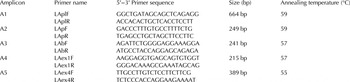
Genomic DNA was extracted from blood leucocytes with a commercial kit (Puregene DNA Isolation Kit, Qiagen). Based on the caprine LALBA gene sequence (GenBank accession number M63868) five primer pairs were designed with the Primer 3 Plus software (http://www.bioinformatics.nl/cgi-bin/primer3plus/primer3plus.cgi/), in order to amplify 858 bp at the 5′ end of the gene (including 670 bp of the promoter, exon-1 and partial intron-1) and 389 bp at the 3′ of the gene (spanning the entire exon-4, including 88 bp of the coding sequence and the complete 3′UTR). PCR amplicons were designated A1 to A5 (Table 1). PCR amplification was carried out on a reaction mixture of 25 µl final volume: 100 ng of genomic DNA, 1·5 mm MgCl2, 0·2 mm dNTPs, 1X reaction buffer, 0·2 µm of each primer, and 1 unit of Taq polymerase (Platinum, Invitrogen, Life Technologies). Thermal conditions included an initial denaturing step at 94 °C for 2·30 min, followed by 30 cycles of 94 °C for 20 s, 55–59 °C for 30 s (Table 1), and 72 °C for 15–30 s, depending on the fragment size, and a final elongation step at 72 °C for 10 min.
Primer sequences for the caprine LALBA gene analysis

PCR amplicons from 60 goats, randomly chosen among the 263 goats of the sampled population, were analysed by SSCP according to Dettori et al. (Reference Dettori, Rocchigiani, Luridiana, Mura, Carcangiu, Pazzola and Vacca2013), with some modifications. For the A4 amplicon (exon-1) we used 9·25% polyacrilamide gels (acr/bis 29:1) in 0·5X TBE (Tris Borate EDTA), with 1% glycerol. Gel electrophoresis was run overnight (16:30 h) at low voltage, with 275 V, 10 W and 50 mA; the temperature was set at 12 °C. The SSCP of the remaining amplicons was optimised at 12% polyacrilamide gels (acr/bis 37·5:1) in 1X TBE. Gel electrophoresis conditions were: 25W, 500 V and 100 mA for 7·5 h; constant temperature of 15 °C. From one to three amplicons representative of each SSCP pattern were sequenced in both directions, to possibly find the nt changes responsible of SSCP differences. Sequencing was performed with an Applied Biosystems 3730 DNA Analyser (Applied Biosystems, Foster City, CA, USA), after purification with the ChargeSwitch® PCR Clean-Up Kit (Invitrogen, Carlsbad, CA, USA).
The nt changes were described following recommendations of the Human Genome Variation Society (http://www.hgvs.org/mutnomen/). Putative transcription factor binding sites (TFBS) within the promoter region were analysed using the Alibaba 2·1 program and the TRANSFAC database version 7.0 (http://www.gene-regulation.com/pub/programs/alibaba2).
The SNPs detected in the promoter region (c.−358T>C, c.−163G>A and c.−121T>G) were genotyped in the entire sample population by SSCP of amplicons A2 and A3, as described above.
Statistical analysis
In order to investigate association between SNPs at the LALBA gene and milk traits and renneting properties, data were analysed using the mixed effect model procedure of SAS Software (version 9.3, SAS Inst. Inc., Cary, NC) and the following model:
 $${Y_{ijkl}}\, = \,{\rm} \mu + {H_i}\, + \,{S_j}\, + {G_k}\, + H\, \times \,{S_{ij}}\, + {A_l}({G_k})\, + {e_{ijkl}}$$
where Y ijkl is the analysed variable, μ is the general mean, Hi is the fixed effect of the herd (i = 3 levels), S j is the fixed effect of the stage of lactation (j = 5 levels 45, 75, 105, 135 and 165 d after parturition), G k is the fixed effect of genotype at each SNP (k = 3 levels), H × S ij is the interaction effect between the herd and the stage of lactation, A l(G i) is the random effect of lth animal nested within the kth genotype and e ijkl is the error effect. Because of the low frequency of some genotypes and the resulting rank deficiency in contingency tables, each of the SNPs was analysed at a time. Renneting parameters RCT, k20 and a30, were analysed after removing non-coagulating samples (NC, samples with a RCT higher than 30 min) from dataset; NC were compared to coagulating samples (C) by using contingency tables and chi-square or Fisher's exact test (Devold et al. Reference Devold, Nordbø, Langsrud, Svenning, Brovold, Sørensen, Christensen, Adnøy and Vegarud2010; Pazzola et al. Reference Pazzola, Balia, Carcangiu, Dettori, Piras and Vacca2012), according to the different herd, stage of lactation and SNP.
SCC were logarithmically transformed into Somatic Cell Score (SCS) as proposed by Ali and Shook (Reference Ali and Shook1980) and TMC into Logarithmic Bacterial Count (LMC = log10 total bacterial count/1000) as described in Pazzola et al. (Reference Pazzola, Dettori, Cipolat-Gotet, Cecchinato, Bittante and Vacca2014a). The Bonferroni method was used to correct multiple comparison of the means and significance was set at P < 0·05.
Results
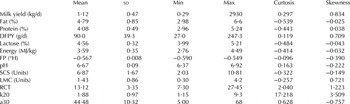
Descriptive statistics of milk traits on 263 goats, throughout lactation, was reported in Table 2.
Descriptive statistics of milk traits in Sarda goats

DFPY, daily fat and protein yield; FP, freezing point; SCS, log2 (SCC × 10 − 5) + 3; LMC, log10 of total microbial count/1000; RCT, rennet clotting time; k20, rate of clot firming; a30, clot firmness
DNA analysis
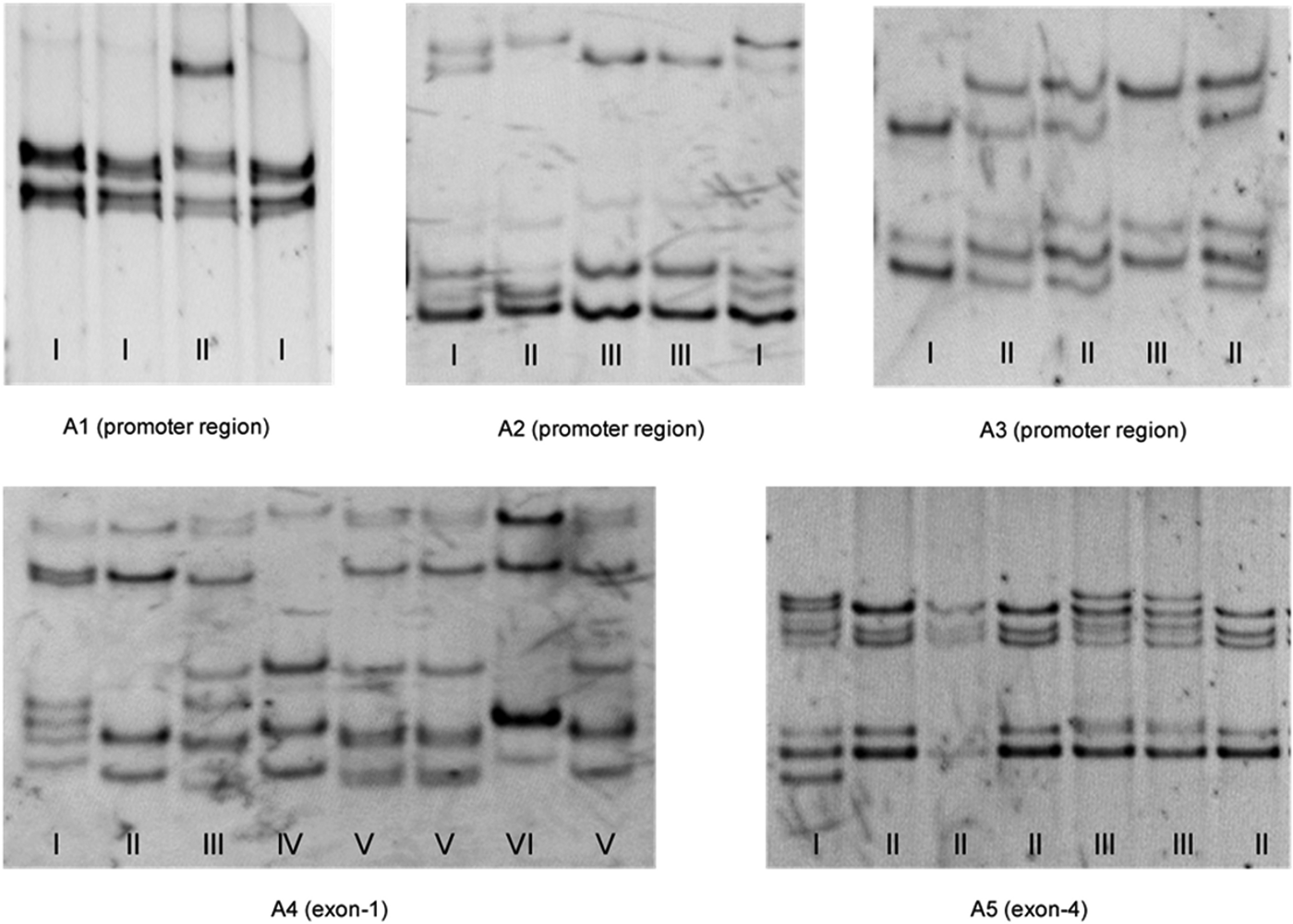
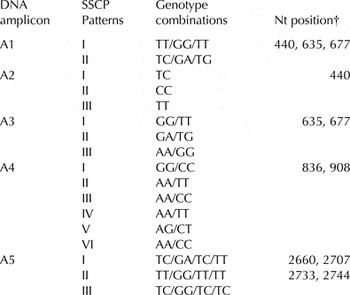
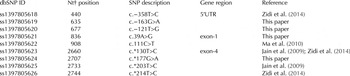
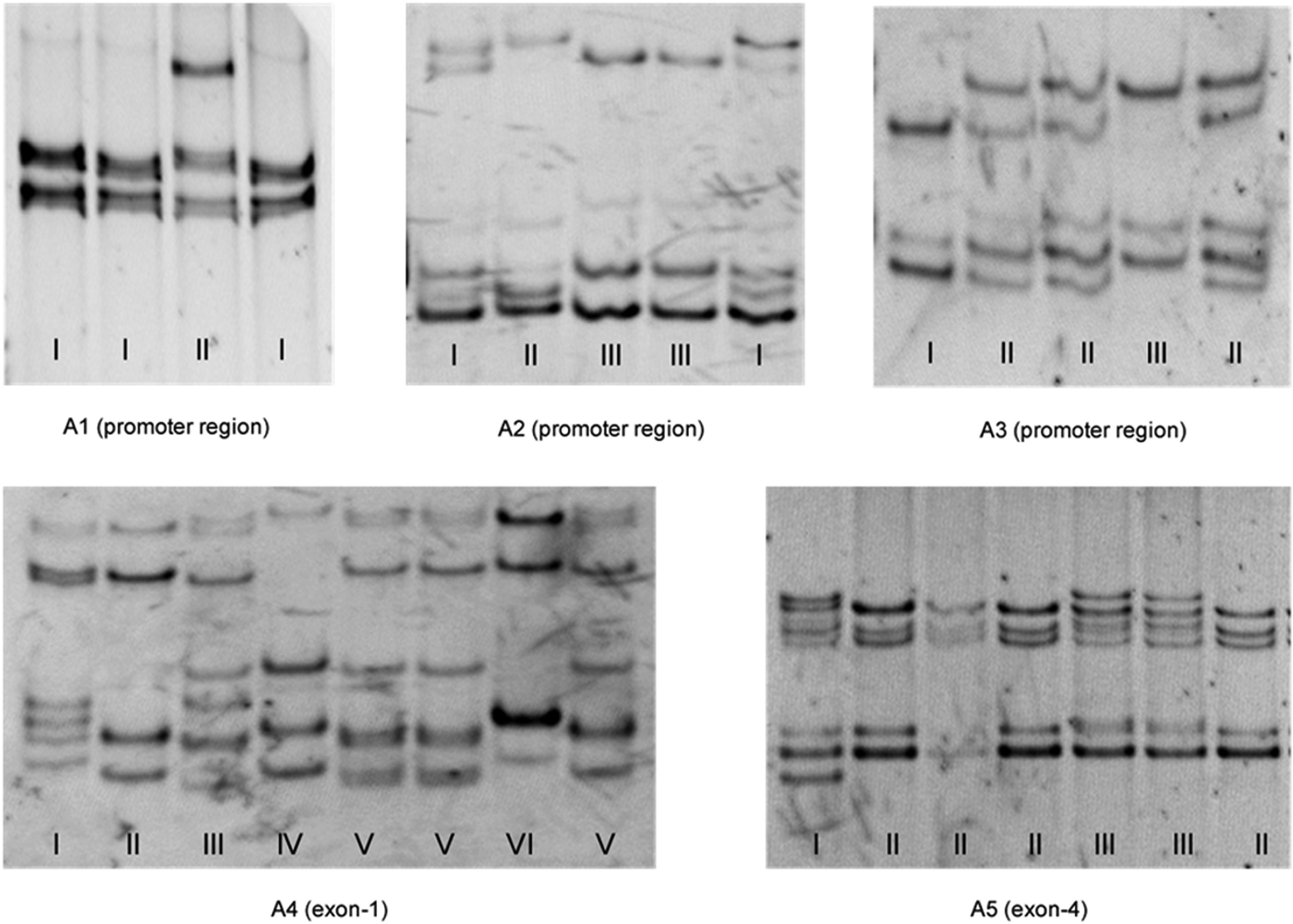
The SSCP analysis showed that all the amplicons were polymorphic (Fig. 1). The different SSCP patterns were described in Table 3. Nucleotide positions (np) of the polymorphic sites were relative to GenBank M63868 (considered here as the reference sequence). The nine polymorphic sites detected were described in Table 4. All polymorphic sites were single nucleotide polymorphisms (SNPs), and they were all transitions, except for the transversion c.−121T>G (np 677). Three nt changes were in the promoter region (c.−358T>C, c.−163G>A and c.−121T>G), two were synonymous coding SNPs at exon-1 (c.39A>G and c.111C>T), and four SNPs were in exon-4 (c.*130T>C, c.*177G>A, c.*203T>C and c.*214T>C) within the 3′UTR. The DNA sequences obtained were published on GenBank with accession numbers EU889001-5, while the nucleotide changes were deposited in the dbSNP database (https://www.ncbi.nlm.nih.gov/SNP/) and accession numbers were shown in Table 4.
SSCP patterns of the LALBA gene DNA fragments A1–A5, in Sarda goats. Each different SSCP pattern was given a roman numeral designation.
SSCP patterns and genotype combinations at the caprine LALBA locus

SSCP patterns were designated with roman numerals; genotype combinations were assigned after sequence analysis
† Nt: nucleotide positions relative to GenBank M63868
SNPs at the LALBA gene

† Nt: nucleotide positions relative to GenBank M63868
After genotyping of the three SNPs c.−358T>C, c.−163G>A and c.−121T>G, located in the promoter region, the population examined was found to be out of HW equilibrium for c.−358T>C (Table 5). Linkage disequilibrium analysis (Haploview software, Barrett et al. Reference Barrett, Fry, Maller and Daly2005) revealed that the most frequent haplotype for the three nt changes c.−358T>C, c.−163G>A and c.−121T>G was TGT (0·79) while CAG had a frequency of 0·183. SNPs c.−163G>A and c.−121T>G were in strong linkage disequilibrium (r 2 = 0·98), for this reason, we only considered c.−358T>C and c.−163G>A for association analysis.
SNP genotyping at the caprine LALBA gene

ObsHET, observed heterozygosity; PredHET, predicted heterozygosity; HWpval, Hardy–Weinberg P value; MAF, minor allele frequency
† Alleles with the lowest frequency are in brackets
Effects on milk composition and renneting properties
A total of 100 milk samples were non-coagulating (with RCT higher than 30 min). The Fisher's exact test did not evidence any statistical difference among the distribution of non-coagulating and coagulating within each genotype. In contrast, the effects of herd (P value from chi-square test: 0·001) and stage of lactation (P-value from chi-square test: 0·004) were significant, with the lowest incidence of non-coagulating at herd A (28 out of 415 records) and at 45 d after parturition (8 out of 263 records), respectively (data not shown).
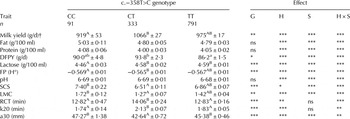
Tables 6 and 7 report the results of statistical analysis based on the fixed effects model, with least square means and standard deviation according to genotype at c.−358T>C and c.−163G>A, respectively. For both SNPs, the herd effect was significant for all milk traits, whereas the stage of lactation influenced all traits with the exception of RCT and k20. Genotype at c.−358T>C affected many of the analysed milk traits: DFPY at P < 0·05, milk yield at P < 0·01, lactose, with the lowest values recorded in homozygote CC goats; freezing point at P < 0·001; SCS at P < 0·001 and LMC at P < 0·01; also the three coagulating parameters were highly affected (P < 0·001), and heterozygotes CT were characterised by delayed RCT and k20 and, as a consequence, the lowest value of a30.
Least square means ± standard deviation of milk traits according to SNP c.−358T>C genotype (G), and significance of P values according to the effects of G, herd (H), stage of lactation (S) and interaction H × S

DFPY, daily fat and protein yield; FP, freezing point; SCS, log2 (SCC × 10−5) + 3; LMC, log10 of total microbial count/1000; RCT, rennet clotting time; k20, rate of clot firming; a30, and clot firmness
A-B, a-bMeans with different superscripts with capital or lower case letters in each row differ significantly in genotype comparison, respectively at P < 0·01 and P < 0·05
*P < 0·05; **P < 0·01; ***P < 0·001; ns, non-significant
† Yield of the morning milking.
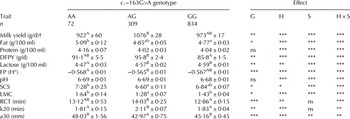
Least square means ± standard deviation for milk traits according to SNP c.−163G>A genotype (G), and significance of P values according to the effects of G, herd (H), stage of lactation (S) and interaction H × S

DFPY, daily fat and protein yield; FP, freezing point; SCS, log2 (SCC × 10−5) + 3; LMC, log10 of total microbial count/1000; RCT, rennet clotting time; k20, rate of clot firming; a30, and clot firmness
A-B, a-bMeans with different superscripts with capital or lower case letters in each row differ significantly in genotype comparison, respectively at P < 0·01 and P < 0·05
*P < 0·05; **P < 0·01; ***P < 0·001; ns, non-significant
† Yield of the morning milking
Genotype at c.−163G>A affected fat at P < 0·05; milk yield, DFPY and lactose content at P < 0·01; freezing point at P < 0·001; SCS and LMC at P < 0·05; the lowest values were recorded for homozygotes GG (fat and DFPY), AA (milk yield, lactose and freezing point), and heterozygotes GG (SCS and LMC). Results regarding renneting properties were analogous to those recorded at c.−358T>C, with highly significant P values, and heterozygotes AG showing delayed RCT and k20, and the lowest a30.
Discussion
The milk fat and protein percentages were similar to those found in Sarda goats by Dettori et al. (Reference Dettori, Rocchigiani, Luridiana, Mura, Carcangiu, Pazzola and Vacca2013) and slightly lower than those obtained by Balia et al. (Reference Balia, Pazzola, Dettori, Mura, Luridiana, Carcangiu, Piras and Vacca2013) and Vacca et al. (Reference Vacca, Dettori, Piras, Manca, Paschino and Pazzola2014a). With respect to that last research, however, the milk yields of goats of the present investigation were higher, implying a higher daily production of the DFPY component. The variability of milk yield, DFPY, TBC and k20 were very high, instead lactose content, pH and FP variability were low.
Genotyping
Genetic variability of the 5′ flanking region and the 3′UTR of the caprine LALBA gene revealed a total of nine SNPs. The synonymous change c.111C>T has been previously reported in Xinong Saanen and Guanzhong goats (Ma et al. Reference Ma, Deng, Zhang, Yue, Lan, Chen and Lei2010) and c.*130T>C and c.*203T>C, both in the 3′UTR, have been detected in the Indian Jamunapari breed (Jain et al. Reference Jain, Gour, Bisen, Prashant, Dubey, Sharma, Joshi and Dinesh2009). In addition, c.−358T>C, c.*130T>C and c.*214T>C have been recently revealed in Murciano-Granadina and Malagueña goats (Zidi et al. Reference Zidi, Casas, Amills, Jordana, Carrizosa, Urrutia and Serradilla2014). On the other hand, the Sarda goats of the present experiment did not show the nt changes c.133+13C>T and c.*456C>G, detected in Red Syrian, Girgentana, and in an Italian local goat population by Cosenza et al. (Reference Cosenza, Gallo, Illario, Di Gregorio, Senese, Ferrara and Ramunno2003), nor the nt changes c.−440C>T and c.−151C>T revealed in Spanish goats by Zidi et al. (Reference Zidi, Casas, Amills, Jordana, Carrizosa, Urrutia and Serradilla2014). Although the Sarda is included in the Mediterranean goat group (Vacca et al. Reference Vacca, Daga, Pazzola, Carcangiu, Dettori and Cozzi2010a) and its genetic similarity with Mediterranean goats has been highlighted by casein gene cluster analysis (Vacca et al. Reference Vacca, Dettori, Piras, Manca, Paschino and Pazzola2014a), the present findings about the LALBA gene variability made the Sarda goat more similar to Chinese and Indian goats than to those reared in Italy.
Effects on milk composition and renneting properties
Genotypes CC at c.−358T>C, as well as genotypes AA at c.−163G>A were characterised by lower milk yield, FP and lactose content. To the best of our knowledge, this is the first report highlighting an association between the goat LALBA genotype and milk lactose content. Indeed, no relationships were evidenced between genotype at regulatory regions in LALBA gene (including c.−358T>C) and lactose content in Murciano-Granadina goats (Zidi et al. Reference Zidi, Casas, Amills, Jordana, Carrizosa, Urrutia and Serradilla2014).
Analysis of TFBS revealed that c.−358T>C was part of a potential binding site for the transcription factor AP-2alpha, when T is present, whereas the nucleotide c.−358C excludes this potential binding site. It has been shown that AP-2 in mouse regulate embryonic development and are expressed in the mammary gland. Expression of AP-2 alpha mRNA decrease during lactation and is reactivated during involution of the mammary gland, indicating that AP-2 proteins play a role in regulating proliferation and differentiation of mammary epithelial cells (Zhang et al. Reference Zhang, Brewer, Huang and Williams2003). In cattle, expression of LALBA mRNA increases sharply at birth, and remains high throughout lactation (Goodman & Schanbacher, Reference Goodman and Schanbacher1991), therefore, it is unlikely that its expression is modulated by AP2-alpha during lactation. In that case, SNP c.−358T>C may be considered as a marker of an unknown causal mutation.
In contrast, SNP c.−163G>A was not included in any potential TFBS. This SNP was in strong linkage with c.−121T>G, which, in turn, was targeted by transcription factor Specific protein 1 (Sp1), only when a T occurs. Sp1 is an ubiquitous transcription factor involved in many cellular functions, such as differentiation, proliferation as well as chromatin remodelling and apoptosis (Deniaud et al. Reference Deniaud, Baguet, Chalard, Blanquier, Brinza, Meunier, Michallet, Laugraud, Ah-Soon, Wierinckx, Castellazzi, Lachuer, Gautier, Marvel and Leverrier2009). In addition, transcription factor Sp1 is present in the bovine mammary gland, with different levels during the various stages of pregnancy, lactation, involution (Malewski et al. Reference Malewski, Gajewska and Zwierzchowski2005).
Transcription factors work in concert with other regulatory elements, such as hormones and local growth factors, in order to achieve stage and tissue specific expression of milk protein genes during lactation. Analysis of epigenetic modifications during mammary gland development and differentiation, in mouse, has shown that the proximal promoter region of the LALBA gene already has an open chromatin organisation in the mature virgin gland, while proximal promoter regions of the casein genes only have an open chromatin configuration in the lactating mammary gland (Rijnkels et al. Reference Rijnkels, Freeman-Zadrowski, Hernandez, Potluri, Wang, Li and Lemay2013). This indicates that the LALBA gene regulation is different from the other milk protein genes, and that the nucleotide changes analysed in this investigation might affect the chromatin status.
Among the major milk traits directly related to cheese production, such as total proteins, casein and casein fractions, pH and titratable acidity; milk calcium and phosphorus content (Cecchinato et al. Reference Cecchinato, Penasa, De Marchi, Gallo, Bittante and Carnier2011) we only measured total proteins and pH. Also, among the cheese making traits (milk coagulation properties and cheese yield) we only measured milk coagulation properties. None of the three SNPs genotyped showed association with total milk proteins and pH (Tables 6 and 7), while both were associated with the MCP.
The observed effect of the LALBA genotype on renneting properties could have a relationship with its effect on the lactose content, in fact, a correlation between lactose content and a30 (curd firmness) has been already highlighted in goat (Leitner et al. Reference Leitner, Merin and Silanikove2011; Pazzola et al. Reference Pazzola, Balia, Carcangiu, Dettori, Piras and Vacca2012). Also in the present study, lactose and a30 were positively correlated (data not shown), but the actual meaning of this correlation is still unexplained (Inglingstad et al. Reference Inglingstad, Steinshamn, Dagnachew, Valenti, Criscione, Rukke, Devold, Skeie and Vegarud2014), and it is more likely that the lactose content is a marker of other elements that affect renneting properties and in particular curd firmness, rather than the direct cause (Leitner et al. Reference Leitner, Merin and Silanikove2011).
Although lactose content undergoes a reduction during clinical and subclinical mastitis (Werner-Misof et al. Reference Werner-Misof, Pfaffl and Bruckmaier2007), and values of about 4% characterises non coagulating samples, it should be underlined that, in the present investigation, no milk samples with lactose content of about 4% were revealed. The mean values of the microbial count were on the whole satisfactory and always lower than the upper limits regarding the hygienic requirements of goat milk, fixed by the European Union (Vacca et al. Reference Vacca, Dettori, Carcangiu, Rocchigiani and Pazzola2010b). In addition, the influence of the polymorphisms on somatic cell and microbial count is attributable to a probable dilution effect. This hypothesis is based on the results of the present study which evidenced that the higher was the milk yield of a genotype the lower the SCS and LMC, and the results of a previous study on Sarda goats (Pazzola et al. Reference Pazzola, Balia, Carcangiu, Dettori, Piras and Vacca2012) which has evidenced the high negative correlation between somatic cell, microbial count and milk yield.
Even if some genotypes (CT at c.−358T>C and AG at c.−163G>A) showed a delayed RCT and lower a30, these could be nevertheless scored as good when compared with the same Sarda goat (Pazzola et al. Reference Pazzola, Dettori, Pira, Noce, Paschino and Vacca2014b), other goat (Mestawet et al. Reference Mestawet, Girma, Ådnøy, Devold and Vegarud2013; Inglingstad et al. Reference Inglingstad, Steinshamn, Dagnachew, Valenti, Criscione, Rukke, Devold, Skeie and Vegarud2014) and sheep breeds (Pazzola et al. Reference Pazzola, Dettori, Cipolat-Gotet, Cecchinato, Bittante and Vacca2014a). Moreover, the gap between these genotypes and the other ones with lower RCT was extremely limited, being a period of time of about 1–2 min (from 14·06 to 14·03 min for heterozygotes vs. from 12·82 to 13·82 min for homozygotes) and no significant difference was found in the incidence of non-coagulating samples among the different genotypes. This information should be kept in mind when considering the use of the Sarda goat milk, which is almost entirely devoted to cheese making (Vacca et al. Reference Vacca, Daga, Pazzola, Carcangiu, Dettori and Cozzi2010a).
Conclusions
While for a long time the LALBA gene has received little attention, because it was considered to be monomorphic, our analysis of the regulatory regions showed high variability in the Sarda breed goat. A total of nine polymorphic sites were observed, and the three SNPs located in the promoter region were associated with milk yield, lactose content and milk coagulation properties. This information can be used in selection studies for the caprine species.
Research supported by the RAS, Regional Government of Sardinia (P5a-Animal Biodiversity funds).