INTRODUCTION
Bipolar disorder (BD) is a chronic episodic psychiatric disorder that affects approximately 1–2% of the world’s population (Alonso et al., Reference Alonso, Petukhova, Vilagut, Chatterji, Heeringa, Üstün and Kessler2011). Beyond the affective dysregulation that characterizes the illness, many BD patients suffer substantial neurocognitive impairments, with verbal memory (VM) shown to be among the most profoundly and stably impaired domains (Arts, Jabben, Krabbendam, & van Os, 2008; Bourne et al., Reference Bourne, Aydemir, Balanzá‐Martínez, Bora, Brissos, Cavanagh and Goodwin2013; Kurtz and Gerraty, Reference Kurtz and Gerraty2009; Robinson et al., Reference Robinson, Thompson, Gallagher, Goswami, Young, Ferrier and Moore2006; Torres, Boudreau, & Lantham, 2007). Data suggest VM deficits in BD are already present at early stages of illness (Arts et al., Reference Arts, Jabben, Krabbendam and Van Os2008; Bourne et al., Reference Bourne, Aydemir, Balanzá‐Martínez, Bora, Brissos, Cavanagh and Goodwin2013; Lee et al., Reference Lee, Hermens, Scott, Redoblado-Hodge, Naismith, Lagopoulos and Hickie2014; Martínez-Arán et al., Reference Martinez-Aran, Vieta, Torrent, Sanchez-Moreno, Goikolea, Salamero and Ayuso-Mateos2007; Robinson and Ferrier, Reference Robinson and Ferrier2006), persist even during periods of remission (Kurtz and Gerraty, Reference Kurtz and Gerraty2009), and are linked to overall chronicity (Martínez-Arán, Vieta, Colom, et al., Reference Martínez‐Arán, Vieta, Colom, Torrent, Sánchez‐Moreno, Reinares and Salamero2004; Martínez-Arán, Vieta, Reinares, et al., Reference Martínez-Arán, Vieta, Reinares, Colom, Torrent, Sánchez-Moreno and Salamero2004). Together these results suggest that VM deficits are a prominent neurocognitive characteristic of BD that may deteriorate as bipolar illness advances (Kapczinski et al., Reference Kapczinski, Magalhães, Balanzá‐Martinez, Dias, Frangou, Gama and Berk2014).
VM deficits have also been linked to lower levels of community functioning in BD, with effects comparable to residual affective symptoms (Burdick, Goldberg, & Harrow, Reference Burdick, Goldberg and Harrow2010; Torres et al., Reference Torres, DeFreitas, DeFreitas, Bond, Kunz, Honer and Yatham2011; Wingo, Harvey, & Baldessarini, Reference Wingo, Harvey and Baldessarini2009), as well as being linked to occupational, social (Atre-Vaidya et al., Reference Atre-Vaidya, Taylor, Seidenberg, Reed, Perrine and Glick-Oberwise1998), and global functioning indexes (Altschuler et al., 2008; Martínez-Arán, Vieta, Colom, et al., Reference Martínez‐Arán, Vieta, Colom, Torrent, Sánchez‐Moreno, Reinares and Salamero2004; Martínez-Arán, Vieta, Reinares, et al., Reference Martínez-Arán, Vieta, Reinares, Colom, Torrent, Sánchez-Moreno and Salamero2004; Martínez-Arán et al., Reference Martinez-Aran, Vieta, Torrent, Sanchez-Moreno, Goikolea, Salamero and Ayuso-Mateos2007). Indeed, one study found steadily employed bipolar patients did not clinically differ from those unable to maintain employment, but rather showed significantly better VM performance (Martinez-Aran et al., Reference Martinez-Aran, Vieta, Torrent, Sanchez-Moreno, Goikolea, Salamero and Ayuso-Mateos2007). Long-term outcome studies have similarly linked baseline VM deficits to overall functioning at 1-year follow-up (Tabarés-Seisdedos et al., Reference Tabarés-Seisdedos, Balanzá-Martínez, Sánchez-Moreno, Martinez-Aran, Salazar- Fraile, Selva-Vera and Vieta2008) and work functioning at both 4- and 15-year follow-ups (Bonnin et al., Reference Bonnin, Martinez-Aran, Torrent, Pacchiarotti, Rosa, Franco and Vieta2010; Burdick et al., Reference Burdick, Goldberg and Harrow2010). Importantly, VM deficits have also been linked to a pattern of low medication adherence (Fuentes, Rizo-Méndez, & Jarne-Esparcia, Reference Fuentes, Rizo-Méndez and Jarne-Esparcia2016).
Such data highlight the potential importance of remediation efforts for improving VM impairment in BD. Remediation efforts have often included (1) cognitive remediation (CR), which administers drill-and-practice exercises using repeatable batteries of neuropsychological tests to improve cognition (Medalia and Choi, Reference Medalia and Choi2009); and (2) functional remediation (FR), which administers neuropsychological education about how to adapt around cognitive deficits alongside exercises applying these strategies to everyday life (Medalia and Freilich, Reference Medalia and Freilich2008). Although remediation research has primarily focused on schizophrenia (Wykes, Huddy, Cellard, McGurk, & Czobor, Reference Wykes, Huddy, Cellard, McGurk and Czobor2011), it has recently been explored in BD (Deckersbach et al., Reference Deckersbach, Nierenberg, Kessler, Lund, Ametrano, Sachs and Dougherty2010; Martínez-Arán et al., Reference Martínez-Arán, Torrent, Solé, Bonnín, Rosa, Sánchez-Moreno and Vieta2011; Torrent et al., Reference Torrent, del Mar Bonnin, Martínez-Arán, Valle, Amann, González-Pinto and Vieta2013). Preliminary evidence has found that CR improved bipolar patients’ occupational functioning (Deckersbach et al., Reference Deckersbach, Nierenberg, Kessler, Lund, Ametrano, Sachs and Dougherty2010; Tse, Chan, Ng, & Yatham, Reference Tse, Chan, Ng and Yatham2014) and FR improved both self-reported and observer-rated disability levels (Martínez-Arán et al., Reference Martínez-Arán, Torrent, Solé, Bonnín, Rosa, Sánchez-Moreno and Vieta2011; Torrent et al., Reference Torrent, del Mar Bonnin, Martínez-Arán, Valle, Amann, González-Pinto and Vieta2013).
By gaining an understanding of exactly how VM breaks down, current remediation treatments may be further improved by taking into account the intricacies of VM deficits. Although the overarching cognitive domain of VM is well understood to be impaired in BD (Robinson et al., Reference Robinson, Thompson, Gallagher, Goswami, Young, Ferrier and Moore2006), data are still inconsistent regarding retention rates (Bearden et al., Reference Bearden, Glahn, Monkul, Barrett, Najt, Kaur and Soares2006; Thompson et al., Reference Thompson, Gray, Crawford, Hughes, Young and Ferrier2009; Van Rheenen and Rossell, Reference Van Rheenen and Rossell2014), learning slopes (van Gorp, Altshuler, Theberge, & Mintz, Reference van Gorp, Altshuler, Theberge and Mintz1999), and discriminability indices (Radanovic, Nunes, Forlenza, Ladeira, & Gattaz, Reference Radanovic, Nunes, Forlenza, Ladeira and Gattaz2013; Robinson et al., Reference Robinson, Thompson, Gallagher, Gray, Young and Ferrier2013; Swann, Lijffijt, Lane, Steinberg, & Moeller, Reference Swann, Lijffijt, Lane, Steinberg and Moeller2009). Perhaps most notably, studies have found inconsistent results regarding whether organizational strategies to aid recall may mediate overall VM performance, including semantic clustering where words are grouped by meaning and serial clustering where words are grouped by order of presentation.
While some (Chang et al., Reference Chang, Choi, Ha, Ha, Cho, Choi and Moon2011; Deckersbach, McMurrich, et al., Reference Deckersbach, McMurrich, Ogutha, Savage, Sachs and Rauch2004; Deckersbach, Savage, et al., Reference Deckersbach, Savage, Reilly‐Harrington, Clark, Sachs and Rauch2004) have found organizational learning strategies to mediate the relationship between diagnostic group [BD vs. healthy control (HC)] with both VM and non-VM deficits, other studies have not (Bearden et al., Reference Bearden, Glahn, Monkul, Barrett, Najt, Kaur and Soares2006; Kieseppa et al., Reference Kieseppä, Tuulio-Henriksson, Haukka, Van Erp, Glahn, Cannon and Lönnqvist2005; Van Rheenen and Rossell, Reference Van Rheenen and Rossell2014). However, past studies of VM deficits in BD patients have been notably limited by small BD sample sizes (range=25 to 49 BD patients) (Bearden et al., Reference Bearden, Glahn, Monkul, Barrett, Najt, Kaur and Soares2006; Chang et al., Reference Chang, Choi, Ha, Ha, Cho, Choi and Moon2011; Deckersbach, McMurrich, et al., Reference Deckersbach, McMurrich, Ogutha, Savage, Sachs and Rauch2004; Deckersbach, Savage, et al., Reference Deckersbach, Savage, Reilly‐Harrington, Clark, Sachs and Rauch2004; Kieseppa et al., Reference Kieseppä, Tuulio-Henriksson, Haukka, Van Erp, Glahn, Cannon and Lönnqvist2005; Van Rheenen and Rossell, Reference Van Rheenen and Rossell2014) as well as the inclusion of affectively unstable individuals within BD samples (Bearden et al., Reference Bearden, Glahn, Monkul, Barrett, Najt, Kaur and Soares2006; Van Rheenen and Rossell, Reference Van Rheenen and Rossell2014). These limitations in past work could have potentially exerted undue influence on California Verbal Learning Test (CVLT) performance, especially since studies evidencing VM deficits entirely consisted of affectively stable patients while some of the studies finding no deficits included affectively unstable patients in their BD samples.
Our study can, therefore, help to resolve past inconsistencies and extend past findings since it specifically examines CVLT performance in a sample of exclusively affectively stable bipolar patients that is substantially larger than that of past work. Such additional examination of VM deficits in a large sample of affectively stable BD patients can especially help explain past inconsistencies and extend past findings regarding the mediating role of organizational learning strategies for verbal learning.
In sum, while VM deficits are prominent, stable, and substantially impair functioning in BD, the exact nature of VM impairment remains unclear. Current remediation efforts have made significant progress but a better understanding of the intricacies of VM deficits may help to further improve remediation treatments. Clarifying the role of organizational learning strategies could help refine neuropsychological education strategies aimed at correcting or attenuating the downstream functional consequences of VM impairment. To this end, we investigated VM performance in a large BD sample using the CVLT (Delis, Kaplan, Kramer, & Ober, 1987) to examine the intricacies of VM deficits and to determine the extent to which organizational learning strategies mediated those deficits.
METHOD
Participants
Our sample included 113 individuals with BD and 106 unrelated HCs who were recruited from studies (K23MH077807; R01MH100125 to K.E.B.) conducted at the Icahn School of Medicine at Mount Sinai and Zucker Hillside Hospital. All participants provided written informed consent to protocols approved by the internal review boards of Mount Sinai and Zucker-Hillside Hospitals. BD patients were recruited using the following inclusion criteria: (1) diagnosis of BD I or BD II as determined by the Structured Clinical Interview for DSM-IV (SCID-IV) (First, Spitzer, Gibbon, & Williams, Reference First, Spitzer, Gibbon and Williams1995); (2) age 18–65 years; (3) current affective stability, defined as a score of 3 or less on Clinical Global Impression for Bipolar Disorder (CGI-BP; Spearing, Post, Leverich, Brandt, & Nolen, Reference Spearing, Post, Leverich, Brandt and Nolen1997). HC subjects were also administered the non-patient version of the SCID-IV to rule out any current or lifetime Axis I diagnoses as well as any first degree relatives with any Axis I disorders. Exclusion criteria for both BD and HC participants included any history of central nervous system trauma, neurological disorder, any report of a past or present diagnosis of attention deficit hyperactivity disorder (ADHD), a diagnosis of substance abuse/dependence within the past 3 months, or any electroconvulsive therapy treatment within the past year. Although we considered whether the exclusion of ADHD may limit generalizability of findings (since many BD patients have comorbid ADHD diagnoses), we opted to retain this exclusion criteria to rigorously rule out the possibility that observed VM deficits could stem from attention problems rather than bipolar illness.
Clinical Assessment
Diagnostic groupings were determined using the SCID-IV (First et al., Reference First, Spitzer, Gibbon and Williams1995). For patients, these semi-structured clinical interviews were supplemented by medical records wherever possible. Current psychopathology was evaluated in both BD and HC participants using the Hamilton Depression Rating Scale (HRSD; Hamilton, Reference Hamilton1960) and the Clinician-Administered Rating Scale for Mania (CARS-M; Altman, Hedeker, Janicak, Peterson, & Davis, Reference Altman, Hedeker, Janicak, Peterson and Davis1994).
VM Assessment
VM was assessed using two near-identical editions of the CVLT, where the CVLT 2nd Edition (Delis, Kaplan, Kramer, & Ober, Reference Delis, Kaplan, Kramer and Ober2001) was administered to BD patients and the CVLT 1st Edition (Delis et al., Reference Delis, Kramer, Kaplan and Ober1987) was administered to HC participants. That is, one single version of the CVLT (i.e., the 2nd edition) was administered to BD patients and one single version of the CVLT (i.e., the 1st edition) was administered to HC participants. These two CVLT versions, again, were nearly identical. In both editions of the task, participants are asked to read a list of 16 words (List A) each from four semantic categories. List A is read five times and subjects are asked to recall as many words as possible after each of five trials. An interference list (List B) is then presented for one trial immediately followed by free and category-cued recall of List A.
After a 20-min interval, free recall and cued recall are assessed. The sole differences between the two editions are as follows: (1) the manuals contain different published norms, (2) the 2nd edition contains some additional metrics, such as subjective clustering, and (3) the equations for percent retention and learning slope differ between editions. For the purposes of the present study, we calculated estimates for both percent retention and learning slope, where estimated percent retention=(long delay free recall÷trial 5) and estimated learning slope=(List A Trial 5 – List A Trial 1). However, both these calculations are estimates, because they assume that immediate recall trial 5 was the highest performance trial, which is often but not always the case.
Thus, our CVLT measures consisted of the following: (1) attention (number of words subjects were able to recall after only one presentation of List A) (Trial 1); (2) learning (total number of words recalled across all List A Trials 1–5, estimated learning slope which measures their improvement from Trial 1 to Trial 5); (3) memory (words correctly recalled after a short delay and long delay, free and cued and an estimate of percent retention); and (4) learning strategies (semantic clustering, serial clustering, and across-trial recall consistency). Across-trial recall consistency is defined as the percentage of words correctly recalled on Trial 1 that are also recalled on subsequent trials, where poor consistency is believed to reflect a haphazard learning style or difficulty formulating and maintaining a plan for learning (Delis et al., Reference Delis, Kaplan, Kramer and Ober2001). Although the CVLT also assesses recognition, these data were unfortunately unavailable in our HC sample and thus recognition was not assessed in the present study.
While published norms were available for the CVLT domains (Delis et al., Reference Delis, Kramer, Kaplan and Ober1987; Reference Delis, Kaplan, Kramer and Ober2001), our sample of HC participants was better demographically matched to our BD patient sample, as the CVLT data were not stratified by race. Specifically, the CVLT’s HC sample consisted of roughly 70% Caucasian participants, whereas our HC participants consisted of 34.91% Caucasian participants, which was better matched to our BD patients. Thus, we calculated Z-scores using means and standard deviations derived from our HC data. All CVLT measures were then converted to t-scores for consistency for presentation. We also used the Wide Range Achievement Test–Third Edition Reading subtest (WRAT-3 Reading; Wilkinson, Reference Wilkinson1993) as our accepted proxy for a direct measure of premorbid intellectual ability.
Data Analysis
Diagnostic groups (BD vs. HC) were first compared in terms of demographic and clinical characteristics using analysis of variance or chi-square tests as appropriate. Next, a multivariate analysis of covariance (MANOVA) compared CVLT performance by diagnostic group. Last, we conducted two separate mediation analyses using the Baron and Kenny (Reference Baron and Kenny1986) method by separately testing whether the organizational learning strategies of (1) semantic clustering or (2) serial clustering would mediate relations between diagnostic category (BD vs. HC) and immediate verbal recall.
RESULTS
Demographics and Clinical Characteristics
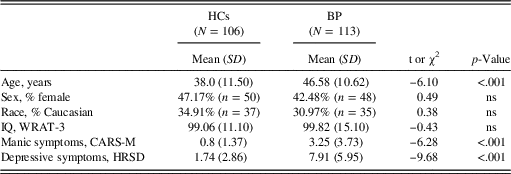
The BD and HC groups differed in age (t=−6.10; p<.001) but did not differ in sex, race, or premorbid intellectual ability (χ 2=0.49; χ 2=0.38; and t=−.43, respectively, all ps>.05); Table 1. As expected, BD patients had significantly higher HRSD ratings (t=−9.68; p<.001) and CARS-M ratings (t=−6.28; p<.001) compared to HC participants; however, as noted in Table 1, mood ratings for BD participants still fell within the stable range.
Demographic comparisons across diagnostic groups

Note. ns = Not statistically significant.
Neuropsychological Performance
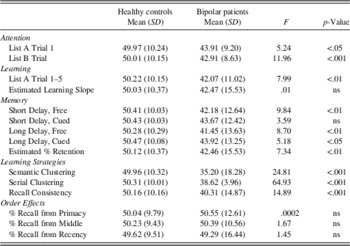
The MANOVA revealed a significant main effect of diagnostic group (HC vs. BD) on overall VM performance (F(15,219)=12.48; p<.001), even after controlling for age, sex, race, current bipolar symptom levels, and premorbid intellectual ability. The only other significant variable in this multivariate analysis was premorbid intellectual ability (F(15,219)=2.649; p=.001).
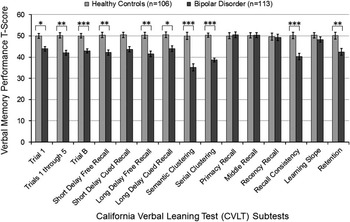
Furthermore, when controlling for age, sex, race, current bipolar symptom levels, and premorbid intellectual ability, subsequent analyses of specific CVLT measures revealed significant main effects of diagnostic group (BD vs. HC) on attention, learning, memory, long delay free and cued recall, estimated percent retention, organizational learning strategies (i.e., semantic and serial clustering), and across-trial recall consistency. There were no significant effects of diagnostic group for metrics of estimated learning slope, short delay cued, and percent recall from primacy, middle, and recency. For a full summary of CVLT measures, see Table 2 and Figure 1.
Comparative performance across verbal memory subtests in healthy controls versus bipolar disorder patients.

Multivariate analysis of CVLT intricacies in bipolar patients and healthy control participants

Note. Analysis controls for age, sex, race, current bipolar symptoms, and premorbid IQ.
ns = Not statistically significant.
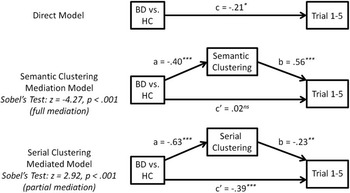
Next, mediation analyses were conducted to test if semantic or serial clustering significantly accounted for the relationship between diagnostic group (HC vs. BD) and verbal learning (i.e., total learning: Trials 1 through 5). All mediation analyses controlled for age, sex, race, current bipolar symptoms, and premorbid intellectual ability. Results indicate that semantic clustering fully mediated the association between diagnostic grouping and verbal learning (Sobel’s test: Z=−4.27; p<.001), while serial clustering partially mediated the relationship (Sobel’s test: Z=2.92; p<.001). We also ran a Pearson correlation between semantic and serial clustering in our bipolar sample and found a strong and statistically significant negative correlation between the two clustering techniques (r=−.56; p<.001). For a full summary of mediating effects, see Figure 2.
Mediating effects of semantic and serial clustering on the relations between diagnostic group and verbal memory performance.

DISCUSSION
The primary aim of the present study was to characterize the intricacies of VM deficits in a large sample of 113 BD patients compared to 106 HC participants using a multi-factorial measure, the CVLT. Our results further supported previous meta-analytic evidence showing moderate VM deficits among euthymic BD patients (Kurtz and Gerraty, Reference Kurtz and Gerraty2009; Robinson et al., Reference Robinson, Thompson, Gallagher, Goswami, Young, Ferrier and Moore2006). BD patients displayed statistically significant deficits in almost all VM domains (i.e., attention, learning, memory); however, these were generally in the mildly impaired range. The notable exceptions were organizational learning strategies and recall consistency, which together suggested BD patients have a more disorganized, haphazard learning approach that leads them to be less consistent in how many words they can recall.
Moreover, BD and HC participants did not differ on well-known serial position memory effects (Deese and Kaufman, Reference Deese and Kaufman1957), suggesting our BD patients did not use a passive learning style but rather actively engaged in the learning task. This evidence of patients’ active engagement in the verbal learning task emphasizes how their inadequate use of clustering strategies may have contributed to their VM deficits. Mediation analyses further revealed the potential importance of organizational learning strategies for VM deficits, as semantic clustering fully mediated and serial clustering partially mediated the relationship between diagnosis (HC vs. BD) and verbal learning performance (i.e., Trials 1 through 5 total). These data suggest BD patients showed inadequate use of effective clustering strategies (including both semantic and serial clustering) to aid their verbal learning/recall, compared to HC participants.
Taken together, these data are consistent with prior studies showing that the use of clustering mediates total VM performance in BD (Chang et al., Reference Chang, Choi, Ha, Ha, Cho, Choi and Moon2011; Deckersbach, McMurrich, et al., Reference Deckersbach, McMurrich, Ogutha, Savage, Sachs and Rauch2004; Deckersbach, Savage, et al., Reference Deckersbach, Savage, Reilly‐Harrington, Clark, Sachs and Rauch2004). These results were also notably different from past work showing no VM deficits in BD patients, which was possibly the result of having a larger sample size and a focus on affectively stable BD patients. Thus, our study’s large sample of affectively stable BD patients potentially meant it was able to help resolve past inconsistencies in the literature by demonstrating VM deficits mediated by inadequate use of clustering strategies in BD. Moreover, an important clinical implication of our results is that they suggest that FR efforts may benefit from incorporating lessons about the effective use of grouping words based upon semantic categories and chunking strategies to improve VM in BD.
Specifically, within our mediation models, semantic clustering was positively associated with verbal learning while serial clustering was negatively associated with verbal learning. We have some theories about why this pattern arose, which could help explain these findings and inform future research. Specifically, one possible explanation for these findings is that individuals may generally choose to use one strategy over the other (if using a strategy at all); therefore, the use of serial clustering, which may be less effective than semantic clustering might result in lower performance overall. This theory was supported by the strong negative correlation between the two clustering strategies, indicating that, if an individual used more semantic clustering, they tended to use serial clustering far less, and vice versa.
Alternatively, rather than considering one strategy “better” than the other, there is a possibility that serial clustering may represent a more idiosyncratic mnemonic device that might be highly useful for certain individuals but ineffective for others (Shuell, Reference Shuell1975; Stricker, Brown, Wixted, Baldo, & Delis, Reference Stricker, Brown, Wixted, Baldo and Delis2002). Thus, our data suggest FR lessons could benefit from identifying the most optimal clustering strategy for each patient to personalize VM-related training modules. Overarching lessons could also teach the value of both clustering methods while stressing that semantic clustering is effective for most people while serial clustering is more idiosyncratic and may only be effective for certain individuals.
Despite our BD patients showing widespread deficits across multiple VM domains, there were also a few notable areas of similarity between our BD and HC participants. Specifically, our diagnostic groups showed a similar rate of learning improvement, suggesting that BD patients did not reach a plateau in their capacity to learn verbal information. BD patients also showed intact performance on short and long delay cued recall, which indicates that cuing aids in memory retrieval, which points toward relatively normal encoding of information.
Our evidence of BD patients’ relatively normal encoding suggests their VM deficits may be related to an access/retrieval problem. Indeed, both examiner-employed retrieval aids (i.e., providing cues for recall) as well as self-employed retrieval aids (i.e., applying one’s own clustering strategies) both help compensate for access/retrieval deficits. Since BD patients did not differ from HCs when given cues but inadequately used clustering strategies, our data suggest BD patients have not adequately self-corrected for their access/retrieval deficits by self-identifying effective clustering strategies, although they still benefit from external, examiner-provided cues/clues.
Notably, it is theoretically possible our evidence of inadequate use of clustering strategies in BD patients may implicate executive functioning (EF) deficits in VM performance. EF and VM deficits exert similarly large effects in BD (Arts et al., Reference Arts, Jabben, Krabbendam and Van Os2008; Bora, Yucel, & Pantelis, Reference Bora, Yucel and Pantelis2009; Bourne et al., Reference Bourne, Aydemir, Balanzá‐Martínez, Bora, Brissos, Cavanagh and Goodwin2013; Kurtz and Gerraty, Reference Kurtz and Gerraty2009; Robinson et al., Reference Robinson, Thompson, Gallagher, Goswami, Young, Ferrier and Moore2006; Torres et al., Reference Torres, Boudreau and Yatham2007), and some researchers have evidenced a robust overlap between VM and EF nearing 50% (Cunningham, Pliskin, Cassisi, Tsang, & Rao, Reference Cunningham, Pliskin, Cassisi, Tsang and Rao1997; Duff, Schoenberg, Scott, & Adams, Reference Duff, Schoenberg, Scott and Adams2005; Fossati, Amar, Raoux, Ergis, & Allilaire, Reference Fossati, Amar, Raoux, Ergis and Allilaire1999; Orellana and Slachevsky, Reference Orellana and Slachevsky2013).
Additionally, some neuroimaging studies have linked deficits in mnemonic retrieval of verbal information to abnormal activation of the midventrolateral prefrontal cortex (PFC), which controls higher-order cognitive processes such as EF (Petrides, Alivisatos, & Evans, Reference Petrides, Alivisatos and Evans1995; Phillips and Swartz, Reference Phillips and Swartz2014). Diffusion tractography of BD patients has similarly found abnormal nodal networks in the left ventrolateral PFC (Leow et al., Reference Leow, Ajilore, Zhan, Arienzo, GadElkarim, Zhang and Altshuler2013). Future studies are needed to comprehensively assess EF (including capacity to plan) and investigate how EF may interact with clustering strategies as a mediator in the relationship between diagnostic grouping (BD vs. HC) and verbal learning performance.
The present study was limited by the lack of CVLT data regarding recognition. Specifically, we drew data from two research sites, one of which did not have recognition data available (Zucker-Hillside Hospital). All HC participants were collected from this research site; thus, no recognition data were available for HCs, which meant that we were unfortunately unable to make any comparisons in CVLT recognition between BD patients and HC participants. Our study was also limited by a lack of data about medication status in our BD patients, which was unfortunately unavailable from both sites. Our study’s generalizeability was also limited by our exclusion of any participant who reported a past or current diagnosis of ADHD. Thus, the benefit of FR lessons may not extend to those bipolar patients who have comorbid ADHD unless those individuals undertaking FR are highly adherent with their ADHD medications to the point that they resemble a bipolar patient without comorbid ADHD.
Although it may also be argued that our mediation results could have been limited by differences in standard deviation size (as our BD patients’ standard deviation size was large for semantic clustering and small for in serial clustering), we concluded such differences in standard deviation size did not undermine the validity of our mediation modeling a priori. For example, similar Baron and Kenny mediation models can be run with binary dichotomous mediator variables that do not have a standard deviation at all. However, standard deviation size may have biased our results since mediation models with large standard deviations are more likely to be statistically significant while those with small standard deviation sizes are more likely to be non-significant. Thus, we addressed the potential impact of standard deviation size on statistical significance by verifying our mediation findings with the quite conservative Sobel’s test.
Since the Sobel’s test is highly conservative, it is able to render non-significant any findings that achieved statistical significance due to statistical artifacts like standard deviation size. In addition, this highly conservative test also helped to verify results given the many other potential limitations of mediation modeling. Thus, future studies are needed to examine the contribution of medication effects on VM deficits in BD and explore whether the present findings also extend to include possible verbal recognition deficits in BD while addressing potential limitations of mediation models using conservative tests such as the Sobel’s test used in the present study.
In sum, to identify the exact nature of verbal learning and memory deficits in BD patients and inform CR and FR efforts, we examined the separable indices of the CVLT in a large cohort. We also tested whether differences between BD and HC participants regarding VM deficits may be accounted for by BD patients’ inadequate use of organizational learning strategies, such as semantic or serial clustering approaches. Although BD patients showed statistically significant VM deficits on most CVLT indices, most of these deficits were mild. The inefficient use of organizational learning strategies that are known to aid learning and subsequent recall was a significant mediator of total verbal learning performance. These results suggest that CR and FR efforts may benefit from educational modules targeting the use of semantic clustering and/or chunking to help to attenuate VM deficits in BD.
Acknowledgments
Dr. Burdick has served as an advisory board member for Dainippon Sumitomo Pharmaceutical and for Takeda Lundbeck, which had no impact upon the work presented in this manuscript. Dr. Nitzburg has received research funding from Talkspace Incorporated, which had no impact upon the work presented in this manuscript. All other authors report no competing interests regarding the present study. This study was funded by grants from the National Institute of Mental Health (NIMH) to Dr. Burdick (K23MH077807; R01MH100125).