Implications
Supplementing up to 90 ppm of Quillaja saponaria L. did not affect the overall fatty acid profile and cholesterol content in lamb meat. The lower concentration of C14:1 cis-9 in the saponins-fed lambs suggests a possible effect of saponins on Δ9-desaturase enzyme. Further research is needed.
Introduction
Saponins are secondary metabolites produced mainly by plants and also by lower marine animals and some bacteria (Yoshiki et al., Reference Yoshiki, Kudou and Okubo1998). Their name derives from their ability to form stable foams in aqueous solutions. They are characterized by a sugar moiety that is glycosidically linked to a hydrophobic aglycone (named sapogenin), which may be triterpenoid or steroid in nature (Francis et al., Reference Francis, Kerem, Makkar and Becker2002). Saponins may be considered a part of plants’ defense system as they have been shown to be antimicrobial, to inhibit mould and to protect plants from insect attacks (Francis et al., Reference Francis, Kerem, Makkar and Becker2002).
Many authors have studied the biological properties of saponins on animal and human nutrition (Cheeke, Reference Cheeke2000; Francis et al., Reference Francis, Kerem, Makkar and Becker2002). It has been reported that saponins when supplemented in diets reduce cholesterol content in blood and tissues in monogastric mammals, such as rats, gerbils and humans (Sidhu and Oakenfull, Reference Sidhu and Oakenfull1986; Potter et al., Reference Potter, Jimenez-Flores, Pollack, Lone and Berber-Jimened1993; Harris et al., Reference Harris, Dujovne, Windsor, Gerrond, Newton and Gelfand1997). This cholesterol-reducing effect is attributed to saponins ability to form insoluble complexes (micelles) with sterols (Sidhu and Oakenfull, Reference Sidhu and Oakenfull1986), such as cholesterol and bile acids. Several feedstuff used for livestock feeding, such as Yucca schidigera (Singer et al., Reference Singer, Robinson, Salem and DePeters2008; Holtshausen et al., Reference Holtshausen, Chaves, Beauchemin, McGinn, McAllister, Odongo, Cheeke and Benchaar2009), Quillaja saponaria (Holtshausen et al., Reference Holtshausen, Chaves, Beauchemin, McGinn, McAllister, Odongo, Cheeke and Benchaar2009), Medicago sativa (Klita et al., Reference Klita, Mathison, Fenton and Hardin1996) and Sapindus saponaria (Abreu et al., Reference Abreu, Carulla, Lascano, Diaz, Kreuzer and Hess2004) contain saponins and are used in animal nutrition with the purpose of inhibiting methanogenesis in the rumen (Patra and Saxena, Reference Patra and Saxena2010). Some studies have shown that saponins can be degraded by ruminal microflora (Gutierrez et al., Reference Gutierrez, Davis and Lindahl1959; Makkar and Becker, Reference Makkar and Becker1997). Hitherto, there is no information with regard to the possible effects of dietary saponins on fatty acids (FAs) and cholesterol metabolism in ruminants and their effects on meat quality.
Some FAs present in ruminant products exert favorable effects on human health (McGuire and McGuire, Reference McGuire and McGuire2000). Increasing levels of polyunsaturated FAs (PUFAs) in human diet reduce the risk of cardiovascular diseases and chronic pathologies (e.g. cancer, diabetes; Simopoulos, Reference Simopoulos1999). Besides PUFA, interest in conjugated linoleic acids (CLAs), especially in the C18:2 cis-9,trans-11 (rumenic acid, RA), has incremented considerably over the last years because of its beneficial effects on human health (reduction of carcinogenesis, atherosclerosis and body fat; McGuire and McGuire, Reference McGuire and McGuire2000). The CLAs are synthesized during biohydrogenation (BH) of dietary C18:2 cis-9,cis-12 (linoleic acid, LA; Kepler and Tove, Reference Kepler and Tove1967), a process which is carried out by the ruminal bacteria.
It has been shown both in in vivo studies (Lu and Jorgensen, Reference Lu and Jorgensen1987; Wallace et al., Reference Wallace, Arthaud and Newbold1994; Klita et al., Reference Klita, Mathison, Fenton and Hardin1996) and in in vitro ruminal fermentation systems (Makkar et al., Reference Makkar, Sen, Blummel and Becker1998; Wang et al., Reference Wang, McAllister, Newbold, Rode, Cheeke and Cheng1998) that saponins have pronounced antiprotozoal activity. One of the potential consequences of antiprotozoal effect is the reduction of the predation by protozoa on rumen bacteria, thus modifying ruminal ecosystem. Therefore, it is plausible to suppose an effect of saponin supplementation on the appearance of FAs synthesized by bacteria during the BH pathway. However, so far, there are no studies on the possible effects of saponin on BH, with consequent effect on muscle FA composition. In addition, considering the interaction between saponins and cholesterol in other animal species, including humans, we have hypothesized an effect of saponins on cholesterol content in muscle Longissimus dorsi of lambs.
The aim of this study was to evaluate the effects of increasing levels of sapogenins present in a preparation of Q. saponaria on FA profile and cholesterol level in lambs.
Material and methods
Experimental design, animals and management
The experiment was carried out from April to June 2008 at the National Institute of Agricultural Research of Tunisia (INRAT, Tunisia). A total of 24 male Barbarine lambs, 5- to 6-month-old and with average initial live weight 18.6 ± 1.98 kg, were assigned to four dietary groups, each consisting of six animals. All groups received the same basal diet consisting of oat hay ad libitum and 400 g of concentrate (80% barley, 17.5% soybean meal and 2.5% mineral and vitamin supplement). Groups QS30, QS60 and QS90 were supplemented with 30, 60 or 90 ppm of a Q. saponaria preparation, respectively. The Quillaja saponins were administered as a water solution drench, prepared by dissolving the opportune amount of Quillaja extract in tap water. The Q. saponaria extract used in this experiment was purchased from Sigma Aldrich (batch: 024K2505, Santiago, Chile, USA) and it contained 20% sapogenin. Therefore, the sapogenin content administered to the groups QS30, QS60 and QS90 was 6, 12 and 18 mg per kg of feed (concentrate + hay) consumed, respectively. The control group (C) did not receive the Quillaja water solution. Lambs were allowed to the following experimental treatment: 15 days adaptation, 57 days growth trial, 4 days adaption to metabolic cages, 5 days digestibility measurement and 4 days resting (receiving the above diets). Data referring to the digestion and growth performance were presented in a companion paper by Nasri et al. (2010). At the end of the experimental period, animals were slaughtered in an experimental abattoir. After carcass refrigeration at 4°C for 24 h, the muscle L. dorsi was excised, wrapped in aluminum foil, vacuum packed and stored at −20°C until analysis. Meat FAs and cholesterol content were analyzed at the Sezione di Scienze Zootecniche, University of Pisa.
FAs analysis in the L. dorsi muscle
Total lipids of L. dorsi were extracted with Folch's method (Reference Folch, Lees and Sloane Stanley1957) from 8 g of minced meat. FA methyl esters (FAMEs) were prepared by the base-catalyzed trans-methylation (Christie, Reference Christie1982). Before methylation, C9:0 and C23:0 FAMEs were added together as internal GC 8000 Top standards. The FAMEs were determined by a ThermoQuest (Milan, Italy) gas-chromatograph (GC) apparatus equipped with a flame ionization detector (FID) and a high polar fused silica capillary column (WCOT fused silica CP-Select CB for FAMEs Varian, Middelburg, Netherland; 100 m × 0.25 mm i.d.; film thickness 0.25 μm). Helium was used as the carrier gas at a flow of 1 ml/min. The split ratio was 1 : 80. The GC conditions were: the oven temperature was programed at 150°C and held for 1 min, then increased up to 175°C at a rate of 0.8°C/min, held for 14 min, then increased up to 188°C at 2°C/min, held for 18 min, and then increased up to 230°C at a rate of 2°C/min, held for 13 min. The injector and detector temperatures were set at 270°C and 300°C, respectively. Meat FAs’ results are expressed as percentage of total identified FAs.
Feedstuff analysis
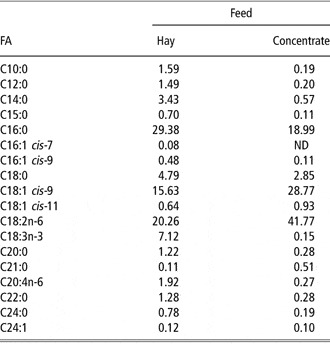
Total lipids of hay and concentrate were extracted with chloroform–methanol, according to Folch's method (Reference Folch, Lees and Sloane Stanley1957) The FAMEs were prepared by the base-catalyzed trans-methylation as described by Christie (Reference Christie1982). Feed FAs analysis was performed as described for meat samples. Feed FAs’ profile is reported in Table 1 and the results are expressed as percentage of total identified FAs.
FA composition of control diet (% of total FAs)

FA = fatty acid; ND = not detectable.
Cholesterol analysis
For cholesterol analysis, we have adopted the method described by Sander et al. (Reference Sander, Addis, Park and Smith1989). The extracted total lipids (100 mg) were weighed in a 20 ml test tube, dried under nitrogen flow and then kept in vacuum and in the dark overnight. To this 500 μl of Betulin in chloroform (1 mg/ml) was added as an internal standard, and then 10 ml of 1N KOH in methanol was added and the mixture was vortexed for 30 s to make it free of dispersed fat particles. The tubes were shaken at room temperature for 18 to 20 h to allow the formation of a saponified fraction. Distilled water (10 ml) was then added to the saponified mixture, which was transferred to another test tube. The unsaponifiable fraction was extracted three times with 10 ml of diethyl ether, and the pooled diethyl ether extracts were washed twice with 5 ml of 0.5 N KOH and twice with 5 ml of saturated NaCl solution. After drying with anhydrous sodium sulfate for 1 h at 4°C, the extract was filtered, dried under vacuum using a rotary evaporator and then the dried material was kept for one night in the dark, in a glass bowl containing hygroscopic salts and under vacuum: this procedure allows the complete dryness of the samples before measuring the weight of the extracted lipids. The unsaponifiable fraction was then recovered in a solution of hexane : 2-propanol mixture (4 : 1 v/v) and stored at −20°C until analysis. Cholesterol was determined after silylation of unsaponifiable matter. Silylation solution was composed of a pyridine solution of hexamethyldisilazane and trimethylchlorosilane (5/2/1 v/v/v, respectively; Sweeley et al., Reference Sweeley, Bentley, Makita and Wells1963) of the silylated sample. Derivatization was completed in 20 min at 40°C. About 0.4 μl was injected at a split ratio of 1 : 100. Trimethysilyl derivatives were identified and quantified by using a GC equipped with FID and an apolar 25 m × 0.25 mm i.d. capillary column according to Boselli et al. (Reference Boselli, Caboni, Rodriguez-Estrada, Toschi, Daniel and Lercker2005). The injector and detector temperatures were set up at 325°C. The oven temperature was programed at 250°C and increased to 325°C at 3°C/min, with final temperature of 325°C held for 15 min. Helium was used as the carrier gas with a flow rate of 0.75 ml/min.
Statistical analysis
Data were analyzed by ANOVA as a completely randomized design and included in the model treatment effects and experimental error. Individual animals were considered as experimental units. When ANOVA was significant (P < 0.05), means were separated by the Pairwise comparison. The data were analyzed by the software MINITAB version 14.0.
Results
Effect of saponin supplementation on muscle FA composition and cholesterol content
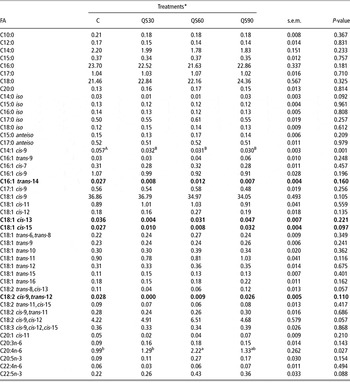
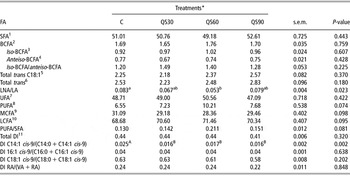
Table 2a and b, show the effects of increasing levels of saponins on the FA profile and on the desaturation indexes (DIs) of lamb meat. The concentration of C14:0, C16:0 and C18:0 in meat was similar for the four groups of lambs (Table 2a). The concentration of total saturated FAs (SFAs) was unaffected by dietary treatments (Table 2b). The concentrations of iso-BCFA (branched chain FAs), anteiso-BCFA and total BCFA were not influenced by saponin supplementation (P > 0.05). None of the individual BCFA was affected (P > 0.05). The iso-BCFA/anteiso-BCFA ratio was similar in the meat of all experimental groups (P = 0.225; Table 2b).
Effect of saponin supplementation on Longissimus dorsi muscle individual FAs (% of total FAs)

FAs = fatty acids.
*Treatment: C = lambs receiving control diet; QS30 = lambs receiving C diet plus 30 ppm of Quillaja; QS60 = lambs receiving C diet plus 60 ppm of Quillaja; QS90 = lambs receiving C diet plus 90 ppm of Quillaja.
a,bDifferent letters within the same row indicate significant differences (P < 0.05).
A,BDifferent letters within the same row indicate significant differences (P < 0.01).
Effect of saponin supplementation on Longissimus dorsi muscle FA indices (% of total FAs)

FAs = fatty acids; SFA = saturated FAs; BCFA = branched chain FAs; LNA = α-linolenic acid; LA = linoleic acid; UFA = unsaturated FAs; PUFA = polyunsaturated FAs; MCFA = medium-chain FAs; LCFA = long-chain FAs; DI = desaturation index; RA = rumenic acid; VA = vaccenic acid.
*Treatment: C = lambs receiving control diet; QS30 = lambs receiving C diet plus 30 ppm of Quillaja; QS60 = lambs receiving C diet plus 60 ppm of Quillaja; QS90 = lambs receiving C diet plus 90 ppm of Quillaja.
a,bDifferent letters within the same row indicate significant differences (P < 0.05).
A,BDifferent letters within the same row indicate significant differences (P < 0.01).
1Sum of SFA: C8:0; C10:0; C12:0; C14:0; C15:0; C16:0; C17:0; C18:0; C20:0.
2Sum of iso- and anteiso- BCFA: iso-BCFA; anteiso-BCFA.
3Iso-BCFA = C14:0 iso; C15:0 iso; C16:0 iso; C17:0 iso; C18:0 iso.
4Anteiso-BCFA = C15:0 anteiso; C17:0 anteiso.
5Total trans C18:1 = sum of trans C18:1: C18:1 trans-6,trans-8; C18:1 trans-9; C18:1 trans-10; C18:1 trans-11; C18:1 trans-12; C18:1 trans-15; C18:1 trans-16.
6Total trans = sum of total trans FAs: C16:1 trans-14; C18:1 trans-6,trans-8; C18:1 trans-9; C18:1 trans-10; C18:1 trans-11; C18:1 trans-12; C18:1 trans-15; C18:1 trans-16; C18:2 trans-8,cis-13; C18:2 cis-9,trans-12.
7Sum of UFA: C14:1 cis-9; C16:1 trans-9; C16:1 cis-7; C16:1 cis-9; C16:1 trans-14; C17:1 cis-9; C18:1; C18:1 trans-6,trans-8; C18:1 trans-9; C18:1 trans-10; C18:1 trans-11; C18:1 trans-12; C18:1 cis-9; C18:1 trans-15; C18:1 cis-11; C18:1 cis-12; C18:1 cis-13; C18:1 trans-16; C18:1 cis-15; C18:2 trans-8,cis-13; C18:2 cis-9,trans-12; C18:2 trans-11,cis-15; C18:2 cis-9,cis-12; C18:3 cis-9,cis-12,cis-15; C20:1 cis-11; C20:3 cis-8,cis-11,cis-14; C20:5 cis5,cis-8,cis-11,cis-14,cis-17; C22:4 cis-7,cis-10,cis-13,cis-16; C22:5 cis-7,cis-10,cis-13,cis-16,cis-19.
8Sum of PUFA: C18:2 trans-8,cis-13; C18:2 cis-9,trans-12; C18:2 trans-11,cis-15; C18:2 cis-9,cis-12; C18:3 cis-9,cis-12,cis-15.
9Sum of MCFA (10 < C > 17): C12:0; C14-iso; C14:0; C15-iso; C14:1 cis-9; C15-anteiso; C15:0; C16-iso; C16:0; C16:1 trans-9; C16:1 cis-7; C16:1 cis-9; C16:1 trans-14; C17-iso; C17-anteiso; C17:0; C17:1 cis-9.
10Sum of LCFA (C > 17): C18-iso; C18:0; C18:1 trans-6,trans-8; C18:1 trans-9; C18:1 trans-10; C18:1 trans-11; C18:1 trans-12; C18:1 cis-9; C18:1 trans-15; C18:1 cis-11; C18:1 cis-12; C18:1 cis-13; C18:1 trans-16; C18:1 cis-15; C18:2 trans-8,cis-13; C18:2 cis-9,trans-12; C18:2 trans-11,cis-15; C18:2 cis-9,cis-12; C18:3 cis-9,cis-12,cis-15; C20:0; C18:2 cis-9,trans-11; C20:1 cis-11; C20:3 cis-8,cis-11,cis-14; C20:4 cis-5,cis-8,cis-11,cis-14; C20:5 cis-5,cis-8,cis-11,cis-14,cis-17; C22:4 cis-7,cis-10,cis-13,cis-16; C22:5 cis-7,cis-10,cis-13,cis-16,cis-19.
11Total DI calculated as (C14:1 cis-9 + C16:1 cis-9 + C18:1 cis-9 + C18:2 cis-9,trans-11)/(C10:0++ C14:0 + C14:1 cis-9 + C16:0 + C16:1 cis-9 + C18:0 + C18:1 cis-9 + C18:1 trans-11 + C18:2 cis-9,trans-11).
When saponins were added to the diet, the concentration of C14:1 cis-9 in meat was lower (P = 0.001), whereas C16:1 cis-9 and C18:1 cis-9 were not affected by saponin supplementation (P > 0.05; Table 2a).
None of the FAs arising from ruminal BH was affected by saponin supplementation (P > 0.05). Neither the total trans C18:1 nor the individual trans C18:1 were influenced by saponin supplementation (P > 0.05). The concentration of RA was similar between the four groups of animals (Table 2a). The sum of the C18:1 trans and C18:2 with at least one double bound in trans configuration was not influenced (P > 0.05) by saponin supplementation (Table 2b).
The concentration of LNA (α-linolenic acid) and LA did not differ among the four treatments (P > 0.05). The ratio LNA/LA was lower (P < 0.05) in the group receiving 60 ppm of Quillaja than the C group (0.053 v. 0.083, respectively), and was found at intermediate value in the meat of lambs from the QS30 and QS90 groups (0.067 and 0.079, respectively; Table 2b). The concentration of C20:4n-6 in the meat of animals receiving 60 ppm of Quillaja was twice (2.22% of total FA) compared with that of meat from the C and QS30 groups (0.99% and 1.29% of total FA, respectively). The concentration of this FA in the meat of animals from the QS90 group was intermediate of the values (1.33% of total FA) of the other three groups. The concentration of C20:3n-6, C20:5n-3, C22:4n-6 and C22:5n-3 was unaffected by Quillaja supplement (Table 2a).
The concentrations of total UFAs (unsaturated FAs), PUFAs, medium-chain FAs and long-chain FAs were not influenced by saponin supplementation. Saponin supplementation did not affect (P > 0.05) the PUFA/SFA ratio (Table 2b).
The total DI, calculated as described by Kelsey et al. (Reference Kelsey, Corl, Collier and Bauman2003) (product of Δ9-desaturfase/[product of Δ9-desaturase + substrate of Δ9-desaturase]), was not affected by the dietary treatments (P > 0.05). The DI C14:1 cis-9/(C14:0 + C14:1 cis-9) was lower (P < 0.005) in QS30, QS60 and QS90 groups than in C group. The DI C16:1 cis-9/(C16:0 + C16:1 cis-9), the DI C18:1 cis-9/(C18:0 + C18:1 cis-9) and the DI RA/(vaccenic acid; VA + RA) were not influenced by saponin supplementation (P > 0.05; Table 2b).
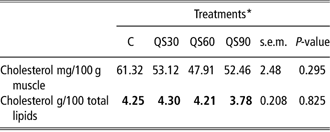
The effect of saponin supplementation on meat cholesterol content is shown in Table 3. The supplementation of saponins did not influence muscle cholesterol content (P > 0.05). The cholesterol content in meat ranged between 47.91 and 61.32 mg/100 g of muscle.
Effect of saponins on Longissimus dorsi muscle cholesterol
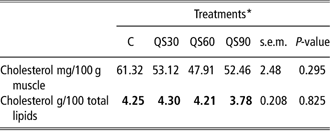
*Treatments: C = lambs receiving control diet; QS30 = lambs receiving C diet plus 30 ppm of Quillaja; QS60 = lambs receiving C diet plus 60 ppm of Quillaja; QS90 = lambs receiving C diet plus 90 ppm of Quillaja.
Discussion
Effect of saponins on muscle FA composition
In our study, we have focused on meat FA profile with particular emphasis on FAs arising from metabolism of rumen bacteria (e.g. BCFA) or those FAs, which are intermediates in the process of ruminal BH.
The concentration of BCFA was not affected by the dietary treatments. BCFAs are formed by ruminal bacteria from the propionate that originates in the rumen by the fermentation of dietary carbohydrates (Scaife et al., Reference Scaife, Wahle and Garton1978) and their synthesis is enhanced when animals are fed concentrate-based diets (Vlaeminck et al., Reference Vlaeminck, Dewhurst, Demeyer and Fievez2004). The concentration of BCFA in the rumen also depends on ruminal protozoal population (Or-Rashid et al., Reference Or-Rashid, Odongo and McBride2007), which is sensitive to saponins (Wallace et al., Reference Wallace, Arthaud and Newbold1994; Makkar et al., Reference Makkar, Sen, Blummel and Becker1998). Therefore, in our study, we would have expected an interaction between saponin supplementation and the BCFA in the muscle. Probably the levels of saponin supplementation chosen for this study were not sufficient to have an impact on those microorganisms responsible for BCFA synthesis.
The concentrations of C16:1 cis-9 and C18:1 cis-9 were not affected by Quillaja supplementation; these FAs derive both from feed and from the desaturation of C16:0 and C18:0, operated by Δ9-desaturase enzyme in the muscle (Choi et al., Reference Choi, Park, Pariza and Ntambi2001). Conversely, C14:1 cis-9 is exclusively synthesized endogenously in muscle by Δ9-desaturase enzyme (Palmquist et al., Reference Palmquist, St-Pierre and McClure2004) and therefore the DI C14:1 cis-9/(C14:0 + C14:1 cis-9) has been proposed as an evaluation index of Δ9-desaturase enzyme activity in lamb muscle (Palmquist et al., Reference Palmquist, St-Pierre and McClure2004). The lowering effect of saponins on the concentration of C14:1 cis-9 and of its DI was an unexpected result. Nevertheless, saponin supplementation did not affect the other DIs. The fact that the DI C14:1 cis-9/(C14:0 + C14:1 cis-9) was the only DI affected by saponins might be explained by considering that Δ9-desaturase enzyme has higher affinity for 16 and 18 carbon atoms’ FAs than FAs with a shorter carbon chain (Enoch et al., Reference Enoch, Catalá and Strittmatter1976). Even though we did not observe a dose-response effect of saponin supplementation, maybe in the presence of saponins, Δ9-desaturase enzyme activity was weaker for C14:0, which is not among the Δ9-desaturase enzyme preferred substrates of action. We did not observe changes between the four treatments in C16:1 and C18:1 accumulation probably because the high concentration of these FAs could have masked a variation of Δ9-desaturase activity. In addition, it is plausible to suppose that saponins (or their aglycone) may influence directly or indirectly Δ9-desaturase enzyme activity. In fact, an enzyme-inhibitory effect of saponins has been previously described, for example, in vitro for elastase and hyaluronidase enzymes (Facino et al., Reference Facino, Carini, Stefani, Aldini and Saibene2006) and in vivo for the cytochrome P450 enzymatic system in rats (Kim et al., Reference Kim, Chun, Park, Kim, Roh and Jeong1997). In a previous study, we have found that supplementing lambs with tannins (another group of plants’ secondary compounds, which are not absorbed through the digestive tract) reduced the Δ9-desaturase enzyme protein expression (Vasta et al., Reference Vasta, Priolo, Scerra, Hallett, Wood and Doran2009). Further research is needed to elucidate it in context to saponins. In addition, RA is endogenously synthesized from the desaturation of VA by Δ9-desaturase enzyme. According to our hypothesis of a possible inhibition of Δ9-desaturase enzyme by saponins, we would have expected a lower concentration of RA in the meat of the saponins-supplemented lambs, but this was not the case. Palmquist et al. (Reference Palmquist, St-Pierre and McClure2004) have shown that up to 90% of the RA in lamb intramuscular fat originates through endogenous synthesis.
Ruminant products are significant sources of dietary trans FAs, which originate from BH of dietary UFAs by the activity of ruminal microbes (Mosley et al., Reference Mosley, Powell, Riley and Jenkins2002). In this study, none of the FAs that originated during the BH was affected by saponin supplementation. For most of the trans FAs the exact synthetic pathways are still unclear. The conversion of LA and LNA to VA is carried out by ‘group A’ bacteria (mostly Gram-positive bacteria), whereas the following step of the BH is carried out by ‘group B’ bacteria (mostly Gram-negative bacteria; Kemp and Lander, Reference Kemp and Lander1984). As Wang et al. (Reference Wang, McAllister, Yanke and Cheeke2000) noted, the Gram-negative bacteria are more resistant to saponins than Gram-positive bacteria. Therefore, we would have expected an effect of dietary saponins on ruminal BH, but at the inclusion levels of saponins chosen for this study we did not observe any interference of saponins on ruminal BH. Gutierrez et al. (Reference Gutierrez, Davis and Lindahl1959) reported that Butyrivibrio fibrisolvens – one of the bacteria involved in the BH of PUFA in the rumen – strains isolated from cattle rumen was able to degrade alfalfa saponins. Therefore, it is possible that in this study saponins were ineffective because they were degraded by ruminal microorganisms.
C20:4n-6, whose concentration in this study was higher in the meat of QS60 lambs compared with that of C and QS30 lambs, is mainly derived from LA through elongation and desaturation reactions (Brenner, Reference Brenner1989). Arachidonic acid is preferentially stored in cell membrane phospholipids, rather than in triglycerides (Aurousseau et al., Reference Aurousseau, Bauchart, Calichon, Micol and Priolo2004). There was a tendency to have a leaner meat in QS60 group compared with the other groups (1.16 for QS60 v. 1.5 for C, 1.25 for QS30, 1.43 for QS90 g of total intramuscular fat/100 g of muscle; P < 0.1). Leaner meat contains greater proportions of phospholipids than triglycerides (Aurousseau et al., Reference Aurousseau, Bauchart, Calichon, Micol and Priolo2004) and this would explain the higher concentration of C20:4n-6 in the meat of the QS60 lambs compared with the other groups.
Effect of saponins on muscle cholesterol composition
A large number of studies have shown an hypocholesterolemic effect of saponins in mammals (Sidhu and Oakenfull, Reference Sidhu and Oakenfull1986). However, so far, there is no information on the effects of saponins on cholesterol metabolism in ruminants. There are two school of thoughts emerging for the hypocholesterolemic effect of saponins: (i) a direct binding between saponins and dietary cholesterol in the gut, which prevents its absorption from the small intestine and (ii) a binding between saponins and bile acids in the gut, which decreases the enterohepatic circulation of bile acids and increases cholesterol excretion with feces (Sidhu and Oakenfull, Reference Sidhu and Oakenfull1986). These hypotheses were formulated through studies with monogastric animals. Considering that ruminants’ diets do not contain cholesterol, the first of the hypotheses above mentioned is not valid. Moreover, saponins are structurally modified by ruminal microorganisms (Makkar and Becker, Reference Makkar and Becker1997; Wang et al., Reference Wang, McAllister, Newbold, Rode, Cheeke and Cheng1998) and it is likely that the aglycone remaining after saponin degradation is not as effective as the entire saponin in binding bile acids in the gut. This would explain why we did not observe any hypocolesterolemic effects of saponins in lamb. It is also likely that the inclusion level of saponins was not enough for interfering with cholesterol metabolism.
Conclusions
Saponin supplementation did not affect the overall FA profile of lamb meat. However, we have observed that saponin supplementation reduced the concentration of C14:1 cis-9 and the respective DI (C14:1 cis-9/(C14:0 + C14:1 cis-9)). We hypothesize an effect of saponins on Δ9-desaturase enzyme activity, although the other DIs were not affected by saponin supplementation. None of the FAs arising from ruminal BH was affected by Q. saponaria. Supplementing lambs with 60 ppm of Quillaja increased C20:4n-6 in meat. Thus, an influence of saponin on LA metabolism is possible. The concentration of cholesterol in meat was not influenced by saponin supplementation. This result could be attributed to insufficient dose of saponin supplemented in the diet or to structural modification of saponins carried out by ruminal microorganisms. Further investigations should be undertaken to evaluate the effect of saponins on ruminal BH, with emphasis on Δ9-desaturase enzyme activity, and on cholesterol levels of lamb meat.
Acknowledgments
The technical assistance of Giuseppe Conte and Giorgio Formisano to analyze meat sample at the University of Pisa is gratefully acknowledged.