INTRODUCTION
Existing public opinion research in the United States has demonstrated that minority groups — defined by religion or ethnicity — differ from each other and from the majority population in their attitudes on foreign policy issues (Boussios and Cole Reference Boussios and Cole2010a; Reference Boussios and Cole2010b; Burris Reference Burris2008; Holsti Reference Holsti2004; Jones Reference Jones2003; Nincic and Nincic Reference Nincic and Nincic2002; Mueller Reference Mueller1994; Reference Mueller1973; Wittkopf Reference Wittkopf1990). This is particularly the case for military interventions occurring during the Cold War and post-Cold War periods. Even though Britain has been a major contributor to military interventions in the post-Cold War era — including Iraq in 1991 and 2003, the Balkans in the 1990s, and Afghanistan in 2001 — there has been little scholarly research into the nature and determinants of foreign policy attitudes held by religious and ethnic minorities. In contrast, there is existing research into the domestic policy preferences, voting behavior and political participation of minority groups in Britain (Studlar Reference Studlar, Layton-Henry and Rich1986; Saggar and Heath Reference Saggar, Heath, Evans and Norris1999; Saggar Reference Saggar2000; Sobolewska Reference Sobolewska2005; Heath et al. Reference Heath, Fisher, Sanders and Sobolewska2011).
This article contributes to the wider literature on public opinion and foreign policy by examining the influence of religious factors on attitudes toward the war in Afghanistan in Britain among the ethnic minority population. It uses a nationally-representative survey — based on a large sample of the ethnic minority population in Britain — to examine the sources of opposition to the war in Afghanistan, including the relative impact of group attachments based on religious affiliation and ethnic background. Assessing the role of these influences is important as to “a large degree, ordinary citizens interpret politics through the lens of social groups” (Berinsky Reference Berinsky2009, 129). It builds upon the few studies that have examined public attitudes toward recent military interventions (Clarke et al. Reference Clarke, Sanders, Stewart and Whiteley2009; Clements Reference Clements2011; Reference Clements2012) in the wider British population. Particularly relevant to the issue of support for Britain's role in Afghanistan and the international war against terrorism, it builds on existing research into the perceptions and attitudes of Muslims (Field Reference Field2007; Reference Field and Helbling2011; Reference Field2012). Muslims are a growing religious minority in the United Kingdom (Britain and Northern Ireland), projected to increase from 4.6 percent of the population in 2010 (2.9 million people) to 8.2 percent in 2030 (5.6 million people) (Pew Forum on Religion & Public Life 2011, 162). Census estimates from 2001 showed that after Christians, Muslims form the second largest individual religion (Peach Reference Peach2006, 632). Other minority religious faiths in Britain are also growing in size, so it is clearly important to deepen scholarly understanding of their political attitudes and behaviors.
The article is structured as follows. The first section reviews existing findings from public opinion research into the foreign policy attitudes of religious and ethnic minority groups. The second section discusses the data source, measurement of dependent and independent variables, and the analytical procedures. The third section presents the results from the model estimations and discusses the main findings. Finally, conclusions are drawn and areas for further research highlighted.
MINORITY GROUPS AND PUBLIC OPINION TOWARDS FOREIGN POLICY ISSUES
Exiting research into public opinion toward foreign policy attitudes has found that social group memberships or attachments, such as ethnic group or religious affiliation, are important factors in underpinning mass support or opposition for overseas military interventions. As well as domestic issues, Berinsky (Reference Berinsky2009, 127) argues that “beliefs about those groups to which individuals feel loyalty or hostility also structure their attitudes in the realm of foreign policy.” Individuals can use social groups as reference points for understanding an issue that may affect their political choices; these group attachments will vary in their importance depending on the issue at hand; and the influence of group attachment can be heightened by the use of “cues” in the wider political environment (Berinsky Reference Berinsky2009, 130). The investigation of social group differences in pro- or anti-war sentiment was commonplace in earlier research into public opinion toward the wars in Vietnam and Korea, and has been undertaken in relation to more recent conflicts (Boussios and Cole Reference Boussios and Cole2010a; Reference Boussios and Cole2010b; Burris Reference Burris2008; Nincic and Nincic Reference Nincic and Nincic2002). Do such social group differences in attitudes toward military interventions exist in public opinion in Britain, in relation to religion and ethnicity? We might expect social group attachments to affect public opinion among minority groups toward the war in Afghanistan, where Britain has committed military forces alongside NATO allies as part of the wider fight against terrorism since 2001. In particular, what are the attitudes of Muslims, who have often perceived the war on terrorism as tantamount to a war on Islam, compared to those from other religious traditions; and of those from Asian or Asian British backgrounds (particularly Pakistani) relative to other ethnic groups? To help inform the analysis undertaken here, existing findings are reviewed in relation to religious affiliation and ethnic group.
Religious affiliation has been a prominent explanatory variable in recent analyses of public opinion toward the wars in Iraq and Afghanistan (Guth Reference Guth, Smidt, Kellstedt and Guth2009a). In particular, a growing body of research has shown that different aspects of religious identity, including belonging, behavior and beliefs (Leege and Kellstedt Reference Leege and Kellstedt1993), influence contemporary foreign policy attitudes in the United States (Froese and Mencken Reference Froese and Mencken2009; Guth Reference Guth, Smidt, Kellstedt and Guth2009a; Reference Guth2009b; Jelen Reference Jelen1994). Religious minorities differ from each other in their attitudes on foreign policy as well as from mainstream religious traditions. In relation to religious minorities, Muslims have shown greater opposition to the war against terrorism and the interventions in Iraq and Afghanistan. The Pew Research Center's (2007, 49) Muslim Americans survey, found that 75.0 percent of Muslims thought that invading Iraq was the wrong decision (compared to 47.0 percent of Americans in general). In both 2007 and 2011, 48 percent of Muslims thought the use of military force in Afghanistan was the “wrong decision,” compared to 29 percent (2007) and 35 percent (2011) of the general United States population (Pew Research Center 2011, 73). When asked if the United States-led war on terrorism was a sincere effort to reduce international terrorism, the majority of Muslims in the United States said it was not (55.0 percent) (Pew Research Center 2007, 49), thought this fell to 41.0 percent in 2011. In a survey of Muslim-Americans, Patterson, Gasim and Jangsup (Reference Patterson, Gasim and Choi2011, 9) also found that few supported the war in Iraq. Moreover, when asked if the Iraq War was important for the security of the United States, more than 90 percent disagreed. Muslim-Americans were generally in agreement that their civil rights have suffered since the attacks of September 11 (Patterson, Gasim and Jangsup Reference Patterson, Gasim and Choi2011, 9).
In the United States, Guth (Reference Guth, Smidt, Kellstedt and Guth2009a, 20) has found that there are distinctive preferences on foreign policy issues between, on the one hand, evangelicals and, on the other, religious minorities (including Muslims) and secularists. Furthermore, Jews and Muslims in the United States hold differing views toward Israel and predominantly Muslim countries (Guth Reference Guth, Smidt, Kellstedt and Guth2009a, 16). In terms of the underlying dimensions structuring foreign policy attitudes, it has also been shown that Black Protestants, Jews, and other religious groups are less likely to support “militant internationalism” (characterized by support for a strong military and willingness to use force to protect national interests) but score more highly on “cooperative internationalism” (emphasizing the importance of international cooperation and working through international institutions) (Guth Reference Guth2011a). Muslims were among the religious minority groups who scored low on the “militant internationalism” scale (Guth Reference Guth2009b).
In Britain, existing research has shown that Muslims are more likely to have negative views of the Iraq and Afghanistan conflicts and toward the broader war on terrorism. Recent aspects of British and United States foreign policy have evidently shaped the perceptions of young Muslims (Abbas Reference Abbas2007, 291). Muslims were strongly opposed to the wars in Iraq and Afghanistan and tended to perceive the “war on terror” to be a war against Islam (Field Reference Field2007; Reference Field and Helbling2011; Reference Field2012). The evidence from polling data shows that “young British Muslims consistently interpreted it [the war on terrorism], more than their elders, as a war against Islam” (Field Reference Field2011, 8). Evidence from the British Election Study (BES) 2005 face-face survey (pre-election wave) shows that Muslims overwhelmingly disapproved of the war in Iraq (about 80.0 percent disapproved, 17.0 percent approved, with 3.0 percent unsure). The corresponding figures for the full BES sample also showed a majority — though not such an overwhelming one — disapproved of the Iraq war (68.0 percent). Recent polling of Muslims in Britain also found high levels of opposition to the United States and United Kingdom military operations in Afghanistan and Pakistan (76.0 percent were against), as well as opposition toward political intervention in those countries (BBC News 2009). More specifically, since the Sunni tradition predominates in Afghanistan, we might expect Sunni Muslims in Britain to be most likely to disapprove of the conflict.
While the public opinion data shows differences between religious groups, there might also be differences within religious traditions based on varying levels of religiosity, as has been found in existing research into public opinion and foreign policy (Nelsen, Guth, and Highsmith Reference Nelsen, Guth and Highsmith2011). Previous research has shown that religion plays a more important part in the lives of Muslims in Britain compared to members of other religious traditions (Modood et al. Reference Modood, Berthoud, Lakey, Nazroo, Smith, Virdee and Beishon1997, 310). We might expect that more devout Muslims — those with higher levels of religiosity — would have distinctive views on this topic compared to their co-religionists, and be more likely to disapprove of Britain's involvement in Afghanistan. Specifically, opposition would be particularly pronounced among more devout Sunni Muslims in Britain. The following hypotheses are tested in relation to religious affiliation and religiosity:
Hypothesis 1
Muslims are less likely to approve of the war in Afghanistan than members of other religious traditions or those who are not religious.
Hypothesis 1a
Muslims with higher levels of religiosity are less likely to approve of the war.
Existing research into public opinion and foreign policy has also found attitudinal differences in relation to ethnic background. In the United States, blacks historically have been more “dovish” or “isolationist” (Wittkopf Reference Wittkopf1990) in their attitudes and thus less supportive of military intervention overseas (Nincic and Nincic Reference Nincic and Nincic2002). These include Korea (Hamilton Reference Hamilton1968; Mueller Reference Mueller1971), Vietnam (Verba et al. Reference Verba, Brody, Parker, Nie, Polsby, Ekman and Black1967; Hamilton Reference Hamilton1968; Mueller Reference Mueller1973; Lunch and Sperlich Reference Lunch and Sperlich1979), the 1991 Gulf War (Mueller Reference Mueller1994; Holsti Reference Holsti2004), and the 2003 invasion of Iraq (Holsti Reference Holsti2004; Jones Reference Jones2003). Across differing ethnic groups in United States society, Burris (Reference Burris2008, 465) observes that “the sharpest racial differences have usually been between whites and blacks, with other racial groups occupying an intermediate position in terms of their support for the use of military force.” As well as historical differences between blacks and whites in foreign policy attitudes, research into the 1991 Gulf War argued that there were other ethnic groups with a special interest in that issue who would have differing preferences, in particular Arab-Americans and American Jews (Wilcox, Ferrara, and Allsop Reference Wilcox, Ferrara and Allsop1993).
More recent research in the United States shows differences in view by ethnic group on foreign policy issues. Evidence from The Baylor Religion Survey (Reference Religion Survey2006) conducted in 2005, found that just 12.6 percent of blacks agreed that the 2003 Iraq War was justified compared to 48.0 percent of whites (Berinsky Reference Berinsky2009, 37). Berinsky (Reference Berinsky2009, 244–245) found that blacks were less likely to hold positive evaluations of the Iraq War — in terms of whether the United States was right to use military force against Iraq, whether the war has been worth fighting, and whether the war will be successful — than whites. Kam and Kinder's (Reference Kam and Kinder2007, 328) study of attitudes in the United States found that being black was associated with less support for military action in Iraq and less agreement with the mission in Afghanistan being worth it. Huddy, Feldman, and Weber (Reference Huddy, Feldman and Weber2007, 149) also found that blacks were less likely to be supportive of an aggressive foreign policy, with other ethnic groups more supportive of “overseas military intervention.”
Compared to religious affiliation, there is less evidence pertaining to the attitudes of minority ethnic groups in Britain toward overseas military interventions. This makes it difficult to draw conclusions about the attitudes of ethnic minority groups, and identify any inter-group variation, in relation to military interventions prior to those undertaken as part of the war against terrorism. In relation to recent conflicts, one study of the wider population found that individuals from a white ethnic background were more likely to approve of Britain's role in the wars in Iraq and Afghanistan than those from a non-white ethnic group (Clements Reference Clements2011). While interesting, this finding raises some of the issues with using general social surveys, in terms of measurement limitation and limited group-disaggregation, to analyze variation in attitudes across minority groups.
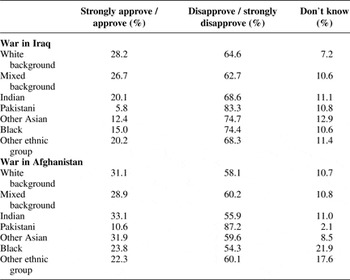
However, evidence from the British Election Study's Continuous Monitoring Survey — based on a pooled dataset of monthly cross-sectional surveys undertaken between 2004 and 2011 — shows that ethnic groups differ in their views of Britain's involvement in the wars in Afghanistan and Iraq. Table 1 shows that, for both wars, those from a Pakistani background were mostly likely to disapprove or strongly disapprove: 83.3 percent for Iraq and 87.2 percent for Afghanistan. The corresponding figures for those from a white ethnic background are lower: at 64.6 percent (Iraq) and 58.1 percent (Afghanistan). The levels of disapproval for the other minority groups vary somewhat, though those against (disapproving or strongly disapproving) comprise a majority in each case. In terms of comparing attitudes toward the wars in Iraq and Afghanistan, disapproval is higher across all groups for the conflict in Iraq. Based on the evidence presented here, there is clear evidence of differences between ethnic groups in their degree of disapproval of Britain's role in both wars, which warrant further investigation.Footnote 1
Public opinion toward the wars in Iraq and Afghanistan by ethnic group

Source: BES CMS. Weighted data.
Based on the available evidence from existing research and survey data, the following hypothesis is tested:
Hypothesis 2
Those from an Asian or British Asian — Pakistani background are less likely to approve of the war in Afghanistan than those belonging to other ethnic groups.
As well as examining group attachments based on ethnic background and religious tradition, when analyzing the domestic or foreign policy attitudes of minority groups — who are more likely to be socially and economically marginalized — it is also important to examine their engagement with the political process or general feelings of “political alienation” (Nincic and Nincic Reference Nincic and Nincic2002). In Britain, a general sense of political alienation, underpinned by “a broader social alienation and exclusion,” has clearly shaped the political role of minority groups in society (Saggar Reference Saggar2000, 98). As Nincic and Nincic (Reference Nincic and Nincic2002, 555) observe, political alienation “implies a sense of non-participation, a lack of impact upon political and policy developments. A person who does not feel represented by the political system may be less likely to support major national policies — particularly those that, like military intervention, involve costs and risks” (emphasis added). Similarly, Allison (Reference Allison2011, 673) observes that:
Those who do not trust the government or do not feel they are heard and represented are less likely to support what the government does. The effect of trust on policy opinion is especially acute for policies involving few to no directly tangible benefits, but real or perceived costs …
Accordingly, it might be expected that those who feel less engaged with the political process in Britain — as manifested in lower levels of institutional trust or political efficacy — are less likely to approve of the country's role in the war in Afghanistan. The war represents an overseas commitment that has entailed considerable expenditure on the country's military forces since 2001 as well as monetary contributions via bilateral and multilateral development assistance, with increased military deployments and casualties in recent years. The following hypotheses are tested in relation to political alienation:
Hypothesis 3
Those with lower levels of political trust are less likely to approve of the war in Afghanistan.
Hypothesis 4
Those with lower levels of political efficacy are less likely to approve of the war in Afghanistan.
As well as examining the role played by ethnic group, religion affiliation, and political alienation, this analysis builds on well-established findings from the wider literature. It examines the impact of other important sociological factors that have been found to affect public opinion on foreign policy issues in existing studies. Studies have repeatedly shown the existence of a “gender gap” in foreign policy attitudes, with women less “hawkish” in relation to military involvement abroad (Bendyna et al. Reference Bendyna, Finucane, Kirby, O'Donnell and Wilcox1996; Burris Reference Burris2008; Clarke et al. Reference Clarke, Sanders, Stewart and Whiteley2009; Eichenberg Reference Eichenberg2003; Nincic and Nincic Reference Nincic and Nincic2002). Research also demonstrates the role of age-related or generational effects in relation to foreign policy attitudes, though the findings are less clear-cut compared to those for gender (Holsti Reference Holsti2004). Foreign policy attitudes also differ by level of education (Wittkopf Reference Wittkopf1990; Holsti Reference Holsti2004). The analysis also assesses the impact of political predispositions on foreign policy attitudes, such as partisanship and left-right ideology, which represent “relatively stable and enduring political beliefs and attitudes” (Page Reference Page2006, 239). These political predispositions can act as accessible “cues” structuring views on foreign policy issues (Holsti Reference Holsti2004; Page Reference Page2006).
DATA AND METHOD
The data source for this analysis is the Ethnic Minority British Election Study (EMBES) focusing on the 2010 British General Election, and running alongside the main BES. The BES series provides an authoritative source of data on political attitudes, voting behavior, and democratic participation. The EMBES has some important features for the type of analysis undertaken here. First, the large sample size enables robust analysis of those from different ethnic backgrounds and religious faiths, including differentiating between traditions within the Muslim and Christian faiths. This is in contrast the much more limited analyses that can be undertaken with other social surveys, where there are smaller numbers of cases for minority ethnic and religious groups (see similar concerns discussed in Wilcox, Ferrara, and Allsop (Reference Wilcox, Ferrara and Allsop1993, 355); Burris (Reference Burris2008, 465)), often necessitating a dichotomous majority-minority measure of ethnic group background. While there is some opinion polling evidence specifically relating to the view of Muslims on the wars in Iraq and Afghanistan (Field Reference Field2007; Reference Field and Helbling2011), there is little information on the opinions of other religious and ethnic minorities in conventional opinion polls, which often use samples sizes of 1,000 or less. Moreover, breakdowns by ethnic group or religious tradition are often not available in the public domain, if such information was collected. Second, as the EMBES collects data pertaining to a wide range of analysis variables — building on the BES studies — it enables the influence of ethnic group and religious affiliation to be robustly assessed when accounting for a range of other explanatory factors found in the wider literature.
The EMBES 2010 consists of a post-election wave — involving a face-to-face interview and a self-completion section — and a mail-back questionnaire. Fieldwork was conducted from May to August 2010. The participants are adults aged 18 years and older. The total number of respondents (unweighted) is 2,787. The data are appropriately weighted to make the sample representative of the wider population from which it was drawn.Footnote 2
Principal Independent Variables
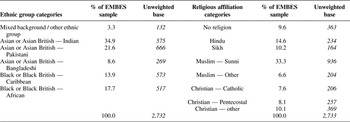
A detailed classification of ethnic group and religious affiliation is available in the EMBES survey. However, some of the groups contained small numbers of cases that did not lend themselves to robust statistical analysis. Accordingly, a revised set of categories, involving some combining of groups, is used for the analysis undertaken here. The descriptive statistics for the ethnic group and religious affiliation variables used in the analysis are given in Table 2. Ethnic background is measured as a series of dummy variables representing the major ethnic minority groups in British society (White Reference White2002). These are mixed background or other ethnic group, Asian or Asian British — Indian, Asian, or Asian British — Pakistani, Asian, or Asian British — Bangladeshi, black, or black British — Caribbean, and black or black British — African. The mixed background or other ethnic group category contains those who reported their ethnic category as any mixed background, Chinese, any other Asian/Asian British background, and any other black/black British background.
Revised ethnic group and religious affiliation categoriesa

Source: EMBES 2010. Weighted data.
a Excluding the small number of cases classified as belonging to some “other” religion.
The categories used for religious affiliation are as follows: no religion; Hindu; Sikh; Muslim — Sunni; Muslim – Other; Christian — Catholic; Christian — Pentecostal; Christian — other. The “Christian — other” category includes Anglicans Baptists, Methodists, those belonging to other denominations (such as Orthodox or Seventh Day Adventist) and those who do not belong to a particular denomination. The “Muslim — other” category includes Shi'a Muslims, those affiliated with some other tradition and those who do not belong to any particular tradition. Because the “other religion” category in the EMBES sample contained only 26 respondents, it was omitted from the analysis.
The analysis does not only examine religious tradition or “belonging,” it also examines the impact of religiosity. A data reduction analysis of three indicators of religious commitment was undertaken (perceived salience of religion, religious activities undertaken with other people, religious activities undertaken alone — see the Appendix for question wording). Those who reported having no religious affiliation — and were not therefore asked the religiosity indicators — were scored as the lowest value on each item. An exploratory Principal Components factor analysis showed that these three items loaded onto a single dimension.Footnote 3 The factor scores from the data reduction analysis are used as the religiosity variable in the analysis. In order to examine for the effects of religiosity within each religious affiliation category, a series of interaction terms are used in the analysis.
To tap into feelings of political alienation among minority groups in Britain, two indictors are used. First, an indicator measuring political trust. This is a composite scale, consisting of two items asking about level of trust in the “Parliament at Westminster” and “British politicians generally” (Cronbach's α = 0.82). Second, a measure of self-assessed political efficacy is also used (Whiteley et al. Reference Whiteley, Clarke, Sanders and Stewart2010), which asked about each respondent's perceived level of influence on “politics and public affairs.”
Other Independent Variables
The analysis includes standard demographic variables: gender (a dummy variable) and age (a continuous variable). To account for the differing spatial patterns of ethnic minority populations (White Reference White2002), controls are also included for a respondent's geographical context (a series of dummy variables based on regional location). Marital status is measured as a dummy variable.
It is important to examine the effects of political predispositions since their exclusion could lead to omitted variable bias and variance being mistakenly attributed to prior sociological factors. Party identification is measured as a series of dummy variables based on the long-standing BES question. Those who responded unsure or don't know are coded as “no party.” It is preferable to use this more durable measure of party support than voting intention or reported vote choice. Left-right ideology, traditionally the most important ideological dimension structuring British politics (Sanders Reference Sanders, Evans and Norris1999; Clarke et al. Reference Clarke, Sanders, Stewart and Whiteley2004) is measured via a “proxy” indicator of attitudes towards increasing (or decreasing) taxation and public spending. More details on the measurement of the independent variables are given in the Appendix.
Dependent Variable
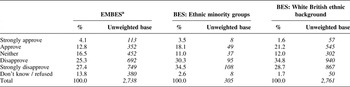
The dependent variable is a question asking about approval or disapproval of Britain's involvement in the war in Afghanistan. In line with other studies in this area, the question represents a “retrospective endorsement of military actions that had already been undertaken” (Burris Reference Burris2008, 448).Footnote 4 The question wording and response options for the approval-disapproval question are as follows: “Please indicate whether you strongly approve, approve, disapprove, or strongly disapprove of Britain's involvement in the war against the Taliban in Afghanistan. Strongly approve. Approve. Neither approves nor disapproves. Disapprove. Strongly disapprove. Don't know. Do not want to answer.” The distribution of responses to this question is shown in Table 3. Overall, a majority of disapproves of Britain's participation in the Afghanistan war (52.7 percent). A small minority (16.9 percent) approves of Britain's involvement to some degree while a similar proportion has a neutral stance (16.5 percent). The remainder of the sample offer “don't know” responses or refuse to say (15.0 percent). In the interests of wider comparison, the corresponding distributions for ethnic minority respondents and those from a white British ethnic background from the British Election Study 2010 (in-person survey, post-election wave) are shown. For both groups in the BES 2010, smaller proportions had no opinion or were less likely to choose the neutral option (less than 3.0 percent in both cases), while approval of the war in Afghanistan was somewhat higher than in the EMBES sample.
Approval or disapproval of Britain's involvement in the war in Afghanistan

Sources: EMBES 2010 and BES 2010 in-person survey (post-election wave). Weighted data.
aExcluding the small number of cases classified as belonging to some “other” religion.
Analytical Procedures
Linear regression is used as the statistical estimation technique, with the dependent variable scored from 1 through to 5, with higher values representing approval of the war in Afghanistan (mean: 2.31; standard deviation: 1.11). Higher scores therefore indicate approval of the war in Afghanistan. In order to maximize the cases available for analysis, missing data for the dependent variable are assigned the mean score.
The models are estimated using a sequential approach, whereby the explanatory factors are grouped into blocs that contain variables of a similar type. The approach assumes that variables within each given block are caused by those variables in the block or blocks that precede it (Miller and Shanks Reference Miller and Merrill Shanks1996). Adapting and simplifying Miller and Shanks's (Reference Miller and Merrill Shanks1996) multi-stage approach, three blocks of explanatory factors are employed. The explanatory variables in the first block comprise fixed personal traits — gender, age group, and ethnic group — which are determined outside of the model and are treated as exogenous. The second block consists of acquired social characteristics — religious affiliation, religiosity, educational attainment, marital status, and region. The third and final block consists of political predispositions — party identification, left-right ideological beliefs, political trust and political efficacy — which can be affected by the social and demographic factors in the first two blocks of variables. In order to maximize the cases for analysis, mean value imputation was used for the scale items used as independent variables. Using list-wise deletion would inevitably reduce the numbers of cases available for analysis — based on only those respondents giving substantive responses to all questions, who are unlikely to be representative.
RESULTS AND DISCUSSION
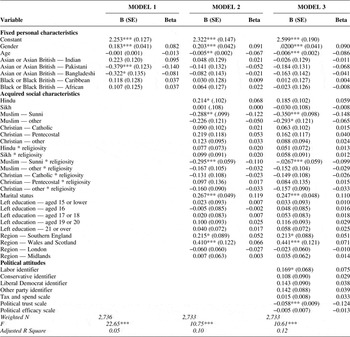
The results report the unstandardized coefficients (B), standardized coefficients (Beta) and the standard errors (in parentheses). Model fit statistics (Adjusted R 2) are shown at the bottom of Table 4. In Table 4, Model 1 includes the fixed personal characteristics; Model 2 adds the acquired social characteristics; and Model 3 includes the political attitudes. Each block of variables added to the model specification increases the proportion of variance explained by a modest amount, but the levels explained are generally low (Model 1: 5 percent; Model 2: 10 percent; Model 3: 12 percent).
Linear regression models of approval for the war in Afghanistan

Note: p ≤ 0.05 = *; p ≤ 0.01 = **; p ≤ 0.001 = ***
Reference categories: mixed background or other ethnic group; no religion; still in full-time education; region — lives in Northern England; does not support a political party.
Source: EMBES 2010. Weighted data
It is clear that the fixed personal characteristics have substantive effects in Model 1. Gender and ethnic group have significant effects. Men are more likely to support involvement in Afghanistan compared to women, underlining the well-established “gender gap” found in the analysis of wider populations. Specifically, in the wider British population, men were more supportive of the wars in Iraq and Afghanistan compared to women (Clarke et al. Reference Clarke, Sanders, Stewart and Whiteley2009; Clements Reference Clements2011). In relation to age, older people are less likely to approve of the war in Afghanistan, though the effect is not statistically significant in Model 1. In relation to ethnic background, those from an Asian or Asian British — Pakistani background are less likely to approve of the war compared to the reference category (those of a mixed background or some other ethnic group. This provides clear support for Hypothesis 2. There is a similar effect for those who are Asian or Asian British — Bangladeshi (though only significant at the 0.5 level). The greater test, though, is whether these significant direct effects remain when additional blocks of explanatory variables are added to the model.
Model 2 adds the acquired social characteristics to the fixed demographic traits, which increases the proportion of explained variance. As has often been found in public opinion and foreign policy research (Nincic and Nincic Reference Nincic and Nincic2002; Burris, Reference Burris2008), there is still a “gender gap” present in Model 2, with men more likely to approve of the war in Afghanistan. Interestingly, age now has a significant effect, with older people less approving of the war in Afghanistan (cf. Clements Reference Clements2011). In Model 2, being married — compared to other forms of relationship status — is positively-related to approval of the war in Afghanistan (significant at the most demanding level).
Importantly, ethnic background does not have any significant effects when religious-based variables are accounted for. The results for religious affiliation in Model 2 provide clear support for Hypothesis 1, as Sunni Muslims are much less likely to approve of the war compared to those of no religion (the reference category). The only other significant effect is for Hindus, who are more likely to approve of the war (but at the 5 percent level). The findings for Sunni Muslims from this analysis nuance the evidence from opinion polls of Muslims’ attitudes towards foreign policy issues (Field Reference Field2007; Reference Field and Helbling2012). Beyond the stand-alone impact of affiliation, the interactions between affiliation and religiosity are significant in the case of Sunni Muslims. Those Sunni Muslims for whom religion is particularly important in their lives and who take part religious activities more often are less likely to approve of the war in Afghanistan. This finding provides confirmation of Hypothesis 1a. It is a moot point as to whether similar relationships for religious identity would have been evident for the attitudes of the ethnic minority population in Britain towards the earlier wars in Iraq of 1991 and 2003.
Looking at the other variables, education does not have a significant impact in Model 2, which contrasts with findings from studies of attitudes in the wider British population (Clements Reference Clements2011). It should be acknowledged, though, that the measure used here is arguably not as sensitive a measure of educational attainment as is the highest qualification held by an individual, which would allow for a more finely-grained classification. The effects for regional controls show that those living in Scotland or Wales, or in Southern England, are more likely to approve of the war in Afghanistan than those residing in Northern England. The addition of acquired social characteristics increases the explanatory power of the model.
Measures of political attitudes are added in Model 3, slightly increasing the overall proportion of variance explained. The effects for gender, age, marital status, and region present in Model 2 all remain in this more robust test, both in terms of the direction of the relationship and level of statistical significance. Similarly, the strong effects for Sunni Muslims and for the interaction with religiosity are present in Model 1 (though the dummy variable for Hindus is no longer statistically significant). How do the political attitudes perform? In contrast to analysis of attitudes towards the interventions in Iraq and Afghanistan in the wider population (Clements Reference Clements2011), the party identification variables — an accessible heuristic for structuring foreign policy opinions (Wittkopf Reference Wittkopf1990; Holsti Reference Holsti2004) — perform poorly as predictors within the ethnic minority population. The only significant result is for Labor Party partisans, who are more likely to approve of the war in Afghanistan compared to those who do not support a party (at the 5 percent level). Britain's involvement in Afghanistan started in late-2001 and continued for the best part of a decade under a Labor government, so it is perhaps to be expected that their partisans ‘stayed the course’ and were more likely to express approval. It is an interesting question whether this was also the case for ethnic minority attitudes towards the conflict in Iraq, a divisive political issue during and after the invasion in 2003 and which sustained clearer elite-level cues, with the Liberal Democrats clearly positioned as the anti-Iraq war party (Whiteley, Seyd, and Billinghurst Reference Whiteley, Seyd and Billinghurst2006; Whiteley et al. 2005, 146–147). It may be that partisan affiliations held greater sway on attitudes toward the Iraq war amongst the ethnic minority population. Some minor parties also took up strong anti-war positions; in particular, the Respect Party, “born in the context of protest against the war in Iraq” (Webb Reference Webb2005, 767), campaigned strongly on this issue at the 2005 general election, winning their only parliamentary seat in an east London constituency with a high proportion of Muslim constituents. Muslim voters also switched to the Liberal Democrats in other constituencies to register opposition to the invasion of Iraq (Curtice, Fisher, and Steed Reference Curtice, Fisher, Steed, Kavanagh and Butler2005, 239–240). Accounting for partisanship, ideological beliefs do not have a significant impact in Model 3, at least using the proxy measure of attitudes toward taxation and public expenditure.
In relation to the political (dis)engagement and alienation of minority groups, political trust has a strong effect in Model 3. Those who distrust political institutions and politicians are less likely to approve of the Afghanistan war. This provides clear support for Hypothesis 3. In contrast, there is no significant effect for political efficacy, though the effect is signed in the expected direction. There is no support for Hypothesis 4. There is some evidence that those more likely to be disengaged from the political process, in this case, showing greater levels of distrust of governing institutions, are less likely to support Britain's role in the Afghanistan war. This finding is instructive in the context of Nincic and Nincic's (Reference Nincic and Nincic2002) findings in relation to minority groups and political alienation and expectations about support for foreign policy initiatives, which over time can be costly in terms of military expenditure and lives lost. Moreover, Allison (Reference Allison2011, 686) showed that political alienation decreased support for the Iraq War in the United States, but that this relationship was gender-specific and only held for women. This finding should serve to encourage further investigation of how political disengagement and alienation affects attitudes amongst ethnic minorities on domestic policy issues in Britain.Footnote 5
Overall, the evidence shows that sociological variables and political attitudes had strong direct effects on approval of the war in Afghanistan. Some of these findings underline well-established insights from the wider public opinion and foreign policy literature, including the existence of a “gender gap” in relation to military interventions (Clarke et al. Reference Clarke, Sanders, Stewart and Whiteley2009; Clements Reference Clements2011; Reference Clements2012). As in the wider British population, amongst ethnic minorities men were more supportive of military action in Afghanistan than women. However, the effects for some variables did not support findings from existing studies (the role of education). Religious affiliation had important stand-alone effects while religiosity had a significant effect when interacted with religious tradition. While Sunni Muslims were much less likely to approve of the war in Afghanistan, this effect was more pronounced for the more devout Sunni Muslims. Even when accounting for the impact of political attitudes, social characteristics — gender, age, religious-based factor and marital status — retained strong direct effects on attitudes towards the war in Afghanistan. It is evidently not the case that their impact is mainly indirect; in other words, their influence is not primarily mediated through attitudinal factors more proximate to the dependent variable. In fact, the sorts of political predispositions through which the influence of social group attachments may be mediated – such as partisanship and ideological beliefs – had weak effects overall.
CONCLUSION
This analysis makes an important contribution to the wider literature on religion and public opinion on foreign policy and to research into the political attitudes of minorities in Britain (Saggar Reference Saggar2000; Saggar and Heath Reference Saggar, Heath, Evans and Norris1999; Sobolewska Reference Sobolewska2005; Heath et al. Reference Heath, Fisher, Sanders and Sobolewska2011). The findings point the way toward widening the scope of public opinion research into the foreign policy attitudes of minority groups in Britain. For example, do minority groups in Britain possess distinctive opinions toward the European integration process (Dowley and Silver Reference Dowley and Silver2011)? Future research could also examine the attitudes of minority groups in Britain on those issues where states can exercise “soft” power, including political-diplomatic and trade-economic issues, (Page Reference Page2006). Moreover, do Muslims in Britain possess different views on Middle East issues and towards the state of Israel (cf. Guth Reference Guth2011b) compared to adherents of other religious traditions; and what is the interrelationship of religiosity and affiliation on such issues?
The focus on a single foreign policy issue is a limitation of this analysis. The lack of similar survey data for minority groups — containing suitable measures of ethnicity and religion — prevents a similar analysis of minority attitudes toward the Iraq War. The BES and EMBES surveys also do not allow scholars of public opinion research to examine the impact of more deep-rooted foreign policy beliefs, for example attitudes towards the “cooperative internationalism” dimension, on specific issues (Guth Reference Guth2009b). Another limitation of this analysis was that while it provided a robust assessment of the effects of affiliation and religiosity, it could not examine the impact of religious belief or doctrine, which would have provided a more nuanced analysis of the effects of religious identity on public opinion.
APPENDIX: MEASUREMENT OF INDEPENDENT VARIABLES
Gender: Coded as 1 if male, 0 if female.
Age group: Coded as a continuous variable ranging from 18 through to 97 (mean: 39.06; standard deviation: 14.98).
Ethnic group: Coded as a series of dummy variables (Asian or Asian British — Indian; Asian or Asian British — Pakistani; Asian or Asian British — Bangladeshi; Black or Black British — Caribbean; Black or Black British — African; mixed background or other ethnic group). Mixed background or other ethnic group is the reference category.
Religious affiliation: Coded as a series of dummy variables (Hindu; Sikh; Sunni Muslim; Muslim — other; Catholic; Pentecostal; Christian — other; no religion). Those with no religion form the reference category.
Religiosity: Factor scores from a data reduction analysis of three scales (using Principal Components). The importance of religion scale is scored from 1 to 5 while the participation in religious activities scales are scored from 1 to 6. Higher scores denote greater importance of religion and more frequent participation in religious activities, respectively.
Marital status: Measured as a dummy variable (scored as 1 if married, 0 if other).
Educational attainment: Measured as a series of dummy variables which denotes the age at which full-time education was completed (aged 15 or under; aged 16; aged 17 or 18; aged 19 or 20; aged 21 or over; still in full-time education). Those still in full-time education form the reference category.
Region: Measured as four dummy variables (Wales and Scotland, Northern England — north-west, north-east and Yorkshire, Midlands — east and west, eastern England, London, Southern England — south-west and south-east). Scotland and Wales are combined because relatively few respondents in the EMBES sample live in either country. Those living in Northern England form the reference category.
Party identification: Measured as dummy variables (Labor, Conservative, Liberal Democrat, other party, no party). Those who do not support a party are the reference category.
Tax and spend: A single-item scale ranging from 1 to 11 (mean: 6.31; standard deviation: 2.46). Higher scores denote preferences for higher taxation and public expenditure.
Political trust: A scale, based on two items asking about the “Parliament at Westminster” and “British politicians generally,” ranging from 1 to 11 (Cronbach's α = 0.84; mean: 6.00; standard deviation: 2.37). Scoring is reversed so that higher values represent lower levels of trust.
Political efficacy: A single-item scale ranging from 1 to 11 (mean: 8.33; standard deviation: 2.80). Scoring is reversed so that higher values represent lower levels of political efficacy.