Introduction
Klotho is a newly discovered, anti-ageing gene, the name of which comes from the Greek goddess Klotho who was said to spin the thread of life and destiny. The klotho gene codes for a trans-membrane protein, β-glucuronidase, which represses the intracellular signals of insulin and insulin-like growth factor.Reference Kuro-o1 Klotho-deficient mice show growth retardation and become inactive.Reference Kuro-o, Matsumura, Aizawa, Kawaguchi, Suga and Utsugi2 They also show a syndrome resembling accelerated ageing, with extensive arteriosclerosis and an average lifespan of approximately 2 months (versus 2.5 to 3 years for wild-type mice).Reference Bartke3, Reference Manya, Akasaka-Manya and Endo4 No obvious morphological abnormalities of the cochlea have been detected in klotho-deficient mice, even though klotho protein expression was undetectable and there was an obvious hearing disorder. On the other hand, klotho-overexpressing mice show a 20–30 per cent longer lifespan than wild-type mice.Reference Kurosu, Yamamoto, Clark, Pastor, Nandi and Gurnani5 Klotho acts on growth factors including insulin and insulin-like growth factor 1, and on the Wnt signalling pathway; inhibition of insulin-like growth factor 1 signalling may contribute to the anti-oxidative-stress and anti-cancer properties of klotho.Reference Kuro-o1 Mouse klotho is predominantly expressed in the kidney and the epithelium of the choroid plexus in the brain. Slight expression of klotho has also been found in the pituitary gland, placenta, skeletal muscle, urinary bladder, pancreas, testis, ovary, colon and inner ear.Reference Kurosu, Yamamoto, Clark, Pastor, Nandi and Gurnani5, Reference Kamemori, Ohyama, Kurabayashi, Takahashi, Nagai and Furuya6
Cisplatin is an effective anti-neoplastic drug widely used to treat various cancers. However, at higher doses it promotes ototoxicity by inducing apoptosis of the cochlear hair cells. It damages primarily the outer and inner hair cells, induces degeneration of the stria vascularis, and greatly reduces the number of spiral ganglion cells. Cisplatin-induced ototoxicity correlates with depletion of the cochlear antioxidant system and an increase in lipid peroxidation.Reference Rybak7 A major mechanism of cisplatin-induced toxicity involves the production of reactive oxygen species.Reference Rybak7, Reference Im, Chang, Choi, Chae, Ko and Jung8 Cisplatin can cause irreversible sensorineural hearing loss and serious tinnitus in humans, mice and other animals. Cisplatin-induced ototoxicity is a useful research model for ototoxicity and the effect of protective antioxidants.Reference Rybak7, Reference Im, Chang, Choi, Chae, Ko and Jung8
Ageing and death are not evitable in human beings. The ageing process is multi-factorial and involves genetic factors and environmental stress. The mammalian inner ear loses its sensory cells with advancing age, resulting in significant sensorineural hearing loss and vestibular disturbance. However, recent articles have proposed the presence of various reactive oxygen species and different time courses of oxidative change in individual tissues of the ageing inner ear.Reference Arking, Krebsova, Macek M, Macek, Arking and Mian9–Reference Yamamoto, Clark, Pastor, Gurnani, Nandi and Kurosu11 Thus, it would be valuable to assess the effect of klotho on reactive oxygen species in auditory cells treated with cisplatin, as this could provide evidence that klotho acts as a protective factor against cisplatin ototoxicity and/or ageing related to reactive oxygen species in the cochlea.
This study aimed to identify the expression of klotho in auditory cells treated with cisplatin, and to investigate the effect of klotho protein on cisplatin-induced auditory cell ototoxicity. Cell viability was assessed after exposure to cisplatin and various concentrations of klotho protein. To investigate the inhibitory effect of klotho protein against reactive oxygen species, under conditions of cisplatin-induced cytotoxicity, the intracellular level of reactive oxygen species was measured using a fluorescent dye.
Materials and methods
Auditory cell culture
The HEI-OC1 cell line is a representative auditory cell line which has been artificially made from mouse cochlear cells. The establishment of this cell line was facilitated by the development of a transgenic ‘immortomouse’.
Cochlear half-turns from immortomice at postnatal day 7 were cultured under conducive conditions (33.8°C) in Dulbecco's modified Eagle's medium (Gibco BRL, Grand Island, New York, USA) containing 10 per cent fetal bovine serum (JRH Biosciences, Lenexa, Kansas, USA) and 50 U/ml interferon-γ, without antibiotics. The HEI-OC1 cells are extremely sensitive to ototoxic drugs, and express several molecular markers that are characteristic of organ of Corti sensory cells.Reference Kalinec, Webster, Lim and Kalinec12 Therefore, the HEI-OC1 cell line can be a useful model with which to study the effects of ototoxic drugs such as cisplatin. The cells used in this study were maintained in Dulbecco's modified Eagle's medium with 10 per cent fetal bovine serum at 33°C under 10 per cent CO2 in air.
Klotho protein preparation
Recombinant mouse klotho protein (1819-KL) was purchased from R&D Systems (Minneapolis, Minnesota, USA).
Reverse transcription polymerase chain reaction
The expression of klotho messenger RNA (mRNA) was confirmed by semi-quantitative reverse transcription polymerase chain reaction. The glyceraldehyde-3-phosphate dehydrogenase gene (a housekeeping gene) was also used as an internal control in the polymerase chain reaction protocol.
The polymerase chain reaction primer sequence for klotho was as follows: (sense) 5′-GCTCATGGACGGTTTCGAGT, (anti-sense) 5′-GTCTGGTTACCCAGAGGCAA (where G = guanine, C = cytosine, T = thymine and A = adenine). The polymerase chain reaction protocol consisted of: (1) 94°C for 30 seconds, (2) 52–62°C for 30 seconds and (3) 72°C for 1 minute 30 seconds. This protocol was repeated for 25 cycles (for the glyceraldehyde-3-phosphate dehydrogenase control) or 35 cycles (for klotho). A polymerase chain reaction involving Taq polymerase and the primer combination, but no template, was used as a negative control.
Polymerase chain reaction products were separated on 1.5 per cent agarose gel and visualised by ethidium bromide staining. Polaroid photographs were optically scanned at 300 dots/inch and analysed using National Institutes of Health Image Software (version 1.60) and the available gel macros.
Western blot
Equal amounts of total protein were separated on 7.5 per cent sodium dodecyl sulphate-polyacrylamide gels and transferred to Immobilon (Millipore, Bedford, Massachusetts, USA). The blots were blocked for 1 hour at room temperature with phosphate-buffered saline containing 1 per cent skim milk, and then incubated with anti-klotho antibodies (R&D Systems) overnight at room temperature. A biotinylated secondary antibody was applied, followed by the avidin-biotin-peroxidase complex. The colour was developed using 3,3′-diaminobenzidine.
3-(4,5-Dimethylthiazol-2-yl)-2,5-diphenyltetrazoliumbromide assay
The uptake and conversion of 3-(4,5-dimethylthiazol-2-yl)-2,5-diphenyltetrazoliumbromide (Sigma, St Louis, Missouri, USA) to crystals of dark violet formazan depends upon cell viability.
In order to examine the effects of klotho protein on cisplatin ototoxicity in the HEI-OC1 auditory cell line, cells were pretreated with klotho protein at various concentrations for 2 hours. Cells were then incubated (105 cells per well in a 24-well plate) with 15 µM cisplatin for 48 hours. Fifty microlitres of 3-(4,5-dimethylthiazol-2-yl)-2,5-diphenyltetrazoliumbromide solution (0.25 mg) was added to 0.5 ml of cell suspension and the plates incubated for 4 hours at 33°C in 10 per cent CO2. The insoluble formazan crystals were centrifuged, and the pellets were dissolved by the addition of dimethyl sulfoxide (500 µl per well). The optical density was measured using a microplate reader at 570 nm (Spectra Max; Molecular Devices, Sunnyvale, California, USA).
Hoechst 33258 staining
The HEI-OC1 cell nuclei were stained with the chromatin dye Hoechst 33258 (Sigma). Cells were washed twice with phosphate-buffered saline and fixed with 3.7 per cent glutaraldehyde for 10 minutes at room temperature. After fixation, cells were washed twice with phosphate-buffered saline and incubated with 10 µg/ml Hoechst 33258 for 10 minutes at room temperature in the dark. After two washes, the cells were observed under an inverted fluorescence microscope (BX61; Olympus, Tokyo, Japan).
Intracellular reactive oxygen species
The intracellular level of reactive oxygen species was measured using the fluorescent dye 2',7'-dichlorofluorescein diacetate (Eastman Kodak, Rochester, New York, USA). In the presence of an oxidant, 2',7'-dichlorofluorescein is converted into highly fluorescent 2',7'-dichlorofluorescein.
For the assay, HEI-OC1 cells were cultured overnight on cover slips and then treated with 20 µM cisplatin for 48 hours in the presence or absence of klotho protein pretreatment. Cells were washed twice with serum-free medium and incubated with 5 µM 2',7'-dichlorofluorescein diacetate in serum-free medium for 10 minutes at 33°C. After washing twice with serum-free medium again, cells were fixed with 3.7 per cent glutaraldehyde for 10 minutes at room temperature. Cells were incubated with 10 µg/ml Hoechst 33258 stain for 5 minutes at room temperature in the dark. After washing twice with phosphate-buffered saline, the samples were immediately observed at excitation wavelength 387 nm. The fluorescence intensity was then measured at excitation wavelength 485 nm and emission wavelength 538 nm, using a long-term, real-time, live cell image system (Lambda DG-4; Sutter Instruments, Novato, California, USA). One hundred micromoles per litre of H2O2 was used as a positive control.
Statistical analysis
All values are represented as means ± standard deviation. Data analysis was performed using the Statistical Package for the Social Sciences version 17.0 software program (SPSS Inc, Chicago, Illinois, USA). For statistical comparisons, one-way analysis of variance was used for multiple comparisons and independent samples t-testing for pairs of data. A p value of less than 0.05 was considered statistically significant.
Results
Effect of cisplatin on klotho messenger RNA expression
Semi-quantitative reverse transcription polymerase chain reaction analysis showed that the expression of klotho mRNA in cells treated with cisplatin was significantly greater than in normal auditory cells (Figure 1). The ratio of expression levels was measured by performing densitometry on a photographic image of the reverse transcription polymerase chain reaction gel strip. The klotho mRNA integrated density expression ratio was 69.9 ± 4.0 in cisplatin-treated cells, significantly greater than the 55.5 ± 7.8 seen in the control (p < 0.01; results from nine separate experiments) (Figure 1).
(a) Reverse-transcription polymerase chain reaction results for klotho messenger (m) RNA (mKlotho) in normal auditory cells (‘control’) and cells treated with cisplatin. Glyceraldehyde-3-phosphate dehydrogenase (GAPDH) was used as an internal control. Klotho mRNA was expressed in both normal and cisplatin-treated cells. (b) Comparison of densitometry results, showing that klotho mRNA expression was significantly greater in cisplatin-treated versus non-treated cells; *p < 0.01, results from nine separate experiments.

Effect of cisplatin on klotho protein expression
Western blotting revealed that klotho protein was expressed in both cisplatin-treated and non-cisplatin-treated auditory cells. However, the klotho protein integrated density expression ratio was 212.4 ± 20.0 in the cisplatin-treated cells, significantly greater than the 168.8 ± 14.7 seen in the non-treated cells (p < 0.01; results from five separate experiments) (Figure 2).
(a) Western blot results for klotho and β-actin in normal auditory cells and cells treated with 15 µM cisplatin. (b) Comparison of densitometry results showing that the klotho protein expression was significantly greater in cisplatin-treated than non-treated cells; *p < 0.01, results from five separate experiments.

Effect of klotho protein on cell viability
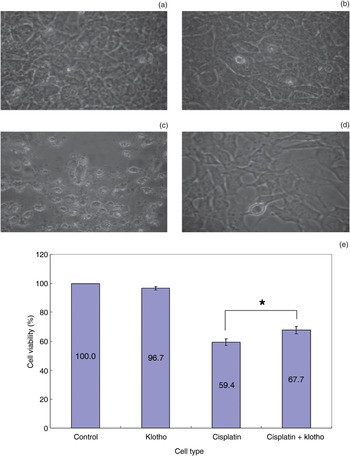
Light microscopy identified a similar cell growth pattern in incubated auditory cells grown with and without klotho protein (Figures 3a and 3b). However, dead and floating cells were observed amongst the cisplatin-treated cells (Figure 3c). Pretreatment with klotho reduced the number of these dead cells (Figure 3d).
(a) to (d) Light microscopy photomicrographs of auditory cell growth showing: (a) normal cells grown in growth medium alone; (b) cells treated with klotho protein alone; (c) cells treated with cisplatin alone; and (d) cells treated with 2 nM klotho (2 hours) then 15 µM cisplatin (48 hours) (×20 for all). (e) Comparison of 3-(4,5-dimethylthiazol-2-yl)-2,5-diphenyltetrazoliumbromide assay results, showing significantly greater cell viability in cells treated with both klotho and cisplatin (67.7 per cent), versus cells treated with cisplatin alone (59.4 per cent); *p = 0.031, results from five separate experiments in triplicate.

3-(4,5-Dimethylthiazol-2-yl)-2,5-diphenyltetrazoliumbromide assay indicated that the viability of HEI-OC1 auditory cells incubated in appropriate growth medium with and without klotho protein was quite similar; the presence of klotho protein did not appear to affect cell growth (Figure 3e). However, cisplatin treatment caused significant auditory cell death, resulting in cell viability of only 59.4 ± 7.1 per cent (Figure 3e). After pretreatment with klotho protein for 2 hours, auditory cells appeared to be significantly protected from cisplatin-induced cytotoxicity, showing a cell viability of 67.7 ± 7.9 per cent at a concentration of 2 nM (p = 0.031; results from five separate experiments performed in triplicate) (Figure 3e).
Effect of klotho protein on reactive oxygen species
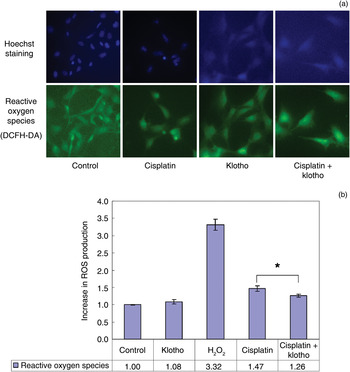
To create a negative control, the nuclei of HEI-OC1 cells incubated without cisplatin or klotho were stained with the chromatin dye Hoechst 33258, and the intracellular level of reactive oxygen species was measured using the fluorescent dye 2',7'-dichlorofluorescein diacetate (Figure 4a).
(a) Photomicrographs showing staining for nuclei (Hoechst 33258, blue) and intracellular reactive oxygen species (2',7'-dichlorofluorescein diacetate (DCFH-DA, green) in: control cells (normal auditory cells grown in growth medium); cells treated with cisplatin alone; cells treated with klotho alone; and cells treated with klotho then cisplatin (×20 for all). (b) Comparison of increase in reactive oxygen species (ROS) production (compared with control) in: control cells; cells treated with 2 nM klotho alone; positive control (100 µM H2O2); cells treated with 15 µM cisplatin (48 hours); and cells treated with 2 nM klotho (2 hours) then 15 µM cisplatin (48 hours). *p < 0.05; results from five separate experiments.

In order to investigate the effect of klotho protein on cisplatin-induced generation of intracellular reactive oxygen species, HEI-OC1 cells were treated with 15 µM cisplatin for 48 hours in the presence or absence of klotho. One hundred micromoles per litre of H2O2 was used as a positive control.
Compared with the negative control, cisplatin treatment increased the level of reactive oxygen species production by a factor of 1.47 ± 0.08 (Figure 4b). Pretreatment of the cisplatin-treated cells with klotho significantly reduced their reactive oxygen species production (production was increased by a factor of 1.26 ± 0.05 compared with the negative control), compared with cells treated with cisplatin alone (p < 0.05; results from five separate experiments). The inhibitory effect of klotho protein on intracellular reactive oxygen species production due to cisplatin ototoxicity is summarised in Figure 4(b).
Discussion
To our best knowledge, this study is the first to investigate the protective effects of klotho protein against cisplatin-induced ototoxicity, using the HEI-OC1 auditory hair cell line, an excellent experimental model for ototoxicity. We found that klotho protein significantly attenuated cisplatin-induced increases in reactive oxygen species production, and increased the viability of cisplatin-treated cells. We believe that the anti-apoptotic effect of klotho protein is due to inhibition of reactive oxygen species production, a major mechanism of cisplatin-induced ototoxicity.Reference Rybak7, Reference Im, Chang, Choi, Chae, Ko and Jung8, Reference Rybak, Whitworth, Mukherjea and Ramkumar13
Many studies have described the beneficial effect of klotho protein, including its inhibition of reactive oxygen species production. Klotho inhibits the insulin and insulin-like growth factor 1 signalling pathway and also moderates inhibition of this pathway, which is one of the mechanisms for suppressing ageing.Reference Tatar, Bartke and Antebi14 This inhibition lead to a decrease in the level and activation of phosphorylated Forkhead box O transcription factor, and an increase in superoxide dismutase type 2 expression, leading to a reduction in oxidative stress.Reference Kuro-o1, Reference Bartke3, Reference Brunet, Bonni, Zigmond, Lin, Juo and Hu15 It is quite clear that klotho overexpression induces resistance to oxidative stress.
In our study, expression of klotho mRNA and protein was greater in auditory cells treated with cisplatin, compared with non-treated cells. This observation supports the theory that klotho acts as a protective factor against various pathological conditions in the cochlea.
Klotho protein is also known to act as a circulating hormone, and is predominantly expressed in the kidney, the choroid plexus of the brain and the stria vascularis of the cochlea. The klotho gene is expressed in a limited number of tissue types, but klotho deficiency causes extensive ageing in nearly all tissues and organs.Reference Wang and Sun16 Thus, klotho may function as a hormone that acts on tissues that do not express klotho.Reference Xiao, Zhang, Zheng and Gu17 However, the main source of circulating klotho, and its action mechanism, are still unknown.Reference Wang and Sun16
• This study assessed the protective effect of klotho against cisplatin ototoxicity in HEI-OC1 auditory cells
• In cisplatin-treated cells, klotho reduced reactive oxygen species production and increased cell viability
• Inhibition of reactive oxygen species may be the main mechanism of this effect
Our study used the HEI-OC1 auditory cell as an in vitro model. Thus, systemic hormones and circulating factors had no influence on our findings. We observed local expression of klotho in response to cisplatin application. We believe that klotho may act both in an endocrine fashion, arising from its systemic origins, and a paracrine fashion, arising from the stria vascularis.
Our study provides evidence of the protective effect of paracrine klotho, but is limited by lack of evaluation of systemic klotho effects.
Further evidence is needed to confirm the origin of klotho and its mechanism of action (i.e. paracrine and/or endocrine). In addition, the overall effect of klotho should be evaluated under in vivo conditions.
Conclusion
Klotho protein can play a protective role against cisplatin-induced ototoxicity in the HEI-OC1 auditory cell line, and this protection could be due to inhibition of oxidative stress. The possible roles of klotho protein in inhibiting reactive oxygen species production and retarding ageing should be evaluated and confirmed, in order to advance our understanding of its potential therapeutic value for humans.
Acknowledgements
This study was supported by the National Research Foundation of Korea (grant funded by the Korean Government Ministry of Education, Science and Technology), the Basic Research Promotion Fund (grant number NRF-2010-013-E00015) and the Institute of Communication Disorder at Korea University.