The genus Afzelia and the Belitung ship
In a previous article,Footnote 1 I have suggested that the Belitung shipFootnote 2 was very probably not of Arabian origin, but more likely originated from Southeast Asia. More recently, I have researched this question in greater depth, and have found further evidence to support my conclusion. Indeed, there is only one piece of evidence which has been claimed to connect the Belitung ship clearly with Arabia, the evidence of the woods from which the ship was constructed: “It all boiled down to identifying the various woods used in her construction and their native distribution”.Footnote 3 The connection with Arabia is nevertheless far from clear. The woods identified as being used in the ship do not, in fact, come from anywhere very near Arabia. The two critical identifications are of Afzelia africana and Afzelia bipindensis.Footnote 4 Neither of these trees is Arabian: their areas of natural distribution are in West and Central Africa. This presents a problem, for it is difficult to see how sufficient timber of these trees to be useful for shipbuilding could have been transported to anywhere in Arabia during the early ninth century. The question must arise of whether these identifications of wood from the Belitung shipwreck are reliable. In order to understand fully the implications of these wood identifications, it is necessary to place them in context.
Firstly, it is essential to look at the genus Afzelia Smith and its worldwide distribution, as well as the areas of distribution of the various species of the genus.Footnote 5 The first point that must be made is that, contrary to claims repeatedly made by Dr Michael Flecker, the genus Afzelia is not confined to Africa: it is not “native to Africa and nowhere else”.Footnote 6 In reality, the genus occurs not only in Africa but also in Southeast Asia. Species of the genus Afzelia were formerly assigned to different genera. There was also a certain amount of confusion regarding the correct application of the name Afzelia, which, at various times, has been assigned to a genus of mosses and to a genus of herbaceous plants. All confusion was fully resolved in 1950, however, with the publication of a complete revision of Afzelia. This merged the genera Afrafzelia Pierre and Pahudia Miq. with Afzelia, recognising fifteen species in the genus.Footnote 7 Six of these species occurred in Southeast Asia (with one extending into south China), the other nine were of African distribution. Since 1950, several species then recognised as distinct have been merged. This left four recognised species in Southeast Asia and seven in Africa. In 1972, Afzelia parviflora (Vahl) Hepper was published. This was a new name in the genus Afzelia, but it did not relate to a completely new species. Afzelia bracteata Vogel ex Benth. was given as a synonym of A. parviflora.Footnote 8 These two names therefore appear to relate to only a single species.Footnote 9
The African species of Afzelia are:
1) Afzelia africana Pers.
2) Afzelia bella Harms
3) Afzelia bipindensis Harms
4) Afzelia bracteata Benth. [probably not distinct from A. parviflora]
5) Afzelia pachyloba Harms
6) Afzelia parviflora (Vahl) Hepper
7) Afzelia peturei De Wild.
8) Afzelia quanzensis Welw.
The Southeast Asian species are:
9) Afzelia javanica (Miq.) J. Léonard
10) Afzelia martabanica (Prain) J. Léonard
11) Afzelia rhomboidea (Blanco) S. Vidal
12) Afzelia xylocarpa (Kurz) Craib
The two species identified as being involved in the construction of the Belitung ship are Afzelia africana and A. bipindensis. However, as stated above, this must be regarded as problematic. Both these species are essentially plants of tropical West and Central Africa. It has been claimed that they are East African,Footnote 10 but this is erroneous. A. africana is recorded from no further east than Uganda, the extreme west of Kenya, and the extreme north-west of Tanzania.Footnote 11 This has been recognised as a problem, and an attempt has been made to explain it: “Afzelia africana is a heavy, dense hardwood that a thousand years ago grew all across sub-Saharan Africa”.Footnote 12 Regrettably, no evidence is supplied to support this claim, which is very unlikely to be true. There is in reality no good reason to think that A. africana occurred substantially further east some 1,200 years ago than it is now recorded to do. It is indeed likely that A. africana was formerly more abundant within its area of distribution, but there is nothing to suggest that its area of distribution was significantly larger in about the year 800:
In the course of the last 1,000 years man has had a devastating influence on the vegetation [of East Africa] by destruction of forest, burning woodlands and overgrazing. It would, however, be an over-simplification to assume that without human interference East Africa would have been completely covered by forest. The opening up of the vegetation is of much older age and is the consequence of the gradual desiccation of Africa which started at least during the world wide cooling in the end of the Miocene (5Mya). This is also testified by the fauna of alcelaphine antelopes which are highly adapted to this open type of vegetation.Footnote 13
Moreover, there is a species of Afzelia which is widespread in eastern Africa, from Kwazulu Natal in the south to as far north as southern Somalia. If Arabian shipbuilders had wanted to use Afzelia wood, it is certainly timber from this tree which would have been most easily accessible to them. This species is A. quanzensis. It is a good timber for shipbuilding, resistant to teredo worm.Footnote 14
Afzelia africana occurs as far northeast as southern South Sudan. It is just possible to believe that timber of A. africana might have been floated down the Nile from this region, although this would have been a long and difficult journey. Moreover, it would also have been necessary somehow to transport the timber from the Nile to, presumably, the west coast of the Red Sea. There is in fact evidence that wood for shipbuilding was, at one time, carried from the Nile to the Red Sea, but the woods involved came up the Nile, not down it. It is also likely that such timber was mainly used for repairs, rather than for building ships from scratch.Footnote 15 It has been suggested that the timber of Afzelia africana is so heavy that it must have been sawn where it was felled, “making planks and frame blanks on the spot”.Footnote 16 This seems very unlikely to have happened in Central or West Africa during the early ninth century. Nevertheless, it is perhaps more or less possible to envisage timber of Afzelia africana somehow being transported to the Red Sea, but it is really quite impossible to see how significant quantities of timber of Afzelia bipindensis could have made such a journey. Afzelia bipindensis has a more restricted area of distribution than A. africana. It does not extend any further north and east than the Democratic Republic of the Congo. Its use in shipbuilding in Arabia seems extremely unlikely. It must be emphasized that there is absolutely no evidence that timber of either Afzelia africana or A. bipindensis was ever transported to anywhere in Arabia, at least before modern times.Footnote 17 The dunnage in the Belitung ship was also identified as Afzelia africana. Dunnage is brushwood used as packing around cargo. The dunnage of the Belitung ship is described as “branches … placed between the hull planks and the ceiling in several places”.Footnote 18 Normally, such dunnage would consist of material readily available locally when the ship was loaded. It is very difficult to understand how branches of Afzelia africana could have been used as dunnage. It is far more probable that the identifications of wood samples from the Belitung ship as Afzelia africana and particularly as A. bipindensis are erroneous Indeed, it is admitted that, although the identifications to generic level are believed to be correct, there is room for doubt about the species.Footnote 19
In contrast, there is a considerable amount of evidence that, from an early period, timbers from India, particularly teak (Tectona grandis L.f.), were regularly carried to Arabia and as far as the west coast of the Red Sea. Teak is an excellent wood for shipbuilding.Footnote 20 It must therefore be wondered why shipbuilders in Arabia would have wished to use timber of Afzelia when teak was far more easily available to them. Teak has been identified at the site of Berenike on the west coast of the Red Sea, dating from the late Roman period.Footnote 21 The Periplus Maris Erythraei also records that teak was exported westwards from Barygaza (Broach, Bharuch) in northwest India, along with other woods: ebony (probably Diospyros ebenum J. Koenig ex Retz.)Footnote 22 and North Indian Rosewood (Dalbergia sissoo DC.).Footnote 23 Teak has also been identified at al-Balīd in southern Oman, dating from about the eleventh century.Footnote 24 Some of the wood from the Belitung ship (the through-beams) have been identified as teak by two different experts (Jugo Ilic of CSIRO and Professor Nili Liphschitz of Tel Aviv University).Footnote 25 Teak must therefore have been available to the builders of the Belitung ship. If they did not use it more extensively, this must surely have been because, in the location where the ship was built, teak was not as readily available as Afzelia timber. This would not have been the case anywhere in Arabia, or, indeed, India, but might well have been the case in some parts of Southeast Asia. Both Afzelia javanica and A. rhomboidea grow in Sumatra,Footnote 26 but teak is believed not to be native to Indonesia. It may have been introduced there no more than about six centuries ago.Footnote 27 Its natural area of distribution in Southeast Asia is apparently more northerly, principally in Myanmar and Thailand. It must also be wondered why there are apparently no Arabian timbers in the Belitung ship (not even as dunnage).Footnote 28 Local trees which have been used in shipbuilding in Arabia include Acacia nilotica (L.) Delile and A. indica (a synonym of A. farnesiana (L.) Willd.), Prosopis cineraria (L.) Druce, and Ziziphus spina-christi (L.) Desf.: “wherever it was possible, shipbuilders reverted to local wood; the advantages were obvious compared to the expense of buying the timber from abroad”.Footnote 29 The Belitung ship foundered not far from the east coast of Sumatra.Footnote 30 It is distinctly possible that it was heading for a home port somewhere on that island. It may be noted that there are other features which suggest a connection between the ship and Southeast Asia, including the fibres used for stitching and wadding,Footnote 31 a lump of resin recovered from the wreck,Footnote 32 a piloncito coin,Footnote 33 a scales bar and weights, and a grindstone with roller.Footnote 34 All these were probably of Southeast Asian origin.
Wood identification is far from being an exact science. Attempts have been and continue to be made to use DNA for identifying plants to species level, but although “the ambitious idea of using a short piece of DNA to tell every species in the world apart … is already a powerful tool for scientists studying animals … for plant biologists, the idea has for the most part remained a pipe dream …”.Footnote 35 In any case, such a technique would probably not work for wood, which usually contains little DNA,Footnote 36 especially after it has been lying on the seabed for more than a millennium. The methodology of identifying wood is comparative: samples of wood to be identified are compared with samples of known origin. This is a technique which requires considerable experience and expertise, and is moreover highly dependent on the availability of samples for comparison. Most experts in the field of scientific wood identification would say that it is rarely possible to identify wood to species level. Usually, the best that can be done is to identify to the level of genus, or sometimes to a group of species within a genus.Footnote 37 “Isolated pieces of wood usually cannot be identified to species, and often not to a single genus”.Footnote 38 This is the case with new timber in perfect condition, and must surely be even more the case when wood has been submerged beneath the sea for almost 1,200 years. Usually, it is only possible to be confident about identifications at species level when a tree species has no close relatives (particularly when it is the only species of its genus), or when only one species of a genus occurs in the area from which the wood is known to have originated. Teak is an example. Tectona grandis is not the only species of its genus, but there are only two other species of Tectona. Both are of limited distribution and have rarely been used as timber.Footnote 39 It is therefore possible to conclude that any wood identified as Tectona is very likely to be Tectona grandis. If it is known to have come from India, then it can only be Tectona grandis, as the other two species do not occur there.
As the question of the availability of samples of known identity for comparison is fundamental, I contacted Professor Nili Liphschitz and enquired what collection(s) or database(s) of wood samples she had used when making her identifications of wood from the Belitung ship. She informed me that she had used the InsideWood database.Footnote 40 This is almost certainly the best possible choice, as this database is extremely large. As far as I am aware, it is the largest currently available. However, it is not comprehensive. It does not include samples of every woody species of plant.Footnote 41 Indeed, the InsideWood database warns that:
Wood is variable, and most descriptions are based on only a few samples. Consequently, the database description may not represent the full variability of a species. Although this database is relatively large, certainly not all woody species are represented; an unknown wood may belong to a species not represented in the database.Footnote 42
As far as the genus Afzelia is concerned, a check has shown that the InsideWood database includes information about eight species.Footnote 43 One of them, however, is “Afzelia bipinnata” a species which does not exist. Presumably this is an error for Afzelia bipindensis. Thus, the database has information about seven of eleven species of the genus Afzelia. This certainly means that the identifications of Afzelia wood from the Belitung ship cannot be reliable at species level, for no less than four of eleven species are not represented in the database and therefore cannot have been taken into consideration by Professor Liphschitz. It is also worthwhile to note that the database includes information about five of the seven African species (about 71%), but only two of the four Southeast Asian species (50%). Neither Afzelia javanica nor A. martabanica are included. The database is therefore clearly biased in favour of the African species of the genus.
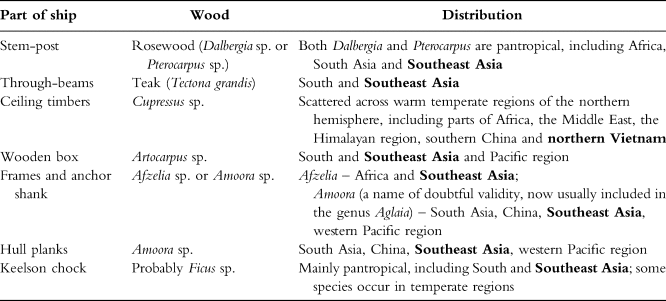
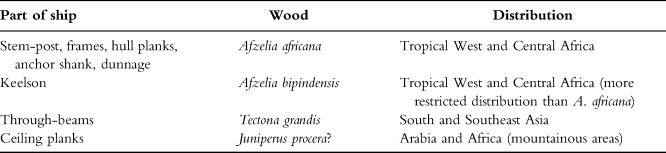
Once it is accepted, as it must be, that the identifications of the species of Afzelia cannot be reliable, the possibility arises that the Afzelia timber in the Belitung ship came from one or more of the Southeast Asian species. Indeed, if all identifications to species level are ignored, and only the identifications of genera are retained, then a Southeast Asian origin of the ship is very clearly suggested. With a single exception, Southeast Asia is, in fact, the only area of the world where all the genera identified as having been used in the construction of the Belitung ship occur (see Tables 1 and 2). The sole exception is the genus Juniperus, used for the ceiling planks (according to Professor Liphschitz), but it is entirely possible that the ship could have picked up juniper wood in China. Juniperus chinensis L. is a tree up to 25 m (80 ft) tall which occurs in many parts of China, including the southeastern coastal provinces of Guangdong and Fujian.Footnote 44 The ceiling planks may well have been removable, and were possibly cargo rather than an integral part of the ship.Footnote 45 Contrary to what has been asserted,Footnote 46 the evidence of the woods, fibres and resin strongly suggest a Southeast Asian origin of the Belitung ship.
Identifications of wood from the Belitung shipwreck according to Jugo Ilic, CSIRO (Source: Michael Flecker, “A ninth-century AD Arab or Indian shipwreck in Indonesia: First Evidence for Direct Trade with China”, World Archaeology XXXII, 3 (2001), p. 347).

Identifications of wood from the Belitung shipwreck according to Professor Nili Liphschitz, Tel Aviv University (Source: Michael Flecker, “A 9th-century Arab or Indian shipwreck in Indonesian Waters: Addendum”, International Journal of Nautical Archaeology XXXVII, 2 (2008), p. 385).

This, however, is claimed to conflict with the evidence of the construction technique of the ship. To put this in context, it must be clearly realised that what is known of the techniques of shipbuilding in relevant regions during the early ninth century is extremely limited.Footnote 47 Only very few remains of ships from approximately this period have ever been found.Footnote 48 This makes coming to any definite conclusions based on construction technique highly problematic. It is not unreasonable to say that the possibility of the Belitung ship having been built in Southeast Asia, or even in south China, has been ruled out much too readily. For example, it seems to have been overlooked that sewn-plank vessels were still being built in some parts of south China at least as late as the twelfth century. According to Zhou Qufei, writing in about 1178: “In the remote coastal prefectures of Guangdong, it is difficult to obtain iron nails and tung oil,Footnote 49 so when ships are built they are all constructed by making holes in the planks and binding them together with rattan”.Footnote 50 There is no detail of exactly how these ships were built, but it is clear that sewn-plank ships of some kind continued to be constructed in parts of south China until long after the time of the Belitung ship.
Nevertheless, it does not seem very likely that the Belitung ship was built in China (although perhaps it might have originated in Jiaozhou 交州, now northern Vietnam, which, during the ninth century, was part of the Tang Empire). An anchor found with the wreck was made of iron and wood, and incorporated a cast iron weight which can only have come from China, although the overall design of the anchor is not recognisably Chinese.Footnote 51 On the other hand, nothing very similar to the anchor from the Belitung ship has ever been found in the western Indian Ocean, either. Anchors of “Indo-Arabian” type, found from the coast of Oman to the western coast of India and off Galle in Sri Lanka, have stone shanks pierced by holes believed to have been used for attaching arms, and perhaps stocks, which were probably wooden.Footnote 52 Traces of wood have only very rarely been found associated with these anchors, however.Footnote 53 It has been suggested that the anchor depicted in one of the illustrations from the Maqāmāt of al-Ḥarīrī is a “composite grapnel-type anchor”, similar to the anchor from the Belitung wreck.Footnote 54 In contrast, it has also been said that what this same illustration depicts “is certainly an iron anchor”.Footnote 55 The correct interpretation of the illustration is less than clear. It must also be pointed out that it is not certain that the ship illustrated is Arab, or Perso-Arabian. It could be Indian.Footnote 56 Nor is it contemporary with the Belitung ship: the illustration dates from some four centuries later. In any case, an anchor might have been picked up at any port which a ship happened to put in to during the course of its voyaging. The evidence of the anchor does not connect the ship with the western Indian Ocean.
In fact, details of the construction technique of the Belitung ship seem to have parallels in the eastern Indian Ocean. One distinctive feature of the Belitung ship is the method of sewing its wooden components together. Holes were bored right through the wood, so that, after stitching, the stitches were visible on both sides. Wadding was placed beneath the stitching both inboard and outboard. There is no trace of dowels or treenails.Footnote 57 This technique is not known to have been used in the western Indian Ocean, where stitches are visible outboard but are wadded only inboard, and where dowelling is normal.Footnote 58 Holes for dowels or treenails have been found in teak timbers, probably originally from ships, found at the site of Berenike.Footnote 59 These date from the late Roman period, so this technique appears to have been known and used in the western Indian Ocean region well before the ninth century. Indeed, there is evidence that it was already in use during the Middle Kingdom period of ancient Egypt in ships which sailed the Gulf of Suez.Footnote 60 Most of the ship timbers found at al-Balīd were also dowelled.Footnote 61 On the other hand, stitching with wadding both inboard and outboard is known to have been used in Sri Lanka,Footnote 62 and may still be used today on the east coast of India.Footnote 63 The boats known as masulas, which are recorded from various sections of this coast, resemble the Belitung ship in a number of ways. Not only are many of them sewn with wadding both inboard and outboard, without dowels or treenails, but they are double-ended and have through-beams (crossbeams).Footnote 64 There is, then, clear evidence that construction techniques similar to that of the Belitung ship can be associated with the eastern Indian Ocean, from Sri Lanka into the Bay of Bengal.
Perhaps, then, the Belitung ship may have originated in or near what is today Myanmar. Both Afzelia martabanica and A. xylocarpa occur in parts of Myanmar.Footnote 65 It would not be surprising to find construction techniques used on the eastern coast of India also appearing on the other side of the Bay of Bengal. It has been suggested that there was “convergence” between polities on both sides of the Bay well before the ninth century.Footnote 66 Unfortunately, there seems to be little information about shipbuilding in Myanmar in early times. Another possibility that must be considered is that the Belitung ship might have been constructed in Southeast Asia by South Asian craftsmen, using local materials. Chinese sources record the presence in Chinese ports of ships from Sri Lanka and India, and also the presence of South Asians in China, who were sufficiently well established to have built their own temples:
The South Sea bo 舶 are foreign ships. Every year they arrive at Annan [northern Vietnam] and Guangzhou. The largest are those of Sri Lanka.Footnote 67 Ladders are used to ascend and descend several tens of feet [to board and disembark], and they are filled with precious goods. When they arrive, the local circuit reports it to the throne. … When these ships have set out on the sea route, they always keep white pigeons as messengers. If a ship sinks, the pigeons can return even over a distance of several thousand li 里.Footnote 68
Clearly, these large ships from Sri Lanka impressed the Chinese. There is also a record of an Indian Buddhist who, in about 750, had been at a temple in Guangzhou for at least 30 years. The same source reports “innumerable” Indian and other foreign ships on the river at Guangzhou, and Sri Lankans and many other kinds of foreigners in the town. Guangzhou boasted three “Brahmin” (probably Hindu) temples, with Indian monks.Footnote 69 It is entirely possible that Sri Lankans and other South Asians might also have settled, at least temporarily, at ports in Southeast Asia, as they had apparently done in Guangzhou. They may have built ships using local timber, or Southeast Asian shipbuilders might have been influenced by South Asian techniques. There is considerable evidence of South Asian influences in Southeast Asia, from a period well before the ninth century.Footnote 70 The Chinese seem to have been impressed by the size of the very large Sri Lankan ships, so perhaps Southeast Asians were, too, and sought to copy them.
During the Tang period (618–907), China and various South Asian states exchanged embassies on numerous occasions. It was not only a question of the Tang court receiving foreign missions. Chinese envoys travelled to Maghada on the northwest side of the Bay of Bengal. It is even reported that a Chinese envoy who met with a hostile reception in Maghada captured the king of the country (with help from Tibetans and Nepalese) and brought him back to China. Chinese contacts with South Asia seem to have ceased after the rebellion of An Lushan in 755,Footnote 71 but this would not have affected contacts between South and Southeast Asia. It is also relevant that the Indian religion of Buddhism spread to China, and undoubtedly exercised a considerable effect on relations between China and South Asia.Footnote 72 In Southeast Asia, both Buddhism and Hinduism exerted great influence.Footnote 73 Relations between South Asia, Southeast Asia and China were complex and did not depend solely on trade.
The cargo of the Belitung ship clearly suggests that it had loaded in a Chinese port.Footnote 74 A substantial part of the cargo consisted of Chinese ceramics. Virtually nothing at all was recovered from the wreck which suggested a connection between the ship and Western Asia: “A tiny blue glass bottle may be the only surviving artifact of Middle Eastern origin”.Footnote 75 One bowl is inscribed with a Chinese date equivalent to 826.Footnote 76 The ship therefore cannot have sunk any earlier than this year, and possibly several years after this date. The question then arises of what the intended destination of the cargo may have been. This really cannot be answered with very much certainty, as Chinese ceramics were traded, at various periods, to many parts of the world. By the ninth century, they were making their way as far as the coast of East Africa, although there is no evidence that they did so directly.Footnote 77 The cargo of the Belitung ship might have been destined for a port on the Persian Gulf, or in the Gulf of Aden. Equally, however, it might have been on its way to a Southeast Asian port. One possibility is Barus. If the ship was on its way to the Sunda Strait when it sank, as seems clearly possible,Footnote 78 then Barus might at least have been a port of call on its intended route. Very considerable quantities of sherds of Chinese ceramics, dating from at least as early as the mid-ninth century, possibly somewhat earlier, have been found at the site of Lobu Tua, Barus.Footnote 79 Chinese ceramics have also been found recently at Bengkulu on the west coast of Sumatra.Footnote 80 This port was very probably on the itinerary from China to India and beyond as given by Jia Dan 賈耽 in about 800, and may well be the Kalāh mentioned in Arabic works.Footnote 81 The Early Middle Chinese pronunciation of Geluo 箇羅, which probably should be identified with modern Bengkulu, was kâlâ.Footnote 82 There can be little doubt that Chinese Geluo should be identified with Arabic Kalāh. Locating this port is more contentious. It has usually been placed somewhere on the Malay Peninsula, and has been most convincingly identified with Kra.Footnote 83 All such identifications are guesses, however, based on vague phonetic similarity and the erroneous assumption that, throughout most of recorded history, the Strait of Melaka was regularly used by ships sailing between the Indian Ocean and the South China Sea. If Jia Dan's itinerary is correctly interpreted, however, it reveals that Geluo was on the west coast of Sumatra. In reality, the Sunda Strait was the normal route until long after the ninth centuryFootnote 84 (which perfectly explains the location of the Belitung shipwreck). What Tomé Pires reported in the early sixteenth century was correct:
Before the channel of Malacca was discovered they [Gujarati traders] used to trade with Java round the south of the island of Sumatra. They used to go between Sunda and the point of Sumatra island and sail to Grisee [Gresik in eastern Java] … and came back very rich men. It is not a hundred years since they gave up this route.Footnote 85
Of course, if the ceramics on the Belitung ship were destined for Kalāh or Barus, this does not necessarily mean that they would have remained there. Goods were frequently traded onwards.Footnote 86
Finally, it must be pointed out that the voyage of the Jewel of Muscat, a “reconstruction” of the Belitung ship,Footnote 87 proves virtually nothing. It shows only that a ship of sewn-plank construction might have made a voyage from the Persian Gulf to Southeast Asia, but certainly not that any such ship actually did so during the ninth century. Moreover, the Belitung ship was carrying a heavy cargo. It is not clear that the Jewel of Muscat could have made the voyage similarly laden. In fact, the Jewel of Muscat did not successfully complete its voyage from Oman to Singapore. It had to be towed some 145 nautical miles into the Indian port of Kochi (Cochin) by an Indian Coast Guard vessel, the ICGS Lakshmi Bai.Footnote 88 This was probably not a failing of the ship, however. It happened because the ship left Oman at the wrong time of year, and therefore had problems with the wind.Footnote 89 It was reported that “there was no favourable wind that would steer it in the direction of Kochi”: the wind had fallen to only 0.7 knots.Footnote 90 A similar problem recurred in the Strait of Melaka, and once again the ship had to be towed into Port Klang.Footnote 91 More significant is the fact that the archaeological excavation of the Belitung shipwreck did not provide sufficient information for a replica of the ship to be built. Several parts of the ship were missing, including its stern and the masts and rigging. “To fill in blanks, clues were derived from medieval texts, iconography, ethnographic sources and naval architecture principles”.Footnote 92 Of course, most of this additional information was not contemporary with the Belitung ship. The shape of the hull of the “reconstruction” also does not appear to match that described by Flecker. He considered that it was a “broad-beamed but shallow drafted ship”, and sketched its cross-section as almost flat-bottomed, with a shallow keel.Footnote 93 The Jewel of Muscat, however, is much less flat-bottomed.Footnote 94 The original Belitung ship was, in fact, too flat-bottomed and broad in the beam to be an ocean-going vessel. It would have been very unsafe in blue water. Being so broad in the beam, with a shallow keel, it would have rolled heavily in the slightest swell. Essentially, such a ship was suitable only for sailing inland waters, and for coasting in fair weather.
In conclusion, then, it can be asserted with confidence that there is no sound evidence that the Belitung ship was of Arabian origin, or even that it came from the western Indian Ocean. The supposed evidence of the wood is certainly unreliable, and there is absolutely nothing else that clearly connects the ship with the western Indian Ocean. In reality, it appears to have more in common with boats of the eastern Indian Ocean. However, if Afzelia timber was used in its construction, it cannot have been built in India or Sri Lanka, for no species of Afzelia is native to South Asia. Most probably, it was built somewhere in Southeast Asia, perhaps by South Asian shipbuilders, or by Southeast Asian craftsmen influenced by South Asian techniques of construction. Perhaps it was built somewhere in what is today Myanmar, where two species of Afzelia occur. Sumatra is also a distinct possibility, for both Afzelia javanica and A. rhomboidea are native to the island. In view of the location of the wreck, Sumatra may be the most likely possibility. The piloncito coin suggests that the ship may have visited Java at some time (or had at least one Javanese crew member). Unfortunately, the available evidence is not conclusive. Nevertheless, by far the strongest probability is that the ship originated somewhere in Southeast Asia.