In sociolinguistic research on English dialects, and particularly American English dialects, verbal morphology has occupied a diachronically privileged position. For instance, one of the most investigated features—if not the single most investigated feature—in the quest to uncover the origins of African-American Vernacular English (AAVE) has been the verb phrase. Is variable copula absence in AAVE a remnant feature of an earlier creole or does it result from the former slaves' contact with European settlers who were, themselves, nonstandard speakers? Likewise, what does the frequent but variable absence of third-person singular (3sg) -s suggest, if anything, about the history of this dialect?
Spurred on by such questions, a number of researchers, looking at a number of different types of evidence representing a number of different periods of AA(V)E, have examined variable subject–verb agreement in the hopes of clarifying the past trajectory of changes in, and ultimately the original state of, that variety of English (e.g., Brewer, Reference Brewer, Montgomery and Bailey1986; Childs & Mallinson, Reference Childs and Mallinson2004; Cukor-Avila, Reference Cukor-Avila and Schneider1997; Labov, Cohen, Robbins, & Lewis, Reference Kytö1968; Montgomery, Fuller, & DeMarse, Reference Montgomery, Fuller and Schneider1993; Myhill & Harris, Reference Mufwene1986; Pitts, Reference Pietsara1981; Reference Pitts1986; Poplack & Tagliamonte, Reference Pooley1989; Reference Poplack and Tagliamonte2004; Schneider, Reference Schilling-Estes and Wolfram1983; Tagliamonte & Smith, Reference Tagliamonte, Chambers, Trudgill and Schilling-Estes1999; Van Herk & Walker, Reference Trüb2005; Viereck, Reference Van Herk and Walker1995; Wolfram, Reference Wolfram and Sellers1969). Others have looked, instead, at various British dialects and/or their descendants in the Americas to better elucidate what the English that the former slaves came into contact with might have been like (e.g., Bailey, Maynor, & Cukor-Avila, Reference Bailey, Maynor and Cukor-Avila1989; Clarke, Reference Clarke1997; Godfrey & Tagliamonte, Reference Flanigan1999; Wright, Reference Wolfram2001).
Still other studies have investigated subject–verb concord for its own sake, without concern for either early AAE or the varieties that it came into contact with. Some of these are primarily concerned with a range of theoretical issues associated with agreement marking (Aniya, Reference Aniya1992; Börjars & Chapman, Reference Börjars and Chapman1998; Butters, Reference Butters1973; Henry, Reference Hazen, Fluharty and Bender1995; Meechan & Foley, Reference McCafferty1994; Morgan, Reference Montgomery and Hall1972; Pietsara, Reference Nevalainen, Raumolin-Brunberg, Trudgill, Fisiak and Trudgill1988; Pooley, Reference Pitts and Sankoff1934; Strang, Reference Sommer, Montgomery and Bailey1966), whereas others aim to observe a given variety at multiple times and/or locations to better understand dialect stability and innovation (Britain & Sudbury, Reference Britain, Sudbury, Jones and Esch2002; Christian, Wolfram, & Dube, Reference Wolfram and Labov1988; Hazen, Reference Hay and Schreier1996; Reference Hazen2000a; Kytö, Reference Henry1993; Montgomery, Reference Montgomery1994; Nevalainen, Raumolin-Brunberg, & Trudgill, Reference Myhill, Harris and Sankoff2001; Wolfram & Schilling-Estes, Reference Wolfram, Hazen and Schilling-Estes2003; Wright, Reference Wright2002). More often, though, the goal is to describe and analyze the variation attested in a particular dialect, be it in England (Anderwald, Reference Anderwald2001; Britain, Reference Britain2002; Cheshire, Reference Cheshire1982; Schendl, Reference Roose1996; Tagliamonte, Reference Strang, Cellini and Melchiori1998), in America (Ellis, Reference Ellis1994; Schilling-Estes & Wolfram, Reference Schendl and Britton1994; Trüb, Reference Tortora2006; Wolfram, Hazen, & Schilling-Estes, Reference Wolfram and Christian1999), or elsewhere, such as Australia (Eisikovits, Reference Eisikovits and Cheshire1991), Ireland (McCafferty, Reference Mallinson and Wolfram2003; Reference McCafferty2004), New Zealand (Hay & Schreier, Reference Harris2004), Scotland (Smith & Tagliamonte, Reference Schreier1998), or Tristan da Cunha (Schreier, Reference Schneider2002). In the specific context of America, subject–verb agreement has also been scrutinized in ethnic dialects other than AAE, including Cajun Vernacular English (Dubois & Horvath, Reference Dubois and Horvath2003), Lumbee Vernacular English (Dannenberg & Wolfram, Reference Dannenberg and Wolfram1998; Wolfram & Sellers, Reference Wolfram and Christian1999), and nonstandard white vernaculars (Blanton, Reference Blanton1974; Feagin, Reference Feagin1979; Montgomery, Reference Meechan and Foley1989; Wolfram & Christian, Reference Wolfram1976). In some cases, two or more ethnic varieties have been compared simultaneously (Hazen, Reference Hazen1998; Reference Hazen2000b; Mallinson & Wolfram, Reference Larmouth, Marjorie and Frazer2002; Montgomery & Fuller, Reference Montgomery1996; Sommer, Reference Smith and Tagliamonte1986).
In short, there has been an enormous amount of interest in verbal morphology among sociolinguists working on English. Perhaps this is because it is only on the verb that any substantial inflectional morphology persists in this language. More likely is that because variation in subject–verb agreement is attested throughout much of the history of the language, this provides a fruitful area of investigation into how constraints on variation develop over time and/or in specific segments of society (cf. Wolfram et al., Reference Wolfram and Christian1999:56).
The present study belongs among those that observe a given dialect in multiple locations. This multiple observation is achieved by comparing data on “plural verbal -s” (Montgomery, Reference Montgomery, Fenton and MacDonald1997) in the dialect spoken in Harrison County, Indiana—which I will call Kentuckiana (KyIn) English—with existing accounts of the same phenomenon in varieties that are related, but that are not geographically contiguous, to it. Specifically, the question that I seek to answer is approximately that which Christian et al. (Reference Christian, Wolfram and Dube1988) asked of Ozark English almost 20 years ago (also cf. Harris, Reference Hall1946 for southern Illinois, and Larmouth & Remsing, Reference Labov, Cohen, Robbins and Lewis1993 for northern Wisconsin): Can the dialect spoken in this area outside of Appalachia reasonably be considered Appalachian?
Athough the evidence examined here in response to this question consists of just this one variable, it is perhaps the single best variable to consider for this purpose. Montgomery observed that “a number of … studies … have shown verbal -s to be a characteristic feature of AppE” (Reference Pooley1989:255, emphasis added), and Mallinson and Wolfram (Reference Larmouth, Marjorie and Frazer2002:750) summarized that it “is widely documented as a feature of American English varieties that were influenced by the Scotch Irish, such as Appalachian English' (also cf. Childs & Mallinson, Reference Childs and Mallinson2004:33). The assumption underlying this analysis, then, is that the relevant patterns of subject–verb agreement in KyIn are a retention (although not necessarily a completely unchanged retention) of the Appalachian English(es) spoken by large proportions of the early European settlers in the area (more about this later). As such, this study is an investigation into the founder principle, which states that “structural features of creoles have been predetermined to a large extent … by characteristics of the vernaculars spoken by the populations that founded the colonies in which they developed” (Mufwene, Reference Morgan1996:84). Although Mufwene limited his application of the principle to creole genesis, Wolfram speculated that it can “be applied to the study of dialects in general” (Reference Wolfram2000:53).
In spite of the plausibility of this guiding assumption (cf. Montgomery on “the remarkable retention of linguistic patterns and constraints across more than four centuries and two continents in the evolution of Scottish English into Scotch-Irish English into Appalachian English” (Reference Montgomery, Fenton and MacDonald1997:137)), it must be acknowledged that other explanations could be posited for the parallel systems of subject–verb concord in Kentuckiana and Appalachia. One possibility is that plural verbal -s was previously and/or is currently widely distributed (i.e., is a so-called “universal” of English vernaculars). Certainly, this is a valid hypothesis with respect to plural verbal -s in the past be paradigm (i.e., with respect to was leveling (cf. Chambers, Reference Chambers and Kortmann2003)), but Montgomery seemed to argue against such a hypothesis for the system as a whole: “there appears to be no other plausible source of plural verbal -s in Britain and Ireland than Scottish and Northumbrian English” (Reference Montgomery1997:126). The evidence against a “universalist” account to be presented (much later) in this article consists of preliminary data from a dialect spoken in a distant corner of Indiana without the same Appalachian roots as in Kentuckiana and where the observed patterns of plural verbal -s appear to be markedly different. A second possibility is that plural verbal -s could be an independent and coincidental development in Kentuckiana and Appalachia. This hypothesis seems unlikely when the cumulative effect of additional evidence, discussed only superficially in this article, is considered. That is, that the similarities between Kentuckiana English and Appalachian English are not limited to plural verbal -s. Some additional morphosyntactic features that occur in the Kentuckiana data and that are also reported to be common in Appalachian English are listed and exemplified in (1)–(4); and this list only continues to grow as I learn more about not only the morphosyntactic, but also the lexical and phonological features that define Appalachian English. Confronted with such mounting evidence, Occam's Razor forces us to prefer one hypothesis (i.e., that the co-occurrence of features X, Y, and Z in the two dialects is a result of their shared history) over the other (i.e., that features X, Y, and Z each developed spontaneously and independently in the two locations), especially when incontrovertible evidence of the relevant historical connection exists (cf. the following section).
(1) A-prefixing (cf. Christian et al., Reference Christian, Wolfram and Dube1988:51–84; Montgomery, Reference Meechan and Foley1989:242–243; Wolfram, Reference Wessel and Smith1980; Reference Wolfram and Labov1988; Wolfram & Christian, Reference Wolfram1976:69–76; etc.):
They was just roof tops a-stickin' out [of the water], I'm tellin' ya! (Spkr 103)
I pay all my bills just like I did, I said, when they was a-livin'. (Spkr 105)
I was cuttin' tobacco, a-workin' in a lumber company, [etc.] (Spkr 207)
(2) They (and, much less frequently, it Footnote 1) as an alternate form of the existential pronoun there (cf. Blanton, Reference Blanton1974:44; Christian et al., Reference Christian, Wolfram and Dube1988:120, 133–134; Feagin, Reference Feagin1979:205, 207, 238; Montgomery, Reference Montgomery2004:278; Reference Montgomery, Kortmann and Schneider2006; Tortora, Reference Tagliamonte and Smith2006; Wolfram & Christian, Reference Wolfram1976:124–126; Wolfram et al., Reference Wolfram and Christian1999:63):
They wasn't but maybe 3 or 4 kids in one grade. (Spkr 103)
They's days that I can't do it and there's other days that I can. (Spkr 201)
It finally went out of business, and so it's just not much to do. (Spkr 401)
(3) Null relative subject pronouns (cf. Montgomery, Reference Meechan and Foley1989:243–244; Montgomery, Reference Montgomery2004:265–266; Montgomery & Hall, Reference Montgomery, Fuller and DeMarse2004:xli; Wolfram & Christian, Reference Wolfram1976:120–121, but cf. Henry, Reference Hazen, Fluharty and Bender1995:§6 for a different analysis):
There's some people __ does [i.e., hunt turkeys from a tree stand]. (Spkr 205)
I got a good many people __ have my interest at heart. (Spkr 501)
(4) Causative have…to (cf. Butters & Stettler, Reference Butters and Stettler1986; Montgomery, Reference Montgomery2004:258), as illustrated in the following example containing multiple instances of the construction:
But I had the priest to come in and talk to the students, I had the Church of Christ to come in and talk to them, and I had some of the protestant… uh… preachers to come in and talk to them. (Spkr 301)
So, while, yes, there are other possible explanations for similarities that may exist between Kentuckiana English and Appalachian English, a “family resemblance” account is proposed in this article. The argumentation will follow the three criteria, or standards, proposed by Montgomery (Reference Meechan and Foley1989:240; Reference Montgomery, Fenton and MacDonald1997:125–126) for plausibly establishing a linguistic heritage between two languages or dialects. First, a historical connection must exist between them. Second, a “full, explicit description of the grammatical feature [or features] within each variety [must be] made, on a quantitative basis if possible” (Reference Pooley1989:240). Finally, the feature(s) being compared in the two varieties should, as much as possible, be common to those varieties and those varieties alone, thereby minimizing the possibility of coincidental similarities. Montgomery (Reference Meechan and Foley1989:240) warned that “this standard is the most difficult to meet” and it will not be possible to meet it fully here. This is because there really are no features that are unique to Appalachian English; it is, instead, a unique pattern of a bundle of features (Wolfram & Christian, Reference Wolfram1976:29–30, 162; also cf. Flanigan, 2000:345, and references there). Nonetheless, although it will not be possible to fully meet this requirement here, it will be possible to reasonably meet it by uncovering numerous similarities in subject–verb agreement between Appalachian English and Kentuckiana English. Also, because these two varieties are separated today by no more than a couple hundred years, a relatively short amount of time in the grand scheme of language change, the impossibility of fully satisfying this requirement is tolerable. Montgomery (Reference Meechan and Foley1989:240) also granted that “the more immediate the contact between varieties being compared, the less relevant this requirement is.”
THE RESEARCH SITE AND ITS APPALACHIAN/SCOTCH-IRISH HERITAGE
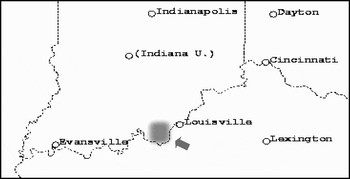
The data for this study was collected in Harrison County, Indiana between March and November of 2002. Harrison County is a largely rural community located on the Ohio River in extreme south-central Indiana, only about 25 miles, on average, from Louisville, Kentucky. According to census figures, its population in 2000 was 34,325 with a density of just 70 people per square mile. See Figure 1.Footnote 2 The residents of Harrison County are almost all European Americans and many of them have lived in the community for a number of generations. According to the same census figures, 98.4% of the county's population in 2000 was white.
Map of southern Indiana, northern Kentucky, and southwestern Ohio, showing the location and (approximate) boundaries of Harrison Country, Indiana.

The early European settlers in Harrison County relocated here from Georgia, Kentucky, Maryland, New York, North Carolina, PennsylvaniaFootnote 3, South Carolina, Tennessee, Vermont, and VirginiaFootnote 4, among other eastern, southern, and New England states (Ferree & Hardin, Reference Ferree and Hardin1961; Griffin, Reference Godfrey and Tagliamonte1984; Reference Griffin1991; Reference Griffin1993).Footnote 5 It will be noted that (many of) these locations fall within the Appalachian region (cf. Appalachian Regional Commission; Christian et al., Reference Christian, Wolfram and Dube1988:16, 30; Wolfram & Christian, Reference Wolfram1976:5, 12), an area that was heavily settled by the Scotch-Irish after they arrived in Delaware and southeastern Pennsylvania during the 18th century (Crozier, Reference Crozier1984; Montgomery, Reference Meechan and Foley1989; Reference Montgomery, Fenton and MacDonald1997). It is no surprise, then, that the Scotch-Irish were one of Harrison County's first major (European) ethnic groups: “A great percentage of the first pioneers of the county were the Scotch-Irish, German, French, and English …” (Griffin, Reference Godfrey and Tagliamonte1984:12).
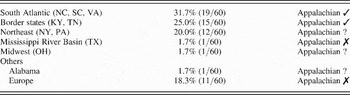
It is also possible to get a sense of how Appalachian the early settlers in Harrison County were by tallying the number of them that came from each state. Table 1 shows that the majority of 60 individuals who I was able to gather unambiguous information about (Griffin, Reference Griffin1991; Reference Griffin1993; Roose, Reference Robinson, Lawrence and Tagliamonte1911) did, in fact, come from states that fall more or less uncontroversially within Appalachia and where the people would have been predominantly Scotch-Irish. The regional classifications are those of Montgomery et al. (Reference Montgomery, Fuller and Schneider1993; cf. their Table 1, p. 345). Assuming that the 60 individuals represented in Table 1 are indeed representative of Harrison County's early settlers, much of its early population does seem to have had strong Appalachian (i.e., Scotch-Irish) origins. Furthermore, since Harrison County once spanned a much larger geographical area than it does today (Griffin, Reference Godfrey and Tagliamonte1984:12, 13), the same may be true of the early population of south-central Indiana more generally, which, incidentally, could help to account for the existence of the so-called Hoosier Apex (Carver, Reference Carver1987) and the common perception of Indiana as “a peculiarly northern outpost of southern speech” (Preston, Reference Poplack, Tagliamonte and Hickey1993:32; Reference Preston and Frazer1996:313).
Regional origins of 60 of Harrison County's earliest and early settlers

A ‘✓’ indicates that at least part of the state(s) in question are included in even the most conservative definitions of Appalachia; a ‘?’ indicates that at least part of the state(s) in question are included in only more liberal definitions of Appalachia; and an ‘✗’ indicates that the settlers from these places cannot be considered to have come from Appalachia under any definition of it.
METHODS
Speakers
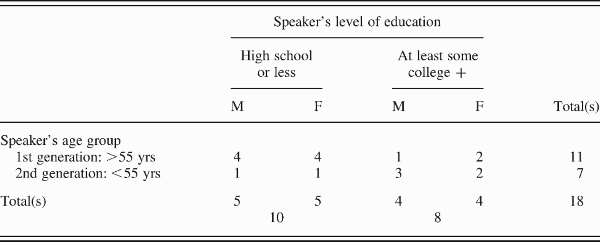
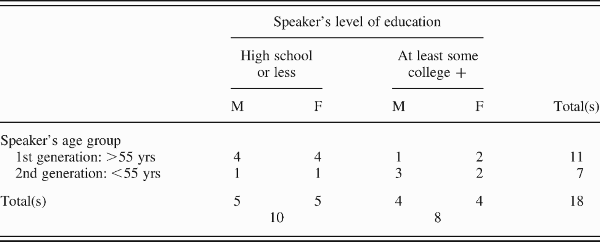
The social profile of the 18 speakers in this study is summarized in Table 2. All of the 9 men and 9 women are European Americans who grew up in the area. I recorded them during individual- and dual-participant interviews and group sessions that usually took place in their homes or, alternatively, in local gathering places or their places of business/employment (general stores in both of these latter two cases).Footnote 6 At the time (in 2002), they ranged in age from 25 to 87, with a mean age of 59 years. They are divided into two generations, each spanning a range of 29 years (25–53 inclusive and 59–87 inclusive). Their levels of formal education range from about an 8th grade education to a master's degree. They are classified into one of two educational groups: those with less than or equal to a high school diploma (or its equivalent) and those with at least some college and/or graduate school. Overall, these speakers constitute a well-educated group, the younger generation even more so than the older generation. Fifteen of these 18 speakers completed high school (or the equivalent)—all 7 of the younger-generation speakers and 8 of the 11 older-generation speakers—and over half of those went on to college (at least for a while).
Social profile of the 18 speakers
Data
The literature on verbal -s has identified two main loci of variation: the absence of 3rd person singular -s and the presence of (especially, 3rd person) plural -s. The former, 3sg -s absence, occurs only sporadically in the KyIn data and, consequently, is not considered here. Therefore, tokens of finite present-tense indicative verbs with a third-person plural (3pl) subject and tokens of past be with any plural subject (including 2nd singular ‘you’), as illustrated in the examples in (5)–(9), were extracted from the interviews with the following exceptions.
(5) But at the same time th- th- there has to be some, uh, horrible consequences. (Spkr 402)
(6) And two of ’em lives right up here … in them trailers across the road up there. (Spkr 202)
(7) I think they know_ it come [i.e., came] from Sears & Roebuck catalogue. (Spkr 102)
(8) I don't even remember what we was doin’ now. (Spkr 301)
(9) And the kids that I was in class with … their parents were like parents to me. (Spkr 401)
Exclusions
All tokens were discarded in which the segment following the verb was an [s]. With such tokens, it was (often) not possible to determine whether the verb was inflected with -s or uninflected.
All tokens of don't were excluded. In many dialects of English, there is a very strong tendency to use don't even in the 3sg, where doesn't is prescribed (e.g., He don't X, She don't Y; cf. Blanton, Reference Blanton1974:48; Cheshire, Reference Cheshire1982:36; Feagin, Reference Feagin1979:198; Wolfram & Christian, Reference Wolfram1976:79; Wolfram et al., Reference Wolfram and Christian1999:63). Consequently, it would be very unlikely to find singular doesn't in plural don't contexts (e.g., *They doesn't Z). Although plural don't was excluded for this reason, tokens of affirmative 3pl do(es) and tokens with an unaffixed negative particle were retained. In this latter case, no distinction is made between whether the negative particle could have been cliticized to the verb but simply wasn't (e.g., do/does not) or could not possibly have been (e.g., do/does never, do/does hardly).
Verbs that cannot be inflected with verbal -s had to be excluded. Of course, only finite present-tense indicative verbs can be inflected. So, if it was unclear whether or not a verb was finite, that token was excluded, as shown in example (10), which could mean either (a) they try to help ’em and [to] give ’em personal backing or (b) they try to help ’em and [they] give ’em personal backing. Similarly, if there was any doubt as to whether a token was present tense, it, too, was excluded. The tense of a verb might be ambiguous because the following context triggers a phonological neutralization—in the same way that a following [s] is problematic—as in (11), or because an irregular past-tense form is homophonous with an uninflected present-tense form, as in (12), also cf. (7). In either of these cases, if the presence of temporal adverbs or the like made it possible to determine that a verb was present-tense, then that token was retained.
Even some finite present-tense verbs cannot be inflected. These include invariant modal verbs (13) and deleted auxiliaries (14); another finite verb that I consider “uninflectable” is contracted want to (i.e., wanna), as in (15). However, in the same way that tokens of affirmative and unaffixed negative plural do/does not were retained in spite of the exclusion of plural don't, tokens of uncontracted want(s) to and tokens of want(s) that were not followed by an infinitive were retained in spite of the exclusion of contracted wanna.
(10) And they try to help ’em and … give ’em … personal backing. (Spkr 204)
(11) ’Cause they ??{ live_ / lived }?? down, you know, in [place name] (Spkr 103)
(12) They give [i.e., gave] us a choice to be shipped out or … (Spkr 205)
(13) … to keep the telephone exchange goin’, for they can make calls. (Spkr 101)
(14) They __ got so damn many games. (Spkr 205)
(15) People just don't– They just … wanna be left alone. (Spkr 201)
Finally, because this study focuses on 3pl (and, in the case of past be, 1pl and 2sg/2pl) verb forms, number-ambiguous tokens had to be excluded unless some cue could serve to establish them as plural. An example is provided in (16), in which the antecedent of the relative pronoun subject could conceivably be either the plural four columns or the singular front of the building.
(16) It's got three column– uh, got four columns up the front of it that faces the river (Spkr 501)
Factor groups
The data remaining after these various exclusions had to be coded for a variety of factors, which, as much as possible, were inspired by previous research on variable subject–verb agreement. These include the type of subject, the proximity of the subject to the verb, the person/number of the subject, the “type” of verb, the polarity of the verb, the type of clause, the preceding and following phonological contexts, and the social characteristics of the speaker.
Subject type
Researcher after researcher who has looked at plural verbal -s, including was leveling, has noted an influence according to the type of subject. Very often, noun phrase (NP) subjects favor inflected (-s) forms and pronominal subjects favor uninflected (-ø) forms. In a more specific version of the NP/Pro constraint, known as the Northern Subject Rule (NSR), which Montgomery (Reference Meechan and Foley1989:250) traced back to Old Scotch-Irish English, the constraint opposes personal pronoun subjects that immediately precede the verb, on the one hand, and any other type of pronominal or NP subject, on the other hand. In this study, subjects are coded as one of the five types listed in (17); their proximity to the verb is coded independently (discussed later).
The last two subject types listed in (17), relative pronouns and null relatives, have not received nearly as much attention in the literature as the distinction between NPs and personal pronouns. Overt relatives have been taken into account in the occasional analysis (e.g., Cheshire, Reference Cheshire1982; McCafferty, Reference Mallinson and Wolfram2003; Reference McCafferty2004; Montgomery, Reference Montgomery1994; Reference Montgomery, Fenton and MacDonald1997; Montgomery et al., Reference Montgomery, Fuller and Schneider1993) and at other times they have been the topic of impressionistic observation. For example, Feagin observed that “the relative pronoun that referring to a plural seems to be most likely to trigger -s agreement …” (1979:193); likewise, without analyzing them, per se, Hazen “hypothesize[d] that the word that significantly contributed to nonstandard concord” (Reference Montgomery1996:51, endnote 6). Conversely, the potential influence of null relatives on verbal -s does not seem to have been considered; instead, the focus has been on the mere fact that subordinate clauses with null subject-relatives are a possible nonstandard syntactic structure of, particularly, Scotch-Irish and Appalachian English (cf. the references at (3)). Null relatives are coded here to determine, first, the extent to which they also occur in KyIn and, second, whether they favor plural verbal -s, as might reasonably be expected based on the differences between them and the types of subjects that other researchers have found to disfavor plural verbal -s.
(17) Subject types
NPs
Personal and other pronounsFootnote 7
Existential pronouns
(Overt) Relative pronouns
Null relative pronouns
Proximity of subject to verb
The proximity of the subject and the verb has also been noted to influence verbal -s. If the subject and the verb are adjacent to each other, the verb is less likely to be inflected with plural -s; if they are separated from each other by some intervening material, the verb is more likely to be inflected with plural -s. In this study, the subject's proximity to the verb is coded as an independent factor to test for main effects without having to associate the subject's status as an NP or a pronoun with its proximity to the verb, as in the NSR [Northern Subject Rule], but while still being able to test for the NSR through recoding (more on this, later).
Person/number of subject
Another subject-oriented constraint is its person (1st, 2nd, 3rd) and number (sg, pl). In the present study, however, this factor group has very limited relevance. Here, data was collected for 1pl, 2sg/2pl, and 3pl verbs only in the past be paradigm; elsewhere, only 3pl data was collected. A goldvarb analysis was performed on the past be data alone, allowing for an investigation into the person/number of the subject where relevant, but space limitations prevent reporting those results here. Suffice it to say that the highest rate of was leveling was found in the 2nd person (54.3% (19/35)), followed by the 3pl (37.0% (108/292)), and, finally, by the 1pl (32.9% (28/85)). These differences, however, did not reach the level of significance, possibly due, in part, to the sparse data in the 2nd person and 1pl contexts.
The “type” of verb
There are reasons to believe that particular verbs might favor or disfavor verbal -s differently. For instance, one verb may prescribe an uninflected form (a -ø form) where another prescribes an -s form (e.g., I go__ vs. I was). More to the point, in a number of (Appalachian, and possibly other?) communities, be is more susceptible than other verbs to plural verbal -s. Perhaps the one trait that distinguishes be from all other verbs the most, though, is that it has -s forms in both the present and past tenses. Verbs are coded into three categories here: (1) past be, (2) present be + present have, (3) all other verbs. Clearly, past be belongs in a group by itself, whereas present-tense be and have are grouped into a single category because they are similar to each other in a number of ways. For example, unlike regular verbs, they function as both main verbs and auxiliaries; they can occur in existential clauses; and they show the same propensity for plural verbal -s in this community (excluding existentials: 14% plural is, 12% plural has).
Polarity
Previous research, especially on past be, has found that negative polarity triggers more plural (i.e., -ø) than singular (i.e., -s) verb forms. But as there has been no discussion, to my knowledge, of this effect outside of past be, the factor group was included here to investigate its potential influence.
Clause type
There has been very little investigation of whether finite verbs in subordinate clauses are inflected more than, less than, or the same as in main clauses. For example, Clarke found that “embedded clauses [favor] -s marking [including in the 3sg?] significantly more … than matrix clauses” in Newfoundland (1997:245), whereas Eisikovits offered only “anecdotal evidence … that subordinate structures are less likely to favour the use of non-standard forms” (Reference Eisikovits1987:18). Clearly, “further investigation in a wider range of dialects is in order” (Clarke, Reference Clarke1997:245), and I code the KyIn data accordingly.
Phonology
Given the influence of the preceding phonological context on -s allomorphy even in standard English, where verbal -s has three allomorphs—voiced [-z], voiceless [-s], and epenthesized [-iz]—it seemed prudent to take the neighboring contexts into account where the variable realization of verbal -s is concerned. In each position, only two values are distinguished. In the preceding context, those values are (a) a vowel and (b) a consonant (either singleton or cluster). It should be noted, though, that the preceding context varies in only one of the three categories of verbs (the regular present-tense verbs); in the other two, (i) past be and (ii) present be + have, there are suppletive forms—was/were; is/are, has/have—so that only the following phonological context is potentially meaningful. In that following position, the two values distinguished are (a) a following segment (either a vowel or a consonant/cluster), and (b) a syntactic/prosodic pause or a nonsyntactic/prosodic hesitation. The data was (re-)coded in this way because following vowels and consonants pattern similarly (they manifest 18.1% and 18.5% plural verbal -s, respectively; 18.4%, combined), and following pauses and hesitations also pattern similarly (they manifest 8.5% and 10.4% plural verbal -s, respectively; 9.3%, combined).
Social factors
The external factors taken into account are those represented in Table 2: the speaker's sex, level of formal education, and age group/generation.
RESULTS
Distributional analysis
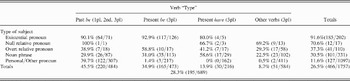
Table 3 shows the distribution of the 1757 coded tokens of plural verbal -s from the KyIn corpus according to verb “type” and subject type. With respect to the type of verb, the overall frequency of plural -s decreases as we move along the table from left to right, from past be to present be + have (with be > have) to the other present-tense verbs. (Note that this is true even if existential constructions are excluded; cf. Factor Group #1 in Table 4.) As mentioned earlier, this is consistent with the findings in some other Appalachian communities, where be has also been found to be more susceptible to -s than other verbs are, a point that will be taken up further in the Discussion section. Moving down the table, with respect to the type of subject, the highest rate of plural verbal -s is found with existential pronoun subjects (as is the case in virtually every other study that has looked at these), followed by null relative pronouns, overt relative pronouns, NP subjects, and, finally, pronominal subjects. For the data as a whole, a weak version of the NP/Pro constraint appears to be active: 31% verbal -s with plural NP subjects vs. 12% with plural pronoun subjects. However, closer examination reveals that this constraint is active only for present-tense verbs (be, have, others) and not for past be. Thirty-one percent (75/244) of the present-tense verbs with a plural NP subject are inflected with -s, whereas less than 1% (5/790) of the present-tense verbs with a plural pronoun subject are inflected with -s! With past be, on the other hand, there is more was leveling when the subject is a pronoun (40%) than when it is an NP (30%), showing that the effect of the NP/Pro constraint is actually reversed there. Importantly, KyIn English is not the only dialect in which this is the case. The NP/Pro constraint has also been found to hold except for past be in a number of other Appalachian communities, another point that will be taken up in the Discussion section.
Distribution of plural verbal -s in KyIn by subject type and verb “type”

Multivariate analysis of plural verbal -s in KyIn English (application value = -s)a

Note. input = 0.05; log likelihood = −418.93; convergence at iteration 13; p = .01.c
aExcluding existentials (n = 202) and null relative pronoun subjects (n = 17) [1538 + 202 + 17 = 1757 (cf. Table 3)].
bThe missing token in this group occurred at the end of the tape, preventing recovery of the following context.
cOne-level analysis: total χFootnote 2 = 440.68; χFootnote 2/cell = 1.56; convergence at iteration 13.
Multivariate analysis
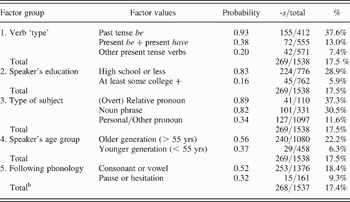
Table 4 shows the results of a multivariate analysis, implemented using goldvarb 2001 (Robinson, Lawrence, & Tagliamonte, Reference Preston and Schneider2001), of the data summarized in the distributional analysis in Table 3. Tokens with null relative pronoun subjects were excluded from the goldvarb analysis because of their infrequent occurrence in the corpus (n = 17) and tokens with existential pronoun subjects (n = 202) were excluded because they show near-categorical behavior.Footnote 8goldvarb found two external and three internal factor groups to contribute significantly to plural verbal -s in KyIn English: the external factors are (1) the speaker's level of formal education and (2) the speaker's age group; the internal factors are (1) the verb “type,” (2) the type of subject, and (3) the following phonological context.
Verb “type”
The factor group that exerts the strongest influence on plural verbal -s in KyIn English is the type of verb. The three different “classes” of verbs considered here pattern very differently with respect to plural -s. For past be, was leveling with plural subjects is very strongly favored. Both of the other verb classes disfavor verbal -s with plural subjects, the regular verbs even more so than present-tense be and have. In KyIn English, then, there is a hierarchy of plural verbal -s: plural was > plural is/has > plural -s.
Level of education
The factor group that exerts the second strongest influence on plural verbal -s in KyIn English is the speaker's level of formal education. This plays a very predictable role in that less education means that nonstandard agreement is favored and is used more; more education means nonstandard agreement is disfavored and is used less.
Type of subject
The factor group that exerts the third strongest influence on plural verbal -s in KyIn English is the type of subject. Relative pronoun and NP subjects favor plural verbal -s (confirming Feagin's, Reference Feagin1979, and Hazen's, Reference Hay and Schreier1996, impressions about the contribution of relative pronouns), whereas personal (and “other”) pronouns disfavor it. If the overall rate of 12% plural verbal -s with pronominal subjects seems unusually high compared to what has been observed in other communities, it should be remembered that this figure includes data for past-tense be (i.e., was leveling); as shown in Table 3, the rate of present-tense plural verbal -s with pronominal subjects is only 0.6% (5/790).
Speaker's age group
The factor group that exerts the fourth strongest influence on plural verbal -s in KyIn English is the speaker's age group. Here, the older generation (59–87 year-olds) shows an essentially neutral effect, only slightly favoring plural verbal -s; the younger generation (25–53 year-olds) more strongly disfavors plural verbal -s. The most likely explanation for this generational difference is the increasing importance of education in the modern world. As discussed in connection with Table 2, these speakers constitute a very well-educated group—the younger generation even more so than the older generation—and the effect of education on plural verbal -s in KyIn has already been identified. Therefore, it is completely understandable that the more-educated younger speakers disfavor plural verbal -s.
Phonological environment
The final statistically significant factor group for plural verbal -s in KyIn English is the following phonological context. Recall that the preceding phonological context is meaningful for only one-third of the data, the regular present-tense verbs, and here incidentally, its effect is not significant: 7.9% plural verbal -s after a consonant, 6.3% after a vowel. With respect to the following phonological environment in Table 4, the probability of plural verbal -s occurring before either a consonant or a vowel is a neutral 0.52; on the other hand, it is disfavored before a syntactic/prosodic pause or a nonsyntactic/prosodic hesitation. This result is reminiscent of the dispreference for -s before a pause that Godfrey & Tagliamonte (Reference Flanigan1999:105, 106) found in Devon, England (except that, there, it is significant only in the 3sg). An interpretive caveat applies here, however, in that only 10% of the data occurs before either a pause or a hesitation (161 tokens); the other 90% of it occurs phrase-internally before either a consonant or a vowel (1376 tokens). This could result in the data being (relatively) too sparse before a pause or a hesitation for it to be reliably modeled by goldvarb.
Four nonsignificant factor groups
The following factor groups were not selected as significant by the preceding model, but are, nonetheless, deserving of some commentary: (1) the subject's proximity to the verb, (2) the type of clause in which the verb occurs, (3) the polarity of the verb, and (4) the speaker's sex.
The subject's proximity to the verb was not selected as an independently significant factor group. This is a potential weakness of the current story. If KyIn has Scotch-Irish origins, as is argued here, then it should show evidence of the proximity constraint so salient in Scotch-Irish varieties. To address this apparent incongruity, another goldvarb analysis was performed in accordance with the Northern Subject Rule: Personal pronoun subjects that immediately precede the verb were opposed to all other types of subjects in all other positions (except that null relative pronoun subjects and existentials continue to be excluded). Given this recoding of the data, the NSR is found to be significant in KyIn: Personal pronoun subjects that immediately precede the verb disfavor plural verbal -s (with a probability of 0.32) and subjects of any other type in any other position favor it (with a probability of 0.80).
The question that arises is why, if the NSR is active, is the subject's proximity to the verb not a significant factor in and of itself? Two thoughts come to mind. First, the vast majority of personal and “other” pronouns in this dataset are actually personal pronouns that immediately precede the verb. Therefore, recoding the data according to the NSR is effectively equivalent to recoding it into a binary opposition between pronominal subjects, which were already found to disfavor plural verbal -s, and nonpronominal subjects, which were already found to favor plural verbal -s. Second, perhaps the effect of distance between the subject and the verb has been somewhat overstated in the literature, stemming from some types of subjects being coded as distant from the verb when they would more appropriately be coded as adjacent to it. For instance, some researchers analyze the subject as separated from the verb in sentences like those in (18)–(20). Thus, in (18), the subject people is separated from the verb is by the relative pronoun that; in (19), the subject the dogs is separated from the verb barks by the prepositional phrase in the trucks; and in (20), the subject the nations is separated from the verb needs by the relative clause that are around us.
(18) I feel sorry for people that's just bringing children up now (Christian et al., Reference Christian, Wolfram and Dube1988:112)
(19) The dogs in the trucks barks (Mallinson & Wolfram, Reference Larmouth, Marjorie and Frazer2002:751)
(20) The nations that are around us needs help (Van Herk & Walker, Reference Trüb2005:119)
An alternate possibility, however, is that the subject is adjacent to the verb in all of these examples. In (18), the subject could be analyzed not as people, but as the relative pronoun that, which is adjacent to the verb. In fact, it seems that this would have to be the analysis of this sentence once relative pronouns are admitted as a possible type of subject (perhaps they shouldn't be). In (19), the subject could be analyzed not simply as the dogs, but as the complex NP [NPthe dogs [PPin the trucks]], which is adjacent to the verb. In (20), the subject could be analyzed not as the nations, but as the complex NP [NPthe nations [CPthat are around us]]. Examples of structures that I would argue would be more appropriately coded as nonadjacent subjects are provided in (21)–(24). In (21), the speaker corrects himself, resulting in the subject being separated (if only a little bit, perhaps negligibly) from the verb; in (22), a parenthetical interjection separates the subject from the verb, and in (23)–(24), these are separated by an adverb. (I suspect, though, that Wolfram et al.'s reasoning for why the subject is separated from the verb in (24) would probably differ from mine.) Thus, my coding of subjects that are separated from the verb seems to be much more stringent than some other researchers', which could have contributed to the subject's distance from the verb not being selected as significant in the goldvarb model in Table 4. The appropriate analysis of structures like those in, especially, (18)–(20) is an issue that future research should seek to resolve.
(21) No, but people g– buys it. (Spkr 104)
(22) We didn't have heat. We … 'course … were there in the summer time. (Spkr 501)
(23) We knew we probably weren't gonna be very successful with that. (Spkr 215)
(24) A lot of people [who] comes here from off island now is getting married on the beach (Wolfram et al., Reference Wolfram and Christian1999:62, note: ‘[ ]’ in original)
The type of clause in which the verb occurs—main versus subordinate—was also not selected as a significant factor group, at least not in the goldvarb analysis summarized in Table 4. Conversely, when the data was recoded according to the NSR, as just discussed, the type of clause was selected as significant (after the speaker's age group and before the following phonological context). In that model, where the type of subject and its proximity to the verb were recoded according to the NSR, plural verbal -s was found to be slightly favored on verbs in subordinate clauses (0.58) and slightly disfavored on matrix verbs (0.46). The slight preference for plural verbal -s in subordinate clauses is somewhat unexpected, given, for example, Eisikovits' “anecdotal evidence … that subordinate structures are less likely to favour the use of non-standard forms' (Reference Eisikovits1987:18, emphasis added). One cannot help but wonder if this result is a consequence of the strong preference for plural verbal -s with relative pronoun subjects (so, where the verb would necessarily be in a subordinate clause); but that question is quickly put to rest with the realization that relative pronoun subjects account for only about one-fifth of the tokens in subordinate clauses. Clearly, the weak favoring effect of subordinate clauses on plural verbal -s must be more generally motivated, and Clarke's call for “further investigation in a wider range of dialects” (Reference Clarke1997:245) remains in force.
Another nonsignificant factor group is the polarity of the verb. Contra previous findings, in which negative polarity triggers more plural (e.g., they weren't) than singular (e.g., they wasn't) verb forms (e.g., Britain, Reference Britain2002; Britain & Sudbury, Reference Britain, Sudbury, Jones and Esch2002; Cheshire, Reference Cheshire1982; Schilling-Estes & Wolfram, Reference Schendl and Britton1994), plural verbal -s was found to occur nearly twice as often in negative clauses (32.9% (27/82)) than in affirmative clauses (16.6% (242/1456)) in KyIn English. Perhaps one reason that this difference does not reach the level of significance is the extremely sparse data in the negative context: only 82 of the 1538 tokens, or just 5% of the data.
The final nonsignificant factor group is the sex of the speaker. Here, the data is sufficiently robust in both factors; clearly, then, the reason that this factor group was not selected as significant is because men and women exhibit comparable rates of plural verbal -s in KyIn: 18.4% (92/501) and 17.1% (177/1037), respectively.
DISCUSSION
The first two of Montgomery's (Reference Meechan and Foley1989; Reference Montgomery, Fenton and MacDonald1997) three requirements for establishing a close genetic relationship between Kentuckiana English and Appalachian English have now been met. The historical connection between the people has been established, and we now have an explicit quantitative description of plural verbal -s in Kentuckiana English to add to existing accounts of the same in Appalachian English. All that remains is to perform the explicit comparison of these varieties, which will uncover similarities between them that, I argue, cannot be due to chance, thereby satisfying Montgomery's final requirement: that coincidental similarities between the two varieties be ruled out. A final piece of evidence in support of the argument will come in the form of a small, preliminary study of plural verbal -s in a distant corner of Indiana, some 275 miles to the north of Harrison County and without the same Appalachian heritage.
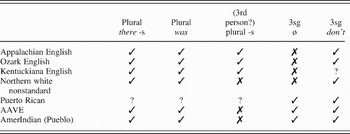
The first similarity between Kentuckiana English and Appalachian (also, Ozark) English is where nonstandard agreement occurs in them. Table 5, following Christian et al. (Reference Christian, Wolfram and Dube1988:133), shows the different types of nonstandard agreement that are found in a number of American dialects. A ‘✓’ in a cell indicates (variable) nonstandard agreement for that structure in that dialect; an ‘✗’ indicates that this nonstandard feature is reportedly not found in that dialect. For example, the first column shows that all of the dialects represented in Table 5—with the possible, but unlikely, exception of Puerto Rican English—variably use singular is/was in plural existentials. Similarly, the fourth column shows that variable 3sg -s absence is found in Puerto Rican English, AAVE, and Pueblo English, but not in Appalachian English, Ozark English, Kentuckiana English, or northern white nonstandard vernaculars.Footnote 9
Comparison of nonstandard agreement in several varieties of English

Note. Based on Christian et al., Reference Christian, Wolfram and Dube1988:133. A ‘✓’ indicates that the structure in question occurs, if only variably; an ‘✗’ indicates that the structure in question reportedly does not occur; and a ‘?’ indicates a lack of relevant data.
Given that there are no differences (as far as we know) among these seven dialects with respect to plural existentials (column 1), was leveling (column 2), and 3sg don't (column 5), the relevant and diagnostic variables, among those included in Table 5, are plural verbal -s and 3sg -s absence (columns 3 and 4). The system in which verbal -s is variably present with plural subjects and not regularly absent with 3sg subjects is shared by Appalachian English, Ozark English, and Kentuckiana English, but not by any of the other dialects in the table. This, then, constitutes a first piece of evidence that Kentuckiana English and Appalachian/Ozark English are similar to each other while being distinct from some other varieties of American English.
Another general similarity common to numerous varieties of Appalachian English is the NP/Pro constraint. Comparing three varieties of Appalachian English—two spoken in West Virginia and one spoken in Tennessee's Smoky Mountain region—Montgomery (Reference Meechan and Foley1989:259) found that plural verbs in all three are inflected with -s most frequently in existential sentences, less frequently when the subject is a 3pl NP subject, and least of all when the subject is the 3pl personal pronoun subject they. To that list can be added Alabama English (Feagin, Reference Feagin1979), Ozark English (Christian et al., Reference Christian, Wolfram and Dube1988), Smoky Mountain English, as spoken not only in Tennessee but also in North Carolina (Montgomery, Reference Montgomery, Fenton and MacDonald1997, citing, especially, Hall, Reference Hackenberg1942), and Kentuckiana English. This yields the list in (25).
It must be stated, though, that the [there > NP > Pro] hierarchy may very well not be unique to Appalachian English. Perhaps a more convincing consideration, then, is that this is only part of the story on the NP/Pro constraint in Appalachia. More specifically, although it is active over the system as a whole, it breaks down in specific areas, particularly in the past be paradigm. A number of varieties of Appalachian English that observe the NP/Pro constraint except with respect to was leveling are listed in (26). Note that “Appalachian English II” and “Smoky Mountain English I & II” are absent from (26) because there is no was leveling data from them (cf. Table 7) and not (necessarily) because they follow a different pattern; among the several varieties considered here, only Ocracoke English was explicitly found not to reject the NP/Pro constraint in the past tense be paradigm (Hazen, Reference Hay and Schreier1996:33–34, 36–37; also cf. Wolfram et al., Reference Wolfram and Christian1999:69–71).Footnote 10
This adherence to the NP/Pro constraint except in the past be paradigm is an uncommon pattern that contrasts with what has been observed in several other varieties of English. For example, Tagliamonte (Reference Tagliamonte2002:743–746) summarized that in five other disparate communities—one in northeastern Scotland (Buckie), one in southwestern England (Devon), and three in Nova Scotia, Canada (Guysborough Enclave, Guysborough Village, and North Preston)—the [NP > Pro] constraint does apply in the past be paradigm; also see Trüb (Reference Tortora2006) for Earlier White Southern American Vernacular English, and Wolfram & Sellers (Reference Wolfram and Schilling-Estes1999) for Lumbee Vernacular English. The range of these communities that observe [NP > Pro] in the past be paradigm suggests that it is probably a sufficiently widespread phenomenon for its absence in the Appalachian dialects in (26) to be a noteworthy gap in need of explanation. The explanation offered here is that the pattern in question is shared by these dialects because it is a family trait. However, rejection of [NP > Pro] in the past be paradigm is not strictly restricted to Appalachian English. It also fails to apply, for example, in affirmative contexts in Fenland English (Britain, Reference Britain2002) and in Samaná English (Tagliamonte & Smith, Reference Tagliamonte, Chambers, Trudgill and Schilling-Estes1999). Therefore, it cannot be taken as definitive proof that the dialects in (26) share a family bond, but, this is, at the very least, a plausible possibility that is consistent with the information available about the historical connection(s) among them.
(25) Appalachian English dialects with the NP/Pro constraint: [there > NP > they]
Alabama English (Feagin, Reference Feagin1979)
Appalachian English I (Wolfram & Christian, Reference Wolfram1976; Christian et al., Reference Christian, Wolfram and Dube1988)
Appalachian English II (Hackenberg, Reference Griffin1973, cited in Montgomery, Reference Meechan and Foley1989; Reference Montgomery, Fenton and MacDonald1997)
Ozark English (Christian et al., Reference Christian, Wolfram and Dube1988)
Smoky Mountain English I (Montgomery, Reference Meechan and Foley1989)
Smoky Mountain English II (Montgomery, Reference Montgomery, Fenton and MacDonald1997, citing, esp., Hall, Reference Hackenberg1942)
Kentuckiana English
(26) Appalachian English dialects with the NP/Pro constraint (cf. (25)) except with past be
Alabama English (Feagin, Reference Feagin1979)
Appalachian English I (Wolfram & Christian, Reference Wolfram1976; Christian et al., Reference Christian, Wolfram and Dube1988)
Ozark English (Christian et al., Reference Christian, Wolfram and Dube1988)
Kentuckiana English
Another trait of Appalachian Englishes is that they tend to show a greater propensity for plural -s with past be than with present-tense be compared with other present-tense verbs. The dialects that adhere to this pattern, in very general terms, are listed in (27).Footnote 11 Those four dialects also conform very closely to more precise quantitative details of the hierarchy, as shown in Table 6.
(27) Appalachian English dialects with [plural was > plural is > plural -s]
Alabama English (Feagin, Reference Feagin1979)
Appalachian English I (Wolfram & Christian, Reference Wolfram1976; Christian et al., Reference Christian, Wolfram and Dube1988)
Ozark English (Christian et al., Reference Christian, Wolfram and Dube1988)
Kentuckiana English
Quantitative comparison of concord marking in four varieties of Appalachian English

Note. AL = Alabama English (Feagin, Reference Feagin1979; Feagin's working class speakers only); AR = Ozark English (Christian et al., Reference Christian, Wolfram and Dube1988; Pro = 1st, 2nd, and 3rd plural); WV I = Appalachian English I (Wolfram & Christian, Reference Wolfram1976; Pro = 1st, 2nd, and 3rd plural); KyIn = Kentuckiana English (1,630 tokens; overt/null relative pronoun subjects excluded; cf. Table 3). {NP/Pro}+ … indicates which singular verb form (whether was, is, has, or -s) co-occurs with a plural subject (whether an NP or a pronoun). Percentages in square brackets mark deviations, i.e., values that are greater than the value in the cell immediately to their left.
Quantitative comparison of concord marking in four (more) varieties of Appalachian English

Note. NC = Ocracoke English (Hazen, Reference Hay and Schreier1996; Wolfram et al., Reference Wolfram and Christian1999); TN = Smoky Mountain (TN) Appalachian English I (Montgomery, Reference Meechan and Foley1989); TNC = Smoky Mountain (TN, NC) Appalachian English II (Montgomery, Reference Montgomery, Fenton and MacDonald1997; citing, esp, Hall, Reference Hackenberg1942); WV II = Appalachian English II (Hackenberg, Reference Griffin1973; cited in Montgomery, Reference Meechan and Foley1989; Reference Montgomery, Fenton and MacDonald1997). {NP/Pro}+ … indicates which singular verb form (whether was, is, has, or -s) co-occurs with a plural subject (whether an NP or a pronoun). Percentages in square brackets mark deviations, i.e., values that are greater than the value in the cell immediately to their left.
In Table 6 (also Table 7), the rate of plural verbal -s decreases from left to right. Square brackets [ ] mark deviations from this pattern so that a value that is greater than the value in the cell immediately to its left is easily identifiable. There are only four such deviations in the table, most of which are very small increases that are probably of very little concern in the grand scheme of things; the otherwise high adherence to this quantitatively rigorous grammatical pattern seems much more important. In fact, the only point of genuine concern—that is, the only substantial increase when moving along a row from left to right—occurs in the KyIn dialect, where there is a sharp rise between 30% NP + was and 59% NP + has! One possible explanation for this drastic increase is the small number of tokens that it is based on. Of all of the cells in the KyIn row of Table 6, NP + has is the only one that is based on fewer than 50 tokens (cf. Table 3). Presumably, with more data, this exceptional cell would prove to be less of a concern than it initially seems. That said, it would be inappropriate to place all of the “blame” on the shoulders of NP + has; it also matters that there are comparably very low rates of was leveling in this dialect (cf. columns 2 and 3). In KyIn, was leveling occurs at a rate of only about 30 to 40 percent, depending on the type of subject, whereas in Alabama, Arkansas, and West Virginia, there is much more was leveling, anywhere from about 60 to 75 percent. If the rate of was leveling in KyIn were comparable to the rates in Alabama, Arkansas, and/or West Virginia, we might “drop off” to 59% NP + has instead of “climbing up” to it.
The question then becomes why there is so little was leveling in KyIn. This is certainly a result of the KyIn speakers being a highly educated group. Recall that 15 of these 18 speakers completed high school (or the equivalent) and over half of those went on to college (at least for a while). On the other hand, in West Virginia and Arkansas, Wolfram and Christian (Reference Wolfram1976:29) and Christian et al. (Reference Christian, Wolfram and Dube1988:7) targeted the speech of “the working class rural population,” which Christian et al. specified meant “with limited formal education” (Reference Christian, Wolfram and Dube1988:4).Footnote 12 Similarly, Feagin (Reference Feagin1979) collected data from both upper class and working class speakers in Anniston, Alabama, but the figures in Table 6 are based only on the data from her working class speakers.Footnote 13 This very likely explains the different rates of was leveling in these communities. A goldvarb analysis of just the past-tense be data in KyIn (omitted here because of space restrictions) reveals that the single most important factor conditioning was leveling in this community is the speaker's level of education. In fact, if an attempt is made, after the fact, to “control” for level of education by excluding those speakers with more than a high school education, the overall rate of was leveling in KyIn increases from 38% (148/394) to 80% (118/148), and much more closely approximates the other three dialects in Table 6.Footnote 14
Table 7 repeats the information in Table 6 for four additional communities, but with a number of gaps in the data because of methodological differences, resulting in fewer points of comparison. Therefore, I will not comment extensively on the communities in Table 7. Suffice it to say that the limited data available for the two Smoky Mountain samples and the second West Virginia sample shows them conforming perfectly to the overall pattern. The Ocracoke dialect, on the other hand, is considerably different than the other seven dialects in Tables 6 and 7, as it alone is responsible for the three deviant cells in Table 7.
Given what is known about the historical connections between these communities both within Appalachia and outside of it, the simplest and thus the best, albeit not the only possible, explanation for the linguistic similarities among most of them is that they reflect a linguistic system inherited from a common ancestor. Thus, Montgomery (Reference Meechan and Foley1989:259) argued that these types of “fundamental similarities” in the patterning of plural verbal -s across dialects supports an argument for a “common source” among them; Wolfram et al. contended that “similarities in patterning [i.e., among Outer Banks, Appalachian, and Ozark Englishes] are probably a good indicator of these dialects’ historical connection to the Scots-Irish, Scots, and Northumbrian dialects” (Reference Flanigan1999:60); and Van Herk & Walker argued that “shared retention of variable conditioning that cannot be attributed to universal considerations constitutes evidence of a shared origin” (Reference Trüb2005:127).
Van Herk & Walker's reference to linguistic universals seems to be a critical point. Thus, one anonymous reviewer questions whether “the similarities … between KyIn and Appalachian dialects [are] unique to themselves,” and another cautions, first, that “3rd pl. -s on main verbs … appears to have been … widely distributed in earlier American English, regardless of its origin” and, second, that “its contemporary distribution seems to be fairly extensively documented in vernacular dialects of American English so that one might question whether it can be assumed that it is restricted to those areas heavily influenced by Scots Irish.” Both of these reviewers, then, echo the spirit of Tagliamonte's position that “parallel constraints across one set of varieties is not conclusive proof of a common origin unless contrastive corroborating evidence can be found elsewhere' (Reference Tagliamonte2002:746, emphasis added). In other words, these reviewers take issue with the extent to which Mongtomery's third standard has been adequately met here: “that the existence of the grammatical features in question … be as closely limited to the varieties concerned as possible” (Reference Montgomery1989:240; Reference Montgomery1997:126).
Even if it is true that Montgomery's third standard hasn't been satisfactorily met, this should not be seen as a critical flaw of the argumentation. Insofar as Montgomery is correct that “the more immediate the contact between varieties being compared, the less relevant this requirement is” (Reference Pooley1989:240), then satisfying this particular standard need not be our primary concern: it was, after all, only about 200 years ago that pioneers brought their Appalachian language varieties to Harrison County. Also, since that relocation from Appalachia to Kentuckiana took place as recently as it did, there is ample documentation of it in the historical record. Consequently, the cross-linguistic comparisons performed here do not investigate parallel constraints across just any set of dialects, but across a set of dialects that we already know to be related. In such a case, the default assumption has to be that any similarities observed are very likely genetic. That is, the question isn't one of using linguistic data to posit a genetic relationship that we are otherwise unsure of, but, given that an undeniable genetic relationship exists (e.g., given a pair of twins separated at birth), have—or how have—the relevant traits and characteristics (in this case, linguistic patterns) persisted through time and space?
Still, additional corroborating evidence of the type called for by Tagliamonte (Reference Tagliamonte2002) is available. It is not at all clear that, even within the set of (American) English dialects, the similarities between Appalachia and Kentuckiana uncovered here are, in fact, “universal.” As a point of comparison, take the following “pilot-study” data from just one-half hour of conversation for each of six speakers—three European-American men (aged 41, 51, and 69) and three European-American women (aged 25, 49, and 64)—who I interviewed for an unrelated project in extreme northwestern Indiana in November Reference Trüb2005, and who, in terms of their ages and levels of education, but not in terms of their community's early-settler origins, are comparable to the KyIn speakers analyzed above. Those three hours of conversation with these six speakers yielded a mini-corpus of 248 relevant tokens, 221 of which are represented in Table 8. This sample is insufficient for any statistical analyses, but the distribution of plural verbal -s in it seems impressionistically very different than in Tables 6 and 7 for Appalachia and Kentuckiana. In the Northwest Indiana sample (Table 8), there is very little plural verbal -s outside of existential constructions, including a very (surprisingly!) modest amount of was leveling. In the present tense (all verbs combined: be, have, and others), only 2 of the 127 tokens (1.6%) of plural verbs are -s forms (vs. 55/521 = 10.6% in KyIn), and both of those are instances of plural is with an NP subject, produced by a single speaker in a single utterance (Yeah, my hobbies is probably dedicated to–is dedicated to shootin'). There are no instances of plural verbal -s, as an inflectional morpheme properly speaking, which stands in sharp contrast to the Kentuckiana and Appalachia data, in which the lowest rate of NP + -s reaches 22% (incidentally, in the KyIn community); likewise, the rate of 0% NP + has also contrasts with the rates of at least 40% NP + has in Kentuckiana and Appalachia. However, given the strict limitations of the size of the sample in Table 8, these differences must be taken cautiously. Still, the data from this northwest Indiana community, preliminary as it is, tentatively suggests that the similarities between Kentuckiana English and the other varieties of Appalachian English discussed in this article are likely a result of their common heritage, rather than any “universal” considerations. But this is a question that will have to await future research for further elaboration.
Pilot-study data of concord marking in one variety of northern white American Englis h

Note. Inland = Northwest Indiana's stake of the “Inland Northern” dialect of American English. {NP/Pro}+ … indicates which singular verb form (whether was, is, has, or -s) co-occurs with a plural subject (whether an NP or a pronoun). Percentages in square brackets mark deviations, i.e., values that are greater than the value in the cell immediately to their left.
CONCLUSION
The three standards proposed by Montgomery (Reference Meechan and Foley1989:240; Reference Montgomery, Fenton and MacDonald1997:125–126) for establishing a genetic relationship between two languages have now been satisfied. The historical connection between Kentuckiana and Appalachia has been established, satisfying the first standard. An explicit quantitative description of plural verbal -s in KyIn English has been provided, satisfying the second standard. And this part of the subject–verb concord system of Kentuckiana English has been explicitly compared to the same in numerous dialects of Appalachian English, uncovering similarities that, I argue, are too numerous and too quantitatively similar to be coincidental, thereby satisfying the third and final standard. Additionally, differences observed in another Indiana community, some 275 miles away, were offered in support of the claim that the Kentuckiana/Appalachian patterns are not “universals” of English vernaculars.
Therefore, I am now in a position to offer an answer, however preliminary (because it considers evidence for only one variable), to the research question: Can the dialect spoken in this area outside of Appalachia reasonably be considered Appalachian? The answer to this question necessarily depends on how we define Appalachian English (e.g., Hazen & Fluharty, Reference Hazen2004). If it is defined geographically, then, no, Kentuckiana English clearly cannot be labeled Appalachian; Harrison County is located some 100–150 miles from the nearest points on the periphery of Appalachia, as defined by the Appalachian Regional Commission. Conversely, if Appalachian English is defined linguistically, then the results of the present investigation suggest that, yes, there is compelling qualitative and quantitative linguistic evidence—in addition to the historical evidence—of Kentuckiana English's Appalachian-ness. Kentuckiana English, like Ozark English, “operate[s] according to very similar, if not identical, agreement patterns” as Appalachian English (Christian et al., Reference Christian, Wolfram and Dube1988:133). Consequently, any conclusions about the transmission of features from a mother language to a geographically discontiguous daughter variety based on a comparison of Appalachian English and Ozark English can only be strengthened to the extent that similarities also exist between Kentuckiana and Appalachia, on the one hand, and between Kentuckiana and the Ozarks, on the other hand.
In spite of this corroborating value of the Kentuckiana data, a question arises from considering the contextual differences surrounding the Kentuckiana and Ozark sisters: Precisely how similar must the history shared by mother and daughter be? Christian et al. (Reference Christian, Wolfram and Dube1988) are of the opinion that the relative geographic isolation of the people living in the Appalachian and Ozark Mountains and their shared mountain culture are important ingredients in the maintenance of their linguistic similarities. Similarly, Wolfram et al.'s (Reference Wolfram and Schilling-Estes1999) and Hazen's (Reference Hazen2000a) point of departure is the assumption that the current state of Ocracoke English is due, in large part, to its general lack of historical contact with other dialects. That is, Ocracoke English has long remained free of outside influence precisely because Ocracokers were once an isolated community. In contrast, Kentuckiana does not share a same history of isolation. For instance, in the early days, Harrison County was an important political center, which is reflected even in its name. When formed (in 1808), it was named for then-governor of the Indiana Territory, and, later, 9th president of the United States, William Henry Harrison. A few years later (1813), the territorial capital was relocated here from Knox County, on the Illinois border in southwestern Indiana; after statehood (1816), the state capital remained here until it was relocated to Indianapolis (1825). Also, in the days of heavy riverboat traffic, some of the river towns in particular (i.e., in the southern half of the county) were thriving commercial and cultural ports in the region. Boats carrying goods and/or performance groups would dock at various locations along the river, and people would descend on these communities from the surrounding countryside to buy items that they needed and/or to see a show. So, for its former political, commercial, and cultural importance, it is difficult to maintain that Harrison County constituted an isolated community, even in (or especially in?) the early days. Yet, Kentuckiana English's system of verbal concord remains very similar to both that of Appalachian English and Ozark English and, in certain respects, it is more similar to them than is the Ocracoke English system. This suggests either that sociogeographical isolation may not be as important for (relative) linguistic conservatism as was once thought (cf. Montgomery, Reference Montgomery2000a; Reference Montgomery2000b) or that less sociogeographical isolation than was previously thought may be sufficient.
A final, alternate possibility worth considering—but one that, unfortunately, cannot be explored here—is whether Harrison County's lack of isolation, including its proximity to Kentucky and socioeconomic relations with Kentuckians might have contributed in some way or another to the maintenance of Appalachian features in Harrison County. These socioeconomic relations have been with Kentuckians who, it should be specified, also live some 100 or more miles away from the closest points on the periphery of Appalachia. This is, of course, a question that will have to await future research, but if and when that research is undertaken, it should be remembered that the hypothesis is not one of borrowing, but of contact-induced maintenance. An important step in investigating that hypothesis will not only be determining the degree of contact, but also sorting out the complex nature of the contact between these people who live on opposite sides of the geopolitical and psycho-socio-cultural boundary that is the Ohio River.