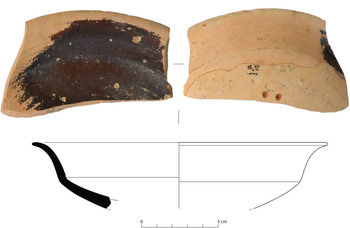
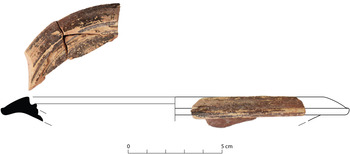
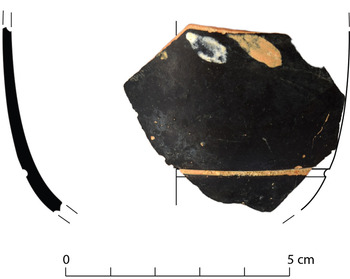
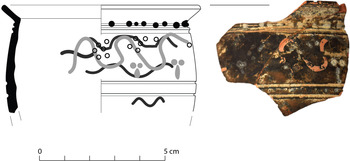
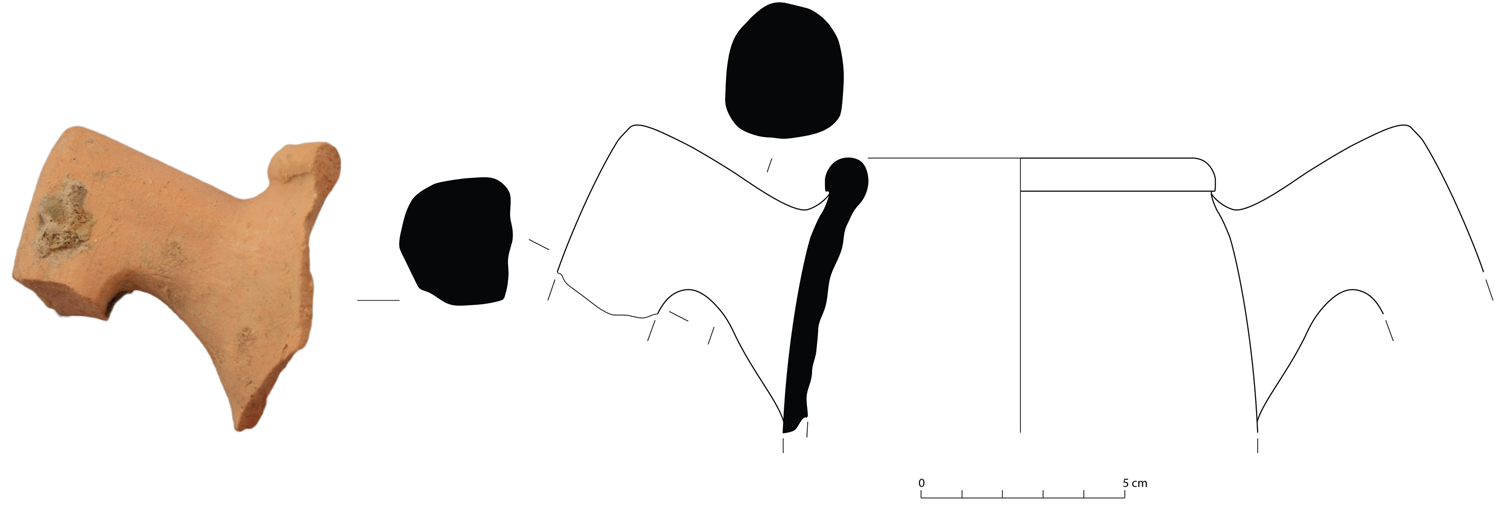
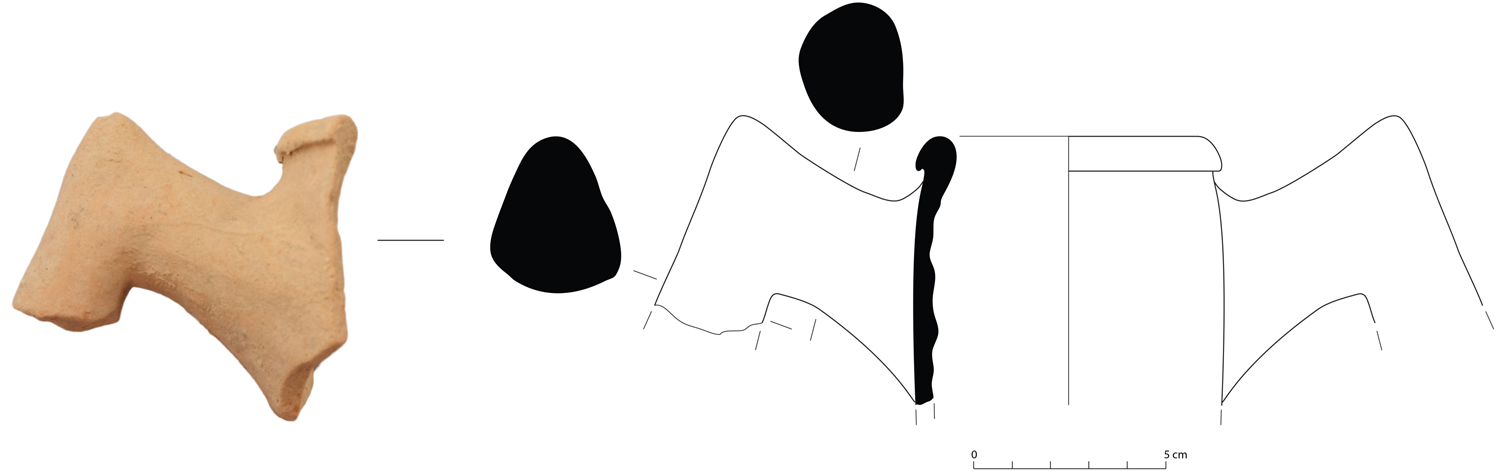
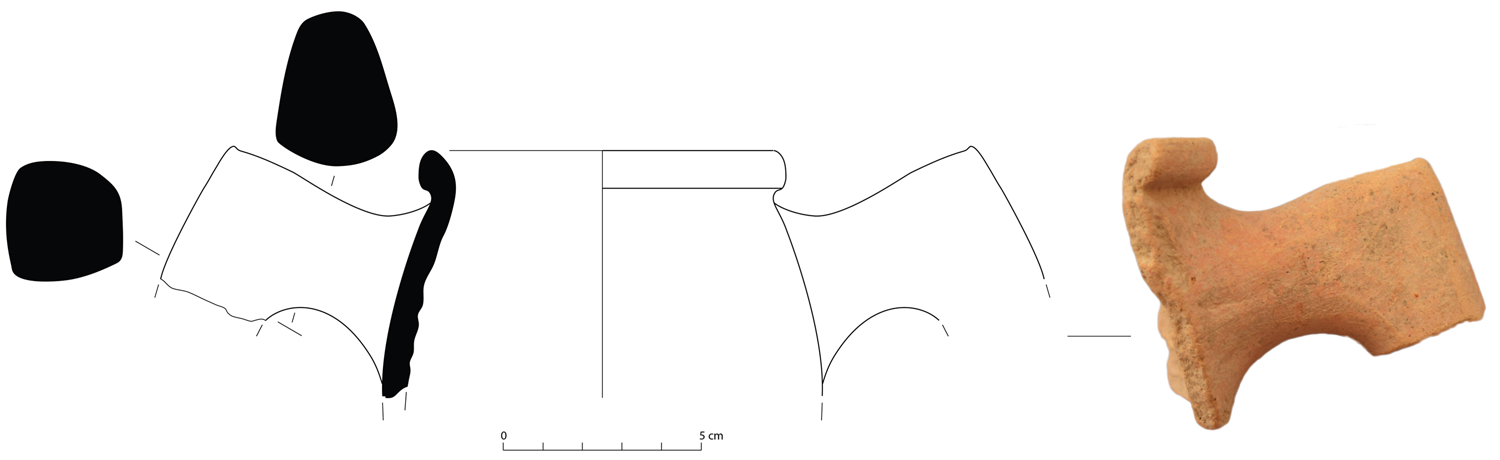
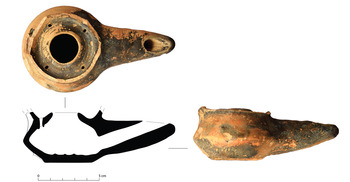
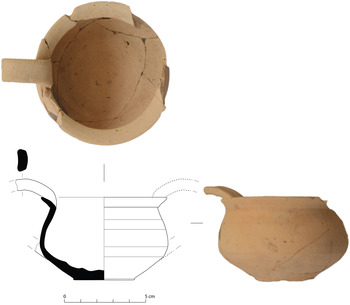
INTRODUCTION: EXCAVATIONS AND CHRONOLOGY
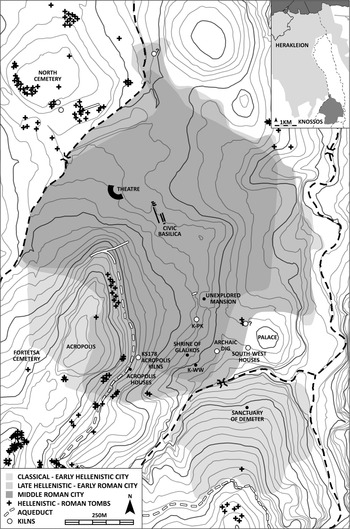
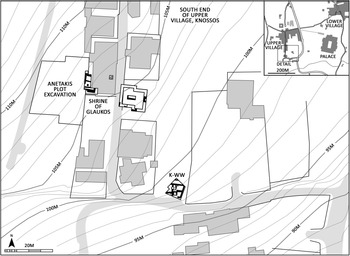
The Hellenistic wine press excavations (BSA reference code: KWW’77 [Knossos Widow's Well]; hereafter ‘KWW’) took place under the direction of Jill Carington Smith and the British School at Athens in July and August of 1977 (Figs 1 and 2). The excavations were carried out in response to a land subsidence on the southern edge of the upper village of Knossos (Boughada Metochi).Footnote 1 The excavations began with a 2 × 2 m test pit, and eventually extended across an area of approximately 50 m2, concluding in late August 1977 due to safety concerns (Carington Smith and Wall Reference Carington Smith and Wall1994, 368). The architecture, stratigraphy and faunal remains from this excavation were published by Carington Smith, in collaboration with Sheilagh Wall in Reference Carington Smith and Wall1994 in BSA.
Area map with sites discussed.

Vicinity map of the KWW’77 excavations. Maps courtesy of T. Whitelaw.

The KWW/wine press site was excavated 44 years ago, and since then our chronological resolution of the material culture of historical-era Knossos has developed considerably through important publications of excavated material, as well as through the Knossos Urban Landscape Project, which systematically surveyed the entire Knossos valley in the early 2000s. As a result of these advances, it is possible to present the artefact assemblages from KWW within their wider urban context, and to reconsider some of the site chronology. It is now possible, for example, to identify a mid-to-late-first-century bc Roman phase at this site, as well as some later Archaic finds.
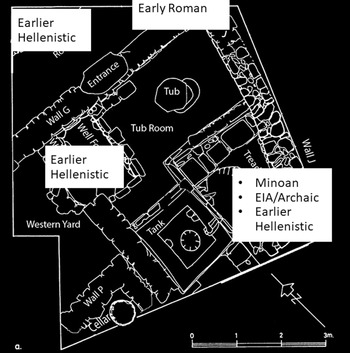
The phasing of the KWW site forms the outline for the present study, and can be presented as follows (Fig. 3):
1) Prehistoric/Minoan.
2) Early Iron Age–Archaic (ninth–sixth centuries bc).
3) Hellenistic (fourth–mid-second centuries bc).
4) Late Hellenistic [Wine Press] (late second century bc).
5) Early Roman (mid–late first century bc).
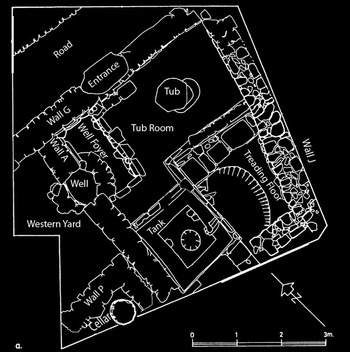
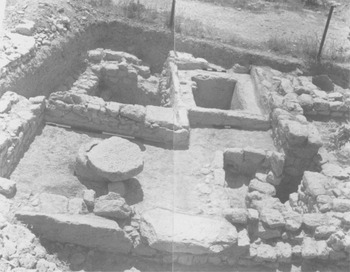
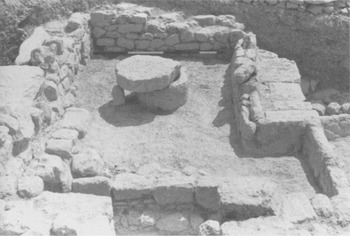
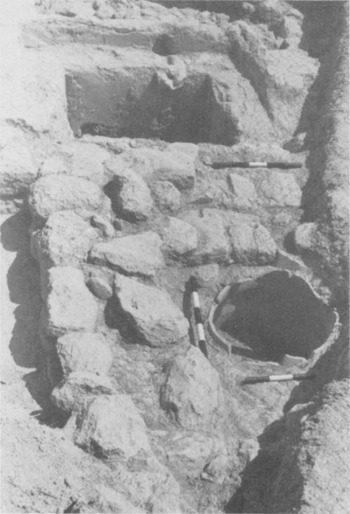
Of the abovementioned phases, the Late Hellenistic phase (Figs 3, 4 and 5) is by far the best represented, with evidence of a wine press, a utility room (the Tub Room) (Fig. 6), and a pithos room (Fig. 7). In addition to the architectural remains, pottery and other artefacts were also recovered. This study will present the remains from these excavations in chronological order, beginning with the evidence for the prehistoric phase, and ending with the Early Roman phase. The wine press discussion can be found in the Phase 4 section, below.
KWW’77 Late Hellenistic Wine Press Complex with the locations of earlier and later deposits. After Carington Smith and Wall Reference Carington Smith and Wall1994.

Archaeological plan of the Late Hellenistic Wine Press Complex.

Photograph of the Wine Press Complex. Tank is at the top center right of the image. After Carington Smith and Wall Reference Carington Smith and Wall1994.

Photograph of the Tub Room. After Carington Smith and Wall Reference Carington Smith and Wall1994.

Photograph of the Tank and Pithos Room. After Carington Smith and Wall Reference Carington Smith and Wall1994.

Index numbers and archaeological contexts
The current study presents catalogued finds from the KWW excavations, and uses the following classifications for the artefacts discussed:
-
M 1–20 = Artefacts from miscellaneous contexts. Unless otherwise stated, these artefacts were recovered from the chronologically mixed layers above the footprint of the Wine Press Complex. These artefacts appear in the catalogues under chronological phases in which they can be assigned (e.g. M 1 is an Archaic lamp and appears in the Early Iron Age–Archaic section).
-
E-A 1–19 = Early Iron Age and Archaic/Classical material, found in a sounding below the Treading Floor. This is not a single coherent deposit, with material ranging in date between the ninth and the early fifth centuries bc. Most of the material recovered here, however, dates to the eighth to seventh centuries bc.
-
EH 1–17 = Earlier Hellenistic levels were identified below the Late Hellenistic Tub Room and Treading Floor. Additional earlier Hellenistic remains were uncovered in a contemporaneous deposit at the northern edge of the excavations. The earlier Hellenistic deposits are contemporary with one another and are of late third-century or earlier second-century bc date. It is unlikely, however, that these remains are representative of a single coherent assemblage.
-
WP 1–48 = The Wine Press Complex is made up of the multi-purpose Tub Room, as well as the Wine Press and Pithos Room. Artefacts recovered from these floor levels date to the middle–late second century bc:
• WP 1–27 = The Tub Room
• WP 28–46 = The Wine Press (Collection Tank and the Treading Floor)
• WP 47–48 = The Pithos Room
-
ER 1–26 = Mid to late first century bc (Early Roman) context that was identified in the northern section of the excavation, just beyond the northern edge of what had been the Wine Press Complex.
PHASE 1: MINOAN FINDS
Knossos is undoubtedly best known for its spectacular prehistoric Minoan remains. The location of KWW would have been close to the urban core of Knossos throughout the entirety of the Minoan period (Whitelaw, Bredaki and Vasilakis Reference Whitelaw, Bredaki, Vasilakis, Mitsotaki and Tzedaki-Apostolaki2019, 3–7) and lies in close proximity to other excavations that indicate Minoan activity in this immediate area (e.g. Hood and Smyth Reference Hood and Smyth1981, 50, Archaic Excavation [H2.207] and Kanta Reference Kanta, Stampolidis, Papadopoulou, Lourentzatou and Fappas2018 [Anetakis]). The KWW excavation, however, turned up surprisingly few artefacts of Minoan date. Carington Smith recorded that the excavation team were beginning to encounter Minoan finds at the lowest levels of the site, but that they were unable to fully explore this context owing to safety concerns. The Minoan remains found in the area below the Treading Floor include a globular loomweight (M 13) and a scrap of wall, but nothing more has been recorded from this context. The remaining finds of probable Minoan/prehistoric date were all recovered from fill levels and topsoil above the Wine Press Complex and include three small fragments from serpentine vases (M 15, M 16), an obsidian core (M 17) and two fragments from obsidian blades (M 18, M 19). Finally, two chert flakes found amongst the mixed fill above the Wine Press Complex press are likely to be of prehistoric date (M 20).
Ceramics
-
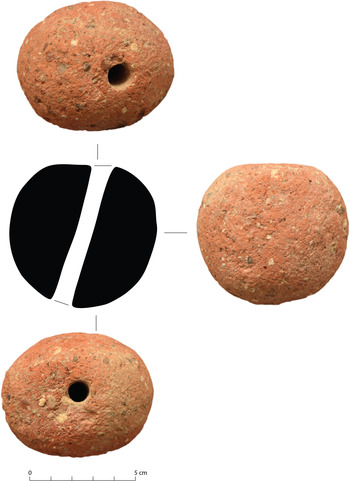
M 13: Globular Loomweight (SMT 2638).Footnote 2 100% complete. Preserved height 7.4 cm. Weight 290 g. Hard-fired coarse, light, brick red, large white grits. Date: Minoan. Jo Cutler pers. comm. 2017.Footnote 3 Find location: below Treading Floor. Fig. 8.
M 13. Minoan Globular Loomweight.

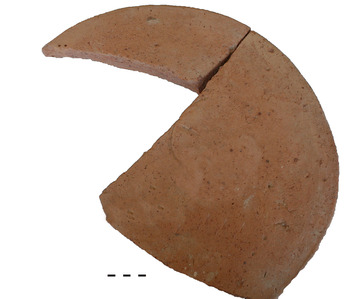
Stone/lithics
-
M 15: Serpentine Vessel Fragments (KWW’77 SF#37). Two small body sherds of dark grey serpentine with greenish-white veins. The larger piece is 3 cm long, while the smaller piece is 1.5 cm. Date: Minoan. Find location: mixed context.
-
M 16: Serpentine Vase Fragment (KWW’77 SF#3). Small body sherd, 3.5 cm long. Dark grey with greenish-white veins. Date: Minoan. Find location: topsoil.
-
M 17: Obsidian Core (SMS 764). Stripy black obsidian with light grey streaks and vertically flaked-off blades. Preserved dimensions 4.5 cm x 2.5 cm. Probable prehistoric date. Find location: surface.
-
M 18: Obsidian Blade (SMS 765). Black obsidian, trapezoidal section 1 cm in length preserved. Found in Tub Room above roof fall. Probable prehistoric date. Find location: mixed context.
-
M 19: Obsidian blade (SMS 766). Small fragment of an obsidian blade (<1 cm preserved). Surface find, probable prehistoric date. Find location: mixed context.
-
M 20: Chert flakes (x2). Found amongst the tile collapse in the Tub Room. Not indexed as small finds, no preserved images or drawings. Date: unclear, possibly prehistoric. Find location: mixed context.
PHASE 2: EARLY IRON AGE–ARCHAIC FINDS
The earliest stratified material from the KWW excavation dates to the Early Iron Age and Archaic periods (late ninth–early eighth centuries bc) and comes from a mixed deposit that was partially excavated below the Treading Floor of the Late Hellenistic wine press. The Early Iron Age/Archaic period represents the early years of the polis of Knossos. Perhaps the most well-known aspects of Knossos from this period are mortuary remains such as the Knossos North Cemetery (Coldstream and Catling Reference Coldstream and Catling1996) and the tombs at Fortetsa (Brock Reference Brock1957) located at the northern end of the urban area. The site of KWW would have been located toward the southern end of the urban settlement during the Early Iron Age (EIA)–Archaic periods.
The settlement at Knossos is estimated to have been 50–60 ha during the EIA (Kotsonas Reference Kotsonas, Mitsotaki and Tzedaki-Apostolaki2019, 8). Our current understanding of Archaic Knossos, however, is very much a work in progress; the hypothesis that Knossos experienced a ‘gap’ in habitation during the sixth century bc (Coldstream, Huxley and Webb Reference Coldstream, Huxley and Webb1999) appears to have been a problem of archaeological visibility in the material remains which can no longer be substantiated (Trainor Reference Trainor, Mitsotaki and Tzedaki-Apostolaki2019, 4–5; Paizi Reference Paizi2019). In the catalogue below, the mid-sixth-century bc lamp (M 1) represented an important clue for enabling us to consider the larger issue of the so-called Archaic gap at Knossos. Through a systematic analysis of ceramic evidence recovered during the Knossos Urban Landscape Project survey, C. Trainor, A. Kotsonas, and T. Whitelaw were able to establish that the distribution of sixth-century bc material at Knossos indicates that there was no major variation in either the size (50–60 ha) or the location of the settlement between the EIA and the Classical periods.
Regarding KWW, with the possible exception of one wall, ‘Wall J’ (Fig. 4, furthest right; Carington Smith and Wall Reference Carington Smith and Wall1994, 368), no definitive architecture from the EIA–Archaic phases was identified. Digging in this part of the excavation was restricted to a small space between walls at the edge of the site, and as a result, this material is not indicative of a complete assemblage, or even a synchronous context. The recovered artefacts find parallels with material that was excavated from the Knossos North Cemetery (Coldstream and Catling Reference Coldstream and Catling1996), the Fortetsa tombs (Brock Reference Brock1957), and the Unexplored Mansion excavations (Sackett et al. Reference Sackett, Branigan, Callaghan, Catling, Catling, Coldstream, Higgins, Popham, Price, Price and Waywel1992). Based on the surviving assemblage, which appears to have been heavily selected, the artefacts from KWW are indicative of domestic activity.Footnote 4 The EIA–Archaic material is of local/regional production. The most common forms of ceramic vessels from this deposit include cups (E-A 1, E-A 2, E-A 3, E-A 4, E-A 5, E-A 6, E-A 7, E-A 8), larger open vessels such as kraters (E-A 10, E-A 11, E-A 13) and a kalathos (E-A 12), a lid (E-A 9), a jar/pyxis (E-A 14), a cooking jug (E-A 15) and a pyramidal loomweight (E-A 16). In addition to the ceramic finds, a fragment of an iron knife handle (E-A 17) was recovered, as was a fragment of a bronze pin (E-A 18) and a hammerstone (E-A 19).
While the EIA material dates mostly to the late eighth–early seventh centuries bc,Footnote 5 it is worth noting that two of the three identified krater fragments (E-A 10–11), and the kalathos fragment (E-A 12) date broadly to the Middle–Late Protogeometric periods (c. 920–850 bc), making them over a century older than the rest of the material here (Coldstream, Eiring and Forster Reference Coldstream, Eiring and Forster2001, 22). These finds raise the possibility that there was also earlier, Protogeometric, activity at this location below the Late Geometric–Early Archaic level. The character of these finds indicates a broadly domestic function; however, the mixed composition, fragmentary condition, and chronological range for these artefacts indicates that their deposition most likely represents dumping activity.
Ceramics
-
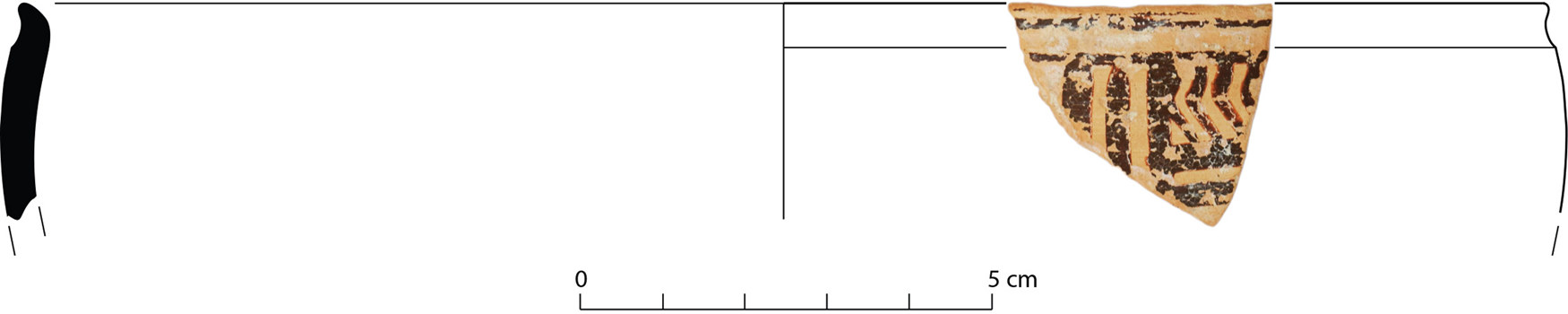
E-A 1: Proto-Kotyle (SMP 10043.4). Rim fragment with painted exterior and slipped interior. Vertical chevrons in panel. Rim dia. 22 cm. Date: eighth century bc. Sackett et al. Reference Sackett, Branigan, Callaghan, Catling, Catling, Coldstream, Higgins, Popham, Price, Price and Waywel1992, 77, cat. no. GH.71. pls 59, 71. Find location: below Treading Floor. Fig. 9.
-
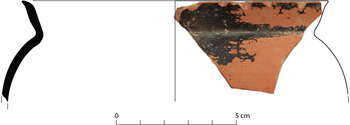
E-A 2: Cup with Slightly Flaring Rim (SMP 9944.2). Rim and upper body fragment. Slipped on both interior and exterior. Fine, buff, hard fabric. Interior colour: 7.5YR 7/4–7/6. Exterior colour: 7.5YR 2.5/1. Rim dia. 13.5 cm. Date: Late Geometric–Early Orientalising (LG–EO). Sackett et al. Reference Sackett, Branigan, Callaghan, Catling, Catling, Coldstream, Higgins, Popham, Price, Price and Waywel1992, 73, cat. no. GE.17, pl. 56. Find location: below Treading Floor. Fig. 10.
-
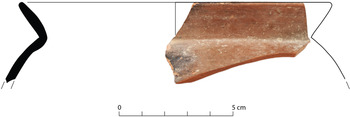
E-A 3: Cup with Slightly Flaring Rim (SMP 9944.2). Rim and upper body fragment. Slip-painted on both sides, fine buff, hard-fired fabric. Interior colour: 7.5YR 7/4–7/6. Exterior colour: 7.5YR 2.5/1. Rim dia. 13.5 cm. Date: LG–EO. Sackett et al. Reference Sackett, Branigan, Callaghan, Catling, Catling, Coldstream, Higgins, Popham, Price, Price and Waywel1992, 73, cat. no. GE.17, pl. 56. Find location: below Treading Floor. Fig. 11.
-
E-A 4: Cup with Slightly Flaring Rim (SMP 9944.2). Rim and upper body fragment. Slip-painted horizontal band around the inside of the rim. Fine buff, hard-fired fabric. Interior colour: 7.5YR 6/6–7/6. Exterior colour: 7.5YR 2.5/1–5YR 5/6. Rim dia. 16 cm. Date: LG–EO. Sackett et al. Reference Sackett, Branigan, Callaghan, Catling, Catling, Coldstream, Higgins, Popham, Price, Price and Waywel1992, 77, cat. no. GH.37, pl. 59. Find location: below Treading Floor.
-
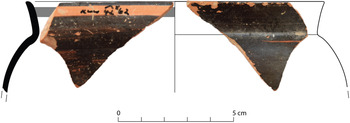
E-A 5: Cup with Slightly Flaring Rim (SMP 9944.5). Rim and upper body fragment. Totally slipped, except for a single unslipped horizontal band near the rim. Fine buff, hard-fired fabric. Interior colour: 7.5YR 6/6–7/6. Exterior colour: 7.5YR 2.5/1–5YR 5/6. Rim dia. 16 cm. Date: LG–EO. Sackett et al. Reference Sackett, Branigan, Callaghan, Catling, Catling, Coldstream, Higgins, Popham, Price, Price and Waywel1992, 73, cat. no. GE.17, pl. 56. Find location: below Treading Floor. Fig. 12.
-
E-A 6: Skyphos (SMP 9944.1). Upper wall fragment. Slip-painted on interior and exterior. A vertical band of zig-zags between parallel horizontal lines. Fine buff, moderately hard-fired fabric. Interior colour: 7.5YR 6/6–7/6. Exterior colour: 7.5YR 3/1–4/1. Rim dia. unclear. Preserved height 2.3 cm. Date: Middle–Late Geometric. Coldstream and Catling Reference Coldstream and Catling1996, 183–4, cat. no. 163:5. Find location: below Treading Floor.
-
E-A 7: Cup (SMP 9944.3). Half of foot preserved. Red-brown slip-dipped. Fine buff, fabric with uneven firing (patchy slip). Interior colour: 10YR 8/4–7/4. Exterior colour: 2.5YR 4/6–4/8. Foot dia. 6.5 cm. Date: Orientalising–Archaic. Sackett et al. Reference Sackett, Branigan, Callaghan, Catling, Catling, Coldstream, Higgins, Popham, Price, Price and Waywel1992, 91, cat. no. H3.3, pls 5, 75. Find location: below Treading Floor. Fig. 13.
-
E-A 8: Cup, Body Rim Fragment (SMP 10043.6). Slipped interior and painted exterior. Dotted lozenge panel between vertical triglyph-type decoration. Fine buff, hard-fired fabric. Interior colour: 10YR 7/4. Exterior colour: 7.5YR 3/1. Rim dia. unclear. Preserved height 4 cm. Date: LG–EO. For motif, see Brock Reference Brock1957, 173, motif 5aq. Find location: below Treading Floor. Fig. 14.
-
E-A 9: Lid (SMP 10043.3). Lid with an out-turned edge and a small exterior flange above the lip. Most of a section survives. Slip-painted on exterior/top with horizontal band motifs with a vertical rouletting-type painted pattern around the bottom edge. Fine buff local fabric. Exterior and interior colour: 7.5YR 8/4. The main motif is fragmentary but may be a stylised vegetal motif with dotted filling. Date: Orientalising. Find location: below Treading Floor. Fig. 15.
-
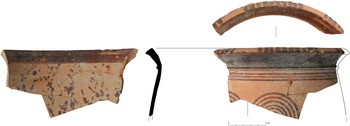
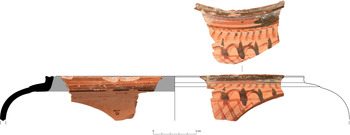
E-A 10: Bell Krater (SMP 9944.2). Rim fragment. Slip-painted. Slipped rim with vertical lines on top and horizontal bands around the body. Fine buff, hard-fired fabric with pinkish core. Interior colour: 7.5YR 8/4–7/4. Exterior colour: 2.5YR 3/3–3/6. Rim dia. 26 cm. Date: broadly Protogeometric due to preservation. Similis KNC D5 in Coldstream and Catling Reference Coldstream and Catling1996, 5, fig. 57, pl. 46; see also Kotsonas Reference Kotsonas2006, 84–6. Find location: below Treading Floor. Fig. 16.
-
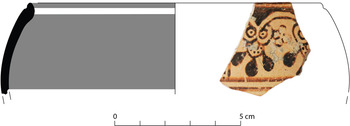
E-A 11: Bell Krater (SMP 9944.1). Rim and lip fragment. Slip-painted concentric circles on main register, parallel horizontal lines below rim, rim is dark, lip has clusters of vertical lines on it. Fine buff, hard-fired fabric with reddish core. Interior colour: 7.5YR 7/4–8/4. Exterior colour: 7.5YR 4/1–2.5YR 4/4. Rim dia. 32 cm. Date: Middle Protogeometric–Late Protogeometric. See KNC D5 in Coldstream and Catling Reference Coldstream and Catling1996, 5, fig 57, pl. 46. Find location: below Treading Floor.
-
E-A 12: Kalathos (SMP 9944.2). Body fragment. Slip-painted and surface wash. Four concentric circles within a triangular window. Fine buff, hard-fired fabric with reddish core. Interior colour: 10YR 7/4–8/4. Exterior colour: 2.5YR 6/6. Rim dia. unclear. Preserved height 5 cm. Date: Middle Protogeometric–Late Protogeometric. Find location: below Treading Floor. Fig. 17.
-
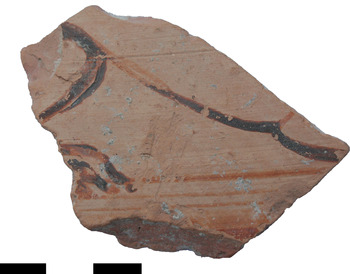
E-A 13: Open Vessel (Krater?) (SMP 10043.1). Body fragment. Painted, hind section of a Lion (?), hind leg and chest area. Semi-fine buff, hard-fired fabric. Interior colour: 2.5YR 6/6–7/6. Exterior colour: 7.5YR 8/4–7/6. Rim dia. Unclear. Preserved height 6.7 cm. Date: Orientalising–Archaic. Find location: below Treading Floor. Fig. 18.
-
E-A 14: Jar/Pyxis (SMP 9943.5). Rim and body fragment with an external groove for receiving a lid. Slip-painted exterior with a jewellery motif. Local fine buff fabric. Interior colour: 10YR 8/4. Exterior colour: 10YR 3/1. Rim dia. 14.5 cm. Date: Orientalising (poss. LG). Sackett et al. Reference Sackett, Branigan, Callaghan, Catling, Catling, Coldstream, Higgins, Popham, Price, Price and Waywel1992, 74, cat. no. GF.14, pls 57, 66. Find location: below Treading Floor. Fig. 19.
-
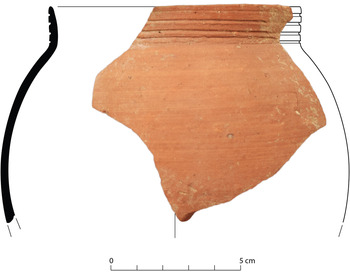
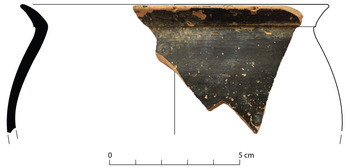
E-A 15: Cooking Jug (SMP 9944.2). Rim and body fragment in cooking pot fabric. Unslipped body with four parallel horizontal grooves around neck. Cooking pot fabric, orange-brown semi-coarse and hard fired. Interior colour: 2.5YR 6/6. Exterior colour: 10R 8/4. Rim dia. 9.5 cm. Date: Orientalising. Kotsonas Reference Kotsonas2006, 160; Sackett et al. Reference Sackett, Branigan, Callaghan, Catling, Catling, Coldstream, Higgins, Popham, Price, Price and Waywel1992, 74, cat. no. GF.24, pl. 57. Find location: below Treading Floor. Fig. 20.
-
E-A 16: Pyramidal Loomweight (SMT 2623). 100% Complete. Preserved height 4.5 cm. Base dimensions 3.4 x 3.5 cm. Weight 56 g. Hard orange, medium grits, fine paler orange slip. Date: LG–EO. Find location: below Treading Floor.
-
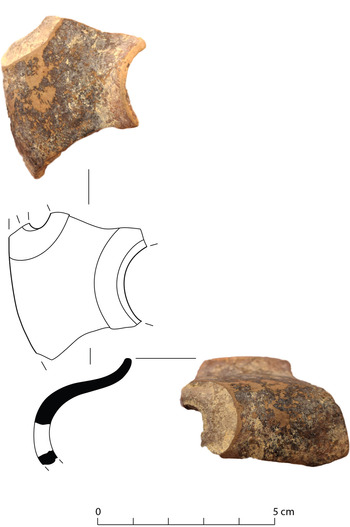
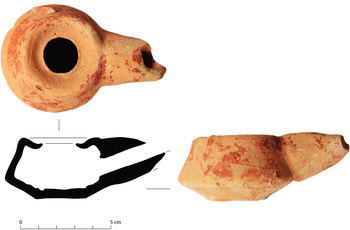
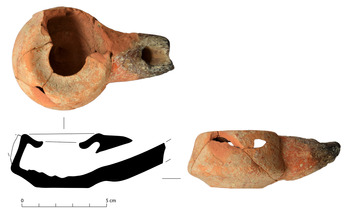
M 1: Lamp (SMP 9944.7). Complete profile of Howland's Type 12a. Unslipped lamp profile, with flat overhanging rim. Hard-fired greyish-reddish fabric with a surface wash. Interior colour: 5YR 6/3. Exterior colour: 7.5YR 7/3. Rim dia. 7.8 cm. Date: mid-sixth century bc. The same form as Howland's Type 12a, although possibly of Cretan production on account of the complete lack of slip. Howland Reference Howland1958, 25–6, no. 72, pls 3 and 31. Find location: mixed context. Fig. 21.
-
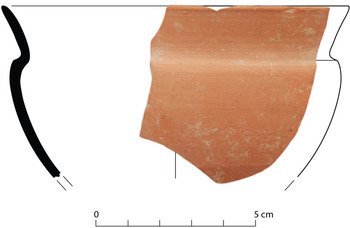
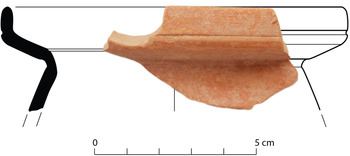
M 2: Cup (SMP 9944.13). Rim and upper body fragment. Unslipped, wiped surface. Orange fine fabric. Interior colour: 5YR 7/6. Exterior colour: 5YR 7/6. Rim dia. 12 cm. Date: Late Archaic–Early Classical, perhaps slightly earlier due to the comparatively pronounced curvature of the profile. Sackett et al. Reference Sackett, Branigan, Callaghan, Catling, Catling, Coldstream, Higgins, Popham, Price, Price and Waywel1992, 91, cat. no. H4.5, pl. 75. Find location: below Treading Floor. Fig. 22.
E-A 1. Proto-Kotyle.

E-A 2. Cup.

E-A 3. Cup.

E-A 5. Cup.

E-A 7. Cup.

E-A 8. Cup.

E-A 9. Lid.

E-A 10. Bell Krater.

E-A 12. Kalathos.

E-A 13. Open Vessel (Krater?).

E-A 14. Jar/Pyxis.

E-A 15. Cooking Jug.

M 1. Lamp of Howland's Type 12a.

M 2. Cup.

Metal finds
-
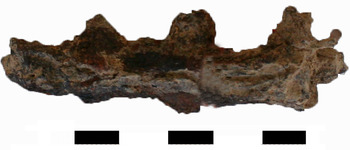
E-A 17: Iron Handle (KWW SF#38).Footnote 6 Iron handle of a possible sword or dagger with rivets and a square head. 5–10% complete. Surviving section is 7.6 cm in length and 2.3 cm in width. Heavily corroded bronze handle with three surviving protruding rivets, perhaps indicating a now-lost wooden handle. This piece has a square shaft with slightly offset square head. The profile of this piece indicates a swelling at the middle of the tang, with a protrusion at the end, which may indicate that it was more likely to have been a double-edged blade than one with a single edge. The fragmentary nature of the piece makes a more detailed function difficult to establish. Find location: below Treading Floor, in the foundation trench of Wall J (Carington Smith and Wall Reference Carington Smith and Wall1994, 368), indicating an EIA date. Fig. 23.
-
E-A 18: Bronze Pin Shaft (KWW SF#80). Fragmentary, 2.1 cm long. Date unclear, although the pin shaft was found amongst EIA/Archaic material. Find location: below Treading Floor.
E-A 17. Iron Handle with Rivets.

Stone
-
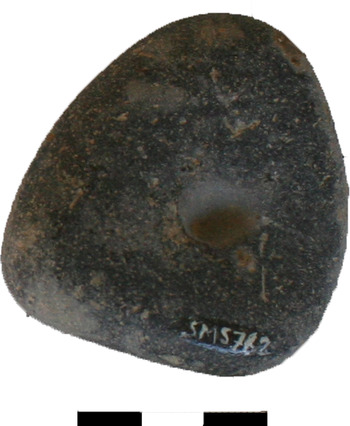
E-A 19: Hammerstone (SMS 762). Rounded non-local stone tool with a flat side and a small hole bored in the centre. Most likely used as a hammerstone for pounding. 100% preservation. Find location: below Treading Floor near the foundation of Wall J. Fig. 24.
E-A 19. Hammerstone.

PHASE 3: EARLIER HELLENISTIC FINDS (Fig. 3)
Crete is an interesting case study for our understanding of the eastern Mediterranean and Middle East during the Hellenistic period. One of the defining features of the broad region at this time was the emergence of large states that were ruled by Greco-Macedonian monarchies. Crete is anomalous in this context, for although a few parts of it were effectively allied with the Ptolemaic dynasty of Egypt (see also Spyridakis Reference Spyridakis1970 [Itanos]; Lippolis Reference Lippolis, Francis and Kouremenos2016 [Gortyn]), the island as a whole was never officially a part of any kingdom during its Hellenistic period (323–67 bc). The historical narrative for Hellenistic Crete had, for a long time, been based on Polybius’ account of an economically and socially inward-looking region that was blighted by near-constant warfare between its states (e.g. Polybius 6.46). Various manifestations of a confederacy (koinon) served as a regional council for settling disputes and considering common policies on Crete during Hellenistic times; however, the overall effectiveness of this body is unclear (Ager Reference Ager1994). Around the middle of the second century bc, the leading states of Crete, such as Knossos, Gortyna, Hierapytna and Kydonia, had taken control of most of the territory on the island. As a result of this territorial expansion, Crete appears to have experienced an economic restructuring and development in the two or three generations prior to the Roman conquest (Hadjisavvas and Chaniotis Reference Hadjisavvas, Chaniotis, Whitley, Cadogan, Iacovou and Katerina2012, 166).
Earlier Hellenistic domestic material
Returning to the KWW excavations, the Late Hellenistic Wine Press Complex was built over the remains of earlier Hellenistic levels. Two test trenches below the Wine Press Complex (well-foyer in the Tub Room and the Treading Floor) revealed a dense tile collapse which overlay some patches of burnt earth and ash, indicating burning in relation to a possible early-second-century bc collapse. The artefacts that were recovered from these soundings can be broadly connected with domestic activity, although it is unclear if these represent a unified context or two different, but contemporary, assemblages.
The artefacts that were found below the tile collapse were mostly of local production and were of a later-third- or early-second-century bc date. This material included a West-Slope-style decorated Kantharos (EH 1), fragments from two echinus bowls (EH 2, EH 3), a Dinoid krater rim (EH 4), a lamp (EH 5), a pithos fragment (EH 6) and five pyramidal loomweights (EH 15, EH 16, EH 17, EH 18, EH 19). In addition to the ceramics, a small Knossian bronze coin (EH 22) and a fragment from an imported domestic hopper rubber mill (EH 20) were also uncovered.
The kantharos and echinus bowls would likely have fulfilled a dining function, while the Dinoid Krater/Stamnoid Lebes with a parallel from Lyttos would likely have been used for mixing wine.Footnote 7 The imported dark-grey stone hopper rubber mill would have been used for domestic-scale grain preparation (Peacock Reference Peacock2013, 38–53; Frankel Reference Frankel2003) and may have been imported from the volcanic island of Nissyros (Strabo, Geographica 10.5.16; Peacock Reference Peacock2013, 46–8; also Carter Reference Carter and Vogeikoff-Brogan2014, 59). The remains of the mill, in conjunction with the loomweights which would have been used for weaving and the pithos for storage, provide a snapshot of some aspects of the organisational and economic character of a Knossian household during earlier Hellenistic times.
The Knossian small bronze coin from this context was studied by P. Kinns and is listed in the original publication as dating to the years around 221 bc (Carington Smith and Wall Reference Carington Smith and Wall1994, 363). Unfortunately, this coin does not appear to be in the collection of the Stratigraphic Museum, nor are there any details, or even formal illustrations/photographs, of the piece in the British School at Athens collections or archives. The only known image of this coin is a largely indistinguishable field sketch on an index card from the excavation notes, and it appears to depict a left-facing head with a possible helmet (or crown?) on the obverse, with a rise around the lower part of the reverse, which may be remains of the legend.Footnote 8 The precise 221 bc date, which was likely made with reference to material from the destruction of Lyttos in that year (Polybius 4.53–4), should be approached with caution without more precise records. That said, the chronology of the ceramic assemblage does broadly align with the published late-third-century bc date for the coin.
Earlier Hellenistic economic assemblage
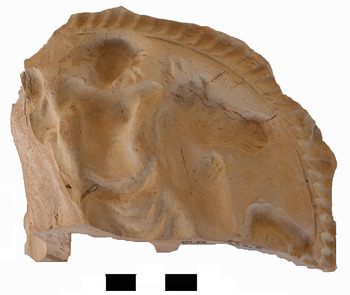
To the north of the footprint of the late Wine Press Complex, a wash layer was identified that contained a small assemblage of late-third-century bc date, which included: a stamped amphora handle of Rhodian origin (EH 13); a clay bread-stamp with a depiction of a nereid riding on a hippocamp (EH 14); and a concentration of kiln debris (EH 15). The other finds in this unit, including a fragment from a broken discoid loomweight (EH 16) and a possible hammerstone (EH 17), present us with an assemblage of a production-related character. The finds from this deposit are chronologically synchronous with the aforementioned earlier Hellenistic domestic material from underneath the Wine Press Complex (late third–early second centuries bc); however, on account of the difference in the findspots, these should be considered as separate deposits from one another.
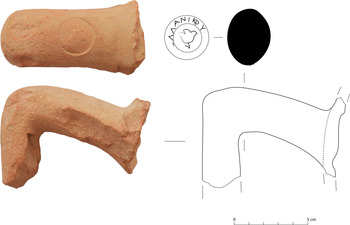
The amphora handle fragment (EH 13) featured a stamp that depicts a rose and the name of a known Rhodian fabricant, ΕΛΛΑΝ[Ι]Κ[ΟΥ], and should therefore date to c. 235–200 bc (Grace Reference Grace1985, 51). The presence of this single amphora handle does not necessarily mean that Knossos and Rhodes enjoyed anything resembling a robust trading relationship during the third century bc. It does, however, at least raise the possibility that trade connections may have existed between both states at this time, a hypothesis which could find some further support in the alliance between Knossos and Rhodes during the Cretan War in the final years of the third century bc (Polybius 4.53).
The decorated bread-stamp (EH 14) features an impressed depiction of a nereid riding on a hippocamp with a rope-style border surrounding the pictorial scene.Footnote 9 Bread-stamps have a long tradition which go back as far as the Neolithic period, and in ancient historical times bread could be stamped with names, symbols, or images of deities for festivals (Kakish Reference Kakish2014, 20–1; Cotsonis and Kouroumali Reference Cotsonis and Kouroumali2012, 1). The KWW stamp features a nereid and hippocamp impression on its underside and may have served a similar function, for stamping bread during festivals. The close proximity of the Shrine of Glaukos (Callaghan Reference Callaghan1978a) to the findspot of this stamp (<30m) indicates that religious festivals had been taking place in the immediate vicinity of KWW during Hellenistic times. While this shape finds relatively close parallels from Ptolemaic Egypt (British Museum 1881,0709.9; 1981,0413.1; 1981,0413.2), the image of the Nereid on the hippocamp has not been seen on other bread-stamps. The date for this piece rather comes from iconographic similarities with the interior of a Medallion cup from Morgantina (Stone Reference Stone2015, 261, no. 570, pl. 119), which has been dated broadly to the late third or early second century bc.
While no remains of a pottery kiln were unearthed during the KWW excavations, there was surely one in the immediate vicinity. The presence of vitrified ceramic kiln wasters and burnt limestone fragments in the northern part of the excavation are indicative of pottery production (EH 23) (e.g. Trainor Reference Trainor2015, 39). While no identifiable shapes were recognisable in the surviving evidence, one of the burnt limestone fragments appears to be part of a perforated kiln floor.
There is evidence of pottery production in this section of urban Knossos during the Late Minoan, Early Iron Age, Archaic, Late Classical and late Hellenistic periods (Grammatikakis, Kanta and Dimadis Reference Grammatikakis, Kanta, Dimadis, Panagiotaki, Tomazos and Papadimitrakopoulos2020 [Anetakis Plot], 19; Coldstream, Macdonald and Catling Reference Coldstream, Macdonald and Catling1997 [South-west Houses]; Homann-Wedeking Reference Homann-Wedeking1950 [Acropolis Kiln]; Eiring, Boileau and Whitbread Reference Eiring, Boileau, Whitbread, Blondé, Ballet and Salles2002 [KS178]). Additionally, excavations of wells close to the main street in Bougadha Metochi/Knossos Village (Sweetman and Grigoropoulos Reference Sweetman and Grigoropoulos2010, 345, 353, 368–9, K-PK excavations) revealed evidence of kiln activity and kiln-wasters, along with a large number of amphora fragments and beehive extension rings also recorded. This southern part of the urban area of Knossos appears to have been a locus of ceramic production for at least 700 years, meaning that the location must have met the basic criteria necessary for producing pottery – access to clay, fuel (wood), and water – so the KWW kiln debris would fit within this wider pattern of ceramic production in the area.
Ceramics
-
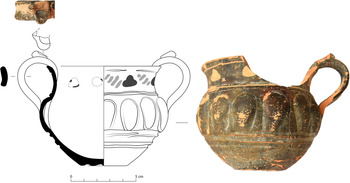
EH 1: Kantharos (SMP 10035). Complete, except for one missing handle. Handles join inside rim. Mottled dark slip, impressed horizontal lines, vertical ribbing, West-Slope-style decoration with brown bands and white dots with partially fugitive garlands. Fine buff fabric. Interior colour: 7.5YR 8/6–10YR 8/4. Exterior colour: 2.5YR 5/6–10YR 3/1. Rim dia. 8.6 cm. Date: early second century bc. Sackett et al. Reference Sackett, Branigan, Callaghan, Catling, Catling, Coldstream, Higgins, Popham, Price, Price and Waywel1992, 118, cat. no. H28.3, pl. 96; Egglezou Reference Egglezou2005, 60–1, no. 201; both are similar in form, but are slenderer than EH 1, which may indicate a slightly later date for our piece. Find location: below the Wine Press Complex. Fig. 25.
-
EH 2: Echinus Bowl (SMP 10040). Complete profile with outward rolled rim and a sharpish carination on the upper profile. Eroded matte grey slip on the interior surface, dipped. Sandy, semi-fine fabric. Interior colour: 5YR 6/4. Exterior colour: 10YR 6/1–4/1. Rim dia. 12 cm. Find location: below the Wine Press Complex. Fig. 26.
-
EH 3: Echinus Bowl (SMP 9944.4). Rim. Slipped at top, dipped. Reddish fine fabric with traces of dark reddish matte slip. Interior colour: 2.5YR 6/6. Exterior colour: 5YR 2.5/1. Rim dia. unclear. Preserved height 3 cm. Date: 230–200 bc. Sackett et al. Reference Sackett, Branigan, Callaghan, Catling, Catling, Coldstream, Higgins, Popham, Price, Price and Waywel1992, 106, cat. no. H14.6, pl. 88. Find location: below the Wine Press Complex.
-
EH 4: Dinoid Krater/Stamnoid Lebes (SMP 9944.9). Rim and upper body of a large Dinoid Krater with painted/slipped decoration. Dark rim, horizontal bands below rim, fleur-de-lis-type motif around central band above cross-hatched filling motif. Buff fine with reddish core and hard firing. Interior colour: 2.5YR 7/4–7/6 (core). Exterior colour: 7.5Y 8/4. Rim dia. 32 cm. Date: late third–early second century bc. Coldstream Reference Coldstream1999, 338, cat. no. S.18, pl. 32; Egglezou Reference Egglezou2005, 103, no. 460, for a parallel from Lyttos. Find location: below the Wine Press Complex. Fig. 27.
-
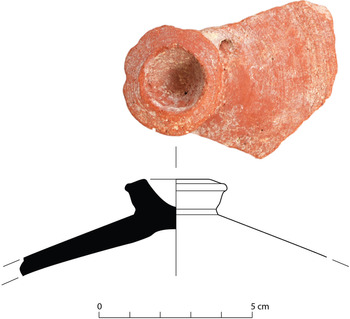
EH 5: Lamp (SML 990). Complete profile, but for handle. Slipped around the nozzle and flute with a reddish-orange matte slip. Buff, semi-fine fabric. Interior colour: 7.5YR 4/6–7/6. Exterior colour: 5R 3/3–10R 5/6 (slip). Rim dia. 2.3 cm. Preserved height 2.6 cm. Date: 200–150 bc. Callaghan Reference Callaghan1978a, 21, nos 108 and 110, pl. 7. Find location: below the Wine Press Complex. Fig. 28.
-
EH 6: Pithos (SMP 10044). Rim and body fragments from a pithos found amongst a tile collapse in a stratum below the Treading Floor. 40% of the rim dia. 31 cm (interior); coarse buff fabric, pale wash on surface and pink core. Common elongated voids, large rounded white inclusions, small pale. Date: third–second century bc. Vogeikoff-Brogan Reference Vogeikoff-Brogan, Glowacki and Vogeikoff-Brogan2011, 559, no. 45, pl. 237. Find location: below the Wine Press Complex. Fig. 29.
-
M 3: Jug (SMP 9942.8). Rim and neck profile. Slightly flaring mouth and a moulded rim. Buff, fine fabric with a reddish core and rim with dark matte slip. Interior colour: 10YR 8/3–5YR 64. Exterior colour: 2.5Y 4/1–3/1. Rim dia. 8 cm. Date: early second century bc. Rotroff Reference Rotroff2006, 250, no. 48, fig. 9, pl. 9 similis. Find location: mixed context. Fig. 30.
-
M 4: Petal Kantharos (SMP 9942.10). Rim and wall. Black matte slip on both sides (dipped). Buff fine fabric. Two incised parallel horizontal grooves below rim. Rim dia. 7.1 cm. Date: mid-second century bc. Callaghan et al. Reference Callaghan, Catling, Catling, Smyth, Spawforth and Wall1981, 44, no. 18, pl. 2B. Find location: mixed context. Fig. 31.
-
M 5: Cylindrical Cup (SMP 9942.8). Rim fragment with remains of a handle attachment on the interior of rim. Faded, partially fugitive dark and red slip on both sides. Buff, fine fabric. Interior colour: 10YR 7/4–6/4. Exterior colour: 7.5YR 3/1 (slip). Rim dia. 9 cm. Date: 250–220 bc. Callaghan Reference Callaghan1978a, 16, no. 45, fig. 10. Find location: mixed context. Fig. 32.
-
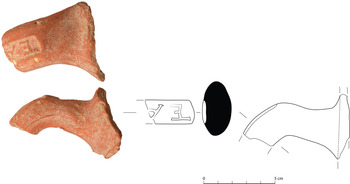
EH 13: Rhodian Amphora (SMP 9942.12). Handle with stamp: rose and fabricant name – ΕΛΛΑΝ[Ι]Κ[ΟΥ]. Rhodian fabric (conchoidal breaks, pinkish, quite fine fabric). Interior colour: 5YR 6/6–6/8 (core). Exterior colour: 5YR 6/6–6/8 (lighter surface wash). Date: 235–200 bc. Grace Reference Grace1985, 51; British Museum 2011,5002.12, 2011,5003.58, 2011,5003.68, and 1989,0710.22. Find location: the northern edge of the excavations. Fig. 33.
-
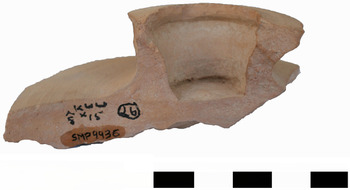
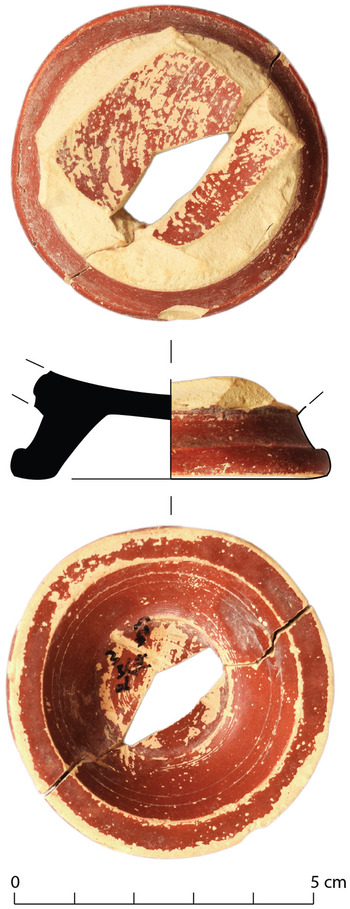
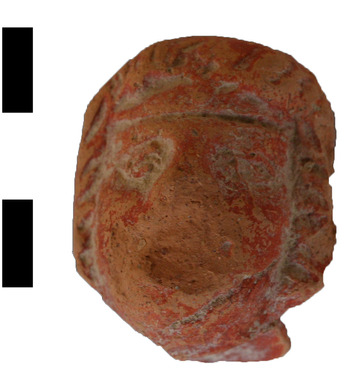
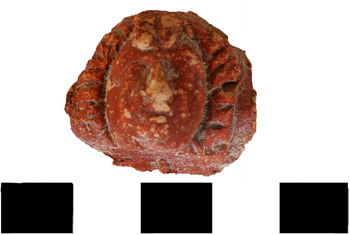
EH 14: Bread-Stamp (SMP 9936). Approximately 40% of this object has been preserved. From above it looks like a relatively flat lid in a local fine buff clay fabric, with a hollow knob-type handle. The underside of this piece, however, features an impressed depiction of a nereid riding on a hippocamp with a rope-style border surrounding the pictorial scene. A similar motif has been published from the interior of a Medallion cup from Morgantina (Stone Reference Stone2015, 261, no. 570, pl. 119), which has been dated broadly to the late third century–early second century bc, and ours might be placed within the same chronological range based on the iconography and the similar date range of associated finds in the same deposit. The estimated 12 cm diameter of EH 14 is, however, almost twice that of the Morgantina example, meaning that it was unlikely to have served as a stamp for pottery, or at least not for Medallion cups. The size and profile of EH 14 is more similar to Hellenistic bread-stamps from Ptolemaic Egypt (British Museum 1881,0709.9; 1981,0413.1; 1981,0413.2). For a similar composition in stone, see Stern Reference Stern2019, 107, no. 1, fig. 6:1:1. Find location: the northern edge of the excavations. Figs 34 and 35.
EH 1. Kantharos.

EH 2. Echinus Bowl.

EH 4. Dinoid Krater/Stamnoid Lebes.

EH 5. Lamp.

EH 6. Pithos.

M 3. Jug.

M 4. Kantharos.

M 5. Cylindrical Cup.

EH 13. Rhodian Amphora Handle.

EH 14. Decorated Bread-Stamp underside.

EH 14. Decorated Bread-Stamp section photograph.

Loomweights
-
EH 15: Pyramidal Loomweight (SMT 2626). 100% complete. Preserved height 6.1 cm. Base dimensions 3.4 x 3.4 cm. Weight 76 g. Very fine hard orange. Smooth paler orange slip. Find location: below Treading Floor.
-
EH 16: Pyramidal Loomweight (SMT 2613). 100% complete. Preserved height 6.7 cm. Base dimensions: 3.5 x 3.5 cm. Weight 83 g. Fine powdery orange, traces of buff slip. Find location: below the Treading Floor.
-
EH 17: Pyramidal Loomweight (SMT 2619). 80% complete. Preserved height 6.7 cm. Base dimensions 3.3 x 3.1 cm. Weight 50 g. Pinkish coarse core with darkish red, white and yellowish grits. Pale wiped surface. Find location: below the Treading Floor.
-
EH 18: Pyramidal Loomweight (SMT 2633). 90% complete. Preserved height 7.8–8 cm. Base dimensions 2.2 x 2.2 cm. Weight 151 g. Fine buff with small white and glassy inclusions. Incised horseshoe-like pattern below hole. Find location: below the Wine Press Complex.
-
EH 19: Discoid Loomweight (SMT 2636). Broken discoid loomweight. 30% complete. Thickness 2 cm. Weight 43 g. Dull, light brown fabric with small grits and a surface wash. Find location: the northern edge of the excavations.
-
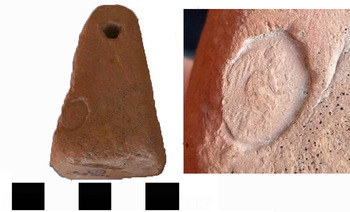
M 14: Pyramidal Loomweight (SMT 2617). Small ring impression of a seated winged Eros. 95% complete. Preserved height 4.8 cm. Base dimensions 2.8 x 3.2 cm. Weight 41 g. Very fine hard brick red surface, carefully smoothed and wiped. Date: Hellenistic. Sackett et al. Reference Sackett, Branigan, Callaghan, Catling, Catling, Coldstream, Higgins, Popham, Price, Price and Waywel1992, 401, 403, cat. no. W30, pl. 335; Davidson Reference Davidson1952, 162, no. 1196, fig. 25. Find location: mixed context surface find. Fig. 36.
M 14. Pyramidal Loomweight.

Stone finds
-
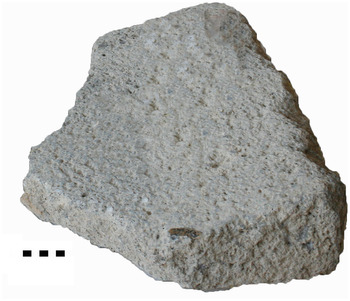
EH 20: Millstone (SMS 787). Fragment of a hopper rubber (or Olynthos-type) mill, with a central depression and higher sides, but no (surviving) slot holes. Non-local, volcanic stone, very hard, pockmarked surface and dark grey in colour. Possibly from Nissyros. Approximately 20% preserved. Preserved height 8.5 cm. Preserved length 33.2 cm. Preserved width 25.3 cm. Preserved weight 7650 g. Peacock Reference Peacock2013, 46–50; Frankel Reference Frankel2003; Carter Reference Carter and Vogeikoff-Brogan2014, 59; Strabo, Geog. 10.5.16. Find location: below the Wine Press Complex. Fig. 37.
-
EH 21: Hammerstone (?) (SMS 794). Rounded non-local stone tool most likely used as a hammerstone for pounding. 100% Preservation. Preserved height 2.5 cm. Circumference 6.5 cm. Preserved weight 172 g. Find location: the northern edge of the excavations.
EH 20. Millstone.

Coinage
-
EH 22: Coin. Knossian bronze, dated to c. 221 bc in the original publication (found with discarded ‘domestic pottery’). Dia. 0.9 cm. Thickness 0.15 cm. Heavily corroded. Identification was made by P. Kinns around the time of the excavation. The only known image of this coin appears as a sketch in the small finds index from the site, and it appears to depict a left-facing head with a possible helmet (or crown?) on the obverse, with a short, heavily abraded legend around the lower part of the reverse. Find location: below the Wine Press Complex.
Kiln debris
-
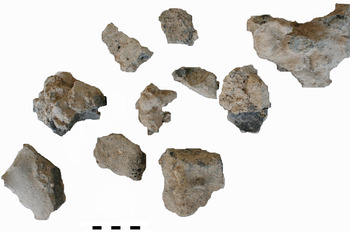
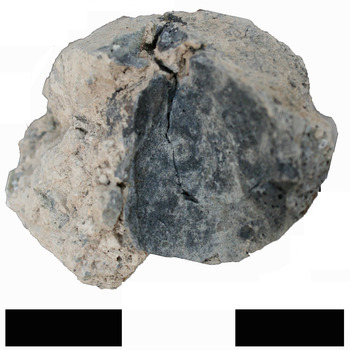
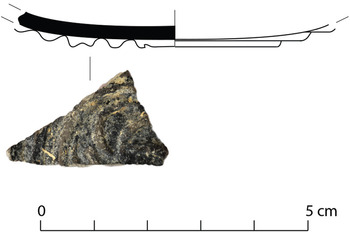
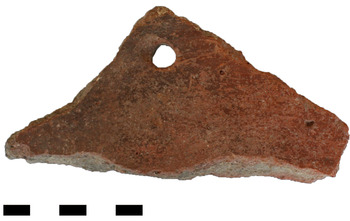
EH 23: Kiln Debris/Kiln-Wasters (SMV 2371). 17 pieces of partially vitrified ceramic kiln wasters and burnt limestone fragments. These pieces are all of tile thickness (approximately 2–3cm) and range in length, approximately 2–10 cm. All are very hard, and their interiors are all dark, ranging from very dark grey to very dark green, and exhibit common circular voids that appear in heavily overfired ceramics (Trainor Reference Trainor2015, 30), and rare rounded and sub-rounded milky inclusions (quartz). None of these pieces represent identifiable vessel-forms. The condition and thickness of these pieces indicates that they are more likely to have been pieces from the interior of a kiln, as opposed to products of a kiln. In addition to the overfired ceramics, there were also fired limestone fragments found here. One piece of burnt limestone has a large perforation through it, which may indicate that it was once part of a kiln floor. Find location: the northern edge of the excavations. Figs 38 and 39.
EH 23. Kiln Debris.

EH 23. Perforated floor fragment.

PHASE 4: THE LATE HELLENISTIC WINE PRESS (Figs 4 and 5)
The remains of a Late Hellenistic wine press complex were the most substantial features uncovered during the KWW excavations. While evidence for wine production and presses of Hellenistic, and even Late Classical, date have been identified in various parts of Crete, this one appears to be the most complete published example of an ancient wine press complex on the island.Footnote 10
The excavated area uncovered several rooms of what was surely a larger building.Footnote 11 Before beginning the discussion of the finds associated with the architectural remains, it is important to clarify some terminology. The term Wine Press Complex herein describes all of the Late Hellenistic architecture that was uncovered during this excavation, including: 1) the Wine Press itself (the Treading Floor and the Collection Tank); 2) the Tub Room; 3) the Western Yard; and 4) the Pithos Room.Footnote 12 Of these, the Treading Floor, the Collection Tank, and the Pithos Room can be convincingly related to the manufacture of wine. The Tub Room likely served a range of functions and probably also played some role in wine production. The so-called Western Yard was an area to the west of the Tub Room that was identified in the excavation notebooks. This part of the site, however, was not excavated to a floor level, and as no stratified artefacts were recorded in this area, it will not be discussed further.
Stratigraphically, the Wine Press Complex consisted of an upper stratum and a lower stratum that were separated by a thick tile layer. The tiles most likely represent the remains of a collapsed roof from the years after the wine press had fallen out of use. Material from the lower stratum below the tile collapse is synchronous and is of mid-to-late-second-century bc date. Finds from the stratum above the tile collapse were chronologically mixed, and consisted of prehistoric, Hellenistic, and Roman material.
A lack of complete vessels amongst the mid-to-late-second-century bc assemblage would indicate that the Wine Press Complex was likely neither destroyed in a single event nor even abandoned especially quickly. Rather, it appears that the complex had probably fallen out of use, with the artefact assemblage from excavation representing discarded material when the people who used this complex left it, or perhaps indicating that the site was used as a dump prior to the roof collapse. We can be quite confident of the chronology of this complex, however, as soundings below the floors revealed an earlier tile collapse, below which was material of consistent late-third-to-early-second-century bc date (see Phase 3, above). The earliest identifiable artefacts from the Wine Press Complex date to the years around the middle of the second century bc, while the latest date to around the close of the second century bc, or possibly the earliest years of the first century bc. We are, therefore, provided with a terminus post quem of the early second century bc and a terminus ante quem of the years around the close of that century. In other words, we have an artefact assemblage that can be reasonably associated with the third and fourth quarters of the second century bc.
Tub Room (Figs 4 and 6)
The largest part of the Wine Press Complex is the Tub Room, named for a large stone tub that was built into the floor of the room. The Tub Room included a lowered well-foyer in its western end, which would have been accessible from inside the Tub Room as well as from the outside via the Western Yard. The floor of the well-foyer was separated by a border of stones and was approximately 20 cm deeper than the rest of the floor of the Tub Room. The presence of earlier Hellenistic pottery in immediate proximity to the well indicates that it was likely a reused feature from the earlier-third-to-early-second-century domestic activity at this location.
The most striking feature of the room was a round fossiliferous limestone tub (hence the name of the room), which was reburied after excavation and therefore not possible to study in person. The tub was quite large with maximum dimensions of 74 cm x 50 cm x 30 cm, with c. 20 cm thick walls and a liquid capacity of approximately 166 litres. The excavator noted that the tub was empty except for a single pyramidal loomweight that most likely fell in after its use life. The tub had a 3 cm hole drilled through its bottom, which may have originally served as a drainage mechanism. This hole had, however, been deliberately blocked and covered by the second-century bc floor, meaning that its location within the Wine Press Complex most likely represents a secondary use for the tub. A flat fossiliferous limestone slab with rounded edges overlay most of the tub, and the excavator suggests that this may have served as a lid. At 74 cm x 65 cm x 15 cm, this lid would have been slightly larger than the mouth of the tub and would have weighed in the range of 150 to 170 kg (Carington Smith and Wall Reference Carington Smith and Wall1994, 362–3).
The location and size of the tub feature bear some resemblance to fourth-to-third-century bc domestic limestone mortars at Lato, most clearly seen in Maison Δ (Hadjimichali Reference Hadjimichali1971, 177–9, figs 10 and 57), which were likely used for grain processing (Amouretti Reference Amouretti1986, 135–7). The context of our tub, however, is not domestic, and its close proximity to the wine press instead may indicate a function related to wine production. Evidence from numerous ancient wine-production sites in Israel presents us with a repeated association of rock-cut depressions close to stone treading floors (e.g. Franklin et al. Reference Franklin, Ebeling, Guillaume and Appler2020, 68–9). These depressions likely served as basins at points in the wine production process. It has been proposed that they may have been used to hold/store baskets of grapes (Feig Reference Feig2003, 198) or that they were used as installations for preparing additives to wine (Frankel Reference Frankel1999, 54). The KWW tub, therefore, may have fulfilled some similar role, perhaps even serving as a store for grapes or must pre-/post-treatment. A stone spouted-basin fragment with a rough inner surface (WP 26) was found immediately to the east of the KWW stone tub. This spouted-basin finds a close parallel from the Maison du Temple at Lato (Hadjimichali Reference Hadjimichali1971, 193, fig. 28) and can be connected with grinding and pouring, an association which may support Frankel's (Reference Frankel1999, 54) hypothesis that depressions/basins in close proximity to wine presses indeed served some type of function related to preparing additives to wine.
The pottery found in the Tub Room dates to around the end of the second century bc and includes cups and bowls (WP 1, WP 2, WP3, WP 4, WP 5, WP 6, WP 7, WP 8, WP 9, WP 10, WP 11), jugs (WP 12, WP 13, WP 14, WP 15), a lopas for cooking (WP 16, WP 17), lekanai or basins (WP 18, WP 19), transport/storage vessels (WP 20), lamps (WP 21, WP 22, WP 23) and a loomweight (WP 24). The majority of the recovered pottery was of local manufacture, with imports represented by a chous (WP 15), a lagynos (WP 14) from the Pergamon region, two transport amphorae (WP 30 and WP 37), and a mouldmade shield-bowl (WP 2) of probable eastern Aegean origin.
Wine press area (Treading Floor/Collection Tank) (Figs 4 and 7)
The wine pressing area occupies the southern part of the Wine Press Complex and was separated from the Tub Room by a low barrier-wall. The wine press consisted of a sloped plastered floor, that has been interpreted as a Treading Floor for pressing grapes, and a relatively large Collection Tank for receiving the juice of the pressed grapes.
The Treading Floor was partially covered by four flagstones (limestone) which were set into pink hydraulic plaster.Footnote 13 The treading area itself had a plaster surface that sloped slightly downward to the east, and at the lowest point of the walls there was a small square cavity into which a stone spout was connected, which in turn opened out into the large collection tank below. The ceramic remains found around the Treading Floor area are contemporary with those from the Tub Room and include a stamped handle from an imported amphora with ‘TE AT’ in ligature (WP 30), a non-local mouldmade bowl fragment (WP 28), a lid from a locally made cooking pot (WP 29), and a locally made lamp (WP 31).
The most prominent feature of this part of the complex is the Collection Tank, which was sunk below the floor level. The tank's walls were formed of mud-bonded rubble masonry and were heavily coated in plaster; the first layer was a rough grey type which contained small pebbles, while the other four layers all consisted of a pink waterproof plaster.Footnote 14 The layering of the plaster in the tank aligns closely with the Roman author Vitruvius’ later description of a similar plastering technique (Vitruvius 7.1). The tank was 98 cm wide, 104 cm long, and had a depth of 140 cm at the corners, with a 17 cm deep circular sediment depression at its centre (Carington Smith and Wall Reference Carington Smith and Wall1994, 367). The walls on the east and west sides contained two pairs of flagstone steps, presumably used to access the tank.Footnote 15
There were a significant number of artefacts found within the Collection Tank. All of these artefacts were broken and incomplete, and therefore likely represent material that was left behind when the complex was abandoned or even dumped after the complex fell out of use. That said, the finds from the tank are contemporary with the artefacts from the rest of the complex and are of late-second-century bc date. The objects that were found inside the tank include a stamped handle from a Knidian amphora (WP 37), a mouldmade bowl fragment (WP 32), a locally made lopas cooking pot (WP 34), a large pithos lid (WP 38), a recycled ceramic weight (WP 35), numerous roof tiles (WP 39, WP 40, WP 41, WP 42, WP 43), part of a limestone door-socket (WP 47) and an iron spearhead (WP 48).
The Pithos Room (Fig. 7)
One extremely interesting feature was the north-east corner of a separate outbuilding that was uncovered next to the wine press. Although only a small section of this building was excavated, it contained a large clay vessel, a pithos, while the remains of another were noted by the excavator next to it, at the extreme edge of the excavations and underneath the modern road. The pithos that was excavated had been set into the ground up to its neck, while some scattered fine pottery had been found close to its rim. This fine pottery is of local production and included a biconical jug (WP 26) and a flaring rim bowl (WP 27), which may have provided a function related to testing or dispensing the contents of the pithos.
While it is not impossible that this pithos room served a function related to food storage, there are good reasons to believe that it served as a fermentation room for wine. Large clay storage vessels known as dolium/-ia were used for fermenting wine in Roman Italy and Gaul. While dolia were not a part of the Cretan ceramic repertoire, the pithos/-oi represents the island-equivalent of dolia and would serve perfectly as vessels for fermentation (Thurmond Reference Thurmond2006, 138). After pressing and a brief initial fermentation, grape juice would have been placed into large, sealed, clay vessels for fermentation. These sealed clay vessels were often partially buried in order to minimise temperature fluctuations during the fermentation process (Rossiter Reference Rossiter1981, 359; Thurmond Reference Thurmond2006, 134; Van Oyen Reference Van Oyen2020, 50–1). Fermentation rooms would have been located close to wine presses but were often separated by walls from the treading floors, as can be seen in the plan of the wine press at the Villa della Pisanella, Boscoreale (Pasqui Reference Pasqui1897, fig. 14). We do not have a complete picture of the Wine Press Complex and its associated remains, but the proximity of the Pithos Room to the Wine Press Complex, the presence of buried pithoi, and similarities with the layout of other presses appear to support the hypothesis that this was indeed a stand-alone fermentation room, which is an extreme rarity in a Hellenistic Greek context.
Scale and context of production at the KWW Wine Press Complex
The remains of the Wine Press Complex provide us with a lens through which to consider wine production at Late Hellenistic Knossos. While it was not possible to complete the excavation in 1977, the remains that were uncovered nonetheless enable us to trace the process of wine production from pressing to settling, and finally to fermentation. Based on its dimensions, the maximum capacity of the tank would have been approximately 1400 litres, a scale that would likely have significantly exceeded the production requirements of a single household (Rossiter Reference Rossiter1981, 348–9). Tchernia (Reference Tchernia1986, 26) has estimated that the average wine consumption of a Roman adult around the time of the end of the Republican period was between 70 and 180 litres annually, meaning that a single tank from our press would provide wine for between 7 and 20 adults for a year. Van Limbergen's (Reference Van Limbergen, Diler, Senol and Aydinoglu2015, 175) study of wine and oil presses from Late Antique Syria presents evidence for an approximate seven-week vintage season, with the primary fermentation of grape juice taking place in the main press tanks over five to seven days, prior to grape juice being placed in vessels for secondary fermentation.Footnote 16 Van Limbergen then estimates that presses may have been used approximately seven to nine times across the annual vintage season. If we apply a similar model to the evidence from Knossos, then our wine press could have feasibly produced between 9800 and 12,600 litres as a maximum annual output. This volume of wine would be sufficient for 54 to 180 adults for a year, or enough wine to fill between 392 and 504 25-litre-Rhodian-amphorae, upon which the Cretan amphora varieties were modelled. We can also state with confidence at this point that other contemporary wine production facilities would have been in operation within the territory of Hellenistic Knossos in order to meet even the basic needs of the estimated population of the urban area of 10,000 to 17,000 people (Trainor Reference Trainor, Mitsotaki and Tzedaki-Apostolaki2019, 2).
If we apply van Limbergern's (Reference Van Limbergen, Diler, Senol and Aydinoglu2015, 178) guiding estimates that one vine produces approximately 3 kg of grapes, and 1 kg of grapes yields approximately 0.68 litres of juice, then we can hypothesise that 14,411–18,529 kg of grapes, or 4,803–6,176 individual vines, would be required to produce 9800–12,600 litres of wine at Knossos. Columella provides us with some useful low (De Re Rustica 5.3.10) and high (De Re Rustica 5.3.5) estimates for the number of vines per hectare, which range from 1300 to 8100 vines (Van Limbergen Reference Van Limbergen, Diler, Senol and Aydinoglu2015, 179). Based on these numbers, we can consider that the KWW wine press would only have required between 0.59 and 4.7 hectares of vines in order to meet its maximum annual output.
The remains of the Wine Press Complex present us with an example of localised wine production on Crete, and a valuable insight into the economy of Late Hellenistic Knossos.Footnote 17 It was located roughly equidistant between two probable ancient roads that connected Knossos with its agricultural hinterlands to the south and may therefore have served as a processing hub on Knossian rural–urban networks (similis Dodd Reference Dodd2019/20, 131). Wine production in Hellenistic times likely took place in rural settings (e.g. Dodd Reference Dodd2020, 113), so the location of our wine press in what is essentially a suburban area is noteworthy, as it should indicate easy accessibility to both the vines and the press.Footnote 18 Most of the ceramics from the press contexts were of local production, with imports from the areas of Attica, Pergamon, Rhodes, Knidos, and Ephesus attesting to what would have been a rural-looking part of the city maintaining connections to the wider Aegean world, especially the eastern Aegean, during this period.
The construction of the wine press may be considered within an island-wide narrative of power consolidation and economic restructuring by the large states of Crete (including Knossos) around 150 bc. With more territory and more resources, the largest states on Crete would have increased their ability to organise and to develop commercial aspects of their economies, including wine production (Hadjisavvas and Chaniotis Reference Hadjisavvas, Chaniotis, Whitley, Cadogan, Iacovou and Katerina2012, 166–7). These political conditions on Crete in the late second century bc can also be linked to another commercial activity, amphora production. These clay vessels were used to transport a wide range of agricultural goods and foodstuffs. Amphorae were not produced if a state had nothing to sell/ship, so the presence of amphora production at a site can be taken as a reasonable indicator of agricultural surplus. At Knossos, we have evidence of second-century bc amphora production.
In 1993, C. Macdonald excavated a Late Hellenistic kiln (Stratigraphic Museum, Knossos excavation code KS178) approximately 200 m from the Wine Press Complex that would have been in use during the second and first centuries bc. The major products of this kiln appear to have been wine amphorae and amphora stands to enable the filling of these vessels (Eiring, Boileau and Whitbread Reference Eiring, Boileau, Whitbread, Blondé, Ballet and Salles2002). The KS178 kiln does not necessarily have any direct connection to our Wine Press Complex, and indeed in a city of approximately 120ha, as Hellenistic Knossos likely was, other kilns and other wine presses would surely have been in operation at this time (Trainor Reference Trainor, Mitsotaki and Tzedaki-Apostolaki2019, 2). The KS178 kiln does, however, add considerable weight to the hypothesis of commercial wine production and packaging in this southern part of the city of Knossos during the Late Hellenistic period.Footnote 19
Ceramics
-
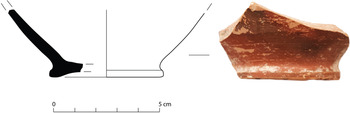
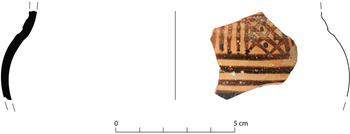
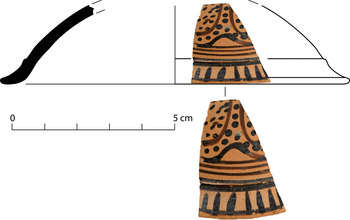
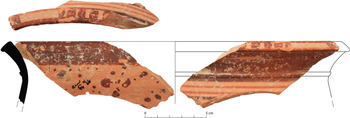
WP 1: Kantharos (SMP 10042.2). Small rim and neck fragment. Black-slipped on both sides with West-Slope-style decoration, sloppy fugitive rosettes below lip. Fine, buff fabric. Interior colour: 5YR 7/6–6/6. Exterior colour: 2.5YR 4/1–4/4. Rim dia. 9 cm. Date: mid-second century bc. Egglezou Reference Egglezou2005, 83–4, no. 352. Find location: Tub Room.
-
WP 2: Mouldmade Shield-Bowl (Concentric Semi-Circle Bowl) (SMP 10040). Body (c. 5% of vessel). Small fragment from the body of a Shield-Bowl, fragmentary concentric semi-circles with a whirligig motif at the centre. Dark slip (non-local). Colour: Gley 1 3/n. Fine fabric. Date: late second–early first century bc. Similis Baur Reference Baur1941, 240–1, fig. 10; Callaghan Reference Callaghan1978b; Rotroff Reference Rotroff1982, 91, nos 400–2, pls 68–9. Find location: Tub Room. Fig. 40.
-
WP 3: Bowl (SMP 10040). Rim and 50% of profile. Black-slipped on both sides. Incised horizontal line below rim, West-Slope-style painted garlands (fugitive white). Fine local fabric. Interior colour: 2.5YR 7/4–7/6. Exterior colour: 10YR 4/1. Rim dia. 9 cm (est.). Date: late second century bc. Eiring Reference Eiring2001, 38, fig. 5d; Coldstream, Eiring and Forster Reference Coldstream, Eiring and Forster2001, 100, fig. 3:4d. Find location: Tub Room. Fig. 41.
-
WP 4: Flaring Rim Bowl (SMP 10042.3). Rim and wall fragment. Dark mottled slip, drip marks visible at bottom of piece. Local fine, buff fabric. Interior colour: 10YR 8/3–8/4. Exterior colour: 5YR 5/1–2.5YR 5/4. Rim dia. 21 cm. Date: 125–100 bc. Homann-Wedeking Reference Homann-Wedeking1950, 177–8, cat. no. B1.1a, fig. 15b, pl. 14a. Find location: Tub Room.
-
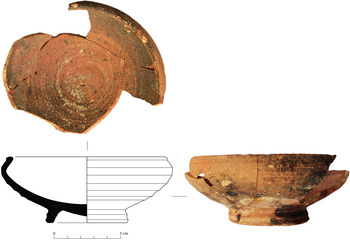
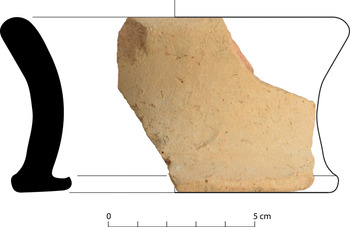
WP 5: Flaring Rim Bowl (SMP 10041). Rim. Dark red-brown matte slip. Local buff, fine fabric. Interior colour: 10YR 8/3–8/4. Exterior colour: 5YR 3/2–3/1. Rim dia. 21 cm. Date: 125–100 bc. Homann-Wedeking Reference Homann-Wedeking1950, 177–8, cat. no. B1.1a, fig. 15B, pl. 14a. Find location: Tub Room. Fig. 42.
-
WP 6: Bowl with Overhanging Rim (SMP 10039). Rim with horizontal relief line at turn of rim. Dark slipped, dipped. Interior colour: 2.5YR 6/4–6/6. Exterior colour: 2.5YR 2.5/1–2.5/3. Local buff, fine fabric. Exterior rim dia. 20 cm. Date: late second century bc. Egglezou Reference Egglezou2005, 65, no. 233, pl. 18. Find location: Tub Room. Fig. 43.
-
WP 7: Echinus Bowl (SMP 10039). Rim and upper body. Slipped with a dark and patchy colour, dipped. Orange-beige semi-fine fabric. Interior colour: 2.5YR 5/8. Exterior colour: 10YR 4/1. Rim dia. 6.8 cm. Date: 125–100 bc. Similar to Homann-Wedeking Reference Homann-Wedeking1950, 179, cat. no. B1.2, fig. 15D, pl. 14b. Find location: Tub Room.
-
WP 8: Echinus Bowl (SMP 10039). Rim. Slipped on both sides, matte mottled. Buff, fine fabric. Interior colour: 10YR 8/4. Exterior colour: 2.5YR 5/1–5/3. Rim dia. 12 cm. Date: 125–100 bc. Homann-Wedeking Reference Homann-Wedeking1950, 179, cat. no. B1.2, fig. 15D, pl. 14b. Find location: Tub Room.
-
WP 9: Echinus Bowl (SMP 10039). Slipped on both sides, matte mottled, dipped. Buff, fine fabric. Interior colour: 10YR 8/4–7/4. Exterior colour: 5YR 6/8–3/5. Rim dia. 12 cm. Find location: Tub Room.
-
WP 10: Echinus Bowl (SMP 10039). Slipped on both sides, matte mottled, dipped. Buff, fine fabric. Interior colour: 10YR 8/4–7/4. Exterior colour: 5YR 6/8–3/5. Rim dia. 16 cm. Find location: Tub Room.
-
WP 11: Echinus Bowl (SMP 9942.4). Rim. Slipped on both sides, matte mottled, dipped. Buff, fine fabric. Interior colour: 2.5YR 6/4–5/4. Exterior colour: 2.5Y 4/1. Rim dia. 12 cm. Find location: Tub Room.
-
WP 12: Cylindrical Jug (SMP 10040). Body (c. 5%). Black-slipped on both sides with West-Slope-style decoration, alternating white and orange myrtle leaves. Incised horizontal line around lower body. Fine non-local fabric. Interior colour: 2.5YR 6/6–5/6. Exterior colour: 2.5Y 2.5/1. Preserved height 4.4 cm. Date: mid-second century bc. Similis Coldstream Reference Coldstream1999, 338, cat. no. S.12, pl. 32. Find location: Tub Room. Fig. 44.
-
WP 13: Tulip Jug (SMP 10040). Rim and partial profile (c. 15%). Black-slipped on both sides, incised horizontal bands below neck and around belly. Rows of painted dots, garlands and partially fugitive bucrania in West-Slope style. Buff fine fabric. Interior colour: 2.5YR 7/4–7/6. Exterior colour: 10YR 4/1. Rim dia. 10.5 cm. Date: early–mid-second century bc. Find location: Tub Room. Fig. 45.
-
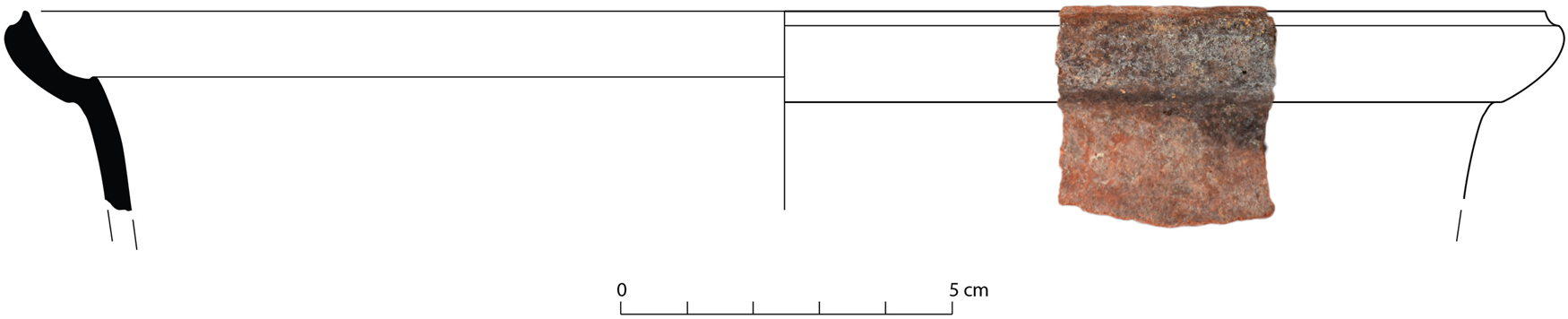
WP 14: Lagynos (with rectangular double-grooved handle) (SMP 10042.3). Rim, neck and grooved strap handle-join. White-slipped exterior (plus interior of neck), with a brown/red horizontal band around neck/body join. Orangish, micaceous fine fabric. Interior colour: 5YR 6/4–6/6. Exterior colour: pale white (not chartable on the Munsell charts). Rim dia. 3.5 cm. Preserved height 8.2 cm. Lagynoi, although common in the wider Aegean region, are rare at Knossos. Eastern Aegean import, likely from Pergamon. Date: second century bc. See British Museum 1867,0512.52. Broadly similar to Rotroff Reference Rotroff1997, 390, no. 1504, and 392, no. 1514. Find location: Tub Room. Fig. 46.
-
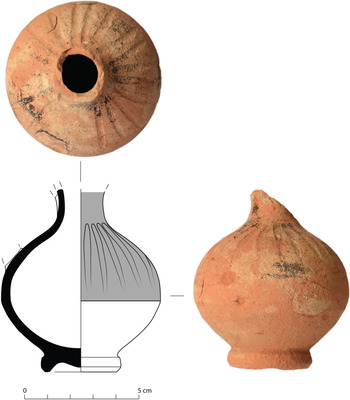
WP 15: Chous (SMP 10033). Most of the lower part of the vessel is complete. Globular form with a ring foot and a nipple-like protrusion on the underside of the floor. Impressed vertical lines around the vessel from the neck to the belly of the vessel. Traces of black slip on the exterior. Fabric is semi-fine and pinkish, probably not local. Interior colour: 2.5YR 6/4–6/6. Exterior colour: 10YR 2/1. Foot dia. 3.9 cm. Preserved height 7.8 cm. Date: mid-second century bc. Similar to Rotroff Reference Rotroff1997, 295, no. 484. Find location: Tub Room. Fig. 47.
-
WP 16: Lopas with Flanged Rim (SMP 10042. 2). Rim and flange fragment. Dark, gritty cooking pot fabric. Interior colour: 2.5YR 5/6. Exterior colour: 2.5YR 3/2–5/6. Rim dia. 15.2 cm. Date: Hellenistic. Find location: Tub Room.
-
WP 17: Cooking Pot Lid (SMP 10039). Knob and part of wall, 15% profile preserved. Orange, gritty cooking pot fabric. Interior colour: 2.5YR 5/8–10YR 5/8. Exterior colour: 2.5YR 5/8–10YR 5/8. Date: Hellenistic. Find location: Tub Room. Fig. 48.
-
WP 18: Lekane (SMP 10039). Rim dia. 23 cm. About 15% preserved. Lekane with flat rim and horizontal incised lines on vertical outer face of rim. Buff, fine fabric. Interior colour: 2.5YR 8/3. Exterior colour: 10Y 4/3–4/8. Date: Hellenistic. Find location: Tub Room.
-
WP 19: Lekane (SMP 10042.2). Rim dia. 21.5 cm. About 10% preserved. Lekane with flat rim and horizontal groove around the upper face of rim. Buff, fine fabric with matte brown slip around rim. Interior colour: 10YR 7/3–7/4. Exterior colour: 5YR 4/4. Date: Hellenistic. Find location: Tub Room.
-
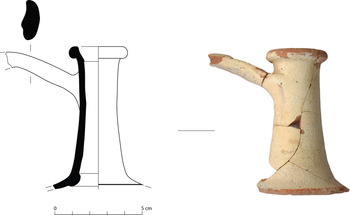
WP 20: Amphora Stand (SMP 10042.5). Complete profile. Pale yellow, finely levigated, local fabric. Interior colour: 2.5YR 7/6. Exterior colour: 2.5YR 8/3. Preserved height 6.8 cm. Diameter at top 11.5 cm. Date: 125–100 bc. Eiring Reference Eiring2001, 77, fig. 19f; Coldstream, Eiring and Forster Reference Coldstream, Eiring and Forster2001, fig. 3:18f. Find location: Tub Room. Fig. 49.
-
WP 21: Lamp (SMP 10042.2). Upper body and collar-rim preserved, 25% of vessel. Powdery beige fabric, with dark slip. Callaghan suggests an origin in the Messara (pers. comm. April 2015). Non-local. Interior colour: 2.5Y 7/3. Exterior colour: 10YR 5/1–4/1. Sackett et al. Reference Sackett, Branigan, Callaghan, Catling, Catling, Coldstream, Higgins, Popham, Price, Price and Waywel1992, 261, cat. no. L.25, 26. Date: late second century bc. Find location: Tub Room. Fig. 50.
-
WP 22: Lamp (SMP 994). Complete profile (including horizontal handle) from rear of lamp. Slipped at top with reddish-orange matte drips down the exterior. Buff, semi-fine fabric. Interior colour: 7.5YR 7/6. Exterior colour: 2.5YR 5/8. Preserved height 4.8 cm. Diameter at top 1.9 cm. Date: 150–125 bc. Coldstream, Eiring and Forster Reference Coldstream, Eiring and Forster2001, fig. 3:17. Find location: Tub Room.
-
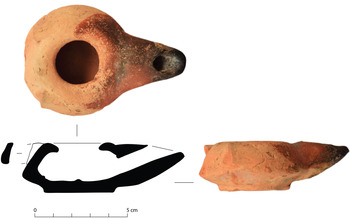
WP 23: Lamp (SMP 991). Complete, but for nozzle-tip and handle. Slipped at top with reddish-orange matte slip on the exterior. Buff, semi-fine fabric. Interior colour: 7.5YR 7/6. Exterior colour: 2.5YR 5/8–4/8 (slip). Preserved height 3.3 cm. Diameter at top 1.9 cm. Date: second half of the second century bc. Eiring Reference Eiring2001, 75, cat. no. 18s. Find location: Tub Room. Fig. 51.
-
WP 24. Discoid Loomweight (SMT 2645). Two-holes at top, manufactured in a very coarse clay fabric. <10% complete. Weight 13 g. Very coarse fabric, orange burnt black in places, organic temper. Date: Hellenistic context, but the comparative softness of the ceramic fabric and the presence of organic temper in the fabric may indicate that this may even be of prehistoric manufacture. Find location: Tub Room.
-
WP 26: Biconical Jug (SMP 9942.9). Four joining fragments of rim and neck. Slipped with a thin reddish matte slip on both sides, and horizontal groove around the lip. Orange-buff, fine fabric. Interior colour: 7.5YR 7/6. Exterior colour: 2.5YR 5/6–5/8. Rim dia. 11.5 cm. Date: 140–130 bc. Rotroff Reference Rotroff1997, 297, no. 511, fig. 38, pl. 20. Find location: Pithos Room. Fig. 52.
-
WP 27: Flaring Rim Bowl (SMP 9942.9). Rim (<5%). Mottled, dark matte slipped exterior. Local, fine buff fabric. Interior colour: 10YR 8/3–7/3. Exterior colour: mottled, dark matte (slip). Rim dia. 11 cm (est.). Date: 125–100 bc. Coldstream, Eiring and Forster Reference Coldstream, Eiring and Forster2001, fig. 3:6O. Find location: Pithos Room.
-
WP 28: Mouldmade Bowl (SMP 10042.7). Body (c. 5% of vessel). Red slipped surface with fragmentary moulded leaf or long petal decoration. Fine fabric. Date: second century bc (late). See Kenrick Reference Kenrick1985, 110, ‘Square-Monogram painter’ nos B159 and B160, fig. 21, pl. 8. See also Callaghan Reference Callaghan1978a, pl. 8. Find location: Wine Press.
-
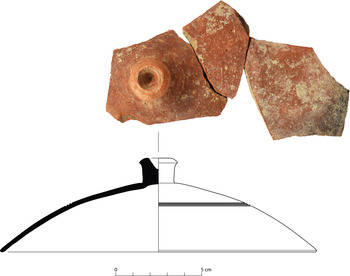
WP 29: Cooking Pot Lid (SMP 10042.4). Knobbed cooking pot lid, complete profile. Orange, gritty cooking pot fabric with dark core. Interior colour: 2.5YR 4/1. Exterior colour: 2.5YR 6/8. Rim dia. 17 cm. Date: Late Hellenistic. Sackett et al. Reference Sackett, Branigan, Callaghan, Catling, Catling, Coldstream, Higgins, Popham, Price, Price and Waywel1992, cat. no. A1.14. Find location: Wine Press. Fig. 53.
-
WP 30: Imported Amphora Handle (SMP 9943.6). Stamped: rectangular stamp – 1.6 x 4 cm – ‘TE AT’ in ligature. Interior colour: 2.5YR 6/6–5YR 6/6. Exterior colour: 2.5YR 6/6–5YR 6/6. Date: second century bc. Sackett et al. Reference Sackett, Branigan, Callaghan, Catling, Catling, Coldstream, Higgins, Popham, Price, Price and Waywel1992, cat. no. X26. Eastern Aegean amphora, possibly Ephesian. Similis Bezeczky Reference Bezeczky2013, 61–5, no. 538. Find location: Wine Press. Fig. 54.
-
WP 31: Lamp (SML 987). Most of profile and 30% of vessel preserved. Semi-fine grey fabric with a thin-orangish surface wash. Interior colour: 5YR 6/6. Exterior colour: 2.5Y 6/2. Similar to Howland Reference Howland1958, Type 35a; Coldstream Reference Coldstream1999, cat. no. V14. Date: late second–early first century bc. Find location: Wine Press.
-
WP 32: Mouldmade Bowl (SMP 10042.6). Rim (c. 5% of vessel). Part of the same vessel as WP 28. Red slipped surface with moulded ovolo-and-tongue band below rim but above a row of dots. Rim dia. 13.5 cm. Fine fabric. Find location: Wine Press.
-
WP 33: Cylindrical Cup (SMP 10039). Rim, wall, and strap handle attached on interior of rim. Light orange slipped. Interior colour: 10YR 7/4. Exterior colour: 10YR 4/1–3/1. Local buff, fine fabric. Rim dia. 6.3 cm. Date: second quarter of the second century bc. Egglezou Reference Egglezou2005, 58, no. 183, pl. 3. Find location: Wine Press.
-
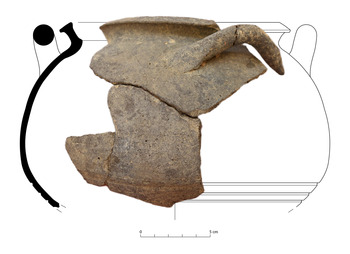
WP 34: Lopas with Flanged Rim (SMP 10039). About 5% of vessel. Rim and flange fragment. Lopas with interior flange and slightly offset rim. Orange, gritty cooking pot fabric with evidence of burning around the rim. Interior colour: 10YR 6/8–5/8. Exterior colour: 10YR 6/8–5/8. Rim dia. 14.2 cm. Preserved height 3.3 cm. Date: Hellenistic. Riley Reference Riley and Lloyd1979, 244, no. 425. fig. 98. Find location: Wine Press. Fig. 55.
-
WP 35: Ceramic Weight (reused) (SMT 9937). Made from a broken cooking vessel. Wall. 3–5% of complete vessel. Preserved length 11.6 cm. Weight 69 g. Gritty pinkish orange fabric with a dark core, relatively soft-fired. Common small to medium white and pale inclusions. Date: most likely prehistoric. Find location: Wine Press, inside the collection tank. Fig. 56.
-
WP 36: Lekane (SMP 10039). Lekane with flat horizontal rim. Rim dia. 18 cm. About 15% preserved. Buff, fine fabric with matte brown slipped rim. Interior colour: 10YR 8/3–8/4. Exterior colour: 12.5YR 6/8. Date: Hellenistic. Find location: Wine Press.
-
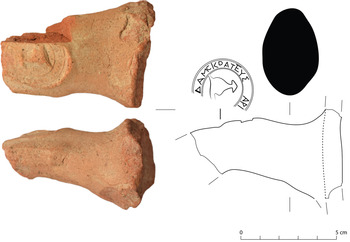
WP 37: Knidian Amphora (SMP 10043.2). Handle fragment stamped with a Bucranium motif and fabricant name ΑΡΙ[ΣΤΟΚΛOΣ O] ΔΑΜΟΚΡΑΤEYΣ. Knidos. Interior colour: 5YR 6/6–7/6. Exterior colour: 7.5YR 7/4. Date: c. 188–175 bc. See Grace Reference Grace1985, 18, 49, nos 19–21, pl. 3. The earlier date of this amphora in comparison to the rest of the assemblage may indicate that it was not in its first use in this context. Find location: Wine Press. Fig. 57.
-
WP 38: Pithos Lid (SMT 2653). 52% preserved. Height 3 cm. Diameter 52.6 cm. Preserved weight 5650 g. Local buff coarse fabric, with common large rounded and angular red matte inclusions. Interior colour: 2.5YR 8/6–6/6. Exterior colour: 5YR 7/6–8/6. Find Location: Wine Press, inside the wine collection tank. Fig. 58.
WP 2. Mouldmade Shield-Bowl.

WP 3. Bowl.

WP 5. Flaring Rim Bowl.

WP 6. Bowl with Overhanging Rim.

WP 12. Cylindrical Jug.

WP 13. Tulip Jug.

WP 14. Lagynos.

WP 15. Chous.

WP 17. Cooking Pot Lid.

WP 20. Amphora Stand.

WP 21. Lamp.

WP 23. Lamp.

WP 26. Biconical Jug.

WP 29. Cooking Pot Lid.

WP 30. Imported Amphora Handle.

WP 34. Lopas with Flanged Rim.

WP 35. Ceramic Weight.

WP 37. Knidian Amphora.

WP 38. Pithos Lid.

Stone, metal and tile finds
-
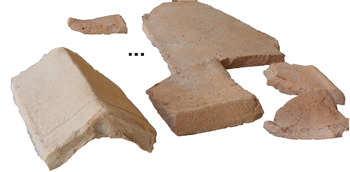
WP 39: Tile (SMT 2649). Pan tile fragment of local production, 20% complete. Max preserved length 36.6 cm. Max preserved width 35.5 cm. Preserved weight 2250 g. Interior colour: 5YR 7/6–7.5YR 8/6. Exterior colour: 2.5Y 8/6–6/6. Buff coarse fabric with common large rounded and angular red matte textural concentration features (TCFs herein). These aside, the composition looks very similar to that of local coarse Hellenistic pottery. Find location: Wine Press, inside the wine collection tank. Fig. 59.
-
WP 40: Tile (SMT 2649). Pan tile fragment of local production, 15–20% of complete tile. Max preserved length 23.5 cm. Max preserved width 20.5 cm. Preserved weight 958 g. Interior colour: 5YR 7/6–7.5YR 8/6. Exterior colour: 2.5Y 8/6–6/6. Buff coarse fabric with common large rounded and angular red matte TCFs. Find location: Wine Press, inside the wine collection tank. Fig. 59.
-
WP 41: Tile (SMT 2649). Cover tile fragment of local production, 15–20% of complete tile. Max preserved length 30.6 cm. Max preserved width 20.3 cm. Preserved weight 1750 g. Interior colour: 10YR 8/4–8/6. Exterior colour: 2.5Y 6/8–5/8. Buff coarse fabric with common large rounded and angular red matte TCFs with a reddish core. Find location: Wine Press, inside the wine collection tank. Fig. 59.
-
WP 42: Tiles (seven samples) (SMT 2652). Local fabric. Interior colour: 5YR 7/6–7.5YR 8/6. Exterior colour: 2.5Y 8/6–6/6. Buff coarse fabric with common large rounded and angular red matte TCFs. Find location: Wine Press, inside the wine collection tank. Fig. 59.
-
WP 43: Tile (SMT 2652). Cover tile of local production, 40% complete. Max preserved length 29.1 cm. Max preserved width 16.5 cm. Preserved weight 1673 g. Interior colour: 10YR 8/4–7/4. Exterior colour: 5YR 7/4. Buff, hard fabric with common small dark grey and white rounded and sub-rounded inclusions. Harder-fired in comparison to the other tiles. Find location: Wine Press, inside the wine collection tank. Fig. 59.
-
WP 44: Collection Tank Plaster (25–30 fragments) (SMV 2372). Thick, coarse plaster with a greenish exterior. Colour: 2.5YR 8/3–8/4. 1.2 cm thick. Coarse plaster with frequent rounded grey and milky white inclusions. Find location: Wine Press, inside the wine collection tank.
-
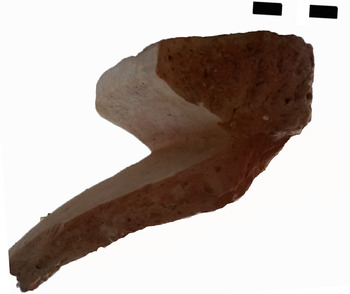
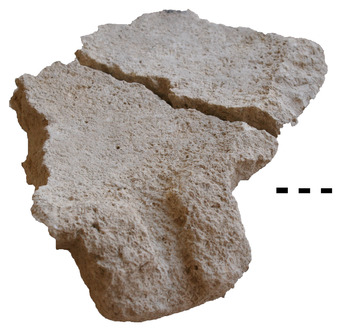
WP 45: Stone Spouted-Basin (SMS 782). Rim, body and spout fragments from a shallow stone bowl with a concave, pockmarked interior surface. This non-local vessel most likely fulfilled a similar grinding function to those of clay mortaria. Preserved diameter 47 cm (est.). Preserved weight 1742 g. Date: Hellenistic context. Similar to Hadjimichali Reference Hadjimichali1971, 193, fig. 28. See also Villing and Pemberton Reference Villing and Pemberton2010; Poupaki Reference Poupaki and Kokkorou-Alevra2017. Find location: Tub Room. Fig. 60.
-
WP 46: Quartz Fragment (SMS 776). Preserved dimensions 2.3 cm x 1.2 cm. Found in the Tub Room below the roof fall in the corner of walls G and J, in a context with burn patches and the mortarium spout. Find location: Tub Room.
-
WP 47: Stone Door Socket (SMS 777). Very light yellowish-green limestone with a central depression 8.9 cm x 7.8 cm x 3.5 cm deep. Identified by the excavators as a fragment of a door socket. Preserved length 21 cm. Preserved width 27.5 cm. Preserved height 7.8 cm. Preserved weight 4400 g. Find location Wine Press, inside the wine collection tank.
-
WP 48: Iron Spear Head. Preserved dimensions (max.) 6.7 cm x 1.9 cm. Roughly leaf-shaped short spear head with remains of socket and a rivet at the centre. Find location: Wine Press. Fig. 61.
WP 39–43. Tiles.

WP 45. Stone Spouted-Basin.

WP 48. Iron Spear Head.

PHASE 5: EARLY ROMAN FINDS (Fig. 3)
At the beginning of the first century bc, Knossos had been one of the leading states on the island of Crete. It was, however, the main source of opposition to the Roman campaigns on Crete in 71 bc and 69 bc (Sanders Reference Sanders1982, 3–4). Knossos was besieged and eventually taken by the Roman commander Q. Caecilius Metellus, who also destroyed the house of its best-known resident, the resistance commander Lasthenes (Appian 6.5 [frag]). When the Romans completed their conquest of Crete in 67 bc, they chose Gortyn as the island capital and created a unified province with the island's southern neighbour, Cyrene (Strabo 10.4.7). Under Roman rule, Crete was politically and economically orientated southward, and Knossos became less prominent than it had been during the preceding Hellenistic period. In the latter years of the first century bc, most likely around 27 bc, Knossos apparently further declined economically when Augustus founded the Colonia Julia Nobilis Cnosus within the territory of Knossos, which granted land to the people of Capua (Cassius Dio 49.14; Sanders Reference Sanders1982, 14; Bowsky Reference Bowsky and Dabrowa2002, 27–8; Chaniotis Reference Chaniotis2004, 103). Based on historical accounts alone, the picture of Knossos in the first century bc under Roman rule would certainly not be a positive one. Archaeological evidence, however, provides a different viewpoint and indicates that things may not have changed all that much during the early years of Roman rule (Sweetman Reference Sweetman2007; Sweetman and Grigoropoulos Reference Sweetman and Grigoropoulos2010, 358–9; Trainor Reference Trainor, Mitsotaki and Tzedaki-Apostolaki2019, 6–7).
Emerging results from the Knossos Urban Landscape Project indicate that a major contraction in the southern part of the city of Knossos occurred during the first century bc (Trainor Reference Trainor, Mitsotaki and Tzedaki-Apostolaki2019) and seems to have initiated a trend of urban contraction to the north which ran into the third–fourth centuries ad. Excavated material from other areas across the south of the city appears to support this observation: late first-century destructions or abandonments recorded at the Acropolis Houses (Callaghan et al. Reference Callaghan, Catling, Catling, Smyth, Spawforth and Wall1981, 85–97); the KS178 kiln (Eiring, Boileau and Whitbread Reference Eiring, Boileau, Whitbread, Blondé, Ballet and Salles2002); the Shrine of Glaukos (Callaghan Reference Callaghan1978a, 28); and possibly also the Sanctuary of Demeter (Coldstream et al. Reference Coldstream, Higgins, Waywell, Jackson, Hughes-Brock, Kenna and Jarman1973, 186). The KWW excavations can offer some insight into our understanding of this urban contraction.
Two contemporaneous deposits of late first-century bc date were recorded in the northern area of the KWW excavations. The character of the artefacts from these deposits appears to be divided between domestic and economic spheres. The material consists of two fragments of imported Eastern Sigillata A plates (ER 1, ER 2), five local cups (ER 3, ER 4, ER 5, ER 6, ER 7), two bowls (ER 8, ER 9), a cooking pot/chytra (ER 10), two lekanai/basins (ER 11, ER 12), and six local amphorae (ER 13, ER 14, ER 15, ER 16, ER 17, ER 18). The composition of this assemblage is interesting as it represents the Hellenistic–Roman transitional period at Knossos. The city would have been under Roman control during the late first century bc; however, the KWW assemblage appears to be almost entirely Hellenistic in appearance, with Everted rim cup (ER 3), Cylindrical cup (ER 4) and Carinated cup (ER 5) types all persisting at this time. Similarly, Hellenistic-style bowls with overhanging rim (ER 8) and flaring rim (ER 9) were also still being used. The exception to the otherwise local, Hellenistic-orientated assemblage is the presence of the Eastern Sigillata A imports, which most likely originated on the Levantine coast.Footnote 20 In addition to dining, practices relating to cooking, utility, weaving, and lighting all appear to retain a local and distinctly Hellenistic character. Fragments of five local amphorae in forms that imitate Rhodian prototypes extend a trend away from the island's earlier, traditional Hellenistic archetype (Marangou-Lerat Reference Marangou-Lerat1995, 66–7, Amphora Crétoise 7). Yet despite this morphological change in amphora forms, these local Rhodian-imitations can safely be classified as Hellenistic based on evidence for the production of these forms during the second and first centuries bc (alongside imitations of Koan forms) from the KS178 kiln the lower slope of the Knossos acropolis.
What does this tell us about the issue of a first-century bc urban contraction? The abandonment of the KWW, and the disruptions and abandonments mentioned above all postdate the Roman conquest of the city by a generation or two. The Romans conquered Knossos in 67 bc, while the latest material from the KWW excavations dates to the third, or even to the fourth, quarter of the first century bc. After this point, the area around the KWW remained undeveloped in an urban context.
It is probably impossible to know if the entire southern part of the city of Knossos fell out of use at one time, or if the abandonment of this part of the town was a gradual process over a decade or two. The apparent lack of complete vessels in the KWW assemblages may indicate that abandonment was not sudden or absolute, and that the remains we have reflect either dumping activity or the remains of broken vessels that were deliberately not taken away when the people using this site left. One hint at a factor in the urban contraction comes from the Unexplored Mansion, where Sackett identified evidence of a possible earthquake destruction in the late first century bc (Sackett et al. Reference Sackett, Branigan, Callaghan, Catling, Catling, Coldstream, Higgins, Popham, Price, Price and Waywel1992, 178–81), which may also find support in evidence from Gortyn, where earthquake damage was recorded in c. 31–30 bc (Di Vita Reference Di Vita1979–80, 435). Perhaps an earthquake caused an abandonment, or even a weakening of structures in the southern part of the city, and the inhabitants eventually moved toward the north. A lack of obvious burning in any of the abandonment levels/destruction levels across this part of Knossos may add further weight to the earthquake argument as opposed to a fire or a deliberate destruction.
Ceramics
-
ER 1: Eastern Sigillata A (SMP 9942.3). Part of foot. Atlante Form 3 (or 4), the surviving fragments do not enable more precise identification. Thick reddish-brown slip on both sides. Fine, pale Eastern Sigillata A (ESA) fabric. Interior colour: 2.5Y 8/3. Exterior colour: 2.5YR 4/4–3/6. Foot dia. 12 cm. Date: 50–1 bc. Hayes Reference Hayes1986, Form 3 (or 4). Find location: Early Roman level north of Wall G.
-
ER 2: Eastern Sigillata A Plate (SMP 9942.3). Part of foot. Atlante Form 3 (or 4), the surviving fragments do not enable more precise identification. Thick reddish-brown slip on both sides. Fine, pale ESA fabric. Interior colour: 2.5Y 8/3. Exterior colour: 2.5YR 4/4–3/6. Foot dia. 10.5 cm. Date: 50–1 bc. Hayes Reference Hayes1986, Form 3 (or 4). Find location: Early Roman level north of Wall G.
-
ER 3: Everted Rim Cup (SMP 9942.3). Foot. Dull, reddish-yellow slip. Local buff fine fabric. Interior colour: 7.5YR 5/1–4/1. Exterior colour: 7.5YR 5/1–4/1. Foot dia. 4.5 cm. Date: c. 50–25 bc. Sackett et al. Reference Sackett, Branigan, Callaghan, Catling, Catling, Coldstream, Higgins, Popham, Price, Price and Waywel1992, cat. no. H35.6. Find location: Early Roman level north of Wall G.
-
ER 4: Cylindrical Cup (SMP 9942.3). Complete foot. Dull, grey-brown slip. Local semi-fine coarse pinkish fabric. Interior colour: 7.5YR 5/1–4/1. Exterior colour: 7.5YR 5/1–4/1. Foot dia. 5.5 cm. Date: 50–25 bc. Sackett et al. Reference Sackett, Branigan, Callaghan, Catling, Catling, Coldstream, Higgins, Popham, Price, Price and Waywel1992, cat. no. H35.2. Find location: Early Roman level north of Wall G.
-
ER 5: Carinated Cup (SMP 9942.3). Rim. Dull, reddish-yellow slip. Local buff-orange fine fabric. Interior colour: 5YR 6/6. Exterior colour: 2.5YR 5/6–5/8. Rim dia. 11.5 cm. Date: c. 50 bc. Coldstream, Eiring and Forster Reference Coldstream, Eiring and Forster2001, fig. 3:1w. Find location: Early Roman level north of Wall G.
-
ER 6: Cup with Everted Rim (SMP 9942.2). Foot. Dull, reddish-yellow slip. Local buff fine fabric with a reddish core. Interior colour: 7.5YR 6/6–5YR 6/6. Exterior colour: 10YR 7/8–10YR 4/8. Foot dia. 5.5 cm. Date: third quarter of the first century bc. Sackett et al. Reference Sackett, Branigan, Callaghan, Catling, Catling, Coldstream, Higgins, Popham, Price, Price and Waywel1992, cat. no. H35.6. Find location: Early Roman level north of Wall G.
-
ER 7: Cylindrical Cup (SMP 9942.1). Foot fragment. Dull, pinkish-brown slip. Regional, fine pinkish fabric. Interior colour: 7.5YR 7/4. Exterior colour: 2.5YR 4/1–3/1 (slip). Foot dia. 5.1 cm. Date: late first century bc. Sackett et al. Reference Sackett, Branigan, Callaghan, Catling, Catling, Coldstream, Higgins, Popham, Price, Price and Waywel1992, cat. no. H36.1. Find location: Early Roman level north of Wall G.
-
ER 8: Bowl with Overhanging Rim (SMP 9942.2). Rim. Dull, dark grey matte slip (likely dipped). Local buff fine fabric with a reddish core. Interior colour: 7.5YR 7/4–2.5YR 6/6. Exterior colour: 2.5Y 3/1 (slip). Rim dia. 12 cm. Date: 50–25 bc. Sackett et al. Reference Sackett, Branigan, Callaghan, Catling, Catling, Coldstream, Higgins, Popham, Price, Price and Waywel1992, cat. no. H35.13. Find location: Early Roman level north of Wall G.
-
ER 9: Bowl with Flaring Rim (SMP 9942.1). Rim. Dull, very pale brown slip. Local, fine buff fabric. Interior colour: 10YR 8/4. Exterior colour: 2.5YR 5/8 (slip). Rim dia. 11 cm (est.). Date: 50–25 bc. Coldstream, Eiring and Forster Reference Coldstream, Eiring and Forster2001, fig. 3:5q. Find location: Early Roman level north of Wall G.
-
ER 10: Chytra (SMP 10035). Mostly complete profile. Mushroom rim, interior flange and circular horizontal handles. Dark, gritty cooking pot fabric with greenish surface (overfired?). Interior colour: 10YR 4/1. Exterior colour: 10YR 4/1–Gley 1 7/10Y. Rim dia. 16.1 cm. Preserved height 13.6 cm. Date: 100–25 bc. Sackett et al. Reference Sackett, Branigan, Callaghan, Catling, Catling, Coldstream, Higgins, Popham, Price, Price and Waywel1992, cat. no. H32.18 (less pronounced flange than ER 10). Find location: Early Roman level north of Wall G. Fig. 62.
-
ER 11: Lekane (SMP 9942.5). Flat rim with parallel horizontal grooves around the top. About 5% of total vessel. Unslipped. Pale fine fabric, which is typical of late Hellenistic and Early Roman lekanai from Knossos. Colour: 2.5Y 8/3–7/3. Preserved height 5 cm. Rim dia. 36.2 cm. Date: first century bc. Sackett et al. Reference Sackett, Branigan, Callaghan, Catling, Catling, Coldstream, Higgins, Popham, Price, Price and Waywel1992, cat. no. A1.25. Find location: Early Roman level north of Wall G.
-
ER 12: Lekane (SMP 9942.5). Rolled rim with parallel horizontal grooves around the top. About 5–10% of total vessel. Unslipped. Pale fine fabric, which is typical of late Hellenistic and Early Roman lekanai from Knossos. Colour: 2.5Y 8/3, 2.5YR 6/6 (core). Preserved height 3.9 cm. Rim dia. 35 cm. Date: first century bc. Sackett et al. Reference Sackett, Branigan, Callaghan, Catling, Catling, Coldstream, Higgins, Popham, Price, Price and Waywel1992, cat. no. A1.25. Find location: Early Roman level north of Wall G.
-
ER 13: Amphora (SMP 9942.5). Local imitation of a Rhodian amphora form. Handle, neck, rim join. Handle(s) rounded in section and spiked in profile. Interior colour: 5YR 7/6–6/6. Exterior colour: 5YR 7/6–6/6 (surface wash slightly lighter). Parallels with amphorae from a kiln site at Knossos: Coldstream, Eiring and Forster Reference Coldstream, Eiring and Forster2001, 129–30, fig. 3:18d. Date: first century bc. Find location: Early Roman level north of Wall G. Fig. 63.
-
ER 14: Amphora (SMP 9942.5). Local imitation of a Rhodian amphora form. Handle, neck, rim join. Handle(s) rounded in section and spiked in profile. Interior colour: 5YR 7/6–6/6 (slightly reddish core). Exterior colour: 5YR 7/6–6/6. Date: first century bc. Find location: Early Roman level north of Wall G. Fig. 64.
-
ER 15: Amphora (SMP 9942.5). Local imitation of a Rhodian amphora form. Handle, neck join. Handle(s) rounded in section and spiked in profile. Interior colour: 5YR 6/6. Exterior colour: 5YR 6/6. Date: first century bc. Find location: Early Roman level north of Wall G.
-
ER 17: Amphora (SMP 9942.5). Local imitation of a Rhodian amphora form. Handle, neck join. Handle(s) rounded in section and spiked in profile. Interior colour: 2.5Y8/3–8/4. Exterior colour: 2.5Y8/3–8/4. Date: first century bc. Find location: Early Roman level north of Wall G.
-
ER 18: Amphora (SMP 9942.5). Imitation of a Rhodian amphora form. Handle, neck, rim join. Handle is rounded in section and spiked in profile. Possibly regional as opposed to local. Interior colour: 5YR 6/4–6/6 (core). Exterior colour: 10YR 8/4. Date: first century bc. Find location: Early Roman level north of Wall G. Fig. 65.
-
ER 19: Lamp (SMP 988). Collar-rim with tiny filling holes around the upper disc. 90% profile (rim and handle missing). Slipped with a mottled dark and orange matte slip. Buff, sandy fabric. Interior colour: 7.5YR 8/4–8/6. Exterior colour: 10YR 4/1. Preserved height 4.3 cm. Date: late first century bc. Sackett et al. Reference Sackett, Branigan, Callaghan, Catling, Catling, Coldstream, Higgins, Popham, Price, Price and Waywel1992, cat. no. L37; Howland 1968, Type 49. Find location: Early Roman level north of Wall G. Fig. 66.
-
ER 20: Lamp (SML 989). Late Hellenistic wheel-made lamp with depressed central disc. 75% complete. Pale wash on the surface and traces of a reddish slip at the base of the nozzle. Buff, fine fabric. Interior colour: 7.5–5YR 7/6. Exterior colour: 5YR 5/8. Preserved height: 3.4 cm. Date: late Hellenistic. Sackett et al. Reference Sackett, Branigan, Callaghan, Catling, Catling, Coldstream, Higgins, Popham, Price, Price and Waywel1992, cat. nos L12–14 are similar. Find location: Early Roman level north of Wall G. Fig. 67.
-
ER 22: Discoid Loomweight (SMT 2636). 30% complete. Weight 43 g. Light brown with small white and glassy inclusions with a thin, buff slip. Find location: Early Roman level north of Wall G.
-
ER 23: Pyramidal Loomweight (SMT 2616). 70% complete. Preserved height 5.8 cm. Base dimensions 3.8 cm x 3.8 cm. Weight 70 g. Pale yellow fabric with large grits. Find location: Early Roman level north of Wall G.
-
M 6: Carinated Cup (SMP 10036). 80% complete vessel. Local buff fine fabric with interior wash. Interior colour: 10YR 8/3–8/4. Exterior colour: 10YR 8/3–8/4. Rim dia. 8.4 cm. Preserved height 5.1 cm. Foot dia. 5.1 cm. Date: c. 50 bc. Hayes Reference Hayes1971, 266, no. 36. Find location: mixed context. Fig. 68.
-
M 7: Eastern Sigillata A Plate (SMP 9942.8). Atlante Form 9. Part of foot and floor. Thick reddish-brown slip on both sides. Fine, pale ESA fabric. Interior colour: 10R 8/3–8/4. Exterior colour: 10YR 4/6–4/8. Foot dia. 10 cm. Date: 50–25 bc. Sackett et al. Reference Sackett, Branigan, Callaghan, Catling, Catling, Coldstream, Higgins, Popham, Price, Price and Waywel1992, 185, cat. no. A2.13(a), pl. 138. Find location: mixed context.
-
M 8: Eastern Sigillata A Cup (SMP 9943.5). Atlante Form 22a. Part of foot. Thick reddish-brown slip on both sides. Fine, pale ESA fabric. Interior colour: 10R 8/3. Exterior colour: 10YR 4/6–4/8. Foot dia. 5.4 cm. Date: 50–25 bc. Hayes Reference Hayes1986, Form 22a; Reference Hayes2008, 132, no. 88. Find location: mixed context. Fig. 69.
-
M 9: Cup with Everted Rim (SMP 9942.8). Rim and wall. Dark slip over local buff, fine fabric. Relief line under lip. Interior colour: 10YR 8/4–7/4. Exterior colour: 5Y 2.5/1. Rim dia. 13.2 cm. Date: mid–late first century bc. Eiring Reference Eiring, Drougou, Zervoudaki, Marangou and Touratsoglou2000, 54, pl. 27a:1. Find location: mixed context. Fig. 70.
-
M 10: Small Clay Applique Head (SMT 2643). Partially eroded head of a person with an open mouth, neck-length hair and a possible headband. A figurine of similar design from the Unexplored Mansion excavations has been interpreted as an actor playing a female character (Sackett et al. Reference Sackett, Branigan, Callaghan, Catling, Catling, Coldstream, Higgins, Popham, Price, Price and Waywel1992, 356, cat. no. 79, pl. 300). Our piece, however, is not a figurine, rather it would have been attached to a vessel, likely a cup or a jug. Beige semi-fine fabric with orange-red slip. Preserved height 3.7 cm. Preserved width 3 cm. Date: Roman. Find location: surface. Fig. 71.
-
M 11: Mouldmade Terracotta Protome from a Vase (SMT 2641). Female head (gorgon?) with long hair around the round face. Preserved height 2.1 cm. Preserved width 2.6 cm. Fine buff local fabric with red slipped surface. Date: likely Roman on account of the red slipped surface of the piece and the other associated material in this context. Find location: Early Roman level north of Wall G. Fig. 72.
ER 10. Cooking Pot.

ER 13. Amphora.

ER 14. Amphora.

ER 18. Amphora.

ER 19. Lamp.

ER 20. Lamp.

M 6. Carinated Cup.

M 8. Eastern Sigillata A Cup.

M 9. Cup with Everted Rim.

M 10. Small Clay Applique Head.

M 11. Mouldmade Terracotta Protome from a Vase.

Stone finds
-
ER 24: Stone Door Socket (SMS 780). Very light yellowish-green limestone with a very slight central depression. Preserved length 12.8 cm. Preserved width 11.1 cm. Preserved height 6.3 cm. Preserved weight 1300 g. Find location: Early Roman level north of Wall G.
-
ER 25: Hammerstone (SMS 794). Rounded stone tool of non-local provenance. Most likely used as a hammerstone for pounding. 100% preservation. Preserved height 2.5 cm. Circumference 6.5 cm. Preserved weight 172 g. Find Location: Early Roman level north of Wall G.
-
ER 26: Stone Tool (SMS 784). Possible pounder or a grinder. Dark grey, very hard stone (granite?). Preserved length 8.8 cm. Preserved width 6.2 cm. Preserved height 4.1 cm. Preserved weight 528 g. Find location: Early Roman level north of Wall G.
KWW’77 EXCAVATIONS: SUMMARY
Although KWW was a relatively small and incomplete excavation, some important finds were uncovered. The KWW excavations provide a window onto domestic and economic life at the edge of the city of Knossos between the eighth and first centuries bc. As the campaign was a rescue excavation, no single building was excavated completely, and the site was eventually backfilled. Nonetheless, the campaign was meticulously recorded by the excavator, which has been crucial for enabling the present study.
These excavations revealed evidence of domestic activity during the EIA–Archaic periods, which appears to align relatively closely with material found in tombs and the Unexplored Mansion. The Early Hellenistic material (late third to early second centuries bc) reveals three contemporary, but possibly unrelated, contexts. The first two of these underly the later Wine Press Complex and can be viewed as domestic in character, with remains that relate to dining, consumption, localised production and storage activities. The other Early Hellenistic context was beyond the northern wall of the later wine press and represents some remains related to the ceramic production process, as well as a rare Hellenistic bread-stamp which features a depiction of a nereid riding on a hippocamp. The assemblages from these contexts are almost entirely local, with a single imported Rhodian amphora and an imported millstone, of possible Nissyrian origin, providing some hints at wider eastern Aegean links during this period. Although a small excavation, the evidence from the KWW excavations presents us with a mixed-used domestic and economic area. Within a century, this site would become a wine press. Based on our present understanding of Hellenistic Knossos, however, it is unclear whether this represents a simple repurposing of a site, or if it may have been indicative of some wider planned economic restructuring in this part of the city.
The remains of the Late Hellenistic Wine Press Complex (c. 125–100 bc) attest to organised economic activity taking place in Hellenistic Knossos. Wine has been produced on the island of Crete for several millennia (Hadjisavvas and Chaniotis Reference Hadjisavvas, Chaniotis, Whitley, Cadogan, Iacovou and Katerina2012). The origins of large-scale wine production and export during the historical period are generally considered to have begun under the Romans in the first century bc. Certainly, by the Roman period, Cretan wines were exported widely throughout the Mediterranean (Marangou-Lerat Reference Marangou-Lerat1995; Chaniotis Reference Chaniotis1988; Gallimore Reference Gallimore2017; Reference Gallimore2018). The findings from KWW present a case of earlier wine production from the later second century bc and contribute to our understanding of aspects of the economy of Hellenistic Crete and wine production more generally. The range of imported finds from within the Wine Press Complex indicates a considerably more connected site than the earlier phases of this excavation, with artefacts from the eastern Aegean being particularly well represented. We can also see how both the Early Hellenistic and Late Hellenistic findings from KWW connect with our wider understanding of Hellenistic Crete, with material parallels from north-central Crete (Apollonia and Lyttos), the Messara (Phaistos) and east Crete (Lato, Mochlos and Trypitos). The next step in this research will involve the systematic study of the KS178 kiln, in order to better understand the chronology of when, and precisely what, was being exported from this site during the Late Hellenistic period.
Finally, the last phase of ancient occupation at this site was the Early Roman one (mid- to late first century bc). In this, we are presented with a picture of a domestic assemblage, along with a number of local amphorae. Two of the main findings from this context are: 1) the establishment of an approximate date for the abandonment of the southern part of Knossos to the years around the final quarter of the first century bc, and therefore excluding any likely Roman destruction in this area; 2) the emergence of eastern Mediterranean imported pottery (Eastern Sigillata A), the first of the red-slipped imported wares that would come to characterise Roman-period dining within the city during the early centuries of our era.
ACKNOWLEDGEMENTS
The author would like to thank the editors and two anonymous peer reviewers for their kind, thought provoking and helpful comments on this article. I would also like to thank Peter Callaghan, Jill Carington Smith, Kostis Christakis, Jo Cutler†, Jo Day, Matthew Haysom, Amalia Kakissis, Philip Kinns, Antonios Kotsonas, Michael Iliakis, Barry Molloy, Denitsa Nenova, Clare Rowan and Todd Whitelaw for contributing their time and expertise as this study was being undertaken. Institutional support was kindly provided by the British School at Athens and the University of Warwick. Funding for this study was generously provided by the Knossos Research Fund and the University of Warwick. Artefact illustrations were done by Denitsa Nenova, and the maps in Figs 1 and 2 were kindly provided by Todd Whitelaw.