


Introduction
Chest pain and palpitations are prevalent complaints in the general population (Eslick, Jones and Talley, Reference Eslick, Jones and Talley2003; Rief, Hessel and Braehler, Reference Rief, Hessel and Braehler2001), and the two most common symptoms in patients who are referred to cardiac evaluation (Mayou, Reference Mayou1998). In cardiac settings, a considerable proportion of these patients have no cardiac disease (Jonsbu et al., Reference Jonsbu, Dammen, Morken, Lied, Vik-Mo and Martinsen2009). Follow-up studies have reported maintenance of symptoms that affect daily life and lead to avoidance of physical activity because of worry about the heart, depressive symptoms and reduced health related quality of life (Barsky, Cleary, Coeytaux and Ruskin, Reference Barsky, Cleary, Coeytaux and Ruskin1995; Jonsbu, Dammen, Morken and Martinsen, Reference Jonsbu, Dammen, Morken and Martinsen2010; Potts and Bass, Reference Potts and Bass1995). The psychological characteristics among patients with non-cardiac chest pain and patients with benign palpitations are similar (Jonsbu et al., Reference Jonsbu, Dammen, Morken and Martinsen2010; Mayou, Bryant, Forfar and Clark, Reference Mayou, Bryant, Forfar and Clark1994). Among psychological interventions, cognitive behavioural therapy (CBT) has been reported to be effective, but there are few well designed studies with long-term follow-up (Kisely, Campbell, Skerritt and Yellan, Reference Kisely, Campbell, Skerritt and Yellan2010), and information about potential mediators of change is sparse.
To achieve a better understanding of the treatment mechanisms, increase knowledge about effective treatment, and develop treatment models even better matched to patients, further knowledge about mediators of change is required (Laurenceau, Hayes and Feldman, Reference Laurenceau, Hayes and Feldman2007). For related disorders to non-cardiac chest pain and benign palpitations some mediators of change have been identified. In panic disorder, changes in cognitions, fear of fear, end tidal PCO2, and perceived control have such mediator properties (Meulenbeek, Spinhoven, Smit, van Balkom and Cuijpers, Reference Meulenbeek, Spinhoven, Smit, van Balkom and Cuijpers2010; Meuret, Rosenfield, Seidel, Bhaskara and Hofmann, Reference Meuret, Rosenfield, Seidel, Bhaskara and Hofmann2010; Smits, Powers, Cho and Telch, Reference Smits, Powers, Cho and Telch2004). In depression change of automatic thoughts (Coleman, Cole and Wuest, Reference Coleman, Cole and Wuest2010), perfectionism and catastrophizing have such properties (Jacobs et al., Reference Jacobs, Silva, Reinecke, Curry, Ginsburg and Kratochvil2009; Lee, Wu, Lee, Cheing and Chan, Reference Lee, Wu, Lee, Cheing and Chan2008), and among patients with chronic pain, change in beliefs regarding ability to control pain mediated 80% of the treatment effect on pain intensity (Turner, Holtzman and Mancl, Reference Turner, Holtzman and Mancl2007).
The perception of illness affects the way patients cope with their complaints and is important for outcome (Petrie, Jago and Devcich, Reference Petrie, Jago and Devcich2007). Models, trying to explain the development of non-cardiac chest pain and benign palpitations, emphasize perceptions of bodily symptoms as a main factor (Mayou, Reference Mayou1998). Nevertheless, no randomized controlled trial (RCT) for patients with non-cardiac chest pain or benign palpitations has focused on illness perception, which may be assessed by the Brief Illness Perception Questionnaire (BIPQ). To the best of our knowledge, no previous study has explored how BIPQ items change during a psychological intervention or whether eventual changes are transient or persistent. One of the items of the BIPQ is supposed to cover experienced personal control regarding the symptoms (Item 3). It is of interest to investigate whether changes in this attitude may mediate treatment effects among patients with non-cardiac chest pain or benign palpitations similar to what has been reported in related conditions like panic disorder (Mauret et al., Reference Meuret, Rosenfield, Seidel, Bhaskara and Hofmann2010) and chronic pain (Turner et al., Reference Turner, Holtzman and Mancl2007).
Previously we have reported that in a RCT, comparing three CBT-sessions with treatment as usual (TAU) in patients with non-cardiac chest pain or benign palpitations, CBT was significantly more effective in reducing depression. This treatment effect persisted one year after the end of treatment (Jonsbu, Dammen, Morken, Moum and Martinsen, Reference Jonsbu, Dammen, Morken, Moum and Martinsen2011). In this study, as among depressive patients with chronic muscular pain (Lee et al., Reference Lee, Wu, Lee, Cheing and Chan2008), catastrophizing proved to be a mediator of change in depression. In BIPQ illness concern (Item 6) appears to be the item that best represents catastrophizing.
Aims
In this paper we aimed to:
1) Compare scores of the Brief Illness Perception Questionnaire in patients with non-cardiac chest pain and benign palpitations receiving three sessions of CBT or TAU;
2) Evaluate whether the changes in personal control and illness concern mediated the changes in depression.
Method
Participants
Consecutive patients aged between 18 and 65, who were referred to the cardiac outpatient unit at Molde Hospital, Norway, for evaluation of chest pain or palpitations between May 2006 and May 2007, were studied. Before the cardiac evaluation, demographic and psychiatric data were collected by the first author (EJ). All patients underwent a psychiatric diagnostic interview (Structured Clinical Interview for DSM-IV axis I disorders, SCID-I). Six months after the cardiac evaluation the patients received questionnaires about their health status by mail (baseline). Patients with persistent symptoms or limitations in physical activity were invited to take part in a RCT comparing three sessions of CBT and TAU. The intervention was described to eligible participants as a way to learn how to cope with their chest pain/palpitations in a better manner, and they were informed that a psychiatrist (EJ) would perform the intervention.
Eligible patients had no cardiac disease in need of treatment confirmed at cardiac evaluation 6 months earlier, and had clinically significant complaints at the time of inclusion. Clinically significant complaints were defined as: 1) at least weekly symptoms of chest pain or palpitations (score 1 or 2 on a questionnaire about frequency of symptoms); 2) at least “some impact” on family life, social life or work from the symptoms (score 1–3 on a questionnaire about impact of the symptoms); or 3) at least “rare but sometimes” avoidance of physical activity because of worry about the heart (score 1–3 on a questionnaire about avoidance of physical activity).
Therapists
The first author (EJ), a psychiatrist with formal training in CBT as therapist and supervisor, performed treatment of all patients except two, who were treated by a physician with training in CBT, under the supervision of the first author.
Design
After the baseline assessments participants were randomly assigned to CBT or TAU by a web module, which offers block randomization balanced on sex. The procedure was performed by the Unit for Applied Clinical Research, NTNU, Norway, which is located separately from where the intervention took place. Patients assigned to TAU received usual care from their general practitioner, and were free to use the health care system when needed. There was no blinding regarding the group assignment. As a reward for each set of questionnaires being returned by mail, the patients received lottery tickets worth about 10 euros.
Treatment
The treatment consisted of three sessions of CBT that included exposure to physical activity on a treadmill. All sessions were performed at the Psychiatric Outpatient Clinic at Molde Hospital. A detailed description of the treatment has previously been published (Jonsbu et al., Reference Jonsbu, Dammen, Morken, Moum and Martinsen2011).
Assessments
All patients were assessed at the start and end of the intervention and at 3- and 12-month follow-up. All assessments were done by self-report. All assessments in the control group, and the follow-up assessments for the intervention group, were performed with mailed questionnaires.
Brief Illness Perception Questionnaire (BIPQ)
The BIPQ was designed to provide rapid assessment of a patient's personal perception of his or her illness (Broadbent, Petrie, Main and Weinman, Reference Broadbent, Petrie, Main and Weinman2006). BIPQ consists of eight items related to illness perception rated on a 0–10 scale. In addition, patients were asked to identify the three most important factors that they believed have caused their illness. The eight aspects of illness perceptions are: Item 1. Consequences (“How much does your illness affect your life?”); Item 2. Timeline (“How long do you think your illness will continue?”); Item 3. Personal control (“How much control do you feel you have over your illness?”); Item 4. Treatment control (“How much do you think your treatment can help your illness?”); Item 5. Symptom frequency (“How much do you experience symptoms from your illness?”); Item 6. Illness concern (“How concerned are you about your illness?”); Item 7. Understanding (“How well do you feel you understand your illness?”); and Item 8. Emotional effect (“How much does your illness affect you emotionally? e.g., does it make you angry, scared, upset, or depressed?”). The questions of Items 3, 4 and 7 are reversed, and higher scores are supposed to be beneficial. The BIPQ shows good test-retest reliability (Broadbent et al., Reference Broadbent, Petrie, Main and Weinman2006). We applied an approved Norwegian translation (Sivertsen and Havik, 2004, unpublished). In order to adapt the questionnaire to non-cardiac chest pain and benign palpitations, the word “illness” was replaced with “complaints”. It was emphasized that patients should relate “complaints” to the main reason for referral (chest pain or palpitations).
Depression
The Beck Depression Inventory (BDI) (Beck, Reference Beck1993) measures the level of depression and comprises 21 items rated on a 0–3 scale. The questionnaire has sound psychometric properties. It is widely used clinically and in research, and has previously been used in studies on patients with non-cardiac chest pain and benign palpitations patients (Mayou et al., Reference Mayou, Bryant, Forfar and Clark1994).
Statistics
Differences at baseline between those who wanted treatment and those who did not were examined using t-tests and Mann-Whitney tests. Linear mixed model was used to test the differences between the CBT and TAU groups in the amount of change on items of BIPQ. Analyses assessing the role of Item 3 and Item 6 as mediators of the effect of the intervention were performed by linear multiple regressions, with follow-up scores for the relevant outcome (BDI) as dependent variable (controlling for baseline). Changes in the direct uncontrolled standardized betas for the intervention variable were observed after controls for the assumed mediators (also including controls for their baseline level) had been applied. Strongly reduced standardized betas for the intervention variable are indicative of mediation, and Sobel tests were used to assess the statistical significance of mediator effects (bootstrap test did not change the results). All tests were two-tailed. The alpha level was p < .05. The Statistical Package for Social Science (SPSS) version 20 software was used in all analyses.
Ethics
The research protocol was accepted by the Regional Committee for Medical Research Ethics in Trondheim in May 2006 and by the Norwegian Social Science Data Service in Bergen in June 2006. The study was registered at ClinicalTrials.gov (ID NCT00623454).
Results
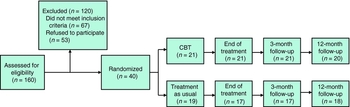
The recruitment of subjects and participation in the study are summarized in Figure 1. Among 160 eligible patients, 94 met the inclusion criteria at 6-month follow-up. Among these, 41 (44%) agreed to participate in the RCT; one was then excluded before randomization because he was seriously ill, leaving 40 for randomization. All participants signed an informed consent form. Of the 94 patients who were eligible, those who wanted to participate had significantly more symptoms, reported more consequences of the symptoms, and avoided physical activity to a higher degree (p < .01) than those who declined to participate (data not shown). Demographic and clinical data for CBT and TAU groups at the time of cardiac evaluation have previously been described (Jonsbu et al., Reference Jonsbu, Dammen, Morken, Moum and Martinsen2011).
Recruitment of subjects and participation in the study

Items of BIPQ before and after three sessions of CBT
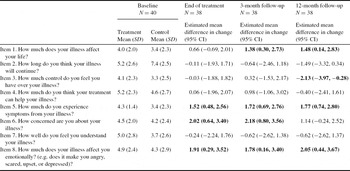
Estimated mean differences in change between intervention and control group for items of BIPQ at end of treatment, 3 and 12 months follow-up are presented in Table 1. There were significant differences between the CBT and TAU groups at the end of treatment for three items (Item 5 symptom frequency, Item 6 illness concern, and Item 8 emotional effect), at 3-month follow-up for four items (Item 1 consequences, Item 5 symptom frequency, Item 6 illness concern, and Item 8 emotional effect) and at 12-month follow-up also for four items (Item 1 consequences, Item 3 personal control, Item 5 symptom frequency, and Item 8 emotional effect) (see Table 1).
Mean scores at baseline for intervention and control group and their estimated mean differences in change at end of treatment and three and twelve months follow-up for items of Brief Illness Perception Questionnaire (BIPQ) following three sessions of CBT (Linear mixed model)

Notes: For all items of BIPQ, except Item 3, Item 4 and Item 7, positive mean difference is supposed to be beneficial for the treatment group.
Numbers written in bold represent significant differences between intervention and control group.
Item 3 and Item 6 of BIPQ as mediators of change for depression
The extent to which illness perceptions acted as mediator of (were the “mechanism” behind) the treatment effect on BDI may be expressed as reduction in standardized beta of the treatment variable, when the linear regression is adjusted for change (baseline score and scores at the end of treatment or 3/12-month follow-up score as independents) in illness perceptions. At end of treatment and at 3-month follow-up, the means of Item 6, but not Item 3, were significantly different for the intervention and TAU groups, at 12-month follow-up the opposite was the case (Table 1). At the end of treatment and at 3-month follow-up the standardized betas of the treatment variable for BDI were 0.23 and 0.30 respectively without controlling for change in Item 6 and were reduced to 0.14 and 0.18 with such controls. The corresponding standardized betas for the treatment variable for BDI at 12-month follow-up changed from 0.25 to 0.13 with controls for change in Item 3. These reductions in standardized betas indicate that approximately 40% of the treatment effects on BDI at end of treatment and at 3-month follow-up were mediated by changes in Item 6 (illness concern), and at 12-month approximately 50% was mediated by change in Item 3 (personal control). However, with the present sample size neither of these mediator effects reached statistical significance (using the Sobel test).
Discussion
Five of eight items of Brief Illness Perception Questionnaire (BIPQ) were significantly different between CBT and TAU group at least at one follow-up assessment after three CBT-sessions. Items asking about personal control (Item 3) and illness concern (Item 6) to some extent were mediators of change for depression.
All items of BIPQ except Item 2 timeline, Item 4 treatment control, and Item 7 understanding were significantly different between intervention and control group at least at one time point after the three sessions of CBT. For Item 1, which measures consequences of the complaints, the scores of the intervention group were reduced during the intervention and the differences between intervention and control group were statistically significant at both 3- and 12-month follow-up. Item 3 personal control was significantly different between the groups at 12-month follow-up, but not at the end of treatment or at 3-month follow-up. One hypothesis might be that the patients need long-time experience before they feel that they have more control over the complaints. For Item 5 symptom frequency, the intervention group did experience reduction in symptoms from their complaints, and the differences between the groups were significant at all time points after the intervention. For Item 6 the tendency also was clear; less illness concern in the intervention group, and the difference was significant at end of treatment and at 3-month follow-up. Item 7 understanding had a strange pattern; both groups increased in their understanding of the illness during the treatment period, then both groups had a lower score at 3-month follow-up, only to rise again at 12-month follow-up. However, there were no significant differences in scores between the groups. The patients in the intervention group felt they were less affected emotionally by the illness (Item 8), and the difference between the groups was significant at end of treatment and at 3- and 12-month follow-up.
Surprisingly, more items of BIPQ (4/8) were significantly different between intervention and control group at 3- and 12-month follow-up compared to at the end of treatment (3/8). This might indicate that changing perceptions is a process based on prolonged experiences. The delayed effect on some of the items might be explained by the fact that the intervention focused on maintenance of physical activity after the interventions. To experience that the heart is fit during physical activity will challenge the thoughts about having heart disease. When such thoughts are challenged time after time, they might become weaker, less frightening or maybe even replaced by other, more appropriate thoughts. This is the basic theory of cognitive behavioural therapy, and we suppose this is an important factor in changing the patient's perceptions of chest pain and palpitations.
We have previously reported from the same sample (Jonsbu et al., Reference Jonsbu, Dammen, Morken, Moum and Martinsen2011) that change in how much fear the patients felt regarding bodily sensations (Body Sensation Questionnaire, BSQ) mediated the change in BDI from baseline to 3-month follow-up. This relationship at 3-month follow-up is supported by the tendency for Item 6 (illness concern) to mediate the treatment effect on BDI since BSQ and item 6 cover very similar attitudes to the complaints.
At 12-month follow-up Item 3 (personal control) seemed to have a mediator effect on BDI score. The importance of perceived personal control for outcome among these patients is in line with what is reported for patients with panic disorder (Meuret et al., Reference Meuret, Rosenfield, Seidel, Bhaskara and Hofmann2010) and chronic pain (Turner et al., Reference Turner, Holtzman and Mancl2007).
The evaluation of change in BDI is important among patients with non-cardiac chest pain and benign palpitations as the level of depression seems to increase after a negative cardiac evaluation (Jonsbu et al., Reference Jonsbu, Dammen, Morken and Martinsen2010) and in the TAU group this increased level of depression remains above the normal range (BDI> 9) during the 12-month follow-up (Jonsbu et al., Reference Jonsbu, Dammen, Morken, Moum and Martinsen2011).
Since non-cardiac chest pain and benign palpitations are common complaints, and the variations between good and poor outcome seem to be large, cardiologists and GPs should focus on this issue. Specific programs and routines that aim to increase the experience of personal control and reduce the emotional effects of the complaints should be implemented in an effort to prevent poor outcome among these patients.
Strengths and limitations
Strengths of the present study include the randomized controlled design with 12-month follow-up. All consecutive patients were recruited from the general clinical setting. Most of the questionnaires used are well known and meaningful in this setting. All patients finished the treatment and a high percentage participated at follow-up.
As for limitations, there might have been a selection bias as those who wanted to participate in the treatment trial might have been more prone to adopt a psychological approach to their complaints. All assessments were done by self-report measures, and no blind rating was included. The number of comparisons performed increases the probability that some of the significant results may be due to chance. The low participation rate (only about 40% of eligible patients wanted to participate), small sample size and the limited selection of therapists restrict the generalizability of our findings.
Conclusion
Changes in perceived personal control and illness concern may mediate the short and long-term effects of the treatment of depression.
Acknowledgements
The study was carried out at the Department of Psychiatry, Molde Hospital, 6407 Molde, Norway. The authors have no competing interests to report.



Comments
No Comments have been published for this article.