Introduction
Stress can alter appetite and contribute to the development and maintenance of eating disorders (Rojo et al. Reference Rojo, Conesa, Bermudez and Livianos2006). Approximately one-third of people show reduced food intake and weight loss during or after mild to moderate stress, while most individuals either maintain or increase food intake (Adam & Epel, Reference Adam and Epel2007; Roberts et al. Reference Roberts, Troop, Connan, Treasure and Campbell2007). Factors such as restrained eating patterns (Lattimore & Caswell, Reference Lattimore and Caswell2004) and/or disinhibition (Rutters et al. Reference Rutters, Nieuwenhuizen, Lemmens, Born and Westerterp-Plantenga2009) are reported to contribute to these differences; however, the findings are not conclusive (Lowe & Kral, Reference Lowe and Kral2006; Wallis & Hetherington, Reference Wallis and Hetherington2009). The impact of chronic stress on people with bulimia nervosa (BN) is reflected in their increased adrenal gland volume and levels of visceral adipose tissue (Ludescher et al. Reference Ludescher, Leitlein, Schaefer, Vanhoeffen, Baar, Machann, Claussen, Schick, Eschweiler, Ludescher, Leitlein, Schaefer, Vanhoeffen, Baar, Machann, Claussen, Schick and Eschweiler2009). Stress also promotes the intake of highly palatable, rewarding, foods (Laessle & Schulz, Reference Laessle and Schulz2009) and is a key precipitant of bingeing behaviour (Mathes et al. Reference Mathes, Brownley, Mo and Bulik2009) in a manner analogous to drug use in addictions (Sinha, Reference Sinha2008).
There is evidence that baseline hypothalamic–pituitary–adrenal axis (HPAA) activity is altered in people with bulimic disorders, especially in the acute phase of BN (for a review, see Lo Sauro et al. Reference Lo Sauro, Ravaldi, Cabras, Faravelli and Ricca2008). Studies have investigated HPAA reactivity to a stressor in people with BN (Pirke et al. Reference Pirke, Platte, Laessle, Seidl and Fichter1992; Girdler et al. Reference Girdler, Koo-Loeb, Pedersen, Brown and Maixner1998; Koo-Loeb et al. Reference Koo-Loeb, Pedersen and Girdler1998, Reference Koo-Loeb, Costello, Light and Girdler2000; Neudeck et al. Reference Neudeck, Florin and Tuschen-Caffier2001) and binge-eating disorder (Gluck et al. Reference Gluck, Geliebter, Hung and Yahav2004a, Reference Gluck, Geliebter and Lorenceb) and reported that there is hyper-reactivity in the system. Diverse approaches have been used, including a cold pressor stress (Gluck et al. Reference Gluck, Geliebter, Hung and Yahav2004a, Reference Gluck, Geliebter and Lorenceb), social stress (Koo-Loeb et al. Reference Koo-Loeb, Pedersen and Girdler1998, Reference Koo-Loeb, Costello, Light and Girdler2000), a mental challenge task (Pirke et al. Reference Pirke, Platte, Laessle, Seidl and Fichter1992) and a pain stimulus (Girdler et al. Reference Girdler, Koo-Loeb, Pedersen, Brown and Maixner1998). In patients with BN, exposure to high-calorie (as opposed to low-calorie) foods increases subjective measures of stress and also salivary cortisol (Neudeck et al. Reference Neudeck, Florin and Tuschen-Caffier2001). This is of note, as HPAA hyperactivity affects food intake patterns and energy storage, and may play a role in the development of obesity (Adam & Epel, Reference Adam and Epel2007; Nieuwenhuizen & Rutters, Reference Nieuwenhuizen and Rutters2008). It has also been reported that it is the change in cortisol, rather than baseline concentrations, that predicts increased high-calorie food intake in both laboratory (Epel et al. Reference Epel, Lapidus, McEwen and Brownell2001) and ecological (Newman et al. Reference Newman, O'Connor and Conner2007) settings. Similarly, the peak cortisol increase following corticotropin-releasing hormone (CRH) administration also predicts subsequent food consumption (George et al. Reference George, Khan, Briggs and Abelson2010). The mechanism of action of glucocorticoids is likely to involve their interplay with other hormones and neuropeptides, and with the dopamine and opioid-mediated reward system resulting in alterations in the ‘wanting’ and ‘liking’ of food (Adam & Epel, Reference Adam and Epel2007; Nieuwenhuizen & Rutters, Reference Nieuwenhuizen and Rutters2008).
In addition to prompting a (hormonal) stress response, exposure to food stimuli has a diverse impact on people with a bulimic disorder, including the induction of food craving (Giel et al. Reference Giel, Teufel, Friederich, Hautzinger, Enck and Zipfel2010). Animal studies suggest that repetitive transcranial magnetic stimulation (rTMS) attenuates the HPAA stress response (Keck et al. Reference Keck, Welt, Post, Muller, Toschi, Wigger, Landgraf, Holsboer and Engelmann2001; Hedges et al. Reference Hedges, Massari, Salyer, Lund, Hellewell, Johnson and Lephart2003) and our studies have shown that high-frequency rTMS can reduce cue-induced food craving (Uher et al. Reference Uher, Yoganathan, Mogg, Eranti, Treasure, Campbell, McLoughlin and Schmidt2005; Van den Eynde et al. Reference Van den Eynde, Claudino, Mogg, Horrell, Stahl, Ribeiro, Uher, Campbell and Schmidt2010). Studies of the impact of rTMS on HPAA function in humans (George et al. Reference George, Wassermann, Williams, Steppel, Pascual-Leone, Basser, Hallett and Post1996; Evers et al. Reference Evers, Hengst and Pecuch2001; Baeken et al. Reference Baeken, De Raedt, Leyman, Schiettecatte, Poppe, Kaufman, Haes, Vanderhasselt, Anckaert and D'Haenen2009b) have not produced definitive conclusions, possibly due to methodological differences. However, data from studies in depressive disorder, which is associated with increased HPAA activity, are more consistent: they show that there is a reduction in cortisol concentrations following rTMS, i.e. they suggest that there is a normalization of HPAA function (Pridmore, Reference Pridmore1999; Zwanzger et al. Reference Zwanzger, Baghai, Padberg, Ella, Minov, Mikhaiel, Schule, Thoma and Rupprecht2003; Baeken et al. Reference Baeken, De Raedt, Leyman, Schiettecatte, Kaufman, Poppe, Vanderhasselt, Anckaert and Bossuyt2009a). Here, we test the hypothesis that rTMS reduces HPAA activity (i.e. salivary cortisol concentrations) after exposure to food cues in people with a bulimic disorder.
Method
Participants
Participants were a subsample of a larger (n=38) research group of people with a bulimic disorder (BN or eating disorder not otherwise specified – bulimic type) who were recruited for a randomized sham-controlled study on the effect of one session of real high-frequency rTMS applied to the left dorsolateral prefrontal cortex (DLPFC) on craving (for additional information, see Van den Eynde et al. Reference Van den Eynde, Claudino, Mogg, Horrell, Stahl, Ribeiro, Uher, Campbell and Schmidt2010). To examine the effect of rTMS on salivary cortisol, we only included women and only those who completed the trial in the afternoon: this was done as gender and time of the day are the major confounding factors in cortisol studies (Kudielka et al. Reference Kudielka, Hellhammer and Wust2009). With these inclusion criteria, from the 25 participants of the original group who were assessed in the afternoon, three men were excluded and data from 22 participants, randomized to real (n=11) or sham (n=11) rTMS, were available. Thus, no sample-size calculation was performed a priori. Approval from the local ethical committee was obtained, as was informed consent from all participants.
Salivary cortisol: collection and analysis
Participants were requested to have their last meal 2 h before the visit, and to avoid eating, drinking caffeinated beverages or smoking during this period. Salivette® devices (Sarstedt, Germany) were used to collect a saliva sample at four time points during the experiment. Samples were stored at −20°C where they are stable for several months (Garde & Hansen, Reference Garde and Hansen2005). The first sample was obtained at the beginning of the experiment (time 1, T1). Subsequently, collections were made during the first ‘food challenge task’ (FCT) (during which participants were presented with an array of different highly palatable snack foods and had to rate their properties; for details, see Van den Eynde et al. Reference Van den Eynde, Claudino, Mogg, Horrell, Stahl, Ribeiro, Uher, Campbell and Schmidt2010) (T2), then immediately after applying (real or sham) rTMS (T3), and lastly, during the second FCT (T4). In the whole group (n=22), the mean time from the first saliva collection (T1) to T2, T3 and T4 was 30 (s.d.=7), 73 (s.d.=10) and 91 (s.d.=10) min, respectively. Thus, T3 was 5–10 min and T4 was 20–25 min after the end of the rTMS session. We did not adhere strictly to fixed time points because this might have jeopardized the feasibility of the experiment as other outcomes were also being assessed (Van den Eynde et al. Reference Van den Eynde, Claudino, Mogg, Horrell, Stahl, Ribeiro, Uher, Campbell and Schmidt2010).
The frozen samples were thawed and the saliva separated from the swab by centrifugation (1500 g, 15 min). Cortisol concentrations were measured by enzyme-linked immunosorbent assay (ELISA) (DRG International, Germany). Intra-assay and inter-assay variability was <5% and 7%, respectively.
rTMS procedure
We used a Magstim Rapid device, with real and sham figure-eight coils (Magstim, UK). Following mapping of the abductor pollicis brevis site in the left motor cortex, each participant's motor threshold was established as the minimum stimulus required to induce contraction of the right thumb at least five of 10 times. The site for the left DLPFC stimulation was 5 cm anterior to the point of maximal abductor pollicis brevis stimulation. Twenty trains of 5 s with 55-s inter-train intervals were administered with a frequency of 10 Hz and intensity of 110% of the individual's motor threshold, providing 1000 pulses over 20 min. Sham stimulation was given at the same location and frequency (Uher et al. Reference Uher, Yoganathan, Mogg, Eranti, Treasure, Campbell, McLoughlin and Schmidt2005; Van den Eynde et al. Reference Van den Eynde, Claudino, Mogg, Horrell, Stahl, Ribeiro, Uher, Campbell and Schmidt2010).
Statistical analysis
To investigate differences in cortisol concentrations between the real and sham rTMS groups at T3 and T4, a random-effects model was used (Stata 10; StataCorp LP, USA). Cortisol concentrations at T2 were used as the ‘baseline’ measure and added to the model as a covariate. A random-effects model was also used to study whether the change in cortisol between T1 and T2 (first food exposure, FCT) was different from that between T3 and T4 (second food exposure, FCT). Post-hoc correlational analyses (Spearman's rho, ρ) were conducted between baseline cortisol concentrations (T2) and baseline craving indices [Food Craving Questionnaire – State (FCQ-S) and 10-cm visual analogue scale (VAS) ‘urge to eat’] as well as between cortisol concentration changes (T2–T4) and changes in craving measures (FCQ-S and VAS ‘urge to eat’).
Results
Baseline characteristics
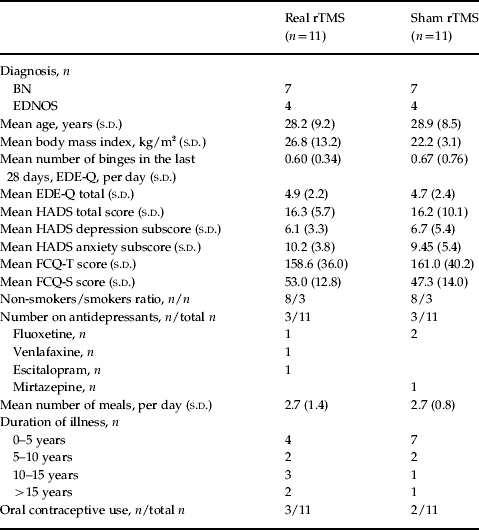
At baseline, the groups did not differ on any of the assessed characteristics (Table 1).
Baseline characteristics for the real and sham rTMS groups

rTMS, Repetitive transcranial magnetic stimulation; BN, bulimia nervosa; EDNOS, eating disorder not otherwise specified – bulimic type; s.d., standard deviation; EDE-Q, Eating Disorder Examination – Questionnaire; HADS, Hospital Anxiety and Depression Scale; FCQ-T, Food Craving Questionnaire – Trait; FCQ-S, Food Craving Questionnaire – State.
Salivary cortisol
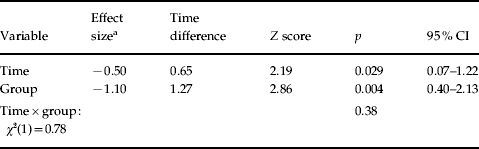
The main effects of randomization, group and time (T3 and T4) were investigated using a random-effects model with baseline cortisol (T2) as covariate, as well as the group×time interaction effect. The latter was removed from the model as it was not significant [χ2(1)=0.78, p=0.38, d=0.22]. This indicates that the change in cortisol concentrations from T3 to T4 did not differ between the groups. However, there were significant main effects for group and time (Table 2). The real rTMS group showed a significantly lower cortisol concentration at time points 3 and 4 (T3 and T4) than the sham group (p=0.004). One participant in the real rTMS group had a very high body mass index (63.2 kg/m2); however, results of the analyses remained significant when her data were excluded (p=0.002).
Effect sizes and estimated time differences for the outcome measure cortisol

CI, Confidence interval; T3, immediately after applying (real or sham) repetitive transcranial magnetic stimulation; T4, during the second food challenge task; T2, baseline.
a The negative effect sizes (Cohen's d) indicate a lower cortisol level at T3 than at T4. The effect size (Cohen's d) was calculated by dividing the change in cortisol level between two time points by the standard deviation of cortisol level at T2.
With regard to the effect of the food exposure (FCT), the random-effects models found no significant change in cortisol concentrations between T1 and T2 for the whole sample (z=1.14, p=0.26), or a difference between the two groups (z=0.48, p=0.63). Moreover, the change in concentrations from T1 to T2 did not differ from the change between T3 and T4 for either group (real rTMS: z=1.57, p=0.12; sham rTMS: z=1.36, p=0.17). In this analysis, the actual time between the assessment points 1 and 2, 3 and 4, respectively, was taken into account.
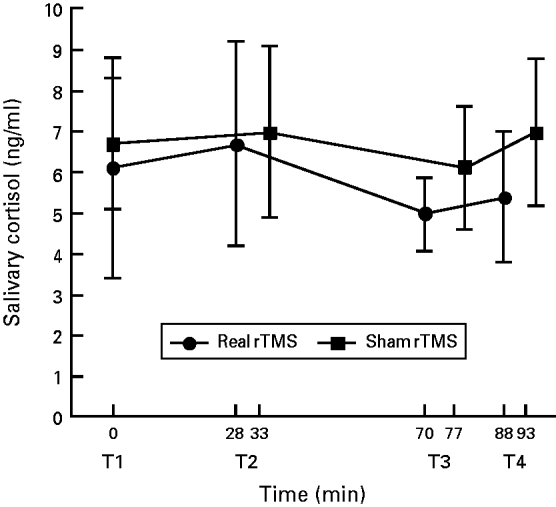
Fig. 1 shows the salivary cortisol concentrations for the two groups over the course of the experiment.
Salivary cortisol levels for the real and sham repetitive transcranial magnetic stimulation (rTMS) groups at time points 1 to 4 (T1–T4). Values are means, with standard deviations represented by vertical bars. The time indicates the mean time (in min) at an assessment point calculated with T1 as baseline. The mean cortisol levels at T1–T4 in the real rTMS group were 6.1 (s.d.=2.7), 6.7 (s.d.=2.5), 5.0 (s.d.=0.9) and 5.4 (s.d.=1.6) ng/ml, respectively. In the sham group, the mean cortisol levels at T1–T4 were 6.7 (s.d.=1.6), 7.0 (s.d.=2.1), 6.1 (s.d.=1.5) and 7.0 (s.d.=1.8) ng/ml, respectively.

Baseline characteristics and clinical outcome measures
In this patient sample, we assessed the effects of rTMS on craving and other variables. An analysis of covariance, comparing the post-rTMS scores between real and sham rTMS groups with the pre-rTMS scores as covariate, indicates a trend for the real rTMS to reduce craving (one-sided p=0.056) compared with the sham rTMS. It is noted, however, that real rTMS appears to have no superior effect on mood (p=0.175), tension (p=0.107), hunger (p=0.074) or the urge to binge-eat (p=0.325), compared with sham rTMS. In addition, in this sample, we found that participants in the real rTMS group (0/10) were less likely to have a binge in the 24 h following the rTMS than the sham group (3/9) [χ2(1)=3.96, p=0.047]. Data from one participant in the real group and two in the sham group were not obtained. Our results are in accord with our findings in the original larger sample (Van den Eynde et al. Reference Van den Eynde, Claudino, Mogg, Horrell, Stahl, Ribeiro, Uher, Campbell and Schmidt2010).
Post-hoc correlational analyses between cortisol and craving measures
Baseline cortisol concentrations were not significantly correlated with the FCQ-S (ρ=−0.39, p=0.72) or VAS ‘urge to eat’ scores (ρ=−0.13, p=0.56) in the whole group, or the sham (FCQ-S ρ=−0.44, p=0.14; VAS ρ=0.07, p=0.83) and real rTMS (FCQ-S ρ=−0.16, p=0.63; VAS ρ=−0.08, p=0.81) groups separately. Likewise, cortisol concentration changes (T2–T4) did not correlate with changes in craving measures in the whole group (FCQ-S ρ=−0.15, p=0.50; VAS ρ=−0.02, p=0.95), or the sham (FCQ-S ρ=−0.56, p=0.71; VAS ρ=−0.12, p=0.72) and real rTMS (FCQ-S ρ=0.24, p=0.47; VAS ρ=−0.23, p=0.50) groups individually.
Discussion
Our preliminary findings indicate that rTMS applied to the left DLPFC reduces salivary cortisol concentrations in people with a bulimic eating disorder. Our data also suggest that in these patients, high-calorie food cues increase salivary cortisol, though this was not statistically significant. Others have found increased subjective stress in response to salient food cues (Neudeck et al. Reference Neudeck, Florin and Tuschen-Caffier2001). Delivery of real – compared with sham – rTMS to the left DLPFC significantly reduced cortisol concentrations, which then remained lower than in the sham group. Repetition of the stressor (the FCT) after the rTMS raised cortisol concentrations. This apparent absence of a physiological habituation to food stimuli in people with BN has been described (Neudeck et al. Reference Neudeck, Florin and Tuschen-Caffier2001) and is in accord with data on HPAA responsivity to various stressors in other conditions (Kudielka et al. Reference Kudielka, Hellhammer and Wust2009). During the second FCT, changes in cortisol concentrations were not significantly different between the real and sham groups, i.e. rTMS has no apparent short-term ‘protective’ effect on the stress response to food cues. It is possible that any group differences were not detected as the time between assessments (T3 and T4) was short (15 min). In absolute values, however, the increase in cortisol between T3 and T4 in the sham group was twice that in the real rTMS group and roughly three times that in reference to the first FCT in the sham group (T1–T2). Furthermore, in the sham group, but not in the real group, the cortisol concentration after the second FCT (at T4) was roughly the same as after the first exposure (T2). A longer follow-up or a longer time interval between the 3rd and 4th measure might have allowed any group differences to be detected. Subjective ratings of food craving show a similar pattern to that of cortisol, i.e. a lower craving after real rTMS (compared with sham). However, this effect was only present as a statistical trend (p=0.056). As we only have data on craving at T2 and T4, a mediator analysis could not be performed and it is not possible to establish the direction of the relationship (if any) between craving and the HPAA activity. Although the possibility that these observations are unrelated cannot be ruled out, there are other plausible interpretations.
How rTMS lowers salivary cortisol concentrations is unclear. Animal data showing gene expression changes in the paraventricular nucleus (Ji et al. Reference Ji, Schlaepfer, Aizenman, Epstein, Qiu, Huang and Rupp1998) have led to the proposal that this is where rTMS modulates HPAA functioning and causes inhibition of CRH synthesis and release (Post & Keck, Reference Post and Keck2001). However, the spatial resolution of TMS coils is larger than such discrete brain regions in small animals, and some caution is warranted for this explanation. It has also been proposed that rTMS has an indirect action on the HPAA, via subcortical limbic structures (e.g. the amygdala), which then results in a readjustment in HPAA activity (Baeken et al. Reference Baeken, De Raedt, Leyman, Schiettecatte, Kaufman, Poppe, Vanderhasselt, Anckaert and Bossuyt2009a). Functional neuroimaging has revealed rTMS's potential to increase dopaminergic activity in the ipsilateral anterior cingulate cortex (ACC), orbitofrontal cortex (OFC) (Cho & Strafella, Reference Cho and Strafella2009) and striatum (Pogarell et al. Reference Pogarell, Koch, Popperl, Tatsch, Jakob, Mulert, Grossheinrich, Rupprecht, Moller, Hegerl and Padberg2007). As dopamine is implicated in reward and in the development of addictions, including the preoccupation/anticipation or craving stage (Koob & Volkow, Reference Koob and Volkow2010), striatal dopamine release may reduce the need for immediate ‘reward’ and reduce compulsive drug-seeking, and thus craving. This, combined with improved functioning of structures involved in salience attribution and motivation (OFC) and inhibitory control and conflict resolution (ACC), may reduce stress and cortisol. Alternatively, animal and human studies suggest that stress is involved in the development and maintenance of compulsive drug seeking via interactions between glucocorticoid and dopaminergic systems, e.g. the ventral striatum and mesencephalon (Piazza & Le Moal, Reference Piazza and Le Moal1996; Barrot et al. Reference Barrot, Marinelli, Abrous, Rouge-Pont, Le Moal and Piazza2000; Sinha, Reference Sinha2008). Glucocorticoids have a stimulating effect on dopamine-driven drug-seeking behaviours. As craving or the ‘urge to consume’ can be seen as the equivalent of compulsive drug seeking in animals (Koob & Volkow, Reference Koob and Volkow2010), a direct effect of rTMS on HPAA activity that lowers concentrations of glucocorticoids and their effects on the dopamine system may result in less craving. Moreover, as CRH levels are increased in acute drug withdrawal (Koob & Volkow, Reference Koob and Volkow2010), an inhibitory effect of rTMS on CRH production may be associated with less craving.
Research on HPAA reactivity and subjective feelings of craving in humans is limited. In smokers, pharmacological suppression of the HPAA reduces nicotine craving in low-impulsive individuals (Reuter et al. Reference Reuter, Netter, Rogausch, Sander, Kaltschmidt, Dorr and Hennig2002), an effect which may be mediated by interactions between the HPAA and the brain dopaminergic reward system (Reuter & Hennig, Reference Reuter and Hennig2003). In habitual smokers, an association has been found between increased cigarette craving following a social stress task and a rise in cortisol concentrations (Buchmann et al. Reference Buchmann, Laucht, Schmid, Wiedemann, Mann and Zimmermann2010). In our study, post-hoc correlational analyses between (changes in) cortisol and indices of craving were not significant. As dissociation between cortisol measures and clinical variables is common (Hellhammer et al. Reference Hellhammer, Wust and Kudielka2009), it is possible that the effect of rTMS on the HPAA in bulimic patients is independent of the observed changes in craving.
In this study, the sample size is limited because of the selection criteria applied to our original sample (Van den Eynde et al. Reference Van den Eynde, Claudino, Mogg, Horrell, Stahl, Ribeiro, Uher, Campbell and Schmidt2010). In addition to gender and time of day, other factors can influence salivary cortisol concentrations (Kudielka et al. Reference Kudielka, Hellhammer and Wust2009). We have attempted to minimize the impact of these factors and characteristics such as nicotine use, medication use, age and contraceptive pill use are similar in the randomized groups (Table 1). We have no data on menstrual cycle phase but note that increased cortisol concentrations have been linked to bulimic symptom fluctuations (mainly increases in the mid-luteal and premenstrual cycle phases) in people with BN (Lester et al. Reference Lester, Keel and Lipson2003). Furthermore, in healthy women, menstrual cycle phase has a significant effect on HPAA reactivity (Lustyk et al. Reference Lustyk, Olson, Gerrish, Holder and Widman2010) and, thus, we cannot exclude that menstrual cycle phase may have affected the results. Two other issues that might have added variability to the design are of note. Localizing the left DLPFC using neuronavigation may provide a more accurate stimulation of the targeted region than the conventional ‘5 cm anterior’ method in this trial. Second, our between-subject design may diminish the strength of study as it introduced a greater inter-individual variability to stress response than a within-subject design. However, cross-over designs are hampered because of difficulties with blinding real and sham rTMS. Current sham procedures do not optimally reflect the nociceptive effects of real rTMS (Broadbent et al., unpublished observations). For this study sample, 9/11 in the real and 7/11 in the sham rTMS group guessed that they had received real rTMS [χ2(1)=0.917, p=0.338]. This shows that blinding was successful in this subsample and therefore issues related to blinding success do not affect the findings of the present study.
We have shown that salivary cortisol concentrations in people with a bulimic eating disorder can be reduced by rTMS. There is also a trend (p=0.056) for rTMS to reduce food craving, a finding that was significant in our larger sample (Van den Eynde et al. Reference Van den Eynde, Claudino, Mogg, Horrell, Stahl, Ribeiro, Uher, Campbell and Schmidt2010). Whether rTMS acts directly on the HPAA or indirectly via cortical and subcortical structures is unclear. We have previously shown that rTMS can reduce food craving in a control group with high levels of craving (Uher et al. Reference Uher, Yoganathan, Mogg, Eranti, Treasure, Campbell, McLoughlin and Schmidt2005), however, cortisol measures were not available. Thus, in the absence of a control group in the present study, we cannot conclude that our findings are specific to people with a bulimic disorder. Future studies should investigate the nature and direction of the interactions between rTMS, the HPAA, the dopaminergic reward system and the reduction of craving. This may have implications not only for rTMS as a treatment option in bulimic eating disorders, but also for investigations into the mechanisms through which other therapeutic interventions may be effective. An alternative strategy for future research may be to use a different stressor (e.g. a social stress test). This may contribute to the understanding of whether rTMS reduces cortisol concentrations independently from the disorder-salient food stressor.
Acknowledgements
A.M.C. was funded by CAPES, a division of the Brazilian Ministry of Education, with a post-doctoral grant at the Institute of Psychiatry, King's College London, during 2008. F.V.d.E. is a research fellow in the Marie Curie Research Training Network INTACT (MRTN-CT-2006-035988). The authors acknowledge support from the National Institute for Health Research (NIHR) Specialist Biomedical Research Centre for Mental Health award to the South London and Maudsley NHS Foundation Trust and the Institute of Psychiatry, King's College London. We thank Carmine Pariante and Valeria Mondelli for their advice on the design of the study.
This study was conducted at the Department of Psychological Medicine, Section of Eating Disorders, Institute of Psychiatry, King's College London, UK.
This trial is registered under number ISRCTN95300084.
Declaration of Interest
None.