Introduction
Soil organic matter (SOM) plays a vital role in maintaining soil quality and improving agricultural productivity (Smith et al., Reference Smith, Ashmore, Black, Burgess, Evans, Quine, Thomson, Hicks and Orr2013). Furthermore, agricultural soil has account for a large proportion in global greenhouse gas emission, which is to mitigate global climate warming through carbon (C) sequestration, decreasing carbon dioxide (CO2) content in the atmosphere (Lal, Reference Lal2004). A higher SOM content can improve soil quality and represent a substantial contribution to reduction of C emission via C sequestration (Plaza-Bonilla et al., Reference Plaza-Bonilla, Álvaro-Fuentes and Cantero-Martínez2014). Therefore, it is a beneficial way to maintain soil quality and improve soil productivity by increased SOM content (Li et al., Reference Li, Cao, Chang, Zhang, Zhu, Zong, He, Zhang and He2017; Tang et al., Reference Tang, Li, Xiao, Pan, Cheng, Shi, Li, Wen and Wang2020).
In recent years, the effects of long-term fertilizer regime on soil organic carbon (SOC) content have been investigated by more and more researchers. In previous studies, results indicated that application of long-term chemical fertilizer management has positive effects on SOC content (Gong et al., Reference Gong, Yan, Wang, Hu and Gong2009; Lou et al., Reference Lou, Xu, Wang, Sun and Liang2011). However, Tang et al. (Reference Tang, Li, Xiao, Pan, Cheng, Shi, Li, Wen and Wang2020) showed that SOC content with long-term organic manure or crop residue treatments was higher than that of chemical fertilizer treatment. Ding et al. (Reference Ding, Han, Liang, Qiao, Li and Li2012) indicated that application of organic manure treatments significantly enhanced SOC content as compared with chemical fertilizer only and unfertilized treatments. A number of results in previous studies have shown that SOC contents were increased under the application of crop residue or organic manure condition (Wang et al., Reference Wang, Hu, Xu, Li, Lou, Chen, Wu and Wang2015; Blanchet et al., Reference Blanchet, Gavazov, Bragazza and Sinaj2016; Tang et al., Reference Tang, Li, Xiao, Pan, Cheng, Shi, Li, Wen and Wang2020; Xu et al., Reference Xu, Wang, Tian, Shi, Shi, Yu, Xu, Pan, Li and Xie2020; Zhao et al., Reference Zhao, Liu, Liu, Qi, Wang, Pu, Li, Zhang, Yang, Lal, Chen and Zhang2020).
SOM is usually considered as being composed of several functional fractions, differing in their intrinsic degradability and in factors controlling decomposition rate (Li et al., Reference Li, Cao, Chang, Zhang, Zhu, Zong, He, Zhang and He2017; Tian et al., Reference Tian, Lou, Gao, Fang, Liu, Xu, Blagodatskaya and Kuzyakov2017). In previous studies, results indicated that labile SOM fractions were characterized by rapid turnover and it is usually considered as an important indicator of the effects of field practice (von Lützow et al., Reference von Lützow, Kögel-Knabner, Ekschmitt, Flessa, Guggenberger, Matzner and Marschner2007; He et al., Reference He, Zhang, Xu, Tong, Sun, Wang, Huang, Zhu and He2015). Six et al. (Reference Six, Conant, Paul and Paustian2002) showed that labile SOM fractions (biochemically protected, chemically protected, physically protected and unprotected fractions) were separated according to the stabilization mechanism, and the unprotected fraction was labile and an important nutrient source for crop growth. SOM was physically protected from decomposition by forming microaggregates, chemically protected by mineral (silt and clay) particles and biochemically protected by forming recalcitrant SOM compounds (Six et al., Reference Six, Conant, Paul and Paustian2002). The SOC content within the free particulate organic matter (POM), occluded POM and organic matter (OM) is increased with the combined application of crop residue or organic manure with mineral fertilizer (Sleutel et al., Reference Sleutel, De, Németh, Tóth and Hofman2006). Tian et al. (Reference Tian, Lou, Gao, Fang, Liu, Xu, Blagodatskaya and Kuzyakov2017) indicated that physical, chemical and biochemical protection mechanisms play important roles in maintaining high SOC content based on long-term application of organic manure condition. However, there is still limited information about how the SOM stabilization mechanism responds to soil C sequestration with long-term fertilizer regime under the double-cropping rice (Oryza sativa L.) paddy field system of southern China.
Long-term fertilizer experiments have revealed that there is a close relationship between soil C sequestration and C input (Chung et al., Reference Chung, Grove and Six2008; Fan et al., Reference Fan, Ding, Xiang, Qin, Zhang and Ziadi2014). Some studies have indicated that there is a linear relationship between soil C sequestration and C input under long-term fertilizer field experiment conditions (Sun et al., Reference Sun, Huang, Yu and Zhang2013; Fan et al., Reference Fan, Ding, Xiang, Qin, Zhang and Ziadi2014; Wang et al., Reference Wang, Hu, Xu, Li, Lou, Chen, Wu and Wang2015). However, other studies have shown no obvious correlation between SOC stock and C input based on long-term field experiments (Six et al., Reference Six, Conant, Paul and Paustian2002; Stewart et al., Reference Stewart, Paustian, Conant, Plante and Six2007). However, further analysis is needed to investigate the response of differential functional SOM fractions to C input under long-term fertilization conditions.
Rice is one of the main crops in Asia, with the double-cropping rice system (early rice and late rice) being the main land use in southern of China (Yang et al., Reference Yang, Ren, Sun and Zhang2012). It is a beneficial practice for maintaining or improving paddy soil quality and fertility by the application of organic fertilizer and inorganic fertilizer (Blanchet et al., Reference Blanchet, Gavazov, Bragazza and Sinaj2016; Tang et al., Reference Tang, Li, Xiao, Pan, Cheng, Shi, Li, Wen and Wang2020). The different fertilizer managements may have profound effects on soil physical and chemical characteristics such as pH, soil bulk density, SOC content (Tang et al., Reference Tang, Li, Xiao, Pan, Cheng, Shi, Li, Wen and Wang2020), which in return affect functional SOM fractions and C sequestration. Therefore, a 34-year long-term field experiment with different fertilizer treatments was conducted in a double-cropping rice system of southern China. Hence, the objective of the current study was: (1) to investigate the change of functional SOM fractions in paddy soil under different long-term fertilization conditions and (2) to quantify the response of functional SOM fractions to C input with different fertilizer practice in a double-cropping rice system.
Materials and methods
Sites and cropping system
The experiment was begun in 1986 and was located in NingXiang County (28°07′N, 112°18′E) of Hunan Province, China. Under a continental monsoon climate, the annual mean precipitation is 1553 mm and potential evapotranspiration of 1354 mm. The monthly mean temperature is 17.2°C. At the beginning of the experiment, the surface soil characteristics (0–20 cm) were as follows: SOC 29.4 g/kg, total N 2.0 g/kg, available N 144.1 mg/kg, total phosphorous (P) 0.59 g/kg, available P 12.87 mg/kg, total potassium (K) 20.6 g/kg and available K 33.0 mg/kg. There were three crops in a year, barley (Hordeum vulgare L.), early rice and late rice (O. sativa L.). Barley was sown in the middle of November and harvested in early May of the following year. Early rice was then transplanted and harvested in the middle of July. The growing season of late rice transplanted lasted from late July to the late October. More detailed information about the experiment field was described by Tang et al. (Reference Tang, Xiao, Tang, Li, Wang, Li, Cheng and Pan2018).
Experimental design
The experiment included four fertilizer treatments: chemical fertilizer alone (MF), rice straw residue and chemical fertilizer (RF), 30% organic manure and 70% chemical fertilizer (OM) and without fertilizer input as control (CK). A randomized block design was adopted in the plots, with three replications of each treatment. Each plot size was 66.7 m2 (10 × 6.67 m2). The experiment ensured that same total amount of N, phosphorus pentoxide (P2O5), potassium oxide (K2O) for RF, MF and OM treatments during early rice and late rice growing season, respectively. During the early rice and late rice growth periods, the total amount of N, P2O5, K2O for MF, RF and OM treatments was 142.5, 54.0, 63.0 kg/ha and 157.5, 43.2, 81.0 kg/ha, respectively. The kind of organic manure for OM treatment was decomposed chicken manure. The C content of rice straw residue, and chicken manure were 230.5 and 165.5 g/kg, respectively. Before barley sowing or rice seedling transplanting, air-dried rice straw was manually spread onto the soil surface and incorporated into the soil at a cultivation depth of 20 cm. During the barley, early rice and late rice growing periods, 60, 70 and 60% of N, respectively, was applied at tillage before barley sowing or rice seedling transplanting, respectively, and the remaining N were applied at top dressing stage (7–10 days after barley sowing or rice seedling transplanting). All the P2O5 and K2O fertilizer were applied at tillage before barley sowing or rice seedling transplanting. The barley sowing rate was 250.0 kg/ha. One-month-old early rice and late rice seedling were transplanted with a density of 150 000 plants/ha in paddy field. Further detailed information about fertilizer management and field arrangement was described by Tang et al. (Reference Tang, Xiao, Tang, Li, Wang, Li, Cheng and Pan2018).
Soil sampling and sample preparation
Soil samples were collected from each plot on 25 August 2019, at the tillering stage of late rice. Twenty soil samples from each plot were taken adjacent to rice plants at a depth of 0–20 cm and bulked to form composite soil samples. Thus, three composite samples of soil from each fertilizer treatment were collected at sampling time. Subsequently, the composite samples were air-dried at room temperature and passed through a 2-mm sieve for further analysis.
Soil chemical properties’ analysis
Soil chemical properties (pH, total N, total P, total K, available N, available P, available K and SOC) were measured according to the method described by Bao (Reference Bao2000) and Wu et al. (Reference Wu, Joergensen and Pommerening1990). Briefly, soil pH was measured with a compound electrode (PE-10, Sartorious, Germany) by using a soil to water rate of 1 : 2.5. Other soil chemical properties were determined by using an elemental analyzer (Carlo Erba 1110, CE Instruments) coupled to a Delta Plus isotope ratio mass spectrometer (Finnigan MAT) via a Conflo III (Thermo Fisher). The carbon (C) content of soil samples were measured by using a Vario EL III Elemental Analyzer (Elementar, Germany).
Soil SOM fractionation analysis
Functional SOM fractions were separated by using a combined physical, chemical and density fractionation method as described by Stewart et al. (Reference Stewart, Plante, Paustian, Conant and Six2008). In the first step, three size fractions were obtained by using physical fractionation and partial dispersion. They consisted of >250 μm coarse unprotected particulate organic matter (cPOM), 53–250 μm microaggregate fraction (μagg), and <53 μm easily dispersed silt and clay (dSilt and dClay). All the obtained fractions were oven-dried at 60°C and weighed.
In the second step, the microaggregate fractions isolated in the first step were further fractionated. Density flotation was used to isolate the fine unprotected POM fraction (fPOM) with 1.85 g/cm3 sodium polytungstate. After fPOM was removed, dispersion was conducted for the heavy fraction to separate the >53 μm microaggregate-protected POM fraction (iPOM) and the microaggregate-derived silt- and clay-sized fractions (μSilt and μClay).
The third step was acid hydrolysis of the silt- and clay-sized fractions (dSilt, dClay, μSilt and μClay) isolated in the first two steps, as described by Plante et al. (Reference Plante, Conant, Stewart, Paustian and Six2006). The process of acid hydrolysis included fluxing at 95°C for 16 h in 6 mol/l HCl after which the suspensions were filtered and washed by using deionized water. All residues were oven-dried at 60°C and weighed. The portions obtained from this step were the non-hydrolysable fractions (NH-dSilt, NH-dClay, NH-μSilt and NH-μClay). Furthermore, the hydrolysable fractions (H-dSilt, H-dClay, H-μSilt and H-μClay) were determined by the difference between the whole fractions and the non-hydrolysable fractions.
According to the fractionation schemes that were based on the assumed link between the isolated fractions and the protection mechanism (Stewart et al., Reference Stewart, Plante, Paustian, Conant and Six2008): (i) the unprotected pool correspond to cPOM and fPOM, (ii) the pure physically protected pool was iPOM, (iii) the physico-biochemically protected pool consists of non-hydrolysable silt and clay-sized fractions (NH-μSilt and NH-μClay) derived from the microaggregates, (iv) the physico-chemically protected pool consist of hydrolysable silt- and clay-sized fractions (H-μSilt and H-μClay) derived from the microaggregates, (v) the chemically protected pool was the hydrolysable portion of the silt- and clay-sized fractions (H-dSilt and HdClay) and (vi) the biochemically protected pool consists of the non-hydrolysable portion remaining in the silt- and clay-sized fractions after acid hydrolysis (NH-dSilt and NH-dClay).
Grain yield of rice
Grain yields of rice with each plot were measured at mature stages of early rice and late rice in 2019; three 1 m2 areas of each plot were collected to calculate the dry weight of grain yield of rice.
Statistical analysis
The statistical analysis of each measurement item was conducted using the SAS 9.3 software package (SAS, 2008). The data from each measurement item with fertilizer treatment means were compared using one-way analysis of variance following standard procedures at the P < 0.05 probability level. The results were expressed as means and standard errors.
The total SOC contents were used as a proxy for the C input to assess the effect of increased C input on SOC accumulation of functional SOM fractions among treatments as described by Stewart et al. (Reference Stewart, Plante, Paustian, Conant and Six2008). Linear and logarithmic models were applied to evaluate the relationship between SOC content in various fractions and total SOC content, and the best-fit model were selected in terms of R 2 value.
Results
Soil characteristics with different fertilizer treatments
The soil chemical properties were significantly changed by different long-term fertilizer treatments (Table 1). The results showed that total N, total P, available N, available P and available K contents with RF and OM treatments were higher (P = 0.041) than those of MF and CK treatments. The total N, total P, available N, available P and available K contents with MF treatment were higher (P = 0.039) than those of CK treatment. Compared with CK treatment, the soil pH with OM treatment was increased. But there was no significant difference (P = 0.065) in total K content among different fertilizer treatments.
Effects of different long-term fertilizer treatments on soil chemical characteristics in paddy field

MF, chemical fertilizer alone; RF, rice straw residue and chemical fertilizer; OM, 30% organic manure and 70% chemical fertilizer; CK, without fertilizer input as control.
Values were presented as mean ± standard error.
Different lowercase letters in the same column indicate significant differences at P < 0.05.
Distribution of functional SOM fractions
Proportions of cPOM and fPOM fractions in paddy soil with RF and OM treatments were higher (P = 0.042) than those of CK treatment (Table 2). The proportion of fPOM in paddy soil with MF treatment were higher (P = 0.039) than that of CK treatment. The results indicated that proportion of iPOM in paddy soil with OM treatment was higher (by 117.6%) than that of CK treatment (P = 0.040). Compared with CK treatment, OM and RF treatments increased the proportion of iPOM in paddy soil. In paddy soil, the proportion of NH-μSilt and NH-μClay in paddy soil were the highest with OM and RF treatments, whereas no significant differences (P = 0.067) were detected in the proportion of NH-μSilt or NH-μClay in paddy soil across the fertilizer treatments. The proportions of H-μSilt and H-μClay in paddy soil with OM treatment were higher (P = 0.042) than that of CK treatment. The proportions of H-dSilt in paddy soil with MF, RF and OM treatments were higher (P = 0.037) than that of CK treatment. However, the proportions of H-dClay, NH-dSilt and NH-dClay in paddy soil with RF, OM treatments were lower (by 7.0–14.0%) than that of CK treatment (P = 0.040).
Distribution of the functional SOM fractions (%) under long-term fertilizer treatment in double-cropping paddy soil

Values are presented as mean ± standard error.
Different lowercase letters in the same column indicate significant differences at P < 0.05.
SOC content in functional SOM fractions
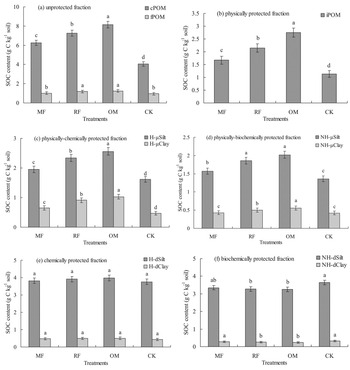
The results showed that SOC contents in cPOM, fPOM and iPOM in paddy soil with OM treatment were the highest (P = 0.039; Figs 1(a) and (b)). The SOC contents in cPOM in paddy soil with MF and RF treatments were increased by 54.3 and 79.5%, compared with CK treatment, respectively (Fig. 1(a)). The SOC contents in fPOM in paddy soil with RF and OM treatments were increased by 24.2 and 30.5%, compared with CK treatment, respectively (Fig. 1(a)). The SOC contents in iPOM in paddy soil with MF, RF and OM treatments were increased by 47.8, 89.4 and 143.4%, compared with CK treatment, respectively (Fig. 1(b)).
SOC content in functional SOM fractions under long-term fertilizer treatment in double-cropping paddy soil. MF, chemical fertilizer alone; RF, rice straw residue and chemical fertilizer; OM, 30% organic manure and 70% chemical fertilizer; CK, without fertilizer input as control. (a) Unprotected fraction; (b) physically protected fraction; (c) physically–chemically protected fraction; (d) physically–biochemically protected fraction; (e) chemically protected fraction and (f) biochemically protected fraction. Different lowercase letters indicate significantly differences (P < 0.05) among different fertilizer treatments. Error bars represent standard error of the mean (n = 3).

Meanwhile, the results indicated that SOC contents in physico-chemically, physico-biochemically, chemically and biochemically protected fractions were smaller, compared with SOC content in unprotected fractions (cPOM, fPOM and iPOM) (Fig. 1). The SOC contents in physico-chemically protected and physically–biochemically fractions (H-μSilt, H-μClay, NH-μSilt and NH-μClay) in paddy soil with RF and OM treatments were higher (P = 0.040) than that of CK treatment (Figs 1(c) and (d)).
The results showed that RF and OM treatments increase the SOC content in chemically and biochemically protected fractions in paddy soil (Figs 1(c) and (d)). The SOC contents in H-dSilt and H-dClay in paddy soil with RF and OM treatments were higher (P = 0.037) than that of CK treatment, whereas there was no significant differences (P = 0.064) in H-dSilt and H-dClay in paddy soil among MF, RF, OM and CK treatments (Fig. 1(e)). Meanwhile, the results indicated that SOC contents in NH-dSilt and NH-dClay in paddy soil with CK treatment were higher (P = 0.036) than that of RF and OM treatments (Fig. 1(f)).
SOC distribution ratio
Among the SOC content in unprotected, physically, physically–biochemically, physically–chemically, chemically and biochemically protected fractions, the largest proportion was ‘biochemically protected’ with 24.7–33.4%, followed by ‘chemically protected’ (20.4–23.3%), ‘unprotected’ (18.3–22.7%), ‘physically–chemically protected’ (9.1–11.2%) and ‘physically–biochemically protected’ (8.5–10.8%). The smallest proportion was ‘physically protected’ (7.3–10.3%).
Compared with CK treatment, the proportions of SOC in biochemically protected and physically protected fractions to total soil SOC content with RF and OM treatments were increased, respectively (Fig. 2). The proportions of SOC in biochemically protected in paddy soil with RF and OM treatments were increased by 27.9 and 35.2%, compared with CK treatment, respectively. The proportions of SOC in physically protected in paddy soil with RF and OM treatments were increased by 23.3 and 41.1%, compared with CK treatment, respectively. However, the results showed that the proportions of SOC in unprotected and physically–chemically protected fractions to total soil SOC content with MF, RF and OM treatments were lower (P = 0.040) than that of CK treatment (Fig. 2).
Effects of long-term fertilizer treatments on proportion of SOC in different fractions to total soil SOC. (a) Unprotected fraction; (b) physically protected fraction; (c) physically–biochemically protected fraction; (d) physically–chemically protected fraction; (e) chemically protected fraction and (f) biochemically protected fraction.

The relationship between SOC content in functional SOM fractions and total SOC content
Significantly linear relationship among SOC content in iPOM, H-μSilt, NH-μSilt, NH-μClay, H-dSilt, H-dClay, NH-dSilt and NH-dClay with total SOC content was observed in paddy soil (Figs 3(a)–(c), (e) and (f)). The results indicated that SOC content in H-μClay, NH-μClay, NH-μSilt, NH-μClay, H-dSilt and H-dClay showed a significantly logarithmic relationship with total SOC content (Figs 3(c)–(e)). The SOC contents in cPOM and NH-dClay were declined with an increase in total SOC content, although it was not statistically significant (Figs 3(a) and (f)).
Relationship between SOC content within functional SOM fractions and total SOC under long-term fertilizer treatment in paddy soil.

The SOC content was linearly related to total SOC in fPOM, H-μSilt, NH-μClay, NH-μSilt, H-dSilt and H-dClay in paddy soil (Figs 3(a) and (c)–(e)). No obvious increasing trend was found in SOC content of cPOM, H-μClay, NH-μSilt and NH-dSilt with increasing of total SOC content (Figs 3(a), (c), (d) and (f)). The SOC content in NH-dClay was declined with an increase in total SOC content; it was statistically significant (Fig. 3(f)).
Grain yield of rice
The grain yield of early rice and late rice was affected by different long-term fertilizer treatments (Fig. 4). This results showed that grain yields of early rice with RF and OM treatments were higher (P = 0.039) than that of MF and CK treatments. Compared with CK treatment, the grain yield of early rice with RF and OM treatments was increased by 2978.2 and 3685.5 kg/ha, respectively. Meanwhile, the results indicated that grain yield of late rice with MF, RF and OM treatments was higher (P = 0.037) than that of CK treatment. Compared with CK treatment, the grain yield of late rice with MF, RF and OM treatments was increased by 3092.3, 3478.5 and 3212.1 kg/ha, respectively.
Effects of different long-term fertilizer treatments on grain yield of rice. MF, chemical fertilizer alone; RF, rice straw residue and chemical fertilizer; OM, 30% organic manure and 70% chemical fertilizer; CK, without fertilizer input as control. Different lowercase letters indicate significant differences (P < 0.05) among different fertilizer treatments.

Discussion
Effects of long-term fertilization on soil chemical properties and yield of rice
In the previous studies, these results showed that soil chemical properties and yield of rice were obviously changed under different fertilizer managements. Tang et al. (Reference Tang, Li, Xiao, Pan, Cheng, Shi, Li, Wen and Wang2020) reported that soil quality and grain yield of rice were increased by the combined application of OM with chemical fertilizer practice. Results of Sun et al. (Reference Sun, Huang, Yu and Zhang2013) indicated that it was a beneficial management to increase soil chemical properties and yield of rice with OM management based on long-term fertilization experiment. In the current study, the results indicated that soil fertility was improved with the application of organic manure and crop residue treatments compared with chemical fertilizer alone and without fertilizer input treatments (Table 1), consistent with the results of previous studies in other similar paddy fields (Sun et al., Reference Sun, Huang, Yu and Zhang2013; Tian et al., Reference Tian, Lou, Gao, Fang, Liu, Xu, Blagodatskaya and Kuzyakov2017). The main reason may be that crop residue or organic manure contained a high proportion of nutrient material, therefore, the soil nutrient contents and soil microbial activity in paddy field were improved under long-term combined application of crop residue or organic manure with chemical fertilizer condition. Meanwhile, these results indicated that grain yields of early rice and late rice with RF and OM treatments were higher than that of CK treatment (Fig. 4), suggesting that soil physicochemical properties of paddy field in rice production system were increased by the combined application of organic manure or crop residue with mineral fertilizer, which were consistent with the previous studies in similar ecological region of paddy field (Tang et al., Reference Tang, Li, Xiao, Pan, Cheng, Shi, Li, Wen and Wang2020; Zhao et al., Reference Zhao, Liu, Liu, Qi, Wang, Pu, Li, Zhang, Yang, Lal, Chen and Zhang2020).
Effects of long-term fertilization on functional SOM fractions
In the current study, the combined application of organic manure and crop residue with chemical fertilizer treatments (RF and OM) significantly increased not only the proportion of unprotected cPOM and fPOM fractions but also their SOC content in a double-cropping rice paddy soil (Table 2; Fig. 1(a)). Similar results were also reported by Tian et al. (Reference Tian, Lou, Gao, Fang, Liu, Xu, Blagodatskaya and Kuzyakov2017) in a similar ecological region of China, who found that addition of manure and crop residue increases SOC content in cPOM and fPOM, especially combined with inorganic fertilizer. The unprotected fractions mainly consist of the crop-derived residue that were partially decomposed, but also comprise seed and root residue (Six et al., Reference Six, Conant, Paul and Paustian2002). Therefore, the increase in unprotected fractions (cPOM and fPOM) by the combined application of organic manure and crop residue with chemical fertilizer might be the result of the direct effect of manure and crop residue addition (Tian et al., Reference Tian, Lou, Gao, Fang, Liu, Xu, Blagodatskaya and Kuzyakov2017). Besides the direct effect of manure and crop residue addition, the addition of manure or crop residue combined with inorganic fertilizer may result in better rice growth, such as larger root biomass, root exudates (E et al., Reference E, Li, Chen, Li, Song and Guggenberger2012) and higher yield of rice (Tong et al., Reference Tong, Xu, Wang, Bhattacharyya, Zhang and Cong2014), than that under without fertilizer input conditions. Consequently, the increased input of crop residue into paddy soil lead to a higher OM content as well as higher SOC content in the unprotected fractions.
In the current study, the results showed that SOC content in iPOM in paddy soil with OM and RF treatment were increased, which were consistent with the results obtained in previous study in the other similar paddy field (He et al., Reference He, Zhang, Xu, Tong, Sun, Wang, Huang, Zhu and He2015; Tian et al., Reference Tian, Lou, Gao, Fang, Liu, Xu, Blagodatskaya and Kuzyakov2017). As SOM was a major binding agent of soil aggregates (Six et al., Reference Six, Bossuyt, Degryze and Denef2004), the input of manure and crop residue may provide the binding material for the formation of micro-aggregates, which could enhance the stabilization of SOC which has become physically protected in the newly formed micro-aggregates (Tisdall and Oades, Reference Tisdall and Oades1982). Therefore, in the current study, the increase of SOC content in iPOM was might be attributed to the increase of soil microaggregation with the application of organic manure and crop residue (Tian et al., Reference Tian, Lou, Gao, Fang, Liu, Xu, Blagodatskaya and Kuzyakov2017), which could be beneficial to slow down the turnover rate of SOM, and contribute to C stabilization (Hai et al., Reference Hai, Li, Li, Suo and Georg2010). In this study, the results indicated that proportions of iPOM in paddy soil with OM and RF treatments were increased 27.57 and 17.09% compared with MF treatment (Table 2), and led to the highest SOC content in iPOM in paddy soil (Fig. 1(b)). The SOC content and proportion of iPOM with MF treatment were significantly higher than those of CK treatment (Table 2; Fig. 2(b)), indicating that balanced application of N, P and K fertilizer had a more positive effect on iPOM than that of without fertilizer input treatment in paddy field. A large amount of available nutrients was contained in the mineral fertilizer, which could benefit to rice growth and soil microbial activity increases the decomposition in intramicroaggregate POC (iPOC) (Liu et al., Reference Liu, Tong, Xu, Ma, Wang, Zhang and Xu2010). Meanwhile, MF treatment might have a stronger stimulation effect on rice growth than that of SOC decomposition, leading to a net accumulation of crop residue into the paddy soil and increasing SOC in iPOC (He et al., Reference He, Zhang, Xu, Tong, Sun, Wang, Huang, Zhu and He2015). In previous studies, these results indicated that stabilization of POM within microaggregate (i.e. iPOM in this study) was one of the major protection mechanisms (Six et al., Reference Six, Conant, Paul and Paustian2002; Plaza-Bonilla et al., Reference Plaza-Bonilla, Álvaro-Fuentes and Cantero-Martínez2014). Therefore, the current findings also proved that long-term application of balanced chemical fertilizer, manure and crop residue with chemical fertilizer were crucial for SOC sequestration.
The aggregate-associated physically fractions (H-μSilt, H-μClay, NH-μSilt and NH-μClay) were usually considered as stable fractions that occluded within microaggregate or associated with silt and clay (Liu et al., Reference Liu, Tong, Xu, Ma, Wang, Zhang and Xu2010; Lou et al., Reference Lou, Xu, Wang, Sun and Liang2011). Results of Stewart et al. (Reference Stewart, Plante, Paustian, Conant and Six2008) indicated that response of un-aggregated silt and clay to C addition was faster than that of aggregate-mineral fractions. In the current study, the results showed that SOC contents in the physico-biochemically and physico-chemically protected fractions in paddy soil were increased by the combined application of balance chemical fertilizer, manure and crop residue with chemical fertilizer (Figs 2(c) and (d)), except for NH-dSilt and NH-dClay in paddy soil. Similarly, a pronounced increase was observed in H-dSilt and NH-dSilt with RF and OM treatments in paddy soil (Figs 2(e) and (f)). Comparable results were also found in other similar paddy fields (Xu et al., Reference Xu, Wang, Tian, Shi, Shi, Yu, Xu, Pan, Li and Xie2020), indicating that aggregate-associated chemically fractions and easily dispersed chemically fractions responded differently to long-term fertilizer practice and that different protection mechanisms might be responsible for the different responses of these fractions.
The biochemically protected SOM fractions were a non-hydrolysable fraction, protected against decomposition by a biochemical stabilization mechanism, which was affected by crop residue quality or OM decomposition (Six et al., Reference Six, Conant, Paul and Paustian2002). In the current study, the results indicated that SOC content of NH-dSilt and NH-dClay in paddy soil with RF and OM treatments were significantly lower than that of CK treatment (Fig. 2(f)), which was in agreement with other similar ecological regions of the world (Hassink, Reference Hassink1997). The reason may be attributed to the reduced proportion of soil dry matter in the biochemical SOM fraction in paddy soil. On the contrary, fertilizer practice might accelerate the decomposition of biochemically protected fractions in paddy soil, which were under anoxic conditions. In the current study, the SOC in biochemically and chemically protected silt-sized fractions were higher than that of biochemically and chemically protected clay-sized fractions, suggesting that silt and clay may have different adaptability in response to hydrolysation (Kiem and Kogel-Knabner, Reference Kiem and Kogel-Knabner2003).
Response of SOC content within functional SOM fractions to total SOC content
The SOC content of unprotected fPOM increased with increasing total SOC in paddy soil, suggesting that paddy soil has the potential to sequester and stabilize more C in fPOM fraction under the present experimental conditions. These results were in agreement with those for other similar ecological regions reported by Stewart et al. (Reference Stewart, Plante, Paustian, Conant and Six2008), who found that fPOM fraction fitted the linear model best. However, the current study revealed that SOC content in cPOM declined with increases in total SOC in paddy soil, albeit not significantly (Fig. 3(a)), suggesting a negative relationship between SOC content in cPOM and total SOC. Six et al. (Reference Six, Conant, Paul and Paustian2002) suggested that SOC in light fraction (cPOM in the current study) did not increase with increased C input. The reason may be attributed to the saturation behaviour of the unprotected fraction, which depends on the balance between C input and specific decomposition rate of the fraction, whereas the different saturation behaviour of the unprotected fraction was affected by environmental factors such as soil temperature, moisture and substrate biodegradability (Stewart et al., Reference Stewart, Plante, Paustian, Conant and Six2008). Furthermore, SOC content in the cPOM fraction is consumed by higher soil microbial activity under fertilizer application (Blagodatskaya and Kuzyakov, Reference Blagodatskaya and Kuzyakov2008).
The SOC content in iPOM had a positive linear relationship with the total SOC in paddy soil (Fig. 3(b)), which was inconsistent with previous studies. Six et al. (Reference Six, Conant, Paul and Paustian2002) reported that SOC content of iPOM fraction had a weak linear relationship with total SOC content, while Stewart et al. (Reference Stewart, Plante, Paustian, Conant and Six2008) found a curvilinear relationship between SOC content in iPOM fraction and total SOC content. However, in the current study, there was an obvious increase in SOC content in the iPOM fraction with increasing total SOC content in the paddy soil (Fig. 3(b)), suggesting a distinct management practice and environment-specific SOM decomposition rate in paddy soil. Moreover, SOM decomposition in paddy soil was obviously fast under the dry and wet alternate anaerobic conditions (Sahrawat, Reference Sahrawat2004). Therefore, the higher SOC mineralization capacity under these conditions may allow iPOM to approach a higher level under long-term application of fertilization condition.
In the current study, the results showed that there was a positive linear relationship between SOC content in H-μSilt, H-dSilt, H-dClay and total SOC content in paddy soil (Figs 3(c) and (e)), suggesting that physico-chemical and chemical protection mechanisms play an important role in stabilizing SOC in paddy soil. This could accumulate more C through the physico-chemical protection mechanism. Furthermore, the physico-chemical protection of SOC in paddy soil was increased under the existence of free Fe-oxyhydrates (Zheng et al., Reference Zheng, Li, Pan, Zhang, Smith and Hussain2012). Meanwhile, the SOC content in H-μClay and NH-μSilt in paddy soil had little increase with increasing of total SOC content (Figs 3(c) and (d)). These results were agreement with previous studies in other similar ecological regions. Stewart et al. (Reference Stewart, Plante, Paustian, Conant and Six2008) found that a linear model fitted physico-chemically and physico-biochemically protected fractions, suggesting that C levels of H-μClay and NH-μSilt fractions seem to be lower than that of cPOM fraction, attributed to their slower C turnover rate (Chung et al., Reference Chung, Grove and Six2008). In contrast, the SOC content in NH-dClay in paddy soil decreased with an increase in total SOC content, indicating that a priming effect might also occur in NH-dClay (Fig. 3(f)). The SOC content in biochemically protected fractions in paddy soil had no obvious further increase with an increase in SOC content; this may be because biochemically protected fractions were negatively affected by environmental factors, such as soil temperature and moisture (Stewart et al., Reference Stewart, Plante, Paustian, Conant and Six2008). On the contrary, the biochemically protected fractions were consumed by higher soil microbial activity under long-term application of fertilization conditions (Blagodatskaya and Kuzyakov, Reference Blagodatskaya and Kuzyakov2008). However, due to the inconsistent relationship between SOC content in different protection mechanisms and total SOC content in paddy soil, further analysis is needed to investigate the functional SOM fractions in rhizosphere soil under long-term fertilization conditions. Meanwhile, further studies are necessary to investigate the relationship between cumulative organic C input and SOC fractions with different long-term fertilizer treatments.
Conclusions
Combined application of OM with mineral fertilizer practice was shown to be a beneficial way to maintain or increase paddy soil fertility and obtain higher grain yield of rice. The SOC content in iPOM, H-μSilt, NH-μClay and H-dSilt in paddy soil with OM treatment were increased (by 7.74–117.55%) over that of CK treatment and showed a relatively high increase per unit of total SOC content. Therefore, the current results suggested that physical (physically, physically–biochemically and physically–chemically) protection mechanisms play an important role in stabilizing carbon in paddy soil. Physical protection mechanisms within the microaggregate also play a vital role in sequestrating carbon in paddy soil. In conclusion, the different responses of functional SOM fractions to long-term fertilizer treatments indicated different mechanisms for SOM cycling in terms of carbon sequestration under fertilizer management conditions. However, further studies are necessary to investigate the protection mechanism and the carbon sequestration capacity related to long-term fertilizer practice under different agroaggregate conditions.
Financial support
This study was supported by the National Natural Science Foundation of China (31872851) and Innovative Research Groups of the Natural Science Foundation of Hunan Province (2019JJ10003).
Conflict of interest
There is no conflict of interest in our manuscript.