

1. Introduction: Trill Variation and Rhotic Shift
Trill sounds exhibit a wide range of phonetic variation cross-linguistically (Demolin, Reference Demolin2001; Ladefoged & Maddieson, Reference Ladefoged and Maddieson1996; Lindau, Reference Lindau1985). This may be due to the precise articulatory and aerodynamic demands of trill production, such that even small deviations result in failure of the trilling gesture (Dhananjaya, Yegnanarayana & Bhaskararao, 2012; Solé, Reference Solé2002). Non-trill productions include coronal and dorsal approximants, fricatives, taps and flaps, and vocoids (Muminović & Engstrand, Reference Muminović and Engstrand2001). Researchers often investigate whether there are shared acoustic and/or articulatory properties of ‘deviant’ trill articulations to understand attested variations on more principled grounds (e.g., Boyce & Espy-Wilson, 2007; Zhou, Espy-Wilson, Boyce, Tiede, Holland & Choe, 2008). Psycholinguistic work has now begun to explore the perceptual correlates of coronal and dorsal trills, although currently data are limited to approximant trills (Engstrand, Frid & Lindblom, 2007). In spite of their complex articulation, trills are not typologically uncommon. More than one third of the world's languages are reported to have trills, and of the languages that use rhotic sounds, half or more of these are trills (Maddieson, Reference Maddieson1984; Ruhlen, Reference Ruhlen1975).
On the whole, no single phonetic or acoustic correlate may be available as a unifying property for trills. Rather, it may be the historical connections between trill types, and more specifically, similar diachronic developments in different language families, that unify this class of sounds. Rhotic dorsalization, or shift from coronal [r] to uvular [r], is well-documented in particular. Data on this phenomenon are available for French (Webb, Reference Webb2011), Caribbean Spanish (Vaquero & Quilis, Reference Vaquero and Quilis1989), German (Howell, Reference Howell1987), modern Hebrew (Devens, Reference Devens1981), and Cambodian (Whitley, Reference Whitley2003:83), to name a few examples. For Western European languages, there is debate on whether modern dorsal trills share a common historical origin (see Trautmann, Reference Trautmann1880) or whether they result from independent changes in different languages (see Runge, Reference Runge1974). To cite one well-known example from Spanish, Willis (Reference Willis2007) suggests that the Dominican pre-breathy voiced trill likely represents a “bridge allophone” (46) between the standard alveolar production and the dialectally marked dorsal production. Given the common historical connections among rhotics, researchers often rely on data showing synchronic variation, framing their findings within principles of sociolinguistic theory to make inferences on whether there is change in progress or stable variation (e.g., Clermont & Cedergren, Reference Clermont and Cedergren1979; Díaz-Campos, Reference Díaz-Campos2008; Sankoff & Blondeau, Reference Sankoff and Blondeau2007). Another means of examining language change is with geographic data, comparing differences in adjacent dialect areas under the assumption that dialect continua reflect successive historical fragmentation from an earlier state in the language (Hock, Reference Hock1991:447–455). This was a common practice in early descriptive work on Hispano-Romance (see Dworkin, Reference Dworkin2008; Lipski, Reference Lipski2008 for review), and in the current paper we will follow in this tradition by examining acoustic data for two adjacent sub-varieties of Peninsular Spanish spoken in the north-central region of the Iberian peninsula.
Alternations involving two or more rhotics are seen in a wide range of languages, and it is noted that historical shifts bear strong resemblance to cases of synchronic variation. In the case of Continental French, rhotic shift was well-attested as early as the 16th century (see Webb, Reference Webb2011, for review), and by the second half of the 17th century, writers observe that dorsals [r] and
 had replaced coronal variants among upper class speakers (cited in Thurot, Reference Thurot1966:272–273). Webb reiterates the importance of social factors as key motivators in the diachronic shift: “[…] all sources examining the issue in French underscore the prestige associated with upper class speech and the strong preference for dorsals that emerged in these circles over the course of the 16th and early 17th centuries” (92).Footnote
1
For Spanish, a reasonable hypothesis is that historical developments have led to current widespread use of fricative realizations in varieties like Puerto Rican Spanish (Vaquero & Quilis, Reference Vaquero and Quilis1989), although there is debate on the role of individual variation (Henriksen & Willis, Reference Henriksen and Willis2010). Nonetheless, recent research shows that social variables condition rhotic production within single speech communities (Díaz-Campos, Reference Díaz-Campos2008; Lastra & Martín-Butragueño, Reference Lastra and Martín Butragueño2006).
In this paper we examine the geographic distribution of phonemic trill variation for speakers of northern Peninsular Spanish (León, Spain) and central Peninsular Spanish (Ciudad Real, Spain).Footnote 2 As can be gathered from the current research, these are geographical areas for which acoustic data on rhotic production are presently unavailable and for which no geographically remarkable production of the phonemic trill had been reported prior to this research study. Nevertheless, as noted in Hammond (Reference Hammond1999), there are relatively few experimental studies on dialect variation addressing northern and central varieties of Peninsular Spanish when compared to the abundance of work on regional variation in Latin American Spanish (see, for example, Canfield, Reference Canfield1981; Lipski, Reference Lipski1994). Given a recent finding that speakers of southern Peninsular Spanish produce the phonemic trill in non-canonical fashion (i.e., with less than two lingual occlusions, see Henriksen & Willis, Reference Henriksen and Willis2010), the question that arises is whether this variation is likewise prevalent in central and northern varieties, and if so, what factors have led to the present state of affairs. We know that trill production is highly sensitive to small variations in its aerodynamic and articulatory demands (Ladefoged & Maddieson, Reference Ladefoged and Maddieson1996; Solé, Reference Solé2002), but have much less information on the envelope of variation for non-canonical trill variants within one dialect area or over adjacent dialect areas. It is also possible that for Spanish the distribution is like that of English //, where variation at the level of the individual speaker has been well-documented (e.g., Boyce & Espy-Wilson, Reference Boyce and Espy-Wilson1997; Zhou etal., Reference Zhou, Espy-Wilson, Boyce, Tiede, Holland and Choe2008). The primary objective of this paper, given this background, is to provide a sociophonetic analysis of phonemic trill production in two sub-varieties of Peninsular Spanish. We investigate the influence of certain social and linguistic factors to achieve a more thorough assessment of how trill variation is manifested in Spanish. These data, in turn, allow for speculation on how trill variants are spread throughout Spanish-speaking speech communities.
2. Background
2.1. Spanish Phonemic Trill
Spanish has two contrastive rhotic segments: A tap // and a trill /r/. These phonemes contrast in intervocalic position in word-initial (aroma ‘aroma’ vs. a Roma ‘to Rome’) and word-medial contexts (e.g., caro ‘expensive’ vs. carro ‘car’) (Hualde, Reference Hualde2004, Reference Hualde2005:183) (1a).Footnote 3 In other contexts, taps and trills distribute complementarily, with trills appearing after a heterosyllabic consonant or word-initially (1b) and taps appearing tautosyllabically in the second position of a complex onset or word-finally when resyllabified into a following vowel-initial word (1c). In syllable-final position, taps and trills are non-contrastive, typically showing free variation, although the most common realization is the tap (1d).Footnote 4

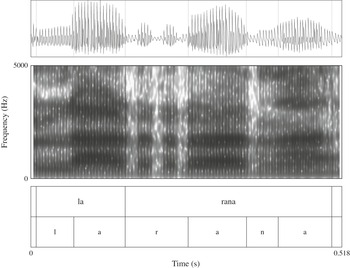
In synchronic terms, researchers working with acoustic data typically consider the phonetic realizations for the phonemic tap and trill as articulatorily and acoustically distinct (Martínez Celdrán, Reference Martínez Celdrán1998; Martínez Celdrán & Rallo, Reference Martínez Celdrán and Rallo1995; Quilis, Reference Quilis1993; Recasens, Reference Recasens1991; Recasens & Pallarès, Reference Recasens and Pallarès1999; Willis & Bradley, Reference Willis and Bradley2008). Standard descriptions claim that production of the trill involves two or more brief occlusions between the tongue apex and the alveolar ridge (Hualde, Reference Hualde2005:181; Martínez Celdrán, Reference Martínez Celdrán1997; Quilis, Reference Quilis1993: 329–332), as exemplified in Figure 1. Nevertheless, it is well-known that the Spanish phonemic trill is not always realized in canonical fashion (e.g., Hammond, Reference Hammond1999, Reference Hammond2000; Henriksen & Willis, Reference Henriksen and Willis2010; Willis, Reference Willis2006, Reference Willis2007).
Word-initial canonical phonemic trill production containing three apical occlusions for la rana ‘the frog’ (trill duration 108ms).

For Dominican Spanish, evidence on trill variation was reported in Willis (Reference Willis2006, Reference Willis2007); the most common phonemic trill productions included a pre-breathy-voiced tap, a pre-breathy-voiced trill, and breathy-voiced frication. From a phonological standpoint, Willis and Bradley (Reference Willis and Bradley2008) and Bradley and Willis (Reference Bradley and Willis2012) argue that the contrast between the phonemic tap and trill is maintained by means of overall segmental duration even when there is no difference in the number of lingual contacts.Footnote 5 For Argentinean Spanish, Colantoni (Reference Colantoni2006a,Reference Colantonib) shows that non-trill variants include fricatives and approximants, noting that similar degrees of periodicity in approximant and multiple-occlusion productions may lead to a perceptual similarity between the two rhotic types (see also Engstrand etal., Reference Engstrand, Frid and Lindblom2007).
Experimental evidence on phonemic trill production is slowly extending to dialects of mainland Spain. Blecua Falgueras (Reference Blecua Falgueras2001) and Lewis (Reference Lewis2004) analyzed trill tokens produced by speakers of Peninsular Spanish. In both studies phonemic trills were produced most commonly with multiple alveolar occlusions, although, of note, the data collection methodologies of Lewis and Blecua Falgueras were limited to read speech protocols, and there is a likely possibility that prescriptive norms influence speaker productions in formal speaking settings. More recently, Henriksen and Willis (Reference Henriksen and Willis2010) examined data on phonemic trill production in unscripted speech samples taken from 16 native speakers from Andalusia, Spain, located in the southernmost part of the Iberian Peninsula. Nearly two-thirds of phonemic trill productions contained zero or one apical closures, distributed among fricatives, approximants, and r-colored variants. No single non-canonical variant could be selected as the prototypical Andalusian variant, a distribution reminiscent of that of English // (e.g., Boyce & Espy-Wilson, 2007; Zhou etal., Reference Zhou, Espy-Wilson, Boyce, Tiede, Holland and Choe2008). Regarding methodology, most research documenting variation in Spanish phonemic trill articulation is based on data extracted from semi-spontaneous or spontaneous speech protocols under the premise that read aloud methodologies require a greater amount of attention to speech. This study follows in the former tradition, analyzing data for speakers who participated in semi-spontaneous oral narratives, an experimental protocol implemented originally in Willis (Reference Willis2006, Reference Willis2007).
2.2. Trill Articulation
Trill production requires the vibration of a supralaryngeal articulator (e.g., tongue-tip, uvula, lips) caused by certain aerodynamic forces (Barry, Reference Barry1997; Ladefoged & Maddieson, Reference Ladefoged and Maddieson1996; Spajić, Ladefoged & Bhaskararao, 1996). From an articulatory standpoint, the conditions for initiating tongue-tip trilling involve muscle contraction of the tongue to assume requirements in position, shape and elasticity. Specifically, trills must exhibit retraction of the postdorsum and lowering of the tongue predorsum so that space can be made for the vertical movements of the blade and apex (Proctor, Reference Proctor2009; Recasens & Pallarès, Reference Recasens and Pallarès1999). From an aerodynamic standpoint, oropharyngeal pressure must build up behind the linguopalatal constriction so that a sufficient pressure difference across the lingual constriction may initiate vibrations across the apex. Once the trill gesture begins, vibration is self-sustained. As reported in Solé (Reference Solé2002), voiced trills are highly constrained in their aerodynamic requirements such that the smallest variations in oropharyngeal and subglottal pressure lead to non-trilled fricative productions (see Blecua Falgueras, 1999; Spajić etal., Reference Spajić, Ladefoged and Bhaskararao1996).
Two topics of note regarding rhotic articulation in Spanish and other Romance languages are positional strengthening and segmental coarticulation. Recasens (Reference Recasens2002) discusses the correlates of positional strengthening and weakening in Romance. Weakening is defined as a consonantal substitution involving decrease in duration, decrease in constriction degree, or change in glottal activity yielding voicing. Following Posner (Reference Posner1996:288), Recasens argues that trills are stronger than taps due to distributional considerations; namely it is shown in Romance that trills occur in word-initial position, after a heterosyllabic consonant, and even after a tautosyllabic consonant. From an acoustic standpoint, there is evidence that trills exhibit correlates typical of consonantal strengthening (e.g., Raymond & Parker, Reference Raymond and Parker2005). Recasens and Espinosa (Reference Recasens and Espinosa2007) show that in Catalan dialects /#r/ sequences often exhibit one long contact followed by an approximant phase or several contacts with a long first occlusion, whereas postconsonantal trills have two contacts presumably since the first contact is short in duration. Of note, Recasens and Espinosa suggest that speaker dialect weighs heavily on such strengthening mechanisms.
Regarding segmental coarticulation, Recasens and Pallarès (Reference Recasens and Pallarès1999) show that Catalan trills exert larger and longer effects than taps on adjacent vowels and are less sensitive to vocalic effects, suggesting that the tongue body is more constrained for /r/ than //. Specifically, patterns of coarticulation for trills are more in line with those of the dark lateral [
 ] since trills and dark [
 ] have in common predorsum lowering and postdorsum retraction. In this regard, Recasens and Pallarès (Reference Recasens and Pallarès1999) argue that the articulatory configuration for /r/ is most compatible with a low front vowel. On the other hand, /r/ is least compatible with a high front vowel due to tongue dorsum lowering and retraction for the trill in combination with tongue dorsum raising and fronting prior to the high front vowel. Using articulatory data, Recasens (Reference Recasens2013) shows that [r] influences greater tongue dorsum lowering for [i] and greater tongue dorsum raising for [a] in comparison to [
 ].
2.3. Goals and Hypotheses
Given this background, two broad research goals can be highlighted. First, we begin to explore the extent of social conditioning of rhotic variation in Peninsular Spanish. Studies on North American English suggest that variation is at the level of the speaker (e.g., Boyce & Espy-Wilson, Reference Boyce and Espy-Wilson1997; Zhou etal., Reference Zhou, Espy-Wilson, Boyce, Tiede, Holland and Choe2008), whereas studies on many Romance languages indicate that social factors contribute to variation systematically in tandem with linguistic factors (e.g., Sankoff & Blondeau, Reference Sankoff and Blondeau2007). Of note, gender is a recurrent motivating factor for trill variation (Díaz-Campos, Reference Díaz-Campos2008; Lastra & Martín Butragueño, Reference Lastra and Martín Butragueño2006). In the case of French, diachronic shifts cannot be fully explained unless social factors are appropriately acknowledged (Webb, Reference Webb2011). In this paper we limit our scope to two social factors: Speaker dialect (León, Spain and Ciudad Real, Spain) and speaker gender.Footnote 6 León, Spain is a city located in the northwest part of the Iberian Peninsula, with a population of roughly 130,000 inhabitants. Ciudad Real, Spain is somewhat smaller in size, located in the south-central part of the peninsula, with an approximate population of 80,000 inhabitants. We chose these cities for study given their comparability in size; they are medium-sized provincial capitals, but not large enough to constitute autonomous community capitals. The variety of Spanish spoken in both areas is generally considered Castilian Spanish, resistant to phonological innovation such as syllable-final /s/-weakening, merger of the /s/-/θ/ distinction, and velarization of /n/ (Alvar, Reference Alvar1996; Escobar, Reference Escobar2009; Hualde, Reference Hualde2005:121). Of note, Ciudad Real Spanish (commonly termed ‘Manchego Spanish’; see Henriksen, Reference Henriksen2012) exhibits some segmental weakening typical of southern varieties (e.g., /s/-lenition; see Calero Fernández, Reference Calero and Ángeles1993; García Mouton & Moreno Fernández, Reference García Mouton and Francisco1994). In this regard, we may hypothesize that Ciudad Real speakers will show a greater propensity toward non-canonical trill variants than León speakers. For speaker gender, we have no clear hypothesis.
A second goal is to explore the influence of linguistic factors on trill variation. To this end, we investigate the effects of word position, prosodic stress, preceding vowel, and following vowel. We may hypothesize weaker trill articulations (i.e., shorter duration or less contacts) in less prominent prosodic positions, namely in word-medial position and in unstressed syllables (Recasens, Reference Recasens2002). We will also examine the potential for coarticulation effects with adjacent vowels. Previous work in this area shows that trills are less sensitive to vocalic effects than taps, suggesting a more constrained tongue body position for trills (Recasens & Pallarès, Reference Recasens and Pallarès1999). Nonetheless, we can hypothesize higher frequency of canonical trill articulations when in contact with low vowels and of non-canonical trill articulations when in contact with high vowels. Insight into trill weakening and/or coarticulation effects may be useful for understanding the linguistic contexts that promote innovative articulations and thus serve as mechanisms of change within a speech community.
3. Method
3.1. Participants and Recordings
The informants for this study were 24 native speakers of Peninsular Spanish: 12 speakers were from the northern province of León, and 12 others were from the south-central province of Ciudad Real. Each dialect sample was balanced for speaker gender (i.e., six men and six women per dialect sample), and each speaker was recorded in his/her dialect location. The age range for all speakers was between 18 and 30, and the average age was 24. All speakers were born and raised in their home city until the start of post-secondary education. All subjects reported that their mother and father were natives of the respective home city, and that the native language for both in all cases was Spanish. All participants were concurrently enrolled in post-secondary education in Madrid or Valencia, the first and third most populated cities in Spain, respectively. The decision was made to recruit speakers who attended university away from their home province since this characteristic reflects a common demographic of post-secondary Spanish adults.Footnote 7
Speakers narrated the children's picture book story by Mercer Mayer, Frog, Where Are You? (Reference Mayer1969). The picture book story is about a little boy, a dog (perro /péro/), and a frog (rana /rána/). Other potential target words containing Spanish phonemic trills were: jar (tarro /táro/); branch (rama /ráma/); run (correr /koré/); river (río /río/; and land (tierra /tiéra/). A valid token was defined as being uttered in phrase-internal intervocalic position. The data were recorded with a SONY HI-MD MZ-RH1 minidisc recorder and a Shure WH20 head-mounted microphone; sound files were digitally transferred into .wav format and analyzed with the acoustic analysis software PRAAT (Boersma & Weenink, Reference Boersma and Weenink2010). A total of 622 phonemic trills were produced (25.91 trill tokens/speaker average), and the distribution was 320 phonemic trills for León speakers and 302 phonemic trills for Ciudad Real speakers.
Auditory and acoustic inspection of all 24 speech recordings revealed phonetic and phonological properties that are characteristic of Northern-Central Peninsular Spanish: Contrast between /s/ and /θ/; a strong post-velar pronunciation of the /x/ phoneme; and merger of the palatal /
 / and /λ/ phonemes (Hualde, Reference Hualde2005:20–21). For most speakers, syllable-final /s/ showed retention, although there was a greater trend toward aspiration (and in some cases, deletion) in the Ciudad Real speech sample.
3.2. Acoustic Analysis
The total duration of each syllable-initial phonemic trill segment was extracted from PRAAT.Footnote 8 The number of occlusions was recorded for each target production, with occlusions ranging from zero to five per token (see §4.1 for examples). The acoustic cues leading to the determination of an occlusion were the presence of lingual contacts, a reduction in the amplitude of the waveform, a transition in F3 and F4 formant structure, and changes in intensity (Martínez Celdrán, Reference Martínez Celdrán1998). Many phonemic trill tokens were not produced in canonical fashion (i.e., with two or more alveolar occlusions), and often there was considerable r-coloring following the contact(s) of the trill segment. For the purposes of this paper, r-coloring is defined as a rhotic-sounding approximant that typically followed a single alveolar occlusion (see Figure 3 for example).Footnote 9
Each token was coded for four linguistic variables: Word position (i.e., initial or medial); stress (stressed syllable or unstressed syllable); preceding vowel (/a/, /e/, /i/, /o/, /u/); and following vowel (/a/, /e/, /i/, /o/, /u/). The gender and dialect of each speaker were also coded for each production.
4. Results
4.1. Acoustic Results
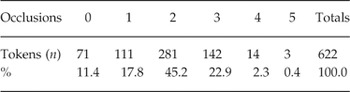
We begin the report of results with a descriptive acoustic characterization of phonemic trill production based on the full sample of 24 speakers. Rhotic variants were initially sorted according to number of closures produced, which ranged from 0 to 5 per token, shown in Table 1.
Occurrences of phonemic trill tokens based on number of occlusions per production

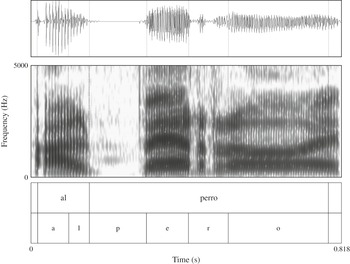
The most common trill articulation contained two occlusions, comprising 45.2% of the total corpus. A sample phonemic trill with two occlusions is shown in Figure 2. Trills containing three or more occlusions were also common, at 25.6%, and an example was presented earlier in Figure 1.Footnote 10
Word-internal phonemic trill production containing two apical occlusions (plus r-coloring) for al perro ‘to the dog’ (trill duration 92ms).

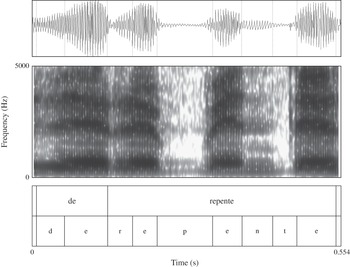
Next, 1-closure trills were produced at a rate of 17.8% (111/622). For these variants the beginning of the trill has a clear occlusion in both the waveform and the spectrogram, as seen in Figure 3. Between this closure and the following vowel, there is a long period of r-colored voicing with lowering of the third formant. In this example, the occlusion lasts 24ms and the r-colored portion lasts 29ms.
Word-initial phonemic trill production containing one apical occlusion (plus r-coloring) for de repente ‘suddenly’ (trill duration 53ms).

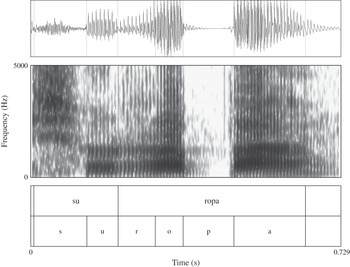
The fourth most common variant was the 0-closure variant, produced at a rate of 11.4% (71/622). This variant had several realizations based on voicing and degree of amplitude in the waveform. A typical voiced approximant production is shown in Figure 4.
Word-initial phonemic trill production containing zero apical occlusions for su ropa ‘his clothes’ (trill duration 80ms).

In order to determine consistency in the acoustic analysis, an interrater reliability test was performed with a second linguist who has considerable experience in spectrographic analysis. We conducted the reliability test for 100 total phonemic trill tokens (approximately one-sixth of the full corpus). The interrater reliability for the raters was found to be Kappa = 0.88 (p < 0.001), 95% CI (0.80, 0.94); this is considered almost perfect agreement.
4.2. Statistical Results
The complete dataset was submitted to a six-way (2 × 2 × 2 × 2 × 4 × 5) fully factorial Multivariate Analysis of Variance (MANOVA) to explore the potential effect of the linguistic and social variables on the two dependent variables (DV), thus motivating the division of the original dataset into smaller subsets that allow for the examination of the research objectives of this study. The two dependent variables were Occlusions and Duration. The MANOVA was conducted with dialect and gender as between-subjects factors and wordposition, stress, precedingvowel, and followingvowel as within-subjects factors in addition to dialect-by-gender, dialect-by-wordposition, dialect-by-stress, dialect-by-precedingvowel, and dialect-by-followingvowel as interaction contrasts. There were two levels of dialect (Leon vs. Ciudad Real), two levels of gender (female vs. male), two levels of wordposition (initial vs. medial), two levels of stress (stressed vs. unstressed), five levels of precedingvowel (/a/, /e/, /i/, /o/, and /u/), and four levels of followingvowel (/a/, /e/, /i/, and /o/). Following /u/ was not included in the statistical analysis since three tokens only satisfied this condition.
In the MANOVA, omnibus tests found overall effects for dialect (Wilks’ Lambda = .963, F = 11.39, p < .001), gender (Wilks’ Lambda = .846, F = 54.18, p < .001), wordposition (Wilks’ Lambda = .990, F = 3.93, p = .024), stress (Wilks’ Lambda = .976, F = 7.39, p = . 001), precedingvowel (Wilks’ Lambda = .953, F = 3.65, p < .001), and the interaction contrasts dialect-by-gender (Wilks’ Lambda = .989, F = 3.44, p = .033) and dialect-by-precedingvowel (Wilks’ Lambda = .972, F = 2.12, p = .031).Footnote 11 No effect was found for followingvowel (Wilks’ Lambda = .973, F = 1.77, p = .110) or the interaction contrasts dialect-by-wordposition (Wilks’ Lambda = .998, F = .626, p = .535), dialect-by-stress (Wilks’ Lambda = .996, F = 1.08, p = .339), or dialect-by-followingvowel (Wilks’ Lambda = .989, F = 1.06, p = .381), so statistical results for these factors will not be reported in the following sections.
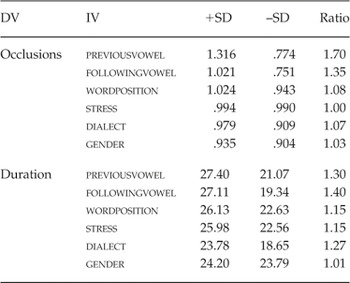
In order to verify the assumption of equal variances across factors, a Levene's test was run for the two dependent variables. The results were significant for both dependent variables: p < .001 for occlusions, and p = .003 for duration. Following Glass, Peckham, and Sanders (Reference Glass, Peckman and Sanders1972), standard deviation ratios were calculated by dividing the highest standard deviation by the lowest standard deviation (σ1/σ2) for each independent variable based on the two dependent variables. Table 2 displays the highest standard deviation (+SD), the lowest standard deviation (–SD), and the resulting ratio for all independent variables. All ratios of the standard deviations were less than 1.4 with the exception of previousvowel on occlusions, which was 1.7 (between /u/ and /o/). Mild heterogeneity of this size is not expected to influence MANOVA results.
Standard deviation ratios for dependent variables Occlusions and Duration

4.3. Social Factors
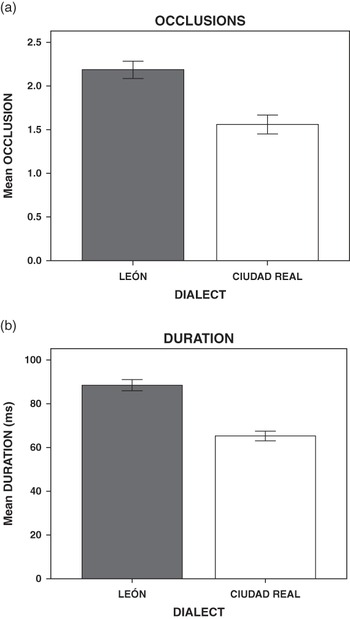
In Figure 5 we provide data for the mean number of occlusions and duration based on dialect. León speakers produced more occlusions than Ciudad Real speakers (2.18 (SD = 0.90) to 1.56 (SD = 0.98), respectively) and also produced phonemic trills with longer duration (88.61ms (SD = 23.75) to 65.35ms (SD = 18.65), respectively). The MANOVA showed a significant effect of dialect on both dependent variables: Occlusions, F(1, 618) = 13.66, p < .001; and duration, F(1, 618) = 18.82, p < .001.
Mean number of occlusions (a) and duration (b) based on dialect.

In Table 3 we see that the most common trill variant contained two visible occlusions, produced at near identical rates: 45.3% for León, and 45.0% for Ciudad Real. However, there were dissimilar distributions for less common variants. For León, the 3-closure trill was the second most common variant (33.7%), followed by the 1-closure trill (11.9%) and the 0-closure trill (5.9%). For Ciudad Real, the 1-closure trill (24.8%) was the second most common variant, followed by the 0-occlusion trill (17.2%) and then the 3-occlusion trill (11.2%).
Occurrences of trill type based on dialect

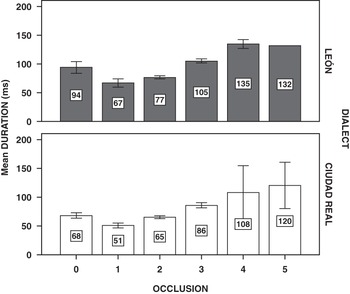
The fact that 42% of Ciudad Real tokens and 17.8% of León tokens contained 0 or 1 apical contacts calls into question whether these phonemic trills are acoustically differentiated from phonemic taps. Knowing that the duration of the phonemic tap typically ranges between 15 and 30ms (cf. Martínez Celdrán, Reference Martínez Celdrán1998; McDonough & Johnson, Reference McDonough and Johnson1997:8; Nicolaidis, Reference Nicolaidis2001:75; Quilis, Reference Quilis1993), the question that arises is whether trill variants comprised of less than two occlusions are durationally equivalent to the phonemic tap. Duration measurements were extracted for each trill type, shown in Figure 6. As can be seen, there is a general increase in duration as the number of occlusions per token increases. The exception is the 0-closure trill, which was longer than 1-closure and 2-closure trills in both dialect samples. Otherwise, 1-closure trills lasted 67ms on average in the León corpus and 51ms on average in the Ciudad Real corpus. These means are considerably greater than those known to correspond to the phonemic tap; we have little reason to believe that phonological merger is prevalent in either variety (e.g., Willis & Bradley, Reference Willis and Bradley2008).
Duration (ms) based on dialect and occlusions.

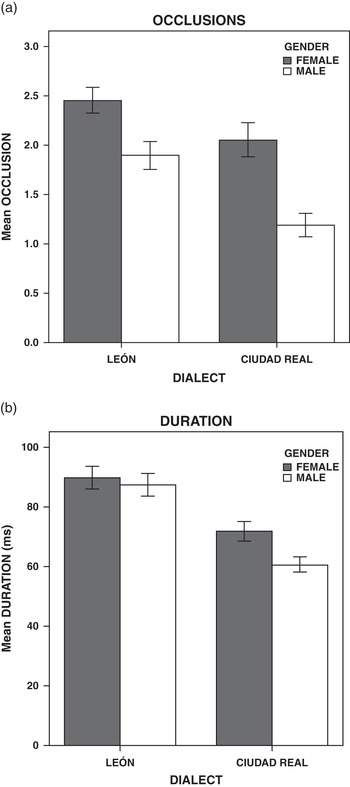
Next, the data were sorted according to gender and dialect, plotted in Figure 7. León women produced more occlusions in addition to longer phonemic trills on average than León men (2.45 to 1.89, and 88.21ms to 87.52ms, respectively). The same pattern held for Ciudad Real women vs. men (2.05 vs. 1.19, and 71.73ms vs. 60.59ms, respectively). An ANOVA test was conducted for the effect of gender on both dependent variables, and the differences were significant: Occlusions, F(1, 618) = 108.54, p < .001; and duration, F(1, 618) = 20.25, p < .001. As for the dialect-by-gender interaction contrast, there was a significant effect on occlusions, F(1, 618) = 6.76, p = .010, but not on duration, F(1, 618) = 2.17, p = .141. Follow-up post hoc tests on occlusions revealed a significant difference for Ciudad Real speakers (t = 4.97, p < .001), but not for León speakers (t = 1.35, p = .175).
Mean occlusions (a) and duration (b) based on dialect and gender.

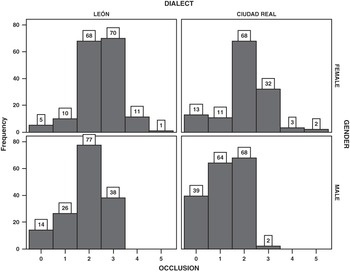
Given the statistical effect of dialect-by-gender, Figure 8 was generated in which each histogram represents the distribution of phonemic trill tokens based on occlusions for each dialect-by-gender combination. León men and Ciudad Real women obtained similar distributions overall: For both groups, the most common variant contained two occlusions, followed by the 3-closure trill, and much fewer productions of 1- and 0-closure trills. In contrast, León women favored 3-closure trills, and trills with zero or one occlusions were rare in their sample. Ciudad Real men produced more frequently 0- and 1-closure trills.
Histograms based on dialect-by-gender.

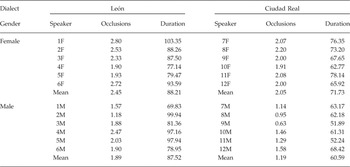
In Table 4, we provide a speaker-based analysis of the data sample. León women obtained the highest mean occlusions, followed by Ciudad Real women, León men, and Ciudad Real men. Of note, none of the female speakers obtained a mean occlusion score below 1.90. For Ciudad Real men, the highest average was 1.58, and two speakers obtained averages below 1.0. Duration scores followed these general trends.Footnote 12
Mean occlusions per phonemic trill for 24 speakers

In summary, our analysis revealed the following consistent effect of dialect, gender, and the interaction contrast dialect-by-gender: Ciudad Real men produced the least occlusions per phonemic trill, whereas León women produced the most occlusions per phonemic trill. Similar tendencies were found for duration data; of note, all speakers showed mean duration scores greater than 50ms.
4.4. Linguistic Factors
This section explores the effect of linguistic variables (word position, prosodic stress, and adjacent vowel) on trill production. Analysis of these factors was motivated by proposals on positional strengthening and coarticulation patterns in rhotics (Recasens, Reference Recasens2002; Recasens & Espinosa, Reference Recasens and Espinosa2007; Recasens & Pallarès, Reference Recasens and Pallarès1999).
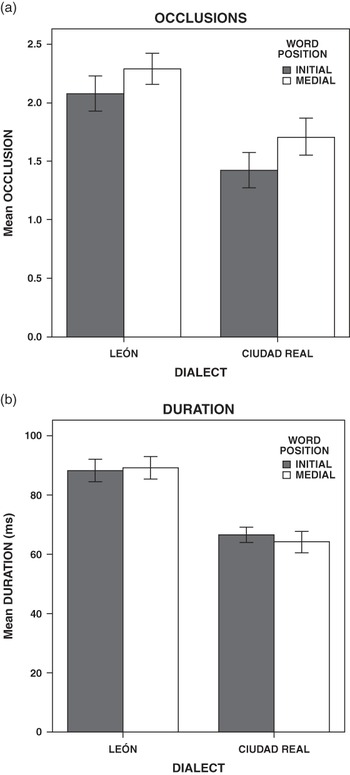
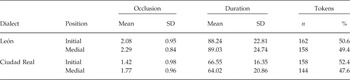
The data in Figure 9 and Table 5 show results for the number of occlusions and the duration of phonemic trills based on word position. Trills in word-medial position contained slightly more occlusions than those in word-initial position for both dialects; the effect on duration was not consistent. The MANOVA showed a significant effect of wordposition on occlusions, F(1, 618) = 5.56, p = .019, but not on duration, F(1, 618) = .275, p = .600.
Mean number of occlusions (a) and duration (b) based on word position.

Descriptive results for Occlusion and Duration based on dialect and word position

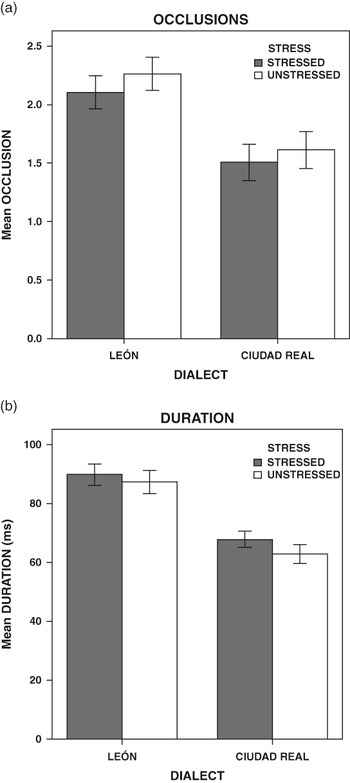
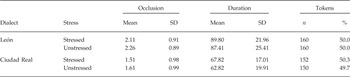
Data for the average number of occlusions and duration based on word stress are reported in Figure 10 and Table 6. For both dialects the average number of occlusions was higher in unstressed position than in stressed position; duration measurements were slightly higher in stressed syllables. The MANOVA showed a significant effect of stress on occlusions, F(1, 618) = 14.78, p < .000, but not on duration, F(1, 618) = .328, p = .071.
Mean number of occlusions (a) and duration (b) based on dialect and prosodic stress.

Descriptive results for Occlusion and Duration based on dialect and prosodic stress

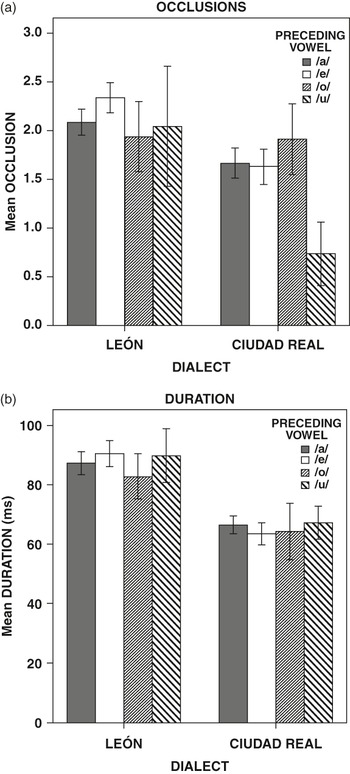
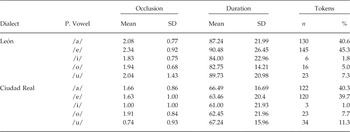
In Figure 11 and Table 7, we show data on the effect of preceding vowel. For León, differences were arguably minimal, ranging from 2.34 contacts per trill for preceding /e/ to 1.83 contacts per trill for preceding /i/. For Ciudad Real, the range was greater, from 1.91 contacts per trill for preceding /o/ to 0.74 contacts per trill for preceding /u/. The MANOVA showed a significant effect of precedingvowel on occlusions, F(4, 618) = 4.22, p = .002, but not on duration, F(4, 618) = .655, p = .623.
Mean number of occlusions (a) and duration (b) based on dialect and preceding vowel.

Descriptive results for Occlusion and Duration based on dialect and preceding vowel

Additionally, a significant effect was found for dialect-by-precedingvowel on occlusions, F(4, 618) = 3.07, p = .016, but not on duration, F(4, 618) = .784, p = .536. Follow-up post hoc tests performed for the effect of dialect-by-precedingvowel revealed a significant difference for /u/ vs. /a/ (t = 4.45, p < .001), /u/ vs. /e/ (t = 2.61, p = .031), and /u/ vs. /o/ (t = 3.47, p = .005) for Ciudad Real speakers only.Footnote 13
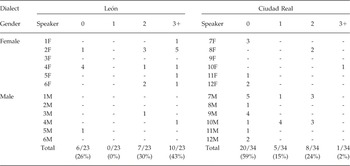
Given the strong effect of preceding /u/ in Ciudad Real, Table 8 is a speaker-based analysis of the number of occlusions per trill token preceded by the high back vowel. This analysis shows that for Ciudad Real speakers, 74% (25/34) of trills preceded by the high back vowel contained zero or one occlusions, whereas for León speakers, the result was 26% (6/23).Footnote 14
Number of occlusions per /ur/ context based on 24 speakers

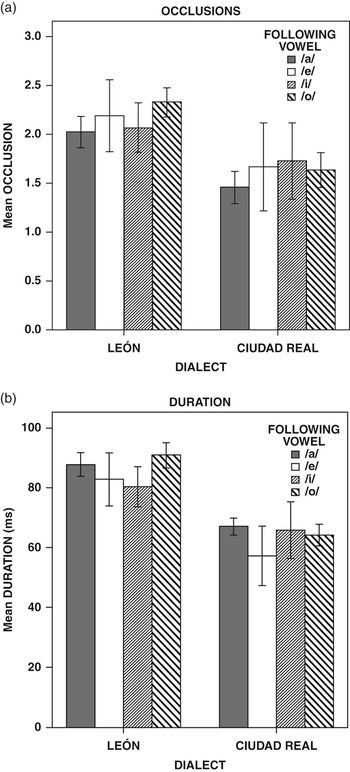
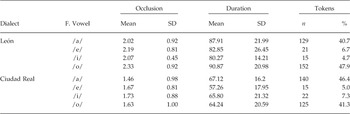
Finally, in Figure 12 and Table 9 we summarize the effect of following vowel. Differences in occlusions and duration were arguably minimal across conditions for following vowels. This observation is supported by the earlier result that there was no overall effect for followingvowel on either DV in the MANOVA.
Mean number of occlusions (a) and duration (b) based on dialect and following vowel.

Descriptive results for Occlusion and Duration based on dialect and following vowel

To recapitulate, we have indicated statistical effects for word position, prosodic stress, and preceding vowel. Our analysis revealed main effects for the DV Occlusions such that trills in word initial position, stressed syllable position, and following the high back vowel contained significantly less lingual contacts. We did not find significant effects of any variable on the DV Duration. This suggests that while phonemic trills may be articulated with fewer contacts in distinct linguistic contexts, their duration remains a robust phonetic characteristic, most likely to preserve phonological contrast with the phonemic tap counterpart (cf. Bradley & Willis, Reference Bradley and Willis2012; Willis & Bradley, Reference Willis and Bradley2008).
5. Discussion
5.1. Social Factors
The goal of this study was to examine sociophonetic conditioning of phonemic trill production in two sub-varieties of Peninsular Spanish. Although the finding of trill variation in Spanish was not without precedent (e.g., Bradley, Reference Bradley2006a; Colantoni, Reference Colantoni2006a,Reference Colantonib; Díaz-Campos, Reference Díaz-Campos2008; Henriksen & Willis, Reference Henriksen and Willis2010; Willis, Reference Willis2006, Reference Willis2007), a review of the literature on this topic revealed the need for an assessment of whether this variation had extended to varieties of Spanish for which no dialectally remarkable trill pronunciations had been reported. We now have preliminary evidence in favor of the hypothesis that differences in speaker dialect contribute to differences in the articulation of the phonemic trill: León speakers produced significantly more occlusions per phonemic trill than Ciudad Real speakers. A gender effect was also found such that women produced significantly more occlusions in both sub-varieties; this effect was stronger in the Ciudad Real sample. Further distributional analysis indicated higher frequencies of 3-closure trills for León women and higher frequencies of 0- and 1-closure trills for Ciudad Real men. Notwithstanding the small sample size of this study, we suggest that these findings warrant speculation into the social motivations of trill variation in these varieties.
Under the assumption that the multiple-closure trill is historically the prototype in Spanish (Hualde, Reference Hualde2005:181; Martínez Celdrán, Reference Martínez Celdrán1997; Quilis, Reference Quilis1993:329–332) and that weakened variants are innovations, it can be inferred that the trend toward weakened variants (i.e., less contacts per phonemic trill, see Recasens, Reference Recasens2002) is more advanced in Ciudad Real than in León, and this shift is most strongly reflected in the speech of Ciudad Real men.Footnote 15 Additionally, there was little distributional overlap based on gender for Ciudad Real speakers: the lowest individual average for mean occlusions in the female sample was 1.91, whereas the highest individual average in the male sample was 1.58. As a generally accepted postulate in the variationist paradigm, men often use non-standard variants as part of a desire to belong to a certain community to mark local identity, whereas women prefer variants of a standard speech variety to gain status in the wider speech community in cases of social stratification (Labov, Reference Labov1990; Trudgill, Reference Trudgill1972). This attitudinal gender difference is what Trudgill invokes in his study of men in Norwich, England who valued positively local speech variants. Although our findings cannot answer the question of what are ‘standard’ trill variants, it is not unreasonable to hypothesize that non-canonical trill variants (i.e., variants in which multiple closures are not executed due to failure to meet articulatory and aerodynamic requirements) in Ciudad Real Spanish have been adopted by male speakers to acquire a status of local identity in their speech community. Such ‘failed’ variants are not uncommon in normal speech (e.g., Blecua Falgueras, Reference Blecua Falgueras2001; Dhananjaya etal., Reference Dhananjaya, Yegnanarayana and Bhaskararao2012; Engstrand etal., Reference Engstrand, Frid and Lindblom2007; Solé, Reference Solé2002), and this would not be the first study to suggest that articulations other than alveolar trills are the basis of social stratification in Romance languages (see Webb, Reference Webb2011).Footnote 16
We must also consider the case of León women. Specifically, these speakers produced the highest number of 3-closure trills and yielded the highest mean occlusion average among the four speaker groups. On the whole, the distribution for León women was inverse to that of Ciudad Real men; namely, León women favored 3-closure trills and barely produced 0- and 1-closure trills. This preference for stronger variants can be interpreted as evidence for what has been discussed as ‘quantitative hypercorrection’ (Janda & Auger, Reference Janda and Auger1992; Yaeger-Dror, Reference Yaeger-Dror1992) in its broadest sense. As discussed in Janda and Auger (Reference Janda and Auger1992), hypercorrection occurs in two forms: Qualitative hypercorrection and quantitative hypercorrection. Qualitative hypercorrection is inferred when speakers attempt to emulate a speech variety with which they are not familiar and insert sounds in inappropriate linguistic contexts (Yaeger Dror, 1992). On the other hand, in contexts of quantitative hypercorrection speakers use a linguistic variable at a rate higher than that of the speakers they are emulating or more than a prescribed norm. One commonly referenced example is r-reintroduction described by Labov (Reference Labov1966, Reference Labov1972) for New York City English.Footnote 17 A similar state of affairs may be at work for León women who produce a significantly higher number of lingual contacts per trill. Specifically, we might view the realization of stronger trills as a way of overtly emulating the prescribed norm and of marking social distance with groups that prefer weaker variants. At this juncture, we must leave for future research the full extent of this proposal.
5.2. Linguistic Factors
We tested four linguistic variables to determine their influence on phonemic trill production: word position, prosodic stress, preceding vowel, and following vowel. In terms of positional strengthening, data on the effect of word position and prosodic stress showed arguably minimal differences across conditions. The weakest phonetic variants actually occurred in word-initial and stressed syllable position. Given this result, we reject our initial hypothesis on positional weakening (cf. Recasens, Reference Recasens2002) whereby weaker trill variants should appear in prosodically less prominent positions. Although the data dispersion was not especially robust between word-initial and word-medial positions, we might suggest that trills in word-medial position contain slightly more occlusions due to the fact that the tap and the trill contrast operates in this prosodic position primarily (see also Hualde, Simonet & Nadeu, 2011).
Regarding coarticulation patterns with adjacent vowels, there was no effect for following vowel, but one noteworthy finding for preceding vowel such that, for Ciudad Real speakers, preceding /u/ contributed to fewer closures per phonemic trill. One explanation for the effect of preceding /u/ may relate to the amount of lip rounding needed to produce this vowel. As noted in Ladefoged and Maddieson (Reference Ladefoged and Maddieson1996:132), high back vowels have the greatest incidence of lip rounding of all vowels; lip rounding creates extra articulatory complexity given the added upward jaw movement that is required to round the lower lip. Ladefoged discusses further that rounded vowels require extra forward jaw movement and also the pulling together of the corners of the lips in their articulation. On the other hand, for the alveolar trill there is evidence that F1 is quite high (it may go up to 650 Hz, Spajić etal., Reference Spajić, Ladefoged and Bhaskararao1996), suggesting that the jaw must be placed in a relatively low position for execution of this consonant. As noted by Daniel Recasens (p.c., e-mail), this acoustic characterization follows with the observation that the predorsum must be low for successful production of the alveolar trill (i.e., lower predorsum implies lower jaw; for further details, see Proctor, Reference Proctor2009). Given these conflicting articulatory requirements (i.e., low jaw position for the alveolar trill and high jaw position for the high back vowel due to lip rounding), trill initiation may display greater susceptibility toward misarticulation in the /ur/ context.Footnote 18 What remains to be seen is whether the same explanation would hold for /ru/ sequences. Unfortunately, there were too few /ru/ tokens in our corpus to measure such an effect. We would speculate that /ru/ sequences may not be as prone to trill failure as are /ur/ sequences since predorsum lowering (and subsequent jaw lowering) is required to initiate trill articulation. Once apical contact has been realized, the jaw may be readily available for movement to initiate lip rounding in the /ru/ context.Footnote 19
All in all, we show partial confirmation for our hypothesis that trill consonants should display weakening characteristics when in contact with high vowels. This is because we uncovered weakening effects for /ur/ sequences in the Ciudad Real sub-variety; we could not test the effect for /ir/ sequences due to the small sample size. Recasens (Reference Recasens2013) suggests that trills demonstrate less antagonism with high back vowels than with high front vowels. Dhananjaya etal. (Reference Dhananjaya, Yegnanarayana and Bhaskararao2012) show that the frequency resonances of voiced trills are more in synch with those of /a/ and /u/ rather than /i/. What remains unclear at this juncture is how to incorporate into these accounts with the present finding that preceding /u/ leads to greater trill weakening. One important difference may lie in data collection discrepancies across studies; the effect of speaking condition should be examined in detail in future work.
5.3. Some Broader Implications
A combined analysis of the data on northern and central Peninsular Spanish (analyzed here) and also of the data on Jerezano Andalusian Spanish, a southern sub-variety examined in Henriksen and Willis (Reference Henriksen and Willis2010), prompts the observations given in Table 10.Footnote 20
Cross-dialectal comparison of descriptive results for Occlusion and Duration; data for Jerez de la Frontera are based on Reference Henriksen and WillisHenriksen and Willis (2010)

Looking at mean occlusion data alone (2.18 for León; 1.56 for Ciudad Real; 1.13 for Jerez de la Frontera), one might propose northward expansion of a southern innovation, namely, that weakened variants developed in southern Spain and have spread north to central varieties, adopted there possibly by men as markers of local identity. Independent evidence to support this contention would come from data on syllable-final /s/ weakening, which is observed at high rates in southern Spanish and to a lesser extent as far north as Madrid (Hualde, Reference Hualde2005:161; Penny, Reference Penny2000:122). For rhotics, researchers have now proposed a lenition scale based on a continuum of trill weakening from the multiple-occlusion alveolar variant to the post-approximantized variant (Bradley & Willis, Reference Bradley and Willis2012, based on Blecua Flagueras, 2001). However, not all southern innovations expand north in Peninsular Spanish, and it is well-known that some southern innovations (e.g., seseo, /-/ and /-l/ neutralization) hold negative stigma within central and northern speech communities.Footnote 21 For trills, Henriksen and Willis (Reference Henriksen and Willis2010) note much individual variation even among speakers of the same age and gender, with some speakers producing mostly multiple-occlusion trills and other speakers providing almost no instances of this articulation. The authors deemphasize the role of social variables, proposing instead that the Andalusian situation is reminiscent of English //, where variation at the level of the individual speaker is known to be very important (Boyce & Espy-Wilson, Reference Boyce and Espy-Wilson1997; Zhou etal., Reference Zhou, Espy-Wilson, Boyce, Tiede, Holland and Choe2008). For both sub-varieties described here, social differences emerged based on mean occlusions, with Ciudad Real men adopting weakened variants in greater numbers. Overall, this distribution is reminiscent of Labov's (1990) Principle I whereby, in contexts of stable sociolinguistic stratification, men use a higher frequency of nonstandard forms than women. In such stable situations in which there is no change in progress, women are conservative in linguistic use and favor variants that hold overt social prestige. Given the present finding that women of both sub-varieties prefer articulations with two or more apical occlusions, we might infer that a wholesale shift toward weakened variants is an unlikely outcome. Perhaps, as proposed earlier, non-canonical trill variants are below the level of awareness, employed most commonly as markers of local identity (cf. Trudgill, Reference Trudgill1972) throughout speech communities in mainland Spain.Footnote 22 We leave the full extent of this proposal as an open question for future research.
As a final point, we wish to reiterate that trill weakening is understood here based on number of apical occlusions and not duration. Recall that for all speakers trill productions were fairly long on average, ranging between 51 and 103 milliseconds for a particular speaker. Although we lack published reports on phonemic tap production in León Spanish, Roller (Reference Roller2011) shows that speakers of Ciudad Real Spanish produce phonemic taps at 25 millisecond durations on average. Therefore, there is little evidence that fewer occlusions in the phonemic trill lead to phonological merger between the trill and its phonemic tap counterpart (cf. Hammond, Reference Hammond1999). On the whole, the converging finding on trill variation in Spanish-speaking communities is that non-canonical variations remain long in terms of duration despite fewer mean occlusions (e.g., Bradley & Willis, Reference Bradley and Willis2012; Henriksen & Willis, Reference Henriksen and Willis2010; Willis, Reference Willis2006, Reference Willis2007; Willis & Bradley, Reference Willis and Bradley2008), most likely to preserve phonological contrast with the phonemic tap. For Peninsular Spanish, this is achieved primarily through r-coloring (i.e., post-approximantization), although in other varieties there is evidence for pre-breathy voicing (e.g., Willis, Reference Willis2006, Reference Willis2007).
6. Conclusion
In this paper, we analyzed a total of 622 phonemic trill tokens produced in intervocalic position for speakers of two sub-varieties of what is generally assumed a conservative variety in Spanish segmental phonology. Results showed that approximately 30% of all phonemic trill productions contained less than two apical closures, distributed among fricatives, approximants, and r-colored variants. Production of weakened variants was conditioned by a number of social and linguistic variables. Specifically, we have proposed that synchronic variation results from the application of two processes (one social and one phonetic): (1) there is variation in which 0- and 1-closure variants are adopted by male and central Peninsular Spanish speakers; additionally, there may be an inverse trend by female speakers of northern varieties to produce especially strong or ‘hypercorrected’ variants; (2) trill failure is common in /ur/ contexts possibly due to antagonistic jaw position requirements between the trill and the adjacent high back vowel. The broader implication is that the present context of variation is proposed as a stable one: We do not see evidence to support an account whereby weakened trill variants are extending within sub-varieties of Peninsular Spanish in robust fashion, although it will be necessary to examine intergenerational data to confirm this proposal. All in all, we have laid out empirical results that help to answer an important question in Spanish, specifically, do synchronic data yield insights into the nature of how rhotics develop within and across speech communities in Spanish? At this juncture our answer is an affirmative one, given especially the combined cross-dialectal findings and also the gender distribution in the León and Ciudad Real sub-varieties. There is every reason to believe that, historically, social as well as linguistic factors played critical roles in the development of what is currently a wide array of trill articulations in pan-Hispanic pronunciation. This is now laid out clearly in French (e.g., Webb, Reference Webb2011), and it would seem that there is much scope to test this hypothesis in Spanish.
Based on these sociophonetic findings, we have proposed directions for future study on trill articulation in Spanish. Given the preliminary nature of our experiment, 24 speakers were recruited; a larger participant pool will be necessary to solidify the claims on geographic and social variation especially. It may be necessary to explore additional acoustic measures of trill articulation as well, perhaps in a more varied set of linguistic contexts (see, for example, Dhananjaya etal., Reference Dhananjaya, Yegnanarayana and Bhaskararao2012; Recasens, Reference Recasens2013). The effect of word frequency (e.g., Bybee, Reference Bybee2002) may be worth considering, although recent research reveals that phonetic context may be the critical factor at the earliest stages of segmental weakening (Hualde etal., Reference Hualde, Simonet and Nadeu2011). In the meantime, it is with a comparative geographic approach that we have informed historical work on rhotics through sociophonetic analysis of synchronic data.
Acknowledgements
This paper has benefited greatly from feedback provided by Travis Bradley, Steven Dworkin, Lorenzo García-Amaya, Roberto Mayoral Hernández, Terrell Morgan, Carmel O'Shannessy, Daniel Recasens and various anonymous reviewers. Stephanie Dickinson also provided valuable help with statistical analysis. I also thank Maxim Aleksa, Juan Garví Medina, and Jason Roller for their research assistance. Portions of this paper were presented at Hispanic Linguistics Symposium held in Athens, Georgia in October 2011 and New Ways of Analyzing Variation held in Bloomington, Indiana in October 2012. All shortcomings are my own.