The last vote was counted in the 2004 presidential election and old debates
began anew about the causes of low turnout of those between the ages of 18
and 24. Despite an unprecedented amount of time and effort spent on turning
out the youth vote, the data suggest that only about half of the eligible
voters between the ages of 18 and 24 cast a vote for president. The good
news is that, indeed, this year's figures reverse a downward trend in voter
turnout amongst the youth; the bad news is that every age bracket increased
in voting and youth voting still lagged behind other age groups by
significant margins. Scholars have once again cited evidence of political
apathy and alienation among young people; they have referred to studies that
reveal widespread ignorance of American politics and history in our nation's
high schools and colleges. Dire predictions will continue about the bleak
future of American democracy due to the ostensible lack of knowledge and
interest in the American political system among our newest voters. Despite
studies showing increases in volunteerism, service, and civic engagement,
the low voter turnout will dominate the debate about civic education.
The concern over young voter apathy is well founded. Many posit voting as the
essential responsibility of citizenship in a democracy. As such, voting is a
good in and of itself—a measure of one's commitment to civic duty. Voter
turnout is an important indicator of both individual commitment to, and the
collective health of, any democratic society. Yet, there is evidence that
voter turnout is just as much a means as it is a noble end: studies have
shown a strong correlation between low political participation, high
literacy inequality, and the unequal distribution of material resources
(Milner 2002). Such conclusions support what
democratic theorists have been saying for some time, namely, that societies
which have high levels of participation and a relatively equal distribution
of intellectual resources will, over time, tend to distribute material
resources more equally as well. The mantra from Jean-Jacques Rousseau to
Thomas Jefferson, from Gabriel Almond and Sidney Verba to Benjamin Barber,
has been that active participation facilitates procedural democracy, and
thereby leads to a more vibrant substantive democracy. Read another way:
high voter turnout equals a greater number of interests served equals
socioeconomic equality implemented.
So why don't the young vote in large numbers? We might characterize the two
main explanations as the alarmist point of view and the pragmatic
perspective. The alarmists say that political participation is inextricably
tied to political knowledge. As Popkin and Dimcock (1999) put it, “The dominant feature of nonvoting in America is a
lack of knowledge about government.” Study after study has bemoaned the
youth's lack of knowledge about our political system (Lutkus et al. 1999; Morin 2000; Gallup and Gallup 2000; Sax et
al. 1998; Vanishing Voter 2000). Raise
civic competency, according to this view, and you will raise voter turnout.
On the other side, there are the pragmatists who look to the weight of
history and suggest that the most important indicator of political
participation is aging (Coulson 1999). Young
people who do not vote now will more than likely become voters once they
progress through the life cycle (Wolfinger and Rosenstone
1980). The alarmists speak with a sense of dire urgency; the
pragmatists advise us that time and maturity will increase voter
participation in a generational cohort.
If forced to choose which camp to join, we'd throw our hat into the alarmist
ring: it is better to confront the problem of a lack of political knowledge
amongst youth today rather than waiting for them to acquire it tomorrow. The
2004 presidential election witnessed the launch of an unprecedented number
of campaigns encouraging young people to register to vote, but more
importantly to become a player in electoral politics. Rock the Vote, Rap the
Vote, Vote or Die, Hip Hop Political Conventions: Music is fast becoming the
favorite way to light the spark of political involvement among the youth
culture. Sports, hamburgers, and TV commercials all delivered the message
that we were in an election year and that voting was the most important way
to express your freedom and responsibility in a democracy.
If, in fact, political knowledge is an indicator of political participation,
then as political scientists we must do all we can to raise political
knowledge amongst our youth. At Pace University, we used large-scale
simulations to achieve that goal. In this paper, we describe Presidential
Convention 2004 (PC2004), a mock presidential convention where 650 high
school students in the New York metropolitan region were taught the process
of presidential selection by 75 Pace students. Projects such as PC2004
promote what we call Democratic Action Research (DARE).
Nature of the Problem
Voter turnout is one way to measure the health and legitimacy of any
democratic society. Simply put, voting is a means by which a citizenry
tacitly consents to be governed by its leaders—whether the candidate one
chooses wins or loses. In the United States, voter turnout in
presidential elections peaked in 1960 at about 64% and has declined
(with the exception of the 1992 election) to roughly 50% in 2000 (Maisel and Buckley 2004). 2004 was a good year
by all measures, with voter turnout hitting 60%, the highest turnout
since 1968 in a presidential election year. Yet in midterm elections
turnout has dropped in the same 40-year period from nearly 50% to
35%.
A further consideration of voter turnout by age finds other disturbing
trends. In 2000, 67% of those over the age of 65 voted. Voter turnout
for those between the ages of 45 and 64 was just slightly lower at 64%.
By contrast, just over a third of those between the ages of 18 and 24
went to the polls in 2000 (U.S. Census Bureau, Voting and Registration
Reports), and nearly 50% went to the polls in 2004. Statistics also show
that voter turnout is correlated to socioeconomic factors: the affluent
and highly educated tend to vote in higher proportions than the poor and
uneducated. Given these findings, we can posit several conclusions about
the state of American democracy: first, that our political system is
more responsive to the wealthy and the educated, and second, that our
political system is more responsive to middle age and elderly voters
than to young voters.
Debates rage over why the young or the less affluent tend not to vote.
Partisanship, navigating the “rules of the game,” socioeconomic status,
political knowledge, and participation: all are important variables in
distinguishing the voter from the nonvoter. Yet, whatever the causes,
identifying the effects of voting and nonvoting are perhaps just as
important—if not more so. Henry Milner (2002)
postulates a direct correlation between levels of political
participation and the distribution of material resources in a democratic
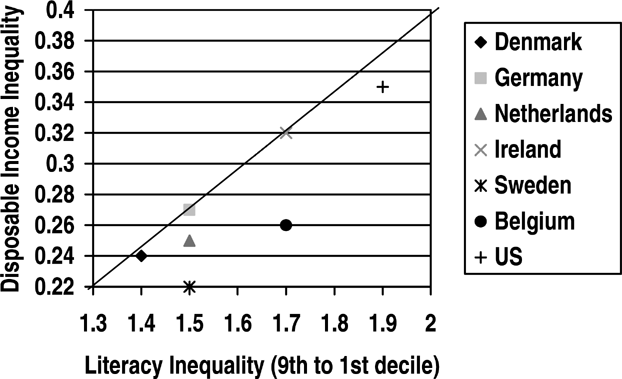
society. Figure 1 suggests that higher income
disparities lead to a higher level of literacy inequality. The United
States lags far behind in this category when compared to other western
democracies.
Literacy and Income Inequality, Select Countries
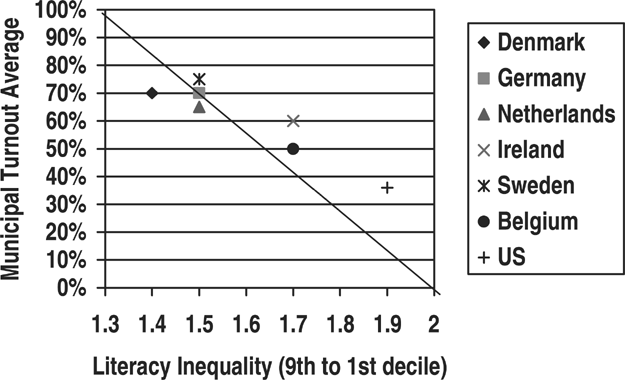
Figure 2 shows that the higher the voter
turnout, the less literacy inequality there is in a society. Once again,
the United States lags behind its counterparts. Combine these two
figures and a disturbing pattern emerges: societies that promote higher
levels of political participation more equally distribute both
intellectual and, most importantly, material resources.
Voter Turnout and Literacy Inequality
If voter turnout is indeed tied to the material health of a democratic
society as the above data suggest, then we as educators and political
scientists have a duty to promote democracy (and thereby the equal
distribution of material resources) through teaching our students the
value of political participation. We believe that universities must play
a transformational role in increasing political participation among our
youth.
DARE and Democratic Education
Democratic Action Research (DARE) is the name we have given to
Participatory Action Research (PAR) that is focused specifically on
expanding political consciousness. Rooted in anthropology and
development, PAR “goes beyond usual institutional boundaries in
development by actively involving the people in generating knowledge
about their own condition and how it can be changed” (Fals-Borda and Rahman 1991). Jose Ortega y Gasset claimed
“through the actual experience of something, we intuitively apprehend
its essence; we feel, enjoy, and understand it as reality, and we
thereby place our own being in a wider, more fulfilling context” (Fals-Borda and Rahman 1991, 11). Habermas'
“life-world” also propagates an authentic commitment to a holistic
understanding of everyday life within a freely chosen value system, and
inspires investigation into the context of political action that is
liberating and emancipating (Habermas 1985).
Habermas' concept of life-world and Thomas Kuhn's “paradigm shift” serve
as a call for political scientists, among others, to change the level of
discourse concerning participation in civic life. Creating opportunities
to increase political literacy and democracy, rather than observe,
lament, and remain disinterested at the failure of youth to engage in
politics, become legitimate activities in the more activist engaged
mission of political educators.
DARE seeks to “harmoniously reconcile the normative, empirical and the
prudential components of political life” (Riemer
1962). This process must begin in the classroom, but it does
not end there. Indeed, our courses should be laboratories for democracy
(Becker and Couto 1996) where we teach the
political knowledge associated with democracy while at the same time we
are democratic in our pedagogy. This immediately raises an important
question: Can we serve two masters, the empirical and the normative, at
once? DARE demands we bridge the two; we have found this is best done
through large-scale simulations which engage young people in
synthesizing facts, analysis, evaluation, communication, negotiation,
and creation. In the process, DARE confronts the radical paradox that
gaining knowledge of the political system leads to a powerlessness to
change the system (Clecak 1974).
As political science professors, we accept the tension that comes from
having one foot in the classroom and one foot in the political world.
Henry Nelson Wieman (1990) characterized
creativity as living in the interchange between these two worlds. For
political scientists, this creativity bridges the distance between the
dual responsibilities of the active practitioner of civic engagement and
the detached observer of the political world. As an educational mentor
to Martin Luther King, Wieman's legacy lies at the crux of the debate
between thought and action. DARE seeks to engage thought and action in
and out of the classroom to increase political participation and
enlighten students in their civic duty.
Embracing this dual role then forces upon us a dual purpose. As
educators, our responsibility is to see to it that our students become
politically literate: that is, that they acquire objective knowledge
about the political world that will allow them to comprehend, evaluate,
and analyze the world around them. As professors of politics, we also
have a responsibility to see to it that our students consider and learn
the values of good citizenship—and engage that political world in a
meaningful way. Our courses are successful, then, when they promote
political literacy on the one hand and increase civic engagement on the
other. We must, in other words, create an interaction between the
objective knowledge required of a successful student and the subjective
development required of a well-rounded citizen (Putnam 2001).
How is this to be done? Richard Guarasci (1997)
has offered some necessary criteria for “democratic education.” Now
president of Wagner College, Guarasci has joined David Caputo, president
of Pace University, in calling for a new era in which higher education
is in part measured by its success in promoting civic engagement. Both
political scientists, they have taken the route of college
administration to forge a growing interdependency between democratic
governance in education and meaningful civic engagement outside the
walls of academia. Building upon Guarasci and Caputo's example, we
believe DARE needs to include the four aspects of “democratic education”
that are captured in large-scale simulations such as PC2004: 1)
political literacy; 2) active learning; 3) civic engagement; and 4) an
ethic of democratic leadership and professionalism.
1) Political Literacy
As the term suggests, political literacy is the ability to “read
politics.” Like “reading” literacy, political literacy is a
developmental process that ranges from learning to interpreting
facts, data, and history to establishing higher levels of
understanding. The reality is that some individuals become more
politically “literate” than others. The process begins with
acquiring objective knowledge about politics; but it does not end
there. It includes the ability to comprehend, conceptualize,
navigate, and critically evaluate the political world around us.
Students who are politically literate have moved beyond learning the
mere facts of politics (e.g., the number of senators and number of
electoral votes) and are able to analyze the political system for
its strengths and weaknesses (e.g., how the number of senators or
the number of electoral votes enhances or diminishes the democratic
experience). Our emphasis on political literacy is founded upon the
belief that politically literate individuals are knowledgeable
about, and interested in, the political world. The more knowledge
they obtain, the more interested they become, and vice versa.
Literacy is cumulative and the “costs” to participate (time and
effort) in politics become more manageable. Thus, students who take
our courses are more likely to engage in political participation
(e.g., vote) because they understand political candidates and issues
more readily than students who are less politically literate. The
pedagogy of democratic decision-making in the classroom, combined
with real world activities like teaching high school students,
writing instructional material, and running a large conference, are
exercises in developing political literacy.
2) Active Learning
Educational studies have long supported the hypothesis that students
learn more by actively acquiring knowledge. Effective teaching
practices are fundamentally more participatory and democratic. The
transition from traditional, instructor-centered teaching practices
to more interactive processes such as checking for understanding,
student team learning, and simulations, has created a pedagogical
revolution. Many students learn best when they are asked to
transcend the consumption of knowledge (or the banking principle of
education) and put thoughts into action, becoming producers of
knowledge in their own right (Freire
1971). In our classes, students are asked to become producers
of knowledge and to “teach” other students—by sharing their work in
group projects, delivering class presentations, working in real-life
situations outside of class and sharing those experiences in class,
and assuming roles in a large-scale simulation. Active learning
assists student development of marketable skills, including:
analytical reading skills; critical writing skills; coherent and
clear communication skills; the art of negotiation and compromise;
and the value of collaboratively working in groups.
3) Civic Engagement
Civic engagement exists on a continuum from students “shadowing”
engaged people as they do their work to volunteering, from
committing to community service projects to system-transforming
actions taken by individuals and non-governmental organizations.
Civic engagement creates opportunities for expanding political
consciousness by connecting the everyday experiences of individuals
and the communities with whom they come in contact to the larger,
structural problems of society. Higher levels of understanding
evolve as participation positively influences self-esteem and
confidence, and students grow increasingly willing to challenge the
larger, structural problems that society faces over time. An example
might be the following: students join with community leaders to
paint a public school in the neighborhood. While the students are
engaged in a community activity, this activity divorced from the
wider context might be construed as nothing more than an act of
charity. We think it should lead to a discussion of larger
questions: for example, why is there not enough funding for the
school to get painted in the first place? Where does the funding for
education come from? Who controls the funding? What are the power
relations involved in school funding? What is the process for
increased funding which will allow for things like a coat of paint
in the budget? An unpainted school building should thus open a
window on to larger, structural issues of education. Civic
engagement must pay equal attention to both the immediate and
“everydayness” of social and political issues, along with the
structural causes that lie at the root of persistent problems. Thus,
civic engagement encourages students to move beyond the educational
process of rote learning to the process of systemic analysis.
Students in a civic engagement course confront the reality of issues
and assess the reasons for their imperfect knowledge and incomplete
information. Students can challenge authority by creating the
opportunities, resources, and leadership for effective democratic
practices within and beyond the classroom. Once back in class,
students are then able to reflect upon their experiences by coupling
thought and action. The classroom thus becomes the venue for a
discussion of the “structural” problems they witnessed firsthand. It
is the place for critical reflection about the causes of the
problems they faced and the solutions that they may offer. Our role
in the process of civic engagement is thus as facilitators as
students travel along the road from the everydayness of social
issues to their larger, underlying causes, and back again to the
potential solutions that citizens face daily.
4) An Ethic of Democratic Leadership and
Professionalism
Today many students fail to see the relationship between the material
covered in a college course and the “real world” outside of the
classroom. Some openly wonder what good this knowledge will do them
once they graduate. Many times they are right: the material covered
on a test will not factor into whether they get a job. Yet, focusing
entirely on the knowledge they acquire in class misses the point. As
educators we must try to instill in our students the notion that the
lessons and work habits they gain in college are relevant to their
identity formation. Habits obtained now, both bad and good, will be
hard to break in the future. Thus, an ethic of leadership and
professionalism does not focus so much on what is learned in the
classroom, but how a student conducts him/herself from day to day in
the classroom. Is the student attentive? Courteous? Respectful to
other students? Are assignments handed in on time? Were they done
without outside assistance? Does the student interact with group
members in a professional manner? Was the student able to adapt to
circumstances? Our belief is that students will be able to adapt to
the professional world after college if they experience
opportunities to present their maturing identities while in college
(Bellah et al. 1996).
Presidential Convention 2004 and Democratic Education
One way to accomplish the goals of DARE and democratic education is
through large-scale simulations. In this section, we describe the mock
presidential convention we conducted with over 650 high school students
at Pace University in New York City in January 2004. We encourage
political scientists to incorporate DARE and democratic education in
their own courses to advance the complementary objectives of political
literacy and civic engagement. We called our mock convention
Presidential Convention 2004 (PC2004).
PC2004 was held January 7–9, 2004 at the Pace New York City campus. It
was attended by roughly 650 students from 25 different high schools in
New York City and Westchester County. The high school students convened
at Pace University for three days and assumed the role of “delegates” to
the presidential convention of one of the two major political parties.
The student delegates performed two of the most important activities of
a real political party convention: 1) building and proposing “planks” in
the national party platform, and 2) nominating presidential candidates
for the general election. Both the Democratic and Republican delegations
drafted national party platforms on a set of eight issues of importance
in this year's presidential election.1
The
issues were: Abortion; Foreign Policy/War on Terrorism; Federal
Budget; Social Security; Race/Affirmative Action; Education;
Health Care; Environment. The model party platforms can be
viewed at
http://webpage.pace.edu/cmalone/pc2004.htm.
Pace University students were responsible for teaching the high school
students about party convention politics in preparation for PC2004. In
the fall of 2003, Pace students on both the New York City and
Pleasantville campuses took a course in presidential politics with
Christopher Malone entitled “Road to the White House.” While the course
focused primarily on presidential campaigns and elections, much class
time was spent preparing the Pace students for their visits to the high
schools. The visits began in early October 2003 and continued beyond the
end of the semester. The Pace students, totaling roughly 75 spread out
over both campuses, were broken down into groups of three and assigned a
school: New York students in New York City, Pleasantville students in
Westchester. The Pace groups visited the schools to prepare the high
school teachers and students. The Pace student leaders and the high
school teachers worked together to devise their own schedules for
meetings at the high schools.
The 650 high school students were divided into two groups of roughly 325
representing a Democratic delegation and a Republican delegation. Each
of these party delegations was further divided into 50 state party
delegations, meaning that there were approximately six students per
state delegation. With 25 high schools participating, each school was
assigned two states, and four state parties.
One of the most unique aspects of PC2004, and one of which we are perhaps
most proud, is the 450-page book the Pace students co-wrote with
Professor Malone titled PC2004: Delegate Almanac of Presidential
Politics.2
The entire Almanac can
also be viewed at
http://webpage.pace.edu/cmalone/pc2004.htm.
The book is
an extraordinary collaborative effort between the Pace students and the
high school teachers and students. The Pace students worked with each
high school/party delegation to draft a state party platform on the
eight issues the delegates debated at PC2004. For example, students
playing the role of Mississippi Republicans researched and wrote
platforms on the eight issues from the perspective of Mississippi
Republicans. Each state delegation did the same, and all 100 state party
platforms (50 Dems, 50 Reps) were compiled in the
Delegate
Almanac. The
Delegate Almanac also included:
- background material on the eight issues (written by Pace students
who did independent studies in the summer 2003)
- background on the presidential and vice presidential candidates
(also researched and written by Pace students)
- all of Professor Malone's course lecture notes on presidential
campaigns and elections (roughly 80 pages in nine lecture
outlines)
- edited versions of the Democratic and Republican Party Platforms
from the year 2000 (to give the students a sense of where the
parties stood on the issues in the previous presidential election
cycle)
Producing a book from which to teach others allowed the Pace students to
highlight their roles as “producers” of knowledge. Further, knowing that
this publication was handed out to every delegate and placed on the
PC2004 web site gave the Pace students the incentive to improve and
refine their work.
Completion of the Delegate Almanac was also crucial to the
educational experience of both the Pace and the high school students. It
allowed all the students to grasp the three elements required to perform
their roles properly in the large scale simulation: 1) a basic
understanding of the issues; 2) an understanding of their state parties'
stances on the issues; and 3) an understanding of the positions of the
candidates they were to choose for president.
Just as important, the “division of labor” which culminated in the
drafting of the Delegate Almanac allowed the students to
comprehend the very thing which this exercise was intended to highlight:
the highly decentralized and complex political process of nominating
candidates for the office of presidency and drafting national party
platforms. By breaking the students into state party delegations and
asking them to understand issues from the perspective of the state
parties (rather than their own), students began to comprehend the
essence of the two–party system in the United States, how the parties
function both on the state and national level, and how each state's
interests is voiced in the nominating process for president. Ultimately,
our goal was to give the students an experience in American
democracy—the good, the bad, the ugly—and to do it in a way that allowed
them to learn by doing.
Pace University provided the high school teachers with materials that
served as either a curriculum substitute or supplement in return for
their participation. We provided every high school student with a copy
of Stephen Wayne's Road to the White House 2004, a very
readable college text on presidential elections. Professor Malone also
provided the high school teachers with his extended lecture notes on the
text and on the process of presidential selection that he had developed
over the last five years. Many of the high school teachers built the
content of the project into their curriculum for the fall semester.
Teachers met regularly with us in the fall of 2003. Establishing trust
with the high school educators through these regular meetings was a
fundamental element to the success of the PC2004.
Pace students coordinated the convention based upon their experiences of
running large-scale high school model United Nations conferences at Pace
University and internationally. These conferences call upon students to
transform the participation skills learned at competitive model UNs into
the decision-making skills of creating large-scale learning events. Pace
University is one of a handful of universities that creates
opportunities for students to learn democratic leadership by
administering these major undertakings. The group worked to draft
convention rules and procedures for committee chairs, ran mock committee
hearings for the committee chairs in the weeks leading up to the
convention, and generally prepared all of the documentation and
scheduling for the three-day event.
On the first full day of the convention, both the Democrats and
Republicans set to work on their respective party platforms. The first
meetings of the day consisted of Joint Platform Committee Hearings,
eight meetings on the issues the delegates were to debate and ultimately
draft platforms on. The party platform committees then met separately to
draft their respective planks in the platforms. Their goal: construct a
draft plank on their issue. Each committee would present their plank
before the entire caucus on the morning of January 9th, so it
was crucial to have a finished draft by the end of the first full day of
the convention.
The morning of the second day the delegates finalized their national
party platforms. The Democratic and Republican delegations met
simultaneously in separate venues. Each platform committee elected two
high school delegates to present their plank to the entire caucus.
Convention rules allowed for 15 minutes of discussion on each plank. Two
amendments to each plank were entertained. The entire draft was voted up
or down, and the two amendments were then voted on separately. By lunch
each delegation had drafted their party platforms.
The afternoon of the 9th hosted the finale: the nomination and
election of the candidates. The Republican convention offered less
excitement, since George W. Bush ran unopposed in this year's Republican
primary. We created an atmosphere of uncertainty in the GOP by imposing
a crisis when Vice President Dick Cheney withdrew his name from the
ballot. The delegates had to replace him with another candidate.
Secretary of State Colin Powell was eventually nominated to be the
Republican vice presidential candidate in 2004 in a contest that
included New York Governor George Pataki, former New York City Mayor
Rudy Giuliani, and Arizona Senator John McCain.
The Democratic nomination proved as typically raucous as most Democratic
conventions are in reality. The convention rules were similar to those
of an actual convention: a nominee had to get a clear majority of the
voting delegation. With nine Democratic candidates, this proved
impossible on the first balloting. After the first ballot, Ohio
Representative Dennis Kucinich, Vermont Governor Howard Dean, and
Massachusetts Senator John Kerry were the top three vote getters and
made it to the second round of balloting.
On the second ballot, Howard Dean finished first and Dennis Kucinich
second. But neither received a clear majority; the convention went to a
third ballot—this time between Kucinich and Dean only. To the surprise
of many, Dennis Kucinich won the Democratic nomination. Reports from the
floor of the convention indicated a strong antiwar constituency amongst
the Democrats. A “deal” to deliver Kerry supporters to Kucinich
reportedly derived from the rancor between Dean and Kerry on the
campaign trail.
Conclusion
Large-scale simulations such as PC2004 serve many objectives that
political scientists must focus on. First, the expose both college and
high school students to the political system through role-playing; this
increases their knowledge of, and interest in, the political system.
Evidence from the convention indicates that the high school students who
would turn 18 by election time intended to vote in the 2004 presidential
election. Similarly, most of the Pace students reported the same. A goal
of future projects such as PC2004 is to obtain funding to carry out
short-term analysis and long-term longitudinal studies that track
participants through one or several election cycles to see if their
participation rates are higher than the overall cohort. This research is
needed to authenticate the anecdotal and small samples that support the
contention that large-scale simulations are important influences in
leadership development.
Second, simulations such as PC2004 allow political scientists to serve
two masters at once: on the one hand, they allow us to remain true to
the demands and necessities of our academic discipline by teaching
material that is required in the classroom. On the other hand, such
simulations allow us to engage in the democratic experience by
connecting our students to the realities of the social and political
world outside of the classroom. In the process, we combine thought and
action in our own pedagogy. We are motivated by the conviction that the
younger generation needs to experience dramatic simulations to feel the
excitement of political involvement and the joy of learning by
engagement.
Third, these types of projects promote what we have called DARE through
the process of “democratic education” both in and out of the classroom.
Students who participated in PC2004—both the high school and Pace
students—were exposed to our four requisites of democratic education.
The students became more politically literate about the process of
presidential selection because they were asked to learn and then teach
their peers the material. In the process, the students engaged in active
learning through role playing and simulation, and thereby gained a
deeper understanding about how politics really works—the fragmented
structure of our federalist political system, the nature of the
two-party system, the importance of division of labor through committee
systems, the art of compromise and negotiation, etc. In traveling to the
high schools to teach high school students, the Pace students saw the
importance of civic engagement as they came across some of the
fundamental problems in our educational system. In the process, they
connected the everyday problems of the high school students to some of
the larger structural issues facing our education system. And finally,
the students learned what it means to act democratically and
professionally toward one another, as they were perceived as leaders by
those outside of their immediate community while being faced with the
realities of diversity and difference. Hence, the need for mutual
respect became much more pronounced.
Author Bios
Gregory Julian is professor of political science and the faculty director
of the Model United Nations Team at Pace University. He can be reached
at gjulian@pace.edu.
Christopher Malone is assistant professor of political science at Pace
University and a political consultant in New York City. He can be
reached at cmalone@pace.edu.