1. Introduction
Grylloidea is a superfamily of insects commonly known as true crickets within the order Orthoptera, consisting of four recent families (Gryllidae, Mogoplistidae, Gryllotalpidae and Myrmecophilidae) (Resh & Cardé, Reference Resh and Cardé2009) and two fossil families (Baissogryllidae and Protogryllidae) (Cigliano et al. Reference Cigliano, Braun, Eades and Otte2018). It occupies almost all terrestrial habitats occurring: in or near treetops and on bushes, grasses and other herbaceous plants; on the soil surface; in caves and burrows in logs or standing trees; and even on beaches (Resh & Cardé, Reference Resh and Cardé2009). The earliest fossil record of Grylloidea can be dated back to Middle Triassic time (Heads & Leuzinger, Reference Heads and Leuzinger2011), and fossil Grylloidea have been reported from America, Brazil, England, Germany, Mongolia, Myanmar, Russia and China (Cigliano et al. Reference Cigliano, Braun, Eades and Otte2018). However, among these fossils, only one specimen belonging to Trigonidiidae has been found in China (Ren, Reference Ren1998). Here we report the second grylloid fossil from China, a forewing attributed to the extinct family Baissogryllidae from the Lower Jurassic Sangonghe Formation of the Junggar Basin, northwestern China. This specimen represents not only the earliest record of Baissogryllidae, but also the first fossil grylloid wing with a sound-producing organ from China.
The Junggar Basin is one of the most famous walled sedimentary basins in western China, with Mesozoic and Cenozoic non-marine strata more than 11 km thick (Carroll et al. Reference Carroll, Graham and Smith2010). Of these strata, Jurassic deposits are widely distributed in the basin and have a total thickness of 4000 m, with several sedimentary centres located in the eastern and southern Junggar Basin (Deng et al. Reference Deng, Lu, Fan, Pan, Cheng, Fu, Wang, Pan, Shen, Wang, Duan, Zhang, Jia and Fang2010). As one of the best stratigraphical sections of the terrestrial Jurassic System in China, the Haojiagou–Toutunhe section is situated on the southern margin of the Junggar Basin (Deng et al. Reference Deng, Lu, Fan, Pan, Cheng, Fu, Wang, Pan, Shen, Wang, Duan, Zhang, Jia and Fang2010). Jurassic deposits are approximately 2400 m thick in the section and can be divided into six formations (in ascending order): the Badaowan, Sangonghe, Xishanyao, Toutunhe, Qigu and Kalazha formations (Deng et al. Reference Deng, Lu, Fan, Pan, Cheng, Fu, Wang, Pan, Shen, Wang, Duan, Zhang, Jia and Fang2010). Until now, only two fossil insects have been reported from the Sangonghe Formation in this section, comprising Artematopodites insculptus (Zhang, Reference Zhang1997) Yan & Zhang, Reference Yan and Zhang2010 and Eofulgoridium tenellum Zhang et al. Reference Zhang, Wang and Zhang2003 (Zhang, Reference Zhang1997; Zhang et al. Reference Zhang, Wang and Zhang2003; Yan & Zhang, Reference Yan and Zhang2010). Most recently, several insects were unearthed from the Sangonghe Formation including a grylloidean forewing described in Section 4 below.
2. Geological setting
The stratotype of the Sangonghe Formation is located in Fukang, Xinjiang, northwestern China and this formation is represented by a set of lacustrine and delta sediments; the Sangonghe Formation occurs in the Junggar, Turpan–Hami, Santanghu, Kupu, Hoxtolgay and Hefeng basins in northern Xinjiang, China, and has a thickness ranging from over 10 m to 480 m (Deng et al. Reference Deng, Lu, Fan, Pan, Cheng, Fu, Wang, Pan, Shen, Wang, Duan, Zhang, Jia and Fang2010). Abundant bivalves, gastropods, conchostracans, plants and palynomorphs have been found in the formation (Deng et al. Reference Deng, Lu, Fan, Pan, Cheng, Fu, Wang, Pan, Shen, Wang, Duan, Zhang, Jia and Fang2010).
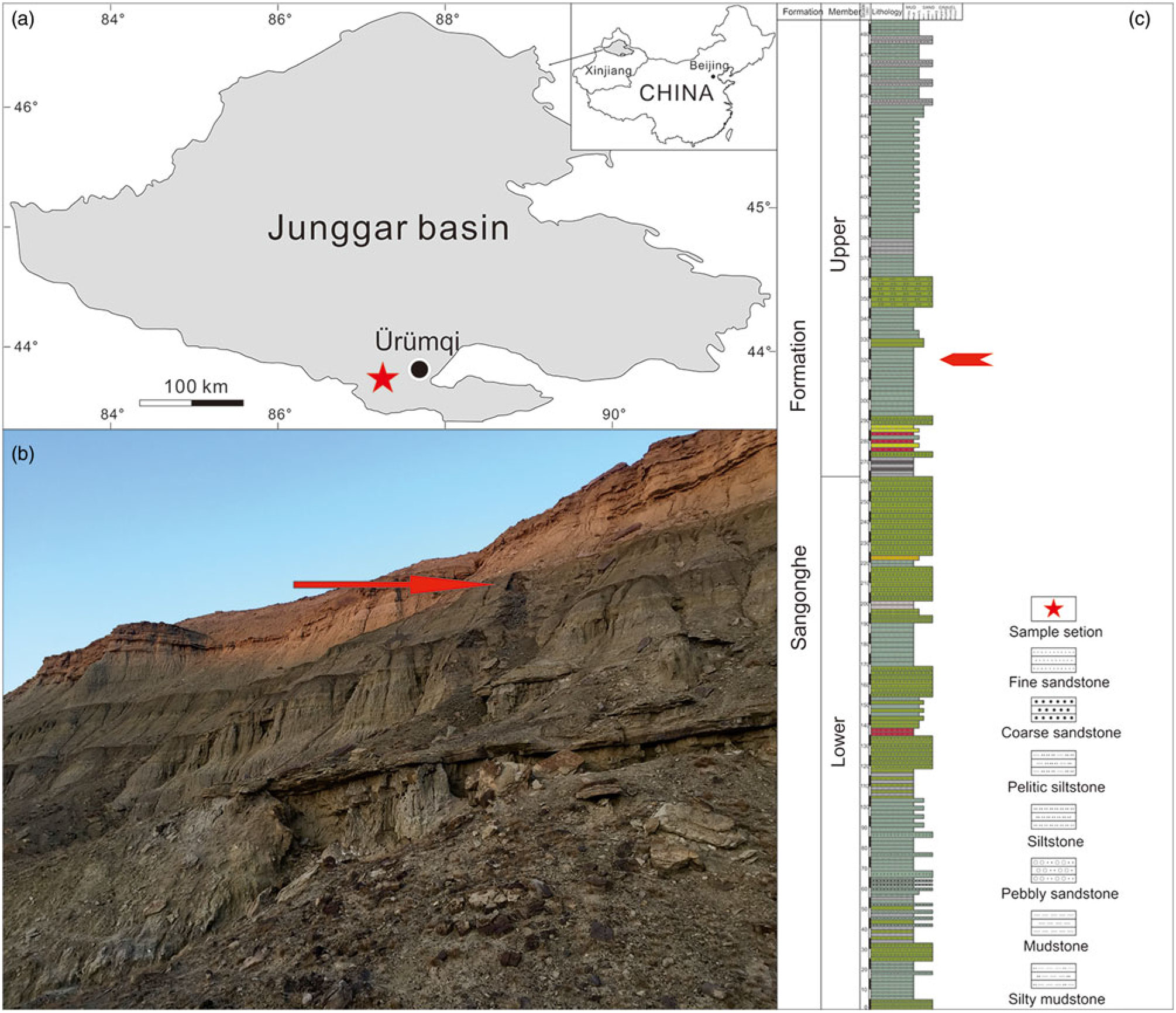
The specimen described in this study was collected from the Sangonghe Formation in the Haojiagou–Toutunhe section, 40 km SW of Urumqi City (Fig. 1). In this section, the Sangonghe Formation is in conformity with the overlying Middle Jurassic Xishanyao Formation and the underlying Lower Jurassic Badaowan Formation, and is divided into two members with a total thickness of 486.87 m (Deng et al. Reference Deng, Lu, Fan, Pan, Cheng, Fu, Wang, Pan, Shen, Wang, Duan, Zhang, Jia and Fang2010). The Upper Member mainly consists of greenish-grey and dark-grey, thin-bedded fine-grained sandstones and siltstones, silty mudstone, greyish-black mudstones intercalated with greyish-green medium-grained sandstones, and greyish-black carbonaceous mudstones with thin-bedded coal beds at base (Deng et al. Reference Deng, Lu, Fan, Pan, Cheng, Fu, Wang, Pan, Shen, Wang, Duan, Zhang, Jia and Fang2010). The Lower Member is composed mainly of yellowish-green and greyish-green, thick-bedded or massive medium- to coarse-grained sandstones, pebble-bearing coarse-grained sandstones, fine-grained conglomerates and ferric, carbonaceous sandstones unequally alternating with greyish-green, dark-grey fine-grained sandstones and siltstones, silty mudstones intercalated with dark-grey mudstones, and carbonaceous and calcareous mudstones (Deng et al. Reference Deng, Lu, Fan, Pan, Cheng, Fu, Wang, Pan, Shen, Wang, Duan, Zhang, Jia and Fang2010). The Sangonghe Formation in the Haojiagou–Toutunhe section yields abundant plants, spores and pollen, megaspores, bivalves, gastropods, conchostracans and ostracods (Deng et al. Reference Deng, Lu, Fan, Pan, Cheng, Fu, Wang, Pan, Shen, Wang, Duan, Zhang, Jia and Fang2010).
(a) Geographical sketch map of the Junggar Basin, Xinjiang, China, showing the locality (star) of the Haojiagou–Toutunhe section. (b) Photograph of the insect-bearing beds (arrow) of the Sangonghe Formation in the Haojiagou–Toutunhe section. (c) Stratigraphical column showing the lithology of the Sangonghe Formation and position (arrow) of the new insect collected from the Sangonghe Formation (based on data from Deng et al. Reference Deng, Lu, Fan, Pan, Cheng, Fu, Wang, Pan, Shen, Wang, Duan, Zhang, Jia and Fang2010).

Different fossil assemblages have been established from the Sangonghe Formation including the Phlebopteris–Marattiopsis plant assemblage, three spore and pollen assemblages (featuring a lack of fern spores in the lower part of the Lower Member, a high content of Classopollis in the upper part of the Lower Member and highly abundant fern spores in the Upper Member), the Minerisporites institus–Kuqaia megaspore assemblage, and the Rhipidoblattina robusta – Liaossogomphites xinjiangicus insect assemblage (Deng et al. Reference Deng, Lu, Fan, Pan, Cheng, Fu, Wang, Pan, Shen, Wang, Duan, Zhang, Jia and Fang2010). According to the fossil assemblages and other fossils including bivalves and conchostracans, the age of the Sangonghe Formation can be quite confidently dated to Early Jurassic time. It is also possible that the top of this formation is of Middle Jurassic age (Deng et al. Reference Deng, Lu, Fan, Pan, Cheng, Fu, Wang, Pan, Shen, Wang, Duan, Zhang, Jia and Fang2010), suggesting that the grylloid forewing described in Section 4 from the lower Upper Member of the Sangonghe Formation is late Early Jurassic in age.
3. Materials and methods
The specimen described here is preserved as an impression on the surface of greyish-green mudstones and lightly tectonically deformed. It was collected from the lower part of the Upper Member of the Sangonghe Formation in the Haojiagou–Toutunhe section, Urumqi, Xinjiang, China (Fig. 1c).
There is no consensus on the interpretation of wing-venation nomenclature of Orthoptera; here we follow that proposed by Zeuner (Reference Zeuner1939), Sharov (Reference Sharov1968, Reference Sharov1971), and amended by Gorochov (Reference Gorochov1986, Reference Gorochov1995). The venational abbreviations used by Béthoux and Nel (Reference Béthoux and Nel2001, Reference Béthoux and Nel2002) are given here in parenthesis following the corresponding venational abbreviations used by Gorochov (Reference Gorochov1995) if any significant differences are present between the two terminologies: C (ScA), costa; Sc (ScP), subcosta; RA, radius anterior; RS (RP), radial sector; M (M+CuA), media; MA (M), media anterior; MP (CuA), media posterior; Cu (CuP), cubitus; CuA (CuPa), cubitus anterior; CuP (CuPb), cubitus posterior; A, analis; 1A, first anal vein; 2A, second anal vein; and handle vein, a special cross-vein between CuA1 and CuA2.
The specimen was examined dry and alcoholic using a Nikon SMZ1000 stereomicroscope. The photographs were taken using a Nikon D800 digital camera, and the line drawings were compiled by tracing the photographs using the image-editing software CorelDraw X5 and Adobe Photoshop CS. The specimen is deposited in the Nanjing Institute of Geology and Palaeontology (NIGP), Chinese Academy of Sciences, Nanjing, China.
4. Systematic palaeontology
Order ORTHOPTERA Olivier, Reference Olivier1789
Superfamily GRYLLOIDEA Laicharting, Reference Laicharting1781
Family BAISSOGRYLLIDAE Gorochov, Reference Gorochov1985
Subfamily BAISSOGRYLLINAE Gorochov, Reference Gorochov1985
Genus Sinagryllus gen. nov.
Derivation of name. Latin for China and recent genus Gryllus.
Type species Sinagryllus xinjiangensis sp. nov.
Diagnosis. Sc long and sigmoidal; lancet-like area small; mirror small with three dividing veins; diagonal vein with both ends branched; oblique veins simple and slightly curved; cross-veins between branches of MP+CuA1 reticulated basally and regularly straight distally; diagonal vein, CuA2 and a cross-vein between them forming a triangular cell.
Included species. Type species only.
Sinagryllus xinjiangensis sp. nov.
(Fig. 2)
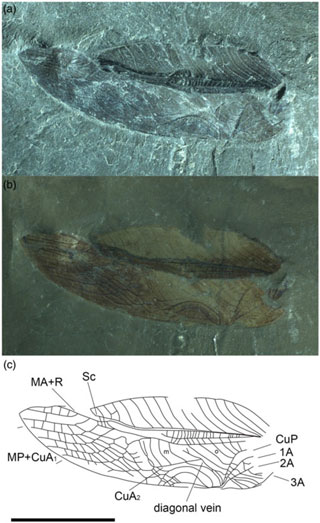
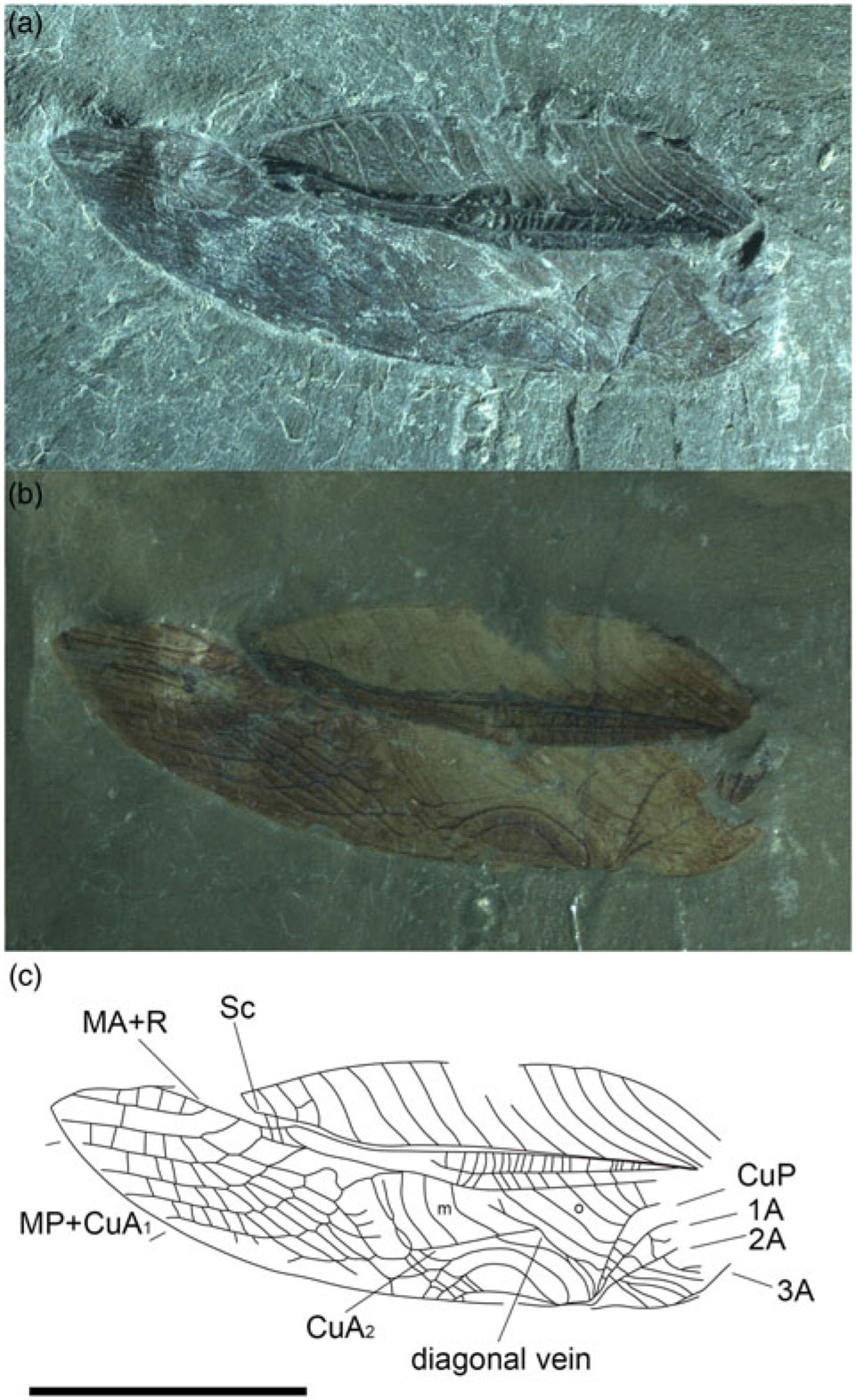
Sinagryllus xinjiangensis gen. et sp. nov., holotype, NIGP167908. (a) General view; (b) in alcohol; (c) reconstruction. Scale bar: 10 mm.
Etymology. The specific name derives from Xinjiang, in reference to the locality of the type material being in that autonomous region.
Diagnosis. As for genus.
Material. Holotype, NIGP167908, a well-preserved male forewing.
Locality and horizon. Haojiagou–Toutunhe section, Urumqi, Xinjiang, China; Sangonghe Formation, Lower Jurassic.
Description. Male forewing, slightly damaged basally; preserved length 14.5 mm; Sc long and sigmoidal, reaching anterior margin slightly beyond two-thirds of forewing length from base and giving off 15 distinct and strongly oblique branches; lancet-like area between R and the proximal part of MA small and devoid of cross-veins; true mirror present in male tegminal stridulatory apparatus; MP+CuA1 slightly curved basically; area between CuA2, lateral part of diagonal vein, and proximal part of branch of MP+CuA1 wide; dividing veins (cross-veins) of mirror sigmoidal, more or less parallel to true oblique veins; mirror small with three dividing veins; diagonal vein with both ends branched; oblique veins simple and slightly curved; cross-veins between branches of MP+CuA1 reticulated basally and regularly straight distally; diagonal vein, CuA2 and cross-vein between them forming triangular cell; CuP, 1A and 2A fused at about one-fifth of forewing length from base and then branched.
5. Discussion
The new specimen is confidently attributable to Baissogryllidae based on the following associated features: a true mirror in the male tegminal stridulatory apparatus; distinct widening of the area between CuA2, lateral part of diagonal vein, and proximal part of the proximal branch of MP+CuA1; and dividing veins (cross-veins) of the mirror obliquely longitudinal and subparallel to the oblique veins. It is assigned to Baissogryllinae based on the small lancet-like area and the numerous and distinctly oblique dividing veins of the mirror.
Baissogryllinae includes the following genera: Baissogryllus Sharov, Reference Sharov1968, Castilogryllus Martins-Neto, 1995, Eubaissogryllus Gorochov, Reference Gorochov1985, Ponomarenkoana Gorochov, Reference Gorochov1992, Speculogryllus Gorochov et al., Reference Gorochov, Jarzembowski and Coram2006, Storozhenkoana Gorochov, Reference Gorochov1992 and Sinagryllus gen. nov. with eight species. The new genus is different from Baissogryllus in lancet-like area devoid of cross-veins, fewer dividing veins, cross-veins between branches of MP+CuA1 reticulated basally and regularly straight distally, and a triangular cell enveloped by a diagonal vein, CuA2 and a cross-vein between them; from Castilogryllus mainly in having a smaller mirror with fewer dividing veins and fewer oblique veins; from Eubaissogryllus in having more oblique veins, cross-veins between branches of MP+CuA1 reticulated basally and regularly straight distally, and a triangular cell enveloped by a diagonal vein, CuA2 and a cross-vein between them; from Ponomarenkoana in having a smaller mirror, a diagonal vein with both ends branched, cross-veins between branches of MP+CuA1 reticulated basally and regularly straight distally, a triangular cell enveloped by a diagonal vein, CuA2 and a cross-vein between the two veins; from Speculogryllus in having a smaller mirror, oblique veins subparallel, and a triangular cell enveloped by a diagonal vein, CuA2 and a cross-vein between them; from Storozhenkoana in having a relatively bigger mirror, cross-veins between branches of MP+CuA1 reticulated basally and regularly straight distally, and a triangular cell enveloped by diagonal vein, CuA2 and a cross-vein between them.
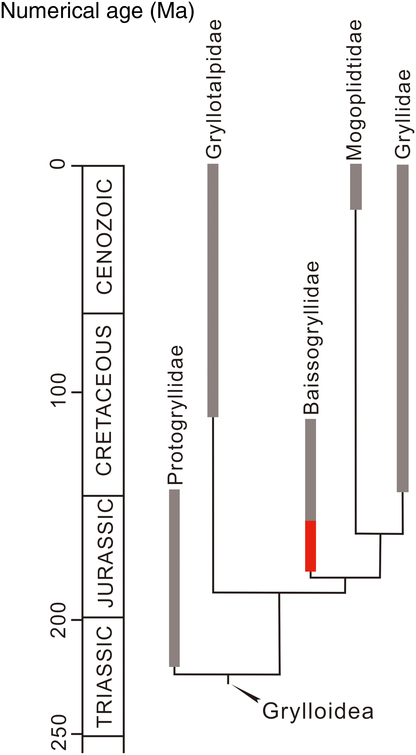
Untill now, 39 species and 21 genera have been attributed to Baissogryllidae (Cigliano et al. Reference Cigliano, Braun, Eades and Otte2018; this study). Before this study, Baissogryllidae was only reported from Upper Jurassic – Lower Cretaceous strata of Brazil, England, Mongolia and Russia (Gorochov et al. Reference Gorochov, Jarzembowski and Coram2006; Cigliano et al. Reference Cigliano, Braun, Eades and Otte2018). A tentative reconstruction of relationships among major ensiferan groups, however, indicates that the Baissogryllidae lineage originated at least during late Early Jurassic time (Heads & Leuzinger, Reference Heads and Leuzinger2011), which is supported by our new discovery (Fig. 3). Furthermore, Baissogryllidae are mostly found in former warm temperate areas, with the exception of Castillogryllus complicatus Martins-Neto, 1995 reported from Brazil which was considered to be arid during Early Cretaceous time (Boucot et al. Reference Boucot, Chen and Scotese2013). We therefore speculate that Sinagryllus xinjiangensis sp. nov. preferred to live in a warm environment, and that the palaeoclimate in the southern Junggar Basin was warm during late Early Jurassic time. This speculation is consistent with many thermophilous plants found in the Sangonghe Formation (Deng et al. Reference Deng, Lu, Fan, Pan, Cheng, Fu, Wang, Pan, Shen, Wang, Duan, Zhang, Jia and Fang2010). More certainly, the highly specialized and distinctive venation of the fossil forewing was associated with mating and territorial sound production, showing that the Jurassic “bush” periodically reverberated to the sound of musical stridulation.
Possible relationships among the Infraorder Gryllidea. Thick lines indicate known geological ranges, and thinner lines project likely ranges based on sister-group relationships. The red line indicates the extension of Baissogryllidae by the present study. Revised from Heads & Leuzinger (Reference Heads and Leuzinger2011).

Acknowledgements
We thank the anonymous reviewer for constructive suggestions to improve the earlier manuscript. This research was supported by the National Natural Science Foundation of China (41572010, 41622201, 41688103, 41730317), the State Key Laboratory of Palaeobiology and Stratigraphy (Nanjing Institute of Geology and Palaeontology, CAS) (No. 183101) and the Chinese Academy of Sciences (XDPB05). This work is a contribution to UNESCO-IUGS IGCP Project 632 and a Leverhulme Emeritus Fellowship contribution for EAJ.