The number of international adoptions has increased gradually in many Western countries since the end of World War II, and international adoptees now constitute a notable part of many populations. One example is Sweden, where approximately 1,000 children from foreign countries are adopted by Swedish parents every year, and international adoptees amount to over 50,000 out of about 9 million (MIA, 2010).
Many adopted children come from countries where the language is very different from the adoptive, second language (L2). Their ages at adoption vary, but the majority are adopted at a very early age, most during infancy. The typical situation for these children is that development in their first language (L1), which begins in their countries of origin, is interrupted upon their arrival in the adoptive country, and they are forced to learn a new language without having any real opportunities to maintain and develop their L1.Footnote 1 It might seem that immigrant children learning the language of a new country would be comparable to adopted children, but in fact they are quite different (Gindis, Reference Gindis2005; Hummel, Reference Hummel, Cohen, MacAlster, Rolstad and MacSwan2005). Adopted children are often completely isolated from their L1, whereas immigrant children usually have continued exposure to their L1 from their families. The linguistic situation faced by adopted children is thus quite unique. Adopted children are also unique as language acquirers (Hyltenstam, Bylund, Abrahamsson, & Park, Reference Hyltenstam, Bylund, Abrahamsson and Park2009): they learn neither L1 nor L2 like others do. In learning their L2 they resemble L1 learners because they learn the new language from child-directed speech in their families, but they are different from L1 learners in that they already have some experience with their L1 before adoption. They also remind us of L2 learners because they learn the new language after their L1 has been somewhat established, but they differ from L2 learners in that they stop learning and using the language of their country of origin at the point when they start learning the new language.
L1 ATTRITION IN INTERNATIONAL ADOPTEES
Studies on international adoptees have thus far focused on children and have mainly investigated their cognitive development, development of the adoptive language, and educational development in their new environments (Delcenserie, Genesee, & Gauthier, in press; Gindis, Reference Gindis2005; Glennen, Reference Glennen2007; Glennen, & Masters, Reference Glennen and Masters2002). According to the existing literature on international adoptees, adopted children forget or lose their L1 abruptly (e.g., Gindis, Reference Gindis, Tepper, Hannon and Sandstrom1999; Isurin, Reference Isurin2000; Maury, Reference Maury1999; Nicoladis, & Grabois, Reference Nicoladis and Grabois2002) as a result of many factors. One of the most important factors is probably the lack of people in the new environment who can speak their language.Footnote 2 In their study of adopted infants and toddlers brought from Eastern Europe to the United States, Glennen and Masters (Reference Glennen and Masters2002) found that children lost their L1s within a few months after arrival in the adoptive country. Rapid loss of L1 has also been reported for children adopted at older ages, even at the age of 10 (e.g., Gardell, Reference Gardell1979; Hene Reference Hene1993, Reference Hene, Hyltenstam and Lindberg2004). If a language is not used regularly for a certain period of time, it is clear that the language undergoes attrition; however, there is little research on L1 attrition among international adoptees. The existing evidence suggests that L1 attrition patterns in international adoptees parallel the general patterns found in immigrant children (e.g., Gindis, Reference Gindis2005; Hummel, Reference Hummel, Cohen, MacAlster, Rolstad and MacSwan2005).Footnote 3 Although the attrition rate is dependent on ages and level of L1 development at adoption, it is evident from the literature that after adoption they can quite quickly lose their ability to use their L1.
The literature on international adoption generally assumes that the L1 of adopted children is completely lost (e.g., Gindis, Reference Gindis, Tepper, Hannon and Sandstrom1999, Reference Gindis2005). This assumption seems to be supported by common opinion among international adoptees that they have completely forgotten or lost their L1 (e.g., Gardell, Reference Gardell1979; Maury, Reference Maury1999). Since the question of whether an individual's knowledge is really lost is controversial, however, it is difficult to ascertain whether adopted children's L1 is actually lost from their memory or they just have difficulty in retrieving it due to lack of opportunities to use it.
Focusing on adult international adoptees, Pallier and associates (Reference Pallier, Dehanene, Poline, LeBihan, Argenti and Dupous2003; Pallier, Reference Pallier, Köpke, Schmid, Keijzer and Dostert2007; Ventureyra & Pallier, Reference Ventureyra, Pallier, Schmid, Köpke, Keijzer and Weilemar2004; Ventureyra, Pallier, & Yoo, Reference Ventureyra, Pallier and Yoo2004) have recently explored the issue of adoptees’ residual L1 knowledge in a series of studies of Korean adoptees’ L1 attrition in France. Using behavioral tests, such as language identification, word recognition, and speech fragment detection, Pallier et al. (Reference Pallier, Dehanene, Poline, LeBihan, Argenti and Dupous2003) examined whether or not remnants or traces of the adoptees’ L1 Korean existed. They found that, just like the native French people who had never been exposed to Korean, the Korean adoptees could not recognize Korean. The participants in the study were eight Korean children adopted when they were between 3 and 8 years old who had lived in France for more than 20 years without exposure to Korean, along with eight native French people with no prior contact with Korean. In this study, functional magnetic resonance imaging (fMRI) was also used to examine brain activation patterns in the adoptees and the French control group during the speech fragment detection test, when they were asked to listen to sentences in Korean and other languages. According to the fMRI data analysis, there was no difference in brain activation between the adoptees and the French born. Based on the results of both the behavioral tests and the fMRI, Pallier and colleagues argue that the adoptees’ L1 has been lost and that this loss is closely related to their successful and complete L2 acquisition.Footnote 4
The authors admitted that there were some methodological shortcomings associated with data collection in the latter study and suggested that “early experience with Korean may have left implicit unconscious traces at the level of the microcircuitry of the language processing areas that our behavioral and fMRI methods did not detect” (Pallier et al., Reference Pallier, Dehanene, Poline, LeBihan, Argenti and Dupous2003, p. 159). Subsequently, Pallier et al. (Ventureya & Pallier, Reference Ventureyra, Pallier, Schmid, Köpke, Keijzer and Weilemar2004; Ventureyra et al., Reference Ventureyra, Pallier and Yoo2004) carried out new behavioral tests designed to investigate Korean adoptees’ L1 remnants in more detail (i.e., knowledge of phonology and lexical items). In Ventureyra et al. (Reference Ventureyra, Pallier and Yoo2004), 18 Korean adoptees (adopted when they were between 3 and 9 years old by French-speaking families in France, Switzerland, or Belgium), ages 22–36, were involved. Nine of the 18 had been reexposed to Korean through short touristic trips to Korea at some point during the 4 years before testing, and 9 had not.Footnote 5 They also included 12 native French people and 12 native Koreans as control groups. One of the tests concerned phonetic perception and aimed to find out whether Korean adoptees could differentiate between pseudo word pairs starting with Korean stop and fricative consonants that are difficult for foreign learners of Korean. The finding of this study (that there was no significant difference between the Korean adoptees and the native French speakers) led Pallier et al. to the conclusion that the adoptees had no remnant trace of their L1 and that their earlier exposure to Korean did not give them any advantage in perceiving Korean phonology later in life. They did not observe any advantage in perception among the adoptees with higher ages of adoption. It is, however, important to note that the comparison between the six different test categories and different levels of reexposure to Korean showed a statistical significance in one category: tense-aspirated contrast. With no statistically significant differences in the other categories, Pallier and colleagues concluded that reexposure does not play a facilitating role in L1 phonetic perception. Reporting that one adoptee who had been reexposed to Korean through a few months’ language training scored highest within the adoptee group on all categories, however, they allude to the possibility that extensive reexposure through relearning can be conducive to reactivating the L1 in adoptees (Ventureyra et al., Reference Ventureyra, Pallier and Yoo2004, p. 5).
A small but interesting difference between the Korean adoptees and the native French was found in the number series recognition task (Ventureyra & Pallier, Reference Ventureyra, Pallier, Schmid, Köpke, Keijzer and Weilemar2004), where 9 adoptees and 10 French speakers were asked to rate number series in different languages. The task showed no significant difference between the groups. However, the Korean adoptees who did not recognize the Korean number series explicitly gave the highest ratings to them, whereas the native French with no previous exposure to Korean gave the highest ratings to the tone languages: Cantonese and Thai. Suggesting that this difference between the groups may be indicative of “an implicit knowledge of adoptees that Korean is not a tone language,” Pallier (Reference Pallier, Köpke, Schmid, Keijzer and Dostert2007, p. 163) raises the question whether Korean adoptees could relearn their L1 faster or better than those who have never had contact with Korean, and he adds, “If the adoptees showed such an advantage, this would provide evidence for remnant traces of earlier exposure to Korean” (Pallier, Reference Pallier, Köpke, Schmid, Keijzer and Dostert2007, p. 163).
CAN RELEARNING REACTIVATE ADOPTEES’ L1?
It has been a common view that relearning is faster than initial learning; relearning can give a boost to the reactivation of knowledge that has become inaccessible because of nonuse. This view has been strengthened by several memory studies in psychology (e.g., MacLeod, Reference MacLeod1989; Nelson, Reference Nelson1978). With respect to linguistic knowledge, support for this view is found in Bahrick's often-cited 1984 study of the retention of L2 Spanish learned at school but not used for more than 50 years. His study showed that residual linguistic knowledge can be retained after a long period of time. De Bot and Stoessel (Reference de Bot and Stoessel2000), who first applied the savings paradigm framework to L2 relearning vocabulary, also observed long-term retention of the knowledge of Dutch acquired in childhood.Footnote 6 Yukawa's Reference Yukawa1997 finding from her study of the relearning of L1 Japanese by children, that the process of learning Japanese a second time is faster than that of learning it for the first time, corroborates the findings from the other studies cited.
There is further evidence of long-term language retention in research examining whether exposure to a language in childhood has an effect when relearning it as an adult (e.g., Au, Knightly, Jun, & Oh, Reference Au, Knightly, Jun and Oh2002; Oh, Jun, Knightly, & Au, Reference Oh, Jun, Knightly and Au2003). By comparing adult learners of Spanish who had overheard Spanish during childhood with those who had had no exposure to Spanish at all, Au et al. (Reference Au, Knightly, Jun and Oh2002) found that the former sounded more native than the latter, whereas there was no difference between the groups in terms of morphosyntax. Their comparison revealed that childhood overhearing experiences have measurable long-term benefits in phonology. In their study of the effects of childhood speaking later in life, Oh et al. (Reference Oh, Jun, Knightly and Au2003) accessed perception and production of Korean stop consonants by three different groups of speakers enrolled in Korean language classes at the college level: (a) childhood speakers who had spoken Korean on a regular basis for a few years during childhood, (b) childhood hearers who had heard Korean regularly during childhood but spoken it minimally, and (c) first-time learners. They found that in the perception of Korean consonants, both the childhood speakers and the childhood hearers outperformed the first-time learners, providing evidence that reconfirms the lasting benefits of early childhood language experience, even if the language experience has been minimal during childhood or has disappeared beyond childhood. In language production, as could be expected, the childhood speakers performed significantly better than both the childhood hearers and the first-time learners, but there was no difference between the latter two groups. Based on the finding of their study, Oh et al. (Reference Oh, Jun, Knightly and Au2003) argue for “the potential of re-learning to tap childhood language memory” (p. B62).
THE PRESENT STUDY
It is only since the last decade that researchers have begun to take an interest in L1 attrition among international adoptees. The assertion by Pallier and associates (e.g., Pallier et al., Reference Pallier, Dehanene, Poline, LeBihan, Argenti and Dupous2003; Ventureyra & Pallier, Reference Ventureyra, Pallier, Schmid, Köpke, Keijzer and Weilemar2004; Ventureyra et al., Reference Ventureyra, Pallier and Yoo2004) that adoptees’ L1 is lost, based on their studies of residual L1 knowledge in adult Korean adoptees adopted by French-speaking families, has attracted a great deal of attention in the literature. Two issues derived from their studies, whether adoptees have lost their L1 completely and whether relearning can help them recover their L1 if it is not completely lost, have begun to generate debate among researchers, but to my knowledge there are few published studies that have explored these issues.
Two recent studies, Oh, Au, and Jun (Reference Oh, Au and Jun2010) and Singh, Liederman, Mierzejewski, and Barnes (Reference Singh, Liederman, Mierzejewski and Barnes2011), have investigated whether adoptees have an advantage in relearning their L1. Oh et al. (Reference Oh, Au and Jun2010) compared adult Korean adoptees in the United States who were adopted before the age of 1 with first-time learners of Korean on a phonemic identification task consisting of Korean lenis, aspirated and fortis stop consonants. All participants were students who were enrolled in a college-level Korean course at the time of testing, and the test was administered during the second week of their first semester. Oh et al. (Reference Oh, Au and Jun2010) found that even if adoptees’ early exposure to Korean was limited to the first year of life, they were significantly better at identifying some of the phonemes tested on the task, specifically lenis and aspirated consonants, than were the first-time learners. Singh et al. (Reference Singh, Liederman, Mierzejewski and Barnes2011) also observed that early L1 experience gave adoptees an advantage in relearning the language, this time among Indian adoptees who came to the United States when they were between 6 months and 5 years old. Singh et al. reported that after the first test session, adoptees, at ages 8–15, could not discriminate Hindi stop consonants any better than nonadopted, English-speaking children. However, after a single short training session on the contrasts, adoptees significantly improved in their ability to discriminate the consonants. The nonadopted children showed no difference between the test sessions. The results of these two studies show that adoptees who are exposed to their L1 early in life can have a comparative advantage in relearning that language relative to nonadopted learners without previous exposure to the language. It is important to note that both studies were conducted with participants who received only short periods of language training, comprising 50 min of formal instruction for less than 2 weeks (Oh et al., Reference Oh, Au and Jun2010) or through a short training session (Singh et al., Reference Singh, Liederman, Mierzejewski and Barnes2011).
This study reports some results from an extensive research project on language reactivation among Korean adoptees in Sweden.Footnote 7 The main purpose of the study is to examine whether or not adoptees’ preexisting knowledge of L1 has an impact when they attempt to relearn the language as adults. Unlike the two studies mentioned above, this study is conducted with participants who had participated in language courses for at least 1 year (with one exception) at the university level.Footnote 8 Furthermore, this study focuses on participants’ grammatical knowledge as well as their phonetic perception and examines if there is any correlation between them.
The article begins with a description of the participants and the linguistic material of the present study. This is followed by results from the analysis of two of the language tests administered in the research project: the perception and grammaticality judgment tests. Appendixes A and B provide detailed background information and test scores for the individual participants.
Participants
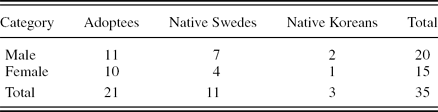
In total, 35 persons took part in the study: 21 adoptees (11 male, 10 female), 11 native Swedes (7 male, 4 female), and 3 native Koreans (2 male, 1 female), as shown in Table 1. With the exception of the native Koreans, all participants were current or former students of Korean at the Department of Oriental Languages at Stockholm University. The 3 native Koreans were included in the study as a Korean language control group.Footnote 9 They were all exchange students at a Swedish University and had only been in Sweden for a couple of months at the time of the data collection.
Participants

Some of the adoptees and native Swedes were accessed via the university because they were enrolled in Korean language study at the time of the data collection. The majority, however, were approached by sending out a letter to those who had studied Korean from the 1990s to 2002. The adoptees were also approached through advertising about the research on the homepage for Adopterade Koreaners Förening AKF (the Adopted Korean Association). In addition, some participants contacted the researcher after they heard of the research through friends or acquaintances who had already taken part in the study.
In this context, it should be noted that since there are a limited number of students of Korean in Sweden, it is difficult, if not impossible, to sample participants randomly from homogeneous populations. The participants in this study were thus determined by availability. As a consequence, it cannot be said that the design of the study is strictly experimental because the two groups could not be matched (see group descriptions below).
The ages of the adoptees upon arrival in Sweden ranged from 3 months to 10 years, the average being 2.5 years (SD = 2.8). Six had come to Sweden before they were 1 year old, eight when they were between 1 and 2 years old and the remaining seven when they were over age 2 (total range = 0 years, 3 months [0;3]–10;5). The length of time since their arrival in Sweden ranged from 19 to 28 years, and the average was 22 years (SD = 3.36).
Of the 21 adoptees, 8 had some exposure to Korean prior to studying Korean at the university, whereas the remaining 13 had had no exposure at all.Footnote 10 As far as the Swedish participants were concerned, 7 reported some exposure to Korean whereas 4 had no exposure to Korean prior to their university studies.Footnote 11
All but one adoptee had studied Korean in Sweden for at least 1 year.Footnote 12 The average length of time the participants had studied Korean was about 3 years, but this varied considerably: one had completed only the first semester, two others had doctoral degrees in Korean language and culture and were teachers of Korean at the university.
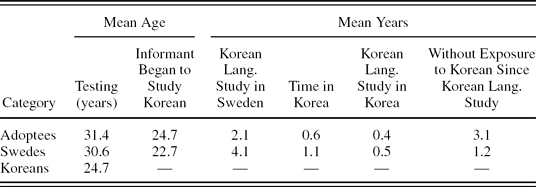
As seen in Table 2, the average age at testing was 31 years for both the adoptees (SD = 3.65) and the native Swedes (SD = 7.29) and 25 years for the native Koreans (SD = 2.30). The table also shows the participants’ average age when they started studying Korean. As Table 2 illustrates, the two participant groups are different in several important respects: the adoptees’ length of Korean language study in Sweden was considerably shorter than that of the native Swedes. The average length of Korean study was 2.1 years (SD = 1.45, range = 0.5–6 years) for the adoptees but 4.1 years (SD = 4.48, range = 1–13 years) for the native Swedes. This means that the native Swedes had studied Korean for twice as long as the adoptees had.
Information on the participants

Most participants had visited or revisited Korea for further study or touristic travel. However, as Table 2 shows, the adoptees had spent an average of 6–7 months (SD = 0.78, range = 0.0–3.5) in the country, while the native Swedes had spent 12–13 months (SD = 1.28, range = 0.0–4.5), about twice as long as the adoptees. Furthermore, the native Swedes had spent on average a few more months (SD = 0.57, range = 0.0–1.8) than had the adoptees (SD = 0.48, range = 0.0–1.3) on university studies of Korean in Korea. An additional difference between the groups was that for the adoptees an average of 3 years (SD = 2.72, range = 0.0–8.0) had passed since ending their Korean studies, while only 1 year (SD = 3.06, range = 0.0–10.0) had passed for the native Swedes. With the exception of 2 individuals, all native Swedes (82%) had continued exposure to Korean since their language study, whereas only 7 of the 21 adoptees (33%) had.
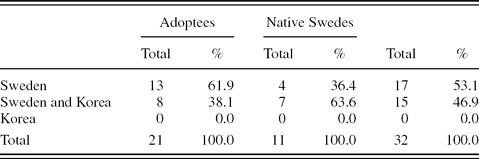
One further difference between participants was that more native Swedes than adoptees had studied Korean in Korea (see Table 3), meaning they had learned Korean in a more authentic learning context than those who had only studied Korean in Sweden. The table shows that 7 of the 11 native Swedes (64%) had studied in Korea, as opposed to only 8 out of the 21 adoptees (38%).
Learning contexts

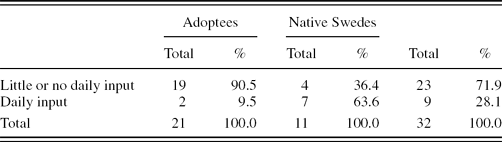
Only 2 of the 21 adoptees (10%) had been regularly exposed to Korean input following their language studies, whereas 7 of the 11 native Swedes (64%) had had input on a regular basis (see Table 4). For the purpose of this study “input on a regular basis” is defined as exposure to Korean native speakers, for example, a native Korean spouse in Sweden, a boyfriend/girlfriend in Korea and/or professional Korean-speaking contacts.
Daily input since language study (self-reported)

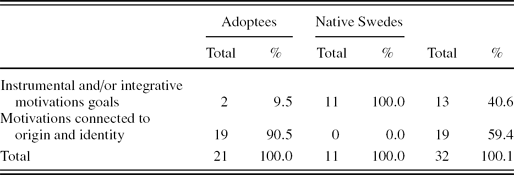
All of the native Swedes had strong instrumental and/or integrative motivations for studying Korean: they were very interested in languages in general, and/or had taken great interest in Korean or East Asian culture, and/or had ambitions to use the language professionally in their future careers (Table 5). In contrast with the native Swedes, only 2 adoptees had such motivations for studying Korean. The remaining 19 expressed motivations that were strongly connected to their origin and identity. Some of the reasons they gave on a participant background questionnaire (see Linguistic material subsection) were (a) to be able to speak with my biological mother and/or Korean family, (b) to learn more about my home country and language, (c) to be able to travel around in my home country in the future, (d) to strengthen my Korean identity, and (e) to feel more Korean. It is interesting to note that, according to university course administrators, Korean adoptees are more likely than native Swedes to drop out of Korean studies after the first semester.Footnote 13 Because the native Swedes have more instrumental and/or integrative reasons for studying Korean than adoptees do, the native Swedes may be more prepared for the persistent and hard work that language study usually requires.
Motivations to study Korean

Taking into account all of these differences between groups, we can reasonably conclude that the native Swedes generally had better learning conditions than did the adoptees. As mentioned above, there are few Swedish students of Korean, and these were the individuals available for the present study.
Linguistic material
There were 43 individuals who volunteered to take part in the study. The first criterion was that they needed to have studied Korean for at least 1 year in Sweden, which was an indicator that the individuals in question would have developed sufficient linguistic proficiency to take the Korean language tests. Eight of the 43 individuals were thus excluded from the study, including 7 who were first-semester students at the time of the data collection and 1 who was not a monolingual Swedish speaker. In all, 32 individuals were chosen as participants in the study.
All of the participants, including the native Korean controls, were required to pass a hearing test with an OSCILLA SM910 screening audiometer. Since the participants needed to have high enough linguistic competence in Korean to participate in the subsequent tests, they were also asked to carry out a relatively simple task wherein they read a short text in Korean and then translated it into Swedish. All passed this test. Once this was done, they answered a questionnaire in Swedish to provide information about when they had started studying Korean, why, and for how long, and so on. All of the participants were then tested individually in a soundproof room. The whole testing session took about 2–3 hr per participant.Footnote 14 Instructions were given in Swedish to all except for the three native Koreans.
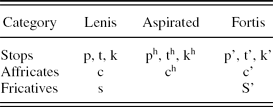
The participants were tested for perception of Korean vowels and obstruents (i.e., stops, affricates, and fricatives; see Table 6), production of these vowels and obstruents, global accents, grammaticality judgments, retelling of a story from a series of pictures, and written production, all during the single testing session. The present study focuses only on two tests: the perception and grammaticality judgment tests.
Obstruents in Korean

In the perception test, each participant listened to and differentiated between word pairs that included Korean vowels or the word-initial obstruents that are difficult for Swedish learners of Korean. The test items in this study were all real words.Footnote 15
The perception test consisted of 40 word pairs with Korean vowels and 40 word pairs beginning with Korean obstruents (giving a total of 80 word pairs). The 40 word pairs with Korean vowels included 10 simple vowels and 9 diphthongs. Of the 40 pairs, 22 were minimal pairs, for example, /na/–/nŏ/ meaning “I–you” and /yuli/-/yoli/ “glass-cooking.”Footnote 16 The remaining 18 were pairs consisting of the same words.
The 40 word pairs with Korean obstruents included Korean stops, affricates, and fricatives in the word-initial position.Footnote 17 Swedish (as well as English) stops are characterized by two-way contrast (e.g., aspirated/unaspirated, voiceless/voiced). Korean stops and affricates, however, are characterized by three-way contrast (i.e. lenis/aspirated/fortis).Footnote 18 Along with stops and affricates, Korean also has two-way contrast in fricatives.Footnote 19 Another interesting thing about Korean obstruents is that they are all voiceless in the word-initial position.Footnote 20 Swedish learners of Korean are not expected to have any problem with aspirated obstruents in Korean, but they need a great deal of practice to master the lenis and fortis obstruents.
Of the 40 word pairs beginning with Korean obstruents, 26 were minimal pairs that differed only in the quality of the first consonant, for example, /pul/-/phul/meaning “fire-grass,” /pul/-/p'ul/ “fire-horn” or /phul/-/p'ul/ “grass-horn” (see Table 7). Ten pairs in the test contained a lenis-fortis contrast whereas 8 pairs included a lenis-aspirated contrast and another 8 pairs involved an aspirated-fortis contrast. The remaining 14 were pairs consisting of the same words.
Minimal contrasts for Korean obstruents in word-initial position

The word pairs in the whole perception test were presented to the participants through a set of earphones in random order, 1 pair at a time. Every word pair appeared twice in the material but never in succession. Altogether, the test had 80 word pairs with vowels and 80 word pairs beginning with obstruents. The participants were asked to decide if the two words in a given pair were the same or different. The two words in each pair were read by two different native Korean speaking women in standard Seoul Korean.Footnote 21 Decisions were made by participants by pressing one of two keys on a computer keyboard.
The grammaticality judgment test was a paper-and-pencil task that consisted of 40 written sentences in Korean. Each question was presented on one sheet of paper. The Korean grammatical phenomena tested were case morphology (including allomorphic variation), verb morphology, and adverb placement, where Swedish learners of Korean often have difficulties. The 20 test sentences involved the choice of nominal endings, including case endings, and the remaining 20 dealt either with verb endings or adverb placement. The following is one example of the test sentences:
-
(1) *sakwa-ûl mokossoyo.Footnote 22 “I ate an apple.”
-
Apple-ACC ate
Half of the sentences were grammatically correct and half contained one grammatical error, and the participants’ task was to tick one of two boxes marked “correct” or “incorrect.”
RESULTS
This section presents results from the analysis of the perception test and the grammaticality judgment test. For statistical analysis, separate one-way analyses of variance (ANOVAs) were conducted comparing the Korean adoptees and the native Swedes. Given extensive variation between individual participants (see Participants subsection), analyses of covariance (ANCOVAs) were also conducted to examine differences between the two groups with adjustment for their various background factors. Four factors were selected as potential covariates: years of Korean language study in Sweden, years of Korean language study in Korea, years without exposure to Korean since language study, and daily Korean input (see Table 2).Footnote 23 ANCOVAs were used to select statistically important covariates among the four background factors. Factors were sequentially removed from the full model by a backward elimination procedure under the entry condition that significance probability was less than 0.1.
Perception test with Korean vowels
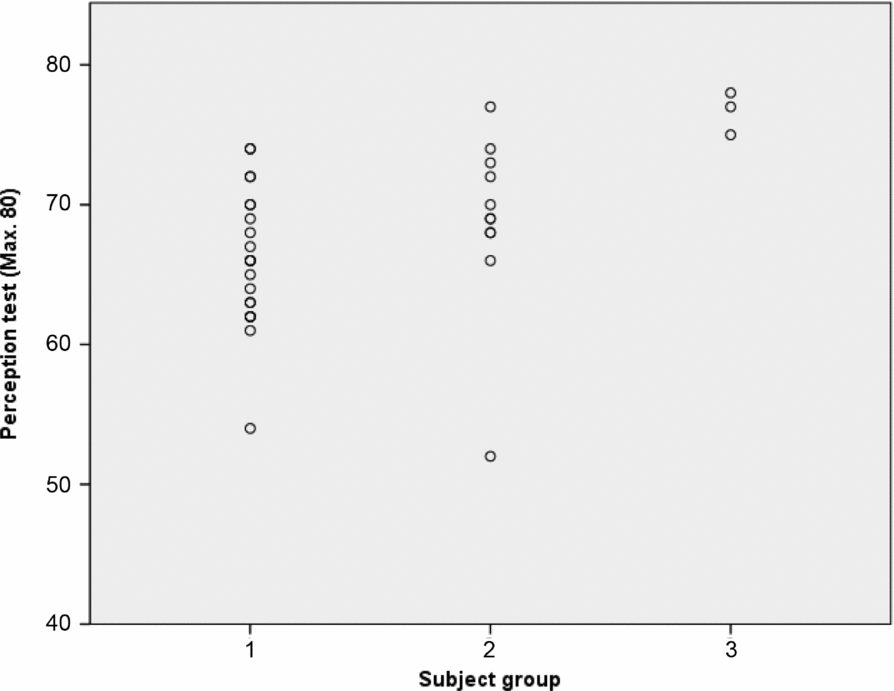
Figure 1 shows the results of the perception test with Korean vowels. As expected, the native Koreans scored almost at the ceiling (mean score 76.6 out of 80). Both the adoptees and the native Swedes were successful in perceiving Korean vowels. The native Swedes (mean score 68.9) performed slightly better than the adoptees (mean score 66.2), but the unadjusted group difference (–2.72) was not significant, F (1, 30) = 1.78, p = .192. Three background factors were excluded from the stepwise ANCOVA procedures: years without exposure to Korean since language study, F (1, 26) = 0.01, p = .906, years of Korean language study in Korea, F (1, 27) = 0.47, p = .499, and years of Korean language study in Sweden, F (1, 28) = 0.39, p = .537. The daily Korean input factor was, however, found to be highly significant and was included as a covariate, F (1, 29) = 8.10, p = .008. The group difference adjusted for this daily Korean input covariate was, however, 0.92, which means that the Korean adoptees performed slightly better than the native Swedes on this condition, though the difference was not significant, F (1, 29) = 0.17, p = .685. The variation was slightly higher among the native Swedes (SD = 6.44, range = 52–77) than among the adoptees (SD = 4.93, range = 54–74). If we look at the results at an individual level, the best result was obtained by a native Swede who scored 77 points. The two adoptees who performed best both scored 74 points.
The results of the perception test with Korean vowels. 1 = Adoptees, 2 = Native Swedes, 3 = Native Koreans.

That there are no differences between the adoptees and the native Swedes in Korean vowel perception seems to support the finding from Ventureyra et al. (Reference Ventureyra, Pallier and Yoo2004) that the adoptees’ early L1 experience has not left traces of the language. Given the result of this part of the perception test, similar results might be expected from the other part of the perception test, such as the test with Korean obstruents.
Perception test with Korean obstruents
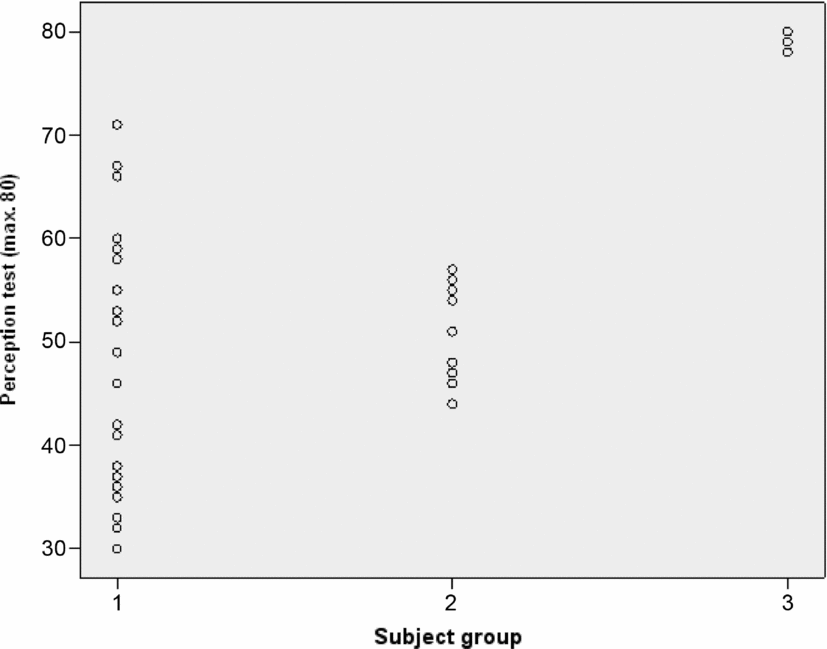
Figure 2 shows the results of the perception test with Korean obstruents. The native Koreans scored at the ceiling (mean score = 79.0 out of 80). There was no statistically significant difference between the adoptees and the native Swedes. The mean score was 48.5 for the adoptees and 51.6 for the native Swedes, while the unadjusted difference was –3.07, which is not significant, F (1, 30) = 0.6, p = .445. All four factors were excluded from the stepwise ANCOVA procedures: years of Korean language study in Sweden, F (1, 26) = 0.14, p = .710, years of Korean language study in Korea, F (1, 27) = 0.15, p = .705, daily Korean input, F (1, 28) = 0.14, p = .715, and years without exposure to Korean since language study, F (1, 29) = 2.29, p = .141. The final model, therefore, became the one-way ANOVA model. To sum up, the native Swedes performed slightly better than the adoptees on this test, but the difference was not significant.
The results of the perception test with Korean obstruents. 1 = Adoptees, 2 = Native Swedes, 3 = Native Koreans.

As seen in Figure 2, the native Swedes could differentiate between Korean obstruents slightly better than could the adoptees. If we look at the results at an individual level, however, we see that the adoptees were generally better than the native Swedes in the perceptual ability, yet some adoptees had the worst scores. Put another way, the adoptees varied in their perceptual ability to a greater extent than the did native Swedes. As the figure shows, the variation was much greater among the adoptees (SD = 12.6, range = 30–71) than among the native Swedes, who performed more similarly to each other (SD = 4.55, range = 44–57).Footnote 24
However, as Figure 2 also reveals, a greater proportion of adoptees scored higher than native Swedes, showing that their perceptions were closer to being nativelike. Seven of the 21 adoptees (33%) got higher scores than the top-performing native Swede, who got 57 points. The best performing adoptee, with a score of 71, had the highest age at adoption, having come to Sweden at the age of 10. The second highest performer, with a score of 67, was 9 years old at adoption, the second oldest at time of adoption. These two learners were both 36 years old at the time of testing, which means that they had spent 26 or 27 years in Sweden since adoption. They had studied Korean in Sweden for 1.5 and 2 years, respectively. They had both been to Korea, but their visits had been relatively short and touristic, and they had never studied Korean there. Two to three years had passed since their language studies in Sweden, after which neither had had any contact with Korean.
However, not all the high-performing adoptees had a late-age adoption. The third and fourth best performers were adopted before the ages of 1 and 2 years, respectively. The adoptee with the third highest score (66) had been in Korea for 3.5 years following his university studies in Sweden. He had also worked at a Korean company during his stay in Korea and was married to a native Korean, meaning that he was exposed to daily input. In addition, he was one of the two adoptees that had expressed instrumental and/or integrative motivations for studying Korean. These advantageous learning conditions could reasonably explain at least part of his results. This can be contrasted with the fourth best performing adoptee, with a score of 60, who had spent only 9 or 10 months in Korea, had had no daily exposure to Korean, and had been unexposed to Korean for 6 years following her studies in Sweden. All this can be taken as an indication that L1 experience of Korean during childhood can, but does not necessarily, lead to advantages with respect to Korean phonology/phonetics.
According to the perception test with Korean obstruents, it was also adoptees who had the worst scores. In total, 14 persons (i.e., 10 adoptees and 4 native Swedes) had test scores that were lower than the participants’ average (49.5). With the exception of 1, all 3 other native Swedes had been exposed to Korean regularly after their Korean studies, but only 3 of the 10 adoptees (30%) had had Korean input on a regular basis; The remaining 7 (70%) had had no exposure to Korean after their language study. The length of unexposed time following these adoptees’ language study ranged from 3–8 years. It is possible that some adoptees performed worse than the native Swedes because they had had no exposure to Korean after their studies.
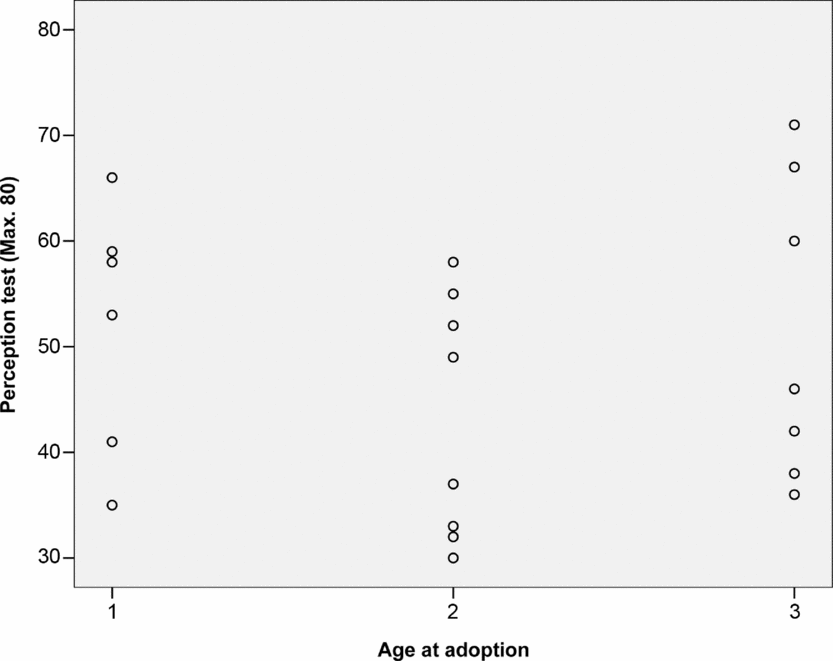
Figure 3 shows the test results within different subgroups of adoptees divided according to their ages of adoption. The results for the adoptees with ages of adoption less than 1 (M = 52, SD = 11.76, range = 35–66) and over 2 (M = 51.4, SD = 14.35, range = 36–71) were better than for those of the adoptees who came to Sweden at between 1 and 2 years of age (M = 43.2, SD = 11.41, range = 30–58). However, no statistically significant difference was found among the three different adoptee groups, F (2, 18) = 1.22, p = .347. Given the wide variety of characteristics of the adoptees, however, it is not reasonable to claim that there is any relationship between age of adoption and perceptual ability among the adoptees in the study based only on the results of this test.
The results of the perception test with Korean obstruents according to age of adoption: 1 = x < 1, 2 = x > 1 < 2, 3 = x > 2, where x is the age of adoption.

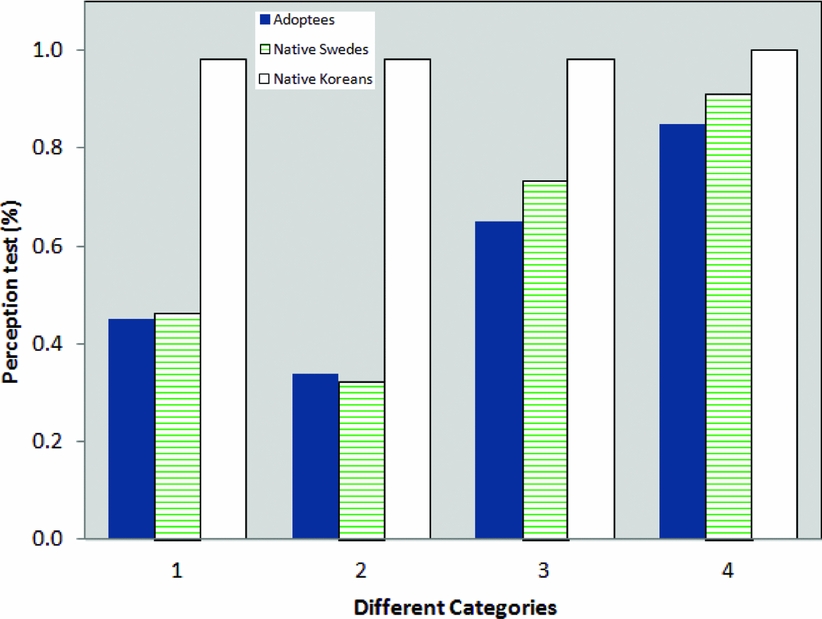
Figure 4 presents the results from the analysis of the different types of word categories (i.e., lenis-fortis contrast, lenis-aspirated contrast, aspirated-fortis contrast, and same pairs). The native Koreans performed significantly better than both the adoptees and the native Swedes on the lenis-fortis and lenis-aspirated contrasts, but there were no significant differences on the remaining two categories. There was no significant difference at the p < .05 level between the adoptees and the native Swedes on any of the categories.
The distribution of individual results by category. 1. Lenis-fortis contrast, 2. Lenis-aspirated contrast, 3. Aspirated-fortis contrast, 4. Same pairs.

As the figure shows, the native Swedes scored slightly higher than the adoptees on three categories (i.e., lenis-fortis contrast, aspirated-fortis contrast, and same pairs) yet not on the lenis-aspirated contrast, but the differences among the categories were not significant. The same pairs were easily identified by the two groups, but the best results were obtained by two adoptees who had all items correct. The aspirated-fortis contrast was relatively easier for the participants to distinguish than were the other contrasts. Many adoptees also showed better ability in this category than the native Swedes: 6 of the 21 adoptees (29%) scored within the range of the native Koreans, whereas only 1 native Swede did. Differentiating the lenis-fortis contrast proved to be no easy task for any of the groups. Nine of the 21 adoptees (43%) had higher scores in this category than the native Swede who got the highest score of her group.Footnote 25 The most difficult contrast for the participants was found to be the lenis-aspirated one, which consequently confirms the prediction that Swedish learners of Korean would have the most difficulty in learning Korean lenis and fortis obstruents (see Linguistic material subsection). Here again, the best results were obtained by the adoptees. Eight of the 21 adoptees (38%) got higher scores than the best Swedish performer.
In contrast to the perception test with Korean vowels, the perception test with obstruents (at least at an individual level) showed that adoptees seem to have an advantage over native Swedes at perceiving obstruents. Given the results of the perception test, it would be interesting to see whether the adoptees also outperform the Swedes on the grammaticality judgment test.
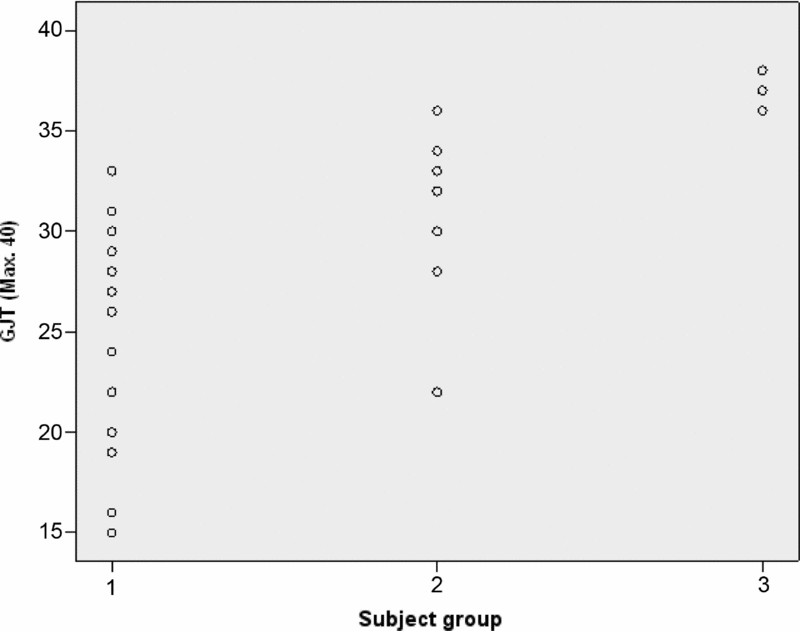
GRAMMATICALITY JUDGMENT TEST. To be sure that the adoptees’ high results on the perception test with obstruents are not simply due to their good knowledge of Korean in general, we can compare their grammatical competence in Korean as well as their learning conditions using the grammaticality judgment test. Figure 5 shows the results on the grammaticality judgment test.
The results of the grammaticality judgment test. 1 = Adoptees, 2 = Native Swedes, 3 = Native Koreans. GJT, grammaticality judgment test.

The native Koreans scored almost at the ceiling (M = 37.0 out of 40). The native Swedes scored significantly better than the adoptees on this test (M = 30.5 and 25.5), which was a surprise. The unadjusted group difference was –4.98, F (1, 30) = 7.29, p = .011. Two factors were excluded from the stepwise ANCOVA procedures: daily Korean input, F (1, 26) = 0.37, p = .552, and years without exposure to Korean since language study, F (1, 27) = 2.58, p = .120. The remaining two factors, years of Korea language study in Sweden, F (1, 28) = 3.16, p = .086, and years of Korean language study in Korea, F (1, 28) = 5.95, p = .021, were included as covariates. The group difference adjusted for these two covariates was slightly weaker (–3.55) but still statistically significant, F (1, 28) = 4.01, p = .055. We can also see that the variation was only marginally greater among the adoptees (SD = 5.01, range = 15–33) than among the native Swedes (SD = 4.84, range = 22–36). Two of the native Swedes scored at the same level as the native Koreans, whereas none of the adoptees did. As suggested above, this may be explained by the fact that the native Swedes had more advantageous learning conditions.
As we recall regarding the perception test with obstruents, 7 of 21 adoptees (33%) performed better than the best performing Swede. These 7 adoptees’ results on the grammaticality judgment test ranged from 22 to 33 (M = 27.8). Recalling the test again, the 2 best performing adoptees had the highest ages at adoption, 9 and 10 years, respectively. Their scores on the grammaticality judgment test were 27 and 22, both of which were lower than the native Swedes’ average score on the test. Of the remaining 5, the adoptee who arrived in Sweden before the age of 1 and who performed third best on the perception test with obstruents is also of interest, because he got the best result (with a score of 33) of the adoptees on the grammaticality judgment test. His good result on this test clearly shows the effects of his advantageous learning conditions on high-level knowledge of phonology and grammar in Korean.
DISCUSSION AND CONCLUSION
This study has examined possible L1 residual knowledge in Korean adoptees in Sweden and also possible relearning effects on reactivating adoptees’ L1. According to the entire perception test, the native Swedes performed slightly better than the adoptees as a group. This result could lead us to believe that adoptees have no advantage over native Swedes when they are learning Korean. The results of the vowel part of the perception test actually support this belief. It must be admitted, however, that the vowel test itself had several problems. First, Korean vowels are not difficult for Swedish learners to distinguish because Swedish has a more complicated vowel system than Korean: Swedish is a tone language and has 18 vowel sounds including long vowels.Footnote 26 Second, the vowel part of the testing included almost all vowels, unlike the consonantal part of the testing, where the perception test with obstruents limited the test consonants to stops, affricates, and fricatives, all of which have been found to be most difficult for Swedish learners. That the vowel testing was not targeted may have limited the ability of this study to find possible traces of L1 in the adoptees. Remembering the individual results of the perception test with Korean obstruents, however, it is clear that some traces are evident, since one third of the adoptees, regardless of their grammatical proficiency, had higher results on the perception test than the best performing Swedish learner.
It is important to remember that the native Swedes were in circumstances that would suggest that they would manage the test better than the adoptees. First, almost all of the native Swedes had instrumental and/or integrative motivations for studying Korean. Second, as a group they had had longer periods of language study, both in Sweden and Korea, greater daily input, and less unexposed time since their language study. Third, their knowledge of Korean grammar was significantly greater than that of the adoptees’. Taking all of this into account, it could reasonably be assumed that the native Swedish learners, not the adoptees, should have been more committed and successful learners of Korean. However, the reality is that the adoptees were more successful learners in terms of perceiving Korean obstruents.
In this respect, it is worth mentioning that, according to the students as well as the university course administrators, very few class hours are spent on Korean phonetics and pronunciation. Throughout their language study, the emphasis is on developing skills in grammar, lexicon, and translation.
How can we explain the fact that seven adoptees had better results than the best performing native Swede on the perception test with obstruents? There are several explanations available. First, they could have acquired their high perceptual skills through their own intensive study and/or training. Second, they could have acquired their skills through an extraordinary aptitude for phonetic perception in general. Third, they could have retrieved Korean phonetic remnants from their memories. Given the learning conditions for the adoptees mentioned above, the last option seems to be most reasonable. If this is correct, the results from this study suggest that the adoptees have not completely lost their L1 and that there seem to be remnants or traces of the adoptees’ native Korean.
That the adoptees who were experienced with Korean obstruents outperformed the native Swedes seems to suggest that adoptees’ early experience of Korean actually does play a facilitating role. These results are not consistent with those of Pallier and colleagues’ working with Korean adoptees in France, but they do confirm the hypothesis that relearning can give rise to L1 reactivation. The differences between findings may have to do with the adoptees in each study; in this study all were reexposed to Korean through formal instruction before testing, while the adoptees in France (Pallier et al., Reference Pallier, Dehanene, Poline, LeBihan, Argenti and Dupous2003; Ventureyra, et al., Reference Ventureyra, Pallier and Yoo2004) lacked effective relearning activities. Because this study found that the reexposed adoptees performed better than the native Swedes with no previous exposure, we may assume that the greatest impact on retrieving L1 knowledge came from relearning. The studies by Oh et al. (Reference Oh, Au and Jun2010) and Singh et al. (Reference Singh, Liederman, Mierzejewski and Barnes2011) would support this assumption.
It also appears significant that the two adoptees with the best results on the perception test with Korean obstruents had the highest ages at adoption. This suggests that a late adoption age, indicating greater L1 exposure prior to arrival in the new country, positively impacts the chances of accessing remnants of the L1 (see also Bylund, Reference Bylund2009).
The finding that the adoptees demonstrated higher competence in perception than in grammar seems to indicate that the remnants or traces of the adoptees’ once-lost (or forgotten) Korean consist mostly of phonetic and phonological features rather than more complex, higher order grammatical features.Footnote 27 This finding is consistent with the results of Au et al. (Reference Au, Knightly, Jun and Oh2002) that earlier exposure to Spanish in childhood gave adults who were childhood hearers an advantage over first-time learners in phonology but not in morphosyntax. The finding also bears out the assumption (e.g., Ventureyra & Pallier, Reference Ventureyra, Pallier, Schmid, Köpke, Keijzer and Weilemar2004) that phonology, which is acquired first, is where remnants of L1 can be expected to be found.
It should be remembered that the Korean adoptees had been completely isolated from their original linguistic environment for an average of 22 years and had had no continuous exposure to Korean before they started studying Korean in Sweden as adults. Even so, the findings from this study suggest that the adoptees’ early experience with L1 Korean has left traces of the language, and that these traces can have an effect on their phonetic perception when they relearn the language as adults.
Findings from the perception test raise an interesting question about whether or not early language experience has lasting benefits for the adoptees’ productive ability. It will be very revealing if the adoptees also have higher productive skills in pronouncing words with the Korean obstruents tested for this study. This will be presented in a future report (see Park, Reference Park2013).
APPENDIX A
Personal data on the Korean adoptees (A)

APPENDIX B
Personal data on the native Swedes (S)

ACKNOWLEDGMENTS
The research project presented in this paper was conducted with the support of the Bank of Sweden Tercentenary Foundation (Grant J2001-0244:1, 2, 3). I express my appreciation to Niclas Abrahamsson for his expertise in the initial stages of the project and to Kenneth Hyltenstam and Emanuel Bylund for their valuable comments on an earlier version of the paper. Special thanks go to three anonymous reviewers for several relevant and constructive suggestions. I am also grateful to Hyun-Jo You for statistical assistance and Carol Benson for checking and correcting my English writing. The writing of the paper was supported in 2012 by the research fund of Hankuk University of Foreign Studies.