1 IntroductionFootnote 1
The Uniformitarian Principle, which has its origins in eighteenth-century geology and especially Lyell's Principles of Geology (Reference Lyell1830–3), has been conceptualized in at least two different ways in linguistics. One conception is that it is a constraint on states of affairs: ‘The (global, cross-linguistic) likelihood of any linguistic state of affairs (structure, inventory, process, etc.) has always been roughly the same as it is now’ (Lass Reference Lass1997: 29, parentheses original). For the most part, this Uniformitarian Principle has been used to make hypotheses about language in broad brushstrokes. For example, could a language have a vowel system consisting exclusively of rounded vowels or could a language have referential lexical items only? As Lass (Reference Lass1997: 29) points out, our view of what architecture of language is possible is dependent on our knowledge of languages, which is poor for both the present and the past. Nevertheless, it is valuable in that it imposes constraints on excesses of imagination in reconstruction (Reference Lass1997: 31).
As Winters (Reference Winters, Winters, Tissari and Allan2010: 16) points out, this view of uniformitarianism assumes the ‘cognitive invariance’ hypothesis that human cognition is stable, and has been ‘since the evolution of other related species into homo sapiens’. Some problems for language evolution and reconstruction with this interpretation of the Principle are articulated in Comrie (Reference Comrie and Hickey2003), particularly the lack of evidence for language states before the first records from about five thousand years ago, and the need for (and dangers of) stripping away complexities. Bergs (Reference Bergs, Hernández-Campoy and Conde-Silvestre2012) discusses problems for historical sociolinguistics, especially the danger of projecting back states of affairs that are anachronistic.
The alternative linguistic concept of uniformitarianism is that, according to Lyell and other geologists, it is types of processes, not states, that have remained the same: ‘[T]he linguistic processes taking place around us are the same as those that have operated to produce the historical record’ (Labov Reference Labov1972: 101). Comrie (Reference Comrie and Hickey2003) and Winters (Reference Winters, Winters, Tissari and Allan2010) argue that, because the historical record is a product of the happenstance of what was considered worthy of preservation given political situations, and of the medium of transcription (bronze, clay, papyrus, paper, etc.), the only reasonable approach is to use the historical record as a benchmark. This benchmark is itself only very partial.
Since this interpretation of the Uniformitarian Principle refers to processes, most notably production and perception, I will refer to it as the Uniformitarian Process Principle (UPP for short). The principle is general, and, as has often been pointed out, needs to be distinguished from language-specific and time-specific particulars. For example, while language use has presumably always been variable, particular types of variability need not be reconstructed or sought in data. By hypothesis there have always been different genres in homo sapiens’s repertoire, e.g. dyadic conversation, and narrative (which may itself be embedded in conversation), but some specific genre types have not always existed, e.g. legal contracts, diaries, film, internet blogs. Much current work focuses on micro-analysis, typically fine-grained accounts of particular phenomena in context (e.g. Bybee Reference Bybee2010). It is often based on corpora, and sometimes conducted with high degrees of statistical sophistication (e.g. Gries Reference Gries2006; Hilpert Reference Hilpert2008). Particular processes identified in the UPP generalize over the micro-details but need to be consistent with them. I assume that the UPP remains invaluable as a guide for work on language attested in the period of linguistic historical record.
In this article I investigate evidence in the history of English for the development of finite monoclauses that are introduced by subordinators, a process called ‘insubordination’ by Evans (Reference Evans and Nikolaeva2007), as in (1):
-
(1) If you would open the door.
I argue that some proposals about the development of ‘insubordination’, particularly those that link it to degrammaticalization, are artifacts of theory (see also Kaiser & Struckmeier Reference Kaiser and Struckmeier2015), and do not conform to processes that can be projected from a UPP that pays attention to interactional practices.
It has been customary in discussing the history of ‘insubordination’ constructions in English to investigate a single potential type, such as because X or as if X monoclauses without comparison with other types of monoclauses, or consideration of the syntax of interactional discourse in general. I suggest that we can gain a different perspective on ‘insubordinates’ if we situate them fully in interactional speech, in so far as it is represented in historical corpora.
The organization is as follows. In section 2, I revisit some claims about ‘insubordination’ and the assumptions behind the (to date largely reconstructed) historical processes assumed to be involved. Because the term ‘insubordination’ links the phenomenon under discussion firmly to subordination and to noncanonical behaviors, neither of which is appropriate to the data, I prefer to refer to ‘monoclauses introduced by subordinators’ (MISs). In section 3, I introduce the data used for the present analysis. Section 4 investigates the early history of three clause-types that have been considered to be examples of ‘insubordination’ in English: monoclausal because- and if-clauses and exclamatives. The syntax of represented responses is outlined in section 5. The findings are discussed in section 6, and section 7 serves as a conclusion.
2 ‘Insubordination’ and assumptions behind research on it
Evans (Reference Evans and Austin1988: 255; cited in Higashiizumi Reference Higashiizumi2006: 211) identified ‘the use of a formally subordinate clause type as a main clause’ as ‘insubordination’. Later he refined the definition: ‘the conventional main clause use of what, on prima facie grounds, appear to be formal subordinate clauses’ (Evans Reference Evans and Nikolaeva2007: 367). These form a continuum from ‘subordinate clauses only used as such’, to ‘insubordinated clauses which have become so conventionalized that they are felt to be quite complete in themselves’ (Reference Evans and Nikolaeva2007: 386). They cover a wide range of functions, including implicit requests, of which (1) above is a prototype example, epistemic, evidential and deontic expressions, exclamations, evaluations, and contrastive focus.
Formal cues for insubordination are typically considered to be the presence of:
-
(i) a subordinator;
-
(ii) modality/mood (subjunctive in languages where relevant);
-
(iii) subordinate clause word order (in languages where relevant);
-
(iv) independent syntactic use.
In English the main clue is a subordinator (e.g. if, as if, because, what). (1) has the structure of a conditional subordinate clause, but the function of a request. It presupposes the door is shut and the addressee is willing and able to open it. As an instance of a slightly formal request-type it has an interactional and illocutionary function.
When Evans first identified ‘insubordination’ in the 1980s as an element in the architecture of languages that deserved attention, it was a clause-type that had been ignored in most earlier linguistic work because it did not meet the criteria of ‘core syntax’ or of ‘complete’ sentences typical of written style. Subordination was conceptualized in terms of complex sentences (matrix + subordinate), as were parataxis (conjunction of independent clauses) and hypotaxis (dependency). More recently, it has been argued that there are degrees of subordination.Footnote 2 For example, a view developed in Huddleston (Reference Huddleston, Huddleston and Pullum2002: 1011) is that only three types of finite clauses are truly subordinate: complementations (Huddleston calls them ‘content clauses’), relative clauses and comparative clauses. The argument is based on the syntactic characteristics of the subordinator. That, whether, if (interrogative) complementizers are considered not to be heads (they are omissible), whereas because, unless, if (conditional) are considered to be prepositional heads. Recently, questions have been raised about the assumption that parataxis and hypotaxis are discrete (Gisborne & Truswell Reference Gisborne and Truswell2015). But the assumption that a subordinate clause requires a main clause is not challenged in these works.
An exception to conceptualizing ‘insubordination’ in terms of ‘complete’ complex sentences is Couper-Kuhlen's (Reference Couper-Kuhlen2011) interactional analysis of independent because-clauses in conversation. She argues that what are usually preplanned, complex clauses in writing are often separate contributions in speech; they may be ‘resources which real speakers manipulate and adapt to local contingencies’ in unplanned, incremental on-line interaction (Couper-Kuhlen Reference Couper-Kuhlen2011: 13; see also Ford et al. Reference Ford, Fox, Thompson, Ford, Fox and Thompson2002; Lindström & Londen Reference Lindström, Londen and Leino2008 on Swedish monoclauses with subordinators; Gras & Sansineña Reference Gras and Sansineña2015 on Spanish monoclausal que-constructions). Couper-Kuhlen shows that initially an assessment or proposal may be made as if it needed no explanation, but one may be given later as the conversation unfolds, either by the same speaker or by another interlocutor. An example of a because response to a why-question is (Couper-Kuhlen Reference Couper-Kuhlen2011: 4):
-
(2)
Footnote 3

This is a paratactic structure that has been put together in the course of negotiated interaction. But as Couper-Kuhlen points out (Reference Couper-Kuhlen2011: 13), without Rob's intervening question this looks much like the complex subordination patterns discussed in grammars (I think his metabolism is tremendously slow because last year. . .). Similarly, Sansiñena et al. (Reference Sansineña, Smet and Cornillie2015) highlight the degree to which Spanish independent que ‘that’ clauses are dependent on the same or a different speaker's prior talk. The authors suggest this adds credibility to the ellipsis-based pathway of change that Evans (Reference Evans and Nikolaeva2007) proposes.
Most work on ‘insubordination’ is synchronic. Evans reconstructed stages of change based on the synchronic continuum he found. They can be summarized as follows (see Evans Reference Evans and Nikolaeva2007: 370; Brinton Reference Brinton2014: 102):
-
Stage I. Subordinate construction with overt main clause, i.e. the ‘normal situation’.
-
Stage II. Ellipsis of the main clause, under conditions of recoverability.
-
Stage III. Conventionalization of ellipsis.
-
Stage IV. Reanalysis as a conventionalized main clause; the original main clause is no longer recoverable and ‘the construction now has a specific meaning of its own’.
A dominant perspective on change at the time when Evans was writing was grammaticalization as reduction (see Lehmann Reference Lehmann1995) and increased dependency (Haspelmath Reference Haspelmath, Fischer, Norde and Perridon2004). In this model of change, paratactic (coordinate) clauses are less grammatical than hypotactic (dependent) ones (Lehmann Reference Lehmann, Haiman and Thompson1988). Since ‘insubordinate’ clauses were thought to be main clauses derived from subordinate ones, and dependency appeared to be reduced rather than increased, it was natural to hypothesize that ‘insubordination’ was a counterexample to structural grammaticalization, a case of degrammaticalization.
If it is a case of degrammaticalization, ‘insubordination’ could be said to violate a UPP of ‘normal’ processes of grammaticalization, specifically:
-
(i) Discourse is conventionalized as morphosyntax (Givón Reference Givón1979); relatively free syntax that is governed by discourse factors such as information structuring gives way to syntacticized word order.
-
(ii) Parataxis gives rise to hypotaxis (Hopper & Traugott Reference Hopper and Traugott2003); relatively loose, independent clause combining gives rise to dependent structures.
With regard to the hypothesis that ‘insubordination’ arises from ellipsis, it has been called into question from a synchronic perspective. One of the problems is that the prosodic patterns of elliptical clauses and ‘insubordination’ differ, at least in contemporary English (Mato-Míguez Reference Mato-Míguez2015), German (Kaiser & Struckmeier Reference Kaiser and Struckmeier2015) and Spanish (Schwenter Reference Schwenter, Evans and Watanabe2016).
The ellipsis hypothesis has also been problematized from a diachronic perspective. Several researchers, among them Evans and Brinton, have noted that where there is a historical record, as in English, Dutch or Japanese, it may be difficult to find good data that would provide evidence for the hypothesized changes, most especially for matrix clauses that might plausibly have been ellipted. Even so, Evans's view of the rise of monoclausal structures with structural properties of subordinate clauses has been adopted in much work on ‘insubordination’ (e.g. Higashiizumi Reference Higashiizumi2006 on because-monoclauses; Brinton Reference Brinton2014 on as if monoclauses).
An issue of concern is that examples of monoclauses that have been regarded as cases of ‘insubordination’ have to date been exemplified only from Early Modern English on, and largely independently of each other. Brinton (Reference Brinton2014: 105) finds examples of as if-monoclauses only in the sixteenth century; Hiigashiizumi (Reference Higashiizumi2006: 82) finds examples of because-monoclauses only from the seventeenth century. Do we need to project a past in which speakers of Old and Middle English did not have such structures in their repertory and hypothesize that a new phenomenon of ‘insubordination’ arose in Early Modern English?
I argue that the answer is no. MISs are attested from earliest times in the history of English, if only rarely. They are important phenomena in the incremental extension of interactional discourse (Ford et al. Reference Ford, Fox, Thompson, Ford, Fox and Thompson2002; Couper-Kuhlen Reference Couper-Kuhlen2011). However, they are not important because they are ‘incomplete’ or because of ‘the unusual way the direction of change runs’ (Evans Reference Evans and Nikolaeva2007: 429). These notions are artifacts of grammatical tradition and of the concept of degrammaticalization (e.g. Campbell Reference Campbell2001; Norde Reference Norde2009) and counterexamples to grammaticalization as reduction and increased dependency. To date examples of degrammaticalization have been associated mainly with individual expressions in individual languages (Norde Reference Norde2009). A phenomenon found as frequently and cross-linguistically as ‘insubordination’ is unlikely to be a case of degrammaticalization. In the case of some subordinators there is, however, evidence of univerbation and fixing of phrasal units that is consistent with a grammaticalization model.
If we cast our net widely, and do not restrict ourselves to one construction at a time, we can find a more plausible model for thinking about the past, one which gives an account that is consistent with the emerging awareness of the degrees of ‘insubordination’ that Evans proposed (Van linden & Van de Velde Reference Van linden and Van de Velde2014; Beijering & Norde Reference Beijering and Norde2015). Such an account should be consistent with the UPP, not necessarily those of a particular theory of syntax or of grammaticalization. The model needs to be interactional because ‘insubordinates’ are strongly associated with dyadic, interactional language use (Kaltenböck Reference Kaltenböck2016; Beijering et al. Reference Beijering, D'Hertefelt, Kaltenböck and Sansiñena2015). Although there is not much relevant material in earlier periods of English prior to the sixteenth century, historical texts can be found representing interactive speech, typically didactic question and answer dialogues, drama and, later, trials (Taavitsainen Reference Taavitsainen, Jucker, Fritz and Lebsanft1999; Culpeper & Kytö Reference Culpeper and Kytö2010). Many ‘insubordinates’ have a conventionalized meaning and form that is non-compositional, as does If you would open the door in (1) (see, e.g., Verstraete et al. Reference Verstraete, D'Hertefelt and Van linden2012), and form–meaning pairings with some idiosyncrasy are the foundational building block of Construction Grammar (Goldberg Reference Goldberg1995, Reference Goldberg2006). It therefore seems appropriate to investigate ‘insubordinates’ from a Construction Grammar perspective on change (see, e.g., Hilpert Reference Hilpert2008; Traugott & Trousdale Reference Traugott and Trousdale2013; Barðdal et al. Reference Barðdal, Smirnova, Sommerer and Gildea2015).Footnote 4
I will conclude that types of finite MISs are fairly diverse in English. They range from because-monoclauses in which the matrix is usually recoverable and there is little semantic/pragmatic difference between the ‘insubordinate’ and the subordinate clause, to exclamatives like What a nerd!, for which no matrix clause is usually recoverable.
3 Sources consulted
Data are drawn from a large variety of sources, ranging from electronic resources such as the Oxford English Dictionary (OED), corpora such as A Corpus of English Dialogues 1560–1760 (CED) and the machine readable Works of Geoffrey Chaucer, edited by F. N. Robinson (CR), to print-only texts such as the York Plays (YP). Examples from Shakespeare's plays were identified in the OpenSource Shakespeare (OSS). OSS uses the Moby edition, a compilation of folio and quarto editions designed for online searches; line numbers are continuous within plays. In this article citations of Shakespeare are from the Hardin Craig edition (SHC), since in SHC line numbers are relatively standard. In the case of because X, if X and as if X constructions, searches were also conducted on the Corpus of Historical American English (COHA) and on the first 100 hits of the spoken component of the Corpus of Contemporary American English (COCA) for the year 2015.
Search strings varied from individual words (because) to collocations (if you, as if) to clauses (if you would). In the case of examples with pronouns, strings with all other personal pronouns were searched (if I/you/he/she/we/they would), and in the case of modals, other modals (would/could/might/should). Use as independent clauses was determined by eye-balling texts for interaction. Several York Plays were read for examples of ‘incomplete’ clauses introduced by subordinators of the period, e.g. for ‘because’.
Wherever possible, examples of potential MISs are taken from interactional texts in which either conversation or question and answer routines are represented. The best kind of example is an adjacency pair consisting of an initiation and response,Footnote 5 and then followed by further adjacency pairs, as these show the dialogual nature of MISs. Since the data are written, I refer to ‘clauses’ rather than ‘utterances’.
-
(3)

As in (2), the participants in (3) volunteer contributions and syntax is ‘shared or “distributed”’ (Couper-Kuhlen Reference Couper-Kuhlen2011: 14). If the if- and because-turns are semantically and pragmatically dependent on the first, they are no more so than Hurt, how I pray?, in (3b), which does not begin with a structural feature of dependency such as the subordinator how.
An aside in drama, as in (4), is an especially useful data point because the contribution is not part of a ratified adjacency pair:
-
(4)

Interactions of the types in (3b) and (4) allow the historical researcher to avoid the potential problems of punctuation. Contemporary syntax-based punctuation is relatively recent, a mainly eighteenth century phenomenon (Parkes Reference Parkes1992). In many case editors modify or add punctuation. Therefore punctuation is not a reliable guide in earlier texts when a turn is lengthy.
4 The histories of some clause-types that have been considered ‘insubordinate’
In this section I investigate the histories of two ‘insubordinate’ monoclause-types: because X (section 4.1) and if X (section 4.2). A variety of exclamatives such as As if you're not gorgeous! are briefly discussed in section 4.3.
4.1 Because X monoclauses
Monoclauses beginning with because have been analyzed as ‘insubordinates’ in Higashiizumi (Reference Higashiizumi2006). They conform to Evans's structural definition cited in section 2: ‘the conventional main clause use of what, on prima facie grounds, appear to be formal subordinate clauses’ (Evans Reference Evans and Nikolaeva2007: 367), and are functionally presuppositional. ‘Ellipsed result clauses’ in Kayardild are included among Evans's types of ‘insubordinates’ (Reference Evans and Nikolaeva2007: 390). In English they typically do not conform to other characteristics such as modality and special illocutionary force, and are therefore at best only marginal members of the class. Mostly they are assertions, but occasionally they can be used to introduce a challenge (Schiffrin Reference Schiffrin1987; Schleppegrell Reference Schleppegrell1991):
-
(5)

Investigation of the first 100 hits of because in spoken COCA for the year 2015 attests 31 cases of because-clauses punctuated as separate clauses. Ignoring short backchannels like Hmm, of these 10 continue the same speaker's turn, as in (6a), and 21 initiate a new speaker's turn, as in (6b):
-
(6)
-
(a) It's not what ISIS is thinking so much right now but what Iran is doing.
Because it looks to me like they have a plan coming together and we don't have any plan at all. Todd: You know Tom . . .
(2015 NBC [COCA])
-
(b) Rashidi: Manbij is, I would call it is not a Syrian city, actually. It's a European city. Engel: Because there are so many foreigners. Rashidi: Yes.
(Ibid.)
-
Higashiizumi's (Reference Higashiizumi2006) data for because-clauses are mainly Modern English plays and conversational portions of novels, supplemented by the Helsinki Corpus. She says that in her data Clause 1 because Clause 2 order has always predominated, but the monoclausal [because Clause] type has been on the rise in her data since 1850 (82). She hypothesizes (Reference Higashiizumi2006: 75–6) that the latter are derived by ellipsis of Clause 1.
What follows are brief comments on earlier periods of English. In Old English the causal subordinator was forþæm (þe) ‘for.that (that)’. In Middle English it was for (that). For appears in the York Plays in a monoclausal response to a why question:
-
(7)

For (that) was the default causal connective in Middle English. By the cause that (later reduced to because), which eventually replaced for, first appears in later Middle English, sometimes preceded by for (for by the cause that), sometimes followed by an adjunct, e.g. because why. Because was also used with the correlative therefore, which Disterheft & Viti (Reference Disterheft, Viti, Luraghi and Bubenik2010: 242) interpret as a relatively paratactic structure. The correlative declined during Early Modern English, as did use of that, for and why with because. These changes suggest that because was becoming conventionalized as marker of a weakly dependent clause.
In the first fragment of Chaucer's Canterbury Tales (late fourteenth century, 4,422 lines) because-clauses are still very rare (only 4 in all, none monoclausal). A little over two centuries later, in Shakespeare's plays the main causal conjunctions are for and because, with because the more frequent.
A search for because in the OpenSource Shakespeare (OSS) yielded 20 examples of because on the first page, of which 7 are monoclausal. Like earlier monoclausal for-clauses as in (7) they answer why:
-
(8)

Other examples, however, attest to use as elaborations on what preceded. An example is (9), in which a pun is made on the idiom be put out of countenance ‘be embarrassed’ and the Latinate lexeme for ‘face’:
-
(9)

For/because monoclauses in English are at the second position in Evans's continuum: ‘free-standing subordinate clauses for which an ellipsed main clause can be readily supplied’ (Reference Evans and Nikolaeva2007: 386). As the early examples of monoclausal because-clauses show, the argument for ellipsis of the main clause is not implausible as the latter is always either presented by a prior speaker or inferable. However, syntactic constituents can in general be used independently in interaction as increments of prior talk (see further section 5), so there is no need to invoke ellipsis.
4.2 If X monoclauses
Monoclauses starting with because meet Evans's (Reference Evans and Nikolaeva2007) structural criterion for ‘insubordinates’, provided only that ‘subordination’ is understood to include weak, adjunct dependency. In English they have no modal or directive characteristics and in this regard are unlike his prototypical ‘insubordinates’.
In contrast, as indicated in section 1, if monoclauses of the type If you would shut the door have typical characteristics of Evans's ‘insubordinates’. They resemble conditional subordinate clauses, but are monoclausal and have the illocutionary force of requests, not conditionals. This is particularly clear in (10), where if you would appears clause-finally (where it is equivalent to please) and what precedes can be interpreted as an imperative:
-
(10) Fill us in, briefly, if you would. (2015 PBS [COCA])
Other fixed expressions starting with if are if you'd like to, if you wouldn't mind (Kaltenböck Reference Kaltenböck2016).Footnote 6 These are formulas or ‘chunks’, strings that have become units by repetition not only in terms of form but of form–meaning pairings (see e.g. Goldberg Reference Goldberg1995; Bybee Reference Bybee2010; Wray Reference Wray and Brown2006).
A variant of if you would with could is also attested, but is less frequent and not as fixed (first and third person are allowed). Examples include (3a) (if you could bring us some Oreos), and (11) with a first-person plural subject (in context it appears to be a request to see the picture again).
-
(11) Well I was going to not say this but in the, you know, tone of, for comedy, if we could see that picture again, it just, them all linked, it looks like the most intense game of red rover I've ever seen in my life. (2015 ABC [COCA])
Potential original main clauses are recoverable and attested, and can in theory be interpreted as more formal, expanded requests, such as:
-
(12) So I would be grateful if you would ask the family who has adopted my son to write. (1996 CBS-60 [COCA])
Turning now to the history of if X monoclauses, I have not found examples that are interpretable as requests before the first decade of COHA (1810s):
-
(13) I have heard you sing, Margaret, and most enchantingly – but you were at a greater distance than at this moment. O, if you would now indulge me with one song. Margaret Homespun: I should be ashamed to sing before so good a judge. (1818 Pinckey, Young Carolinians [COHA])
In the same decade we also find what may have been its original complex clause context, but there are fewer examples than of the monoclause:
-
(14) I should be particularly gratified, if you would leave the matter entirely to me. (1823 Neal, Randolph, A Novel [COHA])
Examples with could at this period are all followed by exclusive but or only:
-
(15) Adelaide: But he has given particular orders that nobody is to be admitted, but the persons you will find described in this paper – (drops a paper) – Now if you could but contrive to be disguised like the old lady – Camelion: Me, in petticoats! Impossible. (1814 Bray, Transformation [COHA])
Examples without these restrictors begin to appear in the 1850s:
-
(16)
-
(a) ‘I am afraid I was hasty in presuming I could help you to find your object. I was thinking only of mine.’ ‘I don't know but you could, as well as anybody,’ said Elizabeth. ‘If you could give me your mother's secret for not minding disagreeable things.’ ‘I am afraid I can not say she does not mind them.’ (1852 Warner, Hills of Shatemuc [COHA])
-
(b) ‘I don't see, Brother Cross, how good things that come from God can be dangerous things.’ ‘If I could see the books, Sister Cooper; – I say not that they are evil –’ (1856 Simms, Charlemont [COHA])
-
The preceding discussion shows that If X monoclauses are different from because X monoclauses in several important respects. In the case of if-monoclauses:
-
(i) only a small set of matrix clauses is recoverable; they concern anticipated positive evaluation on the part of the speaker, and therefore are oriented to upcoming rather than prior discourse;
-
(ii) if-monoclauses are restricted in that a modal is required (would or could); would requires a second-person subject;
-
(iii) the construction arose late in the history of English.
Most if X monoclauses are at the third position on Evans's continuum: ‘insubordinated’ clauses which can be supplied with main clauses though they sound ‘somewhat unnatural or pedantic’ (Evans Reference Evans and Nikolaeva2007: 386).
4.3 Exclamatives
Some if X monoclauses are used not as requests but as wishes (If only I had known) or to express indignation (The wretch! if he has not smashed the window!) (OED if, 7). Such uses can be found from Old English on.
Some exclamatives are formed with initial how and what or occasionally that (e.g. Huddleston Reference Huddleston, Huddleston and Pullum2002; Rett Reference Rett2011). Schröder (Reference Schröder2014) refers to ‘insubordinated exclamatives’ in cases like (17a, b) where the exclamative is expressed by a finite clause. Other exclamatives tend to be verbless (17c):
-
(17)
-
(a) How they can bet on a bloody dog like that!
-
(b) That I should live to see this!
-
(c) What a nerd!
-
Like other ‘insubordinates’, exclamative monoclauses are introduced by a form homonymous with a subordinator. But unlike because- and if-monoclauses, in English they may have subordinate word order (contrast main clause interrogative (18a) with subordinate (18b)). The latter matches the word order of (17a):
-
(18)
-
(a) How can they bet on a bloody dog like that?
-
(b) I wonder how they can bet on a bloody dog like that.
-
Much has been written on features of exclamatives (see, e.g., Michaelis Reference Michaelis, Haspelmath, König, Österreicher and Raible2001; Rett Reference Rett2011; Verstraete et al. Reference Verstraete, D'Hertefelt and Van linden2012; Schröder Reference Schröder2014). Features that are particularly important include:
-
Stage I. emotional reaction;
-
Stage II. scalarity; e.g. What a nerd! implicates that the speaker views the referent as high on a scale of nerdiness;
-
Stage III. in some circumstances, implicated negative epistemic stance; e.g. exclamative What a joke! implicates ‘how not-funny’, What, me worry? implicates ‘Of course I don't worry, because what can I do about it?’;
-
Stage IV. ‘irregular syntax’; although Beautiful she is or Delicious desserts John bakes are possible, they sound formal and archaic; furthermore, exclamatives lack do-support, *What a noise does she make (Schröder Reference Schröder2014).
In section 4.2 example (13), if X is introduced by O (O, if you would now indulge me with one song). This suggests it might be an exclamation as well as a request. A request presupposes a wish, so it should not be surprising that there are overlaps between if X requests and if X exclamatives, and that sometimes there may be ambiguity between them. For example, (19) can be interpreted as a request to Helen to allow the speaker to see her (the queen) in her rooms or as an exclamative wish (‘if only I could see her in her rooms!’):
-
(19) Deveraux: What is her face like? Helen: No man may see her face. Deveraux: If I could see her in her rooms – From behind a curtain, perhaps. (1999 Walker, The Queen's Two Bodies [COHA])
A set of monoclausal as if clauses such as (20) has received considerable attention, both synchronic and diachronic (e.g. López-Couso & Méndez-Naya Reference López-Couso, Méndez-Naya and Vásquez-González2012; Brinton Reference Brinton2014):
-
(20) ‘I can not believe that he wants to date me. Like, he is just so perfect and so beautiful.’ Gio Benitez: (Off-camera) As if you're not gorgeous. Lauren Worley: Well, I appreciate that, but . . . (2015 ABC [COCA])
As if X monoclauses are evaluative and have the illocutionary force of denying an implied prior proposition. ‘There is always reverse polarity’ (Brinton Reference Brinton2014: 101). As if you're not gorgeous denies an earlier implied utterance of the type I'm not gorgeous. As if X constructions are usually analyzed as exclamatives, but, noting that Evans (Reference Evans and Nikolaeva2007) includes exclamatives among ‘insubordinates’, Brinton (Reference Brinton2014: 99) suggests that they are ‘insubordinates’, along with as though X, if X and if only X on grounds of their form and conventionalized, idiosyncratic meaning.
An exclamative that appears earlier in English is hwæt ‘what’. Hwæt is usually analyzed as an interjection. Walkden (Reference Walkden2013) argues against this analysis on the grounds that interjections such as La! ‘lo!’ are clause-external and therefore should not affect word order in Old English. Furthermore, they are stressed, as evidenced by being available for alliteration. However, hwæt X monoclauses typically have subordinate OV word order and they are unstressed in metrical texts (see (21)), therefore they should be analyzed as exclamatives:
-
(21)

Walkden (Reference Walkden2013: 481–2) suggests that hwæt is related to interrogatives and activates a degree exclamative reading ‘how much we have heard!’ During Middle English, OV word order obsolesced and subordinate clauses came to be used with VO word order. Middle English what-monoclauses therefore do not have distinct subordinate word order.
-
(22)

A notable feature of these constructions is that they are amenable to scalar interpretations, and are ‘parallel in interpretation to Modern English How you've changed!’ (Walkden Reference Walkden2013: 483). They are usually preceded by an interjection, like O in (22). This and the possibility of scalar interpretation support the hypothesis that hwæt X constructions in Old and Middle English are exclamatives.
Exclamatives in English are for the most part at the extreme end of Evans's cline of idiosyncracy and are consistent with ‘insubordinates’ at the fourth position on his continuum: ‘insubordinated clauses which have become so conventionalized that they are felt to be quite complete in themselves’ (Evans Reference Evans and Nikolaeva2007: 386).
5 The syntax of represented responses
Since ‘insubordination’ is dyadic and interactional, and many of the historical examples cited are responses to questions, it is useful to consider how responses, including MIS responses, are represented in historical texts.
Contemporary schoolchildren are expected to respond to written questions with ‘complete/full sentences’, that is, sentences that repeat the presupposed part of the question. This is not, however, a typical response-type in everyday interaction. Even one of the earliest educational question–answer models in English, Ælfric's Colloquy (AC), which was written around 1000, uses some simple noun phrase and prepositional phrase answers, as in (23) (in this case the pupil is a fisherman):
-
(23)

There are also monoclausal causal answers as in (24), a question–answer routine involving all the pupils:
-
(24)

The Colloquy was written in Latin and translated into Old English. Like similar works in the scholastic tradition it is designed for vocabulary building (Hüllen Reference Hüllen and Jucker1995) and to teach ‘how to speak correctly and not crudely’. The Colloquy shows that processes of turn-taking were similar a thousand years ago to those of the present day, at least in question–answer routines, and at least with respect to use of phrases and causal monoclauses.
In the fifteenth century, when dramas such as the York Plays began to be performed, they were meant to be largely didactic, and most of the represented interaction is expressed in ‘complete’ sentences. However, especially in scenes involving insults or characters of questionable virtue, the same kinds of prepositional and noun phrase responses can be found as in AC, which suggests that they were socially marked. (25a) exemplifies a prepositional phrase response. (25b), which is example (7), partially repeated, exemplifies monoclausal for X clauses:
-
(25)

By c. 1600 Shakespeare was representing the ellipses and partial phrasings typical of spoken language in richer ways and apparently without any social marking. The MISs in his plays include not only the adjunctive because X monoclauses exemplified in section 4.1 above but also relative and purpose monoclauses, as in (26a) and (26b) respectively:
-
(26)

6 Discussion
By the beginning of the seventeenth century, several MIS types were being represented in interactional texts. I have illustrated in the Old English period for þæm X ‘because X’, and hwæt X, in the earlier Middle English period for X and what X, in the later sixteenth century because X, and in the Modern English period if X, as if X, where X is a finite clause. Of these only hwæt X was lost, perhaps due to systemic changes affecting what (Walkden Reference Walkden2013: 483). For the most part, the repertoire of represented MISs expands over time.
Exclamatives can be found in most early texts as evaluative comments or appeals to the reader/listener. The scarcity of other types of MISs in earlier texts can be understood as a function of the genres and genre conventions available at a particular time, of punctuation practices, and especially of the degree of formality expected of written material. ‘Colloquialization’, a term introduced by Mair (Reference Mair and Ljung1997: 203–5) for the increasing acceptance of informal linguistic options in writing, is often associated with the nineteenth and twentieth centuries, but Farrelly & Seoane (Reference Farrelly, Seoane, Taavitsainen and Traugott2012: 394) argue that there has actually been ‘a long-term drift over the course of the history of English’ for at least the last four hundred years.
In the earliest periods of the history of English, the genres that have been preserved are for the most part neither informal nor interactional; Ælfric's Colloquy is a valuable relative exception. We do not have records of drama until the fifteenth century. When these start to appear, we find social differences in use of various pragmatic expressions, ranging from MISs to pragmatic markers. In the York Plays of the late fifteenth century God and angels speak formally, while others like Satan, the bombastic angelus deficiens ‘angel who is revolting’ of (22), speak more casually, with extensive use of pragmatic markers, exclamatives and interjections.
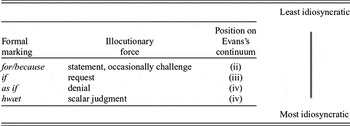
The MISs discussed all share the structural property of beginning with a subordinator followed by a finite clause. They are all consistent with incremental conversational contributions in negotiated interaction. They vary considerably, however, in the degree to which they involve conventionalized, idiosyncratic meanings. In most cases, for/because X does not have a specific pragmatic function associated with the monoclausal form. By contrast, if X is coercive, as if X conveys reversed meaning, and, like other exclamatives, hwæt is used to ‘express noncanonicity judgments which involve semantic scales’ (Michaelis Reference Michaelis, Haspelmath, König, Österreicher and Raible2001: 1049). As summarized in table 1, the MISs form a continuum which approximately matches the one proposed in Evans (Reference Evans and Nikolaeva2007: 386) for ‘insubordination’.
The continuum of MISs discussed in this article

We can therefore be confident in using the UPP to hypothesize that, even though the evidence is scanty, turn-taking in Old English times was similar to contemporary turn taking and at least both MISs and phrasal responses were permissible as partial responses to questions and assertions.
As has been mentioned, in seeking to account for the rise of ‘insubordinates’, several researchers have invoked grammaticalization, and possible counterexamples to it (among them Higashiizumi (Reference Higashiizumi2006); Evans (Reference Evans and Nikolaeva2007); Verstraete et al. (Reference Verstraete, D'Hertefelt and Van linden2012)). Does the UPP suggest these are the right processes to invoke? With respect to grammaticalization, the univerbation of the phrase by the cause that as because is consistent with prototype examples of the kind of morphosyntactic change considered to be grammaticalization of a conjunction (e.g. in stede ‘in place’ > instead). It is also consistent with some types of constructionalization in which formnew-meaningnew pairs develop (Traugott & Trousdale Reference Traugott and Trousdale2013: 22).Footnote 7 Higashiizumi (Reference Higashiizumi2006: 83–94) traces the increase in the relative frequency of subjective uses of independent because-clauses in English, especially the epistemic (‘I conclude because‘) and speech-act type (‘I am saying this because’) and notes that this is consistent with the kind of subjectification that may accompany grammaticalization. Such subjectification is characterized as the process whereby ‘meanings become increasingly based in the speaker's subjective belief state, or attitude toward what is said’ (Traugott Reference Traugott, Stein and Wright1995: 185).
The increase in subjective uses appears to be a function of both biclausal and monoclausal because-constructions. This is consistent with the fact that because-monoclauses have not become idiosyncratic. Where the development of the illocutionary force of if X (request) and as if X clauses (denial) is concerned, it appears that the meaning of the matrix clause has been transferred to the MISs, e.g. of some version of ‘I would be grateful’ in the case of if X monoclauses, and of ‘it seems (but I don't believe it)’ in the case of as if X monoclauses. Here subjectification is restricted to the MIS construction.
Does the existence of MISs require us to hypothesize that degrammaticalization has occurred? If we look at MISs in the context of interaction in general, we see that syntactic constituents can be used independently in interaction as increments of prior talk, whether by the same or a different speaker. Ford et al. (Reference Ford, Fox, Thompson, Ford, Fox and Thompson2002: 18) find in contemporary spoken data increments ‘of a variety of syntactic types, including NPs, adverbs, adverbial phrases, prepositional phrases, relative clauses, and adverbial clauses’. Of these NPs, prepositional phrases, and adverbial for monoclauses are attested about a thousand years ago in Ælfric's Colloquy (see section 5). Like other constituents, MISs are simply chunks usable in negotiated interaction. There is no reason to consider MISs to be cases of degrammaticalization.Footnote 8
7 Conclusion
In sum, expansion of prior utterances by constituent increments is a fundamental communicative ability. Structurally these increments are units that can be used for moving discourse forward. These may be phrasal or clausal in size. I have argued that in English so-called ‘insubordinates’ are structurally clausal increments no different in kind from NP, prepositional and adverbial ones.
I have restricted my discussion to finite independent clauses introduced by subordinators in English. Other types of ‘insubordinates’, particularly those involving morphology in Australian languages (Evans Reference Evans and Nikolaeva2007) or Uto-Aztecan (Givón Reference Givón2015) may require different analysis. So may ‘insubordination’ in languages other than English, like Dutch, German and Swedish, which show far richer word order and morphsosyntactic constraints. But I hope to have suggested that, since it is generally agreed that ‘insubordination’ is characteristically embedded in interactional language, it is necessary to use the UPP as it pertains to negotiated interaction, rather than to monologic writing, to guide reconstruction where there is no historical record.
Likewise it is useful to think about the larger set of linguistic phenomena in the language under discussion that might be related to the individual example being investigated. Other ‘irregular’ monoclauses should also be investigated such as non-finite To think that X! clauses. Finally, the larger context of interactional language in general deserves attention. This requires investigating the syntax, semantics, pragmatics and prosody of contributions to ongoing discourse in the light of both what precedes and what follows. Detailed micro-analysis using electronic corpora and other resources can reveal what traditional historical accounts have largely ignored, in the present case, morphosyntactic phenomena that have largely been considered ‘irregular’ or ‘extra-grammatical’ and the interactional contexts that license them.
DATA SOURCES
-
AC Ælfric's Colloquy. n.d. Online course materials, www.ucalgary.ca/UofC/eduweb/engl401/texts/frame.html (accessed January–March 2016).
-
CED Kytö, Merja & Jonathan Culpeper. 2006. A Corpus of English Dialogues 1560–1760. Uppsala University. www.helsinki.fi/varieng/CoRD/corpora/CED/ (accessed 3 April 2017).
-
COCA Davies, Mark. 2008–. The Corpus of Contemporary American English: 520 million words, 1990–present. Brigham Young University. http://corpus.byu.edu/coca/ (accessed December 2015 – March 2016).
-
COHA Davies, Mark. 2010–. The Corpus of Historical American English: 400 million words, 1810–2009. Brigham Young University. http://corpus.byu.edu/coha/. (accessed December 2015 – March 2016).
-
CR Robinson, F. N. (ed.). 1957. The Works of Geoffrey Chaucer. Boston: Houghton Mifflin, 2nd edn. Machine-readable version, available through the Oxford Text Archive at http://name.umdl.umich.edu/CT (accessed January 2016).
-
OED Oxford English Dictionary. www.oed.com (accessed December 2015 – January 2016).
-
OSS Johnson, Eric M. 2003–2005. OpenSource Shakespeare: An Experiment in Literary Technology. George Mason University. www.opensourceshakespeare.org/ (accessed December 2015 – February 2016).
-
SHC Craig, Hardin (ed.). 1951. The Complete Works of Shakespeare. Chicago: Scott, Foresman.
-
YP Beadle, Richard. 1982. The York Plays. London: Arnold.