Introduction
A link between anxiety and dysfunctions of the hypothalamic-pituitary-adrenal (HPA) axis has been widely reported in both normal and pathological anxiety. Some data would indicate that healthy subjects with high levels of trait anxiety or neuroticism might be characterized by low basal cortisol concentrations,Reference Zorrilla, DeRubeis and Redei1–Reference Oswald, Zandi and Nestadt5 or by a blunted cortisol increase under stress conditions.Reference Hubert and de Jong-Meyer6–Reference Tyrka, Wier and Price11 Interestingly, after a psychological stress, but not at baseline, highly anxious women had lower cortisol levels than men.Reference Kirschbaum, Bartussek and Strasburger12–Reference Takai, Yamaguchi and Aragaki14 Recently, a gender-specific association between the gene promoter polymorphism of the serotonin transporter and the cortisol awakening response, which is a reliable marker of basal cortisol secretion, was described in a sample of healthy women.Reference Wüst, Kumsta and Treutlein15
Disturbances of the HPA axis, as reflected by peripheral cortisol levels, have been reported in panic disorder (PD); however, the ensuing findings are controversial. In fact, elevated or normal basal plasma or salivary cortisol concentrations were observed in PD patients, as compared with healthy subjects.Reference Nesse, Cameron and Curtis16–Reference Wedekind, Bandelow and Broocks26 More recently, a review of four studies carried out in PD patients reported enhanced overnight cortisol levels that correlated with sleep disruption.Reference Abelson, Khan and Liberzon27 In the same patients, the Adrenocorticotropic hormone (ACTH) secretion triggered by a challenge drug (doxapram) was more exaggerated than in resting conditions, and panic symptoms could be elicited without HPA axis activation. Further, PD male patients, but not women, showed higher levels of dehydroepiandrosterone (DHEA) than healthy control subjects.Reference Brambilla, Biggio and Pisu28, Reference Brambilla, Mellado and Alciati29 The possible relationship between different degrees of normal anxietyReference Brambilla, Biggio and Pisu30 and the plasma levels of four neurosteroids (pregnenolone, progesterone, allopregnenolone, and etrahydrodeoxycorticosterone) was explored in men during resting conditions in order to study their possible role in modulating anxiety. The DHEA and its sulfate derivate (DHEA-S), which are the most abundant steroids in the human body, are produced in adrenals, but some evidence indicates that they are synthesized also in the brain where their concentrations are higher than those in plasma.Reference Liere, Pianos and Eychenne31, Reference Maninger, Wolkowitz and Reus32 These neurosteroids exhibit potent inhibitory effects at the level of gamma amino-butyric acid (GABA) receptors. In particular, the DHEA-S is a negative modulator of GABA receptors of type A, while cortisol is a positive one at that level. Despite the intensive research in this field, the functions of DHEA and DHEA-S are still unclear, and several questions concerning their potential role in different pathological conditions remain unanswered.
The HPA axis alterations shared by both normal and pathological anxiety suggest the presence of common underlying psycho(patho)logical features and/or dimensions.Reference Millan33, Reference Van Praag34 Recently, many research efforts have been, in fact, directed toward the identification of the predominant symptom clusters or dimensions (and of their biological correlates, when possible) in different anxiety disorders, especially in PD, but also in obsessive-compulsive disorder, that might explain the heterogeneity of their clinical presentation.Reference Schmid, Forsyth and Santiago35–Reference Sansone and Sansone39
In the last several years, increasing evidence has supported the possible clinical relevance of detecting even subthreshold panic-agoraphobic symptoms in both the general population and clinical samples. In line with these studies and in accordance with the “Spectrum model,”Reference Frank, Cassano and Shear40 a new assessment instrument was developed, called the Structured Clinical Interview for Panic-Agoraphobic Spectrum lifetime version and its related self report (PAS-SR),Reference Cassano, Rotondo and Maser41–Reference Shear, Frank and Rucci44 by the researchers of the so-called Spectrum Project, an international Italy–United States research collaboration project. Using the term “spectrum,” these researchers refer to a broad array of manifestations of a mental disorder (e.g. panic disorder), including its core and most severe range of symptoms, as well as its subthreshold manifestations. The latter may be either temperamental traits, or prodromal or residual symptoms following or preceding a fully developed episode. The eight domains of the panic-agoraphobic spectrum incorporate the typical symptomatology of panic attacks, anticipatory anxiety, and agoraphobia, together with the array of subthreshold and atypical panic and phobic signs and symptoms that are less frequently linked to panic disorder. The panic-agoraphobic spectrum includes traits and lifestyles that characterize threshold and subthreshold anxiety related to Axis I anxiety disorders. According to the spectrum concept, low-severity and isolated symptoms may occur not only in the family or personal history of a patients with an index episode, but also concomitantly with other axis I disorders or alone across the lifespan. In this dimensional approach to psychopathology, in fact, early-onset and enduring symptoms shape the adult personality and establish a vulnerability to the subsequent development of a full-blown disorder.Reference Frank, Cassano and Shear40, Reference Cassano, Rotondo and Maser41
Given the paucity of information in this field, the aim of the present study was to investigate the possible correlation between serum levels of cortisol/DHEA-S or the DHEAS/cortisol ratio and panic-agoraphobic dimensions, as rated by the PAS-SR, in a sample of healthy subjects of both sexes.
Methods
Subjects and assessments
Forty-two healthy subjects of both sexes (23 women and 19 men; mean age ± SD: 33.0 ± 8.1 years) were recruited from blood donors at the Transfusion Centre of the Azienda Ospedaliero-Universitaria of Pisa who volunteered for this study. They were selected on the basis of the absence of current or lifetime psychiatric disorders, medical illnesses, obesity, alcohol or drug abuse, ongoing contraceptive drugs, or heavy cigarette smoking. All subjects were drug-free and were assessed by the Structured Clinical Interview for DSM-IV axis-I disorders (SCID-I/P),Reference First, Spitzer, Williams and Gibbon45 performed by certified raters (C.C., L.D.), and by the PAS-SR lifetime version.Reference Shear, Frank and Rucci44
As already mentioned, the PAS-SR is a validated questionnaire for the assessment of panic-agoraphobic spectrum symptomatology and includes a broad array of symptoms, anxiety traits, and behaviors that are often associated with DSM-IV-TR46 PD, but that may also occur without a full PD diagnosis. The PAS-SR consists of 114 items that are coded in a dichotomous way (yes/no), articulated through eight dimensions (domains) including typical (i.e., DSM-IV criteria for PD) and atypical (non-criterion) panic symptoms (panic like symptoms, n = 27 items; anxious expectation, n = 5 items; and agoraphobia, n = 25 items), as well as temperament or behavior-related features (separation sensitivity, n = 15 items; stress sensitivity, n = 2 items; substance and medication sensitivity, n = 9 items; illness-related phobias and hypochondriasis, n = 5 items; and reassurance orientation, n = 26 items). In PD patients, they represent the precursors, prodromals, or even interictal “anxiety trait–like” manifestations. When showing an early onset, such symptoms and features may constitute life-enduring characteristics detectable in subjects that never fulfill criteria for Axis I PD across the lifespan, and generally they are interpreted as subtle expressions of a panic-agoraphobic diathesis.
The Spectrum instrument can be downloaded from the Web site: http://www.spectrum-project.org.
The Ethics Committee of the Azienda Ospedaliero-Universitaria of Pisa approved all recruitment and assessment procedures. All subjects provided written informed consent after receiving a complete description of the study and having the opportunity to ask questions.
Biological sample collecting
Venous blood samples (10 ml) were collected after an overnight fasting from all subjects, between 9 a.m. and 10 a.m., and in the month of April, at least 2 h after awakening, in order to minimize the cortisol awakening rise. All subjects reported that they had slept well, for at least 7 h, and were invited to relax in the same room at a constant temperature (20°C) for at least 30 min before the blood sampling. Blood withdrawals in women were performed in the luteal phase. The psychopathological assessment was performed immediately thereafter.
Blood samples were collected in test tubes without anticoagulant and processed for serum separation by centrifugation at 200 × g for 15 min, at room temperature. The serum was stored at −80°C until the assays, which were performed within 1 month.
Serum cortisol and DHEAS measurements
The serum cortisol levels were evaluated by a polarization fluorescence immunoenzymatic assay (FPIA) (TDx/TDxFLx, Cortisol FPIA, Abbott Laboratories, Abbott Park, IL, USA), with a sensitivity of 1.1 μg/dL and 10% of intra-assay variability. The DHEAS concentrations were measured by an enhanced chemo-luminescence competitive immunoenzymatic assay (IMMULITE DHEA-SO4, Siemens Medical Solutions USA, Malvern, PA, USA), with a sensitivity of 15 μg/dL and 10% of intra-assay variability.
The tests were carried out at the Endocrinology Laboratory of the Azienda Ospedaliero-Universitaria Pisana, Pisa, Italy.
Statistical analyses
The demographic characteristics, with the only exception being age, of patients and control subjects were compared by the χ2 test. The unpaired Student's t-test was used to compare parametric variables, such as age. Since the psychopathological and biological variables were not normally distributed, non-parametric tests were applied. The comparisons between two independent samples were assessed by the Mann–Whitney test and the relationships between variables by the Spearman's coefficient. A p-value < 0.05 was judged as statistically significant. All analyses were carried out using SPSS version 14.0.
Findings
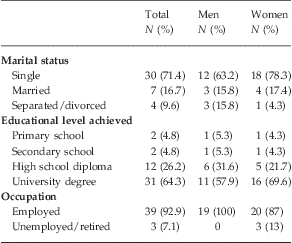
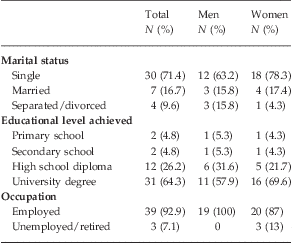
The clinical and demographic characteristics of the subjects are reported in Table 1.
Demographic characteristics of the whole sample (N = 42) and of men/women
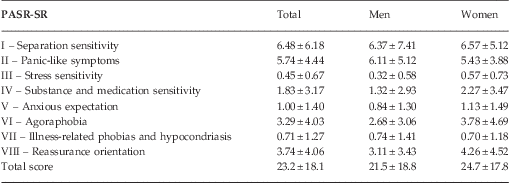
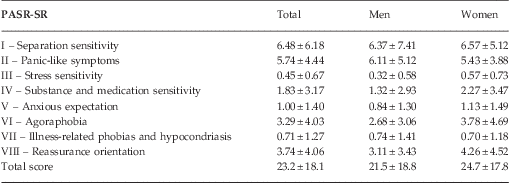
The total score (mean ± SD) of the PAS-SR was 23.2 ± 18.1, which is within normal values. The single domain scores, as well as the levels of cortisol (mean ± SD, μg/dL), DHEAS (mean ± SD, μg/dL), and DHEAS/cortisol ratio in the total sample and in the two sexes, are shown in Table 2 and Table 3, respectively. None of these parameters was significantly different between men and women.
PAS-SR total and domain scores (mean ± SD) in the total sample and in men/women
Cortisol (mean ± SD, μg/dL) and DHEAS (mean ± SD, μg/dL) serum levels and DHEAS/cortisol ratio in the total sample and in men/women

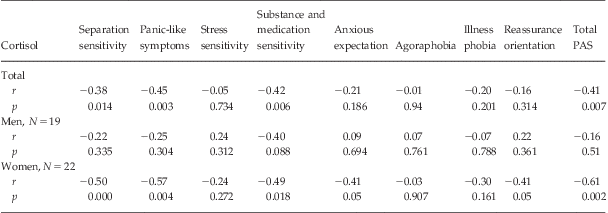
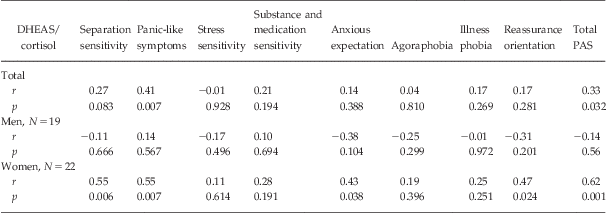
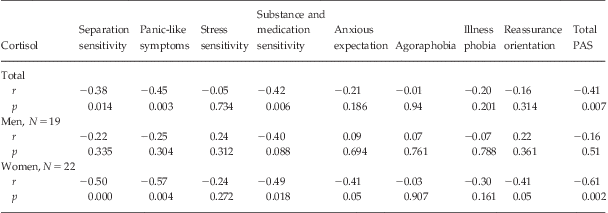
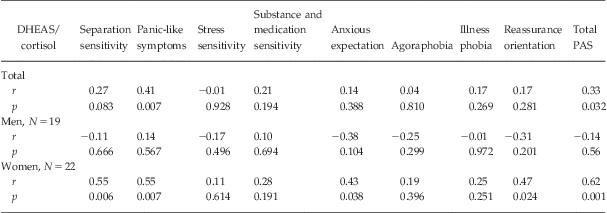
In the total sample, significant negative correlations were found between cortisol levels and the PAS-SR total scores (r = −0.41; p = 0.007), and the following domain scores: separation sensitivity (r = −0.38; p = 0.014), panic-like symptoms (r = −0.45; p = 0.003), and medication and substance sensitivity (r = −0.42; p = 0.006). On the contrary, the DHEA-S/cortisol ratio was significantly and positively related to PAS-SR total scores (r = 0.33; p = 0.032) and to the panic-like symptoms domain scores (r = 0.41; p = 0.007).
However, while performing the same analyses in the two sexes, it emerged that the significance was present in women only (Tables 4 and 5). Again in women, the DHEAS/cortisol ratio was significantly correlated with anxious expectation (r = 0.43; p = 0.038) and reassurance orientation (r = 0.47; p = 0.024) domain scores (Tables 4 and 5). Further associations, albeit not significant, were observed among women between the cortisol levels and the anxious expectation and the reassurance orientation domain scores.
Spearman's correlations between the PAS-SR total and domain scores and the levels of cortisol in the total sample and in men/women
Spearman's correlations between the PAS-SR total and domain scores and the levels of DHEA-S/cortisol in the total sample and in men/women
Discussion
The results of the present study, which was carried out in healthy subjects of both sexes, showed the presence of significant correlations between serum cortisol levels or DHEAS/cortisol ratio and subthreshold panic-agoraphobic symptoms, as assessed by a specific instrument, the PAS-SR. In the whole sample, negative correlations were found between the cortisol concentrations and the PAS-SR total and three domain scores, in particular the separation sensitivity, panic-like symptoms, and medication and substance sensitivity domains. The PAS-SR total scores were also positively related to the DHEA-S/cortisol ratio, so the overall results would indicate that higher cortisol levels are related to lower panic-agoraphobic traits. However, when the analyses were performed in the two sexes, it emerged that the correlations were only present in women.
The findings in the total sample may be considered in line with previous data that show low basal cortisol levels in those subjects with high levels of trait anxiety or neuroticism.Reference Zorrilla, DeRubeis and Redei1, Reference Jezova, Makatsori and Duncko8–Reference Jezova and Hlavacova10, Reference Mathew, Ho and Francis47, Reference Young, Abelson and Cameron48 In addition, a blunted cortisol response to stress was reported in healthy individuals with high somatic anxiety, neuroticism, and low sense of mastery.Reference Grossi, Ahs and Lundberg2, Reference McCleery and Goodwin3 During exposure to a psychosocial stress, such as a public speech, subjects with high trait anxiety exhibited lower levels of plasma and saliva cortisol, suggesting that trait anxiety may be associated with an impaired hormonal response to acute stress.Reference Jezova, Makatsori and Duncko8
Interestingly, when dividing our sample by gender, the results were corroborated among women. There has been prior evidence of functional gender differences in the HPA axis, with lower cortisol levels in women than in men.Reference Kirschbaum, Kudielka and Gaab49–Reference Kudielka, Buske-Kirschbaum and Hellhammer51 Recently, blunted HPA axis responses in women were associated with high neuroticism scores, as well as with high scores on four of its facets (anxiety, anger/hostility, depression, and self-consciousness).Reference Oswald, Zandi and Nestadt5 Interestingly, these personality traits are those traditionally associated with a greater vulnerability to psychopathology; however, the gender-related alterations seem to disappear when investigated in patients with full-blown disorders.Reference Bekker and van Mens-Verhulst52
It is noteworthy that our results highlighted the presence of significant correlations not only between the cortisol levels and separation sensitivity and panic symptoms domains, typically related to PD core symptoms, but also to the medication and substance sensitivity dimension that represents a typical lifelong feature, often preceding the onset of full-blown PD by many years.
Some limitations of the present study should be taken into account. First, the sample size was small, albeit of a limited age range, and this might have prevented a reliable estimation of gender differences. Second the single hormone determination rather than the assessment of diurnal rhythmicity, but at least all blood samplings were performed at the same time and month and under the same conditions. Third is the lack of information on possible traumatic life events that subjects may have had to face across the lifespan. This information may have added to the possible correlations between lifetime panic spectrum symptoms, life events, and cortisol alterations. Another potential bias is the lack of information on the presence of personality disorders.
In conclusion, our findings suggest that some peripheral HPA indices, such as plasma cortisol levels and DHEAS/cortisol ratio, are related to specific panic-agoraphobic dimensions in healthy women. Such relationships may constitute one of the factors explaining the greater vulnerability of women to anxiety disorders. Since recent data have shown a significant cortisol increase in anxious women during the follicular phase,Reference Hlavacova, Wawruch and Tisonova53 future studies should investigate whether the observed relationships may be considered stable or whether they fluctuate throughout the different phases of the menstrual cycle.