




No CrossRef data available.
Article contents
Cognitive flexibility in anorexia nervosa and bulimia nervosa
Published online by Cambridge University Press: 01 July 2004
Abstract
The aim of this study was to determine if there are differences in cognitive flexibility in anorexia nervosa and bulimia nervosa. Fifty-three patients with an eating disorder (34 with anorexia nervosa and 19 with bulimia nervosa) and 35 healthy controls participated in the study. A battery of neuropsychological tests for cognitive flexibility was used, including Trail Making B, the Brixton Test, Verbal Fluency, the Haptic Illusion Test, a cognitive shifting task (CatBat) and a picture set test. Using exploratory factor analysis, four factors were obtained: 1: Simple Alternation; 2: Mental Flexibility; 3: Perseveration; and 4: Perceptual Shift. Patients with anorexia nervosa had abnormal scores on Factors 1 and 4. Patients with bulimia nervosa showed a different pattern, with significant impairments in Factors 2 and 4. These findings suggest that differential neuropsychological disturbance in the domain of mental flexibility/rigidity may underlie the spectrum of eating disorders. (JINS, 2004, 10, 513–520.)
Information
- Type
- Research Article
- Information
- Journal of the International Neuropsychological Society , Volume 10 , Issue 4 , July 2004 , pp. 513 - 520
- Copyright
- 2004 The International Neuropsychological Society
INTRODUCTION
It has been argued that anorexia nervosa is a developmental disorder with a neuropsychological manifestation (Braun & Chouinard, 1992; Connan et al., 2003; Gillberg et al., 1994; Rastam, 1992; Treasure & Collier, 2001). This could result from a both aberrant neurodevelopment (which may be genetic in origin) and environmental brain insults early in life. Consistent with this is evidence that birth trauma is a risk factor for anorexia nervosa (Cnattingius et al., 1999), and it has been reported that patients with perinatal injury have a worse outcome (Halmi et al., 1979). People with anorexia nervosa have been noted to have the soft neurological sign of dysdiadochokinesis, thought to involve the cerebellum (Gillberg et al., 1996; Halmi et al., 1979; Wentz et al., 2000). Additionally, there is evidence for brain structural changes, including widening of the cerebral cortical sulci, increased ventricular width, and subcortical changes affecting the thalamus and basal ganglia (Uher et al., 2002). Although some structural changes are partially reversible with recovery, grey matter deficit persists (Katzman et al., 1996, 1997). Functional neuroimaging has revealed decreased function in the inferior frontal and parietal regions, and in some studies there was increased activity in the caudate nucleus, thalamus and in the hippocampal–amygdala complex (Naruo, 2002).
Many studies have found neuropsychological impairments in anorexia nervosa. Whilst a broad range of cognitive functions have been implicated (Hamsher et al., 1981; Katzman et al., 2001), the prominent characteristics are attentional impairment and difficulties in executive function. For example, specific deficits in sustained attention (Green et al., 1996; Katzman et al., 2001; Kingston et al., 1996), divided attention (Lauer et al., 1999), working memory (Green et al., 1996), response inhibition (Cooper & Fairburn, 1992), and mental flexibility (Fassino et al., 2002; Pendleton Jones et al., 1991; Tchanturia et al., 2001, 2002) have been reported. This pattern of deficits has been linked to abnormalities in parietal and prefrontal cortical circuits (Uher et al., 2002). Fewer investigations have been conducted in bulimia nervosa, but these also reveal attentional and executive impairments (Lauer, 2002). Patients with bulimia nervosa were found to have significantly lower average hit rates and perceptual sensitivity than normal-weight female control subjects (Laessle et al., 1990).
Problems with mental flexibility have been noted as a behavioral characteristic of people with anorexia nervosa (Fassino et al., 2002). Accordingly, several studies have explored cognitive flexibility in anorexia. For example, Fassino et al. (2002) found less categories achieved and more errors committed in the Wisconsin Card Sorting Test in anorexia. Impairments on the Trail Making task (slower reaction times) have been demonstrated (Lauer, 2002). Pendleton Jones et al. (1991) also showed impairment in an executive functioning factor (Focus/Execute), which included the Trail Making task performance, in both anorexia nervosa and bulimia nervosa. Finally, a recent studies by Tchanturia et al. (2001, 2002) found impairment in anorexia nervosa and bulimia nervosa on a test of perceptual shifting.
Specific personality traits have been reported in anorexia nervosa, including high levels of perfectionism and harm avoidance and low flexibility (Bastiani et al., 1995; Brecelj-Anderluh et al., 2003; Bulik et al., 2003). Consequently we hypothesized that in a laboratory setting it would be possible to detect impaired flexibility in cognitive style using a set shifting battery. Set shifting is one of the most important executive functions, which concerns shifting back and forth between multiple tasks, operations or mental sets (Miyake et al., 2000). In this study we present the subjects with a battery of set-shifting tasks, focusing on characteristics of verbal, haptic perceptual, contextual and attentional flexibility. We focused on “shifting” between mental sets since some aspects of this function have been found to be abnormal in previous studies (Fassino et al., 2002; Tchanturia et al., 2001, 2002). All selected tasks require shifting between mental sets, although the specific operations that may be involved are rather different across the tasks. These were selected to reflect the different aspects of set-shifting, ranging from perceptual patterns to the processing of higher order concepts. The idea behind the study was to clarify the relationships between different aspects of the cognitive shift in the eating disorder groups, using a factor-analytical approach. The study compared anorexia nervosa and bulimia nervosa directly to investigate whether the pattern of cognitive flexibility impairment was general to eating disorders or more specific to different subtypes.
METHODS
Research Participants
The study group consisted of 34 patients with anorexia nervosa, 19 with bulimia nervosa and 35 healthy controls. Patients were recruited from the South London and Maudsley NHS Trust Eating Disorders Clinic. Each patient underwent a semi-structured diagnostic interview called EATAET, developed by a European set of collaborators involving our own group (Brecelj-Anderluh et al., 2003). Weight and height were measured on the day of testing. The patients fulfilled the DSM–IV (American Psychiatric Association, 1994) criteria for either anorexia nervosa or bulimia nervosa. Exclusion criteria for all participants were a history of head injury or brain operation, psychosis or substance abuse-related disorder in past. Fifty-two percent of the patients were attending for inpatient treatment. Healthy controls were recruited by advertisement from the local community and screened for a history of abnormal eating behavior. All controls had a normal Body Mass Index (BMI; calculated as kg/m2; range 20–25) and no personal or family history of mental or neurological disorders. At the time of assessment 61% of the patient participants were medication free, 8% were receiving hormone replacement therapy, and 31% patients were taking antidepressant medication (SSRI type) (a preliminary analysis showed no significant differences in neuropsychological performance on patients on an off medication, and the data for this comparison is not presented here). All participants were informed about the research procedures and gave informed consent in writing. Procedures were as approved by the South London and Maudsley NHS Trust Ethical Committee. The participants were all female native English speakers. The groups did not differ according to age or years of education (means are presented in Table 1).
Demographic and clinical measures for anorexia nervosa and bulimia nervosa groups

Procedure
The National Adult Reading Test–Restandardized (NART–R, Nelson & Willison, 1991), was used to match the groups on general intellectual ability. The Maudsley Obsessive-Compulsive Inventory (MOCI; Hodgson & Rachman, 1977) was used to measure obsessionality. This is a self-report 30-item instrument, including four subscales: Checking, Cleaning, Doubting, and Slowness. The self-report Hospital Anxiety and Depression Scale (HADS; Zigmond & Snaith, 1983) was used to measure current anxiety and depression. A neurological test of diadochokinesis was performed, involving alternating between pronation and supination (Gillberg et al., 1994; Rastam, 1992).
A series of tests of cognitive flexibility were selected on the basis that they covered the main aspects of this domain and incorporated some of the tests that were in regular clinical use.
The Trail Making Task
(Kravariti et al., 2001, 2003; Toulopoulou et al., 2003) A computerized test was used which has the core features of the Trail Making Test (Reitan, 1958), namely a manual response and alternative between number and letter sets. The task is presented on a computer screen and a mouse used to respond. There were three levels: A motor control task in which responses were made to a shifting ‘ball’; an ascending alphabetic sequence, with letters only presented on the screen (20 letter task); and an alphabetic and numeric sequence 20-number/letter task, again presented on the screen, equivalent to Trail Making B.
The Brixton Test
(Burgess & Shallice, 1997) Participants were asked to predict the movements of a blue circle, which changes location after each response. A concept (rule) has to be inferred from its movements to make correct predictions. Occasionally, the pattern of movement changes and the participant has to abandon the old concept in favor of a new one.
The Picture Set Test
(adapted from the Set Flexibility Test; Surguladze, 1995) Participants are given sets of four pictures on a computer screen (18 trials in total) with the instruction to indicate which objects have something in common (e.g., carrot, onion, pepper, and pineapple). The first six trials present objects that can be grouped by object category (e.g., vegetables, clothes, furniture, and vehicles). In the next six trials the objects can be divided in terms of their constituent materials (e.g., paper vs. fabric). In the last six trials (from 13–18) the objects could be grouped by concepts relating to their function (e.g., guns vs. stationery or make-up vs. cutlery). Thus participants have to change their sorting response set twice during the experiment.
The Verbal Fluency Task
(Controlled Oral Word Association, FAS; Lezak, 1983) This task requires participants to vocalize as many words as they can in 1 min beginning with the letters f, a, s, without repetition and excluding proper nouns, numbers and sequences. The sum of all the words generated (minus exclusions) and the number of perseverative responses are recorded.
The Cat Bat Task
(Eliava, 1964; Tchanturia et al., 2002) Participants are asked to fill in missing letters in a written short story as quickly and accurately as possible. In the first part of the story the contextual requirements prompt the participant to fill in the letter c and reconstruct the fragment word as cat. In the second part of the story (the shifting part), the word cat is no longer appropriate and inserting letter b to reconstruct the word as bat, is more logical. Thus in the first part participants are primed for the reconstruction of one particular word (cat) and in the second part of task they need to adjust their cognitive set to the changes in context. The number of perseverative errors and the time taken to complete the task are measured.
The Haptic Illusion Task
(Tchanturia et al., 2001; Uznadze, 1966) This is a perceptual set-shifting task. This version uses three wooden balls: two small balls of equal size (5 cm in diameter) and one larger ball (diameter 8 cm). The participants are asked to judge the relative size of two balls in their hands while keeping their eyes closed. First, the larger ball and one of the smaller balls are placed into participant's hands. This process is repeated 15 times (the same ball is placed in the same hand each time). Then, during the critical stage (30 presentations), participants are given the two identical 5 cm balls, one in each hand. They are asked if there is any difference in size between the balls. Most participants have the illusion that the ball in the hand previously holding the larger ball is smaller. The number of trials where illusions are experienced is a measure of perceptual rigidity.
Statistical Methods
The anorexia nervosa group were initially split into subgroups with the Restricting (n = 20) and Binge Purge subtypes (n = 14). The restricting and binge-purging subgroups were compared using independent samples t tests. These groups did not differ significantly on clinical characteristics or neuropsychological performance (t values between 1.4 and 0.04, p values between .17 and .97) and so all anorexia nervosa patients were included as a single group in all analyses.
A one way ANOVA was used for between-group comparisons on continuous demographic variables, clinical self-report questionnaires and the initial analysis of the neuropsychological variables. Bonferroni post-hoc tests were used to carry out pair-wise comparisons.
To reduce the number of variables from neuropsychological tests relevant to set shifting, a factor analysis was carried out on nine set shifting related variables. The factors were extracted using principal component analysis and Oblimin rotation with Kaiser Normalization. A scree plot was used to determine the number of factors. After standardization to zero mean and unit variance, items with a factor loading of at least 0.5 were summed to construct the factor scores.
The resulting factor scores were then compared between the three groups using multivariate analysis of variance (MANOVA) using Wilk's Lambda. If significant, this was followed up with individual one-way ANOVAs and Bonferroni post-hoc comparisons for each factor. In order to investigate the contribution of anxiety, depression and obsessive-compulsive features to performance on cognitive flexibility tasks, the MANCOVAs were repeated, but using the psychiatric measures as covariates in the analyses. A 5% level of significance was used in each case.
RESULTS
Demographic and Clinical Data
These are shown in Table 1. Means and standard deviations are presented together with the results of one-way ANOVAs comparing the anorexia nervosa, bulimia nervosa and healthy comparison group. The groups were found to be well-matched in respect to age and premorbid IQ (as predicted by their NART–R score) and there was no significant difference in years of education; the BMI was significantly lower in the anorexia nervosa group. A preliminary analysis showed no significant differences in neuropsychological performance on patients on and off medication (data not presented here) and medication was not further controlled for.
On the MOCI both clinical groups showed significantly higher scores than the controls, including on the four subscales. Additionally, the anorexia and bulimia groups showed higher levels on the HADS anxiety and depression subscales.
Individuals with anorexia nervosa were significantly slower in dysdiadochokinesis than bulimia nervosa and healthy control groups.
Neuropsychological Investigation
The data on neuropsychological test performance of the three groups are presented in Table 2. Relative to the healthy control group, anorexia nervosa group was impaired on Trail Making (Motor Speed, Alphabet Sequence and Trail Shifting time), the Brixton and the Haptic Illusion tasks. The bulimia nervosa group showed impairment on the CatBat task completion time and the Haptic task.
Cross-sectional data for neuropsychological tasks (one way ANOVA)

The factor analysis of the neuropsychological data revealed four factors with rotation method oblimin with Kaiser normalization between 1.04 and 2.29, accounting for between 13.1% and 28.7% of the variance in responses (a total of 72.0%). The scree plot suggested that 4 factors should be considered. These were (with item loading included in brackets) as follows:
- Simple Alternation: This consisted of Trail Making B total time (0.94) and errors (0.92) and the Brixton total number of errors (0.57) and is considered to represent rapid alternation between mental sets
- Mental Flexibility: This includes the Cognitive Set Shift Task (CatBat) time (−0.805) and the FAS–Verbal Fluency Perseverations (0.58)
- Perseveration: This included the Cognitive Set Shift Task (CatBat) errors (0.77) and Picture Set Making errors (0.63)
- Perceptual Shift: This factor contains only the Haptic task, number of illusions (0.93).
The factors were used to compute outcome variables for the different groups and the results transformed into z scores using the control means and standard deviations (see Figure 1; note that control data is not given because by definition their mean is zero and SD = 1). These z scores were analyzed using post-hoc Bonferroni tests and showed that the anorexia nervosa patients were significantly worse than controls on factors 1 and 4 [F(2,84) = 6.41, p < .002] and [F(2,86) = 5.69, p < .005], respectively. The bulimia nervosa group differed significantly from the healthy controls in Factors 2 and 4 [F(2,84) = 6.55, p < .01] and [F(2,86) = 5.69, p < .01], respectively.

Four factors were computed and then converted into z scores. In this case, a positive z score represents lower performance from the control group. Z scores for the controls are not presented in this figure because by definition the mean is zero and the standard deviation 1 for the four factors (Key: 1 = Simple Alternation; 2 = Mental Flexibility; 3 = Perseveration; and 4 = Perceptual Shift) for the anorexia nervosa (AN) and bulimia nervosa (BN) groups (note that data for the controls is not shown because of the z-scoring technique). Standard error bars are shown.
The Effects of Background Variables on Performance
Scores on the self-report clinical measures MOCI and the anxiety and depression subscales of the HADS were included separately as covariates in MANCOVAs. There was no evidence that MOCI was associated with the four factors simultaneously [F(4,82) = 1.91, p = .11] and the effect of group remained significant [F(8,164) = 2.31, p < .01]. Depression was also not related to these factors [F(4,82) =1.40, p = .24] and the effect of group remained significant [F(8,164) = 3.28, p < .002]. Anxiety was also not associated with the four factors simultaneously [F(4,82) = 1.95, p = .81], and the group effect again was significant [F(8,164) = 1.74, p = .09].
We explored relationships between BMI, IQ, and age of participants and four factors. A weak, but significant correlation on .05 level was found between age and Factor 1 (r = .359) only.
DISCUSSION
The study is an exploratory investigation of cognitive and perceptual rigidity, deriving four factors: Simple Alternation, Mental Flexibility, Perseveration, and Perceptual Shifting, which highlight the differential patterns of impairment in the two patient groups. Individuals with anorexia nervosa differed significantly from controls on five separate neuropsychological tests and two factors, Simple Alternation and Perceptual Shift. In contrast, the bulimia nervosa group were impaired in two neuropsychological tasks and on the Mental Flexibility and Perceptual Shift factors. A large impairment was seen on the Simple Alternation factor in the anorexia nervosa group suggesting that the tests that contribute to this factor are the most sensitive to cognitive flexibility impairment in this group. For the Mental Flexibility factor, even though the bulimia nervosa group were impaired relative to the controls, they were not significantly worse than anorexia group. One factor not showing impairment in either groups was Perseveration. Finally, the Perceptual Shift factor showed equivalent impairment in both anorexia and bulimia groups. This pattern is mirrored approximately in individual test performance.
The Simple Alternation factor proved to be the most sensitive in detecting impairment in the anorexia nervosa group. This comprised the Trail Making B and Brixton tests. Studies which have used the paper version of the Trail Making Task (Kingston et al., 1996; Pendleton Jones et al., 1991; Szmukler et al., 1992) have shown moderate effect sizes (the average Cohen between studies for Trails A = .56; Trails B = .47). The effect size was somewhat larger in the current study (Trails A = .96; Trails B = .90), but in line with the findings of Kingston et al. (1996) and Szmukler et al. (1992). In addition, in common with these previous studies Trail Making A and B impairments are equivalent, suggesting that the sequencing aspect of executive functioning may be impaired rather than mental flexibility per se. There is no published research using the Brixton task in these patient populations, but the deficit appears to be similar in size (.80) to the Trail Making Test in the anorexia nervosa.
A feature of a proportion of the tests is that they were either time limited or speed was the outcome measure. This raises the possibility as to whether impairments may reflect psychomotor slowing rather than executive impairment. This is a possible explanation for some of the deficits, for example, performance on the modified Trail Making Test. However, some tests were not timed and impairment reflects problems with accuracy, for example, the Brixton task, the Picture Set Test and the Haptic illusion task. Hence, impairment on these tasks are less readily explained in this fashion.
Impairment in flexibility has been found in eating disorder in previous studies (Kingston et al., 1996; Lauer et al., 1999; Pendleton Jones et al., 1991) mostly based on attentional deficits and problem solving tasks. Some studies showed similar impairment in underweight anorexia nervosa patients and those with bulimia nervosa (e.g., Laessle et al., 1990; Pendleton Jones et al., 1991). Our results suggest differences between tests in the size of impairment differs according to the type of task used, with the Trail Making and Brixton tests showing greatest impairments in the anorexia group. Perceptual shifting was clearly impaired in both eating disorder groups, in line with previous reports (Grunwald et al., 2002), where impairments in various perceptual tasks without visual feedback were reported in anorexia nervosa patients.
The current study also explored the link between clinical features and neuropsychological functioning. One aspect was obsessional features measured using the MOCI to measure different aspects of obsessionality, including subscales relating to Checking, Cleaning, Slowness and Doubting. Although both the anorexia nervosa and bulimia nervosa groups showed significantly greater scores on these scales (which is on line with previous findings using the same measures; e.g., Cassidy et al., 1999), there was no association to cognitive flexibility. Additionally, performance was unrelated to depression, or anxiety.
There are some contradictory findings regarding cognitive speed in bulimia nervosa. Kaye et al. (1995) as well as Toner et al. (1987) reported higher speed in the bulimia nervosa group relative to anorexia nervosa in cognitive tasks (using Matching Familiar Figures Test) and results were interpreted as an indicator of impulsivity in bulimia nervosa. In contrast, Touyz and Beumont (1994) reported their bulimia nervosa group to be slower in cognitive tasks than anorexia nervosa. Our battery may help explaining these contradictory findings. Whereas bulimia nervosa participants were significantly slower than healthy comparison group in the shift part of the Cognitive Set Shift task, no differences emerged in the Trail Making task. Speed in cognitive tasks in bulimia nervosa patients may therefore depend on the tests used. The Matching Familiar Figure Test is designed to distinguish cognitive reflective from cognitive impulsive style, with faster responses and increased errors indicating a more impulsive style in the bulimia nervosa group. This confirms the conclusions of two previous studies (Kaye et al., 1995; Toner et al., 1987). Regarding the set shifting, the bulimia nervosa group did not show increased errors in shifting and switching strategies, but longer to adopt new strategies.
More generally, impairments in cognitive flexibility are observed in a range of psychiatric disorders, including obsessive compulsive disorders (Fontenelle et al., 2001) and depression (Austin et al., 2001). It is possible that the lack of flexibility in different psychiatric disorders may be expressed in a different factorial structure, as we found in anorexia nervosa and bulimia nervosa. Impairments in cognitive flexibility seem to be reflected in the everyday behavior of patients with anorexia nervosa. For example, problems with mental flexibility, in our own clinical experience, reduce the ability to engage fully in cognitive therapy, where different interpretative or behavioral options have to be considered by the patient. The link between perceptual rigidity and behavior is less clear and further research is needed to establish the practical implications of this finding.
The differences between anorexia nervosa and bulimia nervosa highlight the need for future studies to assess the differential causes of cognitive flexibility impairment in eating disorders. Such explorations will contribute to the search for common neural correlates underlying eating disorder psychopathology. In anorexia nervosa, for example, there is evidence for structural and functional changes in the basal ganglia and prefrontal cortex, including the orbitofrontal region. Structural and functional brain changes in bulimia nervosa are more subtle and may reflect the lesser degree of neuropsychological dysfunction (Uher et al., 2002).
Our exploratory study using some of the shifting paradigms has several limitations. The effects of starvation cannot be ruled out, and a further study including recovered groups would establish whether the differential pattern in the groups is trait- or state-related. Additionally, the obsessive characteristics were based on self-report rather than more in depth clinical interviews, which are expected to be more reliable.
Our findings indicate the pervasive nature of cognitive flexibility impairment in anorexia nervosa and may have important implications for rehabilitation. There is the possibility that attempts to remediate specific executive dysfunction may have benefits on patient management and everyday functioning. For example, it may be possible to focus on reducing rigidity and increasing flexibility using techniques derived from the rehabilitation of brain-injured patients (Levine et al., 2000; Von Cramon et al., 1991). Eating disorder treatment programs are currently focused on rigid behaviors around eating and food, but it remains to be established whether addressing a more broad range of approaches, such as suggested here, may have additional benefits as a means of assessment and/or therapy.
ACKNOWLEDGMENTS
The work was funded by The Welcome Trust–International Fellowship for K. Tchanturia (059049) and from the European Commission Framework V program (http://www.cordis.lu/life/home.html) Grant number QLK1-1999-916. We would like to thank Dr. Simon Surguladze and Prof. Iain Campbell for their help in this study.
References
REFERENCES
American Psychiatric Association.
(1994).
Diagnostic and statistical manual of mental disorders
(4th ed.).
Washington, DC:
Author.
Austin, M.P.,
Mitchell, P., &
Goodwin, G.M.
(2001).
Cognitive deficits in depression: Possible implications for
functional neuropathology.
British Journal of Psychiatry,
178,
200–206.CrossRefGoogle Scholar
Bastiani, A.M.,
Rao, R.,
Weltzin, T., &
Kaye, W.H.
(1995).
Perfectionism in anorexia nervosa.
International Journal of Eating Disorders,
17,
147–152.3.0.CO;2-X>CrossRefGoogle Scholar
Brecelj-Anderluh, M.,
Tchanturia, K.,
Rabe-Hesketh, S., &
Treasure, J.
(2003).
Childhood obsessive-compulsive personality traits in adult women
with eating disorders: Defining a broader eating disorder
phenotype.
American Journal of Psychiatry,
160,
242–247.CrossRefGoogle Scholar
Braun, M.J. &
Chouinard, M.J.
(1992).
Is anorexia nervosa a neuropsychological disease.
Neuropsychology Review,
3,
171–212.CrossRefGoogle Scholar
Bulik, C.M.,
Tozzi, F.,
Anderson, C.,
Mazzeo, S.E.,
Aggen, S., &
Sullivan, P.F.
(2003).
The relation between eating disorders and components of
perfectionism.
American Journal of Psychiatry,
160,
366–368.CrossRefGoogle Scholar
Burgess, P.W. &
Shallice, T.
(1997).
The Hayling and Brixton Tests.
Bury St. Edmonds, UK:
Thames Valley Test Company Ltd.
Cassidy, E.,
Allsopp, M., &
Williams, T.
(1999).
Obsessive Compulsive symptoms at initial presentation of adolescent
eating disorders.
European Child and Adolescent Psychiatry,
8,
193–199.CrossRefGoogle Scholar
Connan, F.,
Campbell, I.C.,
Katzman, M.,
Lightman, S.L., &
Treasure, J.
(2003).
A neurodevelopmental model for anorexia nervosa.
Physiology and Behaviour,
79,
13–24.CrossRefGoogle Scholar
Cnattingius, S.,
Hultman, C.M.,
Dahl, M., &
Sparen, P.
(1999).
Very preterm birth, birth trauma, and the risk of anorexia nervosa
among girls.
Archives of General Psychiatry,
56,
634–638.CrossRefGoogle Scholar
Cooper, M.J. &
Fairburn, C.G.
(1992).
Selective processing of eating, weight and shape related words in
patients with eating disorders and dieters.
British Journal of Clinical Psychology,
31,
363–365.CrossRefGoogle Scholar
Eliava, N.
(1964).
A problem of set in cognitive psychology.
Tbilisi, Georgia:
Academic Press.
Fassino, S.,
Piero, A.,
Daga, G.A.,
Leombruni, P.,
Mortara, P., &
Rovera, G.G.
(2002).
Attentional biases and frontal functioning in anorexia nervosa.
International Journal of Eating Disorders,
31,
274–283.CrossRefGoogle Scholar
Fontenelle, L.,
Marques, C.,
Engelhardt, E., &
Versiani, M.
(2001).
Impaired set-shifting ability and therapeutic response in
obsessive-compulsive disorder.
Journal of Neuropsychiatry and Clinical Neuroscience,
13,
508–510.CrossRefGoogle Scholar
Gillberg, C.,
Gillberg, C.,
Rastam, M., &
Johansson, M.
(1996).
The cognitive profile of anorexia nervosa: A comparative study
including a community based sample.
Comprehensive Psychiatry,
37,
23–30.CrossRefGoogle Scholar
Gillberg, C.,
Rastam, M., &
Gillberg, I.C.
(1994).
Anorexia nervosa: Physical health and neurodevelopment at 16 and 21
years.
Developmental Medicine and Child Neurology,
36,
567–575.Google Scholar
Green, M.W.,
Elliman, N.A.,
Wakeling, A., &
Rogers, P.J.
(1996).
Cognitive functioning, weight change and therapy in anorexia
nervosa.
Journal of Psychiatric Research,
30,
401–410.CrossRefGoogle Scholar
Grunwald, M.,
Ettrich, C.,
Busse, F.,
Assmann, B.,
Dahne, A., &
Gertz, H.
(2002).
Angle paradigm: A new method to measure right parietal dysfunction
in anorexia nervosa.
Archives of Clinical Psychology,
17,
485–496.Google Scholar
Halmi, K.A.,
Casper, R.C.,
Eckert, E.D.,
Goldberg, S.C., &
Davis, J.M.
(1979).
Unique features associated with age of onset of anorexia nervosa.
Psychiatry Research,
1,
209–215.CrossRefGoogle Scholar
Hamsher, K.,
Halmi, K.A., &
Benton, A.L.
(1981).
Prediction of outcome in anorexia nervosa from neuropsychological
status.
Psychiatry Research,
4,
79–88.CrossRefGoogle Scholar
Hodgson, R.J. &
Rachman, S.
(1977).
Obsessional-compulsive complaints.
Behaviour Research and Therapy,
15,
389–395.CrossRefGoogle Scholar
Katzman, D.K.,
Christensen, B.,
Young, A.R., &
Zipursky, R.B.
(2001).
Starving the brain: Structural abnormalities and cognitive
impairment in adolescents with anorexia nervosa.
Seminars in Clinical Neuropsychiatry,
6,
146–152.CrossRefGoogle Scholar
Katzman, D.K.,
Lambe, E.K.,
Mikulis, D.J.,
Ridgley, J.N.,
Goldbloom, D.S., &
Zipursky, R.B.
(1996).
Cerebral gray matter and white matter volume deficits in adolescent
girls with anorexia nervosa.
Journal of Pediatrics,
129,
794–803.CrossRefGoogle Scholar
Katzman, D.K.,
Zipursky, R.B.,
Lambe, E.K., &
Mikulis, D.J.
(1997).
A longitudinal magnetic resonance imaging study of brain changes in
adolescents with anorexia nervosa.
Archives of Pediatics and Adolescent Medicine,
151,
793–797.CrossRefGoogle Scholar
Kaye, W.H.,
Bastiani, M.A., &
Moss, H.
(1995).
Cognitive style of patients with anorexia nervosa and bulimia
nervosa.
International Journal of Eating Disorders,
18,
287–290.3.0.CO;2-Y>CrossRefGoogle Scholar
Kingston, K.,
Szmukler, G.,
Andrewers, B.,
Tress, B., &
Desmond, P.
(1996).
Neuropsychological and structural brain changes in anorexia nervosa
before and after refeeding.
Psychological Medicine,
26,
15–28.CrossRefGoogle Scholar
Kravariti, E.
(2001).
A neuropsychological investigation of adolescent onset schizophrenia.
Unpublished Ph.D. thesis,
Institute of Psychiatry, King's College, University of London.
Kravariti, E.,
Morris, R.G.,
Rabe-Hesketh, S.,
Murray, R.M., &
Frangou, S.
(2003).
The Maudsley early onset schizophrenia study: Cognitive function in
adolescents with recent onset schizophrenia.
Schizophrenia Research,
61,
137–148.CrossRefGoogle Scholar
Laessle, R.G.,
Bossert, S.,
Hank, G.,
Hahlweg, K., &
Pirke, K.M.
(1990).
Cognitive performance in patients with bulimia nervosa:
Relationship to intermittent starvation.
Biological Psychiatry,
27,
549–551.CrossRefGoogle Scholar
Lauer, C.J.
(2002).
Neuropsychological findings in eating disorders. In
H. D'haenen,
J.A. den Boer,
H. Westenberg, &
P. Willner (Eds.),
Biological psychiatry (pp.
1167–1172).
Swansey, UK:
John Wiley & Sons.
Lauer, C.J.,
Gorzewski, B.,
Gerlinghoff, M.,
Backmund, H., &
Zihl, J.
(1999).
Neuropsychological assessments before and after treatment in
patients with anorexia nervosa and bulimia nervosa.
Journal of Psychiatric Research,
33,
129–138.CrossRefGoogle Scholar
Levine, B.,
Robertson, I.H.,
Clare, L.,
Carter, G.,
Hong, J.,
Wilson, B.A.,
Duncan, J., &
Stuss, D.T.
(2000).
Rehabilitation of executive functioning: An experimental-clinical
validation of goal management training.
Journal of the International Neuropsychological Society,
6,
299–312.CrossRefGoogle Scholar
Lezak, M.D.
(1983).
Neuropsychological assessment.
Oxford, UK:
Oxford University Press.
Miyake, A.,
Friedman, N.,
Emerson, A.H.,
Witzki, A.H.,
Howertrt, A., &
Wager, T.D.
(2000).
The unity and diversity of executive functions and their
contributions to complex “Frontal Lobe” tasks: A latent
variable analysis.
Cognitive Psychology,
41,
49–100.CrossRefGoogle Scholar
Naruo, T.
(2002).
Brain imaging. In
H. D'haenen,
J.A. den Boer, &
P. Willner (Eds.),
Biological psychiatry (pp.
1181–1189).
Chichester, UK:
John Wiley & Sons.
Nelson, H.E. &
Willison, J.W.
(1991).
The National Adult Reading Test
(2nd ed.).
Windsor, UK:
NFER Nelson.
Pendleton Jones, B.,
Duncan, C.,
Brouwers, P., &
Mirsky, A.
(1991).
Cognition in eating disorders.
Journal of Clinical and Experimental Neuropsychology,
13,
711–728.CrossRefGoogle Scholar
Rastam, M.
(1992).
Anorexia nervosa in 51 Swedish adolescents: Premorbid problems and
comorbidity.
Journal of the American Academy of Child and Adolescent Psychiatry,
31,
819–829.CrossRefGoogle Scholar
Reitan, R.M.
(1958).
Validity of the Trail Making Test as indicator of organic brain
damage.
Perceptual and Motor Skills,
8,
271–276.CrossRefGoogle Scholar
Surguladze, S.
(1995).
Insight and characteristics of fixed set in patients with
schizophrenia.
Journal of Georgian Medicine,
2,
58–60.Google Scholar
Szmukler, G.I.,
Andrewes, D.,
Kingston, K.,
Chen, L.,
Stargatt, R., &
Stanley, R.
(1992).
Neuropsychological impairment in anorexia nervosa: Before and after
refeeding.
Journal of Clinical and Experimental Neuropsychology,
14,
347–352.CrossRefGoogle Scholar
Tchanturia, K.,
Serpell, L.,
Troop, N., &
Treasure, J.
(2001).
Perceptual illusions in eating disorders: Rigid and fluctuating
styles.
Journal of Behavior Therapy and Experimental Psychiatry,
32,
107–115.CrossRefGoogle Scholar
Tchanturia, K.,
Morris, R.,
Surguladze, S., &
Treasure, J.
(2002).
An examination of perceptual and cognitive set shifting tasks in
acute anorexia nervosa and following recovery.
Eating and Weight Disorders,
7,
312–316.CrossRefGoogle Scholar
Toner, B.,
Garfinkel, P., &
Garner, D.
(1987).
Cognitive style of patients with bulimic and diet-restricting
anorexia nervosa.
American Journal of Psychiatry,
144,
510–512.Google Scholar
Toulopoulou, T.,
Morris, R.G.,
Rabe-Hesketh, S., &
Murrey, R.M.
(2003).
Selectivity of verbal memory deficit in schizophrenic patients and
their relatives.
American Journal of Medical Genetics,
116,
1–7.Google Scholar
Touyz, S. &
Beumont, P.J.V.
(1994).
Neuropsychological assessment of patients with anorexia and
bulimia nervosa. In
S. Touyz,
D. Byrne, &
A. Gilandas (Eds.),
Neuropsychology in clinical practice (pp.
305–329).
Sydney, Australia:
Academic Press.
Treasure, J. &
Collier, D.
(2001).
The spectrum of eating disorders in humans. In
J. Owen,
J. Treasure, &
D. Collier (Eds.),
Animal models—Disorders of eating behaviour and body
composition (pp.
19–51).
London:
Kluwer Academic Publishers.
Uher, R.,
Treasure, J., &
Campbell, I.C.
(2002).
Neuroanatomical bases of eating disorders. In
H. D'haenen,
J.A. den Boer, &
P. Willner (Eds.),
Biological psychiatry (pp.
1173–1179).
Swansea, UK:
John Wiley & Sons.
Uznadze, D.N.
(1966).
The psychology of set.
New York:
Consultants' Bureau.
Von Cramon, D.Y.,
Matthes von Cramon, G., &
Mai, N.
(1991).
Problem solving deficits in brain-injured patients: A therapeutic
approach.
Neuropsychological Rehabilitation,
1,
45–64.CrossRefGoogle Scholar
Wentz, E.,
Gillberg, I.C.,
Gillberg, C., &
Rastam, M.
(2000).
Ten-year follow-up of adolescent-onset anorexia nervosa: Physical
health and neurodevelopment.
Developmental Medicine and Child Neurology,
42,
328–333.CrossRefGoogle Scholar
Zigmond, A.S. &
Snaith, R.P.
(1983).
The hospital anxiety and depression scale.
Acta Psychiatrica Scandinavica,
67,
361–370.CrossRefGoogle Scholar

Demographic and clinical measures for anorexia nervosa and bulimia nervosa groups
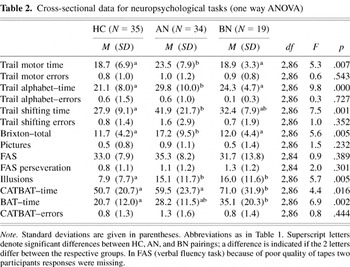
Cross-sectional data for neuropsychological tasks (one way ANOVA)
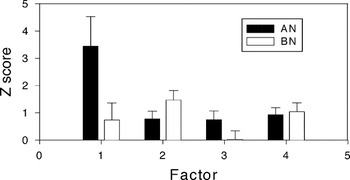
Four factors were computed and then converted into z scores. In this case, a positive z score represents lower performance from the control group. Z scores for the controls are not presented in this figure because by definition the mean is zero and the standard deviation 1 for the four factors (Key: 1 = Simple Alternation; 2 = Mental Flexibility; 3 = Perseveration; and 4 = Perceptual Shift) for the anorexia nervosa (AN) and bulimia nervosa (BN) groups (note that data for the controls is not shown because of the z-scoring technique). Standard error bars are shown.
 You have
Access
- 220
- Cited by