The oriental ballet is typically associated with modern dance, Russia, and the nonpareil dancers Vaslav Nijinsky, Michel Fokine, Anna Pavlova, and Ruth St. Denis. One of the most excerpted of all classical ballets and considered the first example of the abstract form in modern dance is the “Kingdom of the Shades” sequence in Marius Petipa's La Bayadère, featuring thirty-two ghosts of Hindu temple dancers dressed in white entering the stage one by one with a simple arabesque cambre.Footnote 1 What people often forget is that La Bayadère was a huge sensation in Europe during the romantic ballet years – the 1830s and 40s – 50 plus years before the Ballets Russes and a full generation before Petipa's 1877 production, which most assume to be the ballet's original. This and other grand operas and ballets of its kind – Lalla Rookh, Les Orientales, Le Corsair, La Peri, La Paquita, Revolt of the Harem – took romanticism beyond the pale in terms of visual extravagance; elaborate water systems were installed to depict bathing scenes and shipwrecks, and live horses and elephants brought onto the stage to add verisimilitude to the Eastern spectacle.
In his introduction to Orientalism, Edward Said uses the stage as a metaphor to discuss the ways in which the East was packaged for European consumption: rather than “an unlimited extension beyond the familiar European world,” the Orient was contained in a “closed field, a theatrical stage affixed to Europe” to cull from and put into the service of empire (63). Despite its eminence, Orientalism is often criticized for its dependence on a binary of difference that elides the ambivalent relationship between the colonizer and the colonized, a relationship that was not static but in constant flux, depending on the cultural specificity of the moment or place. My purpose is to contribute to the revision of Said's work by returning to London in the 1830s and to the real Western stage (rather than Said's metaphoric) to study the ways in which representations of an imagined India reinforced orientalist ideologies but also challenged the binary necessary for upholding them.
The early 1830s saw the rise of the Romantic ballet, which revolutionized the dance world by departing from the heroic gestures and mythological narratives of the eighteenth century to emphasize instead bodily grace and emotional pathos (under the illusion of carefully crafted naturalness). Marie Taglioni was celebrated as the embodiment of the romantic form and, as such, was the most popular ballerina in Europe, her closest rival during the 1830s being the French born Pauline Duvernay. Both of these dancers performed the role of the bayadère in Le Dieu et la Bayadère, produced collaboratively by musician Daniel Francois Auber, librettist Eugene Scribe, and Filippo Taglioni and premiered at the Paris Opera in 1830.Footnote 2 Both also performed the role in London: Marie Taglioni at the King's Theatre in a compressed version entitled La Bayadère, choreographed by A. J. J. Deshayes, and Duvernay at the competing Theatre Royal, Drury Lane in a stage adaptation by H. R. Bishop entitled the Maid of Cashmere (1833). Such cultural prevalence of the ballet, in its various versions and venues, evidences not only its popularity amongst theatregoers, but also the hold it had on the British imagination. The story, drawn from Hindu legend, tells of a young temple dancer, Zoloe (or Zelica in the Theatre Royal's Maid of Cashmere version), refusing the favors of Olifour, the Grand Judge of the city of Cashmere, because she loves a stranger, who ends up being the god Brahma in disguise.Footnote 3 When Olifour finds the two together, Zoloe sacrifices herself for her lover, and enraged, Olifour orders her death by fire. Surrounded by leaping flames, Zoloe is soon met by Brahma and the pair, wrapped in each other's arms, rise towards the clouds and enter Indian paradise. Versions of Le Dieu et la Bayadère and other oriental ballets of the 30s offered audiences the visual topoi they expected to see – dancing girls, funeral pyres, licentious sultans, eunuchs, snakes in baskets, magic bouquets, slave markets on the stage – the “false and monstrous” relics that fed European fantasies, while reinforcing the belief in India's cultural stasis.Footnote 4 The backdrops of the ballets were not accurate – a little bit of Turkey here, a little bit of India there – and ballerinas wore their bouffant knee-length tutus slightly adjusted with an eastern trim. They still danced en pointe, pirouetted across the stage, and abided by the rules of classical ballet, using sensualist elements – scarves, earrings, darkened faces – as props for representing an exotic, non-specific east.
Such artistic mélange was challenged, however, when a troupe of devadasis marketed as the “real bayadères,” affiliated with the Perumal temple of Thiruvanthipuram in Pondicherry India, visited Europe in 1838 and after spending some time in France, performed every evening for two months in London at the Adelphi theatre and twice daily for two months (the two venues overlapped during the month of November) at the Egyptian Hall in Piccadilly Street.Footnote 5 The English literati would have known about the devadasi tradition considering the high circulation of travel narratives during the 1830s that described the rituals and customs of the “Hindostan” or “Mussalmaun,” with the temple dancer a mainstay in those accounts. My aim is to examine the popular reception of the Western ballerina in her role as the bayadère juxtaposed to that of the visiting “real bayadères” from Pondicherry and to argue that the physical presence of the Indian dancer in London and on the London stage augmented an already growing interest in Indian culture beyond that of the imaginary.Footnote 6 Not only did Londoners see the Indian dancers and read about them in published reviews and commentary, but they also had actual on-the-ground encounters with them, made possible by the marketing efforts of theatre managers to promote the novelty and sell tickets. Rather than the signs associated with the temple dancer providing a pool of difference against which to construct Western ideals of beauty, femininity and artistic merit, the Indian temple dancer, as I will argue, is imbricated in that construction. A study of this moment in the history of empire and the opportunities afforded the British and the Indian visitors to meet, greet, and learn about each other serves as a reminder of the superficiality of the colonized/colonizer binary and the heterogeneity of the imperial encounter.
The Bayadère, the Devadasi, and the Romantic Ballet
Before turning to this moment in the history of empire, we must first acquaint ourselves with the origins of the bayadère story and how the devadasi tradition in India was appropriated and repackaged by poets, librettists, and choreographers for Western consumption. Goethe's “Der Gott und die Bajadere” (“The God and the Dancing Girl”) is typically understood as the primary source for the opera-ballet Le Dieu et la Bayadère; my research, however, suggests a more diverse origin, one comprised of orientalist fantasy, but also first-hand accounts of Indian cultural practices and religious mythology. Following Schlegel's directive that “it is in the Orient that we must search for the highest Romanticism” (Said 98), Goethe turned imaginatively to the East – he never traveled outside of Europe – and found inspiration for his poem from Pierre Sonnerat's Voyage to the East Indies and China, a four-volume travel account that includes a section about the “Bayadères, or dancing girls, whose true name is Devedassi . . . who devote themselves to honour the gods, in whose processions they go singing and dancing before their images” (Sonnerat 1: 29). Footnote 7 Sonnerat pays great attention to the jewels, perfume, and decorative garments of the dancers as well as their soft voices and the motion of their eyes and bodies that together create “the highest idea of voluptuousness” (30). While Sonnerat does not include Hindu legends in his account, Goethe would have been familiar with the story of Shiva visiting Earth to test the devotion of mortals, considering its ever presence in orientalist poetry, opera, and theatre.Footnote 8 In the Hindu trinity, Lord Shiva embodies the dance of bliss; he appears in religious iconography with his left foot elegantly raised, his arms out to the side, to symbolize the cosmic cycles of creation and destruction and the daily rhythms of birth and death. In one of the older Hindu myths, Shiva's wife, Sati, immolates herself at a banquet given by her father after he insulted Shiva, who was not present because uninvited. Furious, Shiva creates Veerabhadra to punish the offenders, and he picks up the pieces of Sati and dances the dance of destruction throughout the universe.Footnote 9 In later stories Shiva comes to Earth as a pilgrim and after he has gained the love of a woman, he feigns death; if she commits sati she has passed the test and gains immortality.Footnote 10
Goethe merges the devadasi figure from Sonnerat's Voyage with that of Shiva and the religious test to give his readers, in one frame, the two themes they found most troublesome and titillating: temple dancers and sati. In Goethe's ballad “Der Gott und die Bajadere,” Mehadiwa (a Shiva figure) visits a bayadère at her hut, and she falls in love with him; in the morning, to test her love, he feigns death. When he is put on the funeral pyre, she jumps into the flame, disregarding the priest's admonishments that she has no such duty or means of glory because she is not his wife and she is a dancer-prostitute. Pleased with the sacrifice, Mehadiwa carries her in his arms to heaven. Goethe describes the bayadère as having “the pretty painted face / Of a fallen woman” (13–14) and the visiting god sees “through all her corruptions and vices” to a heart “[D]eep buried . . . that's still human. . . .” (33–34). While Goethe reinforces the belief held by many Europeans that the Indian temple dancer was a prostitute, contemporary research suggests that holding the office of devadasi was considered sacred in Hindu tradition, with initiation into it a privilege determined by heredity (through the maternal line) and natural talent. The devadasi was not permitted to marry – having symbolically married God Brahma – but she could have sexual liaisons with a proper patron and protector, usually a Brahmin or member of landed and commercial elite, who helped support the temple financially. Wives of said Brahmin patrons were proud that the devadasi was affiliated with the family, and having her present at weddings and special events was considered a badge of fortune, a conduit for honour and divine acceptance. Not only was the devadasi higher ranked than the men in the religious community she was affiliated with, but she also had legal rights denied most women: any children she might have in her extra-marital alliances were legally hers, and she was educated and free to engage in business matters such as purchasing property and adopting a child.Footnote 11 The dancing girl in Goethe's poem, however, has “fallen” into prostitution and she is likened to Mary Magdalene, whose love for Mehadiwa – a Jesus equivalent – leads to her redemption: she spills “Tears till now she never knew/ . . . and confesses/An affection strange and new;/ . . . [S]eek[ing] no pleasure now nor gain . . .” (45–50). Rather than a servant of god, the bayadère of the poem is a sinner, who is absolved by god and allowed to ascend to heaven. Goethe's use of the fall and ascension theme was, no doubt, more palpable for European readers than a story of a prostitute temple dancer rewarded with heaven, without the accompanying penalty of guilt and shame.
Thirty years after the publication of “Der Gott und die Bajadere” and two years after the banning of sati in India (1829), Auber, Scribe, and Filippo Taglioni borrowed elements from Goethe's ballad but reconfigured the theme of female sacrifice to emphasize the romantic ideal rather than the culturally real sati; Zoloe allows her beloved unknown to escape the guards of the palace and as a result is captured and punished. The pyre, however, is not for sati but for public execution by order of Olifour, the Grand Judge. Even though sati was illegal, debates about it were still top of mind in Britain; as late as 1835, T. B. Macaulay was drafting the Indian Penal Code that allowed a provision for voluntary sati because it fell under the category of Hindu ritual rather than crime (Mani 25). While devadasis were exempted from widowhood and the glory of female emulation having ritually married an immortal, the spectacle of fire conflated with prostitution would have reminded audiences of the depravity of Indian practices that their role as colonizers helped to dismantle . . . despite the uncomfortably familiar resonances of Christianity invoked with the themes of female sacrifice and heavenly ascension. As with the Western ballerina, the devadasi was an ambivalent figure in the minds and imaginations of British readers and viewers: she was financially independent, she could choose her lovers, but she was also modest and graceful; both sexual other and feminine ideal, she was a hybrid figure who traversed the whore / angel binary and maintained the openness of the category woman.Footnote 12
While the collaborators of Le Dieu et la Bayadère were clearly inspired by Goethe's poetic fusion of Hindu legend and practice, the libretto suggests that Scribe also drew elements from Jacob Haafner's Reize in eenen Palanquin (1800), another travel narrative that circulated widely in Europe describing in great detail Haafner's experience living for thirteen years in eastern India.Footnote 13 Haafner includes an account of falling madly in love with a young dancer, Mamia, who dies tragically after saving him during a shipwreck, which parallels the non-sati sacrifice theme enacted in the ballet – Zoloe hides “the stranger” in her house. As punishment her house is turned into a pyre and she placed on top of it. While Mamia was a member of a troupe of independent dancers, hence not affiliated with a temple or court, Haafner includes a chapter in his book on the devadasi that was no doubt based on Mamia's insider account as well as his own first-hand experience. A staunch anti-colonialist, Haafner wanted to correct Western myths about the Indian dancer, who he wrote was not forced into marriage with the main priest of the temple after reaching puberty – a popular idea coursing through orientalist writings – nor was she a prostitute. He writes that the “main duty of the devadasis is to dance in front of the image of the deity they serve . . . and to sing in praise of the god, and about his deeds” (Bor 48). Haafner divided devadasis into two ranks: the “bhitar gauni” who performed in the inner portion of the temple before the deity and the “bahar gauni” who performed only in the outer portion (Bor 48). Zelica, the name of the bayadère in the Maid of Cashmere, is foreign, and she leads a procession through the streets of Cashmere before being brought to the palace of the Chief Judge. This aligns her with the second rank devadasi, whose training was the same as the first rank but who was free to move about and obliged to perform at important rituals and processions. Not only does Scribe infuse cultural detail into his libretto, but he disassociates Zelica from prostitution. This bayadère does not spill tears at her fallen status nor does she feel shame in the company of the stranger/god Brahma; rather, she is independent, confident, and resourceful, especially when it comes to hiding the stranger and finding him food. Like Haafner, Scribe corrects Western myths about the devadasi by departing from the redemption theme of Goethe's poem to celebrate instead female heroism, which is rewarded in the end with heavenly bliss.
Haafner not only legitimizes the function of the devadasi in his account, but he also praises the natural beauty of the Indian dancer and her affinity with nature in ways that anticipate European dance reviewers’ celebration of the romantic form and the ballerinas who embodied it. Indeed, it is quite likely that Taglioni, like Scribe, used elements from Haafner's descriptions of Indian dancers in his choreography of Le Dieu et la Bayadère as well as La Sylphide, produced two years later. Haafner writes that the devadasis love flowers and while dancing are covered with garlands of them; indeed, “one rarely sees them without bouquets in their hands” (Bor 50). The dancers have “natural beauty” and “gracefulness of . . . persona and gesture,” and their bodies are “enchanting and modest.” Their movement is “supple . . . regulated and gracious,” their steps “light and ingenious,” which Haafner prefers over European dancers with their “cold and meaningless gestures, contortions of the body and break-neck jumps” (Bor 51). Haafner also notes that the devadasis are excellent mime artists and have developed the “art to express emotions . . . to such a height” that they can portray a love story or any other theme (Bor 51). Interestingly, Haafner's description of the devadasi circulated almost twenty-five years before the premiere of La Sylphide, the ballet that dance historians agree marks the genesis of the form and pathos of the romantic ballet. In popular iconography, Taglioni and other ballerinas of the Romantic era, are surrounded with flowers – wearing them, carrying them, walking through them – to emphasize their affiliation with the natural realm. But in light of Haafner's description of the devadasis, the evocation of emotional pathos that was considered revolutionary in Europe had been a traditional form of dance in southern India for hundreds of years and celebrated as such by Western travelers.
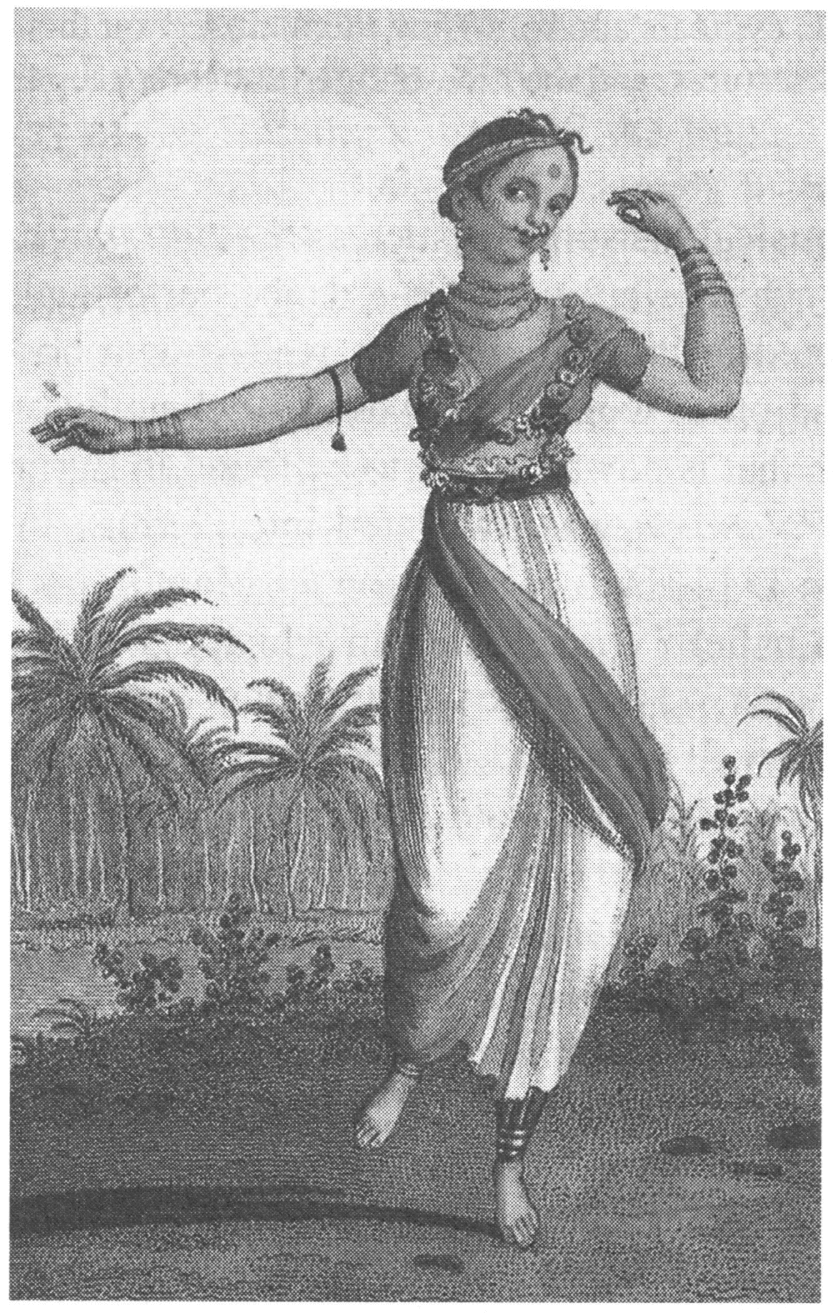
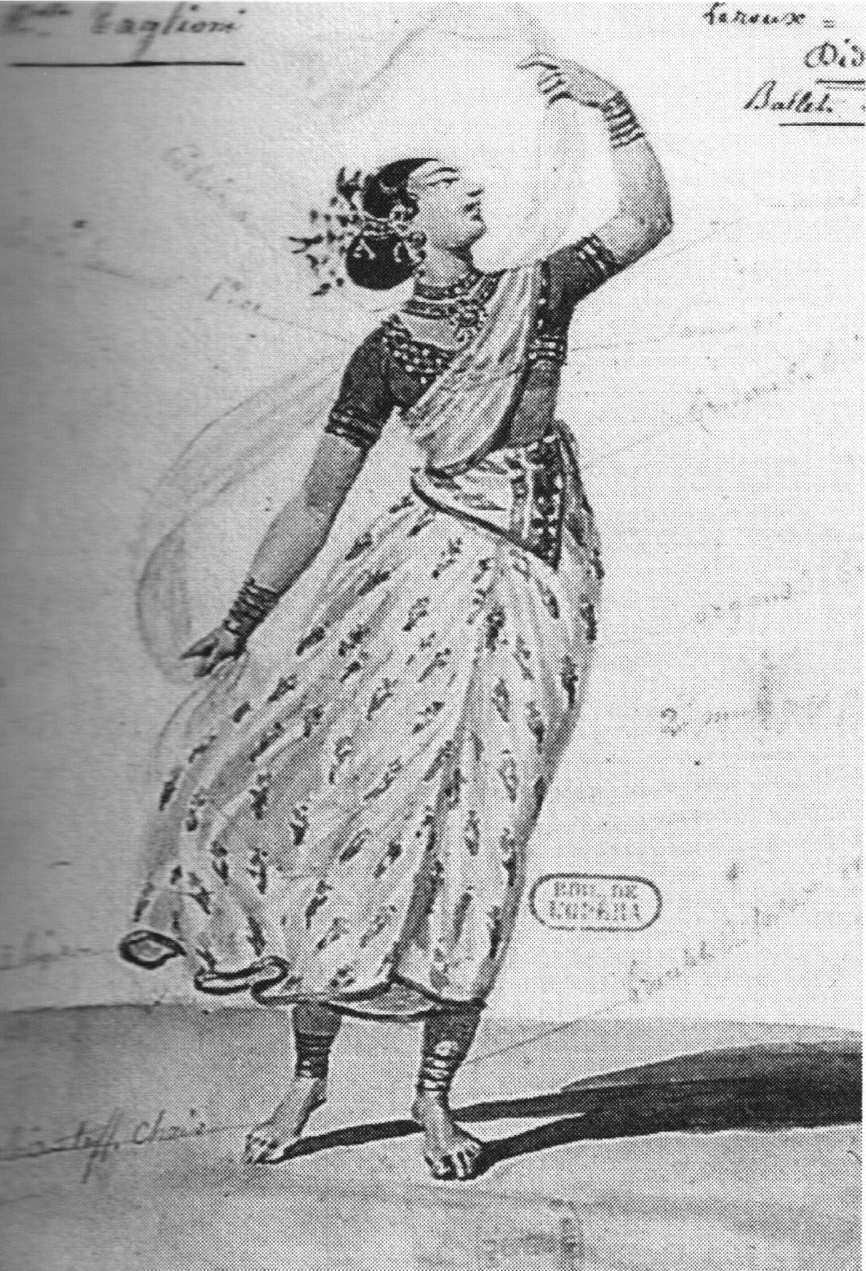
Yet if elements of Indian dance – modesty, gracefulness, emotional expression, affinity with nature – did indeed inspire the idea of romanticism, Western choreographers paid no heed to the actual gestures and bodily moves of Indian dancers, preferring instead to follow a European tradition and revise the classical forms available to them. Travel writers often included illustrations of devadasis dancing barefooted, with emphasis on bent knees and waving arms and finger work, suggesting that audiences versed in such writings would have realized the liberties taken by Western choreographers to create their own vision of the Orient (Figure 30). The “Dance of the Bayadères” in Sonnerat's text represents the dancers squatting, with legs out to the side (similar to second position in classical ballet) and fingers held in fixed positions as if signing (Figure 31). Wife of a British official in Madras, Elizabeth Gwillim, describes in a letter home to her mother the look, dress, and behavior of the devadasis she encountered first hand: “Their dancing is very little like ours. They never step upon the toes but keep the knees bent & tread on the broad sole of the foot . . . .The chief display of their skill is in the motions of the hands and arms, the air of the head & the expression of the features” (Spear, “Gods” 146). Less interested in authenticity than in invoking a mood saleable to Western audiences, ballerinas in their roles as Indian bayadères did not squat but kept their legs taut, their bodies straight, sometimes completely supported on one pointed toe, with arms adhering to the five positions of classical ballet, i.e., fixed to comply with the formality of the position. The illustrations of an early costume designed for Maria Taglioni as the bayadère, however, suggest that the designer Hippolyte Lecomte used descriptions and illustrations of Indian dancers from travel accounts as his guide (Figure 32). The model is barefoot, her features Indian, and her arm is raised in a way to suggest movement. In contrast, an illustration by A. E. Chalon of Marie Talgioni in the bayadère role shows her on point wearing a bouffant skirt, her face expressionless and her arms lowered, suggesting a preference on the part of Marie or her father for the new abbreviated ball gown that constituted, along with point work, the romantic form (Figure 33). Such appropriation of the narratives and props of Indian dance without heed to the movements or meanings behind them perpetuated an idea of India removed from its cultural origins. Suspending their disbelief, English audiences accepted the white, ethereal Marie Taglioni in her pink tights and gossamer as the embodiment of the exotic other, the Indian bayadère.
“Devadasis, Indian Dancer.” Illustration from Jacob Haafner, Reize in eenen Palanquin (1808), 218a.

“The Dance of the Bayadères.” Illustration from Pierre Sonnerat, Voyage to the East Indies and China (1782), facing 41.
Costume design for Marie Taglioni by Hippolyte Lecomte for her performance in Le Dieu et la Bayadère (1830).
One of the many images of Marie Taglioni illustrated by A. E. Chalon in her role as the bayadère. This is a slight variation of that included in a book of poems produced collaboratively by Chalon and F. W. N Bayley, Six Sketches of Mademoiselle Taglioni (London: J. Dickinson, 1831).
Taglioni's 1831 premiere of La Bayadère in London “elicited repeated thunders of applause” with the ballerina praised for her “grace and elegance personified” as well as her “spirit and vigour” (Morning Post 27 May 1831). Pauline Duvernay performed the lead in the Maid of Cashmere two years later, but while she expressed “feeling and genius,” the Morning Post wrote that she could only proximate the “consummate elegance” of Taglioni (18 March 1833). The twenty-two-year-old William Makepeace Thackeray was in the audience that first night of Duvernay's performance and his description was far more enthusiastic than that of the Morning Post writer. He recalls in later life the “thumping of his heart” when after a clash of cymbals, Duvernay appeared before the Sultan: “There has never been anything like it – never. There never will be” (Beaumont 78). Susan Leigh Foster uses the term evanescence to explain the excitement generated by the ballerinas during the golden years of the romantic ballet. Viewing pleasure derived from seeing “sensual, graceful forms coalescing, floating through space and then reconverging in new patterns. Through these pleasing designs it could construct a mood but not deliver a message. . . . these were sensibilities cultivated outside of speech. These were the fugitive occupations of desire” (197). Thackeray's description of Duvernay's performance supports Foster's claim, for what he remembers is how she made him feel when she suddenly appeared – anticipation caused by a worked up imagination followed by pleasurable satisfaction of her momentary presence – and not so much the story of a religious devotee who sacrifices herself for the pilgrim god Shiva.
The Romantic ballet was popular, in part, because it aroused feelings that were “fugitive,” i.e., not contained by story or cultural origin. It was the idea of the chase that excited audiences about La Sylphide, the story of a Scotsman who on the eve of his wedding is lured by a beautiful, lightly clad woman into an enchanted forest where his desires are heighted but never satisfied. The French ballet critic Jules Janin writes, “I know of no greater joy or more lively pleasure than seeing Mlle Taglioni dance, than hurrying after her (I will not say in her footprints, for she leaves none), than following her in spirit through the imaginary spaces where she is transported without even willing it” (qtd. in Chapman 202). The oriental bayadère, on the other hand, is not of the supernatural world but the material, caught and enslaved, a condition accentuated by her wrists, ankles, and neck being laden with jewelry. But because she is an idea of the Orient, unattainable in the West, she too fanned fugitive desires in audiences. The sylph incarnates unfulfilled desire, the bayadère temporary possession, with both, despite their difference, functioning as icons of romanticism. As Lisa Lowe reminds us, the close “associations of orientalism with romanticism are not coincidental, for the two situations of desire – the occidental fascination with the Orient and the male lover's passion for and pursuit of his female beloved – are structurally similar. Both depend on a structure that locates an Other – as woman, oriental scene – as inaccessible, different, and beyond” (2).
But in the ballet, the idea of two situations of desire does not quite work, since Marie Taglioni embodied both the oriental bayadère and the romantic sylph; not only did the premiere of La Sylphide (1832) come shortly after that of Le Dieu et la Bayadère (1830), but sections of these two ballets were often included in the same night's program. Such collapsing of different desires into one bodily form is best expressed in a commemorative book about Taglioni that circulated in the early 1830s, produced collaboratively by artist A. E. Chalon and poet F. W. N. Bayley. The poem accompanying the before-mentioned illustration of Taglioni as the bayadère begins with “Light and lovely Bayadère/Gentle too, as thou art fair . . . All the Graces wait on thee/As thou wert their divinity!” (Bayley and Chalon 4). She's lovely, she has honey on her “nectar'd lip,” she's light, “spring[y]” and the poem ends with a merger of the two terms, “Laughing and sylph-like Bayadère!” The orientalized Indian dancer, in other words, was not Other to a Western ideal but a different version of the same thing, the binary necessary for knowing Western femininity temporary eliminated. As a result, Taglioni, the Western ballerina, whose popularity derived, in part, by her ability to stir and satisfy a range of desires particular to a European consciousness, became the model for determining artistic merit in representations of the Indian dancer. As the bayadère, Pauline Duvernay, for example, didn't quite measure up, not because she lacked expression of “true feeling and genius” while performing the shawl dance, but because she was found wanting in the “consummate elegance of Taglioni” (Morning Post 18 March 1833).
Such a closed referential system was challenged when the real bayadères performed in England, which not only fueled interest in Indian culture but also fused the ballet back to its Indian origins. Reviews praised the devadasis for their grace and elegance; however, the signs defining these characteristics were radically different from those assigned the ballerina. Unlike the light and ethereal ballerina who bounded soundlessly across the stage, the devadasi pounded her feet against the floor, the jingling of her ankle bells accompanying the rhythm established by the drums. Rather that taking flight or performing as the eternal tease, the devadasi looked directly at her audience, using her eyes, fingers, cheek, mouth, neck and nose to convey a message and a feeling of religious rapture.Footnote 14 As I will show in the next section, the devadasis’ visit to England complicated the construction of femininity being codified discursively in the ballet reviews of Taglioni and Duvernay during the 1830s. Not only were these foreign dancers the real thing rather than a Western construction of an imagined India, but also the signs associated with them in the rhetoric of the reviewers were a compilation of Western codes of femininity – modesty, grace, and beauty – and Eastern codes – religious bliss, sexual agency. The result of the devadasis’ visit to England was a temporary erasure of the East/West divide necessary for upholding Westerns standards of beauty, femininity, and artistry to create in its stead a contact zone for cultural exchange.
Extending the European Familiar
What made it possible for the English public to see the devadasis first hand and form a point of comparison between Western and Eastern dance practices was the fierce competiveness between theatre directors, who had to work overtime to keep their theatres financially stable. Audiences were fickle and they demanded novelty, their tastes and preferences for artists changing from one performance to the next. Ballerinas were a primary attraction during the 1830s and 40s and to be competitive, managers had to pay them exceedingly well to get them under contract for a season. Taglioni's five-year contract with the Imperial Theatre in St. Petersburg was big news across Europe, and in England Alfred Bunn proudly advertised his securement of Duvernay for 500 pounds a month during the Theatre Royal, Drury Lane's 1833 season, which included performances of the Maid of Cashmere.Footnote 15 Why he changed the name of La Bayadère to the Maid of Cashmere is open to speculation, but more than likely it had to do with marketing. Because the titular role was so closely associated with Marie Taglioni, Bunn needed to lure audiences with something new, which he did with Duvernay as well as with the cashmere reference in the title. Orientalist poetry often was set in this northern part of India and English readers associated “the vale of Cashmere” with beautiful women.Footnote 16 The program for the Maid of Cashmere, which includes the entire sixteen-page libretto and was available for purchase in the theatre lobby for ten pence, opens with an epigraph from Thomas Moore's extended poem Lalla Rookh that begins “Who has not heard of the Vale of Cashmere / With its Roses the brightest that earth ever gave.” Not only was cashmere a lure, but possibly too was the “maid” of cashmere, providing a religious cover for a story about a sexually independent woman who chooses her love object. During the run of the Maid of Cashmere Felicia Hemans produced a new translation of Goethe's poem entitled “The Hindoo God and the Bayadère” that she claims to be “the original of Taglioni's beautiful Ballet . . . and an English Opera now performing . . . under the name of the “Maid of Cashmere.” In the preface of the poem Hemans writes that “[bayaderas] are remarkable for their beauty and accomplishments, but belong to a low and despised caste,” but she doesn't determine who exactly despises the dancer. Obviously, it is not Lord Shiva considering that she gains his favor by dancing around him “in circling mazes . . . Hovering as on angel's wings” (ll. 46–47, 212) before making love to him all night with “Gentle cares and courteous favors” (ll. 57, 212). Footnote 17 The content of the poem and its direct link to the opera-ballet would have alerted audiences to the sexual promise located behind the veil of the innocent and pedestrian “maid” of the opera-ballet's English title.
While Heman's new translation of Goethe's ballad added to the excitement surrounding the story of Shiva and the “maiden” temple dancer, so too did the knowledge that the real bayadères would soon be in London. Three months before their appearance, Marie Taglioni performed the role of the bayadère at the King's Theatre (July 1838) to an audience unusually animated. Because theatre managers fretted about expenses, they oftentimes oversold tickets to ensure a profitable return, which is what happened on this night. Theatre manager Pierre Francois Laporte privately admitted people into the pit so that when the doors were finally opened, ticket holders had no place to sit. The confusion and pressed crowds were so great that about a hundred people, including women, were handed up onto the stage where they remained until the performance's conclusion at around 2 a.m.! Queen Victoria arrived at the theatre, but left without entering her box because of the confusion (“Her Majesty's Theatre”).
But such Taglioni fandom was eclipsed by the arrival of the real bayadères in London; the fugitive desires stirred in the minds of theatregoers by evanescent sylphs and enslaved bayadères was supplanted with a desire to see the real thing. Novelty was the name of the game in theatre marketing and it was Frederick Yates, Adelphi Theatre manager, who earned the prize for exciting audiences with something new and curious with his showcasing of the devadasis of Pondicherry at his newly renovated theatre. The public relations he initiated to generate interest in the dancers soon developed into a journalistic frenzy with accounts published daily about the temple dancers from India that the English public sought to better understand. It all began with the French impresario, E. C. Tarvidal, making a trip to southern India and contracting five temple dancers and three musicians affiliated with the Perumal temple in Pondicherry for an eighteen-month engagement in Europe.Footnote 18 Yates made a big to do in the London papers about traveling across the channel and signing the devadasis for a fourteen-week engagement in London, beating out the contenders Laporte of the King's Theatre and Macready of Theatre Royal, Covent Garden.Footnote 19 A dramatization of this marketing coup, with Yates playing the lead as, well, Yates, was what initially opened the devadasis’ performance at the Adelphi. During the dancers’ stay in France, Yates advertised daily in the Morning Chronicle, Times, Morning Post, and the papers included as well sneak-preview accounts written by London correspondents in France about the dancers: how they looked, what they ate, the Hindu rules they adhered to, what they thought of Europe, how much they were paid. Rumors circulated that the dancers were imposters, English shop girls who dyed their skin with licorice, followed by verification of their authenticity; papers carried stories about the many lovers of the dancers, who were so distraught about the impending loss that they jumped off the pier in Pondicherry to swim after the boat. Even the contract Yates signed with Tardival was included in its entirety in the Morning Post.Footnote 20 A few days after landing at Bordeaux, Tardival arranged a performance of Le Dieu et la Bayadère in the devadasis’ honor; the English papers described the dancers crying out “Attcha! Attcha!” in praise, but expressing distress later over the pirouettes and French moves, which the oldest of the troupe, Tille Ammal, was said to have called “licentious” (Morning Post 9 August 1838). The devadasis performed before the royal family, who presented them with a basket of flowers and fruit. Ladies of rank visited the dancers at their lodgings with offerings of pastries and liquor, which rather than consuming the dancers stored away in a musician's leather bag (Morning Post 3 October 1838).
Much of the newspaper commentary about the visiting dancers was light-hearted and fabricated, as if part of the novelty was the humor derived from mishaps or confusions between participants from both sides of the divide.Footnote 21 The Morning Post was there when the steamer arrived from France and the writer describes the dancers as looking a little sea sick and “dowdy” in their woolen socks and “cumbrous cloaks” but who will undoubtedly “float in the air like sylphs when displayed in the costume of gauze and silver” (29 September 1838). Such insider accounts temporarily removed the exoticism surrounding the eastern dancers by emphasizing instead their ordinariness that the stage apparatus will soon correct. Day by day accounts of the dancers’ routine appeared in the papers: their need for special foods and sacred vessels for cooking; Yate's lodging them at his own home for convenience sake; their morning ablutions to God and their singing and sleeping. Cooking, eating, praying, singing looked like idleness to one writer who concludes that “[t]hey do not know how to do anything, and they do nothing,” but their health, nonetheless, is “not injured by idleness” (Morning Post 3 October 1838). Such publicity efforts succeeded in raising the excitement barometer to such a pitch that on the night of the London premiere, October 1, 1838 the house was “crammed in every part, entrances completely blockaded long before the opening of the doors audience.” The audience “could barely contain itself”” (Morning Chronicle 2 October 1838). What audiences wanted was to see the dancers, to compare the imagined other of the Romantic ballet with the real thing, the novelty being as much about their faces, bodies, and costumes as their actual dancing.
But for dance critics who depended on the language of romanticism to review oriental ballets, that curiosity was tempered by a degree of dread about reality compromising the imagined India of the stage. In France, poet and critic Theophile Gautier was one of the first to see the devadasis dance and he asserted in his reviews that they were not only charming but also “unimpeachably authentic” (41). Gautier was invited to a private performance before their premiere in Paris and he describes his feelings while waiting for their entrance. He writes: “Only a door now separated us from the realization of one of our life's dreams, one of our last poetic illusions, and we felt strangely moved, half in expectation, half in anxiety” (40). Gautier's life dream, his fantasies of an imagined India, are about to be fulfilled (or shattered) with the material presence of the real thing. Considering that reality – authenticity – has an ugly habit of thwarting anticipation, killing desire, Gautier's anxiety is understandable since the illusions are what fuel his poetic sensibility. Not surprisingly, in his review of the performance Gautier writes very little about form and movement but goes into great detail about the dress and jewelry, bodies and body piercings of these Indian dancers, the latter of which he compares to European women. He admires the face and mouth of the eighteen-year-old Amani – even more radiant than a European mouth – but he doesn't like the blue-dyed gums and outlined teeth that produce an “alien, Asiatic character.” Her ear holes are enormous enough “to put one's thumb through – and the pierced nose “barbaric,” but the latter, he admits, soon acquires a “depraved and piquant grace” (42). It is the eyes that most intrigue him. When the dancers rise from their salaam, they “display the whites and blacks of the eyes” with a little wiggle of the body that he says defies description. The eyes are “incomparably beautiful and brilliant . . . like two jade suns revolving in a crystal sky” with a transparency, a limpidity, a creamy, velvety brilliance, a sensual, exotic languor that are beyond one's power to imagine (42). The “rolling of the eyes,” the “prodigious winks in which the whites and darks of the eye vanish” seem to baffle Gautier as do the head movements which he compares to a “bird regurgitating,” graceful perhaps, but “incomprehensible to [his] eyes” (49). Gautier's comparison of the Indian dancer with European women and his refusal to adjust his Western standards to comprehend the Indian dancers’ eye and body movements suggest a need on his part to maintain the binary between Western/Eastern woman.
Inderpal Grewal partially explains this impulse in her application of Edmund Burke's taxonomy of the sublime and the beautiful to the expansion of empire and the racialization of the colonized “other.” Burke saw beauty as a feminine quality, but it could not belong to a woman who was not white. A black woman could only arouse a feeling of terror, placing her in the category of the sublime; but a beautiful woman earned the distinction by being “restful and amiable” and having the “softer virtues; easiness of temper, compassion, kindness and liberality” (30). The exterior appearance of a woman should match her inner moral qualities, with the eye a window to that interior. According to Burke, the eye should be “clear and transparent: like diamonds, clear water, glass” (qtd. in Grewal 30). A woman could not be beautiful without optic transparency because such lack would suggest mystery, deceit or the possession of faults that her eyes were shielding. Gautier describes the devadasis’ eyes as beautiful as well as transparent and limpid – meaning open, intelligible – which aligns with Burkean beauty; but he also describes them as creamy, with a velvety brilliance and a sensual, exotic languor as they roll about and wink, displaying not only the whites of the eye but the dark. Such ambiguous language suggests that Gautier's belief – that the principal quality of a dancer is beauty – is being challenged by the visiting Indian dancers. By concluding that the dancers’ eyes and body movements are incomprehensible he recovers himself ideologically by aligning the Indian dancer with the sublime, her body a deceitful maze that defies understanding.
While the French Gautier claims that the devadasis’ bodies “def[y] description,” the English critics tend to be more straightforward, even open-minded in their accounts of the dancers. According to Binita Mehta, the French were less interested in knowing India because they did not have the colonial motivations of the British. With the signing of the Treaty of Paris in 1763, France surrendered all its Indian territories to the British, and while Pondicherry was returned to the French in 1816 after the Napoleanic Wars, the colony, like all of India, continued to be under the complete control of the British. As a result, according to Mehta, India proved to be too different for the French subconscious to assimilate, and so became shrouded in mystery and romance. As a result, the French made India into an attractive venue in which to “freely exercise their imaginations and create an India based on a remembered reality, or on a reality that had perhaps never really existed at all” (20). The British, on the other hand, had more political motivation to learn about the real India through travel or through reading travel accounts and histories; their accounts suggest more openness toward recognizing beauty from a different set of cultural codes than those offered by Burke. Robert Montgomery Martin, for example, writes in his History of the British Possessions in the East Indies (1837) that “[i]n spite of the disadvantage attendant upon the colour of skin, perhaps no part of the world can present a more perfect specimen of feminine beauty than are to be found in Hindostan.”Footnote 22 He describes the women's “soft expressions,” their “fine erect forms, set off by the graceful drapery,” their delicate hands and feet and “splendid dark, gazelle-like eyes” (289). A story appearing in Fraser's magazine in 1838 included a first-hand account of Indian dancers, who the writer described as “full of grace and beauty, and to an accustomed eye, no doubt hav[ing] great charms” (730). In a review of the Pondicherry dancers the Morning Post likewise acknowledges that the western standards of beauty are not universally true but shift according to geographic specificity: “[The Pondicherry dancers] do not, of course, answer to our standard of beauty. Their colour is too deep to satisfy European taste. But once admitting that a brown woman can be beautiful, we must feel that these girls have high claim to that distinction” (2 October 1838). Even the troublesome nose ring is explained in the Morning Post as “part of the national ornament, and thus cannot be dispensed with” (2 October 1838).
A writer for the Courier de Bordeaux in France praises the dancers for what he calls their “art of ogling,” a talent he prophesizes that all the coquettes of Paris will soon be taking lessons in.Footnote 23 What this French writer and Gautier fail to understand is that Indian dance is an art, indeed an art of semiotics using signs encoded through the eyes, as well as the hands and feet for the purpose of conveying feelings and telling stories translatable to the literate and/or trained dance professional. In her comprehensive book on Indian dance, Enakshi Bhavnani devotes sixty pages, including diagrams, to illustrate the thirty-one single hand gestures and twenty-seven combined hand gestures of “Dance Speech” from the Sanskrit Treatises on the Classical Dance. Evolved from a basic foundation or alphabet of postures known as Karanas, whole conversations can be communicated with finger formations, with added meaning derived from subtle wrist and arms movements coordinated with the rhythm from the drums and cymbals. There are nine facial expressions and twenty-four head movements; what Gautier described as a “bird regurgitating” (49) – the head moving from front to back, would have signified to the literate “You and I, swinging, talking, explaining.” The rolling eyes, which bewildered Gautier, signified, when side to side, “looking at things on both sides,” when up and down, “anger, or friendly invitation.” Bhavnani includes twenty-six eye movements, six eyebrow movements, four neck movements and it gets even more complicated when you add music and foot work; plus the fact that meanings change depending on combinations of the above and the school of dance, of which there are many.
Unlike the French writers, the English seem to realize that the Indian dancing is not “utterly incomprehensible” to those literate in the interpretive codes. As colonizers and travelers, the British were more prone to be aware of the ceremonial context of the Indian dance and appreciate the emotions being conveyed through the eyes and bodies of the dancers, which in some cases they compared favorably to the ballerina. The Morning Post writes that the devadasis
do not resemble in the least our European dancers. . . . They form no pirouettes, cut no entrechats, nor bound like Taglioni or Fanny Elssler. Theirs is truly the poetry of motion. They speak a language in their dance. Their animated countenances and expressive eyes respond to the magic of their gestures. The arms, feet, and every portion of the pliant frame undulate to the same idea. (2 October 1838)
Another reviewer describes Soundirom, a favorite with many European viewers, as a menace threatening to “to eclipse Taglioni and Elsler (sic) outright” (Examiner 12 August 1838). And another complains that while the dance of Europe is “insufferably tedious,” the body cold and constrained, the head moving with mechanical precision, and the mouth wearing the eternal smile, the bayadères “dance with their whole frame. Their heads dance, their arms dance – their eyes, above all, obey the movement and fury of the dance. For them each dance is a poem” (Morning Post 3 October 1838). In other words, the dancers are not only different from the Western ballerina, but they are superior – their dancing replaces Taglioni's as the poetry of motion and, in accordance with the laws of romantic unity, every portion of their body undulates to the same idea. Rather than “ogling,” their eyes “speak a language” that the writer recognizes but is unable to interpret. Similarly, the Standard notes the dancers’ “extraordinary diversity of expression,” while the Morning Post describes their eyes, not as velvety and liquid, but as “bright and so intelligent.” Indeed a writer for Chamber's Edinburgh Journal describes Indian dance as “more [my italics] intellectual than western dance: Its motions are intended to illustrate the sentiments being conveyed in the words” (“The Dancing Girl” 99).Footnote 24
The general public likewise recognized a language system in the movements and gestures of the dancers and understood that the meanings being imparted were sacred. A letter addressed to Yates and published in the Morning Post requested that he include a key in the playbill so that audiences could better “understand what has been the mode of worship in the vast Eastern world nearly throughout the whole vita of ages known and forgotten” (18 October 1838). The writer goes on to say that the opportunity to see the sacred gestures of the dancers to their gods is “worth the while of every enlightened person.” The Brighton Herald admires the dancers’ “high antiquity and embod[iment of] religious feelings and passions” (6 October 1838) while the Salisbury Guardian admonishes the public for not knowing more about India and its culture. The writer aligns the performance with “transcripts of the manners of a nation of which, though we have been connected with them many years in commercial relations, we know very little and ought to be seen by all persons who are fond of tracing the diversities of human nature and the peculiarities of habit” (2 October 1838). Discourses such as these suggest that the English public wanted to learn about the devadasis outside the orientalist frames of the Western stage, in part because of the commercial relationship between England and India, but also because they felt an interest in the “peculiarities of habit” of a different culture.
Yates, on the other hand, was less interested in creating a stage for cross-cultural sharing than for selling tickets and turning a profit. To include a key for helping audiences understand the dancer's language would have involved research, which he probably had neither time for nor interest in, and it would also put the English in a position of inferiority to India because of their illiteracy in a Hindu language they sought to understand. If seeing and being able to interpret the devadasis’ dance will help to enlighten British audiences, which the Morning Post writer suggests, what happens to the binary that casts the British as already enlightened in contrast to the inferior, primitive, monstrous Indian Other? In his work on dance, gender and culture, Ted Polhemus writes that “[d]ance is a stylized, highly redundant schema of a people's overall physical culture which is itself the embodiment of that particular people's unique way of life – their culture in the broadest sense of the term. Dance is the metaphysics of culture” (8). As Lisa Arkin and Marian Smith's research shows, national dance was tremendously popular during the 1830s and 40s, on the stage and in the ballrooms of the middle classes. In one of his many treatises on dance, ballet choreographer and dance master Carlos Blasis tells professional dancers that they must become “servile imitators . . . of dancing peculiar to different countries, giving their attitudes and movements the true national stamp of the dances they performed” (qtd. in Arkin and Smith 31). But considering that India was a colony of England, it was problematic for the British to become its “servile imitators”; the idea was for Indian to become westernized, not for the British to turn to India for purposes of enlightenment or for new modes of corporeal expression.
Helping to maintain Britain's position as the natural ruler of India, whether purposeful or not, Yates marketed the dancers as a curiosity, a novelty rather than a metaphysics of India's culture. While performing in France the dancers followed the sequence of Bharatanatyam, the classical dance tradition practiced in South India that they used in their own religious practices. Yates, however, built orientalist frames that he changed from time to time and inserted the five or six dances of the Bharatanatyam into them. Following the before mentioned prologue about Yate's coup in outsmarting the competition, for example, was a one-act burletta pared down from the popular English play The Widow of Malabar about an English officer in love with an Indian widow who is about to commit sati; her servant alerts the officer and he comes to her rescue. In the midst of this narrative the devadasis performed their own spiritual, amatory dances, including the “Law of Brahma” or “The Hindoo Widow,” in front of a painted temple backdrop, filling the orientalist frame with color and verisimilitude. Janet O'Shea claims that the bulk of bhakti poetry used in Bharatanatyam expresses “religious longing through idioms of amatory desire. Moments of contact with the divine compare with the rapture of sexual union” (113). Not only were the dancers performing outside of a religious context – on a Western stage rather than before a God in a temple – but also their expressions of rapture and sexual union (if they were able to express such emotions in a commercial setting) are framed by a humorous burletta featuring an English colonizer as hero. Such framing was offensive to some in the audience; the Morning Chronicle praises the bayadères as graceful and interesting, who “give the most distinct expression of all the various emotions of the soul which they are intended to exhibit”: but the writer criticizes the burletta as “a tiresome affair” and adds that “Mr. Yates would do well to abridge it materially” (2 October 1838). While the devadasis were for the most part received enthusiastically, a few reviewers referred to their dancing as “monotonous,” and on opening night a group of concerned moralists initiated a hissing campaign to express fears of the baneful effect of these “temple prostitutes” on “the morals of the spectators.” Defenders of the devadasis’ morality not only out clapped the critics’ expression of disapproval, but they blamed the event on the “prurient imagination of the religious minded” (Standard 1 October 1838). In efforts to correct stereotypes, writers emphasized the cleanliness of the devadasis and their chaste demeanor and high caste. The Era included a traveler's account of the Hindu temple dancers concluding that against popular opinion, the devadasis do not lead profligate lives and are not looked down upon as disreputable but “are infinitely superior to the ladies of the corps de ballet at home (14 October 1838). While popular attitudes toward western ballerinas oscillated between moral registers – from morally pure to sexually promiscuous – reviewers typically celebrated the ballerina as the embodiment of femininity and romanticism collapsed into one form.Footnote 25 But if the devadasis are cast as superior to the ballerina, then so too are the feminine codes inscribed in their gestures, making the Indian woman the model of femininity and the Western ballerina a poor imitation of the real thing.
The Curtain Drops on the Devadasis
Positioning the Indian bayadère as superior in “consummate elegance” and morality to the Western ballerina could not hold in a political environment growing increasingly aggressive about Britain's role as colonizer; through the course of the decade, the colonizing mission shifted from being about restoring India to its golden age to reforming India and pulling it out of its cultural stasis (Collingham 51). One result of this shift in attitude is that once the devadasis departed London to begin their tour of the English provinces, news coverage about them all but stopped. The last newspaper account I found about the devadasis is a humorous note in the Morning Post that upon arriving back to France, the first inquiry out of the dancers’ mouths was whether or not there was a boat in the harbor ready to sail them back to Pondicherry (25 September 1839). Rumors circulated, unfounded, that Amani committed suicide, suggesting that her travels through Europe were too hard on her Hindu sensibility (or the writer was making a wry allusion to sati). To imaginatively kill off Amani might have been a way for the English to forget the effect of the Indian travelers on their own notions of superiority. What is remembered about the devadasis is the mounting excitement about the visit followed by flagging interest once the novelty wore off, as well as the money Yates lost in the venture. According to Frederick Yates's son in the biography he wrote about his father, the dancers were “utterly uninteresting, wholly unattractive.” Yates lost 2000 pounds, and the family referred to the dancers as “Buy-em-dears” (Yates 52). In retrospect, this failure was at least partially due to Yates's inability to read his audience and its wants. After the first month of the Adelphi run, the French Tardivel who first contracted the devadasis for their European tour, entered the London scene and financed exhibitions of the Indian dancers at the Egyptian Hall in Piccadilly twice a day during the afternoon, for a month running concurrently with the Adelphi evening performances. Owned by William Bullock, the Egyptian's niche was the display of curiosities, such as the historical relics brought back from the South Seas by Captain Cook, but also people. The Siamese twins were exhibited at the Egyptian in 1829, and Charles S. Stratton, known as the American dwarf “Tom Thumb,” appeared in 1844. Unlike the Adelphi, the Egyptian allowed a closer proximity between viewer and the Indian spectacle and it attracted non-theatre goers, young people and even children, who, toward the end of the run, could afford the lowered one-shilling entrance fee.
The Pondicherry dancers followed their own sequence at the Egyptian – no Western framing – and they included the “Carrier Doves” dance that had culminated their performance in France to the delight of audiences, but that Yates excluded from the Adelphi run. Taking advantage of Yate's marketing oversight, Tardival promoted the “Carrier Doves” in his newspaper advertising under the assumption, no doubt, that it would draw English audiences considering their love for magic and tricks of the eye.Footnote 26 While Amani recited a sad tale of love and betrayal, the other two dancers, Ramgoun and Saouundiroun, whirled around “with frightening speed,” and as they “crumpl[ed] and torment[ed] between their fingers” a white sparkling scarf, a bird slowly emerged from the middle of the twirling followed by a nest and palm tree (Gautier 45). In Paris the dancers would then present the folded dove to ladies sitting in the boxes, and it is likely they did the same at the Egyptian in London. The “Fashionable World” section of the Morning Post obviously preferred the Egyptian exhibition to that of the Adelphi theatre, writing that the “persons complexions, attitudes, and costumes of the dancing priestesses [were] seen to much more advantage by daylight in a room than on the stage by gas light The dancers walked amongst the visitors after the performance allowing the curious to inspect their jewelry and dresses and they conversed with people who knew their native language and spoke in broken English with those who didn't.Footnote 27 The Morning Post advises management to provide more seats and take greater care to clear the room immediately after the first performance so as not to impede the entrance of the second audience. Footnote 28 While the profitability of Tardival's exhibition is unknown, the fact that he added an evening performance once Yates dropped the devadasis from his repertoire and kept adding seats suggests that his venture was a popular money maker. Perhaps Londoners preferred the less restrictive, more affordable packaging of the visiting Indian dancers because it allowed them to go behind the veil of orientalism and have an on-the-ground encounter with representatives from the real India.
Such encounters, coupled with the comparisons being made discursively between the faces, bodies, and gestures of the Indian dancer and those of the Western ballerina challenged Western superiority as coded in the ideologies of beauty and standards of dance excellence. For some, the Indian dancer was superior, for others she was immoral, her dancing tedious, and for others she was aligned with the sacred world, hence her dancing more spiritual, more real than the romantic illusions created by a Taglioni or a Duvernay. In other words, the Indian dancers’ presence in London and on the Western stage aroused a range of competing responses, which interfered with orientalist fantasies of the Eastern temple dancer. While research suggests that theatregoers lost interest in the devadasis toward the end of their stay and conveniently forgot them once they departed from London, I suggest that their presence in Europe had a lasting effect on the development of the Romantic ballet and the modern form. While William Makepeace Thackeray makes no mention of the devadasis in his travel account of the eastern Mediterranean written six years after they departed from London, Gautier in his later reviews of Marie Taglioni in the role of the bayadère can't seem to get them out of his mind. While there is no evidence that Thackeray saw the devadasis perform in London, it seems likely that he did considering his about-the-town status in London and his affiliation with the Morning Chronicle in the 1840s, which was one of the primary carriers of the devadasi story. As Thackeray's ship advances toward the Golden Horn in its entrance to Grand Cairo, he compares the fog obstructing his view of the real thing to the gauze curtains of the theatre, remembering how like the fog, they slowly “lifted away, one by one, before a great fairy scene” (63). He compares his excitement about finally seeing the city when the fog lifts to Drury Lane and the “thrill of pleasure, and . . . fullness of sensual enjoyment” at finally seeing Pauline Duvernay appear with a “clang of cymbals” (63).
We have a complete reversal with the French Gautier, who, also six years later, watches Marie Taglioni perform the lead in Le Dieu et la Bayadère at the Paris Opera. Rather than effusing over her spirituality, femininity and beauty – as he did before the devadasi visit – he devotes almost the entire review space, not to the performance he is viewing, but to his remembrance of the visiting bayadères. He playfully chastises French audiences for not appreciating the “genuine article” having accepted Taglioni as the “typical” bayadère. He writes that the “white gauze tutus and delicate pink tights were too much for the gold-striped trousers and the spangled brassieres of the bibiaderis, who were not forgiven for being as yellow as a tobacco leaf from Havana, nor for their wonderful eyes, in which ebony stars seemed to float in a crystal firmament” (135). The eighteen-year-old Amani holds a sacred place in Gautier's imagination and, not surprisingly, what he remembers most are the wonderful eyes. He can't interpret them nor does he want to try – but he can abstract them into poetry: Rather than rolling or winking, these eyes are as “ebony stars floating in a crystal firmament.” While in the reviews before the devadasis visit, ballet critics compared Taglioni to Elssler or to Duvernay, this critic expands his perspective beyond Europe to use the Indian dancer as the model rather than the idea of the romantic bayadère.
Not only was Gautier's aesthetic sensibility influenced by the devadasis, but so too were those of Western ballerinas, who began to experiment with expressive movement and complicate the romantic form. Fanny Elssler, ballerina and rival of Marie Taglioni during the 1840s, did not begin to attain high fame and status until 1838 after developing a dancing style described as fiery, playful, and saucy, very different from Taglioni's sublime/ethereal. Critics loved Elssler's mime ability and her dramatic power and she, more than the other great dancers of the era, helped to popularize national dance on stages and in ballrooms across Europe. Indeed, dance historian Lisa Arkin considers Elssler's “bold thrusting movements” in her role as La Cachucha to be “one of the pivotal stylistic directions that helped to define Romantic ballet” (317). Elssler saw the devadasis dance while they were in Bordeaux and that performance included the “Carrier Doves” dance that Gautier prophesized would be a “roaring success, matching that of [Elssler's] Cachucha” (45). He describes how the dancers assume poses of “profound melancholy and voluptuousness” until they begin to lift their arms and “dreamily throw them back before allowing them to fall langourously” to their sides (45). While Gautier does not yet have the vocabulary, the slow lifting of arms and their “languorous” fall suggests “undulation,” a term picked up later in the century to describe the relaxed arm work of modern dancers, who departed from the structured techniques of classical ballet in favor of a more free style of dancing, with emphasis on emotion rather than narrative. An observer of Elssler dancing La Cachucha toward the end of her career (1880s) notes the “graceful and expressive inclinations of her head and body and such rounded and undulating movements of her arms” [my emphasis], suggesting that Elssler's new style was partially inspired by the Indian dancers she saw perform in 1838 (Arkin 317). The devadasis used a large scarf as a prop for the “Carrier Doves,” which, as before mentioned, they folded into the shape of a dove while “spinning around with frightening speed” (Gautier 45). Gautier compares the Indian dancers to Elssler, celebrated in Europe for her “fiery speed” and her use of a scarf. To build excitement for Elssler's 1840 premiere, Paris Opera director Louis-Desire Veron covered Elssler with a veil so that when the curtain raised, audiences saw a form completely covered and standing alone, center stage. Elssler describes the experience in a letter to her friend Mina: “The house was silent, and almost breathless with expectation; my veil was thrown back and instantly every opera glass was leveled at my devoted head . . . with the intensity of the gaze, so fixed and piercing.”Footnote 29 Not only did the western choreographers and dancers borrow steps, gestures, and emotional expression to add novelty to their own performance, but such novelty also contributed to the development of modern dance. Gautier's immense oriental ballet Sacountala (1858) was inspired by the “impeachably authentic” Indian dancers; interestingly, the ballet was choreographed by Lucien Petipa, whose brother Marius, is often credited with initiating the modern form in his 1877 revision of La Bayadère mentioned at the beginning of this article. In other words, while the devadasis might have been forgotten by the general public, the effect they had on ballerinas, dance critics and choreographers is preserved in the emerging aestheticism of modern dance.
The Demise and Rebirth of the Indian Devadasi
By conveniently forgetting the devadasis once they departed England, the British public indirectly enabled the smear campaign against the tradition instigated by reform lobbyists – missionaries, doctors, journalists, administrators, and social workers – later in the century. The Anti-Nautch campaign of 1892, strongly influenced by Christian moralists, conflated all dance practices under the heading of prostitution, the consensus being that abolishing all ceremonies and procedures involving young girls dedicating themselves as devadasis to Shiva or whoever would support imperialism on the grounds of its civilizing mission.Footnote 30 According to Amrit Srinivasan this campaign was further advanced during the 1920s by Indian populations; the Dravidianist non-Bhahman activists used the devadasi as an example of the superstition of Hindu religious practice that maintained class dominance and exploited the lower castes. The menfolk of the devadasis community stood to gain politically and economically by the legislation as well and advocated abolishment of the practice.Footnote 31
When Western dancers Anna Pavlova, Ruth St. Denis, and Indian modernist dancer Uday Shanker traveled to India in the 1920s to train in its classical dance tradition to make their representation of the bayadère more authentic, they found that the Bharatanatyam had moved underground and was no longer being performed publicly. Together, the small community of Bharatanatyam dancers still remaining and these Western dance modernists worked to validate the dance, describing it as a high, autonomous art that expressed creativity and engaged with serious intellectual and philosophical concerns.Footnote 32 O'Shea writes that the revival “positioned the dance practice not as a ritual activity associated with temples and courts but as an urban, global art, crosscut by concerns of local, regional, and national identities” (8). Because national dance is never pure or authentic but always a mixture of shifting populations and political and aesthetic agendas, the recovery of a dance form to speak the nation is often riddled with ironies. For example, Argentinean nationalists embraced the lost tango as a symbol of the new nation, when, in fact, the tango was a hybrid mix of Buenos Aires, African, and Spanish origins danced in dockyards to express agitation against “a world in transformation” (Matsuda 188). What Argentina actually recovered was a dance cleaned up, softened by French dance masters to function as the penultimate of cosmopolitanism, which was suitable as well for the upper-class Porteno society mobilizing the new nation. Likewise what we see here are Western dancers turning to India to recover authentic movements from the Bharatanatyam to help build a new modern form based, in part, on a celebration of primitivism. The steps and gestures selected, however, were mediated by Western dancers’ ideas of modernity, some of which derived from the Pondicherry dancers who visited Europe in 1838. Indeed, it just might be that the reviews and social commentary produced during the Indian dancers’ stay in England serve as a repository of what the dance looked like, at least partially, a hundred and seventy years ago. By turning their gaze to the West, Indian dance revivalists might find relics of their historical/cultural past at least as authentic as the steps recovered and reutilized by dance modernists.