




No CrossRef data available.
Joseph von Sonnenfels's Courses and the Making of the Habsburg Bureaucracy
Published online by Cambridge University Press: 20 April 2017
Abstract
An abstract is not available for this content. As you have access to this content, full HTML content is provided on this page. A PDF of this content is also available in through the ‘Save PDF’ action button.
Information
- Type
- Article Commentary
- Information
- Copyright
- Copyright © Center for Austrian Studies, University of Minnesota 2017
References
1 Beales, Derek, Enlightenment and Reform in Eighteenth-Century Europe (London, 2005), 22Google Scholar.
2 See the most thorough and up-to-date biography: Simon Karstens, Lehrer–Schriftsteller–Staatsreformer. Die Karriere des Joseph von Sonnenfels (1733–1817) (Vienna, 2011), 69–96. On Sonnenfels's contribution to the Austrian legal system, see Wagner, Stephan, Der politische Kodex. Die Kodifikationsarbeiten auf dem Gebiet des öffentlichen Rechts in Österreich 1780–1818, Schriften zur Verfassungsgeschichte 70 (Berlin, 2004)Google Scholar. On his political theories, see Kontler, László, “ Polizey and Patriotism: Joseph von Sonnenfels and the Legitimacy of Enlightened Monarchy in the Gaze of Eighteenth-Century State Science,” in Monarchism and Absolutism in Early Modern Europe, ed. Cuttica, Cesare and Burgess, Glen (London, 2012), 75–90 Google Scholar. On his concept of nobility, see Kökényesi, Zsolt, “Kiváltságosok az állam és a közjó szolgálatában. Joseph von Sonnenfels nemesség koncepciójáról” [Privileges in the service of the state and common good. On Joseph von Sonnenfels's concept of the nobility], Aetas 28, no. 3 (2013): 60–91 Google Scholar.
3 Namenverzeichnis der Persönlichkeiten, die in den Jahren 1764–1914 mit dem Königlichen Ungarischen St. Stephan-Orden ausgezeichnet worden sind, Herausgegeben anlässlich der 150 Jahreswende der Gründung dieses Ordens von der Ordenskanzlei (Budapest, 1914). On the Order and its significance, see Pandula, Attila, “Der königlich-ungarische St. Stephans-Orden,” Zeitschrift der österreichischen Gesellschaft für Ordenskunde 5 (1992): 4–14 Google Scholar; Szent István lovagjai. A legrangosabb magyar kitüntetés 250 éve. Kiállítási katalógus [St. Steven Chevaliers. 250 years of the most prestigious Hungarian reward. The exhibition catalogue], ed. Mátyás Gödölle and Lajos Pallos (Budapest, 2014). Cf. Szabo, Franz A. J., “Perspective from the Pinnacle: State Chancellor Kaunitz on Nobility in the Habsburg Monarchy,” in Adel im “langen” 18. Jahrhundert, ed. Haug-Moritz, Gabriele, Hye, Hans Peter, and Raffler, Marlies (Vienna, 2009), 251–52Google Scholar.
4 Magyar Nemzeti Levéltár Országos Levéltára, Budapest [The National Archives of Hungary, hereinafter: MNL OL] P 1058, Kisebb testületi, egyesületi és intézményi fondok [Archives of minor organisations, unions, and institutions], Szent István Rend. Lajstromozott kérvények [St. Stephan's Order. Registered requests], 29. cs., no. 233.
5 Karstens, Sonnenfels, 91–96.
6 Bleek, Wilhelm, Von der Kameralausbildung zum Juristenprivileg. Studium, Prüfung und Ausbildung der höheren Beamten des allgemeinen Verwaltungsdienstes in Deutschland im 18. und 19. Jahrhundert (Berlin, 1972)Google Scholar.
7 Cf. Klingenstein, Grete, “Bildungskrise: Gymnasien und Universitäten im Spannungsfeld theresianischer Aufklärung,” in Maria Theresia und Ihre Zeit. Zur 200. Wiederkehr des Todestages, ed. Koschatzki, Walter (Vienna, 1980), 214–16Google Scholar.
8 Cf. Brückner, Jutta, Staatswissenschaften, Kameralismus und Naturrecht. Ein Beitrag zur Geschichte der politischen Wissenschaften im Deutschland des späten 17. und frühen 18. Jahrhunderts (Munich, 1977)Google Scholar; Tribe, Keith, “Cameralism and the Science of Government,” Journal of Modern History 56, no. 2 (1984): 263–84CrossRefGoogle Scholar; Tribe, Keith, Strategies of Economic Order: German Economic Discourse, 1750–1950 (Cambridge, 1995)CrossRefGoogle Scholar.
9 Khavanova, Olga, “Eine universitäre Lehrveranstaltung als universales Instrument: Joseph von Sonnenfels und die administrative Elite der Habsburgermonarchie,” in Die Anatomie frühneuzeitlicher Imperien: Herrschaftsmanagement jenseits von Staat und Nation: Institutionen, Personal und Techniken, ed. Wendehorst, Stephan (Berlin, 2015), 103–20Google Scholar. Cf. Khavanova, Olga, “Josef Sonnenfels i ‘genealogiia’ ego studentov: K voprosu o formirovanii biurokratii v monarkhii Gabsburgov” [Joseph von Sonnenfels and the “genealogy” of his disciples: On the formation of the bureaucracy in the Habsburg monarchy], in Slavianstvo, rastvorennoe v krovi… V chest’ 80-letiia so dnia rozhdeniia Vladimira Kontantinovicha Volkova (1930–2005). Sbornik statei, ed. Nikiforov, Konstantin (Moscow, 2010), 79–98 Google Scholar.
10 von Sonnenfels, Joseph, Sätze aus der Polizey, Handlungs- und Finanz-Wissenschaft. Zum Leitfaden der akademischen Vorlesungen (Vienna, 1765)Google Scholar. Cf. Joseph von Sonnenfels. Grundsätze der Polizey, ed. Werner Ogris (Munich, 2003).
11 Justi, Johann Heinrich Gottlob, Staatswirthschaft oder systematische Abhandlung aller Öconomischen und Cameral-Wissenschaften die zur Regierung eines Landes erfordert werden (Leipzig, 1755)Google Scholar. Zinke, Georg Heinrich, Leipziger Sammlungen von Wirthschafftlichen-, Polizey-, Cammer- und Finantz-Sachen (Leipzig, 1745–61)Google Scholar. Osterloh, Karl-Heinz, Joseph von Sonnenfels und die österreichische Reformbewegung im Zeitalter des aufgeklärten Absolutismus (Lübeck and Hamburg, 1970)Google Scholar; Kremers, Hildegard, “Das kameralistische Werk von Joseph von Sonnenfels: Einige neue Aspekte der Quellenforschung,” in Joseph von Sonnenfels, ed. Reinalter, Helmut (Vienna, 1988), 172–89Google Scholar.
12 Karstens, Sonnenfels, 70.
13 Österreichisches Staatsarchiv, Wien (hereinafter ÖStA), Finanz- und Hofkammerarchiv (hereinafter: FHKA), Österreichisches Kamerale (hereinafter ÖK), Fasz. r. Nr. 1628, 48 ex Oct. 1763, fol. 53r–v. Cf. the same Handbilliett for Hungary, dated 29 October 1763 and addressed to the Lieutenancy Council: MNL OL A 35, Magyar kancelláriai levéltár [The Hungarian Chancellery Archives], Magyar Királyi Kancellária regisztratúrája [The Hungarian Chancellery Register-Desk], Conceptus expeditionum, no. 3 ex Dec. 1763.
14 The so-called Chaos'sche Stiftung was founded in 1664 in Vienna, initially as an orphanage. It bore the name of the Hungarian Ober-Berggraf Johann Richtshausen Baron Chaos, who, as his baronage-diploma attests, got his peculiar name because he brought order to the chaos in his office. Later, the foundation was complemented with endowments for Low-Austrian, Hungarian, and Croatian pupils (preferably officers' and soldiers' sons and orphans) trained in military disciplines. The lack of archival sources does not allow for reconstructing a more detailed history of this institution. See Geusau, Anton, Geschichte der Stiftungen, Erziehungs- und Unterrichtsanstalten in Wien von den ältesten Zeiten bis auf gegenwärtiges Jahr (Vienna, 1803), 232–35Google Scholar; Poten, Benedikt, Geschichte des Militär-Erziehungs- und Bildungswesens in den Landen deutscher Zunge, vol. 3: Österreich (Berlin, 1893), 15–19 Google Scholar.
15 MNL OL B 2, Erdélyi kancelláriai levéltár [The Transylvanian Chancellery Archives], Erdélyi Kancellária regisztratúrája [The Transylvania Chancellery Register-Desk], Acta generalia, no. 220 ex 1766.
16 Bernd Wunder, Privilegierung und Disziplinierung. Die Entstehung des Berufsbeamtentums in Bayern und Württemberg (1780–1825), Studien zur modernen Geschichte 21 (Vienna, 1978).
17 Reconstructing the subsequent careers of these students remains the subject of future research.
18 MNL OL A 39, Magyar kancelláriai levéltár [The Hungarian Court Chancellery Archives], Magyar Királyi Kancellária regisztratúrája [The Hungarian Court Chancellery Register-Desk], Acta generalia, no. 690 ex 1775.
19 MNL OL A 39, no. 690 ex 1775.
20 MNL OL A 39, no. 690 ex 1775.
21 ÖStA, Haus-, Hof und Staatsarchiv, Obersthofmarschalamt, Testamente, Kt. 639, 1766/7. Bethlen Gabriel, 29 March 1766.
22 ÖStA, FHKA, Hoffinanz Ungarn, Fasz. r. Nr. 885, 3. Apr. 1759, fol. 19v, 23r.
23 Historians no longer view patronage and its cultural forms as aristocratic resistance to absolutism. In an age of rapid growth of the administrative apparatus monarchs, in the absence of clear, obligatory, and transparent mechanisms of employment and verification of qualifications, had no other choice but to delegate the task of (pre-)selection of the royal servants to competent “patrons.” For a general overview of the recent state of research, see Droste, Heiko, “Patronage in der Frühen Neuzeit—Institution und Kulturform,” Zeitschrift für Historische Forschung 30 (2003): 555–90Google Scholar. Cf. Vári, András, Pál, Judit, and Brakensiek, Stephan, Herrschaft an der Grenze. Mikrogeschichte der Macht im östlichen Ungarn im 18. Jahrhundert (Vienna, 2014)Google Scholar.
24 Kisparti, János, A Váci Theresianum története [The history of the Vác Theresianum] (Vác, 1914)Google Scholar.
25 On the Theresianum, see Schwarz, Johann, Geschichte der k.k. Theresianischen Akademie von ihrer Gründung bis zum Curatorium Sr Excellenz Anton Ritter von Schmerling, 1746–1865 (Vienna, 1890)Google Scholar; Schwarz, Johann, “Die niederen und höheren Studien an der k.k. Theresianischen Akademie in Wien,” in Jahresbericht über das Gymnasium an der k.k. Theresianischen Akademie (Vienna, 1903), 1–28 Google Scholar; Jahresbericht über das Gymnasium an der k.k. Theresianischen Akademie (Vienna, 1904), 1–16; Guglia, Eugen, Das Theresianum in Wien (Vienna, 1912)Google Scholar; Olga Khavanova, Zaslugi otsov i talanty synovei: Vengerskie dvoriane v uchebnykh zavedeniiakh monarkhii Gabsburgov [Fathers' merits and sons' talents: Hungarian nobles in schools of the Habsburg monarchy] (St. Petersburg, 2006). On the Savoyard Noble Academy, see Schwarz, Johann, Geschichte der Savoy'schen Ritter-Akademie in Wien vom Jahre 1746 bis 1778 (Vienna, 1897)Google Scholar. On the Piarist Order, see Julia Riedel, Bildungsreform und geistliches Ordenswesen im Ungarn der Aufklärung. Die Schulen der Piaristen unter Maria Theresia und Joseph II, Contubernium. Tübinger Beiträge zur Universitäts- und Wissenschaftsgeschichte 77 (Stuttgart, 2012).
26 Kann, Robert, A Study in Austrian Intellectual History: From the Late Baroque to Romanticism (New York, 1960), 194Google Scholar.
27 von Sonnenfels, Joseph, Das Bild des Adels. Eine Rede womit in der k.k. savoyischen Ritterakademie am 4. November 1767 das Studium angefangen worden: Gehalten von J. v. Sonnenfels k.k. Rathe, ordentlichen öffentlichen, wie auch an den k.k. theresianischen und savoyischen adeligen Akademien Lehrer der Polizey-, Handlungs-, und Finanzwissenschaft (Vienna, 1767), 4Google Scholar.
28 von Sonnenfels, Joseph, Über die Liebe des Vaterlandes (Vienna, 1771), 122–23Google Scholar.
29 Cf. Butschek, Joseph, Versuch über die Absichten der Landesregierung bei Leitung der Landwirtschaft nebst angehängten Lehrsätzen aus der Polizey-, Handlungs- und Finanzwissenschaft, welche unter dem allerhuldreichesten Schutze Marien Theresiens Kaiserin, Königin … und der Anleitung Josephs Butscheks Lehrers der Kammeralwissenschaften … auf der Prager hohen Schule öffentliche … verteidigen wird. (Prague, 1768)Google Scholar; Sätze aus der allgemeinen Einleitung in die Staatswisenschaft, aus der Polizey, und Handlungswissenschaft, welch’ nach den Vorlesungen Caspars von Ehrenfels Kay. Königl. wie auch Königl. Apostolischen Lehrers der Polizey und Cameralwissenschaften Joseph Straller von Groß-Commorn gebürtig … verteidigen wird auf der hohern Schule zu Tyrnau (Tyrnau, 1771).
30 See Khavanova, Olga, “Hazafiság a lojalitás jegyében: A Theresianum magyar növendékei és a bécsi udvar” [Patriotism under the sign of loyalty: Hungarian pupils of the Theresianum and the Vienna Court], Századok [Centuries] 140, no. 6 (2006): 1503–18Google Scholar; Khavanova, Olga, “Men of Letters between Profession and Vocation in the Eighteenth-Century Habsburg Monarchy,” in Social Change in the Habsburg Monarchy. Les transformations de la sociéte dans la monarhcie des Habsbourg: l'epoque des Lumières, ed. Heppner, Harald, Urbanitsch, Peter, and Zedinger, Renate (Bochum, 2011), 255–58Google Scholar.
31 Wienerisches Diarium, no. 68 (24 August 1771).
32 Wienerisches Diarium, no. 72 (5 September 1772).
33 Hegyi, Ferenc, “A szenci piarista közgazdasági főiskola (1763–1776)” [The Szenc Piarist Economic High School (1763–1776)], in Debreceni piarista kereskedelmi középiskola évkönyve 1941/1942 [Debrecen Piarist trade college yearbook 1941/1942] (Debrecen, 1941), 3–9 Google Scholar; Ferenc Hegyi, “A Szenci Collegium Oeconomicum, 1763–1776–1780” [The Economic College of Szenc, 1763–1776–1780], Irodalmi Szemle [Literature review] 26 (Pozsony, 1983): 531–54; Ferenc Hegyi, “Új adatok a Tatai Piarista Kollégium XVIII. Századi történetéhez” [New data on the history of the Piarist college in Tata in the eighteenth century], Piaristák Magyarországon 1642–1992. Rendtörténeti tanulmányok [The Piarists in Hungary 1642–1992. Studies from the order's history], ed. Béla Holl (Budapest, 1992), 89–164. Koltai, András, “A szenci Collegium Oeconomicum alapítása” [Foundation of the Wartberg Collegium Oeconomicum], in Szenc—egy város évszázadai [Wartberg, a city in centuries], ed. Strešňák, Gábor (Szenc, 2013), 147–65Google Scholar.
34 Karstens, Sonnenfels, 82.
35 Wienerisches Diarium, no. 70 (29 August 1772).
36 ÖStA, FHKA, ÖK, Fasz. r. Nr. 2143, no. 127 ex Mar. 1775, fol. 669r.
37 MNL OL E 47, Magyar kincstári levéltárak [The Hungarian Treasury Archives], Magyar Kamarának regisztratúrája [The Hungarian Chamber Register-Desk], Cancellariae et registraturae necnon postae negotia negotia, item honorifica et gremialia, necnon extraordinaria, 18. cs., no. 142 ex Majo 1775.
38 László, József K., “Mozzanatok a magyar nemes testőrök életéből” [Features from the life of Hungarian noble guardsmen], in A magyar testőrségek névkönyve, 1760–1918, ed. Hellebronth, Kálmán (Budapest, 1939), 48Google Scholar.
39 ÖStA, FHKA, Ungarisches Kamerale [hereinafter UK], Fasz. r.Nr. 1, Subd. 2: Ratsgremium, Kt. 7, no. 63 ex Aug. 1771, fol. 61r.
40 Fallenbüchl, Zoltán, “A Magyar Kamara tisztviselői a XVIII. században” [The Hungarian Chamber officials in the eighteenth century], Levéltári Közlemények 41 (1970): 299, 319Google Scholar; Zoltán Fallenbüchl, “A Magyar Kamara tisztviselői II. Józseftól a polgári forradalomig, 1780–1848” [The Hungarian Chamber officials from Joseph II to the bourgeois revolution, 1780–1848], Levéltári Közlemények [Archival announcements] 43 (1972): 348.
41 MNL OL E 47, 18. cs., no. 204 ex Jan. 1775.
42 For Hungary, see Mészárós, István, ed., Ratio educationis. Az 1777-i és az 1806-i kiadás magyar nyelvű fordítása [Ratio educationis. Hungarian translations of the editions of 1777 and 1806] (Budapest, 1981), 149Google Scholar.
43 On this development, see Wiesinger, Peter, “Die Einführung der allgemeinen deutschen Schriftsprache in Österreich in der zweiten Hälfte des 18. Jahrhunderts,” in Im Zeichen der ungeteilten Philologie. Festschrift für Professor Dr. sc. Karl Mollay zum 80. Geburtstag, ed. Bassola, Péter, Hessky, Regina, and Tarnói, László (Budapest, 1993), 393–410 Google Scholar; Wiesinger, Peter, “Die sprachlichen Verhältnisse und der Weg zur allgemeinen deutschen Schriftsprache in Österreich im 18. und frühen 19. Jahrhundert,” in Sprachgeschichte des Neuhochdeutschen. Gegenstände, Methoden, Theorien, ed. Gardt, Andreas, Mattheier, Klaus J., and Reichmann, Oskar (Tübingen, 1995), 319–68Google Scholar; Roessler, Paul, Die deutschen Grammatiken der zweiten Hälfte des 18. Jahrhunderts in Österreich (Frankfurt, 1997)Google Scholar.
44 This detail was first mentioned by Waltraud Heindl in her book on the rise of the Austrian bureaucracy. See Heindl, Waltraud, Gehorsame Rebellen. Bürokratie und Beamte in Österreich 1780 bis 1848 (Vienna, 1991)Google Scholar.
45 von Sonnenfels, Joseph, Über den Geschäftsstyl. Die ersten Grundlinien für anlegende österreichische Kanzleibeamte. Zum Gebrauch der öffentlichen Vorlesungen nebst einem Anhange von Registraturen (Vienna, 1784)Google Scholar.
46 Versuch über Grundsätze des Stils in privat-, und öffentlichen Geschäften (Vienna, 1782).
47 Cf. Reinhard M. G. Nickisch, Die Stilprinzipien in den deutschen Briefstellern des 17. und 18. Jahrhunderts. Mit einer Bibliographie zur Briefschreiblehre (1474–1800), Palaestra. Untersuchungen aus der deutschen und englischen Philologie und Literaturgeschichte 254, (Göttingen, 1969); Droste, Heiko, “Briefe als Medium symbolischer Kommunikation,” in Ordnung und Distinktion. Praktiken sozialer Repräsentation in der ständischen Gesellschaft, ed. Füssel, Marian and Weller, Thomas (Münster, 2005), 239–56Google Scholar.
48 Handbuch aller unter der Regierung des Kaisers Joseph des II. für die k.k. Erbländer ergangenen Verordnungen und Gesetze, vol. 1, ed. Joseph Kroptaschek, (Vienna, 1785), 18–27. Cf. Beales, Derek, “Joseph II, Petitions and the Public Sphere,” in Cultures of Power in Europe during the Long Eighteenth Century, ed. Scott, Hamish and Simms, Brendan (Cambridge, 2007), 249–68CrossRefGoogle Scholar.
49 von Sonnenfels, Joseph, Über den Geschäftsstyl. Die ersten Grundlinien für anlegende österreichische Kanzleybeamten. Zum Gebrauch der öffentlichen Vorlesungen nebst einem Anhange von Registraturen. Vierte sorgfältig durchgegebene Aufgabe (Vienna, 1820), v–viGoogle Scholar.
50 On the influence of Sonnenfels's business-style manual on the languages and cultures of the Austrian monarchy, see Bodi, Leslie, “Sprachregelung als Kulturgeschichte. Sonnenfels: Über den Geschäftsstil (1784) und die Ausbildung der österreichischen Mentalität,” in Literatur, Politik, Identität–Literature, Politics, Cultural Identity (St. Ingbert, 2002), 339–61Google Scholar.
51 See also numerous manuals on letter writing from the nineteenth century not only in German, but also in the other languages of the monarchy, with or without references to Sonnenfels: Engelhart, Andreas, Allgemeiner österreichischer oder neuester Wiener Secretär, für alle im Geschäfts und gemeinen Leben, so wie in freundschaftlichen Verhältnissen vorkommenden Fälle (Vienna, 1826)Google Scholar; Hoffer, Joseph, Wiener Briefsteller oder allgemeiner österreichischer Haus- und Geschäfts-Secretär (Vienna, 1840)Google Scholar; Josef Alois Ditscheiner, Österreichischer Haussecretär oder gründliche, leichtfaßliche Anleitung zur Abfassung von Briefen und schriftlichen Aufsätzen aller Art… (Leipzig, s.a.), 220; Legújabb megbővített és megjobbíttatott magyar és német levelező könyv [The newest enlarged and revised Hungarian and German letter-writing manual] (Pest, 1815), 255–64.
52 MNL OL A 39, no. 4632 ex 1784.
53 MNL OL P 398, Károlyi család levéltára. Missiles [The Károlyi family archives. Correspondence], no. 27038, Vincent Henyey to Anton Károlyi, 17 July 1785.
54 Olga Khavanova, “Born or Brought Up a Hungarian Aristocrat? Count Antal Károlyi Educates his Son József,” in Adel im “langen” 18. Jahrhundert, 86.
55 On Josef Buresch, see Grete Walter-Klingenstein, “Der Fall Buresch oder über die Anfänge der Polizey- und Kameralwissenschaften in Graz,” in Siedlung, Macht und Wirtschaft. Festschrift Fritz Posch zum 70. Geburtstag, ed. Gernot Peter Obersteiner, Veröffentlichungen des Steiermärkischen Landesarchives 12 (Graz, 1981), 397–409. Caspar Ehrenfels taught in the philosophy faculty of Tyrnau University until 1772, when he resigned due to ill health. The Hungarian Court Chamber refused to pay him a pension because a professor of Cameralwissenschaften had not been formally on its staff. See ÖStA, FHKA, UK, Fasz. 29: Pensionen, Subd. 2: Remunerationen und Gnadengaben, Kt. 1945, no. 54 ex Dec. 1772, fol. 277r–278r.) In 1772, the chair was headed by Ehrenfels's disciple Francis Gyurkovics. Cf. Imre Szentpétery, A bölcsészettudományi kar története, 1635–1935 [History of the humanities faculty, 1635–1935] (Budapest, 1935), 43–44. On Adalbert Adam Barics (Barić), see Bayer, Vladimir, “Političko-kameralni studij u Hrvatskoj u XVIII stoljeć (1769–1776),” Zbornik pravnog fakulteta [Proceedings of the Law Faculty] 27, no. 2 (1967): 208–48Google Scholar; Khavanova, Olga, “Adalbert Baritsch: Ot studenta v Vene do professora v Zagrebe” [Adalbert Barics: From a student in Vienna to a professor in Zagreb], Slavianskii Almanakh. 2006 [Slavic almanac.] (Moscow, 2007): 434–46Google Scholar.
56 Karstens, Sonnenfels, 161.
57 Cf. Grete Klingenstein, “Akademikerüberschuss als soziales Problem im aufgeklärten Absolutismus, Bemerkungen über eine Rede Joseph von Sonnenfels' aus dem Jahre 1771,” in Bildung, Politik und Gesellschaft, ed. Grete Klingenstein, Heinz Lutz, and Gerald Stourzh, Wiener Beiträge zur Geschichte der Neuzeit 5 (Vienna, 1978), 165–204.
58 ÖStA, FHKA, ÖK, Fasz. r. Nr. 1628, Subd. 2, no. 87 ex Jan. 1766, fol. 117r–v.
59 ÖStA, FHKA, ÖK, Fasz. r. Nr. 1628, Subd. 2, no. 46 ex Apr. 1767, fol. 231r–v.
60 Kann, A Study in Austrian Intellectual History, 171–72. Ignaz de Luca (1746–99) became professor of statistics at Vienna University. His most renowned work is Das gelehrte Österreich, 2 vols. (Vienna, 1777–78).
61 Cf. MNL OL A 39, no. 212 ex 1774.
62 Cf. MNL OL A 39, no. 4845 ex 1772.
63 Adalbertus Barić, Statistica Europae, 2 vols. (Zagreb, 2002).
64 MNL OL C 67, Helytartótanácsi levéltár [The Lieutenancy Council Archives], Magyar Királyi Helytartótanács [The Hungarian Lieutenancy Council], Departamentum litterario-politicum, 226. d., no. 14.
65 MNL OL A 39, no. 1779 ex 1772.
66 MNL OL B 2, no. 99½ ex 1768.
67 MNL OL B 2, no. 99½ ex 1768.
68 According to documents in the Court Chamber Archives, Daniel Lazarini was eventually employed in the administration of Banat. He wrote a Walachian grammar book with Latin transliteration, but after a critical assessment the work remained unpublished. See: ÖStA, FHKA, Jüngere Banater Akten, Fasz. r. Nr. 140, no. 50 ex 1770. Cf. Adler, Philipp, “Habsburg School Reform among the Orthodox Minorities, 1770–1780,” Slavic Review 33, no. 1 (1974): 29CrossRefGoogle Scholar. On the confessional situation in Banat, see Landais, Benjamin, “Habsburg's State and Power of the Orthodox ‘Local Elite’ on the Borders of the Ottoman Empire: The Case of the Banat of Temesvár (1750–1780),” in Encounters in Europe's Southeast: The Habsburg Empire and the Orthodox World in the Eighteenth and Nineteenth Centuries, ed. Heppner, Harald and Posch, Eva (Bochum, 2012), 109–20Google Scholar.
69 MNL OL B 2, no. 99½ ex 1768.
70 MNL OL B 2, no. 99½ ex 1768.
71 Archives of Foreign Policy of the Russian Empire, Moscow, F. 32, Opis [Inv.] 6, no. 656, List [fol.] 89, Dimitrii Golitzin to Andrei Ostermann, 7 August (27 July) 1782. See also Khavanova, Olga, “Ungarn mit russischen Augen gesehen. Berichte des Botschafters Fürsten Dimitrij Golizin aus Wien, 1761–1792,” in Die Vision von Mitteleuropa. Stephan Széchenyi (1791–1860) und seine Reformideen. Tausend Jahre Lebensgemeinschaft in Mitteleuropa, ed. Brandenstein, Maria Jahn (Vienna, 2002), 375–82Google Scholar.
72 MNL OL P 1765, Balassa Ferenc levéltára [Francis Balassa Archives], 64. cs., 22. t., no. 4275.
73 MNL OL B 2, no. 342 ex 1773.
74 Fateev, A. N., Akademicheskaia i gosudarstvennaia deiatel'nost’ M. I. Baludianskogo v Rossii [Academic and administrative career of M. I. Balugyánszky in Russia] (Uzhgorod, 1931)Google Scholar.
75 On the bureaucracies of the Habsburg monarchy in the age of Joseph II, see Hajdú, Lajos, II. József igazgatási reformjai Magyarországon [Joseph II's administrative reforms in Hungary] (Budapest, 1982)Google Scholar; Lajos Hajdú, Közjó szolgálatában: a jozefinizmus igazgatási és jogi reformjairól [Serving the common good: Concerning the administrative and judicial reforms of the Josephinian age] (Budapest, 1983); Dickson, Peter G. M., “Monarchy and Bureaucracy in Late Eighteenth-Century Austria,” English Historical Review 110 (April 1995): 323–67CrossRefGoogle Scholar; Szántay, Antal, Regionalpolitik im alten Europa. Die Verwaltungsreformen Josephs II. und Ungarn, in der Lombardei und den österreichischen Niederlanden, 1785–1790 (Budapest, 2005)Google Scholar.
76 See MNL OL E 701, Magyar kincstári levéltárak [The Hungarian Treasury Archives], Magyar (pozsonyi) kamarai levéltár [The Hungarian (Pressburg) Chamber Archives], Magyar Kamara számvevősége [The Hungarian Chamber Audit-Office], Gremialia, 3. k., Enthalt die von einer Hochlöblichen kaiserlichen königlichen Hofrechenkammer herabgegebene acht Fragpunkte und wie sie durch ein jedes Glied der Ofner Landes-Zentral-Buchhalterey mit Inbegriff der in die Bezirke detaschirten sind beantwortet worden. Zusammengetragen den 15tens Decembri 1788. This volume was known to the leading Hungarian expert on the history of bureaucracy, Zoltán Fallenbüchl, but he had never analyzed this group prosopographically. Cf. Fallenbüchl, Zoltán, Mária Terézia magyar hivatalnokai [Maria Theresa's officials] (Budapest, 1989), 100Google Scholar.
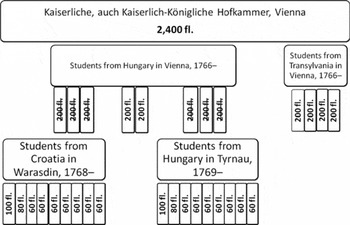
Table 1: Royal scholarships for attendants of Sonnenfels's course, 1766–77
 You have
Access
- 6
- Cited by
Derek Beals, considering the impact of enlightened policies on different social forces, has noted that “enlightened policies were sometimes imposed from above and were more advanced than were being demanded by, or were appropriate to, the balance of social forces in the society concerned.” This happened “essentially because of intellectual development at the top of society, perhaps among the elite as a whole, more commonly among a limited group, and in some cases largely because of the ruler's own attitude.” Below that level, “a much more dilute and generalized Enlightenment was slowly and unevenly seeping through society.”Footnote 1 This is true for the Habsburg monarchy, where enlightened minds at the top were often confronted with the selfishness of the provincial nobilities or ill-qualified middle-rank officials. To make the levels below acquainted with the key goals of the reform agenda, this “limited group” needed skillful and charismatic mediators capable of making advanced ideas comprehensible. One of the most successful transmitters of the “Enlightened policies” to less advanced social strata in the Habsburg monarchy was the statesman, university professor, and writer Joseph von Sonnenfels (1732/33–1817).Footnote 2
He summarized his own achievements in a petition to Emperor Leopold II (r. 1790–92) to request that he be awarded the small cross of the St. Stephen's Order—the highest award for civil servants in the Habsburg monarchy since 1764.Footnote 3 Among other things, the petition stated: “I can call the course of political sciences in the form, in which it is taught in all universities of the Hereditary Provinces and which treats all parts of the domestic administrative system, entirely my own creature. All teachers of these disciplines in the monarchy are my pupils. Almost all universities abroad are teaching the political sciences approximately following the Austrian example.”Footnote 4
This statement was largely true. Sonnenefels's course and corresponding textbook on the Polizey- und Cameralwissenschaften were instituted by the Vienna Court and won recognition beyond the borders of the Habsburg Lands. From the middle of the eighteenth century, the Vienna Court was searching for an appropriate way to create a cadre of competent and loyal officials for different branches and levels of the administrative apparatus.Footnote 5 Rival Prussia possessed some useful experience in this field, where in 1727 the first chairs for Cameralwissenschaften were founded in Halle and Frankfurt-am-Oder. Wilhelm Bleek treats their foundation as an episode of Frederick William I's (r. 1713–40) fight against the estates and views it as the king's endeavor to create an obedient administrative corps. As soon as his successor Frederick II (r. 1740–72) “pacified” the nobility, the respective chairs almost perished due to a lack of financing. Nevertheless, the rulers got a useful course, which embraced the spectrum of administrative techniques and conceived of all branches of the economy as a whole.Footnote 6
Between 1750 and 1753, Johann Heinrich Gottlob Justi (1720–71) was invited to teach natural law at the Theresian College of the Society of Jesus in Vienna. In 1756, the reform of the law faculty at the University of Vienna was launched, aimed at better training and higher requirements for those who aspired in one or another way to serve the common good.Footnote 7 Yet the court also clearly saw the necessity of a universal, concise, and comprehensible course, containing basic norms and rules of how a modern state ought to function, what economic and social policies it ought to pursue, and how subjects could be motivated to greater individual initiative and self-discipline in the interest of the economy as a whole. The young Joseph von Sonnenfels—with the intercession of his mighty patron Councilor Egid Borié (1719–93)—was entrusted with the task of writing such a textbook, organizing a lecture course at the University of Vienna, selecting apt students, and recommending them for future professional training and subsequent employment in the administrative apparatus. While the content of the textbook has been extensively analyzed,Footnote 8 the teaching of the course as a social practice and the social profile of the students have received much less attention.Footnote 9
The present article considers how and with what success the Vienna Court endeavored to educate new generations of officials sharing similar knowledge and values, and how satisfied it was with the educational model developed by Joseph von Sonnenfels. It pays special attention to the making of the educational network, details implications of the new knowledge and skills required for the nobilities and officials, and analyzes some teaching careers.
Useful Knowledge and Strategies of Its Dissemination
The manuscript of the textbook, Polizey- und Cameralwissenschaften, that the court commissioned was written, or to be more precise, compiled, by Joseph von Sonnenfels in a very short period of time in the autumn of 1763.Footnote 10 The fact that it borrowed liberally from the works of Johann Heinrich Gottlob Justi, Georg Heinrich Zinke (1792–69), and the French physiocrats, was not a secret to contemporaries and has been analyzed in detail by modern scholars.Footnote 11 As Simon Karstens has shown, the practical and experienced officials of the Imperial Chamber (Kaiserliche auch Kaiserlich-Königliche Hofkammer) were not entirely satisfied with the quality of the text. Having paid tribute to the clarity of style and praised the author's diligence, they still recommended that he take one more year to correct minor mistakes and clarify some theoretical statements.Footnote 12 Maria Theresa, however, did not want to wait. She ordered turning the course as soon as possible into a universal tool for creating a whole new generation of officials, and foresaw an even broader application for her subjects. On the eve of the 1763 academic year, in a note to Austro-Bohemian Chancellor Count Rudolph Chotek (1706–71), she wrote: “By means of this resolution it is to be announced in all my lands, that those who attend the course and make good progress would be preferred to other applicants for admission to the imperial and royal service.”Footnote 13 A similar note was simultaneously issued to the Hungarian and Transylvanian chancellors, Count Francis Esterhazy (1715–85) and Count Gabriel Bethlen (1580–1629). Her desire to introduce modern administrative techniques and approaches to economy, finance, and administration, in particular in the more remote and less developed parts of her realm, is evident from the following remark: “Those young Croats who are at the endowed Chaos Institution (Chaos'sche Stiftung) are to be explicitly advised to attend this course.”Footnote 14
It would thus appear that unlike Prussia a quarter of a century earlier, where a similar course served the purpose of “domesticating” the estates, in the Habsburg Lands it was to serve the task of homogenizing administrative norms, practices, and techniques throughout the monarchy, and as a consequence strengthening the sovereign's position. This conclusion is supported by an instruction the empress issued in 1766, again addressed to counts Esterházy and Bethlen: “Those Hungarians and Transylvanians, who have attended the course on Polizey- und Cameralwissenschaften and can prove their good diligence and progress with a certificate signed by Sonnenfels, will deserve special attention in appointments to positions in economic, or town-administration, and in the future it is recommended that the counties also give preference in employment to these people, which those applying to this course should be made aware of.”Footnote 15 Bernd Wunder entitled his book on the rise of early modern south German bureaucracy Privileging and Disciplining.Footnote 16 To adopt this formula to the specific conditions of the Habsburg monarchy, one might say that having successfully completed Sonnenfels's course, future officials were “privileged” with preferable admission to administrative positions and by the same token “disciplined” by means of the rigid requirement to observe the ideological and professional norms formulated in the course.
To facilitate access to such courses, Maria Theresa in 1767 created eight scholarships at 200 florins each for students from the Kingdom of Hungary, and four scholarships for those from the Principality of Transylvania. These scholarships were granted exclusively on the basis of Sonnenfels's evaluation of talented but needy students. Nominations were made by the Hungarian Lieutenancy Council, the Croatian Council, and the Transylvanian Gubernium, who were to present a list of suitable applicants to the empress via the Hungarian and Transylvanian chancelleries. Financial issues were in turn monitored by the chamber. The annual reports and recommendations of these bodies allow us to reconstruct how this system functioned, the names of scholarship recipients, and, in many cases, the degree to which they met the requirements of their teachers. However, the authorities soon found that a mere twelve scholarships in the imperial capital could not satisfy the growing demand. For this reason, the court was constantly redistributing the total scholarship fund (1,600 fl.) to support as many students as possible by transferring the course to local educational centers, where the cost of living was much lower. Thus, in 1769, three of the eight scholarships in Vienna were moved to the Warasdin (Varaždin/Varasd) Political-Economic College in Croatia, where the 600 fl. were divided into one scholarship of 100 fl. for the best pupil, one scholarship of 80 fl. to the second-best, and six or seven scholarships of 60 fl. each to less advanced students. The following year the number of scholarships in Vienna was reduced to two, while three more scholarships (600 fl.) were transferred to Tyrnau (Trnava/Nagyszombat) University, where the same scheme as in Warasdin was applied. Between 1766 and 1777 more than 140 scholarship recipients in Vienna, Tyrnau, and Warasdin (later Zagreb) were educated at the court's expense (see Table 1).Footnote 17
Royal scholarships for attendants of Sonnenfels's course, 1766–77
Exactly who was to enjoy preference in the distribution of the scholarships and why was a question the authorities permanently confronted. The desire to achieve a proper balance between meritocracy and philanthropy, just as in other areas of Theresian social policy, in the long run contributed to the birth of a modern state with welfare state overtones. Thus, for example, in 1775 the empress noted on the Hungarian Chancellery's proposals concerning the distribution of the scholarships in Tyrnau University: “In case, when among those who are considered to be deserving a subsidy, there are those who have sufficient financial means, let their places be given to the needier ones.”Footnote 18 The Hungarian Lieutenancy Council's School Commission objected: “There is no need to take into account greater or lesser degrees of poverty, inasmuch as subsidies for those who are enrolled as imperial-royal scholarship recipients, are to be allotted without any special attention to wealth, but exclusively to praiseworthy progress in the sciences, and for this particular reason awarded to those deserving the special reward.”Footnote 19 The Hungarian Chancellery in its turn, making a final proposition to be sanctioned by the monarch, took Maria Theresa's side and recommended that all other things being equal a poorer student should be preferred to a well-to-do one.Footnote 20 In this way philanthropic motives paved the way for talented and clever youngsters of lower origin into the administrative elites of the monarchy. Furthermore, admission based exclusively on knowledge and skill regardless of social status and tempered with elements of a would-be welfare state was ground-breaking for its time.
The admission practices under scrutiny also demonstrate how the principle of meritocracy was making advances with the help of premodern patrimonial networks. The informal character of these kinds of social ties makes them almost invisible to contemporary scholars, unless one comes across references to a client-patron relationship in private correspondences or other, often unlikely, sources. In fact, many of the scholarship recipients were in one way or another tied to persons having access to exclusive information and capable of rendering their support. For example, a young man by the name of Johann Nyagoe was admitted to Sonnenfels's course most likely because he was a relative (son or nephew) of the Transylvanian chancellor's estate administrator (oeconomiae secretarius) of the same name, mentioned in Count Bethlen's testament.Footnote 21 Similarly, Thomas Szlabik might be a son of Andreas Szlabig (or Szlabik), the former tutor of Hungarian chancellor Nicolas Pálffy's children and member of archduchess Maria Christina's Hofstatt in Pressburg.Footnote 22 This and similar cases illustrate the importance of personal contacts with mighty aristocrats, who were clearly facilitating access for gifted people of lower origin.Footnote 23 Proximity to the decision-making bodies was also very useful. The young Michael and Philipp von Seeberg were admitted to the Cameralwissenschaften course in Tyrnau evidently because their father, Zacharias Wanckhel von Seeberg, was a councillor at the Transylvanian Court Chancellery. He first sent them (together with their brother Maximus) to the Theresian College in Vác (Waitzen), where six scholarships were reserved for the nobility from the principality.Footnote 24 Having entered the “pool” of scholarship recipients, two of them later continued their education in Tyrnau.
The Nobility: New Ideals and New Requirements
In conjunction with open lectures at the university, Sonnenfels taught the same discipline to pupils of elite schools, such as the Theresian Noble College of the Society of Jesus (from 1773 the Theresian Noble Academy, also known as Theresianum) and the Savoyard Noble Academy, founded by Maria Theresa Felicitas of Savoy (née Lichtenstein) and run by the Order of Piarists.Footnote 25 He did not question the “established though unjust privileges” of his pupils (as Robert Kann put it), but rather saw his mission as imbuing young aristocrats with a feeling of social responsibility.Footnote 26 In a public lecture held on 14 November 1767 before the noble youth of the Savoyard Academy, Sonnenfels claimed: “The privileges and dignities of your ancestors belong to you only in the expectation that you are not insignificant armor-bearers of your ancestors, but strive to repay the previously made debts through the greatness of your future service.”Footnote 27 Four years later, in his famous treatise “On the Love of the Fatherland,” presented in the Theresian College, he also addressed the nobility: “In Europe people think that virtues and merits have an inheritable nature; this principle would be just if the nobility justifies its privileges … when it uses them to make citizens happy and consider it below their dignity to lag behind lower classes in observing the law, showing loyalty to the sovereign, and fulfilling the duties of a citizen.”Footnote 28 All this was taught in the framework of Polizey- und Cameralwissenschaften.
To underscore the exclusivity of the course and the importance of the knowledge it conveyed, the court welcomed examinations on Cameralwissenschaften in the form of solemn public ceremonies.Footnote 29 This old practice, whereby an examinee answered questions from a pre-printed syllabus in front of a distinguished board, including ecclesiastic and lay dignitaries and respected professors, was well-known in major universities and colleges of the Society of Jesus. On some occasions, examinations were combined with book presentations, written by professors and presented to the “noble and learned” public by carefully selected students. Solemn examinations on imperial law, history, or physics held in the Vienna Theresianum, due to its proximity to the court, received special mention in the semi-official Wienerisches Diarium.Footnote 30 We do not know to what extent other pupils were drilled to give answers to the questions they received in advance, but Sonnenfels insisted that his pupils had to demonstrate their ability by giving spontaneous answers to unexpected questions. On 15 August 1771, his sixteen-year-old pupil, Count Anton Apponyi (1755–1817), presented the abovementioned treatise on love of the fatherland in the framework of a solemn examination on Cameralwissenschaften. His father, Georg Apponyi (1736–82), was a councillor in the Hungarian Lieutenancy Council and Tolna County high sheriff. (The young man would later “inherit” both of these dignities.) He gave answers on seventy-five questions in German from the “science” of police, commerce, and finance, and dedicated his performance to the empress. She, as often happened, was absent, but was represented by her official representative at the examination, the president of the Vienna Court of Audit (Rechnungskammer), Count Ludwig Zinzendorf (1721–80).Footnote 31 The remaining board was recruited from the imperial and royal administration, as well as the academic community, which signified the triumph of power imbued with knowledge and knowledge advanced by power.
Imperial law and Cameralwissenschaften were, in principle, the two major examinations held in German for native speakers and foreigners alike. At the same time, the propagandistic value of the examination passed publically by prominent aristocrats was so high, that for those of foreign origin who had spent just one or two years at the college and were not ready to be examined in German, answering in French (Count Angelo Serponti), or Italian (Prince Francesco Ruspoli [1752–1829], the future ambassador to the Naples) was permitted.Footnote 32 By and large, at the Theresianum Sonnenfels's public examination was taken by the sons of most of the prominent statesmen of the monarchy and, as with the examination on imperial law, signified their intention to join the highest ranks of the imperial-royal bureaucracy, to which, as a rule, their parents and grandparents had already belonged. It also served as a public example to their fellow citizens and, last but not least, showed that they would be able to share the same values with their future subordinates.
Sonnenfels's Courses as Bureaucratic Catechism
Because the main aim of the course was to convey its useful knowledge to those who would later serve as minor clerks at lower levels of the administration, the court welcomed all initiatives that might contribute to this goal. In 1763, on the initiative of the Hungarian chancellor, Count Francis Esterházy, a political-economic college was established on one of the chancellor's estates, Wartberg (Senec/Szenc), with the court's financial support. This college was designed in the first instance to educate impoverished nobles and commoners, who saw their way to social ascent by acquiring qualifications in needed professions such as accountancy, geodesism, cartography, and engineering. Initially the college was intended to receive students from all over the monarchy, but due to a lack of funding it remained a breeding-ground mostly for Hungarian Chamber officials. Indeed, attempts by Vienna to reserve some places for young men from the Austro-Bohemian Hereditary Lands were met with deep dissatisfaction by the Hungarian authorities. All in all, this project was a partial success. In 1776 the college's main building was damaged by fire to such an extent that it made no sense to invest in its renovation. The school was transferred to another town in Esterházy's domain, Tata (Totis), but a fatal coincidence of bad financing and the low academic profile of applicants (often unable to succeed in highly specialized disciplines in German) led to the dissolution of the college in 1780.Footnote 33
One of the court's long-term goals was to turn Sonnenfels's course into a form of political catechization. This becomes even more obvious when one considers to what an extent priests were welcomed in the lectures. When Caspar Ehrenfels began teaching Polizey- und Cameralwissenschaften in Tyrnau in 1769, Maria Theresa ordered making the course obligatory for the students of the Theological Faculty. The same year the empress demanded diligent attendance of the course by the Bohemian clergy.Footnote 34 According to the Wienerisches Diarium the first priest who took the public examination at the University of Vienna was Johann Albrecht Huber in 1772. Count Anton Pergen (1725–1814) stood in for the empress, and the board represented the imperial-royal bureaucracy, academics, and the clerics in exactly the same manner as it did for secular students. The Wienerisches Diarium suggested that “his example will undoubtedly lead to dissemination of this highly important knowledge among the members of his profession.”Footnote 35 This wish came true after the dissolution of the Society of Jesus. Dozens of young, well-educated, and unemployed ex-Jesuits enrolled in Sonnenfels's course hoping to improve their chances in competing for a modest position in the administrative apparatus. Still, the chances of success remained poor for this group of students. Michael Heinzmann, who in his own words, had “lost his source of income after the dissolution of the Society and found himself in the most miserable condition” saw his application declined despite his reported knowledge of Latin and French, as well as having attended the course on Cameralwissenschaften at the University of Vienna, on the pretext of the absence of available vacancies.Footnote 36 Another ex-Jesuit, Franz Pindlmayer, was seemingly luckier. He got an unpaid position as a Praktikant at the Hungarian Chamber in Pressburg (Bratislava/Pozsony), yet it held out little chance for promotion to even a modestly paid job.Footnote 37
Another group that was the target of “political catechization” was the officers of the Hungarian Noble Guard. This institution was created in 1760 to give the provincial nobility from Hungary and Transylvania an opportunity to spend three to five or more years at court to improve their German and to receive social polish through their participation in the court ceremonial. After 1774 guardsmen enjoyed special instruction in languages and in Polizey- und Cameralwissenschaften, which were taught by Johann Hauck.Footnote 38 One of the far-reaching goals behind the creation of the noble guard was to provide the local administration with skilful county officials. In an age when a career was as much the result of slow immersion in office rather than the product of academic education, a university certificate could not guarantee young officers an automatic preference over other applicants, yet many of those who had invested their free time in study in the imperial capital were rewarded with positions in central and local royal or county administration. The career of Michael Csergheő (b. 1738) from Abaúj County is a case in point. His father (a county notary) died when the boy was just three years old. Csergheő received an education, was employed by the county administration as a minor clerk and at the age of twenty-one was enrolled as one of the very first Hungarian guardsman. He spent eleven years (1760–71) in the Habsburg capital. His skills in letter writing and clever self-promotion helped him, without a doubt, to win the empress's benevolence. “I did not waste a single hour,” wrote Csergheő in an eloquent petition, “but have used time free from my routine duties for learning natural law and the law of nations, Cameralwissenschaften in accordance with Sonnenfels's principles, and, last but not least, have made progress in the German and Italian languages, and all that with the passionate zeal to be even more useful to Your Majesty.”Footnote 39 He was eventually employed at the Hungarian Chamber in 1771 and soon promoted to the vice secretaries, becoming the secretary in 1776 and filling this position until 1783.Footnote 40
If the names of some 140 scholarship recipients (Appendix 1) were reconstructed through a systematic exploration of certain dossiers in the Court Chamber archives in Vienna, the names of those who attended Sonnenfels's lectures at their own expense could be established only through surveying petitions, job applications, reports, and similar official letters. Behind every such statement there is a unique human destiny, as, for example, that of Ludwig Fejes, who applied for a position in the Hungarian Chamber: “From my early youth, I studied the useful sciences indispensable for royal service. After [studying at] the philosophical faculty I studied civil and Hungarian law in theory, then spent six more years perfecting myself … among other things by living in Vienna at my own expense and studying the German language and Polizey- und Cameralwissenschaften.” In his own words, he had invested all his “wealth” in knowledge and expected that the empress would remunerate him with an appointment.Footnote 41 Fejes was employed by the Hungarian Chamber for a couple of years as a trainee (Praktikant). With every year, the number of less successful contestants grew. In the long run, the reputation of Sonnenfels and the high expectations of those desiring to join the ranks of the administration contributed to the extraordinary popularity of this course among outsiders, who believed they would be better qualified for desired jobs if they produced a certificate from Sonnenfels or one of his trained teachers. This might partly explain why this course survived in the secondary-school curricula all over the monarchy in the next half a century despite its obvious obsolescence.Footnote 42
Clarity, Conciseness, Uniformity
By the end of the 1770s, when the course was widely taught throughout the monarchy, Joseph von Sonnenfels was occupied with a no less ambitious project. This time his literary qualities were in demand, as he strove to reform the business writing style (Geschäftsstil) of the Habsburg monarchy. Early modern German (and Latin) bureaucratic language in the Habsburg Lands was very complex, in many ways archaic and vague.Footnote 43 The growth of the administrative apparatus and consequent circulation of notes, vota, memoranda, and so forth, made it imperative that all these documents be brief and written in understandable language to allow for the quick and efficient dispatch of business. In 1781 Sonnenfels started lecturing on how to write documents of different sorts in a clear and comprehensible German. His knowledge and expertise were also in demand at the Council of State, which was considering new, shorter, and simpler forms for written applications and petitions submitted to the authorities. Sonnenfels held open, free lectures on the subject at the law faculty of the University of Vienna in the early morning hours, to facilitate access for those who had to be at their offices at eight or nine in the morning.Footnote 44 No special programs or “national” quotas were introduced so as to facilitate dissemination of this “useful knowledge” to as many as possible. The lectures were an immediate success. Notes made by those attending were carefully kept and copied for others who wanted to meet the new professional requirements. Although Sonnenfels himself first published his lectures in the form of a textbook in 1784, his devoted pupils did so much earlier.Footnote 45 In an anonymous manual dated 1782 the author's preface reads: “I took the trouble of diligent attendance of the free-of-charge lectures, held out of pure love of the Fatherland, on Geschäftsstil of a certain man, to whose depth in learning, elegance in speech and zeal for improvement of literature Austrian youth owes the greater part of its culture; and I faithfully noted samples [of the new style] sounding from his mouth…. Why should I hesitate to call by name my leader, my benefactor? This is Joseph von Sonnenfels.”Footnote 46
The reform of Geschäftsstil in a wider sense had a direct impact on every subject of the monarchy. Appeals of subjects to the authorities at that time were written in the form of detailed, often deeply personal letters, in which one could hardly discern the essence of the message unless one read it very slowly, with much concentration.Footnote 47 On 2 January 1782 Emperor Joseph II issued a decree prescribing the new way of appealing to the monarch.Footnote 48 The concept of short and clearly structured petitions was worked out by Sonnenfels, who later referred to this decree in his textbook: “His Most Sacred Majesty has used the opportunity to define everything which is required for a petition in order to put an end to digressions and repetitions, insomuch as they make arguments not weightier, but vaguer, and the narration itself becomes more complicated.”Footnote 49 From now on any eloquent title was replaced by the simple name of the addressee, be it the monarch, a chancellery, or the court. The salutation was to be followed by the essence of the request and supported by numbered arguments, from more important to less significant. The petition was to include the reason (Veranlassung), request (Bitte), and grounds (Gründe) for it. In the conclusion, the undersigned was to refrain from referring to him- or herself as “the most humble” or “most obedient,” but simply write the full name, address, and social status or, if applicable, occupation.Footnote 50 Despite many changes in curricula Geschäftsstil was still included as a required course in the fourth year of education in the law faculty as late as 1848.Footnote 51
As with the course on Polizey- und Cameralwissenschaften, it is virtually impossible to know who attended this course, unless they mentioned it in some written form. One of the future intimate friends of Ludwig van Beethoven, the Hungarian nobleman of Slovakian origin, Nicolas Zmeskal (Zmeškal, 1759–1833), applied for a vacant position in the Hungarian Court Chancellery in 1784. Among the reasons he gave for why he deserved this appointment was his attendance of Sonnenfels's course on Geschäftsstil. He also appended a certificate signed by the professor himself.Footnote 52 Private correspondence of the age provides interesting evidence of the paramount importance proficiency in Geschäftsstil had not only among minor clerks but also in aristocratic circles. The family archives of the Hungarian counts Károlyi contain a letter, written by the house tutor, Vincent Henyey, to Count Anton Károlyi (1732–91), whose son he accompanied during his school years in Vác and Vienna, noting that Prince Liechtenstein had paid Sonnenfels a sum of 1,000 fl. for private tuition in Geschäftsstil.Footnote 53 This sheds a whole new light on the role Sonnenfels played in preparing new generations of Viennese aristocrats for higher office. Unwilling to attend public lectures and memorize the catechism-like textbooks, they were prepared to pay for exclusive private lessons. Had they not done so, they might not have been considered competent leaders of their social inferiors, who—in tune with the new requirements—had attended Sonnenfels's lectures.Footnote 54
Far and Beyond
From the very beginning Sonnenfels was confronted with a twofold task: he had to train hordes of those attending his course in hopes of subsequent quicker promotion, and to select the most brilliant of those to teach the same course following the teacher's guidelines in other universities of the monarchy. Sonnenfels's statement that all professors of this science in the monarchy were his pupils was by no means an exaggeration. Indeed, Ignaz de Luca (1746–99) in Linz and later in Vienna, Josef Ignaz Butschek/Buček (1741–1821) in Prag, Josef Buresch in Graz, Leopold Schulz in Klagenfurt, Karl Krobath in Laibach (Ljubljana), Caspar Paul Ehrenfels in Tyrnau, Adalbert Adam Barics/Barić (1742–1813) in Warasdin, and later in Zagreb and Buda/Pest, Antal Dobokay in Klausenburg (Cluj-Napoka/Kolozsvár), and, last but not least, beyond the monarchy's borders, Mikhail Balugyánszky (1769–1847) in St. Petersburg were his students.Footnote 55 Looking at this group of graduates Karstens concluded that the combination of direct personal contacts, patronage, and cooperation later resulted in a network of students and alumni that could be mobilized to mutual benefit.Footnote 56
Yet it would be an exaggeration to suggest that Sonnenfels was fortunate to have only talented pupils. As he himself had only been employed at the University of Vienna in 1763 after a stringent examination, held by a special commission, he demanded the same competitive and meritocratic procedure for those of his pupils who were to teach his courses elsewhere.Footnote 57 But the demand for talented teachers was higher than the supply of graduates. From 1765 to 1768 candidates for these positions were given eight days to write an essay, in which they were asked to address three questions of the professor's choice. If Butschek or Barics belonged to those who were highly esteemed by their professor,Footnote 58 Schultz and Krobath, in Sonnenfels's own words, simply copied parts of his lecture and only received their appointments due to the lack of better applicants.Footnote 59 Sonnenfels always insisted that the examination include an oral part similar to the one he himself had undergone. By 1768 the written examination was formally complemented by an oral one.
Robert Kann was skeptical about the outcome of Sonennfels's pedagogical activities: “None of his students, with the possible exception of Ignaz de Luca, rose above the level of well-trained efficiency to standards of independent thinking and action. None of them even tried to withstand the pressing of advancing reaction…. He must take part of the blame for having failed to comprehend that the bureaucratic system, supported and reformed by him with so much sincere zeal, was outdated in a far deeper sense than he ever realized.”Footnote 60 It is certainly true that Sonnenfels was often confronted with poorly educated, intellectually immature, mediocre individuals incapable of profiting very much from his courses. But if one looks beyond the borders of the Hereditary Lands, where Kann's focus lay, his conclusion underestimates, if not the intellectual potential of particular students, then their role as transmitters of the new knowledge and the system of values associated with it in the more remote corners of the monarchy.
The case of Adalbert Barics provides an example of both the felicity of Sonnenfels's choice and his pupil's commitment. A Hungarian nobleman of Slavic descent born in southern Hungary, Barics was recommended to head the recently founded Political-Economic College in Warasdin in 1769 (most likely due to his language proficiency in the Southern Slavic vernacular). The young man travelled to Croatia, which was completely alien to him, assumed the chair and succeeded in educating a dozen students annually despite their poor German, insufficient academic qualifications, low motivation, and, last but not least, insufficient and irregular financing.Footnote 61 And yet he did not miss any opportunity to render support to talented youngsters, always recommending those who showed a real commitment to learning for transfer to Zagreb, “where there is a university and they might profit from lectures on different sciences.”Footnote 62 Barics translated Sonnenfels's textbook into Latin, although the manuscript has not survived. In 1773 he moved to the University of Zagreb, where he continued to teach Polizey- und Cameralwissenschaften as well as work on his treatise, Statistica Europae.Footnote 63 In 1777 he was invited to Buda University (recently moved from Tyrnau to the ancient capital of Hungary). The great respect he enjoyed among his colleagues there is illustrated by a revealing anecdote. When, due to some bureaucratic formalities, his annual salary turned out to be 200 fl. less than that of other professors in the law faculty, the royal school district director, Anton Vörös, covered the difference from his own income.Footnote 64 In 1786 Barics was appointed the rector of Pest University and held this position till 1804.
The career of another of Sonnenfels's pupils, Theodor Jankovics (1741–1814), is equally instructive. He was a commoner by birth. His father was a notary in Neusatz (Novi Sad/Új-Vidék), but as one learns from the father's petition for a noble title, he was also related to the Greek-Orthodox bishop of Temeswar (Timişoara/Temesvár), Vikentije Jovanović Vidak (1730–80).Footnote 65 The cleric had noticed the boy's inclination to the sciences and languages and saw to Theodor's early education. Most likely it was Vidak, who, having learned about the introduction of the Transylvanian quota in 1767, helped the young man get to Vienna. At the end of the academic year Sonnenfels evaluated the young Serb as the best in the group and drew the attention of the authorities to his talent for languages.Footnote 66 However, four of Jankovics's fellows submitted a petition to the empress, complaining that a non-Transylvanian had deprived them and their compatriots of modest material support and a possible means of social ascent.Footnote 67 The only skillful student among them was Daniel Lazarini, whom Sonnenfels had ranked second (after Jankovics). Lazarini had already graduated from the Jesuit Academy in Klausenburg; attended courses on natural, civil, canon, and imperial law at the University of Vienna; and reported proficiency in five languages (Hungarian, Walachian, Illyrian, Latin, and German).Footnote 68 As to the co-signatories of the petition, Sonnenfels stated: “[Anton] Dobokay and [Ignaz] Engedi simply do not know the German language and I cannot report about any profit whatsoever [they gained] from my lectures, consequently I see no reason to pay them a stipend, unless they make themselves familiar with this language.”Footnote 69
Jankovics, feeling his stay at the university and future career in danger, turned to Maria Theresa with a petition composed in stylistically perfect German and begged the empress to let him finish the course: “In fact, with regard to my forefathers and my origin, I am neither a Transylvanian, nor a Hungarian, and have no claims to the graces reserved for these nations, but I am an Illyrian, a most faithful Illyrian of Your Royal-Imperial Apostolic Majesty, who has already enjoyed the highest grace for one year as a recipient of a stipend of the Transylvanian Chancellery. I am the first Illyrian, since the Illyrian people have sworn alliegence to the House of Austria, who has attended academic lecutres in Vienna and has learned juridical and cameralist sciences in order to serve the state and turn into a useful subject and citizen.”Footnote 70
Maria Theresa, relying on Sonnenfels's judgment, let Jankovics finish the course, and the young Illyrian later proved to be worthy of the high esteem he thus enjoyed. In 1774 he was ennobled for his prominent role in elementary school reform among the Greek Orthodox Serbs of the Austrian monarchy. Furthermore, when the St. Petersburg court was looking for education experts of preferably Slavic origin and possibly Greek Orthodox faith in the neighboring Habsburg Lands, the Hungarian Chancellor Count Francis Esterházy recommended Jankovics to Ambassador Dimitrij Golitzin (1721–93) as a consultant for the ongoing elementary school reform in Russia.Footnote 71 In 1782 Jankovics proudly reported to the Hungarian Vice Chancellor Count Charles Pálffy (1735–1816): “My project of how to organize the elementary schools has been approved by the [Russian] court and consequently I have nothing to wish, but to do the duties of my profession.”Footnote 72
It is noteworthy that while in Hungary and Croatia stress was laid on the incorporation of Cameralwissenschaften into the framework of “national” university curricula, the Transylvanian Chancellery preferred to continue educating future civil servants in Vienna: “The youth from Transylvania … in this city apart from this course have an opportunity to practice themselves in other useful sciences (which are missing in the Principality) and at the same time learn the German language and the Viennese way of life.”Footnote 73 The case of the young Transylvanian Anton Dobokay (one of those who had complained about Jankovics's abuse of the quota reserved for the principality) is a case in point. He arrived in Vienna in 1767 without sufficient knowledge of German and after a year in the imperial capital was entitled to only half of the scholarship. Yet his diligence and, not least, the goodwill of the Transylvanian Court Chancellery, which allowed him to spend five more years in Vienna at the expense of the chamber, finally yielded positive results. Slowly progressing in Cameralwissenschaften, Dobokay eventually became Sonnenfels's assistant, helping his teacher educate other ill-prepared Transylvanian youth. His salary was in fact paid by one of the scholarships, and his primary task was to summarize Sonnenfels's lectures in Latin to make their essence clear to the newcomers. Later, he returned to Klausenburg, and at the turn of the nineteenth century still taught the Polizey- und Cameralwissenschaften there.
Among those who attended Sonnenfels's lectures in the 1780s was Mihály (Mikhail) Balugyánszky (1769–1847), who later had a spectacular career in the Russian Empire. An ethnic Ruthenian born in a village at the eastern border of the Kingdom of Hungary, he studied first in Kaschau (Košice/Kassa) and then at the University of Vienna. Later, Balugyánszky held the law chair at the Royal Academy in Grossvardein (Oradea Mare/Nagyvárad) and in 1796 held one of the chairs at the law faculty of Pest University. In 1803 he was invited to St. Petersburg, where a year later he received a professorship at the Pedagogical Institute (the forerunner of St. Petersburg University). Alongside his teaching activities he was an active member of the legislative commission created to codify the Russian legislation. A highly respected jurist, Balugyánszky taught law to Emperor Alexander I's younger brothers, grand dukes Nikolai (future Emperor Nicholas I, r. 1825–55) and Mikhail. For his diverse and highly professional activities he was awarded a Russian title and died a senate member and privy councillor.Footnote 74
Conclusion
To get some sense of the impact of Sonnenfels's teaching activities, the reports provided by the personnel of the bookkeeping office of the Hungarian Court Chamber in 1788 for the famous Konduitlisten introduced by Joseph II are revealing.Footnote 75 Of the 223 officials, twenty-five (ranging in age from twenty-one to fifty-one) reported having attended the Polizey- und Cameralwissenschaften course in Vienna (twenty-three) and Hungary (two). Four of them also mentioned that they had attended the Sonnenfelsian lectures on business style. Ten persons (from twenty-two to thirty-four years of age) referred only to the business style.Footnote 76 With the course on Polizey- und Cameralwissenschaften and later with the lectures on business style, as taught by Joseph von Sonnenfels, the Vienna Court by and large reached its desired goal—to create a new generation of professional and loyal officials. Sonnenfels fulfilled the role of transmitter of the basic values that administrators on all levels were to share. His lectures summarized these values and concepts in a comprehensive, often simplified form of catechism. As a result, (would-be) officials all over the monarchy reacted as it was hoped they would, having eagerly joined the ranks of Sonnenfels's pupils in the hopes of better employment opportunities. However, the courses having fulfilled their disciplining function, lost their exclusivity, which was so persistently advertised in the first years of the educational experiment. In the 1780s, these competencies were taught in the framework of secondary school (Gymnasium) and became indispensable as proficiencies in writing or accounting. At the same time, they ceased to be an entrance ticket into the ranks of the bureaucracy.
Appendix 1: Scholarship Recipients
The list below is based on records of the Vienna Court Chamber (ÖStA, FHKA, UK, Fasz. 29: Pensionen, Subd. 2: Remunerations, Gnadengaben, Abfertigungen und Almosen, Kt. 1932–1956), Hungarian Court Chancellery (MNL OL A 39, 1766–1777), and Transylvanian Chancellery (MOL B 2, 1766–1777). It contains the names of those who studied Polizey- und Cameralwissenschaften in Vienna, Tyrnau, or Warasdin (later Zagreb) as scholarship recipients. The list contains names in their original transcription, “nationality,” city where the educational institution was situated, and duration of education as registered. Scholarship recipients of non-noble origin (if mentioned) are marked with an asterisk.
Antalics, Joannes, Hungarus, Tyrnaviae, 1770/71
Anyos, Joannes, Hungarus, Tyrnaviae, 1770/71
Avakumovics, Ioannes*, Illyro-Rascinus, Tyrnaviae, 1770/71
Balogh, Ladislaus, Hungarus, Viennae, 1767/68
Balduzzi, Francisus, Transylvanus, Viennae, 1771/72
Barabas, Joannes, Hungarus, Viennae, 1775/76
Barics, Adalbert, Hungarus (?), Viennae, 1766/67
Bedekovics, Adamus, Croata, Tyrnaviae, 1770/71
Bitto, Ludovicus, Hungarus, Tyrnaviae, 1772/73
Bogovics, Paulus, Croata, Viennae, 1769/70
Carlegg, Ladislaus, Croata, Varasdini, 1770/1771
Chavrak, Mathias, Croata, Varasdini, 1775/76
Clement, Ferdinand, Hungarus, Viennae, 1775/76
Cselkó, Nicolaus, Hungarus, Viennae, 1767/68
Csermáky, Andreas, Hungarus, Viennae, 1776/77
Czillich, Franciscus, Hungarus (?), Tyrnaviae, 1772/73
Czvictkovich, Johannes, Croata, Varasdini, 1776/77
Delimanics, Carolus, Hungarus, Tyrnaviae, 1770/71
Demien, Antonius*, Transylvanus, Tyrnaviae, 1770/71
Dévay, Joannes, Hungarus (?), Tyrnaviae, 1772/73
Dietrich, Jospehus*, Hungarus, Tyrnaviae, 1770/71
Dobokay, Antal, Transylvanus, Viennae, 1768/73
Eötvös, Joannes, Hungarus, Tyrnaviae, 1772/73
Erdődy, Franciscus, Hungarus, Tyrnaviae, 1777/–
Fedő, Johannes, Hungarus, Viennae, 1772/73
Felszegi, Josephus, Transylvanus, Viennae, 1768/69
Fidler, Ignatius*, Hungarus, Tyrnaviae, 1771/72
Fistitsch, Joseph, Croata, Zagrabie, 1777/–
Fluch, Christophorus, Hungarus, Viennae, 1775/76
Fogarassy, Gabriel, Hungarus, Tyrnaviae, 1771/72
Frater, Joannes*, Transylvanus, Tyrnaviae, 1771/72
Frön, Josephus*, Hungarus, Tyrnaviae, 1770/71
Gerhard, Francisnus, Styrus/Hungarus, Varasdini, 1770/71
Galenich, Thomas, Croata, Varasdini, 1775/76
Goszvay, Josephus, Hungarus, Viennae, 1776/77
Grazzi, Angelus*, Italus/Croata, Varasdini, 1770/71
Gulasy, Joannes, Hungarus, Tyrnaviae, 1777/–
Gyurkovics, Franciscus, Hungarus, Tyrnaviae, 1770/71
Hadrovics, Antonius, Croata, Viennae, 1767/68
Hadrovics, Joannes, Croata, Varasdini, 1776/77
Hauk, Joannes Carolus, Hungarus, Viennae, 1767/68
Herendics, Stephanus, Hungarus, Viennae, 1775/76
Herzeg, Josephus, Hungarus, Viennae, 1767/68
Hidas, Aloysius, Hungarus, Tyrnaviae, 1772/73
Hillmer, Franciscus, Hungarus, Tyrnaviae, 1777/–
Hochraiter, Casimirus, Hungarus, Varasdini, 1770/71
Hoffman, Josephus*, Hungarus, Tyrnaviae, 1771/72
Hoziak, Thomas, Croata, Varasdini, 1773/74
Hutzagh, Samuel, Hungarus, Viennae, 1769/70
Incsiger, Antonius, Croata, Varasdini, 1776/77
Jaketics, Franciscus, Croata, Tyrnaviae, 1770/71
Jankovics, Theodorus*, Illyrus, Viennae, 1767/69
Jansko (Jancso), Josephus, Hungarus, Viennae, 1771/72
Jesics, Stanislaus, Croata, Varasdini, 1775/76
Joanits, Georgius, Hungarus, Tyrnaviae, 1770/71
Jurinics, Jacob, Croata, Viennae, 1766/67
Jursics, Antonius, Hungarus, Tyrnaviae, 1777/–
Kapelle, Nicolaus, Croata, Zagrabie, 1777/–
Kavegyia, Adamus*, Illyrus, Tyrnaviae, 1770/71
Kemenovics, Thomas, Croata, Varasdini, 1775/76
Kemners, Paul, Transylvanus, Viennae, 1767/68
Kercselics, Emericus, Croata, Viennae, 1767/68
Kerselics, Mathias, Hungarus, Viennae, 1775/76
Kiss, Andreas, Croata, Varasdini, 1770/71
Kiss, Antonius, Hungarus, Viennae, 1770/71
Kiss, Joannes, Hungarus, Viennae, 1767/69
Klobusiczky, Joannes, Hungarus, Tyrnaviae, 1770/71
Koósz, Mathias, Croata, Tyrnaviae, 1771/72
Kovachoczy, Ignatius, Croata, Varasdini, 1770/71
Kovacsics, Martinus, Hungarus, Tyrnaviae, 1770/71
Kovatschits, Mathias, Croata, Zagrabie, 1777/–
Kratzer, Joannes, Hungarus, Viennae, 1776/77
Lakitsch, Joannes, Hungarus, Varasdini, 1770/71
Lázárini, Daniel, Transylvanus, Viennae, 1768/69
Lehnau, Franciscus, Hungarus, Viennae, 1767/68
Lixl, Leopoldus*, Hungarus, Tyrnaviae, 1771/72
Lucsics (Lichich), Andreas, Hungarus, Varasdini, 1770/71
Lucsánszki, Emerikus, Hungarus, Tyrnaviae, 1772/73
Lupinácz, Joannes, Croata, Varasdini, 1773/74
Mattanovitsch, Andreas, Croata, Zagrabie, 1777/–
Matossevich, Mathias, Croata, Varasdini, 1773/74
Mehessy, Joseph, Transylvanus, Viennae, 1770/72
Michaly, Antonius, Croata, Varasdini, 1776/77
Mihaloczy, Georgius, Hungarus, Varasdini/Viennae, 1770/71, 1775/76
Milekovics, Josephus, Croata, Varasdini, 1775/76
Mittinger, Joannes, Hungarus, Tyrnaviae, 1770/71
Morocz, Joseph, Hungarus, Tyrnaviae, 1777/–
Mrozek, Ignatius, Silesita, Tyrnaviae, 1770/71
Nagy, Johannes, Hungarus, Viennae, 1772/73
Németh, Josephus, Hungarus, Tyrnaviae, 1772/73
Nevedy, Carolus, Hungarus, Tyrnaviae, 1770/71
Novák, Stephanus, Hungarus, Viennae, 1769/70
Nunkovics, Franciscus, Hungarus, Tyrnaviae, 1770/71
Nyagul (Nyagoe, Niagoe), Johannes, Transylvanus, Viennae, 1767/68
Pauletics, Paulus, Croata, Viennae/Varasdini, 1771/72
Perchaich, Josephus, Croata, Varasdini, 1776/77
Piacsek, Nicolaus, Hungarus, Tyrnaviae, 1770/71
Poka, Isidorus, Croata, Varasdini, 1773/74
Potak, Joannes, Croata, Varasdini, 1775/76
Pumper, Stephan, Croata, Zagrabie, 1777/–
Quatall, Joannes*, Croata, Varasdini, 1770/71
Racz, Samuel, Transylvanus, Viennae, 1770/72
Relecz, Joannes, Croata, Viennae, 1769/70
Rigler, Sigismundus, Hungarus, Tyrnaviae, 1777/–
Riszto, Franciscus, Croata, Varasdini, 1776/77
Rogoja, Joannes, Croata, Varasdini, 1773/74
Rozmann, Maximiliamus, Croata, Varasdini, 1775/76
Rutrics, Hosephus, Viennae, 1773/74
Salecz, Joannes, Croata, Varasdini, 1776/77
Schkolonics (Skollonics), Georgius, Hungarus, Viennae, 1771/72
Schoppel, Joannus, Transylvanus, Viennae, 1768/69
Schulz, Joannes, Hungarus, Viennae, 1767/68
Schulz, Josephus Cyrillus, Hungarus, Viennae, 1767/68
Seeberg, Michael, Transylvanus, Tyrnaviae, 1772/73
Seeberg, Philippus, Transylvanus, Tyrnaviae, 1772/73
Sierbök, Paulus, Hungarus, Viennae, 1769/70
Sinkoy, Johannes, Transylvanus, Viennae, 1772/73
Staller, Josephus*, Hungarus, Tyrnaviae, 1770/71
Steiger, Josephus, Hungarus, Viennae, 1776/77
Stivalich, Michael*, Croata, Zagrabie, 1777/–
Sumics, Mathias, Croata, Varasdini, 1775/76
Szalics, Matthias, Croata, Varasdini, 1768/69
Szarátsovits, Josephus*, Illyrus, Tyrnaviae, 1771/72
Szedmaky, Károly, Hungarus, Viennae, 1776/77
Szeiller, Georgius, Hungarus, Tyrnaviae, 1777/–
Szekér, Joannes, Transylvanus, Viennae, 1771/72
Szent-Galy, Joannes*, Hungarus, Tyrnaviae, 1770/71
Szlabik, Thomas*, Hungarus, Viennae, 1775/76
Tartler, Joannes, Transylvanus, Tyrnaviae, 1771/72
Tersics (Terzics), Matthias, Croata, Varasdini, 1772/73
Tüsztics, Josephus, Croata, Zagrabie, 1777/78
Ukrovics, Josephus, Hungarus, Tyrnaviae, 1777/–
Valicsek, Josephus, Hungarus, Viennae, 1773/74
Vilaghy, Paulus, Hungarus, Viennae, 1773/74
Voltigi, Joseph, Croata, Varasdini, 1775/76
Wachtler, Ignatius*, Hungarus, Tyrnaviae, 1770/71
Wass, Josephus, Hungarus, Tyrnaviae, 1770/71
Weissengruber, Anton, Hungarus, Viennae, 1766/67
Weissengruber, Carolus, Hungarus, Viennae, 1769/70
Zaverszky, Franciscus, Croata, Varasdini, 1772/73
Zbukich, Nikolaus, Croata, Varasdini, 1773/74
Zvik, Antonius, Hungarus, Tyrnaviae, 1771/72
Zwiker, Bernhard, Transylvanus, Viennae, 1770/72.