In the United States, African American men experience pervasive and persistent threats to their economic, health, social, and emotional wellbeing (Hope, Hoggard, & Thomas, Reference Hope, Hoggard and Thomas2015; Syed & Mitchell, Reference Syed and Mitchell2013). Accumulating evidence suggests that emerging adulthood is a developmental inflection point when vulnerabilities emerge and negative life trajectories are solidified (Zapolski, Pedersen, McCarthy, & Smith, Reference Zapolski, Pedersen, McCarthy and Smith2014). In general, emerging adulthood (~ages 18–25 years) has been described as a developmental phase characterized by enhanced life satisfaction and mental health (Schulenberg & Zarrett, Reference Schulenberg, Zarrett, Arnett and Tanner2006). Studies suggest, however, that the benefits of emerging adulthood are less likely to accrue for African American men, particularly those from low-resource communities (Brody, Chen, & Kogan, Reference Brody, Chen and Kogan2010; Estrada-Martínez, Caldwell, Bauermeister, & Zimmerman, Reference Estrada-Martínez, Caldwell, Bauermeister and Zimmerman2012). Their vulnerability is evident in patterns of substance abuse and depressive symptoms that manifest during this transition. Rates of both depression (Riolo, Nguyen, Greden, & King, Reference Riolo, Nguyen, Greden and King2005) and substance abuse (Johnston, O'Malley, Bachman, & Schulenberg, Reference Johnston, O'Malley, Bachman and Schulenberg2011) among African American men are low in adolescence, with rapid increases in the years following high school. During emerging adulthood and into young adulthood, rates become similar to or exceed those of their peers from other racial/ethnic groups (Substance Abuse and Mental Health Services Administration, 2014; Walsemann, Gee, & Geronimus, Reference Walsemann, Gee and Geronimus2009). Despite the later onset of these problems, African American men experience heightened negative consequences associated with substance abuse (National Institute on Drug Abuse, 2003; Zapolski et al., Reference Zapolski, Pedersen, McCarthy and Smith2014) and depressive symptomatology (Ward & Mengesha, Reference Ward and Mengesha2013).
The risk factors and mechanisms that could account for African American men's escalating rates of substance abuse and depressive symptoms during emerging adulthood are unclear. Prevailing models, however, implicate their exposure to socioeconomic and race-related stressors, both in childhood and during the emerging adult years (Brody et al., Reference Brody, Chen and Kogan2010; Gilbert et al., Reference Gilbert, Ray, Siddiqi, Shetty, Baker, Elder and Griffith2016; Ward & Mengesha, Reference Ward and Mengesha2013; Watkins, Reference Watkins2012). The African American men on whom this study is focused come from resource-poor communities in the rural South that are characterized by persistent poverty and unemployment. Growing up and navigating emerging adulthood in such an environment exposes men to a proliferation of socioeconomic and race-related stressors (Probst et al., Reference Probst, Samuels, Jespersen, Willer, Swann and McDuffie2002). In a comprehensive review of the antecedents of alcohol use problems among African American men, Zapolski et al. (Reference Zapolski, Pedersen, McCarthy and Smith2014) hypothesized that, during emerging adulthood, contextual stressors marginalize emerging adult African American men from community support and protective social systems. For men with little stake in conventional educational or occupational systems and with few supportive prosocial bonds with family, peers, or community adults, the transition to independent adult roles can be a challenging and protracted process that increases vulnerability to substance abuse and depressive symptoms.
Informed by life course (Pearlin, Schieman, Fazio, & Meersman, Reference Pearlin, Schieman, Fazio and Meersman2005) and social developmental (Catalano & Hawkins, Reference Catalano, Hawkins and Hawkins1996) perspectives on stress and health, we tested hypotheses regarding the ways in which the exposure of rural African American men to adverse childhood experiences and emerging adulthood stressors culminate in substance abuse and depressive symptoms. Figure 1 summarizes our hypotheses. The exposure of rural African American men to childhood adversity and emerging adulthood stressors forecasts substance abuse and depressive symptoms indirectly via influences on defensive/hostile relational schemas and social developmental risk factors. In addition, we tested a biological vulnerability factor, DNA methylation (DNAm) in the oxytocin receptor gene (OXTR), which is hypothesized to moderate the influence of stress on relational schemas. Discussion of the theory and evidence that support the hypothesized paths follows.
Conceptual model of the influence of childhood adversity and emerging adult stressors on emerging adult depressive symptoms and substance abuse.

Exposure of rural African American men to adverse environments during emerging adulthood
As Figure 1 illustrates, adverse childhood experiences (ACEs) and young adult stressors conjointly forecast depressive symptoms and substance use. Epidemiological data suggest that growing up in rural environments places male African Americans at heightened risk for exposure to ACEs (Health Resources and Services Administration, 2011; Umberson, Williams, Thomas, Liu, & Thomeer, Reference Umberson, Williams, Thomas, Liu and Thomeer2014). ACEs include both living in destructive home environments, such as those in which children observe intimate partner violence, and experiencing directly neglectful or abusive treatment from caregivers. ACEs represent extreme environmental hazards to psychosocial and cognitive development (Rogosch, Dackis, & Cicchetti, Reference Rogosch, Dackis and Cicchetti2011) and predict a wide range of long-term health outcomes and behaviors during adulthood; these outcomes include smoking, substance abuse, psychopathology, and premature death (Kalmakis & Chandler, Reference Kalmakis and Chandler2015).
Stress proliferation perspectives on substance use and mental health emphasize the ways in which socioeconomic and other stressors early in development affect stress exposure in adulthood (Pearlin et al., Reference Pearlin, Schieman, Fazio and Meersman2005; Umberson, Crosnoe, & Reczek, Reference Umberson, Crosnoe and Reczek2010). Exposure to contextual stress demonstrates considerable stability from childhood to emerging adulthood (Manyema, Norris, & Richter, Reference Manyema, Norris and Richter2018; Umberson et al., Reference Umberson, Williams, Thomas, Liu and Thomeer2014). Applied to the current study, ACEs are hypothesized to carry forward to affect the exposure of rural African American men to contextual stressors during emerging adulthood. These stressors include exposure to racial discrimination (Williams & Mohammed, Reference Williams and Mohammed2009), economic distress (Brody et al., Reference Brody, Chen and Kogan2010), residence in low-resource and high-crime neighborhoods (Estrada-Martinez et al., Reference Estrada-Martínez, Caldwell, Bauermeister and Zimmerman2012), residential instability (Cho & Kogan, Reference Cho and Kogan2016), and incarceration (Johnson, Reference Johnson2010). During emerging adulthood, the accumulation of stressors is linked to escalating risk for substance abuse (Stone, Becker, Huber, & Catalano, Reference Stone, Becker, Huber and Catalano2012) and depression (Riggs & Han, Reference Riggs and Han2009).
Stress effects on relationship schemas
We hypothesized that childhood adversity and the accumulation of emerging adult contextual stressors would forecast conjointly defensive/hostile relational schemas. Relational schemas are enduring beliefs, cognitions, and expectations regarding close relationships (Baldwin, Reference Baldwin1995). They are developed in response to one's history of interpersonal interactions with important others. Relational schemas help individuals to define situations more efficiently by drawing attention to salient cues in the social environment, goals associated with response options, and consequences associated with particular responses (Crick & Dodge, Reference Crick and Dodge1994). In their studies of African American youth, Simons and colleagues (Simons & Burt, Reference Simons and Burt2011; Simons, Simons, Lei, & Landor, Reference Simons, Simons, Lei and Landor2012) identified relational schemas associated with antisocial behavior and hostile couple relationships. These schemas were characterized by an interrelated set of attitudes and cognitions that include insecure attachment styles and cynical views regarding relationships, as well as attitudes associated with what Anderson (Reference Anderson1999) labeled “street code.” Street code involves a hypersensitivity to sources of disrespect and the need always to show strength or dominance. Other studies with African American youth and young men linked these schemas with quality of romantic relationships (Kogan et al., Reference Kogan, Lei, Grange, Simons, Brody, Gibbons and Chen2013) and with men's risky sexual behavior (Kogan, Cho, & Oshri, Reference Kogan, Cho and Oshri2016). These strongly interrelated constructs make up a unidimensional relational schema we term defensive or hostile, comprising measures of insecure attachment, cynical views of relationships, and positive attitudes towards street code.
Studies indicate that ACEs, including inconsistent or chaotic relationships, exert a robust influence on the extent to which men will manifest defensive/hostile relational schemas (Kogan et al., Reference Kogan, Lei, Grange, Simons, Brody, Gibbons and Chen2013; Thomson & Jaque, Reference Thomson and Jaque2017). Relational schemas, however, are not set in stone as a consequence of socioemotional environments in childhood. Core perceptions of relationships can be modified in response to environmental circumstances in adolescence and young adulthood (Baldwin, Reference Baldwin1995). The unstable, hostile environments that disadvantaged communities and social instability generate can contribute to the extent to which a man evinces defensive/hostile schemas (Kogan et al., Reference Kogan, Lei, Grange, Simons, Brody, Gibbons and Chen2013). We thus expected defensive/hostile relational schemas to be affected by both ACEs and emerging adult contextual stressors.
Social developmental risk factors and relational schemas
Young men who develop increasingly defensive/hostile relational schemas are likely to perceive others as untrustworthy and to exhibit hostile behavior in relationships (Simons et al., Reference Simons, Simons, Lei and Landor2012). This undermines men's interpersonal relationships and social bonds with prosocial institutions such as school, the workplace, and the church—a central institution in rural African American communities (Brody, Stoneman, Flor, & McCrary, Reference Brody, Stoneman, Flor and McCrary1994). Social developmental perspectives (Catalano & Hawkins, Reference Catalano, Hawkins and Hawkins1996) highlight the risks that arise from a lack of engagement with work, school, civic groups, or religious organizations, as well as from a dearth of supportive, prosocial ties with family, peers, romantic partners, and informal mentors (Bachman et al., Reference Bachman, O'Malley, Schulenberg, Johnston, Bryant and Merline2014). Young men who are marginalized from educational and occupational systems and have few close relationships with conventional peers or family members receive little support for abstinence from substances (Bachman et al., Reference Bachman, O'Malley, Schulenberg, Johnston, Bryant and Merline2014) or for coping with emotionally challenging environments and the demands of emerging adulthood (Galambos, Barker, & Krahn, Reference Galambos, Barker and Krahn2006). Conversely, young people with strong social bonds exhibit decreasing substance use (Stone et al., Reference Stone, Becker, Huber and Catalano2012) and experience enhanced mental health (Costello, Swendsen, Rose, & Dierker, Reference Costello, Swendsen, Rose and Dierker2008).
We hypothesize that defensive/hostile relational schemas will predict the accumulation of social developmental risk factors that will act as proximal antecedents to men's substance abuse and depressive symptoms. These risk factors include unsupportive relationships with parents, affiliations with risk-taking peers and romantic partners, a lack of mentorship from adults in the community or the workplace, nonparticipation in either school or work, and a lack of religious involvement. We consider the accumulation of social developmental risk factors, rather than the strength of any one factor, to have the greatest impact on men (Sameroff, Reference Sameroff, Clarke-Stewart and Dunn2006). This perspective is consistent with studies predicting substance use (Epstein, Botvin, Griffin, & Diaz, Reference Epstein, Botvin, Griffin and Diaz2001; Ostaszewski & Zimmerman, Reference Ostaszewski and Zimmerman2006) and depressive symptoms (Klein & Forehand, Reference Klein and Forehand2000; McGee, Reference McGee2003).
OXTR DNA methylation and stress modulating effects
Considerable individual differences characterize the effects of contextual stressors on development, substance use, and depressive symptoms. For example, social support is a consistent buffering factor, whereas social undermining can exacerbate the effects of stress (Taylor, Reference Taylor, Friedman and Silver2007). Emerging research implicates epigenetic regulation of OXTR in the stress-modulation process (Maud, Ryan, McIntosh, & Olsson, Reference Maud, Ryan, McIntosh and Olsson2018). Oxytocin (OXT) is a neuropeptide with anxiolytic properties that plays an important role in social cognition, relationship behavior, and stress response (Insel, Reference Insel2010). Epigenetic regulation involves biochemical mechanisms that influence the genome to express (upregulate or downregulate) particular genes (Carey, Reference Carey2012). DNAm—that is, the addition of a methyl group to a DNA base—attenuates gene expression; it is the most well-known and extensively studied example of an epigenetic modification (Meloni, Reference Meloni2014).
Several sources of evidence support the examination of OXTR DNAm as a moderator of the influence of both ACEs and concurrent contextual stressors on defensive/hostile relational schemas. First, converging evidence has identified the OXT system in general as an important biological mediator of the stress buffering effects of social support (Hostinar & Gunnar, Reference Hostinar, Gunnar, Weiner, Freedheim and Lerner2013). Second, functional magnetic resonance imaging (fMRI) studies of the phenotypic expression of OXTR DNAm suggest that increases in methylation negatively affect social perception processes (Jack, Connelly, & Morris, Reference Jack, Connelly and Morris2012; Puglia, Connelly, & Morris, Reference Puglia, Connelly and Morris2018) and emotion regulation (Puglia, Lillard, Morris, & Connelly, Reference Puglia, Lillard, Morris and Connelly2015). For example, Puglia et al. (Reference Puglia, Lillard, Morris and Connelly2015) found that increased OXTR methylation was associated with decreased functional coupling within regions supporting social perception and emotion processing, a pattern of activity that suggests diminished emotion regulation in reaction to negative stimuli. Finally, Smearman et al. (Reference Smearman, Almli, Conneely, Brody, Sales, Bradley and Smith2016) found that OXTR DNAm moderated the link between a history of physical abuse in childhood and adult psychopathology. Taken together, these findings suggest that, for men with high levels of OXTR DNAm, the associations of ACEs and contextual stress with defensive/hostile relational schemas may be exacerbated. Conversely, when methylation is low, men may be protected from the effects of both ACEs and emerging adulthood contextual stressors.
The present study
This article presents results from a three-wave study of African American emerging adult men living in rural communities in the southern United States. We tested an indirect effects model of the factors contributing to increases in substance abuse and depressive symptoms among these men. We specified defensive/hostile relational schemas and social developmental risk factors as intermediate outcomes linking exposure to ACEs and emerging adult contextual stressors to substance abuse and depressive symptoms. We also included exploratory analyses of OXTR DNAm as a moderating factor linked to the effects of both kinds of stressors.
Method
Sampling, recruitment, and retention
Hypotheses were tested with data from the African American Men's Project (AMP), a study of relationships and health risk behavior among young African American men in the rural South. Participants resided in 1 of 11 rural counties in southern Georgia, an area representative of a geographic concentration of rural poverty across the southern coastal plain (Crockett, Carlo, & Temmen, Reference Crockett, Carlo, Crockett and Carlo2016). To be eligible, men must have been age 19–22 years (M = 20.18; SD = 1.08) and have designated themselves as African American or Black at the baseline interview (Time 1; T1). We recruited participants using respondent-driven sampling (RDS; Heckathorn, Reference Heckathorn1997). Community liaisons recruited 45 initial seed participants from targeted counties to complete a baseline survey. Each participant was then asked to identify three other men in his community from his personal network who met the criteria for inclusion in the study (self-reported African American or Black, age 19–22 years, and living in the targeted area). Project staff contacted the referred potential participants, and the referring participant received $25 per person who completed the survey. After completing the survey, each referred participant, in turn, was asked to refer three men in his network. According to an a priori power analysis, recruitment ended after a sample exceeding 500 (N = 505) was reached.
The RDS protocols include an assessment and weighting system that is designed to assess and attenuate the influence of biases common in chain-referral samples and to improve approximation of a random sample of the target population (Heckathorn, Reference Heckathorn1997, Reference Heckathorn2002). Analyses of network data related to substance use and other risky behavior at T1 for this sample are reported elsewhere (Kogan, Cho, & Oshri, Reference Kogan, Cho and Oshri2016) and sampling details are available from the first author. These analyses indicated that the sample evinced negligible levels of common biases observed in chain-referral samples arising from the characteristics of the initial seed participants, individual participants’ recruitment efficacy, and differences in the sizes of participants’ networks.
A follow-up data collection visit (Time 2; T2) was conducted 18.30 (SD = 4.19) months after the baseline survey, when men's mean age was 21.85 years (SD = 1.27). A third visit (Time 3; T3) took place 19.68 months after T2; men's mean age at T3 was 23.12 (SD = 1.26). Of the 505 men who participated at T1, 423 (84%) completed the T2 survey and 409 (81%) completed the T3 survey. Retention status was not associated with any study variables (ps > .21).
Procedure
African American research staff visited participants in their homes or at convenient community locations, where participants completed an audio computer-assisted self-interview on a laptop computer. This allowed participants to navigate the survey privately with the help of voice and video enhancements, eliminating literacy concerns. Participants received $100 at each time point for completing the surveys. Participants provided written informed consent, and all study protocols were approved by the Institutional Review Board of the university at which the study was conducted. At T2, participants provided DNA specimens using Oragene Discover OGR-500 kits (DNA Genotek Inc., Ottawa, ON, Canada). Participants rinsed their mouths with tap water and then deposited 2 ml of saliva in the Oragene sample vial. The vial was sealed, inverted, and shipped via courier to a central laboratory in Iowa City, Iowa, where samples were prepared according to the manufacturer's specifications. Of the 423 participants who completed survey data at T2, 374 (88.4%) agreed to provide a specimen, of which 358 (95.7%) yielded valid information on OXTR DNAm. Analyses comparing those who declined to provide a specimen and those who provided one revealed no differences on demographic (income, age, student status; ps > .25) or other study variables (ACEs, relational schemas, social developmental risk factors, substance abuse, depressive symptoms; ps > .10).
Measures
Adverse childhood experiences
At T1, men reported the presence or absence of 10 types of experiences during their first 16 years of life using the Adverse Childhood Experiences questionnaire (Felitti et al., Reference Felitti, Anda, Nordenberg, Williamson, Spitz, Edwards and Marks1998). Adversities included experiencing physical abuse, neglect, or sexual abuse and witnessing violence directed toward one's caregiver. Items are summed to generate an ACEs score. Cronbach's alpha was .71.
Contextual stressors
Contemporaneous contextual stressors were assessed at T1 and modeled as a latent variable with five indicators: perceived discrimination, economic distress, residential instability, community crime, and incarceration. Perceived discrimination was assessed using a 9-item scale adapted from the Schedule of Racist Events (Landrine & Klonoff, Reference Landrine and Klonoff1996). Participants reported the frequency during the past 6 months with which each of nine discriminatory events occurred, ranging from 0 (never) to 3 (frequently). Example items included, “Have you been ignored, overlooked, or not given service because of your race?” and “Have you been treated rudely or disrespectfully because of your race?” Cronbach's alpha was .83. Economic distress was assessed with a 5-item scale that indicates whether respondents had enough money in the past 3 months for shelter, food, leisure, healthcare, and clothing (Cho & Kogan, Reference Cho and Kogan2016). Responses ranged from 1 (strongly disagree) to 4 (strongly agree); Cronbach's alpha was .79. The community crime measure comprised eight items that addressed the occurrence of behaviors in the community such as drinking in public, theft, rape or other sexual assault, and violent arguments between neighbors (Sampson, Raudenbush, & Earls, Reference Sampson, Raudenbush and Earls1997); Cronbach's alpha was .81. Residential instability was measured with an item regarding changes in living arrangements during the past 6 months. Responses were coded as 0 (1 or 2 residences) or 1 (more than 2 residences). For incarceration, participants reported the numbers and durations of their incarceration experiences (defined as spending at least one night in jail) during the past year. Responses were dichotomized as follows: 0 (no incarceration in past year) or 1 (any incarceration in past year).
Defensive/hostile relational schemas
At T1 and T2, men completed three measures. The Street Code measure (Stewart & Simons, Reference Stewart and Simons2006) is a 7-item scale developed to assess the extent to which an individual believes that aggression is a means of gaining respect in relationships. Sample items were, “It is important not to back down from a fight or challenge because people will not respect you,” and “Being viewed as tough and aggressive is important for gaining respect.” Participants’ responses ranged from 1 (strongly disagree) to 4 (strongly agree). Cronbach's alpha exceeded .70. Participants also completed the short form of the Experiences in Close Relationships Scale (Wei, Russell, Mallinckrodt, & Vogel, Reference Wei, Russell, Mallinckrodt and Vogel2007). The scale focuses on romantic relationships and is designed to yield Anxious and Avoidant attachment scores; however, we were unable to replicate this factor structure or obtain reliable subscales as specified. Our factor analysis (available from the corresponding author) revealed a single “negative attachment style” factor that combined both avoidance and anxiety items. The resulting 6-item scale yielded a Cronbach's alpha that exceeded .73. Example items included, “I often worry that my partner will not want to stay with me” and “I try to avoid getting too close to my romantic partners.” The response set ranged from 1 (strongly disagree) to 4 (strongly agree). Cynical views of relationships were measured using a 4-item scale (Simons et al., Reference Simons, Simons, Lei and Landor2012) to assess the degree of suspicion that participants held toward people and relationships. An example item is, “When people are friendly, they usually want something from you.” Items were rated on a scale ranging from 1 (strongly disagree) to 4 (strongly agree). Cronbach's alphas were .64 (T1) and .67 (T2). At T1, the scales were standardized and summed to form a composite (α = .79). At T2, the scales were used to form a latent variable.
Social developmental risk factors
Past research suggests that social developmental risk factors function in a cumulative fashion (Ostaszewski & Zimmerman, Reference Ostaszewski and Zimmerman2006; Stoddard et al., Reference Stoddard, Whiteside, Zimmerman, Cunningham, Chermack and Walton2013). Specifically, the accumulation of risks has an effect above and beyond the effects of individual risks. Consistent with this approach, we created cumulative risk indices at T1 and T2, to account for the number of risks present at each time point. Six dichotomized indicators (1 = risk present, 0 = risk absent) were summed: (a) unsupportive relationships with caregivers, (b) lack of an informal community mentor, (c) risk-taking romantic partner, (d) affiliations with risk-taking peers, (e) disengagement from school and work, and (f) low religious involvement. Risk factor thresholds for continuous variables were determined using a median split. Relationship with parent. Support from a primary parent figure was assessed with a 6-item subscale from the Network of Relationships Inventory (Furman & Buhrmester, Reference Furman and Buhrmester1985). Example items included, “How often do you depend on this parent for help, advice, or sympathy?” and “How often do you turn to this parent for support with personal problems?” Responses ranged from 0 (never) to 3 (very often). The measure was reverse coded; Cronbach's alpha exceeded .79. Community mentor. A single item was used to determine whether respondents had relationship with a supportive older mentor figure in the community (0 = yes, 1 = no). Risk-taking romantic partner. Men who reported that they had “a woman or girl that you have a very special or committed romantic or sexual relationship with, such as a girlfriend or a spouse” assessed their partners’ problem behaviors using a 4-item scale. Example items included, “How often does she get drunk?” and “How often does she get into fights?” Responses ranged from 0 (never) to 3 (very often). Cronbach's alpha exceeded .76. Data on same-sex partners were not collected; however, fewer than 4% of participants reported sexual activity with other men. Participants who (a) had a romantic partner (b) who was above average in problem behaviors were coded as 1 (risk present), all others were coded as 0 (risk absent). Affiliations with risk-taking peers during the past 6 months were assessed with an 11-item scale that indexed externalizing behavior and substance abuse among friends. Example items included, “How many of your friends got into trouble with the police?” and “How many of your friends used marijuana?” Participants’ responses ranged from 0 (none of them) to 3 (all of them). Cronbach's alpha exceeded .89. Disengagement from school and work was assessed using a single item to indicate whether respondents were either affiliated with school or worked at least part time (0 = yes, 1 = no). Religiosity was assessed using an eight-item version of the Multidimensional Measure of Religious Involvement (Levin, Taylor, & Chatters, Reference Levin, Taylor and Chatters1995). Example items include, “How often do you attend religious services,” “How often do you pray,” and “How religious would you say you are?” Alphas were .74 at both T1 and T2.
Substance abuse
Substance abuse was assessed at T1 and T3 using measures indexing frequency and substance use-related problems. Substance use frequency was indexed with three items. The first item was as follows: “Thinking about the past 3 months, on average how many days per month did you get high using alcohol or drugs of any type?” Two additional items addressed the number of days during the past 3 months on which the participant had (a) drunk four or more alcoholic beverages or (b) smoked marijuana. Substance use problems were assessed with a 9-item scale (Harrison, Fulkerson, & Beebe, Reference Harrison, Fulkerson and Beebe1998). Items indexed the frequency in the last 3 months with which the use of “alcohol or drugs” led to a range of difficulties that included problems with family, missing work, driving vehicles while intoxicated, and substance-related legal problems. Possible responses were 0 (0 never), 1 (1 time), 2 (2 times), 3 (3 times), 4 (4–6 times), 5 (7–10 times), and 6 (11 or more times). Men with 0 days of substance use were assigned a “0” on this scale. Cronbach's alphas were .86 at T1 and .92 at T3. At T1, the four indicators were standardized and summed to form a composite (α = .74). At T3, the indicators comprised a latent construct.
Depressive symptoms
At T1, men completed a 10-item version of the Center for Epidemiologic Studies Depression Scale (CES-D) (Björgvinsson, Kertz, Bigda-Peyton, McCoy, & Aderka, Reference Björgvinsson, Kertz, Bigda-Peyton, McCoy and Aderka2013). Participants reported, on a scale ranging from 0 (rarely or none of the time) to 3 (most or all of the time) the frequency with which they had experienced particular symptoms during the past 7 days. Example items include, “How often did you feel depressed?” and “How often was your sleep restless?” Cronbach's alpha for this scale was marginal (alpha = .69). Therefore, at T3, participants completed the full 20-item version of the scale (Radloff, Reference Radloff1977). Cronbach's alpha for the full scale was .82.
OXTR methylation assays
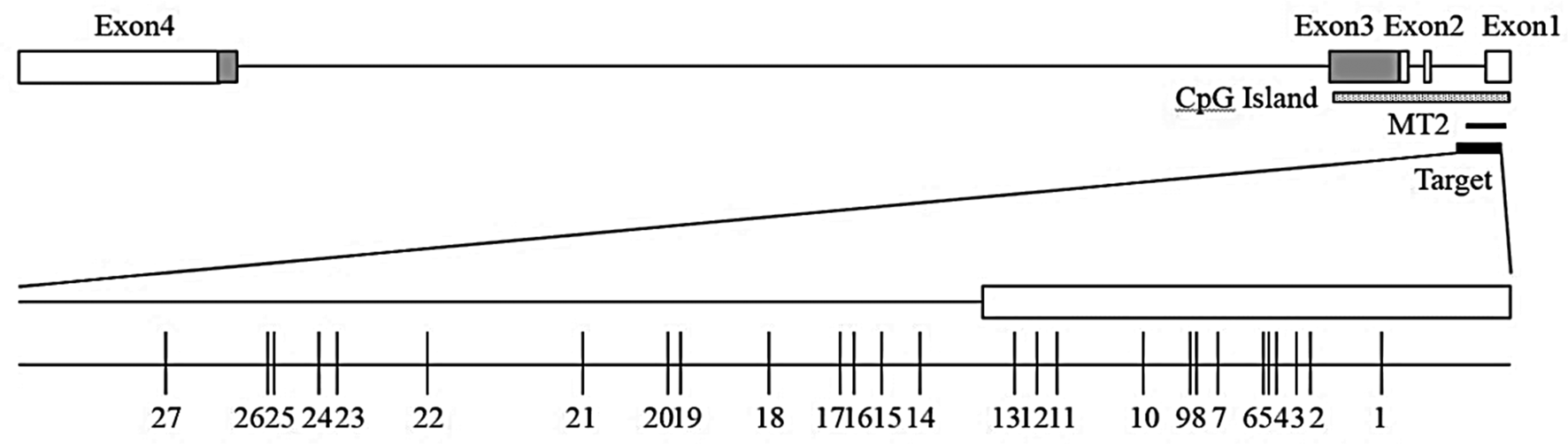
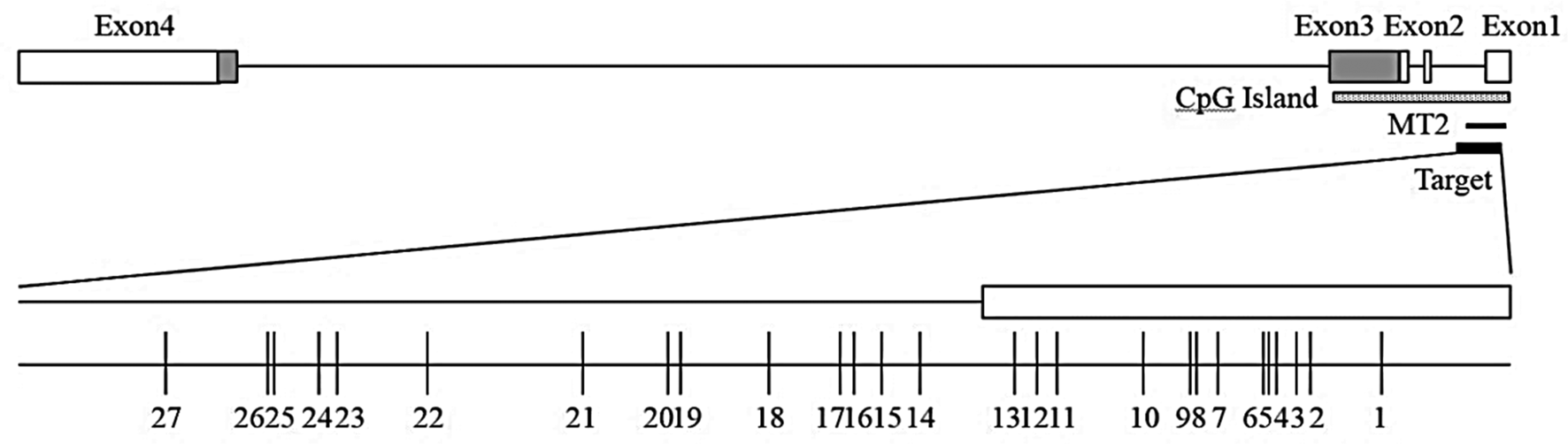
DNA was extracted using prepIT®•L2P reagent (DNA Genotek) and was quantified with PicoGreen® (Quant-iT™ PicoGreen® dsDNA Assay Kit, Thermo Fisher Scientific Inc., Pittsburgh, PA, USA). Using the EpiTect Bisulfite Kit (Qiagen, Germantown, MD, USA), 500 ng of DNA was treated with bisulfite. DNA methylation of 27 CpG sites (see Figure 2) in the promoter region including the MT2 region (Kusui et al., Reference Kusui, Kimura, Ogita, Nakamura, Matsumura, Koyama and Murata2001) of the OXTR gene (chr3: 8,792,095–8,811,300; hg19 build) was analyzed using EpiTYPER (MassARRAY system; Agena Biosciences, San Diego, CA, USA) according to the manufacturer's instructions. Forward (aggaagagagGAGGTTTTAGTGAGAGATTTTAGTTTAG) and reverse (cagtaatacgactcactatagggagaaggctTCCCTACTAAAAAAACCCCTACCTC) primers were used corresponding to chr3: 8,810,604–8,811,075 (Clark & Coolen, Reference Clark and Coolen2007). Cycling conditions were: denaturation (94°C for 15 min), then 50 cycles of amplification (94°C for 30 s, 58°C for 60 s, and 72°C for 30 s) and a final extension step of 72°C for 10 min. Samples were electrophoresed using 2% agarose gel to confirm amplification.
Overview of oxytocin receptor (OXTR) and methylation sites. Note. Gene structure of OXTR (chr3: 8792095–8811300; hg19). MT2 (chr3: 8761543–8761138; Kusui et al., Reference Kusui, Kimura, Ogita, Nakamura, Matsumura, Koyama and Murata2001). The location of 27 CpG sites in this study are indicated below. Assayed CpG sites correspond to the following genomic positions: chr3: 8811028 (CpG1), chr3: 8811010/8811005 (CpG2,3), chr3: 8810999 (CpG4), chr3: 8810995/8810993 (CpG5,6), chr3: 8810981 (CpG7), chr3: 8810974/8810971 (CpG8,9), chr3: 8810958 (CpG10), 8810936/8810930 (CpG11,12), chr3: 8810924 (CpG13), chr3: 8810890 (CpG14), chr3: 8810875 (CpG15), chr3: 8810863 (CpG16), chr3: 8810856 (CpG17), chr3: 8810833 (CpG18), chr3: 8810808/8810798 (CpG19,20), chr3: 8810775 (CpG21), chr3: 8810734 (CpG22), chr3: 8810709 (CpG23), chr3: 8810700 (CpG24), chr3: 8810682/8810680 (CpG25,26), chr3: 8810648 (CpG27)
Mass spectra methylation ratios were generated using EpiTYPER version 1.2 (Agena Biosciences). The instrument detects 16 Da molecular weight differences between methylated and unmethylated fragments. The percentages (or rates) of the surface area of the peak representing the methylated fragments are calculated as follows: methylation rate = methylated fragment / methylation fragment + unmethylated fragment (Suchiman et al., Reference Suchiman, Slieker, Kremer, Slagboom, Heijmans and Tobi2015). The reliability of the methylation assays was checked for each cytosine nucleotide–phosphate–guanine nucleotide (CpG) site. EpiTect control DNA samples (Qiagen) known to be fully methylated and fully unmethylated were assessed in parallel to the study DNA to determine the upper and lower limits of detection for each assay.
OXTR DNA methylation index
Previous researchers have evaluated methylation at individual CpG sites as well as mean methylation levels across sites in this region (Dadds et al., Reference Dadds, Moul, Cauchi, Dobson-Stone, Hawes, Brennan and Ebstein2014; Szyf & Bick, Reference Szyf and Bick2013). We focused on developing an index of methylation by considering 14 consecutive CpG sites across Chr3: 8810890 (CpG14) to Chr3: 8810648 (CpG27). These sites are located in Intron 1; a region with demonstrated associations to social behavior and cognition (Dadds et al., Reference Dadds, Moul, Cauchi, Dobson-Stone, Hawes, Brennan and Ebstein2014; Gregory et al., Reference Gregory, Connelly, Towers, Johnson, Biscocho, Markunas and Pericak-Vance2009; Kumsta, Hummel, Chen, & Heinrichs, Reference Kumsta, Hummel, Chen and Heinrichs2013). Per standard practice (Beach, Lei, Brody, & Philibert, Reference Beach, Lei, Brody and Philibert2018; Huang et al., Reference Huang, Galati, Burrows, Beilin, Li, Pennell and Craig2012; Noro et al., Reference Noro, Gianfagna, Gialluisi, De Curtis, Di Castelnuovo, Napoleone and Donati2019), prior to creating a summed index, we conducted a principal components analysis (PCA). PCA of the sites revealed one reliable factor (Eigenvalue 2.63, loadings .31–.74) that explained 28% of the variance. Three items did not load on the primary factor (.04–.13); they comprised an internally inconsistent second factor that explained 14% of the remaining variance. This suggested using the sites that loaded on the primary factor and excluding the three CpG sites that did not load on it (CpGs15, 17, and 25.26). The 11 sites loading on the primary factor were subsequently summed to form the OXTR DNAm index.
Plan of analysis
Hypotheses were tested with path analyses using Mplus 7.13 (Muthén & Muthén, Reference Muthén and Muthén1998-2015). Parameters were estimated and missing data were managed with full information likelihood estimation (FIML). The FIML estimator tests hypotheses with all available data; no cases are dropped. Data missing due to skipped items were minimal for each variable (<2%). Missing-data patterns met assumptions for missing completely at random (MCAR; Little's MCAR test: χ2 (253) = 211.25, p = .97), supporting the use of FIML. We specified an indirect effects model where ACEs and T1 contextual stressors predicted defensive/hostile relational schemas at T2 (T1 controlled). T2 relational schemas, in turn, predicted social developmental risk factors at T2 (T1 controlled), which was specified as a predictor of both depressive symptoms and substance abuse at T3 (T1 controlled). Note that the T1 control for depressive symptoms was a brief version of the full scale used at T3. We then examined the moderating influence of OXTR DNAm on the paths linking ACEs and contextual stressors to defensive/hostile schemas using multigroup procedures, comparing paths with high and low levels of methylation as defined using a median cut. We first constrained all model paths to equity, then freed the beta parameter representing the path of interest to determine if model fit changed significantly with the parameter freed. The significance of conditional indirect effects was tested with bootstrapping analyses with 50,000 bootstrapping resamples to produce 95% confidence intervals.
Results
Correlations among all study indicators and their means and standard deviations are presented in Supplemental Table 1. The average number of days men reported using drugs or alcohol to get high was 7.3 at T1 and 5.4 at T3. At T3, men's mean CES-D score was 15.7, just below the commonly cited threshold of 16 for clinically significant levels of symptomatology (Radloff, Reference Radloff1977). We conducted a confirmatory factor analysis (CFA) of the measurement model. The model fit the data as follows: χ2(48) = 65.84, p = .04. RMSEA = .03. CFI = .96. All factor loadings were significant, exceeding .22, and loaded in the expected directions.
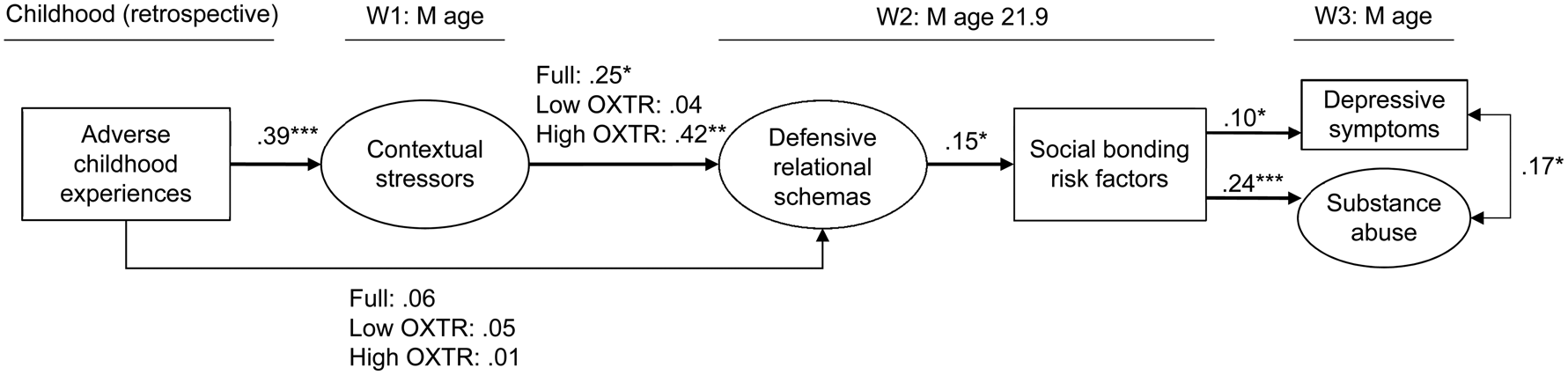
Figure 3 and Supplemental Table 2 present the indirect effects model. It fit the data as follows: χ2(129) = 199.43, p < .001. RMSEA = .04. CFI = .93. Consistent with our hypotheses, ACEs predicted young adult contextual stress (β = .39, p < .001), which in turn forecast increases in defensive/hostile schemas (β = .25, p < .05). Defensive/hostile schemas predicted increases in social developmental risk factors (β = .15, p < .05), which were a proximal antecedent of depressive symptomatology (β = .10, p < .05) and substance abuse (β = .24, p < .001). Inconsistent with our hypotheses, ACEs did not directly predict relational schemas. To probe the directions of effect between relational schemas and social developmental risk factors, we tested an alternative model in which social developmental risk factors predicted defensive/hostile schemas. No significant path linking social developmental risk factors to defensive/hostile relational schemas emerged, suggesting that the temporal ordering of mediators in Figures 1 and 3 is appropriate.
Path analysis results with moderation by OXTR methylation. χ2 = 46.74, df = 24, p = .01. root mean square error of approximation (RMSEA) = .05. comparative fit index (CFI) = .95. Standardized coefficients are shown. *p < .05. **p < .01. ***p < .001.

Tests of the moderating effect of OXTR DNAm are presented in the pathways linking ACEs and contextual stressors to defensive/hostile schemas in Figure 3. The multigroup analysis detected significant moderation for the path linking contextual stressors to defensive/hostile relational schemas as indicated by a significant reduction in chi-square (Δχ2(1) = 4.87, p = .03), but not for the ACEs to relational schemas path. The moderation analysis indicated that, when OXTR DNAm was elevated, a significant link emerged between contextual stressors and defensive/hostile schemas (β = .42, p < .01); however, when OXTR DNAm was low, contextual stress had no apparent influence on increases in defensive/hostile relational schemas (β = .04, p = ns). A significant conditional indirect effect linked contextual stress to social developmental risk factors via defensive/hostile relational schemas for young adult with high levels of OXTR methylation (β = .13, 95% confidence interval = [.013, .242]) but not for young adult with low levels of OXTR methylation (β = .04, 95% confidence interval = [−.027, .097]).
Discussion
This study documents the mechanisms that link ACEs and concurrent contextual stressors to increases in substance abuse and depressive symptoms among rural African American men during emerging adulthood. Findings support a cascade model that highlights the ways in which stressful contexts forecast substance abuse and depressive symptoms by promoting increasingly defensive/hostile relational schemas, which increase social developmental risk factors. Exploratory analyses suggest that DNA methylation in OXTR is a moderating factor; when OXTR DNAm was high, the association between contextual stress and defensive/hostile relational schemas was exacerbated. When OXTR DNAm was low, contextual stress had no significant association with defensive/hostile schemas.
Our findings suggest that exposure to adversity both in childhood and emerging adulthood increases men's vulnerability to substance abuse and depressive symptoms. This is consistent with past research indicating that male African Americans in adolescence and emerging adulthood encounter a host of stressful life events (i.e., racism, violence, and economic marginalization) that influence their mental health (Watkins, Reference Watkins2012) and substance use (Williams, Neighbors, & Jackson, Reference Williams, Neighbors and Jackson2003). The notion of stress proliferation arose from the observation that serious stressors tend to give rise to secondary, or proliferated, stressors that carry forward across time to contribute to changes in important social relationships and individual functioning (Hammen, Reference Hammen2006). Applied to the current study, ACEs promote increases in men's exposures to multiple contextual stressors during the emerging adult transition. Emerging adult stressors thus represent both the influence of stress in a previous life stage and the influence of challenges endemic to rural Southern environments for emerging adults. Consistent with past research using cascade type models (Brody et al., Reference Brody, Chen and Kogan2010), our findings further underscore the predictive efficacy of proximal contemporary stressors rather than more distal childhood ones that affect emerging adult outcomes indirectly, primarily through robust links with concurrent exposures.
Although substance abuse is relatively common during this developmental period, it has unique prognostic significance for compromised life course trajectories in this population. Many African American men experience a late onset of substance abuse, mainly abstaining from substances in secondary school (Wallace, Brown, Bachman, & LaViest, Reference Wallace, Brown, Bachman and LaViest2003). When they use substances in emerging adulthood, however, they experience heightened social, legal, economic, and psychological consequences from use (National Institute on Drug Abuse, 2003). Our findings are consistent with Zapolski et al.'s (Reference Zapolski, Pedersen, McCarthy and Smith2014) thesis implicating social developmental risk factors in African American men's patterns of substance abuse. Emerging adulthood is a time of instability and rapid change during which young people experience increases in autonomy and learn to navigate their communities as parental supervision and guidance decrease. Young African American men go from immersion in a system of protective social bonds involving family and school that deter substance use to the exercise of greater personal autonomy in developing new relationships and making decisions regarding education and joining the labor force. For men with a history of adversity who must contend with challenging environments, our findings suggest that it is particularly difficult to maintain or develop adult roles and prosocial ties that play a pivotal role in the decline of substance use during the transition to adulthood (Bachman et al., Reference Bachman, O'Malley, Schulenberg, Johnston, Bryant and Merline2014).
Similarly, our study indicates that, for many African American men, emerging adulthood coincides with increases in vulnerability to depressive symptoms. Stress-coping perspectives on the emergence of depression underscore the accumulation of chronic stress in taxing young adults’ coping efficacy (Reed, Ferraro, Lucier-Greer, & Barber, Reference Reed, Ferraro, Lucier-Greer and Barber2015; Vrshek-Schallhorn et al., Reference Vrshek-Schallhorn, Stroud, Mineka, Hammen, Zinbarg, Wolitzky-Taylor and Craske2015). Developmental scientists have increasingly characterized emerging adulthood as a developmental inflection point with heightened vulnerabilities for African American youth from low-resource environments (Hope et al., Reference Hope, Hoggard and Thomas2015). Emerging adulthood often provides individuals’ first opportunities to make their own life-shaping decisions. The majority of emerging adults believe they will get what they want from life, and most expect that their lives will be better than those of their parents (Arnett & Schwab, Reference Arnett and Schwab2012). Interestingly, Arnett (Reference Arnett2004) found that emerging adults from low socioeconomic status backgrounds are even more likely than their more advantaged counterparts to feel that they will be better off than their parents. This optimism conflicts with the proliferation of challenges that many racial/ethnic minority populations face, including the barriers to education and employment that act as proximal predictors of decrements in mental health (Utsey, Giesbrecht, Hook, & Stanard, Reference Utsey, Giesbrecht, Hook and Stanard2008). For rural African Americans, succeeding in school or joining the labor force in a low-resource environment can be a protracted and demoralizing process. Consistent with past research (Cohen, Farley, & Mason, Reference Cohen, Farley and Mason2003; Hardie & Lucas, Reference Hardie and Lucas2010), our data reveal that the accumulation of stressors takes a toll on men's supportive social ties. This deprives men of a source of protection from depression, particularly in stressful environments.
Past research with African American men has linked defensive/hostile schemas to antisocial behavior (Simons & Burt, Reference Simons and Burt2011; Simons et al., Reference Simons, Lei, Beach, Brody, Philibert and Gibbons2011) and problems with intimate relationships (Kogan et al., Reference Kogan, Lei, Grange, Simons, Brody, Gibbons and Chen2013). Our cascade model implicated increases in defensive/hostile relational schemas in the etiology of substance abuse and depressive symptoms via their influence on social developmental risk factors. Adverse experiences in the family of origin are particularly influential in adults’ development of the ability to process information about their contemporaneous relationships (Murphy et al., Reference Murphy, Steele, Dube, Bate, Bonuck, Meissner and Steele2014). Schemas can also be modified by ongoing experiences with challenging environments. Although zero-order associations emerged with schemas and ACEs, concurrent stressors fully mediated this link. Concurrent stressors forecast increasingly defensive/hostile schemas during the 2-year period in which men were observed. These changes were independent of the effects of ACEs on defensive/hostile schemas and suggest that the emerging adult transition occasions profound challenges.
We included in our design a novel biological moderating factor that empirical data on stress modulating mechanisms suggested (Smearman et al., Reference Smearman, Almli, Conneely, Brody, Sales, Bradley and Smith2016). The findings were partially consistent with our hypotheses. We expected OXTR DNAm to moderate the influence of ACEs and concurrent contextual stressors on relational schemas, but only concurrent stress was moderated. This diverges from Smearman et al.'s (Reference Smearman, Almli, Conneely, Brody, Sales, Bradley and Smith2016) findings that documented an interaction between physical abuse history and adult psychopathology. A focused assessment of physical abuse may have revealed similar associations in our data or, conversely, physical abuse in the prior study may have diminished predictive efficacy when concurrent stressors are modeled. Examinations of OXTR DNAm are scarce and additional studies are needed. We did find, consistent with our hypothesis, that OXTR DNAm moderated the influence of concurrent stressors on relational schemas. In the context of high methylation, the influence of contextual stress was exacerbated; however, when methylation was low, young men were protected from the influence of contextual stressors on their relational schemas.
This finding points to the potential for oxytocin-informed interventions to affect relationship cognitions. Considerable attention has been given to the use of intranasal oxytocin as a means of treating social dysfunctions and substance use (Bakermans-Kranenburg & van IJzendoorn, Reference Bakermans-Kranenburg and van IJzendoorn2013). It is important to note, however, that circulating levels of oxytocin are affected by multiple factors, of which OXTR DNAm is only one. Identification of the antecedents of OXTR DNA methylation that might constitute intervention targets requires considerably more study. The extant literature also has suggested that OXTR DNAm may be usefully considered as a mediator of the association of early life and adult stress with social functioning and psychopathology (Gouin et al., Reference Gouin, Zhou, Booij, Boivin, Cote, Hebert and Vitaro2017). For example, Simons and colleagues (Simons, Lei, Beach, Cutrona, & Philibert, Reference Simons, Lei, Beach, Cutrona and Philibert2017) found that concurrent life stressors forecast negative relational schemas and depressive symptoms indirectly via effects on OXTR DNAm. In contrast, our analyses (see Supplemental Table 1) revealed no zero-order associations between ACEs or concurrent stressors with OXTR DNAm. Considerably more research is needed in this area to specify the effects of OXTR DNAm; heterogeneity in the loci assayed and the types of samples used also must be addressed (Maud et al., Reference Maud, Ryan, McIntosh and Olsson2018).
Caution is necessary in interpreting this study's findings. Childhood adversity was retrospectively self-reported and may be subject to recall and social desirability biases. A brief version of the CES-D was used as a control variable at T1. We included two intermediate outcomes, relational schema and social developmental risk, both of which were measured at T2. A time lag between these intermediate outcomes would be optimal for testing mediation. OXTR methylation was assayed using DNA from saliva samples. Concordance of methylation in peripheral tissue with methylation in centrally located tissue is a core issue in epigenetic research on behavior (Langie et al., Reference Langie, Moisse, Declerck, Koppen, Godderis, Vanden Berghe and De Boever2017). Validation of this procedure and concordance with sera-based methods, however, suggest that the use of saliva samples yields reliable information on OXTR methylation in both central and peripheral systems (Langie et al., Reference Langie, Moisse, Declerck, Koppen, Godderis, Vanden Berghe and De Boever2017; Nishitani, Parets, Haas, & Smith, , Reference Nishitani, Parets, Haas and Smith2018; Smith et al., Reference Smith, Kilaru, Klengel, Mercer, Bradley, Conneely and Binder2015). Cellular heterogeneity can act as a confounding factor for epigenetic studies of saliva-derived DNA; however, our targeted sites are located in a CpG island that exhibits relatively consistent methylation levels among cell types (Smith et al., Reference Smith, Kilaru, Klengel, Mercer, Bradley, Conneely and Binder2015). This feature could minimize the impact of differences in cell type for between-group comparisons. In addition, following the results of the factor analysis, we dropped three sites from the consecutive section of CpG loci in our moderation analysis. It remains unclear in the literature how best to characterize methylation at the loci level, and additional research is needed to identify the ways in which patterns of methylation manifest at this level of analysis.
We selected stressors and mechanisms on the basis of research and theory. However, other factors have been implicated in the etiology of depressive symptoms and substance use among young African American men. Studies suggest the importance of examining racial stress and aspects of masculinity ideology as etiological factors (Hammond, Reference Hammond2012; Matthews, Hammond, Nuru-Jeter, Cole-Lewis, & Melvin, Reference Matthews, Hammond, Nuru-Jeter, Cole-Lewis and Melvin2013). This warrants additional attention in future research.
In conclusion, few, if any, longitudinal studies have addressed the ways in which childhood and emerging adult life stresses that young African American men from low-resource environments experience are translated into cognitive and social processes that forecast substance use and depressive symptoms. We conceptualized vulnerability to substance use and depression as a developmental cascade in which childhood and emerging adult stressors increased defensive/hostile relational schemas, which, in turn, increased social developmental risk factors for substance use and depression. The emergence in this study of a chain-like, cascading sequence is important because it underscores the need for longitudinal data and for analytic methods that can be used to test the postulated ordering of the risk indicators and risk mechanisms through which the contributions of life stress are transmitted. Information about the cascade of risk indicators and risk mechanisms is also important from a prevention science perspective. Knowing that life stress affects relational schemas in ways that compromise social bonds will enable prevention scientists to formulate developmentally appropriate interventions that interrupt this sequence or eventually target behavioral or biological protective factors associated with the OXT system.
Supplementary Material
The supplementary material for this article can be found at https://doi.org/10.1017/S0954579420000632
Acknowledgments
Funding for this study was provided by NIDA Grants R01 DA029488 and P30 DA027827 and NIAAA grant R01 AA026623. NIDA and NIAAA had no role in the study design; the collection, analysis, or interpretation of the data; the writing of the manuscript; or the decision to submit the article for publication. We would like to thank Eileen Neubaum-Carlan, MS, for her helpful comments in the preparation of this manuscript.
Conflicts of Interest
None