On the February 18, 2005, toward the end of the foxhunting season of that year, the 2004 Hunting Act became law in England and Wales; and the hunting of foxes (Vulpes vulpes) with packs of hounds was prohibited.1
The act prohibited the hunting of all mammals with dogs, unless that hunting fell within the exceptions of the act, and so covered mink, hare, and deer previously hunted with packs of hounds. Deer stalking or shooting was not affected by the act. The act refers to hunting with dogs, whereas members of the hunting world always use the term hounds to refer to the dogs used to hunt in packs. In using this term, they always distinguish between hounds and other dogs in the context of hunting and, in an important sense, culturally elevate hounds above other dogs. I will follow this insider terminology when writing about hunting as a cultural practice but use the term dogs when referring specifically to the Hunting Act.
The use of Hunt with a capital H always refers here to the registered social entity rather than to the practice of hunting itself. In a similar way Huntsman and Master with capital letters refer to specific roles within a Hunt. Meet is capitalized to refer to the formal coming together of the Hunt at the beginning of the day to distinguish it from meeting as an informal coming together.
It is not my intention to discuss the multifaceted general public and political debates as they developed prior to the Hunting Act becoming law nor to discuss how the prohunting lobby has attempted subsequently to challenge, so far unsuccessfully, the legality of the act (I have, however, offered an overview of some of the key issues in an extended endnote).3
Although I have not engaged here with the general debates for and against hunting leading up to the parliamentary debates on the issue, I would like to offer a very brief thumbnail sketch of some of the key issues.
There has been a long history of opposition to foxhunting. From the latter part of the eighteenth century when the sport was developing, from the nineteenth century when it was consolidating, and into the twentieth century, there were complaints about how Hunts intruded into the agricultural space of the countryside where they caused damage and did not always respect the rights of landowners who did not want people galloping, uninvited, across their land. Such debates did not, generally, reach a large public and were confined to rural areas.
Debates in the latter part of the twentieth century and up to the present about other aspects of foxhunting reached a much wider public. Very basically, the groups that have campaigned against hunting have done so in terms of arguments about the welfare implications for hunted animals, arguments that have been combined with moral issues about the unacceptability of the practice. Such groups have argued that hunting involved unnecessary and prolonged suffering for the hunted animal. If, they have argued, foxes need to be controlled and killed because of their predation on livestock and game birds (something they have often disputed and they have marshalled evidence to show that fox predation has been exaggerated by the prohunting lobby), there are more humane methods available for killing them. From their perspective not only is foxhunting unnecessary and inhumane, but it is a deliberately cruel practice and they find it morally objectionable that participants derive pleasure from animal suffering. In recent years those opposed to hunting have also made the claim that it is a sport of rural elites who should not be able to use their social, economic, and political power to continue a socially exclusive and anachronistic practice.
Those in favor of foxhunting have argued that foxes cause significant economic losses to livestock farmers and those who raise game birds. They have argued that it is necessary to control fox numbers and that hunting is both the most effective and humane way of doing so. They have also argued that hunting foxes with hounds is essentially a natural practice. Prohunting groups have claimed that foxhunting forms an integral part of their general concern with a stewardship of the countryside and the careful management of its landscapes and biodiversity. In terms of the social issues involved, they have argued that foxhunting, far from being elitist, is socially inclusive; is an important part of the social life of rural communities; and, in terms of employment and income, makes a significant contribution to the rural economy. From the perspectives of these groups, the moral arguments against hunting have been countered by emphasizing their views of hunting contributing to the positive welfare of foxes in general and the humane killing of foxes individually. Prohunting groups have strongly maintained that the demand for a ban was lead by urban dwellers with no sense of rural society and culture, whereas those in favor of the ban often pointed out that not all those who live in the countryside supported hunting.
Shifting perspective to the political issues involved, in 1949 two private (i.e., non-political party) bills to ban foxhunting were introduced into the House of Commons by individual Members of Parliament; both failed. In the same year a government inquiry, the Scott Henderson Inquiry, concluded that hunting with hounds involved less cruelty than other means of controlling foxes. In the early 1990s three Labour party private members bills to ban hunting failed in a Conservative-dominated House of Commons and because of opposition in the House of Lords. The momentum toward a ban picked up in 1997 when the Labour Party promised in its election manifesto to institute a ban. Although there was debate in parliament, the promise was never realized because the bill was not given government time and because of strong opposition in the House of Lords. As part of their response to hunting becoming a significant political issue, the prohunting groups held a major rally in 1997 in Hyde Park, London. In 1999 Home Secretary asked Lord Burns to institute an inquiry into hunting with dogs. The inquiry was not asked to consider moral and ethical issues relating to hunting but rather:
To inquire into:
[bull ] the practical aspects of different types of hunting with dogs and its impact on the rural economy, agriculture and pest control, the social and cultural life of the countryside, the management and conservation of wildlife, and animal welfare in particular areas of England and Wales;
[bull ] the consequences for these issues of any ban on hunting with dogs; and
[bull ] how any ban might be implemented.
To report the findings to the Secretary of State for the Home Department.
(Report on Committee of Inquiry into Hunting with Dogs in England and Wales. London: The Stationary Office, 2000. The actual quotation comes from page 1.)
In the document submitted to the Home Secretary, the inquiry team specifically stated that they had “not attempted to answer the question of whether or not hunting should be banned.” In 2001 prior to the general election, the Labour Party pledged that a Labour government would ban hunting with hounds; and it promised both a free vote on the issue and to resolve matters if its plans were blocked by the House of Lords. Once again, one response from the prohunting groups in 2002 was to help organize a demonstration, estimated to have been attended by some 400,000 people, in central London. The Hunting Bill was given its first reading in the House of Commons on September 9, 2004; and, after many hours of impassioned and heated debate, it was finally deemed to have been passed on November 18, 2004.
Although the influential Burns Inquiry did deal with the potential affects of a ban in terms of the rural economy and rural social and cultural life, such issues did not feature in the Act. The central concern of the Act is that of the welfare of foxes, and it does not make any reference to moral or ethical issues relating to hunting. Those in favor of the Act believe that it will protect foxes against inhumane treatment (but it must be pointed out that it does not prohibit the killing of foxes by other means) as well as end what they regard as a barbaric practice that inflicts unacceptable and gratuitous suffering on animals for the pleasure of the participants. In terms of welfare arguments, those opposed to the Act believe that the wellbeing of foxes has been compromised by the legislation and that individual foxes will suffer from being trapped for long periods before they are killed or by being wounded from nonfatal gunshots.
Readers interested in the complexities and issues involved in the politics of hunting in England might like to refer to the following sources: Thomas, The Politics of Hunting; Wikipedia, the online encyclopaedia has a useful survey at http://en.wikipedia.org/wiki/Fox_hunting_legislation (last accessed 7 July 2007). Pye-Smith, Rural Rites, engages with many of the welfare, moral, social, and political issues involved in the lead up to the ban; the author is prohunting but there is important analysis of a range of arguments. Details of progress of the Hunting Bill through parliament can be found at www.countryside-alliance.org/hunting_campaigns/hunting_politcal_issues/Hunting_Act_2004/ (last accessed 7 July 2007). Although this is the web site of the Countryside Alliance, a prohunting alliance, it provides important links to House of Commons sites that have verbatim texts of the debates. The Final Report of the Committee of Inquiry into Hunting with Dogs in England and Wales (2000) at www.huntinginquiry.gov.uk/mainsections/huntingframe.htm has information on the submissions, both pro and anti, to the inquiry.
The research on which this article is based has been largely that of long-term participant observation anthropological fieldwork with four Hunts in England and on extensive interviews with Masters, Huntsmen, and supporters across England.
See Marvin, “Cultured Killers,” for a full exposition.
For many supporters of hunting, the Hunting Act has stripped the fox of its cultural status and reduced it to that of an animal unceremoniously killed if it is deemed a nuisance or a pest. In a peculiar sense, this is a reversion to the fox's much earlier status before it became the focus of hunting. There is a long history of fox killing in England, and they have probably been killed as a nuisance predator for as long as humans have kept poultry and other livestock on which foxes preyed. The earliest literary images are of foxes creeping around fields and farmyards attempting to snatch unwary or unprotected animals.6
For example, Chaucer, The Nun's Priest's Tale; Terry, Reynard the Fox; Varty, Reynard the Fox.
Foxhunting only developed as a sporting practice in the latter part of the eighteenth century.7
There is evidence that the deliberate hunting of foxes with packs of hounds existed in the seventeenth century (see Carr, English Foxhunting, 21–30; Ridley, Fox Hunting, 1–4), but it was not until the mid-eighteenth century that foxhunting began to develop as specialized form of hunting and gradually to become the most popular form of hunting with hounds.
For a classic early account, see Beckford, Thoughts on Hunting.
The fox initially emerged as a substitute for the ideal or noble quarry species traditionally hunted; but it soon began to acquire a new cultural status—one that was conferred on it because it proved, in the eyes of those who hunted, to be a worthy and challenging opponent.9
Howe, “Foxhunting as Ritual,” 1981.
For two delightful literary accounts see Trollope, Phineas Redux, chapter 75, 280–85; and Trollope, The American Senator, chapter 4, 22–28).
These sketchy remarks about the past should not to be taken as a history of foxhunting but rather as an introduction to the account of foxhunting that follows.11
See Carr, English Foxhunting; and Itzkowitz, Peculiar Privilege, for rich historical accounts.
Master of Foxhounds in conversation with author.
Ogilvie, Collected Sporting Verse, 32.
Ex-master of Foxhounds in conversation with author.
This notion of valuing the fox indicates that the hunting of foxes is very different from merely killing foxes. Although there is no space here to embark on a full analysis of sports hunting as a field of cultural activity, it is worth signalling a key difference between killing as vermin control and killing within hunting.15
See Marvin, “Wild Killing,” for an attempt to explore the differences between killing by hunting and other processes of killing animals.
PROHIBITED PRACTICE: THE IMMEDIATE PAST
Foxhunting takes place during a season that extends from autumn until early spring.16
In this section I use the ethnographic present for ease of narrative flow. The present to which it refers is to that immediately prior to February 18, 2005.
The closed season is also the breeding season of foxes and foxhunters speak of the cessation of hunting as respecting this breeding period, a notion of respect that is often expressed by hunters of other species.
Each Hunt usually hunts 2 days a week (most on a Saturday and a weekday), but some hunt more often. On the morning of a hunt, usually at 11 AM, the officials, the Huntsman18
The Huntsman is the person who is responsible for working with the hounds on a hunting day.

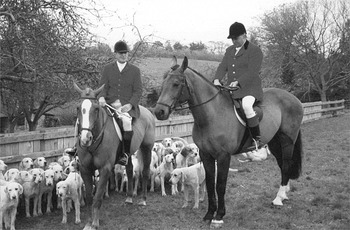
Master of Foxhounds (right), Huntsman (left), and hounds at the Meet. Photographs by and in the personal collection of the author.
When the Master and/or the Huntsman decide to begin hunting, the Huntsman calls his hounds to him (the numbers vary depending on the Hunt, the day, and the terrain; but an average would perhaps be between 28 and 38 hounds19
In the language of foxhunting, hounds are always counted in couples and 20 hounds would be referred to as ten couple. It is also tradition for the Huntsman to take out an odd number of hounds on a hunting day and this would be expressed as ten and a half couple. It is often said that “it is that extra half that might catch the fox.” Despite this tradition Huntsman have told me that they might actually have an even number of hounds with them on any hunting day.
When the Huntsman reaches the field, hedgerow, or woodland where he has planned to start hunting he encourages his hounds, by his voice and horn, to begin searching for the scent of a fox. This is referred to as drawing a covert (the word covert is pronounced cover). Foxhounds hunt by scent rather than vision; and, rather than looking for an actual fox, they seek out the traces of scent left by a fox. If there are no such traces in the first covert, the hounds remain silent; and if he is convinced there is nothing for them to discover there, the Huntsman calls the hounds back to him and moves on to another place to begin a new draw. If some hounds do detect the scent of a fox, they begin to whimper excitedly; this draws the other hounds to them. If the scent becomes stronger, the whimpering becomes a baying (referred to as speaking) as they set off following the scent. It could be that the scent has been left by a fox that has long gone, and the hounds may have difficulty following it as the terrain and local climatic conditions cause it to evaporate or dissipate. If they are unable to follow the scent, their excitement subsides and they come to a standstill. When he catches up with them, the Huntsman might encourage them to search around the area where the scent disappeared in the hope of picking it up again; but if there is nothing to respond to, he again moves them on to begin hunting elsewhere.
However, if the scent is fresh and strong, the hounds increase their pace and their baying and the excitement of the hunt begins. As the hounds set off at speed, the Huntsman follows and blows a fast and excited call on his horn to let the other participants know that a hunt has begun. It might take the hunted fox some time before it is aware of the following hounds; but when it does, it seems to start to take evasive action. Perhaps it will try to flee into dense ground cover or through hedgerows where it is difficult for hounds to follow; it may run along a wall, through a stream, or along a road where it is difficult for the hounds to remain connected with the scent. Sometimes foxes seek refuge in places where hounds cannot discover them or reach them (e.g., in drainage pipes, under farm buildings, in badger setts, or in the earths of other foxes). However, if the hounds are successful in following the scent and the fleeing fox is unable to find a place to escape, the hounds finally lift their heads; see the fox; and the leading hounds surge forward to outpace it, seize it and kill it. As the other hounds catch up they join the melee tearing at the dead fox. When the Huntsman arrives he blows The Kill on his horn and spends several moments praising his hounds. Gradually, they lose interest in the carcass of the fox and the Huntsman allows his horse to rest and other participants to catch up before moving off to start the whole procedure again. The day's hunting activities usually come to an end in the late afternoon.

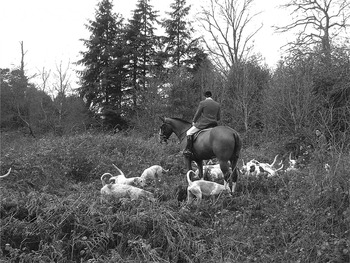
Huntsman with hounds that have just killed a fox in dense undergrowth. Photographs by and in the personal collection of the author.
In this account of foxhunting, the focus has been on the central aspect of hunting itself; but it is now necessary to offer some comments about how the humans take part in the event and move toward a consideration of some of the wider aspects of foxhunting. I previously argued that humans are not directly involved in hunting foxes; but if they are not directly hunting, what are they doing? They are certainly part of the totality of the hunting event; and, as I have suggested elsewhere, there are no mere spectators of foxhunting.20
See Marvin, “A Passionate Pursuit.”.
Perhaps the most immediately obviously engaged group are those on horseback, and many people become members of the Hunt because it offers them the opportunity to ride across the countryside on land that would not be accessible to them as individuals. The hounds hunting their fox create the conditions and possibilities for an exciting and exhilarating equestrian event as the riders attempt to keep up with them. As previously mentioned, the riders must not intrude on the hounds when they are hunting; but they may follow them. This is a controlled and disciplined following. Only the fox may move anywhere it chooses across the countryside, and there should be no restriction to its flight. Hounds are also allowed a considerable freedom of movement, but they are called back from their pursuit if they enter forbidden or dangerous territory. So, for example, the Huntsman tries to stop them entering land where the Hunt is denied access or places, such as major roads or built-up areas where it is too dangerous to continue hunting. Riders are free to jump hedges, gates, and walls as well as to gallop across the countryside; but they may not decide on their own route. Riders are led by a Field Master who is chosen for his or her intimate knowledge of the part of the countryside through which they are hunting on a particular day. The Field Master must know which land they have permission to enter, which fields may be crossed or skirted around, which fields have livestock and must be avoided, how the hounds are running, and how to keep up with them even if it is impossible to follow them directly.
An important point to emphasize here is that although most of the riders hope for an exciting ride, a commonly expressed view by both Masters and Huntsmen is that the exciting bursts of riding should only come about because of the conditions generated by the fox and the hounds, by the central activity of hunting itself. Most Masters and Huntsmen I have interviewed believed that galloping and jumping should not be something done for its own sake but for the riders to follow the hounds. Hunting purists frown on what they regard as unnecessary galloping when hounds are not running; and they regard this as frivolous entertainment (sometimes referred to as larking or jollying), something purposeless and unconnected with the serious business of hunting. Although Masters and Huntsmen might try to ensure that riding is purposeful, they also understand that riders pay to participate in hunting because they hope for an exciting ride. A hunting day in which there is little scent or during which hounds are unable to run very much is likely to disappoint the keen riders, and those managing the day's event often allow or create some moments of fast and exciting riding simply to entertain the riders. For example, it sometimes happens that the Huntsman leads his hounds off quietly in the direction of a covert he intends to draw while the Field Master leads the riders in a different direction for some fast riding and jumping before reconnecting with the Huntsman at a prearranged point.
A Huntsman could certainly hunt foxes with his hounds without the mounted followers behind him. Some Huntsmen commented to me that this would be a delight because they could then concentrate on what they termed the art and science of hunting without worrying about whether the followers were having an enjoyable day. This, however, would be a very different form of foxhunting because it would be reduced to an individual pursuit, whereas the spirit of foxhunting is that of a collective, social practice.
Those who participate on foot21
Some of those on foot are people who would normally ride but who, on a particular day, might have an unfit or injured horse or might not have the time to spend all day out on horseback.
Some foot followers prefer to travel on their own, whereas others travel with friends or family in their vehicles. Throughout the day the foot followers form a fluid group that comes together in different configurations in different parts of the countryside. Whether they move about as individuals or in small groups, there is a considerable sociality when they come together at the same place. Many conversations continue discussions about everyday matters and the expression of everyday sociability from the Meet; however, the focus is generally on what is going on around them. People discuss what they have seen or not seen, who they have seen or not seen, where they have been, where they have connected with or lost the hunt, and where hunting might be taking place now. A significant part of the talk among these followers are the judgements that are made about how the hunting has developed during the day. There is some talk about riders and their horses, who has jumped well, and who has fallen; but the main concern centers on foxes, hounds, and the Huntsman. People discuss the difficulties or ease of finding a scent on that particular day; they make judgements about the skill of the fox in evading hounds, the performance of the hounds, and the performance of the Huntsman. Has he read the countryside successfully and taken the hounds to places that are likely to hold a fox? Has he missed a good opportunity at a particular place? Has he been giving his hounds enough time to work through a covert or is he moving them on too quickly? Is he lingering too long in a place where it seems obvious to the observers that there is no likelihood of finding a fox? Where will he go next or, simply, where on earth is he now!?
COUNTRYSIDE AND COMMUNITY
In this section I consider a more encompassing sense of foxhunting. To be a member of a Hunt or to participate in foxhunting involves far more than joining the activities of a hunting day. Foxhunting in its totality involves a connectedness with the countryside and rural life, and it generates a set of local identities and a sense of belonging among the participants. In part, these senses of identity and belonging result from the particular spatial organization of foxhunting that began in the nineteenth century and has continued until the present. However, they are also generated by the collective nature and sociality of foxhunting in this wider sense.
An important feature of foxhunting is its extension across the countryside—unlike fishing or other field sports such as game bird shooting—the human participant does not take up a fixed point in the landscape and wait for the animals to come. Here, humans are engaged with the pursuit of a free-ranging wild animal that may flee in any direction. From the earliest days of foxhunting, there was always the problem of where the humans, their horses, and their hounds might go as well as what right of access they might have, or might demand, across land that was owned by someone. Precedents and, literally, gentlemen's agreements developed, but there were also disputes. With the increasing popularity of foxhunting in the nineteenth century and the increasing number of disputes about who had the right to hunt where, there was a need to formalize arrangements. An early attempt at this came in 1856 when a committee of Masters of Foxhounds was established at Boodle's Club (a private gentlemen's club) in London to settle disputes submitted to them. This informal association developed into the Masters of Foxhounds Association, which from 1881 registered and regulated Hunts and hunting. In terms of the focus of this article, an important outcome of the regulation was the fixing of what are called Hunt countries or the territories over which named and registered Hunts had the right to hunt. However, the fact that these territories are established and recognized by the Hunt authorities does not guarantee that the Hunt may go anywhere it chooses within this territory. There is no legal right of access. Presently, access to the countryside must be negotiated with farmers and other landowners, some of whom disapprove of the event and do not allow them onto their land; the Hunt must take notice of this and other places in the landscape (built up areas, roads, railway lines) where their presence is either forbidden or inappropriate.
These named territories do not correspond to any other official, administrative mappings such as parish or county boundaries. Although some Hunts use the name of a county as the name for the Hunt (Essex, Suffolk, Hampshire) no one county is given over as a Hunt country. The county of Devon, for example, has three Hunts that use the county name: the East Devon, Mid Devon, and South Devon. However, it is also has the Dulverton Farmers and the Dulverton West Hunts that use more local names. For the purposes of foxhunting, these countries form a set of landscapes and a social world that are of deep significance for those who belong to them.
In terms of rights, perhaps the most important aspect is that the named Hunt associated with the country does not have the right to hunt outside that territory; and, conversely, no other Hunt has the right to enter their territory to begin hunting there. However, there is an intriguing exception to this incursion into another Hunt country. The boundaries are nominal, there to set limits on humans; but they are porous to animals. Nobody can stop a fox moving where it will, it is also sometimes difficult to control the movement of hounds, which allows for a legitimate crossing of boundaries. If the scent of a fox has been found and followed and that fox crosses into the territory of an adjoining Hunt, it may be followed to the point where it is lost, killed, or escapes into a refuge. What is absolutely forbidden is for the intruding Hunt to begin to hunt a fox from that country when they are there. Foxes, as it were, belong to Hunt countries once they are the focus of attention of the hunting hounds; but a fresh or unhunted fox in an adjoining country belongs to that Hunt and should only be hunted by the Huntsman and hounds of that Hunt.
For those who belong to Hunts, the sense of identity is engendered by these Hunt countries; Identities are closely associated with the notions of connectivity and belonging. There are many people who live within a Hunt country who are not of it—they may not even know of its existence—it is of no social or cultural significance to them, because to belong to it people must connect to the event for which the territory was established. They belong to, support, or follow a particular Hunt and develop a profound attachment to particular landscapes. Those interested in foxhunting do not usually travel around England participating in other Hunts—they are part of a particular Hunt.22
However, people do sometimes go to other Hunts as visitors.
You know the Hunt country is created by foxhunting people for foxhunting people. It is something that unites us and identifies us. We are often in different places in England, at country shows and things like that, and we will identify ourselves as being from this Hunt country, not from this village or this county but from this Hunt country, then they know where we are from.23
Master of Foxhounds in conversation with author.
For me what is important is the sense of belonging, belonging with the people and belonging to the countryside, to this countryside, our country. It is about being connected.24
Master of Foxhounds in conversation with author.
For so many years the boundary of my life was the edge of the Blackmore Vale country.25
Ex-master of Foxhounds in conversation with author.
Fundamental to these senses of connectedness is the fact that foxhunting, while there are some exceptions, does not take place mainly in the wild spaces of the countryside but rather in the spaces and places of worked agricultural land. Most who hunt are rural dwellers who do not leave the spaces of their everyday world on a hunting day to go elsewhere. Rather, they are drawn into the landscapes that are part of their everyday world and engage with them in more intense ways. For farmers who hunt, these landscapes are their working environments; for others they are part of a countryside that is familiar to them as they drive to work, go shopping or to school, or crisscross when visiting friends and family. However, on a hunting day the everyday countryside is, as it were, elevated to something of special significance; and the mundane becomes extraordinary because it becomes the site for the possibilities, excitements, disappointments, and challenges of foxhunting.
Through their participation in hunting, these people come to have a deep and intimate knowledge of the countryside and all it contains; they know how to move through it because of their close engagement with it. Such engagement does not just produce complex local knowledge of its spaces, it also creates experience. Participants become fully attuned to the countryside; because to be in hunting mode they must sense and respond to the immediacy of the local conditions. Because hunting is enacted in the same familiar spaces of the countryside, each hunt reengages with the places of previous hunts; and the memories of these hunts inform the experiences of participating in each present hunt. Indeed, it is difficult to fully participate in foxhunting and to immerse oneself in a hunt without this previous knowledge and experience. Without knowledge of where to go and how to get from one place to another or experience of what has happened in similar conditions on different days, it is difficult to connect fully with what occurs and difficult to anticipate what might occur. A person from outside the country on a hunting day might be familiar with foxhunting, but a visitor to that countryside and that country must rely on knowledgeable and experienced locals to guide them through the day.
Not only does foxhunting generate a sense of connectedness with the landscapes of the physical countryside, it also generates a social connectedness that is of great significance to the members and supporters of hunts. This social connectedness goes beyond the hunting field, but it is essentially connected with the practice of foxhunting. Hunts are not only formal administrative organizations, they are also informal social organizations. This social life of a Hunt extends beyond the hunting season to connect people in webs of sociality throughout the year. Each Hunt has its Hunt Supporters Club that organizes dozens of events to raise money for the cost of maintaining the infrastructure of the Hunt.26
The most important expenses of a Hunt are the wages of the Hunt staff (those who work with the Hunt horses and hounds) as well as the costs of maintaining stables, kennels, Hunt vehicles, and animal feed.
I take this sense of inseparability from Anthony Cohen who, writing about a local fly fishing club in Shetland, discusses how angling and “talking about fishing, doing the business of the club, is inseparable—not reducible to, but inseparable—from the cultural context of the community.
PROHIBITED PRACTICE: THE PRESENT
The Hunting Act 2004 prohibits the hunting of most wild mammals in England and Wales with packs of dogs. Section 1 of the act states, “A person commits an offence if he hunts a wild mammal with a dog, unless his hunting is exempt.” And the hunting of foxes with a pack dogs is not exempt.28
It would seem from the act that the only two species of wild animals that may be hunted and killed legally by packs of dogs are rats and rabbits.
For the purposes of this Act a reference to a person hunting a wild mammal with an dog includes, in particular, any case where—(a) a person engages or participates in the pursuit of a wild
mammal, and
(b) one or more dogs are employed in that pursuit …
Here, it is the pursuit that is deemed the central concern, and killing is not mentioned. According to the terms of the Act, it is evidently illegal to allow a pack or hounds to chase a fox even if the Huntsman ensured that they did not kill it: Hunting here is simply pursuit. Indeed, as the Countryside Alliance29
The Countryside Alliance is a campaigning, lobbying, publicity, and educational organization concerned with a wide range of rural issues; and in recent years, it has had a high profile as organizing the support and defence of foxhunting.
The very act of pursuing an animal (except rabbits and rats) will be illegal whether or not you have an intent of killing it. Therefore hunting with muzzled hounds would still be illegal because the dogs would be engaged in the pursuit of the animal.30
Countryside Alliance, Hunting Handbook 2005, 9.
Killing is only mentioned in terms of the exemptions to the Act. There is a range of legal exemptions in the use of dogs as part of the processes of finding and killing wild mammals, but none of these allow the dogs themselves to kill an animal. In each case the death of the hunted animal must be brought about by a human using a firearm.
In the case of foxes (other forms of finding and killing wild animals are differently configured—see Hunting Act 2004, schedule 1), it is legal to hunt them with dogs if a claim is made that foxes in a particular area might otherwise cause damage to livestock, game birds, or other wild birds and if the hunt takes place on land owned by the person hunting or on land where the owner has given permission for hunting to take place.31
It would also be legal to hunt a fox, subject to the conditions of the act, if it hunter believes that the animal is injured and so long as it was not injured for the purpose of enabling it to be hunted (Hunting Act 2004, schedule 1, para. 8).
(a) reasonable steps are taken for the purpose of ensuring that as soon as possible after being found or flushed out the wild mammal is shot dead by a competent person, and
(b) in particular, each dog used in the stalking or flushing out is kept sufficiently under close control to ensure that it does not prevent or obstruct achievement of the objective of paragraph (a). (schedule 1, para. 7[3])
The implication here is that although the dogs may be used to force the fox to flee, they should not be so close that the person with the gun fails to take a lethal shot for fear of hitting one of the dogs. Such a closeness would further imply that they were actually close enough to possibly catch and kill the fleeing fox.32
A perhaps unusual exemption to the act that does allow a fuller notion of hunting in terms of pursuit and attack is that which allows two dogs to flush out a fox and for a person to then allow a trained bird of prey to hunt the fleeing fox (Hunting Act 2004, schedule 1 para. 6).
Although Hunts are allowed to gather and the Huntsman to take his hounds into the countryside followed by mounted riders and people on foot, it is clearly prohibited to hunt foxes in the manner described in the first part of this article. Despite this prohibition all Hunts in England seem determined to find ways to be in the countryside, in as close a manner to hunting mode as they were before, while not actually hunting foxes. Superficially, the Meet appears to be the same as before. Mounted members of the Hunt are attired in the same clothes; the Huntsman and his hounds are present; there are still foot followers; there is the same hospitality offered by hosts of the Meet; and there is the same buzz of convivial socializing. What is new is that each hunting day is now suffused with political issues and legal concerns. All Hunts realize that they are liable to be under intense scrutiny and surveillance from the police, who must ensure that that they obey the law, as well as the antihunt campaigners, who suspect that they will be tempted or attempt to break the law.
At all the Meets I have attended since the ban, there has been strong and defiant political rhetoric, both in individual conversations and in more formal speeches by officials, against all aspects of the Act. The themes prevailing through the conversations and speeches are that the Act is an unacceptable imposition on them contrived by ill-informed urbanites who have a purely social political agenda, it is bad for the welfare of foxes and the stewardship of the countryside, and all those present must work together to have the act repealed or overturned and for true foxhunting to be resumed. Although Hunts are verbally defiant, they know that they cannot defy or break the law and, in my experience, there are always speeches to this effect. Prior to moving off from the Meet, the Master responsible for the day has always announced that it is their intention to abide by the law and that the day will involve a mixture of trail hunting, hound exercise, and perhaps the use of two hounds to flush out a fox so that it can be shot. The Master has also always promised that those organizing the events of the day will attempt to ensure that all of those on horseback have the opportunity for some exciting riding and that others have a chance to watch hounds at work.
Trail hunting is a strategy adopted by many Hunts to create an event, or perhaps recreate an event, as close as legally possible to foxhunting without there being an engagement with a live fox; but it involves an involvement with a previously live fox. Hunts differ in their ways of creating the conditions for trail hunting. Sometimes they make use of a fox that has been deliberately killed, perhaps by a farmer, or accidentally by a car on the road. In these cases parts of the fox are boiled to produce an aromatic liquid in which rags are then soaked. Many Hunts now purchase artificial fox scents and similarly soak rags with it. During the Meet, and later at different times during the hunting day, the trail layers drag a bag containing the rags attached to a cord across the countryside in a manner that imitates how a fox might travel to avoid the attention of pursing hounds. The trail layers do this from a four-wheeled quad bike, from horseback, or by running on foot. Once the trail has been laid, the Huntsman brings his hounds to the area where the trail layers began (however, to make the search for the scent of the fox as realistic as possible, he might not know the exact point) and encourages them to seek out the scent. If they are able to pick it up, something similar to hunting, as described earlier, ensues with mounted riders following at a distance from the Huntsman and hounds. A fundamental difference between trail hunting, or simulated hunting, and real hunting is that it is guaranteed that there is a scent of fox because it is certain that the trail has been laid and, at the end, that there is never a fox for the hounds to pursue and kill. Absent is the challenge posed to the hounds and the Huntsman of searching through an area to pick up the perhaps elusive scent of a fox that has long gone or to attempt to follow the line of an animal that can flee through places that are scarcely accessible to hounds. This human-laid scent line becomes something approaching a mechanical and predictable trail, and it is certainly reflects human choice rather than animal purpose. As a result, this is no longer the same engagement and encounter with the countryside.
Trail hunting maintains something of the outer form of foxhunting, but it is an eviscerated form devoid of hunting purpose. Foxhunting has been reduced to a form of hound exercise and an equestrian activity. Peculiarly, the equestrian activity that was previously dependent on and generated out of the complex engagements between hounds and potential or actual, present or absent, foxes seems to have become the most important feature of this denatured form of foxhunting. For Hunt officials it is of great importance to ensure that mounted supporters continue to participate in hunting activities, because without mounted followers the event literally disappears. Such participation depends, in part, on maintaining an event in which it is worth participating. For riders this can only be done by making sure that conditions are created that still offer exciting and challenging riding each hunting day. However, this is another slippage toward the artificial, because such riding is now deliberately created rather than occurring naturally. For those on foot who are, in the main, particularly interested in hound work, the event is perhaps more obviously impoverished because it is artificial and has thus lost its vital unpredictability. This changes their relationship with the countryside, because their previous knowledge of what might happen and where is not needed in the same ways in trail hunting. They are still participants, just because if they are unaware of where the trail layers have gone, there is still some unpredictability about where to go. However, because this is no longer true hunting, they are becoming more like spectators of an event that begins to take on the quality of theater that represents life but is not that life itself.
The greater emphasis on the equestrian element in this nonhunting hunting relates back to earlier comments about foxhunting being more than the activities of a hunting day. The present aim of Hunts is to maintain themselves during what they hope will only be a temporary prohibition of foxhunting, and for this they need funds to maintain the infrastructure of the Hunt. To do this they must ensure that people continue to pay their subscriptions to ride with the Hunt. This is a crucial reason for attempting to offer the possibilities of an exciting ride across land to which horse riders would not otherwise have access. Similarly, Hunts and Hunt Supporters Clubs continue to organize social and fundraising events not only to collect money but to maintain the community and sociality of their local hunting world. However, each hunting day now has another purpose. Gathering together officials, riders, and foot followers is a political, social, and cultural statement to others that they are still a vibrant presence in the countryside, people who refuse to be evicted and demand a return to what they consider to be their proper and rightful relationship with their countryside through hunting foxes.
CONCLUDING REMARKS: A CONCERN WITH BELONGING
I was struck, during the debates prior to the banning of foxhunting, that there was scarcely any mention of or appeal to tradition; but in a sense this should have come as no surprise. Pictorial representations of red-coated riders, horses, and hounds with a country pub or an imposing country house in the background or scenes of a hunt in full cry across autumnal fields have often been offered as quintessential images of traditional English rural life. When I began my research, I expected to find that people who hunted would be imbued with a sense of tradition and for whom their participation in the event would be a continued and conscious enactment of tradition. I soon found that foxhunting as tradition was never mentioned in everyday conversation, however; and if I directly asked about their sense of tradition, their responses were generally along the lines that they never really thought about it in these terms, the past was about their personal memories of hunting, and the present was about hunting in the proper ways as set out in both the formal and informal codes that govern and structure of the event. As one Huntsman said to me, at a time well before the ban, in response to a direct question about how he felt about tradition:
This is here and now to me. This is your life. This is what you do. This is the proper way to do it. The whole idea of tradition to me is the way I do my job. It's not saying, “Oh, they did this 250 years ago.” … It's an on-going thing, … It's every day life while we are hunting that maintains the tradition. You don't have to think about it because the way we do things … is the tradition.33
Huntsman in conversation with author.
There is obviously a history of foxhunting in England, and there is also a notion of heritage involved here both as a sense of a valued past and as something of value maintained and often transmitted through generations of families. What does not seem to be present is a more recent notion of heritage, which “now reflects not just habit but conscious choice.”34
Lowenthal, The Heritage Crusade, 13.
Lowenthal, The Heritage Crusade, x.
Michael F. Brown, “Heritage Trouble,” 43.
In the arguments against foxhunting, those who sought to have it banned argued in terms of it being an anachronistic and gratuitously cruel event in which the participants took pleasure in inflicting unnecessary suffering on foxes; and they attacked the notion that it was a necessary or efficient form of fox control. Those who argued for the event argued that foxhunting was an efficient and effective form of fox control, to ban it would result in a loss of livelihoods37
Those who have defended foxhunting have claimed that a permanent ban would result in the loss of those jobs, in kennels and stables, immediately connected with Hunts. They have also argued that the end of hunting would have a major affect on the economy of the equestrian world—farriers, veterinarians, stable workers, feed suppliers, saddlery manufactures—as well as on the rural hospitality industry.
At a very basic level, the notion of cultural heritage refers, in part, to something of value from the past belonging to a particular group of people. Although nobody in the foxhunt world ever articulated to me a specific notion of heritage, it was certainly there in terms of their beliefs, activities, and concerns and is perhaps best expressed in the notion of belonging; belonging not as ownership of something but of belonging as a set of enduring relationships. There is certainly a tangible, material, cultural heritage of foxhunting that includes, for example, parts of the English landscape created for it, the foxhounds that have been bred for this purpose, the clothing in which it is performed, and the literature and art in which it is celebrated. All are greatly valued, but the intangible culture of a set of lived relationships are of the greatest value and concern. Those with whom I have spoken have talked about how they belong to foxhunting, how foxhunting belongs to them, and how their lives are shaped by it; this is both individual and collective. A Master and Huntsman captured this when he wrote recently, “Hunting is about people. It is about community, team spirit and a sense of belonging and identity. Without the people there would be no purpose or reason for a Hunt to exist.”38
Captain Rupert Inglesant in his final Master's Report in “The Flying Childe—Newsletter of the Ludlow Hunt,” Spring 2006.