On 8 February 2004, the San Francisco branch of the American Federation of Musicians (Local 6) held a joyous if belated celebration to commemorate a turning point in its history: the merger—forty-four years earlier—with Local 669, one of about fifty so-called “colored locals” in the country.1
The Musical News 76/2 (March 2004): 1. The event was spearheaded by former Local 6 president Melinda Wagner.
For example, Alex Walsh, “A Brief History of Local 6” and “Earl Watkins—Mr. Lucky,” and Steven Meicke, “A History of the Musicians Union Local 6, American Federation of Musicians,” American Federation of Musicians Local 6 website, http://www.afm6.org. Walsh also prepared an oral history of Eddie Alley for the San Francisco Performing Arts Library and Museum.
The present article reconstructs the turbulent history of San Francisco's segregated union, highlighting in the process the central role of the AFM in the life of working musicians and the national struggle of blacks to gain recognition within that organization. Prior to passage of the anti-labor Taft-Hartley Act in 1947, the AFM was extremely powerful, exerting substantial control over both temporary and ongoing employment. In 1929 Anna Green wrote (with perhaps a bit of hyperbole) that Local 6 enjoyed “practically 100% control over the so-called ‘steady’ engagements and approximately 90% control over the casual engagements.”3
Anna Welda Green, “Musicians' Union of San Francisco” (master's thesis, University of California, Berkeley, 1929), 2–3.
Segregated unions in the AFM were hardly unique to San Francisco. When the Bay Area locals merged in 1960, racially separated unions were still operating in forty-five cities, many outside the South: Denver, Omaha, Boston, Hartford, Atlantic City, Chicago, Philadelphia, Cleveland, Milwaukee, Buffalo, and Washington DC, to name but a few.4
Julie Ayer, More Than Meets the Ear: How Symphony Musicians Made Labor History (Minneapolis: Syren Book Co., 2005), 108–9, lists forty-three locals that merged between 1960 and 1971 in her chapter on “Segregated Musicians Union Locals.” However, this list is undependable. Fourteen of these locals were not segregated (the merger merely involved adjacent geographical areas); several branch numbers are incorrect; and many relevant locals are omitted. The chapter in question contains numerous errors. The author confuses “colored” locals with subsidiaries, for example, and makes errors in dates, sometimes by several years.
The CIO was founded in 1935 as the Committee for Industrial Organization. Its name changed in 1938.
Though segregation was widespread throughout the country, competition between the black and white locals became especially bitter in San Francisco: union members clashed over jobs in the clubs and the courts; blacks were relegated to subsidiary status for ten years during the Depression and World War II; and the white union voted against integration as late as 1956. Social conditions affecting workers on a national scale fueled this conflict: expanding job opportunities in the 1920s, massive unemployment in the 1930s, discriminatory politics within the AFL, and the effects of Prohibition and its revocation. But it took specific local conditions to propel competition into confrontation: the size of San Francisco's African American community forced blacks into direct competition with whites, and aggressive activism by a few officers of Local 6 left blacks with little choice other than a counterattack that garnered support from club owners and attorneys.
To their credit, the current officers of Local 6 have made no attempt to hide or excuse this history, encouraging and aiding my investigation into a decidedly uncomfortable chapter in their organization's past.6
Gretchen Elliott, Alex Walsh, and Melinda Wagner from San Francisco's Local 6 were extremely helpful and generous with their time. Among the many other union officials who sent me documentation and detailed information, I would particularly like to acknowledge Lew Mancini (assistant secretary at the AFM), Bob Crothers (retired assistant to the AFM president), John Grimes (vice president of Boston's Local 9-535), Gordon Stump (president of Detroit's Local 9), Dan Stevenson (president of Des Moines's Local 75), and Warren Johnson (secretary-treasurer of Seattle's Local 76-493). I am also extremely grateful to Lawrence Gushee for sharing with me his sources on the early history of Local 6; Earl Watkins for the informative interview and numerous phone calls; attorney Dennis Caspe for helping me understand the Superior Court's Record of Action; and, most especially, my tireless research assistant, Alissa Roedig.
The AFL, the AFM, and the Black Worker
San Francisco at the end of the nineteenth century was a union town. Along with many other professions, musicians in California began organizing in mid-century, and short-lived unions were founded in the city in 1869 and 1874.7
Green, “Musicians' Union of San Francisco,” 11, gives information on wage demands by musicians in conjunction with the California statehood celebrations of 1850 and the July Fourth celebrations of 1852. In both cases, the musicians were unsuccessful. Similar stories are told by Meicke, “History of the Musicians Union Local 6,” 3, and Phyllis Kern, “A Centennial History of San Francisco Musician's Union, Local 6” (pamphlet published by the Musicians Union Local 6, 1985), 1. Other sources on the early history of the San Francisco union include James G. Dewey, “Sixtieth Anniversary of Musicians' Union Local No. 6 of American Federation of Musicians,” The Musical News 40/1 (February 1957): 1; and Caesar Brand, “Golden Reminiscences,” serialized in The Musical News 18 (1935): February, 14; March, 11–12; April, 11–12; June, 18–20; August, 15–16; and September, 12, 19, 21.
On the NLM and the history of the AFM, see James P. Kraft, “Artists as Workers: Musicians and Trade Unionism in America, 1880–1917,” Musical Quarterly 79/3 (Autumn 1995): 512–43; George Seltzer, Music Matters: The Performer and the American Federation of Musicians (Metuchen, N.J.: Scarecrow Press, 1989); and “The American Federation of Musicians: Celebrating Our Centennial,” special issue of the International Musician, ed. Jessica Roe (October 1996).
In its early years, the AFL tried to enforce a policy of racial integration. In 1890, it refused to admit the machinists because of a “whites only” clause in their constitution. Five years later the offensive clause was removed, but replaced with a pledge in the initiation ritual “binding each member to propose only white men for membership.”9
Sterling D. Spero and Abram L. Harris, The Black Worker: The Negro and the Labor Movement (Port Washington, N.Y.: Kennikat Press, 1931), 89. See also Herbert R. Northrup, Organized Labor and the Negro (New York: Harper, 1944), 8; and Philip Foner, Organized Labor and the Black Worker, 1619–1973 (New York: International Publishers, 1974), 65, 70. This ritual was still cited by the San Francisco black press in 1934. See “Amer. Federation of Labor Rapped for Its Two Faced Policy in Treating Race,” The Spokesman, 20 September 1934, 3.
See the AFL Proceedings of 1900, 6, 22–23, and 112; and Foner, Organized Labor, 72–73. The separate but equal concept was sanctioned by the US Supreme Court in the landmark Plessy v. Ferguson case in 1896.
Spero and Harris, The Black Worker, 89–92; Northrup, Organized Labor, 9–10. For example, see the AFL Proceedings of 1919, 304–6 (discussion of various resolutions about exclusion and reaffirmation of the policy of separate black unions); and 1920, 307–10 (discussion of Resolution 5); and 351–52 (discussion of Resolution 37).
Five were associated with the AFL; four were independent. Eight were railroad unions. See Clyde W. Summers, “Admission Policies of Labor Unions,” Quarterly Journal of Economics 61/1 (November 1946): 68. The CIO, instead of following the AFL's trade union model, organized vertically by industry, including both skilled and unskilled workers. Dedicated to integration from the start (like the old Knights of Labor in the nineteenth century), it courted members of all races. For an interesting view of the situation in the mid-1940s, see Robert C. Weaver, “Recent Events in Negro Union Relationships,” Journal of Political Economy 52/3 (September 1944): 234–49. The centrality of the CIO in the social and cultural climate of the nation was so strong that Michael Denning labels the period from the mid-1930s to the early 1950s as the “Age of the CIO.” See Denning, The Cultural Front: The Laboring of American Culture in the Twentieth Century (London: Verso, 1996).
Although the AFM's constitution contained no discriminatory language, it did not forbid racial separation. Eventually the musicians' unions in most large US cities followed the AFL's separate but (ostensibly) equal lead. Beginning with Chicago's Local 208 in 1902, the AFM gradually chartered “colored” locals throughout the country. Notable exceptions were Detroit (Local 5) and New York (Local 310, later 802), both integrated throughout their history.13
The tempestuous history of the New York local is described in detail in Richard D. Leiter, The Musicians and Petrillo (New York: Bookman Associates, 1953), 28–32. New York's Musical Mutual Protective Union (MMPU), which played a leading role in the NLM, resisted affiliation with the AFM, which had chartered Local No. 41. In 1903, this local merged with the MMPU to form Local 310. However, friction between 310 and the national organization led to its expulsion in July 1921. The following month, after theater managers decided to negotiate with the AFM instead of a rival union, the New York local was reinstated as No. 802. Detroit's Local 5 was integrated from its inception, but (according to its current president Gordon Stump) as late as 1986 tracked voting records by race by placing a small x in the upper left corner of the secret ballots submitted by black members. E-mail communication with the author, 2 and 3 September 2006.
Aside from explicit exclusion through constitutional regulations, blacks were often barred from union membership by more subtle means. Plumbers, for instance, had to be licensed by the state; white union members often sat on licensing boards. In the musicians' union, the local board of directors was empowered to grant admission, often on the basis of an audition. Though the audition could be used to exclude black applicants, I have found no information to suggest that Local 6 designed its process with such a goal. In fact, in its earliest years the San Francisco local did admit some African American members. Lawrence Gushee discovered that nine black musicians from Ferdon's Quaker Medicine Show band joined Local 6 in 1908–9.14
Lawrence Gushee, Pioneers of Jazz (Oxford: Oxford University Press, 2005), 51–52. In e-mail messages (19 and 21 September 2006), Gushee informed me that he found nine names of band members in Local 6's report to the AFM in the International Musician, January 1909, 4.
Whether deliberate or not, the audition proved a stumbling block for some black applicants. Reb Spikes recalls problems encountered by Sid LeProtti's “So Different Orchestra” when the group was invited to play at the Porta La Louvre in 1916:
Old man Swanberg had a Union place, so we had to be Union. We went down and took the Union examination, and they said three of us could read and the other three couldn't read. They said Sidney, Williams, and Slocum couldn't read, but we could all read. If we'd taken the job that way, that would'a broken up our combination.15
Tom Stoddard, Jazz on the Barbary Coast (Chigwell, Essex: Storyville Publications, 1982), 73.
Though information from Local 6's minutes differs slightly in detail, it largely substantiates this story. Saxophonist Reb Spikes, bassist Clarence Williams, and clarinetist Slocum Mitchell were admitted to Local 6 on 25 April 1916, but pianist Sid LeProtti and drummer Peter Stanley failed two different auditions. After an attorney for the rejected applicants appealed to the board, a third audition was administered. LeProtti and Stanley failed again.16
Local 6 minutes of the board meetings of 25 April, 2 May, 9 May, 16 May, and 18 May 1916 (unpublished). Two musicians from Seattle had been hired in place of the LeProtti band, but ultimately were denied permission to play at the club (which the minutes call the Portola Café). I am extremely grateful to Melinda Wagner for finding these references in the unpublished minutes of Local 6 (predating the instigation of The Musical News, which thereafter published the minutes for all meetings).
Information on the strike, which lasted from 1 August to 15 December 1916, is given in Green, “Musicians Union,” 76–78.
The discriminatory policies of organized labor pushed blacks into the arms of management, who particularly welcomed them as strikebreakers (scabs), but often fired them just as quickly once labor disputes were settled. Whereas some blacks came to regard management as paternalistic, many ultimately recognized that they could hope for little advancement outside the powerful union movement. W. E. B. Du Bois articulated this position in a 1924 challenge to the AFL:
For many years the American Negro has been demanding admittance to the ranks of union labor. For many years your organizations have made public profession of your interest in Negro labor, of your desire to have it unionized, and of your hatred of the black “scab.”
Notwithstanding this apparent surface agreement, Negro labor in the main is outside the ranks of organized labor, and the reason is first, that white union labor does not want black labor and secondly, black labor has ceased to beg admittance to union ranks because of its increasing value and efficiency outside the unions….
On the other hand, intelligent Negroes know full well that a blow at organized labor is a blow at all labor; that black labor today profits by the blood and sweat of labor leaders in the past who have fought oppression and monopoly by organization. If there is built up in America a great black bloc of non-union laborers who have a right to hate unions, all laborers black and white, eventually must suffer.18
W. E. B. Du Bois, “To the American Federation of Labor,” The Crisis 28/4 (August 1924): 153.
Setting the Scene: Battles and Breakthroughs in the 1920s
By the time a “colored” musicians' local was chartered in the San Francisco Bay Area in 1923, forty-one cities had racially separate branches. The increase in the number of black locals in this period is striking: in 1919 there were twenty-two; six years later there were forty-three.19
These numbers are taken from the AFM Proceedings, which reflect the situation midyear, at the time the convention was held.
In Seattle in 1913, for instance, Local 76 allowed blacks to join only if they agreed not to “avail themselves of the headquarters socially,” according to David Keller, “Seattle's Segregated Musicians' Union, Local 493, 1918–1956” (master's thesis, Western Washington University, 1996), 26.
Steven Laifer, in “Looking Back: Merged Locals Are Windows on Changing Times,” International Musician, February 2003, 16–17, 24, discusses the mergers of white and black locals in Los Angeles, Chicago, Boston, and New Orleans. Details of the Boston merger are given in Sue-Ellen Hershman, “What's in a Number? The History and Merger of Local 535,” Interlude, January–February 1993, 4, 12. Hershman does not speculate on why the black musicians of Boston may have wanted a separate charter. I am particularly grateful to John Grimes, vice president of the Boston local, for sending me a copy of Hershman's article, as well as excerpts from oral histories with former members of 535.
Pervasive discrimination in the US labor market compelled most black unions to set lower wage scales than competing white affiliates. If the rates were equal, black workers lost jobs to whites. (Cases in which pay scales were identical were a cause for comment—as in the Chicago AFM unions in the late 1930s.)22
Bob White, in “Chicago Local Typical of Negro AFM Groups,” Down Beat, 1 November 1940, 23, states that members of Local 208 played at the same rates as (white) Local 10. Despite the headline, Chicago's Local 208 was not at all typical; it was far larger, more powerful, and more influential than other African American affiliates.
Leiter, Musicians and Petrillo, 92–93, and AFM Proceedings, 1944 (President's Report), 56.
Where work venues were segregated, differential pay scales did not lead to direct confrontation between blacks and whites. Retired AFM executive assistant Bob Crothers recalls that the two Boston locals operated with such independence during the 1930s.24
Bob Crothers, phone interview, 15 August 2006. Crothers was executive assistant to the AFM president from the mid-1960s to 1986. Similar reports are given by former members of Local 535 in Boston. See “Musicians Remembering: The Oral History Project of the Boston Musicians' Association, AFM Local 9-535,” Interlude (November–December 2005): 5–6.
The black locals were chartered directly by the AFM and sent delegates to the conventions in proportion to their size. Black musicians residing in, or traveling to jurisdictions with segregated unions were obliged to register with the “colored” local, no matter how prominent they might be. (Demeaning as this situation was, however, they found separate organization preferable to no organization.) In cities where dual unions operated, the two affiliates were theoretically equal. In practice, however, the (much larger) white locals were far more influential than their black counterparts. As a case in point, in 1928 Seattle's white Local 76 asked AFM president Joseph Weber to clarify its relation to black Local 458 after repeated conflicts arose over venues and pay scales. Weber replied that Local 76 enjoyed oversight privileges.25
Keller, “Seattle's Segregated Musicians' Union,” 56.
In 1916, a year after the black musicians of Boston formed their own union, San Francisco's African Americans tried to follow suit. Two black musicians appeared before Local 6's board in January requesting permission to form a separate “colored” local. (Chartering a new local required approval from the nearest existing local.) Local 6's board denied permission for this potential competition.26
Local 6's board minutes of 13 January 1916 note that “Messrs. Jackson and Long addressed the organization relative to a permit for a strictly colored union, to operate indiscriminately within and without this jurisdiction.”
The number 648 was previously assigned to a (non-colored) local in Paragould, Arkansas. When locals lost their charters, numbers were reassigned; therefore a higher number does not necessarily represent a later charter. In terms of territory, the AFM Proceedings list for both 6 and 648 the towns of Fruitvale, Melrose, and Elmhurst (all in the East Bay and long since absorbed by surrounding cities), and San Rafael, San Anselmo, and Mill Valley in Marin County. In the mid-1930s, Palo Alto is listed in the Local 6 territory, but not in that of 648. These listings are incomplete. Local 6, for instance, gained jurisdiction over other towns on the peninsula when it amalgamated with Local 570 in Redwood City in 1924.
The decade in which Local 648 was chartered was a heady time for musicians. Despite the loss of jobs in taverns, bars, and restaurants when Prohibition took effect in 1920, new and lucrative opportunities were opening up in radio and motion pictures.28
Prohibition took effect on 16 January 1920 after ratification of the Eighteenth Amendment.
Green, “Musicians' Union,” 4–5, 94. According to Green, radio musicians charged overtime at $4 per hour and were paid an extra $2 after midnight. Theater musicians were paid for extra performances and were entitled to twenty-minute intermissions for each hour of work.
Local 6 was at the forefront of the battle for higher wages and improved working conditions, repeatedly making headlines through confrontational job actions in 1926, 1928, and 1929. In 1926, it took on Allied Amusement Industries, the umbrella organization for most major theaters in California, seeking higher wages and a six-day work week. In response, management encouraged a rival union, and in doing so mobilized Local 6's 2,700 members. The union squelched the internal revolt and dug in its heels on contract demands.30
“Music Union and Theaters Deadlocked Over Terms,” San Francisco Chronicle, 26 August 1926, 7.
On 4 September 400 bandsmen (spearheaded by Local 6 musician Phil Sapiro) marched down the city streets, cheered by enthusiastic crowds. After a fifteen-hour negotiating session, the parties reached agreement (at 5 a.m. Sunday morning) on the six-day week and wage increases. Details of the settlement are given by Green, “Musicians' Union,” 111–12.
The peace, however, was short-lived. The invention of “talkies” in 1927 introduced mechanized sound in the theaters, a development the musicians could not stop, no matter how reasonable their demands or how widespread their support from fellow unionists. Nevertheless, the AFM—and Local 6—fought a hard battle. In August 1928, the Embassy Theater dismissed its eight-piece orchestra and two organists, claiming that its new Vitaphones made the musicians redundant. Projectionists, janitors, and stagehands again walked out in sympathy.32
“S.F. Talky Theater Refuses Union's Music Demands,” and “Theater Will Remain Open Despite Order, Says Wagnon,” Chronicle, 4 October 1928, 1, 4; and 5 October 1928, 1, 5. See also articles in the Chronicle on 7 October, 18; 10 October, 1; 11 October, 7; 12 October, 3; 14 October, 7; and especially 11 October, 13: “Union Employe[e]s Walk Out in Embassy Talkie Row.”
“Embassy Employe[e] Kidnapped, Beaten and Robbed,” Chronicle, 15 October 1928, 1; and “Theater Unions Post $500 Reward for Sluggers,” Chronicle, 16 October 1928, 17.
A more extended conflict erupted the following year between Local 6 and Nasser Brothers, operators of twenty-five theaters in the Bay Area. In March 1929, musicians were dismissed at the Castro, Royal, and Alhambra theaters; the owners claimed they were being paid to play cards.34
“Owners Close Picture House to Musicians,” Chronicle, 17 March 1929, 10.
The contracts had expiration dates of 1 September 1930. Stench bombs were set off at several theaters during this extended conflict. Numerous articles in the Chronicle chart the progress of the conflict. In 1929, see 17 March, 10; 18 March, 5; 19 March, 3; 20 March, 9; 2 April, 5; 3 April, 11; 26 April, 1; 1 May, 21; 2 May, 3; 3 May, 19; 7 May, 6; 11 May, 15; 17 May, 13; 21 May, 8; 3 July, 12. In 1930, see 4 June, 1; and 6 June, 1–2.
See these articles in the Chronicle: in 1929: 26 May, 8; 1 June, 10; 2 June, 8; 4 June, 3; 7 June, 4; 11 June, 3; 15 June, 3; 20 June, 13; in 1930: 11 April, 7.
Chronicle 1930: 2 June, 1; 3 June, 3; 4 June, 1; 6 June, 1; 24 June, 3; 26 June, 4; 28 June, 11; 11 July, 5; 12 July, 5; 15 July, 3; 16 July, 11; 26 July, 13; 6 August, 12; 15 August, 5; 2 October, 21; and 31 October, 5.
In its fight against the talkies, the AFM shied away from attacking technology per se. Instead, officials mounted aesthetic arguments. “Mechanical music can never substitute adequately for real music BECAUSE YOU CANNOT MECHANIZE AN ART,” proclaimed AFM president Joseph Weber. Furthermore, the “substitution of canned music for real music in theatres would seriously injure national culture through … lowering the public taste and … discouraging young talent.”38
Joseph N. Weber, “The ‘Talkie’ Situation” (a letter to all AFM locals, 4 January 1929), The Musical News 12/1 (15 January 1929): 1–2.
The Early 1930s: The Bubble Bursts
The fight against the talkies was, of course, doomed from the outset, and theater orchestras increasingly became anachronistic. “During three years in the early 1930s,” reported Business Week, “13,000 movie houses were wired for sound—and 25,000 musicians lost their jobs.”39
In Chicago, for example, two thousand musicians had been employed in theaters prior to sound films; by the mid-1930s only 125 jobs remained. See “Coping with Automation: The Musicians,” Business Week, 9 June 1956, repr. in Unions and Union Leadership, Their Human Meaning, ed. Jack Barbash, 306–11 (New York: Harper, 1959); and Leiter, Musicians and Petrillo, 47–48.
“Orchestra of 200 Billed for Benefit,” Chronicle, 29 November 1931, D3.
“M'Donald Fund Aided by Chief of S.F. Utility; Musicians' Union Lends Support to Benefit on September 18,” Chronicle, 9 September 1933, 3. See also Joseph Weber, “Living Music Day,” International Musician, February 1932, 1. Some of these issues are discussed by Robin Kelley in “Without a Song: New York Musicians Strike Out Against Technology,” in Howard Zinn, Dana Frank, and Robin D.G. Kelley, Three Strikes: Miners, Musicians, Salesgirls, and the Fighting Spirit of Labor's Last Century, 119–55 (Boston: Beacon Press, 2001). Though lacking some source references and giving an incorrect date of 1900 for the founding of the AFM, the article gives valuable information on Local 802's futile battle with the theaters in New York in 1936–37.
These and similar measures were only minimally effective, however, and by 1934 the situation had grown bleak. On 19 January 1934 Local 6's president Walter Weber wrote to national AFM president Joseph Weber that 40 percent of the local's 2,500 members—500 “formerly steadily employed and about the same number once partially employed”—were unable to find work.42
“Appeal for National and State Relief for Unemployed Musicians,” The Musical News 17/2 (February 1934): 1, 10–11.
The crisis was not restricted to the theaters. Even in good times, the San Francisco Symphony had been waging a battle against insufficient funding.43
The letters of Alfred Hertz, who conducted the orchestra from 1915 to 1930, are filled with pleas for money for players, soloists, music rental, etc. (Information from Hertz's correspondence, San Francisco Public Library, Hertz Papers.)
Data compiled from a detailed examination of the symphony's programs.
Passed by a 64 percent margin on 2 May 1935, the tax assessed property owners a half-cent per $100 assessed valuation. The Chronicle urged passage (editorial 22 April, 10; article by Alfred Frankenstein, 28 April, D3; and voting recommendations, 29 April, 13, and 1 May, 1), as did the mayor and the union. An excellent summary of the activities supporting the campaign, and the vital role played by Local 6, is given in the “Report of Campaign for Charter Amendment Number 3, ‘Save Our Symphony,’” The Musical News 18/6 (June 1935): 2–3, 5–7. The symphony began performing again in January 1936 under Pierre Monteux.
By 1934 the payroll for Local 6's membership was about half its normal level. After four years of unemployment, some of the musicians were taking Civil Works Administration (CWA) jobs “with picks and shovels” and local president Walter Weber appealed to the AFM—as well as to Mayor Angelo Rossi and Governor James Rolph—for funding from the State Emergency Relief Administration (SERA).46
CWA funds were nominally restricted to construction projects, though some allotments had been made to musicians. SERA funds were unrestricted and could be allocated by the state for any employment project (“Appeal for National and State Relief”). In June 1934, Kajetan Attl, the symphony's harpist and the Supervisor for Musicians' Relief, reported that between 15 May and 2 June ninety-one SERA applicants had been placed on relief and the program had room for seventeen more. Kajetan Attl, “S.E.R.A.,” The Musical News 17/6 (June 1934): 15.
If economic conditions for whites were dismal, those for blacks were worse. As Albert Broussard states: “Confined primarily to semiskilled and unskilled labor, domestic, and personal service jobs, most black workers had no protection or security whatsoever in a depressed economy…. Blacks had the highest rate of unemployment, the highest percentage of temporary workers in the labor force, and the fewest opportunities to enter the work force as permanent workers.”47
Albert S. Broussard, Black San Francisco: The Struggle for Racial Equality in the West, 1900–1954 (Lawrence: University Press of Kansas, 1993), 113.
“Negroes Hit Twice as Hard as Whites by the Depression, Report Shows,” The Spokesman, 4 October 1934, 5. The cities studied were Atlanta, Indianapolis, Richmond, Newark, Charlotte, and Columbus.
Broussard, Black San Francisco, 115–17.
William H. Harris, The Harder We Run: Black Workers Since the Civil War (New York: Oxford University Press, 1982), 104–5. See also Foner, Organized Labor, 200–201.
On the history of this group, see Michael Fried, “W. Elmer Keeton and His WPA Chorus: Oakland's Musical Civil Rights Pioneers of the New Deal Era,” California History 75/3 (Fall 1996): 236–49. For one assessment of the FMP's activities in California, see Catherine Parsons Smith, Transforming the Popular: Music Making, Concert Life, and Opera in Los Angeles, 1887–1941 (Berkeley: University of California Press, forthcoming), chapter 15.
One of the most bitter labor disputes in this period involved the ports along the Pacific Coast. The battle—which eventually embraced all union workers in San Francisco, including the musicians—became particularly brutal in 1934, the same year in which the struggle between Locals 6 and 648 reached head-on conflict. In May 1934, longshoremen from San Pedro to Seattle walked off the job, demanding higher wages, improved working conditions, and a closed shop. Sympathetic strikes by seamen and teamsters brought the shipping industry to a virtual standstill, and the companies (typically) turned to African American strikebreakers. “Bricks Fly as 500 Longshoremen Attack Oakland Scabs,” cried San Francisco's black newspaper The Spokesman during the second week of the strike. The editorial staff fumed at the plight of black workers:
If they work, they are traitors to labor; if they remain idle, they are traitors to their stomachs …. Union labor never seems to need the loyalty of Aframerican workers until it calls a strike. As long as the unions are getting what they want, any person darker than a sunburned Swede is blackballed the moment he sticks his head in the meeting room. But when the union boys want to wrest a few extra hours or dollars from the “bosses,” the atmosphere becomes thick with mellow friendship, warm invitations, and loud hurrahs for “our black brothers.”52
“Bricks Fly as 500 Longshoremen Attack Oakland Scabs,” The Spokesman, 17 May 1934, 1.
In early July, the industry's attempts to forcibly open San Francisco's ports led to rioting and, on 5 July, the death of a striker and a strike sympathizer at the hands of the police. The violence crystallized pro-union sympathy. On 9 July, a funeral parade for the dead men drew 40,000 mourners. Three days later teamsters, butchers, railway employees, and others stayed off their jobs. Other unions followed and, on 16 July, 127,000 workers stayed home, marking the beginning of a three-day general strike.53
For information on the strike, see San Francisco: The Bay and its Cities, compiled by the Federal Writers' Project of the Works Progress Administration of Northern California (New York: Hastings House, 1947); Felix Riesenberg, Jr., Golden Gate: The Story of San Francisco Harbor (New York: Alfred A. Knopf, 1940); and Mike Quin, The Big Strike (Olema, Calif.: Olema Publishing Company, 1949). Michael Denning considers 1934 a turning point in US labor history, citing not only the general strike in San Francisco but also strikes by teamsters in Minneapolis and auto parts workers in Toledo. See Denning, The Cultural Front, xiv, 22.
Local 6 board meetings of 14 and 16 July (The Musical News 18/8 [ August 1934]: 12–13); and Clarence H. King, “Report of the Delegates of General Strike Committee,” The Musical News 18/8 (August 1934): 1, 6.
This uproar—in addition to (temporarily) settling the long-simmering conflict at the ports—had some positive effects on race relations. Harry Bridges, charismatic leader of the longshoremen, spoke out strongly in favor of integration, leading The Spokesman to claim he had “struck the shackles that have kept black and white labor alike chained to the chariot wheels of the privileged classes.”55
“I.L.A. Pledges Open Door to Negro Worker,” The Spokesman, 9 August 1934, 1. In 1937, Bridges and the Pacific Coast ILA broke with the AFL and joined the CIO as the ILWA (International Longshoremen's and Warehousemen's Union).
The one bright spot in the dismal economic picture of the early 1930s was the passage (in 1933) of the Twenty-first Amendment, which repealed the Eighteenth (Prohibition). With prolonged unemployment reaching crisis levels for so many musicians, the re-legalization of alcoholic drinks offered the prospect of clubs reopening with live music—a glimmer of hope in the unemployment morass. That same hopefulness, however, led to a series of events that triggered a collision between Locals 6 and 648.
1934–35: Confrontation
Local 6 wasted little time after the repeal of prohibition to begin enforcing wage standards in San Francisco's nightclubs. Even before the national ratification process was completed on 5 December 1933, its board of directors engaged in lengthy discussions about prices and classification.56
The minutes from October and November record detailed discussions of wage rates. Second-class clubs, for example, were set at $35 per week, equivalent to $545 in 2006. Congress passed the Twenty-first Amendment on 20 February 1933, but ratification by the states took until December.
Eddie B. Love, “The Bubble Bursts,” The Musical News 18/12 (December 1934): 1–2.
Ibid.
The club owners did not necessarily agree. When the managers “went up in arms and threatened wholesale reprisals,” Local 6 telegrammed the AFM. In response, national president Joseph Weber put all clubs and speakeasies “of any consequence” in the San Francisco area on the “forbidden territory” list,59
Ed S. Moore, “The End of the War and The State of the Union (Local 6),” The Musical News 28/9 (September 1945): 3, 5.
Any establishment … may be placed on the forbidden territory list … if the American Federation of Musicians has information that the owner or manager of such establishment … has caused … or intends to cause members of the Federation to accept or play engagements … in violation of any rule of the American Federation of Musicians. Musicians for … any establishment … on such forbidden territory list can only be employed through the local union in whose jurisdiction their services are to be rendered.60
AFM Constitution and By-Laws, 1934, 133 (art. XIII, sec. 18, par. 3). San Francisco was by no means the only city to use the forbidden territory clause as a way of closing out competition by black locals. See, for example, Keller, “Seattle's Segregated Musicians' Union,” 91.
The problem, of course, was that San Francisco had two local unions—6 and 648—with jurisdiction over the same territory. By the following year, the forbidden territory provision had been rewritten, possibly in response to the San Francisco court battle that erupted in 1934. Wage issues and traveling bands were now highlighted, “union” was changed to “unions,” and “one local” [read “colored”] was forbidden from undercutting another in the same jurisdiction.
If … evidence satisfactory to the Federation is submitted which discloses that an employer attempted to induce a contracting member … of a Local to accept less than the price of an engagement and while making such attempt threatens to engage a traveling orchestra … the Federation shall have the right to declare such employer and his establishment forbidden territory. Musicians for or on behalf of any such establishment … can only be employed through the local unions in whose jurisdiction their services are to be rendered.
NOTE: Nothing in this section can be so construed that an employer in a jurisdiction in which two unions are maintained could use the members of one union to the detriment of the other.61
AFM Constitution and By-Laws 1935, 138–39 (art. XIII, sec. 18, par. 5). According to Lew Mancini, assistant to the AFM president, some form of this clause appeared in the bylaws until 1981.
Normally foreign territory restrictions were imposed on a case-by-case basis. Had Local 6 used this approach, the conflict with 648 might not have escalated into full-scale war. But the AFM president's ruling not only set up Local 6 as the predominant union in the area but also cast a blanket restriction over the entire region. Beginning in February 1934, the following announcement appeared every month in Local 6's Musical News:
Forbidden Territory List: All speakeasies and night clubs in the jurisdiction of Local No. 6, San Francisco, Calif., are declared Forbidden Territory to all members of the A. F. of M. other than members of Local No. 6. [Signed]: Jos. N. Weber, President, A. F. of M.62
The forbidden territory notices for all clubs in the Local 6 jurisdiction appeared in The Musical News every month until 1944, when the breadth of this ruling was challenged by a Los Angeles booking agent and the blanket restriction was revoked. See the board minutes of 22 June 1944 (The Musical News 27/8 [August 1944]: 3); and 18 and 21 July 1944 (The Musical News 27/9 [September 1944]: 2 and 7). Local 6's protests against the revocation were rejected. See also Moore, “End of the War.”
This move by Local 6 aimed to improve the employment situation for its members, but it also effectively eliminated competition from Local 648. While 648 tried to maintain cordial relations with 6 (which was about five times its size),63
For instance, Local 648 ran a “Season's Greetings” ad in The Musical News every January.
Strather case: board meeting of 12 December 1933 (The Musical News 17/1 [January 1934]: 20); Capitol Theater case: board meeting of 27 December 1933 (The Musical News 17/1 [January 1934]: 26); Alameda Walk-A-Way Derby case: board meetings of 24 and 26 April 1934 (The Musical News 17/6 [June 1934]: 7–8).
On the other hand, club owners, many of whom had invested considerable sums in renovating facilities and purchasing liquor and dancing licenses, were interested in keeping entertainment costs down. One way to cut expenses was to employ African American musicians—whose bands attracted enthusiastic audiences—at lower rates. To a significant extent, then, the lack of racial barriers in San Francisco in this period actually exacerbated the conflict by bringing black musicians into direct competition with whites for jobs in the same venues.
The small size of San Francisco's black population also increased the competition for jobs. African American musicians had little choice but to vie for the same jobs as whites, unlike their counterparts in cities such as Chicago, where an active and prominent black music scene had already been established by the 1930s.65
See, for example, William Howland Kenney, Chicago Jazz: A Cultural History 1904–1930 (New York: Oxford University Press, 1993).
Broussard, Black San Francisco, 52–54. Drummer Eddie Alley recalled difficulty finding jobs on street cars or in department stores. See Elizabeth Pepin and Lewis Watts, Harlem of the West: The San Francisco Fillmore Jazz Era (San Francisco: Chronicle Books, 2006), 35.
Broussard, Black San Francisco, 2.
In the classical music field, a number of African American artists attracted enthusiastic responses from predominantly white audiences during the 1930s. On 5 March 1933, for example, tenor George Garner received a warm welcome by a large audience at the Community Playhouse,68
In addition to an extensive preview article and brief review in The Spokesman (2 March, 1; and 9 March, 1), the Chronicle ran a small concert announcement (4 March, 16) and a strong review by Alfred Frankenstein (6 March, 5). Garner was touted as the first black singer to appear at the Chicago Opera House.
Alfred Metzger, “Roland Hayes Tolerant of Music Ideas,” Chronicle, 29 December 1933, 17; and “Throng Braves Rain to Hear Roland Hayes,” Chronicle, 30 December 1933, 24. Metzger was editor of the Pacific Coast Musical Review.
Anderson's 1937 appearance is discussed in the Chronicle on 14 February, D5; 21 February, D5; 24 February, 9; 25 February, 13; 28 February, D5; 1 March, 28; 3 March, 15; 5 March, 20 and 36; and 6 March, 11. The specific quote is from the article of 3 March.
Before World War II “no rigidly segregated Negro community existed” in San Francisco.71
Charles Johnson, The Negro War Worker in San Francisco (San Francisco, 1944), 3, quoted in Douglas Henry Daniels, Pioneer Urbanites: A Social and Cultural History of Black San Francisco (Berkeley: University of California Press, 1990), 99.
Watkins, telephone interview with the author, 27 August 2006.

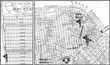
San Francisco in the 1930s: D = Dawn Club, E = Edgewater Cafe, L = Liberty Theater, T = Tip Top Club.

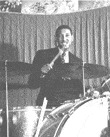
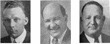
Earl Watkins, 1947 (photographer unknown).
Though white club owners and patrons welcomed black bands (some of whom came across the bay by ferry from Oakland), Local 6's forbidden territory restriction increasingly squeezed them out of job opportunities. Local 648 didn't take the actions of Eddie Love's committee lying down. It appealed—apparently repeatedly—to the International. In April 1934, Local 6 received a communication “from President Joe N. Weber enclosing a protest of Local 648 against forbidden territory in speakeasies and night clubs together with his reply thereto.” Unfortunately this “reply” is not detailed, but later that year the black press noted that 648's “repeated wires and letters to national headquarters” had met with silence or references to Local 6. On the other hand, when Local 6 charged 648 with “inept maintenance” the following month, it received word from the AFM that the “matter will be immediately taken up by Federation.”73
Board meeting of 17 April 1934 (The Musical News 17/6 [June 1934]: 2); “Coast Musicians Sue White Local,” Chicago Defender, 22 September 1934, 7; and board meeting of 22 May 1934 (The Musical News 17/6 [June 1934]: 12). The Spokesman claimed that 648's secretary John Terrell had written “at least a dozen letters” and received no answer. “Bi-Union Discrimination Case Set for Tue.: Showdown Court Trial Follows Music Union's Attempt to Jim-Crow Bay Area,” 30 August 1934, 2.
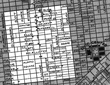
In late July or early August 1934, Bud Fisher, owner of the Tip Top Club, hired a black band composed of members of Local 648. The club was located at 130 Kearny Street, an upscale area near Union Square—today one of San Francisco's ritziest shopping districts (see Figure 1). Nevertheless, it had reputedly lost $4,200 with the “Nordic” bands it previously featured.74
“Oakland Musicians Go to Law When Nordic Group ‘Hogs’ Good Jobs,” The Spokesman, 30 August 1934, 1; and “Bi-Union Discrimination Case.”
“Legionnaires: Here's Your Sure Guide to the City's Night Life,” Chronicle, 11 August 1934, 10.
Board meeting of 7 August 1934 (The Musical News 17/9 [September 1934]: 2).
“Oakland Musicians Go to Law” and “Bi-Union Discrimination Case,” The Spokesman.
“Tip Top Club Features Music,” Chronicle, 20 September 1934, 14, and ad on the same page. The minutes of the Local 6 board meeting of 11 September state that “Don Regan is granted permission to contract for the engagement at Tip Top Club with five men commencing September 15.” The Musical News 17/10 (October 1934): 8.

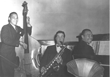
Left to right, Vernon Alley, Bob Barfield, Wilbert Baranco, 1938–39 (photographer unknown).
Byron “Speed” Reilly, who wrote a weekly “Star Stuff” column in The Spokesman, reported the incident on 23 August, noting that “the boys have asked my support … in the FIGHT.” Reilly fumed that members of Local 6 “are said to have approached the owner and when he refused to discharge the sepia ork …, he was warned that he would ‘make a change or else ….’ Incident after incident can be recited regarding the attitude Local No. 6 and white bands have taken whenever it looked as though a Negro band were about to land a good job.” Reilly claimed he was warned to go easy to avoid trouble with Local 6, since he contracted “more bands than any other one individual around here …. If that's the ‘fight’ in my effort to secure justice and equal rights for some 50 Negro musicians,” he added, “I'm ready for the front line trenches.”79
Byron “Speed” Reilly, “Star Stuff: News of Stage, Screen and Radio,” The Spokesman, 23 August 1934, 2.
Close on the heels of this incident, a similar situation arose at the Liberty Theater, located on the edge of Chinatown (see Figure 1). A band led by Wade Whaley (a board member of 648) was dismissed four days after beginning work; two weeks' notice was required by union rules. The Spokesman reported that “the manager of the theater was very indignant and … that persons affiliated with the white union told him, ‘Get those N—–rs out of here or your place will be closed.”'80
“Bi-Union Discrimination Case,” The Spokesman.
The Whaley band's dismissal pushed the growing conflict into pitched battle. On 24 August Lester Robinson (a member of the band) and three other musicians from Local 648 filed for an injunction against Local 6 in San Francisco Superior Court. Five days later a summons was served on its officers and an Order to Show Cause was filed. (An Order to Show Cause requests interim relief. In this case, the plaintiffs demanded that Local 6 cease “interfering with [their] performances.”)81
“Negro Musicians Seek Court Ban,” Chronicle, 2 September 1934, 5. (“The Negro plaintiffs charge that the defendants are ‘arbitrarily’ seeking to bar them from playing in many cafes, night clubs and theaters.”) I would particularly like to thank Dennis Caspe for helping me to interpret the court records.
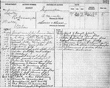
Unfortunately, transcripts from this period were destroyed decades ago by the court, but the Record of Action survives, shown in Figure 4.82
Superior Court Record of Action 252,613; the case number has since been reassigned to a divorce case from the 1990s. All records below 370,000 were destroyed except for probate cases.
“Biographical Sketches of Leaders in Professional and Official Fields Tell of Genuine Achievements,” Chronicle, 16 January 1918, 46; and “City's Bench and Bar Boast Great Traditions,” Chronicle, 18 January 1922, 45. A “self-made man,” Mooslin was educated at Hastings College of Law in San Francisco and Kent Law School in Chicago. He was a boxer as well as a lawyer and had a “large general law practice.”
The two Dunnes in the firm name were Arthur and his father Peter, who died in 1933. Arthur Dunne was editor of the Harvard Law Review in 1921–23, in which year he received his LLB cum laude. He became president of the San Francisco Bar Association in 1942 (information from the Martindale-Hubbell Directory of Experts and Legal Services, 1970).
Board meeting of 28 August 1934 (The Musical News 17/9 [September 1934]: 10–11) and “Bi-Union Discrimination Case,” The Spokesman.

San Francisco Superior Court Record of Action, case no. 252613, 1934.

Three Local 6 officers, 1934: Walter Weber, Eddie Love, Clarence King (photos published repeatedly in shape The Musical News, photographer unknown).
Apparently, the members of the black local had reason to expect a sympathetic hearing from the court. Mooslin was well known, having served as an assistant district attorney and secretary of the West of Van Ness Avenue Improvement Association. Judge Louis Ward also proved receptive to their arguments: by the end of the month he signaled his intention to rule in their favor. At the initial hearing on 4 September, however, the judge was forced to sustain the demurrer of the defendants when Mooslin sought a restraining order that would apply to all jobs under Local 6's jurisdiction. (A demurrer is basically a legal “So what?”: it acknowledges that the allegations are true but asserts that they are insufficient to sustain the claim.) Nevertheless, the judge allowed ten days for an amended complaint and, according to The Spokesman, told the white union that “unless they proved, when the case is heard again …, that they have not interfered illegally with the hiring of Negro musicians, in the Bay district, he will issue a court order COMPELLING them to keep hands off managers of theaters, restaurants, hotels, and nite spots using Negro orchestras.”86
“Court Bares Threats of Musicians: White Musician's Union Accused of Intimidation, Lose First Court Tilt,” The Spokesman, 6 September 1934, 1.
The case made headlines in black papers outside San Francisco. The California Eagle in Los Angeles ran a lengthy article under a banner head (“White Unions Hit for Discrimination by Judge”) and the Chicago Defender highlighted Local 6's success in enlisting the help of the police:
Testimony was introduced at the hearing showing that for a number of months past a systematic campaign has been carried on by members of the white union to keep all Race musicians from playing in San Francisco in any night club, speakeasy, hotel, cabaret, theatre, in fact in any place where a living might be made by members of the Race union. Repeated wires and letters to national headquarters have been met with either a reference to Local 6 or with stony silence…. It is also currently reported that … the white local is using its purposed [sic; purported?] influence with the police department by having the local police harass such places whose operators cannot entirely stand before the law or whose places are a trifle shady…. The business agent of Local 6 called and informed the operators [of the Tip Top Club] they would have to get rid of the Negro musicians. The operators demurred, as they were having good crowds and making money, whereupon, it is reported, the police became suddenly active and began to crack down on the place, imposing such restrictions as to make it impossible for the club to continue.87
“Coast Musicians Sue White Local,” Chicago Defender.
The Eagle reported that Local 6's attorney offered no testimony, but in a “long-winded address” accused 648 of “chiseling and working outside union scale.” Furthermore, the defense alleged that 648 was under the “watch care” of Local 6, an argument reminiscent of Joseph Weber's 1928 ruling regarding the supervisory privileges of the white union in Seattle. The Local 6 board minutes paint a rather different picture, noting only that the judge sustained the demurrer “entered by our attorneys” and granted Mooslin ten days to amend the complaint.88
“White Unions Hit for Discrimination by Judge,” California Eagle, 21 September 1934, 2; “Court Bares Threats,” The Spokesman,; and Local 6 board meeting of 7 September 1934 (The Musical News 17/10 [October 1934]: 6).
On Thursday, 27 September, Judge Ward ruled in favor of the plaintiffs, overruling the defense's demurrer to the amended complaint and giving the white union's lawyers ten days to answer. Dunne and Dunne immediately submitted a motion to vacate, as well as several affidavits.
This is where matters stood when the American Federation of Labor opened its fifty-fourth convention in San Francisco on 1 October. Civil rights leader William Randolph, head of the Brotherhood of Sleeping Car Porters, chose this venue to mount a heated challenge to the AFL on its abysmal record of race relations. With support from Walter White, executive secretary of the NAACP, and local black attorneys Edward Mabson and Leland Hawkins, a picket line was organized: “Neatly-dressed young Negro men and women paraded back and forth before the Whitcomb Hotel,” where the delegates were housed, and at the doors of the civic auditorium, where two thousand attendees “were applauding idealistic utterances.”89
“NAACP Pickets A. F. of L. Convention,” The Spokesman, 4 October 1934, 1.
“Our Local Stalwarts,” The Spokesman, 12 October 1934, 6; “Race Workers Picket Labor Meeting in San Francisco,” Chicago Defender, 13 October 1934, 4; and “Musicians Balk at Picket Job,” The Spokesman, 4 October 1934, 1.
Resolution 141; see the AFL Proceedings of 1934, 254–55, 330–34. The other resolutions (a) opposed wage differentials for blacks and whites; (b) opposed lynching and supported the Costigan-Wagner Federal Anti-Lynching Bill; (c) requested approval of an international charter for the Brotherhood of Sleeping Car Porters; and (d) requested appointment of one or more African American labor organizers.
This series of events has been discussed in many sources; see, for example, Harris, The Harder We Run, chap. 4, esp. 89–91; Harvard Sitkoff, A New Deal for Blacks: The Emergence of Civil Rights as a National Issue, vol. 1, The Depression Decade (New York: Oxford University Press, 1978), chap. 7; and Foner, Organized Labor, 204–12. Hutcheson's name is misspelled as Hutchinson in some of these sources.
Meanwhile, actions in the Superior Court continued on 2 and 4 October, with Judge Ward overruling one demurrer, sustaining another, and giving Mooslin still a third opportunity to amend his complaint. Just as matters were moving in favor of the plaintiffs, however, the case took a surprising turn: the black musicians withdrew their action and on 22 October the case was dismissed with no ruling (see Figure 4).
We can only speculate on what occasioned this unexpected move. AFM president Joseph Weber, who was one of eight vice presidents of the AFL, was attending the San Francisco labor convention: he might well have applied pressure on 648 in phone conversations or personal meetings. No such interaction is recorded in Local 6's minutes, however, which merely report a communication from Dunne and Dunne “advising plaintiff had dismissed the case.”93
Board meeting of 30 October 1934 (The Musical News 17/12 [December 1934]: 7).
“Union Musicians Drop Job Suit,” The Spokesman, 12 October 1934, 1. The timing of this article is curious, as several more court actions are registered in the Record of Action before the dismissal on 22 October. The article reports that “the musicians of Local 648, through their attorney, A. Mooslin, announced the withdrawal of their petition for an injunction to prevent musicians of white local 6 from closing them out of lucrative jobs in the bay district…. From authoritative sources, it is learned that a local appealing to a civil court from the decisions of the national body is subject to loss of charter. This, it is believed, is the reason for the sudden dropping of the present case from the calendar.”
A week after the court case was dropped, Local 648's secretary Terrell—in an apparent attempt to make peace—appeared at the Local 6 board meeting “re supervising all steady engagements where their members play.”95
Board meeting of 30 October 1934 (The Musical News 17/12 [December 1934]: 7).
Board meeting of 13 November 1934 (The Musical News 17/12 [December 1934]: 9). No discussion of the issue is recorded on 2 November.
The IEB minutes do not register this decision; the case—recorded in the docket of 1935 as No. 75—was probably handled by a subcommittee. A follow-up article in The Spokesman stated that the complaint, filed by Eddie Love, was not based on the lawsuit. Rather he asserted “that conditions of working, rates of pay, and punishment of its members for infractions of rules by Local 648 are not in accordance with union orders.”97
“Local Musicians May Lose Jobs as Nat. Body Revokes Union Charter,” The Spokesman, 14 December 1934, 1.
Local 6, after all, was quite powerful; one of its members, Albert Greenbaum, even sat on the nine-member IEB. Joseph Weber, for his part, was under considerable pressure to find work for unemployed musicians and bring wages back to pre-Depression levels, making him loath to ignore a complaint by one of his influential locals.
Despite the loss of their charter, African American musicians continued to play in San Francisco clubs. Baranco, notes a December article in The Spokesman, was “heading a six piece orchestra at the Dawn night club,” located on Annie Street, only a few blocks from the Tip Top Club (see Figure 1).98
Ibid.
Local 6 board meetings of 6 and 13 November 1934 (The Musical News 17/12 [December 1934]: 8 and 12); and “LaFerne Is Our Friend, Says Group,” The Spokesman, 22 February 1935, 1.
On 7 January 1935, the IEB considered an application by the “colored residents of Oakland” for a new charter. It referred the matter to president Weber, who in turn sent it to Local 6 for comment.100
AFM Proceedings, 1935, 26; and Local 6 board meeting of 22 January 1935 (The Musical News 18/1 [February 1935]: 9).
“Union Offers Olive Twig to Oak. Bandmen,” The Spokesman, 5 April 1935, 1.
The obvious alternative—simply admitting the former members of 648 to Local 6—was apparently never considered. Instead, the black musicians faced two undesirable alternatives: fighting continual turf battles with Local 6 as scabs without union affiliation, or accepting less–than-equal status within the rival organization. In the former position, they would certainly lose out to their powerful competition. As a case in point, the upscale Edgewater Beach Cafe, located on the west side of town overlooking the Pacific (see Figure 1), defied Local 6 and in March 1935 hired former 648 member Ben Watkins and his ten-piece Dixie Rhythm Boys. Though the management vowed to stand by this decision, it received threats that as many as 700 reservations would be cancelled. The (now non-union) band was fired.102
“Musicians Lose Cafe Job Through Union Threat,” The Spokesman, 29 March 1935, 1.
“Musicians Must Choose Between Jim Crow Union and Scabbing,” The Spokesman, 19 April 1935, 1. A similar transformation occurred in St. Louis in 1932: charges against “colored” Local 44 were found to have merit and its charter was revoked. Thereafter the black musicians became a subsidiary of white Local 2 (International Musician, February 1932, 3: IEB meeting of 7 January). Locals—both white and colored—frequently lost charters and might be rechartered later with new numbers. Every month the International Musician listed new or disbanded groups.
“Subsidiary Local 6” was established on 15 April 1935; its officers were Charles Turner (president), Alex Forbes (secretary), and James Simpson (business agent).104
Minutes of the board meeting of 9 April 1935 describe the forthcoming organizational meeting (The Musical News 18/5 [May 1935]: 11–12).
“Baranco Band Loses Out at Dawn Cafe,” The Spokesman, 24 May 1935, 1.
The 1940s: The Birth of Local 669
The entry of the United States into World War II meant the conscription of many members of the musicians' union. Subsidiary Local 6 was particularly hard-hit. In October 1942, secretary Al Forbes reported that thirty-four members had entered the armed forces, leaving its ranks severely depleted.106
Board meeting of 27 October 1942 (The Musical News 25/12 [December 1942]: 12).
Jim Goggin, Earl Watkins: The Life of a Jazz Drummer (Victoria, BC: Trafford Publishing, 2005), chap. 2. Although this book contains a number of errors, it includes valuable photographs and documents, as well as interviews with Watkins.
Watkins, phone conversation, 9 October 2006. Collette discusses how he formed the Topflighters after declining to play baritone sax in Marshal Royal's band in Jazz Generations: A Life in American Music and Society (London: Continuum, 2000), 55–61.
The white local, on the other hand, stayed quite healthy; by September 1942 its membership had grown to 3,400.109
The Musical News, 25/9 (September 1942): 6.
Clarence King, “The Facts and Correspondence in the Eddie B. Love Case,” The Musical News 26/8 (August 1943): 15–25; and 26/9 (September 1943): 15–19. The specific quote is on 26/9, 19.
Infuriated by these discoveries, the officers brought Love back from New York and charged him with fraud. At a meeting on 7 May 1943, he pleaded guilty to all charges, but asked for leniency based on his many years of dedicated service. His colleagues were not persuaded. At a general meeting a week later, a petition with fifty-four signatures was presented, urging the board to press criminal charges.111
Board meetings of 7 and 13 May 1943 (The Musical News 26/5 [May 1943]: 15–17, 18–19).
Board meetings of 24 August and 23 October 1945 (The Musical News 28/10 [October 1945]: 4; and 28/11 [November 1945]: 12).
The Musical News 27/1 (January 1944): 2.
Meanwhile, Local 6 and its subsidiary appeared to be operating on a quite cordial, if highly unequal basis. In February 1943, the Local 6 board sent Forbes as one of its representatives to the California-Arizona-Nevada Conference, and each January he sponsored a cheerful New Year's ad in The Musical News. As business for the subsidiary picked up in 1944, Local 6's board voted Forbes two raises.114
Board meetings of 18 January 1944: salary raised to $75/mo. (The Musical News 27/3 [March 1944]: 3) and 19 September 1944: salary raised to $100/mo. (The Musical News 27/10 [October 1944]: 20).
Even at the national level, AFM officers began to show more awareness of racial issues. In the late 1950s, Petrillo asserted that “one of my first acts when I became president [in 1940] … was to insist on the abolition of the ‘subsidiary’ local status for negro locals and the establishment of the same autonomous rule and charter that the white local enjoyed.”115
“Petrillo Talks!” Down Beat, 16 May 1957, 19, 41.
International Musician, July 1944, 1. The twelve subsidiaries were: Anaconda (Mont.), Atlantic City (N.J.), Columbia (S.C.), Fort Worth (Tex.), Galveston (Tex.), Lexington (Ky.), Little Rock (Ark.), Richmond (Va.), St. Louis (Mo.), San Francisco, Steubenville (Ohio), and Tulsa (Okla.). Eight of the twelve eventually received their own charter (information derived from listings of locals in the AFM Proceedings from 1942 to 1961). At the same 1944 conference Marian Anderson held delegates “spellbound” in a performance with the Chicago Symphony and Chicago's Local 208 provided much of the entertainment.
Beginning in November 1944, notices of newly chartered “colored” locals appear in the International Musician every few months. Some of these locals had been subsidiaries (St. Louis, Fort Worth, Richmond, Lexington, Atlantic City); others were new (such as Fort Wayne, Norfolk, and Des Moines). The situation in San Francisco, however, became more complicated. On 21 June 1945, the IEB considered a letter from Subsidiary 6 “wherein that local states that it prefers to remain a subsidiary local instead of being granted a separate charter.”117
IEB meeting of 21 June 1945, International Musician, August 1945, 19.
On the banquet: board meetings of 19 and 29 June 1945 (The Musical News 28/7 [July 1945]: 8, and 28/8 [August 1945]: 3). On the offer of payment for services by Subsidiary 6: board meeting of 24 August 1945 (The Musical News 28/10 [October 1945]: 5). On the petition for absorption: board meeting of 25 September 1945 (The Musical News 28/10 [October 1945]: 22).
Earl Watkins heard from colleagues (now deceased) that Local 6's board rejected Forbes's proposal. Further discussions of the issue are not recorded in the minutes, however; nor is any formal decision mentioned. In fact, the merger proposal never came up for a vote. Instead, a delegation of members from Local 6 and its subsidiary met with the IEB on 17 January 1946 in Chicago. The following day the IEB determined that a new “colored” charter should be issued.119
IEB meeting of 18 January 1946, International Musician, April 1946, 24. See also the minutes of the Local 6 board meeting of 12 February 1946 (The Musical News 29/4 [April 1946]: 3). These notices contain two errors; they state (a) that subsidiaries were abolished in 1942 rather than 1944 (a check through the minutes of 1942 reveals no discussion of this issue); and (b) that the IEB decision was made on 19 January (the correct date is 18 January). They also imply that all other subsidiaries had become independent colored locals; in fact, only four such transitions are recorded in the International Musician prior to the action regarding Locals 6 and 669.
Thus the San Francisco locals returned to their pre-1934 status: two separate, but (nominally) equal affiliates, one white, one “colored.” Though the union situation might have looked the same, however, the demographics of San Francisco had changed radically. The war brought a major influx of African American citizens to Northern California, most of them attracted by the availability of skilled jobs in the shipbuilding industry during the early 1940s. The black population of San Francisco jumped from 4,846 in 1940 (0.8 percent) to 43,502 ten years later (5.6 percent). These new residents crowded into the Western Addition, where inexpensive housing became available after the deportation of thousands of Japanese Americans to internment camps.
The new immigrants of the 1940s brought with them indigenous musical styles (such as rural blues) and the vastly expanded African American community fostered a lively club scene—a virtual “Harlem of the West,”120
The book is excellently researched and contains priceless photographs that have been beautifully restored. Several of the map locations are slightly misplaced, however.
On Purcell's and the Barbary Coast scene, particularly in the era before 1921, see Stoddard, Jazz on the Barbary Coast.
Pepin and Watts, Harlem of the West, 138. For a detailed discussion and history of Bop City, see Carol P. Chamberland, “The House that Bop Built,” California History 75/3 (Fall 1996): 272–83. Bop City closed in 1965.

Post–World War II clubs in San Francisco's Fillmore district. Dots indicate club locations. Specific references mark clubs highlighted in the article: J = Jack's Tavern, C = Club Alabam, M = Minnie's Can-Do, B = Bop City.
These Fillmore District clubs provided gratifying employment for African American jazz musicians such as Watkins, Lowe, Richardson, the Alley Brothers (Vernon and his older brother Eddie, a drummer), and many others, such as John Handy, Johnnie Cooper, Frank Jackson, and Johnnie Ingram. I asked Watkins why the situation in the late 1940s didn't erupt into the confrontations that had characterized the 1930s. “We simply didn't go to the white clubs,” he said, “but lots of young white musicians came to us.”123
Watkins, interview with Leta Miller and Alissa Roedig, 14 August 2006.
In terms of community relations, however, Watkins recalls significant exclusion in this period. Blacks were barred from some hotels, bars, restaurants, and other venues. He was once refused a drink at the Stage Door on a break during his own performance with the St. Mary's Band, and remembers restaurants in Chinatown that drew curtains around their black customers so as not to “offend” the white clientele.124
Ibid.
“He Teaches Be-Bop and Studies Bach,” Chronicle, 4 July 1949, 9.
1956–60: Amalgamation
Though African American musicians may have found artistic fulfillment in the Fillmore clubs, racial separation in the union rankled. It also continued to lead to nasty confrontations nationwide, such as an incident in Miami in 1949, when contractor Earl Hodges, a member of (integrated) Local 802 in New York, hired a black band to play on a series of jazz concerts. In a move reminiscent of San Francisco in 1934, (white) Local 655 sought to have the club placed on the forbidden territory list, claiming sole jurisdiction over certain municipal areas. Black Local 690 countered that its 1946 charter contained no such restriction.126
“Battle Jim Crow in Miami Locals,” Down Beat, 23 September 1949, 1–2. The club operator described considerable pressure from the white union; for two weeks its officers showed up right before the show and kept a packed house waiting for an hour while checking credentials.
Photos, news clips, and interview excerpts in Goggin, Earl Watkins, chaps. 4 and 5.
The AFM was also out of step with other labor unions. The landmark California State Supreme Court case James v. Marinship (2 January 1945) forced the boilermakers to abandon “auxiliary” black locals. (The boilermakers represented about 70 percent of workers at Bay Area shipyards.) Like AFM subsidiary unions, members of such auxiliaries paid dues but had no voting rights, no representation at the national convention, no independent business agents, and smaller insurance benefits. The instigator of the legal challenge was Joseph James, who was not only a welder but also a singer. He had studied music at the Boston Conservatory and came to San Francisco to perform in the “Swing Mikado” led by Elmer Keeton at the Golden Gate Exposition in 1939.128
On this case, see the excellent article by Charles Wollenberg, “James vs. Marinship: Trouble on the New Black Frontier,” California History 60/3 (Fall 1981): 262–79. A similar battle with the boilermakers' union was going on in Los Angeles in the same period; one of the leaders of that protest group, Andrew Blakeney, was also a musician. See Josh Sides, “Battle on the Home Front: African American Shipyard Workers in World War II Los Angeles,” California History 75/3 (Fall 1996): 251–63.
Fred Stripp, “The Treatment of Negro-American Workers by the AFL and the CIO in the San Francisco Bay Area,” Social Forces 28/3 (March 1950): 330–32.
Although the tone of the International Musician from this period suggests increasing embarrassment over the tradition of segregated locals, the AFM found itself in an awkward predicament. With more than fifty “colored” affiliates in existence and a firm commitment to respecting local autonomy, the organization felt constrained about flexing its muscles except in cases where it had direct jurisdiction. The result was a deliberately cautious policy, with the national organization encouraging and cajoling but not mandating change. In a twenty-six-page 1954 article on “Civil Rights in the American Federation of Musicians,” William Steeper devoted only one page to the status of African Americans.130
William P. Steeper, “Civil Rights in the American Federation of Musicians,” International Musician, December 1954, S1–S26. The section on “colored locals” is on page S24.
Ibid., S24.
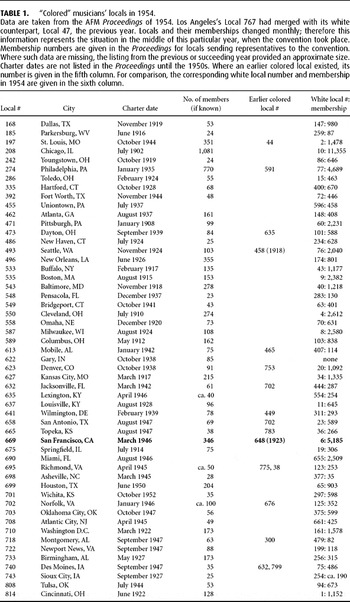
Although black locals were indeed in the minority, they included many of the country's largest cities. In 1954, when Steeper's article was published, fifty-three black locals are listed in the AFM proceedings, out of a total of 701. Though Steeper states that the majority were in the South, by my count thirty were not; in addition to San Francisco, there were six in Ohio, three in Connecticut and Pennsylvania, two in Illinois and Iowa, and others spread across the country from Washington state to Washington, DC (see Table 1).

The Los Angeles locals—Nos. 47 (white) and 767 (“colored”)—had just merged the previous year, bolstered by support from a biracial group of activists. Down Beat focused the spotlight on the L.A. unions in 1949, reporting on a city ordinance introduced by councilman Edward Royball to prohibit employment discrimination based on race or creed.132
“Jim Crow in L.A. Local 47 to Face Legal Showdown,” Down Beat, 21 October 1949, 1.
Employment problems were not restricted to the studios, of course. In 1951, Charles Emge cited a slump in the “dance and nitery business during the last two years,” which, he claimed, hit members of 767 harder than those in the white union. He predicted that the black local might even “reach the disintegration stage due to financial problems.”133
Information and quotations in this paragraph are taken from Marl Young, “The Amalgamation of Locals 47 and 767,” The Overture, December 1988, http://www.promusic47.org/benefits/amalgam.asp; Charles Emge, “Move Grows to Scrap L.A.'s Jim Crow Union,” Down Beat, 15 June 1951, 1, 19; Red Callender and Elaine Cohen, Unfinished Dream: The Musical World of Red Callender (London: Quartet Books, 1985), 99–109; telephone interview with Buddy Collette, 6 November 2006; and Collette, Jazz Generations, 110–20.
Despite meetings with the pro-amalgamation group, Local 47's board of directors hesitated, fearing job losses and financial costs (such as higher death benefits). Local 767 was also split, with some officers resisting the loss of the black local's independence. After enormous publicity in the local papers and a letter signed by 350 members, Local 47 placed the question on its ballot in December 1952. The resolution passed by a margin of 54 to 46 percent. Local 767 overwhelmingly voted its approval on the first Monday of 1953 and, with the aid of Petrillo, the IEB, and Herman Kenin (who would succeed Petrillo as president in 1958), the two groups merged on 1 April 1953.
A few years later, Seattle's locals amalgamated. The 2,100-member Local 76 and the 100-member Local 493 voted to merge at the end of 1956 but official action was delayed until January 1958 when 493's property was sold.134
Special thanks to Seattle's secretary-treasurer Warren Johnson, who searched for and sent me excerpts from Local 76's minutes and monthly magazine, Musicland (December 1956, 1–2; March 1957, 1; February 1958, 1). For the detailed history of black Local 493, see Keller, “Seattle's Segregated Musicians' Local.”
In San Francisco the road to merger proved considerably more rocky. Despite continued separation, relations between Locals 6 and 669 seemed, on the surface, good. Local 669 rented two rooms on the third floor of Local 6's building on Jones Street. Its constitution and bylaws were identical to those of Local 6 (with merely a different cover) and the two branches operated with the same pay scales.135
In 1957, the officers of Local 669 complained to the IEB that they were not being consulted about price changes, but the minutes report that the situation was being corrected and that “it is anticipated that the cause for the complaint has been removed.” AFM Proceedings of 1957, 333.
Watkins, interview with Miller and Roedig.
In the spring of 1956, Al Forbes died of a cerebral hemorrhage. Local 6's secretary Jack Haywood wrote a moving (if somewhat patronizing) eulogy:
During the many years [Forbes] was in office, his consultations with the officers of Local No. 6 were countless, his honesty, integrity and courage outstanding, and his cooperation with Local No. 6 invariable. Nothing was too hard or onerous for him to undertake.
We of Local No. 6 miss his cheery laugh and pleasant voice around the building, and we join his three daughters, his brother officers and members of Local No. 669, in deploring the passing of a good friend, a good officer of his Union, and a man who was a credit to his race. His footsteps will be hard indeed for anyone to follow.137
The Musical News 39/6 (June 1956): 6.
At the time, Local 669's president Elma Graves was already discussing merger with Local 6's board. In fact, a year earlier (June 1955) Graves and the other San Francisco convention delegates had appeared before the IEB on the matter of amalgamation, but “due to certain complex circumstances” (left undefined), the matter was referred to Petrillo.138
AFM Proceedings of 1955, 445.
Board meetings of 8 May 1956 (The Musical News 39/6 [June 1956]: 13); 28 August 1956 (The Musical News 39/10 [October 1956]: 6); and 20 October 1956 (The Musical News 40/2 [February 1957]: 3, 5).
The ballot measure, specifying terms of the proposed merger, along with arguments pro and con, is printed in The Musical News 39/11 (November 1956): 6. See also the ad on page 16.
Watkins recalls that as the vote approached some officers of Local 6 visited clubs to press the case against amalgamation. At the same time, an article in the Chronicle claimed that the merger was supported by both Petrillo and Local 6's board.141
“Musicians [sic] Union Votes Segregation,” Chronicle, 7 December 1956, 1, 4.
“Musicians [sic] Union Isn't in Tune with History,” Chronicle, 13 December 1956, 33; also quoted in Variety, 19 December 1956, 58.
Meanwhile, members of the recently integrated Los Angeles union pressed for passage of an antisegregation resolution at the AFM convention in June 1957. Resolution 34, submitted by Max Herman of L.A.'s Local 47, required segregated locals to “take immediate steps to eliminate any membership restrictions based upon race, color, creed, religion or place of national origin.” It also empowered the IEB “to take the necessary steps to eliminate such membership restrictions” in cases where progress was slow. The resolution sparked considerable controversy, even among the African American members, who were far from united. An opposing petition signed by sixty delegates—fifty-six from black locals—expressed concern about “the financial aspect involved with some of the larger colored locals, who have spent many years of hard work to attain their present status in the Federation.”143
The resolution and petition are published in the International Musician, November 1957, 42–43.
Seltzer, Music Matters, 110.
The resolution was referred to the office of the president, an action for which the AFM was taken to task by Donald Janson in the New York Times. Noting that the organization had “in effect acted … to continue its policy of racially segregated locals,” Janson quoted Petrillo as stating that he “was personally opposed to segregation but … even more strongly opposed to compelling locals to integrate.”145
Donald Janson, “A.F.M. Shelves Bid for Integration,” New York Times, 14 June 1957, 22.
“Musicians Here Told to End Jim Crow,” Chronicle, 18 June 1957, 1, 7.
Although the AFM couldn't (or wouldn't) “force things,” the state of California could. On 16 April 1959, Governor Pat Brown signed into law a Fair Employment Practices Act that specified (among other things) that labor organizations could not refuse membership on the basis of race, creed, color, national origin, or ancestry. It also prohibited segregated locals. Attorney general Stanley Mosk appointed Franklin H. Williams, West Coast executive secretary of the NAACP, to head his department's civil rights section. On 19 October, while Local 6 was in the midst of discussing how to implement the new law, Walter Browne—a former counselor with the Alameda County parole office, and a guitarist and folksinger—decided to join the union.147
The story of Browne joining Local 6 is told colorfully by Ralph J. Gleason in “A Blow to Jim Crow,” Down Beat, 10 December 1959, 14–15.
A week later assistant attorney general Franklin Williams met with the union's board of directors. He reported that he would be sending identical letters to Locals 6 and 669 requesting immediate action to effect amalgamation, and offered to act as mediator. Local 6's officers assured him that the merger terms could be arranged without external involvement.148
For the relevant letters and an explanation of the situation, see “Locals 6-669 Merger Ordered,” The Musical News 42/12 (December 1959): 1–2.
Williams's letters were dated 2 November, postmarked 4 November, and delivered 5 November. On 3 November Pop Kennedy received a call from a local reporter asking for comments on the document, which he had not yet seen. The following day articles appeared in local and national publications casting Local 6 in a negative light. Information in these and other news reports contain numerous errors: in addition to misspellings, wrong dates, and incorrect tabulation of the number of dual locals nationwide, the papers reported that the 1935 subsidiary had been formed because Local 648 suffered from financial problems; that in 1945 the subsidiary had requested separate status; that Browne was admitted to Local 6 under pressure from Williams; and that San Francisco and Philadelphia had spearheaded the 1957 resolution seeking the abolition of dual unions.149
For example, Bill Steif, “Calif. Atty. General's Merger Order to White & Negro Frisco AFM Locals; 1st Major Ukase [sic] Under State's FEP,” Variety, 4 November 1959, 59, 62; “State Sends FEP Request to Musicians Locals,” Chronicle, 4 November 1959, 9; and Ralph J. Gleason, “Musicians' Locals Face FEP Action,” Chronicle, 31 October 1959, 1, 4.
“Locals 6-669 Merger Ordered,” The Musical News.
Fortunately, cooler heads prevailed. Local 669's Sammy Simpson assumed a relaxed posture, noting that his group was “not a segregated union, so [Williams's letter] doesn't affect us.”151
Steif, “Calif. Atty. General's Merger Order.”
In a series of meetings in February 1960, the boards of 6 and 669 hammered out the details of the merger, assisted by officers from the International (vice president William Harris, secretary Stanley Ballard, and treasurer George Clancy). The arrangements proved considerably more favorable to 669 than the 1956 proposal. Local 669's secretary-treasurer Curtis Lowe and business agent Samuel Landers would join the Local 6 staff as coordinators. A third member (Simpson) would serve on the executive board until the election of December 1960. In addition, “all Local 669 members who are in good standing as of March 31, 1960, will enjoy the same conditions and privileges as applicable to Local 6 members.” The official merger of the 400-member Local 669 and the 5,500-member Local 6 took place on 1 April.152
Exact membership numbers, published in the 1959 AFM Proceedings, are 390 for Local 669 and 5,528 for Local 6.
Having been a member of the Subsidiary Local No. 6; Local No. 669 from its inception and finally an Official of Local No. 669, I am well aware of the many sacrifices made by the members and officials of Local No. 669 for many years to build the organization into the thriving local which it became. One cannot help but feel a deep sense of loss that this organization as such, no longer exists.
Rest assured, the American Federation of Musicians Charter of Local No. 669 was not revoked for failure to properly conduct its affairs, but was retired … because there no longer was a necessity for two … Locals in the San Francisco jurisdiction.153
The Musical News 43/5 (May 1960): 1.
With the San Francisco merger complete, the AFM moved to amalgamate other dual locals. Denver and Sioux City merged later the same year and the Cleveland branches joined in 1962. But most did not merge until after the passage of the 1964 Civil Rights Act; and for some, the process extended into the 1970s. Some white locals were strongly resistant. Some black locals were also hesitant, fearing they would lose their identity (and representation) by being absorbed into much larger white chapters. Indeed, during the 1970s fewer blacks appeared at the national AFM conventions after failing to win elections for delegates in amalgamated unions. (In 1977, the AFM moved to reverse this trend by allowing merged locals to send an extra delegate to the convention, “to be elected from the black membership of said local.” Curtis Lowe served in that capacity for Local 6 from 1978 until his death in 1993.)
Several former members of Local 669 ran for Local 6 offices in December 1960; large campaign ads appeared in the December issue of The Musical News. None garnered enough votes to win a seat on the seven-member board. Vernon Alley came in ninth, Sammy Simpson tenth, and Wilbert Baranco twelfth. But soon the situation changed dramatically. Alley was elected to the board in 1963 and in the next two elections he received the highest vote total of any candidate on the ballot.154
Elections were held biannually in this period. In 1963, Alley came in fifth out of twenty-two candidates; in 1965, he was first out of sixteen; in 1967 first out of thirty-two; and in 1969 second out of twenty (information from The Musical News election reports).
Conclusion
The saga of Locals 6, 648, and 669 brings into focus a complex picture of the social and economic forces buffeting the working musician in the early twentieth century. Racialist attitudes in the US labor movement were reflected in the early history of the AFM, beginning with the initial establishment of the dual-local system in Chicago in 1902. The formal name of Chicago's 208, San Francisco's 669, and many other locals, is the “Musicians' Protective Union.” As the name implies, these unions were formed to protect musicians from unscrupulous or exploitive employers—fly-by-night traveling theater managers who would skip town without paying musicians, restaurant owners who would stiff their employees, orchestra managers who resisted limits on rehearsal time or guarantees of employment from one season to the next. The paramount issues for the union were job security and a living wage. But the “protection” it offered was for many years unequal. Black musicians were forced—or felt compelled—to organize separately and offer lower wages in order to work at all. Eventually, law mandated equality, but even that change was slow in coming.
The African American community itself showed some ambivalence toward the practice of separate organization. From the 1915 Boston breakaway local to the 1957 petition opposing forced amalgamation, black union musicians were torn between outrage at their second-class status within the AFM and the apparent benefits of working for change from within the organization's established structures. In the teens and early 1920s, separate “colored” locals seemed a promising alternative, offering the prospect of secure employment and a presence within the national organization. And in some cases, such as Chicago, black locals proved highly effective. But in the majority of cities, these segregated affiliates operated as poor cousins, doing battle with much larger white organizations that in practice, if not theory, held the dominant position in the labor market.
For its part the AFM found itself increasingly boxed in by its historical dedication to local autonomy. As with its parent body, the AFL, the musicians' union showed reluctance to interfere in the workings of its locals. Once established, the segregated local system guided the AFM down a path it found increasingly uncomfortable but at the same time difficult to reverse. Constrained by its history and fearful of offending its constituents, the AFM hesitated at a time when it might have acted.
With the model of discrimination officially sanctioned in many branches of the labor movement, individuals found it easy (or convenient) to rationalize the dual standard. In good times the parallel unions could operate independently, white musicians pursuing their careers unaware of (or too self-absorbed to pay attention to) their black counterparts, and black unions enjoying some measure of success in placing their members in musically satisfying, if lower-paid, work. But the desperation of the early 1930s disrupted such laissez-faire tolerance. Spurred by Eddie Love, an overzealous tyro, Local 6 was able virtually to monopolize the Bay Area job market. Its request to the Federation for a blanket “forbidden territory” restriction was spurred by the 40 percent unemployment rate of its membership, but it also aimed at crippling Local 648, whose members played at a lower scale. The local's request, as well as Joseph Weber's granting of such an overriding restriction, smack unpleasantly of racism.
The 1934 San Francisco crisis reflected a confluence of particularized factors. New York, for instance, had its own record of discriminatory social practices, but since Musicians' Local 802 was integrated, the forbidden territory list could not be used as a racist tool. In Chicago black musicians certainly played at white-owned establishments, though some areas were off-limits to all but the best-known performers;155
A 1940 Down Beat article heralding the strong position and high pay scale of black musicians (“Chicago Local Typical”) also notes, in a discussion of traveling musicians, that “Jimmie Lunceford plays at one of the town's better spots and no one [in Local 208] objects because it is evident that Lunceford isn't taking business away from anyone. A local colored band wouldn't get the spot under any circumstance.”
Moore, “End of the War.”
The 1956 vote against amalgamation is more difficult to comprehend, particularly in view of increasingly vocal civil rights activism. Certainly there were those in Local 6 opposed to (or fearful of) the recently expanded black community, either because of jealousy over the exciting Fillmore scene or prejudice. But the most striking aspect of this episode is that the majority of Local 6's members simply failed to respond to the injustice within their ranks. Only a quarter of them cast ballots on an issue of vital importance to colleagues. Apathy, however, can be as dangerous as hostility. Through their failure to act, nonvoting unionists ceded power to racist elements within the organization.
In later years, San Francisco would find itself at the forefront of multiethnic collaboration, even though the roots of that spirit can be traced to a much earlier period—for example, the pre–World War II teachings of Henry Cowell, whose universalism was molded by the city's rich ethnic mix and who spent his life advocating cultural exchange and musical hybridity. Local 6, too, moved quite quickly toward equity after the 1960 amalgamation, with an almost palpable sense of relief that all was finally as it should be. Once Vernon Alley was elected to the board of directors in 1963, he continued to serve with distinction for over twenty years; he also served as an elected delegate to both the California Labor Federation and the San Francisco Labor Council. Curtis Lowe served as assistant to the secretary-treasurer from 1960 until he retired at the end of 1984. Earl Watkins, too, took a leading role in Local 6. Soon after the merger he was appointed to several committees, including the one on wages, where he served with Jess Jessup. The two men became close friends. In 1965, Pop Kennedy tapped Watkins for the position of branch secretary at the Oakland office. After it closed in 1972, Watkins moved to the main office in San Francisco, where he acted as assistant to the secretary-treasurer until 1994. He still serves on the board of directors. At eighty-six, the San Francisco drummer—who had joined Subsidiary Local 6 in 1937, served on the board of 669 in the 1940s and 1950s, and helped negotiate the 1960 merger—is now the organization's elder statesman. He is also deservedly its most articulate and respected historian.
The story of widespread racial segregation in the musicians' union—particularly in San Francisco, a city known for its openness to diversity—will come as a discomforting surprise to many. Writings about the AFM typically pass quickly over the history of segregated locals, acknowledging their existence but then moving on in embarrassed haste. To repress this tale out of our collective guilt, however, or to shy away from exploring its causes, is to perpetuate a sanitized account of our rich American music history and delay the process of curing institutional amnesia. Local 6 has actively begun such a process. So have other branches of the AFM such as Boston's 9-535, which is gathering oral histories about its “colored” affiliate and publishing excerpts in its newsletter. By such candor, we may even succeed—at least in part—in reversing the apathy of our predecessors. As Martin Luther King Jr. cautioned us in 1958: “It may be that our generation will have to repent not only for the diabolical actions and vitriolic words of the children of darkness, but also for the crippling fears and tragic apathy of the children of light.”157
Martin Luther King Jr., “The Current Crisis in Race Relations,” in A Testament of Hope: The Essential Writings and Speeches of Martin Luther King, Jr., ed. James Melvin Washington (1958; repr. San Francisco: Harper, 1986), 89.